arXiv:hep-ex/0612013v1 8 Dec 2006
Search for techniparticles in e+jets events at D0
V.M. Abazov,35 B. Abbott,75 M. Abolins,65 B.S. Acharya,28 M. Adams,51 T. Adams,49 E. Aguilo,5 S.H. Ahn,30
M. Ahsan,59 G.D. Alexeev,35 G. Alkhazov,39A. Alton,64,∗ G. Alverson,63 G.A. Alves,2 M. Anastasoaie,34
L.S. Ancu,34 T. Andeen,53 S. Anderson,45B. Andrieu,16 M.S. Anzelc,53 Y. Arnoud,13 M. Arov,52A. Askew,49
B. ˚Asman,40A.C.S. Assis Jesus,3O. Atramentov,49 C. Autermann,20 C. Avila,7C. Ay,23 F. Badaud,12A. Baden,61
L. Bagby,52B. Baldin,50 D.V. Bandurin,59 P. Banerjee,28 S. Banerjee,28 E. Barberis,63 P. Bargassa,80
P. Baringer,58 C. Barnes,43 J. Barreto,2 J.F. Bartlett,50 U. Bassler,16 D. Bauer,43 S. Beale,5 A. Bean,58
M. Begalli,3M. Begel,71 C. Belanger-Champagne,40L. Bellantoni,50 A. Bellavance,67 J.A. Benitez,65 S.B. Beri,26
G. Bernardi,16 R. Bernhard,22L. Berntzon,14 I. Bertram,42M. Besan¸con,17 R. Beuselinck,43 V.A. Bezzubov,38
P.C. Bhat,50 V. Bhatnagar,26 M. Binder,24C. Biscarat,19I. Blackler,43 G. Blazey,52 F. Blekman,43 S. Blessing,49
D. Bloch,18 K. Bloom,67 A. Boehnlein,50 D. Boline,62 T.A. Bolton,59G. Borissov,42 K. Bos,33 T. Bose,77
A. Brandt,78R. Brock,65 G. Brooijmans,70A. Bross,50D. Brown,78 N.J. Buchanan,49 D. Buchholz,53M. Buehler,81
V. Buescher,22S. Burdin,50 S. Burke,45 T.H. Burnett,82E. Busato,16C.P. Buszello,43 J.M. Butler,62 P. Calfayan,24
S. Calvet,14 J. Cammin,71 S. Caron,33 W. Carvalho,3 B.C.K. Casey,77N.M. Cason,55 H. Castilla-Valdez,32 S. Chakrabarti,17 D. Chakraborty,52 K.M. Chan,71 A. Chandra,48 F. Charles,18E. Cheu,45 F. Chevallier,13
D.K. Cho,62 S. Choi,31 B. Choudhary,27 L. Christofek,77 D. Claes,67B. Cl´ement,18 C. Cl´ement,40 Y. Coadou,5
M. Cooke,80 W.E. Cooper,50M. Corcoran,80F. Couderc,17 M.-C. Cousinou,14 B. Cox,44S. Cr´ep´e-Renaudin,13
D. Cutts,77 M. ´Cwiok,29 H. da Motta,2 A. Das,62 M. Das,60 B. Davies,42G. Davies,43K. De,78 P. de Jong,33
S.J. de Jong,34 E. De La Cruz-Burelo,64C. De Oliveira Martins,3 J.D. Degenhardt,64F. D´eliot,17 M. Demarteau,50
R. Demina,71 D. Denisov,50 S.P. Denisov,38S. Desai,50 H.T. Diehl,50 M. Diesburg,50 M. Doidge,42 A. Dominguez,67
H. Dong,72 L.V. Dudko,37 L. Duflot,15 S.R. Dugad,28 D. Duggan,49 A. Duperrin,14 J. Dyer,65A. Dyshkant,52
M. Eads,67 D. Edmunds,65 J. Ellison,48 V.D. Elvira,50Y. Enari,77 S. Eno,61P. Ermolov,37 H. Evans,54
A. Evdokimov,36 V.N. Evdokimov,38 L. Feligioni,62A.V. Ferapontov,59 T. Ferbel,71 F. Fiedler,24 F. Filthaut,34
W. Fisher,50 H.E. Fisk,50 M. Ford,44M. Fortner,52 H. Fox,22 S. Fu,50 S. Fuess,50 T. Gadfort,82 C.F. Galea,34
E. Gallas,50 E. Galyaev,55C. Garcia,71 A. Garcia-Bellido,82V. Gavrilov,36 A. Gay,18 P. Gay,12 W. Geist,18
D. Gel´e,18 R. Gelhaus,48 C.E. Gerber,51 Y. Gershtein,49D. Gillberg,5 G. Ginther,71 N. Gollub,40 B. G´omez,7
A. Goussiou,55 P.D. Grannis,72 H. Greenlee,50 Z.D. Greenwood,60E.M. Gregores,4G. Grenier,19 Ph. Gris,12
J.-F. Grivaz,15 A. Grohsjean,24 S. Gr¨unendahl,50 M.W. Gr¨unewald,29 F. Guo,72 J. Guo,72 G. Gutierrez,50 P. Gutierrez,75A. Haas,70 N.J. Hadley,61P. Haefner,24 S. Hagopian,49J. Haley,68 I. Hall,75 R.E. Hall,47 L. Han,6
K. Hanagaki,50 P. Hansson,40K. Harder,44A. Harel,71 R. Harrington,63 J.M. Hauptman,57R. Hauser,65 J. Hays,43
T. Hebbeker,20 D. Hedin,52 J.G. Hegeman,33 J.M. Heinmiller,51 A.P. Heinson,48 U. Heintz,62 C. Hensel,58
K. Herner,72 G. Hesketh,63 M.D. Hildreth,55 R. Hirosky,81J.D. Hobbs,72B. Hoeneisen,11 H. Hoeth,25M. Hohlfeld,15
S.J. Hong,30R. Hooper,77 P. Houben,33Y. Hu,72 Z. Hubacek,9 V. Hynek,8 I. Iashvili,69R. Illingworth,50A.S. Ito,50
S. Jabeen,62 M. Jaffr´e,15S. Jain,75 K. Jakobs,22 C. Jarvis,61A. Jenkins,43 R. Jesik,43K. Johns,45 C. Johnson,70
M. Johnson,50A. Jonckheere,50P. Jonsson,43 A. Juste,50D. K¨afer,20S. Kahn,73 E. Kajfasz,14 A.M. Kalinin,35
J.M. Kalk,60 J.R. Kalk,65S. Kappler,20D. Karmanov,37J. Kasper,62 P. Kasper,50 I. Katsanos,70D. Kau,49
R. Kaur,26 R. Kehoe,79 S. Kermiche,14 N. Khalatyan,62 A. Khanov,76 A. Kharchilava,69Y.M. Kharzheev,35
D. Khatidze,70H. Kim,31 T.J. Kim,30 M.H. Kirby,34 B. Klima,50 J.M. Kohli,26 J.-P. Konrath,22 M. Kopal,75
V.M. Korablev,38J. Kotcher,73B. Kothari,70 A. Koubarovsky,37 A.V. Kozelov,38D. Krop,54A. Kryemadhi,81
T. Kuhl,23A. Kumar,69S. Kunori,61A. Kupco,10T. Kurˇca,19 J. Kvita,8D. Lam,55 S. Lammers,70G. Landsberg,77
J. Lazoflores,49A.-C. Le Bihan,18 P. Lebrun,19 W.M. Lee,50 A. Leflat,37F. Lehner,41V. Lesne,12 J. Leveque,45
P. Lewis,43 J. Li,78 L. Li,48 Q.Z. Li,50S.M. Lietti,4 J.G.R. Lima,52 D. Lincoln,50 J. Linnemann,65 V.V. Lipaev,38 R. Lipton,50 Z. Liu,5 L. Lobo,43 A. Lobodenko,39 M. Lokajicek,10A. Lounis,18 P. Love,42 H.J. Lubatti,82
M. Lynker,55 A.L. Lyon,50 A.K.A. Maciel,2 R.J. Madaras,46 P. M¨attig,25 C. Magass,20 A. Magerkurth,64
N. Makovec,15P.K. Mal,55 H.B. Malbouisson,3 S. Malik,67 V.L. Malyshev,35 H.S. Mao,50 Y. Maravin,59
R. McCarthy,72 A. Melnitchouk,66A. Mendes,14 L. Mendoza,7P.G. Mercadante,4 M. Merkin,37 K.W. Merritt,50
A. Meyer,20 J. Meyer,21 M. Michaut,17 H. Miettinen,80 T. Millet,19 J. Mitrevski,70 J. Molina,3 R.K. Mommsen,44 N.K. Mondal,28 J. Monk,44 R.W. Moore,5 T. Moulik,58 G.S. Muanza,19 M. Mulders,50 M. Mulhearn,70
P. Neustroev,39C. Noeding,22 A. Nomerotski,50 S.F. Novaes,4T. Nunnemann,24 V. O’Dell,50 D.C. O’Neil,5
G. Obrant,39 C. Ochando,15 V. Oguri,3 N. Oliveira,3 D. Onoprienko,59 N. Oshima,50 J. Osta,55 R. Otec,9
G.J. Otero y Garz´on,51M. Owen,44P. Padley,80 M. Pangilinan,62 N. Parashar,56S.-J. Park,71 S.K. Park,30
J. Parsons,70R. Partridge,77N. Parua,72 A. Patwa,73 G. Pawloski,80P.M. Perea,48 K. Peters,44Y. Peters,25
P. P´etroff,15 M. Petteni,43 R. Piegaia,1 J. Piper,65 M.-A. Pleier,21 P.L.M. Podesta-Lerma,32V.M. Podstavkov,50
Y. Pogorelov,55M.-E. Pol,2 A. Pompoˇs,75 B.G. Pope,65 A.V. Popov,38 C. Potter,5W.L. Prado da Silva,3
H.B. Prosper,49 S. Protopopescu,73 J. Qian,64 A. Quadt,21 B. Quinn,66 M.S. Rangel,2 K.J. Rani,28
K. Ranjan,27 P.N. Ratoff,42 P. Renkel,79 S. Reucroft,63M. Rijssenbeek,72I. Ripp-Baudot,18 F. Rizatdinova,76
S. Robinson,43 R.F. Rodrigues,3 C. Royon,17 P. Rubinov,50 R. Ruchti,55 G. Sajot,13 A. S´anchez-Hern´andez,32
M.P. Sanders,16 A. Santoro,3 G. Savage,50L. Sawyer,60 T. Scanlon,43 D. Schaile,24 R.D. Schamberger,72
Y. Scheglov,39 H. Schellman,53 P. Schieferdecker,24 C. Schmitt,25 C. Schwanenberger,44 A. Schwartzman,68
R. Schwienhorst,65 J. Sekaric,49 S. Sengupta,49 H. Severini,75 E. Shabalina,51 M. Shamim,59 V. Shary,17 A.A. Shchukin,38 R.K. Shivpuri,27 D. Shpakov,50V. Siccardi,18 R.A. Sidwell,59 V. Simak,9 V. Sirotenko,50
P. Skubic,75 P. Slattery,71 R.P. Smith,50 G.R. Snow,67 J. Snow,74 S. Snyder,73S. S¨oldner-Rembold,44 X. Song,52
L. Sonnenschein,16 A. Sopczak,42M. Sosebee,78K. Soustruznik,8 M. Souza,2 B. Spurlock,78J. Stark,13J. Steele,60
V. Stolin,36 A. Stone,51 D.A. Stoyanova,38J. Strandberg,64 S. Strandberg,40 M.A. Strang,69 M. Strauss,75
R. Str¨ohmer,24 D. Strom,53M. Strovink,46L. Stutte,50 S. Sumowidagdo,49 P. Svoisky,55A. Sznajder,3 M. Talby,14
P. Tamburello,45 W. Taylor,5 P. Telford,44 J. Temple,45 B. Tiller,24 M. Titov,22 V.V. Tokmenin,35M. Tomoto,50
T. Toole,61 I. Torchiani,22 T. Trefzger,23S. Trincaz-Duvoid,16 D. Tsybychev,72 B. Tuchming,17 C. Tully,68
P.M. Tuts,70 R. Unalan,65L. Uvarov,39S. Uvarov,39 S. Uzunyan,52B. Vachon,5 P.J. van den Berg,33B. van Eijk,35
R. Van Kooten,54 W.M. van Leeuwen,33 N. Varelas,51 E.W. Varnes,45 A. Vartapetian,78 I.A. Vasilyev,38
M. Vaupel,25P. Verdier,19 L.S. Vertogradov,35M. Verzocchi,50F. Villeneuve-Seguier,43 P. Vint,43 J.-R. Vlimant,16
E. Von Toerne,59 M. Voutilainen,67,† M. Vreeswijk,33H.D. Wahl,49L. Wang,61M.H.L.S Wang,50 J. Warchol,55
G. Watts,82 M. Wayne,55G. Weber,23 M. Weber,50 H. Weerts,65 N. Wermes,21 M. Wetstein,61 A. White,78
D. Wicke,25 G.W. Wilson,58 S.J. Wimpenny,48 M. Wobisch,50 J. Womersley,50D.R. Wood,63 T.R. Wyatt,44
Y. Xie,77 S. Yacoob,53 R. Yamada,50 M. Yan,61 T. Yasuda,50 Y.A. Yatsunenko,35 K. Yip,73 H.D. Yoo,77
S.W. Youn,53 C. Yu,13 J. Yu,78 A. Yurkewicz,72 A. Zatserklyaniy,52C. Zeitnitz,25 D. Zhang,50 T. Zhao,82
B. Zhou,64 J. Zhu,72 M. Zielinski,71 D. Zieminska,54 A. Zieminski,54 V. Zutshi,52 and E.G. Zverev37
(DØ Collaboration)
1Universidad de Buenos Aires, Buenos Aires, Argentina 2
LAFEX, Centro Brasileiro de Pesquisas F´ısicas, Rio de Janeiro, Brazil 3
Universidade do Estado do Rio de Janeiro, Rio de Janeiro, Brazil 4Instituto de F´ısica Te´orica, Universidade Estadual Paulista, S˜ao Paulo, Brazil 5
University of Alberta, Edmonton, Alberta, Canada, Simon Fraser University, Burnaby, British Columbia, Canada, York University, Toronto, Ontario, Canada, and McGill University, Montreal, Quebec, Canada
6University of Science and Technology of China, Hefei, People’s Republic of China 7
Universidad de los Andes, Bogot´a, Colombia 8
Center for Particle Physics, Charles University, Prague, Czech Republic 9Czech Technical University, Prague, Czech Republic
10Center for Particle Physics, Institute of Physics, Academy of Sciences of the Czech Republic, Prague, Czech Republic 11
Universidad San Francisco de Quito, Quito, Ecuador 12
Laboratoire de Physique Corpusculaire, IN2P3-CNRS, Universit´e Blaise Pascal, Clermont-Ferrand, France 13
Laboratoire de Physique Subatomique et de Cosmologie, IN2P3-CNRS, Universite de Grenoble 1, Grenoble, France 14
CPPM, IN2P3-CNRS, Universit´e de la M´editerran´ee, Marseille, France 15
Laboratoire de l’Acc´el´erateur Lin´eaire, IN2P3-CNRS et Universit´e Paris-Sud, Orsay, France 16LPNHE, IN2P3-CNRS, Universit´es Paris VI and VII, Paris, France
17
DAPNIA/Service de Physique des Particules, CEA, Saclay, France 18
IPHC, IN2P3-CNRS, Universit´e Louis Pasteur, Strasbourg, France, and Universit´e de Haute Alsace, Mulhouse, France 19Institut de Physique Nucl´eaire de Lyon, IN2P3-CNRS, Universit´e Claude Bernard, Villeurbanne, France
20
III. Physikalisches Institut A, RWTH Aachen, Aachen, Germany 21
Physikalisches Institut, Universit¨at Bonn, Bonn, Germany 22Physikalisches Institut, Universit¨at Freiburg, Freiburg, Germany
23
Institut f¨ur Physik, Universit¨at Mainz, Mainz, Germany 24
Ludwig-Maximilians-Universit¨at M¨unchen, M¨unchen, Germany 25Fachbereich Physik, University of Wuppertal, Wuppertal, Germany
26
Panjab University, Chandigarh, India 27
28
Tata Institute of Fundamental Research, Mumbai, India 29
University College Dublin, Dublin, Ireland 30Korea Detector Laboratory, Korea University, Seoul, Korea
31
SungKyunKwan University, Suwon, Korea 32
CINVESTAV, Mexico City, Mexico
33FOM-Institute NIKHEF and University of Amsterdam/NIKHEF, Amsterdam, The Netherlands 34
Radboud University Nijmegen/NIKHEF, Nijmegen, The Netherlands 35
Joint Institute for Nuclear Research, Dubna, Russia 36Institute for Theoretical and Experimental Physics, Moscow, Russia
37Moscow State University, Moscow, Russia 38
Institute for High Energy Physics, Protvino, Russia 39
Petersburg Nuclear Physics Institute, St. Petersburg, Russia
40Lund University, Lund, Sweden, Royal Institute of Technology and Stockholm University, Stockholm, Sweden, and Uppsala University, Uppsala, Sweden
41
Physik Institut der Universit¨at Z¨urich, Z¨urich, Switzerland 42Lancaster University, Lancaster, United Kingdom
43
Imperial College, London, United Kingdom 44
University of Manchester, Manchester, United Kingdom 45University of Arizona, Tucson, Arizona 85721, USA 46
Lawrence Berkeley National Laboratory and University of California, Berkeley, California 94720, USA 47
California State University, Fresno, California 93740, USA 48
University of California, Riverside, California 92521, USA 49
Florida State University, Tallahassee, Florida 32306, USA 50
Fermi National Accelerator Laboratory, Batavia, Illinois 60510, USA 51
University of Illinois at Chicago, Chicago, Illinois 60607, USA 52Northern Illinois University, DeKalb, Illinois 60115, USA
53
Northwestern University, Evanston, Illinois 60208, USA 54
Indiana University, Bloomington, Indiana 47405, USA 55University of Notre Dame, Notre Dame, Indiana 46556, USA
56
Purdue University Calumet, Hammond, Indiana 46323, USA 57
Iowa State University, Ames, Iowa 50011, USA 58University of Kansas, Lawrence, Kansas 66045, USA 59
Kansas State University, Manhattan, Kansas 66506, USA 60
Louisiana Tech University, Ruston, Louisiana 71272, USA 61University of Maryland, College Park, Maryland 20742, USA
62
Boston University, Boston, Massachusetts 02215, USA 63
Northeastern University, Boston, Massachusetts 02115, USA 64University of Michigan, Ann Arbor, Michigan 48109, USA 65Michigan State University, East Lansing, Michigan 48824, USA
66
University of Mississippi, University, Mississippi 38677, USA 67
University of Nebraska, Lincoln, Nebraska 68588, USA 68Princeton University, Princeton, New Jersey 08544, USA 69
State University of New York, Buffalo, New York 14260, USA 70
Columbia University, New York, New York 10027, USA 71University of Rochester, Rochester, New York 14627, USA 72
State University of New York, Stony Brook, New York 11794, USA 73
Brookhaven National Laboratory, Upton, New York 11973, USA 74Langston University, Langston, Oklahoma 73050, USA 75University of Oklahoma, Norman, Oklahoma 73019, USA 76
Oklahoma State University, Stillwater, Oklahoma 74078, USA 77
Brown University, Providence, Rhode Island 02912, USA 78University of Texas, Arlington, Texas 76019, USA 79
Southern Methodist University, Dallas, Texas 75275, USA 80
Rice University, Houston, Texas 77005, USA 81University of Virginia, Charlottesville, Virginia 22901, USA
82
University of Washington, Seattle, Washington 98195, USA
(Dated: Dec 5, 2006)
We search for the technicolor process pp → ρT/ωT → W πT in events containing one electron and two jets, in data corresponding to an integrated luminosity of 390 pb−1, recorded by the D0 experiment at the Fermilab Tevatron. Technicolor predicts that technipions, πT, decay dominantly into bb, bc, or bc, depending on their charge. In these events b and c quarks are identified by their secondary decay vertices within jets. Two analysis methods based on topological variables are
presented. Since no excess above the standard model prediction was found, the result is presented as an exclusion in the πT vs. ρT mass plane for a given set of model parameters.
PACS numbers: 12.60.Nz, 13.85.Rm
Technicolor (TC), first formulated by Weinberg and Susskind [1, 2], provides a dynamical explanation of electroweak symmetry breaking through a new strong SU (NT C) gauge interaction acting on new fermions,
called “technifermions.” Technicolor is a non-Abelian gauge theory modeled after Quantum Chromodynamics (QCD). In its low-energy limit, a spontaneous breaking of the global chiral symmetry in the technifermion sector leads to electroweak symmetry breaking. The Nambu-Goldstone bosons produced in this process are called technipions, πT, in analogy with the pions of QCD. Three
of these technipions become the longitudinal components of the W and Z bosons, making them massive.
An additional gauge interaction, called extended nicolor [3, 4], couples standard model fermions and tech-nifermions to provide a mechanism for generating quark and lepton masses. By limiting the running of the tech-nicolor coupling constant, walking techtech-nicolor [5] avoids flavor-changing neutral currents. To generate masses as large as the top quark mass, another interaction, topcolor, seems to be necessary, thereby giving rise to topcolor-assisted technicolor models [6].
Extensions of the basic technicolor model tend to re-quire the number ND of technifermion doublets to be
large. In general, the technicolor scale ΛT C ≈ O(1) ×
FT C, where FT C is the technipion decay constant,
de-pends inversely on the number of technifermion dou-blets: FT C ≈ 246 GeV/
√
ND. For large ND, the
low-est lying technihadrons have masses on the order of few hundred GeV. This scenario is referred to as low-scale technicolor [7]. Low-scale technicolor models predict the existence of scalar technimesons, π±
T and π 0
T, and
vec-tor technimesons, ρT and ωT. General features of
low-scale technicolor have been summarized in the technicolor strawman model (TCSM) [8, 9]. The analysis presented in this paper is based on Ref. [9].
Vector technimesons are expected to be produced with substantial rates at the Fermilab Tevatron Collider via the Drell-Yan-like electroweak process pp → ρT + X or
ωT + X. In walking technicolor, it is expected that
vec-tor technimesons decay to a gauge boson (γ, W , Z) and a technipion or to fermion-antifermion pairs. The pro-duction cross sections and branching fractions depend on the masses of the vector technimesons, M (ρT) and
M (ωT), on the technicolor-charges of the technifermions,
on the mass differences between the vector and scalar technimesons, which determine the spectrum of accessi-ble decay channels, and on two mass parameters, MAfor
axial-vector and MV for vector couplings. The
parame-ter MV controls the rate for the decay ρT, ωT → γ + πT
and is unknown a priori. Scaling from the QCD decay
ρ, ω → γ + π0, the authors of Ref. [9] suggest a value of
several hundred GeV. We set MA = MV, and evaluate
the production and decay rates at two different values: 100 and 500 GeV. For all other parameters, we use the default values quoted in Table III of Ref. [9]. Technipion coupling to the standard model particles is proportional to their masses, therefore technipions in the mass range considered here predominantly decay into b¯b, b¯c, or ¯bc, depending on their charge.
In this Letter, we describe a search for the decay of vector technimesons to W πT, followed by the decays
W → eν and πT → b¯b, b¯c, or c¯b. In the D0 detector,
which is described in detail in Ref. [10], the signature of this process is an isolated electron and missing transverse momentum (/pT) from the undetected neutrino from the
decay of the W boson, and two jets of hadrons coming from the fragmentation of the quarks from the decay of the technipion. Jets are reconstructed using the Run II cone algorithm [11] with a cone size of 0.5. We search for events with this signature in the data collected with a single electron trigger until July 2004 and corresponding to an integrated luminosity of 388±25 pb−1[12].
There are a number of standard model processes that can result in the same final state signature as W πT
pro-duction. Vector boson production in association with jets is the dominant background. Z boson production can be suppressed by vetoing on a second electron and requiring significant /pT. Most of the jets in W +jets events
orig-inate from the fragmentation of light quarks or gluons and therefore requiring the explicit identification of at least one jet from the fragmentation of a b or c quark suppresses most of this background, leaving only W + b¯b, W + b, W + c¯c, and W + c events. Top quark produc-tion followed by the decay to eνb is another background. Top-antitop quark pair production typically results in ei-ther an additional lepton or a higher jet multiplicity from the decay of the second top quark, and this background can be reduced by selecting events with exactly two jets. Single top quark production is an irreducible background, but it has a smaller cross section. We simulate all these processes using either pythia [13] or alpgen [14] Monte Carlo (MC) generators, followed by the D0 detector sim-ulation based on geant [15]. Quark hadronization and fragmentation is simulated using pythia.
The multijet background is due to events with poorly measured jets, resulting in missing momentum and a jet that is misidentified as an electron. Background from the mistagged W +jets process originates from events in which a light-quark or gluon jet is incorrectly identified as a b jet. These instrumental background contributions are estimated from the same data sample before requiring
the identification of a b jet.
We select events in which there is exactly one well-identified electron based on tracking and calorimeter data with transverse momentum pT > 20 GeV and
pseudo-rapidity |η| < 1.1 [16]. There must be significant /pT,
measured in two ways: /pobjT > 20 GeV computed as the
negative sum of the jet momentum vectors and the elec-tron momentum vector and /pT > 20 GeV which also
includes the calorimeter energy deposit not assigned to the electron or the jets. We require the transverse mass MT(eν) > 30 GeV. We further require the presence of
exactly two jets with pT > 20 GeV and |η| < 2.5.
To further reduce backgrounds, we take advantage of the long lifetime of b flavored hadrons. Tracks from the decay products of b hadrons may not project back to the proton-antiproton collision, but have a significant impact parameter. They can therefore be identified and used to reconstruct the decay vertex of the b hadron. A jet is tagged as a b jet if there is a secondary decay vertex within ∆R =p(∆η)2+ (∆φ)2< 0.5 of the jet axis. We
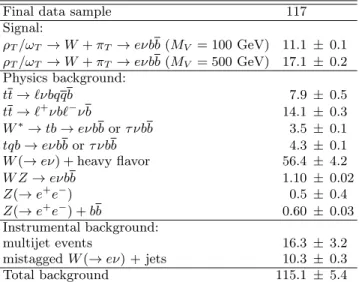
require at least one of the jets to be b-tagged. This leaves us with 117 events in our final data sample.
The expected background event yields are listed in Ta-ble I. When estimating these yields, each Monte Carlo event is weighted by the probability that at least one jet is tagged as a b jet. The tagging probability is param-eterized as a function of jet flavor, jet pT, and η. The
efficiency of tagging a jet from the fragmentation of a b quark is derived from collider data which were enriched in their b jet contents by requiring a muon to be recon-structed within at least one jet to preferentially select jets with semileptonic b decays. The probability of tagging a c jet is derived from the tagging probability for b jets by multiplying by the ratio of tagging probabilities for c and b jets derived from MC simulations. We derive the probability to tag a light-quark or gluon jet from a set of dijet events, corrected for contamination by c and b jets. The Monte Carlo events are also weighted by the ratios of jet and electron finding efficiencies in Monte Carlo and collider data. Electron finding efficiencies are measured in Z → ee events in both data and Monte Carlo.
We use the pythia event generator to simulate sig-nal events, modeling initial state and fisig-nal state radi-ation, fragmentradi-ation, and hadronization. To generate W πT signal events for a range of values of the
technime-son masses, we use a fast, parameterized detector simu-lation that was tuned to reproduce the kinematic distri-butions and acceptances from events simulated with the detailed geant-based detector simulation. For the cross section calculations, CTEQ5L [17] parton distribution functions are used. Finally, as is appropriate for this Drell-Yan-like process, the cross section is multiplied by a K-factor of 1.3 to approximate NLO contributions to the cross section [18]. We generate events with ρT masses
from 160 GeV to 220 GeV and assume M (ωT) = M (ρT).
The πT mass values start at the kinematic threshold for
TABLE I: Number of events observed in the data and ex-pected from signal and background sources after the kine-matic selection; only statistical errors are reported. For the expected number of signal events quoted we assume M (ρT) = 210 GeV and M (πT) = 110 GeV.
Final data sample 117
Signal: ρT/ωT→W + πT→eνbb (MV = 100 GeV) 11.1 ± 0.1 ρT/ωT→W + πT→eνbb (MV = 500 GeV) 17.1 ± 0.2 Physics background: tt → ℓνbqqb 7.9 ± 0.5 tt → ℓ+νbℓ−νb 14.1 ± 0.3 W∗→tb → eνbb or τ νbb 3.5 ± 0.1 tqb → eνbb or τ νbb 4.3 ± 0.1
W (→ eν) + heavy flavor 56.4 ± 4.2
W Z → eνbb 1.10 ± 0.02 Z(→ e+ e−) 0.5 ± 0.4 Z(→ e+ e−) + bb 0.60 ± 0.03 Instrumental background: multijet events 16.3 ± 3.2
mistagged W (→ eν) + jets 10.3 ± 0.3
Total background 115.1 ± 5.4
W πT production at M (πT) = M (ρT) − M(W ) and go
down to M (πT) = M (ρT)/2 − 5 GeV where the decay
channel ρ±(0)T → π ±(0,±)
T π
0(0,∓)
T is accessible, reducing
the branching fraction of ρ±(0)T → W πT.
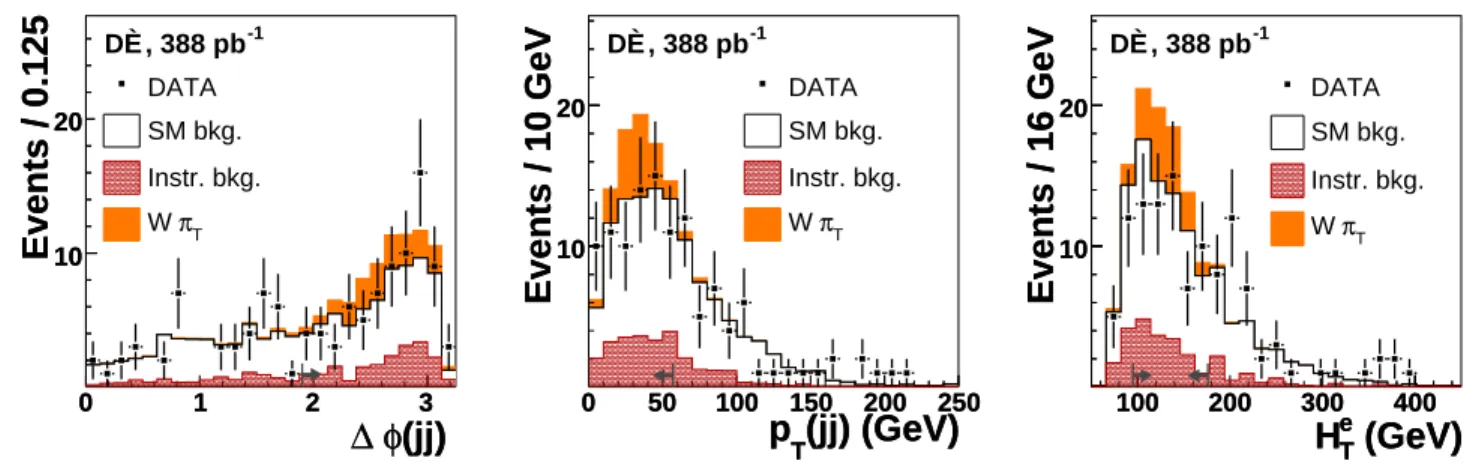
At this point our data sample is still dominated by background. We therefore use additional variables that characterize the topology of the events to discriminate between signal and background. These variables are the azimuthal angle difference between the two jets ∆φ(j, j), the azimuthal angle difference between the electron and the /pT, ∆φ(e, /pT), the transverse momentum of the dijet
system pT(jj), the scalar sum of the transverse momenta
of the electron and the two jets He
T, the invariant mass
of the dijet system M (jj), and the invariant mass of the W boson-dijet system M (W jj). The technicolor parti-cles are expected to have narrow widths (≈ 1 GeV). We should therefore see enhancements in the distributions of M (jj) and M (W jj), consistent in width with the detec-tor resolution. M (jj) corresponds to the reconstructed πT mass and M (W jj) corresponds to the reconstructed
ρT mass. We reconstruct the W boson from the electron
and the missing transverse momentum using the W bo-son mass constraint to solve for pz of the neutrino. If
there are two real solutions, we take the smaller value of neutrino |pz|. If there is only a complex solution, we take
the real part. Distributions of these variables are shown in Figs. 1 and 2. We use two approaches to separate sig-nal and background, a cut-based asig-nalysis and a neural network analysis.
The cut-based analysis is optimized using Monte Carlo simulations to maximize the ratio S/√B for every set of technimeson mass values. S is the expected number of
(jj)
φ
∆
0 1 2 3Events / 0.125
10 20(jj)
φ
∆
0 1 2 3Events / 0.125
10 20 -1 DØ, 388 pb DATA SM bkg. Instr. bkg. T π W(jj) (GeV)
Tp
0 50 100 150 200 250Events / 10 GeV
10 20(jj) (GeV)
Tp
0 50 100 150 200 250Events / 10 GeV
10 20 -1 DØ, 388 pb DATA SM bkg. Instr. bkg. T π W(GeV)
e TH
100 200 300 400Events / 16 GeV
10 20(GeV)
e TH
100 200 300 400Events / 16 GeV
10 20 -1 DØ, 388 pb DATA SM bkg. Instr. bkg. T π WFIG. 1: Distributions of ∆φ(jj), pT(jj) and H e
Tafter final kinematic selection. The W πTsignal is shown for M (ρT) = 210 GeV and M (πT) = 110 GeV. Arrows at the bottom indicate the cuts applied in the cut-based analysis for the signal mass point shown.
M(jj) (GeV)
0 100 200 300 400 500Events / 20 GeV
10 20 30M(jj) (GeV)
0 100 200 300 400 500Events / 20 GeV
10 20 30 -1 DØ, 388 pb DATA SM bkg. Instr. bkg. T π WM(Wjj) (GeV)
200 400 600Events / 24 GeV
10 20M(Wjj) (GeV)
200 400 600Events / 24 GeV
10 20 -1 DØ, 388 pb DATA SM bkg. Instr. bkg. T π WFIG. 2: Distributions of M (jj) and M (W jj) after final kine-matic selection. The W πT signal is shown for M (ρT) = 210 GeV and M (πT) = 110 GeV. Arrows at the bottom indi-cate the cuts applied in the cut-based analysis for the signal mass point shown.
W πT events and B is the expected number of background
events. For each topological variable, the S/√B ratio is evaluated as a function of the value of the variable to determine a set of lower, upper, or window cuts which maximizes this ratio.
The neural network analysis uses the topological vari-ables He
T, ∆φ(e, /pT), ∆φ(jj), pT(jj), the transverse
mo-menta of both jets and of the electron and /pT. A
two-stage neural network based on the Multi Layer Percep-tron algorithm [19] is used. The first stage consists of three independent networks which are trained to re-ject the three main backgrounds, top quark production, W + b¯b production, and all other W +jets production in-cluding heavy flavors. Each of these three networks has eight input nodes and one hidden layer with 24 nodes. The second stage network has three input nodes, con-nected to the outputs of the three networks in the first stage, and one hidden layer with six nodes. The sec-ond stage network is trained using all nine physics
back-ground processes. The networks are trained separately for each set of technicolor mass values. We then apply the trained neural networks to the collider data, techni-color signals, and physics and instrumental backgrounds to obtain the discriminator output spectra. We opti-mize the discriminator cut for every set of techniparticle masses to maximize S/√B.
There is no excess in our data over the expected back-ground. We compute upper limits on the ρT → W πT →
eν b¯b(¯c) production cross section times branching frac-tion. In the cut-based analysis, which is a simple count-ing experiment, we compute an upper 95% C.L. limit on the signal using Bayesian statistics [20]. The neural network analysis performs a maximum likelihood fit of the data in the M (ρT), M (πT) plane to signal and
back-ground expectations. The backback-grounds are constrained to their expected values within statistical and systematic uncertainties. The uncertainties in the background event yields total to 10–12% and the uncertainty in the sig-nal selection efficiency is 10% for the cut-based asig-nalysis and 20% for the neural-net based analysis. The largest contributions to the systematic uncertainties are due to jet reconstruction efficiency, jet energy scale, b-tagging efficiency, and, only for the signal, from the difference between fast and fully simulated detector Monte Carlo. The 95% C.L. upper limit on the signal cross section is then determined by the number of signal events below which lies 95% of the integral over the resulting likeli-hood function.
The expected sensitivity and the regions excluded at 95% C.L. by both analyses in the M (ρT), M (πT) plane
for MV = 500 GeV are shown in Fig. 3. For MV =
100 GeV, only a small region around M (ρT) = 190 GeV
and M (πT) = 95 GeV can be excluded. We note from
Fig. 3(a), that the expected sensitivity of the neural net-work analysis is better than that of the cut-based analy-sis, as indicated by the larger 95% C.L. exclusion region.
) (GeV)
Tρ
M(
160 180 200 220) (GeV)
Tπ
M(
60 80 100 120 (a) = 500 GeV V M -1 DØ, 388 pb production threshold T π W production threshold T π T π Expected Exclusion (NN) Expected Exclusion (Cut-based)) (GeV)
Tρ
M(
160 180 200 220) (GeV)
Tπ
M(
60 80 100 120 (b) = 500 GeV V M -1 DØ, 388 pb production threshold T π W production threshold T π T π Excluded Region (NN) Excluded Region (Cut-based)FIG. 3: Expected region of exclusion (a) and excluded region (b) at the 95% C.L. in the M (ρT), M (πT) plane for ρT → W πT→eν b¯b(¯c) production with MV = 500 GeV. Kinematic thresholds from W πT and πTπT are shown on the figures.
We quote the observed 95% C.L. exclusion region in the M (ρT), M (πT) plane in Fig. 3(b) by the neural network
analysis as our measurement [21].
The results presented in this paper cannot be com-pared directly to those previously published [23]. The CDF experiment did not use Ref. [8] and [9], but rather the models described in the earlier paper of Ref. [7], a precursor to the TCSM. The LEP experiments used Ref. [8] in which the cross sections, while appropriate for narrow ρT production in ¯qq collisions, are incorrect
for off-resonance production in e+e−collisions such as at
LEP (see Ref. [24]). Although differences in the employed TC models preclude a direct comparison with previous searches, the current search achieves a higher sensitivity to the considered physics process.
We thank Ken Lane for helpful discussions, the staffs
at Fermilab and collaborating institutions, and acknowl-edge support from the DOE and NSF (USA); CEA and CNRS/IN2P3 (France); FASI, Rosatom and RFBR (Russia); CAPES, CNPq, FAPERJ, FAPESP and FUN-DUNESP (Brazil); DAE and DST (India); Colciencias (Colombia); CONACyT (Mexico); KRF and KOSEF (Korea); CONICET and UBACyT (Argentina); FOM (The Netherlands); PPARC (United Kingdom); MSMT (Czech Republic); CRC Program, CFI, NSERC and WestGrid Project (Canada); BMBF and DFG (Ger-many); SFI (Ireland); The Swedish Research Council (Sweden); Research Corporation; Alexander von Hum-boldt Foundation; and the Marie Curie Program.
[*] On leave from IEP SAS Kosice, Slovakia.
[†] Visitor from Helsinki Institute of Physics, Helsinki, Fin-land.
[1] S. Weinberg, Phys. Rev. D 13, 974 (1976). [2] L. Susskind, Phys. Rev. D 20, 2619 (1979).
[3] S. Dimopoulos and L. Susskind, Nucl. Phys. B155, 237 (1979).
[4] E. Eichten and K. Lane, Phys. Lett. 90B, 125 (1980). [5] B. Holdom, Phys. Rev. D 24, 1441 (1981).
Phys. Lett. 150B, 301 (1985). T. Appelquist, D. Kara-bali, and L. C. R. Wijewardhana, Phys. Rev. Lett. 57, 957 (1986).
[6] C. T. Hill, Phys. Lett. B 345, 483 (1995).
[7] K. Lane and E. Eichten, Phys. Lett. B 222, 274 (1989). [8] K. Lane, Phys. Rev. D60, 075007 (1999).
[9] K. Lane and S. Mrenna, Phys. Rev. D67, 115011 (2003). [10] DØ Collaboration, V.M. Abazov, et al., Nucl. Instrum.
and Methods A 565, 463 (2006).
[11] G. Blazey et al., in Proceedings of the Workshop: “QCD and Weak Boson Physics in Run II,”edited by U. Baur, R.K. Ellis and D. Zeppenfeld (Fermilab, Batavia, IL, 2000), p.47; see Sec. 3.5 for details.
[12] T. Edwards et al., FERMILAB-TM-2278-E (2004). [13] T. Sj¨ostrand et al., Comput. Phys. Commun. 135, 238
(2001). We use pythia version 6.224.
[14] F. Caravaglios, M. L. Mangano, M. Moretti and R. Pit-tau, Nucl. Phys. B 539 215 (1999).
[15] R. Brun and F. Carminati, CERN Program Library Long Writeup W5013, 1993 (unpublished).
[16] η = − ln[tan(θ/2)] and θ is the polar angle with respect to the proton beam direction.
[17] H. L. Lai, et al., Eur. Phys. J. C 12, 375 (2000). [18] R. Hamberg, W. L. Van Neerven, and T. Matsura, Nucl.
Phys. B359, 343 (1991).
[19] http://schwind.home.cern.ch/schwind/MLPfit.html [20] I. Bertram et al., FERMILAB-TM-2104 (2000).
[21] Consistent scaling of luminosity and background prior to optimization, using the new D0 luminosity [22] will lead to somewhat better limits. Nevertheless, we choose to keep the analysis consistent with the previous estimate of the luminosity value [12].
[22] T. Andeen et. al., FERMILAB-TM-2365-E (2006), in preparation.
84, 1110 (2000); DELPHI Collaboration, J. Abdallah et al., Eur. Phys. J. C 22, 17 (2001).
[24] K. Lane, Lectures at Frascati Spring School, Technicolor