HAL Id: inserm-00415331
https://www.hal.inserm.fr/inserm-00415331 Submitted on 21 Apr 2011
HAL is a multi-disciplinary open access archive for the deposit and dissemination of sci-entific research documents, whether they are pub-lished or not. The documents may come from teaching and research institutions in France or abroad, or from public or private research centers.
L’archive ouverte pluridisciplinaire HAL, est destinée au dépôt et à la diffusion de documents scientifiques de niveau recherche, publiés ou non, émanant des établissements d’enseignement et de recherche français ou étrangers, des laboratoires publics ou privés.
Information and decision-making process for selective
termination of dichorionic pregnancies: some French
obstetricians’ points of view.
Claire-Marie Legendre, Christian Hervé, Michèle Goussot-Souchet, Chantal Bouffard, Grégoire Moutel
To cite this version:
Claire-Marie Legendre, Christian Hervé, Michèle Goussot-Souchet, Chantal Bouffard, Grégoire Mou-tel. Information and decision-making process for selective termination of dichorionic pregnancies: some French obstetricians’ points of view.. Prenatal Diagnosis, Wiley, 2009, 29 (1), pp.89-94. �10.1002/pd.2174�. �inserm-00415331�
TITLE: Information and decision-making process for selective termination of dichorionic
1
pregnancies: Some French obstetricians’ points of view 2
Running head: Selective termination 3
Keywords: selective termination, multifetal pregnancy, counselling, decision-making, patient 4
autonomy 5
Authors: Claire-Marie Legendre1&2, Christian Hervé1, Michèle Goussot-Souchet1, Chantal 6
Bouffard2*, Grégoire Moutel1* 7
Research conducted at: Laboratoire d’éthique médicale et de médecine légale et réseau de
8
recherche en éthique INSERM (INSERM laboratory for medical ethics and forensic medicine and 9
network for ethics research), Faculty of Medicine, Université Paris Descartes 10
11
1 Laboratoire d’éthique médicale 12
et de médecine légale et réseau de recherche en éthique INSERM 13
45 rue des St-Pères, 75006 Paris, France 14
Phone: +33 (142) 86 41 32 15
Fax: +33 (142) 86 41 33 16
2 Service de génétique, Département de pédiatrie 17
Faculté de médecine et des sciences de la santé 18 Université de Sherbrooke 19 3001 12th Avenue North 20 Sherbrooke, QC J1H 5N4 21 Canada 22 Phone: +1 (819) 820-6827 Fax: +1 (819) 564-5217 23
*Correspondence: C Bouffard and G Moutel: 24
E-mail: [email protected]; [email protected] 25
Recent developments in prenatal technology have altered our representations of the fetus (Taylor, 26
1997) and our relationship with it. Three-dimensional ultrasound imaging conveys an impression of 27
the fetus occupying the same space as we do; and this has contributed to the increasing hold on the 28
collective imagination of a sense of the fetus as an individual in its own right, independent of the 29
mother (Dickens and Cook, 2003). Moreover, these technologies have made it possible for 30
biomedical systems of representation to treat the fetus as a patient (Wyatt, 2001; Dumoulin and 31
Valat, 2001). It is known as well that an increased incidence in fetal ultrasound procedures and 32
prenatal genetic diagnoses has contributed directly to the increase in interventions performed on the 33
fetus (Von Dadelszen et al., 1999). 34
35
Thus the responsibility to care for, protect, and prevent suffering in what is nowadays seen as a 36
fetus-individual-child-patient has been intensified by technology’s capacity to forge an intimacy of 37
a visual, auditory, and even tactile nature among physicians, parents, society, and the fetus. In the 38
context of a system of representations of this kind and with most future patents viewing the fetus as 39
already a child (Dumez, 1997), when medical termination of pregnancy (MTP) is proposed 40
following prenatal diagnosis it is difficult for parents to conceive of putting an end to the fetus’s 41
life. 42
43
When, in the case of a multifetal pregnancy, one of the fetuses has a serious disease, the 44
circumstances are even more complex. The choices open to the parents are to continue the 45
pregnancy as is, in the knowledge that one of the children will be born gravely ill and may die 46
prematurely, or to proceed with selective termination (ST). ST differs from the usual MTP because 47
it entails terminating the life of the sick fetus while allowing the development of the healthy sibling 48
or siblings to continue. At term the mother gives birth to a dead child and one or more living 49
children. ST thus entails decision making based on social, ethical, and professional-ethical factors 50
that go far beyond exclusively medical considerations. The conditions in which patients and, where 51
relevant, their partners receive information must take account of these specific factors. Ideally these 52
conditions should contribute to decision making that is as informed as possible and provide the 53
future parents with enhanced empowerment in their decision making. 54
55
With this perspective in mind, we wished to investigate the point of view of some French 56
obstetricians on: the best way, when ST is indicated, of informing patients and their partners; the 57
non-medical information that is important to transmit; and the degree of autonomy patients can 58
assume. This exploratory study yielded, among other results, the finding that through the course of 59
the decision-making process, from the moment of discovery of a fetal anomaly or pathology to the 60
moment of the decision about ST, there was great diversity among the practitioners met with as 61
regarded both practices adopted and perceptions of what is ethical. 62
63
In this article we first give a brief description of ST. We next provide an overview of the 64
methodological approach taken by our study. Then we address the two major themes that emerged 65
from the study interviews. 66
67
Selective Termination
68 69
ST consists of feticide performed during a multifetal pregnancy (most often a twin pregnancy) 70
because one of the fetuses has a grave and incurable disease as of the time of diagnosis (It is
71
important to differentiate between STs, which are performed in cases of fetal pathology, and
72
multifetal pregnancy reduction (MFPR), which consists of embryocide performed in cases of
high-73
order multiple pregnancies (more than three fetuses) to reduce the obstetrical and perinatal risks
74
inherent in this kind of pregnancy.) (Evans et al., 1999). ST is indicated to allow a pregnancy to 75
continue for the sake of the healthy fetus or fetuses. It does however present a risk of miscarriage, a 76
risk that varies according to type of placentation and technique used (Rousseau and Fierens, 1994; 77
Bernard et al., 2006; Hern, 2004). It can also threaten the life of the other fetus or fetuses in other 78
ways, compromise their health, and increase the risk of premature birth (Bernard and al., 2006). 79
In France, there are no regulations or directives specific to ST. (Goussot-Souchet and al., 2008) 80
Given that there is legislation on MTP that is strictly applied(Loi no 75-17 relative à l’interruption
81
volontaire de la grossesse, art. L 162-12)and bioethics law on the donation and use of elements and 82
products of the human body, medically assisted reproduction, and prenatal diagnosis (Act 94-654, 83
29 July 1994), the regulatory void when it comes to ST raises important concerns. 84
85 86
Materials and Methods
87 88
For this exploratory study on information and decision making around ST, we adopted a qualitative, 89
empirical-inductive approach that would allow for the development of knowledge about “a
90
phenomenon on the basis of data gathered [rather than on the basis of] the confirmation of a
91
theoretical hypothesis” (Vittrant, 2005). In contrast to quantitative research, which requires few
92
variables and large numbers of cases, qualitative research explores many variables on the basis of a
93
small number of cases.
94
Descriptive, qualitative studies are appropriate when, as is the case here, a topic has not been
95
previously explored on the basis of large sample sizes. Thus although qualitative studies are
96
descriptive and their results cannot be generalized, they play a crucial role in raising questions
97
and generating hypotheses. They allow for handling subjects in depth while concentrating “on
98
participants’ perspectives, their meanings, their subjective views” (Sulmasy DP and Sugarman J,
99
2001; Creswell, 2007).
100 101
With this approach in mind, we used a purposive sampling strategy. Eight semi-directed interviews 102
were conducted with obstetrician-gynecologists practicing in these multidisciplinary centres for 103
prenatal diagnosis in the Paris region: Cochin/Saint Vincent de Paul, Necker, Robert-Debré, Saint-104
Antoine, Antoine Béclère, Lariboisière. Participants were selected based on their experience with 105
ST. However, only STs done on bichorionic biamniotic twin pregnancies are reflected in the study, 106
because in monochorionic pregnancy the progress of the pregnancy is more complex and the future 107
of the healthy fetus even more uncertain (Bernard et al., 2006). 108
109
The interview guide was developed by a team at the Laboratoire d’éthique médicale et de médecine
110
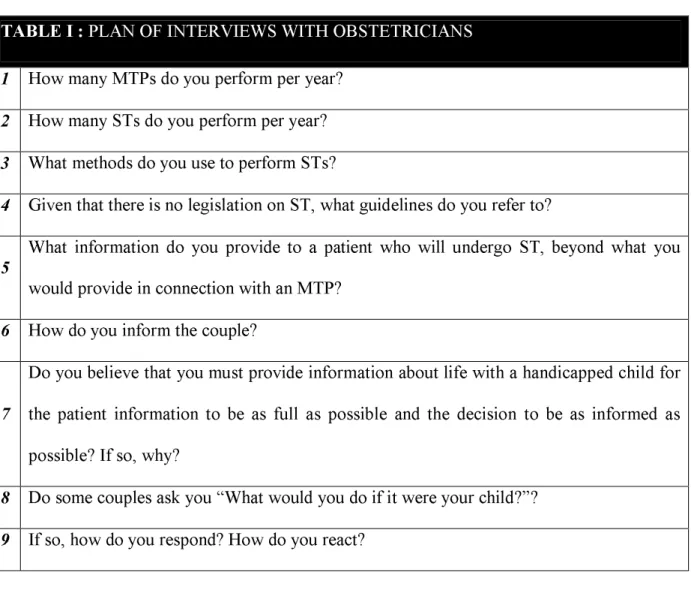
légale (laboratory for medical ethics and forensic medicine) at Université Paris Descartes. As can 111
be seen in Table 1, the questions were designed to initially gather general information on the 112
physicians’ profiles and their experience with ST. The questions then broached the physicians’ 113
perceptions of ST in relation to the law, the differences they saw between ST and MTP, their 114
strategies for providing information on the condition of the fetus and on the procedure, their views 115
on the ideal degree of patient involvement in decision making, and their views on the criteria that 116
should apply for recourse to ST. 117
The interviews were recorded and transcribed in full. The discursive material was then classified 118
and analyzed using the methods of inductive qualitative research. Each interview was handled
119
individually. The data were classified under themes by means of a coding process, i.e., by reducing
120
the data to meaningful segments and assigning categories to the segments (Creswell, 2007). Then
121
the codes were combined under broader themes and the themes were described and illustrated with
122
anonymized quotations from respondents.
123 124 125
Results
126
Two major themes emerged from the interviews: information transfer and respect for couples’
127
autonomy.
128 129
Information transfer
130The theme of how the obstetricians handled information arose in connection with two matters of
131
strategy: the time factor and the nature of the information transferred.
132 133
The Time Factor
134
All the physicians interviewed stressed the importance of the time factor in the process of 135
information transfer in the context of fetal pathology and proposed ST. They believed it is 136
necessary to prolong individual consultations in order to convey sufficiently full information and 137
foster informed decision making. 138
139
Similar reasons were given for a preference for distributing the information over “several
140
successive consultations” (Alice, obstetrician, 2007), because ST requires an adequate period for 141
reflection. They believed spacing out consultations allows for time to process the information 142
received and reflect on the alternatives presented. One of them described this approach very 143
effectively: “There’s a first stage, the stage when the pathology and the prognosis are disclosed.
144
After that I always allow couples a week to work out their own path. When they’re seen again,
145
we’re at the questioning stage: What will we do, what have they understood, where will we go?” 146
(Antoine, obstetrician, 2007). 147
148
The physicians maintained that these strategies limit the number of decisions made in a hurry and 149
reduce the guilt experienced by patients and their partners: “My worst fear is that parents will
150
decide to resort to ST and then, three or four years later, will regret it.” (Julie, obstetrician, 2007). 151
According to our informants, the time factor can contribute to reducing the psychological impact of 152
the disclosure that there is fetal pathology, of the consequences of the pathology for the child and 153
the pregnancy, and of the proposed procedures. 154
Lack of Uniformity
in the Nature
of the Information Transferred
156 157
Although all the physicians agreed about spreading out the transfer of information in time, the 158
nature of the information they provide varied. The differences relate mainly to: (1) information 159
about living with a gravely ill or handicapped child; (2) the importance assigned to certain kinds of 160
supplementary information; (3) the forms of information preferred; and (4) what we have termed 161
the fullness of the information disclosed. 162
163
The majority (six) of the obstetricians interviewed believed the provision of information on the 164
difficulty of living with a gravely ill or handicapped child must form an integral part of the care 165
given to pregnant women for whom ST is indicated. Although two of these physicians convey this 166
information themselves, the other four turn to outside parties. Among these four, two refer patients 167
and couples to associations of parents of handicapped children, reasoning that “information
168
provided by parents who volunteer with these associations could be more explicit, clearer, and
169
simpler for the future parents.” (Antoine, obstetrician, 2007). The other two call on the services of 170
specialist physicians, “colleagues whose job it is to follow children with the same kind of pathology,
171
so that couples can receive the most honest information possible.” (Julie, obstetrician, 2007). In the 172
view of these two physicians, the advice given by parents’ associations is biased and reflects “only
173
one way of thinking, which, while it’s not without interest, is partial and tainted with emotion.” 174
(Julie, obstetrician, 2007). 175
176
The only other obstetrician who answered this question (only seven out of the eight did so) saw the 177
whole issue very differently: “I believe it falls outside our purview to take responsibility for these
178
types of considerations ... and couples usually broadly receive all the necessary information. I think
179
that’s sufficient.” (Louis, obstetrician, 2007). 180
As for the supplementary information physicians deem it important to convey, all the interviewees 182
mentioned the need to explain that ST presents the risk of termination of the whole pregnancy. 183
In a different vein, three of our informants emphasized the impossibility of seeing the body if ST is 184
done early. Three others believed, respectively, that the feelings of ambivalence that will be aroused 185
by the dead child through the course of the pregnancy, the assumption of responsibility for disposal 186
of the body after delivery, and the possibility of burial represent topics that must absolutely be 187
broached. Last, one of the obstetricians brought up the importance of discussing the psychological 188
impact of feticide, while another felt that the technical aspects of ST are underdiscussed. As for 189
other topics, there were as many opinions as obstetricians. 190
191
The variation in the fullness of the information disclosed, or in other words, the intentional 192
omission by some physicians of information they consider to be of secondary importance or 193
needlessly distressing, represents an especially troubling aspect of the circumstances surrounding 194
ST-related decision making. For example, one physician mentioned that he does not consider it 195
useful to inform couples of the rates of in utero fetal death in cases of trisomy 18 and 21. Another 196
physician, who gave as his reason his reluctance to frighten patients needlessly, resorts to what he 197
called “disguised lies” when he discusses the products and techniques used for feticide. From these 198
practitioners’ perspective, holding back some kinds of information does not incur the risk of 199
altering or influencing couples’ final decision. In their view, parental cognizance of certain facts 200
would make the decision harder to reach. 201
202
Respect for Couples’ Autonomy
203 204
All the physicians interviewed consider themselves to be very respectful of couples’ autonomy. 205
“The relationship with the couple is fundamental. You can’t decide for them.” (Marc, obstetrician, 206
2007) is one example of the way they positioned themselves on this. 207
208
The following interview excerpt illustrates the implementation of this position: 209
“When I began practicing, I was more ready to take on the responsibility for making the
210
decision. I used to say that in the end it was comforting to the parents not to have the burden
211
of choice imposed on them. As I grow older, I realize this doesn’t necessarily do them a
212
favour, because I rob them of the decision making. At the time they’re comforted, but in the
213
medium and long term this is something that can’t be managed.” (Julie, obstetrician, 2007). 214
215
However, some may find it hard to implement the position in practice, as this next excerpt makes 216
clear: “Making the decision to terminate the life of a child is very hard. For some people, it’s
217
impossible. If we try not to help and guide them in their decision, they won’t be able to make this
218
decision.” (Claire, obstetrician, 2007). 219
220
The interview questions about patients asking physicians, “What would you do if this were your
221
child?” can be quite revealing of the attitude to patient autonomy. One physician said, “I go ahead
222
and give them my opinion pretty willingly, especially here…, where lots of parents turn up who are
223
in difficult, hard-to-manage circumstances…. I tell them, ‘In your place …, in this situation, I’d do
224
this” (Julie, obstetrician, 2007). The others stated that they never answer this question. 225
226
Discussion
227 228
The methodological approach we adopted does not allow for generalizing our findings to all French 229
obstetricians. However, as we show below, several works in the literature confirm our findings. 230
231
As we saw above, this exploratory study on the points of view of some obstetricians in our French
232
sample regarding information and decision-making processes in the context of ST yielded two
major themes: information transfer, which subdivided into two strategies (the time factor and the
234
nature of the information transferred); and respect for couples’ autonomy. 235
236
First, in connection with ST and feticide, the time factor is obstetricians’ most important ally. The 237
time factor is at the heart of two approaches: (1) an increase in the time devoted to informing 238
patients and their partners; (2) the spreading of the provision of this information over several 239
consultations. Extending consultation time allows physicians to provide all the information they 240
consider necessary and ensure it’s thoroughly understood; and by spreading the information over 241
several consultations, physicians allow patients more time for reflection and decision making. 242
Through recourse to these approaches, the obstetricians aim to reduce the guilt and suffering that 243
could be associated with hasty decisions. Their view is that doing so reduces the risk of 244
psychological suffering flowing from what could appear down the road to patients and their 245
partners to have been a bad decision. 246
247
Certain European authors writing in French stress the significance of the time factor. Barjot and 248
Levy maintain that, while everything surrounding proposed ST creates a climate of urgency, 249
“reintroducing the time factor makes it possible to de-dramatize the situation and approach it as
250
calmly as possible, while allowing the parents time for reflection.” (Barjot and Levy, 1997). 251
Similarly, it is recommended that consultation time be extended in the context of prenatal 252
diagnosis, with the sole purpose of informing patients (Alouini et al., 2007). 253
254
Second, despite this consensus on the question of the time that should be devoted to information 255
transfer, views differed on the kind of information it is useful to transmit. Other than the concerns 256
about the fetal remains and advisories about the difficulty of living with a handicapped child, 257
several obstetricians said they view provision of information that is not of a medical nature as 258
falling outside their professional duties. Others deliberately choose to hide certain kinds of 259
information in order to protect couples from what they consider to be needless suffering. 260
261
Yet the approach revealed by interview responses about the role of the physician in information 262
transfer and the intentional omission of information should change, in view of the literature shows 263
patients’ growing desire for a maximum of information. For instance, according to a French study 264
on couples’ opinions of the care they received in connection with an MTP, 49% of patients stated 265
they had not received sufficient information on feticide and its technical aspects (Garel et al., 2001). 266
In another study, out of a sample of twelve patients, only two stated they had thoroughly 267
understood the information they received about the risks associated with ST and were satisfied with 268
it (Alouini et al., 2007). 269
270
Third, the theme of patient autonomy is at the heart of an opposition between patients’ (or, where 271
appropriate, couples’) decision-making power (Ainsworth-Vaughn, 1998; Britt, 2006; Britt and
272
Evans, 2007) and that of physicians. 273
However before going further, we should emphasize the distinctness of France in connection with
274
respect for patient autonomy. Whereas respect for autonomy is at the basis of medical ethics in the
275
USA, French physicians tend to apply the principle of beneficence and thus to focus on protecting
276
patients. As Maio has written, in the French context, the physician-patient relationship remains
277
imbued with traditional paternalism; and the doctrine of consent does not hold the same
278
foundational status as in English-speaking countries (Maio, 2002). This should be borne in mind in
279
connection with the analysis that follows.
280
Although the physicians stated the final decision is up to the couples, our findings show a degree of 281
tension and inconsistency between their perceptions of patients’ level of autonomy and the 282
limitations they impose on that autonomy. Some physicians showed a tendency in practice to 283
influence couples’ decisions by one means or another (withholding information, “helping” with the 284
decisions, providing personal advice, and so on). 285
286
This approach suggests in the context of ST, physicians’ attitude needs to evolve, because 287
parents are currently laying claim to the power to take ownership of decisions about procreation and 288
child rearing. These parents claim a total freedom of choice because “they know that they’ll have to
289
provide for the economic, moral, and social needs of their children and will not accept limitations
290
placed on their freedom by society by means of medical practice.” (Barjot and Levy, 1997). In a 291
democratic society, it is hard to conceive of an authority better placed to speak for the fetus than its 292
parents (Gold et al., 1995). 293
294
However, consultations that are completely free of directiveness are something of a fantasy. As 295
Amann observes, “the state of medical art certainly consists of an ensemble of impersonal criteria,
296
… but every physician must resort to her or his own judgement at the moment of decision making.” 297
(Amann, 2006). Thus “the criteria for medical decisions are never wholly independent of the
298
subjectivity of the person to whom society has accorded the power to decide.” (Amann, 2006). 299
Indeed, in the context of prenatal diagnosis, many physicians influence couples’ decisions, with 300
greater or lesser degrees of cognizance that they are doing so (Barjot and Levy, 1997; Lippman and 301
Wilfond, 1992; Wyatt, 2001). Several studies have shown that couples’ decisions differ according 302
to the different ways of presenting the risks associated with a genetic disorder (Lippman and 303
Wilfond, 1992). As well, the role held by the person who provides the information (obstetrician, 304
geneticist, pediatrician, genetic counsellor) influences the probability of opting to terminate 305
pregnancy (Wyatt, 2001). 306
307
Thus while attitudes can be in greater or lesser measure directive, it would appear utopian to think 308
the information provided by physicians will be full and will not be affected by physicians’ power to 309
sway. Obstetricians can limit their influence but not really do away with it altogether. And because 310
accompaniment in decision making is viewed differently by different practitioners, it is also 311
difficult to define just what is meant by “helping with the decision” and how far this help can go 312
before it abridges couples’ autonomy. 313
314
Conclusion
315 316
Our findings lead us to believe that there can be significant differences among obstetricians’ 317
approaches to informing patients and to patients’ decision-making processes. These differences 318
relate to: (1) the heterogeneousness of the information disclosed by different physicians; (2) 319
discrepancies in the implementation of the commitment to providing full and non-directive 320
information transfer; (3) representations of what constitutes ethical support; and (4) how physicians 321
engage with couples’ autonomy. Realistically, it would appear difficult to fully respect couples’ 322
demand for autonomy through the whole of the decision-making process (Wyatt, 2001). For Wyatt 323
– and our study bears out this point of view – although autonomy has a clear theoretical meaning, in 324
the context of the reality of fetal medicine, it’s an extremely subtle, hard-to-apply concept. “The
325
truth is that the goal of genuine neutrality in areas as emotive as procreation and abortion is
326
impossible and even inhumane.” (Wyatt, 2001). 327
328
Thus the physicians interviewed showed a strong desire to respect couples’ autonomy in connection 329
with the decision to be made. However, the withholding of some information and the lack of 330
uniformity in the kinds of information disclosed are indicative of a significant degree of 331
directiveness, deliberate or not, on the part of some physicians. 332
333
Despite all the problems associated with ST, in France there are neither State guidelines nor 334
recommendations on the methods of information transfer and support in decision making to patients 335
following diagnosis of a fetal pathology. It is of interest that none of our respondents expressed the 336
need for such guidelines or recommendations. 337
Thus it could be considered acceptable to allow variation in medical practices according to the age
338
of the fetus, the severity of the pathology, non-medical criteria, and the psychology of the couple.
339
Perhaps it is reasonable to ask whether the creation of State guideline for information transfer is
340
appropriate, given that each couple is a singular case and must be considered as such.
341 342
This exploratory study was conducted in order to better understand the attitudes of obstetricians in
343
the context of ST and the ethical problems these situations can give rise to. Based on our findings, a
344
comparative study has been undertaken in France and Quebec. It will be conducted with a higher
345
number of respondents. The study will also examine couples’ considerations in these situations.
346 347
Acknowledgments
348
The research was conducted at Laboratoire d’éthique médicale et de médecine légale et réseau de
349
recherché en éthique INSERM (INSERM laboratory for medical ethics and forensic medicine and 350
network for ethics research) and Faculty of Medicine, Université Paris Descartes. 351
352
References
353
1. Ainsworth-Vaugh N. 1998 (ed.). Claiming power in doctor-patient talk. Oxford University
354
Press: New-York.
355
2. Alouini S; Moutel G; Venslauskaite G; Gaillard M; Truc JB; Hervé C. 2007. Information for 356
patients undergoing a prenatal diagnosis. Eur J Obstet Gynecol Biol Reprod
134
(1): 9-14 3573. Amann JP. 2006. Diagnostic prénatal et discriminations : réflexions à partir de l'exemple 358
français. In Néoracisme et dérives génétiques, Parizeau MH, Kash S (Eds.). Les Presses de 359
l’Université Laval: Saint-Foy; 157-173. 360
4. Barjot PH, Levy G. 1997. IMG : bases et fondements éthiques. Contracept. Fertil. Sex 25(1): 361
37-45. 362
5. Bernard JP, Quarello E, Ville Y. 2006. Conflits d’intérêts entre jumeaux. Troisième congrès 363
de gynécologie obstétrique et reproduction de la Côte d’Azur. 364
6. Britt, DW. 2006. Psychosocial issues in prenatal diagnosis. In Prenatal Diagnosis, Evans MI
365
and al. (ed.). McGraw Hill: Toronto; 701-706.
366
7. Britt DW, Evans MI. 2007. Sometimes doing the right thing sucks: Frame combinations and
367
multi-fetal pregnancy reduction decision difficulty. Soc Sci Med.
65
(11): 2342-2356.368
8. Creswell JW. 2007 (ed.). Qualitative inquiry & research design: Choosing among five
369
approaches. SAGE Publications: Lincoln.
370
9. Dickens BM, Cook RJ. 2003. Ethical and legal approaches to the “fetal patient”. Int J Gynecol
371
Obstet
83
: 85-91. 37210. Dumez Y(Ed.). 1997.Le fœtus à l’hôpital. Paris: Erès. 373
11. Dumoulin, M; Valat, AS. 2001. Morts en maternité : devenir des corps, deuil des familles. 374
Études sur la mort 119: 77-99. 375
12. Evans MI, Goldberg JD, Horenstein J, Wapner RJ, Ayoub MA, Stone J, Lipitz S, Achiron R,
376
Holzgreve W, Brambati B, Johnson A, Johnson MP, Shalhoub A, Berkowitz RL. 1999.
377
Selective termination for structural, chromosomal, and mendelian anomalies : International
378
experience. Am J Obstet Gynecol
181
: 893-7.379
13. Garel M, Cahen F, Gaudebout P, Dommergues M, Goujard J, Dumez Y. 2001. Opinions of 380
couples on care during medical termination of pregnancy. Gynecol Obstet Fertil
29
(5):358-70. 38114. Gold F, Hervé C, Taurelle R, Bauberot J, Pierre F, Deschamps PH, Laugier J. 1995. Problèmes 382
éthiques soulevés par les pratiques françaises actuelles de l’IMG. 3ième partie : contribution à 383
la résolution des dilemmes moraux de la médecine du fœtus. J. Gynecol Obstet Biol Reprod 384
24
: 727-732. 38515. Goussot-Souchet M, Tsatsaris V, Moutel G. 2008. Interruptions sélectives de grossesse en cas 386
d’anomalie grave: état des lieux et enjeux éthiques. Le Courrier de l’éthique médicale
8
(1): 38731-33. 388
16. Hern WM. 2004. Selective termination for fetal anomaly/genetic disorder in twin pregnancy at 389
32+ menstrual weeks. Fetal Diagn Ther
19
(3): 292-295. 39017. Lippman A, Wilfond BS. 1992. Twice-told tales: Stories about genetic disorders. Am J Hum
391
Genet
51
: 936-937. 39217 Maio G. The cultural specifity of research ethics – orwhy ethical debate in France is different. J
393
Med Ethics.
28
(3): 147-150. 39418. Rousseau P. Fierens R-M . 1994. Evolution du deuil des mères et des familles après mort 395
périnatale. J. Gynecol. Obstet. Biol. Reprod.
23
, 166-174. 39619. Sulmasy DP, Sugarman J. 2001. The many methods of medical ethics (Or, thirteen ways of
397
looking at a blackbird). In Methods in medical ethics, Georgetown University Press:
398
Washington DC; 3-18.
399
20. Taylor, JS. 1997. Image of contradiction: Obstetrical ultrasound in American culture. In 400
Reproducing reproduction: Kinship, power, and technological innovation. University of 401
Pennsylvania Press: Philadelphia; 15-45. 402
21. Vittrant A. 2005. Comment constituer son corpus d’étude : exemple d’une enquête 403
linguistique sur le birman vernaculaire. In Actes du colloque Recueil des données en sciences
404
du langage et constitution de corpus : données, méthodologie, outillage, Muni Toke V, 405
Lablanche A (Eds.), Nanterre: 198-222. 406
22. Von Dadelszen P, Johson J-AM, Farquharson DF, Wilson RD, Seaward PGR. 1999. Mutifetal 407
pregnancy reduction and selective termination: The Canadian experience. Fetal Diagn Ther
408
14
: 360-364. 40923. Wyatt J. 2001. Medical paternalism and the fetus. J Med Ethics
27
(5): pii15, 6p. 410TABLE I : PLAN OF INTERVIEWS WITH OBSTETRICIANS
1
How many MTPs do you perform per year?2
How many STs do you perform per year?3
What methods do you use to perform STs?4
Given that there is no legislation on ST, what guidelines do you refer to?5
What information do you provide to a patient who will undergo ST, beyond what youwould provide in connection with an MTP?
6
How do you inform the couple?7
Do you believe that you must provide information about life with a handicapped child for the patient information to be as full as possible and the decision to be as informed as possible? If so, why?