Socially Meaningful Vocal Plasticity in Adult Campbell’s Monkeys
(Cercopithecus campbelli)
Alban Lemasson and Martine Hausberger
Universite´ de Rennes 1Klaus Zuberbu¨hler
University of St. Andrews Campbell’s monkeys (Cercopithecus campbelli) frequently exchange vocalizations, the combined-harmonic calls, with individuals responding to one another’s calls. Previous work has shown that these calls can be grouped into several structural variants. Adult females differ in their variant repertoires, which may change during their adult life, particularly after changes in the group composition. Playback of females’ currently produced variants triggered vocal responses from other group members, whereas the same females’ former, no longer used variants and those of stranger females never did. In contrast, former variants caused long-term cessation of vocal behavior, whereas stranger variants had no effect. Data showed that monkeys were able to distinguish between the different types of variants, indicating that these calls form part of a long-term social memory.Plasticity in vocal production is a widespread phenomenon in songbirds and some marine mammals, but for nonhuman primates comparably little evidence is available. Current theory suggests that primates have little influence over the acoustic structure of their calls and that vocal repertoires are under strong genetic control. If they occur, ontogenetic changes in call structure are usually explained as the results of maturational effects (Fischer, 2002; Hauser, 1989; Janik & Slater, 1997; Seyfarth & Cheney, 1996; Snowdon & Hausberger, 1997). Support for this view comes from studies that unsuccessfully attempted to condition macaques (Macaca mulatta) to alter the acoustic structure of their calls and from cross-fostering experiments and hybridization studies (Gei-ssmann, 1984; Owren, Dieter, Seyfarth, & Cheney, 1992; Sutton, Larson, Taylor, & Lindeman, 1973). These findings have contrib-uted to the general and widely accepted notion that human speech is fundamentally different from primate vocal production and in some ways more similar to bird song or cetacean communication (e.g., Doupe & Kuhl, 1999; Janik & Slater, 2000; Snowdon & Hausberger, 1997). For example, both young children and song-birds go through a babbling phase, in which developmental progress is dependent on social feedback (Goldstein, King, & West, 2003), a phenomenon not reported for nonhuman primates.
More recently, the strong dichotomy between innately guided primate vocalizations and human speech has encountered a num-ber of challenges (Riede, Bronson, Hatzikirou, & Zunum-berbu¨hler, 2005). For example, it has been documented that the trill vocal-izations of pygmy marmosets (Cebuella pygmaea) change in acoustic structure after pairing and remain highly stable thereafter (Snowdon & Elowson, 1999). Second, pant hoot vocalizations of chimpanzees (Pan troglodytes) are more similar within than be-tween groups, regardless of the individuals’ genetic relatedness (Crockford, Herbinger, Vigilant, & Boesch, 2004; Marshall, Wrangham, & Clark Arcadi, 1999; Mitani & Brandt, 1994; Mitani & Gros-Louis, 1998; Mitani, Hunley, & Murdoch, 1999). A vari-ety of other evidence suggests that nonhuman primates may have some control over elements of their vocal repertoire (Macaca
fuscata: Hihara, Yamada, Iriki, & Okanoya, 2003; Masataka &
Fujita, 1989; Sugiura, 1993, 1998; Pan paniscus: Taglialatela, Savage-Rumbaugh, & Baker, 2003). Recently, it has been shown that some vocalizations produced by male baboons (Papio
cyno-cephalus ursinus) change as males acquire and lose dominance
(Fischer, Kitchen, Seyfarth, & Cheney, 2004). Although these studies are interesting, little is still known about the perceptual abilities of monkeys to discriminate such subtle variations and whether the described acoustic variation is socially meaningful to them (Fichtel & Hammerschmidt, 2003; Rendall, Seyfarth, & Cheney, 1999; Semple & McComb, 2000).
Recent work with captive Campbell’s monkeys (Cercopithecus
campbelli) has provided evidence that significant acoustic
varia-tion is present in at least one call type, the combined-harmonic call (Lemasson, Gautier, & Hausberger, 2003; Lemasson & Haus-berger, 2004; Lemasson, Richard, & HausHaus-berger, 2004). Adult females frequently exchange combined-harmonic calls (or cohesion-contact calls; Gautier & Gautier, 1977) as part of their daily social interactions. In their native, visually dense West Af-rican forests, these calls are crucial in maintaining proximity to other group members and in providing information about impor-tant ongoing events, such as the arrival of a neighboring group or the desire to initiate a progression (Uster & Zuberbu¨hler, 2001; Alban Lemasson and Martine Hausberger, Centre National de la
Re-cherche Scientifique, Ethologie–Ecologie–Evolution, Universite´ de Rennes 1, Rennes, France; Klaus Zuberbu¨hler, School of Psychology, University of St. Andrews, St. Andrews, Scotland.
Funding was provided by the Royal Society (International Joint Projects Grant to Klaus Zuberbu¨hler and Martine Hausberger), the Centre National de la Recherche Scientifique. (Origine de l’Homme, du Langage et des Langues to Martine Hausberger), and the Universite´ de Rennes 1 (profes-seur invite´, Klaus Zuberbu¨hler). We are grateful to Vincent Janik, Julia Fischer, and Jennifer McClung for comments on the article and to Philippe Bec and Cathrine Blois-Heulin for their support throughout the study.
Correspondence concerning this article should be addressed to Klaus Zuberbu¨hler; School of Psychology, University of St. Andrews, St. An-drews KY16 9JP, Scotland. E-mail: [email protected]
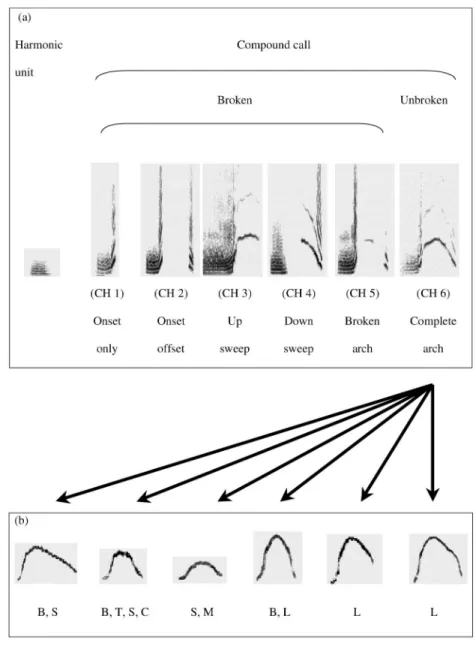
Wolters & Zuberbu¨hler, 2003). The calls also appear to serve functions in maintaining social relationships with other group members (Lemasson et al., 2003; Lemasson & Hausberger, 2004). The combined-harmonic call can be subdivided into various structural subtypes according to differences in their base acoustic structure. One of them, the complete arch (or CH 6 call) can be subdivided into several statistically distinguishable acoustic vari-ants, as determined by similarity indices of the modulation of the main frequency (see Figure 1) (Lemasson et al., 2003, 2004).
Females have been observed to produce several different variants, some of which are individual specific; others are shared with certain group members (Lemasson & Hausberger, 2004). Although variants appear to remain stable in a particular individual for some time, changes in variant production have been documented throughout a female’s adult life, particularly after important changes in the group’s social dynamic (Lemasson et al., 2003; Lemasson & Hausberger, 2004). Taken together, these studies suggest that adult Campbell’s monkeys are able to generate a
Figure 1. a: Spectrographic representations and terminology of the main subtypes and variants of Campbell’s monkeys’ combined-harmonic calls. Calls are ordered as a function of increasing completeness. b: The combined-harmonic calls with unbroken arches can be further subdivided into various acoustic variants (Lemasson et al., 2003, 2004; Lemasson & Hausberger, 2004). Depicted are spectrographic representations of six different variants produced by the adult females during the 1999 recording session. The top row shows six statistically distinguishable frequency contours of the whistle unit. The bottom row indicates the adult females from which the particular call variant was recorded. CH⫽ combined-harmonic call; B ⫽ Bella; S ⫽ Shawnee; T⫽ Tilamook; C ⫽ Chilula; M ⫽ Maricopa; L ⫽ Lowina.
significant amount of acoustic variation within one of these vocal signals, the combined-harmonic call. This variation cannot be explained by maturational or other physiological factors, as all individuals were fully grown adults.
In this study, we are interested in the degree to which the observed acoustic variation is perceived and communicatively relevant for these animals. To this end, we provide observational and experimental data to test the hypothesis that the previously documented relation between vocal structure and social factors is not a mere functionless artifact but of psychological and biological relevance to these monkeys.
Method
Study Animals
In their natural rainforest habitat, Campbell’s monkeys (Cercopithecus
campbelli) live in small groups of one adult male, several adult females,
and their offspring (Wolters & Zuberbu¨hler, 2003). Data were collected on a captive group of Campbell’s monkeys housed at the Station Biologique de Paimpont, which is operated by the Universite´ de Rennes 1. The monkeys were fed two meals per day, fruits and vegetables in the morning and commercial monkey chow in the afternoon. Water was available ad libitum. Environmental enrichment consisted of wood shavings covering the floor of the inside enclosure and various branches that were assembled to provide climbing possibilities throughout the enclosure. The group was established in 1987, initially consisting of one male and three females, all wild born. The group composition at the time of the study matched the ones typically observed in the wild (Zuberbu¨hler & Jenny, 2002; see Table 1).
The Combined-Harmonic Call
Adult females and juveniles produce a number of low-amplitude vocal-izations that can be distinguished by ear and spectrographic displays (Lemasson et al., 2003, 2004; Lemasson & Hausberger, 2004). The most common one, the combined-harmonic call, is usually given in bouts by several group members, a behavioral pattern also described for another closely related forest-dwelling guenon species, the Diana monkey
(Cerco-pithecus diana; Uster & Zuberbu¨hler, 2001). In the wild, adult males do not
produce any of the vocalizations emitted by the adult females and juveniles
but instead utter various types of loud calls, often in response to different types of danger (Zuberbu¨hler, 2000, 2001, 2002, 2003).
As described earlier, combined-harmonic calls consist of two parts: a low-pitched harmonic unit followed by a high-pitched and frequency-modulated whistle unit (see Figure 1). The two units can be given singly or as a compound. A second source of acoustic variation derives from the fact that the frequency contour of the whistle unit varies in its overall shape and may be broken at various sites, yielding six distinct subtypes (see Figure 1). Context predicts whether and where exactly the whistle unit is broken. For example, calls with steady and unbroken whistle units are typically pro-duced by adult females when approaching other group members. Apart from these relatively conspicuous differences, a number of additional and subtler effects have been described for the complete arch version of the calls (CH 6, Figure 1b). These subtypes show consistent differences in the frequency contour, yielding various call variants. Females have been observed to produce up to four different variants at one time, some of which may be shared with other group members (Lemasson et al., 2003; Lemasson & Hausberger, 2004).
Playback Experiments
Because females change the acoustic fine structure of their combined-harmonic calls throughout their adult life, in particular after significant changes in the social setting of their group (Lemasson et al., 2003), we were particularly interested in whether the animals perceived these differ-ent variants and whether the variants were communicatively relevant to them. Thus, between June and July 2003 we recorded a number of com-plete arch calls (CH 6) from 4 adult females (Shawnee, Bella, Lowina, and Tilamook) from whom we already had a library of high-quality recordings from a recording session conducted in May 1999. Campbell’s monkeys reach sexual maturity in their 3rd year of life (Hunkeler, Bertrand, & Bourliere, 1972)—that is, all but 1 individual (Bella, born 1997) had reached full adulthood by 1999. Although the group consisted of 7 adult females, only 4 of them reliably produced CH 6 calls during both recording periods. As we operated within the constraints of a captive group setting, we were restricted to these 4 females, because they were the most active callers who regularly produced complete arch combined-harmonic calls during both time periods (1999 and 2003). To make statements statistically meaningful, we tested the group’s response to the 16 different vocalizations depicted in Figure 2, 8 current and 8 former calls produced by these 4 females.
Calls were recorded with a TASCAM DA-P1 digital audiotape recorder (TEAC Corporation, Tokyo) and a professional directional microphone (for the 2003 recordings, we used a Sony [Tokyo] ECM-969 microphone; for the 1999 recordings, we used a Sennheiser [Wedemark, Germany] MKH 815 microphone). Calls recorded during 1999 were termed former
variants; those recorded during 2003 were termed current variants. 1999
recordings had been stored as computer sound files with customized sound analysis software (Richard, 1991). Via Canary software (Charif, Mitchell, & Clark, 1995), both the 1999 and the 2003 calls were then transferred onto a Macintosh iBook laptop computer for subsequent use in the playback experiment and spectrographic illustration. Figure 2 illustrates all calls used as playback stimuli during the experimental trials. To demonstrate that calls underwent sufficient change in the acoustic structure in these 4 years, we calculated the similarity indices among the various calls and subjected the results to a cluster analysis (see Lemasson et al., 2003). It revealed that, for all 4 individuals, similarity indices were consistently higher within than between the two recording periods, indicating that the acoustic fine structure of CH 6 calls changed considerably from 1999 to 2003 in all 4 animals (Figure 3).
During all phases of the study, the monkey group was kept in an indoor– outdoor enclosure (21 m2⫻ 3 m indoors; 21 m2⫻ 4 m outdoors).
A wall and large windows of milky glass separated the indoor and outdoor Table 1
Composition of the Study Group During the 2003 Study Period
Individual Date of birth Matriline Age/sex class
Sirano 1992 AM Plume (Lisa) 1992 1 AF Lowina (Lisa) 1993 1 AF Maricopa (Lisa) 1995 1 AF Chilula (Lisa) 1996 1 AF Shawnee 1993 2 AF Tilamook 1996 2 AF Bella 1997 2 AF Pikachu (Lisa) 2000 1 JM Togepi (Lowina) 2000 1 JM Entei (Bela) 2001 2 JM Lugia (Chilula) 2001 1 JF Yanma (Tilamook) 2001 2 JM Arbok (Chilula) 2002 1 JM Staross (Lowina) 2002 1 JM
Note. The mother’s name is given in parentheses. AM⫽ adult male; AF⫽ adult female; JM ⫽ juvenile male; JF ⫽ juvenile female.
areas. The indoor area consisted of three compartments, the outdoor enclosure of two separable compartments. During the various recording sessions, individuals had access to all areas of the enclosure. During the playback sessions, the female whose calls we were going to broadcast was separated from the rest of the group in the right indoor area, together with the loudspeaker, while the rest of the group was kept in the left outdoor area.
Being separated from the rest of the group appeared to be a mildly stressful event for the females. Individuals moved about constantly and silently in the indoor enclosure, and they immediately rejoined the group
once this opportunity was given to them. Separated females rarely vocal-ized, but if they did this was equally likely in all conditions and therefore did not affect the results in a systematic way. To minimize the aversive impact of separation, we ran pairs of playback experiments (one current and one former call variant by the same female), using a randomized counterbalanced design. This way, we only had to separate each female on two separate occasions. The two playback stimuli were separated by 20 min. For the subsequent control trials, stranger female calls were presented in the same way: The same 4 females were separated for a third time while two different stranger calls were played back from the inside enclosure,
Figure 2. Spectrographic illustration of the 16 combined-harmonic complete arch (CH 6) variants used in the playback experiment. Calls were digitized with 44.00 kHz/16 bit accuracy via a Hanning window function and then were 12.00 kHz low-pass filtered. Spectrograms were calculated with a 341.95 Hz/512 points filter bandwidth and a grid resolution of 0.3628 ms (96.88% overlap) and 10.77 Hz (Fast Fourier Transform size 4,096 points). Each spectrogram depicts a 0.6 s⫻ 12.00 kHz sound sample.
again separated by 20 min of silence. Testing occurred once in the morning and/or in the afternoon. In all cases we separated the female from the group about 1 hr prior to experimentation to avoid immediate effects of this manipulation on the individuals’ vocal behavior.
The reason we kept the female whose calls we were to broadcast in the inside compartment was to create a spatially plausible situation to other group members—that is, the recipients whose responses to the playback stimuli were measured. No direct visual contact was possible between the two areas, but relatively uninhibited acoustic contact was ensured through a slide door between the middle indoor and the right outdoor compartment. The speaker, a Nagra DH (Kudelski S.A., Cheseaux-sur-Lausanne, Swit-zerland) speaker–amplifier, was positioned in the middle compartment of the inside area, about 40 cm from the slide door, invisible to the group outside. Experiments were conducted between June 19 and July 14, 2003. Current–former pairs were done first (from June 19 to July 7), and stranger calls were done second (from July 11 to July 14).
Each experimental trial consisted of a preplayback period (10 min) followed by a postplayback period (10 min). Playback stimuli consisted of one single, unbroken call (current or former) from 1 of 4 different females played back to the rest of the group. Figure 2 illustrates the 16 playback stimuli as spectrograms. Each female was separated from the group at four different times while one of her call variants was played back in a randomized order to the rest of the group, resulting in a total of 16 sessions. Following these 16 experimental trials, we conducted a series of 8 control trials during which we separated the same 4 females again in the same manner, but this time we played back eight CH 6 calls from 3 stranger females: Putsu (age 14, six calls), Olive (age 15, one call), and Doreen (age 13, one call). The recipients had never met or heard these females before. Recordings of these calls were made at the ZooParc de Beauval (St Aignan-sur-Cher, France), where the 3 Campbell’s monkeys were housed as part of a larger social group. Everything was kept equal during the control trials—that is, we separated each of the 4 target females in the inside enclosure and set up the equipment in the exact same way. However, rather than playing one of the separated female’s calls, we now broadcast one of the stranger female’s calls to the group in the outside enclosure. This control condition was performed to address the hypothesis that individuals’
vocal responses could be explained with differences in familiarity and to test whether individuals possessed any long-term memory of former call variants. The 8 control calls as well as the 16 test calls were edited such that they were broadcast at equal amplitudes, matched to those of naturally occurring calls.
Predictions
We predicted that if the contour differences in Campbell’s monkeys’ combined-harmonic calls were communicatively relevant, then recipients should treat current call variants differently from former (no longer used) ones, even though they were produced by the same familiar individual. We assumed that individuals recognized each other by voice, regardless of the type of variant they produced (e.g., Bergman, Beehner, Cheney, & Sey-farth, 2003). Given this, we predicted that current call variants should elicit a normal vocal response in other group members, as observed during normal call exchanges. We predicted that if the animals recognized each other by voice but did not perceive the subtle acoustic differences in an individual’s call variants, both current and former call variants should elicit a normal vocal response, whereas stranger calls should not. However, if animals were able to distinguish subtle differences in the calls’ frequency contours and if these differences were communicatively relevant to them, then current call variants should trigger a vocal response, but former and stranger calls should not.
Our dependent variable was the number of combined-harmonic calls produced by the other 6 adult females kept in the outside enclosure. Juvenile males and females also responded at times but were not included in the analyses. A trained observer can easily distinguish the calls of a juvenile from the ones of an adult (see Lemasson et al., 2003). We excluded the vocal response of the juveniles that were born after the 1999 recordings were made. We tape recorded the group’s vocal behavior for 20 min, 10 min before and 10 min after playback stimulus, and counted the number of calls in each 1-min interval. These calls appeared to be emitted through the nasal cavity with the mouth closed, such that it is often very difficult to allocate an individual call to a particular female without laryngeal microphones, even with the help of video techniques. Although
Figure 3. Cluster analysis of call similarity indices of calls used as playback stimuli. Abbreviations on the right side of the figure indicate the subject (B⫽ Bella; L ⫽ Lowina; S ⫽ Shawnee; T ⫽ Tilamook), the call variant (current, former, or stranger), and the number of the playback stimulus (1⫽ first playback stimulus, 2 ⫽ second playback stimulus, etc.).
they are interesting, we did not address questions relating to individual response patterns, so analyses at the group level seem appropriate. Because of small sample sizes, we used nonparametric statistics to investigate whether current, former, and stranger call variants differed in eliciting a calling response from other individuals.
Results
Campbell’s monkeys regularly produced combined-harmonic calls as part of calling bouts involving several individuals. Calls given by different individuals typically trailed each other with short intercall intervals. Response patterns were analyzed at three different levels: (a) immediate effects (less than 1 s), (b) short-term effects (less than 1 min), and (c) long-term effects (less than 10 min).
Immediate Effects
Playbacks of current call variants regularly elicited immediate calling responses from other individuals. In five out of eight trials, one or more calls were given immediately (within 1 s) following playback. In contrast, former and stranger call variants never elicited an immediate calling response, a statistically significant effect (former: zero out of eight trials, Fisher’s test, two-tailed, p⬍ .02; stranger: zero out of eight trials, Fisher’s test, two-tailed, p⬍ .02).
Short-Term Effects
Following playback of current variants, recipients’ call rates were significantly increased in the 1st minute relative to the last 1-min preplayback interval (n⫽ 8; z ⫽ 2.536, p ⬍ .01, Wilcoxon’s test; two-tailed; Figure 4). Playbacks of former variants had the opposite effect. In this case, the group’s call rate was strongly decreased in the first postplayback interval relative to baseline (n⫽ 8; z ⫽ 1.823, p ⬍ .07, Wilcoxon’s test, two-tailed, Figure 4). Finally, playbacks of stranger call variants did not cause any noticeable changes in the group’s call rates (n⫽ 8; z ⫽ 0.577, p ⫽ .56, Wilcoxon’s test, two-tailed; Figure 4). Although the call rates
in the 1-min interval previous to playbacks varied slightly among treatments, the difference was not significant, but there was a random effect of small sample size (Kruskal–Wallis-test, two-tailed; H⫽ 2.625, p ⬎ .27; Figure 4).
Long-Term Effects
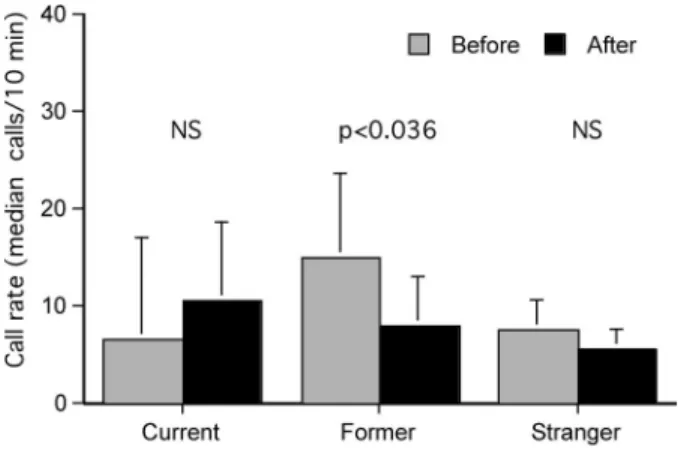
We also analyzed the calling behavior over the entire 20-min period by considering the total number of calls produced in the 10-min intervals before and after a playback stimulus. Although playbacks of current variants had significant immediate effects, as illustrated in Figure 4, they did not significantly alter the call rates in the long run (n ⫽ 8; z ⫽ 0.421, p ⫽ .67, Wilcoxon’s test, two-tailed; Figure 5), which suggests that the main effects hap-pened in the 1st minute. In contrast, former call variants had significant long-term inhibiting effects: When the females heard former variants, their call rates were significantly lower in the 10 min after a playback compared with the 10 min before (n⫽ 8; z ⫽ ⫺2.100; p ⬍ .04, Wilcoxon’s test, two-tailed; Figure 5). In con-trast, playbacks of stranger call variants did not cause any notice-able changes in calling behavior (z⫽ ⫺0.632, p ⫽ .53, Wilcox-on’s test, two-tailed; Figure 5). Although the call rates in the 10-min interval previous to playbacks varied among treatments, the difference was not significant, but there was a random effect of small sample size (Kruskal–Wallis-test, two-tailed, H ⫽ 1.989,
p⫽ .37; Figure 5).
The purpose of our study was to determine whether animals could distinguish current from former calls of known individuals, irrespective of caller identity. As such, testing the calls of one female only—for example, by using five of her former and five of her current variants—would have addressed the problem suffi-ciently. However, to investigate whether certain individuals con-tributed more to the results, we averaged the responses for each female and reran the analyses. The effects remained the same, despite the much smaller sample size, suggesting that the pattern holds across individuals (short-term effects, current: z⫽ ⫺1.841,
p⫽ .07, n ⫽ 4; former: z ⫽ ⫺1.289, p ⫽ .20, n ⫽ 4; stranger: z ⫽
⫺1.000, p ⫽ .32, n ⫽ 4; long-term effects, current: z ⫽ 0.000, p ⫽ 1.00, n⫽ 4; former: z ⫽ ⫺1.841, p ⫽ .07, n ⫽ 4; stranger: z ⫽ ⫺0.730, p ⫽ .47, n ⫽ 4). The lowest possible p value for a two-tailed Wilcoxon’s test with n⫽ 4 is .07.
Finally, there was some concern about the age structure in our study group because 1 individual, Bella, had not reached adulthood in 1999, the time of the first recordings. However, if Bella’s trials are removed from the analysis the effects remain, despite the reduction in sample size (Wilcoxon’s tests, two-tailed; short-term effects, current: z⫽ ⫺2.207, p ⫽ .03, n ⫽ 6; former: z ⫽ ⫺1.656,
p⫽ .10, n ⫽ 6; stranger: z ⫽ ⫺0.577, p ⫽ .56, n ⫽ 6; long-term
effects, current: z⫽ ⫺0.084, p ⫽ .40, n ⫽ 6; former: z ⫽ ⫺1.572,
p⫽ .12, n ⫽ 6; stranger: z ⫽ ⫺0.314, p ⫽ .75, n ⫽ 6).
Discussion
Campbell’s monkeys frequently exchange vocalizations, the combined-harmonic calls, as part of their normal friendly social interactions. These calls are typically given in bouts of several vocalizations immediately following each other, given by different individuals responding to one another. Previous work has shown Figure 4. Call rates (median plus third quartile) of adult female recipients
1 min before and 1 min after playback of one combined-harmonic complete arch (CH 6) call (former, current, or stranger variants; p values indicate significant differences, Wilcoxon’s tests, two-tailed). NS⫽ nonsignificant.
that combined-harmonic calls are not a structurally rigid class of vocalizations (Lemasson et al., 2003, 2004; Lemasson & Haus-berger, 2004). Instead, this call’s acoustic fine structure varies in the shape of the whistling unit (see Figure 1). By statistical means, the various shapes can be grouped into a small set of call variants (Lemasson et al., 2003, 2004; Lemasson & Hausberger, 2004). At any given time, adult females produce a repertoire that may consist of one to several variants, some of which may be shared with other group members. Animals that are more closely affiliated are more likely to share particular variants than animals that are not. How-ever, an individual’s variants are not stable over its entire adult life; structural changes have been observed from 1 year to the next. It has been suggested that these changes may be triggered by alterations in a female’s social relations—for example, after the removal of a group member and the concurrent changes in the group’s social dynamics (Lemasson et al., 2003).
The main objective of this study is to establish whether the variants recorded from the same individuals, at different stages of their adult life, are perceptually salient to other monkeys and whether they have any communicative significance. A variety of evidence suggests that primates recognize each other individually by voice (e.g., Bergman et al., 2003). Thus, we felt it was safe to assume that recipients would be able to associate particular calls with particular individuals, regardless of the acoustic variants presented to them. Our playback experiment tested the monkeys’ responses to current and former call variants produced by the same individual—that is, during the time of the study and 4 years earlier—and compared them with their responses to the calls of stranger females. Results showed that adult female Campbell’s monkeys clearly discriminated between an individual’s current and former variants, which suggests that these calls form part of a long-term social memory.
Current variants elicited an immediate calling response and short-term but no long-term effects, similar to what is observed during natural call exchanges, which suggests that these calls were
perceived as normal attempts to initiate a calling bout. In contrast, playbacks of former variants never elicited a vocal response in recipients. In addition, call rates were lower in both the short term and the long term, which suggests that recipients were affected by the fact that one of their group members suddenly produced unusual call variants, that is, variants that were part of her reper-toire 4 years earlier. We did not find comparable effects in the monkeys’ responses to stranger female calls, which suggests that they were not perceived as socially relevant signals. At the very least, the control trials demonstrated that animals discriminated between former and stranger calls.
Perceptual Processes
What perceptual processes might have been responsible for different response patterns that emerged when different time win-dows were analyzed? Why did significant effects only emerge in the short term, not the long term, for current call variants? Our findings are consistent with the idea that individuals perceived the calls as natural stimuli that elicited an immediate natural response, that is, a response bout from several individuals immediately after perception. In contrast, playbacks of former call variants decreased calling behavior in both the short term and the long term. This is consistent with the idea that individuals perceived the anomaly of the situation, perhaps an expression of the monkeys’ surprise at hearing a group member producing calls of an outdated acoustic structure. Finally, playbacks of stranger female calls decreased call rates mildly but not significantly.
The results of the control trials suggest that the response differ-ences between current and former variants were not the result of differences in familiarity. As we also found with former call variants, recipients never responded to playbacks of stranger calls. However, their long-term vocal behavior was different compared with responses to the former variants, suggesting that the monkeys distinguished between former and stranger call variants. Why the monkeys failed to respond to stranger calls is perhaps more diffi-cult to interpret. Although it is diffidiffi-cult to draw conclusions from negative results, the finding is consistent with at least two possible explanations. First, perhaps the animals perceived the control trials as an unnatural situation, which therefore did not trigger any calling behavior. After all, the calls of a stranger female were played from the same inside compartment where one of their group members was kept, a highly unlikely event. Although it is con-ceivable that recipients perceived this anomaly, it did not affect their overall calling rates in a statistically noticeable way. Alter-natively, it also needs to be kept in mind that the combined-harmonic calls are a firm component of Campbell’s monkeys’ social behavior. As we pointed out earlier, their usage strongly reflects the affinities among individual group members, and mon-keys respond to each other following specific rules. From this perspective, it is unsurprising for a Campbell’s monkey not to respond to the calls of a stranger individual with whom she has had no prior history of social relation. Nevertheless, although we were not able to record any vocal responses to stranger females’ calls, it is quite likely that there were changes in other aspects of the monkeys’ behavior that simply went unnoticed by this study. Figure 5. Call rates (median plus third quartile) of adult female recipients
10 min before and 10 min after playback of one combined-harmonic complete arch (CH 6) call (former, current, or stranger variants; p values indicate significant differences, Wilcoxon’s tests, two-tailed). NS⫽ non-significant.
Some Considerations
It might have been preferable to test 8 different females, rather than using two recordings from 4 females only. Although the Paimpont group is unusual in its size and composition, closely matching the natural situation, we were constrained in the number of females that could be tested. However, when we averaged the responses to the 4 individuals’ calls and reran the analyses, the results remained the same, which suggests that testing additional females would have led to the same results.
With the benefit of the hindsight, a number of other behavioral response measures, such as direction and duration of orientation, could have provided additional clues about how these monkeys categorize and represent the vocal signals of conspecifics. How-ever, in this study we were mainly concerned with the natural effects of these calls—that is, whether they elicited vocal re-sponses and how they affected the vocal behavior in the long run. Related to this, it might also have been of interest to test how individuals responded to the calls of the two individuals that were permanently removed from the group in 1999, although findings would have been of an anecdotal nature.
The effects reported are not a consequence of differences in the monkeys’ vocal activity prior to playback. Call rates prior to playback did not differ significantly, which suggests that they were random effects of small sample sizes. Although it is tempting to compare call rates across treatments, this may not be a meaningful analysis, because baseline call rates can vary substantially from one trial to the next. More crucial are changes in call rates before and after stimulus perception.
Finally, there is some concern about the age structure in our study group. According to the literature (Hunkeler et al., 1972), Campbell’s monkeys reach sexual maturity at 3 years old, which indicates that 1 individual, Bella, might not have reached adult-hood in 1999, the time of the first recordings. If Bella’s trials are removed from the analysis, we continue to find the same effects, although playbacks of former variants fail to show a significant long-term effect, the likely consequence of the reduction in sample size to 6. Clearly, however, our results cannot be explained with the suggestion that animals were simply responding to juvenile versus adult calls.
Vocal Plasticity and Vocal Learning
Our findings on Campbell’s monkeys do not stand alone. Sim-ilar results have emerged from studies on fur seals (Arctocephalus
tropicalis) and European starlings (Sturnus vulgaris). In fur seals,
mothers learn the vocal signature of their pups’ vocalizations immediately after parturition. However, during maturation, the pups’ call structure changes continuously, and, as a consequence, mothers have to constantly update their memory of the pups’ call characteristics to recognize them when returning to the colony. Playback experiments conducted before weaning have demon-strated that mothers still recognized all the successive immature and mature versions of their pups’ calls, demonstrating long-term memory of subtle call structures (Charrier, Mathevon, & Jouven-tin, 2001, 2003). In European starlings, individuals sometimes share songs with other group members, and it has been observed that patterns of song sharing reflect the social organization. During
the nonbreeding season, females tend to associate in same-sex social pairs, and pair members share most of their songs (Haus-berger, Richard-Yris, Henry, Lepage, & Schmidt, 1995). Subse-quent playback experiments have demonstrated that females are able to distinguish past song types. Females responded most strongly to past shared song types, which suggests that these birds keep a repertoire of former variants and the associated social bonds in their memory (Hausberger, Foraste, Richard, & Nygren, 1997). Bottle-nosed dolphins (Tursiops truncates) produce individually distinct whistles that may serve in individual identification (Janik, 2000). Similarly, a number of authors have reported individual differences within certain types of primate vocalizations, suggest-ing that some primate calls may possess signature features as well—for example, Lemur catta (Macedonia, 1986; Oda, 2002),
Saimiri sciureus (Boinski & Mitchell, 1997; Soltis, Bernhards,
Donkin, & Newman, 2002), Callithrix jacchus (Jones, Harris, & Catchpole, 1993), Macaca sylvanus (Hammerschmidt & Todt, 1995), and Presbytis thomasi (Wich, Koski, de Vries, & van Schaik, 2003). Our results add to these findings by showing individual differences in Campbell’s monkeys’ combined-harmonic calls that are perceived by recipients. The Campbell’s monkey system is unique, however, because these calls change in their acoustic fine structure throughout an individual’s adult life. The changes are not simply age related, nor do they occur at random, but they appear after significant changes in the group’s social network, such as the introduction of a new male or the removal of adult females (Lemasson et al., 2003; Lemasson & Hausberger, 2004). This strongly suggests that individual differ-ences cannot be explained by physiological (e.g., body size) or genetic factors (e.g., similarities within matrilines) alone (Gouzoules & Gouzoules, 1990; Hammerschmidt, Newman, Champoux, & Suomi, 2000; Jorgensen & French, 1998), espe-cially as variant sharing among group members was not related to age, matriline, or context.
Although the underlying ontogenetic mechanisms of primate vocal flexibility are still unclear, the dolphins’ signal variability is thought to be the result of vocal learning (Janik & Slater, 1997). Evidence for this comes from a variety of studies. For example, dolphins have been observed to respond to the whistles of con-specifics by emitting the same acoustically matched whistle type (Janik, 2000). Second, dolphins born in aquarium pools develop whistles that are less modulated than those of wild individuals but more similar to the whistles of human trainers, which suggests that captive individuals incorporate features of artificial acoustic mod-els made by humans (Miksis, Tyack, & Buck, 2002). From an evolutionary viewpoint, it is puzzling that vocal learning abilities appear to be more advanced in phylogenetically distant cetaceans than in nonhuman primates, given the sophisticated vocal learning abilities of even very young children. However, this and a number of previously mentioned studies suggest that some rudimentary vocal plasticity is present in nonhuman primate calls, although it seems to be restricted to certain vocalizations and is only expressed within relatively rigid species-specific limits (Owren et al., 1992).
Social Factors and Vocal Plasticity
Independent of the outcome of this debate, vocal plasticity in nonhuman primates is clearly affected by social variables. Perhaps
the best available evidence to date comes from marmosets. When two unfamiliar populations of pygmy marmosets (Cebuella
pyg-maea) were put into acoustic contact, some individuals started to
make parallel changes in the acoustic structure of their contact calls (Elowson & Snowdon, 1994). In another study, cotton-top tamarins (Saguinus oedipus) modified call structures when paired with a new mate, so that the calls converged in acoustic structure and remained stable thereafter (Roush & Snowdon, 1999). In Wied’s black tufted-ear marmosets (Callithrix kuhli), modifica-tions of the social environment, the introduction of new neighbors, influenced the vocal morphology of contact calls, which suggests that this species’ contact calls are also affected by changes in social context (Rukstalis, Fite, & French, 2003). Campbell’s mon-keys’ vocal production seems to be under comparable social in-fluence. This research provides further evidence in support of the hypothesis that nonhuman primates can shape the acoustic struc-ture of some of their calls to a limited degree. These changes can be semipermanent, and it appears that significant amounts of variation are the result of important changes in the social environ-ment of the individuals. Our experienviron-ment has shown that the result-ing acoustic variation is perceptually salient and socially relevant to the individual monkeys.
References
Bergman, T. J., Beehner, J. C., Cheney, D. L., & Seyfarth, R. M. (2003, November 14). Hierarchical classification by rank and kinship in ba-boons. Science, 302, 1234 –1236.
Boinski, S., & Mitchell, C. L. (1997). Chuck vocalizations of wild female squirrel monkeys (Saimiri sciureus) contain information on caller iden-tity and foraging activity. International Journal of Primatology, 18, 975–993.
Charif, R. A., Mitchell, S., & Clark, C. W. (1995). Canary 1.2 user’s manual (Version 1.2) [Acoustic analysis]. Ithaca, NY: Laboratory of Ornithology, Cornell University.
Charrier, I., Mathevon, N., & Jouventin, P. (2001, August 30). Mother’s voice recognition by seal pups: Newborns need to learn their mother’s call before she can take off on a fishing trip. Nature, 412, 873. Charrier, I., Mathevon, N., & Jouventin, P. (2003). Fur seal mothers
memorize subsequent versions of developing pups’ calls: Adaptation to long-term recognition or evolutionary by-product? Biological Journal of
the Linnean Society, 80, 305–312.
Crockford, C., Herbinger, I., Vigilant, L., & Boesch, C. (2004). Wild chimpanzees produce group-specific calls: A case for vocal learning?
Ethology, 110, 221–243.
Doupe, A. J., & Kuhl, P. K. (1999). Birdsong and human speech: Common themes and mechanisms. Annual Review of Neuroscience, 22, 567– 631. Elowson, A. M., & Snowdon, C. T. (1994). Pygmy marmosets, Cebuella
pygmaea, modify vocal structure in response to changed social
environ-ment. Animal Behaviour, 47, 1267–1277.
Fichtel, C., & Hammerschmidt, K. (2003). Responses of squirrel monkeys to their experimentally modified mobbing calls. Journal of the
Acous-tical Society of America, 113, 2927–2932.
Fischer, J. (2002). Developmental modifications in the vocal behavior of non-human primates. In A. A. Ghazanfar (Ed.), Primate audition (pp. 109 –126). Boca Raton, FL: CRC Press.
Fischer, J., Kitchen, D. M., Seyfarth, R. M., & Cheney, D. L. (2004). Baboon loud calls advertise male quality: Acoustic features and their relation to rank, age, and exhaustion. Behavioral Ecology and
Sociobi-ology, 56, 140 –148.
Gautier, J.-P., & Gautier, A. (1977). Communication in Old World
mon-keys. In T. A. Sebeok (Ed.), How animals communicate (pp. 890 –964). Bloomington: Indiana University Press.
Geissmann, T. (1984). Inheritance of song parameters in the gibbon song, analyzed in 2 hybrid gibbons (Hylobates pileatus ⫻ H. lar). Folia
primatologica, 24, 216 –235.
Goldstein, M. H., King, A. P., & West, M. J. (2003). Social interaction shapes babbling: Testing parallels between birdsong and speech.
Pro-ceedings of the National Academy of Sciences, USA, 100, 8030 – 8035.
Gouzoules, H., & Gouzoules, S. (1990). Matrilineal signatures in the recruitment screams of pigtail macaques, Macaca nemestria. Behavior,
115, 327–347.
Hammerschmidt, K., Newman, J. D., Champoux, M., & Suomi, S. J. (2000). Changes in rhesus macaque “coo” vocalizations during early development. Ethology, 106, 873– 886.
Hammerschmidt, K., & Todt, D. (1995). Individual differences in vocal-izations of young barbary macaques (Macaca sylvanus)—a multi-parametric analysis to identify critical cues in acoustic signalling.
Be-haviour, 132, 381–399.
Hausberger, M., Foraste, M., Richard, M. A., & Nygren, C. (1997). Differential response of female starlings to shared and nonshared song types. Etologia, 5, 31–38.
Hausberger, M., Richard-Yris, M. A., Henry, L., Lepage, L., & Schmidt, I. (1995). Song sharing reflects the social organization in a captive group of European starlings (Sturnus vulgaris). Journal of Comparative
Psy-chology, 109, 222–241.
Hauser, M. D. (1989). Ontogenetic changes in the comprehension and production of vervet monkey (Cercopithecus aethiops) vocalizations.
Journal of Comparative Psychology, 103, 149 –158.
Hihara, S., Yamada, H., Iriki, A., & Okanoya, K. (2003). Spontaneous vocal differentiation of coo-calls for tools and food in Japanese mon-keys. Neuroscience Research, 45, 383–389.
Hunkeler, C., Bertrand, M., & Bourliere, F. (1972). Le comportement social de la Mone de Lowe (Cercopithecus campbelli lowei) [The social behavior of the Mona monkey (Cercopithecus campbelli)]. Folia
Pri-matologica, 17, 218 –236.
Janik, V. M. (2000, August 25). Whistle matching in wild bottlenose dolphins (Tursiops truncatus). Science, 289, 1355–1357.
Janik, V. M., & Slater, P. J. B. (1997). Vocal learning in mammals.
Advances in the Study of Behavior, 26, 59 –99.
Janik, V. M., & Slater, P. J. B. (2000). The different roles of social learning in vocal communication. Animal Behaviour, 60, 1–11.
Jones, B. S., Harris, D. H. R., & Catchpole, C. K. (1993). The stability of the vocal signature in phee calls of the common marmoset, Callithrix
jacchus. American Journal of Primatology, 31, 67–75.
Jorgensen, D. D., & French, J. A. (1998). Individuality but not stability in marmoset long calls. Ethology, 104, 729 –742.
Lemasson, A., Gautier, J. P., & Hausberger, M. (2003). Vocal similarities and social bonds in Campbell’s monkey (Cercopithecus campbelli).
Comptes Rendus Biologies, 326, 1185–1193.
Lemasson, A., & Hausberger, M. (2004). Patterns of vocal sharing and social dynamics in a captive group of Campbell’s monkeys
(Cercopithe-cus campbelli). Journal of Comparative Psychology, 118, 347–359.
Lemasson, A., Richard, J. P., & Hausberger, M. (2004). A new method-ological approach to context analysis of call production. Bioacoustics,
14, 111–125.
Macedonia, J. M. (1986). Individuality in a contact call of the ringtailed lemur (Lemur catta). American Journal of Primatology, 11, 163–179. Marshall, A., Wrangham, R., & Clark Arcadi, A. (1999). Does learning
affect the structure of vocalizations in chimpanzees? Animal Behaviour,
58, 825– 830.
Masataka, N., & Fujita, K. (1989). Vocal learning of Japanese and rhesus monkeys. Behaviour, 109, 191–199.
Tursiops truncatus, develop signature whistles that match acoustic
fea-tures of human-made model sounds. Journal of the Acoustical Society of
America, 112, 728 –739.
Mitani, J. C., & Brandt, K. L. (1994). Social factors influence the acoustic variability in the long-distance calls of male chimpanzees. Ethology, 96, 233–252.
Mitani, J. C., & Gros-Louis, J. (1998). Chorusing and call convergence in chimpanzees: Tests of three hypotheses. Behaviour, 135, 1041–1064. Mitani, J. C., Hunley, K. L., & Murdoch, M. E. (1999). Geographic
variation in the calls of wild chimpanzees: A reassessment. American
Journal of Primatology, 47, 133–151.
Oda, R. (2002). Individual distinctiveness of the contact calls of ring-tailed lemurs. Folia Primatologica, 73, 132–136.
Owren, M. J., Dieter, J. A., Seyfarth, R. M., & Cheney, D. L. (1992). Evidence of limited modification in the vocalizations of cross-fostered rhesus (Macaca mulatta) and Japanese (M. fuscata) macaques. In T. Nishida, W. C. McGrew, P. Marler, M. Pickford, & F. B. M. de Waal (Eds.), Topics in primatology: Human origins (pp. 257–270). Tokyo: University of Tokyo Press.
Rendall, D., Seyfarth, R. M., & Cheney, D. L. (1999). The meaning and function of grunt variants in baboons. Animal Behaviour, 57, 583–592. Richard, J. P. (1991). Sound analysis and synthesis using an amiga
micro-computer. Bioacoustics, 3, 45– 60.
Riede, T., Bronson, E., Hatzikirou, B., & Zuberbu¨hler, K. (2005). The production mechanisms of Diana monkey alarm calls: Morphological data and a model. Journal of Human Evolution, 48, 85–96.
Roush, R. S., & Snowdon, C. T. (1999). The effects of social status on food-associated calling behavior in captive cotton-top tamarins. Animal
Behaviour, 58, 1299 –1305.
Rukstalis, M., Fite, J. E., & French, J. A. (2003). Social change affects vocal structure in a Callitrichid primate (Callitrix kuhlii). Ethology, 109, 327–340.
Semple, S., & McComb, K. (2000). Perception of female reproductive state from vocal cues in a mammal species. Proceedings of the Royal Society
of London. Series B, Biological Sciences, 267, 707–712.
Seyfarth, R. M., & Cheney, D. L. (1996). Some general features of vocal development in nonhuman primates. In C. T. Snowdon & M. Hausberger (Eds.), Social influences on vocal development (pp. 249 –273). Cam-bridge, England: Cambridge University Press.
Snowdon, C. T., & Elowson, A. M. (1999). Pygmy marmosets modify call structure when paired. Ethology, 105, 893–908.
Snowdon, C. T., & Hausberger, M. (Eds.). (1997). Social influences on
vocal development. Cambridge, England: Cambridge University Press.
Soltis, J., Bernhards, D., Donkin, H., & Newman, J. D. (2002). Squirrel monkey chuck call: Vocal response to playback chucks based on acous-tic structure and affiliative relationship with the caller. American Journal
of Primatology, 57, 119 –130.
Sugiura, H. (1993). Temporal and acoustic correlates in vocal exchange of coo calls in Japanese macaques. Behaviour, 124, 207–225.
Sugiura, H. (1998). Matching of acoustic features during the vocal ex-change of coo calls by Japanese macaques. Animal Behaviour, 55, 673– 687.
Sutton, D., Larson, C., Taylor, E. M., & Lindeman, R. C. (1973). Vocal-ization in rhesus monkey: Conditionability. Brain Research, 52, 225– 231.
Taglialatela, J. P., Savage-Rumbaugh, S., & Baker, L. A. (2003). Vocal production by a language-competent Pan paniscus. International
Jour-nal of Primatology, 24, 1–17.
Uster, D., & Zuberbu¨hler, K. (2001). The functional significance of Diana monkey “clear” calls. Behaviour, 138, 741–756.
Wich, S. A., Koski, S., de Vries, H., & van Schaik, C. P. (2003). Individual and contextual variation in Thomas langur male loud calls. Ethology,
109, 1–13.
Wolters, S., & Zuberbu¨hler, K. (2003). Mixed-species associations of Diana and Campbell’s monkeys: The costs and benefits of a forest phenomenon. Behaviour, 140, 371–385.
Zuberbu¨hler, K. (2000). Interspecific semantic communication in two forest monkeys. Proceedings of the Royal Society of London. Series B,
Biological Sciences, 267, 713–718.
Zuberbu¨hler, K. (2001). Predator-specific alarm calls in Campbell’s gue-nons. Behavioral Ecology and Sociobiology, 50, 414 – 422.
Zuberbu¨hler, K. (2002). A syntactic rule in forest monkey communication.
Animal Behaviour, 63, 293–299.
Zuberbu¨hler, K. (2003). Referential signalling in non-human primates: Cognitive precursors and limitations for the evolution of language.
Advances in the Study of Behavior, 33, 265–307.
Zuberbu¨hler, K., & Jenny, D. (2002). Leopard predation and primate evolution. Journal of Human Evolution, 43, 873– 886.