“What and How do we learn from LinkedIn
Forums?” An Exploratory Investigation
Alexandra Broillet
University of Geneva and
Webster University,
Switzerland
[email protected]
Constance Kampf
Aarhus University, Denmark
[email protected]
Sabine Emad
HEG-Geneva
[email protected]
Abstract – This study examines several academic and professional LinkedIn forums, and using a grounded theory perspective, observes three key lifelong learning interactions for participants—a) problem solving through shared learning and helping processes,” b) a technical features learning center for learning new interfaces and features, and c) social networking. These three interactions offer a preliminary understanding of the potential for LinkedIn forums as a lifelong learning space, and an innovation space where weak ties and transactive memory systems have the potential to affect multidisciplinary and transdisciplinary research practices, as well as create economic value for higher education by connecting active researchers to industry and other researchers.
Index Terms – Social Media Forums – Learning Experience – Constructed Identity - Branding
INTRODUCTION
This paper focuses on LinkedIn as an international social media space for professionals and academics coming from all over the world. LinkedIn offers a large range of different technical social media tools. Literature examining LinkedIn is still rare, especially with regard to understanding social action in the different sub-social spaces created by LinkedIn through interactive features. Therefore, possible economic outcomes and professional development opportunities for professionals and academics related to their LinkedIn professional social media practices have yet to be examined as well. Consequently, our work has to be considered as a professional “first insight” and work in progress paper.
LinkedIn is one of the most important professional virtual networks in Europe. Americans also understand the economic importance of this professional platform, as there often is lot of social interaction between Americans and Europeans via LinkedIn. By the end of 2013, 2 million
[1,2] members used and trusted this social media platform. Members and non-members use it for different purposes, such as job searching, business promotion activities and professional social networking in general [3]. Information, technology, financial and higher education services together represent more than a half of the largest industries [2] active within LinkedIn. Therefore, due to this scope of use across key industries driving information economies, the economic and social media tool impact cannot be ignored any longer.
Our practical research focus examines learning behaviours of professionals and academics within forums that are part of the technical features offered by LinkedIn. Being an active professional within a virtual social space can be understood as representing value production, which, in turn, is part of the learning and research industry. Our main practical research question regarding professionals focuses on the content and form of learning behaviours within social sub-forums on LinkedIn. We have not been able to locate literature directly investigating LinkedIn Forums per se; thus, the gap we see between current literature and the economic practical and research value of LinkedIn as a lifelong learning space motivates our inquiry. Consequently, our research should be considered as exploratory in nature. It can also be seen as necessary to help both academics and industry reflect on how shared problem-solving, learning about new technical features, and social networking can effectively work together to create shared value and synergy in such a widely shared virtual space. We offer some initial practical insights about how social actions across and within any professional context can be translated into economic value.
UNDERSTANDING LINKEDIN FROM A SOCIAL MEDIA AND INTERACTIVE PERSPECTIVE
LinkedIn is a multifunctional social media tool. Although initially it appears like a collection of profiles that reveal both professional activity and networks, it can
Published in Proceedings of International Professional Communication Conference (IEEE IPCC),
Pittsburg, USA, 13-15 october 2014. 14 p.
be understood as much more when users begin to engage with LinkedIn’s interactive features. Using these features proactively enables researchers and other professionals to shape their profile in alignment with their career goals. At the same time, it also gives information that allows LinkedIn users to reflect on the current state of their professional ethos. Through LinkedIn’s interactive features, a new skill set for public engagement with lifelong learning in professional and academic life appears to be emerging. This skill set is affected by a combination of the affordances of LinkedIn interactive interfaces and the ways that users engage with them to co-construct their professional ethos. These skills include 1) creating a professional summary that reflects and constructs a member’s ethos, 2) engaging in forums to expand audiences and networks, 3) recognizing and understanding a broad, multidisciplinary set of potential clients, 4) understanding and working with algorithms underlying LinkedIn’s platform to actively shape one’s profile such as the one-click recommendations feature, and 5) working with the influence feature of LinkedIn groups to both learn and contribute to discussions.
LinkedIn’s interactive features are included in the interface through navigation tabs. Via these tabs, five major categories are suggested to help guide and shape the thinking of their users—an international professional and academic public. These are the “Home”, “Profile”, “Connections”, “Jobs” and “Interests”. “Home” offers the latest insights about the technical features and economic highlights of LinkedIn as an interface. “Profile” offers the opportunity for professionals and academics to submit an executive summary describing their current key activities, as well as include their employment history, experience, education, and other information from their resumé.
The action of posting a professional summary which is prominently located at the top of the profile, can be considered as a form of constructing a professional “brand”. Pringle [4] said that brands can be seen as a sort of engagement and a promise to future clients. Applying this perspective to LinkedIn forums as a space where professionals and academics are developing their social network brands within and across different professional fields, implies that LinkedIn as a platform also grants its members and potential members a right and opportunity to engage in forums for diverse professional discourses of their choice.
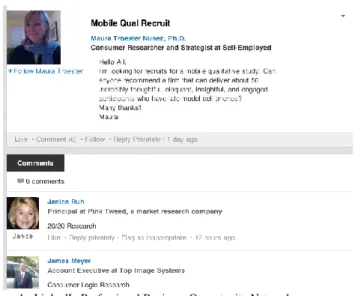
Within these forums, it regularly happens that professionals, launch a discussion related to a current work project in order to look for experts who are interesting in joining the project. Figure 1 offers an example of a researcher looking for a firm delivering recruits for a mobile qualitative study:
Figure 1; LinkedIn Professional Business Opportunity Network Illustration
(http://www.linkedin.com/profile/edit?trk=nav_responsive_sub_nav_edi t_profile (14/07/11))
So, in the case of an independent researcher, this post can be seen as a form of professional positioning for being an expert in recruiting panels for qualitative studies. The action of making an announcement within a subforum can be seen as introducing a potential business opportunity.
A next step for Ms Nunez in our illustration would be to look through different professional profiles of forum members who left comments. This leads directly to their professional summaries because, once users “click” directly on the “name” of a member, the initial profile view includes a photo, name, professional title and the beginning of the member’s professional summary. So, the content of summary becomes important due to it’s prominence in the initial profile view. This summary represents not only a description of professional expertise but also can be understood as a kind of advertisement for professional competencies and services being offered to the forum. This constructed image of a LinkedIn member can be understood as a form of personal brand management, or individual branding. Understanding the professional summary as part of an initial step in LinkedIn interactions has implications for content choices that reflect and construct a LinkedIn member’s professional identity.
From this perspective, any professional with a LinkedIn profile can be understood to be giving a professional promise. Not only that they are being accurate about describing their professional experience, competencies and expertise, but they are actively engaging in building their professional ethos, or credibility, especially in the summary section. This can be seen as a kind of promise implies that in presenting a profile, each member has the professional skills to fulfil the expectations that their choices of wording in the summary section invoke for a variety of audiences across disciplines and professions. Figure 2 illustrates part of a LinkedIn profile presentation
of a professional, showing the picture and part of the professional summary.
Figure 2; LinkedIn Executive Summary Illustration
(http://www.linkedin.com/profile/edit?trk=nav_responsive_sub_nav_edi t_profile (14/06/15))
A professional provides evidence designed to “prove” in Pringle’s sense of the branding promise [4], that his/her professional abilities relate directly to the subsequent descriptions of professional skills which communicate the LinkedIn profile owner’s professional experiences and education. Depending on a member’s professional goals within the social LinkedIn space, there are many ways to use this personal brand such as looking for a new position or searching for new business opportunities and professionals with common goals and interests to build one’s network. So, goes beyond the form of a public CV, because the engagement and history of participation in the forums works together with the profile content to connect audience expectations with the members’ experiences.
One metaphor that sheds light on the profile is to consider it to be a virtual version of a commercial window display that offers services and/or competencies as products. When the window displays in stores are interactive and allow the viewers to not only look, but also affect the display, they often attract more attention. A parallel can be seen in the action of being present within LinkedIn’s credible professional platform. A member’s LinkedIn presence signifies an interesting solution that allows one to go beyond a push model such as with professional web pages. Figure 3 demonstrates an example of professional experiences posted on a LinkedIn profile. It can be understood through a brand management frame here because of the necessity of constructing a professional image for potential clients and potential business and education networking.
For academics, the term “clients” can be seen as integrating students’ and their potential employers’ perspectives, as well as course clients, and clients from a consulting and research perspective. In the case of Figure 3 the researcher member demonstrates a combination of academic, public sector and private industry experience. This combination implies not only that the experience listed is accurate, but also that the professional will have
skills in making connections between these three sectors, and potentially have the ability to act as a mediator between the sectors—bringing practical issues from the public sector and private sector experience into their understanding of academia, as well as the ways in which they frame and connect academic and practical problems.
Figure 3: LinkedIn Brand Constructed Experiences Illustration (http://www.linkedin.com/profile/edit?trk=nav_responsive_sub_nav_edi t_profile (14/06/15))
To demonstrate that their skills are recognized by others as well as themselves, professionals can receive recommendations linked directly to their professional skills from other professionals. These terms can be set by the professional proactively, or they can be generated from the profile content by LinkedIn automatically. They create an additional level of interaction—when a member adds a contact or begins to work with their profile in LinkedIn, the platform suggests recommendations that can be made with a single click. If a member clicks on a recommendation for another member, the member being recommended has the ability to decide whether or not they would like it added to their profile.
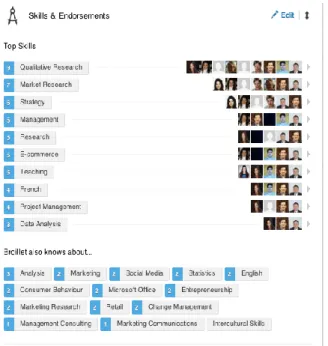
Figure 4 demonstrates some of the skills for which an academic or professional can be recommended. These recommendations are made by a member’s connections, and when people log into their own profiles, the LinkedIn platform suggests recommendation combinations for particular people and skills from their network. These recommendations can be accomplished with small effort— a simple click.
Sometimes, this can result in odd combinations if the member does not carefully control the choices. One of the authors ended up with synonyms—people who recommended them for teaching, and university teaching
as separate categories. Once a synonym category has been accepted by a professional, it is included in the algorithms that LinkedIn uses to offer it as an option. This can also result in unintended consequences for the profile owner— for example, once a skill such as teaching becomes a big category, other skills related to the content one teaches can end up being relatively small in comparison.
Understanding and working with the algorithms that LinkedIn automatically adds to the profile based the contents is an example of a new skill that professionals need to be aware of—to constantly consider the possible consequences for accepting a recommendation. So, it is quite possible that these recommendations are actually affected by choices that the machine makes, which make it easier for others to recommend a professional for the most commonly recommended skills in that person’s profile. Meaning that if a professional chooses not to accept teaching recommendations or recommendations related to other skills that they do not necessarily want to profile, their network will be shown more content focused recommendations. So this process results in a co-constructed profile with recommendations from the network only being added with active approval from the professional. Thus, the acceptance or rejection of a recommendation by professional contacts is part of constructed brand identity management.
Figure 4: LinkedIn Recommendations from Professional Network members.
(http://www.linkedin.com/profile/edit?trk=nav_responsive_sub_ nav_edit_profile (14/06/15))
In addition, professionals or academics can get an idea about “who views my profile”, adding professional or
academic publication highlights, showing affiliations to professional Groups, giving a selected access of Connections to other Professionals, etc. And this is only the range of the “Profile Category”. Within the “Interests” Category Professionals and Academics can get linked directly to Companies, Groups or Pulse that they are interested in. The following example is illustrating a “Pulse” page that is automatically adapted to the professional or academic profile:
Figure 5: LinkedIn “Pulse” Illustration connected to a professional or academic profile
(http://www.linkedin.com/today/?trk=nav_responsive_sub_nav_pulse (14/06/15))
The example shows “LinkedIn influencers”, too. They are professionals contributing added value in the form of content productions to different social discussions. “Influencers” is a label and category created by LinkedIn which can distinguish leaders in their field. A professional can choose to “follow” influencers to help them stay current in their fields of interest. In turn, as one is followed by an increasing number, with high ratings for quality and regular postings, it reinforces and allows a member to retain their influencer status. Influencers are designated by their participation and the responses they garner within a given LinkedIn group. When the LinkedIn algorithms identify a set of actions and responses by forum participants which fits their definition of “Influencer,” the member’s postings are marked with an “Influencer logo.” In our practical research, we focused only on the “Groups” related to the “Interest” tab. So, “Groups” function like discussion forums—with active posters, as well as listeners who read but do not necessarily engage regularly to create LinkedIn content here. A LinkedIn Group can be understood as more than a blog in the sense of the general definition, “A personal website or web page on which an
individual records opinions, links to other sites, etc. on a regular basis. » [5]. It also like a discussion forum, like the
general definition states “An Internet site where users can
post comments about a particular issue or topic and reply to other users' postings; a message board. » [6]. Yet, at the
same time, LinkedIn groups could also be understood as a space where active bloggers post back to their blogs, thus using the LinkedIn profile as part of a social media system for building their professional ethos. LinkedIn groups can
be seen as a connection space for both discussion and linking to blogs and other social media spaces.
“Group” affiliations can also be seen directly in the “Profile” category for each LinkedIn member. The list of Groups and their logos are displayed at the end of a member’s LinkedIn profile. Some of these groups are extensions of existing communities such as the Academy of Management or the IEEE, or University Alumni Societies. These are available to members of the societies. Other groups are emerging groups that can come from interest at a conference, or be set up around topics. Members can choose to join LinkedIn Groups with regard to their professional and/or academic interests.
As a member, one receives email notices about new topics with live links to encourage participation. Being active as a « group » member allows one to stay informed about new debates, on going debates, and news from “influencers.” As it is possible to see the Groups for one’s LinkedIn contacts, LinkedIn members can also learn about the activities and participation of their networks, and choose to join new groups by clicking on them from a connection’s profile. Thus, membership in groups, as well as participation, can play a part in building a professional ethos.
In order to integrate into a LinkedIn Group, LinkedIn members have to signal some interest not only in joining, but also in participating. That interest is seen through the major content discussions of LinkedIn forums examined here. So, future participants of a forum have to ask permission for access first. There is a procedure to follow if an individual wishes to join a forum within LinkedIn. In general, individuals already share interests with the group they choose to join before they even decide to ask for permission to access the group. Once an individual choses to join a group, an automatic message is send to the group manager. This choice to join can be understood as a virtual social action. Next, the individual has to wait for an answer from the group manager and in most cases, access is granted. The “new” member receives some kind of “welcome” message and information about a “code of conduct.” This last one represents an ethic code; behaviour rules are accepted by the “new member” and applied in future posts. Once, he or she receives this “welcome“ message, the “new” member can directly access any group debates and participate in different ways. These possibilities include just reading the different posts, demonstrating a positive opinion on the post with the “like” function. There is also a possibility to “follow” a specific member, if a personal interest does exist toward that individual. This function allows members immediate access to the latest comments of the chosen person.
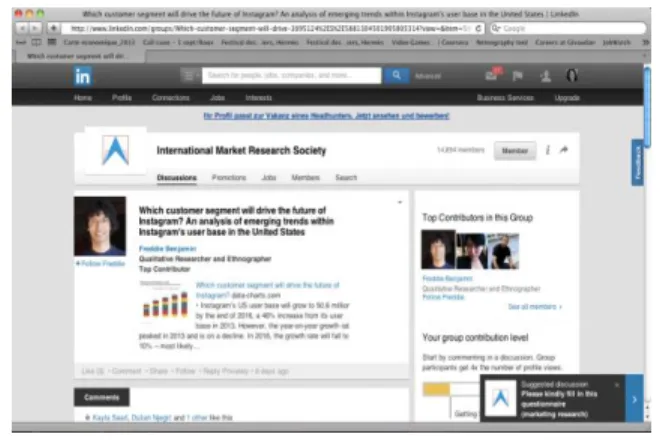
Debates within the forums can be started by anyone. When someone engages regularly, the LinkedIn system begins to attach labels such as “top contributor” or influencer, and shows their pictures on the interface to help them get known. These pictures link back to their profiles.
In Figure 6, a top contributor introduces a debate with a link to an external study on Instagram.
Figure 6: LinkedIn Invitation to a Professional Debate
(http://www.linkedin.com/groups/Which-customer-segment-will-drive-3095124%2ES%2E5881304501905805314?view=&item=58813045019 05805314&type=member&gid=3095124&trk=eml-b2_anet_digest-null-8-null&fromEmail=fromEmail&ut=1jhJmYtNVGNSg1, (14/06/15))
Others are able to like or comment directly on it, and each comment can then subsequently be rated by users. These actions are all used by LinkedIn algorithms to calculate the labels of “top contributor” and “influencer” which can be understood as an indicator of an emerging
ethos built on data from a users actions and others’
assessment of their quality derived from social media platforms.
In sum, LinkedIn is much more than an online version of a CV with links to a member’s professional network. It also offers a space through which professionals and academics can actively engage in building their ethos— both within communities in which they already participate such as the academic societies—the Academy of Management and the IEEE; and within new communities which can cross disciplinary boundaries and form around current issues or topics. The skills needed for effective engagement in LinkedIn are a starting place for investigating the role of social media in building and maintaining professional ethos.
KNOWLEDGE SHARING WITHIN LINKEDIN GROUPS AS A FORM OF
LIFELONG LEARNING
Our exploratory research focuses in particular knowledge sharing within LinkedIn groups as a form of on lifelong learning. Using data from participation of LinkedIn members in both local and global groups, we conduct an exploratory analysis that compares and contrasts some examples demonstrating how Linked-in groups are used in different contexts.
Because of the large quantities of data that exist in virtual social spaces, our exploratory research focus was limited directly to the authors’ professional field of interest: Qualitative Research Forums on LinkedIn. Therefore, our research question is, « What do Professionals and Academics, as qualitative researchers,
learn from participation in global and local LinkedIn forums on this topic? And what implications does this learning have from a managerial perspective? ». These practical learning insights from a qualitative research social platform can serve as a benchmark for examining how these examples of learning are related to or distributed throughout other LinkedIn professional social networks focused in other professional areas.
LITERATURE REVIEW
The purpose of our main research question is to contribute to a better understanding of professional behaviour within LinkedIn Groups. As this is a work in progress paper, we take an experiential approach based on our experiences participating in qualitative research forums. The authors represent three researchers and professionals from different backgrounds and are involved in different LinkedIn forums. We are all interested in qualitative research and exchanges with other professionals coming from both academia and industry. Although we regularly read, participate and learn from people coming from both local and global contexts, we are not always consciously aware of our learning processes and ways in which these forums support our own lifelong learning processes as academics. To help us reflect on the implications and potential long term consequences for each of our own professional ethos building strategies related to our experiences in LinkedIn, we looked at the fields of social media, knowledge economy & knowledge management to position the content and context of LinkedIn as a social media and knowledge management tool. In addition, to engage with the notion of lifelong learning in social media forums, we looked to the fields of sociology, consumer behaviour and grounded theory. Thus, this literature review is more about finding concepts and issues to help us reflect on LinkedIn than placing LinkedIn in the context of other social media studies. We do this in order to foreground notions of knowledge and lifelong learning in the context of the LinkedIn platform. LinkedIn could be treated using concepts in social media literature more from the technical information side [7-10]. Those references are more interested in how you can identify different frequencies of social action through adopted programs than in content identification and their production. We do not learn anything with regard to learning processes, participation and implications for ethos building strategies, or the actual content of these social media conversations. Mishne and de Rijke (2006) [7] identify different types of information needs for blog users as context- or concept-orientated. According to these authors [7], bloggers’ primary information needs focus on seeking new events, and secondarily on information leading to topics of interest. However, there was a lack of concepts related to the skills used to engage in social professional platforms, such as LinkedIn, from those
references. Keikha (2012) [11] gives insights for how text streams can be ranked through methods. But none of this literature about blogs and forums focuses on LinkedIn forums explicitly. And Keikha (2012) [11] focuses more on methods than content. So the question of what we, as professionals and researchers, can learn from these LinkedIn Groups remains to be answered.
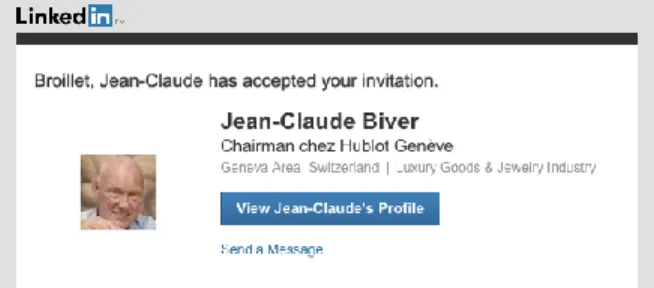
The focus on LinkedIn professional and academic forums is particularly interesting because they are not yet specifically being analysed via the scientific literature. From a knowledge economy perspective, they represent the economic potential of knowledge [2]. An example that points to this economic potential comes from demonstrating that key actors, like Jean-Claude Biver who is part of the Strategy Board of the LVMH Group and Founder and Chairman of the luxury watch brand Hublot, do accept personal invitations based on professional competencies. Figure 7, demonstrates the mail a LinkedIn member receives once he has accepted a professional invitation via LinkedIn.
Figure 7: LinkedIn Professional Network Acceptance, (Author’s personal mail box, (14/07/12)
Taking the example of Switzerland, within forums, such as Swiss Management Consultants, or the Swiss Roman Network, offline business meetings are organized for professionals to participate in business networking. Economic Actors, like Jean-Claude Biver or others, cannot be ignored from the Manager’s perspective. Many business exchanges and social interactions are communicated and even come about through this particular professional social network. LinkedIn cannot be compared to private social networks, like Facebook, because it is used by businesses for job recruitment and multiples business projects. In the case of Denmark, even as a place where online applications are directly linked to job descriptions posted by local industry. So, are LinkedIn communities functioning as communities of practice [12]? What is the relationship between professional identity and content in the posting practices? What is the information value a professional do get from the contents of those Forums? The forums investigated use inside access procedures in which users are introduced to Group Managers through current group members or self-introduction. The Group Manager chooses who may access the list—sometimes with respect to society membership, such as with the IEEE communication
and Academy of Management (AOM) forums. Sometimes the choice is made based on the profile of the person requesting access.
We approached the problem of understanding lifelong learning in LinkedIn forums from a multidisciplinary perspective, bringing together sociology, consumer behaviour and grounded theory. This multidisciplinary of social science literature forms a basis for this approach, as we consider professionals as individuals acting within a professional social space. The consumer behaviour can be seen through professional behaviour among professionals and academics being active within a virtual market place. The sociological view of constructed identity of individuals according to Singly [13] permits one to consider a LinkedIn group member as an individual active in both physical and virtual social life. So, there is no contrast between online and offline learning behaviours for LinkedIn group members. Rather, these spaces are understood as inherently linked together. Further more, the consumer behaviour literature gives us insights for defining virtual communities [14], loyalty [15] and trust [16].
Virtual Communities and Individual Participants According to Rheingold [14] a virtual community can be considered as an association of individuals sharing content based on similar interests. Extended discussion within these virtual community forums include a feeling component [14], which can be understood as the more one posts in forums, the more one feels touched by the discussions, themes, or comments left by other members. Based on Rheingold’s analysis, a member should be more concerned by his or her personal investment within a social media forum. Individuals translate their feelings into a form of continuous virtual social actions as seen in their posts to the forums. Relationships among members should grow deeper [14].
Through LinkedIn, virtual communities that focus on professional content have no formal time for an introduction phase. [14]. Members get to know each other through the content and presentation of their posts and the contents of their profiles. So, does this really differ compared to a face to face “introduction phase” within a physical social space, like a conference? What is the relationship between feelings and professional communication? Could Aristotle’s notion of pathos explain it adequately?
Constructed Identity, and LinkedIn “Procedure” A member of a virtual group participates in a discussion [17] that represents value production in form of social action. Or professionals or academics search for information across existing discussions [18] according to Muniz and O’Guinn within brand communities. Mackiewicz [19] treated the co-construction of credibility
within product feed-back forums. Credibility can be attributed directly to the dialog among members of a LinkedIn group. Participating as a member of a discussion forum, asking questions and searching for information illustrate a general lifelong form of learning behaviour. So, LinkedIn groups can be considered as virtual learning spaces that represent a professional and academic credibility [19] among their members.
In the Consumer Behaviour literature from the field of Marketing, the relationship between online and offline experiences has not yet been adequately resolved or generally accepted. According to Wang and Benbasat, individuals bring their computer mediated or virtual interactions into the physical spaces around them [20]. Therefore, LinkedIn Group members can be seen as individuals being present through their social identities based on physical life experiences [13]. They are acting within social virtual spaces in including social rules [21]. So, a LinkedIn member does act as an individual based on his own real life and virtual experiences and therefore, his own learning experiences. This means also that professionals and academics are aware that learning behaviour of as a LinkedIn member participating in a group discussion may differ from behaviours generally used in a face-to-face class, for example because of the affordances offered by the online platform.
Although, the same person participates in both types of social spaces (physical and/or virtual), the opportunities and social structure of the context affect possibilities and choices for learning behaviours. So, a LinkedIn group member can be considered as a “whole” social identity. Therefore, we do not distinguish virtual and physical learning behaviour from the point of view of constructed identity of an individual. In effect, an individual sits in front of his Computer, iPad, iPhone or any other technology based communication tool and learns from a LinkedIn Group’s Contents. This offers an example of the actions from the virtual world playing out as part of the “physical social life”. So the “Procedure” of access and participation within a LinkedIn Group can be considered as part of a social constructed identity of an individual, as well as a socially constructed learning behaviour. Consequently, the learning experience is part of a socially constructed identity and may explain the “how and what” within a LinkedIn group.
Loyality and Trust within Virtual Social Spaces Active participation of individual members within forums can be compared to brand loyalty [15]. As shown in the introduction, a professional summary can be understood part of a constructed brand identity. Brand loyalty can be seen through frequent exchanges among professionals and academics within the LinkedIn groups. Loyalty can be seen through the use of the “Follow” function. This means that individuals are loyal to certain influencers. This loyalty can be seen as the number of
appearance of posts and comments left within a group. This does not mean that LinkedIn members agree automatically with the content of LinkedIn influencers.
LinkedIn members show they are impressed with others when they choose to use the “Follow” function. This signals that they are interested in receiving and engaging with regular contents coming from those “influencers”. This social action can be understood as a parallel to brand loyalty.
For example, once a client likes to consume Apple products and services, he or she is showing brand loyalty. As we explained that a professional profile can be considered as a constructed brand identity, the regular consultancy of certain professionals and their posts and comments can be understood as a consumer behaviour as in brand loyalty [15] literature. It represents social action in form of economic implications – the more a professional or academic is “viewed” by others, the more he is visible to potential clients. According to Shang and al. (2006) [15] a client leaving his posts on a forum about a product being part of a brand is more connected to the brand. This connection can translate into deeper feelings in regard to the brand, product change and social image of the brand. This is the same with Professionals and Academics being frequently active within professional Forums. Further on, classic Marketing Literature [22] give more details in regard to a proper creation of communities and the strategies that have to be developed for managing those. So, according to Jallet (2003) [22] from the company’s perspective, the client is to be seen as an active person taking an active part in the production of brand value. Reichheld and Teal (1996) [23] call it the “Loyalty Effect” that represents constant revenue to a firm [24]. Consequently, Individuals are loyal to certain brands and group members of a social space are loyal to certain LinkedIn groups. So, we may compare the user behaviour here to the branding literature coming from the field of Marketing. Professionals and academics look for business opportunities and professional networking within their field on the LinkedIn platform. For example, professionals get known, diffuse their expertise and discuss with people from all over the world. The needs of an educational market, for instance, can be identified directly through the discussions within a group. From the Marketing field, we know that about 78% of consumer evaluations in virtual social spaces are trusted [25] in regard to a product, service or brand. That means that a learning content treated within a social space, such as within a LinkedIn group, is more trusted with regards to contents diffused in a physical classroom, from the very beginning of a virtual group debate.
Credibility is a combination of expertise and trustworthiness [26]. Mackiewicz [19] treated the notion of trustworthiness from the technical communication side. One of her components of credibility within product feed-back forums is described as situated trustworthiness in the
form of technical communication strategies. These include quantity of users, review quality, recognitions and length of time as a site member. But it does not teach us something about the “how and what” professionals and academics may trust within a social professional space. Professional learning credibility of research groups within LinkedIn is given through the pre-selection process. Mackiewicz [19] does not integrate any pre-processes of online product reviews in her study. Furthermore, we know that sometimes individuals trust virtual sales in comparison to physical ones [12]. So, the existence of a level of trust among members being part of the same LinkedIn group can be inferred.
Further on, the economic learning impact is huge, as LinkedIn Groups have a very high number of members and the ability to get in touch with individuals on a worldwide [21] basis. Consequently, as professionals we have to understand the “how and what” of learning behaviour within a LinkedIn Forum based on loyalty and trust. This “how and what” approach is interesting because of the economic potential for business and professional networking opportunities available in LinkedIn.
METHODOLOGY
Our methodology frame includes grounded theory [19]. It is an inductive reasoning research approach according to Saunders and al. (2007) [28]. From specific LinkedIn debates within Professional and Academic Forums we try to give some general insights. Based on our main Research Question of “How and What Professionals and academics do learn from LinkedIn Forums”, we had to choose a summary format [28] to be able to give first general professional practical insights. We do remind that this is a work in progress paper. So, due to the huge quantity of raw data, the choice of the inductive research approach was reasonable. Our research objective is to give first practical insights to Technical Communication Industry, as well to the Business and Learning Industry.
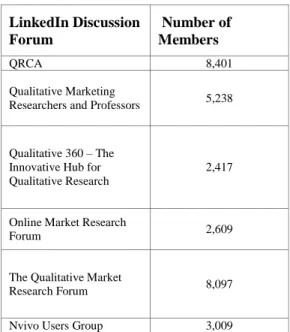
Three researchers are members of different research groups on LinkedIn. So, six qualitative research groups have been selected. Because of personal professional research interest, we chose: QRCA (Qualitative Research Discussion), Qualitative Marketing Researchers and Professors, Qualitative 360 – The Innovative Hub for Qualitative Research, Online Qualitative Research Forum, The Qualitative Market Research Forum and Nvivo Users Group. The following table is illustrating the number of members of each Forum and therefore giving a potential of a 29,771 individuals long life learning market potential.
TABLE 1.ILLUSTRATION OF ECONOMIC POTENTIAL THROUGH SCOPE OF MEMBERSHIP FOR LIFELONG LEARNERS
LinkedIn Discussion Forum Number of Members QRCA 8,401 Qualitative Marketing
Researchers and Professors 5,238
Qualitative 360 – The Innovative Hub for Qualitative Research
2,417
Online Market Research
Forum 2,609
The Qualitative Market
Research Forum 8,097
Nvivo Users Group 3,009
One of our research group members worked with participant observation during a 5 month period, using observation and note taking. The rest of our research team observed for a period of one month and data for this study have been collected from the different discussions during this time period. The observation notes have completed results, but due to repetition in the data, the collection phase was limited to one month. The following Figure is showing an example of collected data:
Figure 8: Illustration of collected data from the professional of LinkedIn Forums
The Netnography method [29-32] was used for analysis. So, 69 posts have been retained, each containing 2 general discussion themes, on average. We begin with compiling corpora of the forum contents. LinkedIn labels like “New Discussions” and “Still Active Discussions” permitted us to distinguish between new and continuous debates. During the one-month’s study, we only added new comments to the Database. Then the extra-textual features were removed. So, we eliminated visual data and tool features provided by the LinkedIn platform, including “like,” and “private reply” functions. So, the written post data represents a 80 page file. In addition, we created a second corpus file, which included only the titles of the announced
discussions. During the observation period, an Excel file was created, containing the number of social interactions linked to discussion group themes, references given, the type of long life learning support and whether there are job announcements. Patterns for types of learning support include social interaction behaviours that could be identified.
Further on, we used an open source program to deal with the information as a corpus, and counted the frequency of words [32] within the 80 pages file combining the 30 days of collected posts. This phase served as a control in identifying learning patterns. This process permitted us to understand connections between content and identity present in this lifelong form of learning for members of these forums—where academics and practitioners can learn about the latest technology based research processes. Therefore, both academics and practitioners can develop their skills to become up to date with technology-based tools as support for developing their research.
This corpus approach focusing on frequency of vocabulary use permits us to identify patterns, which can help us understand the connection between content and identity present in this lifelong form of learning. Additionally, we realize a cross-member check of our data and identified patterns could have been confirmed.
Finally, we analysed 65 LinkedIn groups including social interactions in form of 246 comments and 134 “likes.” In all these categories, social interactions have most frequently occurred in the form of interactive debates. So, a high frequency of social interactions in form of comments and/or “likes” is directly connected to them. The length of comments varied substantially, with the average message length being 25 words long. Approximately 5 % of the 246 comments left within these Forums were longer than 250 words in length. These longer messages are considered as themes within the forum.
We had no support coming from literature in regard to Lifelong learning within LinkedIn Groups. Therefore, our grounded theory approach helped us to stay “open minded” and focus on the qualitative side of the study, especially results emerging directly from the sets of data we collected in this virtual social space.
LIFELONG LEARNING EXPERIENCE PATTERNS As this a work in progress paper, three (3) general
lifelong learning experience patterns in LinkedIn forums
have been identified. These patterns illustrate the approaches to learning behaviour contained in their titles and give first answers to our main research question of the “How and What Professionals and Researchers do learn from LinkedIn Forums?”. We named them: a) “Help me out and let’s learn together”; b) “Technical Features Learning Centre”; and c) “Social Networking Learning Platform.” So, we propose an approach to understanding
LinkedIn forums as communities that share content and are socially willing to interact around that content.
The learning experience can be seen here as an individual willingness to share and exchange knowledge or information within the online group. In this context, a comment from an individual is not seen as an “expert opinion”, but rather, as a social contribution to a whole group discussion context.
We see our long life learning experience patterns as behaviours supporting lifelong learning that a LinkedIn forum user can experience within these virtual social spaces. In the beginning of our study, we considered the LinkedIn platform as a frequently used European professional platform. Through the job posts, we learned that Forum members come from all over the world, not only Europe. Some of them represent a very high rate of “American” memberships, like the Qualitative Market Research Forum, or the QRCA. Although, we did not include job post debates in our analysis, it helped us, to learn more about international culture presences on the LinkedIn platform. We omitted the job seeking posts because we did not see it as the primary interest for joining a LinkedIn Research Group
One interesting point between LinkedIn exchanges and conferences is that the interaction may differ completely from a Face to Face Research Conference setting where attendees listen to speeches of “experts “ within their fields. Exchanges are debates, but the expert’s opinion will generally carry a higher weight and thus be perceived differently from the other participants. This form of expert to non-expert communication was found with “single announcement” Forums, directly connected to links leading to Books, Manager Research Implications Articles, or Research Studies. These links are certainly read, but in most of the cases, there are no comments, or “likes” left in response to one-way communication efforts. Rather, the key learning interactions on LinkedIn forums were observed in the three life long learning patterns we found initially. These patterns are described in detail below:
I. “Help me out and Let’s learn together”
In this learning behaviour pattern, general themes, like open research questions, are discussed and shared. A typical question might be:
“What are your recommendations for Web Streaming
from a facility not using the usual suspects?” or “What are the New Qualitative Methods Tendencies?” Or “Listen, I do have the following client Research Issue… what is your opinion about…?”
The content in contributions are often tested and tried in the writer’s context, whether they are based on their own research and practical experiences, or secondary sources such as books, articles or other references. The evolution of these kinds of debates can be reminiscent of “simple brainstorming” sessions. Compared to a face to face classroom, launching ideas and describing them would be
a learning experience tool with a limited context. But brainstorming in a limited context rarely elicits direct secondary source references, or proven learning experiences. However, this is the case within the LinkedIn virtual research forums we observed here.
Initial posts usually contain concrete research problems, leading to specific exchanges around possible solutions and implications, which is then shared socially through the different comments emerging from different contexts in which each forum member participates. This includes using secondary references for debate and engagement of key issues. Many comments also use the simple and quick “Like” function, to demonstrate “the same opinion” as a form of social action. So, the combination of these uses of comments, content and features together in LinkedIn forums illustrates that a member of a group receives support and learning opportunities not from an individual helper, but a socially collective community.
Every member shares together in the process of life-long learning. This can take different forms such as reading the forum content, participating by commenting directly or leaving an opinion in the form of agreement through the “like” function. Learning experiences emerge here as forum members participate and discover new references together. Members learn together about emerging research themes that represent common interests of the LinkedIn group.
II. “Technical Features Learning Centre”
Qualitative methods can include a pool of different technology based tools, especially by practicing different methods of Social Media Research that rely on technology. See, the following example:
Source: LinkedIn Forum data collected by primary author.
So, new technology based research tool debates occur with high frequency and large scale sharing. Members participate, for example, by suggesting new tools and letting members discuss different aspects related to their application and usefulness in answering research questions. So, LinkedIn members learn about cutting edge technology based tools used for emerging research methods, how they function, and what are the related benchmarks for both effective technology use and learning about qualitative research methods.
This lifelong learning pattern is reminiscent of “Frequently Asked Questions” or other quick help functions that users of new technologies may find on an official Company’s Website. But those product-focused help forums can be understood as single content in nature, due to their focus on the product and users of that product. In contrast, on LinkedIn forums, we find that a large variety of learning needs for technology support for researchers today are addressed. Those debates give a good market picture of technology based research tools and methods related to consumer needs.
III. “Social Network Learning Platform”
The last lifelong learning pattern focuses on networking, but not in the sense of a “Job Seeking” Networking function. Although it sometimes happens that “private replies through the system” may lead to job changes, this is not verified here. Instead, this pattern focuses on issues like the following set of common problems:
” I have to realize the following job for a client and I search a contact to support me in realizing a part of my project…”, or “Do you know someone in the industry of…”, or “Who is interested in writing a Colorado Book Chapter…”, etc.
So, in effect, the LinkedIn platforms create a space where learning experiences pass directly through the LinkedIn social networking platform. Social interactions are shared and visible to all members of the group, so individuals may get to know other people and learn more about their research competencies and areas of experience and expertise. This can be understood as a space for
developing “transactive memory systems” in which forum members, much like virtual team members in organizations, develop an understanding of knowledge in terms of learning and knowing about other participants’ expertise [33]. These lifelong learning experiences can be assimilated to an address book/knowledge reference database or other form of extended reference storage, adding all kinds of qualitative information to contacts through observing their participation and interacting with them in LinkedIn forums. In this case, information shared and learned by any member of the Group is constructed through collective social actions. The lifelong learning experience represents a high economic value here, as you may learn about new contacts and extend your network through the addition of marginally related researchers, who may be from other fields. The importance of such an extended network is examined by Granovetter (1983), as he argues for the strength of weak ties [34] in the context of diffusion of innovation, suggesting that innovative ideas emerge from interactions with weak ties or peripherally related people. LinkedIn forums which are multi-disciplinary by nature offer the opportunity for academics to develop large numbers of weak ties, and even create transactive memory systems out of weak tie relationships with researchers across traditional disciplinary lines. This opportunity is even richer, as the member base of LinkedIn forums represent worldwide researchers with a large quantity of research collaborations for a variety of research areas and connections from research to business.
LIFELONG EXPERIENCE LEARNINGS AND CONCLUSIONS LinkedIn Forum participations offers three key opportunities for lifelong learning—getting help with immediate problems, learning about the latest technology, and building professional networks with the “strength of weak ties” [34]. These practical professional insights are very important for any social reputation and representation of Professionals and Academics. A recent Professional Consumption Report 2014 [35] from LinkedIn concurs with and can be understood as triangulating our preliminary findings. This report was not available at the time we worked on this project.
In observing how people engaged with these opportunities, we found some practical learning insights with regard to lifelong learning behaviour. They can be considered as a series of Manager’s implications:
Avoid “single announcements” with direct links to any kind of membership’s connected references. They may be perceived as a different kind of advertisement for books, or other publications. In most of the cases, they are “punished” by the virtual community by a lack of participation.
Integrate publications, and expert opinions directly in a debate in the form of a comment. It gets even more professionally credible, if a different member uses your publication.
Submit individual comments that can be seen as a contribution to the community, and acknowledge the social actions of others
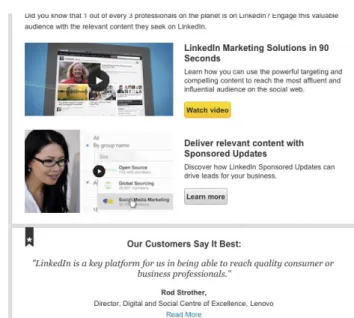
LinkedIn platforms, like other virtual forums, permit a continuous learning experience. A recent professional consumption report 2014 [35] from LinkedIn says that “On average, they spend about 1 workday (8 hours per week) consuming professionally relevant content as a way to educate themselves on their industry news and trends. ». New and emerging practices and issues in any field of research can be discussed quickly from all over the world. Understanding how these practices are diffused throughout academia as a global endeavour can be further investigated through designing research studies to examine weak ties and transactive memory systems as elements of both global and local knowledge diffusion practices emerging from the forums. Figure 9 demonstrates how LinkedIn presents itself as a professional social media tool supporting the construction of professional brand identity.
Figure 9: Construction of Brand Identity within LinkedIn, (Source: LinkedIn Consumption Content Report 2014)
The role of local culture in the diffusion of knowledge practices and the development of transactive memory systems [35] would also be interesting ways to develop a further understanding of effects that culture may have on interactions around knowledge, emerging research methods and technologies in these cross disciplinary research forums. Situating LinkedIn in terms of the transactive memory system literature would be an interesting place to start developing effective questions for better understanding the social aspects of lifelong learning in LinkedIn forums.
We conclude that our results represent general exploratory lifelong experience patterns that are partly confirmed by an external professional report [36] from LinkedIn. Further comparisons focused on including other professional platforms would also be useful for future directions in understanding the potential and actual impacts of these LinkedIn Forums. Also, further research focused on more nationally located social media Platforms may bring some culture insights related to knowledge as well. Companies may be interested in further investigations of the economic impact of Forums before launching specific Company-wide discussion groups on professional social spaces. LinkedIn groups provide links and show patterns of how people make meaning, and therefore, demand a process for “content management” from the Company’s side. Let us finish our paper with the following illustration of practical applications for our preliminary findings about LinkedIn groups. When we
downloaded the LinkedIn report, we got the following suggestion directly in our private mailbox:
Figure 10: Illustrating Practical Applications for using LinkedIn as a marketing tool (Source: Author’s personal mailbox, (14/07/07)
Figure 10 shows LinkedIn’s business strategy as trying to use lifelong learning processes and the data and content generated from participating on this social media cite for marketing purposes. However, as we suggested earlier, lifelong learning has broader implications at the societal level when it is done is public, in a group where both content related and general user action data can be collected and used to give the corporation who owns it an advantage in the market. So Technical Communicators and Marketers alike should consider how new skills as well as shared content learning spaces affect professional ethos, the ability to build effective networks and get global recognition for future employees. For future employers, the focus is moving towards finding effective ways of using LinkedIn as a recruitment and hiring tool. All of these ways for using LinkedIn are both affected by, and reflect lifelong learning processes and their current, as well as potential impacts on society.
REFERENCES
[1] (December 2013) By the Numbers : 48 Amazing LinkedIn
Statistics ; [Online]. Available:
http://expandedramblings.com/index.php/by-the-numbers-a-few-important-linkedin-stats/#.Us6Zd3DvWWc, (01/09/2014) [2] LinkedIn Statistics 2013, [Online]. Available: http://fr.slideshare.net/punchmedia/linkedin-statistics-2013, (01/09/2014)
[3] F. Wagnières, 2012, Étude sur l’utilisation des réseaux sociaux en bibliothèque universitaire : le cas de l’intégration de la Bibliothèque de l’EPFL, Bachelor Thesis, HES-SO, Geneva. [4] H.Pringle, and W. Gordon, Brand Manners: How to create the self-confident organisation to live the brand. Wiley & Sons, 2001.
[5] General Definiton of a Blog, [Online].
http://www.oxforddictionaries.com/definition/english/blog, (14/07/2014).
[6] General Definiton of a Forum, [Online].
http://www.oxforddictionaries.com/definition/english/forum, (14/07/2014).
[7] G. Mishne and M. de Rijke, « A Study of Blog Search. » In: Proceedings 28th European Conference on Information Retrieval (ECIR 2006), LNCS 3936, April 2006, pp. 289-301.
[8] W. Weerkamp and M. de Rijke, « Credibility-based reranking for blog post retrieval. », Information Retrieval Journal, 15(3-4), pp. 243-277, June 2012.
[9] W. Weerkamp, K. Balog and M. de Rijke, « Finding Key Bloggers, One Post At A Time », In: 18th European Conference on Articificial Intelligence (ECAI 2008), July 2008, pp. 318-322. [10] K. Balog, M. de Rijke and W. Weerkamp, « Bloggers as Experts ». In: SIGIR 2008, July 2008.
[11] M. Keikha, « Methods for ranking user-generated text streams : a case study in blog retrieval », University of Svizzera italiana, 2012.
[12] E. Wenger, Communities of practice: Learning, meaning, and identity. Cambridge University Press,1998.
[13] F. Singly, « Choisir des « lunettes » sociologiques pour mieux voir la realité social », in Nouvel manuel de sociologie, F. Singly, C. Giraud et O. Marting, Paris, Armand Colin, 2010, pp. 18-27.
[14] H. Rheingold, Virtual Community : Homesteading on the Electronic Frontier . The MIT Press, 1993.
[15] R. Shang, Y. Chen and H. Lia, « The Value of Participation in Virtual Consumer Communities on Brand Loyalty. » Internet Research 16, 2006, p. 398.
[16] S. Komiak, W. Wang and I. Benbasat, 2004, « Trust Building in Virtual Salespersons Versus in Human Salespersons : Similarities and Differences. », E-Service Journal vol.3.no. 3, 2004, pp. 49-63.
[17] A. Armstrong and J. Hagel, «¨The Real Value of Online Communities. », Havard Business Review, 74, pp. 134-141. [18] A. M. Muniz and T.C. O’Guinn, “Brand Community.” Journal of Consumer Research, 2001, 27, pp. 412-431.
[19] J. Mackiewicz, “The Co-construction of Credibility in Online Product Reviews.”, Technical Communication Quarterly, vol. 19 no.4, 2008, pp. 403-426.
[20] W. Wang and I. Benbasat, « Trust in Adoption of Online Recommandation Agents. », Journal of the Association for Information Systems, 2005, 6, pp. 72-101.
[21] J.E. Brown and T.L. Tuten, “I Don’t Know You, But I Trust You”, in Virtual Social Identity and Consumer Behavior, N.T. Wood and M.R. Solomon, edsø M.E. Shapre. 2009. pp. 61-72. [22] F. Jallet, “Le marketing électronique”, in Le Marketeur. Les nouveaux fondements du marketing, Pearson Education, Paris, 2003. pp. 409-429.
[23] F.F. Reicheld and T. Teal, The Loyality Effect, Havard Business School Press, 1996.
[24] C. Lovelock and J. Wirtz, Services Marketing. People, Technology, Strategy, 6th edition, Canada, Pearson, Prentice-Hall,
2007,
[25] “Consumer Trust: Word of Mouth Rules”, Brand Strategy, November 2007. pp. 40-41.
[26] H.C. Kelman, “Processes of Opinion Change.”, Public Opinion Quaterly 25, 1961, pp. 57-78.
[27] L. Schatzman and A.L. Strauss, Field Research, Strategies for a Natural Sociology, 1973, New Jersey, Prentice-Hall. [28] M. Saunders, P. Lewis, A. Thornhill, Research Methods for Business Students, 4th edition, 2007, Prentice.
[29] R.V. Kozinets, “I want to believe: A netnography of the X-files subcultures of consumption. Advances in Consumer Research, 1997, vol. 24, pp. 470 – 475.
[30] R.V. Kozinets, and Handelman, « Ensouling consumption : A netnography exploration of the meaning of boycotting behavior », Advances in Consumer Research, 1998, vol. 25, pp. 475 - 480.
[31] R.V. Kozinets, « On netnography : Initial reflections on consumer research investigations of cyberculture ». Advances in Consumer Research, 1998, 25, pp. 366 – 371.
[32] R.V. Kozinets, « The field behind the screen: Using netnography for marketing research in online communities ». Journal of Marketing Research, 2002, Feb, 39(1), pp. 61 – 72. [32] Word Counter Open Source Program, [Online]. Available:
http://www.trabix.net/wordcounter/index_text.php, (05/05/2014).
[33] J. Liao, N. L. Jimmieson, A. T. O'Brien and S. L. D. Restubog. «Developing Transactive Memory Systems: Theoretical Contributions From a Social Identity Perspective ». Group & Organization Management, vol. 37 no. 2, 2012, pp. 204-240.
[34] M. Granovetter, «The Strength of Weak Ties: A Network Theory Revisited Sociological Theory, vol. 1, 1983, pp. 201-233.
[35] K. Lewis, D. Lange, L. Lewis. «Transactive Memory Systems, Learning, and Learning Transfer » Organization Science, vol.16 no. 6, November-December 2005, pp. 581-598
[36] Professional Consumption Content Report, LinkedIn, [Online].
ABOUT THE AUTHORS
Alexandra Broillet Ph.D, works as an independent Researcher, Teacher and Consultant in Marketing, Consumer Behaviour and Innovative Strategy Insights. Her Research interests cover Culture Perspectives of Consumption, Communication Behaviour for Products and Services, Qualitative Methods, including Anthropologic Methods for Business Issues within Virtual and Physical Social Spaces, Experience & Experimental Marketing, Innovation, E-Business and Luxury Strategies. Her transversal, international professional experiences are based on practical business experiences, Academic teaching and Applied Business Research. Her records cover practical and academic publications.
Constance Kampf, Ph.D., is an associate professor in the department of Business Communication, Business & Social Sciences, Aarhus University, Denmark. Her research focuses on communication at the intersections between technology, business and society. Recent works include "Art Interrupting Business, Business Interrupting Art: Re(de)fining the Interface Between Business and Society", a chapter in the 2014 book, Cyberactivism on the Participatory Web, edited by Martha McCaughey for Routledge.
Sabine Emad is professor of Marketing at the University of Applied Sciences – Geneva Business School (HEG-Genève). Her research areas are Virtual Worlds, Virtual Reality and disruptive business models such as new educational models or collaborative consumption. She is currently finalizing her PhD thesis in Business Administration / Information systems at the University of Lausanne (Switzerland) on Teaching Marketing in Virtual Worlds, in which she developed a teaching method for which she recently won the inaugural “Innovation in Case Teaching” global competition of the Case Center (2013).