HAL Id: hal-02057481
https://hal.archives-ouvertes.fr/hal-02057481
Submitted on 15 Apr 2020
HAL is a multi-disciplinary open access
archive for the deposit and dissemination of
sci-entific research documents, whether they are
pub-lished or not. The documents may come from
teaching and research institutions in France or
abroad, or from public or private research centers.
L’archive ouverte pluridisciplinaire HAL, est
destinée au dépôt et à la diffusion de documents
scientifiques de niveau recherche, publiés ou non,
émanant des établissements d’enseignement et de
recherche français ou étrangers, des laboratoires
publics ou privés.
Ethnoarchaeology of Paleolithic Fire: Methodological
Considerations
Carolina Mallol, Auréade Henry
To cite this version:
Carolina Mallol, Auréade Henry.
Ethnoarchaeology of Paleolithic Fire:
Methodological
Con-siderations.
Current Anthropology, University of Chicago Press, 2017, 58 (S16), pp.S217-S229.
Ethnoarchaeology of Paleolithic Fire
Methodological Considerations
by Carolina Mallol and Auréade Henry
Most of the ethnoarchaeological literature on hearths is scattered within general works that target many different aspects of foraging or hunter-gatherer societies. Although these works are a good source of ideas and clues for the interpretation of macroscopically observable features of Paleolithic hearths, there is hardly any high-resolution ethnoarchaeological reference material with which to compare microstratigraphic evidence of archaeologicalfire. Our ethnoarchaeological research at this scale has focused on exploring differential preservation of open-air hearths and the potential to identifyfire-related activities and different variables of fire technology (fuel, temperature, and function) using micromorphological and anthracological analysis. Although these studies have been useful sources of analogy, further case studies as well as ethnoarchaeological examples of superposed and imbricated hearths and reference material from enclosed settings such as caves and rock shelters are strongly called for. In this paper we summarize and discuss aspects of our previous work to highlight the strengths and weaknesses of the ethnoarchaeological approach for the study of Paleolithicfire and propose possible avenues for future research on the topic.
Fire has played a fundamental role in the biological and social evolution of humankind. Omnipresent in the domestic and ritual spheres since Paleolithic times, it has been influential for our diet and associated with the emergence of technological, sociological, and artistic expressions in different past societies (Perlès 1977). However, despite its potential to furnish valu-able behavioral information on our most distant past, anthro-pogenicfire has been an elusive topic in prehistoric research. Most researchers have focused on trying to establish the pres-ence or abspres-ence offire in Paleolithic contexts in order to as-certain the timing offire control and use, rarely examining the evidence in order to better understand human lifeways.
Nevertheless, there is a growing number of studies on ar-chaeological combustion structures, combustion residues, and other elements of the archaeological record bearing traces of burning. Such archaeological remains convey not only socio-economic, dietary, and paleoenvironmental information but also clues to site formation and taphonomy. All of these aspects are central to Paleolithic research. Accordingly, recent methodological approaches from different archaeological
sub-disciplines (particularly geoarchaeology, archaeobotany, and zooarchaeology) have contributed valuable data to advance our knowledge of Paleolithicfire and fire-related activities (Aldeias 2017; Alperson-Afil 2017; Costamagno et al. 2009; Hlubik et al. 2017; Holdaway, Davies, and Fanning 2017; Mentzer 2014; Théry-Parisot, Chabal, and Costamagno 2010).
Among these approaches, bioarchaeological analyses (in the sense of analysis of organic materials) of combustion remains— commonly charcoal, but also bone or phytoliths—provide valuable taphonomic data in relation to fuel management and hearth functionality, thus allowing us to better understand en-vironmental and economic aspects of past societies (Théry-Parisot, Costamagno, and Henry 2009). Similarly, geoarchae-ological analyses of hearths or combustion structures, which are in fact sedimentary artifacts, contribute similar kinds of in-formation in addition to an understanding of the hearths’ formation processes (Goldberg, Miller, and Mentzer 2017; Mallol, Mentzer, and Miller, forthcoming; Mentzer 2014).
With increasing studies of anthropogenicfire in Paleolithic archaeology, it has become relevant to incorporate this topic into the ethnoarchaeological research agenda. Some archaeo-logical subdisciplines, such as zooarchaeology, have incorpo-rated ethnoarchaeological research into their interpretive framework (Abe 2005; Costamagno and David 2009; Kent 1993; Monahan 1998; Sázelová et. al. 2015; Svoboda et. al. 2011; Waguespack 2002). Over the years, ethnoarchaeological research has also incorporated a microscopic scale of obser-vation, as in the study of ethnographic artifacts as reference data sets for archaeological use-wear analyses (Beyries 1995; González-Urquijo, Beyries, and Ibáñez 2015; Mansur 1983). Despite these efforts, the ethnoarchaeological fire record is
Carolina Mallol is Ramón y Cajal Researcher in the Departamento de Geografía e Historia of the Universidad de La Laguna (Campus de Guajara, 38071, La Laguna, Tenerife, Spain) and in the Instituto Uni-versitario de Bio-Orgánica Antonio González (Avenida astrofísico Fran-cisco Sánchez, 2, 38206, La Laguna, Tenerife, Spain [[email protected]]). Auréade Henry is a Postdoctoral Researcher at Centre National de la Recherche Scientifique, Unité Mixte de Recherche (CNRS-UMR 7264 CEPAM, Université Côte d’Azur, CNRS, Nice, France [aureade.henry @cepam.cnrs.fr]). This paper was submitted 25 VII 16, accepted 3 II 17, and electronically published 16 V 17.
understudied, and the reason might be thatfire residues are predominantly sedimentary in nature (ash and minute charred residues embedded in sediment) and the study of the sedi-mentary context in ethnoarchaeology is relatively recent, with only a few published case studies (see Friesem 2016 for a re-view on this topic).
In this paper wefirst briefly review and discuss the role of fire in ethnoarchaeological research applied to Paleolithic ar-chaeology and then summarize and discuss two examples of our previous research onfire in ethnoarchaeological contexts. Our goal is to highlight the kinds of questions that can be addressed by studying the ethnoarchaeological record of an-thropogenicfire and possible pitfalls. We also set forth a few methodological guidelines that, based on our experience in geoarchaeology and anthracology applied to ethnoarchaeolog-ical contexts, may aid in procuring useful ethnoarchaeologethnoarchaeolog-ical data toward an understanding of archaeological combustion structure formation processes.
Ethnoarchaeology and Paleolithic Archaeology:
The Role of Fire
Why have the hearths of contemporary traditional societies not been studied in-depth to advance Paleolithic research? Ethnoarchaeological data have been an important source of information in Paleolithic archaeology, from Binford’s ex-haustive documentation on the Nunamiut of northcentral Alaska (Binford 1978) to other referential studies on hunter-gatherer societies around the globe (e.g., Beyries and Pétrequin 2001; Beyries and Vaté 2007; Brooks and Yellen 1987; Fewster and Zvelebil 2001; González-Ruibal, Hernando, and Politis 2011; Kelly 1995; Leroi-Gourhan and Leroi-Gourhan 1989; Lim 1985; O’Connell 1987; Peterson 1971, 1973; Pétrequin 1988). Traditional ethnoarchaeological data concern material and spatial aspects of human behavior analyzed with a holistic approach in order to understand the link between material culture and social structure and beliefs (Binford 1980:5).
Concerningfire, Binford set forth hypotheses about hearth function, such as in his interpretation of certain archaeological combustion features as smudge pits based on ethnoarchaeo-logical observations (Binford 1967). He also used ethnoar-chaeological data to approach areas of human activity and to identify some of the factors of archaeological assemblage for-mation (e.g., Binford 1978). For instance, ethnoarchaeology-based models such as Binford’s “hearth-related assemblage,” “toss and drop zone” (Binford 1978), or collector/forager models (Binford 1980) have been widely used to interpret intrasite ar-chaeological spatial distribution patterns and to infer intersite Paleolithic settlement dynamics, respectively. Actually, the study of settlement dynamics elements such as territorial mobility or site type has relied heavily on ethnoarchaeological information (e.g., Binford 1980; Brooks and Yellen 1987; Cameron and Tomka 1996; Grøn 2005; Kuznetsov 2007).
On the whole, it is generally difficult to obtain detailed information aboutfire-related practices based on the existing
published ethnographic/ethnoarchaeological works. Besides Binford’s work, the ethnographic/ethnoarchaeological litera-ture containing information onfire is mostly scattered within general works about the daily life of particular societies, and very few address technical issues of fuel selection and fire management. Nevertheless, cultural-ecological studies including fire as part of both symbolic and economical practices commonly provide examples of fuel type selection and management,fire functionality and techniques used in cooking fires, duration, spatial distribution, and the entity of group members in charge offire in a number of published studies on such topics (e.g., Brandisauskas 2007, 2010; Gur-Arieh et al. 2013; Lavrillier 2005; Osgood 1970 [1936]; Picornell Gelabert, Asouti, and Allué Martí 2011; Sillar 2000).
Other factors—such as burning temperatures, hearth re-lighting, reworking of ashes, or charcoal dispersal and micro-anatomy—are less present in ethnoarchaeological accounts (with exceptions such as Ntinou 2002; Zapata Peña et al. 2003). Such factors, which are particularly significant in the interpre-tation of Paleolithic fire because they can be approached through the archaeological record, often emerge from questions raised by the study of the sedimentary archaeological record or the bioarchaeological record (i.e., charcoal and other organic residues) at microstratigraphic/microscopic scales of observa-tion, which are generally overlooked in ethnoarchaeological contexts.
As pointed out by Goldberg and Macphail (2008) and more recently by Friesem (2016), geoarchaeology and bioarchaeology did not incorporate ethnoarchaeological investigations into their agendas until very recently. The application of geoarchaeology to ethnoarchaeological contexts, or geo-ethnoarchaeology (a term coined by Brochier et al. 1992), is a relatively youngfield with great potential for advancing our understanding of formation processes of archaeological sites and features. So far, there are few exploratory geo-ethnoarchaeological studies, and these have focused on the micromorphological and geochemical identi fi-cation of activity area sedimentary indicators (e.g., Anderson et al. 2014; Brochier et al. 1992; Shahack-Gross, Marshall, and Weiner 2003; Shahack-Gross et al. 2004; Wattez 1992), post-depositional processes affecting household elements (Friesem et al. 2011, 2014a, 2014b; Goldberg and Whitebread 1993), and the sedimentary manifestation of different kinds of open-air hearths (Mallol et al. 2007).
Within thefield of fuel analysis, a few studies have under-taken investigations of ethnoarchaeological contexts related to fire by focusing on different types of fuel, mainly dung and wood. Only the most recent ethnoarchaeological studies on the use of dung among traditional societies include sampling pro-tocols that aim at producing reference data sets for identifying the use of dung as a fuel within archaeological cooking struc-tures (Gur-Arieh et al. 2013; Lancelotti and Madella 2012; Lan-celotti, Ruiz-Pérez, and García 2016).
Regarding wood fuel, even though the potential benefits of incorporating ethnoarchaeology into charcoal analysis were pointed out more than 20 years ago (Chabal 1994),
“ethno-anthracology” (Henry 2011; Henry, Théry-Parisot, and Vo-ronkova 2009) has only been applied to very few ethnographic charcoal assemblages (Henry and Théry-Parisot 2014a; Joly et al. 2009; Ntinou 2002; Vidal-Matutano 2013). The aims of such studies have been to assess the paleoecological accuracy of charcoal analysis and/or to explore the extent to which different methods are able to identify human practices.
In sum, although there have been ethnoarchaeological ap-proaches to Paleolithicfire since the 1970s, these have rarely focused on combustion residues, which are direct transmitters of environmental and behavioral information. In recent years, with the prominence of interdisciplinary studies in archaeology, the anthropogenic combustion record in the ethnoarchaeolog-ical context is starting to be queried, and Paleolithic archaeology can largely benefit from such a source of analogy.
Research Avenues for the Ethnoarchaeological Study
of Fire: Lessons from Previous Case Studies
Given an interest in hearths and hearth-assemblage formation processes, we aim at approaching some of the factors involved in the formation of archaeologically observable features formed throughout the depositional and postdepositional history of a hearth. Such features may include thermally altered sediment, artifacts and bone fragments, 1–5 cm layers of ash or carbo-naceous matter, and concentrations of charcoal fragments of different sizes. In practice, this is no simple task. The ethno-archaeological context is complex and might lend itself to infi-nite query. Also, every case study is unique in the kinds of hu-man actions performed aroundfire as well as in the nature and condition of the local sedimentary substrate. Thus, it is likely that specific questions and analytical parameters arise not only in the beginning but also during the course of the investigation once the researchers are familiarized with the site. In the case of ethnoarchaeologicalfieldwork for the study of hearths, famil-iarization with the site includes gaining basic knowledge of the sedimentary context, that is, the substrate of anthropogenicfire. We point this out because ethnographic research does not usually focus on sedimentological descriptions.
The motivation underlying ethnoarchaeological research de-sign may be (1) to test existing behavioral or taphonomic in-terpretations derived from archaeological or experimental data, which will likely involve specific questions and analytical pa-rameters, or (2) to document the material expression of par-ticular human actions and their modification through time, which may lead to open-ended, exploratory studies. In the following paragraphs, we provide two examples to illustrate both kinds of motivation and highlight some of the results and implications for each case.
The Hadza Study on Open-Air Hearths
The Hadza study (Mallol et al. 2007) was designed as a test of the visibility of previously established micromorphological features associated with anthropogenicfire (such as browning-reddening,
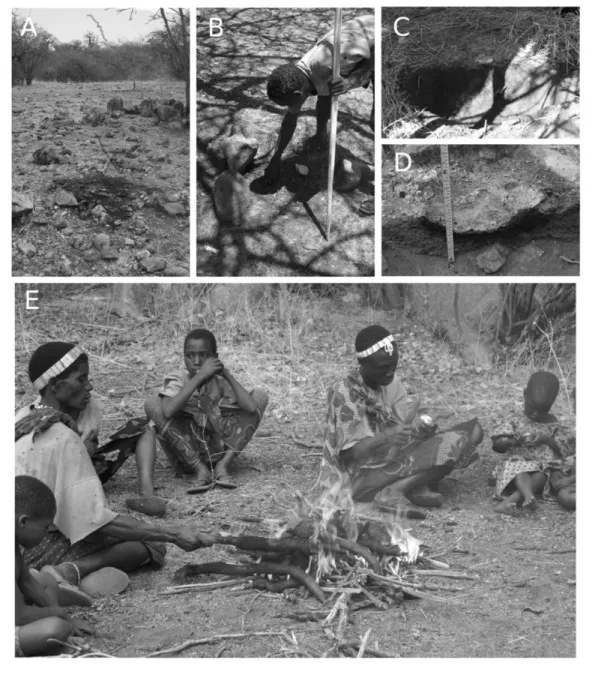
fissuring, and soil organic matter carbonization) in days-old to months-old open-air hearths made by a group of Hadza foragers (Tanzania) and documented ethnographically. To this end, the ethnographers collected a series of undisturbed micromorphology sediment blocks from abandoned open-air, cooking, and sleeping hearths (fig. 1). Some of the hearths were recent (days old), while others had been abandoned for 1 year. Regarding the duration of these fires, some of them were continuously used for 3–4 months, while others were brief fires (less than an hour in duration) for roasting food items.
The results of this study, detailed in Mallol et. al. (2007), included field and micromorphological observations on the sedimentary substrate associated with the abandoned hearths. At a microscopic scale, all the samples, including those from hearths that had been abandoned for a year, yielded com-bustion residues (wood ash, charcoal, and charred plant/ani-mal tissue) attesting to the presence of anthropogenicfire as well as microstructural sedimentary features such as matrix disaggregation and browning or“masked birefringence.” Over-all, the micromorphological components and features observed are in agreement with those proposed by Wattez (1992) as representative of moderate to high intensity hearths involving temperatures from 3507C to 15007C.
Certain micromorphological differences relating to function were observed among the different types of hearth. For instance, the sedimentary substrate of a brieffire made to roast an im-pala yielded a few amorphous black impregnations and coatings (fig. 2A), and a tuber-roasting fire left behind microscopic charred plant tissue fragments (fig. 2B). Before this study, it was unknown whether or not specific activities related to anthro-pogenicfire might leave microscopic material evidence in the sediment. Unfortunately, these particular hearths were sampled only days after they were made, and we do not know the pres-ervation potential of the observed features. There were also micromorphological differences relating to taphonomic factors. The hearths sampled 1 year later showed presence of ash only in a case where a layer of dry grass from a dismantled hut had covered the hearth. They also showed signs of bioturbation (channels and fresh rootlets dissecting the top of the combustion structure; seefig. 2C), whereas those that were days or months old did not (fig. 2D). Interestingly, bioturbation did not affect the sedimentary fabric to the extent of precluding identification of combustion features.
The study also showed that micromorphology is a powerful tool to approach the genesis of sedimentary deposits through a very peculiar finding: one of the samples showed micromor-phological features indicative of the presence of an abandoned hut floor beneath one of the open-air hearths. The previous existence of a hut at the spot of that particular hearth had not been reported ethnographically. This finding shows that geo-ethnoarchaeology performed at a microstratigraphic scale of observation adds a temporal dimension, thus contributing his-torical information. This contribution may help alleviate a short-coming of ethnoarchaeology pointed out by Wobst (1978):“The ethnographic record is insufficiently sensitive to deal with
havioral variability. The living social context is complex and we can only attempt to perceive a limited range of its material ex-pressions.” By incorporating historical information, we broaden the scope of possibly interrelated material expressions.
Overall, our results provided an example of what different kinds of simple anthropogenic fires might leave behind in ethnographic contexts after up to a year’s time. In this regard, the results suggest that rates of sedimentation and the effect of postdepositional disturbance factors such as bioturbation or erosion are key factors in the preservation of open-air simple hearths. Erosion by rain and deflation seemed to be
particularly influential, as we saw that the ash layer of a hearth that had been protected by a light grassy cover was still intact after a year in the open-air while those of exposed hearths had disappeared, or that the ash of a 10-day-old hearth dissi-pated after a single rainfall event. The Hadza example also showed that even though the ash component is likely to erode away with time in cases of low sedimentary rates and deflation, the irreversible effects offire in the top 2 cm of the sedimentary substrate (charring of soil organic matter and clay alteration) may remain intact and be readily identified through micro-morphology.
Figure 1. Different types of Hadza hearths subjected to micromorphological analysis. A, Brief, 20-minute-longfire used to burn an impala and sampled 10 days later. B, Cooking hearth used recurrently for 4 months and sampled a year later. C, Abandoned sleeping hearth at the entrance of an abandoned hut. It was lit every night for 4 months, and the sample was collected a year after aban-donment. Note the layer of dry grass over it. D, Communal cooking hearth used continuously for 3 months and sampled 2 months later. E, Brief (15 minutes) tuber-roastingfire that was sampled the day after. A color version of this figure is available online.
All these observations can be useful in the interpretation of Paleolithicfire evidence. Unfortunately, micromorphological studies of Paleolithic open-air combustion features are scarce. The bulk of data was gathered by Wattez in the 1990s and is associated with Upper Paleolithic and Mesolithic open-air hearths, which are generally more complex, involving stone-lined or stone-filled pit structures (e.g., Wattez 1992, 1994). Therefore, there is not much data allowing us to make anal-ogies with the results of our study of simple Hadza hearths. One case is the Middle Paleolithic open-air site of Nesher Ramla, Israel, where an in situ simple combustion structure and a wood ash midden were reported by Friesem, Zaidner, and Shahack-Gross (2013). The sediments from the com-bustion structure showed a thin black layer composed of blackened sediment aggregates overlain by wood ash residues and calcined bone fragments (Friesem, Zaidner, and Shahack-Gross 2013).
According to the authors, preservation of these features was possibly enhanced by their location in a topographic depression sheltered from the wind and receiving regular colluvial input, which would have buried the intact features. This interpretation is in agreement with our observations
from the Hadza hearths, as we would not expect long-term preservation of ash in such simple open-air combustion features otherwise. The amount of ash reported for the in situ hearth at Nesher Ramla is quite small, suggesting either some period of deflation or erosion from rain before burial. Re-garding the charred substrate, the presence of blackened soil aggregates suggests a more organic-rich substrate than what we documented in the Hadza study, which was practically barren land with a light grass cover.
In sum, the Hadza study showed the value of performing high-resolution, microstratigraphic investigations of the ethno-archaeological sedimentary record to distinguish between nat-ural and anthropogenicfire, to estimate burning intensities, to identify fuel types, and to assess preservation potentials. In hindsight, the study would have yielded more detailed results if we had included the following items in the research design: (1) the presence of a geoarchaeologist on site to enrich the eth-nographic record with data relevant for the study of site for-mation, and (2) the implementation of techniques comple-mentary to soil micromorphology. Current geoarchaeological combustion structure investigations are normally carried out from a microcontextual perspective using interdisciplinary microstratigraphic methods (see examples in Mentzer 2014) and involving techniques from inorganic and organic geochem-istry and geophysics, including, for example, organic petrol-ogy for identification of microscopic charred particles, Fourier Transform Infrared Spectrometry for mineral identification, gas chromatography mass spectrometry for lipid analysis, or archaeomagnetism to approachfiring temperatures and tem-poral relationships between different hearths. Applying such techniques in the Hadza study might have strengthened the reliability of such techniques to provide data on thermal al-teration of the substrate and to identify combustion residues. Finally, in order to further expand the results obtained in the Hadza study toward an understanding of Paleolithic com-bustion structures, the results need to be tested against ex-perimental taphonomic data on abandoned open-air hearths and also against micromorphological data from ethnoar-chaeological examples of hearths in enclosed settings (caves or rock shelters) as well as examples of superimposed and im-bricated hearths, which are common in the Paleolithic fire record. No such data are currently available.
The Evenk Study of Specialized Open-Air Hearths
The Evenk research program wasfirst designed as a case study to test a model proposed for the European Paleolithic ac-cording to which fuel management is a complex system re-sulting from a series of interacting environmental and cultural parameters (Théry-Parisot 2001). An exploratory study was carried out among a group of Evenk reindeer herders and hunters from the Amur Region (South Eastern Siberia) in order to (1) observe firewood management practices from wood acquisition to the discard of fuel residues; (2) observe possible connections between the environment (available
Figure 2. Microphotographs from thin sections of different Hadza hearth samples. A, Detail of the topsoil in a brief impala-burning hearth sampled after 10 days showing thin black coatings and cappings on some of the rock fragments. B, Detail of the top-soil in a brief tuber-roasting hearth sampled after 1 day showing the presence of charred plant tissue fragments (black particle at the center and smaller ones around it). C, Topsoil of a 1-year-old cooking hearth. Note the compact appearance and presence of rootlets. D, Topsoil of the impala-roasting hearth. Note its loose appearance and lack of rootlets, channels, or other bioturbation features. A color version of thisfigure is available online.
biomass), human activities, and fuel management; (3) assess which of these observations could be evidenced by the study of anthracological remains and sedimentary micromorphologi-cal signatures; and (4) explore the possibility of tracing anal-ogies between current nomadic lifeways in cold environments and Paleolithic contexts (Henry 2011; Henry and Théry-Parisot 2014a; Henry, Théry-Théry-Parisot, and Voronkova 2009).
Fieldwork among the Evenks was carried out in two seasons, one in late winter/early spring, and another in late summer/early autumn. Throughout the study, we observed that Evenk tra-ditions are strongly influenced by seasonality and residential mobility. These factors have a decisive effect on the range and configuration of activities performed at their camps (which in archaeological terms would determine the site’s function). This observation also applies to combustion structure types, their function, andfirewood management, with wood procurement areas and modalities varying according to the time of year (Henry 2017; Henry, Théry-Parisot, and Voronkova 2009). In turn, combustion structure types and functions determined the species and state of the selected wood. In Paleolithic research, seasonal constraints have mainly been approached through subsistence studies. By showing that a whole range of activity areas—firewood management included—are strongly tied to seasonal and climatic conditions, this example invites us to ex-pand our approach of seasonality, prehistoric settlement pat-terns, and mobility.
Furthermore, the study confirmed the positive correlation between the degree of fuel selectivity and of hearth speciali-zation implicitly suggested in earlier anthracology works (Chabal 1982, 1991) as well as the importance not only of the taxon but also of the state of the wood in the wood selection process (Théry-Parisot 2001). In turn, the implications for prehistoric anthracology are that the identification not only of the taxon but also of the state of the wood used is crucial for the characterization of prehistoric wood procurement modalities, combustion behavior, and the specialized/seasonal nature of the hearths (see also Henry and Parisot 2014b; Théry-Parisot and Texier 2006).
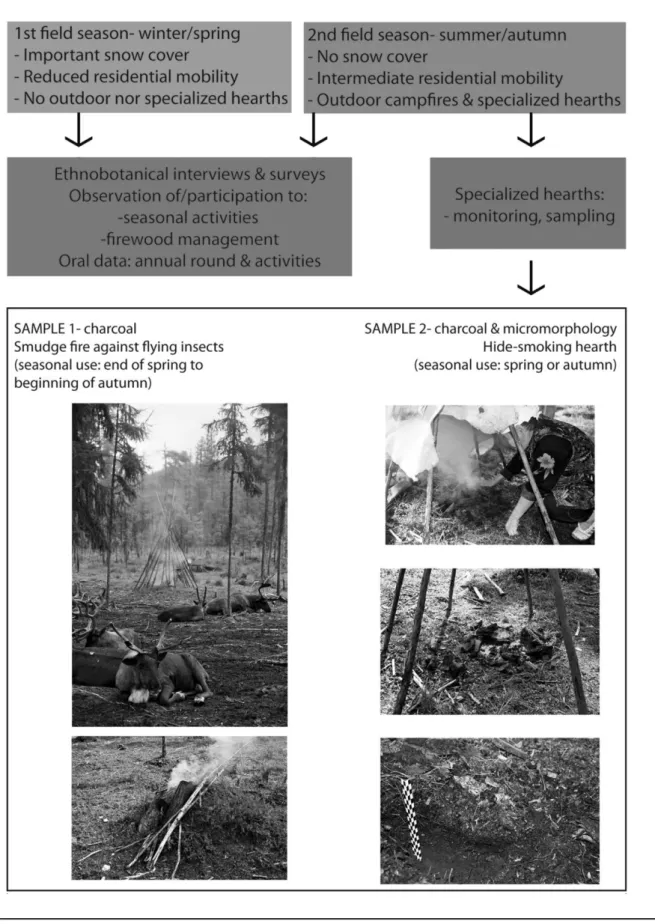
Finally, the relationship between two kinds offireplaces and anthracological/micromorphological signatures were explored during the secondfield season, in which our Evenk hosts were kind enough to allow us to collect charcoal from a smudgefire and to excavate and sample their hide-smoking hearth for charcoal and micromorphological analyses (fig. 3). We exca-vated half of it, collecting anthracological samples, and saved the other half for micromorphological sampling, which re-quired dismantling of the hearth.
Micromorphological observation of three thin sections from the hide-smoking hearth, which produced no ash, showed that the combustion deposit consisted of a mix of charcoal and 1– 3 cm fragments of rotten wood without any visible signs of burning on a bed of relatively fresh plant litter (fig. 4). A few rotten wood fragments were also observed embedded in the plant litter layer (fig. 4A). Rotten wood has a low preservation potential under aerobic conditions. Thus, encountering such
evidence in archaeological context is infrequent, and we can assume that identifying the presence of residual rotten wood in an archaeological version of this hearth would require investigations at a molecular scale. The same can be said about the substrate, which consisted exclusively of fresh plant litter without any apparent effects from the overlying combustion. This is explained by the way in which thefire was made: a small quantity of charcoal from sound wood was produced in a furnace elsewhere and redeposited on the ground at the hide-smoking spot, where it was then covered by rotten, crumbling wood.
Interestingly, our microscopic observations suggest that sim-ilar hide-smoking hearths might have been previously made at the same place, as indicated by the presence of rotten wood— an intrusive element brought by humans—contained within the plant litter substrate. As in the Hadza case, micromorphological analysis yielded information on past events. As we know from the Evenks we worked with, they normally return to their main campsites yearly, at least for periods of 4–5 years, and light their fires at the same spots as in previous occupations.
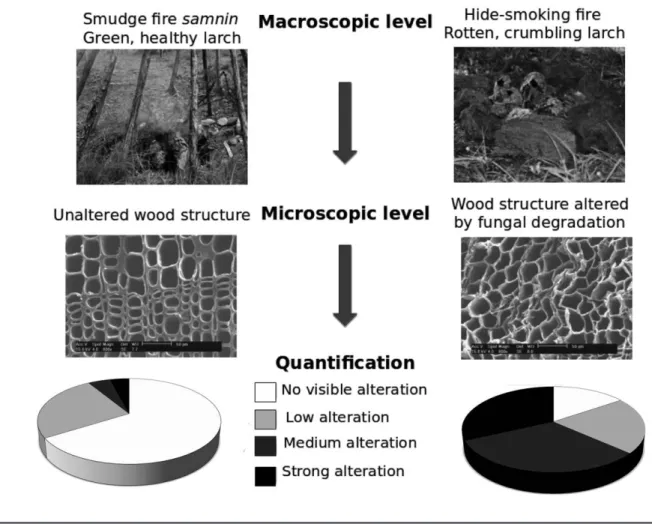
In sum, we can predict that a possible archaeological ex-pression of a hide-smoking combustion structure of the kind studied here, after many years of subaerial exposure, would exhibit a very weak sedimentary signature consisting of a diffuse layer of charcoal resting on an unburned sedimentary substrate. Regarding our anthracological results, both hearths (smudge fire and hide-smoking hearth) were positively discriminated and allowed us to set forth a new method to diagnose the initial soundness of firewood based on the identification of micro-morphological fungal alteration intensities observed on charcoal fragments (Henry and Théry-Parisot 2014a;fig. 5). This method has proven to be effective for discussing fuel management strat-egies evidenced in Paleolithic and Mesolithic hunter-gatherer sites (Henry and Boboeuf 2016; Henry and Teten’kin 2014; Vidal-Matutano, Henry, and Théry-Parisot 2017).
These results have several implications for Paleolithic anth-racology because they evidence the nature of the link between environmental conditions, lifeways, and modalities offire use. As in other research domains, comparisons with other ethno-graphic settings point at the great variability of practices and beliefs aroundfire. Nevertheless, regularities also exist between different groups, revealing similar choices under comparable environments (Henry 2011). For example, the use of crumbling, rotten wood for smoking hides is ubiquitous among northern hunter-gatherers living in forest environments from Siberia to North America (Alix and Brewster 2004; Anikhovskij et al. 2012; Beyries 2002, 2008; Binford 1967; Brandisauskas 2007, 2010; Henry, Théry-Parisot, and Voronkova 2009; Lavrillier 2007; Nelson 1986; Osgood 1970 [1936]). The prospect of being able to discuss archaeological hearth functions thanks to new de-velopments in ethnoanthracology is particularly exciting and motivates new archaeoanthracological studies geared in this direction. One such study involves a hypothetical Middle Paleolithic smoking hearth based on archaeoanthracological data (Vidal-Matutano 2016; Vidal-Matutano, Henry, and Théry-Parisot 2017).
Figure 3. Summary of the ethnoanthracological work with Evenki from Ulgen, Amur Region. Photos: Auréade Henry, ACI“Système Renne.” A color version of this figure is available online.
The downside of the Evenk study is that the limited amount of hearth samples is insufficient to fully evaluate the potential and limitations of our results. Also, as with the Hadza study, applying complementary geoarchaeological techniques would have allowed for richer, more robust data. In the future, many more hearths need to be sampled in order to obtain a stronger reference data set and establish a protocol that incorporates multiproxy geoarchaeological and bioarchaeological data.
Afinal observation is that studying hearths that are still in use has many advantages, because complete operational chains (chaînes opératoires) of specific activities such as meat curing or hide smoking can be documented as well as their timing and duration, fuel amounts and procurement distances, and other such variables involved infire technology. However, one dis-advantage is that sampling can be difficult or even impossible because it involves destruction of a structure within or outside the perimeter of ongoing domestic activity. Some of these struc-tures may have a strong cultural or symbolic meaning for the community.
Methodological Guidelines
The two examples presented here convey a series of aspects to take into consideration when designing an ethnoarchaeo-logical project to study contemporary simple hearths
com-parable to Paleolithic counterparts. Among the things to consider are planning for the implementation of interdisci-plinary methods to test the preservation state of the target features before intervention. In this section, we provide a few more specific and practical guidelines that may facilitate the research design.
1. Compile ethnographic data and assess their quality. What is the potential of this data to address archaeologically relevant questions regarding anthropogenicfire? When a pertinent research context has been defined, it is equally important to assess the marginality of the recorded activity or process: is this type of behavior recurrent today among traditional societies and at what scale? What other related social and environmental domains need to be described? 2. In the case of abandoned contexts, which may be exposed or buried, assess the degree of integrity of the record through surveys and test pits. For each proxy, control samples from nearby natural deposits or activity areas should also be collected to validate the diagnostic value of the results.
3. Perform excavation and collect sediment samples for multiple microstratigraphic analytical techniques. Unlike other ethnoarchaeological remains, such as exposed re-mains, combustion structures representing open hearths
Figure 4. A, Scan of thin section from micromorphological sample collected from an Evenk hide-smoking hearth. Note the presence of rotten wood fragments (lighter colored) at the top but also embedded within a plant litter deposit. B, C, Microphotographs from the same thin section and two others showing a mixed presence of charcoal (dense, black particles) and rotten wood fragments (yellowish-brown particles) on a pristine bed of plant litter (lower half of image in A). D, Rotten wood fragment. Note the presence of fecal pellets (small granulesfilling gaps between healthy portions of tissue). E, Detail of rotten wood fragment showing deformed cell walls due to fungal attack. Photos taken in Plane Polarized Light; E taken in Blue Light (400–440 BL). A color version of this figure is available online.
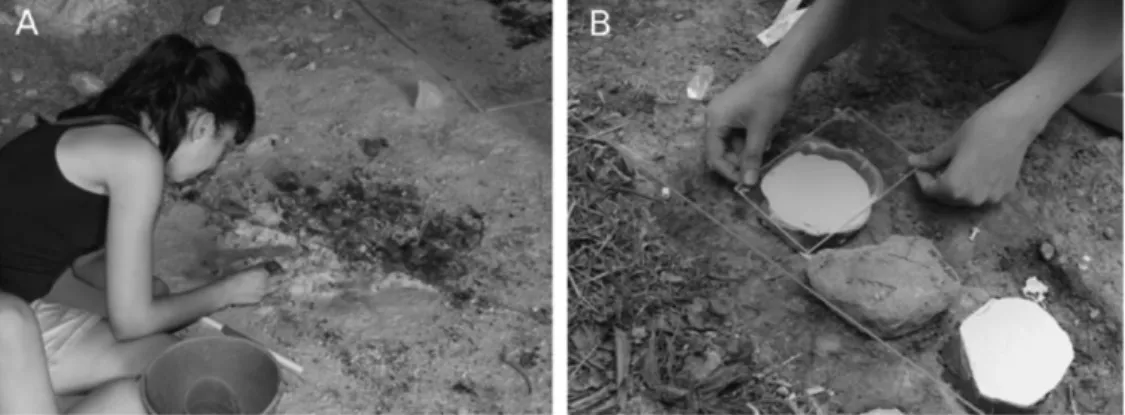
always require excavation because of their sedimentary nature. Excavation and sampling may be performed fol-lowing a protocol for archaeological combustion features. We propose to follow these steps (fig. 6):
a. Determine the perimeter and plot it within a co-ordinate system.
b. Divide the feature in two equal portions and excavate half of it, leaving the other half for microstratigraphic sampling. Excavate following stratigraphic layers and place the sediment from different layers in dif-ferent bags. If possible, collect all the sediment for future studies on fuel loss, ash yield, etc. This sedi-ment will be subsequently sorted to recover different kinds of macroremains (charcoal, seeds, bone frag-ments, microfauna, etc.). In cases of occurrence of anthropogenic bone remains other than fuel or ar-tifacts, these should be plotted as material remains within the coordinate system, including their depth. c. While collecting samples from the second half, keep all the remaining sediment and piece-plot any artifact, bone, or other visible anthropogenic
ob-ject. Keep in mind that different analytical tech-niques (e.g., soil micromorphology, organic and inorganic geochemistry, archaeomagnetism, anal-ysis of phytoliths, spherulites, and pollen if appli-cable) require different specific sampling protocols. d. Collect control sediment samples (or hand spec-imens in the case of macrobotanical studies) from outside the combustion structure for each of the analytical techniques.
Discussion: Some Pros and Cons of
Ethnoarchaeological Research to
Approach Paleolithic Fire
Ethnoarchaeology may be viewed as a polemicfield of research because atfirst it seems rather impossible, if not dangerous and unscientific, to use ethnographic data for the interpretation of archaeological evidence. Societies are complex dynamic systems fashioned by multiple interrelated factors across space and time. Some authors are pessimistic about the potential of ethno-archaeology unless it is carried out through an ontological ap-proach (González-Ruibal, Hernando, and Politis 2011).
Figure 5. Differences in the proportions of microscopic fungal degradation features on charcoal samples according to the initial soundness of the wood used in thefire. Photos: Auréade Henry, ACI “Système Renne.” The SEM photos were taken for A. Henry by Monique Repoux, Centre de Mise en Form des Materiaux, Sophia Antipolis, France. A color version of thisfigure is available online.
In practice, this means that in the study of a particular aspect of human behavior, such as behavior aroundfire, researchers need to adopt a broad perspective and include other behavioral domains in order to approach more general aspects of societal and/or environmental value. In other words, anthropogenic fire, as any other element of human social behavior, must be considered within its social and environmental context. Thus, ideally, the ethnoarchaeological research team involved in a study of fire behavior should include experts from different fields documenting as many aspects of culture and environ-ment as possible.
Another polemic issue is the validity of ethnographic anal-ogy. Present-day observations should not be directly transposed to the past. Caution should be taken when using contemporary societies to approach distant spatio-temporal contexts (e.g., comparing present-day subtropical agricultural societies with Paleolithic hunter-gatherers of the Northern Hemisphere) or tracing analogies that may seem straightforward (e.g., Bronze Age vs. present-day traditional pastoral societies of the same area). In all cases, it is important to bear in mind that“the true role of ethnoarchaeology is not to provide the prehistorian with analogical tidbits, but rather to be an important source for those wanting to build theoretical models for the relationships between people and things” (Skibo 2009:47). As shown by our own work, ethnoarchaeology also provides insight into site
for-mation processes and the nature of our archaeological remains (including sedimentary residues).
The challenge lies in achieving ethnoarchaeological research design in a way that meets the standards of current archaeo-logical science. There are very few general works on ethno-archaeology (e.g., David and Kramer 2001) that include meth-odological guidelines geared at multidisciplinary research and the incorporation of subdisciplines such as bioarchaeology and geoarchaeology. Despite this, the existing literature reveals that ethnoarchaeology may truly benefit most fields of prehistoric research as long as two main targets are pursued: (1) obtaining contextualized ethnographic data through interdisciplinary approaches and (2) carrying out research motivated either by archaeological facts and questions or by a need to obtain ref-erence material for the material residues of specific human activities or lifestyles.
According to our personal experience in the field of the ethnoarchaeology of fire, it has become obvious that ethno-archaeology is much more than a“real-size experiment.” Ethno-archaeology not only improves our reference data sets (and in this sense, it is complementary to experimentation) but also provides an enriching way of approaching the archaeological record through the possibility of apprehending the diversity of environmental and societal variables and their effect on the material record.
Figure 6. A, Excavation of a recent cave entrance hearth. Note that the excavator is reserving half of the combustion structure for sampling. The location of two micromorphological samples in the other half has been marked with nails and thread. B, Archaeo-magnetic sampling of half of a 5-year-old combustion structure. A color version of thisfigure is available online.
The Hadza and Evenk studies are good examples of how ethnoarchaeological research may generate new knowledge that is complementary to archaeology and experimentation. In the Evenk case, while showing that the archaeological model was easily adaptable to any fuel management study, our ob-servations also revealed complex patterns of human behavior towardfirewood, which could only be understood in regard to the social, economical, and seasonal background of the study. In return, these results provided us with new ideas for inter-pretative pathways of prehistoric fuel selection and hearth function in relation to site function and seasonality.
The challenge was then to test the potential of archaeo-metric methods to document socioeconomic aspects through the study of their material expression: combustion structures. The positive results of the ethnoanthracological analysis, which have been subsequently validated by substantial experimental replication (Henry and Théry-Parisot 2014a), opened up new methodological perspectives on fuel selection, hearth function, and even seasonality.
In sum, ethnoarchaeology is complementary to but not re-placeable by experimentation, because functional and mean-ingful anthropogenic deposits or sedimentary features are dif-ficult if not impossible to produce outside their traditional context. On the other hand, experimentation can and should be used to further investigate and validate ethnoarchaeological results before testing their applicability to archaeological con-texts. At a broader, systemic scale, ethnoarchaeology offire is a powerful tool to evaluate the variability of human adaptations to the natural environment through the establishment of causal relationships between culture andfire technology.
Conclusions
This holistic, multidisciplinary approach, which allows us to take into account many different environmental and mate-rial and nonmatemate-rial parameters influencing the nature of the anthropogenic combustion remains, aims at contributing to the development of new analytical methods for the study of prehistoric combustion structure formation processes, fuel management systems, and hearth function. We have shown that ethnoarchaeological research, whether motivated by the need to test experimental or archaeological interpretations or by exploration, requires case-specific questions and analytical parameters. Our two case studies are examples of the great potential in applying geoarchaeological and bioarchaeological techniques and have allowed us to identify several important factors that should be taken into account in future research design. These include the presence of specialists on site and application of multitechnique microstratigraphic studies.
So far, our work has provided pilot micromorphological and anthracological data that contribute to the study of Pa-leolithic fire. However, it needs to be expanded significantly in different ways. We now have a few examples of open-air hearths that need to be complemented with examples of hearths from enclosed settings such as caves and rock shelters
and enriched by geoarchaeological and bioarchaeological data from additional techniques. It is to be hoped that further re-search of this kind will be carried out in the coming years and that it will contribute data to aid in building robust reference data sets for our understanding of Paleolithic hearth and hearth-assemblage contexts through ethnographic analogy.
Acknowledgments
We thank the Wenner-Gren Foundation and the organizers of the“Fire and the Genus Homo” symposium for their kind in-vitation to participate, and we thank our collaborators in the Hadza and Evenkfire projects (funded by NSF grant 0242455 to Frank Marlowe, the American School of Prehistoric Research at Harvard University, and the French Research Council project ACI TTT,“Adaptations biologiques et culturelles: Le Système Renne,” funded by the French Ministry of Research, to Sylvie Beyries, Centre National de la Recherche Scientifique, Unité Mixte de Recherche, 7264 Cultures et Environnements Préhis-toire, Antiquité, Moyen Âge). We would also like to give par-ticular thanks to Frank Marlowe, Claire Porter, Brian Wood, Evgenja Zavadskaja, and especially the Nikiforovs and the Struchkovs, who not only let us sample their hearths but opened their homes and their hearts to us.
References Cited
Abe, Y. 2005. Hunting and butchery patterns of the Evenki in northern Transbaikalia, Russia. PhD dissertation, Stony Brook University, State University of New York.
Aldeias, Vera. 2017. Experimental approaches to archaeologicalfire features and their behavioral relevance. Current Anthropology 58(suppl. 16):S191– S205.
Alix, C., and K. Brewster. 2004. Not all driftwood is created equal: wood use and value along the Yukon and Kuskowim Rivers, Alaska. Alaska Journal of Anthropology 2(1):2–19.
Alperson-Afil, Nira. 2017. Spatial analysis of fire: archaeological approach to recognizing earlyfire. Current Anthropology 58(suppl. 16):S258–S266. Anderson, D. G., E. M. Ineshin, N. V. Kulagina, M. Lavento, and O. P.
Vinkovskaya. 2014. Landscape agency and Evenki-Iakut reindeer hus-bandry along the Zhuia River, Eastern Siberia. Human Ecology 42(2):249– 266.
Anikhovskij, S. A., E. A. Voronkova, A. P. Zabiyako, and R. A. Kobyzov. 2012. Evenki priamurja: olennaja tropa istorij i kultury. Blagoveschchensk: Amurskij gosudartsvennij Universitet, Centr po cokhraneniju istoriko-kulturnovo nacledija Amurskoj Oblasti.
Beyries, S. 1995. Expérimentation archéologique et savoir-faire traditionnel: l’exemple de la découpe d’un cervidé. Techniques et Culture 22. http:// tc.revues.org/587 (accessed May 8, 2015).
———. 2002. Le travail du cuir chez les Tchouktches et les Athapaskans: implications ethno-archéologiques. In Le travail du cuir de la préhistoire à nos jours. S. Beyries and F. Audouin-Rouzeau, eds. Pp. 143–159. Actes des XXIIe rencontres internationales d’archéologie et d’histoire d’Antibes. Antibes: APDCA.
———. 2008. Modélisation du travail du cuir en ethnologie: proposition d’un système ouvert à l’archéologie. Anthropozoologica 43(1):9–42.
Beyries, S., and P. Pétrequin. 2001. Ethno-archaeology and its transfers. BAR International Series 983. Oxford: Archaeopress.
Beyries, Sylvie, and Virginie Vaté. 2007. Les civilisations du renne d’hier et d’aujourd’hui: approches ethnohistoriques, archéologiques et anthropologiques. Antibes: APDCA.
Binford, L. R. 1967. Smudge pits and hide smoking: the use of analogy in archaeological reasoning. American Antiquity 32(1):1–12.
———. 1978. Nunamiut ethnoarchaeology. New York: Academic Press. Mallol and Henry Ethnoarchaeology of Paleolithic Fire S227
———. 1980. Willow smoke and dogs’ tails: hunter-gatherer settlement systems and archaeological site formation. American Antiquity 45(1):4–20. Brandisauskas, D. 2007. Symbolism and ecological uses of fire among
Orochen-Evenki. Sibirica 6(1):95–109.
———. 2010. Hide tanning and its use in the taiga: the case of Orochen-Evenki reindeer herders and hunters of Zabaikalye (East Siberia). Journal of Ethnology and Folkloristics 4(2):97–114.
Brochier, J. E., P. Villa, M. Giacomarra, and A. Tagliacozzo. 1992. Shepherds and sediments: geo-ethnoarchaeology of pastoral sites. Journal of Anthro-pological Archaeology 11(1):47–102.
Brooks, A. S., and J. E. Yellen. 1987. The preservation of activity areas in the archaeological record: ethnoarchaeological and archaeological work in northwest Ngamiland, Botswana. In Method and theory for activity area research. Susan Kent, ed. Pp. 63–106. New York: Columbia University Press.
Cameron, C. M., and S. A. Tomka, eds. 1996. The abandonment of settlements and regions: ethnoarchaeological and archaeological approaches. New York: Cambridge University Press.
Chabal, L. 1982. Méthodes de prélèvement des bois carbonisés protohisto-riques pour l’étude des relations homme-végétation. Masters thesis, Uni-versité des Sciences et Techniques du Languedoc.
———. 1991. L’Homme et l’évolution de la végétation méditerranéenne des âges des métaux à la période romaine: recherches anthracologiques théoriques, appliquées principalement à des sites du Bas-Languedoc. Doctoral dissertation, Université de Montpellier 2.
———. 1994. Apports récents de l’anthracologie à la connaissance des paysages passés: performances et limites. Histoire and Mesure 9(3):317– 338.
Costamagno S., and F. David. 2009. Comparaison des pratiques bouchères et culinaires de différents groupes sibériens vivant de la renniculture. Ar-chaeofauna 18:9–25.
Costamagno, S., I. Théry-Parisot, J. C. Castel, and J.-P. Brugal. 2009. Com-bustible ou non? analyse multifactorielle et modèles explicatifs sur de ossements brûles paléolithiques. In Gestion des combustibles au Paléolithique et au mésolithique: noveaux outils, nouvelles interprétations. I. Théry-Parisot, S. Costamagno, and A. Henry, eds. Pp. 65–84. BAR International Series 1914. Oxford: Archaeopress.
David, N., and C. Kramer. 2001. Ethnoarchaeology in action. Cambridge: Cambridge University Press.
Fewster, K. J., and M. Zvelebil. 2001. Ethnoarchaeology and hunter-gatherers: pictures at an exhibition. BAR International Series 955. Oxford: Archaeo-press.
Friesem, D., E. Boaretto, A. Eliyahu-Behar, and R. Shahack-Gross. 2011. Degra-dation of mud brick houses in an arid environment: a geoarchaeological model. Journal of Archaeological Science 38(5):1135–1147.
Friesem, D. E. 2016. Geo-ethnoarchaeology in action. Journal of Archaeo-logical Science 70:145–157.
Friesem, D. E., P. Karkanas, G. Tsartsidou, and R. Shahack-Gross. 2014a. Sedimentary processes involved in mud bricks degradation in temperate environment: an ethnoarchaeological case study from northern Greece. Journal of Archaeological Science 41:556–567.
Friesem, D. E., G. Tsartsidou, P. Karkanas, and R. Shahack-Gross. 2014b. Where are the roofs? a geoethnoarchaeological study of mud structures and their collapse processes, focusing on the identification of roofs. Archaeo-logical and AnthropoArchaeo-logical Sciences 6:73–92.
Friesem, D. E., Y. Zaidner, and R. Shahack-Gross. 2013. Formation processes and combustion features at the lower layers of the Middle Palaeolithic open-air site of Nesher Ramla, Israel. Quaternary International 331:128–138. Goldberg, P., and R. I. Macphail. 2008. Practical and theoretical
geoarchae-ology. Hoboken, NJ: Blackwell.
Goldberg, P., and I. Whitebread. 1993. Micromorphological studies of a Bedouin tentfloor. In Formation processes in context. P. Goldberg, D. T. Nash, and M. Petraglia, eds. Pp. 165–188. Monographs in World Ar-chaeology 17. Madison, WI: Prehistory Press.
Goldberg, Paul, Christopher E. Miller, and Susan M. Mentzer. 2017. Recog-nizingfire in the Paleolithic archaeological record. Current Anthropology 58 (suppl. 16):S175–S190.
González-Ruibal, A., A. Hernando, and G. Politis. 2011. Ontology of the self and material culture: arrow-making among the Awá hunter-gatherers (Brazil). Journal of Anthropological Archaeology 30(1):1–16.
González-Urquijo J., S. Beyries, and J. J. Ibáñez. 2015. Ethnoarchaeology and functional analysis. In Use-wear and residue analysis in archaeology. João
Manuel Marreiros, Juan F. Gibaja Bao, and Nuno Ferreira Bicho, eds. Pp. 27–40. New York: Springer.
Gur-Arieh, S., E. Mintz, E. Boaretto, and R. Shahack-Gross. 2013. An ethnoarchaeological study of cooking installations in rural Uzbekistan: development of a new method for identification of fuel sources. Journal of Archaeological Science 40(12):4331–4347.
Henry, A. 2011. Paléoenvironnements et gestion du bois de feu au Méso-lithique dans le sud-ouest de la France: anthracologie, ethno-archéologie et expérimentation. Doctoral dissertation, Université de Nice.
Henry, A., and M. Boboeuf. 2016. Environnement ligneux et gestion du bois de feu au cours du Mésolithique au Clos de Poujol (Campagnac, Aveyron). Bulletin de la Société Préhistorique Française 113(1):5–30.
Henry, A., and Teten’kin A. 2014. Анализ образцов древесного угля с местонахождения Коврижка III на Витиме (Байкало-Патомское Нагорье, Иркутская Область) [Anthracological analysis of the wooden pieces from Kovrizhka 3 site on Vitim Valley (Baikalo-Patom’s Escarp-ment, Irkutskaja Oblast)].Известия Лаборатории древних технологий 2(11):9–19.
Henry, A., and I. Théry-Parisot. 2014a. From Evenk campfires to prehistoric hearths: charcoal analysis as a tool for identifying the use of rotten wood as fuel. Journal of Archaeological Science 52:321–336.
———. 2014b. Fuel management during the Mesolithic: current research in archaeobotany. In Des techniques aux territoires: nouveaux regards sur les cultures mésolithiques. Auréade Henry, Benjamin Marquebielle, Lorène Ches-naux, and Sylvène Michel, eds. Palethnologie 6. http://blogs.univ-tlse2.fr /palethnologie/2014-revue/.
Henry, A., I. Théry-Parisot, and E. Voronkova. 2009. La gestion du bois de feu en forêt boréale: problématique archéo-anthracologique et étude d’un cas ethnographique (Région de l’Amour, Sibérie). In Gestion des combustibles au paléolithique et au mésolithique: Nouveaux outils, nouvelles interpréta-tions. Isabelle Théry-Parisot, Sandrine Costamagno, and Auréade Henry, eds. Pp. 17–37. BAR International Series 1914. Oxford: Archaeopress. Henry, Amanda G. 2017. Neanderthal cooking and the costs offire. Current
Anthropology 58(suppl. 16):S329–S336.
Hlubik, Sarah, Francesco Berna, Craig Feibel, David Braun, and John W. K. Harris. 2017. Researching the nature offire at 1.5 Mya on the site of FxJj20 AB, Koobi Fora, Kenya, using high-resolution spatial analysis and FTIR spectrometry. Current Anthropology 58(suppl. 16):S243–S257.
Holdaway, Simon J., Benjamin Davies, and Patricia C. Fanning. 2017. Ab-original use offire in a landscape context: investigating presence and ab-sence of heat-retainer hearths in western New South Wales, Australia. Current Anthropology 58(suppl. 16):S230–S242.
Joly, D., R. March, D. Marguerie, and H. Yacobaccio. 2009. Gestion des combustibles dans la province de Jujuy (Puna, Argentine) depuis l’Holocène ancien: croisement des résultats ethnologiques et anthracologiques. In Gestion des combustibles au paléolithique et au mésolithique: nouveaux outils, nou-velles interprétations. I. Théry-Parisot, S. Costamagno and A. Henry, eds. Pp. 39–56. BAR International Series 1914. Oxford: Archaeopress. Kelly, R. L. 1995. The foraging spectrum: diversity in hunter-gatherer lifeways.
Washington, DC: Smithsonian Institution Press.
Kent, Susan. 1993. Models of abandonment and material culture frequencies. In Abandonment of settlements and regions: ethnoarchaeological and ar-chaeological approaches. C. M. Cameron and S. A. Tomka, eds. Pp. 54–73. Cambridge: Cambridge University Press.
Kuznetsov, O. V. 2007. Ethnoarchaeological approach to Late Palaeolithic settlements and habitation structures (Transbaikal, Siberia). In Les civilisations du renne d’hier et d’aujourd’hui: approches ethnohistoriques, archéologiques et anthropologiques. S. Beyries and V. Vaté, eds. Pp. 111– 125. Antibes: APDCA.
Lancelotti, C., and M. Madella. 2012. The “invisible” product: developing markers for identifying dung in archaeological contexts. Journal of Ar-chaeological Science 39(4):953–963.
Lancelotti, C., J. Ruiz-Pérez, and J. J. García-Granero. 2016. Investigating fuel andfireplaces with a combination of phytoliths and multi-element analysis: an ethnographic experiment. Vegetation History and Archaeobotany 26 (1):75–83.
Lavrillier, A. 2005. Nomadisme et adaptations sédentaires chez les Évenks de Sibérie postsoviétique: “jouer” pour vivre avec et sans chamanes. PhD thesis, École Pratique des Hautes Études, Paris.
———. 2007. Gestion duelle de l’espace à long terme chez les Evenks éleveurs de rennes et chasseurs des monts Stanovoï: interférences ou cohérences des zones sauvages et humanisées. In Les civilisations du renne d’hier et
d’aujourd’hui: approches ethnologiques, archéologiques et anthropologiques. S. Beyries and V. Vaté, eds. Pp. 65–88. Antibes: APDCA.
Leroi-Gourhan, Arlette, and André Leroi-Gourhan. 1989. Un voyage chez les Aïnous: Hokkaïdo 1938. Paris: Albin Michel.
Lim, Imogene. 1985. Rock-shelter use today: an indicator of Usandawe pre-history. In Recent Advances in Indo-Pacific Prepre-history. V. N. Misra and Peter Bellwood, eds. Pp. 105–110. Leiden: Brill.
Mallol, C., F. W. Marlowe, B. M. Wood, and C. C. Porter. 2007. Earth, wind, andfire: ethnoarchaeological signals of Hadza fires. Journal of Archaeo-logical Science 34(12):2035–2052.
Mallol, C., S. M. Mentzer, and C. E. Miller. Forthcoming. Combustion features. In Archaeological soil and sediment micromorphology. C. Nicosia and G. Stoops, eds. Chichester: Wiley.
Mansur Franchomme, M. E. 1983. Traces d’utilisation et technologie lithique: exemple de la Patagonie. Doctoral dissertation, University of Bordeaux. Mentzer, S. M. 2014. Microarchaeological approaches to the identification and
interpretation of combustion features in prehistoric archaeological sites. Journal of Archaeological Method and Theory 21(3):616–668.
Monahan, C. M. 1998. The Hadza carcass transport debate revisited and its archaeological implications. Journal of Archaeological Science 25(5):405–424. Nelson, R. K. 1986. Hunters of the northern forest. 2nd edition. Chicago:
University of Chicago Press.
Ntinou, M. 2002. La paleovegetación en el norte de Grecia desde el Tardiglaciar hasta el Atlántico: formaciones vegetales, recursos y usos. BAR International Series 1038. Oxford: Archaeopress.
O’Connell, J. F. 1987. Alyawara site structure and its archaeological impli-cations. American Antiquity 52(1):74–108.
Osgood, C. 1970 (1936). Contributions to the ethnography of the Kutchin. Yale University Publications in Anthropology 14. New Haven, CT: Yale Uni-versity Press.
Perlès, C. 1977. Préhistoire du feu. Paris: Masson.
Peterson, N. 1971. Open sites and the ethnographic approach to the archaeology of hunter-gatherers. In Aboriginal man and environment in Australia. J. Mulvaney and J. Golson, eds. Pp. 239–248. Canberra: Australian National University Press.
———. 1973. Camp site location amongst Australian hunter-gatherers: ar-chaeological and ethnographic evidence for a key determinant. Archaeology and Physical Anthropology in Oceania 8(3):173–193.
Pétrequin, A. M., and P. Pétrequin. 1988. Ethnoarcheologie de l’habitat en grotte de Nouvelle-Guinee: une transposition de l’espace social et eco-nomique. Archives Suisses d’Anthropologie Générale 1:61–82.
Picornell Gelabert, L., E. Asouti, and E. A. Allué Martí. 2011. The ethnoar-chaeology offirewood management in the Fang villages of Equatorial Guinea, central Africa: implications for the interpretation of wood fuel remains from archaeological sites. Journal of Anthropological Archaeology 30(3):375–384. Sázelová, S., J. Svoboda, Pavel A. Kosintsev, and M. Novák. 2015. Patterns of
change in a Nenets landscape: an ethnoarchaeological study of Yangana Pe, Polar Ural Mts. Russia. Human Ecology 43:283–294.
Shahack-Gross, R., F. Marshall, K. Ryan, and S. Weiner. 2004. Reconstruction of spatial organization in abandoned Maasai settlements: implications for site structure in the Pastoral Neolithic of East Africa. Journal of Archaeo-logical Science 31(10):1395–1411.
Shahack-Gross, R., F. Marshall, and S. Weiner. 2003. Geo-ethnoarchaeology of pastoral sites: the identification of livestock enclosures in abandoned Maasai settlements. Journal of Archaeological Science 30(4):439–459. Sillar, B. 2000. Shaping culture: making pots and constructing households: an
ethnoarchaeological study of pottery production, trade and use in the Andes. Oxford: J. & E. Hedges.
Skibo, J. M. 2009. Archaeological theory and snake-oil peddling: the role of ethnoarchaeology in archaeology. Ethnoarchaeology 1(1):27–57. Svoboda, J., S. Sázelová, P. A. Kosintsev, V. Jankovská, and M. Holub. 2011.
Resources and spatial analysis at actual Nenets campsites: ethnoarchaeolog-ical implications. Journal of Anthropologethnoarchaeolog-ical Archaeology 30(1):30–43. Théry-Parisot, I. 2001. Economie des combustibles au paléolithique:
expérimen-tation, taphonomie, anthracologie. Dossier de documentation archéologique 20. Paris: CNRS.
Théry-Parisot, I., L. Chabal, and J. Chrzavzez. 2010. Anthracology and ta-phonomy, from wood gathering to charcoal analysis: a review of the taphonomic processes modifying charcoal assemblages, in archaeological contexts. Palaeogeography, Palaeoclimatology, Palaeoecology 291(1/2):142– 153.
Théry-Parisot, I., L. Chabal, and S. Costamagno, eds. 2010. The taphonomy of burned organic residues and combustion features in archaeological con-texts. Proceedings of the round-table Valbonne, May 27–29 2008, CEPAM. Palethnologie 2. http://blogs.univ-tlse2.fr/palethnologie/en/2010-revue/. Théry-Parisot I., S. Costamagno, and A. Henry, eds. 2009. Gestion des
combustibles au Paléolithique et au Mésolithique: nouveaux outils, nouvelles interprétations. BAR International Series 1914. Oxford: Archaeopress. Théry-Parisot, I., and P. J. Texier. 2006. L’utilisation du bois mort dans le site
moustérien de la Combette (Vaucluse): apport d’une approche morpho-métrique des charbons de bois à la définition des fonctions de site, au Paléolithique. Bulletin de la Société Préhistorique Française 103(3):453–463. Vidal-Matutano, P. 2013. Combustible vegetal y etnografía: estudio de un
horno de pan en Ghuala (Argelia). Arkeogazte 2013 3:63–79.
———. 2016. Alrededor del fuego: paisaje, clima y gestión de los recursos leñosos en grupos cazadores-colectores durante el Paleolítico medio (Ali-cante, España). Doctoral dissertation, University of Valencia, Spain. Vidal-Matutano, P., A. Henry, and I. Théry-Parisot. 2017. Dead wood
gath-ering among Neanderthal groups: charcoal evidence from Abric del Pastor and El Salt (Eastern Iberia). Journal of Archaeological Science 80:109–121. Waguespack, N. M. 2002. Caribou sharing and storage: refitting the Palangana
site. Journal of Anthropological Archaeology 21(3):396–417.
Wattez, J. 1992. Dynamique de formation des structures de combustion de la fin du Paléolithique au Néolithique moyen. Doctoral dissertation, Université de Paris I.
———. 1994. Micromorphologie des foyers d’Etiolles, de Pincevent et de Verberie: le milieu naturel et son exploitation. 2. Ressources et exploitations. Documents d’Archéologie Française 43:120–127.
Wobst, H. M. 1978. The archaeo-ethnology of hunter-gatherers or the tyr-anny of the ethnographic record in archaeology. American Antiquity 43 (2):303–309.
Zapata Peña, L., L. Peña-Chocarro, J. J. Ibáñez Estévez, and J. E. González Urquijo. 2003. Ethnoarchaeology in the Moroccan Jebala (Western Rif): wood and dung as fuel. Africa Praehistorica 15:163–175.