The MIT Faculty has made this article openly available.
Please share
how this access benefits you. Your story matters.
Citation
Teleman, Aurelio A. et al. “Chromosome Arrangement within a
Bacterium.” Current Biology 8.20 (1998): 1102–1109. Copyright ©
1998 Elsevier Science Ltd.
As Published
http://dx.doi.org/10.1016/S0960-9822(98)70464-6
Publisher
Elsevier
Version
Final published version
Citable link
http://hdl.handle.net/1721.1/83852
Terms of Use
Article is made available in accordance with the publisher's
policy and may be subject to US copyright law. Please refer to the
publisher's site for terms of use.
Chromosome arrangement within a bacterium
Aurelio A. Teleman*, Peter L. Graumann*, Daniel Chi-Hong Lin
†,
Alan D. Grossman
†and Richard Losick*
Background: The contour length of the circular chromosome of bacteria is greater than a millimeter but must be accommodated within a cell that is only a few micrometers in length. Bacteria do not have nucleosomes and little is known about the arrangement of the chromosome inside a prokaryotic cell. Results: We have investigated the arrangement of chromosomal DNA within the bacterium Bacillus subtilis by using fluorescence microscopy to visualize two sites on the chromosome simultaneously in the same cell. Indirect immunofluorescence with antibodies against the chromosome partition protein Spo0J were used to visualize the replication origin region of the chromosome. Green fluorescent protein fused to the lactose operon repressor LacI was used to decorate tandem copies of the lactose operon operator lacO. A cassette of tandem operators was separately inserted into the chromosome near the origin (359°), near the replication terminus (181°), or at two points in between (90° and 270°). The results show that the layout of the chromosome is dynamic but is principally arranged with the origin and terminus maximally apart and the quarter points of the chromosome in between.
Conclusions: The use of cytological methods to visualize two chromosomal sites in the same cell has provided a glimpse of the arrangement of a bacterial chromosome. We conclude that, to a first approximation, the folding of the bacterial chromosome is consistent with, and may preserve, the linear order of genes on the DNA.
Background
All cells face the challenge of packing their genome into a small space. Genomes are DNA molecules of extraordi-nary length, often hundreds of times longer than the cells in which they are contained, and must be highly com-pacted to form the chromosomes of higher cells and the nucleoids of bacteria. At the same time, the genome must remain functional and accessible to the DNA replication, chromosome segregation, and gene transcription machin-ery of the cell. In eukaryotes, this problem is solved, in part, by wrapping DNA around nucleosomes and then wrapping the nucleosomes into higher-order structures to create fibers of approximately 30 nm in diameter. Despite the high degree of compaction, the nucleosome structure remains dynamic. Chromatin is, for example, subject to reversible covalent and non-covalent modifications that render specific genes accessible to the transcription machinery in response to specific regulatory signals. Bacteria, on the other hand, do not have nucleosomes, and how the circular chromosome of many prokaryotes is folded in the nucleoid is largely unknown [1]. Some com-paction is achieved by maintenance of the DNA in a supercoiled state as a result of underwinding [2,3]. Abun-dant proteins that bind to DNA and cause it to bend are
likely to achieve most compaction; these proteins include HU, HNS, FIS and IHF [4–6]. Of special significance is the discovery in bacteria of homologs of a family of eukaryotic ‘structural maintenance of chromosomes’ pro-teins (SMCs), which are involved in chromosome folding [7]. Mutants of smc in Bacillus subtilis exhibit decondensed chromosomes and defects in chromosome segregation [8,9]. Mutants of Escherichia coli mukB, which is a func-tional analog of SMC, exhibit similar defects in chromo-some structure and segregation [10].
We are concerned here with the architecture of the chro-mosome in the bacterial cell. How is the circular genome organized within the ‘nucleoid’ and what is the location of specific regions on the chromosome within the cell? This problem has been difficult to investigate because of the
small size of bacteria (~2µm in length) and the absence of
methods for visualizing specific regions of the chromo-some within cells. Recently, however, the application of cytological methods in conjunction with fluorescence microscopy has made it possible to localize specific chro-mosomal segments within the intact cell. These methods include the use of fluorescence in situ hybridization (FISH) [11,12], the insertion into the chromosome of tandem copies of the lactose operon operator, which can Addresses: *Department of Molecular and Cellular Biology, The Biological Laboratories, Harvard University, Cambridge, Massachusetts 02138, USA. †Department of Biology, Building 68-530, Massachusetts Institute of Technology, Cambridge, Massachusetts 02139, USA.
Correspondence: Richard Losick E-mail: [email protected] Received: 22 July 1998 Revised: 24 August 1998 Accepted: 24 August 1998 Published: 21 September 1998 Current Biology1998, 8:1102–1109 http://biomednet.com/elecref/0960982200801102 © Current Biology Ltd ISSN 0960-9822
be visualized by the use of green fluorescent protein (GFP) fused to the lactose operon repressor LacI (GFP–LacI) [13–17], and the use of GFP fused to, or anti-bodies raised against, chromosome partition proteins that bind to the replication origin region of the chromosome in certain bacteria [18–20]. In the case of B. subtilis, the parti-tion protein known as Spo0J binds to a cluster of at least eight sites spread out over a distance of about 400 kb around the origin of replication [21] and is believed to cause the origin region to fold into a higher-order structure [8,21]. The use of these methods has led to the conclusion that during chromosome segregation the replication origin region of the chromosome tends to be located towards the cell pole at the outer edge of the nucleoid and that the terminus tends to be located towards the cell center. In newborn cells with a single origin, the replication origin region is generally near one pole of the cell and the termi-nus near the other.
To investigate the organization of the chromosome within the cell, we visualized two sites simultaneously on the chro-mosome of B. subtilis. To visualize the replication origin region, we used antibodies against the Spo0J protein [18,19,21,22] and immunofluorescence microscopy. The second site was visualized by insertion into the chromo-some of a lacO cassette, which was decorated with GFP–LacI [15,16]. Because the lacO cassette could be inserted at various sites, we reasoned that we would be able to compare simultaneously the position of the replication
origin region with that of any other site on the chromosome at which the cassette had been inserted.
Results and discussion
Co-localization of Spo0J and the replication origin region
First, we investigated whether Spo0J would co-localize with a lacO cassette that had been inserted into the chromosome (at 359°) near the origin of replication in a strain (AT63) that had been engineered to produce GFP–LacI. A complica-tion was that the fixacomplica-tion procedure employed to detect Spo0J by immunofluorescence lowered the level of fluores-cence from GFP–LacI (compared with the level in unfixed living cells). Nonetheless, sufficient signal was retained for both Spo0J (red) and GFP–LacI (green) to be detected in
the same cell. Cells were grown at 25°C in defined minimal
medium with glucose as the carbon source. The low tem-perature increased the intensity of the GFP fluorescence and the relatively slow growth rate (doubling time of ~100 min) reduced the number of initiation events per cell. The field of cells displayed in Figure 1a shows that fluores-cence from Spo0J partially or substantially coincided with that from the GFP–LacI-decorated lacO cassette (the yellow color in the overlay panel indicates coincidence of GFP flu-orescence and immunofluflu-orescence). The position of the fluorescent foci relative to the boundaries of the cells can be seen in the Nomarski image, although, because of the lysozyme treatment in the immunofluorescence procedure, the images are less clear than for untreated living cells.
Figure 1
Simultaneous localization of Spo0J and a
lacO cassette that has been inserted at one of
four different sites on the chromosome. (a)Cells harboring a lacO cassette at 359° (origin; strain AT63). (b) Cells harboring a
lacO cassette at 90° (strain AT64). (c) Cells harboring a lacO cassette at 270°(strain AT61). (d) Cells harboring a lacO cassette at 181°(terminus; strain AT62). Each row contains four images of the same field; for (b–d), the two rows show two separate sample fields. The first panel in each row is an immunofluorescence image of Spo0J, the second panel is an image of fluorescence from GFP–LacI bound to the operator cassette, the third panel is a Nomarski differential interference contrast (DIC) image, and the last panel is a color-coded overlay of the GFP fluorescence (green) and Spo0J immunofluorescence (red). Spo0J immunodetection micrographs were deconvoluted by Exhaustive Photon Reassignment software (Scanalytics) to remove out-of-focus background light.
(c) (b) (a) Overlay Nomarski Spo0J GFP (d) lacO position 359º 90º 270º 181º Current Biology
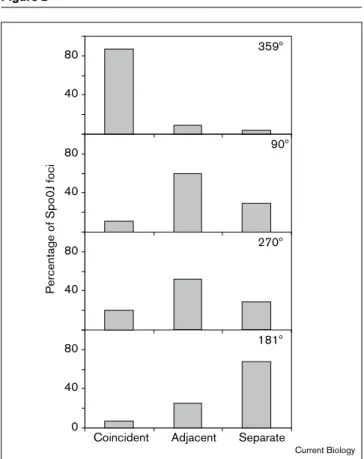
Tabulating the results for 123 Spo0J foci, we found that 87% of the foci were coincident with a lacO cassette. A further 9% overlapped with, but were not substantially superimposable with, the lacO cassette (Figure 2); in such cases, the lacO cassette seemed to lie ‘adjacent’ to the Spo0J focus. In the remaining 4% of the cells there was no visible signal from the GFP–LacI, and so we could not determine whether Spo0J was closely associated with the
lacO cassette. In summary, the cytological evidence
indi-cates that, within the resolution limits of light microscopy, Spo0J molecules principally localized at or near the repli-cation origin region of the chromosome, a finding that is fully consistent with the results of previous investigations of the subcellular distribution of Spo0J [18,19,21,22].
Spo0J movement during the cell cycle
To investigate further the association of Spo0J with the replication origin, we examined the behavior of Spo0J
during the cell cycle. Using time-lapse fluorescence microscopy and the lacO cassette decorated with GFP–LacI, we had previously reported that, after duplica-tion, replication origin regions move towards opposite poles of the cell, often separating abruptly during a brief period of the cell cycle [16]. We found that Spo0J behaves in a similar fashion. We recorded the movement of Spo0J in living cells using a GFP fusion and time-lapse microscopy. Starting with a cell having a single Spo0J focus at the mid-cell position, we observed duplication of the focus and movement of the resulting foci towards opposite poles of the cell (Figure 3).
The speed of separation from the time (12–16 min) when two Spo0J foci were first resolvable to the time (60 min)
when they stopped moving apart was 0.025µm/min. From
11 such time-course experiments, we calculated an
average speed of separation of about 0.08µm/min
(s.d. = 0.06µm/min) and an average distance of separation
of 1.1µm (s.d. = 0.4µm) when measured between the
centers of the two foci.
These measurements underestimate the maximum veloc-ity because a substantial portion of the total separation of foci was often observed to occur over a short period of the cell cycle (although this was not the case in the example of Figure 3). Figure 4 plots the separation of Spo0J foci as a function of time for three time-course experiments. Figure 4a corresponds to the time-course of Figure 3, whereas Figure 4b documents a case in which most sepa-ration occurred over a short time. Measuring the rate of movement during the period of most rapid separation of Spo0J foci for 11 time-course experiments, we calculated
an average peak velocity of separation of 0.17µm/min
(s.d. = 0.07µm/min) and a maximal velocity of
0.31µm/min. In toto, these results are similar to those
obtained previously using the lacO cassette to monitor movement of the origin region. We conclude that Spo0J co-localizes with the replication origin region of the chro-mosome and that it remains associated with, and behaves in a manner similar to, the origin region during the entire course of the cell cycle.
The velocities that we observe for Spo0J–GFP and GFP–LacI are approximately an order of magnitude more rapid than those recently reported by Sharpe and Errington [23] for Spo0J–GFP. One possible explanation for the dis-crepancy is that our measurements were collected for cells that were undergoing a duplication of a single origin focus whereas those of Sharpe and Errington [23] were collected from cells undergoing a duplication of two foci. A second explanation could be that our measurements were col-lected from individual living cells over the course of the cell cycle whereas those of Sharpe and Errington [23] were collected from separate fixed cells of a DNA replication mutant at various times after a temperature shift.
Figure 2
Distribution of distances between Spo0J foci and lacO cassette foci. Immunofluorescence microscopy using Spo0J-specific antibodies was used to detect Spo0J localization in strains producing GFP–LacI and containing a lacO cassette that had been inserted into the
chromosome at 359°, 90°, 270°, or 181°. All Spo0J foci were divided into three classes: those with a spatially coincident GFP signal (referred to in the figure as ‘Coincident’), those with an overlapping but not quite coincident GFP signal (‘Adjacent’), and those that could be resolved and separated from any GFP signal (‘Separate’). The total number of Spo0J foci counted for 359°, 90°, 270°and 181°were 123, 175, 270 and 164, respectively. 40 80 359º 40 80 0 40 80
Coincident Adjacent Separate
Current Biology
40 80
Percentage of Spo0J foci
90º
270º
Although the use of Spo0J–GFP and of the lacO cassette decorated with GFP–LacI yielded similar results, some differences were noted between the two procedures. For example, the percentage of cells with a single fluorescent focus from the origin region was higher with the lacO cassette method (29%) than with Spo0J–GFP (10%; A.A.T., Undergraduate Honors Thesis, Harvard
Univer-sity, 1998). Conversely, the percentage of cells with two replication origin foci was lower with the lacO cassette method (67%) than with Spo0J–GFP (77%). We suspect that insertion of the lacO cassette in the origin region and its decoration with GFP–LacI causes a slight perturbation of the normal processes of chromosome replication and segregation. If, as postulated previously, Spo0J causes the origin region of the chromosome to fold up into a higher-order structure [8,21], then perhaps the insertion of tandem copies of lacO decorated with GFP–LacI interferes with the proper assembly of this structure. In addition, the presence of the lacO cassette bound by GFP–LacI might also delay separation of newly replicated origin regions. Finally, we note that Spo0J foci visualized either by indi-rect immunofluorescence (Figure 1) or by use of a GFP fusion (data not shown) appeared to be somewhat larger than the foci from lacO cassettes decorated with GFP–LacI. Conceivably, the larger size of Spo0J foci reflects the fact that the partition protein binds to multiple sites dispersed over a wide region around the replication origin [21].
Figure 4
Graphical representation of the time-course of separation of Spo0J–GFP foci during the cell cycle. (a) Plot corresponding to the time-course of Figure 3 showing gradual separation of Spo0J–GFP foci. (b) Plot showing abrupt separation of Spo0J–GFP foci. (c) A second example of more gradual Spo0J–GFP separation, as in (a).
0 20 40 60 80 100 120 Time (min) 0 20 40 60 80 100 120 Time (min) 0 20 40 60 80 100 120 Time (min) Current Biology (a) Distance ( µ m) Distance ( µ m) Distance ( µ m) (c) (b) 1.6 1.4 1.2 1.0 0.8 0.6 0.4 0.2 0.0 1.4 1.2 1.0 0.8 0.6 0.4 0.2 0.0 1.8 1.6 1.4 1.2 1.0 0.8 0.6 0.4 0.2 0.0 Figure 3
Time-lapse images of Spo0J–GFP movement during the cell cycle. Cells producing a Spo0J–GFP fusion (strain RL1746) were grown to mid-exponential phase in defined minimal glucose medium and then placed on a slide coated with minimal medium that had been solidified with 1% agarose. Time-lapse photography was used to follow (a) cell growth and (b) Spo0J–GFP movement in a single cell. Pictures of (a) Nomarski DIC and (b) GFP fluorescence were taken at 4 min intervals. Time elapsed from the start of the sequence is indicated on the left. Cell boundaries are indicated for reference by white ticks on the fluorescence image. (a) (b) Time (min) 0 4 8 12 16 20 24 28 32 36 40 44 48 52 56 60 64 68 72 76 80 84 88 Current Biology
Visualizing the origin and the terminus regions of the chromosome in the same cell
Knowing that Spo0J could be reliably used to visualize the replication origin region of the chromosome, we visualized the replication origin and terminus regions of the chromo-some simultaneously in the same cell. For this purpose we used antibodies against Spo0J to visualize the origin region and GFP–LacI to visualize the terminus region in a strain (AT62) in which a cassette of tandem lacO repeats
had been inserted into the chromosome at 181°. Examples
of cells that had been fluorescently labeled in this way at the origin and the terminus regions are shown in Figure 1d. In confirmation and extension of previous results with cells that were singly labeled at the origin or the terminus [15,16], the images show that Spo0J foci were generally localized near the cell poles and that fluo-rescence from GFP–LacI was principally visible near the mid-cell position. Most often, only a single focus of GFP–LacI was present, which presumably represented either one terminus region which had not yet replicated or two newly replicated terminus regions which had not sep-arated sufficiently to be resolved. Sometimes, however, two distinct GFP–LacI foci could be seen near the mid-cell, indicating that the terminus region had replicated and the two sister chromosomes had moved apart sufficiently to be resolved by light microscopy. These results are entirely consistent with those of Niki and Hiraga [12], who recently used FISH to visualize the origin and termi-nus regions of the E. coli chromosome.
Tabulating the separation of origin and terminus regions for 164 images (Figure 2), we found that in most cases (68%) Spo0J foci were clearly resolved and separated from the GFP–LacI foci. In a minority (25%) of the images the terminus signal partially overlapped with, but was not coincident with, the origin signal; that is, the Spo0J and GFP–LacI foci seemed to be adjacent. Finally, in a small number of cases (7%) the Spo0J focus was coincident with the GFP–LacI signal. Thus, in sharp contrast to the distri-bution pattern observed with cells harboring the operator cassette in the origin region, these results indicate that the origin and terminus regions generally occupy distinct regions in the cell.
Resolving the replication origin region from 90° and from 270° on the chromosome
Knowing that the replication origin and the terminus are generally well separated from each other in the cell, we investigated the disposition of two sites lying at interme-diate positions on the chromosome. For these experiments we created GFP–LacI-producing strains harboring the
lacO cassette at positions corresponding to 90° (strain
AT64) and 270°(strain AT61) and used Spo0J as a marker
for the origin region of the chromosome. We observed three principal patterns of localization (Figure 2). In the first pattern, representing the predominant class (60% and
52%, respectively, for the 90°and 270°cassettes; Figure 2), GFP–LacI foci were seen at positions immediately adja-cent to the Spo0J foci. Examples of this pattern are shown in Figure 1b,c. In the second pattern (representing 29%
and 28%, respectively, for the 90° and 270° cassettes;
Figure 2), Spo0J foci were clearly separated from GFP–LacI foci. Often, in these cases, the Spo0J foci were located near the cell poles and one or two GFP–LacI dots were observed at or near the mid-cell position. In the third pattern (representing 11% and 20%, respectively, for the
90°and 270°cassettes), the GFP–LacI foci were
coinci-dent with the Spo0J foci. We conclude that the 90° and
270°sites on the chromosome are generally situated at
dis-tinct positions in the cell from the replication origin
region. Also, because GFP–LacI foci at the 90°and 270°
loci were predominantly located ‘adjacent’ to Spo0J foci whereas GFP–LacI foci at the terminus region were
pre-dominantly ‘separated’ from Spo0J foci, we infer that 90°
and 270°in the chromosome are generally located at
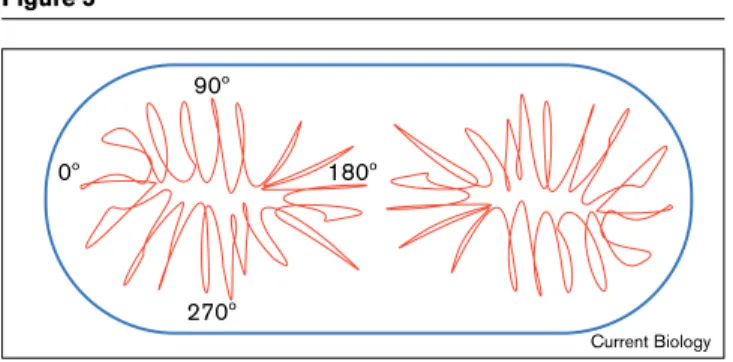
inmediate positions in the cell between the origin and ter-minus regions (Figure 5).
Another way to analyze the images is to count the number of GFP–LacI dots in cells exhibiting two polar Spo0J foci. When the lacO cassette is located near the terminus, cells are frequently observed that have two Spo0J foci near opposite poles and only one GFP–LacI focus. As dis-cussed above, this pattern corresponded to cells in which the terminus region of the chromosome had not yet under-gone replication or cells in which the chromosome had been completely duplicated but the termini had not sepa-rated sufficiently to be resolved by microscopy. Tabulat-ing the results for cells with bipolar foci of Spo0J, we
found that 77% of cells harboring a lacO cassette at 181°
had one GFP–LacI dot, whereas only 28% and 20% of
cells harboring a lacO cassette at 90° and 270°,
respec-tively, had this localization pattern. Most cells (that is, the
Figure 5
A model of chromosome arrangement in the cell. The cartoon shows the nucleoid as a dense core with loops extruding towards the cell membrane. In general, the DNA is locally compacted (that is, it doesn’t string back and forth between the poles of the cell), and the
chromosome is usually arranged such that origin regions are towards the cell poles, termini are towards the mid-cell position and the 90° and 270°regions are in between.
0º
90º
180º
Current Biology
remaining 72% and 80%, respectively) containing bipolar
Spo0J foci and harboring a lacO cassette at either 90°or
270°had two GFP–LacI dots. Our interpretation of these
results is that the 90°and 270°regions of the chromosome
separate earlier than does the terminus region, which indi-cates that segregation propagates from the origin through
the 90°and 270°regions towards the terminus.
Time-lapse microscopy of strains in which the lacO
cas-sette was integrated into the 181°region of the
chromo-some showed dynamics of separation similar to the origin regions, though not as fast and as far apart [16]. In this
study, the 90°and 270°regions were found to separate in a
rapid fashion similar to the origin and terminus regions of the chromosome (data not shown), which suggests that the force that separates the B. subtilis chromosomes is applied not only at the origin but also, at least, at the most distant and the intermediate regions.
The arrangement of the chromosome is not fixed
Our findings are consistent with the view that the chromo-some is often arranged in the nucleoid with the origin at
one end, the terminus at the other end, and 90°and 270°
sites in between (Figure 5). It is important to emphasize, however, that this is a preferred arrangement, and that the chromosome can, and frequently does, exhibit other pat-terns. For example, when the lacO cassette was near the terminus, which is usually near the mid-cell position, 12% (n = 315) of the cells exhibited a localization pattern in which the GFP–LacI signal was closer to the cell pole than was the Spo0J focus. Similarly, when the lacO
cas-sette was at 90°or 270°, fluorescent dots from GFP–LacI
were found at a more polar position than Spo0J in 23% and 21% of the cases respectively (n = 92 and n = 147 respec-tively). These observations reinforce the findings from time-lapse studies indicating that the chromosome is dynamic and undergoes substantial changes in location and organization during the course of the cell cycle.
Conclusions
We have used fluorescence microscopy to visualize two sites on the chromosome simultaneously in the same cell. We used indirect immunofluorescence with antibodies against the partition protein Spo0J to visualize the replica-tion origin region of the chromosome and GFP–LacI to visualize tandem copies of lacO that had been separately
inserted into the chromosome at four quarter points (359°,
90°, 181°and 270°). We draw two principal sets of conclu-sions, one concerning the location of Spo0J on the chro-mosome and the other concerning the overall architecture of the chromosome.
First, in confirmation and extension of previous work [18,19,21,22], we conclude that Spo0J binds near the origin of DNA replication and that it remains associated with the origin region throughout the cell cycle. This conclusion is
based on the high proportion of Spo0J foci that were closely associated with foci from a lacO cassette that had been inserted at the origin and on the similarity in the behavior of Spo0J (as visualized by use of a GFP fusion) in time-lapse images of living cells to that previously observed for lacO. We also note that Spo0J foci (as visual-ized either by indirect immunofluorescence or by use of a fusion to GFP) were somewhat larger than lacO foci. This observation is consistent with, and could be a reflection of, the fact that Spo0J binds to multiple sites spread out over a large distance around the origin of DNA replication [21]. With regard to the architecture of the chromosome, we conclude that the arrangement of the chromosome is dynamic and that individual sites can be found at a variety of locations in the cell. Nonetheless, in the main, the origin and the terminus regions of the chromosome
tend to be maximally apart whereas the 90° and 270°
positions on the chromosome tend to exhibit an interme-diate level of separation from the origin (Figure 5). Thus, the use of cytological methods to visualize two chromoso-mal regions simultaneously has given us a glimpse of the arrangement of the chromosome in a bacterial cell. To a first approximation, the folding of the chromosome is con-sistent with, and may preserve, the linear order of genes on the DNA.
Materials and methods
Strain constructions
RL1746, which corresponds to DCL233 [18], produces Spo0J–GFP and contains a spo0J null mutation. The Spo0J–GFP fusion protein is functional and the strain is phenotypically Spo0J+[18].
An integration plasmid (pAT19) for directing the synthesis of GFP–LacI under the control of the promoter for the veg gene in the chromosome was described previously [16]. In the present work, a derivative of pAT19 was created by site-directed mutagenesis using the primers ATO19 (5′ -CCAACACTTGTCACTACTCTCACTTATGGTGTTCAA-TGC-3′) and ATO20 (5′ -GCATTGAACACCATAAGTGAGAGTAGT-GACAAGTGTTGG-3′). This created pAT27, which contained a Phe to Leu change at codon 64 of gfp–lacI in addition to the Ser to Thr change already present at codon 65. The resulting F64L, S65T double-mutant GFP was several-fold brighter in our experiments than the S65T single-mutant protein. The pAT27 plasmid was introduced into the chromo-some of B. subtilis strain PY79 by transformation followed by selection for resistance to erythromycin (ErmR; 5µg/ml) to yield strain AT60. Four plasmids were created to insert a cassette of lacO tandem repeats at either 359°, 90°, 181°or 270°on the B. subtilis chromo-some. Each plasmid was derived from pAT12 [15], which contains a chloramphenicol-resistance gene and 256 copies of lacO, by insertion of a copy of a segment of DNA from each of the four chromosomal positions. Plasmids pAT14 and pAT15 contain sequences from the 181° (cgeD) and 359°(spo0J) regions of the chromosome, respec-tively, as described previously [15]. pAT26 (90°) was created by inser-tion of a 0.7 kb segment of DNA from yheH between the AatII and
BamHI sites of pAT12. The 0.7 kb DNA fragment was amplified by
PCR from the chromosome of strain PY79 using primers ATO17 (5′ -TCTAGACGTCAAGGCGAAACCGTAG-3′) and ATO18 (5′ -TCTAG-GATCCTGGGTTTTTGAGCGT-3′) and was then digested with AatII and BamHI. Similarly, pAT25 (270°) was created by introducing into the HindIII site of pAT12 a 1 kb DNA from cotS that was amplified from
chromosomal DNA by PCR using as primers ATO13 (5′ -TCTAG-GATCCATCGACCATGTGGCG-3′) and ATO14 (5′ -TCTAGGATC-CGTCAATTCGCCTCCC-3′) and then treated with HindIII.
To generate strains harboring lacO cassettes at 270°, 90°, 181°and 359°, plasmids pAT25, pAT26, pAT14 or pAT15 were used to trans-form wild-type PY79 followed by selection for chloramphenicol resis-tance (5µg/ml) to create AT52, AT53, AT54 and AT55. These were then transformed with chromosomal DNA from AT60, selecting for ErmR, to generate strains AT61, AT64, AT62 and AT63, respectively, which contain a lacO cassette and produce GFP–LacI. Finally, to increase the number of lac operators in these strains, AT61, AT62, AT63 and AT64 were grown at 30°C on Luria–Bertani (LB) plates con-taining an elevated concentration of chloramphenicol (25µg/ml), a pro-cedure that selected for tandem duplications of the integrated
lacO-cassette-containing plasmids.
Growth conditions and fluorescence microscopy
To obtain reasonably bright GFP–LacI signals, strains were grown in the following manner before fixation for immunofluorescence microscopy. Cell cultures (2 ml) were prepared by inoculating L broth with single colonies from each strain and allowed to grow for 6 h at 37°C. This culture was then diluted at various concentrations into defined minimal glucose medium [24] and allowed to grow overnight (~12 hr) at 25°C. During growth, fluorescence from GFP–LacI was dim. As cells reached stationary phase, the GFP–LacI signal became brighter, probably as a result of more and more GFP molecules reaching maturation, which is a slow process. Later, as the cells became older, the intensity of GFP–LacI signal decreased. The culture with the brightest signal was diluted 1:10 into minimal medium (2 ml) and allowed to grow at 25°C for 110 min. Time-lapse photomicroscopy showed that a subpopulation of cells began to grow immediately after dilution and that approximately half of the cells were growing by 75 min after dilution [16]. The GFP–LacI signal become less bright 110 min after dilution, perhaps due to the dilution of mature GFP–LacI among progeny cells.
Cells were fixed for immunofluorescence using methanol (MeOH) as modified from a previously described procedure [25]. This was found to preserve GFP fluorescence better than fixation with glutaraldehyde and paraformaldehyde [15]. Culture (1 ml) growing in minimal medium was collected by centrifugation and resuspended in 30–50µl of its own medium. This volume of cells was then injected into 1 ml 99% MeOH previously equilibrated at –20°C, gently rocked back and forth, and then rapidly placed back at –20°C for at least 10 min. These cells were then placed on a poly-lysine coated slide and allowed to dry fully (~5 min) before lysis and incubation with antibodies. Cells were blocked using 2% BSA/PBS overnight at 4°C. Polyclonal rabbit anti-Spo0J antibodies [18] were used at a 1:16,000 dilution for 1 h at room temperature. Anti-rabbit Cy3 secondary antibodies (Molecular Probes) were used at a 1:300 dilution and also incubated for 1 h at room temperature. Nomarski and GFP images were acquired and processed as previously described [16]. Spo0J images were deconvoluted to remove out-of-focus light as follows. A piezoelectric device was installed on the objective lens of the microscope to move the plane of focus by 0.1µm increments in the direction perpendicular to the microscope stage. An electric shutter was also installed to electrically control emission of the excitation light from the ultraviolet bulb of the fluorescence microscope. Image acquisition, shutter control and voltage on the piezoelectric device were all controlled by Metamorph image acquisition software. A stack of 40 images was acquired for each field of interest with a verti-cal spacing of 0.1µm. The stack was then deconvoluted by the Exhaustive Photon Reassignment software package (Scanalytics) to a convergence of 1×10⁻⁴with a smoothing factor of 10.
Time-lapse images of Spo0J–GFP movement
Time-lapse images of Spo0J–GFP movement were obtained using strain RL1746 as described previously [16], except that the images were collected during the mid-exponential phase of cell growth.
Acknowledgements
P.L.G. is a postdoctoral fellow of the Deutsche Forschungsgemeinschaft and D.C-H.L. was supported in part by a predoctoral training grant from the NSF. We are grateful to C. Webb for guidance in fluorescence microscopy techniques. This work was supported by NIH grants GM18568 and GM41934 to R.L. and A.D.G., respectively.
References
1. Trun NJ, Marko JF: Architecture of a bacterial chromosome. ASM
News 1998, 64:276-283.
2. Pettijohn DE, Pfenninger O: Supercoils in prokaryotic DNA
restrained in vivo. Proc Natl Acad Sci USA 1980, 77:1331-1335.
3. Sinden RR, Pettijohn DE: Chromosomes in living Escherichia coli
cells are segregated into domains of supercoiling. Proc Natl Acad Sci USA 1981, 78:224-228.
4. Nash HA. The HU and IHF proteins: accessory factors for complex
protein–DNA assemblies. In Regulation of Gene Expression in
Escherichia coli. Edited by Lin ECC, Lynch AS. Austin, Texas: R.G.
Landes Company; 1996:149-179.
5. Norris V, Turnock G, Sigee D: The Escherichia coli enzoskeleton.
Mol Microbiol 1996, 19:197-204.
6. Köhler P, Marahiel MA: Association of the histone-like protein
HBsu with the nucleoid of Bacillus subtilis. J Bacteriol 1997, 179:2060-2064.
7. Koshland D, Strunnikov A: Mitotic chromosome condensation. Annu
Rev Cell Dev Biol 1996, 12:305-333.
8. Britton RA, Lin DC-H, Grossman AD: Characterization of a
procaryotic SMC protein involved in chromosome partitioning. Genes Dev 1998, 12:1254-1259.
9. Moriya S, Tsujikawa E, Hassan AKM, Asai K, Kodama T, Osagawara N: A Bacillus subtilis gene encoding protein homologous to
eukaryotic SMC motor protein is necessary for chromosome partition. Mol Microbiol 1998, 29:179-188.
10. Niki H, Imamura R, Kitaoka M, Yamanaka K, Ogura T, Hiraga S: E. coli
MukB protein involved in chromosome partition forms a homodimer with a rod-and-hinge structure having DNA binding and ATP/GTP binding activities. EMBO J 1992, 11:5101-5109.
11. Niki H, Hiraga S: Subcellular distribution of actively partitioning F
plasmid during the cell division cycle in E. coli. Cell 1997, 90:951-957.
12. Niki H, Hiraga S: Polar localization of the replication origin and
terminus in Escherichia coli nucleoids during chromosome partitioning. Genes Dev 1998, 12:1036-1045.
13. Straight AF, Belmont AS, Robinett CC, Murray AW: GFP tagging of
budding yeast chromosomes reveals that protein–protein interactions can mediate sister chromatid cohesion. Curr Biol
1996, 6:1599-1608.
14. Robinett CC, Straight AF, Li G, Willhelm C, Sudlow G, Murray AW, Belmont AS: In vivo localization of DNA sequences and
visualization of large-scale chromatin organization using lac operator/repressor recognition. J Cell Biol 1996, 135:1685-1700.
15. Webb CD, Teleman A, Gordon S, Straight A, Belmont A, Lin DC-H, Grossman AD, Wright A, Losick R: Bipolar localization of the
replication origin regions of chromosomes in vegetative and sporulating cels of B. subtilis. Cell 1997, 88:667-674.
16. Webb CD, Graumann PL, Kahana J, Teleman AA, Silver P, Losick R:
Use of time-lapse microscopy to visualize rapid movement of the replication origin region of the chromosome during the cell cycle in Bacillus subtilis. Mol Microbiol 1998, 28:883-892.
17. Gordon S, Sitnikov D, Webb CD, Teleman A, Losick R, Murray AW, Wright A: Chromosome and low copy plasmid segregation in E.
coli: visual evidence for distinct mechanisms. Cell 1997, 90:1113-1121.
18. Lin DC-H, Levin PA, Grossman AD: Bipolar localization of a
chromosome partition protein in Bacillus subtilis. Proc Natl Acad
Sci USA 1997, 94:4721-4726.
19. Glaser P, Sharpe ME, Raether B, Perego M, Ohlsen K, Errington J:
Dynamic, mitotic-like behavior of a bacterial protein required for accurate chromosome partitioning. Genes Dev 1997,
11:1160-1168.
20. Mohl DA, Gober JW: Cell cycle-dependent polar localization of
chromosome partitioning proteins in Caulobacter crescentus. Cell
1997, 88:675-684.
21. Lin DC-H, Grossman AD: Identification and characterization of a
22. Lewis PJ, Errington J: Direct evidence for active segregation of oriC
regions of the Bacillus subtilis chromosome and co-localization with the Spo0J partitioning protein. Mol Microbiol 1997, 25:945-954.
23. Sharpe ME, Errington J: A fixed distance for separation of newly
duplicated copies of oriC in Bacillus subtilis: implications for co-ordination of chromosome segregation and cell division. Mol Microbiol 1998, 28:981-990.
24. Jaacks KJ, Healy J, Losick R, Grossman AD: Identification and
characterization of genes controlled by the sporulation regulatory gene spo0H in Bacillus subtilis. J Bacteriol 1989, 171:4121-4129.
25. Hiraga S, Ichinose C, Niki H, Yamazoe M: Cell cycle-dependent
duplication and bidirectional migration of SeqA-associated DNA–protein complexes in E. coli. Mol Cell 1998, 1:381-387.
Because Current Biology operates a ‘Continuous Publication System’ for Research Papers, this paper has been published on the internet before being printed. The paper can be accessed from http://biomednet.com/cbiology/cub — for further information, see the explanation on the contents page.