HAL Id: hal-00439902
https://hal.archives-ouvertes.fr/hal-00439902
Submitted on 8 Dec 2009
HAL is a multi-disciplinary open access
archive for the deposit and dissemination of
sci-entific research documents, whether they are
pub-lished or not. The documents may come from
teaching and research institutions in France or
abroad, or from public or private research centers.
L’archive ouverte pluridisciplinaire HAL, est
destinée au dépôt et à la diffusion de documents
scientifiques de niveau recherche, publiés ou non,
émanant des établissements d’enseignement et de
recherche français ou étrangers, des laboratoires
publics ou privés.
LASTIC: a Light Aspiration device for in vivo Soft
TIssue Characterization
Patrick Schiavone, Emmanuel Promayon, Yohan Payan
To cite this version:
Patrick Schiavone, Emmanuel Promayon, Yohan Payan. LASTIC: a Light Aspiration device for in
vivo Soft TIssue Characterization. 5th International Symposium on Biomedical Simulation ISBMS10,
Jan 2010, Phoenix (AZ), United States. pp.1-10, �10.1007/978-3-642-11615-5_1�. �hal-00439902�
LASTIC: a Light Apiration device for in vivo
Soft TIssue Characterization
Patrick Schiavone1,2, Emmanuel Promayon2, and Yohan Payan2,3
1 Laboratoire des Technologies de la Microelectronique CNRS, 17 rue des Martyrs,
38054 Grenoble, FRANCE [email protected]
2
TIMC-IMAG Laboratory, UMR CNRS 5525 and University Joseph Fourier, Pavillon Taillefer, Faculte de Medecine 38700 La Tronche, FRANCE
http://www-timc.imag.fr/Emmanuel.Promayon/
3 PIMS, UMI CNRS 3069, University of British Columbia, Vancouver BC, V6T 1Z2,
CANADA [email protected]
http://www-timc.imag.fr/Yohan.Payan/
Abstract. This paper introduces a new Light Aspiration device for in vivo Soft TIssue Characterization (LASTIC). This device is designed to be used during surgery, and can undergo sterilization. It provides interactive-time estimation of the elastic parameters. LASTIC is a 3cm x 3cm metallic cylinder divided in two compartments. The lower compart-ment is a cylindrical chamber made airtight by a glass window in which a negative pressure can be applied. Put in contact with soft tissues, it can aspirate the tissues into the chamber through a circular aperture in its bottom side. The upper compartment is clinched onto the lower part. A miniature digital camera is fixed inside the upper chamber, focusing on the aspirated soft tissue. LASTIC is operated by applying a range of neg-ative pressures in the lower compartment while measuring the resulting aspirated tissue deformations with the digital camera. These measure-ments are used to estimate the tissue elasticity parameters by inverting a Finite Element model of the suction experiment. In order to use LAS-TIC during surgical interventions, a library-based optimization process is used to provide an interactive time inversion.
1
Introduction
Physically based models are now widely used in the field of biomedical engineer-ing, to represent human organs’ geometrical and mechanical behavior. These models are mostly used to better understand and validate a given surgical treat-ment, to model physiological behaviour or to provide virtual simulators for clin-icians. While virtual simulators were mostly limited to a single preset model, applications such as Computer Assisted Planning and Computer Aided Surgery sparked the need for patient-specific models. In order to precisely model and
simulate a patient’s organ or tissue, a specific geometry and a specific biome-chanical model of the patient’s organ or tissue has to be generated. This implies to build a conforming mesh of the patient’s organ geometry, choose the appro-priate constitutive law and extract the proper mechanical parameters from the patient tissue.
Organ geometries are in general reconstructed from patient medical image data, such as computed tomography or magnetic resonance imaging. The me-chanical behaviors depend on the deformable model parameters, e.g. the spring stiffness in discrete mass-spring models or the constitutive equation in Finite Element models. These parameters are often inferred from image-based defor-mation measurements (elastography) or experimental mechanical excitations on ex vivo or in vivo tissues. Mechanical experiments are generally performed on ex vivo tissue samples using mainly indentation/stretching devices that exert a stress onto a passive tissue and record its corresponding deformations [1]. With a precise control of the tissue sample size and of the external force directions and intensities, these experiments can provide reliable stress/strain curves, or even determine some tissue anisotropy.
The stress/strain laws provided by experiments on ex vivo tissues are very useful for virtual simulators as they mostly need average values for the elastic parameters. The same holds true for other applications such as computer aided planning since getting patient-specific in vivo measurements is extremely com-plex. However, it has clearly been shown ([2],[3]) that the mechanical behavior of soft tissue can differ significantly between in vivo and ex vivo conditions for a number of reasons, including the vascularization of the tissue and the changes in the boundary conditions. Therefore, in vivo measurements seem almost manda-tory to take into account patient specificities in Computer Assisted Planning and Surgery.
This paper aims at introducing the latest version of our in vivo suction device designed to be used in the context of Computer Assisted Surgery. This device takes into account the application constraints, i.e. full sterilization and interactive-time estimation of the tissues constitutive equations. By interactive time, we mean that the full process is not real time but is fast enough (less than a minute) to be used within the operation theater with no time penalty for the surgeon. The speed limiting factor is here the data acquisition, not the solution of the inverse problem of retrieving the mechanical parameters from the measured data. The next section provides a state of the art of the in vivo devices proposed in the literature while section 3 describes our suction device and explains how the constitutive equations are estimated in an interactive time. Section 4 provides some results for a clinical case. Section 5 ends the paper with a discussion and a conclusion.
2
In vivo devices: state of the art
With the design of its Tissue Material Property Sampling Tool (TeMPeST), in parallel with Carter et al. [4], Mark Ottensmeyer [1] pioneered development of
an indentation tool that could be used on in vivo tissues. The objective was to drastically reduce the size of the device in comparison with what is usually pro-vided by commercial indentation machines. The TeMPeST is a 12 mm diameter minimally invasive instrument, designed to investigate viscoelastic properties of solid material under small deformations. A 5 mm right circular punch vibrates the material surface while recording applied load and relative displacement. Our lab bought a prototype of this device and tried to use it to characterize the elastic properties of tongue and cheek tissues. Despite the nice ergonomy and small size of the TeMPeST, we encountered important difficulties in estimating the elastic parameters of tongue and cheeks tissues. Indeed, it was almost impossible for the subjects to keep immobile while recording the force/displacements curves and of course impossible to stop the organ movements due to inner physiology such as blood flow and the corresponding beating movements. This leads to the loss of a fixed reference between the TeMPeST and the organs. The resulting mea-surements mixed the controlled TeMPeST punch as well as the organ natural displacements, which generated an error on the measured elasticity.
Other excitation methods including a robotic indenter [5], a torsion device [6] or a ballistometer [7] exist. It is, however, unclear whether the problem of relative displacements between the excitation tool and the organ could be elim-inated by these methods. On the other hand, suction techniques provide a full link between the device and the organ that guarantees that there is no uncon-trolled relative motion. The principle of suction methods is the measurement of organ elevation caused by the application of a partial vacuum via a circular aperture in a measuring probe. For most human soft tissues, the relevant range for the negative pressure is between 10 mbar to 500 mbar. The deformation can be measured with an optical or ultrasound system. Starting from the pioneer-ing work by Grahame and Holt [8], several authors proposed suction cups ([9], [10], [11]). Most devices were developed to be used on external tissues [12], some of them leading to commercial products designed specifically for dermatology market. Very few suction devices were developed and evaluated for tissues that are only reachable during surgery. To our knowledge, only the suction device of Vuskovic [9] was tested on the uterine cervix during surgery and more recently on the liver [13]. This is probably due to the rather drastic sterilization process needed for each ancillary that has to be used in the sterile field of the opera-tion theater. Sterilizaopera-tion is carried out using very rigorous processes such as (a) steam under pressure, (b) heat or (c) chemicals under a liquid, gaseous or plasma form. The fragile parts of a measurement device can be easily damaged under these conditions, especially electronic parts such as sensors, actuators or circuitry which are not very resistant to such severe environments and condi-tions. Moreover, not only are the parts in close contact with the operating field to be fully sterilized, but also every pieces of the instrument which could come into contact with any projection of liquid during surgery. Design can deal with this to a certain extent. For example, the electronic parts of the suction device of Nava et al. [13] are not sterilized but are integrated in the system and the authors mention that they are never in direct contact with the patient.
We recently developed a suction device that is able to meet the very rigorous sterilization and handling process imposed during surgery [14]. The device, which has no electronic component, is simple, light and can be considered as an ancil-lary instrument. The deformation of the aspirated tissue is imaged via a mirror using an external camera. The device was used to provided some measurements on a patient brain during a neurosurgery (Figure 1).
Fig. 1. Light suction device used to measure brain elasticity: Schematic view (a), intra-operative use (b), photo of the aspirated tissue reflected in the mirror (c) - (from [14])
This device was quantitatively evaluated on other organs such as tongue, cheeks and forearm skin. It appeared that the process needed to collect the photos from the camera, to measure the tissues elevation and to estimate the constitutive law was incompatible with an interactive-time use of the device. Such an interactive-time is needed in order to include soft-tissue modeling in Computer Assisted Surgery. In order to achieve interactive-time performance, improvements were sought in two area: a) the image capture and segmentation, and b) the elastic material parameter estimations. The following section describes these improvements and presents the latest version of our device.
3
Our new suction device
3.1 Device description
The major drawback of the first version of the light suction device is that, since the camera is handheld, the camera optical axis is not always aligned with the mirror. Only the skill of the operator guarantees that the angular offset is close to zero therefore minimizing the parallax error in the aspired tissue height mea-surement. Another issue lies in the absence of synchronization between the image capture and the pressure measurement. Although the device is operated in static
mode, several causes of short term (< 2 s) pressure variation can occur and cause the pressure reading to be shifted in time with respect to the image capture. This turned out to be one of the major cause of error in the measurements performed until then.
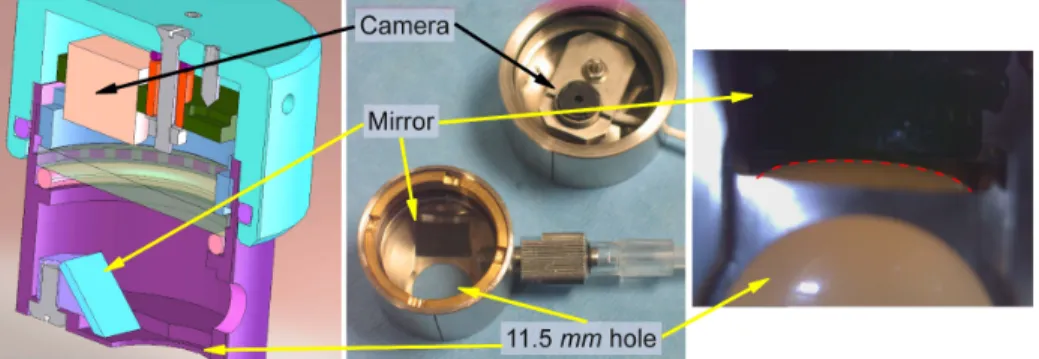
The new Light Aspiration device for in vivo Soft TIssue Characterization (LASTIC) is designed to overcome these issues while keeping the suction cup as light as possible and maintaining compatibility with the sterilization process required by an intra operative use. The basic design is not very far from the one of Vuskovic [9] except for the compactness. This is a major advantage since it allows using the device even when the access to the tissue is limited in size. The light weight makes the device self positioned as soon as the negative pressure is applied. There is no need for a initial force exerted by the user to hold the suction cup in contact with the tissue. We use a 2 M pixel mobile phone camera sensor VS6750 from STMicroelectronics. Its overall size is 1 cm. We had it fitted inside a very compact cylindrical case (33 mm in height ×34 mm in diameter) that encloses both the camera and the mirror. A scheme and a picture of the full device can be seen in Figure 2.
Fig. 2. LASTIC: scheme (left) and picture (center) of the new suction device. Example of an image captured by the camera during a depression of a PVC phantom (right).
It is made of two cylindrical parts that fit together. The lower part is fully passive, it encloses a 45°mirror and its mount. Its bottom side is drilled with a 10 mm circular hole. A lateral hole equipped with a Luer-Lock connector allows application of a negative pressure to the suction cup. An airtight transparent polycarbonate window closes the top end of this cylinder. This part is expected to withstand the full sterilization treatment.
The upper part encloses the miniature camera and its mount as well as a Light Emitting Diode. The camera is precisely aligned with the mirror using a flexible adjustable mount. Proper focus setting is made by slightly screwing down or unscrewing the built-in camera lens mount. Due to the electronic components, this part cannot withstand elevated temperature. It can be sterilized either using
a gas or liquid treatment thanks to a specifically designed air-tight cap that hermetically seals this part. When assembled, both parts constitute an airtight case that is put in contact with the tissues.
In addition to the hardware part of the device, we also significantly improved the data collection as well as the control of the negative pressure and its syn-chronization with the image capture. The negative pressure is applied using a syringe handled by a software-driven calibrated push-syringe. Since the pres-sure application is static, there is no prespres-sure lag between the reading from the manometer and the suction cup. We also check for a steady reading from the manometer, which is an indication that no leak occurs. A software program con-trols the application of the negative pressure, the pressure measurement from an interfaced manometer as well as the synchronisation with the image acqui-sition. Each one of the three digitally interfacable instruments is connected to the data acquisition board of a laptop computer. A typical measurement takes less than ten seconds during which the pressure is decreased step by step and an image is taken at each step, synchronized with the pressure acquisition from the manometer.
The design of the new suction cup with a built-in miniature camera as well as a fully computer controlled user interface addresses the two major issues of the first version of our aspiration device. The alignment of the camera and the mirror is fixed and once aligned during the initial assembly of the cup, it does not need to be adjusted again. The synchronization of the pressure measurement with the image acquisition is guaranteed by the software controlled data acquisition.
3.2 Interactive-time estimation of the constitutive equation
The measurements provided by the LASTIC device are used to estimate the tissue elasticity parameters by inverting a Finite Element model of the suction experiment. The aim of this device is to be used in vivo in a context of Computer Assisted Surgery. This requires the solution of the inverse problem to be obtained in a very short time of the order of seconds. Since there is no rigorous mathemat-ical solution of the inverse problem, our problem can boil down to a parametric non-linear optimization scheme. The unknown parameters are the coefficients of the mechanical constitutive law. Multiple schemes can be used to solve this optimization problem. The typical time of a Finite Element Model simulation of the suction experiment for one negative pressure value (which we will call the “direct problem”) is approximately 25 seconds on a workstation (Intel Core 2 Quadri-processor Q6600). The exact conditions for the FEM simulation are detailed in [14]. Depending on the initial values, a standard optimization routine would need to run the direct problem several tens to several hundreds times with different parameter values before converging to the best set of parameters. The same order of magnitude holds if a global optimization routine such as a genetic algorithm or simulated annealing is used. Needless to say that the time needed to achieve a single optimization is far beyond the time allotted to this constitutive law determination during a computer assisted surgical intervention. That is the reason why we focussed our attention on a library-based method. The library
method proves to be very successful whenever an optimization is required of a problem with a computer intensive direct problem. For example it is widely used to solve the inverse problem of electromagnetic diffraction in the so called scatterometry technique which is a nanometer scale dimensional metrology in the field of microelectronic technology [15]. Other strategies exist that consist of making in advance a large number of time consuming direct problem computa-tions, potentially coupled with a form of preprocessing then restricting the final search of the solution to a much simpler analytical or semianalytical problem. Surface response and neural network approaches are among those. Each one has its own pro and cons, we chose to use the simplest, yet brute force method of the library search.
The choice of the constitutive law as well as the detailed description of the Finite Element simulations have been presented in a previous paper [14], there-fore we will not go in great detail here. Note that in order to avoid edge effects during the FEM resolution, the tissue depth should be more than 4 to 5 times the size of the aspiration hole, i.e. about 5 cm. Should the tissue be non homoge-neous, this could be accounted for in the FEM model at the expense of a larger number of parameters and increased computation time. However, the type of in-homogeneity cannot be completely unknown, a priori knowledge has to be used in order for the FEM model to be described and parameterized. In light of the nonlinear stress-strain relationships given by our previous suction measurements on the brain, the medium was assumed to be an isotropic homogeneous and hy-perelastic continuum. We selected a two-parameter Mooney-Rivlin strain-energy function, W , using only the first and third power of the first invariant of the right Cauchy-Green strain tensor. A best fit between the experimental data and the results from the calculation of the deformation vs negative pressure curve was used to determine the material constants a10 and a30. In the library method,
the calculations are performed in advance and at the time of the measurement, the results are looked up in a file where the computed results have been stored. It can take hours to generate the database, but it takes less than one second to find the best set of parameters in the library. This makes the use in an intra-operative environment fully viable. However, pressure variation is achieved step by step. The simple aspiration control set-up does not allow for dynamic pres-sure control and dynamic tissue response meapres-surements. All meapres-surements are therefore considered to be fully static.
4
Results
The LASTIC device has not been used yet for an intra-operative use. It was only evaluated in our lab with measurements on tongue and skin elasticities. Compared to the first version of our device described in [14], LASTIC proved much easier to use and install. In addition, the interactive-time estimation of the tissues constitutive equations is a major improvement.
A first quantitative evaluation of this inverse procedure was performed by comparing the results given by the optimization process conducted in Ansys
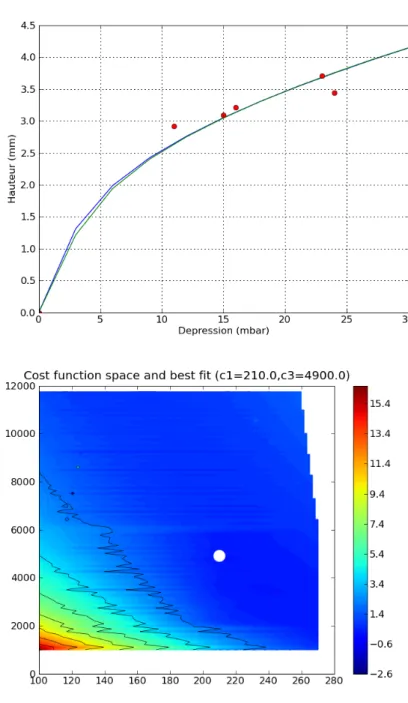
Fig. 3. Comparison of the simulation results for the optimal constitutive laws given by Ansys and by our library-based optimization process, superimposed with measure-ments points (top). Value of the optimization cost function (least mean square) for the (a10, a30) considered range for the brain tissues characterization (bottom). The white
software (Ansys 10 software, Ansys, Inc., Cannonsburg, PA) and by our library based optimization process. The brain measurements described in [14] were used. In Ansys, an advanced zero-order method, which only requires the dependent variable values, and not their derivatives (Subproblem approximation method), found the optimal values of a10 = 240 and a30 = 3420. Our library-based
op-timization process found a10 = 210 and a30 = 4900. The two constitutive laws
are not significantly dissimilar in the pressure range considered (Figure 3, top). Furthermore, the cost-function space is rather smooth and free of local minima (Figure 3, bottom).
The computation times are hardly comparable as our optimization takes less than one second to find the best parameters.
5
Discussion/Conclusion
This paper introduced the latest version of our Light Aspiration device for in vivo Soft TIssue Characterization (LASTIC). Most of the constraints due to an intra-operative use have been taken into account, with a special focus on the sterilization process and on the interactive time estimation of the elastic pa-rameters. The library search inverse method has been proposed to estimate the tissues constitutive laws and was quantitatively compared with a full optimiza-tion direct method based on Ansys Software. Starting from data collected on brain tissues, both methods lead to very similar constitutive laws that match the in vivo measurements. A full validation of the device and inversion method is ongoing that includes an estimation of the errors in the parameter determina-tion as well as a comparison with other more convendetermina-tional rheology instruments. This is first conducted on model materials such as elastomers or hydrogels.
Acknowledgement
The authors wish to thank T. Boudou and J. Ohayon for their contribution to this work, especially the discussion about the aspiration experiment and model inversion.
References
1. Ottensmeyer, M.P.: Minimally invasive instrument for in vivo measurement of solid organ mechanical impedance. PhD thesis, Massachusetts Institute of Technology. Dept. of Mechanical Engineering (2001)
2. Gefen, A., Margulies, S.: Are in vivo and in situ brain tissues mechanically similar? J Biomech 37(9) (2004) 1339–1352
3. Kerdok, A.E., Ottensmeyer, M.P., Howe, R.D.: Effects of perfusion on the vis-coelastic characteristics of liver. J Biomech 39(12) (2006) 2221–2231
4. Carter, F.J., Frank, T.G., Davies, P.J., McLean, D., Cuschieri, A.: Measurements and modelling of the compliance of human and porcine organs. Med Image Anal 5(4) (Dec 2001) 231–236
5. Samur, E., Sedef, M., Basdogan, C., Avtan, L., Duzgun, O.: A robotic indenter for minimally invasive measurement and characterization of soft tissue response. Med Image Anal 11(4) (Aug 2007) 361–373
6. Agache, P.G., Monneur, C., Leveque, J.L., Rigal, J.D.: Mechanical properties and young’s modulus of human skin in vivo. Arch Dermatol Res 269(3) (1980) 221–232 7. Jemec, G.B., Selvaag, E., Agren, M., Wulf, H.C.: Measurement of the mechanical properties of skin with ballistometer and suction cup. Skin Res Technol 7(2) (May 2001) 122–126
8. Grahame, R., Holt, P.J.: The influence of ageing on the in vivo elasticity of human skin. Gerontologia 15(2) (1969) 121–139
9. Vuskovic, V.: Device for in-vivo measurement of mechanical properties of internal human soft tissues. PhD thesis, ETH Z¨urich (2001)
10. Diridollou, S., Patat, F., Gens, F., Vaillant, L., Black, D., Lagarde, J.M., Gall, Y., Berson, M.: In vivo model of the mechanical properties of the human skin under suction. Skin Res Technol 6(4) (Nov 2000) 214–221
11. Mazza, E., Nava, A., Bauer, M., Winter, R., Bajka, M., Holzapfel, G.A.: Mechanical properties of the human uterine cervix: an in vivo study. Med Image Anal 10(2) (2006) 125–36
12. Wang, Q., Kong, L., Sprigle, S., Hayward, V.: Portable gage for pressure ulcer detection. In: Engineering in Medicine and Biology Society, 2006. EMBS ’06. 28th Annual International Conference of the IEEE. (2006) 5997–6000
13. Nava, A., Mazza, E., Furrer, M., Villiger, P., Reinhart, W.H.: In vivo mechanical characterization of human liver. Med Image Anal 12(2) (Apr 2008) 203–216 14. Schiavone, P., Chassat, F., Boudou, T., Promayon, E., Valdivia, F., Payan, Y.: In
vivo measurement of human brain elasticity using a light aspiration device. Med Image Anal 13(4) (Aug 2009) 673–678
15. Niu, X., Jakatdar, N., Bao, J., Spanos, C.J.: Specular spectroscopic scatterometry. Semiconductor Manufacturing, IEEE Transactions on 14(2) (2001) 97–111
![Fig. 1. Light suction device used to measure brain elasticity: Schematic view (a), intra- intra-operative use (b), photo of the aspirated tissue reflected in the mirror (c) - (from [14])](https://thumb-eu.123doks.com/thumbv2/123doknet/12909872.372325/5.918.212.718.320.527/light-suction-measure-elasticity-schematic-operative-aspirated-reflected.webp)