Abstract
Aims/hypothesis. We sought to evaluate the impact of diabetes mellitus on long-term outcome in patients with unstable angina and non-ST-segment elevation myocardial infarction treated with a very early inva-sive strategy.
Methods. We carried out a prospective cohort study in 270 diabetic and 1163 non-diabetic patients with unsta-ble angina and non-ST-segment elevation myocardial in-farction. All patients underwent coronary angiography and, if appropriate, subsequent revascularisation within 24 hours of admission. The primary endpoint was all-cause mortality during follow-up for up to 60 months. Results. Diabetic patients had less favourable baseline characteristics including more advanced coronary ar-tery disease and more severe unstable angina and non-ST-segment elevation myocardial infarction. Percutane-ous coronary intervention was performed in 53% of di-abetic patients and 56% of non-didi-abetic patients. Coro-nary artery bypass grafting was done in 21% of diabetic
patients and 12% of non-diabetic patients. In-hospital mortality (4.1% vs 1.3%; hazard ratio 3.47; 95% CI: 1.57 to 7.64; p=0.002) and long-term mortality (9.7% vs 4.9%; hazard ratio 2.11; 95% CI: 1.33 to 3.36; p=0.002) were significantly higher in diabetic patients. After adjustment for differences in baseline characteris-tics, diabetes mellitus was no longer an independent predictor of long-term mortality (hazard ratio 1.43; 95% CI: 0.74 to 2.78; p=0.292).
Conclusions/interpretation. Diabetic patients treated with a very early invasive strategy for unstable angina and non-ST-segment elevation myocardial infarction have a higher in-hospital and long-term mortality that is largely explained by their less favourable baseline characteristics including more advanced coronary ar-tery disease and more severe unstable angina and non-ST-segment elevation myocardial infarction.
Keywords Diabetes mellitus · Long-term mortality · Myocardial infarction · Revascularisation · Unstable angina
Received: 8 March 2004 / Accepted: 22 April 2004 Published online: 3 July 2004
© Springer-Verlag 2004 C. Müller (
✉
)Departement Innere Medizin,
Medizinische Universitätsklinik Basel, Petersgraben 4, 4031 Basel, Switzerland
E-mail: [email protected]
Tel.: +41-61-2652525, Fax: +41-61-2655353
Abbreviations: CK, creatine phosphokinase · FRISC, Fragmin and fast Revascularisation during InStability in Coronary artery disease · OASIS, Organisation to Assess Strategies for Ischemic Syndromes · TACTICS-TIMI 18, Treat angina with Aggrastat and determine Cost of Therapy with an Invasive or Conservative Strategy—Thrombolysis In Myocardial Infarction 18 · UA/NSTEMI, unstable angina and non-ST-segment elevation myocardial infarction Diabetologia (2004) 47:1188–1195
DOI 10.1007/s00125-004-1450-3
Impact of diabetes mellitus on long-term outcome after unstable
angina and non-ST-segment elevation myocardial infarction treated
with a very early invasive strategy
C. Müller1, 2· F. J. Neumann1· M. Ferenc1· A. P. Perruchoud2· H. J. Büttner1 1 The Heart Center Bad Krozingen, Germany
2 Departement Innere Medizin, Medizinische Universitätsklinik Basel, Basel, Switzerland
Introduction
Diabetes mellitus is an important risk factor for coro-nary artery disease, which is associated with increased mortality and morbidity in diabetic patients as com-pared with non-diabetic patients [1, 2, 3]. Patients with diabetes mellitus with no history of coronary ar-tery disease have the same risk of cardiovascular death as non-diabetic patients with a history of myo-cardial infarction [4]. In addition, patients with diabe-tes mellitus have not experienced the reduction in cardiovascular mortality rates that has recently been observed in non-diabetic subjects [5]. The number of adults with diabetes mellitus worldwide is likely to grow from 135 million in 1995 to approximately 300 million in 2025 [6]. However, only limited
informa-tion is available regarding the outcome of diabetic pa-tients after hospital admission with unstable angina and non-ST-segment elevation myocardial infarction (UA/NSTEMI), the most common reason for admis-sion to a coronary care unit [7, 8, 9, 10, 11]. The OASIS registry prospectively collected data from UA/NSTEMI patients treated with predominately medical therapy in six different countries including the United States, and reported that diabetes mellitus independently predicted mortality [11]. Overall, cu-mulative mortality in patients with diabetes mellitus was 19% at 24 months in the OASIS registry.
Revascularisation, irrespective of the primary suc-cess of medical therapy, has become the preferred treatment strategy in patients with UA/NSTEMI [12, 13, 14]. Current practice guidelines for the manage-ment of patients with UA/NSTEMI from the American College of Cardiology, the American Heart Associa-tion, and the European Society of Cardiology recom-mend an early invasive strategy for most patients [15, 16]. The long-term outcome of patients with diabetes mellitus and UA/NSTEMI treated with a very early in-vasive strategy remains to be assessed. We sought to determine the long-term outcome of systematic revas-cularisation within 24 hours in diabetic patients. In ad-dition, we evaluated whether the prognostic impact of diabetes mellitus is different between women and men.
Subjects and methods
Study population. From January 1996 to December 1999, con-secutive patients admitted to our centre with UA/NSTEMI were treated with a very early invasive strategy. Patients were eligible for inclusion in this study if they underwent coronary angiography for symptoms of myocardial ischaemia occurring at rest (Braunwald class IIIB unstable angina) [17]. We exclud-ed patients who had the following conditions: (i) a first case of angina pectoris during exertion, or worsening angina during exertion (Braunwald class 1A–C); (ii) persistent ST-elevation; or (iii) postinfarction angina (Braunwald class 1C, 2C, 3C). Also excluded were patients in whom angiography was not performed due to patient refusal (n=6) or extremely severe concomitant disease (n=9 with severe dementia or advanced malignancy). The study was carried out in accordance with the Declaration of Helsinki and approved by the institutional re-view board. Informed consent was obtained from all participat-ing patients. Diabetes was defined as the patient havparticipat-ing a known history of diabetes mellitus treated currently with either diet intervention, oral glucose-lowering agents or insulin. Irre-spective of the presence or absence of diabetes, strict gly-caemic control was observed in all patients. Upon hospital dis-charge, all patients were instructed to follow a low-cholesterol diet, and statins were recommended to achieve an LDL choles-terol lower than 2.6 mmol/l during follow-up. All patients received aspirin and beta blockers unless contraindicated. Very early invasive strategy. Patients with persistent chest pain underwent immediate coronary angiography. In patients asymptomatic while on medical therapy, coronary angiography was performed within 24 hours of admission. Whenever possi-ble, coronary stenting of the culprit lesion was done directly
after angiography. Stenting was not restricted to patients with one- and two-vessel disease, but also favoured in patients with three-vessel disease, if the target lesion seemed accessible. If percutaneous coronary intervention was not possible (unpro-tected left main disease, diffuse three-vessel disease) but revas-cularisation seemed necessary, patients were scheduled for urgent coronary artery bypass grafting.
Follow-up. All patients were scheduled for outpatient visits at 6 months. In addition, patients were contacted by questionnaire in September 2000, 4 years and 9 months after enrolment of the first patient. For patients reporting cardiac symptoms, at least one clinical and ECG examination was performed in the outpatient clinic or by the referring physician. All information derived from contingent hospital re-admission records and that provided by the referring physician or by the outpatient clinic was reviewed and entered into the computer database.
Endpoints and statistical analysis. The pre-specified primary endpoint was defined as death from all causes. As secondary endpoints we assessed non-fatal myocardial infarction and the composite of death and non-fatal myocardial infarction. Myocardial infarction was defined as typical chest pain at rest followed by an increase in creatine phosphokinase (CK and CK-MB more than two times the upper limit of normal, and more than five times the upper limit of normal after coronary ar-tery bypass grafting) or new Q waves in the ECG. To meet this endpoint criterion, patients who initially had myocardial infarc-tion had to develop ST-segment changes and an increase in CK of at least 50% over the previous trough level in at least two samples reaching at least three times the upper limit of normal.
Follow-up events were adjudicated by a clinical events committee. All patients received ECG recordings directly after percutaneous coronary intervention or coronary artery bypass grafting and on the following morning. In addition, cardiac markers (CK and CK-MB) were determined between 8 and 24 hours after the intervention, and additionally whenever ischaemic symptoms developed. The statistical analyses were performed using the SPSS/PC (version 11.0; SPSS, Chicago, Ill., USA) software package. Discrete variables were expressed as percentages (95% CI) and continuous variables were ex-pressed as means ± SD. A p value of 0.05 or less was consid-ered statistically significant. For the rarer outcomes, confi-dence intervals were calculated using the Wilson method. Comparisons were made using ANOVA for independent sam-ples and chi square tests as appropriate. All hypothesis testing was two-tailed. Cox proportional hazards regression analysis was used as the appropriate method throughout. Multivariate Cox regression analysis was performed to identify independent predictors of death. Baseline characteristics, ECG findings, markers of inflammation and myocardial necrosis, and the an-giographic extent of coronary artery disease were entered into the model. The cumulative survival curves were constructed by the Kaplan–Meier method.
Results
Baseline characteristics. There were 270 patients with diabetes and 1163 patients without diabetes in this study. The vast majority of diabetic patients were clas-sified as having Type 2 diabetes (261 of the 270, 97%). Besides diet and exercise, therapy included insulin in 74 (28%) of the 261 patients, and glibenclamide in 50 (19%) of the 261 patients. Baseline characteristics
1190 C. Müller et al.:
were considerably different between diabetic and non-diabetic patients (Tables 1 and 2). Diabetic patients were older, more often hypertensive and less often smokers, and they more frequently had a previous myocardial infarction as well as cardiac arrest during the UA/NSTEMI leading to admission than non-dia-betic patients. They also had a higher incidence of new ST-segment depression and raised troponin T.
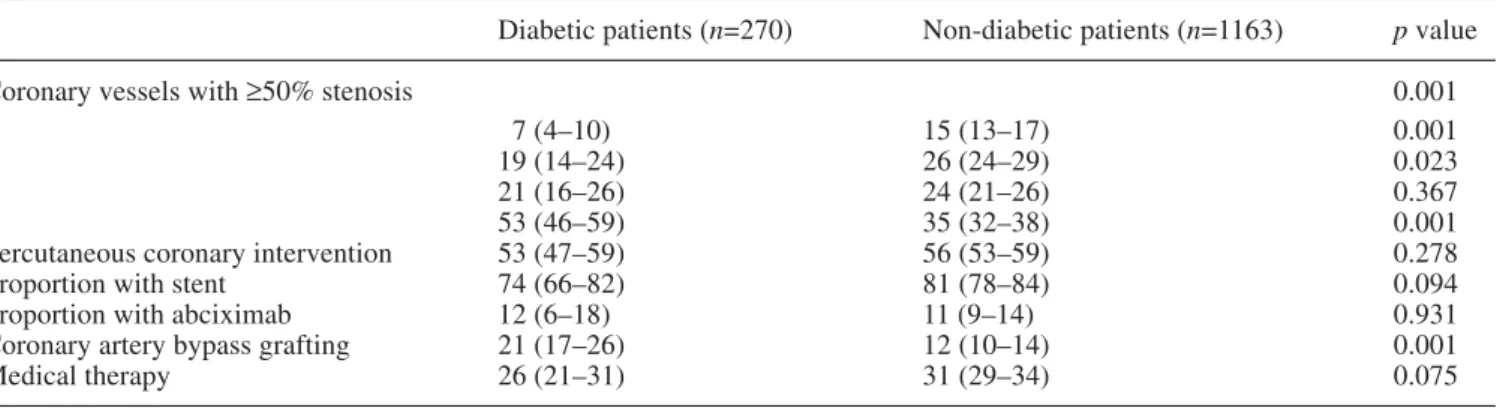
Angiographic characteristics and revascularisation. Coronary angiography revealed that coronary artery disease was more extensive in diabetic patients. More than half of the patients with diabetes mellitus had three-vessel disease compared with 35% of patients without diabetes mellitus. Conversely, non-diabetic pa-tients were two times as likely to have no coronary ves-sel with a high-grade lesion as diabetic patients.
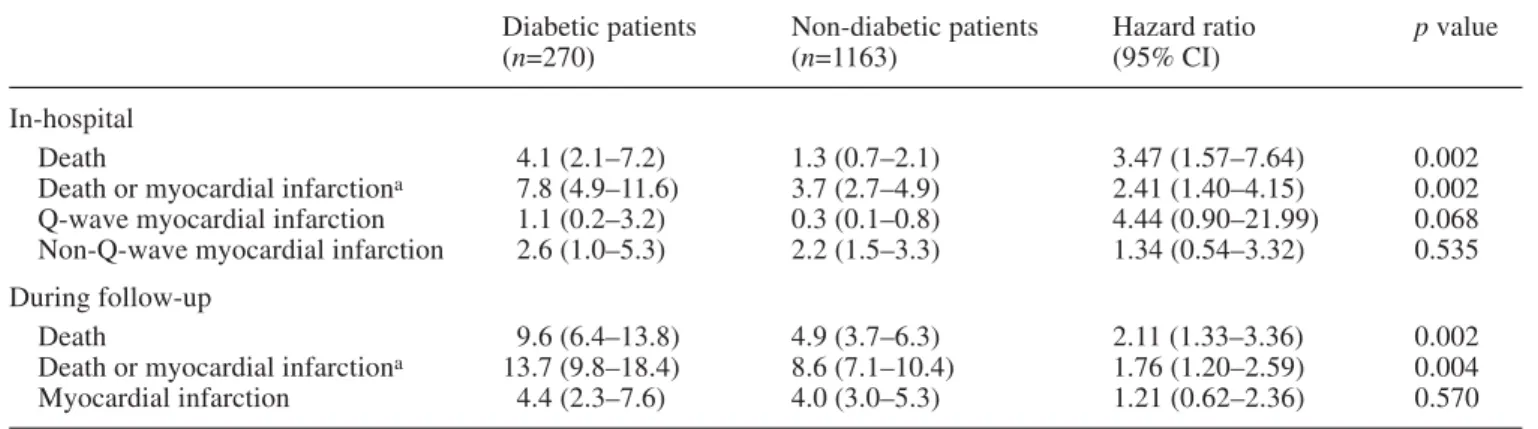
Ac-cordingly, coronary artery bypass grafting was chosen significantly more often (21% vs 12%, p=0.001) in pa-tients with diabetes. However, percutaneous coronary intervention was the predominant revascularisation pro-cedure in both groups. Percutaneous coronary interven-tion was performed in 53% of patients with diabetes and in 56% of patients without diabetes. Altogether, two-thirds of patients underwent revascularisation. In-hospital and long-term outcome. Patients with diabe-tes mellitus had a significantly higher in-hospital mor-tality rate than patients without diabetes mellitus (4.1% vs 1.3%; hazard ratio 3.47; 95% CI: 1.57 to 7.64). In ad-dition, non-fatal Q-wave myocardial infarction and the combined endpoint of death or myocardial infarction was recorded more frequently during the initial hospital-isation in patients with diabetes mellitus (Table 3). Table 1. Baseline patient characteristics
Diabetic patients (n=270) Non-diabetic patients (n=1163) p value
Age (years) 68±9 64±11 <0.001
Female sex 31 (25–36) 28 (26–31) 0.407
Previous myocardial infarction 41 (36–47) 31 (28–34) 0.001
Previous coronary bypass grafting 16 (11–20) 13 (11–15) 0.339
Previous coronary angioplasty 22 (17–27) 22 (20–25) 0.858
Hypercholesterolaemia 64 (58–69) 66 (63–69) 0.451
Hypertension 75 (70–80) 59 (56–62) 0.001
Smoking 14 (9–18) 25 (22–27) 0.001
Angina pectoris at rest >48 h 16 (12–20) 17 (15–19) 0.616
Angina pectoris at rest <48 h 67 (61–73) 69 (66–72) 0.522
Non-Q-wave myocardial infarction 17 (13–22) 14 (12–16) 0.167
Cardiopulmonary resuscitation 3.0 (0.9–5.0) 0.9 (0.4–1.5) 0.009
Defibrillation (only) 2.6 (0.7–4.5) 1.5 (0.8–2.3) 0.238
Cardiogenic shock 1.1 (0–2.4) 0.9 (0.3–1.4) 0.695
New ST depression at entry 14 (10–18) 10 (8–12) 0.090
New T-wave inversion 28 (23–34) 29 (27–32) 0.703
Troponin T ≥0.01 µg/l 63 (56–69) 55 (51–58) 0.047
C-reactive protein >10 mg/l 30 (24–37) 25 (22–28) 0.112
Creatinine (µmol/l) 91±74 80±59 0.016
White blood cell count (×103/µl) 9.0±3.0 8.8±8.0 0.820
Platelet count (×103/µl) 236±94 235±70 0.874
Data are expressed as means ± SD, or percentages (95% CI)
Table 2. Baseline angiographic and procedural characteristics
Diabetic patients (n=270) Non-diabetic patients (n=1163) p value
Coronary vessels with ≥50% stenosis 0.001
0 7 (4–10) 15 (13–17) 0.001
1 19 (14–24) 26 (24–29) 0.023
2 21 (16–26) 24 (21–26) 0.367
3 53 (46–59) 35 (32–38) 0.001
Percutaneous coronary intervention 53 (47–59) 56 (53–59) 0.278
Proportion with stent 74 (66–82) 81 (78–84) 0.094
Proportion with abciximab 12 (6–18) 11 (9–14) 0.931
Coronary artery bypass grafting 21 (17–26) 12 (10–14) 0.001
Medical therapy 26 (21–31) 31 (29–34) 0.075
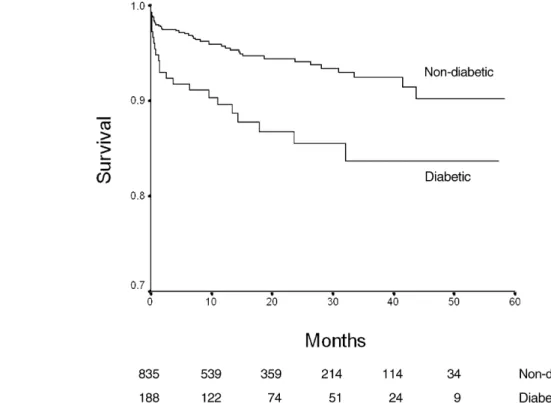
The mean interval between admission and last tient contact or death was 19 months in diabetic pa-tients and 20 months in non-diabetic papa-tients. During follow-up, mortality was significantly higher in pa-tients with diabetes mellitus than in papa-tients without diabetes mellitus (Fig. 1). Kaplan–Meier analysis re-vealed a cumulative survival rate of 86.6% for dia-betic patients and 92.8% for non-diadia-betic patients at 36 months. The incidence of non-fatal myocardial in-farction was similar in the two groups.
Association between diabetes mellitus and sex. As shown in Figures 2 and 3, the impact of diabetes mellitus on long-term outcome was considerably
dif-ferent between men and women (p=0.001 for associa-tion). While diabetic men showed a marked reduction in survival rate compared with men without diabetes (83.7% vs 92.4% at 36 months), diabetic women showed a very similar survival rate to women without diabetes mellitus (93.9% vs 93.7% at 36 months). Diabetes mellitus and very early percutaneous coro-nary intervention. The long-term survival rate in pa-tients undergoing very early revascularisation with percutaneous coronary intervention was excellent, ir-respective of the presence or the absence of diabetes mellitus (Fig. 4). At 36 months, the cumulative sur-vival rate was 92.4% in diabetic patients and 92.0% in non-diabetic patients.
Multivariate Cox regression analysis. After adjust-ment for baseline characteristics, ECG findings, mark-Table 3. Association between diabetes mellitus and outcome
Diabetic patients Non-diabetic patients Hazard ratio p value
(n=270) (n=1163) (95% CI)
In-hospital
Death 4.1 (2.1–7.2) 1.3 (0.7–2.1) 3.47 (1.57–7.64) 0.002
Death or myocardial infarctiona 7.8 (4.9–11.6) 3.7 (2.7–4.9) 2.41 (1.40–4.15) 0.002
Q-wave myocardial infarction 1.1 (0.2–3.2) 0.3 (0.1–0.8) 4.44 (0.90–21.99) 0.068 Non-Q-wave myocardial infarction 2.6 (1.0–5.3) 2.2 (1.5–3.3) 1.34 (0.54–3.32) 0.535 During follow-up
Death 9.6 (6.4–13.8) 4.9 (3.7–6.3) 2.11 (1.33–3.36) 0.002
Death or myocardial infarctiona 13.7 (9.8–18.4) 8.6 (7.1–10.4) 1.76 (1.20–2.59) 0.004
Myocardial infarction 4.4 (2.3–7.6) 4.0 (3.0–5.3) 1.21 (0.62–2.36) 0.570
Data are expressed as percentages (95% CI) unless otherwise stated. aCounting only one event per patient
Fig. 1. Cumulative survival in diabetic and non-diabetic pa-tients during long-term follow-up. p=0.0016 by log-rank
1192 C. Müller et al.:
ers of inflammation and myocardial necrosis, and the angiographic extent of coronary artery disease, diabe-tes mellitus was not found to be a significant indepen-dent predictor of long-term mortality (hazard ratio 1.43; 95% CI: 0.74 to 2.78; p=0.292). Adding very
early percutaneous coronary intervention as a variable to the multivariate Cox regression analysis showed that very early percutaneous coronary intervention was independently associated with a favourable out-come (hazard ratio for long-term mortality 0.50; 95% CI: 0.30 to 0.85; p=0.011). This association would persist if the analysis was restricted to diabetic pa-tients only (hazard ratio 0.47; 95% CI: 0.20 to 1.09; p=0.078).
Fig. 2. Cumulative survival in diabetic and non-diabetic men. p=0.0010 by log-rank
Fig. 3. Cumulative survival in diabetic and non-diabetic women. p=0.5792 by log-rank
Discussion
Our study of 1433 consecutive patients with UA/ NSTEMI treated with a very early invasive strategy showed that in-hospital and long-term mortality were significantly higher in patients with diabetes. This finding is consistent with previous studies that primar-ily used a conservative management strategy for UA/NSTEMI [7, 8, 9, 10, 11]. Nevertheless, as our major novel finding we were able to attribute most of this excess risk to two factors: more advanced coro-nary artery disease and more severe UA/NSTEMI at presentation. In fact, we could demonstrate that after adjusting for cofounders, diabetes mellitus was no longer an independent predictor of adverse outcome with this aggressive revascularisation strategy. We found important differences in baseline characteristics between diabetic and non-diabetic patients. Most im-portantly, diabetic patients were older and more often had previous myocardial infarction and three-vessel disease. In addition, the UA/NSTEMI seemed to be more severe in diabetic patients. Cardiopulmonary resuscitation, ST-segment depression and elevated troponin T were seen more often in diabetic patients than in non-diabetic patients. When we adjusted for these differences between diabetic and non-diabetic patients, the presence or absence of diabetes mellitus was no longer predictive of survival. As coronary angiography was performed in all patients, this study Fig. 4. Cumulative survival in diabetic and non-diabetic pa-tients revascularised very early with percutaneous coronary intervention. p=0.4242 by log-rank
was able to include the angiographic extent of coro-nary artery disease in the multivariate model to assess independent predictors of long-term mortality. We found that the association of three-vessel disease and diabetes constitutes an important component of the predictive power of diabetes by univariate analy-sis.
This was not a randomised trial evaluating the very early invasive strategy. Accordingly, any comparison of the outcome observed in this prospective trial with historical controls has inherent limitations and should be interpreted with considerable caution. Although very similar with respect to patient baseline character-istics and study period, our study population experi-enced merely two-thirds the mortality at 24 months of that observed in the OASIS registry [11]. In our study, particularly in the patients revascularised very early with percutaneous coronary intervention, there was an excellent outcome irrespective of the presence or ab-sence of diabetes mellitus. In fact, in the subgroup re-ceiving very early percutaneous coronary intervention, long-term survival was identical in diabetic and non-diabetic patients. This observation is supported by subgroup analyses of the TACTICS-TIMI 18 and FRISC II studies [12, 13], in which diabetic patients showed a more pronounced benefit from the early invasive strategy than non-diabetic patients. In the TACTICS-TIMI 18 study, the early invasive strategy reduced the primary endpoint of death, non-fatal myo-cardial infarction, or re-hospitalisation, for an acute coronary syndrome at 6 months, from 27.7% to 20.1% in diabetic patients, and from 16.4% to 14.2% in non-diabetic patients. Our finding, however, can only be used to generate hypotheses and needs to be con-firmed by further study.
Excessive restriction during coronary angiography and revascularisation procedures may have contribut-ed significantly to the dismal prognosis of patients with diabetes mellitus in earlier reports [5, 7, 11]. In a case-control study of 162 diabetic patients with unsta-ble angina, diabetic patients less frequently underwent coronary angiography and angioplasty [7]. This obser-vation was confirmed in the large OASIS registry. Al-though the diabetic patients in the registry were at clearly higher risk, having had more previous cardio-vascular events including myocardial infarction, con-gestive heart failure and coronary artery bypass graft-ing, the rate of coronary angiography (37% vs 37%) and revascularisation by percutaneous coronary inter-vention or coronary artery bypass grafting (23% vs 20%) was not appropriately increased in patients with diabetes compared with patients without diabetes. In marked contrast, 70% of patients underwent revascu-larisation in this study. It is possible that at least partly as a result of this difference, 2-year mortality in pa-tients with diabetes in the OASIS registry was in-creased by 50% compared with diabetic patients in our study. This hypothesis is supported by a recent study of 376 consecutive patients [5] showing that al-though diabetic patients with non-Q-wave myocardial infarction represented a cohort with more risk factors for poor outcome, aggressive in-hospital revasculari-sation with percutaneous coronary intervention result-ed in excellent short-term outcome and 1-year sur-vival similar to that in non-diabetic patients (92% vs 94%, NS). In addition, the beneficial effect of coro-nary stenting compared with standard balloon angio-plasty on vessel patency and long-term clinical out-come in diabetic patients has now been demonstrated conclusively [18].
We acknowledge that the revascularisation strategy applied in UA/NSTEMI patients with three-vessel dis-ease is controversial. In this study, coronary stenting was not restricted to patients with one- and two-vessel disease, but also favoured in patients with three-vessel disease, if the target lesion seemed accessible. It is im-portant to note that the benefit of percutaneous coro-nary intervention over corocoro-nary artery bypass grafting in UA/NSTEMI patients with diabetes and three-ves-sel disease has yet to be proven. Although this inter-vention is common in well-established centres, which report an association with significantly lower morbidi-ty, long-term outcome data from randomised trials specifically including UA/NSTEMI patients are lack-ing. In diabetic patients presenting with stable coro-nary artery disease, corocoro-nary artery bypass grafting seems to be more effective [19].
The treatment strategy applied in our patients is novel in two ways: the timing of the intervention and the preferred method of revascularisation. Coronary angiography and subsequent coronary stenting of the culprit lesion, as the primary revascularisation method, were performed within 24 hours of admission
in all patients. The percutaneous coronary intervention : coronary artery bypass grafting ratio was 4:1. In the FRISC II study, coronary angiography was performed within the first 7 days and the percutaneous coronary intervention : coronary artery bypass grafting ratio was 1:1. In addition, the FRISC II study excluded pa-tients with previous coronary artery bypass grafting, and patients with advanced age. These differences may explain the discrepant findings in multivariate analysis with respect to the independent impact of dia-betes mellitus on long-term mortality [13]. In the FRISC II study, diabetes mellitus remained an inde-pendent predictor of mortality at 12 months.
The prognostic impact of diabetes mellitus was different between women and men. Women with dia-betes mellitus had similar long-term outcome to wom-en without diabetes mellitus, whereas mortality was significantly increased in diabetic men compared with non-diabetic men. This finding is in contrast to the ob-servation of the OASIS registry, where diabetes melli-tus was of greater prognostic importance for women than for men. This may suggest that the association between diabetes mellitus and sex depends on the management strategy applied in UA/NSTEMI (very early invasive vs conservative strategy). The very early invasive strategy seems to counteract and com-pensate for many of the extra risk factors present in diabetic women with UA/NSTEMI. The timing of the revascularisation procedure may, at least in part, ex-plain why diabetic women derived such a major bene-fit from the management strategy applied in our study compared with the management strategy applied in OASIS. Although several pathophysiological distinc-tions [20, 21, 22, 23, 24] have been reported between women and men, the fact that women seem to form fewer coronary collaterals than men [24] may be of great importance. Due to this lack of collaterals, women may benefit particularly from a rapid correc-tion of the epicardial obstruccorrec-tion during UA/NSTEMI [25]. However, further study is necessary to confirm this hypothesis.
Our analysis has four distinguishing features: (i) it is derived from a prospective study of consecutive unse-lected patients rather than from a randomised trial. This eliminates selection bias and allows generalisation and extrapolation of the findings into clinical practice; (ii) it involves long-term follow-up; (iii) a uniform revascu-larisation strategy was applied in all patients; and (iv) the extent of coronary artery disease was quantified in all patients and included in the multivariate analysis as a potential cofounder. This enables us to investigate the impact of diabetes mellitus, independent of the extent of coronary artery disease at presentation.
In conclusion, diabetic patients with UA/NSTEMI have more advanced coronary artery disease and more severe UA/NSTEMI than non-diabetic patients. Con-sequently, their in-hospital and long-term mortality is higher. However, when a very early invasive strategy
is applied, and after adjustment for baseline character-istics, ECG findings, markers of inflammation and myocardial necrosis, and the angiographic extent of coronary artery disease, diabetes mellitus is no longer an independent predictor of death.
Acknowledgements. The results of this study were presented in part at the 52ndAnnual Scientific Session of the American
Col-lege of Cardiology, Chicago, 30 March–2 April 2003. The study was supported by research grants from the Swiss Nation-al Science Foundation, the Novartis Foundation, the Krokus Foundation, and the University of Basel (all to C. Müller). The authors wish to thank U. Keller for providing expert advice.
References
1. Abbott RD, Donahue RP, Kannel WB, Wilson PW (1988) The impact of diabetes on survival following myocardial infarction in men vs. women: the Framingham Study. JAMA 260:3456–3460
2. Butler WJ, Osrander LD Jr, Carman WJ, Lamphiear DE (1985) Mortality from coronary heart disease in the Tecum-seh Study: long-term effect of diabetes mellitus, glucose intolerance, and other risk factors. Am J Epidemiol 121:541–547
3. Mueller C, Mc Hodgson JB, Brutsche M et al. (2002) Im-pact of intracoronary ultrasound guidance on long-term outcome of percutaneous coronary interventions in diabet-ics—insights from the randomised SIPS trial. Swiss Med Wkly 132:279–284
4. Haffner SM, Lehto S, Rönnemaa T, Pyörälä K, Laakso M (1998) Mortality from coronary heart disease in subjects with type 2 diabetes and in nondiabetic subjects with and without prior myocardial infarction. N Engl J Med 339:229–34
5. Gu K, Cowie CC, Harris MI (1999) Diabetes and decline in heart disease mortality in US adults. JAMA 281:1291– 1297
6. King H, Aubert RE, Herman WH (1998) Global burden of diabetes, 1995–2025: prevalence, numerical estimates, and projections. Diabetes Care 21:1414–1431
7. Fava S, Azzorpadi J, Agius-Muscat H (1997) Outcome of unstable angina in patients with diabetes mellitus. Diabet Med 14:209–213
8. Wilcox I, Freedman SB, Allman KC et al. (1991) Prognos-tic significance of a predischarge exercise test in risk strati-fication after unstable angina pectoris. J Am Coll Cardiol 18:667–683
9. Calvin JE, Klein LW, Van den Berg BJ et al. (1995) Risk stratification in unstable angina: prospective validation of the Braunwald classification. JAMA 273:136–141
10. Gowda MS, Vacek JL, Hallas D (1998) One-year outcomes of diabetic versus nondiabetic patients with non-Q-wave acute myocardial infarction treated with percutaneous transluminal coronary angioplasty. Am J Cardiol 89:1067– 1071
11. Malmberg K, Yusuf S, Gerstein HC et al. (2000) Impact of diabetes on long-term prognosis in patients with unstable angina and non-Q-wave myocardial infarction. Results of the OASIS (Organization to assess strategies for ischemic syndromes) registry. Circulation 102:1014–1019
12. Cannon CP, Weintraub WS, Demopoulos LA et al. (2001) Comparison of early invasive and conservative strategies in
patients with unstable coronary syndromes treated with the glycoprotein Iib/IIIa inhibitor tirofiban. N Engl J Med 344:1879–1887
13. Norhammar A, Malmberg K, Diderholm E et al. (2004) Diabetes mellitus: the major risk factor in unstable coro-nary artery disease even after consideration of the extent of coronary artery disease and benefits of revasculariza-tion. J Am Coll Cardiol 43:585–591
14. Neumann FJ, Kastrati A, Pogatsa-Murray G et al. (2003) Evaluation of prolonged antithrombotic pretreatment (“cool-ing-off strategy”) before intervention in patients with unsta-ble coronary syndromes. A randomized controlled trial. JAMA 290:1593–1599
15. Braunwald E, Antman EM, Beasley JW et al. (2002) ACC/AHA 2002 guideline update for the management of patients with unstable angina and non-ST-segment eleva-tion acute myocardial infarceleva-tion: a report of the American College of Cardiology/American Heart Association Task Force on Practice Guidelines (Committee on the Manage-ment of Patients with Unstable Angina). Available from http://www.acc.org/clinical/guidelines/unstable/unstable.pdf, accessed 1 February 2004
16. The Task Force on the Management of Acute Coronary Syndromes of the European Society of Cardiology (2002) Management of acute coronary syndromes in patients presenting without ST-segment elevation. Eur Heart J 23:1809–1840
17. Braunwald E (1989) Unstable angina: a classification. Cir-culation 80:410–414
18. Van Belle E, Périé M, Braune D et al. (2002) Effects of coronary stenting on vessel patency and long-term clinical outcome after percutaneous coronary revascularization in diabetic patients. J Am Coll Cardiol 40:410–417
19. Detre KM, Guo P, Holubkov R et al. (1999) Coronary re-vascularization in diabetic patients: a comparison of the randomized and observational components of the Bypass Angioplasty Revascularization Investigation (BARI). Cir-culation 99:633–40
20. Conlan MG, Folsom AR, Finch A et al. (1993) Associa-tions of factor VIII and von Willebrand factor with age, race, sex, and risk factors for atherosclerosis: the Athero-sclerosis Risk in Communities (ARIC) Study. Thromb Haemost 70:380–385
21. Tracy RP, Bovill EG, Fried LP et al. (1992) The distribu-tion of coaguladistribu-tion factors VII and VIII and fibrinogen in adults over 65 years: results from the Cardiovascular Health Study. Ann Epidemiol 2:509–519
22. Stegnar M, Pentek M (1993) Fibrinolytic response to venous occlusion in healthy subjects: relationship to age, gender, body weight, blood lipids and insulin. Thromb Res 69:81–92
23. Johansson S, Bergstrand R, Schlossman D, Selin K, Vedin A, Wilhelmsson C (1984) Sex differences in cardioangio-graphic findings after myocardial infarction. Eur Heart J 5:374–381
24. Levenson J, Pessana F, Gariepy J, Armentano R, Simon A (2001) Gender differences in wall shear-mediated brachial artery vasoconstriction and vasodilation. J Am Coll Cardiol 38:1668–1674
25. Mueller C, Neumann FJ, Roskamm H et al. (2002) Women do have an improved long-term outcome after non-ST-ele-vation acute coronary syndromes treated very early and predominately with percutaneous coronary intervention: a prospective study in 1450 consecutive patients. J Am Coll Cardiol 40:245–250