Doctoral Thesis
International Students in Switzerland:
Trajectories, Stay Rates, and Intentions
for Post-Graduate Mobility
Presented by Annique Lombard
at the Institute of Geography, Faculty of Social Sciences,
University of Neuchâtel
Defended on 22 March 2019
Annique Lombard
Avenue du Mail 2
2000 Neuchâtel
Supervised by Professor Etienne Piguet
Co-supervised by Professor Yvonne Riaño,
Institute of Geography, University of Neuchâtel
International Students in Switzerland: Trajectories, Stay Rates, and
Intentions for Post-Graduate Mobility
Table of Contents
Summaries and Acknowledgements ... iii
1 Introduction ... 1
1.1 Overview of International Student Mobility in Switzerland ... 5
1.2 Switzerland in the Global Context ... 10
1.3 Literature on International Student Mobility ... 12
1.4 Student Mobility and Migration Theories... 18
2 Conceptual Framework ... 20
2.1 The Aspirations-Capabilities Framework ... 20
2.2 International Student Mobility and the Aspiration-Capabilities Framework ... 23
3 Research Questions and Structure of the Thesis ... 33
3.1 References ... 35
4 Stay Rates of International Graduates in Switzerland ... 45
Article: Diplôme en Poche – Partir ou Rester dans le Pays Hôte? Une Analyse des Trajectoires des Etudiants Internationaux en Suisse. Géo-Regards ... 45
5 Partnerships and Stay Intentions of International Students ... 71
Article: Staying or Leaving Switzerland after Graduation? The Influence of Couple Relationships on International Students’ Intentions of Mobility. ... 71
6 Employment of International Graduates in the Swiss Labour Market ... 91
Article: International Graduates in Switzerland: Transitioning into the Labour Market ... 91
7 Policies of Migration and International Student Mobility ... 121
8 Discussion and Conclusion ... 137
8.1 Factors Affecting Post-Graduation Mobility of International Graduates ... 137
8.2 Overall Contributions ... 144
8.3 Avenues for Future Research ... 147
8.4 Political Relevance and Outlook ... 150
International Students in Switzerland: Trajectories, Stay Rates, and
Intentions for Post-Graduate Mobility
Summary
Increased international student mobility (ISM) has become one of the salient features of contemporary global migration. In the context of growing global mobility and the globalization of higher education, international student migration to Switzerland is changing significantly in both extent and character. Due to the importance of international students in current migration flows, their mobility is receiving increased attention in migration studies and policy debates. This dissertation sheds light on the character and dynamics of ISM by analyzing the migration trajectories of international students in Switzerland. The study aims to discover patterns and identify factors which have a positive or negative impact on the stay rates of international students and their subsequent integration into the Swiss labour market, proposes a framework for student mobility, and finally discusses the results in a context of current changes in migration policies and debates including a glance at migration policies outside Switzerland. The thesis is composed of four sections which draw attention to a) stay rates of international students,
b) intentions to stay in Switzerland, taking partnership status into account, c) integration into the Swiss labour market, and d) changes in relevant policies. The statistical data originates from various datasets on international students, from a merged dataset of the Swiss Higher Education Information System (SHIS) and the Central Migration Information System (ZEMIS)1, a series of
the Swiss Graduate Surveys, and the NCCR Mobility and Migration Survey. Statistical methods are used to test a series of static and dynamic factors, such as social and demographic characteristics (nationality, gender, age, civil status), as well as educational characteristics (study field, study performance, the higher education institution). Furthermore, the minutes of the discourse of the parliamentary initiative that led to law amendments are examined. Finally, the results on the educational trajectories of international students are discussed in the context of recent changes in Swiss migration policies.
Acknowledgements
I would like to thank all those who have supported and encouraged me over these last few challenging years. This thesis would not have been possible without the financial support of the Swiss National Science Foundation and I would like to express my gratitude to my colleagues of the nccr – on the move for organizing courses and events for discussing our research over the last four years. I am also very thankful for the valuable feedback and advice of my supervisor Etienne Piguet and my co-supervisor Yvonne Riaño.
I would also like to thank the members of my PhD committee, Christof Van Mol and Jannecke Wiers-Jennssen for their availability, their valuable feedback, and for being present during both rounds of my defence.
My research would have been impossible without the support in statistical matters from Jonathan Zufferey and Didier Ruedin. Thanks to Pathé Barry for their cooperation in preparing the linked dataset, the availability of Jacques Babel and Christoph Freymond and the Federal Statistical Office, and the support from Etienne Piguet and Philipp Wanner in obtaining the data.
Acknowledgements are also directed towards Ilka Steiner for sharing her expertise on the Mobility-Migration Survey and towards Andreas Perret for the inspiration for visualizing data. Many thanks to the SFM of the University of Neuchâtel, not only for hosting me but also for providing an environment for discussions accompanied by a coffee or a drink, in the office or at the lakeside, and the good company of my NCCR and SFM colleagues.
Many thanks for the proofreading go to Francine Cagianut and Hilary Drummond.
My most sincere thanks to my dear friends Anne, Larissa, Sevi, Jess, Bettina, Lucile and others who gave me support during these very challenging years and my colleagues and friends Deborah, Johanna, Eva, Lorenzo, Barbara and Jyothi, accompanying me on this rocky road of doing a PhD. Finally, many thanks to my family.
International Students in Switzerland: Trajectories, Stay Rates, and
Intentions for Post-Graduate Mobility
Résumé
L'augmentation de la mobilité internationale des étudiants (MIE) est devenue l'une des principales caractéristiques de la migration contemporaine. Dans un contexte de mobilité mondiale croissante et de mondialisation de l'enseignement supérieur, la migration internationale des étudiants vers la Suisse est en train de changer de manière significative, tant de par son ampleur que dans sa spécificité. La mobilité des étudiants étrangers, en raison de leur importance dans les flux migratoires actuels, fait l'objet d'une attention accrue dans les études sur les migrations et les débats politiques. Cette thèse donne un éclairage sur le caractère et la dynamique de la MIE en analysant les trajectoires migratoires des étudiants étrangers en Suisse. L'étude vise à découvrir des schémas et à identifier les facteurs qui ont une incidence positive ou négative sur les taux de séjour des étudiants étrangers et leur intégration subséquente dans le marché de l'emploi suisse, propose un cadre pour la mobilité des étudiants et, enfin, en discute les résultats dans le contexte actuel des changements en matière de politiques et débats migratoires, en incluant un regard sur les politiques migratoires en dehors de Suisse. Cette thèse est composée de quatre sections qui attirent l'attention sur a) les taux de séjour des étudiants étrangers, b) l'intention de rester en Suisse en tenant compte du statut de partenaire, c) l'intégration sur le marché suisse du travail et d) l'évolution des politiques en la matière. Les données statistiques proviennent d'un ensemble de données fusionnées du Système d'Information Universitaire Suisse (SIUS) et du Système d'Information Central sur la Migration (SYMIC), d'une série d'enquêtes sur les diplômés en Suisses et du NCCR Mobility-Migration Survey. Les méthodes statistiques sont utilisées pour tester une série de facteurs statiques et dynamiques, tels que les caractéristiques sociales et démographiques (nationalité, sexe, âge, état civil), ainsi que les caractéristiques éducatives (domaine d'étude, résultats des études, établissement d'enseignement supérieur). En outre, les procès-verbaux du discours politique de l'initiative parlementaire qui a conduit à des amendements de loi sont examinés. Enfin, les résultats sur les trajectoires éducatives des étudiants internationaux sont discutés dans le contexte des changements dans les politiques migratoires suisses.
1
Introduction
Worldwide and in Switzerland, international student mobility (ISM) is increasing. Within twenty years, the number of international students enrolled at Swiss universities has more than tripled, reaching 38,000 in 2017. At Swiss universities, the shares of international students are very high: 54% of doctoral candidates, 26% of master’s students, and 12% at the bachelor level (FSO 2018). Switzerland is an attractive destination for many students due to its reputation for quality higher education. In 2018, its two Federal Technical Institutes were among the best universities globally according to the Quacquarelli Symonds World University ranking, with ETH Zurich breaking its own record with a rank of seventh and EPF Lausanne at twenty-second.2 The growing number of internationally mobile students is just one aspect of the process of internationalization of higher education (international curriculum, joint programs, branch campus, education hubs) (Brooks & Waters 2011, Wadhwa 2016). Crossborder education has gradually shifted from a development cooperation framework to a partnership model and now in some cases to a commercial and competitiveness model (Knight 2012). Educational institutions host international students in order to highlight their international profile, improve their networks, and recruit qualified people from abroad (Wang et al. 2015). Also, countries increasingly expect universities to make more direct contributions to knowledge-economy dynamics through labour force training and innovation-based industry spin-off activities (Kuptsch 2006). In fact, student mobility is also relevant to the knowledge economy because it fosters innovation and competition for talent on a global level (Hawthorne 2010, 2012, Kabbanji et al. 2016). In Switzerland, international graduates represent a pool of potentially highly skilled workers for the Swiss labour market. As the relatively low fees do not cover the effective costs, the Swiss Cantons and the Confederation subsidize parts of the education system (SERI 2010). Recruiting international graduates for the labour market means accessing previous investments in higher education; therefore, the question of whether international students opt to leave or stay in Switzerland after graduation is of great academic and economic but also societal relevance. The number of international students at Swiss universities is a topic of public and political debate.
2
The consequences of ISM largely depend on the duration of stay, which can take the form of short-time mobility, long-short-time migration, and the whole spectrum in between. Students are temporary foreign residents and are perceived as visitors, but if they stay for a longer period they become part of the widely debated phenomenon of migration. In 2014, a very controversial debate on limiting immigration resulted in a majority of Swiss voters approving the “initiative against mass migration”. However, how this amendment to the Swiss Constitution affects ISM is still unclear. At the same time, Switzerland is confronted with an aging society and a scarcity of workers in certain specialized sectors of the labour market. Retaining international graduates means more net contributors to social pension funds and additional consumers of goods and services. Due to their previous lived experiences in Switzerland, international students have advantageous characteristics (Tremblay 2005, Felbermayr & Reczkowski 2012), such as being familiar with regional and national customs and cultures, languages, and the cantonal administration, as well as having already established social and professional networks. International students are therefore a very interesting group of mobile and highly qualified persons, but little is known about this demographic in Switzerland. Periodic reports and statistics have been commissioned to describe the foreign student population (FSO 2017, 2018), also some in-depth studies have been conducted, for example, on the living conditions of students from the global South who describe problems finding employment after graduation (Guissé & Bolzman 2015), or the career development, mobility, and role of networks for recipients of Swiss government scholarships (Lindberg et al. 2014). Further recent publications focus on African students in Switzerland (Barry 2017), student’s motivations, strategies, and experiences (Renggli & Riaño 2018), and the representation of non-European students in political discourse (Gilabert & Riaño 2018). Apart from these publications, there is little information on international students enrolled at Swiss universities and whether they stay in or leave Switzerland after graduation. This thesis contributes to filling these research gaps by analyzing international students in Switzerland in terms of a) study trajectories and stay rates, b) post-graduation mobility intentions as related to interpersonal relationships, c) rate of entry into the Swiss labour market, and d) changes in migration policies which affect post-graduation mobility.
These topics are analyzed with three different datasets using statistical methods that include trajectory analysis, regression analysis, and a textual analysis of the minutes of the parliamentary debate on the amendment of a law which provides employment opportunities for international graduates from Swiss universities.
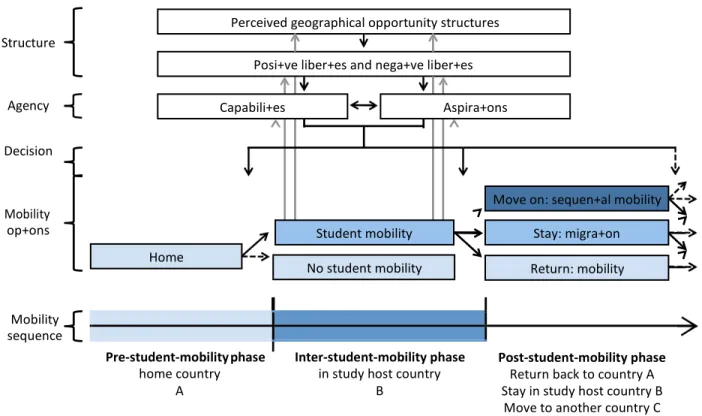
The results from the four sections are embedded in the aspiration and capability framework of migration (de Haas 2014) that conceptualizes migration as a function of aspirations and capabilities to migrate within a given set of opportunity structures. Legal opportunities and restrictions, as well as the temporal and spatial dimensions of student mobility, are of great relevance for the mobility decisions of students and graduates. This model will be discussed in the section on the conceptual framework. However, for specifying the scope of the thesis, I situate the analyses in the temporal and geographical dimension of student mobility. There are several key moments in the process of decision-making regarding mobility, including pondering whether or not to move, deciding to move, and actually moving. To be precise, this thesis concentrates on the moment of the post-graduation mobility decision. I focus on the period of time when an international student is abroad and thinking about the next move after graduation. This post-graduation decision offers three options (see cover): move back to the home country, stay in the host country of study, or move to another country altogether. In many cases, returning home is the original plan, and other options are not taken into account. Some students aspire to stay in the host country and seek employment opportunities, while others use their capability to choose another destination country. Some are confronted with policies restricting their mobility, and are either forced to move on or obtain subsequent residence permits. Thus, not all types of mobility are possible due to legal restrictions, a change of plans, or manifold personal reasons.
For students graduating abroad, the study-to-work transition is crucial for their professional careers. At the same time, personal relationships, partnering, and family-building become increasingly important. A glance at the scientific literature reveals what influences these ISM decisions. Szelényi (2006) summarized the outcome of interviews with international students in the United States by defining broadly the following influencing factors: 1) the international context, 2) social ties, 3) the influence of states and their institutions, and 4) the role of personal and professional interests and aspirations.
Two studies on students in Switzerland examined factors for their mobility decisions. Lindberg et al. (2014) working on foreign grant recipients at ETH Zurich found the main reasons for return to be the desire for a professional contribution in the home country, longing for family and friends, and a higher social status in the country of origin. Rérat (2016) working on Swiss internal student mobility recognizes four theoretical perspectives to explain the logic behind the mobility decisions of students. These factors are: 1) utilitarian (related to employment),
2) calculating (financial), 3) sensitive (related to residential amenities), and 4) affective (interpersonal and social). One Dutch study showed that employment induces international graduates to stay while unemployment is a reason to leave, and marriage (or forming a family) in the host country make students more prone to stay (Bijwaard & Wang 2016). With regard to decisions on future migration while studying abroad, Alberts & Hazen (2005) conducted interviews with international students in the US and found three categories for post-graduation mobility: professional factors encourage staying, while societal and personal factors draw them back to their home countries. Another study on Toronto and London concluded that graduates’ considerations of employment and settlement are tightly intermingled with personal relationships, such as care of aging parents, managing dual careers, future childcare, and work- life balance (Geddie 2013). Similar findings result from a survey on post-graduation migration plans in five European Union (EU) countries, where factors related to employment opportunities induce students to stay, and personal factors urge them to return (Sykes & Ni Chaoimh 2012).
The first section of the thesis provides data on stay rates that were previously unknown and differentiates by nationality, the region of the higher education institution hosting the students, and the study field. The four following sections address some of the most relevant influencing aspects of ISM decisions; post-graduation employment, partnership status (as the partner or spouse is in many cases the most important social tie for international students), and changes in laws which impact opportunities as well as restrictions on staying in Switzerland after graduation.
1.1 Overview of International Student Mobility in Switzerland
The international students in Switzerland analyzed in this thesis are defined as “all persons with a foreign nationality that were residing abroad when they obtained their school-leaving qualification entitling them to university admission” (FSO). This definition corresponds to the Swiss Federal Statistical Office (FSO) definition of a BildungsausländerIn 3 [educational foreigner]. This definition follows the “genuinely spatial” approach (Kelo et al. 2006) which assumes that international students are also transnational (c.f. Knight 2005, 2006). As I discuss student mobility in the context of migration, cross-border movement for studying is an important assumption (e.g. Wells 2014). I, therefore, use the definition described above to analyze international students enrolled at Swiss higher education institutions at a tertiary study level. In contrast, “all persons with a foreign nationality that were residing in Switzerland when they obtained their secondary high school degree” (FSO) were grouped with Swiss nationals as BildungsinländerIn4 [foreigner
with previous education in Switzerland]. Alternatively, the term foreign student is defined solely by their nationality as students who are not citizens of the country in which they study. These differentiations are important, as they impact statistics and challenge the international comparison as not all countries use the same definition. For example, in 2017 the share of international students enrolled at Swiss universities was 25%, whereas the share of foreign students amounted to 30% (FSO 2017). Due to the fact that Swiss naturalization rules are strict by international comparison, Switzerland has numerous non-nationals and second- and third-generation students who have lived most of their lives in Switzerland but are still counted as foreigners. In 2016, 24% of the permanent resident population in Switzerland were foreigners. Taking into account the migration status among those foreign nationals, 10% were second-generation immigrants (FSO 2018). In the same year, non-Swiss nationals accounted for 27% of primary school students, 24% of lower secondary students, and 21% of higher secondary students (FSO 2018).
3
German: Bildungsausländer: Als Bildungsausländer gelten “alle Personen mit ausländischer Staatsangehörigkeit, die im Ausland wohnhaft waren, als sie ihren Hochschulzulassungsausweis erwarben”.
4
German: Bildungsinländer: Als Bildungsinländer gelten “alle Personen mit ausländischer Staatsangehörigkeit, die beim Erwerb der Hochschulzulassung ihren Wohnsitz in der Schweiz hatten”.
International Students Enrolled at Swiss Universities
Data on students at Swiss universities have been available since the introduction of the Swiss University Information System (German: Schweizerisches Hochschulsystem SHIS) in the early 1970s, and data on foreign nationals has been included since 1990. The Swiss Federal Statistical Office (FSO) provides the number of international students in Switzerland in their publications on the study population (FSO 2017). Since the 1990s, the number of international students at Swiss universities on all study levels has been increasing, reaching 38,000 in 2017.5 As the population
of international students grew faster than the number of Swiss resident students (Figure 1.1), the total share of international students grew from 13% in 1990 to 25% in 2017.
Figure 1.1: Swiss Residents and International Students at Swiss Universities (1990–2017)
150'000
100'000
50'000
0
Source: SHIS - FSO, 2018
Over the past two decades, the Swiss higher education system has undergone major transformations regarding the application of the guidelines of the Bologna Declaration in 1999, which aimed to harmonize tertiary education systems within the European Research Area (ERA). Since then, bachelor and master’s degrees have likewise replaced the previous licentiate and diploma degrees. During the same period, the number of Swiss students also increased but by a lower growth factor than the international students.
5
Including bachelor, master, doctorate, licentiate / diploma, and other tertiary studies. From the classified types of tertiary institutes, these numbers include only the universities and institutes of technology (UIT), and not the universities of applied sciences (UAS), and universities of teacher education (UTE).
1990 1 1' 2 22 74 '718 1991 1 1' 9 79 77 '177 1992 1 2' 2 68 78 '495 1993 1 2' 5 32 78 '505 1994 1 2' 4 03 76 '859 1995 1 1' 9 90 76 '253 1996 1 1' 7 78 79 '630 1997 1 2' 1 94 81 '193 1998 1 2' 5 98 82 '099 1999 1 3' 2 10 82 '494 2000 1 3' 9 86 82 '687 2001 1 4' 8 82 84 '688 2002 1 6' 4 50 88 '239 2003 1 7' 8 23 91 '511 2004 18 '718 92 '382 2005 19 '593 92 '780 2006 20 '673 94 '469 2007 21 '928 9 4 '981 200 8 24 '216 96 '768 2009 26 '883 10 0 '057 2010 29 '368 10 2 '126 31 '070 10 3 '768 2011 2012 32 '995 10 5 '626 2013 34 '799 10 7 '364 2014 35 '493 10 8 '467 2015 36 '340 10 9 '606 2016 37 '447 11 1 '086 2017 38 '069 11 2 '603
Doctorate Licenciate
Figure 1.2: Number of International Students at Swiss Universities by Study Level (1990–2017)
14'000 12'000 10'000 8'000 6'000 4'000 2'000 0
Source: SHIS - FSO, 2018
The number of international students increased on all study levels (except the licentiate level). As the study level increases, so does the absolute number. In 2017, the number of international doctoral students was 13,400, or more than the double of 2004, and the international students reached 10,800 at the master’s level, 9,100 at the bachelor level, and 4,200 in other studies. Figure 1.3: Shares of International Students at Swiss Universities by Study Level (2000–2017)
Ba 10.7 10.4 11.2 10.2 11.5 11.7 11.3 11.1 11.8 12.1 12.5 12.2 12.5 12.7 12.5 12.2 12.2 12.3
Ma 0.0 16.7 18.6 19.1 19.5 23.2 25.2 25.1 24.8 25.4 25.6 25.7 25.6 25.6 25.3 25.5 25.9 25.8
Phd 34.7 35.8 37.7 39.9 40.8 41.8 42.6 43.5 44.6 45.9 47.1 48.1 49.7 51.1 51.9 52.6 52.8 53.5
Lic 8.4 8.6 9.1 9.2 8.9 7.9 7.4 7.6 7.3 7.5 9.0 11.8 15.1 17.0 19.2 24.7 26.0 24.0
Source: SHIS - FSO, 2018
While the shares of international students (Figure 1.3) stagnated at the bachelor and master’s levels, they increased constantly at the doctoral level since 2000. In 2017, the shares of international students reached 54% at the doctoral level, 26% at the master’s level and 12% at the bachelor level. 1995 2000 1996 2001 1997 2002 1998 2003 1999 2000 2004 2001 2005 2002 2006 2003 2004 2007 2005 2008 200 6 2009 2007 2010 2008 2009 2011 2010 2012 2011 2013 2012 2013 2014 2014 2015 2015 2016 2016 2017 2017
Figure 1.4: Situation and Size of Universities and Institutes of Technology in Switzerland, 2017
Source: Original map from the FSO website, 2018
Besides the two Federal Institutes of Technology in Zurich and Lausanne, there are ten cantonal universities. Five are located in German-speaking Switzerland: Basel, Bern, Lucerne, St. Gallen, and Zurich. The Universities of Geneva, Lausanne, and Neuchâtel are situated in French- speaking Switzerland. The University of Italian-speaking Switzerland is situated in Lugano, and there is one bilingual (German and French) university in Fribourg. Figure 1.4 shows the size of the institutes and their respective shares of international students (light blue) and foreigners with previous Swiss secondary education (dark blue). The highest shares of international students are found in the two Federal Institutes of Technology and in the universities situated close to the national border (Geneva, St. Gallen, Lausanne, and Basel).
Swiss BS 26 434 TG Universität St. Gallen Universität Basel AG BL SO Universität Zürich AR AI ETH Zürich SG ZG Université de Neuchâtel BE LU NE Universität GL Universität Bern OW VD Université de Fribourg GR FR Université de Lausanne GE EPF Lausanne Université de
Data on the Foreign Resident Population in Switzerland
Data on the foreign resident population in Switzerland retrieved from the Swiss Labour Force Survey has enabled researchers to differentiate residents by their migration background since 2003.6 In recent years, the demographic data collection system in Switzerland has undergone
important reorganizations. The traditional census has been replaced by surveys and a harmonized set of the Population and Household Statistics (STATPOP) has been available since 2010.7
Previously, data on foreign nationals living in Switzerland with a residence permit were registered in the Central Migration Information System [Zentrales Migrationsinformations- system, or ZEMIS], which is managed by the State Secretariat for Migration (SEM) and regularly transferred to the FSO. ZEMIS was created in 2008 as a result of the consolidation of the Central Register of Foreign Nationals and the Automatic Registration System of Persons. Since 2010, these two statistics have been integrated into the Population and Household Statistics (STATPOP) (Steiner and Wanner 2015).
Creation of a New Linked Dataset on International Students in Switzerland
In 2010, the introduction of the personal security number (AHV) as a personal identification number for students enabled linking register data. In cooperation with the FSO and the NCCR – On the Move, as well as this thesis, the International Students Trajectory Database was created.8 The longitudinal dataset is the result of linking data files from the Longitudinal Analyses in the Field of Education [Längsschnittanalysen im Bildungsbereich, or LABB]9 (including SHIS) with STATPOP (including ZEMIS). The new dataset covers all international students registered with a residence permit in Switzerland. This enables researchers to visualize the study trajectories of international students during their stay in Switzerland and to calculate their stay rate after graduation. Furthermore, the variables provide information on changes in residence permits and civil status, as well as nationalities, study fields, and other individual characteristics.
6
Factsheet: www.bfs.admin.ch/bfs/en/home/statistics/population/migration-integration/by-migration-status.html
7
Factsheet: www.bfs.admin.ch/bfs/en/home/statistics/population/surveys/statpop.assetdetail.8541.html
8
The codebook for this dataset is available on the FORS database: https://forsbase.unil.ch (study reference: 13114)
9
Link: www.bfs.admin.ch/bfs/de/home/statistiken/bildung-wissenschaft/erhebungen/labb.assetdetail.5046491.html (all links here last accessed 2 May 2018) and further information on dataset on www.labb.bfs.admin.ch
Survey Data on International Students in Switzerland
Additionally, I identify survey data that has not yet been used for analyzing international students in Switzerland. Complementary to the register data, I analyze the Swiss Graduate Survey on student employment and educational situations one and five years after graduation.10 The survey
is conducted biennially with Swiss and international graduates from Swiss universities and enables a direct comparison of labour market integration. Finally, the NCCR Mobility and Migration Survey provides information on migrants’ immigration experience, labour market participation, integration and the family situation.11 Among recently arrived migrants, I identify the international students and analyze their social partnerships in relation to their intentions to stay in Switzerland.
1.2 Switzerland in the Global Context
Worldwide, the number of foreign students enrolled in tertiary education has increased more than fivefold since the late 1970s, from 800,000 to 4.6 million in recent years. In 2015, applying the definition of international students, approximately 3.3 million students travelled for the purpose of studying abroad in the Organization for Economic Co-operation and Development (OECD) area alone (OECD 2017).
High Shares of International Students
In absolute numbers, Switzerland hosted 38,069 international students in 2017/18 (FSO 2018). Compared to other countries and in relative shares of all mobile students within the OECD area, Switzerland hosted approximately 2% of international students and was in the 10th position after the United States (26%), the United Kingdom (15%), France (11%), Germany (10%), Australia (8%), Canada, Japan, and Italy (all 3%), and Austria (2%) in 2014 (OECD 2016). Also non- OECD countries increasingly gain in importance as destination countries for students, for instance, China, India, Brazil, Russia, and South Africa (UNESCO & UIS 2018).
10
Factsheet: www.bfs.admin.ch/bfs/en/home/statistics/education-science/surveys/ashs.assetdetail.7753.html
11
However, the quality of Swiss universities is internationally known and its institutions of higher education enjoy a good reputation. In 2018, most Swiss universities were among the best 500 globally according to the Times Higher Education World University Ranking, and while the Federal Institutes of Technology are beacons of science and research in Switzerland (the ETH in Zurich ranked 10th, and the EPF in Lausanne ranked 38th), other Swiss universities are well known for their fields of specialization.12 In 2015, Switzerland13 had a very high share of international
students with 17%, which is comparable to New Zealand (21%), the United Kingdom (18%), Austria (16%), and Australia (15%). In comparison, the OECD average was 6% and the United States had a share of only 4% international students (OECD 2017). Beside these anglophone countries, where ISM is very common, the EU—which includes the European Education Area (EEA) and research exchange programs such as Erasmus+ and Horizon 2020—is another key area for student mobility in the global context.
Switzerland’s Geographical Situation
Switzerland’s geographical situation at the heart of the European continent, the bilateral Agreements on Free Movement of Persons between Switzerland and the EU—including mutual diploma recognition, as well as participation in the 1999 Bologna Declaration—are among the reasons for the high presence of European students in Switzerland. Furthermore, Switzerland participates in the Erasmus+ and Horizon 2020 projects. In the 2015–2016 academic year, 69% of international students (at all tertiary study levels) came from the EU. Nationals from neighbouring countries Germany (26%), France (15%), Italy (10%), and Austria (3%) alone made up 54% of all international students in Switzerland. Over the last few years, Asian students have increased to 11%, followed by students from the Americas (6%), Africa (5%) and Oceania (0.3%), who all had constant numbers (FSO 2017).
12
Times Higher Education World University Ranking 2018: ETH Zurich: 10, ETH Lausanne: 38, University of Basel: 95, University of Bern: 105, University of Geneva: 130, University of Zurich: 136, University of Lausanne: 152, University of Fribourg: 201–250, University of Neuchâtel: 401–450, and University of St. Gallen: 401– 450.
13
Universities and Institutes of Technology (UIT), Universities of Applied Sciences (UAS), and Universities of Teacher Education (UTE): The previously presented higher shares in the introduction were of UITs only. As the shares vary considerably by the type of higher education institution (UIT, UAS, UTE), the total share reported from the FSO to the OECD—including all tertiary ISCED institutions—is lower (17%).
1.3 Literature on International Student Mobility
Internationally mobile students have been analyzed by researchers from various disciplines, including human geography, economics, politics, sociology, psychology, higher education and migration studies, law, and other fields (Riaño and Piguet 2016, King et al. 2010). The topic of ISM is interdisciplinary in nature, and different perspectives provide important scientific contributions.
This chapter presents five axes of literature on ISM and migration, ranging from initial causes to post-graduate mobility decisions. The first axis looks at drivers for student mobility, explaining why students go abroad. The second axis examines which host countries they choose to study in. The third axis focuses on institutions of higher education where ISM is taking place and where internationalization is becoming increasingly important. These first three axes provide insights into the contextual and structural background of students’ decisions to move abroad, which may also be related to the motivation to stay in the host country after graduation. The fourth axis gives an overview of methodologies used for calculating stay rates. The fifth axis presents literature on post-graduation mobility.
The first axis focuses on why students go abroad by identifying the main drivers for ISM. Student mobility can be caused by a lack of educational opportunities in the home country (Waters 2009, Kritz 2015), by the perception that a higher quality of education is available abroad (Hazen & Alberts 2006), or by expected benefits from the studies abroad (Raghuram 2013). These benefits could include an improvement in foreign language skills (Baláž & Williams 2004), or be related to future labour market aspects, such as better chances for international assignments (Wiers-Jenssen 2008), wage maximization (Rosenzweig 2006), or higher expected income in the host country (Perkins & Neumayer 2014), while other international students move abroad to experience living in new places, or for excitement and adventure (Waters et al. 2011). Furthermore, Waters (2006) states that besides the human capital aspects that are closely related to labour market imperatives, social and cultural capital also play an important role in student mobility. International education comes with new experiences, and international students acquire important transferable skills and knowledge that can enhance geographical mobility within the global economy and create mobility capital (Brooks & Waters
2010). These forms of capital, experiences, and the academic knowledge acquired and produced abroad are transferable, and move with the international student to their next destination (Madge et al. 2014, Hall 2011, Bilecen & Faist 2015). These aspects of transferable and different forms of capital, as well as the condition of possession of sufficient knowledge and other resources for being mobile are a substantial part of the model of student mobility, and will presented in the methodology chapter.
The second axis examines which host country students choose. This decision is the result of an extensive comparison of the situation in the home country and the advantages of studying at other possible destination countries (Waters & Brooks 2010) or destination cities (van Mol & Ekamper 2016), including the evaluation of study fees and other costs (Beine et al. 2014), and geographical distance (Bessey 2012, Rodriguez et al. 2011). Common languages and relational ties created by former colonial linkages facilitate mobility, and pre-existing migrant populations can be a strong reason for flows between origin and destination countries of international students (Perkins & Neumayer. 2014). Transnational social ties (Geddie 2013), social networks of friendship and kinship (Beech 2015), and family, friends, or partners (Brooks & Waters 2010) are crucial determinants for ISM. Beine et al. (2014) describe the network effect in the context of student mobility, where the nature of social networks can develop cultures of mobility and become mutually reinforcing and self-perpetuating when students follow fellows who previously moved abroad. The flows of international students are as various and multifaceted as the combinations of origin and destination countries. Scholars examined the trends of global flows of students (Bhandari & Blumenthal 2011, OECD 2017) and found differences in mobility flows of students from developed versus developing countries (Perkins & Neumayer 2014), as well as in the study level of students (Choudaha & de Wit 2014, Wächter 2014). Most studies, however, analyze student mobility from a destination country perspective and focus on specific groups of students, or concentrate on clearly defined regions, for example, incoming students in the USA (Ruiz 2014), in Europe (Teichler et al. 2011, van Mol 2013, 2014, Wächter 2014), or in South America (Nogueira & Ramos 2014). Historical colonial ties have been analyzed in France, which hosts numerous francophone students from former colonies (Kell & Vogl 2008), and in Portugal regarding lusophone students (França et al. 2018). As this thesis concentrates on incoming
international students in Switzerland, I do not elaborate on other country-specific flows, but leave it at an overview of the main dynamics. It is, however, important to be aware of home and destination country-specific characteristics when interpreting results. We shall come back to the aspects of network effects that are of mutually reinforcing and even self-perpetuating dynamism in the model on student mobility.
The third axis focuses on the internationalization of higher education institutions. Historically, ISM dates back to the medieval age, when universities received few foreign students. Since then, the number of international students has most strongly escalated in the second half of the twentieth century (Rivza & Teichler 2007). In a historical perspective, Gürüz (2011) analyzes the increase in mobility not only of students, but also of scholars, programs, and institutions. He argues that the evolution of institutions, structures, systems, functions, governments, administrations, and finance in an increasingly globalized and interlinked context has led to a global knowledge economy. Thus, ISM is part of a broader social change in the higher education system. Robertson (2010) recognizes student mobility as a complex and dynamic structure with different actors and of global political force, and describes it as a network of knowledge production. To a large extent, scholars working on comparative international education ascribe the increase in the number of mobile students to the internationalization of the higher education system (Brooks & Waters 2011, Knight 2012, Wadhwa 2016) and globalization (Altbach & Knight 2006), as accentuated competition and marketization of higher education takes place within a global arena (Shields 2013, Findlay et al. 2017). Findlay (2011) brings together “demand-side” theories on the choices of students and “supply-side” theories investigating the financial interests of academic institutions in the UK, where higher education institutions can offset costs with higher fees for international students. In the methodology chapter, these structural and contextual elements of the internationalization of higher education are also included in the methodological reflections on ISM.
The fourth axis presents studies on the stay rates of international students. Methodologically, the definitions of the sample groups and the data sources used for calculating stay rates vary remarkably, and make it difficult to directly compare stay rates from one country to another. Some studies use data from the national foreigner register (Bijwaard & Wang 2016, Cimo 2016,
Hanganu & Hess 2014), while others analyze the transitions of student permits into other types of permits (Lu & Hou, 2015, OECD 2011), data from tax authorities (Finn 2001, Baker & Finn 2003), graduate surveys (Hanganu 2015) or qualitative interviews (Basford & Riemsdijk 2017). In the USA, Finn (2001) analyzes foreign graduates in Science and Engineering14 and finds stay rates of
63% two years after graduation, 51% four or five years after graduation, and an estimated 69% stay rate for foreign doctoral students in all disciplines two years after graduation (Finn 2001). 15
The same author published yearly reports on stay rates which describe a continuous increase over time. In a more recent study with a longer observation period, he reports stay rates of 68% five years after graduation and 65% for all foreign doctorates ten years after graduation (Finn 2014). Focusing on graduates from economic programs,16 Baker and Finn (2003) report stay rates of 41% after two years and 36% four or five years after graduation in the United States. In Canada, the rate of transition from student permits into permanent residency status, calculated ten years after receipt of the first study permit, amounted to 20% (Lu & Hou 2015). Depending on the methods used, stay rates reached 4% in the region of Atlantic Canada (Van Huystee 2011) and ranged between 20% and 27% nation-wide within a period of ten years (Lu & Hou 2015), while the OECD reported a 33% stay rate in Canada (OECD 2011). This OECD report published a comparison of stay rates from third-country nationals in 14 host countries. These range from 17% in Austria to 33% in Canada with an average of 25% for all 14 countries (OECD 2011). However, the report was criticized by academics for methodological shortcomings. Burkhart et al. (2015) and Hanganu (2015) both commented that those shares were probably lower than the actual stay rates.17 Furthermore, based on the analysis of the graduate survey in Germany,18 the estimated stay rate of third-country nationals was 40% while EU and EFTA nationals stayed at a rate of 52% (Alichniewicz & Gleis 2013). These studies help to get an idea of the variety of results on stay rates in the international context, but they are not comparable with the results of my analysis. In contrast to the above results, the following stay
14
These foreign doctorants graduated in 1994/1995 and stayed in 1999, including temporary residents visas only.
15 These foreign doctorants graduated in 1997 and stayed in 1999, including those on permanent visas at graduation. 16
These foreign doctorants graduated in 1994/1995 or 1997 and stayed in 1999, including temporal and permanent resident visas.
17
Not included were former students who had requested but not yet received another permit and those with permanent residence permits.
18
rates are based on foreigner registers of the respective countries and, therefore, the most comparable studies from a methodological point of view. Stay rates five years after graduation in the Netherlands are 38% (Nuffic 2016) and 34% in Finland (Cimo 2016). In Germany, where register data on third-country nationals is limited, scholars found stay rates of 56% (Hanganu & Hess 2014)19 or more recently, 54% (Hanganu 2015).20 Furthermore, a comparative study from
Münch & Hoch (2013) created models estimating the costs and benefits of ISM for the host countries Germany, Switzerland, the Netherlands, Poland, and Spain. As the authors considered the data on stay rates not sufficiently comparable, they created models for 20% and 30% stay rates. In the short-term calculation for the duration of the studies, the public costs for the students’ stay are not yet covered, but their consumption of goods and services with value-added tax has a positive economic effect. In the long run, this cost-utility calculation becomes positive, but the net effect largely depends on the stay rates and the duration of the stay. Assuming employment and stay rates of 30%, in the case of Germany as a host country the public costs for financing international students could be amortized within five years. The estimates of this net effect calculation for Switzerland will be discussed in the conclusion, along with the results of the sections on the stay rates and post-graduate employment of international students.
Literature on the fifth axis of post-graduate mobility is scarce (Mosneaga & Winther 2013, Van Mol & Timmerman 2014). The conceptualization of post-graduate migration causes cannot be sufficiently explained solely by push-and-pull factors, nor does a simple “stay-return” argument do justice to the increasingly complex patterns of post-graduation migration (Geddie 2013, Sage et al. 2013). One example of a study that goes beyond the “stay-return” framework looks at Australia from a transnational perspective using survey data that identifies the importance of onward mobility by pointing out migration strategies using transitory places for achieving migration objectives (Tan & Hugo 2016). In another case, ISM has been identified as a strategy for obtaining permanent resident visas through enrollment in universities (Baas 2006). In contrast, grant or study program stipulations (e.g. the Quota Scheme in Norway, which is
19
These third-country national students had a student permit between January 2005 and October 2013 and stayed in Germany in September 2013.
20
These third-country national students had a student permit between January 2005 and October 2013 and stayed in Germany in October 2014.
designed to improve institutional capacity in developing countries through return migration) constrain the options of staying and encourage the return of international graduates (Basford & Riemsdijk 2017). Thus, the type of study program, the underlying intentions, and the strategies of international students graduating abroad, as well as the higher education institutions, the state, and many other structural and institutional aspects shape the mobility options of graduates living abroad. Therefore, explaining post-migration mobility decisions is very country-specific. Again, these explanations strongly depend on the combination of specific home country and host country contexts, and can only be generalized to a limited extent. Most of the studies on post- graduate migration have been conducted in the major recipient countries (She & Wotherspoon 2013), such as the United States (Hazen & Alberts 2006, Musumba et al. 2011, Kim 2015), Canada (Arthur & Nunes 2014, Lu et al. 2009), Australia (Baas 2006, Tan & Hugo 2016), and New Zealand (Soon 2014, Merwood 2007). Many of these studies focused on Asian students, as they make up the largest group of incoming international students. Further studies focus on the UK (Baláž & Williams 2004), the Netherlands (Bijwaard & Wang 2016), Denmark (Mosneaga & Winther 2013), and Norway (Basford & Riemsdijk 2017). Overall, the main factors influencing post-graduation mobility or migration decisions can be sorted into three groups: professional, societal, and personal (Alberts & Hazen 2005). For example, employment opportunities, as well as a high standard of living and relationship support to stay in the country were key factors in the career-related decisions of international graduates in Canada (Arthur & Nunes 2014). From a structural point of view, distinct national strategies determine key factors in shaping legal opportunities for students upon graduation, as shown in a comparative study on Canada, the US, and the UK (She & Wotherspoon 2013). Furthermore, institutional recruitment practices have an impact on the return decision of international graduates, as described in a study of Chinese universities (Wang et al. 2015). Quantitative studies contribute valuable insights on less quantifiable and less tangible aspects. For example, the conception of home can be crucial, as shown in a study stating that students who consider the host country to be their home are more likely to plan to stay (Wu & Wilkes 2017). The social climate in the host country (Musumba et al. 2011) or parental expectations and aspirations (Lu et al. 2009) can also be deciding factors. Other scholars note the importance of including life experiences and aspirations in the analysis of
post-graduation mobility decisions (Tan & Hugo 2016). Thus, it is clear that these decisions extend beyond simply returning or staying by including past experiences, future aspirations, and potential repeated mobility. From this perspective, student mobility more closely resembles the phenomenon of migration. In order to conceptualize ISM, including post-graduation decisions with the option of a transition from mobility into migration, the next chapter examines selected migration theories as a theoretical background.
1.4 Student Mobility and Migration Theories
Student mobility is not equal to migration, even though the terms student mobility and student migration are both used in the literature on internationally mobile students (Raghuram 2013). Numerous scholars working on ISM or student migration build up their theoretical approach to migration theories (King & Raghuram 2013, Piguet 2013).
International students are in several aspects different from other mobile persons or migrants, for example in their motivation for being mobile. First and foremost, students move abroad for studying, and subsequent employment—or increasing the net income—is an indirect or secondary goal. Early theories explain migration with predominately economic push-and-pull factors for workers that aim to maximize income by migrating to countries with better labour conditions (Ravenstein 1885, Lewis 1954). This approach does not do justice to the case of student mobility, but it is a basic element for further migration theories. Lee (1966) extended the push-and-pull factor theory by observing that migration behaviour strongly depends on personal factors because people react differently to these factors, as well as to obstacles to migration, such as immigration laws. These early observations are of great relevance to student mobility too, as they point out the importance of personal characteristics and include structural elements such as legal obstacles and restrictions that shape the mobility behaviour. Both elements are also important for the mobility decisions of international students. Furthermore, Lee emphasized that it is rather the perception of a factor than the factor itself that causes migration. The perception aspect was also present in later theories explaining migration that included expectations of higher earnings and the probability of employment (Todaro 1976, Harris & Todaro 1970). An international students’ perception of opportunities to study abroad and the perceived
opportunities of subsequent employment can shape their choice of destination. In general, a migrant’s decision to move abroad can be the result of a rational decision-making process for utility-maximization in a broader sense, including the investment in human capital. Sjaadstad’s (1962) human capital theory described more specifically how an increase in utility is reached by migration. On the one hand, human capital in the form of skills, competencies, socio- demographic characteristics, and the migrant’s experiences enable and facilitate migration. On the other hand, migration itself can be a strategy to acquire additional human capital. This aspect proves to be important for explaining student mobility, as a certain level of human capital is necessary in order to access higher education abroad and it increases with studying abroad. Along with the change in the nature and characteristics of migration flows over the last decades, these theories also become broader. Human mobility and migration was once understood as a part of globalization and recognized as a force which shapes contemporary societies in a globalized world. From a social science point of view, migration became a social phenomenon, described as a normal feature of contemporary societies, or “a global phenomenon of flows and counter-flows: geographical fluidity rather than population shifts, on-going daily process” (O’Reilly 2015: 25). In their recent work, de Haas and Fokkema (2011), too, perceive migration as a long-term dynamic social process rather than a one-time static individual choice. Further development of these reflections led to de Haas’ (2014) aspirations and capabilities framework of migration, an approach that is well suited to include important aspects of student mobility. The framework unifies important elements of migration theories, which in some aspects also apply to ISM. Therefore, I present the framework and discuss its suitability for explaining mobility decisions.
2
Conceptual Framework
In this chapter, I first present the original approach from de Haas (2016) and then I propose an adaptation of the aspirations-capabilities model for students’ pre-, intra-, and post-graduation mobility decisions.
2.1 The Aspirations-Capabilities Framework
The aspirations and capabilities framework conceptualizes migration as a function of aspirations and capabilities to migrate within a given set of opportunity structures. The framework aims to explain different forms of migration and unifies different theories from different disciplines. As formulated by de Haas (2014: 23), migration aspirations21 are “a function of people’s general life aspirations and perceived spatial opportunity structures” and migration capabilities are “contingent on positive (freedom to...) and negative liberties (freedom from...).”22 Migration aspirations depend on personal preferences and perceptions of opportunities abroad; they are associated with information, images, symbols, and identities, and can be instrumental or intrinsic. Instrumental aspirations are related to the functional or utilitarian means to achieve a goal, such as higher income, higher social status, better education, or protection from persecution. Intrinsic aspirations refer to the migration experience itself, to the values attached to the pleasure derived from exploring new societies, or enhancing social prestige.
However, people can only be mobile if they have the capabilities to do so. The fundamental assumption of the framework is that the expansion of human capabilities is desirable because freedom of movement adds to the quality of people’s lives. De Haas defines the concept of human mobility not by the move or mobility itself but by the capability to choose where to live.23 This capability also includes the freedom not to move, or the voluntary immobility of people with high migration capacity but low migration aspirations. The most common form, however, is the voluntary mobility of people with high migration aspirations and high migration capabilities
21
Based on Carling’s (2002) previous work on aspirations and mobility.
22
Based on Berlin’s (1969) distinction of forms of liberties.
23
Based on Sen’s (1999) capability approach with the category of acquiescent immobility proposed by Schewel (2015).
as shown in Table 1.1. In contrast, involuntary mobility includes deportees, refugees, or other people who must move against their will, and involuntary immobility, which is having aspirations to move but no capabilities to do so.
Table 1.1: Aspirations-Capabilities Derived Individual Mobility Types
Migration Capabilities
Low High
Migration Aspirations High Involuntary immobility Voluntary mobility
(Intrinsic and/or instrumental) Low Acquiescent immobility Voluntary immobility
Involuntary mobility
Source: Simplified table from de Haas, 2014
De Haas’ (2014) framework comprehends positive and negative liberties as structural elements. Negative liberty is “the absence of obstacles, barriers, or constraints”, while positive liberty is “the ability to take control of one’s life and to realize one’s fundamental purposes” (de Haas 2014: 26). Both forms of liberties are shaped by structural conditions, such as state policies on emigration, the right to freedom of movement, or restrictive legal frameworks for immigration in another country (e.g. Suter & Jandl 2006, 2008, Hercog 2008). Both positive and negative liberties describe the structure within which individuals are embedded, and which provides the basis for aspirations and capabilities to be mobile. In turn, migration aspirations and capabilities are interrelated; when people aspire to be mobile, they also need certain capabilities in the form of resources (e.g. funds, social networks, knowledge, physical ability). Increased capabilities, in turn, can increase aspirations for mobility. As an example, particularly in rural areas, education can be a key element to obtain information on opportunities abroad and activate migration aspirations. However, subjective needs and desires only lead to migration aspirations if they cannot be fulfilled locally. The combination of aspirations and capabilities define the agency (c.f. Bakewell 2010) of individuals to change their circumstances by exercising their mobility.
Figure 1.5 depicts the non-linear and complex ways in which structural conditions such as perceived geographical opportunity structures shape the realization of the individual’s mobility, resulting in migration or non-migration. For being mobile, perceived opportunities abroad are compared and a strategy developed for realizing mobility. The outer circle in the model stands
for the feedback mechanisms in play. Persons who previously have been abroad can provide useful information referring the move; at the same time, they transmit images, symbols, and identities of their post-mobility life that can increase migration aspirations in other persons. The persons who moved previously can provide financial, human, and social capital and increase the capability for further mobility of others.
Figure 1.5: Aspirations-Capabilities Framework for Conceptualizing Migratory Agency
Source: Original figure of de Haas, 2014
Along with the aspiration-capability framework, de Haas (2014) provided a tentative categorization for different forms of migration defined by their positive and negative liberties as manifestations of the structure and agency as shown in Table 1.2.
Table 1.2: Positive and Negative Liberty and Categories of Migration
Positive Liberty (capabilities)
Low High
Negative Liberty (external constraints) High Improvement migration Free migration
Low Precarious migration Distress migration
First, improvement migration is when people are not restricted, meaning that they have a relatively high level of negative liberties but a relatively low level of positive liberties, for example, due to poverty or unfavourable legal conditions. For these people, migration to wealthier countries can be a way of improving their life situation, but these migrants are more dependent on support from their family and networks, such as by pooling resources to invest in the migration of one family member. Second, in distress migration, migrants have a low level of negative liberties—for example, due to persecution, suppression, violent conflicts, or military service obligations—but a high level of positive liberties in the form of financial, social, and human capital in order to escape and build a new life elsewhere. Examples in this category are skilled or relatively wealthy international refugees who are able to obtain legal immigration status in a destination country. Third, precarious migration refers to persons with very limited agency due to a very low level of both positive and negative liberties. These people not only face migration restrictions, but also a lack of state protection against abuse, discrimination, or exploitation. This corresponds, for example, to the situation of refugees with low chances of being recognized. The fourth type, free migration, refers to the relatively unconstrained conditions of people with both high positive and negative liberties, who may be from wealthy countries, or well-resourced within poorer countries (de Haas 2014).
2.2 International Student Mobility and the Aspiration-Capabilities Framework
The Positive and Negative Liberties of Students in Moving to Study Abroad
International students have the aspiration to be mobile and are disposed of sufficient capabilities— education, financial resources, and human capital—to realize their move abroad. This also means that international students are not restricted by negative liberties in leaving their country of residence. In fact, students may even benefit from positive liberties that facilitate their mobility, such as bilateral or multilateral agreements of the free movement of persons and services across national borders, or diploma recognition between educational institutions, countries, or even agents or organizations. Therefore, international student mobility or migration is closest to the category of free migration.
However, besides financial capital such as study grants or financial support from relatives, education is the most relevant condition required to study abroad. A sufficient level of completed education is a form of human capital necessary for admission to a higher education institution abroad. At the same time, early education can trigger aspirations for studying abroad by providing basic skills (e.g. literacy and access to information) and arousing a curiosity to experience other countries. Other forms of capital can also open doors to opportunities that were previously unavailable. Social capital such as family, a romantic partner, or friends can have an impact on mobility capabilities. This can either enhance mobility by contributing financial resources, support, information or a strong network abroad, or impede mobility if the student has family duties or responsibilities, such as taking care of the elderly or children. At the same time, social ties strongly influence mobility aspirations depending on where the most closely related persons live and what their mobility plans look like. These considerations can lead to situations where a student accompanies a partner who is moving abroad, or stays at home in order not to leave a person behind or be in a long-distance relationship.
Instrumental and Intrinsic Aspirations for International Student Mobility
International student mobility aspirations can be instrumental as well as intrinsic. On the one hand, aspirations are instrumental for improving unfavourable living conditions (e.g. Lulle & Buzinska 2017). For example, in the case of a scarcity of educational opportunities in the home country, aspirations are instrumental for increasing the quality of education. In other cases, studying abroad is an investment in developing skills, enlarging one’s international network, and above all, increasing career perspectives while realizing other aspirations (e.g. experiencing the culture of a foreign country, such as sport or art). Student mobility can also contribute to overcoming prevalent (gender or ethnic) discrimination in the home country or attaining a more cosmopolitan identity (Morley et al. 2018). Obtaining an international degree can be seen as a strategy for improving one’s chances of employment on the home country labour market. Furthermore, international experience is good preparation for employment in an international work environment. On the other hand, aspirations are intrinsic when the motivation for going abroad is due to curiosity and a desire to experience other cultures while living abroad.
The Interrelation of Capabilities and Aspirations for International Student Mobility
Studying abroad increases capabilities in terms of human capital through obtaining foreign education credentials or a degree, in cultural capital through experiencing an international or multi-cultural context, in social capital by forging new relationships and strengthening the international network, and in mobility capital by experiencing being mobile and living abroad. Such advantages in capabilities bring new opportunities post-graduation, such as possible employment in the host country, back home or elsewhere. Nevertheless, studying abroad also means a lack of personal contact with possible employers or academics in the home country. Increasing capabilities in one country can come at the cost of missing out on networking opportunities in another place (e.g. Gill 2005). Furthermore, from a home country employer’s perspective, obtaining a foreign degree can either be perceived as an added value (e.g. if the university has a good reputation) or a disadvantage (e.g. if there are problems with diploma recognition) for the graduate seeking a job back home. These capabilities are interrelated with the students’ aspirations and change over time and with the life and mobility experience of a person.
Voluntary and Involuntary Immobility and Mobility Decisions in International Student Mobility
International mobility during tertiary studies is only possible for a minority of students, and studying abroad is a voluntary form of mobility. The aspiration-capability framework provides a convincing and differentiated framework for explaining why the majority of students study in their own country even if a better education is available elsewhere. Many students are voluntarily immobile simply because they have no migration aspirations and prefer to stay at home. In contrast, other students aspire to study abroad but do not have the capabilities due to insufficient financial resources, a lack of human or social capital in the form of a recognized education certificate, language skills, or a valid passport. Yet others are challenged to overcome legal barriers in destination countries such as obtaining a residence permit or having proof of financial resources, health insurance, or a language certificate (e.g. Efionayi & Piguet 2014). Others have not successfully completed secondary education, nor do they have the aspiration to migrate; for them, studying in another country is simply out of reach. In the decision-making process an
evaluation of perceived opportunities and expectations in the form of expected benefits have to be balanced with financial and indirect costs in order to lead to actual mobility behaviour. If the perceived gain in utility is not great enough, students are not mobile even if they have the freedom to do so.
Selection Dynamics in International Student Mobility
The conditions of positive and negative liberties and the minimal requirements regarding capabilities are unequal, and consequently the students who aspire to study abroad are a very specific, self-selected group. In order to be admitted to a higher education institution abroad, they must fulfill a series of conditions of restrictive and selective migration policies. In this second selection, the students have unequal starting positions; those who already have the necessary mobility capabilities also have more opportunities to increase their capabilities with additional benefits from their studies and the experience of living abroad. As a consequence, student mobility tends to foster privileged persons and leads to an increase in existing inequalities in educational opportunities. Nevertheless, there is great potential to encourage talented but less privileged students to study abroad by facilitating their access to grants or development programs.
Heterogeneity of International Students
Besides having achieved the necessary basic requirements to study abroad, international students constitute a very heterogeneous group in terms of national origin, cultural background, age, family status, study field, and professional profile. Apart from the desire to study abroad, other marginal, dominant, or even a combination of reasons for aspiring to migrate could simultaneously be present, such as an interest in working abroad during or after the studies, joining family and friends who already live abroad, economic reasons, or to escape from persecution or other danger, to list only a few examples. When analyzing student mobility, there are not only stereotypical members of the population (people who move primarily for the purpose of studying) but also people who initially move for other reasons, or change their mobility strategy, yet nonetheless formally fulfill the definition of an international student.