HAL Id: hal-02551341
https://hal.archives-ouvertes.fr/hal-02551341
Submitted on 22 Apr 2020
HAL is a multi-disciplinary open access archive for the deposit and dissemination of sci-entific research documents, whether they are pub-lished or not. The documents may come from teaching and research institutions in France or abroad, or from public or private research centers.
L’archive ouverte pluridisciplinaire HAL, est destinée au dépôt et à la diffusion de documents scientifiques de niveau recherche, publiés ou non, émanant des établissements d’enseignement et de recherche français ou étrangers, des laboratoires publics ou privés.
Physiological assessment of User eXprience supported
by Immersive Environments: First input from a
literature review
Mariela Martinez, Giovanny Arbelaez Garces, Laurent Dupont, Anaëlle Hily,
Mauricio Camargo, Christel Jacob, Jérôme Dinet
To cite this version:
Mariela Martinez, Giovanny Arbelaez Garces, Laurent Dupont, Anaëlle Hily, Mauricio Camargo, et al.. Physiological assessment of User eXprience supported by Immersive Environments: First input from a literature review. ConVRgence (VRIC) Virtual Reality International Conference, Laval Virtual, Apr 2020, Laval, France. pp.89-108. �hal-02551341�
1
Physiological assessment of User eXprience supported
by Immersive Environments: First input from a literature
review
Mariela Martinez
1, Giovanny Arbelaez
1, Laurent Dupont
1, Anaëlle Hily
1,2,3,
Mauricio
Camargo
1, Christel Jacob
2,4, Jérôme Dinet
21 Université de Lorraine, ERPI, EA 3767, F-54000 Nancy, France 2 Université de Lorraine, 2LPN, EA 7489, F-54000 Nancy France 3 TEA (Tech Ergo Appliquées), F-54500 Vandœuvre-lès-Nancy, France
4 Centre Hospitalier Régional Universitaire, CMRR, F-54511 Vandœuvre-lès-Nancy, France
Corresponding author: Giovanny Arbelaez, [email protected]
Keywords: Immersive environments – physiological devices – virtual reality – literature review
Abstract
Immersive virtual environments can support the co-design process during the early innovation stages. For these technologies to be used as a support tool researchers and designers need to better understand users’ behaviors and experiences in these environments. While most of the existing literature proposes to assess immersive experiences using self-reported assessments such as questionnaires, some alternatives propose the use of physiological data. In this sense, biometric and physiological measures can be useful indicators to study human behavior and performance in immersive virtual environments in order to highlight what physiological data monitoring can bring to the understanding of user experience. Based on an analysis of 1850 papers retrieved from the main bibliographical databases, our paper is aiming to propose a systematic review of the scientific literature interested in the use of biometric evaluation of human behavior interaction in an immersive environment. Through this review, the different uses of the technologies and their perspectives as tools for the assessment of user experience in immersive environments are presented and discussed.
1. Introduction
Immersive or virtual environments can play an important role as tools to support the design and development of innovation projects. They have been used in multiple disciplines such as health (Vogt et al., 2015), entertainment (Parker et al., 2011), psychology (Wood et al., 2007), human behavior (Slater et al., 2006) and user experience (Silva et al., 2009). This shows a high potential for the technology as a tool in diverse applications. However, research on co-creation process involving user experience supported by immersive environment still needs more development (Dupont et al., 2018). Indeed, if the Immersive Collaborative Environment (ICE) tree describes the properties of collaborative experience and immersive experience (Dupont et al., 2017), we need to better understand how users interact with those technologies. Research methods in human-computer interaction have been developed to analyze user behavior and other human factors (Rubio-Tamayo et al., 2017). While most of the reported methods use self-assessment measures (i.e. questionnaires and survey), another part is based on the use of physiological measures (Rubio-Tamayo et al., 2017). However, the literature shows that these technologies have been used in many different ways to study immersive environment experiences and there is a plethora of methods and approaches. For this reason, it is important to make a synthesis on how biometric and physiological assessment have been applied to study immersive virtual environment experience for researchers to better use this approach. The aim of this study is therefore to propose a systematic literature review of Biometric assessment (or physiological assessment) in Immersive Environments (or virtual environment).
In this review, 1850 research articles published between 2000 and 2020 extracted from Scopus database were analyzed using a co-occurrence approach conducted with VOSviewer software. Next, from those articles 153
2 significant references in terms of biometric devices uses for assessment were selected and sorted. After this, 26 publications were analyzed to determine which parameters have been studied to evaluate virtual immersion. Finally, we summarized the biometric devices technologies found in the literature in three groups: Common Technologies, Original biometrics technologies and Non-typical biometric technologies.
The principal contribution of this work is to summarize relevant aspects of Biometric assessment in Immersive Environments: Which factors have been studied and which technologies have been employed.
The rest of this paper is structured as follows. In section 2, previous works on Immersive Virtual Environment (IVE) and a general background about the Biometrics devices used to measure IVE is developed. In section 3, Material and Methods are described. Sections 3 and 4 synthesizes the results and conclusions.
2. Previous works and general background
2.1.
Immersive virtual environment experience assessment
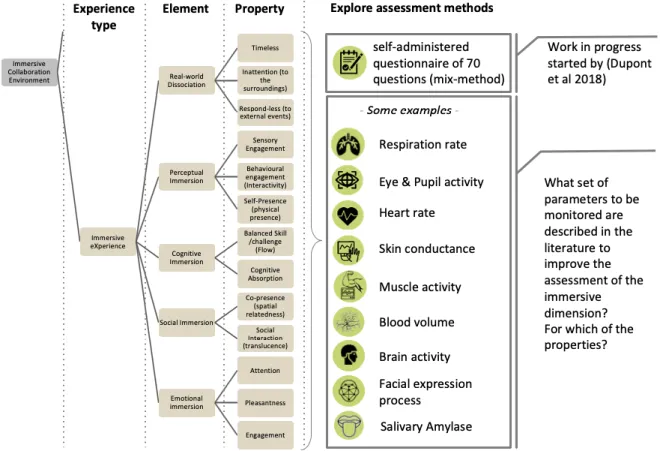
While there are several tools (questionnaires) and models to study user experience on immersive environments (Tcha-Tokey et al., 2016), to our knowledge there are no other frameworks to analyze co-creation in virtual environments. For this reason, in this research we use the Immersive Collaborative Environments (ICE) tree structure developed by (Pallot et al., 2017). This model identifies the most relevant elements to assess immersive co-creation in virtual environments. These elements have been summarized in the Immersive Collaborative Environments (ICE) tree structure (cf. Figure 1).
Figure 1. Exploration of assessment of immersive properties of the ICE structure based on (Dupont et al., 2017)
The ICE structure includes cognitive, social, perceptual and emotional facets. It is divided in two experience types: Immersive Experience and Collaborative Experience, both include their own elements and properties. The ICE tree has been applied by means of a questionnaire (self-reported measure) and survey instrument to assess the participants experience in immersive environments (Dupont et al., 2017). While the use of the ICE tree structure and the questionnaire instruments seems to give a complete picture of all the factors affecting the participants experience in immersive environments, self-assessment measurements present some limits because they rely on the ability and willingness of the respondent to accurately report their attitudes and prior behaviors (Lee et al., 2007). First experiments show the questionnaire is long and tedious for users. The participants are questioned
3 after the experience. How could we collect their feedback at the time of the action, or even automate part of the collection? There seems to be some part of the answer in physiological responses as they can be collected when respondents are directly participating in the behavior and are difficult to control. For this reason, in this research we are interested to study how some of the ICE tree structure properties can be observed by means of biometrical devices as an alternative (or complement) to the existing instruments. For example, can respiration rate or eye pupil activity be used to assess one or several of the model properties. Figure 1 presents the tree structure and some of the possible devices to be explored. Furthermore, as the collaborative and immersive dimensions are complex and attached to different fields of research in this initial literature review, we will focus solely on the Immersive dimension (Figure 1). The collaborative dimension will be explored in further research.
2.2.
Physiological devices for experience assessment
As seen from the ICE tree the immersive experience is affected by cognitive, social, perceptual and emotional facets. There has been extensive research in the fields of human behavior and decision-making processes. This research has shown that emotion plays a critical role guiding decision-making and behaviors in response to stimuli (Damasio, 1994), and also plays a crucial role regulating the interactions between humans and their environment (Dalgleish, & Power, 2013; Eimer, Holmes, & McGlone, 2003; Naqvi, Shiv, & Bechara, 2006). The processing of emotions is predominant in the limbic system (Shalev et al., 2017) located in the brain’s medial temporal lobe. This system is responsible for processing emotional stimuli and regulating the expression of emotional responses to integrate them into complex brain functions. This process integrates the Central Nervous System (CNS) and the dynamics of the Autonomic Nervous System (ANS) (Marín-Morales et al., 2019). Because of this, emotion has a great impact on body responses. This is the working principle exploited by many of existing biometric devices that relies physiological responses to assess emotional and cognitive impact, states or types. One of the impacts of emotion in body responses is expressed through facial expressions: helped by some neuronal groups called Central Pattern Generator (CPG), it initiates and controls facial muscle activities (López Mejía et al., 2009). Thus, some emotions can be recognized by the means of facial expressions (Winkielman et al., 2008). In terms of user experience this measure is related with social interaction and intention of participants, willingness to interact (Sacco & Hugenberg, 2012), empathy (Lundqvist & Öhman, 2005; Ruggiero et al., 2017), and as a confidence or trust indicator (Van IJzendoorn & Bakermans-Kranenburg, 2012; Weber & Brewer, 2006). There are other patterns of physiological activation present in emotional states, such as: heart rate, respiratory rate, brain activity or galvanic activation of the skin (Hagemann et al., 2003). These can be used to measure the impact or relevance of a certain stimulus. However, it is difficult to identify with these biometric data alone to which of the six basic emotions the activation corresponds (Dawson et al., 2007). For this reason, it is often necessary to combine several of these measures (e.g. skin response and facial expressions).
Human emotional processing, interpretation of the facial expression process (Wicker et al., 2003), empathy (Jackson et al., 2005) and perception all involve the activity of the cerebral cortex and the CNS to automatically classify emotions and monitor the attentional meaning of emotions. Because of this, electroencephalogram (EEG) and FMRi are the most commonly used techniques to measure CNS responses (Valenza et al., 2016). In addition, EEG has been used to measure engagement (Castellar, E Voigt A., Jan N. & Marinazzo, D.& Looy, 2016; Cirett Galán & Beal, 2012; Shestyuk et al., 2019) and it can detect the perceived cognitive absorption (Conrad & Bliemel, 2016; Léger et al., 2014).
Changes on cardiovascular dynamics by specific emotional states (Marín-Morales et al., 2019) can be measured using electrocardiogram devices (ECG). Heart rate variability (HRV) has been used as an indicator of presence and pleasantness (Greenfeld et al., 2019; Jonathan et al., 2013; Meehan et al., 2002; Wood et al., 2007).
As a person becomes more or less stressed, the conductance of the skin increases or decreases proportionally (Slater et al., 2006). Galvanic Skin Response (GSR), is commonly used to establish the user's emotional states and it is used to measure sensory stimuli (e.g., pain, pressure, touch). In virtual reality settings it has been used as a presence indicator (Slater et al., 2006).
Finally, eye monitoring data, such as pupil dilation, fixations and saccadic eye movements, can determine pleasant or unpleasant emotions or reactions. Eye movement is measured by the mean of eye tracking devices.
4 The provision of information on the position of the eye is also related with a measure of joint-presence between two people (Špakov et al., 2019), attention (Wang et al., 2015), and it has been used as an indicator of context awareness (Bulling et al., 2008).
As seen from this brief literature background, some of the properties included in the ICE tree for immersive experience assessment have been assessed with the use of physiological measures. In particular presence attention, engagement and pleasantness. However, we need to better understand how authors have assessed those particular properties with physiological devices and if the other properties have been assessed. For this reason, we performed a systematic literature review on the use of physiological devices for the assessment of immersive environments experience.
3. Materials and methods
The objective of this study was to propose a systematic literature review of the use of biometric devices for assessment in Immersive Environment (or virtual environment) experiences. We performed a qualitative and systematic literature analysis using VOSviewer software (www.vosviewer.com). In this process, five filters were applied to narrow the number of publications found.
Table 1: Search parameters.
Field Option
Keywords TITLE-ABS-KEY ("immersive environment" OR "virtual environment” OR “immersive" OR "mixed reality" OR "virtual reality" OR "augmented reality”) AND ("Biometric” OR “Physiological")
Search in Title, abstract, keywords Period explored From 2000 to 2020
Type of documents Articles and conference papers
Database Scopus®
Filter 1. First, we searched in the Scopus database articles and conference papers from 2000 to 2020, using the title, abstract and keywords fields. The 20 years period was chosen because as analyzed from the (Dupont et al., 2018) research it was appeared that before 2000 there are few research works on the immersive experience assessment question. The search parameters are presented in Table 1, the search equation used the keywords: Immersive environment (or Virtual) and Biometrics (or Physiological).
With this first filter a total of 1850 publications were found.
Filter 2. The second step was to use the proximity operator “W/50” between the same keywords. This tip is provided by Scopus to make sure all terms appear in the same paragraph. Applying this filter 530 publications were found.
Filter 3. Using exclusion criteria of English publications and excluding duplicates, a total number of 513 publication result.
Filter 4. Then on this step, we read and analyzed the abstracts of the 513 selected articles, for a quantitative analysis. After the screening 153 publications were chosen as the most relevant, because there were several works unrelated to immersive environment from the previous filter. In addition, we excluded papers performing literature reviews, using languages different from English and we maintained application studies using biometrical devices in Virtual environments. Those 153 selected papers were carefully reviewed and classified to the category of biometric devices used (common technology, original technology and non-typical technology), classified by their study objectives and classified according to the properties of the ICE structure (cf. Appendix B).
Filter 5. This filter based on reading and analyzing the abstracts of those 153 selected articles, for a quantitative analysis, 26 publications were chosen. This filter consisted in the analysis of the topics to select which of those were focused exclusively in immersion study and not for other types of applications, we identified among them the parameters to be monitored used in the immersion research.
5
4. Findings
4.1. Data analysis through visualization
A total of 1850 studies from the first filter were analyzed with the VOSviewer software. Using co-occurrence links, a network of keywords was developed and mapped (cf. Figure 2). The circle represents the keywords and its diameter represents the frequency of occurrence. The distance between words means the relatedness, so, the closer two words are located the stronger their relatedness.
Figure 2. Network analysis of 1850 publications by VOSviewer software
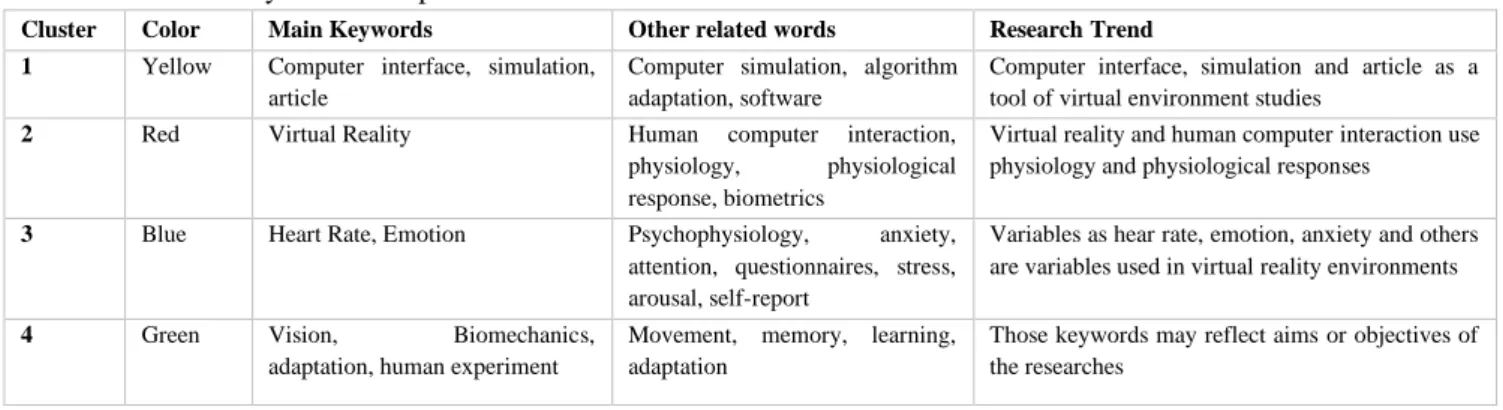
In figure 2, a collection of keywords having strong relationship creates a cluster, each represented by a different color. A total of four main clusters were identified by VOSviewer. Table 2 details each cluster, color, main keywords and others related words. Form table 2 we observe that each cluster might be associated with a certain research trend. The first trend represents the use of virtual environments as a tool for simulation and as an interface for simulators. The second trend shows that there is a stream of research that deals with the use of physiological responses for the study of human computer interaction. The third trend is the use of some specific commonly used variables in these studies, as heart rate, emotion, anxiety. The fourth cluster links some of the aims of the studies that were found (e.g. memory, learning or adaptation studies).
This initial analysis allows us to identify what type of studies have been performed and which types of technologies have been commonly used.
Table 2. Network analysis of 1850 publication with VOSviewer software
Cluster Color Main Keywords Other related words Research Trend 1 Yellow Computer interface, simulation,
article
Computer simulation, algorithm adaptation, software
Computer interface, simulation and article as a tool of virtual environment studies
2 Red Virtual Reality Human computer interaction, physiology, physiological response, biometrics
Virtual reality and human computer interaction use physiology and physiological responses
3 Blue Heart Rate, Emotion Psychophysiology, anxiety, attention, questionnaires, stress, arousal, self-report
Variables as hear rate, emotion, anxiety and others are variables used in virtual reality environments
4 Green Vision, Biomechanics, adaptation, human experiment
Movement, memory, learning, adaptation
Those keywords may reflect aims or objectives of the researches
6
4.2. Document analysis
Based on the Filter 4 the 153 selected publications were first categorized by the application domain and aim of study. Then we performed a detailed analysis on the different technologies that were used.
In an initial analysis we identified five main categories of the aim of the studies. Most of the studies intended to understand and Improve effectiveness of virtual environment (71), a second stream was concerned with Psychological purposes (51), then studies related to Simulation to measure performance (13), then studies related to Health (12) in general and studies related to Education and training purposes (6).
4.2.1. Biometric devices used to measure Immersive Virtual Environments
On the analyzed papers biometric devices were used to measure the emotions and assess the experience of the participants in immersive virtual environments. We summarized them in three categories according to the frequency in which they have been found in the literature: common, original and non-typical technologies. Common technologies are devices that were found on at least 5 studies, original technologies are technologies that were developed for a specific purpose of the study, and non-typical technologies are technologies that were used by less than 5 studies. In particular, we observe that they correspond to existing devices or technologies but are rarely used in the context of immersion studies. Among the studies 82% of the papers used common technologies, 14% used non-typical technologies and 4% developed their own original technologies.
4.2.2. Common Technologies
In common technologies, the most used technology or physiological response to measure virtual environment was heat rate measure (89 studies), followed by skin conductance (67 studies). Other common technologies are less frequently used as respiration rate (20 studies), EEG (30 studies), EMG (9), Blood Flow Velocity (9) and Salivary Aplha Amylase or Cortisol (10). The eye tracking technology that is common in user experience studies was less common on the immersive experience studies found (8 studies).
In the case of Heart rate measures with ECG it has been commonly used with EEG to assess emotional responses and the sense of presence (Marín-Morales et al., 2019; Vogt et al., 2015). In addition, GSR and Respiration Rate measurement devices were used to evaluate emotional (Silva et al., 2009) states and as a measure of stress levels (Hägni et al., 2008; Tinga et al., 2019; Wood et al., 2007). GSR have been used in cognitive rehabilitation as an indicator of presence (Lo Priore et al., 2003; Slater et al., 2006).
Jackson et al. (2015) developed the Evolutive Virtual Environment for Empathy Improvement (EEVEE). It is based on three main components: (1) different avatars capable of expressing feelings and emotions in various levels based on the Facial Action Coding System (FACS); (2) systems to measure the observer's physiological responses (heart and respiratory rate, skin conductance, eye and eye movements, facial expression); and (3) a multimodal interface that links the behavior of the avatar with the neurophysiological response of the observer. EEVEE consists of a series of devices that will allow real-time measurement of the behavioral and physiological responses of the participants, using biometric devices such as: Face Reader (Nolduls) as an emotional face recognition tool to create avatars. In addition, they used measures of heart activity, respiration rate, and skin conductance, as well as eye-tracking and pupillometry.
In the case of eye movements they have been used as a predictor of emotional states and to assess the effects in virtual reality context (Cebeci et al., 2019). Other authors, have used eye tracking as a tool to improve the collaborative immersion experience. Murray et al., (2009) studied how the gaze is of paramount for subjects to correctly identify what a person is looking at in an immersive virtual environment. For this, they tested the differences observed when a subject tried to distinguish which objects in a scene looked at the avatar in the environment. As a result, they find that Eye-gaze has proven to be a key resource for collaborative interaction. In addition, eye-trackers were commonly used as attention, visual search and visual memory indicators in Immersive Experience (Kit et al., 2014).
4.2.3. Original Biometrics Technologies
In the case of original technologies different types were found. GNeuroPathy, Deep Long Short-Term memory (LSTM) and Multimodal Biofeedback System. GNeuroPhaty was a technology developed to measure
7 electrodermal response in virtual reality (Quaresma et al., 2019). LSTM was developed to record state postural signal (Hofmann et al., 2018). Multimodal Biofeedback was designed to capture up to six biomedical signals: EMG, EEG, GSR, temperature, heart rate and respiratory rate simultaneously. Other developed technologies were found: Virtual Reality Medical Center (VRMC), Integrative system, Foveal Eye movements, eyeblink potentiation, Ear-Eye Pitch (E2P), PhysioVR, OpenViBe.
Quesnel & Riecke (2018) studied interactive virtual reality as a positive technology that can generate astonishment and how the scale of beauty / aesthetics, familiarity and personalization characteristics (self-selection of travel destinations) can induce astonishment. To measure the physiological response related to the incredible emotional experience, they created a "chicken-skin camera" that consisted of a webcam to capture changes in skin texture. The person uses the device on his non-dominant arm and was designed to accommodate virtual reality manual controllers. The video of the camera was analyzed to determine the presence of goosebumps on the skin.
It is still complex to measure facial expressions in the virtual environment, because the use of HMDs covers the person face. However, Burn (2017) has developed a device called MASK, a base in foam sensitive to neurons that comprises a ring of sensors that can be inserted in the front plate of any VR headset. This biometric technology allows to detect the user's facial expressions and translate the emotion expressed through virtual avatars in real time.
4.2.4. Non typical biometric technologies in VR
In this category we identified existing technologies that are uncommon to be found in virtual or immersive environment studies. However, they are common in other fields of study such as medicine, biology, neuroscience or others. These were used in these virtual studies mainly because the variable studies were very specific, so they integrated different tools from other areas of knowledge, such as neuroscience (Alcañiz et al., 2018). We found the use of oxygen consumption (VO 2) was used in 3 studies, accelerometers (2 papers), mean ventilation responses (1 paper), body forces (1 paper), transcranial Doppler (1 paper).
Blood flow and oxygen consumption was used in anxiety studies while salivary measures to cortisol (Stress) studies. Among the studies that used a non-typical measures (Yu et al., 2018) created a health application that uses VR and biometric measurements. The objective was to examine the influence of forest and urban environments of virtual reality on health. To measure the impact of the VR environment three biometric measures were used: heart rate frequency, salivary α amylase activity, to quantify stress levels. It was measured using a salivary amylase monitor DM-3.1. Additionally, participants Blood Pressure was used to detect the right position of participants’ arm or movement it was measured by blood pressure monitor (HEM-1000).
Other studies focused on comparing the immersive environment and the real environment based on other physiological responses. Yeom et al., (2019) focused their study on determining whether a thermal quality component and a component built in a built environment could generate some physiological problems, compared to the real-world environmental condition. For this, they used a biometric temperature sensor (STS-BTA).
4.3. Use of properties from the ICE structure
Based on the 153 publications from Scopus we classified the properties studied in each publication quantitatively in the ICE structure (cf. figure 3 and appendix B).
From the 153 publications, only 39 of these studies used at least one of the properties proposed by the ICE structure. Most of the properties from the ICE structure that were used by the studies are those related to emotional immersion facet, being Attention and Presence the most studied properties.
A final filter (Filter 5) was applied to select twenty-six studies that exclusively focused on immersion research. We found that 20 (77%) articles from the 26 used at least one of the properties proposed in the ICE tree structure. From the 26 analyzed studies 58% used only properties found in the ICE structure, 23% used some of the properties in the ICE structure but combined them with other properties, and 19% used only properties that are not included in the ICE structure. Among the other variables included in immersion studies researchers used anxiety (in 3 studies) and stress (2 studies). In terms of parameters to be monitored to assess the different
8 properties that affects the immersive experience figure 3 synthesis the results related to the technologies and properties of the ICE model. Appendix B presents the technologies used for parameter monitoring in all the papers. As presented previously it is shown that heart rate, respiration rate and skin conductance measure are the most used technologies. The Self-presence property of is the one that has benefited from a higher development and use of parameter monitoring technologies followed by Attention property. It would be interesting to see further development of technologies to assess the other properties.
Figure 3. IX Properties and technologies found in the analyzed studies
5. Conclusion
For this study, a systematic literature review methodology with five filters was used to narrow down the number of potential articles collected from the Scopus database. An initial search presented 1850 publications for uses of biometric/physiological devices to measure virtual environment that were briefly explored. In an additional filter we narrowed them down to 153 to develop a qualitative analysis. This literature review contributes to mapping links and connection of the uses of biometric devices in Virtual Environments and some categories of their uses. To measure immersive environment’s experience many studies used biometric or physiological approaches. Their aim was mainly on improving the efficiency of the developed platforms.
Regarding technologies, heart rate and skin conductance were the most used physiological assessment devices used in virtual environments. However, in this review we presented some other non-typical and original technologies to evaluate virtual environments such as blood flow and salivary measures.
Our initial aim was to understand how the physiological technologies have been used for assessing properties and facets of the immersive dimension of ICE tree structure, in order to facilitate the use of the ICE tree model in assessing immersive experiences in complementarity of the already employed questionnaire and survey instruments. From the analyzed studies we observe that 8 of the properties included in the model have been evaluated by a biometrical approach. The most commonly assessed property is presence, as an indicator of immersion. Additionally, it was found that previous research in immersion studies have used Anxiety and Stress properties as an indicator of immersion. These two properties are not part of the ICE tree model, but this shows that further research should explore the inclusion or not of these properties for example to consider them in the Emotional aspect facet.
9 Additionally, we found that the availability of biometric tools coincides with the most studied properties or explained in another way, those that have been studied the least are the ones that have less biometric tools available according to what we saw in the review. This represents a great opportunity not only to study the variables proposed in the ICE but also to develop or propose physiological tools that will allow them to be studied.
This review is not without some limitations, it is only a partial view of the existing literature the presented annexes and list of papers are the base that need to be enriched by a deeper qualitative analysis on the uses of the physiological devices and their use constraints. To operationalize the uses of the devices to assess the different properties we need to consider the multifactorial dimension of the parameters monitored, the interpretation of the potential collected data will be a challenge.
6. Acknowledgments
This work was developed as part of a collaboration between ERPI, 2LPN under the project Inn-Cognitif laureate of the “interdisciplinarité 2019 call” of the Université de Lorraine. This study also benefits from N-Hum-Inno Labcom (ANR) led by ERPI and the company TEA.
7. References
Alcañiz, M., Parra, E., & Giglioli, I. A. C. (2018). Virtual reality as an emerging methodology for leadership assessment and training. Frontiers in Psychology, 9(SEP), 1–7. https://doi.org/10.3389/fpsyg.2018.01658 Bulling, A., Roggen, D., & Tröster, G. (2008). It’s in your eyes: Towards context-awareness and mobile HCI
using wearable EOG goggles. UbiComp 2008 - Proceedings of the 10th International Conference on
Ubiquitous Computing. https://doi.org/10.1145/1409635.1409647
Burn, J. (2017). Neuro-sensitive foam shows your expression in VR before your face does.
Castellar, E Voigt A., Jan N. & Marinazzo, D.& Looy, J. (2016). Being in the zone: Using behavioral and EEG
recordings for the indirect assessment of flow.
Cebeci, B., Celikcan, U., & Capin, T. K. (2019). A comprehensive study of the affective and physiological responses induced by dynamic virtual reality environments. Computer Animation and Virtual Worlds. https://doi.org/10.1002/cav.1893
Cirett Galán, F., & Beal, C. R. (2012). EEG estimates of engagement and cognitive workload predict math problem solving outcomes. Lecture Notes in Computer Science (Including Subseries Lecture Notes in
Artificial Intelligence and Lecture Notes in Bioinformatics). https://doi.org/10.1007/978-3-642-31454-4_5
Conrad, C., & Bliemel, M. (2016). Psychophysiological measures of cognitive absorption and cognitive load in E-learning applications. 2016 International Conference on Information Systems, ICIS 2016.
Dalgleish, T., Power, M. (2013). (2013). Handbook of Cognition and Emotion.
Damasio, A. (1994). Descartes’ error: Emotion, rationality and the human brain. In New York: Putnam. Dawson, M. E., Schell, A. M., Filion, D. L., & Berntson, G. G. (2007). The Electrodermal System. In J. T.
Cacioppo, L. G. Tassinary, & G. Berntson (Eds.), Handbook of Psychophysiology (pp. 157–181). Cambridge University Press. https://doi.org/10.1017/CBO9780511546396.007
Dupont, L., Pallot, M., Christmann, O., & Richir, S. (2018). A Universal Framework For Systemizing the Evaluation of Immersive And Collaborative Performance. Proceedings of the Virtual Reality International
Conference - Laval Virtual on - VRIC ’18, 1–10. https://doi.org/10.1145/3234253.3234306
Dupont, L., Pallot, M., Morel, L., Christmann, O., Boly, V., & Simon Richir, P. (2017). Exploring Mixed-methods Instruments for Performance Evaluation of Immersive Collaborative Environments. International
Journal of Virtual Reality (IJVR), 17(02), 1–29.
Eimer, M., Holmes, A., & McGlone, F. (2003). The role of spatial attention in the processing of facial expression: An ERP study of rapid …. Cognitive.
Greenfeld, A., Lugmayr, A., & Lamont, W. (2019). Comparative reality: Measuring user experience and emotion in immersive virtual environments. Proceedings - 2018 IEEE International Conference on Artificial
Intelligence and Virtual Reality, AIVR 2018. https://doi.org/10.1109/AIVR.2018.00048
Hagemann, D., Waldstein, S. R., & Thayer, J. F. (2003). Central and autonomic nervous system integration in emotion. Brain and Cognition. https://doi.org/10.1016/S0278-2626(03)00011-3
Hägni, K., Eng, K., Hepp-Reymond, M. C., Holper, L., Keisker, B., Siekierka, E., & Kiper, D. C. (2008). Observing virtual arms that you imagine are yours increases the galvanic skin response to an unexpected threat. PLoS ONE. https://doi.org/10.1371/journal.pone.0003082
10 Hofmann, S. M., Klotzsche, F., Mariola, A., Nikulin, V. V., Villringer, A., & Gaebler, M. (2018). Decoding
Subjective Emotional Arousal during a Naturalistic VR Experience from EEG Using LSTMs. 2018 IEEE
International Conference on Artificial Intelligence and Virtual Reality (AIVR), 128–131.
https://doi.org/10.1109/AIVR.2018.00026
Jackson, P. L., Meltzoff, A. N., & Decety, J. (2005). How do we perceive the pain of others? A window into the neural processes involved in empathy. NeuroImage. https://doi.org/10.1016/j.neuroimage.2004.09.006 Jackson, P. L., Michon, P. E., Geslin, E., Carignan, M., & Beaudoin, D. (2015). EEVEE: The
Empathy-Enhancing Virtual Evolving Environment. Frontiers in Human Neuroscience. https://doi.org/10.3389/fnhum.2015.00112
Jonathan, K., James, H., James, G., Andrew, K., & Maree, A. (2013). Emotion Regulation and Heart Rate Variability: Effect of emotion reappraisal on subjective and cardiovascular responses to pleasant and unpleasant pictures. Frontiers in Human Neuroscience. https://doi.org/10.3389/conf.fnhum.2013.213.00044 Kit, D., Katz, L., Sullivan, B., Snyder, K., Ballard, D., & Hayhoe, M. (2014). Eye movements, visual search and
scene memory, in an immersive virtual environment. PLoS ONE. https://doi.org/10.1371/journal.pone.0094362
Lee, N., Broderick, A. J., & Chamberlain, L. (2007). What is ‘neuromarketing’? A discussion and agenda for future research. International Journal of Psychophysiology, 63(2), 199–204.
https://doi.org/10.1016/j.ijpsycho.2006.03.007
Léger, P. M., Davis, F. D., Cronan, T. P., & Perret, J. (2014). Neurophysiological correlates of cognitive absorption in an enactive training context. Computers in Human Behavior.
https://doi.org/10.1016/j.chb.2014.02.011
Lo Priore, C., Castelnuovo, G., Liccione, D., & Liccione, D. (2003). Experience with V-Store: Considerations on presence in virtual environments for effective neuropsychological rehabilitation of executive functions.
Cyberpsychology and Behavior. https://doi.org/10.1089/109493103322011579
López Mejía, D. I., Valdovinos de Yahya, A., Méndez-Díaz, M., & Mendoza-Fernández, V. (2009). El Sistema Límbico y las Emociones : Empatía en Humanos y Primates. Psicología Iberoamericana.
Lundqvist, D., & Öhman, A. (2005). Emotion regulates attention: The relation between facial configurations, facial emotion, and visual attention. Visual Cognition. https://doi.org/10.1080/13506280444000085 Marín-Morales, J., Higuera-Trujillo, J. L., Greco, A., Guixeres, J., Llinares, C., Gentili, C., Scilingo, E. P.,
Alcañiz, M., & Valenza, G. (2019). Real vs. immersive-virtual emotional experience: Analysis of psycho-physiological patterns in a free exploration of an art museum. PLoS ONE.
https://doi.org/10.1371/journal.pone.0223881
Meehan, M., Insko, B., Whitton, M., & Brooks, F. P. (2002). Physiological measures of presence in stressful virtual environments. Proceedings of the 29th Annual Conference on Computer Graphics and Interactive
Techniques, SIGGRAPH ’02. https://doi.org/10.1145/566570.566630
Murray, N., Roberts, D., Steed, A., Sharkey, P., Dickerson, P., Rae, J., & Wolff, R. (2009). Eye gaze in virtual environments: Evaluating the need and initial work on implementation. Concurrency Computation Practice
and Experience. https://doi.org/10.1002/cpe.1396
Naqvi, N., Shiv, B., & Bechara, A. (2006). The role of emotion in decision making: A cognitive neuroscience perspective. Current Directions in Psychological Science. https://doi.org/10.1111/j.1467-8721.2006.00448.x Pallot, M., Dupont, L., Christmann, O., Richir, S., Boly, V., & Morel, L. (2017). ICE Breaking: Disentangling
Factors Affecting the Performance of Immersive Co-creation Environments. Proceedings of the Virtual
Reality International Conference - Laval Virtual 2017 on - VRIC ’17, 1–7.
https://doi.org/10.1145/3110292.3110316
Parker, J. R., Baradoy, G., & Katz, L. (2011). Using virtual reality technology and biometric interfaces in obesity reduction. Canadian Journal of Diabetes. https://doi.org/10.1016/s1499-2671(11)52178-1
Quaresma, C., Gomes, M., Cardoso, H., Ferreira, N., Vigário, R., Quintão, C., & Fonseca, M. (2019). Gneuropathy: Validation process at clinical environment. BIODEVICES 2019 - 12th International
Conference on Biomedical Electronics and Devices, Proceedings; Part of 12th International Joint Conference on Biomedical Engineering Systems and Technologies, BIOSTEC 2019, 275–279.
Quesnel, D., & Riecke, B. E. (2018). Are you awed yet? How virtual reality gives us awe and goose bumps.
Frontiers in Psychology. https://doi.org/10.3389/fpsyg.2018.02158
Rubio-Tamayo, J., Gertrudix Barrio, M., & García García, F. (2017). Immersive Environments and Virtual Reality: Systematic Review and Advances in Communication, Interaction and Simulation. Multimodal
Technologies and Interaction, 1(4), 21. https://doi.org/10.3390/mti1040021
Ruggiero, G., Frassinetti, F., Coello, Y., Rapuano, M., di Cola, A. S., & Iachini, T. (2017). The effect of facial expressions on peripersonal and interpersonal spaces. Psychological Research.
11 https://doi.org/10.1007/s00426-016-0806-x
Sacco, D. F., & Hugenberg, K. (2012). Cooperative and competitive motives enhance perceptual sensitivity to angry and happy facial expressions. Motivation and Emotion. https://doi.org/10.1007/s11031-011-9256-3 Shalev, A., Liberzon, I., & Marmar, C. (2017). Post-traumatic stress disorder. In New England Journal of
Medicine. https://doi.org/10.1056/NEJMra1612499
Shestyuk, A. Y., Kasinathan, K., Karapoondinott, V., Knight, R. T., & Gurumoorthy, R. (2019). Individual EEG measures of attention, memory, and motivation predict population level TV viewership and Twitter
engagement. PLoS ONE. https://doi.org/10.1371/journal.pone.0214507
Silva, D. C., Vinhas, V., Reis, L. P., & Oliveira, E. (2009). Biometric emotion assessment and feedback in an immersive digital environment. International Journal of Social Robotics. https://doi.org/10.1007/s12369-009-0029-z
Slater, M., Guger, C., Edlinger, G., Leeb, R., Pfurtscheller, G., Antley, A., Garau, M., Brogni, A., & Friedman, D. (2006). Analysis of physiological responses to a social situation in an immersive virtual environment.
Presence: Teleoperators and Virtual Environments. https://doi.org/10.1162/pres.15.5.553
Špakov1, O., Istance1, H., Siirtola1, H., Räihä1, K.-J., Sinkonen1, H.-M., & Hällfors, A. (2019). Using eye
tracking to assist teaching reading in schools.
Tcha-Tokey, K., Christmann, O., Loup-Escande, E., & Richir, S. (2016). Proposition and Validation of a
Questionnaire to Measure the User Experience in Immersive Virtual Environments. International Journal of
Virtual Reality, 16(1), 33–48. https://doi.org/10.20870/IJVR.2016.16.1.2880
Tinga, A. M., Nyklíček, I., Jansen, M. P., de Back, T. T., & Louwerse, M. M. (2019). Respiratory Biofeedback Does Not Facilitate Lowering Arousal in Meditation Through Virtual Reality. Applied Psychophysiology
Biofeedback. https://doi.org/10.1007/s10484-018-9421-5
Valenza, G., Greco, A., Gentili, C., Lanata, A., Sebastiani, L., Menicucci, D., Gemignani, A., & Scilingo, E. P. (2016). Combining electroencephalographic activity and instantaneous heart rate for assessing brain-heart dynamics during visual emotional elicitation in healthy subjects. Philosophical Transactions of the Royal
Society A: Mathematical, Physical and Engineering Sciences. https://doi.org/10.1098/rsta.2015.0176
Van IJzendoorn, M. H., & Bakermans-Kranenburg, M. J. (2012). A sniff of trust: Meta-analysis of the effects of intranasal oxytocin administration on face recognition, trust to in-group, and trust to out-group.
Psychoneuroendocrinology. https://doi.org/10.1016/j.psyneuen.2011.07.008
Vogt, T., Herpers, R., Askew, C. D., Scherfgen, D., Strüder, H. K., & Schneider, S. (2015). Effects of exercise in immersive virtual environments on cortical neural oscillations and mental state. Neural Plasticity.
https://doi.org/10.1155/2015/523250
Wang, H., Crewther, S. G., & Yin, Z. Q. (2015). The role of eye movement driven attention in functional strabismic amblyopia. In Journal of Ophthalmology. https://doi.org/10.1155/2015/534719
Weber, N., & Brewer, N. (2006). Positive versus negative face recognition decisions: Confidence, accuracy, and response latency. Applied Cognitive Psychology. https://doi.org/10.1002/acp.1166
Wicker, B., Keysers, C., Plailly, J., Royet, J. P., Gallese, V., & Rizzolatti, G. (2003). Both of us disgusted in My insula: The common neural basis of seeing and feeling disgust. Neuron. https://doi.org/10.1016/S0896-6273(03)00679-2
Winkielman, P., Niedenthal, P. M., & Oberman, L. M. (2008). Embodied Perspective on Emotion-Cognition Interactions. In Mirror Neuron Systems. https://doi.org/10.1007/978-1-59745-479-7_11
Wood, D. P., Murphy, J., Center, K., McLay, R., Reeves, D., Pyne, J., Shilling, R., & Wiederhold, B. K. (2007). Combat-related post-traumatic stress disorder: A case report using virtual reality exposure therapy with physiological monitoring. Cyberpsychology and Behavior. https://doi.org/10.1089/cpb.2006.9951 Yeom, D., Choi, J. H., & Zhu, Y. (2019). Investigation of physiological differences between immersive virtual
environment and indoor environment in a building. Indoor and Built Environment. https://doi.org/10.1177/1420326X17731945
Yu, C. P., Lee, H. Y., & Luo, X. Y. (2018). The effect of virtual reality forest and urban environments on physiological and psychological responses. Urban Forestry and Urban Greening.
https://doi.org/10.1016/j.ufug.2018.08.013
Appendix A. List of papers from the literature review Ref
Detail
1 Jang, D. P., Kim, I. Y., Nam, S. W., Wiederhold, B. K., Wiederhold, M. D., & Kim, S. I. (2002). An investigation of immersiveness in virtual reality exposure using physiological data. Studies in Health Technology and Informatics.
12
2 Meehan, M., Insko, B., Whitton, M., & Brooks, F. P. (2002). Physiological measures of presence in stressful virtual
environments. Proceedings of the 29th Annual Conference on Computer Graphics and Interactive Techniques,
SIGGRAPH ’02. https://doi.org/10.1145/566570.566630
3 Wiederhold, B. K., Gao, K., Sulea, C., & Wiederhold, M. D. (2014). Virtual reality as a distraction technique in chronic pain patients. Cyberpsychology, Behavior, and Social Networking. https://doi.org/10.1089/cyber.2014.0207
4 Zimmons, P., & Panter, A. (2003). The influence of rendering quality on presence and task performance in a virtual environment. Proceedings - IEEE Virtual Reality. https://doi.org/10.1109/VR.2003.1191170
5 Meehan, M., Razzaque, S., Insko, B., Whitton, M., & Brooks, F. P. (2005). Review of four studies on the use of physiological reaction as a measure of presence in stressful virtual environments. Applied Psychophysiology Biofeedback. https://doi.org/10.1007/s10484-005-6381-3
6 Orman, E. K. (2004). Effect of virtual reality graded exposure on anxiety levels of performing musicians: A case study. In
Journal of Music Therapy. https://doi.org/10.1093/jmt/41.1.70
7 Herbelin, B., Benzaki, P., Renault, O., Grillon, H., Thalmann, D., & Riquier, F. (2005). Using physiological measures for emotional assessment: A computer-aided tool for cognitive and behavioral therapy. International Journal on
Disability and Human Development. https://doi.org/10.1515/IJDHD.2005.4.4.269
8 Garau, M., Slater, M., Pertaub, D. P., & Razzaque, S. (2005). The responses of people to virtual humans in an immersive virtual environment. Presence: Teleoperators and Virtual Environments. https://doi.org/10.1162/1054746053890242 9 Meehan, M., Razzaque, S., Whitton, M. C., & Brooks, F. P. (2003). Effect of latency on presence in stressful virtual
environments. Proceedings - IEEE Virtual Reality. https://doi.org/10.1109/VR.2003.1191132
10 Simeonov, P. I., Hsiao, H., Dotson, B. W., & Ammons, D. E. (2005). Height effects in real and virtual environments. Human
Factors. https://doi.org/10.1518/0018720054679506
11 Goo, J. J., Park, K. S., Lee, M., Park, J., Hahn, M., Ahn, H., & Picard, R. W. (2006). Effects of guided and unguided style learning on user attention in a virtual environment. Lecture Notes in Computer Science (Including Subseries
Lecture Notes in Artificial Intelligence and Lecture Notes in Bioinformatics). https://doi.org/10.1007/11736639_151
12 Slater, M., Antley, A., Davison, A., Swapp, D., Guger, C., Barker, C., Pistrang, N., & Sanchez-Vives, M. V. (2006). A virtual reprise of the Stanley Milgram obedience experiments. PLoS ONE. https://doi.org/10.1371/journal.pone.0000039 13 Slater, M., Guger, C., Edlinger, G., Leeb, R., Pfurtscheller, G., Antley, A., Garau, M., Brogni, A., & Friedman, D. (2006).
Analysis of physiological responses to a social situation in an immersive virtual environment. Presence:
Teleoperators and Virtual Environments. https://doi.org/10.1162/pres.15.5.553
14 Slater, M., Antley, A., Davison, A., Swapp, D., Guger, C., Barker, C., Pistrang, N., & Sanchez-Vives, M. V. (2006). A virtual reprise of the Stanley Milgram obedience experiments. PLoS ONE. https://doi.org/10.1371/journal.pone.0000038 15 Macedonio, M. F., Parsons, T. D., Digiuseppe, R. A., Weiderhold, B. K., & Rizzo, A. A. (2007). Immersiveness and
physiological arousal within panoramic video-based virtual reality. Cyberpsychology and Behavior. https://doi.org/10.1089/cpb.2007.9997
16 Dotsch, R., & Wigboldus, D. H. J. (2008). Virtual prejudice. Journal of Experimental Social Psychology. https://doi.org/10.1016/j.jesp.2008.03.003
17 Yamamoto S., Miyashita H., Miyata A., Hayashi M., O. K. (2008). Basic experiment for switching difficulty in virtual
environment.
18 Alcañiz, M., Rey, B., Tembl, J., & Parkhutik, V. (2009). A neuroscience approach to virtual reality experience using transcranial Doppler monitoring. Presence: Teleoperators and Virtual Environments.
https://doi.org/10.1162/pres.18.2.97
19 Jordan, J., & Slater, M. (2009). An analysis of eye scanpath entropy in a progressively forming virtual environment.
Presence: Teleoperators and Virtual Environments. https://doi.org/10.1162/pres.18.3.185
20 Vinhas, V., Silva, D. C., Oliveira, E., & Reis, L. P. (2009). Dynamic multimedia environment based on realtime user emotion assessment: Biometric user data towards affective immersive environments. ICEIS 2009 - 11th International
Conference on Enterprise Information Systems, Proceedings. https://doi.org/10.5220/0001984100420047
21 Repetto, C., Gorini, A., Algeri, D., Vigna, C., Gaggioli, A., & Riva, G. (2009). The use of biofeedback in clinical virtual reality: The intrepid project. Annual Review of CyberTherapy and Telemedicine.
https://doi.org/10.3389/conf.neuro.14.2009.06.085
22 Gorini, A., Mosso, J. L., Mosso, D., Pineda, E., Ruíz, N. L., Ramíez, M., Morales, J. L., & Riva, G. (2009). Emotional respon se to virtual reality exposure across different cultures: The role of the attribution process. Cyberpsychology and
Behavior. https://doi.org/10.1089/cpb.2009.0192
23 Lustigova, Z., Dufresne, A., & Courtemanche, F. (2010). New attitude to learning in virtual environments - mining physiological data for automated feedback. IFIP Advances in Information and Communication Technology. https://doi.org/10.1007/978-3-642-15231-3_34
24 Song, M., Gromala, D., Shaw, C., & Barnes, S. J. (2010). The interplays among technology and content, immersant and VE.
The Engineering Reality of Virtual Reality 2010. https://doi.org/10.1117/12.839444
25 Ranky, R., Sivak, M., Lewis, J., Gade, V., Deutsch, J. E., & Mavroidis, C. (2010). VRACK - Virtual Reality Augmented Cycling Kit: Design and validation. Proceedings - IEEE Virtual Reality. https://doi.org/10.1109/VR.2010.5444798
26 Groenegress, C., Spanlang, B., & Slater, M. (2010). The physiological mirror-a system for unconscious control of a virtual environment through physiological activity. Visual Computer. https://doi.org/10.1007/s00371-010-0471-9 27 Valtchanov, D., & Ellard, C. (2010). Exploring the restorative properties of urban and nature settings using virtual reality.
Proceedings of the 7th International Conference on Design and Emotion.
28 Antley, A., & Slater, M. (2011). The effect on lower spine muscle activation of walking on a narrow beam in virtual reality.
IEEE Transactions on Visualization and Computer Graphics. https://doi.org/10.1109/TVCG.2010.26
29 Rey, B., Parkhutik, V., Tembl, J., & Alcañiz, M. (2011). Breaks in presence in virtual environments: An analysis of blood flo w velocity responses. Presence: Teleoperators and Virtual Environments. https://doi.org/10.1162/PRES_a_00049 30 Johnson, M. J., Chahal, T., Stinchcombe, A., Mullen, N., Weaver, B., & Bédard, M. (2011). Physiological responses to
simulated and on-road driving. International Journal of Psychophysiology. https://doi.org/10.1016/j.ijpsycho.2011.06.012
31 Malbos, E., Rapee, R. M., & Kavakli, M. (2011). Isolating the effect of virtual reality based exposure therapy for agoraphobia: A comparative trial. Annual Review of CyberTherapy and Telemedicine.
https://doi.org/10.3233/978-1-60750-766-6-45
13
conditioning? A Virtual Reality Study. Journal of Neural Transmission. https://doi.org/10.1007/s00702-011-0757-8 33 Yang, S. R., Shi-An Chen, Shu-Fang Tsai, & Lin, C. T. (2012). Transcutaneous electrical nerve stimulation system for
improvement of flight orientation in a VR-based motion environment. ISCAS 2012 - 2012 IEEE International
Symposium on Circuits and Systems. https://doi.org/10.1109/ISCAS.2012.6271686
34 Ogorevc, J., Čop, A., Geršak, G., & Drnovšek, J. (2012). Evaluation of the measuring system for recording driver reaction time in virtual environment. 20th IMEKO World Congress 2012.
35 de Sá, A. A. R., & Soares, A. B. (2012). Interface computacional 3D para biofeedback multimodal em tempo real. Revista
Brasileira de Engenharia Biomedica. https://doi.org/10.4322/rbeb.2012.036
36 Sharma, N., & Gedeon, T. (2013). Modeling stress recognition in typical virtual environments. Proceedings of the 2013 7th
International Conference on Pervasive Computing Technologies for Healthcare and Workshops, PervasiveHealth 2013. https://doi.org/10.4108/icst.pervasivehealth.2013.252011
37 Ocasio-De Jesús, V., Kennedy, A., & Whittinghill, D. (2013). Impact of graphical fidelity on physiological responses in virtual environments. Proceedings of the ACM Symposium on Virtual Reality Software and Technology, VRST.
https://doi.org/10.1145/2503713.2503751
38 Guo, R., Samaraweera, G., & Quarles, J. (2013). The effects of VEs on mobility impaired users: Presence, gait, and physiological response. Proceedings of the ACM Symposium on Virtual Reality Software and Technology, VRST. https://doi.org/10.1145/2503713.2503719
39 Gerritsen, C., De Man, J., & Van Der Meij, J. (2013). Physiological and subjective response to injustice: The effects of unjust evaluations on physiological responses and subjective experiences. Proceedings - 2013 IEEE/WIC/ACM
International Joint Conference on Web Intelligence and Intelligent Agent Technology - Workshops, WI-IATW 2013.
https://doi.org/10.1109/WI-IAT.2013.178
40 Chittaro, L. (2014). Anxiety induction in virtual environments: An experimental comparison of three general techniques.
Interacting with Computers. https://doi.org/10.1093/iwc/iwt049
41 Vázquez, J. L. M., Santander, A., Mosso, J. L., Gao, K., Wiederhold, B., & Wiederhold, M. D. (2013). Using cybertherapy to reduce postoperative anxiety in cardiac recovery intensive care units. Journal of Anesthesia and Clinical
Research. https://doi.org/10.4172/2155-6148.1000363
42 Jangraw, D. C., & Sajda, P. (2013). Feature selection for gaze, pupillary, and EEG signals evoked in a 3D environment.
GazeIn 2013 - Proceedings of the 2013 ACM Workshop on Eye Gaze in Intelligent Human Machine Interaction: Gaze in Multimodal Interaction, Co-Located with ICMI 2013. https://doi.org/10.1145/2535948.2535950
43 Patton, D. (2014). How real is good enough? Assessing realism of presence in simulations and its effects on decision making. Lecture Notes in Computer Science (Including Subseries Lecture Notes in Artificial Intelligence and
Lecture Notes in Bioinformatics). https://doi.org/10.1007/978-3-319-07527-3_23
44 Omata, M., Kagoshima, S., & Suzuki, Y. (2014). A physiological evaluation of immersive experience of a view control method using eyelid EMG. PhyCS 2014 - Proceedings of the International Conference on Physiological
Computing Systems. https://doi.org/10.5220/0004719102240231
45 Meng, F., & Zhang, W. (2014). Way-finding during a fire emergency: An experimental study in a virtual environment.
Ergonomics. https://doi.org/10.1080/00140139.2014.904005
46 Veling, W., Brinkman, W. P., Dorrestijn, E., & Van Der Gaag, M. (2014). Virtual reality experiments linking social environment and psychosis: A pilot study. Cyberpsychology, Behavior, and Social Networking.
https://doi.org/10.1089/cyber.2012.0497
47 Felnhofer, A., Kothgassner, O. D., Hetterle, T., Beutl, L., Hlavacs, H., & Kryspin-Exner, I. (2014). Afraid to be there? Evaluating the relation between presence, self-reported anxiety, and heart rate in a virtual public speaking task.
Cyberpsychology, Behavior, and Social Networking. https://doi.org/10.1089/cyber.2013.0472
48 Wiederhold, B. K., Jang, D. P., Kim, S. I., & Wiederhold, M. D. (2002). Physiological monitoring as an objective tool in virtual reality therapy. Cyberpsychology and Behavior. https://doi.org/10.1089/109493102753685908
49 Chittaro, L., & Sioni, R. (2013). Exploring eye-blink startle response as a physiological measure for affective computing.
Proceedings - 2013 Humaine Association Conference on Affective Computing and Intelligent Interaction, ACII 2013. https://doi.org/10.1109/ACII.2013.44
50 Vogt, T., Herpers, R., Askew, C. D., Scherfgen, D., Strüder, H. K., & Schneider, S. (2015). Effects of exercise in immersive virtual environments on cortical neural oscillations and mental state. Neural Plasticity.
https://doi.org/10.1155/2015/523250
51 Winslow, B. D., Carroll, M. B., Martin, J. W., Surpris, G., & Chadderdon, G. L. (2015). Identification of resilient individuals and those at risk for performance deficits under stress. Frontiers in Neuroscience.
https://doi.org/10.3389/fnins.2015.00328
52 Miranda, M. R., Costa, H., Oliveira, L., Bernardes, T., Aguiar, C., Miosso, C., Oliveira, A. B. S., Diniz, A. C. G. C., & Dom ingues, D. M. G. (2015). Development of simulation interfaces for evaluation task with the use of physiological data and virtual reality applied to a vehicle simulator. The Engineering Reality of Virtual Reality 2015.
https://doi.org/10.1117/12.2083889
53 Tartarisco, G., Carbonaro, N., Tonacci, A., Bernava, G. M., Arnao, A., Crifaci, G., Cipresso, P., Riva, G., Gaggioli, A., De Rossi, D., Tognetti, A., & Pioggia, G. (2015). Neuro-fuzzy physiological computing to assess stress levels in virtual reality therapy. Interacting with Computers. https://doi.org/10.1093/iwc/iwv010
54 Owens, M. E., & Beidel, D. C. (2015). Can Virtual Reality Effectively Elicit Distress Associated with Social Anxiety Disorder?
Journal of Psychopathology and Behavioral Assessment. https://doi.org/10.1007/s10862-014-9454-x
55 Soyka, F., Kokkinara, E., Leyrer, M., Buelthoff, H., Slater, M., & Mohler, B. (2015). Turbulent motions cannot shake VR. 2015
IEEE Virtual Reality Conference, VR 2015 - Proceedings. https://doi.org/10.1109/VR.2015.7223321
56 Deniaud, C., Honnet, V., Jeanne, B., & Mestre, D. (2015). An investigation into physiological responses in driving simulators: An objective measurement of presence. Proceedings of the 2015 Science and Information Conference, SAI 2015. https://doi.org/10.1109/SAI.2015.7237225
57 Moghim, M., Stone, R., Rotshtein, P., & Cooke, N. (2015). Adaptive virtual environments: A physiological feedback HCI system concept. 2015 7th Computer Science and Electronic Engineering Conference, CEEC 2015 - Conference
Proceedings. https://doi.org/10.1109/CEEC.2015.7332711
58 Moro, A. D., Quintero, C., & Sarmiento, W. J. (2016). Narrative approach to assess fear of heights in virtual environments.
Lecture Notes in Computer Science (Including Subseries Lecture Notes in Artificial Intelligence and Lecture Notes in Bioinformatics). https://doi.org/10.1007/978-3-319-50835-1_62
14
59 Zhou, Z., Mingshao, Z., Yizhe, C., Esche, S. K., & Chassapis, C. (2016). A virtual laboratory combined with biometric authentication and 3D reconstruction. ASME International Mechanical Engineering Congress and Exposition,
Proceedings (IMECE). https://doi.org/10.1115/IMECE201666799
60 Patrão, B., Pedro, S., & Menezes, P. (2016). Human emotions and physiological signals: A classroom experiment.
International Journal of Online Engineering. https://doi.org/10.3991/ijoe.v12i04.5098
61 Crescentini, C., Chittaro, L., Capurso, V., Sioni, R., & Fabbro, F. (2016). Psychological and physiological responses to stressful situations in immersive virtual reality: Differences between users who practice mindfulness meditation and controls. Computers in Human Behavior. https://doi.org/10.1016/j.chb.2016.02.031
62 Callejas-Cuervo, M., Martínez-Tejada, L. A., & Botero-Fagua, J. A. (2017). Architecture of an emotion recognition and video games system to identify personality traits. IFMBE Proceedings. https://doi.org/10.1007/978-981-10-4086-3_11 63 Saeidi, S., Lowe, A., Johannsen, N., & Zhu, Y. (2017). Application of Immersive Virtual Environment (IVE) in Occupant
Energy-Use Behavior Studies Using Physiological Responses. Congress on Computing in Civil Engineering,
Proceedings. https://doi.org/10.1061/9780784480830.047
64 Park, S. J., Subramaniyam, M., Kim, S. E., Hong, S., Lee, J. H., & Jo, C. M. (2017). Older driver’s physiological response under risky driving conditions— overtaking, unprotected left turn. Advances in Intelligent Systems and Computing. https://doi.org/10.1007/978-3-319-41627-4_11
65 Jeon S., Lee W.-H., ". (2014). Presence measurements analysis based on EEG characteristics for the personalized
time-based media.
66 Eudave, L., & Valencia, M. (2017). Physiological response while driving in an immersive virtual environment. 2017 IEEE 14th
International Conference on Wearable and Implantable Body Sensor Networks, BSN 2017.
https://doi.org/10.1109/BSN.2017.7936028
67 Rieder, R., Kristensen, C. H., & Pinho, M. S. (2017). Quality Assessment of Interaction Techniques in Immersive Virtual Environments Using Physiological Measures. Proceedings - International Computer Software and Applications
Conference. https://doi.org/10.1109/COMPSAC.2017.196
68 Mirzaei, M. A., Chardonnet, J. R., & Merienne, F. (2018). Comparing real and virtual object manipulation by physiological signals analysis: A first study. CHIRA 2018 - Proceedings of the 2nd International Conference on Computer-Human
Interaction Research and Applications. https://doi.org/10.5220/0006924401080115
69 Liszio, S., Graf, L., & Masuch, M. (2018). The relaxing effect of virtual nature: Immersive technology provides relief in acute stress situations. Annual Review of CyberTherapy and Telemedicine.
70 Mawalid, M. A., Khoirunnisa, A. Z., Purnomo, M. H., & Wibawa, A. D. (2018). Classification of EEG Signal for Detecting Cybersickness through Time Domain Feature Extraction using NaÏve Bayes. 2018 International Conference on
Computer Engineering, Network and Intelligent Multimedia, CENIM 2018 - Proceeding.
https://doi.org/10.1109/CENIM.2018.8711320
71 Arndt, S., Perkis, A., & Voigt-Antons, J. N. (2018). Using virtual reality and head-mounted displays to increase performance in rowing workouts. MMSports 2018 - Proceedings of the 1st International Workshop on Multimedia Content
Analysis in Sports, Co-Located with MM 2018. https://doi.org/10.1145/3265845.3265848
72 Dey, A., Piumsomboon, T., Lee, Y., & Billinghurst, M. (2017). Effects of sharing physiological states of players in collaborative virtual reality gameplay. Conference on Human Factors in Computing Systems - Proceedings.
https://doi.org/10.1145/3025453.3026028
73 Wang, Y. G., Shen, Z. H., & Wu, X. C. (2018). Detection of patients with methamphetamine dependence with cue-elicited heart rate variability in a virtual social environment. Psychiatry Research.
https://doi.org/10.1016/j.psychres.2018.10.009
74 Quaresma C., Gomes M., Cardoso H., Ferreira N., Vigário R., Quintão C., Fonseca M., ". (2019). Gneuropathy: Validation
process at clinical environment.
75 Guna, J., Geršak, G., Humar, I., Song, J., Drnovšek, J., & Pogačnik, M. (2019). Influence of video content type on users’ virtual reality sickness perception and physiological response. Future Generation Computer Systems.
https://doi.org/10.1016/j.future.2018.08.049
76 Wang, X., Shi, Y., Zhang, B., & Chiang, Y. (2019). The influence of forest resting environments on stress using virtual reality.
International Journal of Environmental Research and Public Health. https://doi.org/10.3390/ijerph16183263
77 Ergan, S., Radwan, A., Zou, Z., Tseng, H. A., & Han, X. (2019). Quantifying Human Experience in Architectural Spaces with Integrated Virtual Reality and Body Sensor Networks. Journal of Computing in Civil Engineering.
https://doi.org/10.1061/(ASCE)CP.1943-5487.0000812
78 Cebeci, B., Celikcan, U., & Capin, T. K. (2019). A comprehensive study of the affective and physiological responses induced by dynamic virtual reality environments. Computer Animation and Virtual Worlds.
https://doi.org/10.1002/cav.1893
79 Krogmeier, C., Mousas, C., & Whittinghill, D. (2019). Human–virtual character interaction: Toward understanding the influence of haptic feedback. Computer Animation and Virtual Worlds. https://doi.org/10.1002/cav.1883 80 Leite, S., Dias, M. S., Eloy, S., Freitas, J., Marques, S., Pedro, T., & Ourique, L. (2019). Physiological arousal quantifying
perception of safe and unsafe virtual environments by older and younger adults. Sensors (Switzerland). https://doi.org/10.3390/s19112447
81 Domes, G., & Zimmer, P. (2019). Acute stress enhances the sensitivity for facial emotions: a signal detection approach.
Stress. https://doi.org/10.1080/10253890.2019.1593366
82 Zimmer, P., Wu, C. C., & Domes, G. (2019). Same same but different? Replicating the real surroundings in a virtual trier social stress test (TSST-VR) does not enhance presence or the psychophysiological stress response. Physiology and
Behavior. https://doi.org/10.1016/j.physbeh.2019.112690
83 Oliveira, T., Noriega, P., Carvalhais, J., Rebelo, F., & Lameira, V. (2020). How Deep Is a Virtual Reality Experience? Virtual Environments, Emotions and Physiological Measures. Advances in Intelligent Systems and Computing.
https://doi.org/10.1007/978-3-030-20227-9_43
84 Harris, S. R., Kemmerling, R. L., & North, M. M. (2002). Brief virtual reality therapy for public speaking anxiety.
Cyberpsychology and Behavior. https://doi.org/10.1089/109493102321018187
85 Bullinger, A. H., Hemmeter, U. M., Stefani, O., Angehrn, I., Mueller-Spahn, F., Bekiaris, E., Wiederhold, B. K., Sulzenbacher, H., & Mager, R. (2005). Stimulation of cortisol during mental task performance in a provocative virtual environment.
Applied Psychophysiology Biofeedback. https://doi.org/10.1007/s10484-005-6378-y