Publisher’s version / Version de l'éditeur:
Vous avez des questions? Nous pouvons vous aider. Pour communiquer directement avec un auteur, consultez la première page de la revue dans laquelle son article a été publié afin de trouver ses coordonnées. Si vous n’arrivez pas à les repérer, communiquez avec nous à [email protected].
Questions? Contact the NRC Publications Archive team at
[email protected]. If you wish to email the authors directly, please see the first page of the publication for their contact information.
https://publications-cnrc.canada.ca/fra/droits
L’accès à ce site Web et l’utilisation de son contenu sont assujettis aux conditions présentées dans le site LISEZ CES CONDITIONS ATTENTIVEMENT AVANT D’UTILISER CE SITE WEB.
Housing Note (National Research Council of Canada. Division of Building
Research); Volume 9
READ THESE TERMS AND CONDITIONS CAREFULLY BEFORE USING THIS WEBSITE.
https://nrc-publications.canada.ca/eng/copyright
NRC Publications Archive Record / Notice des Archives des publications du CNRC :
https://nrc-publications.canada.ca/eng/view/object/?id=e86343b1-dcf6-49be-b3e3-694607816d96
https://publications-cnrc.canada.ca/fra/voir/objet/?id=e86343b1-dcf6-49be-b3e3-694607816d96
NRC Publications Archive
Archives des publications du CNRC
This publication could be one of several versions: author’s original, accepted manuscript or the publisher’s version. / La version de cette publication peut être l’une des suivantes : la version prépublication de l’auteur, la version acceptée du manuscrit ou la version de l’éditeur.
Access and use of this website and the material on it are subject to the Terms and Conditions set forth at
Plastering on Polystyrene Foam
Ser
N A T U O
N21h8
7
no.
9
c.
2
NATIONAL RESEARCH COUNCIL
CANADA
DIVISION OF BUILDING RESEARCH
HOUSING
NOTE
NO.
9
BY
R. E.
PLATTS
r
-
>
-
LIBRARY
-
REPRINTED FROM
CANADIAN BUILDER, VOL. 1 3, NO. 3, MARCH, 1963,j P. 35
Ottawa,
March
1963
Plasteriing on polystyrene foam
By R. E. PLATTS uses, and nothing impedes the placing Further, it has been found that Housing Section, of plaster directly on the foam. This neither water-soaking nor cooling to Division of Building Research and other desirable properties of poly- -6°F cause significant dimensional Polystyrene foam is a light, tough in-
sulating material with high resistance to water and water vapour. Although cost- lier than usual insulations such as the mineral wools that are well proven in routine uses, this plastic foam can offer unique and economic solutions in jobs where one material can replace several. An important example to date of such a multiple function application is its use as an insulating plaster base for masonry walls. Here the polystyrene foam serves, in effect, as damp-proofing, strapping, insulation, vapour barrier, and plaster lath.
The application was pioneered by the Dow Chemical Company in Midland, Michigan, over 14 years ago. Reported experience suggests that the method is quite sensitive to job control and that plaster cracking may occur unless the plasterers closely follow special require- ments. Reports also show that this plaster/foam/masonry system performs very well when properly installed.
In this paper the factors affecting the performance of plaster over polystyrene foam are discussed in relation to rec- ommended application procedures. Tested Properties
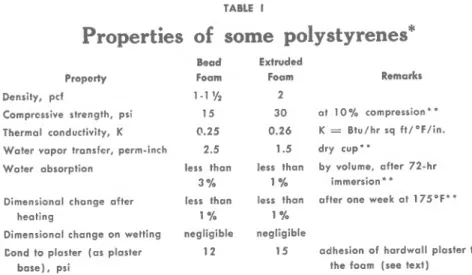
Table I shows representative proper- ties of the two types of polystyrene foam. The moldable bead type is less expensive and is obtainable in larger planks than the extruded type. Its prop- erties are generally lower than those of the extruded foam, but it has proved adequate for most uses and is most commonly used.
Through the years, manufacturers have established foam properties by consider- able testing and development work. Al- though foams have improved markedly in strength and uniformity since their earlier years, some bead foams can be
-
styrene are controlled by CGSB s ~ e c i f i - change. It is suspected that the few cases cation 41-GP-14. of gross shrinkage reported from the Bond Values field have been due to solvent attack
The bond of plaster to plastic foam has been examined by this Division, using a portable bond testing device de- veloped for use on both small labora- tory samples and completed walls.* Bond values of 12 to 15 psi (Table I) were found with this device, using unaggre- gated hardwall plaster. Bonds were also determined for the same material on gypsum lath, giving results of 15 to 20 psi. On corkboard the bond is about 11 psi. Preliminary work indicates that moderate sanding does not decrease the bond of the hardwall plaster to the polystyrene foams. The proportions usu- ally recommended are 1 part hardwall to 1% or 2 parts sand, by weight. If the plaster is properly applied and cured, its bond to the plastic foams is com- parable to that on older plaster-base materials.
* OKelly, B. M. Portabte adhesion testing de-
vice. AM. Soc. for Testing Mats. Bulletin, No. 250, December 1960, p. 32-33.
Dimensional stability
Dimensional stability of the foams has been questioned by some as a possible cause of plaster cracking. This property has been measured and is covered by the specification CGSB 41-GP-14. Table I shows that sustained heating causes
very "loose" and have poor resistance to water and water vapour as manu- facturers strive for lower densities and lower costs.
In co-operation with many manufac- turers, the Division of Building Re- search has set up test methods and car- ried out considerable testing on these foams, primarily for specification pur- poses. In addition to establishing prop- erties such as those listed in Table I,
further work by DBR and others shows that well-made polystyrene foams take care of themselves as far as internal condensation is concerned, even under quite severe vapour pressure conditions, for full winter seasons. Proper foams need no vapour barrier for most building
shrinkage of less than 1% in these foams. Early testing showed gross shrinkage and warping in a few samples, probably due to "locked-in" gases and stresses because of insufficient curing and storage. No such cases have occurred since those were noted.
(from using certain solvent-type ad- hesives or coatings), or perhaps to in- sufficient aging of the foam. In any case it is unlikely that expansion and con- traction of the foam can readily break the plaster since the "elastic modulus" (stiffness measure) of the foam is so very low.
Special Requirements
A special approach is necessary for plastering on polystyrene foam because of two unrelated properties: the foam is both resilient and watertight, whereas older plaster bases are rigid and water absorptive.
Older bases, such as gypsum lath, serve to reinforce the plaster sheet lat- erally and also tie it rigidly to the wall structure. The new foams do not re- inforce the plaster laterally, in the plane of the wall, nor do they transmit small movements or forces from the wall to the plaster because the modulus of elas- ticity (stiffness) of the foam is very low in comparison to that of the plaster.
In effect, then, a sheet of plaster on foam "floats" independently of the masonry wall and is relatively unaf- fected by small movements of the wall, but it is much more subject to shrink- age cracking within the plaster itself, as compared to plaster on rigid bases. The flexible base allows the plaster to shrink freely as it drys and this shrinkage can result in the opening of large cracks along the lines of weakness of the
TABLE I
Properties of some polystyrenes*
Bead
Property Foam
Density, pcf 1-1 %
Compressive strength, psi 1 5
Thermal conductivity, K 0.25
Water vapor transfer, perm-inch 2.5
Wafer absorption less than
3 %
Dimensional chonge after less than
heating 1 %
Dimensional change on wetting negligible Cond to plaster (as plaster 1 2
base), psi
*The properties given ore typical for the densities many densities a r e available on order.
**Tested according to CGSB specification 41-GP-14.
Extruded Foam Remarks 2 3 0 at 1 0 % compression*' 0 . 2 6 K = Btu/hr sq ft/'F/in. 1.5 dry cup"
less than by volume, after 72-hr
1 % immersion * *
less than after one week at 175'F" 1 %
negligible
1 5 adhesion of hardwall plaster to the foam (see text)
plaster. In contrast the shrinkage of plaster applied to a rigid base usually results in a multitude of fine cracks not visible to the unaided eye.
The tendency toward shrinkage crack- ing can be reduced by using a three- coat application (scratch coat 1:1% plas- ter: sand; brown coat 1:2; and finish coat) rather than a double-back appli- cation, since the latter increases the shrinkage problems and also drying and sag problems. Some foam and plaster manufacturers recommend that a 1-inch mesh of "chicken-wire" be lightly tacked to the foam before plastering to extend into the scratch coat and knit the plaster sheet together, particularly for larger wall areas. This does not improve the bond to the foam (which should not need improving), but simply reinforces the plaster sheet and should result in many fine invisible shrinkage cracks rather than a few large ones.
Alternatively, the plaster can be "pre- cracked" by scratching V grooves ver- tically and horizontally every 4 or 5 feet in the brown coat. When drying is completed the shrinkage cracks are all
in these grooves, which are then parched and the finish coat applied.
The watertightness property of the foam is the second factor that dictates special requiremenis for plastering, as already mentioned. Whereas most of the older base materials quickly absorb water from the applied plaster and aid in its drying and stiffening (they can do this to excess of course and prevent proper crystal growtn, leaving a crumbly plaster), the polystyrene foams do not absorb water and all drying must be through the exposed surface of the plaster.
For these reasons the plaster must be strong and as dry as possible when applied. The plasterer may tend to over- wet the mix for easy handling, but this tendency must be corrected by training and supervision. Since the plaster will dry more slowly on the foams a thick application will tend to sag. This is an- other reason why three-coat work is recommended, unless drying conditions are optimum and the plaster contractor is familiar with foam base work. It is claimed that lightweight aggregate should
not be used, as bond may be reduced and drying further retarded. In all cases ventilation must be ample to allow fast one-way drying from the foam out.
Summary
Reported field experience suggests that proper techniques and care are neces- sary for successful plastering over poly- styrene foam. These techniques have been set forth by both polystyrene foam and plaster manufacturers, based on field experience and controlled laboratory work. In general their recommendations are conservative and agree closely with the foregoing discussion. Much has been learned from investigation of initial prob- lems and manufacrurers report that such problems are much less common in re- cent years. It is also useful to note that some manufacturers now have techniques published for applying gypsum drywall to the foams, and these too appear promising and sound.
Thls paper is a contribution from the Division of Building Research of the Na- tional Research Council, and is published with the approval of the Director of the Division.