BRIEF COMMUNICATION
Magnetic toys: forbidden for pediatric patients
with certain programmable shunt valves?
Tycho J. Zuzak&Bettina Balmer&Daniel Schmidig&
Eugen Boltshauser&Michael A. Grotzer
Received: 31 October 2008 / Published online: 5 December 2008
# Springer-Verlag 2008
Abstract
Background Inadvertent adjustments and malfunctions of programmable valves have been reported in cases in which patients have encountered powerful electromagnetic fields such as those involved in magnetic resonance imaging, but the potential effects of magnetic toys on programmable valves are not well known.
Materials and methods The magnetic properties of nine toy magnets were examined. To calculate the effect of a single magnet over a distance, the magnetic flux density was directly measured using a calibrated Hall probe at seven different positions between 0 and 120 mm from the magnet. Strata II small (Medtronic Inc.), Codman Hakim (Codman & Shurtleff), and Polaris (Sophysa) programmable valves were then tested to determine the effects of the toy magnets on each valve type.
Results The maximal flux density of different magnetic toys differed between 17 and 540 mT, inversely
propor-tional to the distance between toy and measurement instrument. Alterations to Strata and Codman valve settings could be effected with all the magnetic toys. The distances that still led to an alteration of the valve settings differed from 10 to 50 mm (Strata), compared with 5 to 30 mm (Codman). Valve settings of Polaris could not be altered by any toy at any distance due to its architecture with two magnets adjusted in opposite directions.
Conclusion This is the first report describing changes in the pressure setting of some adjustable valves caused by magnetic toys in close contact. Parents, surgeons, neurologists, pediatric oncologists, and paramedics should be informed about the potential dangers of magnetic toys to prevent unwanted changes to pressure settings.
Keywords Shunt . Toy . Child . Magnetic flux density
Introduction
A pressure-related shunt valve is an implantable device that provides constant intraventricular pressure and drainage of the cerebrospinal fluid (CSF) for the management of hydrocephalus and other conditions with impaired CSF flow and absorption. Programmable shunt valves allow doctors to optimize the opening pressure of a shunt system non-invasively after implantation, permitting the implemen-tation of specialized treatment regimes [7,11].
Programmable valves are typically adjusted by using an externally applied programmer tool to magnetically couple to the adjustable components of these devices [2]. However, unintended pressure changes in programmable valves can also be caused by external magnetic fields. Alterations in valve settings are common after exposure to strong magnetic fields such as those involved in magnetic resonance (MR)
Childs Nerv Syst (2009) 25:161–164 DOI 10.1007/s00381-008-0770-x
T. J. Zuzak
:
M. A. Grotzer (*)Division of Oncology, University Children’s Hospital of Zurich, Steinwiesstrasse 75,
8032 Zurich, Switzerland
e-mail: [email protected] B. Balmer
Department of Surgery, University Children’s Hospital of Zurich, Steinwiesstrasse 75, 8032 Zurich, Switzerland D. Schmidig Engemattstrasse 31, 8200 Schaffhausen, Switzerland E. Boltshauser
Division of Neurology, University Children’s Hospital of Zurich, Steinwiesstrasse 75,
imaging, and the need for readjustment of the valve setting after MR imaging has been emphasized in the neurosurgical and neuroradiological literature [4,6,8,9].
Accidental alteration by an external magnetic field other than that created by MR imaging has been reported to be rare. Several reports have described single cases: a child playing with a collection of commercially available toy magnets which altered the pressure setting of an implanted valve [1]; a man who attempted suicide by successfully turning his adjustable valve to a near-maximal setting using a hand-held electromagnet [10]; and a 14-year-old girl with an in vivo alteration to the valve setting by a vagus nerve stimulator-activating magnet [3].
To determine the effects of magnets on shunt valves systematically, we selected a series of commercially available magnetic toys that varied in strength, form, and architecture. Using three different types of new valves, we then tested whether it was possible to alter the pressure setting and at what distance.
Materials and methods
Nine different magnetic toys (A–I) were used for this investigation (Fig. 1). All were collected in a single household of a 4-year-old patient with a ventriculo-peritoneal shunt. To calculate the effect of a single magnet
over a distance, the magnetic flux density was measured by a physicist (D.S.) using a calibrated Hall probe MMA-2502-VH (Lake Shore Cryotronics, Inc., Westerville, OH, USA) at seven different positions between 0 and 70 mm (0, 5, 10, 20, 30, 50, and 70 mm). We then selected three different commonly used programmable valves from different manufacturers. For this purpose, we used three new valves from each manufacturer (in total nine program-mable valves) and determined the effects of the magnetic toys on each valve type.
Strata II small (Medtronic Inc., Minneapolis, MN, USA) is a spring/ball valve consisting of a ruby ball, cone valve, a pressure/flow spring, and a magnetic rotor. A series of five concentric steps are located at the base of the rotor cassette. The opening pressure is adjustable between 5 and 25 cm H2O by turning the magnetic rotor via the steps of the rotor
cassette. The position of the magnetic rotor can be checked after implantation by simple visual inspection using an external compass or by a radiograph.
Codman Hakim (Codman & Shurtleff, Raynham, MA, USA) is a double-ball valve. The inlet valve controls the total pressure of the valve and consists of a synthetic ruby ball held in the valve seat by a flat, stainless steel spring. The opening pressure is adjustable between 3 and 20 cm H2O by raising the spring on a spiral polyethersulfone
staircase with a“stepper motor” containing a magnet turned by an external electromagnetic field provided by an external
Fig. 1 The magnetic flux density of nine commercially available magnetic toys was measured using a calibrated Hall probe at seven different posi-tions between 0 and 70 mm (0, 5, 10, 20, 30, 50, and 70 mm) from the magnets
programmer. Radiopaque markers or acoustic signals disclose the opening pressure setting after implantation.
The Polaris (Sophysa, Orsay, France) is a spring/ball valve. Non-invasive adjustment involves using a magnet to rotate a pressure bar containing two cobalt samarium micromagnets to five pressure settings between 3 and 20 cm H2O. The rotor–
shuttle system can be unlocked by attracting two shuttles in opposite directions simultaneously. In contrast, a static magnetic field attracts the shuttles in the same direction and the rotor–shuttle system cannot be unlocked. The position of the pressure bar can be checked after implantation by simple visual inspection using an external compass or by a radiograph.
A single toy magnet was passed at least three times over each valve at increasing distances. Thereby, the highest, middle, and lowest initial settings of each valve were tested. During each test, any alteration to each valve was detected using the methods recommended by the manufacturer. Starting at a distance of 0 mm, the greatest distance that still led to an alteration to the valve setting was determined.
Results
The magnetic flux densities of the nine magnet pieces at different distances are shown in Fig. 1. Maximal flux density of toy A (Road roller (Lego Duplo)) was 17 mT (1 mT=0.1 Gauss) at a minimal distance of 0 mm. Maximal flux density of toy B (Skarloey (Hit Entertainment)) was 43 mT, of toy C (Flower (kitchen magnet)) 315 mT, of toy D (cube with magnet) 481 mT, of toy E (Disc (kitchen magnet)) 67 mT, of toy F (Bornimag (GIGA iKids)) 295 mT, of toy G (Geomag) 404 mT, of toy H (Supermagnet small) 540 mT, and of toy I (Supermagnet big) 440 mT. The flux
density decreased with increasing distance in an inverse correlation.
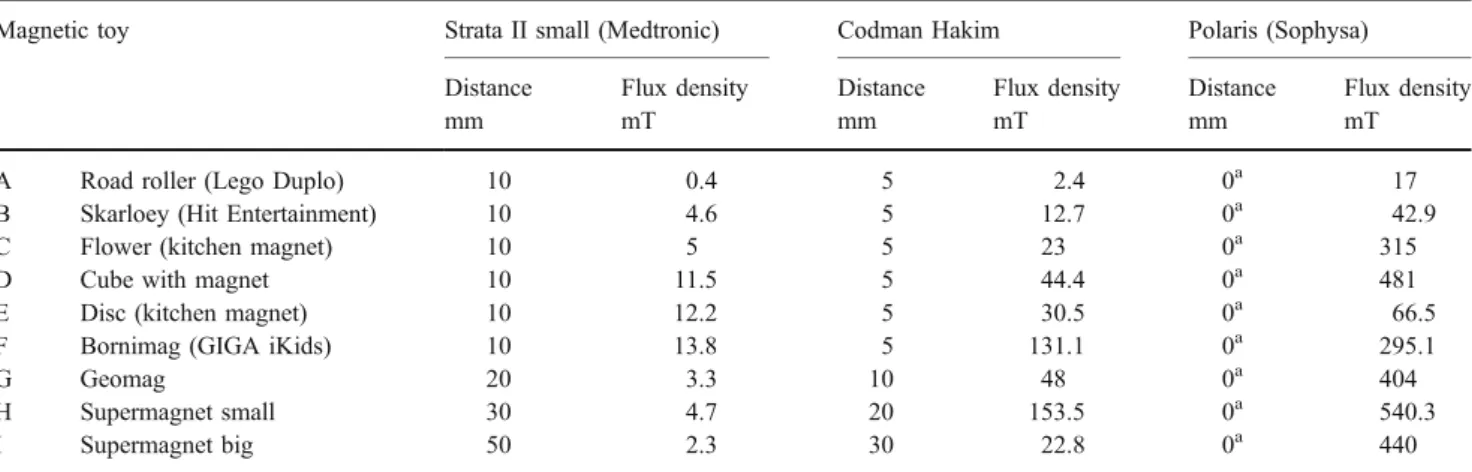
Testing of the Codman and Strata programmable valves revealed significant alterations in pressure settings after exposure to the magnetic toys (Table 1). Exposure of the Strata and Codman valve to the magnet caused pressure settings to change, regardless of the initial setting. Increas-ing the distance from the valve, the maximal distance was determined that still led to an alteration to the valve setting. The maximal distance at which the pressure settings of Strata valves was changed varied from 10 mm (toys A, B, C, D, E, and F) to 50 mm (toy I). The median flux density that led to an alteration was 4.7 mT with a range from 0.4 mT (toy A) to 13.8 mT (toy F). To change the pressure settings of Codman valves, maximal distances varied from 5 mm (toys A, B, C, D, E, and F) to 30 mm (toy I). The median flux density that led to an alteration was 30.5 mT, with a range from 2.4 mT (toy A) to 153 mT (toy H). Testing the Polaris shunt valve, no alteration was detected at any distance (0–70 mm). Performing the investigations with three different new valves from each manufacturer, no differences were detected between different valves from the same manufacturer.
Discussion
Authors of several studies have established that MR imaging can alter the valve settings on programmable valves regardless of their initial settings [4, 6, 8, 9]. Accidental resetting induced by an external magnetic field other than those associated with MR imaging has been reported to be rare [11]. Schneider et al. reported that programmable valve alterations can be produced by
Table 1 The distance that still led to an alteration to the valve setting was measured
Magnetic toy Strata II small (Medtronic) Codman Hakim Polaris (Sophysa)
Distance Flux density Distance Flux density Distance Flux density
mm mT mm mT mm mT
A Road roller (Lego Duplo) 10 0.4 5 2.4 0a 17
B Skarloey (Hit Entertainment) 10 4.6 5 12.7 0a 42.9
C Flower (kitchen magnet) 10 5 5 23 0a 315
D Cube with magnet 10 11.5 5 44.4 0a 481
E Disc (kitchen magnet) 10 12.2 5 30.5 0a 66.5
F Bornimag (GIGA iKids) 10 13.8 5 131.1 0a 295.1
G Geomag 20 3.3 10 48 0a 404
H Supermagnet small 30 4.7 20 153.5 0a 540.3
I Supermagnet big 50 2.3 30 22.8 0a 440
A single magnetic toy (A–I) was passed at least three times over each valve. During each test, the alteration to each valve was determined. Starting at a distance of 0 mm, the greatest distance and its corresponding flux density that still led to an alteration of the valve setting was detected. Note that settings of Polaris (Sophysa) valves could not be altered by any toy at any distance
a
No alteration
magnetic impulses during everyday activities of adult patients, such as those from telephone handsets, head-phones, and hairdryers [8].
Exposure to magnets in the everyday life of pediatric patients differs from that of adults. An increasing number of different toys include magnets of different strengths: When investigating the effects on valves of pediatric patients, attention should be focused on magnetic toys rather than on the objects mentioned above. Therefore, in the present study, the effects of nine different magnetic toys were investigated. It was shown that the magnetic properties of magnetic toys are of sufficient strength to alter program-mable Strata and Codman valves. Although the situation in vivo is complicated by the variable characteristics of patients as regards their skin, with differing thickness and consistency, and their CSF, with differing pressure and fluidity, through the present investigation we would like to reaffirm the appeal made by Anderson et al. [1]: When children with programmable valves such as Codman or Strata present with shunt malfunction, questions should be included in the history that may help identify magnetic toys. Furthermore, the family of a patient with a newly implanted shunt valve should be warned to avoid magnetic toys, so they are removed from the patient’s environment.
The settings of the Polaris valve could not be altered by any magnetic toy at any distance, due to its architecture. The rotor–shuttle system can only be unlocked by attracting two shuttles in opposite directions simultaneously. In contrast, a static magnetic field, such as that of a magnetic toy, attracts the shuttles in the same direction and the rotor– shuttle system cannot be unlocked [5].
The primary limitation of this report is that the number of magnetic toys tested was limited and is not representa-tive. Nevertheless, this is the first report to describe alterations in pressure settings of programmable valves from three manufacturers resulting from contact with commercially available children’s toys.
We have shown that the pressure level of adjustable valves can be altered by magnetic toys present in the everyday life of pediatric patients. Therefore, we call on
surgeons, neurologists, and oncologists to warn nursing staff, paramedics, and the families of patients with these programmable valves to avoid magnetic toys.
References
1. Anderson RC, Walker ML, Viner JM, Kestle JR (2004) Adjustment and malfunction of a programmable valve after exposure to toy magnets. Case report. J Neurosurg 101(2 Suppl):222–225
2. Fransen P (1998) Transcutaneous pressure-adjustable valves and magnetic resonance imaging: an ex vivo examination of the Codman–Medos programmable valve and the Sophy adjustable pressure valve. Neurosurgery 42(2):430
3. Guilfoyle MR, Guilfoyle MR, Fernandes H, Price S (2007) In vivo alteration of Strata valve setting by vagus nerve stimulator-activating magnet. Br J Neurosurg 21(1):41–42
4. Inoue T, Kuzu Y, Ogasawara K, Ogawa A (2005) Effect of 3-Tesla magnetic resonance imaging on various pressure programmable shunt valves. J Neurosurg 103(2 Suppl):163–165
5. Ludemann W, Rosahl SK, Kaminsky J, Samii M (2005) Reliability of a new adjustable shunt device without the need for readjustment following 3-Tesla MRI. Childs Nerv Syst 21 (3):227–229
6. Ortler M, Kostron H, Felber S (1997) Transcutaneous pressure-adjustable valves and magnetic resonance imaging: an ex vivo examination of the Codman–Medos programmable valve and the Sophy adjustable pressure valve. Neurosurgery 40(5):1050–1057 discussion 1057–8
7. Pollack IF, Albright AL, Adelson PD (1999) A randomized, controlled study of a programmable shunt valve versus a conventional valve for patients with hydrocephalus. Hakim– Medos Investigator Group. Neurosurgery 45(6):1399–1408 dis-cussion 1408–11
8. Schneider T, Knauff U, Bitsch J, Firsching R (2002) Electromag-netic field hazards involving adjustable shunt valves in hydro-cephalus. J Neurosurg 96(2):331–334
9. Shellock FG, Wilson SF, Mauge CP (2007) Magnetically programmable shunt valve: MRI at 3-Tesla. Magn Reson Imaging 25(7):1116–1121
10. Turner SG, Hall WA (2006) Programmable shunt-related suicide attempt. Acta Neurochir (Wien) 148(12):1307–1310 discussion 1310
11. Zemack G, Bellner J, Siesjö P, Strömblad LG, Romner B (2003) Clinical experience with the use of a shunt with an adjustable valve in children with hydrocephalus. J Neurosurg 98(3):471–476