HAL Id: cea-01810097
https://hal-cea.archives-ouvertes.fr/cea-01810097
Submitted on 7 Jun 2018
HAL is a multi-disciplinary open access
archive for the deposit and dissemination of
sci-entific research documents, whether they are
pub-lished or not. The documents may come from
teaching and research institutions in France or
abroad, or from public or private research centers.
L’archive ouverte pluridisciplinaire HAL, est
destinée au dépôt et à la diffusion de documents
scientifiques de niveau recherche, publiés ou non,
émanant des établissements d’enseignement et de
recherche français ou étrangers, des laboratoires
publics ou privés.
Towards the integration of security patterns in UML
Component-based Applications
Anas Motii, Brahim Hamid, Agnes Lanusse, Jean-Michel Bruel
To cite this version:
Anas Motii, Brahim Hamid, Agnes Lanusse, Jean-Michel Bruel. Towards the integration of
secu-rity patterns in UML Component-based Applications. Joint Proceedings of the Second International
Workshop on Patterns in Model Engineering and the Fifth International Workshop on the
Verifica-tion of Model TransformaVerifica-tion, 2016, co-located with 19th InternaVerifica-tional Conference on Model Driven
Engineering Languages and Systems (MoDELS 2016), Oct 2016, Saint-Malo, France. �cea-01810097�
Towards the integration of security patterns in UML
Component-based Applications
Anas Motii1, Brahim Hamid2, Agnès Lanusse1, Jean-Michel Bruel2 1 CEA, LIST, Laboratory of Model Driven Engineering for Embedded Systems,
P.C. 174, Gif-sur-Yvette, 91191, France {anas.motii,agnes.lanusse}@cea.fr
2 IRIT, University of Toulouse
118 Route de Narbonne, 31062 Toulouse Cedex 9, France {brahim.hamid,bruel}@irit.fr
Abstract. In software engineering, design patterns are considered effective tools
for the reuse of specific information. They are widely used today to provide ar-chitects and designers with reusable design knowledge. This paper is about the use of patterns in secure systems and software engineering, in particular in model based engineering. In this paper, we are proposing a model-based methodology for security pattern integration aimed to secure component-based software sys-tem architectures in UML. The methodology is based on merging techniques and verifications against integration constraints described in OCL language. The pa-per illustrates the method through a VPN security pattern.
Keywords: model-based methodology, model driven engineering, UML, OCL,
security patterns, pattern integration, secure architecture
1
Introduction
On the last decade, distributed systems have grown in complexity and connectivity. This has led to the introduction of several security breaches such as the one in [1]. This is due to the fact that security has been treated at the late phases of development. The security community all agree that there is a need of secure software and systems meth-ods that tackle security at early phases. Indeed, patterns represent generic solutions for recurring problems. The use of a well-documented catalogue of patterns has proven to be useful in several project in particular for security. However these catalogues are not enough, there is a huge need for methods for helping users select relevant patterns and apply them. Classical pattern concepts described in the pattern templates such as Gang Of Four (GoF) [2] are commonly accepted but we believe that the pattern conceptual model must embody additional concepts relevant for pattern selection and integration into architectures. In this paper, we propose a method for integrating security patterns within architectures. For that purpose, Model Driven Engineering (MDE) offers an ideal development context using metamodeling and model transformation. In fact, if we consider the pattern and the application as two models, the integration process can
be automated as a MDE composition operation resulting in a new (refined) architecture. In this paper we focus on architectures described as UML composite structures. In [3], the authors have presented an automated process for selecting patterns based on a rela-tional view of the application and pattern models. Their approach is similar to ours since it uses role assignment as a query to select software patterns.
2
Background: Prerequisites for using our process
The modeling language and the integration process used for security patterns are based on previous works related to [4]. Here, we present the pattern concepts we have defined to support our methodology.
Pattern: is the main concept. It encapsulates a solution of a recurring problem in specific
context.
Integration relevant concepts: (from [4])
Pattern entity (role): The solution of the pattern consists of a set of entities (roles). Each entity of the targeted application will play a role in the pattern.
Application: architecture targeted by the integration. It consists of a set of application entities. Not all entities must be a target for integration but only a subset. Some en-tities will play a role in the pattern.
Plays (is bound to): is a concept used to link pattern roles and the domain application entities.
Properties: represent the intent of the pattern and formulate the solution of the prob-lem.
Constraints: are assumptions that the application must satisfy in order for the pattern to deliver its properties. There are two kinds of constraints: preconditions and post conditions.
Traceability relevant concepts (added):
Create: If some roles of the pattern are not played by the application, new elements are created. This concept is used to link the newly created elements and the corre-sponding pattern roles.
Integration trace (pattern application): represents the success of the integration on one hand. On the other hand, it guarantees traceability as it keeps the “Plays” and the “Create” traces.
3
Pattern integration process
The process follows four phases: “Preparation” extracts from the pattern the solution description and its related constraints (preconditions and post conditions) into a UML model. Pattern properties and constraints are formalized using OCL1. “Elicitation”
builds a bridge between the application and the pattern. “Merge” does the merging
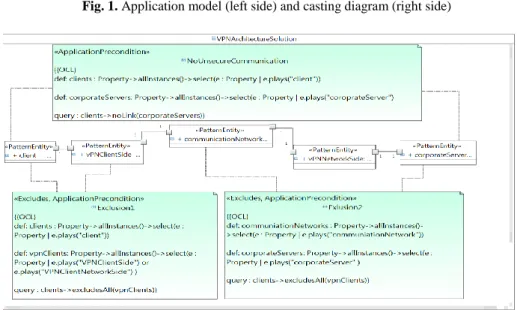
tween them and generates an integration trace. Finally, “Adaptation” offers the possi-bility to make changes by letting the user refining the new application. We illustrate the approach with the application of a VPN pattern on a UML composite structure describ-ing a distributed system. The scenario is performed as follows. A designer wants to establish a secure communication between two clients: “host1” and “host2” and a cor-porate network server “companyServer”. The designer starts by modeling the clients and corporate server in the left side of Fig. 1. Then he follows the steps described below to obtain a refined model integrating the VPN pattern.
Preparation.
Fig. 2 shows the VPN architecture solution as a UML composite structure along with
its constraints. The VPN has the following roles: “client”, “VPNClientSide”, “VPN-NetworkSide”, “communicationNetwork” and “corporateServer”. As seen in Fig. 2, the constraints over the application are formalized in OCL. Each constraint is attached to the constrained elements. These constraints must normally be expressed by security experts. In this example they are mainly illustrative.
Preconditions: (1) there must not be a connection between elements playing roles “client” and “corporateServer” expressed in the constraint “NoUnsecureCommuni-cation”; (2) elements of the application cannot play the exclusive roles: “client” and “VPNNetworkSide”, “client” and “VPNClientSide”, and “communicationNetwork” and “corporateServer” (the last constraint is not shown in the figure).
Post conditions (not shown in the figure): The application must not have a direct connection between entities playing roles “client” and “corporateServer” (no direct link). If there is an indirect link, it must go through the “VPNClientSide” first and then “VPNNetworkSide”.
Elicitation.
Role assignment (casting diagram). The designer specifies that “host1” and “host2”
play the roles of “client”, and that “companyServer” plays the role “corporateServer”. Thus he draws the casting diagram in the right side of Fig. 1.
Role assignment validation. Once the casting has been made the designer checks its
validity through the checking module against preconditions. If one of the preconditions is violated the casting is rejected. For example, if the designer had connected “host1” and “companyServer” directly, then “NoUnsecureCommunication” will be violated.
Merge.
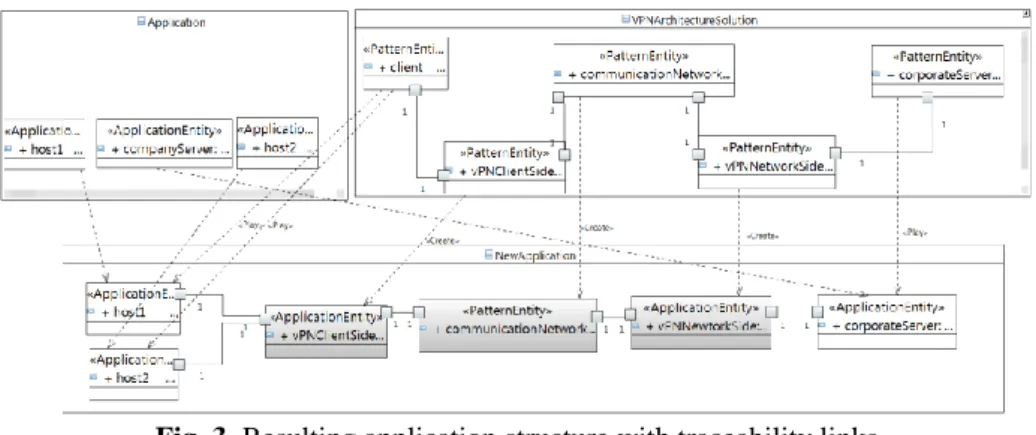
Once the casting is correct, this phase consists of merging the composite structure of the pattern and the application, using merge points defined in the casting diagram, in order to obtain a new application as shown in the bottom of Fig. 3.
In addition, a trace is generated linking the new application model, and the previous application and pattern models as seen in Fig. 3. It consists of the castings (dependen-cies stereotyped with “Play”) in the “casting diagram” and dependen(dependen-cies toward the
newly created entities (dependencies stereotyped with “Create”). The trace is necessary for the last phase.
Fig. 1. Application model (left side) and casting diagram (right side)
Fig. 2. VPN solution architecture model
Adaptation.
The adaptation phase consists in checking the resulting application model against the pattern post conditions at each model change. This change can result from ad-hoc tai-loring by the designer or from the integration of another security pattern (e.g., firewall pattern). For this reason, the created trace plays an important role in this phase. Since the trace keeps a link between the refined application, and the previous version of the application and the pattern. The verification of post conditions over the new application is guaranteed by the checking module. Indeed, at each change in the new application, the checking module verifies that the post conditions described in the pattern are still true in the elements playing a role or created after the integration. For example, if ap-plying a new pattern over the new application creates a connection between “host1” and “companyServer”, then the post condition “no direct link” will be violated. It should be noted that at this phase all the post conditions of patterns that have already been applied are rechecked to enforce their continuous functionality.
Fig. 3. Resulting application structure with traceability links
4
Conclusion
This paper presents a pattern integration process, aimed at correctly applying security patterns on systems and software architectures. The process has been illustrated through the application of a VPN pattern. In future work, we will apply the process through several security patterns.
The challenges faced during the integration process were due to the fact it is part of global MDE process for securing system architectures. It is composed of several phases: (1) risk analysis, (2) pattern selection with regards to multi-concern objectives, (3) pattern integration. In order to guarantee fast considerations of changes in require-ments such as: real-time, we thought of adding new concepts such as traceability links for the architect to keep a trace of the added components and the applied pattern. For instance, if the real-time requirements change, some selected patterns may change. Thanks to traceability, the replacement of patterns becomes easier since the architect has detailed information of the currently applied pattern.
Acknowledgements. This work is conducted in the context of a Ph.D. thesis funded by
CEA LIST and co-leaded by CEA (LISE) and IRIT (MACAO).
Reference
1. Attackers Alter Water Treatment Systems in Utility Hack: Report | Securi-tyWeek.Com, http://www.securityweek.com/attackers-alter-water-treatment-sys-tems-utility-hack-report.
2. Gamma, E., Helm, R., Johnson, R., Vlissides, J.: Design Patterns: Elements of Re-usable Object-oriented Software. Addison-Wesley Longman Publishing Co., Inc., Boston, MA, USA (1995).
3. van den Berghe, A., Van Haaren, J., Van Baelen, S., Berbers, Y., Joosen, W.: To-wards an automated pattern selection procedure in software models. In: Late break-ing papers of the 22nd international conference on inductive logic programmbreak-ing (ILP 2012). pp. 68–73. CEUR-WS (2013).
4. Hamid, B., Percebois, C., Gouteux, D.: A Methodology for Integration of Patterns with Validation Purpose. In: Proceedings of the 17th European Conference on Pat-tern Languages of Programs. p. 8:1–8:14. ACM, New York, NY, USA (2012).