MIT Global Scale Network
MIT SCALE RESEARCH REPORT
The MIT Global Supply Chain and Logistics Excellence
(SCALE) Network is an international alliance of
leading-edge research and education centers, dedicated
to the development and dissemination of global
innovation in supply chain and logistics.
The Global SCALE Network allows faculty, researchers,
students, and affiliated companies from all six centers
around the world to pool their expertise and collaborate
on projects that will create supply chain and logistics
innovations with global applications.
This reprint is intended to communicate research results
of innovative supply chain research completed by
faculty, researchers, and students of the Global SCALE
Network, thereby contributing to the greater public
knowledge about supply chains.
For more information, contact
MIT Global SCALE Network
Postal Address:
Massachusetts Institute of Technology 77
Massachusetts Avenue, Cambridge, MA 02139 (USA)
Location:
Building E40, Room 267
1 Amherst St.
Access:
Telephone: +1
617-253-5320
Fax: +1
617-253-4560
Email: [email protected]
Website: scale.mit.edu
Research Report: MISI-2015-10
Developing E-Commerce Supply Chain Capabilities for an FMCG Manufacturer
Abhishek Goel
MIT Global Scale Network
For full thesis version please contact:
Professor Shardul Phadnis
Director of Research
MISI
No. 2A, Persiaran Tebar Layar, Seksyen
U8, Bukit Jelutong, Shah Alam,
40150 Selangor, Malaysia.
Phone: +6 03 7841 4845
D
EVELOPING E
-
COMMERCE SUPPLY CHAIN CAPABILITIES FOR AN FMCG
MANUFACTURER
By Abhishek Goel
Thesis Advisor: Dr. Shardul Phadnis
Summary: Using scenario planning as a tool, this project suggests the various supply chain models a fast moving consumer
goods (FMCG) manufacturer can use to introduce its online channel. We looked at the most suitable model in the current setting and how the applicability of that structure will change with respect to the changes in the external environment.
About the author: Abhishek Goel received his Bachelor of Technology in Metallurgical and Materials Engineering from Indian Institute of Technology, Roorkee. Prior to the MSCM program, he was worked as an intern in an e-retailing company Jabong.com and he is also actively engaged in managing his family business in Delhi-NCR, India.
KEY INSIGHTS
1. The ability to introduce online channel
has strategic importance as the
manufacturer can alter the market
equilibrium in his favor.
2. Based on the current market trend, the
author has suggested Back Room –
InStore Pickup as the supply chain
structure to introduce online channel.
3. A scenario set gives insight about the
suitability of the supply chain models
based on macro-environment in
Malaysia for the next 5 years.
Introduction
Internet, since its inception has revolutionized the way people communicate. And as with other businesses, retailing industry underwent a huge transformation as more and more people started to shop online. E-Retailing or e-tailing became the new buzzwords, as industry leaders tried to adapt to the new environment where supply chains
became more automated, efficient and faster, resulting in increased product availability across different channels. Growth of e-commerce was not shared by all the product categories alike. Most popular e-commerce categories are non-consumables such as electronic and entertainment-related products. Online market for grocery, however, has had mixed fortunes. The first e-grocery player Webvan, was named as the largest dot-com flop in the history as it could not keep its operational costs down. But introduction of e-retailing introduced a new channel for a manufacturer to reach out to its end consumer.
Although online only makes up a small share (3.7%) of fast moving consumer goods or FMCG sales at the moment, all countries are witnessing considerable growth, providing significant opportunities for retailers and manufacturers. With FMCG growing at an average rate of 31%, ecommerce is expected to account for over 5% of FMCG sales by 2016. This figure has the potential to rise to 28% if 60% of households across the globe use the online channel just once a month. Thus there is a huge opportunity to grow and capture this rapidly growing market.
The key objective of this project is to provide a consumer goods manufacturer with a set of scenarios which prescribe a supply chain model to enter into online channel.
Literature Review
Internet retail channels are becoming increasingly popular. These direct channels, including catalogs and the Internet, now compete against, substitute, or complement conventional retail channels. This when combined with rapid introduction of new consumer products poses interesting challenges and opportunities for traditional brick-and-mortar retailers. Manufacturers are trying to avail this opportunity by selling through their direct channels, in addition to their conventional retail channels. In this project we focus only on online channel introduction and how it impacts a consumer goods manufacturer.
Figure 1: Channel Introduction (Hsiao et al. 2014) Channel introduction is important strategic move for a company and hence we find that there is growing literature on dual channel management, where most papers’ study resulting price competition after direct channel introduction. Several game-theoretic studies have investigated the impact of the Internet channel introduction, typically analyzing the case of an independent physical store retailer(s) facing new competition from a manufacturer’s direct Internet channel (Balasubramanian 1998, Cattani et al. 2006, Ozer et al 2008).
Before introduction of online channel, it is critical for both practitioners and academic researchers to understand the factors that drive consumers to choose one retail channel over another. Therefore to understand how multichannel strategy influences the consumer behavior and their decision making process, an extensive literature
review from secondary data sources was performed. The following constitute the consumer choice lever that act as either enablers or barriers to online shopping: 1) Value, 2) Convenience, 3) Product Assortment, 4) Content, 5) Time, 6) Quality, 7) First Time Shoppers, 8) Resistance to Change, and 9) Security.
I also looked at various supply chain models currently used in the retail industry to serve customers in a dual channel setting. For consumer goods, increased complexity in the last mile delivery shipments represents the biggest impediment to provide high service levels. Since we live in a rapidly changing global economy, it is hard to predict the future. Thus to avoid linearity bias I have provided a set of possible scenarios within the timeframe of 3-5 years to understand which model will be suitable for which setting. This will act as a guiding tool for the management to prepare for various uncertainties and formulate strategies accordingly.
Methodology
A three-stage process was utilized in this project to answer the research question. To begin with, the problem statement/objective was defined. Then I carried out an extensive literature review of the published materials including trade journals, industry publications, and market researches to develop an in-depth understanding of electronic retailing by focusing specifically on consumer preferences. Thereafter I looked at the current state of the art supply chain models adopted by the retail industry. Based on this knowledge, I tried to explore the applicability of these models with regards to FMCG industry specifically in Malaysia.
I also looked at extensive literature on dual channel introduction and management in addition to analyzing the proprietary data issued by the company. Finally, I designed a survey to map local key factors, which we derived from the business strategy models, to driving forces that we can track to gain insight about the external environment. Based on the survey results and insights derived from the earlier steps, 4 scenarios were created considering the changes in the external environment and how they may impact the applicability of a particular supply chain model.
The scenario creation was based on the focal issue what supply chain model should an FMCG manufacturer adopt to enter and remain sustainable in the online channel over the next five years? To answer this I surveyed a
diverse group of mid to senior level management who were acquainted with the consumer goods industry and identified local key factors which can affect the applicability of a model. In addition driving forces in the external environment that have an impact on FMCG industry were tabulated. These were then mapped against each other and their criticality was calculated.
Figure 2: Impact of driving force
As seen in Figure 2, these factors were ranked according to their importance and uncertainty, and the most impactful driving forces namely, GDP growth rate and Online Market Size were chosen as the uncertainty axes. Analysis and Results
To understand the applicability of each supply chain model the trends in the consumer goods, e-commerce and the retail industry were analyzed. It is seen that e-commerce for grocery is growing at a tremendous pace will constitute a major portion of online commerce within the next five years. The retail industry in Malaysia is moving towards Minimarkets and other small convenience stores. Local chain retailers such as Mydin and 99Speedmart are contributing towards 70% of FMCG’s growth.
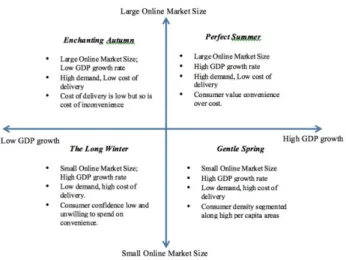
To help understand the changes in the macro-environment and their impact on supply chain structure of the industry we created 4 scenarios as seen in Figure 3. These scenarios were named, ‘The Perfect Summer’, ‘Enchanting Autumn’, ‘Gentle Spring’ and ‘The Long Winter’ and the external conditions prevailing in each
delineated. Finally I suggested the most suitable supply chain structure in each of the given scenarios.
Figure 3: Scenario set for supply chain models Conclusions
Based on the research, we tried to explore the suitability of supply chain models in different scenarios based on changes in the external environment. We looked at how the ability to introduce an online channel has strategic impact for a manufacturer, who can change the equilibrium conditions of the market with the same. In addition by varying the local key factors, it can segment the customer and force them to buy from a particular channel or utilize both at the same time.
Through this thesis we have also looked at how the electronic retail is changing with time and what are its implications for a fast moving consumer goods industry. Hence it becomes imperative to understand what is the best model to deliver to the customers in the current setting for Malaysia and in particular Kuala Lumpur. The author has suggested based on his insight that Backroom – In Store Pick-Up model should be implemented after carefully analyzing the current trends. The scenario set developed seeks to provide a guide to the management as a backdrop for formulating strategic decisions involving online channel introduction and management.
References
Phadnis, S., Caplice, C., Singh, M., & Sheffi, Y. (2014). Axiomatic foundation and a structured process for developing firm-specific Intuitive Logics scenarios. Technological Forecasting and Social Change, 88, 122-139