HAL Id: hal-00407670
https://hal.archives-ouvertes.fr/hal-00407670
Submitted on 22 Mar 2021
HAL is a multi-disciplinary open access
archive for the deposit and dissemination of sci-entific research documents, whether they are pub-lished or not. The documents may come from teaching and research institutions in France or abroad, or from public or private research centers.
L’archive ouverte pluridisciplinaire HAL, est destinée au dépôt et à la diffusion de documents scientifiques de niveau recherche, publiés ou non, émanant des établissements d’enseignement et de recherche français ou étrangers, des laboratoires publics ou privés.
Mantle structure under Gibraltar constrained by seismic
waveform complexity
Goetz Bokelmann, E. Maufroy
To cite this version:
Goetz Bokelmann, E. Maufroy. Mantle structure under Gibraltar constrained by seismic
wave-form complexity. Geophysical Research Letters, American Geophysical Union, 2007, 34, pp.L22305. �10.1029/2007GL030964�. �hal-00407670�
Mantle structure under Gibraltar constrained by dispersion of
body waves
Go¨tz Bokelmann1,2and Emeline Maufroy1,3
Received 11 June 2007; revised 1 October 2007; accepted 15 October 2007; published 17 November 2007.
[1] We study the Africa-Iberia plate boundary in the vicinity
of Gibraltar. Numerous models have been proposed for that region throughout the last decades, proposing mechanisms that range widely from continental delamination, convective removal, to subduction of oceanic lithosphere. To better constrain upper-mantle structure under the region, we study waveforms of P-waves that traverse the Alboran Sea region between Spain and Morocco. These show dispersive behavior, which, together with early arrival times, confirms the presence of an anomalous upper mantle structure under the Alboran Sea. The dispersion is consistent with that expected from subducted lithosphere. Waveforms of body waves therefore provide a way to better constrain the elusive mantle structure and dynamics of the Alboran Sea region.
Citation: Bokelmann, G., and E. Maufroy (2007), Mantle structure under Gibraltar constrained by dispersion of body waves, Geophys. Res. Lett., 34, L22305, doi:10.1029/2007GL030964.
1. Introduction
[2] The European/African plate boundary is one of the
least-understood plate boundaries. A large number of geo-logical and geophysical studies have attempted to shed light on the nature of this plate boundary in the region around Gibraltar [e.g., Michard et al., 2002], but so far there is no consensus on which process should be invoked to explain its geological evolution and structure. A variety of tectonic models has been proposed to explain the most important geological and geophysical observations. Currently, there are two types of geodynamic models that are dominating the discussion; we will call these ‘‘oceanic’’ and ‘‘continental’’ models. The oceanic models explain geological and geo-physical observations via subduction of oceanic lithosphere, either toward the North [Zeck, 1996] or by an east-dipping slab that is rolling back to the West [Royden, 1993; Lonergan and White, 1997; Gutscher et al., 2002]. In contrast, the continental models propose either convective removal [Platt and Vissers, 1989; Calvert et al., 2000] or delamination [Seber et al., 1996] of the continental lithospheric mantle. These different models have been illustrated, e.g., by Calvert et al. [2000]. It appears that both types of models can explain the majority of geological and geophysical observations in the area.
[3] On the other hand, the region between Spain and
Morocco is associated with considerable seismic risk: a
great earthquake (M > 8.5) followed by a tsunami com-pletely destroyed Lisbon in 1755 [Baptista et al., 2003]. Intermediate-depth seismicity is observed beneath the Gibraltar Arc, the Gulf of Cadiz, and the western Alboran Sea [Calvert et al., 2000; Casado et al., 2001], and some deep earthquakes (550 – 650 km depth) occur beneath southern Spain near Granada, as the 1954 earthquake (Mw = 7.8), the most powerful event ever recorded in the area [Buforn et al., 1991; Calvert et al., 2000]. That important seismicity requires a better understanding of the structure of this plate-boundary region. In fact, there is continuing debate concerning the location of the 1755 earthquake [e.g., Baptista et al., 2003; Gutscher, 2004].
[4] Regional and global P-wave tomography shows two
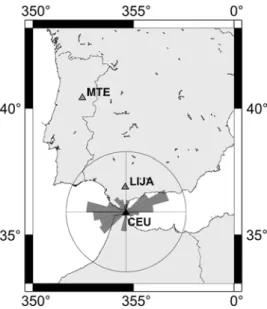
main anomalies in the upper mantle under the Gibraltar Arc: there is a low-velocity anomaly down to 100 km depth beneath the Alboran Sea while there is a high-velocity anomaly under the Gibraltar arc and Alboran Sea that extends at depth to the east and to the northeast under Southern Spain, where the deep earthquakes are initiated in the transition zone [Bijwaard and Spakman, 2000; Calvert et al., 2000]. However the ray coverage at Gibraltar is mainly in an east-west direction with few rays arriving from north and south (Figure 1). This uneven earthquake distri-bution, as well as the restricted space for seismological stations hampers tomographic resolution in the area. Reso-lution tests done by Calvert et al. [2000] indicate that velocity anomalies of any shape under Gibraltar will be severely smeared along the (east-dipping) ray paths. It appears therefore, that the true geometry of the high-velocity anomaly is not yet clear. In addition, tomography cannot easily distinguish between the two types of models (continental versus oceanic lithosphere), since resolved velocity anomalies for continental and oceanic lithosphere are rather similar.
[5] This suggests to us that the following two questions
need to be addressed: (1) Is the high-velocity body identi-fied by P-wave tomography data really dipping toward the east/northeast, and (2) does this anomaly represent subducted lithosphere (oceanic or continental) or rather delamination/convective removal of continental litho-sphere? We propose that both questions may be addressed by studying the dispersion of body waves, in particular P-waves, that traverse the mantle under the Alboran Sea region.
2. Waveform Complexity
[6] A characteristic feature of subduction zones is that
generally an entire column of lithosphere is being sub-ducted. That column has a rather characteristic velocity profile including a low-velocity gabbroic crust and a
high-1Universite´ Montpellier 2, Ge´osciences Montpellier, 34095 Montpellier,
France.
2
CNRS, Ge´osciences Montpellier, 34095 Montpellier, France.
3
Now at Ge´osciences Azur, Sophia Antipolis, Valbonne, France. Copyright 2007 by the American Geophysical Union.
0094-8276/07/2007GL030964
velocity, low-attenuation ‘‘mantle lid’’. Since an oceanic crust is only a few kilometers thick, such a lithospheric profile can generally not be resolved by travel-time tomog-raphy, and it can therefore not be distinguished from continental lithosphere on that basis. However, the particu-lar velocity profile may give rise to waveform effects for waves that propagate nearly parallel to the subducting slab. Indeed, several studies have found such waveform effects from intermediate-depth earthquakes in the circum-Pacific [Abers and Sarker, 1996; Abers, 2005; Martin, 2005] subduction zones where travel times of body waves that arrive parallel to the slab seem to depend on frequency. This dispersion is often associated with high frequencies arriving later than low frequencies, a behavior that is rather different from that of waves propagating outside of the slab [Abers, 2005; Martin, 2005], which do not show such dispersion. Nature and strength of the dispersion depend on the travel distance within the slab plane; delays between low and high frequencies have been found to be between 1 and several seconds, for frequencies varying between 1 to 3 Hz [Abers and Sarker, 1996]. Modeling studies [Abers, 2005; Martin, 2005] have shown that the observed dispersion is consistent with the presence of a gabbroic low-velocity layer at the top of the slab. This low-velocity channel may persist down to 100 – 150 km below which the gabbro-eclogite phase trans-formation is complete [Abers and Sarker, 1996]. Thickness and velocity contrast with respect to the surrounding medium control the dispersion [Gubbins and Snieder, 1991; Martin, 2005]. Short wavelengths travel in the subducted plate, following the low-velocity layer that is too thin to be ‘‘seen’’ by long wavelengths propagating at
the surrounding medium speed. Inspecting waveforms for dispersion may therefore help to identify the presence of a low-velocity crust as would be consistent with a subducting lithosphere.
3. Application to the Alboran Sea
[7] We now apply this approach to the Alboran Sea
region to test the subduction-type model. Data are available for two stations in Southern Spain (Figure 1), LIJA and the station CEU (Ceuta, Spain) that is favorably placed above the axis of the supposed slab, as inferred, e.g., by Gutscher et al. [2002]. In the following we will study the dispersion of P-waves from events that are observed at CEU and LIJA and at a reference station, MTE (Manteigas, Portugal) that is located in the stable central Iberian domain [Dallmeyer and Martı´nez Garcı´a, 1990].
[8] For this purpose we measure dispersion by
character-izing the dependence of group arrival time tgon frequency
in a procedure similar to surface wave analysis [Dziewonski et al., 1969]. That procedure regards tg(f) for a set of
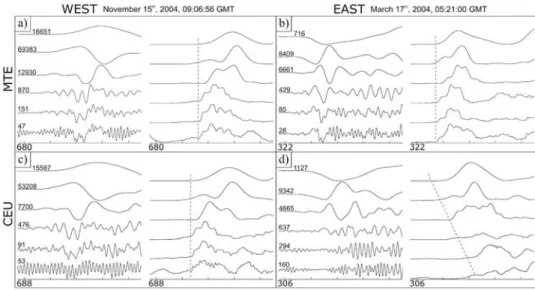
band-pass-filtered wave packets, each around a given central frequency. Not knowing the source-time function, we resort to comparing the dispersion for observations of the same event at station pairs CEU-MTE and LIJA-MTE, if present. Figure 2 shows an example of that procedure for two events observed at CEU and MTE (for others, see the auxiliary material).1 One is arriving from the west (origin time 15 November 2004, 09:06:56 GMT, latitude 4.695°, longitude 77.508°, distance 72.8° from CEU, magnitude Mw 7.2)
and the other from the east (origin time 17 March 2004, 05:21:00 GMT, latitude 34.589°, longitude 23.326°, dis-tance 23.45° from CEU, magnitude Mw6.0). Each of these
two events has been recorded at the two stations at nearly the same distance. Figure 2 displays band-pass-filtered seismograms as well as ‘‘smoothed envelope functions’’ that were computed in a procedure following Abers and Sarker [1996]: they were squared and averaged with a box-car smoothing operator (half-width of 0.5 seconds). The seismogram observed at CEU on the right-hand side (event from the east), and the corresponding envelopes, show a strong dispersion: High frequencies at 4 Hz arrive about 1.5 seconds later than those at 0.5 Hz (‘normal dispersion’). This effect is similar to the one observed for subduction zones around the Pacific. However, there is no or little dispersion observed at MTE for the same event. For the event incident from the west (left-hand side), the disper-sion is nearly identical at the two stations. The difference observed at CEU thus suggests the presence of an anom-alous body in the mantle below and to the east of Ceuta, the Alboran Sea. Observed first-arrival times at CEU are in agreement with previous tomographic results: residuals for seismic rays coming from the East are on average early by about 1.7 seconds compared with those coming from the West.
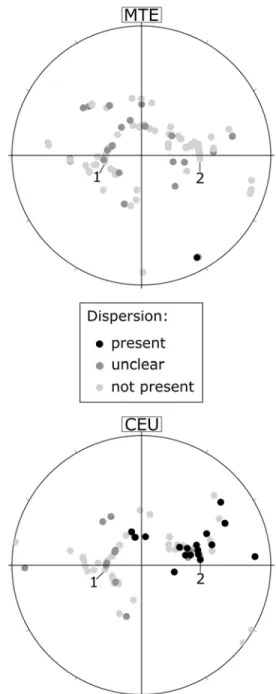
[9] Dispersion tg(f) of P-waves has been characterized for
149 teleseismic and regional events recorded at both sta-tions, including 82 at CEU, 115 at MTE, with 48 in common, and 64 at LIJA. Figure 3 shows results for stations Figure 1. Seismological stations used in this study: CEU,
LIJA, and the reference station MTE. The rose diagram shows teleseismic ray coverage for station CEU for the period 24 October 2001 to 30 December 2004. Note the good coverage of rays arriving from West and East. The maximum of the backazimuthal distribution corresponds to 110 events arriving at angles between 60° and 75°, from the East.
1
Auxiliary materials are available in the HTML. doi:10.1029/ 2007GL030964.
L22305 BOKELMANN AND MAUFROY: MANTLE STRUCTURE UNDER GIBRALTAR L22305
CEU and MTE on lower hemispheres. For display purposes, the results were classified into three categories, based on whether dispersion is present, unclear, or not present. The ‘‘unclear’’ case is indicated if the first arrival is not clear at some frequencies, if the signal-to-noise ratio is not good at high frequencies, or if arrival times seem very variable from one frequency to another. All ‘‘dispersion present’’ measurements correspond to high frequencies at 4 Hz being delayed relative to 0.5 Hz by at least 0.6 seconds, in the sense of ‘‘normal dispersion’’. For a few events an inverse dispersion seems to be present, simultaneously at both stations, e.g. the left-hand side of Figure 2. These were associated to the ‘‘dispersion not present’’ class as it is the difference between the two stations that matters here. Such incidences of ‘‘inverse dispersion’’ are probably due to the particular source-time function of those earthquakes, and the effect of attenuation (see below) may also con-tribute somewhat. The range of dispersion at CEU is up to 2.5 sec, and the distribution of ‘‘present’’ measurements is 1.2 ± 0.5 sec. Dispersion of P-waves can be observed at station CEU for rays coming from the East, for a wide range of dip angles (distances between 12 and 89 degrees), and a few coming from the North. No dispersion is observed at the reference station MTE, except for two shallow events coming from the Alboran Sea that traverse the same region as the dispersive rays east of CEU (distance about 6°). Similarly, the Gulf of Cadiz, to the west of CEU, does not give rise to dispersion that is not also observed at MTE. On the other hand, paths with observed dispersion, from the East of CEU, are sometimes close to paths where dispersion is not observed. We tentatively explain this as an interference of the lower-frequency waves with the subducting slab that has a thickness of nearly a wavelength, therefore rendering the dispersion effect sometimes visible and sometimes not. Results at LIJA are similar to MTE, in that essentially all
events show either no or unclear dispersion, with no clear spatial organization.
4. Discussion and Conclusions
[10] We have searched for other potential effects that
might produce a similar dispersion. In essence, these are (1) attenuation, (2) scattering due to small-scale bodies, and (3) multiple phases. Attenuation is necessarily coupled with dispersion [Liu et al., 1976]. However, that effect is an order of magnitude smaller than the one observed here, and the dispersion is in the opposite (inverse) sense. Small-scale scattering cannot explain the observations neither since it should produce a similar kind of dispersion as attenuation. The other potential effect is that of multiple phases, e.g., the arrival of two phases of similar amplitude within less than two seconds. However, such an effect is not likely to produce consistent dispersion effects for a broad distance and azimuth range. We are therefore left with the proposi-tion of dispersion due to a low-velocity channel in the mantle. A natural explanation of the presence of such a layer is in the context of subducting lithosphere east of Gibraltar. In fact, the observed frequency-dependence of velocity and the mean delay of 1.2 seconds of 4 Hz energy relative to 0.5 Hz, is consistent with synthetic seismograms calculated for a subducting oceanic lithosphere with the typical crustal thickness of 6 km and a path length of about 100 km within the slab [Abers and Sarker, 1996; Abers, 2000; Martin, 2005]. The data may in principle also be explained by a somewhat thinned continental crust that follows a previous oceanic subduction, while preserving the form of an elongated low-velocity channel. On the other hand, it is not clear how a preserved crust might be descending into the mantle in the context of convective removal [Platt and Vissers, 1989] and delamination [Seber et al., 1996], and in addition still preserve a simple elongated shape. Thus, a subduction geometry is required. Figure 2. Waveform examples for two events arriving from west and east at stations MTE and CEU, shown as filtered seismograms and as smoothed envelopes (see text). Filters are, from top to bottom, <0.05 Hz, 0.05 – 0.5 Hz, 0.5 – 1.5 Hz, 1.5 – 2.5 Hz, 2.5 – 3.5 Hz, and 3.5 – 4.5 Hz. Amplitudes are given by numbers. Ticks on time axes give intervals of two seconds. Dotted lines illustrate the dispersion that occurs in Figure 2d.
[11] Most of the dispersed rays (for example ray 2 in
Figure 3) arrive at Ceuta from the east, traveling through a block in the upper mantle that is associated with particularly high seismicity [Calvert et al., 2000]. The agreement with observed dispersion suggests that that block corresponds indeed to subducted material, probably of oceanic nature, but subducted continental lithosphere cannot be ruled out. The spatial distribution of intermediate-depth seismicity shows a nearly vertical line dipping steeply southward. It does not seem to represent the subduction dip since dispersion is observed from Northeastern azimuths. An explanation for that strong localized seismicity might be a
slab-tear or breakoff as discussed in the literature [Carminati et al., 2003; Zeck, 1996]. Essentially all of the dispersed waves arrive at CEU from directions within the first quadrant (North to East). We thus conclude for the presence of subduction under the Alboran Sea (Figure 4). To con-strain however, whether the slab is dipping rather toward the East or the North requires additional data, and especially from stations that are not yet available to us. A slab possibly dipping toward the North might explain the observed dispersion at MTE for the two events from the Alboran Sea that would attain their dispersion while propagating down-dip that same slab. On the other hand, tomographic cross-sections between 45 and 150 km [Calvert et al., 2000] seem to show a lithosphere dipping eastwards.
[12] So far, our observations pertain to the region around
Ceuta, and if the structure of the slab is complex, a generalization to the entire Alboran Sea region may be misleading. Indeed, a complex structure with a deformed slab is likely for this region, due to the tight confinement at the sides, and the relative motion of Iberia relative to Africa [e.g., Stich et al., 2006; Fadil et al., 2006]. This complex structure may also help explain why dispersive and non-dispersive events arrive from nearly the same directions. Due to this complexity we do not draw conclusions yet about the general dip direction of the subduction under the Alboran Sea. If we may do this with additional stations, that may help to distinguish the model of a detached north-wardly subducting slab [Zeck, 1996] from a retreating subduction model [Lonergan and White, 1997] for the Alboran Sea. On the other hand, there is no compelling argument for models of delamination or convective removal in our data, although the data do not disallow those models. The evidence provided in this paper requires the presence of subducted lithosphere under the Alboran Sea.
[13] Acknowledgments. The data used in this study are from the joint Spanish-German TEDESE project. We wish to thank the principal investigators for allowing access to the data. Winfried Hanka has been most helpful. Numerous persons have contributed through discussions. We wish to thank especially Tony Monfret, Guilhem Barruol, Marc-Andre´ Gutscher, Greg Houseman, Anne Deschamps, and Marc Grunberg for discussion. We also thank Eugenio Carminati and anonymous reviewers for thoughtful reviews that have improved the manuscript considerably. This project has used SAC, GMT, and the SPLITLAB code developed by Andreas Wu¨stefeld.
Figure 3. Results of P-wave dispersion analysis at stations MTE and CEU, shown on lower hemispheres (see text). The two events shown in Figure 2 are represented by number 1 for the 15 November 2004, Colombia earthquake, and number 2 for the 17 March 2004, Crete earthquake.
Figure 4. Model explaining the observed difference in dispersion characteristics between rays arriving from west and east, as being due to dispersion in a subducting lithosphere (see text).
L22305 BOKELMANN AND MAUFROY: MANTLE STRUCTURE UNDER GIBRALTAR L22305
References
Abers, G. A. (2000), Hydrated subducted crust at 100 – 250 km depth, Earth Planet. Sci. Lett., 176, 323 – 330.
Abers, G. A. (2005), Seismic low-velocity layer at the top of subducting slabs: Observations, predictions, and systematics, Phys. Earth Planet. Inter., 149, 7 – 29.
Abers, G. A., and G. Sarker (1996), Dispersion of regional body waves at 100 – 150 km depth beneath Alaska: In situ constraints on metamorphism of subducted crust, Geophys. Res. Lett., 23, 1171 – 1174.
Baptista, M. A., J. M. Miranda, F. Chierici, and N. Zitellini (2003), New study of the 1755 earthquake source based on multi-channel seismic survey data and tsunami modeling, Nat. Hazards Earth Syst. Sci., 3, 333 – 340.
Bijwaard, H., and W. Spakman (2000), Non-linear global P-wave tomogra-phy by iterated linearized inversion, Geotomogra-phys. J. Int., 141, 71 – 82. Buforn, E., A. Udias, and R. Madariaga (1991), Intermediate and deep
earthquakes in Spain, Pure Appl. Geophys., 136, 375 – 393.
Calvert, A., E. Sandvol, D. Seber, M. Barazangi, S. Roecker, T. Mourabit, F. Vidal, G. Alguacil, and N. Jabour (2000), Geodynamic evolution of the lithosphere and upper mantle beneath the Alboran region of the western Mediterranean: Constraints from travel time tomography, J. Geophys. Res., 105, 10,871 – 10,898.
Carminati, E., M. J. R. Wortel, W. Spakman, and R. Sabadini (2003), The role of slab detachment processes in the opening of the West-Central Mediterranean basins: Some geological and geophysical evidence, Earth Planet. Sci. Lett., 160, 651 – 665.
Casado, C., C. Sanz de Galdeano, S. Palacios, and J. Romero (2001), The structure of the Alboran Sea: An interpretation from seismological and geological data, Tectonophysics, 338, 79 – 95.
Dallmeyer, R. D., and E. Martı´nez Garcı´a (1990), Pre-Mesozoic Geology of Iberia, 416 pp., Springer, New York.
Dziewonski, A., S. Block, and M. Landisman (1969), A technique for the analysis of transient seismic signals, Bull. Seismol. Soc. Am., 59, 427 – 444.
Fadil, A., P. Vernant, S. McClusky, R. Reilinger, F. Gomez, D. Ben Sari, T. Mourabit, K. L. Feigl, and M. Barazangi (2006), Active tectonics of the western Mediterranean: GPS evidence for roll back of a delaminated subcontinental lithospheric slab beneath the Rif Mountains, Morocco, Geology, 34, 529 – 532.
Gubbins, D., and R. Snieder (1991), Dispersion of P waves in subducted lithosphere: Evidence for an eclogite layer, J. Geophys. Res., 96, 6321 – 6333.
Gutscher, M.-A. (2004), What caused the Great Lisbon earthquake, Science, 305, 1247 – 1248.
Gutscher, M.-A., J. Malod, J.-P. Rehault, I. Contrucci, F. Klingelhoefer, L. Mendes-Victor, and W. Spakman (2002), Evidence for active subduc-tion beneath Gibraltar, Geology, 30, 1071 – 1074.
Liu, H.-P., D. Anderson, and H. Kanamori (1976), Velocity dispersion due to anelasticity; implications for seismology and mantle composition, Geophys. J. R. Astron. Soc., 47, 41 – 58.
Lonergan, L., and N. White (1997), Origin of the Betic-Rif mountain belt, Tectonics, 16, 504 – 522.
Martin, S. (2005), Subduction zone wave guides: Deciphering slab structure using intraslab seismicity at the Chile-Peru subduction zone, Ph.D. thesis, 122 pp., Univ. Potsdam, Potsdam, Germany.
Michard, A., A. Chalouan, H. Feinberg, B. Goffe´, and R. Montigny (2002), How does the Alpine belt end between Spain and Morocco?, Bull. Soc. Geol. Fr., 173(1), 3 – 15.
Platt, J. P., and R. L. M. Vissers (1989), Extensional collapse of thickened continental lithosphere: A working hypothesis for the Alboran Sea and the Gibraltar Arc, Geology, 17, 540 – 543.
Royden, L. H. (1993), Evolution of retreating subduction boundaries formed during continental collision, Tectonics, 12, 629 – 638.
Seber, D., M. Barazangi, A. Ibenbrahim, and A. Demnati (1996), Geophy-sical evidence for lithospheric delamination beneath the Alboran Sea and Rif-Betic Mountains, Nature, 379, 785 – 790.
Stich, D., E. Serpelloni, F. de Lis Mancilla, and J. Morales (2006), Kine-matics of the Iberia-Maghreb plate contact from seismic moment tensors and GPS observations, Tectonophysics, 426, 295 – 317.
Zeck, H.-P. (1996), Betic-Rif orogeny: Subduction of Mesozoic Thetys lithosphere under eastward drifting Iberia, slab detachment shortly before 22 Ma, and subsequent uplift and extensional tectonics, Tectonophysics, 254, 1 – 16.
G. Bokelmann, Ge´osciences Montpellier, Universite´ de Montpellier II, F-34095 Montpellier, France. ([email protected])
E. Maufroy, Ge´osciences Azur, 250 rue Albert Einstein, Sophia Antipolis, F-06560 Valbonne, France. ([email protected])