DEVELOPING SPATIAL STRATEGIES FOR WORKPLACE CHANGE
byRashmi Venkatesh B.Arch., Bangalore University, Bangalore, India. September 1996
SUBMITTED TO THE DEPARTMENT OF ARCHITECTURE IN PARTIAL FULFILLMENT OF THE REQUIREMENTS FOR THE DEGREE OF
MASTER OF SCIENCE IN ARCHITECTURE STUDIES AT THE
MASSACHUSETTS INSTITUTE OF TECHNOLOGY JUNE 1999
0 1999 Rashmi Venkatesh. All rights reserved The author hereby grants to M.I.T. permission to reproduce
and to distribute publicly paper and electronic copies of this thesis document in whole or in part.
Signature of the author:
Rashmi Venkatesh Department of Architecture May 20, 1999 N A b A Certified by: --- v--- ---William L. Porter Norman B. and Muriel Leventhal Professor of Architecture and Planning Co -Thesis Supervisor Certified by: --- ---Turid Horgen Research Associate Co -Thesis Supervisor Accepted by: - --- -L---Roy Strickland Associate Professor of Architecture Chairman, Department Committee on Graduate Students
ROTWNJ
(J
JIS~~igy
Y!'1
1
7S
Peter J. Miscovich
Director, Workplace Transformation Group, Arthur Andersen Thesis Reader
DEVELOPING SPATIAL STRATEGIES FOR WORKPLACE CHANGE
by
Rashmi Venkatesh
Submitted to the Department of Architecture on May 20, 1999, in partial fulfillment of the
requirements for the degree of Master of Science in Architecture Studies
ABSTRACT
This thesis lays out a framework to address issues of uncertainty and constant change facing organizations in today's unstable and turbulent business world. The framework structures the complex process of workplace change and sets up a mechanism by which an inquiry into the existing nature of work practice drives the process of change. Framing the process of inquiry in the context of workplace change, the thesis develops methods and techniques of evaluation that engage people in the organization in a collaborative process of investigation and inquiry into the nature of their work practice. These techniques analyze people's perceptions of their spatial environment to understand the nature of work practice. The techniques are applied at Swanson Roberts, an executive search firm, and the results are analyzed to explore the relationship between spatial inquiry and the nature of work practice. The thesis demonstrates that an inquiry into the spatial environment can lead to an understanding of existing work practices which in turn drives the process of change, thus establishing a dynamic coherence between the workplace, work practices and organizational change. The thesis finally explores methods to integrate perceptions of the spatial environment with patterns of work practice in order to sustain change in organizations, and develops simple strategies that take the first step in helping organizations "learn" to continuously respond and adapt to the changing business environment.
THESIS CO-SUPERVISOR: WILLIAM L. Porter
TITLE: Norman B. and Muriel Leventhal Professor of Architecture and Planning
THESIS CO-SUPERVISOR: TURID HORGEN
ACKNOWLEDGEMENTS
This thesis is the culnination of a two -year journey and exploration. Many have helped to make this intellectual quest an enjoyable and unforgettable experience. I am especially grateful to my advisor Professor Bill Porter for his guidance and remarkable patience in helping me clearly articulate and develop my research objectives. I am also grateful to my co-advisor Dr. Turid Horgen for her advice and her constant challenge and invitation to dig deeper to arrive at a greater understanding of research and design issues. I would also like to thank my reader, Mr. Peter Miscovich, for his constant encouragement and advice in developing this thesis.
My friends deserve most of the credit for making this journey such an enjoyable one. A special thanks to Mine Ozkar, John Haymaker, Paul Keel, Singh Intrachooto, Puja Nanda and others in the Design Technology Suite who made the difficult and arduous task of writing a thesis seem almost enjoyable. I wish them the very best in their endeavors.
The abundant love and encouragement from my parents, my sister, and my parents-in-law have been a constant source of strength throughout this experience and my love and appreciation for them is immeasurable. Last, but most importantly, all credit for this thesis should go to my husband. Without his abiding faith and confidence in my abilities this journey would never have started.
CONTENTS
1.
INTRODUCTION...1
1.1 O V ERV IEW ... 11 1.2 SIGNIFICANCE ...12
1.3 ORGANIZATION...13
2. A GNM
ENT...15
2.1
WHAT IS ALIGNMENT?... 152.2 PATIERNS OF ORGANIZATIONAL SUCCESS AND FAILURE... 16
2.3
HOW IS ALIGNMENT ACHIEVED?20
3. M ODELS OF CHANGE ...
23
3.1
A NEW FRAMEWORK FOR WORKPLACE CHANGE ... 273.11 Components of the Framework...
27
3.12 Framework for W orkplace Change ...
31
3.13 Significance of the Framework...
33
3.14 Application and Validation of the Framework...
36
3.15 Conclusion...43
4. METHODS OF EVALUATION
...
...
o .
...
45
4.1 TRADITIONAL METHODS OF EVALUATION...
45
4.11 Survey Research...
45
4.12 Methods that analyze design variables and work processes...
47
4.2 METHODOLOGY OF EVALUATION...
49
4.21 Evaluating the actual state of work practice: Strategy of Intervention... 50
4.3 EVALUATION THROUGH SPATIAL PERCEPTION...
52
4.4 METHODS TO EVALUATE THE ACTUAL STATE OF WORK PRACTICE ... 57
4.41 W orkplace Maps...
57
4.42 Hypothetical Trips...
60
4.43 Occupancy Logs...
65
4.44 Trade-Off Games...72
4.5 APPLICATION OF THE METHODS OF EVALUATION ... 75
4.51 The Swanson Roberts Project ...
75
4.52 Conclusion...
87
5. ORGANIZATIONAL LEARNING...
89
6.
CONCLUSION ...
93
6.1 REFLECTIONS ... 93 6.2 FUTURE DIRECTIONS...947.
APPENDIX ...
97
BIBLIOGRAPHY...133
10
1
INTRODUCTION
1.1
Overview
In this age of technological innovation and increased competition, it has become increasingly evident that in order to achieve consistent levels of growth and performance an organization has to respond to the rapidly changing external environment by continuously aligning its internal work practices with its strategic business goals. This process of alignment requires an organization to rethink and transform its internal work processes, practices and structures. In short, organizations have to undergo continuous change and transformation. In this thesis, we lay out a framework of workplace change and develop spatial strategies that help an organization continuously sustain, implement and manage change.
The proposed framework structures a continuous process of devising and implementing change, and evaluating the systemic effect of change on the nature of work practice. Traditional models of change often do not address the continuous, non-linear aspects of the change process, or do not capture the dynamic and systemic effect of change on the nature of work practice. We demonstrate that the existing nature of the work practice is a dynamic state that changes constantly throughout the process of change and one that demands continuous evaluation in order to refine the change strategy and to structure an effective strategy of alignment between the organization's internal work processes and its strategic goals. We show that continuous evaluation of the existing nature of work practice is not only crucial to the design of an effective strategy of change, but that an inquiry
into the nature of work practice drives workplace change.
We develop tools and techniques that help workplace designers, programmers, consultants and the organization assess and evaluate the existing nature of the work practice. The evaluative techniques use an inquiry into the workplace as a medium to understand the existing nature of work and we have drawn upon the work of social geographers, urban designers and planners in developing them. The physical environment plays a large part in influencing human behavior and the relationship of people to their work and their surroundings. Spatial design and spatial patterns not only influence people's behavior and the way people work and interact, but the way in which people organize and construe their space is also indicative of the way they perceive themselves and their work. The techniques demonstrate that images and patterns of space influence behavior to such an extent that these spatial patterns can be analyzed to understand the meanings and symbolism attached to them. We apply the techniques that we have developed at a firm in Boston. From this exploration into the relationship between workplace and work practice we conclude that not only does workplace change influence the nature of the work practice, but an inquiry into the workplace can trigger change in the work practice, thus setting up a dynamic coherence between workplace, work practice and organizational change.
The thesis finally discusses ways in which learning can take root in an organization and explores methods to integrate perceptions of the spatial environment with patterns of work practice in order to sustain change in organizations, and develops simple strategies that take the first step in helping organizations "learn" to continuously respond and adapt to the changing business environment.
1.2
Significance
This thesis explores the relationship between an inquiry into the workplace and organizational change. Traditionally, workplaces have been viewed as physical containers for work, and workplace design is often influenced by considerations of cost, the work processes, and the organizational structure and hierarchy. More recently, however, the physical workplace has received greater attention. Corporate real estate managers, architects, and organizational planners have begun to realize the importance of looking at the workplace as a strategic element or resource of the organization. Horgen, et al, in their book Excellence by Design explore the relationship between workplaces and work processes. They describe the workplace to be "dependent upon the internal compatibility - indeed, the active mutual reinforcement - of the spatial, organizational, financial, and technological arrangements."1 They further explain that there exists a dynamic relationship
between these four dimensions, and a dynamic coherence between work processes and the workplace. Analyzing work process may influence a new workplace design and similarly new concepts of workplace design may influence the work processes.
In this thesis, we build upon these findings and explore the dynamic relationship between work places, work practices, and organizational change in greater detail. According to Horgen, et al, organizational change encompasses changes in work processes, the business and work environment, and the organization itself. Therefore the development of a new workplace can trigger a more comprehensive change in the work practice which in turn may enable organizational change and transformation. In this thesis, through the development of a framework for workplace change, and a process of inquiry and evaluation into the workplace we demonstrate that this inquiry into the physical workplace enables an inquiry and rethinking of the work practices which influences workplace change, which in turn creates a pressure for organizational change. Therefore this thesis establishes a dynamic coherence between workplaces, work practices, and organizational change. The significance of the role of the physical workplace as a driver of change casts architects, designers, planners and workplace consultants in a different role in organizations. By demonstrating that spatial design not only influences the way people work, but that the very nature of work practice can be understood and changed through an analysis of cues and clues in the spatial environment, the thesis attempts to firmly establish the importance of the physical workplace as a strategic element in the organization. Therefore not only do architects and spatial designers play a significant part in designing the workplace to support work processes, but they can also play a significant role in designing the process of workplace and organizational change.
1.3
Organization
Chapter 2 describes the unstable environment and the relentless pace of change that organizations are facing today. Through brief historical examples this chapter presents the importance of continuously aligning an organization's internal work practices with its strategic goals. The chapter describes the relationship between alignment and organizational change and highlights the importance of structuring an effective strategy of organizational change.
Chapter 3 first presents an overview of traditional models of change and then develops and lays out a new framework for workplace change that combines aspects of continuity and non-linearity from the more recent traditional models, and the inquiry into the state of the system2 from the Beckhard and Harris model.3 The framework, through the process of inquiry into the existing nature of work practice, sets up the distinction between the desired and existing nature of work practice. By setting up this distinction, the framework triggers a process of inquiry into the reasons for the distinction between the actual and desired states and therefore drives an organization to change its existing nature of work practice in order to move the actual state of work practice as close as possible to the desired state. We validate the framework by applying it to the case study of the successful transformation of Xerox's LX Laboratory.
In chapter 4 we examine traditional methods of evaluation that attempt to understand "what works" in the workplace and conclude that these methods often do not involve the stakeholders in the collection and analysis of data. In contrast, we develop methods of evaluation that adopt a strategy of intervention in which the consultant involves the participants in the analysis of the nature of work practice through an inquiry into their spatial perceptions and constructs. The interactive process results in learning about the organization in the process of trying to change it. This learning therefore benefits the whole organization, as all the stakeholders "learn" along with the consultant. We apply the techniques that we have developed at Swanson Roberts, Inc., an executive search firm in Boston. We present the methodology for the design of the process of inquiry, implementation, and the analysis of the data thus obtained. We also discuss the methodology for structuring a continuous process of inquiry into the workplace so as to help the organization develop an understanding of its evolving and changing nature of the work practice.
Chapter 5 discusses the importance of "learning" in the organization, both on the individual and on the organizational level, in the effort to sustain and evolve with change. We develop simple, 2 In this model of change, Beckhard and Harris describe the ideal state of the system as the state to be attained at some
point in the future. They define the present state of the system, distinct from the ideal state, as that which has to evaluated
by analyzing attitudes and usage patterns among people in the organization. In the model, this process of determining the
ideal and present states of the system precedes the designing and implementation of the change strategy. However, as in the older models of change, this model also views the process of change as a "road-map" linearly connecting the starting and ending points in the change process. Therefore, it does not take into account the fact that the ideal and the present states of the system are themselves subject to change during the process of change.
3 R. Beckhard and R.T. Harris, Organization Transitions: Managing complex change. (2nd ed) Reading, MA: Addison-Wesley, 1987.
graphical representations of the analysis of the data obtained from the process of inquiry. These representations help the organization visualize abstract relationships between work processes, people, and the use of space and technology over time and would serve as a reference against which to compare the organization's evolving pattern of work practice, and to identify the gap between the desired and actual states of work practice.
Chapter 6 reflects on the previous chapters and summarizes the key concepts and findings of the thesis. We reflect on the process of inquiry and evaluation and our attempt to forge a link between the workplace and the work practice. We investigate and identify future directions of research to better understand the complex, interdependent nature of the relationship between workplaces and work practices.
The appendix compiles data from the process of evaluation and inquiry conducted at Swanson Roberts. It presents a record of the process with empirical data in the form of participant drawings and sketches; and our analysis and interpretation of the transcribed interviews and the drawings. The data presented in the appendix serves as a reference against which we check the hypotheses presented in chapters 3 through 6.
2
ALIGNMENT
2.1
What is alignment?
We've watched their struggle as changes in the marketplace, technology, competition, and government regulations pull their organizations apart while all around them, the unrelenting pace of change -technological, competitive, and economic -continues to accelerate.
-- George Labovitz & Victor Rosansky
The Power ofAhgnment: How great Companies Stay Centered and Accomplsh Extraordinaj Things/ The unrelenting pace of change is a reality that many organizations -in business, government and industry - have already begun to face, and this reality will soon reach the rest of the world. Organizations that are struggling to face this reality, and those that are successfully responding to the changing environment, have come to realize that to achieve growth and performance, devising an effective business strategy is not enough. Along with designing and crafting a business strategy, an organization has to integrate its key internal systems, processes and responses with the changes in the external environment. The word "integrate" has long been used to describe the idea of alignment. In the late 1960s, Paul Lawrence and Jay Lorsch of the Harvard Business School used the term "integration" to describe the state of collaboration that exists between departments that are required to achieve unity of effort by the demands of the environment. An organization crafts an external strategy or business strategy to meet the demands of the environment and develops a coherent internal strategy to achieve collaboration between departments and collective effort and action to meet the goals of the external strategy. In recent times, organizational analysts have begun to prefer the term "alignment" to "integration" because it conveys direction as well as internal coherence.
According to Labovitz and Rosansky, alignment can be thought of as both a state of being and a set of actions. Alignment as a state of being is defined as "the integration of internal systems in response to changes in the environment". But no organization can remain in a state of alignment for long, since almost every business lives in an environment of constant change. The real power of alignment is brought out when it is viewed as a set of actions. Labovitz and Rosansky enumerate these actions as follows.
1) Connecting employees' behavior to the mission of the company by turning intentions into actions.
2) Linking teams and processes to the changing needs of the customers.
3) Shaping business (external) strategy with real-time information from customers. 4) Creating a culture in which all these elements all work together seamlessly.5
4 Labovitz and Rosansky, The power of a'gnment: How great companies stay centered and accomplish extraordinary things.(New York: Wiley and Sons,1997) p. 4
Therefore alignment involves the rapid deployment of business strategy or external strategy that is manifested in the actions of people at work. Employees need to understand organization-wide goals and their role in achieving them. Alignment between people and business strategy alone, however, will not yield sufficient growth and profits. Aligning business processes with the customers' requirements has to be achieved. When these four elements: strategy, people, processes, and customers are simultaneously connected with each other a state of alignment is said to be reached. In other words, alignment refers to the continuous process of integrating a firm's external and internal strategies. Lawrence and Lorsch conducted studies on a number of organizations and found that "integrated" or aligned organizations performed better in every measurable financial standard than did their nonintegrated counterparts. To illustrate the importance of aligning an organization's internal and external strategies, a few brief historical examples are examined.
2.2
Patterns of Organizational
Success and Failure
SLOAN AND GENERAL MOTORS6
When Alfred Sloan was appointed to head General Motors in 1921 the demand in cars had fallen due to the 1920 recession, and although the firm had already huge inventories of unsold cars, the factory managers continued to produce with abandon. In response to the falling demand, Ford Motor Company had cut the price of its Model T by about 25 percent - a reduction that GM with its higher costs could not afford to match. By 1921, Ford's Model T held a 55 percent of the US market share compared to 11 percent for all of GM's brands combined. Ford was expanding its production capacity in order to increase its already dominant position by taking advantage of the economies of scale that came with producing a single product at very high volume.
Apart from the problems caused by the recession, GM faced fundamental long term problems and could not produce a car that would offer more value at a lower price than the Model T, and it was squandering the resources and the capabilities it had, as divisions like Cadillac, Buick, Oakland and Chevrolet competed mostly with each other. What was needed was a coherent marketing strategy focused on competing with Ford. Sloan's plan was as follows: GM would design different cars for different segments of the market. Cadillac division would make cars for the highest-income group and the other divisions would serve successively lower income segments, with Chevrolet making a model that would be sold for less than Ford's Model T.
Carrying out this plan involved a combination of diversity of products and close coordination in design that exceeded anything that had been attempted before. Compared to Ford's one product strategy, Sloan's segmented market strategy required that many more decisions be made and much more information be continuously gathered and evaluated. Ford's organizational model could not serve as a model for the new GM. Sloan studied GM's organizational structure and decided that a
5 Ibid., p. 5
6 See P. Milgrom, and J. Roberts,. Economics, OrganiZation and Management (New Jersey: Prentice Hall, 1992) pp. 2-18 for a
radical change was necessary. The new organization would be a multidivisional structure with a strong professional staff in the central office. There would be no infringement on the basic autonomy of the divisions in making operational decisions. Each separate division would make and sell a car targeted at an assigned market segment. Unlike other business organizations, GM's central office would not be responsible for day-to-day operations. Instead its primary role would be audit and evaluate each division's performance and to plan and coordinate overall business strategy. Henry Ford, accustomed to being well informed about every important decision in his company, was skeptical about GM's reorganization and especially about how far its top management was removed from its operations. However, Sloan's organization, which looked so cumbersome to Ford, quickly transformed GM into a fearsome competitor. From 1927 to 1937, Ford lost $200 million, where as GM earned over $2 billion. GM's market share grew to 45 percent in 1940, whereas Ford's once commanding share shrunk to a mere 16 percent. The multidivisional form that GM helped pioneer has become a standard organizational feature of the corporate world, enabling many companies to discover the advantages of organizational innovation.
TOYOTA AND JIT7
In the early 1950s, Toyota was a small automobile manufacturer serving the Japanese market. Compared to its giant US competitors, Toyota suffered from a drastic lack of capital and an almost negligent economy of scale that it made it impossible to match its competitors' low production costs. Like other automobile companies in Europe, Toyota tried for some time to mimic the advanced mass-production techniques of its US competitors. Soon, however, it began to develop a distinct approach that was better suited to the scale and nature of its operations. One of the most famous Toyota innovations was the development of the "just-in-time" (JIT) manufacturing system.
This system was ideally invented to eliminate all inventories from the production process. In traditional manufacturing industries, goods processed on one machine would be held in a buffer inventory until the next machine in the sequence was ready for its operation. Inventories separating the successive stages protect each machine's operations from delay or disruptions at adjacent stages of production. However, inventory systems are subject to very large economies of scale, so Toyota could never achieve cost parity with its larger competitors if it relied on such a system.
In place of inventories, Toyota established a system of closer communication and tighter coordination between successive stages of the production process, so that each stage would be informed "just in time" when it had to deliver its product to the next stage. Without inventories to buffer the disruptions caused by defective products and broken machines, Toyota engineers had to work to improve the reliability of every step of the process. The same changes that reduced the number of interruptions in the production process often reduced the number of defects in Toyota cars as well, as flaws were caught immediately instead of piling up in the in-process inventory. The absence of inventories also meant that Toyota had to be linked more tightly to its suppliers than
7 See P. Milgrom, and J. Roberts,. Economics, Organzation and Management (New Jersey: Prentice Hall, 1992) pp. 2-18 for a detailed description.
were the US firms, communicating with them about the day-to-day needs and helping them improve the reliability of their own systems. At the same time, the need to repair broken equipment quickly caused Toyota to train its equipment operators to carry out maintenance and repairs themselves. In contrast, maintaining and repairing machines was a separate specialty with a separate
job
classification in the US, and when a machine broke down, its operator stood around waiting until a repair specialist turned up to fix it.Under Sloan's leadership, GM moved to take full advantage of the large scale of its operations by including the same parts in many different cars. By using the same chassis or engine or brakes in several models, GM could afford to develop specialized manufacturing for these components, substantially reducing production costs. In contrast, Toyota did not enjoy such scale economies and instead emphasized improving flexibility of the equipment it did use, so that the same equipment could be quickly reset to produce different models. Given this emphasis, it should come as no surprise that Toyota had become a world leader in the use of industrial robots as early as the 1960s.
In these few brief historical accounts, several patterns have begun to emerge. First and most fundamentally, external strategy can be as important as technology, cost, and demand in determining a firm's success. Despite its superior technology, greater resources and scale advantages, Ford Motor Company under Henry Ford's management lost its battle with Sloan's General Motors. GM, in turn, lost market share to a smaller and technologically weaker Toyota, which labored under the same kind of disadvantages. The successful competitors in these stories gained advantage partly from the external strategies they adopted in their markets, but a large part of their advantage also came from their internal strategy of innovative organizational structures and policies and especially from the alignment of their internal strategy with their external strategy.
These examples illustrate the widely appreciated fact that a firm's optimal external strategy often requires complementary internal strategy implementation. However, not only does external strategy drive internal strategy but in many cases internal strategy changes or influences external strategy decisions. The following example summarized from a Harvard Business School Case Study of a law firm demonstrates the influence of internal strategy over the firm's external strategy decisions.
BBF AND THE IMPACT OF INTERNAL STRATEGY ON EXTERNAL STRATEGY8
Brainard, Bennis and Farrell (BBF) was founded in 1963 at Stamford, Connecticut by three partners, each of whom had left a large Wall Street law firm to establish a practice that would deliver " outstanding legal services by providing a harmonious place to work for truly superior legal minds". Part of their external strategy for creating this "harmonious" place was to locate their practice outside New York City in an effort to get away from the brutal lifestyle and enormous pressure to bill hours that went with practicing on Wall Street. The firm got off to a good start, largely because a number of loyal corporate clients followed the founders to Connecticut. The firm
8 From: Andrew Burtis and John J. Gabarro, Brainard, Bennis andFarrell, Harvard Business School Cases, Case# 9-495-037: Harvard Business School Publishing.
had proved successful in attracting top graduates from the leading law schools as well as a growing client list of significant regional and Fortune 1000 companies. By the late 70s the firm had established a strong reputation and much of its growth was coming from referrals of existing clients.
In the early years Brainard, Bennis and Farrell served as the Managing Committee until 1980, when one of the senior partners was chosen to join them. Soon after Farrell retired. This pattern of the Managing Committee choosing its successors continued until 1989 when both Bennis and Brainard retired. At that time, the firm switched to an electoral system for choosing its executives. Four Executive Committee members were elected for rotating four-year terms, so that in each year one of the committee members was up for re-election.
In the early 90s the client list included several Fortune 500 companies and in an effort to provide in house support for all the needs of their clients, BBF expanded its services to include Litigation, Real Estate, Tax, Bankruptcy, and Trusts and Estates. By 1995 BBF had grown to 83 lawyers: 37 partners and 46 associates. According to a survey conducted by an accounting firm, BBF's economic results had been slightly above the median for firms of its size. However like other firms in the 90s the firm had faced increasing competition, escalation of costs and a consequent flattening of economic results forcing them to look closely at their business practice.
The firm's internal organization was set up to reflect its sedate corporate law practice where reputation and word of mouth brought in new clients. The incentive structure rewarded seniority (as a measure of reputation in the field) and other observable performance measures such as the number of hours billed and business origination. However, with the increasing competition, the incentive structure at BBF was modified to reward abilities like "business getting" and "profit generation". These internal changes had the effect of emphasizing and rewarding the abilities of the young litigators who aggressively sought out clients and whose practice included several clients at a time. This emphasis came to be reflected in the elections to the Managing Committee as the litigators began to use their strengthened position in the firm to actively lobby for their election into the committee. In 1997 the Managing Committee was comprised of two litigators, one corporate lawyer and one tax specialist.
BBF had slowly changed from being a genteel corporate law practice to one that almost mimicked the cut-throat law practice of Wall Street firms: the very opposite of what BBF founders had envisioned. Although changing the focus of the firm may have been a good economic outcome, the purpose of this example is to highlight the influence of internal strategy on the external strategy of the firm. The example also illustrates that alignment between a firm's internal and external strategy is crucial to remaining on the intended course.
2.3
How is alignment achieved?
In order to align an organization's internal and external strategies, it is important to understand those factors that influence and shape the external and internal strategies. The external strategy, as we have discussed previously, depends primarily upon the changes in the external environment. These changes in the environment can be attributed to changing market conditions, new players entering the market, demands for better products at cheaper prices. The external strategy can also depend on the changes an organization faces as it grows'. The internal strategy of the organization is influenced by the external strategy. Alfred D. Chandler, Jr., in his book Strategy and Structurel4 proposes that outside market opportunities determine a company's strategy, which in turn determines the company's organizational structure.
This implies that the organization's external strategy influences the internal strategy, which then has to be implemented on the internal organization in order to steer the organization towards alignment. For instance, Toyota implemented its internal strategy of JIT by creating and fostering closer communication and increasing reliability. Attributes of the organization such as reliability and communication are dependent on elements of the organization such as processes, incentives, organizational structures, etc. Toyota achieved reliability by changing organizational elements such as the organizational structure by delegating authority to those with information". Drawing upon the examples described earlier, we can highlight some of the other important aspects and elements of the organization. Important shared features of these examples include incentives and the tendency to place authority for decisions in the hands of those with the information. Incentives are especially important when more initiative is expected from employees. GM with its multidivisional structure placed product and marketing decisions in the hands of divisional managers. Other aspects of the organization such as the spatial design of the work environment, organizational structures, hiring policies are equally important and shape and influence the nature of work. These examples therefore illustrate that changes in the elements of an organization can lead to changes in the way work is performed.
9 Larry Greiner in his paper "Evolution and revolution as organizations grow" explains that growing organizations tend to
undergo phases of development. He uses the tern "evolution" to describe prolonged period of growth where no major upheaval occurs in organizational practices. "Revolution" is used to describe those periods of substantial turmoil in the organization and these phases tend to follow periods of evolution. The critical task for management in each revolutionary period is to find a new set of organizational practices that will become the basis for managing the next period of evolutionary growth because what was considered a major solution in one time period could become a major problem at a latter date.
Larry E. Greiner, Evolutions and revolution as Organi.Zationsgrow. Harvard Business School Cases, Case# 9-495-037: Harvard Business School Publishing.
10 Strategy and Structure: Chapters in the History of the American Industrial Enterprise (Cambridge, MA, The MIT Press,
1962)
11 Decisions regarding machines and production processes were taken by the operators of the machines rather than by managers who had no direct contact with the machine or with the production process.
However, it is important to note that not only do changes in individual elements or variables of the organization change the nature of work, but also changes in these elements have a collective influence on the nature of the work. The collective influence of the aspects of the organization on the nature of work is termed as complementarities in organizational economics. For instance, although delegating authority to those with the information needed to make good decisions is an important part of organizational design, it is of little use unless the decision-makers share the organization's objectives. Delegation of authority is much more valuable when those being empowered have also been given the incentives to work for the organization's objectives. Delegation of authority and the incentive structure are examples of complementarities and it is important to understand and evaluate their effect on the firm in order to understand the nature of work and then to change it to respond to the firm's internal strategy.
Therefore, in order to implement and align a firm's internal strategy with its external strategy, designing and managing an effective organizational change strategy is of great importance. However, organizational change cannot be a one-shot event. Aligning a firm's internal and external strategies has often been compared to the intricacies involved in navigation. Like landing an airplane, aligning the strategies is an ongoing balancing act that involves setting direction, linking processes and systems, and making constant adjustments. Thus a continuous process of organizational change has to be set up in order to steer and maintain the organization on the intended course of alignment.
3
MODELS OF CHANGE
In the previous chapter we have discussed the importance of aligning an organization's internal and external strategies in the effort to succeed in the ever-changing business environment. We have also seen, through examples, the importance of designing, implementing and managing a continuous process of organizational change in order to effectively integrate internal work practices with strategic business goals. In this chapter we develop and lay out a model of organizational change and demonstrate that an inquiry into the workplace and the work environment not only helps structure an effective strategy of change, but also triggers an inquiry into the nature of work practice which in turn drives workplace change. "Change" is meant to include adaptation, evolution, learning, transformation and all other processes that lead a system to move from one state to another state.
SYSTEMS IN QUASI-STATIONARY EQUILIBRIUM
In order to understand any kind of change, we must first have a model of a "system" in a steady "state". Kurt Lewin refers to the steady state as a "quasi-stationary equilibrium".12 A system can be an individual, a group, or an organization, and any given system is usually composed of a number of sub-systems. The system is always in a state of some change, but all systems are homeostatic in that they tend toward some kind of equilibrium. Some sub-systems change more slowly than others and those sub-systems that change at the slowest rate are often referred to as the "structure" of the system. The tendency toward equilibrium pushes a system to a state of equilibrium, however, once the environment changes, the equilibrium moves to another level. In this sense the "steady state" or the "equilibrium" is only "quasi-stationary".
SUB-SYSTEMS, CHANGE AGENT AND CHANGE TARGET
The state of work practice is dependent upon the sub-systems of the workplace. We define the sub-systems of the workplace as those elements of the workplace that can be changed either individually or in combination so as to result in change in the work patterns and the nature of work. For example, changing the spatial design, a sub-system, of the workplace influences the way people interact and thus leads to changes in the nature of the work practice from, for example, a strictly individualistic work environment to one that affords more interaction. Other examples of sub-systems include the organizational structure, the incentive and reward structure, information technology, and the organizational culture. Not only does the change in individual sub-systems impact the nature of work, but also changing the sub-systems in combination has a much deeper impact on the work practice. This collective influence of the sub-systems of the organization on the nature of work is termed as complementarities in organizational economics. In the above example, for instance, in addition to the open spatial plan, if the incentive structure is changed to
1 2
Lewin, K Group decision and social change. In G.E. Swanson, T.N. Newcomb, & E. L. Hartley (Eds.) Readings in Social Psychology Rev. Ed. NY: Holt, 1952
reward collaborative work, the sub-systems of spatial design and the incentive structure work collectively, and more effectively, to influence the nature of work practice. Conversely choosing to change one sub-system without complementing it with changes in other sub-system could lead to sub-optimal results in the state of the work practice. For example, in an effort to increase collaboration, a firm may choose to house all its employees in cubicles. However, without appropriate changes in the reward structure, employees who were accustomed to seeing an increase in their physical space proportionate to their position in the organizational hierarchy may interpret the space-reducing strategy of the organization as reneging on an implicit contract. Thus the state of the workplace would reflect this perceived betrayal of trust by the firm in the form of reduced motivation among the employees.
As we have seen, choosing the sub-systems and the combinations of sub-systems can also impact the state of the system. Therefore changing the sub-systems can change the state of the system. We prefer the term "variables" to describe sub-systems as it conveys the impression that sub-systems are not fixed but can be varied and changed to influence the state of the system. Furthermore, in addition to these variables that can be changed and controlled, there exist other variables, such as, sudden changes in the political climate, sudden drops in demand, etc. that cannot be controlled, but which influence and change the state of the system. Therefore, we term those variables that are under our control or that we can design as "design variables" and those that we cannot control as "independent variables".
A change agent is defined as anyone who, intentionally or unintentionally, forces a change in the state of the system. In most situation, however, the change agent is someone who deliberately tries to move a system in the direction he or she desires. Change agents can be inside the systems as team members, leaders, etc., or outside the systems as consultants. The change agents designs and implements change on the design variables in order to change the state of the system. Therefore we refer to the change agent in the process of change as the design source13 or the design source. Finally, what is to be changed is the change target. The design source manipulates the design variables to change the state of the system. The state of the system is therefore the change target. Most models of change incorporate the variables, the change agent and the change target into some
framework in order to explain the process of change.
MODELS OF CHANGE
A chronological review of change management literature beginning in the 1940s shows a number of models depicting a three stage process: first, a beginning stage, when the organization becomes aware of its need to change and begins formulating a plan; second, a transition stage, when the organization implements the change; and third, a recovery stage, when the change becomes natural to the organization14.
13 The design source can be comprised of more than one change agent. The design source refers to all those people
involved in, and can influence, the process of change in the workplace.
14 W. Bridges, Transitions: Making sense offife's changes. (Reading, MA: Addison -Wesley. 1980) Kurt Lewin, The research centerforgmup dynamics. (New York: Beacon House: 1947)
A model of planned change
Unfreezing: Creating motivation to change Disconfirmation Guilt/ anxiety Psychological safety
Changing: Creating new beliefs, values, behavior Identification, imitation Scanning, trial and error
Refreezing: Stabilizing the changes Integration into personality Integration into key relationships
Fig. 3.1. A Model of Planned Change SOURCE: Kurt Lewin, The research center for group dynamics. (New York: Beacon house, 1947)
Getting fom here to thee: Aussing the presentinterms
of the future to deternine theworktbedone
Managing during the
transition tato
Fig. 3.1. A Map of the Change Management
Process
SOURCE: R. Beckhard and R.T Harris; Organization
Transitions: Managing complex change. (2' ed) Reading,
MA: Addison-Wesley, 1987.
One of the most well known and longest surviv-ing models is Kurt Lewin's model of "unfreezsurviv-ing, changing (or "moving"), and refreezing", as shown in figure 3.1. The unfreezing stage occurs when the organization begins encouraging employees to address the change, informs employees of the pro-cess, and dispels false information. During the changing stage, employee behavior, organizational attitudes, corporate values, and management prac-tices all undergo a dramatic shift. Finally the re-freezing occurs and the organization regains
equi-librium, and employees' new way of working
be-come "learned behaviors" and is supported by management.
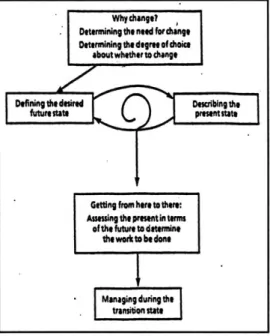
Another well-known formulation for thinking about the management of a total change process is the road map provided by Beckhard and Har-ris2 as shown in figure 3.2 alongside. The fist step is about providing a credible answer to the ques-tion "why change?" In this stage, the need for change is determined, and the degree to which change is crucial is ascertained. The next stage in the process is to develop a clear picture of the ideal state to be attained at some future date. De-veloping a concrete vision of the ideal state is es-sential in order to test the feasibility of the change. As the change process progresses, the ideal state vision often changes, but it is essential to always have it in some form. The next stage in the pro-cess is to define as precisely as possible the present state of the system. Once the present state has been determined, the next steps involve address-ing the problem of movaddress-ing from the present state to the desired state and of managing the transi-tion.
Although the terminology used in different three-stage models has slightly different connotations, the models all follow the same line of reasoning -that change is a linear process (organizations move from one stage to another with one stage influencing the next but that step does not influence the previous step) through which employees must be managed in order for implementation to succeed.
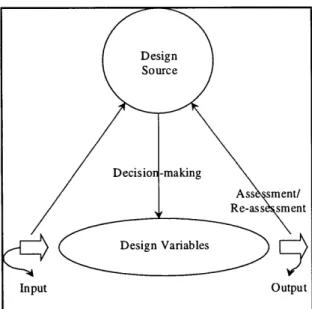
Fig. 3.3 Traditional models of decision-making and
de-sign have often focussed on the Dede-sign Variables rather than on the systemic effect of these variables on the nature of work practice
More recently, change management consultants and the organizations themselves have begun to look closely at how change actually occurs within organizations. From those studies, it has become evident that the change process is not linear. Stages often overlap or have to be revis-ited as the process goes forward. It has become apparent that change is a continuous series of overlapping steps that involve new management structures, new technologies, a variety of lead-ers, a completely different work setting, and so on. While the steps in the implementation pro-cess overlap, they can be divided into two sepa-rate categories in most models: assessing (that is, assessing business goals and the change in the state of the variables) and designing (that is, design and decision-making on the changes to be implemented and managing change); as shown in figure 3.3
WHAT IS LACKING?
We believe that the answer to this question is two-fold. First, the older models of change view the process of change as a "one-shot" linear event. They describe a linear, step-by-step progression from planning change to implementing and managing it. They do not capture the dynamic nature of the steps and the fact that each step can impact and influence all of the others is not modeled. Second, although the more recent models of change look at change as a non-linear and dynamic process, the method of designing and implementing change fails to capture the complexity of the collective influ-ence of the variables on the state of the system. Assessing the change in the variables is often limited to evaluating the difference in the variables before and after change rather than analyzing and evaluat-ing the systemic effect of these changes. Although the Beckhard and Harris model of change clearly defines the distinction between the desired state of the system and the actual state of the system as a result of the systemic effect of the variables, the model views the process of change as a linear process. This model does not indicate that both the desired state and the actual state of the system themselves are influenced by the change process and does not provide for the reassessment of the desired and actual states throughout the process of change. We address both these issues in the proposed framework, by combining aspects of continuity and dynamism of the recent models with the distinction between the actual and desired states of work practice from the Beckhard and Harris model.
3.1
A
NEW FRAMEWORK FOR WORKPLACE CHANGEWe begin our discussion of the proposed framework by first defining the components of this framework, such as, the system, the design and independent variables, the design source, the desired and actual states of the work practice. We then lay out the structure of the framework for workplace change and demonstrate that an inquiry into the actual state of the work practice drives organizational change. Finally, we validate the framework by applying it to the case study of the successful transformation of the Liquid Xerography Laboratory at Xerox's Webster Research Center
3.11 Components of the framework
SYSTEM:
The system, as we have described earlier, is an individual, group or organization that is composed of sub-systems and, analogous to a living system, is almost always under some state of change. For the purposes of our framework, we define the system as the nature of the work practice. In order to succeed in a changing market environment, an organization has to align its internal work practices with its business goals. Therefore, the system, or the change target, in an organizational change process is the nature of work practice.
DESIGN VARIABLES:
We have previously described design variables as those elements and sub-systems of the workplace that can be changed or varied to produce a change in the state of the work practice. These variables are interdependent and dynamically coherent16 and changing one variable changes all other elements and, consequently, the state of the workplace and the work practice.
INDEPENDENT VARIABLES:
Apart from the design variables, the actual state is also effected by independent variables. These independent variables, as the name suggests, cannot be controlled or designed. Examples of the independent variables include sudden, volatile changes in the external market forcing the firm to shift the focus of its recruitment or hiring strategy, freak weather patterns that result in huge drops in the share price of the firm thus reducing capital inflow, etc.
DESIRED STATE OF WORK PRACTICE:
The Beckhard and Harris model of change describes the desired state of the work practice as the ideal state to be attained by the organization at some future date. In terms of the proposed framework, we define the desired state as the concrete vision or the articulation of the actual behavior and attitudes to be achieved so that the work practices of the organization align with its
16Horgen, et al, in their book Excelence by Design (New York: Wiley, 1999) explain that a dynamic coherence exists among work process and the workplace environment. Through case studies they demonstrate that when an "organization sets out to transform its work process, it commits itself to a transformation of all four (spatial, organizational, financial and technological) dimensions of its work environment."
strategic business goals. The term "desired state of the work practice" encompasses all aspects of the work practice such as collaboration, teamwork, motivation, organizational behavior and culture at their optimal degree such that this desired state drives the organization in the direction of alignment. In addition to being dependent on the alignment strategy the desired state is shaped by many other factors such as, "type", "bench marking", and insights into new methods of working.
Over the course of time, each industry, each class of work develops a "type" of work practice. For example, laboratory researchers have often been "typed" as those who constantly work with specialized, and often cumbersome, equipment and dangerous chemicals. As a result, organizations structure the work practice, workplace and the work environment based on a prevalent type rather than examining the fact that most of the dangerous and cumbersome work is now done by computers and robots and that the needs of the researchers are changing. Therefore, very often, the desired state of the work practice is based on type, whether or not it is still relevant to the nature of the work practice. Another factor that influences the desired state is the concept of bench marking. Effective bench marking can be a very useful tool in determining the desired state of the work practice17. Finally, the desired state can also be influenced and changed by insights into new methods of working. These insights are often a "side-effect" of the process of change. It is often noticed that when people in the organization are involved in analyzing the nature of their work, they gain a new perspective of the ways in which they have been working and very often, spot inefficiencies and redundancies in the existing nature of work.
THE ACTUAL STATE OF THE WORK PRACTICE:
The actual state is that state of the work practice that reflects the degree of collaboration, team work, motivation etc. among the employees of the firm as a result of the way in which the collective influence of the design variables is perceived. For instance, changing its compensation and reward structure to a "pay for performance" policy from a standard hourly wage policy a windshield manufacturing firm hoped to increase its output two-fold. The firm believed that since the employees were now paid by the number of windshields they produced, they would increase the level of production to take advantage of this "paid by the widget" policy. However, employees at the firm were threatened by this change in policy. The firm had not explicitly guaranteed to not ratchet down their wage rate once the employees became more "productive". The employees suspected that once production, and therefore output, increased the firm would either "lay-off" a portion of the workforce or reduce the wage rate, thus gaining productivity at a lesser cost. Fearing a ratchet effect, employees continued to produce the same number of windshields as under the hourly wage compensation structure. Therefore, in the context of the windshield-manufacturing firm, the firm's aim of increased production reflects the "desired" state and the skepticism of the employees towards the new compensation structure resulting in a stable rate of production reflects the "actual" state of the workplace.
17 Xerox, in its effort to manage inventory, bench marked L.L. Bean, a firm that almost solely sells its products through
catalogs. Xerox understood that for L.L. Bean to be profitable it needed to reduce inventory costs and had to have an efficient storage and retrieval system. Xerox studied the L.L. Bean inventory management systems and set desired states of work practice in its own organization.
In the case of the windshield-manufacturing firm, the reason for the distinction between the actual state and the desired state resulted from a lack of communication between the firm and its employees. Had the firm analyzed and discussed the situation with its employees and had it given the employees reassurance regarding its post-increased production policy, the firm may have experienced an increase in production along with a reassured and happy workforce. This instance illustrates but one of the many reasons for the distinction between the actual state and the desired state of a workplace. We briefly describe some of the other reasons for the distinction between the desired and actual states of work practice.
1. Top Down enforcement:
Decisions taken by management and enforced on employees. There is no collective involvement of those on whom the decisions effect or influence most.
For example, at Chiat/Day, an advertising company, the internal strategy of eco-friendliness, advertising, cost-reduction, space reduction, and through reduced storage requirements resulted in management's decision to reduce the use of paper and enforcement of a "no-paper" policy. All communication and documentation were to be handled electronically. These decisions were
taken without the involvement of the people actually affected by this policy.
Desired state: Less paper consumed. Faster and more effective communication. (as data become electronic, it was hoped that information could be passed back and forth much faster.) Reduction in usage of space. (Storage requirements reduced)
Actual State: People spending more time hiding paper usage. This resulted in less time spent working and more time spent circumventing the policy, thus creating a distinction between the
"desired" and the "actual" states of the organization.
2. Allparts of the organiZation not involved in the decision process:
Often decisions are taken with involvement of employees of departments directly involved in the change process but without the involvement of departments the change process may effect. For example, at Pfizer Inc., the transformation from functional groups to project groups involved most of the relevant functional groups, such as, the clinicians, the statisticians, the biometricians etc., but did not fully involve the medical writers. Medical writers were previously grouped together in a separate department and gained part of their identity through an association with their department and with their common space. The writers were not assigned to any one project but were assigned tasks (often associated with many projects) based on the internal power structure of the department. During the change process, when project groupings were suggested, medical writers were to be assigned to individual projects and would move upstream or downstream as the project developed.
Desired state: Less bureaucracy and more transparency in operations. Efficient use of expertise, and time since one person would be responsible for "writing" for one project and would be able to devote both time and expertise to it.
Actual State: Medical writers were confused and threatened by their position in the organization as they perceived a loss of identity, which they had built up through association and belonging to the "writing" department.
3. Existing situation not taken into account:
The design source fails to respond to the actual state of the work practice either because they do not have sufficient data pertaining to the actual state or because they ignore or abuse the data to further certain political agendas.
4. Continuous feedback absent
The design source does not have continuous information and feedback about the actual state and the variables upon which change has been implemented. Situation is almost analogous to "designing in the dark".
5. Fauly assumptions
Believing that what worked for one firm would work for their own, management, and the design source, implements the same transformation strategy on their firm. However, without analyzing the requirements of their organization, the transformation strategy may never be able to close the gap between the desired and the actual states of work practice.
6. Fauly implementation
Often, the distinction between the actual and desired states is caused by improper understanding of the collective influence of the variables on the actual state of the work practice, and improper implementation of the transformation strategy.
For example in Xerox's LX laboratory, a decision was taken to shift some employees to cubicles to achieve the desired state of collaboration and teamwork. The decision did not take into account the attendant problems of loss of territoriality and identity.
Desired state: Increased collaboration and communication among researchers.
Actual state: Loss of identity (sense of belonging) and employees threatened by the implication of the reduction of space.
7. Mixed signals
Improper understanding of the collective influence of the variables of change (space, processes, information technology etc.) on the actual state often results in sending mixed signals to the organization.
For example, consider the incentive system of basing compensation and salary on team performances to emphasize teamwork, but setting the measures for advancement (promotion) in the company on individual work. This sends a mixed signal to the employees as working in a team promises greater monetary benefits. However, teamwork would reduce the time spent on individual work and thus reduces the possibility of advancement in the company.
8. Shock to the system
When upheavals in the economy or market takes place the firm shifts its external strategy and this causes the internal strategy to change. Therefore the desired state itself changes dramatically.
3.12 Framework for workplace change
The change process can be conceptualized as consisting of phases of evaluation, redefinition and re-articulation of design issues, design and decision-making, and influencing or changing the actual state of the work practice, as shown in figure 3.4.
Re-define/
Decision-Making
Fig. 3.4. Conceptual diagram of the framework for workplace change
1. EVALUATION: The actual state is analyzed by understanding how the existing workplace works, mapping how the work is currently done, diagnosing problems of the workplace setting and defining the design issues of the workplace. The cause of the distinction between the actual state and the desired state is examined by comparing data from the actual state against data pertaining to the changes in the design variables and the design decisions taken by the design source. The process of evaluation and inquiry is central to the proposed framework and we shall describe the process of evaluation in greater detail later in this chapter.