Dynamic Customer Service Levels: Evolving Safety Stock Requirements for
Changing Business Needs
by
Daniel Patrick Covert
Bachelor of Arts, Math & Physics, Colby College, 2013 and
Joaquín Alberto Ortiz Millán
Master in Innovation, Instituto Tecnológico de Monterrey, 2016
SUBMITTED TO THE PROGRAM IN SUPPLY CHAIN MANAGEMENT IN PARTIAL FULFILLMENT OF THE REQUIREMENTS FOR THE DEGREE OF
MASTER OF APPLIED SCIENCE IN SUPPLY CHAIN MANAGEMENT AT THE
MASSACHUSETTS INSTITUTE OF TECHNOLOGY JUNE 2018
© 2018 Daniel Covert and Joaquín Ortiz. All rights reserved.
The authors hereby grant to MIT permission to reproduce and to distribute publicly paper and electronic copies of this capstone document in whole or in part in any medium now known or hereafter created. Signature of Author...
Daniel Patrick Covert Department of Supply Chain Management
May 11, 2018 Signature of Author... Joaquín Alberto Ortiz Millán Department of Supply Chain Management
May 11, 2018 Certified by... Dr. Tugba Efendigil Research Scientist Capstone Advisor Accepted by... Dr. Yossi Sheffi Director, Center for Transportation and Logistics Elisha Gray II Professor of Engineering Systems Professor, Civil and Environmental Engineering
2
Dynamic Customer Service Levels: Evolving Safety Stock Requirements for Changing Business Needs by
Daniel Covert and Joaquín Ortiz
Submitted to the Program in Supply Chain Management on May 11, 2018 in Partial Fulfillment of the
Requirements for the Degree of Master of Applied Science in Supply Chain Management
ABSTRACT
Retail companies struggle to maintain the appropriate levels of inventory on promotional and seasonal items due to management pressure to never be out of stock. Dynamically changing desired service levels during promotions or seasonal periods will ensure accurate safety stock levels and reduce manual interventions. We simulate inventory policies introducing dynamic changes in desired service levels to determine the impact on inventory, stock outs, and fill rate. We show that dynamic service levels can reduce inventory and stock outs while maintaining the same fill rate as fixed policies. Having different service levels throughout the year contingent on business needs ensures that companies will have the right inventory at the right time.
Capstone Advisor: Dr. Tugba Efendigil Title: Research Scientist
3
Acknowledgements
First, we would like to thank our advisor, Dr. Tugba Efendigil, for her support and guidance throughout the last 8 months of research. As Tugba's first class of advisees, we thoroughly appreciate her dedication, availability, and positivity. Next, we wish to thank the team at Retail Business Services for all of their support. Especially Andre Shaw, Ashley Maclearn, Sam Barrett, Tim Kirsch, Cathy Whitehouse, and Marci Doble. We appreciate the partnership and insight. Next, we want to sincerely thank Alexandra Sandoval from RELEX solutions for all of her help with this project. Alexandra was instrumental in helping us with the theory behind our simulations and building simulation models in RELEX. We would also like to thank Connor Makowski for the guidance in designing our inventory simulation. Finally, we wish to thank Pamela Siska for all of her help editing and improving this capstone. We could not have done it without her great feedback.
4
Table of contents
1. Introduction ... 5 1.1 Problem Statement ... 5 1.2 Company Background ... 5 1.3 Motivation ... 6 2. Literature Review ... 7 2.1 Retail Applications ... 7 2.2 SKU Segmentation ... 8 2.3 Inventory Management ... 9 3. Methodology ... 12 3.1 Operational Context ... 133.1.1 Current System Design ... 14
3.1.2 Interviews and Business Context ... 16
3.2 Decision Frame ... 17
3.3 Inventory policy ... 18
3.3.1 Ordering Flow ... 18
3.3.2 Decision Frame in Safety Stock Calculation ... 21
3.4 Simulation ... 22
3.4.1 System Dynamics Model Parameters... 23
3.4.2 RELEX Simulation Parameters ... 25
3.4.3 Key Performance Indicators ... 27
4. Results ... 28
4.1 Standard Deviation of Demand or Forecast Error... 28
4.2 Fixed vs. Dynamic Cycle Service Levels ... 30
4.3 Improvements on Dynamic Cycle Service Levels ... 31
5. Discussion ... 33
5.1 System Dynamics Model in Practice ... 33
6. Conclusion ... 39
5
1. Introduction
1.1 Problem Statement
Retail Business Service's (RBS) high-low pricing strategy requires strategic safety stock investments to ensure inventory levels are adequately controlled. RBS' current inventory policy does not address the need to dynamically manage the safety stock of items as business needs evolve throughout the year.
1.2 Company Background
RBS is one of the largest food retailers in the world. In the United States they operate 9 different retail banners, each with a different go-to-market strategy. RBS' largest US banner is located in the southeastern US and operates over 1,100 stores selling over 10,000 unique center store products. Supporting these stores are five full case distribution centers (DCs) and one break-pack DC. Annually, this banner generates sales of over $11 billion while moving close to 500 million cases through their DCs.
RBS uses different pricing strategies to support their banners. One of the northern banners uses an everyday low-price strategy (EDLP). An EDLP strategy advertises consistent prices throughout the year and does not typically offer discounts through promotions. This differs from the high-low strategy used at their southern banner. Through weekly advertisements and in-store signs, they promote key items at lower than market prices. In a sample week (Week 44 - 2017) at one DC, promoted products represented 22% of the SKUs shipped and 32.4% of the total cases shipped. To compensate for the margin loss on these items, non-promoted items are often priced slightly above market. This strategy, according to RBS, allows them to generate excitement and return visits as promotions change weekly. Additionally, this creates a customer perception of low prices. However, from an inventory management perspective, a high-low retailer's weekly promotional changes create additional volatility in demand and difficulties in forecasting. As RBS' average vendor lead-time is 10 days, if the right amount of product is not purchased prior to a promotion, it is difficult to rebound. Conversely, if too much product is purchased, selling
6
through excess inventory is equally challenging. To buffer against demand and forecast volatility, RBS must use an inventory policy that increases safety stock on these critical items.
1.3 Motivation
Holidays and promotions are when retailers can differentiate themselves, attract new customers, and create a lasting price impression. To meet these goals, retailers put immense pressure on the supply chain to maintain high on shelf availability. In response, demand management teams and retail stores often disregard normal inventory policies in favor of a "don't be out of stock" mentality. This emotionally driven inventory policy leads to large manual orders by both retail stores and distribution centers (DCs). These orders cause a bullwhip effect which results in excess inventory or high fees to expedite deliveries.
Promotions and holidays require active supply chain management on the "important few" products that are constantly changing. Canned pumpkin is a top item during Thanksgiving, but is quickly relegated to the bottom of the list in June. A slow-moving shampoo, when displayed and promoted, can become a retailer's top selling item. On the other hand, paper towels sell around the same amount every week. Given the range and variability of products carried by food retailers, it is difficult to find a one-size-fits-all inventory policy. This research will develop a method to alleviate emotional responses to promotions and holidays by creating dynamic cycle service levels (CSLs).
7
2. Literature Review
2.1 Retail Applications
A multi-criteria item classification system aims not only to reduce inventory costs, but also to improve customer satisfaction by offering greater in stocks on key items such as those on promotion. Improving in stock conditions, according to Dubelaar et al. (2001), will cause an increase in the square root of sales. Retailers struggle to maintain high in stock numbers, especially for items on promotion. Taylor (2001) found that in the grocery industry, advertised items are not available in their normal shelf location 11.5% of the time. When items are not available on the shelf, according the Emmelhainz et al. (1991), 39% of customers will go to another store to find what they are looking for. The potential financial ramifications of these lost sales can have a lasting impact on a retailer.
Service levels have a direct impact on the company's revenue and profit (Millstein et al., 2014). If they are too high, substantial capital is tied up in inventory. However, if they are too low, they can lead to stock outs, which can cause the loss of the customer goodwill; this in particular makes it difficult to measure the cost of stock outs. Therefore, management should make inventory decisions taking into consideration the service performance perceived by the customers (Bijvank, 2014)
Promotional research has focused on creating strong promotional forecasts to ensure high product availability (Thomopoulos, 2015; Koottatep and Li, 2006). Little research has been done on incorporating promotional importance into a segmentation strategy. This research seeks to reduce the lost sales caused by promotional product unavailability and improve customer satisfaction by maintaining high in stock rates.
In the next section, we review existing SKU segmentation policies used to address different business strategies.
8
2.2 SKU Segmentation
As companies continue to add more diversity to product assortments, it is necessary to define methods for grouping and managing these different items. According to Mohammaditabar et al. (2011), managing thousands of items can cause companies to focus on unimportant items while not paying adequate attention to key items. The traditional approach to segmentation is the ABC analysis in which management groups items into three classes (A, B and C) based on some predetermined criteria (Armstrong, 1985). According to Teunter et al. (2009), the most common method for classification is to use demand value, namely annual goods movement multiplied by unit cost. This principle is based on Pareto's principle that 80% of sales typically come from the top 20% of SKUs (Armstrong, 1985). According to Zhang et al. (2001), there are several drawbacks to the demand value classification system. First, this system will put a large amount of capital investment into the most expensive items. Second, this segmentation still requires "optimization of stocking parameters within each group" (Zhang et al., 2001). Consequently, considerable research has been done in the field of multi-criteria inventory classification (MCIC) using different factors in ABC classification.
The general premise of ABC classification is to manage the "significant few" A items closely and spend less time on the "trivial many" or C items (Flores, 1992). Zhang et al. (2001) proposes ranking items based on the ratio of annual demand divided by lead time times the square of item cost. The problem is solved using linear optimization with fixed service levels and order frequency. The authors demonstrate a 30-35% lower inventory investment as compared to traditional demand value segmentation. Teunter et al. (2009) also solves this problem using a single criterion and clearly defines how to set cycle service levels. The criterion used for classification is:
(2.1)
9
Where h = holding cost, Q= order quantity, b = criticality defined as shortage cost and D = annual demand. The CSL can be defined using:
(2.2)
There is a clear tradeoff between the management cost of multiple classes and the safety stock cost. Millstein et al. (2013) assigns a fixed management cost per class and uses this in an optimization model to maximize profitability rather than reduce inventory cost. This model, however, is limited by a fixed planning horizon and is built around a one-time run. Yang (2016), attempts to address the limitation of Millstein's (2013) research and expand to include non-stationary demand.
A majority of the research into SKU segmentation has been conducted in the spare parts industry (Teunter et al., 2009; Zhang et al., 2001; Molenaers et al., 2011; Millstein et al. 2013). This research will expand on previous research by defining retail-specific classification criteria such as promotional importance and seasonal relevance. Additionally, it will look at future demand patterns and optimize service levels continually based on business needs. The results will be extended to the food retail business, where little, if any research, has been done.
2.3 Inventory Management
Once a firm classifies an item using one of the techniques mentioned above, it must decide which inventory policy to assign to that class of items. Firms should assign an inventory policy that reflects the nature of the items as well as their relative importance. According to Silver et al. (2017), there are two main categories of inventory policies: continuous review and periodic review. In a continuous review system, a firm's inventory position (on hand inventory + pipeline inventory) is evaluated continuously. In a periodic review, inventory is only evaluated every R days where R is the review interval. When certain conditions are met, an order is created. There are tradeoffs with each policy. A periodic review policy can create synchronization across a large family of items. Because items are being ordered on a coordinated
10
schedule, multiple items from the same supplier can be ordered together. Additionally, a periodic review creates stability, as a firm can plan order days for each supplier. However, periodic reviews require higher levels of safety stock because the time between replenishment periods is longer. A continuous review reduces the amount of safety stock because items can be ordered whenever they are demanded (Silver et al., 2017). However, constantly reviewing items can eliminate coordination between SKUs and cause higher labor costs.
There are two main forms of a continuous review policy: the (s,S) system and the (s,Q) system. The (s,S) system, also known as order-point, order-up-to-level states that when inventory position falls below the reorder point s, the firm should order up to the maximum desired inventory S. An (s,Q) policy is similar except that the order quantity Q is fixed. In this system, when the inventory position falls below the reorder point s, the firm orders a fixed quantity Q. Typically, Q is the economic order quantity or specific lot size (Silver et al., 2017).
Two popular periodic review policies are the (R,S) system and the (R,s,S) system. The (R,S) policy states every R units of time order enough inventory to raise the inventory position to the desired level S. The (R,s,S) policy goes one step further and states that every R units of time if the inventory position is below the reorder point s, order up to the desired level S (Silver, 2017). A third type of inventory policy common in enterprise software is the MRP policy. This is essentially a modified version of the (R,s,S) policy. In this policy, the firm sets a desired level of safety stock, s. Every R days, they examine their inventory and order enough so that inventory does not fall below s at the end of that replenishment cycle. For example, assume a firm reviews inventory every Monday and the product is delivered the following Monday. On the first Monday, a replenishment is created such that the inventory will not fall below s during the period when that product arrives (the second Monday) until the next delivery arrives (the third Monday). In all the policies mentioned above, it is necessary to define the appropriate levels of safety stock.
11
Similar to inventory policies there are a variety of ways to determine a firm's desired level of safety stock. To name a few, safety stock levels can be set to minimize the backorder costs, minimize the stock out costs, satisfy a minimum amount of demand, or ensure a certain probability of no stock outs (Silver et. al, 2017). Several of these methods require hard-to-measure numbers such as the fixed cost of stock outs or backorders. As mentioned above, the goal of our research is to show the value of changing the levels of safety stock as business needs change. Therefore, we will calculate safety stock in the same way as RBS by using the CSL. A CSL is the probability that no stock out will occur during lead time (Silver et al., 2017). Assuming that demand is normally distributed, safety stock (SS) is set using the equation 2.3.
SS = k * σl (2.3)
Where SS = safety stock level, k is the safety stock factor which is calculated from the desired CSL, and σl is the standard deviation of demand over lead time. We will show other methods of calculating σl such
12
3. Methodology
In this section, we discuss our procedure for calculating the effectiveness of dynamic cycle service levels as shown in Figure 3.1. The research is centered on CSL changes for promotional and seasonal periods.
To set the business context, we begin with an operational overview of the current inventory system and discuss shortcomings and backdoor solutions. We evaluate the motivation for these backdoor solutions from interviews with management and current inventory analysts. We apply the results of these interviews to construct a decision frame used to set dynamic CSLs. We then show how this decision frame can be incorporated into the inventory policy to set safety stock levels. To evaluate the effectiveness of the decision frame, we simulate the inventory policy using two different simulations. The first simulation uses a system dynamics model created in VenSim and the second runs in RBS' demand planning software RELEX.1
1
RELEX Solutions is dedicated to helping retail businesses improve their competitiveness through accurate forecasting and replenishment, localized assortments, profitable use of retail space and optimized workforce planning. RELEX Solutions has offices across North America and Europe.www.relexsolutions.com
Overview
•Operational overview of the current inventory system •Interviews with management and current inventory analytsts
to understand system shortcomings and backdoor solutions
Application
•Construct a decision frame to set dynamic cycle service levels using classification criteria from interviews •Incorporate decision frame into inventory policy
Simulation
•Simulate inventory policy with systems dynamics •Simulate inventory policy with company software
13
3.1 Operational Context
To systematically manage the inventory for thousands of items, an inventory system must be able to cope with large variability in demand. Seasonal dependency and frequent promotions drive spikes in demand and lead to inventory management outside the traditional bounds of the models discussed in Section 2.3.
An example of the impact of this variability is shown in Figure 3.2. A majority of the annual demand for this item (shown in orange) occurs in the last two months of the year (highlighted in yellow). The demand during these two months is up to 8 times higher than the average demand during the rest of the year. To anticipate the increase in demand, inventory managers begin stock piling inventory prior to the season (shown in blue). On hand inventory numbers reach a maximum immediately before the large seasonal spikes begin. Aggressive manual ordering in reaction to an out of stock can lead to twice the average inventory for two months after the seasonal/promotional event occurred. This sporadic and manual inventory management is a result of RBS' current system design.
14 3.1.1 Current System Design
RBS' inventory management group is responsible for inventory at both retail stores and distribution centers. In this two-echelon system, RBS manages safety stock levels using the following methodology: If retail stores are heavy on inventory, then less safety stock is needed in the DCs. The cycle service level target for each item at each DC is calculated weekly using the following formula:
(3.1) where: (3.2) where: (3.3) and: (3.4) where: where: (3.6) (3.5)
15
The following variables are easily measurable at a weekly level: last week's movement, number of deliveries, minimum shelf presentation, and ending inventory. Combining the above formulas and reducing to only measurable variables gives the following equation for cycle service level:
(3.7)
While this formula can be used to calculate the desired CSL each week using readily available numbers, the results are generally not as desired. Namely, the CSL is based entirely on the prior week's movement. It does not address any future fluctuation in demand that may be brought on by holidays or promotions. In practice, the demand management team at RBS sets a floor and ceiling for the CSL. During weekly runs, most items end up at either end of the spectrum (Figure 3.3). This sub optimal policy leads to many manual workarounds.
16
To have the right products to satisfy customer demand for promotions and holidays, RBS employs manual practices outside of the service level policy outlined above. A typical example is the following practice; if a promotion is one week long, the buyer should order the forecasted demand for the week prior to the promo, the promo week, and the week after the promo. These three weeks of inventory should be available in the DC 9 days prior to the start of the promotion. This approach requires substantial manual intervention and removes any systematic calculation of safety stock. As these items are defined as the "most important," the desired CSLs should reflect this business need.
3.1.2 Interviews and Business Context
We conducted interviews with current inventory buyers and the management team at RBS to gain insight into the classification criteria that should influence CSLs. According to Armstrong (1985), management typically sets CSLs. Therefore, it was necessary to have business input to ensure compliance and accuracy.
The first insight was the criteria that led buyers to deviate from the traditional inventory policy. As expected, promotion and seasonality were the top criteria leading to deviations. The service level agreement between the demand management and category management team requires 99% product availability on all promoted items. Therefore, a backdoor process called a "gap report" is used to meet these requirements. These gap reports use the backdoor inventory policy described above (order X weeks
of forecasted demand) and measure the "gap" between current inventory position (on hand + pipeline)
and desired inventory (X weeks). Buyers are instructed to "close the gap" prior to promotions beginning.
The inventory group presented two additional criteria that led to operating outside of the traditional inventory policy. First, is a criterion that we will call Key Item (KI). A KI meets at least one of the following conditions:
17
2. The product must have a high service level due to business or brand purposes. Examples include baby formula or private label cheese.
The second criterion we will call Vendor Dependability (VD). The vendor dependability is the vendor's ability to fulfill a spike in demand. Another way to think about this is the vendor's promotional fill rate. The VD is calculated annually based on promotional fill rates. Vendors are then segmented based on their historical fill rate performance and assigned a 1 or 0 for dependable or not. In the next section, we show how the classification criteria identified in the interviews can be used to define CSLs.
3.2 Decision Frame
Using the classification criteria from the management interviews (Table 3.1) described in the previous section, we constructed a decision frame to assign discrete desired CSLs to different classes as seen in Figure 3.4. Throughout the year, items will follow different paths in the decision frame depending on their binary values in each of the four classification criteria.
Factor Description Value
Promo (P) An item is on promotion resulting in a price reduction 1 = yes
0 = no
Seasonal (S) An item is defined as being “in season” 1 = yes
0 = no
Key Item (KI)
1. Product is in a secondary location 2. Brand or business requirements
1 = yes 0 = no
Vendor Dependability (VD) Vendor consistently delivers critical product (promo,
seasonal, KY) in full.
1 = yes 0 = no Table 3.1: Overview of the classification criteria used in determining CSL
18
For example, an item that is on promotion, in season, a key item, and sourced from a dependable vendor would trace the leftmost path in the decision frame arriving at the leftmost class with a desired CSL of 95%. The CSL is then used to calculate the k factor used to set the safety stock levels. The CSL values in Figure 3.4 were set by the current management group and can be adjusted as business needs change. In the next section, we show how this decision frame is incorporated into the inventory policy.
3.3 Inventory policy
The inventory policy that we use in our simulations is the MRP policy presented in Section 2.3. We define inter-delivery time as the time between two subsequent deliveries. This policy states that every
R days an order should be placed such that the inventory levels during the inter-delivery time do not fall
below a desired level of safety stock. In this section, we will walk through the ordering flow of this inventory policy and show how the decision frame is used to impact the safety stock levels.
3.3.1 Ordering Flow
In the MRP inventory policy, inventory flows from an order to pipeline inventory and then to on hand inventory after a specified lead time. When stores demand an item from the distribution center, either inventory flows out as sales or demand is lost if it is greater than the on-hand inventory as seen in Figure 3.5. The flow begins with a purchase order (Order). Then suppliers initiate their shipment process, and the amount in the order enters the pipeline inventory, remaining in that status until the order is
19
received (Lead Time). For consistency in simulations, the model assumes that all orders arrive on time and in full.
The inventory levels are affected by the number of orders received, and outbound sales are represented below by demand filled. Demand in this policy is store orders and sales are the shipments from the warehouse to the stores.
Figure 3.6 shows the ordering flow, which is based on the calculations using the MRP policy. The flow is as follows:
1. The first step in the MRP policy is to determine whether each day is an order day. This is set by the R value or review time.
2. If it is an order day, we first calculate what our inventory will be when the delivery arrives (Inventory
at Lead Time). This is the difference between our inventory position (Pipeline + On Hand Inventory)
and the forecast between now and when the delivery arrives (Forecast over Lead Time). Figure 3.5: Ordering flow from supplier to store
20
3. We then calculate how much inventory is needed between when this order arrives and when the next order arrives (Product Needed). This is the sum of the safety stock and the forecast values for that period (Forecast at Lead Time between Replenishment Time).
4. If the quantity needed (Product Needed) is greater than the inventory at lead time, we order the difference. If not, then no order is created.
For the safety stock calculation, we can either use Standard Deviation of Demand or of Forecast
Error. After choosing which to use, a measure for standard deviation over review time is calculated by
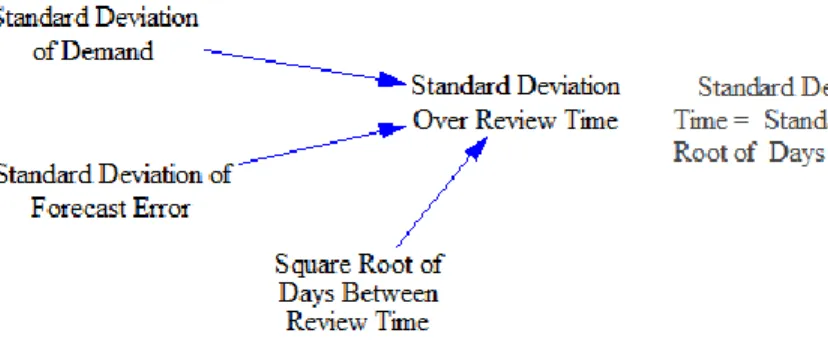
multiplying the square root of the days between review time by either the standard deviation of demand or the standard deviation of forecast error (Figure 3.7). This result is then multiplied by the k factor to set the safety stock level.
Standard Deviation over Review Time = Standard Deviations * √ (3.1) Figure 3.6 – Order calculation logic in the MRP model used in simulations
21 3.3.2 Decision Frame in Safety Stock Calculation
Recall from Equation 2.3 that safety stock is equal to the safety stock factor k multiplied by the standard deviation over lead time. The k value is defined according to the desired CSL. For the desired CSL we can choose from a fixed service value used in the current company policy or the CSL assigned to an item's class in the decision frame as seen in Figure 3.3. The intention behind using the frame is to dynamically change the service level according to the item class during each order cycle (Figure 3.8). Namely, when an item is promoted and in season, it will have a different desired CSL than when it is not.
Figure 3.8 – Flow to assign desired service levels Figure 3.7 – Calculation of the standard deviation used to set safety stock.
22
Based on the item position in the decision frame shown in Figure 3.4, it is assigned to a service level class. At each review time, the item’s classification criteria are reviewed and it is assigned to a specific service level class that sets the k factor. Items can also be assigned to a fixed service level.
The k value calculation uses the maximum CSL value during the order cycle time, or, if it is fixed, the predetermined value. The CSL is then used to set the k factor (Figure 3.9). Please note that k = NORMSINV(CSL). This k value is then multiplied by the standard deviation over lead time to set the desired level of safety stock.
This inventory policy has dynamic safety stock levels determined by the desired CSLs set through the decision frame. In the next section we describe the simulations used to test the impact of this inventory policy.
3.4 Simulation
To evaluate the impact of dynamic CSLs, we use two types of simulations: a system dynamics model created in VenSim and a simulation through RBS' forecast and replenishment software RELEX. The system dynamics model uses the exact flows outlined in the previous section. This model allows a user to easily adjust service levels throughout the year and see immediate impacts on product availability and inventory. However, the system dynamics model is limited in that it is only a model and cannot be used to create actual replenishment orders. RELEX allows for a wide variety of simulations using production data and results can be used directly in production.
23
Each simulation uses actual historical data for starting inventory position, forecasted demand, store orders, lead time, review time, and standard deviation. The models then simulate the inventory levels through different CSL settings.
Both simulations first model the results of the inventory policy when using fixed CSLs throughout the year. We then vary the method of calculating standard deviation between demand and forecast error. Next, we simulate the impact of using dynamic CSLs according to the decision frame. Finally, we simulate the impacts of using dynamic CSLs that are different from the decision frame. In the following sections we present the parameters used in the system dynamics and RELEX simulations.
3.4.1 System Dynamics Model Parameters
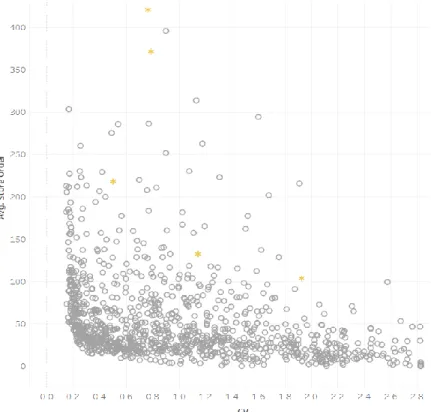
We select five items for our initial simulation using the system dynamics model. Throughout the simulated time, items need to have frequent changes in importance that would merit service level changes. We also select items based on their seasonal variability and dramatic changes in importance throughout the year. Finally, as RBS stores forecast data for two years, we select items with complete records. Figure 3.10 shows a plot of the coefficient of variation versus the weekly demand for the selected items shown as yellow stars. A selection of demand attributes for the simulated items are shown in Table 3.2.
We run each simulation for the maximum amount of time for which data was available. The goal is to understand the long term implications of the dynamic policy, so more data is advantageous. For each item, we test the impact of using the standard deviation of demand versus the standard deviation of forecast error when calculating the safety stock levels. Following RELEX's policy, we calculate the standard deviation of each of these parameters using the last 180 days of data.
In each simulation, we use a lead time of 7 days and a review time of 7 days. These variables can be manipulated in the simulation if agreements with vendors change. In reality, vendor lead times can vary and, when under pressure, orders can be placed whenever they are needed. However, in order to isolate
24
the impact of dynamic CSLs, it is necessary to fix both of these variables throughout the simulation. The final parameter was that demand that cannot be fulfilled directly from inventory is lost and not backordered. This assumption follows what RBS does in practice.
Figure 3.10 - Coefficient of Variation vs. Weekly Demand for System Dynamics Simulation
Weekly Orders Item Description Average Standard
Deviation CV Simulated Days Days on Promotion Forecast MAPE
6180 T/PET HOT SAUCE
395.6 286.1 0.72 570 150 56% 80760 HERSHEY CHOC SYRUP BOTL 217.2 111.4 0.51 601 246 62% 355440 LIBBYS SOLID PMPKIN 104.7 205.7 1.96 570 111 111% 598640 KRAFT SWT HONEY BBQ SAU 140.6 158.0 1.12 502 147 103% 698260 KRAFT ORIGINAL BBQ SAUC 394.5 286.0 0.72 569 149 56%
25 3.4.2 RELEX Simulation Parameters
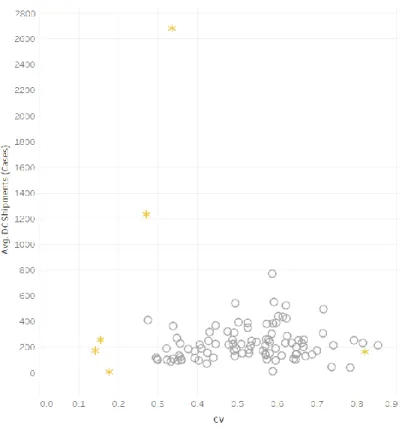
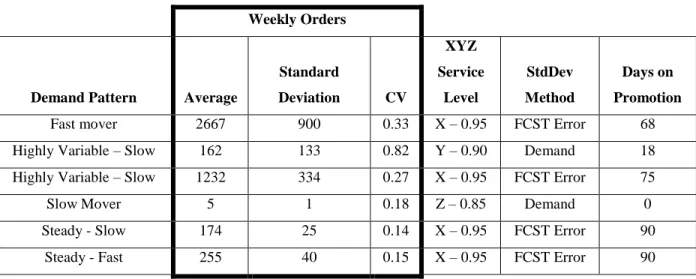
Due to constraints on available data in the RELEX system, we select different items for these simulations than those used in the system dynamics model. However, our criteria for item selection remain the same. Namely, items need complete records, need to be fast and slow movers, and need to have varying levels of importance throughout the year. Using two years of historical sales data, we examine items with respect to their coefficient of variation and total movement (Figure 3.11). We extract two years of data because that is the amount of historical data that RBS uses for forecasting. Any items that do not have at least 60 weeks of movement are removed from the selection process. Demand attributes for the selected items are shown is Table 3.3.
26 Weekly Orders
Demand Pattern Average
Standard Deviation CV XYZ Service Level StdDev Method Days on Promotion
Fast mover 2667 900 0.33 X – 0.95 FCST Error 68
Highly Variable – Slow 162 133 0.82 Y – 0.90 Demand 18
Highly Variable – Slow 1232 334 0.27 X – 0.95 FCST Error 75
Slow Mover 5 1 0.18 Z – 0.85 Demand 0
Steady - Slow 174 25 0.14 X – 0.95 FCST Error 90
Steady - Fast 255 40 0.15 X – 0.95 FCST Error 90
In the system dynamics model, the CSL for the base case is fixed at a predetermined value. However, in the RELEX simulations we use the actual desired service levels from ABC segmentation. This method of segmentation follows the Pareto model of demand volume as discussed in Section 2.2. In our simulation, all items in this product category are organized based on their sales quantity and those categories are called XYZ for this project. Items are partitioned into the following groups based on demand: top 75%, middle 15%, and bottom 10% as X, Y, Z, respectively. Corresponding CSLs are assigned to each group {X, Y, Z} = {95, 90, 85}.
As we discussed in the previous section, we simulate two different methods to calculate the standard deviation used in the safety stock calculation: demand and forecast error. Based on business requirements, RBS has configured the RELEX system such that items that have been on promotion for more than 108 out of the last 180 days use the standard deviation of forecast error to set safety stock. Forecast error is calculated daily at the item-location level and 180 days are used to calculate standard deviation. For items that are not highly promoted, the safety stock calculation uses the standard deviation of demand for the last 180 days. The rationale is that highly promoted items are more difficult to forecast and therefore require additional safety stock.
27
In the RELEX system, we run 16 different simulations. For each simulation we run it for three different 120-day time periods. Simulations are broken into three different groups: base case, dynamic, and extreme. The base case uses all items and current system settings. Using the base case CSLs, we also run simulations with the two different standard deviation calculations to understand the impacts of each one. In the dynamic simulations, we evaluate the impact of having a higher desired CSL during promotional time periods and XYZ segmentation when not promoted. Finally, in the extreme simulations, we ignore the XYZ values and set all non-promoted items at a base service level of 80%. Using the values from the decision frame, we change CSL to 96% when items are on promotion.
3.4.3 Key Performance Indicators
After each simulation, we measure the inventory levels, item fill rate, and lost sales. These are standard metrics used by RBS to evaluate performance. We compare these results across the different methods of calculating standard deviation and the fixed and dynamic CSLs.
1. Fill Rate = Total Sales / Total Orders
2. Average Week Ending Inventory: The average inventory value on the last day of the financial week (Saturday)
28
4. Results
In this section, we examine the results of the simulations using the system dynamics and RELEX models. We first present the differences between the two standard deviation calculations. Next, we look at the impact of using a dynamic service level from the decision frame. Finally, we show the impact of using dynamic CSLs with values different from the decision frame.
4.1 Standard Deviation of Demand or Forecast Error
The first test using the simulations was to look at the results of using the standard deviation of demand versus using the standard deviation of forecast error. As stated earlier, RELEX uses the standard deviation of forecast error to set safety stock levels for highly promoted items. Items that are promoted are typically more difficult to forecast and, therefore, should require higher levels of safety stock to maintain high fill rates.
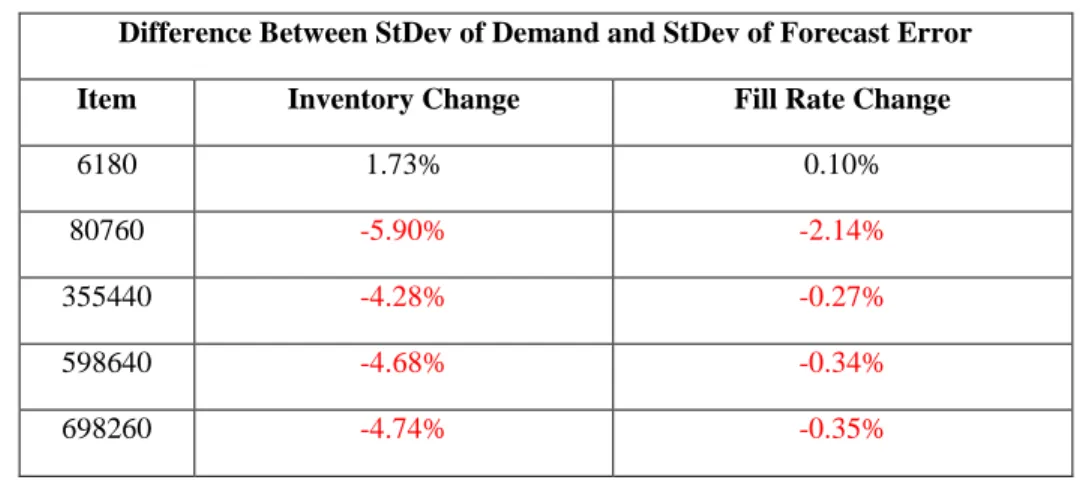
Regarding the average inventory position, setting safety stock levels using the standard deviation of demand led to an average inventory reduction of 5% for 4 out of the 5 items in the system dynamics simulation (Table 4.1). Item 6180 showed a 1% increase in inventory levels using the standard deviation of demand. This result follows from the item selection in that, of all the items selected, the forecast accuracy for item 6180 was the highest.
The fill rate followed in that 4 out of the 5 items experienced a lower fill rate using the standard deviation of demand. On average across all items and tests, the fill rate was 1% lower using the demand calculation. Again, item 6180 experienced the opposite due to the relative accuracy of the forecast and higher inventory position. The fill rate improvement for item 6180 was less than 1%.
29
Difference Between StDev of Demand and StDev of Forecast Error Item Inventory Change Fill Rate Change
6180 1.73% 0.10%
80760 -5.90% -2.14%
355440 -4.28% -0.27%
598640 -4.68% -0.34%
698260 -4.74% -0.35%
In the RELEX simulation, the top moving item had a significant inventory reduction when using the standard deviation of demand instead of forecast error. However, this inventory reduction resulted in a 14% reduction in product availability. In this case, the additional safety stock matches the importance of the item. On the two steady moving items, using the standard deviation of demand instead of forecast error led to an inventory reduction while still maintaining the same product availability. From these simulations, items with high velocity or high variability benefited the most from using the standard deviation of forecast error.
Difference Between StDev of Demand and StDev of Forecast Error
Demand Pattern Default Setting Inventory Change Fill Rate Change
Fast mover FCST Error -36% -14%
Highly Variable – Slow Demand -13% -1%
Highly Variable – Slow FCST Error -37% -4%
Slow Mover Demand 0% 0%
Steady - Slow FCST Error -10% 0%
Steady - Fast FCST Error -7% 0%
Table 4.1 -Difference between the standard deviations of demand and forecast error using the system dynamics simulation
Table 4.2- Difference between the standard deviations of demand and forecast error using the RELEX simulation
30
4.2 Fixed vs. Dynamic Cycle Service Levels
We tested adjusting service levels at key times of the year to see the impact on inventory and product availability. First, using the system dynamics model, we demonstrated that using dynamic CSLs can reduce the average amount of inventory while still maintaining a high fill rate. For each item, both the highest fill rate and highest level of inventory came through fixing the service level at 99%. In the case of item 6180, where the forecasts were relatively accurate, the dynamic model produced a 24% reduction in inventory over fixing the service level at 99% while still fulfilling 97% of the demand filled by the 99% service level (Figure 4.1)
On average, the dynamic CSLs allowed the items to achieve a fill rate above the fixed 90% simulation while carrying less inventory (Table 4.3). Further adjusting the service levels in the decision matrix could improve fill rates even more, but at the expense of extra inventory.
Figure 4.1 – Plot of average weekend ending inventory vs. fill rate for item 6180 using the system dynamics simulation
31
Simulation Average Inventory Average Fill Rate
Dynamic Demand 424.5 86.57% Fixed 80 Demand 394.5 84.49% Fixed 85 Demand 409.2 85.26% Fixed 90 Demand 428.5 86.15% Fixed 95 Demand 457.5 87.32% Fixed 99 Demand 512.8 89.24%
In the RELEX simulation, we tested the dynamic model against the current system configuration. The dynamic model used XYZ service levels if the item was not promoted and a 98% service level when the item was on promotion. As expected, there was not a dramatic change in the highly promoted items as the XYZ service level was already 95%. Across all items, the dynamic model raised product availability and inventory while reducing lost sales (Table 4.4).
Item Number Days on Promotion XYZ Service Level
Demand Pattern Availability Change Inventory Change Lost Sales Change 3582609097 79 0.95 Fast mover 2.8% 3.1% -3.6%
4154803485 27 0.90 Highly Variable - Slow 0.3% 0.3% 0.0%
3582608913 110 0.95 Highly Variable - Fast 0.6% 6.3% -1.6%
7524320345 0 0.85 Slow Mover 0.0% 0% 0.0%
8793260155 130 0.95 Steady – Slow 0.0% 5.0% 0.0%
8793200257 130 0.95 Steady – Fast 0.6% 4.0% -4.9%
Total 0.6% 3.1% -2.9%
4.3 Improvements on Dynamic Cycle Service Levels
Our initial dynamic CSLs used the decision frame inputs from inventory managers and buyers at RBS. In our next set of simulations, we sought to adjust those dynamic levels to see if we could maintain the same service while decreasing the overall inventory levels. For each item, we ran a baseline model Table 4.3 – The average inventory positions and fill rates for all items in the system dynamics model.
Table 4.4 – Change in availability, inventory, and lost sales between the dynamic model and the baseline model in RELEX.
32
using the current service level set by the RBS replenishment system. Next, we changed the CSL from fixed to dynamic and adjusted the levels in the decision frame. The goal of these simulations was to produce the lowest level of inventory, while maintaining a service level that was the same or better than the baseline simulation.
Item System Determined Fixed Service Level
Simulated Average Inventory with Fixed Service Level (Cases)
Simulated Average Inventory with Dynamic
Service Level Difference
6180 0.97 476 391 -18% 80760 0.97 172 170 -2% 355440 0.83 723 663 -8% 598640 0.935 336 310 -8% 698260 0.873 232 218 -6% Total 1940 1752 -10%
Through adjustments in the decision frame, we were able to reduce overall inventory while maintaining the same service levels as the fixed policy. In the original decision frame presented in Figure 3.4, the class in which an item was not promoted, critical, or in season had a desired cycle service level of 80%. This class was representative of items that did not have any special importance to the business and, therefore, presented an opportunity to lower inventory. We found that in many cases this number could be reduced substantially with little impact on the product fill rate. Adjusting the service levels to reduce inventory and maintain fill rates led to higher inventory during the important promotional times and lower overall inventory in the non-promoted times.
In the RELEX simulations, we were not able to actively adjust CSLs to find the best tradeoff between service and inventory. The CSLs needed to be set before running each simulation. Therefore, based on the results of the system dynamics model, we tested an extreme scenario in which desired
33
promotional CSLs were 96% and CSLs at all other times were 80%. We found that on items with many promotions, the service level decreased slightly (0.3% and 0.6%) while the overall inventory reduced by 5.3% and 5.1%, respectively (Table 4.6). However, this reduction led to a 50% increase in the number of lost sales throughout the different simulations. For the fast moving item, this policy led to a significant reduction in inventory (19.1%) with a 3.1% reduction in product availability. Depending on the importance of the item, the decrease in inventory could justify the increase in lost sales. In the next section, we present a strategy to think about these tradeoffs in practice.
Item Number Days on Promo XYZ Service Level
Demand Pattern Availability Change Inventory Change Lost Sales Change 3582609097 79 0.95 Fast mover -3.1% -19.1% 11.1%
4154803485 27 0.90 Highly Variable - Slow 1.1% 0.3% 3.3%
3582608913 110 0.95 Highly Variable - Fast 0.7% -11.0% 9.9%
7524320345 0 0.85 Slow Mover -9.9% 0% 50.0%
8793260155 130 0.95 Steady – Slow -0.3% -5.3% 50.9%
8793200257 130 0.95 Steady – Fast -0.6% -5.1% 50.1%
Total -0.4% -9.4% 9.9%
5. Discussion
Through simulation, we showed that dynamic CSLs could reduce inventory levels while still delivering a high level of service. However, inventory reductions often result in some tradeoff of service or increase in lost sales. In this section, we show how to use the system dynamics model to minimize these tradeoffs. We then comment on the types of items that benefit from using a dynamic CSL.
5.1 System Dynamics Model in Practice
The system dynamics model creates value by providing immediate feedback on management decisions. Additionally, the model visually represents the dynamics of a firm's inventory policy making it
34
easy to understand how different variables in the model interact. The required data to run the simulations (historical forecasts, store orders, and item classifications) should be readily available in most companies. With this data, managers can quickly simulate results for different items to understand the tradeoffs between service and inventory. This model provides insights into where inventories can be lowered while still maintaining desired CSLs. Below is a four-step methodology to set and modify CSLs.
1. Define classes and set desired CSLs. As a first step, determine, with the key stakeholders, which classification criteria are most important in setting CSLs. Using these classification criteria, build a decision frame as shown in Figure 3.4. Leveraging management's expertise, assign CSLs for the different classes in the decision frame.
2. Collect data on items and their classification criteria. Collecting some types of data in an optimal quantity and quality can be challenging. Therefore, it is important that the classification criteria defined in the previous step are easy to record and trace.
3. Select representative SKUs for testing. Representative SKU´s fall in several different desired CSL classes throughout a given time window. Some important demand attributes in selecting items are coefficient of variation, promotional frequency, and frequency of manual orders.
4. Run simulations and adjust the initial values in the decision frame to achieve the desired results
The model can be used to give the company a better understanding of the dynamics of the purchase orders and inventory levels, and to help the decision maker define the best policies for the purchase order process. First, we present the operational dashboard for the model and then explain how to run simulations.
Figure 5.1 shows the operational dashboard of the system dynamics model. The model includes a decision frame, output graphs, and a series of different switches. The decision frame is at the top and is originally set with the default values defined by management. The options for both CSLs and standard
35
deviations can be altered using the switches on the dashboard to improve the results in the inventory performance namely, fill rate and inventory levels.
The following output graphs are available in the simulation dashboard. These graphs help the decision maker understand the simulation dynamics and make appropriate adjustments to variables.
1. Inventory Levels: Average inventory level segmented by total, regular and promotional. 2. Stock outs: Number of days with an inventory level of 0 units.
3. Service level (fill rate): Percentage of sales compare with total demand along all the simulations.
4. Item status & fill rate: Fill rates of the different item classes during simulation.
5. Demand vs. forecast: Levels of demand and forecast demand along all days in the simulation. 6. Service level (fill rate over time): Fill rate levels at each point of time in the simulation. 7. Sales, lost sales and inventory: Levels of sales, lost sales and inventory at each point of time
in the simulation.
Using the switches below each class in the decision frame, we can adjust the variables to improve the results in the inventory performance namely, fill rate and inventory levels. The switches give us the option to make the following changes:
1. Choose from a fixed CSL to dynamic. 2. Set the value for the fixed CSL.
3. Choose from standard deviation of demand to standard deviation of forecast error. 4. Adjust the values for each dynamic CSL class.
To run the simulations we follow the procedure used in Section 4.3 and recommend using the following steps to find the best policy for the simulated item.
36
37
Step 2: Adjust the fixed desired CSL and switch for standard deviation to achieve a desired fill rate and
inventory.
Step 3: Run a simulation with the dynamic CSL frame and the standard deviation used in the previous
simulation (Step 2).
Step 4: Adjust the CSLs for each class in the decision frame until fill rate meets the values in Step 2.
Step 5: Continue to adjust the CSL for each class to minimize the amount of inventory carried while
maintaining the same fill rate from Step 2.
Setting dynamic CSLs makes sense in situations when demand management groups disregard inventory policies due to fear of running out of stock. These situations can include seasonal transitions or critical promotions. A dynamic policy accounts for the important factors that lead to manual orders. Given that the management teams provided the classification criteria used to set the dynamic CSLs, this policy creates additional trust in the system and, ideally, reduces the need for manual interventions. As business priorities change and buyer groups feel the need to deviate from a system, it is important to understand the underlying causes for these changes. Reexamining the decision frame and incorporating these new classification criteria can help realign the buying practices with the business priorities. As shown through the simulations, a dynamic frame increases safety stock based on the importance of the item and reduces it when the item is less important. This reduces overall inventory and thus free up working capital that could be reinvested into other parts of the business.
Using dynamic CSLs does not necessarily make sense in every business context. For example, there are certain external opportunities such as forward buys or limited product availability that may require a firm to deviate from this model.
Finally, as with all inventory policies, it is important to remember that strong inputs lead to strong outputs. Therefore, forecast accuracy is also critical in maintaining high service levels. While a dynamic
38
policy provides extra safety against demand variability, inaccurate forecasts will also lead to out of stocks. In the simulations in which a 99% CSL was desired, out of stocks still occurred due to forecast inaccuracies. When there is high variability in forecasts, it makes sense to use the standard deviation of forecast error as an additional buffer in safety stock.
39
6. Conclusion
This research demonstrates the advantage that a firm can achieve by using dynamic CSLs. Inventory management is a constant balancing act. If a firm carries too much inventory, working capital is tied up and cannot be invested into other areas of the business. By carrying too little inventory, a firm risks missing sales and losing customer goodwill. Traditionally, safety stock levels have been fixed throughout the year depending on a single criterion, demand volume. This often leads to manual intervention and correspondingly high levels of inventory. Our research demonstrates the value of catering safety stock levels to the underlying needs of the inventory managers. By establishing a safety stock frame that meets the priorities of the business, a firm can lower their inventory levels and reduce manual intervention while maintaining a high level of service. This frame can be applied to any business that carries inventory of variable importance throughout a year.
The current frame is limited in that it handles service level variations for only one item at a time and the optimal tradeoffs between inventory and service are up to the user. An obvious area for future research would be applying these dynamic techniques across entire segments of items. Instead of fixing service levels by segment, as is typically done, a dynamic frame could be assigned to each segment. The CSLs for each segment could be assigned through an optimization in which the highest service level is achieved given a predefined budget for inventory. This could be shown as a preferred technique to the traditional ABC methods.
The dynamic model provides unique value in that it takes input from the key decision makers to come up with the best levels of safety stock. Through our research, we found that trust in an inventory management system is essential to ensuring that rules are followed and inventory levels are correct. Dynamically setting service levels that can adapt to changing business needs ensure that a firm has the right inventory at the right time.
40
References
Abaydulla, Anvar. "Grouping Techniques to Manage Large-Scale Multi-Item Multi-Echelon Inventory Systems." (2016).
Arkaresvimun, Rintiya. Inventory optimization in a retail multi-echelon environment. Diss. Massachusetts Institute of Technology, 2008.
Armstrong, David J. "Sharpening inventory management." Harvard Business Review 63.6 (1985):
42-58.
Bijvank, Marco. "Periodic review inventory systems with a service level criterion." Journal of the Operational Research Society 65.12 (2014): 1853-1863.
Boylan, John E., Aris A. Syntetos, and G. C. Karakostas. "Classification for forecasting and stock control: a case study." Journal of the operational research society 59.4 (2008): 473-481.
Chen, Jin-Xiao. "Peer-estimation for multiple criteria ABC inventory classification." Computers & Operations Research38.12 (2011): 1784-1791.
Douissa, Mohamed Radhouane, and Khaled Jabeur. "A new model for multi-criteria ABC inventory classification: PROAFTN method." Procedia Computer Science 96 (2016): 550-559.
Dubelaar, Chris, Garland Chow, and Paul D. Larson. "Relationships between inventory, sales and service in a retail chain store operation." International Journal of Physical Distribution & Logistics
Management 31.2 (2001): 96-108.
Emmelhainz, Larry W., Margaret A. Emmelhainz, and James R. Stock. "Logistics implications of retail stockouts." Journal of Business Logistics 12.2 (1991): 129.
Ernst, Ricardo, and Morris A. Cohen. "Operations related groups (ORGs): a clustering procedure for production/inventory systems." Journal of Operations Management 9.4 (1990): 574-598.
Flores, Benito E., and D. Clay Whybark. "Implementing multiple criteria ABC analysis." Journal of
Operations Management 7.1-2 (1987): 79-85.
Flores, Benito E., David L. Olson, and V. K. Dorai. "Management of multicriteria inventory classification." Mathematical and Computer modelling 16.12 (1992): 71-82.
Hadi-Vencheh, A. "An improvement to multiple criteria ABC inventory classification." European Journal of Operational Research 201.3 (2010): 962-965.
Kobbacy, Khairy AH, and Yansong Liang. "Towards the development of an intelligent inventory management system." Integrated Manufacturing Systems 10.6 (1999): 354-366.
Koottatep, Pakawkul, and Jinqian Li. Promotional forecasting in the grocery retail business. Diss. Massachusetts Institute of Technology, 2006.
Millstein, Mitchell A., Liu Yang, and Haitao Li. "Optimizing ABC inventory grouping decisions." International Journal of Production Economics 148 (2014): 71-80.
41
Mohammaditabar, Davood, Seyed Hassan Ghodsypour, and Chris O'Brien. "Inventory control system design by integrating inventory classification and policy selection." International Journal of
Production Economics 140.2 (2012): 655-659.
Molenaers, A., Baets, H., Pintelon, L., & Waeyenbergh, G. (2012). Criticality classification of spare parts: A case study. International Journal of Production Economics, 140(2), 570-578..
Murthy, Sreerama K. "Automatic construction of decision trees from data: A multi-disciplinary survey." Data mining and knowledge discovery 2.4 (1998): 345-389.
Ng, Wan Lung. "A simple classifier for multiple criteria ABC analysis." European Journal of Operational Research 177.1 (2007): 344-353.
Nigam, Alankrita. Product promotion effectiveness: root causes of stock-outs. Diss. Massachusetts Institute of Technology, 2016.
Porras, Eric, and Rommert Dekker. "An inventory control system for spare parts at a refinery: An empirical comparison of different re-order point methods." European Journal of Operational Research 184.1 (2008): 101-132.
Ramanathan, Ramakrishnan. "ABC inventory classification with multiple-criteria using weighted linear optimization." Computers & Operations Research 33.3 (2006): 695-700.
Silver, Edward Allen, Pyke, David F., & Peterson, Rein. (1998). Inventory management and production planning and scheduling (Vol. 3, p. 30). New York: Wiley.
Taylor, J. C., & Fawcett, S. E. (2001). Retail on‐shelf performance of advertised items: an assessment of supply chain effectiveness at the point of purchase. Journal of Business Logistics, 22(1), 73-89.
Teunter, Ruud H., M. Zied Babai, and Aris A. Syntetos. "ABC classification: service levels and inventory costs." Production and Operations Management 19.3 (2010): 343-352.
Van Kampen, Tim J., Renzo Akkerman, and Dirk Pieter van Donk. "SKU classification: a literature review and conceptual framework." International Journal of Operations & Production
Management 32.7 (2012): 850-876.
Thomopoulos, Nick T. "Promotion Forecasts" Demand Forecasting for Inventory Control. Springer International Publishing, 2015. 71-87.
Timofeev, Roman. "Classification and regression trees (cart) theory and applications." Humboldt University, Berlin (2004).
Yang, Liu. Optimizing inventory for profitability and order fulfillment improvement: Integrating Inventory Classification and Control Decisions under Non-Stationary Demand For Profit
Maximization and Integrating Inventory Classification and Control Decisions to Maximize Order Fulfillment Measures. Diss. University of Missouri-Saint Louis, 2016.
Yu, Min-Chun. "Multi-criteria ABC analysis using artificial-intelligence-based classification techniques." Expert Systems with Applications 38.4 (2011): 3416-3421.
42
control for a distribution center." Journal of Heuristics 7.2 (2001): 185-203.
Zhou, Peng, and Liwei Fan. "A note on multi-criteria ABC inventory classification using weighted linear optimization." European journal of operational research 182.3 (2007): 1488-1491.