Early Pragmatic Language Development for an
Infant Robot
by
Paulina Varchavskaia
Submitted to the Department of Electrical Engineering and Computer
Science
in partial fulfillment of the requirements for the degree of
Master of Science in Computer Science
at the
MASSACHUSETTS INSTITUTE OF TECHNOLOGY
February 2002
@
Massachusetts Institute of Technology 2002. All rights reserved.
)
Author..
Depar
ent of ElecIrical Engineering and Computer Science
February 6, 2002
C ertified by...
.
....
... ...
Rodney Brooks
Fujitsu Professor of Computer Science
Thesis Supervisor
Accepted by...
MASSACHUSETTS INSTITUTE
hairman, Department Committee on Graduate Students
OF TECHNOLOGYAPR
16 2002
Early Pragmatic Language Development for an Infant Robot
by
Paulina Varchavskaia
Submitted to the Department of Electrical Engineering and Computer Science on February 6, 2002, in partial fulfillment of the
requirements for the degree of Master of Science in Computer Science
Abstract
Recent years have seen the growth of the idea in AI that machines can be designed as sociable creatures: that interacting with a robot could and should be as natural as talking to a fellow human and that machine learning could be achieved in a benevolent environment with a human teacher in ways similar to children's learning (Roy 1999, Cassell et al. 2000, Breazeal 2000, Breazeal & Scassellati 2000). The two components of the future natural teaching of robots are a maximally natural interface and fast learning of categories and tasks from few examples. A natural interface lets humans intuitively use all the discourse cues and displays normally present in conversation. Sociable machines are embodied creatures which encourage natural interaction from humans and pick up on those cues and displays for the development of their own abilities, such as learning to perform new tasks, or learning to express themselves.
This thesis describes a system that engages in such interactions and grounds its vocalizations in a manner inspired by the way human infants establish a communica-tive basis with their teachers and learn the meaning of words by engaging in func-tionally, pragmatically meaningful communication. It is a module of proto-linguistic behaviors designed and implemented on a robotic head that was already developed in the Artificial Intelligence Laboratory. The module includes a network of expres-sive proto-verbal behaviors which enables the robot to establish a common basis for vocal communication with the human teacher and express its state to the teacher. It also proposes a mechanism for the acquisition of new concepts, which is based on a representation of linguistic knowledge as processes in a concurrent architecture. The current thesis presents the idea, the relevant linguistic and robotic background, and the framework, design and implementation of the new system.
Thesis Supervisor: Rodney Brooks
Acknowledgments
I would like to acknowledge the invaluable contributions of members of the Humanoid Robotics group at the Artificial Intelligence Lab: Professor Rodney Brooks, Dr. Cyn-thia Breazeal (presently at the Media Lab), Paul Fitzpatrick, Dr. Brian Scassellati (presently at Yale University), and Lijin Aryananda. All the work reported here is built for the hardware platform, using the software tools, and extending the systems that originally came into existence through their efforts. Without them, all of this would have been nothing more than a crazy idea inside my head. Maybe the idea would never have happened either without the intellectual environment fostered and nourished in the lab by Professor Brooks and without his role as my advisor in the last two and a half years, and especially in the last six months.
Naturally, I also wish to thank all the other members of the group who provided the atmosphere and the intellectual stimulation, and from whom I learned so much. Special thanks go to my office-mates Jessica Banks and Eduardo Torres-Jara, for putting up with me, watering my plant when I forgot to, feeding me cookies, and in general being so nice to me. More thanks to Dr. Una-May O'Reilley who kept a constant inquisitive interest in this project and sent important references.
I have benefitted immensely from the acquaintance of two people who have shared
their first-hand knowledge and experience of language acquisition in embodied agents: Professor Justine Cassell and Professor Deb Roy of the Media Laboratory at MIT, and from attending their courses.
Finally, I would never even be here without the continuous love and support of my wonderful parents Tatiana Varshavskaya and Vladimir Varshavski, and my sister Olga Varshavskaya, who have all my love.
Funds for this project were provided by DARPA as part of the "Natural Tasking of Robots Based on Human Interaction Cues" project under contract number DABT
Contents
1 Introduction
1.1 Motivation for Natural Language . . . . 1.2 Pragmatic Basis of Language Acquisition by Sociable Machines
1.3 Overview of the Project . . . .
2 Background
2.1 Human-Robot Interaction ...
2.1.1 Sociable machines . . . . 2.1.2 Robots and speech interfaces . . . .
2.1.3 Robotic language acquisition . . . .
2.2 Development of Meaning and Language . . . .
2.2.1 Pragmatic protolanguage . . . . 2.2.2 Infants' perceptual abilities . . . .
2.2.3 Nature of concept and word acquisition
3 Kismet: the Robotic Platform
3.1 The Physical Robot . . . .
3.2 Perception . . . .
3.3 Motivation and Behaviors . . . .
3.4 M otion . . . .
3.5 Social Play and Learning . . . . 3.6 Special Skills . . . . 15 15 16 18 21 . . . . 21 . . . . 21 . . . . 22 . . . . 23 . . . . 26 . . . . 26 . . . . 28 . . . . 30 33 . . . . 33 . . . . 34 . . . . 35 . . . . 37 . . . . 37 . . . . 38
4 Robotic Behaviors in C++
4.1 Behavior-Based Programming . . . . 4.2 Lateral and Zac . . . . 4.2.1 The Lateral priority scheme . . . .
4.2.2 Zac: An implementation in C++. . . . .
4.3 Shortcomings of Zac for Adaptive Behaviors . . . . 4.4 BALZac: Better Adaptation to Learning . . . . 4.4.1 Architectural requirements for adaptive behaviors 4.4.2 The BALZac extensions: implementation . . . . . 4.4.3 The BALZac syntax . . . .
5 Proto-Linguistic Vocal Behaviors
5.1 Protoverbal Behaviors . . . .
5.1.1 Why speak of behaviors? . . . . 5.1.2 New speech-related drives . . . .
5.1.3 Generic behavior design . . . .
5.2 Kinds of Vocalizations . . . . 5.2.1 Emotive grunts . . . .
5.2.2 Canonical babble . . . .
5.2.3 Formulaic protolanguage . . . .
5.3 Overall Architecture and Communications . . . . 6 Mechanisms of Early Concept and Label Acquisition
6.1 Requirements for Acquisition Methods . . . . 6.2 Concept Methods . . . . 6.2.1 Attribution of label . . . .
6.2.2 Label update and confidence . . . . 6.2.3 Parameter update . . . . 6.3 Preliminary Results from "Fixed" Concepts . . . .
6.4 ConceptMap Methods . . . . 6.4.1 Architecture and operation of the map . . . . .
41 . . . . 41 . . . . 42 . . . . 43 . . . . 45 . . . . 49 . . . . 54 . . . . 55 . . . . 58 . . . . 60 67 67 68 70 70 72 72 76 81 83 87 . . . . 87 . . . . 89 . . . . 90 . . . . 92 . . . . 94 . . . . 96 . . . . 99 . . . . 99
6.4.2 Addition of new concepts . . . . 101 6.5 O verview . . . 102
7 Conclusions, Limitations, and Future Work 103 7.1 Discussion of Results . . . . 103 7.2 Lim itations . . . . 104
7.3 Future W ork . . . . 104
A The Phonemes of American English 107
List of Figures
3-1 Hardware configuration of Kismet . . . . 34
3-2 Kismet: the robotic head . . . . 34
3-3 The behavioral framework of Kismet . . . . 36
4-1 A connection object . . . . 44
4-2 Priority arbitration in a behavior object . . . . 44
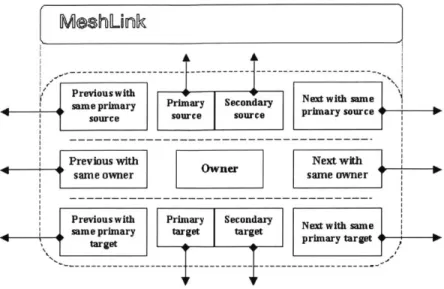
4-3 MeshLink: implementation of a connection object . . . . 47
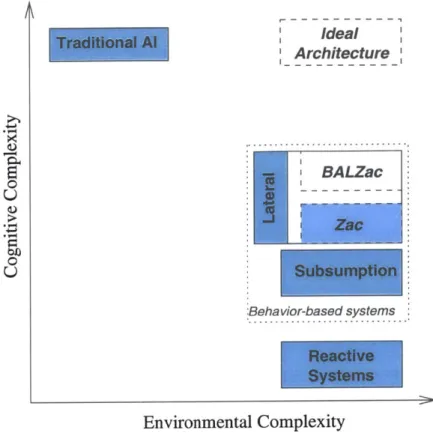
4-4 BALZac in relation to Zac and other robot architectures . . . . 55
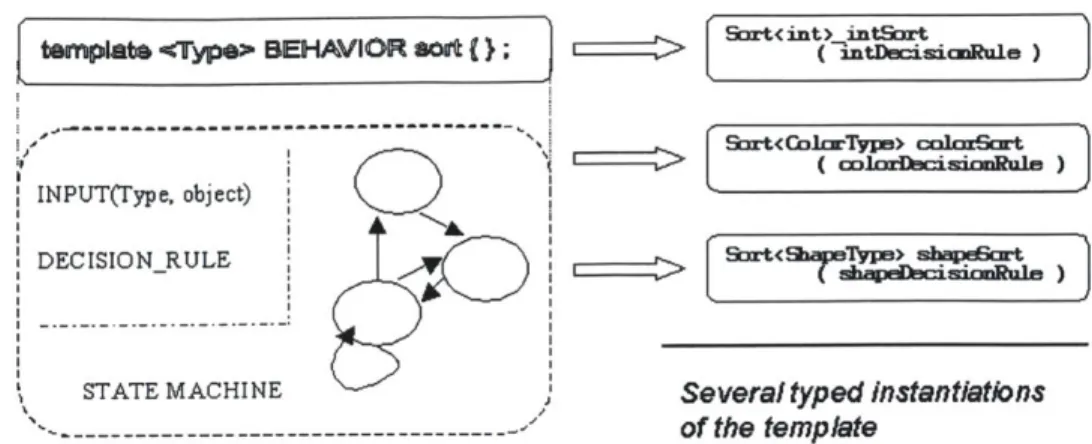
4-5 A template sorting behavior . . . . 57
5-1 The simple state machine of a drive. . . . . 70
5-2 A single protoverbal behavior . . . . 72
5-3 A grunting behavior in BALZac . . . . 74
5-4 Activation of grunting behaviors over time. . . . . 75
5-5 State machine for Canonical babble . . . . 76
5-6 Canonical babble generation on Kismet . . . . 77
5-7 Activation of Canonical babbling behavior over time. . . . . 80
5-8 Overall architecture of Kismet's protoverbal behaviors. . . . . 84
5-9 Communications in the heterogeneous network. . . . . 85
5-10 Control and data flow between verbal and other behaviors. . . . . 86
6-1 State machine of a concept behavior. . . . . 89
6-3 Concepts signalling the results of phonemic matching, and the
confi-dence m easure. . . . . 93
6-4 The HeardThis behavior and its state machine. . . . . 94
6-5 Timings in state transitions of HeardThis and a Concept. . . . . 95
6-6 Some data from a label teaching scenario. . . . . 98
List of Tables
2.1 Development of human infants' perceptual, motor, vocal, and linguistic
abilities during the first year of life. . . . . 31
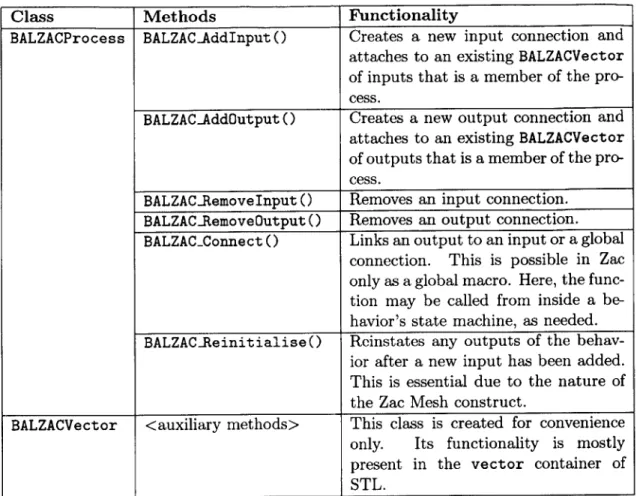
4.1 Functionality of the BALZac extensions . . . . 59
5.1 Correspondence between nonverbal behaviors and proto-linguistic func-tion s . . . . 8 1 6.1 Results of a label teaching scenario. . . . . 97
A. 1 The Phonemes of American English: Vowels . . . . 107
A.2 The Phonemes of American English: Consonants . . . . 107
Chapter 1
Introduction
Recent years have seen the growth of the idea in Al that machines can be designed as sociable creatures: that interacting with a robot could and should be as natural as talking to a fellow human and that machine learning could be achieved in a benevolent environment with a human teacher in ways similar to children's learning (Roy 1999, Cassell et al. 2000, Breazeal 2000, Breazeal & Scassellati 2000). The two components of the future natural teaching of robots are a maximally natural interface and fast learning of categories and tasks from few examples. A natural interface lets humans intuitively use all the discourse cues and displays normally present in conversation. Sociable machines are embodied creatures which encourage natural interaction from humans and pick up on those cues and displays for the development of their own abilities, such as learning to perform new tasks, or learning to express themselves.
This thesis describes a system that engages in such interactions and grounds its vocalizations in a manner inspired by the way human infants establish a commu-nicative basis with their teachers and learn the meaning of words by engaging in functionally, pragmatically meaningful communication.
1.1
Motivation for Natural Language
There are many reasons to endow a robotic system with a speech comprehension and production interface. It is easy for human users to communicate through the
medium of spoken language (we do not examine the cases in which it is easier to communicate using written, sign, or other linguistic forms). And even though a picture is worth a thousand words, in the cases where words must be used, it is more natural for humans to string them together in meaningful chunks of natural speech, than to learn a new "language" of commands. These reasons pertain to human-robot interaction scenarios, in which the robot plays the role of sophisticated tool that a human may use in order to achieve a goal or perform a task.
In the emerging field of sociable robotics, however, the role of the robot is no longer that of a passive device, but rather that of a participant in a cooperative task with humans. This shift of focus influences the choice of interface in important ways. It becomes essential to design for a smooth and natural cooperative interaction, in which there is an established system of cues, behavioral displays and underlying meanings, which both the human and the robot may use to their advantage. Natural spoken language fulfills this requirement as it is composed of the spoken utterance together with accompanying quality of voice, intonation, posture, gesture, and other natural displays, all of which contribute to the information content that is being communicated. If a robot can pick up on these cues, it will receive a richer message.
If it can display such cues appropriately, it will be more successful in communicating
a message to the human. Ultimately, the most important part of the message is its meaning that should be recoverable by both sides. If our task is to make the interaction flow as natural as possible for the human, making the robot rather than the human learn the shared system for communication makes even the more sense.
1.2
Pragmatic Basis of Language Acquisition by
Sociable Machines
The position taken in this thesis is that the shared semantics between the robot and the teacher are procedural or functional, and not declarative or combinatorial. The traditional view of natural language is that of a system of symbols and syntactic
com-bination rules, which encodes a message in a form that can be transmitted through speech or written text. The problem of acquiring such a system is that of acquiring a vocabulary and the applicable combination rules - a notoriously hard problem for machine learning, even in the cases where algorithms are provided with negative ev-idence. An even harder problem is to link the vocabulary to its referents in the real world - this is known as the Grounding Problem (Harnad 1990) and has been ad-dressed with embodied systems that have perceptual abilities. However, the meaning of natural language symbols does not only come from perceptual grounding.
The pragmatic approach to language acquisition is to consider first of all the in-tentions of a speech act. Language is not viewed as a denotational symbolic system for reference to objects and relationships between them, as much as a tool for commu-nicating intentions. The grounding of symbols at the pragmatic level is exemplified
by the most common everyday conversations. "It's getting chilly in the office" -such
a remark is not intended to transmit information from my officemate to me, so I may know that it is indeed getting colder. It may be intended to make me offer to turn up the heating, or may be a way of starting a conversation. The utterance is a way to manipulate the environment through the beliefs and actions of others.
For a robotic sociable creature, speech and language may serve the same purpose. As the robot engages in a cooperative task with a human, utterances should become its tool for influencing the human's behavior, the level of interaction, or the focus of cooperation. The robot's language system must then not only be able to refer to ob-jects or relationships, but also to express intentions in a way naturally interpretable to humans. The acquisition of such a system must begin with goal-directed, moti-vated prelinguistic vocalizations. We believe that languge acquisition must start with the learning of a protolanguage: a finite set of formulaic utterances, which are not subject to combinational rules but which express a finite set of intentional, pragmatic meanings. Some of these may refer to vectors of perceptual features in the world. Their primary application, however, is not referential; they are intended to achieve a change of state of the world through actions of others.
1.3
Overview of the Project
The project reported in this thesis embodies an attempt to create a natural speech interface with a humanoid robot which incorporates and builds on the ideas described above. We develop a system of vocal behaviors for the robot Kismet (Breazeal 2000) which exemplifies the approach we believe should be taken to natural language acqui-sition by machines. The robot's youthful appearance dictates the sort of interaction that humans will have with it: scenarios of social scaffolding similar to the kinds of interactions that teachers have with human infants. They create a benevolent envi-ronment and modify their behavior so as to make the task of learning easier for the infant, so as to taylor the world to her abilities. These actions come naturally to adult humans and the tendency is reinforced when the robot responds appropriately, i.e., as a young infant would.
One step forward is to enable the robot to use the scaffolded environment to its advantage in order to learn to perform tasks and behave appropriately. Learning to communicate with the teachers using a shared semantic basis is one aspect of learning to behave in the world and manipulate it. We augment the existant motivational and behavioral systems of the robot with a set of vocal behaviors, regulatory drives, and learning algorithms, which together constitute Kismet's Protolanguage Module. The purpose of the module is to develop two-way communication with the teacher. This is achieved in two ways. On one hand, we design a set of more convincingly expressive vocalizations, such as grunts and gasps, which are tied into the robot's emotional system. On the other hand, we develop mechanisms by which Kismet may extract meanings from its internal state, its own actions, and the changing environment, and attach vocal labels to them. Meanings, or "concepts", are individual components of the robot's behavior system, which run together in parallel and compete to establish the content and shape of Kismet's utterances.
It is important that the robot's utterances have an intentional basis. They are triggered by the robot's own motivational system, and they serve the purpose of ex-pressing the state of the robot, of regulating the environment through the actions of
the teacher, and of achieving a goal of the robot's behavior system. It follows, and is also important, that the robot's speech acts (or pre-speech vocalizations) are not purely reactive, but actively used by the robot as a tool in world exploration and manipulation, similar to the use of its active vision system. In this Kismet's pro-tolanguage module has a different focus from previous attempts at robotic language acquisition. It also inevitably achieves more modest results. However, we have tried to establish a precedent and a framework for early language development "for the right reasons", and we believe that future work will prove the approach more fruitful.
In this thesis, we first take a brief survey of previous work in robotic language ac-quisition and present a summary of those ideas, studies, and experiments in the large field of developmental linguistics that most inspired the design of Kismet's protolan-guage module (Chapter 2). A description of the robotic platform follows in Chapter
3, as the module must fit into those systems currently operating on Kismet. Chapter
4 outlines an architecture and scripting language for implementing behaviors in C++, which was used and augmented for this project. We then turn to Kismet's system of protoverbal behaviors, its architecture and implementation in Chapter 5. The algo-rithms for concept and vocal label acquisition, are detailed in Chapter 6. Finally, we present our conclusions and possible directions of future research in Chapter 7.
Chapter 2
Background
The problem of early language acquisition has been addressed by many researchers in the fields of developmental psychology, phonetics and linguistics, and more recently, behavior-based robotics and ethology. The present work draws inspiration from many of those studies. It also utilizes many of the results and methods developed in previous research.
2.1
Human-Robot Interaction
The idea that a machine should use natural language communication with the user as the ultimate interface is by no means novel. It has been the panacea of the field of Human-Computer Interaction (HCI) (see Cole, Mariani, Uszkoreit, Zaenen & Zue
(1995) for one overview). It has seen many research and commercial implementations
from dictation systems such as IBM's ViaVoice to telephone enquiry systems such as Jupiter (Zue, Glass, Plifroni, Pao & Hazen 2000). In this section we examine some previous work in speech interfaces on robots and virtual embodied agents.
2.1.1
Sociable machines
The project described in this thesis fits into the framework that has been devised in the Artificial Intelligence Laboratory at MIT in the past decade, and in which
in particular the work on sociable machines (Breazeal & Scassellati 2000) has been undertaken. A sociable machine such as Kismet (Breazeal 2000) is a creature endowed with perceptual, behavioral and motor skills that enable it to sustain an interaction with humans in a natural way, and a social drive that ensures some likelihood of such interaction. Verbal communication is one aspect of social interaction, and natural speech one medium of sustaining it. Conversation as humans know it - with each party taking turns to speak, is just one protocol for social communication; however, it is the one protocol that humans feel most comfortable with, since we get used to using it from very early on.
The sociable machine Kismet is the platform on which the research described in this thesis was implemented. As such it will be examined more closely in 3.
2.1.2
Robots and speech interfaces
The idea of sociable machines was originally conceived (Breazeal 2000) as an alter-native to the traditional perception of robots as servants, where the human-robot interaction is reduced to a command-and-control interface. Traditionally, whenever the interface used the medium of natural speech, it was to enable the human user to naturally communicate a command or request to the robot. For example, the humanoid robot from Waseda University (Matsusaka & Kobayashi 1999) is able to process some simple speech commands and queries regarding its design and purpose, and has a vocabulary of around 1,000 words. Some of the most sophisticated speech interfaces currently developed are embodied in simulated humanoid agents whose pur-pose is still to assist the human in a specific task. For example MACK (Gesture & Narrative Language Group at the Media Lab 2001) helps users find their way around the Media Laboratory at MIT. Such a speech processing system will understand only a specifically restricted type of human verbal input and will require cross-channel assistance, such as pointing at a hypermap to delimit the location.
To be sure, there has been research into speech interfaces that make small talk and are able to process a whole range of out-of-domain vocabulary that they may en-counter as input, resulting in sophisticated agents such as REA (Cassell, Bickmore,
Billingshurst, Campbell, Chang, Villjilmsson & Yan 1999), a virtual real estate agent also developed at the Media Laboratory at MIT. Perceived speech is encoded in a formulaic way at the level of discourse structure, and each separate utterance or words within it may have meaning for the agent which embodies the speech perception only insofar as they enable information retrieval from a database of real estate. We can see that the ultimate purpose in the development of such embodied conversational agents is not the acquisition of language but some kind of functionality that assumes sophis-ticated language use, as well as the creation of an impression of natural interaction in the human user.
The contribution of the current project is to focus on building a shared basis for communication between the learning robotic agent and the human teacher. The representation for an utterance of natural language is naturally different for the robot than it is for humans; however the focus is on the functional range of the acquired concept and the use that the robot makes of it. Speech is a tool which the robot uses to manipulate the world to fit its "goals", and thus the pragmatic function of the medium is shared with humans.
2.1.3
Robotic language acquisition
Some researchers, e.g., Roy (1999), Oates, Eyeler-Walker & Cohen (2000a) and Oates, Eyler-Walker & Cohen (2000 b), approached the problem of acquisition of natural cate-gories and labels by robots from the point of view of perceptual grounding. The robot analyzes the visual scene, and the speech stream into segments, the best correlation between which will form a perceptual concept-label pair which is acquired by the robot.
This approach was taken in particular in the development of CELL (Roy 1999), Cross-channel Early Language Learning, where a robotic platform is developed and a model of early human language acquisition is implemented on it. CELL is embodied in an active vision camera placed on a four degree of freedom motorized arm and augmented with expressive features (eyeballs, eyelids, feathers and a beak). The system acquires lexical units from the following scenario: a human teacher places
an object in front of the robot and describes it. The visual system extracts color and shape properties of the object, and CELL learns on-line a lexicon of color and shape terms grounded in the representations of objects. The terms learned need not be pertaining to color or shape exclusively - CELL has the potential to learn
any words, the problem being that of deciding which lexical items to associate with which semantic categories. In CELL, associations between linguistic and contextual channels are chosen on the basis of maximum mutual information.
Specifically, CELL learns lexical units which consist of a linguistic unit, i.e. a word, and a corresponding semantic category. Categories in CELL are "family resemblance categories" -a prototype together with a radius of acceptable deviation. All semantic input is derived from raw sensory signals through contextual channels, and in that sense, CELL's language is grounded in perception. The acquired lexicon can then be used for describing objects, including novel objects, and semantic parsing of speech. It is claimed that the robot's facial expressions and direction of gaze serve to establish a social interaction between itself and the teacher. However, the interaction consists mostly of the human teacher following the direction of gaze of the robot to make sure that she is describing the object that the robot is actually looking at. Although the robotic CELL is an embodied system, it is only situated in a limited and circumscribed portion of the real world. More importantly, however, the acquired lexicon can only be used for denotational purposes such as visual scene description.
Other researchers have applied the principle of grounding word semantics in per-ceptual inputs of robots to acquisition and evolution of artificial languages. In Steels
(1999) and Steels & Kaplan (2001), Luc Steels and his Talking Heads research group
develop an environment in which agents learn to describe simple visual scenes using a novel artificial language that they collectively construct as they go along, by engaging in communicative games. The typical Talking Heads experimental setup involves two robotic active vision heads, possessing one camera each, and focusing from a slightly different angle on a two-dimensional visual scene. The scene may consist of various geometric shapes in flat bright colors pasted on a whiteboard. The language learners are software agents which are able to teleport themselves to one of the active cameras
in order to receive the visual inputs of the scene.
Initially, all agents in the population have an empty lexicon. When two agents focus on some portion of the visual scene, one of them starts a communicative game
by choosing an object to talk about and describing it to the other participating agent.
If the hearer can find the speaker's vocalisations in its lexical repertoire, the object is identified and the game has succeeded. Otherwise, the speaker has to identify the object of the game for the hearer's benefit, both lexicons and conceptual sets are updated, but the game fails. Eventually a population of such software agents will converge on some shared "semantic" representation of the agents' world, as well as on a shared lexicon.
The purpose of the Talking Heads experiments is to provide a starting point for computational theories of language evolution. The languages that the populations of agents evolve can only be used for communication between the agents, and not between a human user and an agent, unless the human chooses to participate in the game and learn the agents' language. From the point of view of robotic language acquisition, one of the limitations of the project is that it relies on the agent's ability to construct a complete hierarchical description of the scene, whose nodes are the attributes which will become the agent's "concepts". This is only possible when the scene consists of relatively few easily segmented objects in straightforward spacial relationships to each other. Describing an object amounts to vocalizing a path in the scene hierarchy according to some parsing strategy. Another limitation comes through when the game fails. The agents do not use the world to identify the object of the game when words fail them; instead, they send an object ID# through a wire. When all objects in the scene are given a priori ID numbers, the language used by the agents becomes grounded not so much in sensory perception as in another symbolic representation of the world.
In order to achieve communication between humans and a sociable robotic crea-ture, words must be a tool used by the robot to manipulate its physical and social world and they must be interpreted by humans as having such a pragmatic func-tional meaning. In Kismet's case, it will start with proto-language and proto-verbal
behaviors. We draw our inspiration mainly from studies of the linguistic and social development of human infants.
2.2
Development of Meaning and Language
Human infants are surprisingly adept at learning about the structure of the environ-ment, how to behave in it, and how to express themselves and understand others all at once, in the space of a few years. We take the approach of Bloom (2000) who has shown that children are good at innately facilitated learning of socially transmitted information. This means that one of the most important attributes of the spoken language in the infant's environment is that it fulfills a social function, to which the infant is sensitive and which enables her to acquire a new word or concept after a very limited number of examples, perhaps even one (see also Pinker (1999) for overview of experiments suggesting extremely fast word learning by young children and infants).
We turn to an account of the social function of the developing language, which was the most inspirational in the design of the language acquisition module on Kismet. In section 2.2.2 we also look at the perceptual and proto-linguistic abilities of very young infants, so we may place Kismet in an appropriate age group.
2.2.1
Pragmatic protolanguage
In a seminal work Halliday (1975) presents a longitudinal study of a developing child, Nigel, from 4 months to 2 years of age. He takes the approach on asking why the child develops a language at the early stages, and for what he uses his nascent lin-guistic ability. Halliday makes the very important distinction between what he calls the mathetic and the pragmatic functions of human natural language. The mathetic function is to provide an encoding of information channelled through speech or text.
If the speaker wishes to inform the hearer that a certain event occurred (e.g., that it
has started to rain outside), their common language gives them a shared representa-tion of that informarepresenta-tion that can be transmitted through speech. Many tradirepresenta-tional approaches to machine language acquisition equate language with its mathetic
func-tion and neglect its pragmatic aspect, which is to provide the speaker with a means of manipulating the behavior of other humans. When one person makes a speech act
(e.g., the same statement about rain outside), in addition to communicating a piece of information, that person may have intentions to change the state of the world and in particular the behavior of those who hear the utterance, in a particular way. "It has started to rain outside" often really means something like "Close the window, please". The speaker expects the hearer to react in a certain way as a result of hear-ing the utterance, which then becomes the speaker's tool for manipulation of others and of her surroundings.
This pragmatic view of the function of language is extremely important in trying to explain, or devise, an ability for early language acquisition, because infants and young children specifically learn to use speech as a tool. Halliday identifies three main stages of linguistic development: (I) the child's initial closed proto-linguistic system, (II) the transitional stage to that of adult language, and (III) the learning of the adult language. In the first stage, the child has a finite number of meanings to convey and to that effect uses self-generated labels that may or may not resemble adult words for similar occasions. Halliday posits six initial functions of a developing proto-linguistic system that may be expressed in the first stage:
1. Instrumental - satisfying the child's material needs
2. Regulatory - controlling the behavior of others
3. Interactional - participating in a social situation
4. Personal - asserting own unique self
5. Heuristic - exploring the environment
6. Imaginative - pretending and playing
These six functions of the child's phase I proto-language seem to develop in that sequence and represent the child's growing cognitive ability and awareness. They also present a great starting point and timeline for an artificial system that would acquire
a natural language in a way similar to human children. The infant's protolanguage during Phase I is finite and formulaic (see also Wray (2000) for a discussion of for-mulaic systems in the evolution of language), as will be the first part of Kismet's language development module.
2.2.2
Infants' perceptual abilities
When designing a system for language acquisition whose purpose is to follow the development of a human infant, we should be informed by the relevant research in the domain of developmental phonetics and linguistics. Results in this field establish the habitual timeline for emergence of those perceptual abilities in the infant, which are helpful in the process of language acquisition.
For example, Jusczyk in Jusczyk, Friederici, Wessells, Svenkerud & Jusczyk (1993), Jusczyk & Aslin (1995), and Jusczyk (1997) drew attention to the developing speech perception and production systems. His findings establish the extent and progression of the infant's perceptual and motor abilities during her first years. These influence in an important way the kinds of linguistic knowledge that the infant can acquire, and so they are factors to be considered and possibly replicated in our artificial system. In particular, Jusczyk established which cues enable infants at different stages of devel-opment to segment the stream of speech into units such as utterances and words. He showed that the infants most often use prosodic (intonational) information in picking out the most salient information in an utterance. Other sources of information on word boundaries that the infants use include phonotactics and allophone statistics. Phonotactics encode the likelihood of a particular phonemic string to occur within a word versus across a word boundary. For example, in English, the phonemic pair
/kg/ cannot occur within a word. If such a string is heard, it must come from a word
boundary, e.g., as with talk good. On the other hand, allophones are variations on the same phoneme, such as an aspirated and unaspirated [k], which are used depend-ing on the position of the phoneme within a word or at a word boundary. However, Jusczyk et al have shown (Jusczyk et al. 1993) that infants before the age of 9 months are unable to use phonotactic information, for example to distinguish sounds of their
native language from foreign speech, and must rely exclusively on prosodic contours instead.
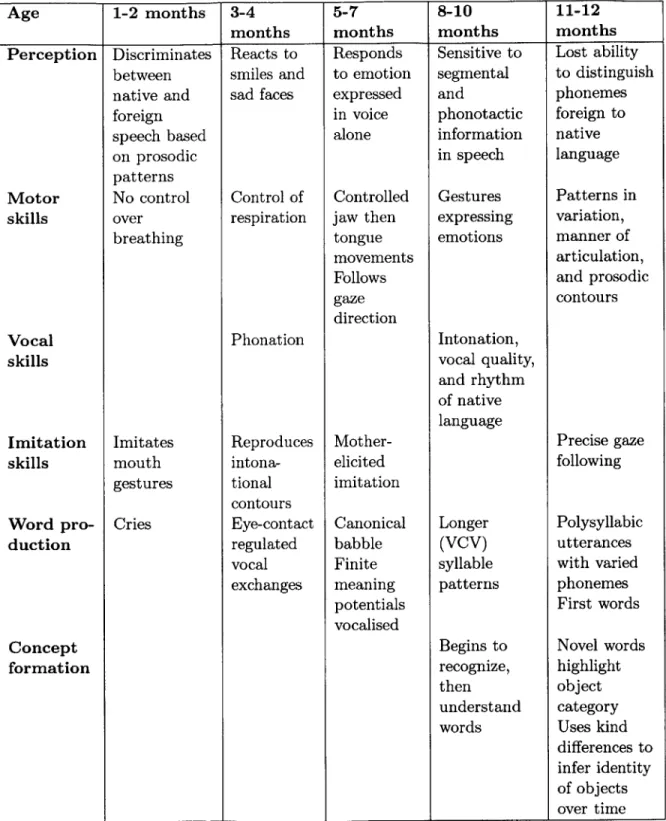
Table 2.1 shows the progressive development of some of the human infants' abili-ties which are important to the process of language development, during the first year of the infant's life. We can see that by the time the infant starts expressing the finite meaning potentials as they are defined in Halliday (1975), she has mastered her vocal tract almost fully and is able to produce canonical babblings. The canonical babble stage, which lasts usually from 6 to 7 months (Boysson-Bardies 1999), is characterized
by repeated vocalization of short syllabic sequences. By that time, the infant's vocal
chords have more or less assumed the adult's posture and proportions: the vocal tract has acquired its distinctive F-shape, the palate has lowered and moved forwared, the pharynx has opened to allow controlled air flow. At the onset of babbling, the infant has already connnected sound production with the movements of the mouth, and routinely engages in vocal exchanges with adults, reproducing intonation contours of the adult speech. The sequences are at first just one syllable long, progressing with time to at most two or three syllables. They consist of consonant-vowel (CV) phone-mic pairs. The phonemes produced show a non-unifrom distribution by both place and manner of articulation, with predominantly bilabial or velar occlusives (stops) and nasal consonants and low-central and central vowels, forming syllables such as /ba/, /pa/, /gu/. Less frequent but also present are dental occlusives. Although it is not known exactly why infants babble the way they do, a simple mechanical theory can explain a lot of the distribution of sounds that we observe in canonical babbling. Infants explore the powers and limitations of tehir vocal tract as tehy would with any other part of their bodies. At first, sounds which stem from the most constricted vocal tract are easier to produce. Simple jaw movements, when fine motor control of the tongue is not yet available, produce sound sequences that go from a simple constriction to an open mouth.
During that stage, the infant must be still mainly relying on prosodic information for the tasks of word segmentation as the ability to use phonotactics and allophone statistics has not yet developed.
2.2.3
Nature of concept and word acquisition
Although this research is not directly related to language acquisition, the ethological studies of the grey African parrot reported in Pepperberg (1990), Pepperberg (1997), and Pepperberg (n.d.), who was learning to label novel concepts is clearly relevant to this project. Pepperberg uses novel methods of teaching in her studies, namely the model/rival technique, and social modeling. It is the social modeling theory and the referential mapping technique that present the most interest to this project, since Kismet is not quite developed enough to be able to benefit from the model/rival teaching method. The theory advises the teacher to treat the student's spontaneous utterances as meaningful, and act upon them. This, it is shown, will encourage the student to associate the utterance with the meaning that the teacher originally gave it, so the student will use the same vocalization again in the future to make a similar request or statement. The technique was successfully used on the grey African parrot Alex to give meaning to his spontaneous labels. It has also been applied in teaching language to children with developmental disorders.
This framework of first and foremost establishing a common communicative base between the teacher and the learner, or the caretaker and the infant (or the robot), is also our framework in the development of early language abilities for the robotic platform Kismet (Breazeal 2000). In the next chapter, Kismet is described in more detail.
Age 1-2 months 3-4 5-7 8-10 11-12
months months months months
Perception Motor skills Vocal skills Imitation skills Word pro-duction Concept formation Discriminates between native and foreign speech based on prosodic patterns No control over breathing Imitates mouth gestures Cries Reacts to smiles and sad faces Control of respiration Phonation Reproduces intona-tional contours Eye-contact regulated vocal exchanges Responds to emotion expressed in voice alone Controlled jaw then tongue movements Follows gaze direction Mother-elicited imitation Canonical babble Finite meaning potentials vocalised Sensitive to segmental and phonotactic information in speech Gestures expressing emotions Intonation, vocal quality, and rhythm of native language Longer (VCV) syllable patterns Begins to recognize, then understand words
Table 2.1: Development of some of human infants' most relevant perceptual, motor,
vocal, and linguistic abilities during the first year of life (see text for detailed expla-nation). Compiled from Boysson-Bardies (1999), Bloom (2000), Xu & Carey (1995),
Waxman (1995), Shafer & Shucard (1995), Jusczyk (1997), and Pinker (1999).
Lost ability to distinguish phonemes foreign to native language Patterns in variation, manner of articulation, and prosodic contours Precise gaze following Polysyllabic utterances with varied phonemes First words Novel words highlight object category Uses kind differences to infer identity of objects over time
Chapter 3
Kismet: the Robotic Platform
This chapter briefly describes the robotic platform for which the language develop-ment system was designed, and on which it was impledevelop-mented. It is the robotic head Kismet (Breazeal 2000) - a sociable machine developed by Breazeal in the MIT Al Laboratory.
3.1
The Physical Robot
Kismet is an expressive robotic head, designed to have a youthful appearance (it is often referred to as an infant robot) and perceptual and motor capabilities tuned to human communication channels. The robot receives visual input from four color
CCD cameras, auditory input from a microphone, and proprioceptive input from
an inertial sensor. It performs motor acts such as vocalizations, facial expressions, posture changes, as well as gaze direction and head orientation. The motor systems serve the dual purpose of effectuating envelope displays on the one hand, and of steering the robot towards sensory stimuli on the other.
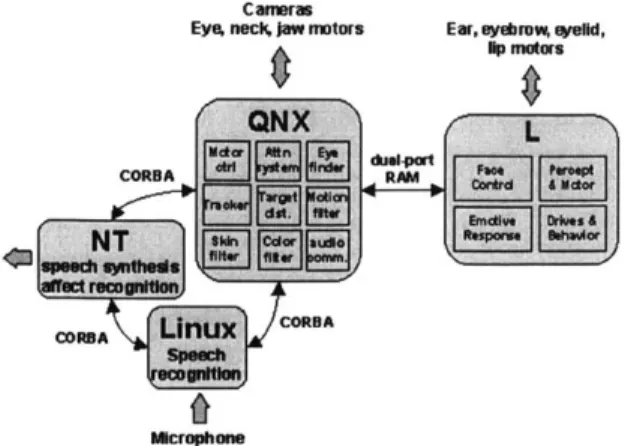
Kismet's control architectures run on a complex network of processors in real time (approaching 30 Hz for visual signals, and 8 kHz sample rate with frame windows of 10 ms for auditory signals), with minimal latencies (less than 500 ms). Low-level visual processing and eye/neck motor control is performed by 15 networked 400 MHz PCs running QNX. The high-level perceptual system, the motivation and behavior
Caffwa
Eye, necK jaw motors Ear, eyeb w eNd,
Np miors
Figure 3-1: The hardware configuration of Figure 3-2: Kismet: the robotic Kismet. From Breazeal (2000), with permis- head. From Breazeal (2000),
sion. with permission.
systems, the motor skill system and the face motor control run on four Motorola 68332 microprocessors running L, a multi-threaded Lisp developed by Brooks in our lab. Expressive speech synthesis and vocal affect recognition execute on a dual 450 MHz PC running NT, and the speech recognition system runs on two 500 MHz PCs
running Linux.
3.2
Perception
Kismet's most important sensory information comes from visual and auditory chan-nels. The visual hardware consists of four color CCD cameras mounted on a stereo active vision head. Two of these are wide field of view 0.25 inch CCD lipstick cameras with 2.2 mm lenses, manufactured by Elmo Corporation. They are fixed in a central position on the head of the robot. Images from these cameras are used as input into Kismet's attention system, as well as to compute distances. There are also 0.5 inch CCD foveal cameras with 8 mm focal length lenses, mounted inside each eye. They provide inputs for higher-resolution post-attentional processing.
Low-level perceptual processes extract salient features from the visual environment of the robot, such as color and motion. The attention system determines the target
of the robot's focus as a function of these salient features as well as the robot's own agenda - e.g, if the robot is currently in "need" of seeing faces, face-like stimuli will be given attentional preference over brightly colored toys. The target's features are fed into a system for higher-level perceptual processing where they are combined to form behaviorally relevant percepts. The perceptual, attentional, and behavioral systems communicate by a releasing mechanism, conceptualized after Tinbergen and Lorenz (cited in Klopfer & Hailman (1965) and in Breazeal (2000)). A releaser for a salient object or event activates when all the necessary conditions in the environment are satisfied for the response to become active.
The auditory input comes from a wireless microphone that the human wears. The processing is done by two speech recognizers. Speech recognition software devel-oped at MIT by the Spoken Language Systems Group (SLS group) outputs low-level features such as the fundamental frequency or pitch of the signal, its energy and pe-riodicity. Commercially available ViaVoice recognition software outputs an estimate of the phonetic sequence. The latter is extremely unreliable due to the fact that no vocabulary is available to the speech recognizer, since the robot's competencies are supposed to be those of a human infant. These output features are used by the vocal affect recognizer developed in Breazeal & Aryananda (2000). They are also the inputs into the system described in this thesis.
3.3
Motivation and Behaviors
Although not a mobile robot and with all computation off-board, Kismet is an au-tonomous agent in that it pursues its own agenda by engaging in specific behaviors which are tuned to the satisfaction of its own "goals" and "desires". The motivation is provided by a set of internal homeostatic variables called "drives", such as the level of engagement with the environment or the intensity of social play, which must be maintained within certain normal bounds in order for Kismet's system to be at equilibrium. Thus, if one of the variables shows specific understimulation or over-whelming, this triggers a behavior tuned to rectifying such symptoms and bringing
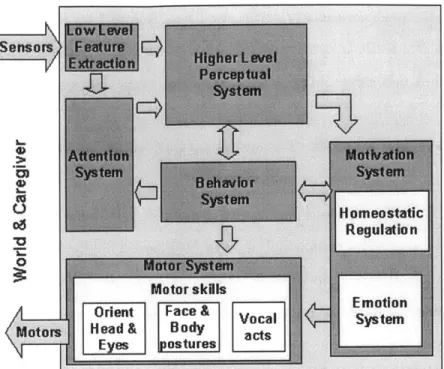
H omeostatic
06 Regulatio n
03
Motor skills
Orient Face & Emolystion
Motors H ead & Body Voalsse
Eyes postures.at
Figure 3-3: The behavioral framework of Kismet. From Breazeal (2000) with permis-sion.
the robot's internal state back to within the norm.
"Emotions" constitute another facet of Kismet's motivational system. The robot's emotional state is modeled, after Ekman, cited in Breazeal (2000), as a point in
three-dimensional space, where the axes represent affect, valence, and stance. Kismet can express, using its facial features, analogs of happiness, interest, fear, sadness,
dis-gust, anger, surprise, and a neutral face. The choice of emotion depends on simple appraisals of the perceptual stimuli, and the emotive response may involve a with-drawal or an approach accordingly.
The behavior system provides structure and an arbiter for the robot's multiple behaviors. The latter are all self-interested mechanisms which compete with each other to be active at any one time. The activation of a particular behavior will depend on the current state of the robot's motivational system, as well as considerations of coherency, persistence and opportunism. The robot has to respond adequately to the environmental stimuli. The arbiter also makes sure that, once a behavior has been activated, it remains so for some time, preventing the robot from switching too soon between behaviors without achieving any one behavior's goals. Finally, to
prevent Kismet from being stuck in a rut, an element of randomness is introduced into the decision process. Thus the behavior system ensures that the robot may engage sensibly its complex and changing environment.
3.4
Motion
Kismet's motor skills include facial displays, gaze and head orientation, smooth pur-suit, and vocalizations. The robot has a 15 DoF face that mirrors its internal "emo-tional" state expressively. Kismet can perk its ears when interested, or fold them back in anger. Each eyebrow can lower or be raised independently, allowing for expressions of surprise or disgust. Eyelids can be opened or closed, enabling the robot to blink or wink. There are four lip actuators, and a single DoF jaw that together work to lip-synch to the speech produced by a synthesizer. The synthesizer software is DECTalk v4.5, based on the Klatt synthesizer, cited in Breazeal (2000), which models the phys-iological characteristics of the human articulatory tract. This enables the robot to speak in a youthful tone of voice, and to vary the parameters of the synthesizer to account for variation in its emotional state.
3.5
Social Play and Learning
Kismet is a robot for social interaction. Its behaviors regulate its internal "drives" but are also geared towards initiating and maintaining social exchanges with humans. The expressive features on the face convey to the human teachers the "emotional" state of the robot. Kismet engages humans in social play by following the human social protocol in its envelope displays. For instance, Kismet reproduces human turn-taking displays such as looking away when starting to speak, or leaning forward to give up the floor.
Turn-taking behaviors are necessary to establish a flow of exchange between the robot and the teacher. That exchange is part of the benevolent social environment which is established to scaffold the robot's learning. The purpose of designing "for
the human in the loop" when developing Kismet was to create an environment in which learning would become easier. The usual machine learning paradigm assumes an impartial teacher who presents many examples of the problem to the learner until the learner discovers a pattern in them or becomes able to classify them correctly. Breazeal expected, however, that a benevolent teacher and a scaffolding environment would enable a machine to learn human concepts and behaviors from drastically fewer examples, if that machine is made to pick up on the cues that human infants use in their development. This idea informed the whole process of developing Kismet which was to be a robot that learns from social interactions with humans.
So far, the only explicit learning routines implemented on Kismet involved spe-cific problems in speech recognition (see section 3.6) and individual face recognition (Aryananda 2001) from streaming video. These routines did not use the social aspect of Kismet's environment. The current project enables Kismet to actually leverage off its social capabilities to learn the basics of a human natural language from its human teachers.
3.6
Special Skills
Since the publication of Breazeal (2000), Kismet has been endowed with other skills, some of which have not yet been described elsewhere. Some of these have been instrumental in the development of the language acquisition system reported here. In particular, Paul Fitzpatrick developed a mechanism for extending a very small initial vocabulary with a clustering algorithm operating on a phone-based "OOV" (out-of-vocabulary) model in a speech recognizer (Varchavskaia, Fitzpatrick & Breazeal 2001). The clustering engine locates the more commonly recovered phone sequences and adds them into the vocabulary as new words. For initial phone recognition, the speech recognizer developed by the SLS group at MIT (Glass, Chang & McCandless
1996) is used, augmented with the OOV model developed by Bazzi and Glass in (Bazzi & Glass 2000). The vocabulary referred to here is that of the speech recognizer; there
The top clusters located by this procedure should be prime candidates for entering Kismet's semantic network as the language acquisition system develops. However, the system presented in this thesis does not yet integrate the above components. Rather, we use commercially available ViaVoice software for Linux to extract the phonemic sequences from the speech signal. In the future (see Chapter 7 for directions of future work) we would like to integrate the OOV model with the Protolanguage Module (Chapters 5 and 6) which could provide the initial small set of recognized words as the initial vocabulary of the OOV system.
Chapter 4
Robotic Behaviors in C++
This chapter explains the need for special libraries for behavior-based implementation of robotic software architectures, the Zac library and scripting language (Fitzpatrick
1997) and its extension developed specifically for the purpose of this work by me
called BALZaci, for Better Adapted to Learning Zac.
4.1
Behavior-Based Programming
The task of endowing a robot with a behavioral system lends itself naturally to a kind of hierarchical decomposition not necessarily adequately supported by the standard architectures of mid-level programming languages. The constraints of a control system are elements of the design, rather than the implementation stage. However, in the cases where constraints may be embodied in well-defined structural elements, such as augmented finite state machines (AFSMs) and wires in Subsumption, it can be useful for clarity and ease of programming to have those elements as building blocks of an implementation. The object-oriented approach of C++ is a good starting framework for understanding, designing, and implementing a behavioral system. Many helpful 'The name predates the system, naturally. Upon reading in Fitzpatrick (1997) that the Zac script was named in tribute to Isaac Asimov -the brilliant widely-read and much-loved author of science fiction classics - I immediately thought that anything I might ever write as an extension of the Zac libraries would be appropriately dubbed BALZac after Honore de Balzac -the much duller seldom-opened and rarely-appreciated author of the classic "Comedie Humaine". The previous long-winded sentence is also in his honor (sad pun not intended).
ideas and constructs that are not directly present in the programming language itself can be incorporated into libraries of code that would be useful to behavior-based programmers of robotic agents. The Zac library and scripting language is one example of a programming language extension that makes behavior-based code more intuitive and readable, as the resulting constructs correspond to the conceptual decomposition of a behavioral system.
Earlier language support for behavior-based programming included systems such as the Behavior Language (Brooks 1990) for the Subsumption architecture, and ALFA
(A Language For Action, cited in Gat (1992)) for the ATLANTIS control
architec-ture. The Behavior Language supports real-time rules written in a subset of Lisp, which are then compiled into AFSMs. ALFA was developed specifically to address the support needed for ATLANTIS, and consisted of computational modules commu-nicating through channels. One of the crucial components of this kind of support is to include automatic management of channels whenever modules are inserted or deleted, so that the user of the language need not restructure the control network.
4.2
Lateral and Zac
This section will briefly outline the Lateral architecture, and its implementation in
C++ called Zac, as it was developed and presented by Paul Fitzpatrick in Fitzpatrick (1997). Lateral is a superset of the Subsumption architecture (Brooks 1986) which
implements a priority scheme among the robot's behaviors. It allows for a more flexible control than Subsumption, but its original implementation (Zac) still suffers from a lack of adaptability which makes it unusable for applications where the whole repertoire of the robot's behaviors may not be known in advance. An extension to the Zac libraries called BALZac which provides for more adaptability was developed specifically for this project, and is described in section 4.4. In order to understand the additions of BALZac, we first take a look at the system it extends.
4.2.1
The Lateral priority scheme
Lateral is an architecture based on two types of objects: behaviors and connections.
A behavior is very loosely defined as any process that runs on a robot and implements
an aspect of the robot's competence. Just like in the Subsumption architecture, any behavior object may have direct connections to the robot's sensors and actuator controls. All behaviors interact with each other and the world through input and output ports accessed by connections. A behavior object also has a priority which puts it on a priority plane, similar to a level in Subsumption. Priority propagates throughout the behavioral system via the connections - it is optionally sent as extra information with any message that is transmitted between behaviors. Just like in Subsumption, behaviors are run concurrently rather than sequentially. Computing priority at every pass through the system determines which behaviors have control over (e.g., subsume) which connections.
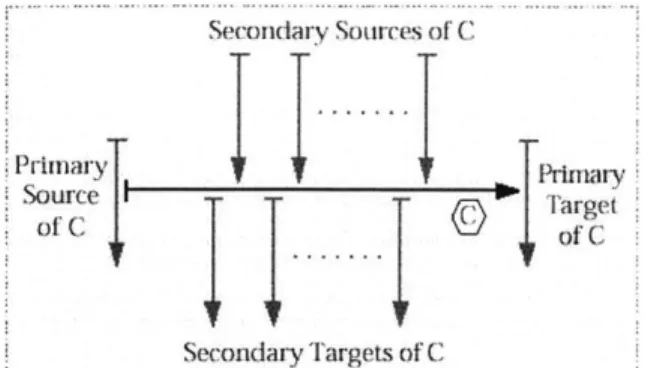
Connections are objects which transport messages from source to target, allowing for priority arbitration. A connection has a primary source and a primary target, which can be an output and input port, respectively, of a behavior, or another con-nection (see figure 4-1). In addition, a concon-nection may have any number of secondary sources and targets, which come from other connections tapping into the one in ques-tion. This kind of tapping access implements the flexible control of connections in
Lateral. When the tapping source's propagated priority is greater than that of the tapped default, such a scenario is equivalent to one behavior subsuming another at the output. However, additional flexibility is seen in the case where there are several secondary sources. They may have the same priority or not, and their priorities may change at runtime, in which case the target will receive inputs from different sources
over time. The principled way in which Lateral determines ownership and control of connections is established as follows.
A behavior's inputs and outputs are also objects of the connection type. They
are data members of the behavior object. An output does not attach its source to anything, since it transmits messages directly from the behavior that owns it.
Secondary Sources of C
Primary Primary
SourceTrgt
of C
TT.IC
fCSecondary Targets of C
Figure 4-1: A connection object, with pri-mary source and target, as well as a num-ber of secondary sources and targets. C is shorthand for "Connection" and represents a global, or "free-standing" connection ob-ject, not owned by any behaviors. From Fitzpatrick (1997) with permission.
P riority P *
I3V~ U! id rirriI NViU
The priority of the behaviour The prioritY of anY output is
is bounded by the highest of bounded by the priority of the the input priorities behaviour.
P:5 I1iaX(II') 0!I-'p P
Figure 4-2: Priority arbitration in a be-havior object. From Fitzpatrick (1997) with permission.
Similarly, an input does not attach its target to anything, since it is the ultimate target of any connections that terminate at it. In addition, an input does not attach its source to any connection either, leaving the initialization task to those connections which will have that input as their target. This arrangement is consistent with the view of inputs as handles in controlling the behavior which owns them. Several connections may be competing for such control, and the winner, according to Lateral's principled mechanism for conflict resolution, will attach its target to the requested behavior's input. As priorities are recomputed, the controlling connection may change dynamically but the input is always connected to something and does not need to be reconfigured.
Conflict resolution is easy when all sources have different priority. In this sim-ple case, the source with the highest priority maintains control of the connection. When sources have the same priority, Lateral implements the ideas of Subsumption in creative ways. Connections may be type-tagged as "Default", "Shared", "Pre-ferred", and "Replace" - corresponding respectively to defaulting, normal transfer, suppression, and inhibition in the Subsumption wires.