HAL Id: tel-02990969
https://tel.archives-ouvertes.fr/tel-02990969
Submitted on 5 Nov 2020HAL is a multi-disciplinary open access
archive for the deposit and dissemination of sci-entific research documents, whether they are pub-lished or not. The documents may come from teaching and research institutions in France or abroad, or from public or private research centers.
L’archive ouverte pluridisciplinaire HAL, est destinée au dépôt et à la diffusion de documents scientifiques de niveau recherche, publiés ou non, émanant des établissements d’enseignement et de recherche français ou étrangers, des laboratoires publics ou privés.
Identifying parameters of soils and selection of
constitutive models using genetic algorithms
Yinfu Jin
To cite this version:
Yinfu Jin. Identifying parameters of soils and selection of constitutive models using genetic algorithms. Géotechnique. École centrale de Nantes, 2016. English. �NNT : 2016ECDN0017�. �tel-02990969�
Yinfu JIN
Mémoire présenté en vue de lʼobtention
du grade de Docteur de lʼÉcole Centrale de Nantes
sous le sceau de l’Université Bretagne Loire
École doctorale :Science Pour l'Ingénieur, Géosciences, Architecture
Discipline : Géothechnique
Unité de recherche : Institut de Recherche en Génie Civil et Mécanique Soutenue le 06/09/2016
IDENTIFICATION LES PARAMÈTRES DES SOLS ET
SÉLECTION DE MODÈLES DE COMPORTEMENT EN
UTILISANT DES ALGORITHMES GÉNÉTIQUES
JURY
Président : Olivier MILLET, Professeur des Universités - Pôle Sciences et Technologie, La Rochelle
Rapporteurs : Yujun CUI, Professeur, École des Ponts ParisTech, Paris
Ali DAOUADJI, Professeur des Universités, INSA Lyon, Lyon
Examinateurs : Pierre-Yves HICHER, Professeur Émérite, Ecole Centrale de Nantes, Nantes
Yvon RIOU, Maître de Conférences, Ecole Centrale de Nantes, Nantes
Directeur de thèse : Zhenyu YIN, Maître de Conférences et HDR, Ecole Centrale de Nantes, Nantes
Yinfu JIN
Identification les paramètres des sols et sélection de modèles
de comportement en utilisant des algorithmes génétiques
Identifying parameters of soils and selection of constitutive models
using genetic algorithms
RésuméLe sujet de la thèse concerne l'identification des paramètres des sols et sélection de modèles de comportement en utilisant des algorithmes génétiques. Tout d'abord, une étude comparative sur l'identification des paramètres par différentes méthodes d'optimisation est effectuée. Ensuite, un algorithme génétique réel codé (RCGA) est conçu pour améliorer la performance d’un algorithme génétique (GA) dans l'identification des paramètres du sol. Par la suite, le RCGA est utilisé pour construire la formulation de la prédiction de la compressibilité des argiles remaniés basée sur la régression polynomiale évolutive (EPR) en utilisant l’indice des vides initial e0, la limite de liquidité wL et
l’indice de plasticité IP. Ensuite, une procédure efficace
pour identifier les paramètres d'argiles structurées est proposée en employant le RCGA avec un modèle élasto-viscoplastique anisotrope. Une procédure de validation est menée ainsi que des applications démontrant que la procédure est utile pratiquement avec une réduction du coût des essais au laboratoire. Enfin, le choix d'un
modèle approprié pour les sables avec les
caractéristiques nécessaires en fonction des essais classiques et un moyen facile d'identifier les paramètres pour les applications géotechniques est discuté en utilisant le RCGA et différents modèles de sable. L’écrouissage plastique non-linéaire, l'implémentation de la ligne d'état critique avec l’effet d’enchevêtrement, les types et nombres d’essais et le niveau de déformation nécessaire sont discutés pour la sélection et l'utilisation des modèles de sable.
Mots-clés
Identification des paramètres; optimisation; modèle de comportement; sable; argile; algorithme génétique
Abstract
The subject of this thesis is the identification of soil parameters and selection of constitutive models using genetic algorithms. First, various optimization methods for identifying soil parameters are studied. Then, a real-coded genetic algorithm (RCGA) has been developed to improve the performance of genetic algorithms (GA) for identifying soil parameters. Subsequently, the RCGA is employed to construct a formula for predicting the compressibility of remolded clays by using an evolutionary polynomial regression (EPR) based on the initial void ratio e0, the liquid limit wL and the plastic index IP. Then, an efficient procedure for identifying necessary
parameters of soft structured clays is proposed by employing the enhanced RCGA coupled with an advanced anisotropic elasto-viscoplastic model. The approach is then validated and several applications are developed to demonstrate that the procedure can be used with a reduction of the testing cost. Finally, an appropriate model of sand with the necessary features based on conventional tests and with an easy way of identifying parameters for geotechnical applications by employing the RCGA and different sand models is selected. A discussion on nonlinear plastic stress-strain hardening, incorporation of the critical state concept with interlocking effect, test types and numbers, and necessary strain level for the selection and use of sand models concludes the thesis.
Key Words
parameter identification; optimization; soil model; sand; clay; genetic algorithm
Ecole Centrale de Nantes
É
COLED
OCTORALES
CIENCESP
OUR L'I
NGÉ NIEUR,
G
É OSCIENCES,
A
RCHITECTUREAnné e 2016
N° B.U. :
Thè se de D
OCTORAT Spé cialité : GENIECIVILPré senté e et soutenue publiquement par : YINFUJIN
le ………06-09-2016………….… à l’Ecole Centrale Nantes
T
ITREIDENTIFICATION
DES
PARAMÈ TRES
DES
SOLS
ET
SÉ LECTION
DE
MODÈ LES
DE
COMPORTEMENT
EN
UTILISANT
DES
ALGORITHMES
GÉ NÉ TIQUES
J
URYPré sident : OLIVIER MILLET Professeur des Université s - Pô le Sciences et Technologie, La Rochelle Rapporteurs : Yujun CUI Professeur, É cole des Ponts ParisTech
Ali DAOUADJI Professeur des Université s - INSA Lyon Examinateur: Pierre-Yves HICHER Professeur É mé rite - Ecole Centrale de Nantes
Yvon RIOU Maître de confé rences - Ecole Centrale de Nantes Directeur de thèse: Zhenyu YIN Maître de confé rences et HDR-Ecole Centrale de Nantes Co-directeur: Shuilong SHEN Professeur- Université de Jiao Tong de Shanghai, Chine
Acknowledgments
The author would like to express his sincere thanks to all the people who he worked with during this PhD period, without them the research could not be accomplished.
Dr. Zhenyu YIN, as the supervisor of the PhD study as well as the good friend over the past several years, did do a lot of efforts in improving my knowledge and academic ability in the field of geotechnical engineering, providing the chance to study at Shanghai Jiao Tong University and then to study at Ecole centrale de Nantes as well to work at Deltares in Deflt. His excellent academic attitude and kind personality are greatly appreciated.
Prof. Shuilong SHEN in Shanghai Jiao Tong University is also my supervisor of my PhD study. I am greatly indebted to him for his continuous help and strong support throughout this research. His wealth of ideas has enriched this dissertation and is highly appreciated.
The two supervisors of mine provided me with great freedom which allowed me to dive into the sea of research and to think freely. Words are not enough to express my appreciations.
Prof. Pierre-Yves HICHER and Shimu are greatly acknowledged by the author for their charming personalities. During my study in Nantes, Pierre-Yves showed me his patience and strictness, his knowledge and modesty in directing my research and paper writing. Shimu made her effort to help me learn French and English.
I am also extremely grateful to Prof. Yvon RIOU for his assistance in optimization and valuable input to various aspects of this dissertation.
I would also like to acknowledge the valuable inspirations from my good friends in Nantes, especially to Zheng LI for teaching me the professional skills in using the computational software. And to some good friends in Shanghai, the time of our study together is unforgettable throughout my life.
Kisses to my girlfriend Ms. SUN for her great encouragements and supports during my PhD study.
Finally, kisses to my parents and sister for their love and support of my study abroad. Their expectation gave me the motivation to pursue higher academic achievements.
Table contents
Abstract ... 1
General introduction ... 3
Chapter 1 Literature survey ... 7
1.1 Introduction ... 7
1.2 Identification of methodology... 8
1.2.1 Formulation of an error function ... 8
1.2.2 Selection of search strategy ... 11
1.2.3 Procedure of parameter identification... 12
1.3 Review of optimization techniques ... 17
1.3.1 Deterministic optimization techniques ... 17
1.3.2 Stochastic optimization techniques ... 19
1.4 Hybrid optimization techniques ... 27
1.5 Conclusions ... 28
Chapter 2 Comparative study of currently used typical optimization techniques ... 29
2.1 Introduction ... 29
2.2 Case 1: Pressuremeter test ... 29
2.2.1 Simulation of Pressuremeter test ... 29
2.2.2 Sensitivity analysis ... 30
2.2.3 Optimization results and discussion ... 32
2.3 Case 2: Excavation ... 34
2.4 Conclusions ... 36
Chapter 3 Development of new hybrid RCGA... 37
3.1 Introduction ... 37
3.2 New hybrid RCGA ... 38
3.2.1 Scope of the proposed RCGA ... 38
3.2.2 Main operators in the new hybrid RCGA ... 41
3.2.3 Performance of the new hybrid RCGA ... 43
3.3.1 Identification of methodology ... 46
3.3.2 Identifying parameters from laboratory testing ... 48
3.3.3 Parameter identification based on field tests... 52
3.4 Conclusions ... 53
Chapter 4 EPR-based prediction approach by optimization methods ... 55
4.1 Introduction ... 55
4.2 Adopted hybrid RCGA ... 56
4.2.1 Basic scope of adopted RCGA ... 56
4.3 EPR procedure by using RCGA ... 56
4.4 EPR-based modeling of compression index ... 58
4.4.1 Database ... 58
4.4.2 EPR-based modeling ... 63
4.4.3 Application to other remolded clays ... 66
4.4.4 Discussion of EPR-based correlations ... 67
4.5 Conclusions ... 68
Chapter 5 Identifying parameters of natural soft clay ... 69
5.1 Introduction ... 69
5.2 Adopted real-coded genetic algorithm ... 70
5.2.1 Method of sample initialization ... 72
5.3 Identification procedure based on RCGA ... 72
5.3.1 Error function ... 72
5.3.2 Identification methodology ... 72
5.3.3 Numerical validation by identifying soil parameters... 73
5.4 Application for identifying parameters of soft structured clay ... 75
5.4.1 Experimental observations on coupling of creep and destructuration ... 75
5.4.2 Discrepancy in standard parameter determination ... 75
5.4.3 Brief introduction of laboratory tests and identification philosophy... 76
5.4.4 Adopted constitutive model ... 77
5.5.1 Optimization results and discussion ... 79
5.5.2 Validation based on experimental measurements... 81
5.5.3 Validation based on test simulations ... 83
5.6 Discussion ... 87
5.7 Conclusions ... 89
Chapter 6 Selection of sand models and identification of parameters ... 91
6.1 Introduction ... 91
6.2 Genetic algorithm based optimization ... 92
6.2.1 Error function ... 93
6.2.2 Adopted hybrid real-coded genetic algorithm and initialization method ... 93
6.2.3 Optimization procedure ... 94
6.3 Selection of necessary features of sand in constitutive modeling... 95
6.3.1 Brief introduction of selected tests ... 95
6.3.2 Performance of the enhanced RCGA ... 98
6.3.3 Optimization results and discussion ... 99
6.4 Selection of test type for identification of parameters ... 103
6.5 Estimation of minimum number of tests for identification of parameters ... 108
6.6 Estimation of strain level of tests for identification of parameters ... 111
6.7 Conclusions ... 113
Chapter 7 General conclusions and perspectives ... 115
7.1 General conclusions ... 115
7.2 Perspectives... 116
Appendixes... 117
Abstract
The subject of this thesis is the identification of soil parameters and the selection of constitutive models using genetic algorithms. First, various optimization methods for identifying soil parameters are studied. Then, a real-coded genetic algorithm (RCGA) has been developed to improve the performance of genetic algorithms (GA) for identifying soil parameters. Subsequently, the RCGA is employed to construct a formula for predicting the compressibility of remolded clays by using an evolutionary polynomial regression (EPR) based on the initial void ratio e0, the liquid limit wL and
the plastic index IP. Then, an efficient procedure for identifying the necessary parameters of soft
structured clays is proposed by employing the enhanced RCGA coupled with an advanced anisotropic elasto-viscoplastic model. This approach is then validated and several applications are developed to demonstrate that the procedure can be used with a reduction of the testing cost. Finally, an appropriate model of sand with the necessary features based on conventional tests and with an easy way of identifying parameters for geotechnical applications by employing the RCGA and different sand models is selected. A discussion on nonlinear plastic stress-strain hardening, the incorporation of the critical state concept with interlocking effect, test types and numbers, and necessary strain level for the selection and use of sand models concludes the thesis.
Résumé
Le sujet de la thèse concerne l'identification des paramètres des sols et sélection de modèles de comportement en utilisant des algorithmes génétiques. Tout d'abord, une étude comparative sur l'identification des paramètres par différentes méthodes d'optimization est effectuée. Ensuite, un algorithme génétique réel codé (RCGA) est conçu pour améliorer la performance d’un algorithme génétique (GA) dans l'identification des paramètres du sol. Par la suite, le RCGA est utilisé pour construire la formulation de la prédiction de la compressibilité des argiles remaniés basée sur la régression polynomiale évolutive (EPR) en utilisant l’indice des vides initial e0, la limite de liquidité wL et l’indice de plasticité IP. Ensuite, une procédure efficace pour identifier les paramètres d'argiles structurées est proposée en employant le RCGA avec un modèle élasto-viscoplastique anisotrope. Une procédure de validation est menée ainsi que des applications démontrant que la procédure est utile pratiquement avec une réduction du coût des essais au laboratoire. Enfin, le choix d'un modèle approprié pour les sables avec les caractéristiques nécessaires en fonction des essais classiques et un moyen facile d'identifier les paramètres pour les applications géotechniques est discuté en utilisant le RCGA et différents modèles de sable. L’écrouissage plastique non-linéaire, l'implémentation de la ligne d'état critique avec l’effet d’enchevêtrement, les types et nombres d’essais et le niveau de déformation nécessaire sont discutés pour la sélection et l'utilisation des modèles de sable.
Mots-clés: Identification des paramètres; optimisation; modèle de comportement; sable; argile; algorithme génétique
General introduction
In geotechnical engineering, the identification of soil parameters using intelligent techniques has been increasingly used in the last decades. Among these intelligent techniques, a number of optimization methods has been widely employed to identify soil parameters from laboratory tests, in-situ tests, field tests, and real engineering measurements. However, the performance of these current optimization methods still needs to be improved, and their applications can be extended. Therefore, this thesis addresses the development of the optimization method, applications to the regression of soil properties, parameter identification and model selection. The thesis is divided into seven chapters, and is outlined as follows:
In chapter 1, the optimization techniques for identifying parameters in geotechnical engineering is reviewed. The identification methodology with its three main parts, i.e., error function, search strategy and identification procedure, is first introduced and summarized. Then, current optimization methods are reviewed and classified into three categories with an introduction to their basic principles and applications in geotechnical engineering.
In chapter 2, a comparative study of optimization techniques by using various typical optimization methods, including genetic algorithms (GA), particle swarm optimization (PSO), simulated annealing (SA), differential evolution algorithm (DE) and artificial bee colony algorithm (ABC) for identifying parameters from a synthetic pressuremeter test and an excavation is presented. The performances of these optimization methods are discussed and evaluated.
In chapter 3, an efficient new hybrid real-coded genetic algorithm (RCGA) has been developed for improving the optimization process in identifying soil parameters. This new RCGA, has allowed us to develop a new hybrid strategy by adopting two crossovers with outstanding ability, namely the Simulated Binary Crossover (SBX) and the Simplex Crossover (SPX). In order to increase the convergence speed, a chaotic local search (CLS) technique is used. The performance of the proposed RCGA has first been validated by optimising six mathematical functions, and then evaluated by identifying soil parameters from both laboratory tests and field tests for different soil models.
In chapter 4, a new approach for predicting the compressibility of remolded clays by their physical properties using the evolutionary polynomial regression (EPR) and the developed optimization method is proposed. To highlight the performance of the RCGA in the proposed procedure, three other excellent optimization algorithms has been selected for comparisons.
In chapter 5, the proposed optimization method has been applied to identify the parameters of soft structured clays from a limited number of conventional triaxial tests. A newly developed elastic viscoplastic model accounting for anisotropy, destructuration and creep features of structured clays, and enhanced with the cross-anisotropy of the elastic part has been adopted for test simulations during optimization. Laboratory tests on soft Wenzhou marine clay were selected, with three of them being used as objectives for optimization and the others for validation. The optimization process, using the new RCGA with a uniform sampling initialization method, has been carried out to obtain the soil parameters. A classic genetic algorithm (NSGA-II) based optimization has also been conducted and compared to the RCGA for evaluating the performance of the new RCGA.
Chapter 6 discusses how to select an appropriate model with the necessary features based on conventional tests and an easy way to identify parameters for geotechnical applications. Models with gradually varying features have been selected from numerous sand models as examples for optimization. Conventional triaxial tests on Hostun sand are selected as the objectives in the optimization procedure. Four key points are then discussed in turn: (1) which features are necessary to be accounted for in constitutive modeling of sand; (2) which type of tests (drained and/or undrained) should be selected for an optimal identification of parameters; (3) what is the minimum number of tests that should be selected for parameter identification; and (4) what is the suitable strain level of objective tests for obtaining reliable and reasonable parameters. Finally, a useful guide, based on all comparisons, is provided at the end of the discussion.
Introduction générale
Dans l'ingénierie géotechnique, l'identification des paramètres de sol en utilisant des techniques intelligentes est devenue de plus en plus populaire dans les dernières décennies. Parmi ces techniques intelligentes, certaines méthodes d'optimization sont largement utilisées pour identifier les paramètres à partir d’essais de laboratoire, d’essais in-situ, d’essais sur le terrain et des mesures sur ouvrages. Cependant, la performance des méthodes d'optimization actuelles doit encore être améliorée, et leur application peut être étendue. Par conséquent, cette thèse porte sur le développement de la méthode d'optimization, les applications à la caractérisation des propriétés du sol, les paramètres d'identification et de sélection du modèle de comportement. La thèse est divisée en sept chapitres, et se présente comme suit.
Dans le chapitre 1, l'état de l'art des techniques d'optimization pour identifier les paramètres de sol dans l'ingénierie géotechnique est présenté. La méthodologie d'identification avec ses trois parties principales, à savoir la fonction d'erreur, la stratégie de recherche et la procédure d'identification, est d'abord présentée et synthétisée. Ensuite, les méthodes d'optimization actuelles sont examinées et classées en trois catégories avec une introduction à leurs principes et applications de base en ingénierie géotechnique.
Dans le chapitre 2, une étude comparative sur les techniques d'optimization pour l'identification des paramètres de sol à partir d'un essai pressiométrique synthétique et une excavation est effectuée en utilisant des méthodes d'optimization classiques, comprenant les algorithmes génétiques (GA), l’optimization par essaims de particules (PSO), le recuit simulé (SA), l'algorithme d'évolution différentielle (DE) et l'algorithme de colonies d'abeilles artificielles (ABC). La performance de ces méthodes d'optimization est évaluée.
Dans le chapitre 3, un nouvel algorithme génétique hybride réel codé (RCGA) est développé pour améliorer la performance de l'optimization dans l'identification des paramètres de sol. Dans ce nouveau RCGA, une nouvelle stratégie hybride est proposée en adoptant deux croisements avec très forte capacité, à savoir le Simulé Binaire Crossover (SBX) et le Simplex Crossover (SPX). Afin d'augmenter la vitesse de convergence, une technique chaotique de recherche locale (CLS) est utilisée. La performance du RCGA proposé est d'abord validée par l'optimization de six fonctions mathématiques. Le RCGA est ensuite évalué en identifiant les paramètres de sol sur la base de deux essais de laboratoire et des essais in-situ pour les différents modèles de sol.
Dans le chapitre 4, une nouvelle approche pour prédire la compressibilité des argiles remaniées à partir de leurs propriétés physiques en utilisant la régression polynomiale évolutive (EPR) et la méthode d'optimization développée est présentée. Pour mettre en évidence la performance du RCGA dans la procédure proposée, trois autres excellents algorithmes d'optimization sont sélectionnés pour les comparaisons.
Dans le chapitre 5, la méthode d'optimization proposée est appliquée pour identifier les paramètres d'argiles molles structurées basée sur des essais triaxiaux conventionnels en nombre limité. Un modèle élastique viscoplastique nouvellement développé comprenant l’anisotropie, la déstructuration et le fluage des argiles structurées est amélioré en prenant en compte l’anisotropie élastique et adopté pour les simulations d’essais lors de l'optimization. Les essais au laboratoire sur l’argile marine de Wenzhou ont été sélectionnés, trois d'entre eux étant utilisés comme objectifs d'optimization et les autres pour la validation. Le processus d'optimization, en utilisant le nouveau RCGA avec un procédé d'initialization d'échantillonnage uniforme est mis en œuvre pour obtenir les paramètres du sol. L’optimization par un algorithme génétique classique NSGA-II est également effectuée et comparée au RCGA pour estimer sa performance.
Dans le chapitre 6, la méthode de sélection d’un modèle approprié avec les caractéristiques nécessaires basées sur des essais classiques et un moyen simple d'identifier les paramètres pour les applications géotechniques sont discutés. Les modèles avec des caractéristiques variables progressivement sont choisis parmi de nombreux modèles de sable comme des exemples d'optimization. Des essais triaxiaux classiques sur le sable de Hostun sont choisis comme objectifs dans l'optimization. Quatre points clés sont ensuite discutés à tour de rôle: (1) les caractéristiques qui sont nécessaires à prendre en compte dans la modélisation du comportement d’un sable; (2) le type d’essais (drainé et/ou non-drainé) qui doit être sélectionné pour une identification optimale des paramètres; (3) le nombre minimum d’essais qui doivent être sélectionnés pour l'identification des paramètres; et (4) le niveau minimum de déformation approprié lors des essais retenus pour obtenir des paramètres fiables et raisonnables. Enfin, un guide utile, sur la base de toutes les comparaisons, est donné à la fin de la discussion.
Chapter 1 Literature survey
1.1 Introduction
In the geotechnical field, the finite element analysis and the tools based on analytical solution are widely used for pre-design and post-prediction, such as predicting the bearing capacity of foundations (Loukidis and Salgado [1]), calculating the safety factor of slopes (Griffiths and Lane [2]), predicting the ground settlement of embankments (e.g. Shen et al. [3]; Karstunen and Yin [4]) or tunnel (Shen et al.[5]) and predicting the deformation of a retaining wall during excavation (Ou et al. [6]). For these cases, a common requirement is to obtain soil properties or parameters from laboratory or field tests or measurements. Thus it can be seen that the method of parameter identification play an important role in the finite element or the analytical solution based analysis in design and construction project.
Hicher and Shao [7] distinguished three approaches, namely analytical methods, correlation and optimization methods, to determine soil parameters based on soil data. Among these approaches, the inverse analysis by optimization has been successfully used in the geotechnical area [8-11], because it produces a relatively objective determination of the parameters for an adopted soil model, even those that express no physical meaning, and this occurs with any testing procedure and for any constitutive model. For an inverse formulation of parameters identification, the variables are the model parameters. A way to find such parameter values is to simulate several sets of field tests in the laboratory and to minimize the difference between the experimental and numerical values of stresses, strains and other typical data (e.g. void ratio, and excess pore pressures). This type of problem is usually solved by using optimization techniques which can be divided into two categories: (1) deterministic techniques; and (2) stochastic techniques. However, as the core technique of parameter identification, the advantages and disadvantages of these optimization techniques are rarely systemically summarized and compared in a same geotechnical problem. Therefore, a review and comparative study of those optimization techniques in identifying parameters is necessary for a good understanding of the differences between the various techniques, and for selecting the appropriate optimization method to solve engineering problems.
This chapter reviews the different optimization methods for identifying parameters in geotechnical engineering. The identification methodology is first introduced. Then, the optimization
methods are investigated and classified into three categories with an introduction to the basic principles and an enumeration of different applications in geotechnical engineering.
1.2 Identification methodology
The mathematical procedure of optimization basically consists of two parts: (a) the formulation of an error function measuring the difference between numerical and experimental results, and (b) the selection of an optimization strategy to enable the search for the minimum of this error function.
1.2.1 Formulation of an error function
In the optimization problem to be formulated, the parameters of the constitutive model considered play the role of optimization variables. In general, more reliable model parameters can be obtained if many (qualitatively different) experimental tests form a basis for the optimization.
In order to carry out an inverse analysis, the user must define a function that can evaluate the error between the experimental and numerical results, and then minimize this function. For the optimization to be successful, it is necessary to evaluate the accuracy of the material parameter sets’ predictions as accounted for in terms of a fitness function. The material parameter sets with higher fitness should survive to produce new parameters sets. Therefore, it is necessary to devise an error function so that the parameter sets with better predictions result in higher fitness values.
For each test involved in the optimization, the difference between the experimental result and the numerical prediction is measured by a norm value, referred to as an individual norm which forms an error function Error(x),
iError x m n (1-1)
where x is a vector containing the optimization variables. Bound constraints are introduced on the optimization variables,
l u
x x x (1-1) where xl and xu are, respectively, the lower and upper bounds of x.
As the first step in the formulation of an error function, an expression for the individual norm has to be established. In general, the individual norm is based on Euclidean measures between
discrete points, composed of the experimental and the numerical result. The simplest error function can take the absolute expression,
exp 1 1 Error N i i num i x U U N
(1-2)where N is the number of values; exp
i
U is the value of the measurement point i; Unumi is the value of
the calculation at point i.
Another formulation of the error function introduced by Papon et al. [12] is presented as:
1 exp 1 1 Error k k N i i num i x U U N
(1-3)where k is a non-null positive value with k=1 for the sum of error at every point and k=2 for the least square function.
However, Eq.(1-2) and Eq.(1-3) present some disadvantages when they are used for measuring the fitness between simulated and objective curves. For example, if the triaxial tests are selected as the objectives, poor performance of the simulation can result in a small strain level if the same fitness is required at different strain levels, because the value of deviatoric stress is smaller at a small strain level than at a high strain level. Additionally, the number of measured points in different objective curves could also affect the fitness.
In order to make the error independent of the type of test and the number of measurement points, an advanced error function proposed by Levasseur et al. [13] has been adopted. The average difference between the measured and the simulated results is expressed in the form of the least square method,
2 exp 1 exp 1 Error 100 i i N num i i U U x N U
(1-4)The scale effects on the fitness between the experimental and the simulated results can be eliminated by this normalized formula. Additionally, the objective error calculated by this function is a dimensionless variable, thus, any difference in error can be avoided for different objectives with
different variables. Due to the stability of Eq.(1-4), it has been adopted by many researchers as the error function to conduct the optimizations [13-16].
Furthermore, another simple error value using the differential area between predicted and observed curves was introduced by Pal et al.[11]. For each stress-strain curve, the error value is defined as the ratio of the area between the predicted curve and the laboratory test curve to the area of the rectangle generated by the maximum and the minimum values of stresses and strains of the laboratory test, (area of rectangle=(maximum stress-minimum stress)×(maximum strain-minimum strain)), as shown in Figure 1.1. Note that the ratio is independent of the scales used for stress and strain. Like Eq.(1-4), this error function has also been widely used by many researchers [12, 17, 18].
O A B C Strains S tr es se s prediction observation difference
Figure 1.1 Definition of an error function
The next step is to formulate a final norm, a total error function, based on the individual norms computed using the above methods for each experimental test involved in the optimization. Two different final norms have been used in the past and either one can be employed for the total error function. The maximum norm and the combined norm are defined as follows:
max comb max 1
1
max Error and = Error
m i i i m i F F m F
(1-5)where m is the number of experimental tests involved in the optimization, and Errori is the individual norm value for Test number, i.
Generally, deformation and strength are two extremely important indicators to show the mechanical behavior of soil. For identifying soil parameters, the error function should involve these
two important indicators. Therefore, the generalized individual error function can be expressed as follows,
min Error( )x min Error(stress), Error(deformation) (1-6)
For mono-objective problems, the total error function is expressed as:
i 1 Error_total = Error Num i i x l x
(1-7)where Num is the number of the individual errors; Error
x is the value of the individual error icorresponding to the objective, i. li is the weight factor with ∑(li) = 1. Finally, the set of parameters
with the minimum error value can be selected as the optimal parameters.
For multi-objective problems, the final error can be expressed as follows,
Error( )
Error(stress) Error(deformation) ... x (1-8)Several sets of parameters on the Pareto frontier can finally be found. The optimal parameters can be determined according to the criterion of selection which was predefined by the user.
1.2.2 Selection of search strategy
After formulating the error function, the selection of the search strategy is the key step of whether the optimized solution can be found or not. The solution to an optimization problem is a vector, x0 which for any xl≤x≤xu satisfies the condition, which is a global minimum,
0
F x F x (1-9)
For obtaining a more accurate solution, a highly efficient optimization method with the ability to search for a global minimum should be adopted. Different optimizers applied in the geotechnical fields are introduced in Section 1.3.
1.2.3 Procedure of parameter identification
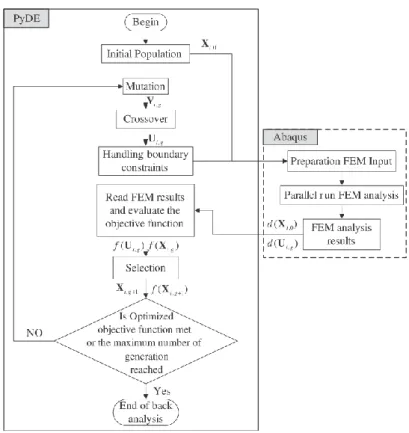
Whether the search strategy used in the optimization is simple or complex, a procedure with a clear structure is necessary and important for the successful identification of parameters. The function of the procedure is to conduct the error function and search strategies together. Therefore, the procedure should be presented before conducting the optimization. Calvello and Finno [19] gave a three step procedure for a general identification of soil parameters, as shown in Figure 1.2; Zentar and Hicher [20] presented a simplified procedure to combine the finite element code CESAR-LCPC and the SiDoLo optimization tool to identify modified Cam-clay (MCC) parameters from pressuremeter tests, as shown in Figure 1.3; Finno and Calvello [18] presented a relatively complex procedure to combine the computer code UCODE and the software tool PLAXIS for identifying Hardening Soil (HS) model parameters from excavation, as shown in Figure 1.4; Obrzud et al. [21] presented a procedure employing a two-level neural network tool to conduct the parameters identification, as shown in Figure 1.5; Zhang et al. [22] presented a procedure involving the MUSEFEM finite element code and particle swarm optimization for identifying the soil parameters of an unsaturated model from pressuremeter tests, as shown in Figure 1.6; Zhao et al. [23] presented an optimization procedure involving a differential evolution algorithm and ABAQUS software for identifying MCC parameters from an excavation, as shown in Figure 1.7.
Figure 1.3 Numerical process to identify soil parameters
Figure 1.5 Scheme of the two-level parameter identification using neural network tool
Figure 1.6 Flow chart for identifying soil parameters using particle swarm optimization from pressuremeter tests
Figure 1.7 Back analysis with an interaction between the differential evolution algorithm and ABAQUS
The procedures presented above, and others which are not presented here, are summarized as Figure 1.8. Most identification procedures are based on two different codes: the FEM code (e.g. PLAXIS [19], FLAC [24] and ABAQUS [23]) or single Gauss point integration of a constitutive model (e.g. Jin et al. [25, 26] and Ye et al. [27]) for the simulation, and the search method code for finding the optimal solution.
For the initialization step shown in Figure 1.8, there are two main methods used for sampling initialization: uniform and random. For uniform sampling, a method introduced by Sobol [28] is usually adopted. The SOBOL method is a deterministic algorithm that imitates the behavior of a random sequence. The aim is to obtain a uniform sampling of the design space. It has been reported to be suitable for problems with up to 20 variables [12, 25-27], and is therefore used in optimising geotechnical engineering problems. For random sampling, a particular method named Latin Hypercube Sampling (ULH), proposed by McKay et al. [29] is usually adopted. ULH is an advanced Random (Monte Carlo) Sampling. Compared to the commonly used Random (Monte Carlo) method,
ULH is better at mapping the marginal probability distributions (i.e., the statistical distribution of each single variable), especially in cases where there is a small number of generated designs.
For objective tests, laboratory tests or field tests can be adopted in the optimization for calibrating model parameters. These test results are usually displayed in the form of a displacement-stress curve, which implies the softening or hardening, the contraction or dilation of soil. In other words, the results of selected tests can provide information to optimize the model parameters, which is the basis of parameter identification with an optimization method. For laboratory tests, the isotropic or anisotropic compression and conventional triaxial tests are usually recommended for use within the industry [17, 18, 25-27, 30]. For field tests, the pressuremeter test [12, 13, 19, 22, 31], pile [32], excavation [15, 16, 23, 33, 34], and tunnelling [24, 35-37], are usually employed.
Either one of the error functions introduced above can be adopted to calculate the fitness value to the results of the optimization method.
For the optimization algorithms, the deterministic techniques (e.g. gradient-based algorithms, and simplex) or stochastic techniques (e.g., genetic algorithms, particle swarm optimization and differential evolution algorithms) can be employed to minimize the error. The optimization process does not stop until the convergence criterion is attained.
Input parameters Initialization Error Evaluation Run Simulation Optimization algorithm Stopping Criterion met? Optimal solution Yes No Generate new parameter sets Optimization Program Experimental data Error function Numerical simulation
1.3 Review of optimization techniques
Until now, numerous optimization techniques have been applied to solve different problems in geotechnical engineering. In this section, some typical and widely used optimization techniques are reviewed and their basic principles are introduced.
1.3.1 Deterministic optimization techniques
1.3.1.1 Gradient-Based algorithms
The gradient method is probably one of the oldest optimization algorithms, as far back as to 1847 with the initial work of Cauchy. Nowadays, gradient-based methods have attracted a revived and intense interest among researchers both in theoretical optimization and in scientific applications [38]. In optimization, the gradient method is an algorithm used to solve problems, with the search directions defined by the gradient of the function at the current point. Based on the basic principle of gradient, different gradient-based methods have been developed to date, such as the steepest descent method, the conjugate gradient method, the Levenberg-Marquardt method [39, 40], the Newton method and several Quasi-Newton methods. Unlike the steepest descent gradient methods, which only use first order information (the first derivative term in the Taylor series) to obtain a local model of the function, the Newton-based gradient methods use a second-order Taylor series expansion of the function on the current design point. In addition to the above mentioned gradient-based methods, the Davidon-Fletcher-Powell (DFP) method and the Broyden-Fletcher-Goldfarb-Shanno (BFGS) method are also widely used in optimization engineering.
The primary advantage of a gradient-based method is rapid convergence. Clearly, the effective use of gradient information can significantly improve the speed of convergence, unlike a method that does not compute gradients. However, gradient-based methods have some limitations, being strongly dependent on user skill, due to the need to choose the initial trial solutions. Also, they can easily fall to local minimums, mainly when the procedure is applied to multi-objective functions, as is the case with material parameter identification. The requirement of derivative calculation makes these methods non-trivial to implement. Another potential weakness of gradient-based methods is relative intolerant of difficulties such as noisy objective function spaces, inaccurate gradients, categorical variables, and topology optimization.
The gradient-based methods have been used for solving different geotechnical engineering problems, such as identifying the soil model parameters [13, 16, 19, 20, 31, 35, 37, 41-45] or soil permeability [46], optimizing back-analysis for tunneling-induced ground movement [47], and analysis of excavation-induced wall deflection [48]. However, due to their limitations, gradient-based methods cannot be satisfactorily applied to complex nonlinear optimization problems.
1.3.1.2 Nelder-Mead simplex
The simplex algorithm is a nonlinear optimization algorithm developed by Nelder and Mead [49] for minimizing an objective function in a poly-dimensional space, which adopts a direct search strategy. The method uses the concept of a simplex, which is a polytope of N+1vertices in N dimensions, and finds a locally optimal solution to a problem with N variables when the objective function varies smoothly.
The Nelder-Mead simplex can change during iteration in five different ways (Figure 1.9) in two dimensions (Lagarias et al.[50]). Apart from the case of a shrink, the worst vertex of the simplex at iteration k (point p3 in the figure) is replaced at iteration k+1 by one of the reflection, expansion, or
contraction points (Nelder and Mead [49]). If this new point is not much better than the previous value, then the algorithm knows it is stepping across a valley, so it will shrink the simplex towards the best point. Based on this description, users feel that they understand how the method functions. The simplex can lead to the best solution using a limited number of calculations. In that sense, it can be fast and efficient.
Reflection Expansion Outside contraction Inside contraction Shrink p p p p 3 p p3 p3 p3 p3 2 p 1 p r p e p out p in p
Figure 1.9 Structure of Nelder-Mead simplex algorithm
However, most direct search strategies, such as the gradient-based methods and simplex described above, are only capable of searching for a local minimum. Generally, there is no way to
check whether the local minimum obtained is also the global one. A possible solution to this problem is to start the search from different initial positions and, if the local minima become the same, then this is most probably also the global minimum.
Nevertheless, there are still many applications for the simplex due to its excellent convergence speed, such as identifying the cohesion, and friction angle of an elastoplasticity model and initial stress using a flexible polyhedron (modified simplex) strategy [8]; estimating soil hydraulic properties from field data [51]; identifying parameters of a hardening soil model based on pressuremeter tests [12], and identifying both creep and destructuration related parameters for soft clays [27].
1.3.2 Stochastic optimization techniques
1.3.2.1 Genetic algorithms (GA)
The genetic algorithm (GA) originally developed by Holland [52] is a simulation mechanism of Darwinian natural selection and a genetics computational model of the biological evolutionary process. It is also a process to search for the optimal solution by simulating the natural evolution. In GAs, an encoding scheme is first used to represent a point (individual) in the search of decision variables, and then each individual of the population is assigned a fitness based on certain criteria. In early implementations [53], the decision variables were encoded as strings of binary alphabets using ‘zero’ and ‘one’. The performance of binary GAs are found to be satisfactory on small and moderately sized problems, which do not require as much precision in the solution, but for high dimensional problems in which a higher degree of precision is desired, binary GAs require huge computational time and memory [54]. To overcome these difficulties, real coded GAs, in which decision variables are encoded as real numbers, are now more commonly used. It has been established that real coded GAs are superior to binary coded GAs for continuous optimization problems [55].
The procedure of a general genetic algorithm is presented in Figure 1.10. Once the genetic representation and the fitness function are defined, the GA proceeds by initializing a population of solutions and then improving it through repetitive applications of the selection, crossover, inversion and mutation operators. Genetic algorithms work with a population of solutions, so that they can provide a set of satisfactory solutions. They also do not use any gradient information and they are based on stochastic principles. Therefore, they are considered more robust than the gradient methods.
Initial population Evaluation Fitness Selection Rand(0,1)<pc No Yes Crossover Rand(0,1)<pm Mutation Stopping Criterion met? Optimal solution Yes Replacement No Yes
Figure 1.10 General flow chart of GA
In geotechnical fields, GAs have been widely employed to solve various problems such as parameter identification of constitutive models [11-15, 17, 18, 25, 26, 56, 57], prediction of soil hydraulic parameters [58-60], identification of critical slip surfaces in slope stability analysis [61-65], prediction of vertical settlement [66], optimization of pile group design [32, 67], reliability analysis [68], road maintenance [69], and prediction of soil-water characteristic curves [70].
1.3.2.2 Particle swarm optimizations (PSO)
Particle swarm optimization (PSO) is a population-based stochastic global optimization algorithm which was first suggested by Kennedy and Eberhart [71] in an attempt to simulate the graceful choreography of flocks of birds, as part of a socio-cognitive study on the notion of “collective intelligence” in biological populations.
Initial particles Evaluation Fitness
Assign best pBest to gBest Calculate velocity
for each particle Fitness better
than pBest ?
No
Update the data values No Yes Optimal solution Assign current fitness as new pBest
Keep previous pBest Yes
Target reached ?
Figure 1.11 General flow chart of PSO
Figure 1.11 shows the procedure of PSO to find the best solution. In PSO, a number of simple entities, the ‘particles’, are randomly placed in the search space of a given problem or a given function, and each entity evaluates the objective function at a particular location. Each particle then determines its movement through the search space by combining some aspect of the history of its own actual and best (best-fitness) locations with those of one or more members of the swarm, with some random perturbations, as shown in Figure 1.12. The new position xi
t of the ith particle canbe defined as,
1
, 1, 2, ...,i t i t i t i Np
x x V (1-10)
where Np is the total number of particles. The new velocity Vi
t of the ith particle is calculated by,
1
1 1
1
2 2
1
i t w t i t c r pBesti i t c r gBest i t
where r1 and r2 are random numbers between 0 and 1; pBest is the local best position (the best i
among all previous positions at time (t-1)); gBestis the global best position (the best particle position among all known particle positions within the whole swarm); w(t) is the inertia weight used to control the impact of the previous particle velocities on the current velocity and it is usually taken as slightly less than 1 [30]. The learning factors c1 (cognitive weight) and c2 (social weight) are
positive constants, which determine how much the particle is directed towards the good positions and are usually adapted to the individual task to be solved by manual variation, but usually are set as equal to 2 [30]. The local best position for the ith particle is updated, if
i
i
F x F pBest (1-12)
and the global best position is updated, if
i
F x F gBest (1-13)
The next iteration takes place after all particles have been moved. Eventually, the swarm as a whole, like a flock of birds collectively foraging for food, is likely to move close to an optimum of the fitness function.
i pBest i t x 1 i t x i 1 w t V t gBest
1 1 i i 1 c r pBest x t
2 2 i 1 c r gBestx tFigure 1.12 Schematic diagram of the method of the PSO
Unlike in GA with its binary encoding, in PSO, the design variables can take any value, based on their actual position in the design space and the calculated velocity vector. PSO also has no evolution operator such as crossover or mutation, which makes it ideal for asynchronous parallel implementation. However both algorithms have similar functions for finding the best solution. The comparison between GA and PSO has already been investigated in terms of computational effectiveness and efficiency by several researchers [72, 73]. Each algorithm has its unique advantages for solving different types of problems.
PSO has been shown to provide valuable results in various inverse geotechnical problems, such as parameter identification of constitutive models [22, 30, 74-80], identification of hydraulic
parameters for unsaturated soils [81], parameter identification in soil-structure interaction [82], location of the critical non-circular failure surface in slope stability analysis [83], and parameter estimation of laboratory through-diffusion transport of contaminants [84].
1.3.2.3 Simulated annealing (SA)
Simulated annealing (SA) is a random-search technique which exploits an analogy between the way in which a metal cools and freezes into a minimum energy crystalline structure (the annealing process) and the search for a minimum in a more general system [85]. Classical simulated annealing (CSA) was proposed by Kirkpatrick et al. [86]. Due to the inherent statistical nature of simulated annealing, in principle local minima can be hopped over more easily than in gradient-based methods [87].
Input & Assess initial solution Estimate initial temperature Generate new solution Assess new solution Accept new solution? No Yes Updates stores Stopping Criterion met? Adjust temperature Optimal solution Yes No
Figure 1.13 General structure of SA algorithm
Figure 1.13 shows a general structure of simulated annealing algorithm. A simple form of local search (a descent algorithm) starts with an initial solution. A neighbor of this solution is then
generated by some suitable mechanism and the change in cost can be calculated. If a reduction in cost is found, the current solution can be replaced by the generated neighbor; otherwise the current solution is retained. The process is repeated until no further improvement can be found in the neighborhood of the current solution and so, the descent algorithm terminates at a local minimum.
Further details about the strengths, and weaknesses of simulated annealing, and a comparison with other methods, can be found in Busetti [85]. For simulated annealing, there are few applications in geotechnical field, one example is to determine a safety factor for slope stability [88].
1.3.2.4 Differential evolution algorithm (DE)
The differential evolution (DE) algorithm, proposed by Price and Storn [89, 90] is a simple, yet powerful population-based stochastic search technique, which is an efficient and effective global optimizer in the continuous search domain. Like other population-based optimization algorithms, DE also involves two phases: initialization and evolution. In the initialization phase, the DE population is generated randomly if nothing is known about the problem. In the evolution phase, individuals from the population traverse mutation, crossover, and selection processes repeatedly until the termination criterion is met. The DE algorithm was sometimes considered as a variant of a GA because it had the same optimization process. The main difference in constructing better solutions is that a GA mainly relies on crossovers whereas DE relies mainly on a mutation operation. The DE uses a mutation operation as a search mechanism and a selection operation based on the differences in randomly sampled pairs of solutions in the population,
3 2 1 , 1, 2, 3 1, 2, ..., , 1, 2 , 0, 1 k i r r r k p F r r r N k F x x x x (1-14)where F is a scaling factor which is closely related to the convergence speed. k indicates the k
number of difference vectors taking part in the mutation operation; x ,r1 x andr2 x are selected r3
individuals from the population which are different from the running individual x . i
Furthermore, the DE algorithm also uses a non-uniform crossover that can take child vector parameters from one parent more often than it does from others. Selecting the DE algorithm takes the competition mechanism. Each new solution produced competes with a mutant vector and the better one wins the competition.
As evolution proceeds, the population of DE may move through different regions in the search space, within which certain strategies associated with specific parameter settings may be more effective than others (Qin et al. [91]). However, the performance of the conventional DE algorithm depends highly on the chosen trial vector generation strategy and associated parameter values used. DE does not guarantee the convergence to the global optimum. It is easily trapped into local optima resulting in a low optimizing precision or even a failure (Jia et al. [92]).
In geotechnical engineering, the DE has been applied to cope with different optimization problems, such as parameter identification of constitutive models [23, 93, 94], and back analysis of tunneling [24].
1.3.2.5 Artificial bee colony (ABC)
The artificial bee colony (ABC) algorithm originally developed by Karaboga [95] in 2005 is an optimization algorithm simulating the intelligent foraging behavior of honey bee swarms. It is a very simple, and robust population-based stochastic optimization algorithm.
The ABC algorithm describes the foraging, learning, memorizing and information sharing behavior of honeybees. A basic model of the foraging behavior of honeybee swarms consists of two essential components, and defines two leading modes of behavior. The artificial bee colony consists of three groups of bees: employed bees, onlookers, and scout bees.
The colony of the artificial bees is divided into two groups: the first half of the colony consists of the employed artificial bees, and the second half of the onlooker bees. Scout bees are the employed bees whose food source has been abandoned. In the ABC algorithm, the position of a food source represents a possible solution to the optimization problem (value of design variables) and the nectar value of a food source corresponds to the quality of the associated solution (fitness value). The number of employed bees is equal to the number of onlookers, and is also equal to the number of food sources. Any food sources that cannot be improved further in certain cycles will be replaced with a new food source by a scout bee.
Following Karaboga and Akay [96], the flow chart of the algorithm is shown in Figure 1.14. Further details of the ABC algorithm, can be found in Karaboga and Basturk [97].
However, as in other evolutionary algorithms, the ABC algorithm also faces some challenging problems [98]. For example, the convergence speed of an ABC algorithm is typically slower than those of representative population-based algorithms (e.g., DE and PSO) when handling these unimodal problems [96]. In addition, an ABC algorithm can become easily trapped in the local optima when solving complex multimodal problems.
Initial food source positions Calculate the nectar
amounts
No All onlookers
distributed ?
Find food source position
Yes
No
Yes Determine the new food positions for the
employed bees Calculate nectar
amounts
Determine a neighbor food source for the onlooker Select a food source for
an onlooker Memorize the position
of best food source Find the abandoned
food source Produce new position for the exhausted food
source Stop criterion
met ?
Figure 1.14 Flow chart of the ABC algorithm
The applications of ABC algorithms in geotechnical engineering vary for different problems. The ABC algorithm has been employed to locate the critical slip surface of a slope [99, 100]; to predict the uplift capacity of suction caissons [101]; and to analyze the reliability of geotechnical engineering solutions [102, 103].
1.3.2.6 Others
Apart from the previously mentioned optimization methods, some other algorithms, initially developed by modeling the behavior of social insects such as ants and bees, have been developed for the purpose of solving some certain optimization problems. Among them, Ant Colony Optimization (ACO), a metaheuristic for solving difficult combinatorial optimization problems, was introduced by Dorigo et al. [104, 105] as a novel nature-inspired metaheuristic for solving of hard combinatorial optimization (CO) problems. The inspiration behind ACO is the trail laying of pheromone and following behavior of real ants, who use pheromones as a communication medium. More information about ACO can be found in Dorigo [106]. In the geotechnical field, ACO has initially attracted more attention, as applications include estimating unsaturated soil hydraulic parameters [107] and determining the critical failure surface for slope stability analysis [108].
Similar way to ACO, the Honey-bee mating algorithm (HBMO) [109], the Bacterial Foraging Optimization Algorithm (BFOA) [110] and the Krill herd (KH) algorithm [111] are also considered as typical bio-based approaches to optimization. However, their applications in geotechnical engineering have not been presented to date.
1.4 Hybrid optimization techniques
Conventional optimization methods usually suffer from the local optimality problem and slow convergence speed, which limits the application of these traditional methods to a small range of real word problems, even sometimes causing a failure optimziation at times. In order to enhance the optimizing performance of these traditional algorithms, an efficient method is to combine the advantages of each approach with a hybrid strategy (e.g. Tsai et al. [112] and Shi et al. [113]). The hybrid strategies can generally be divided into three groups: (1) hybrids of different operators (e.g. different crossovers in GAs [114]); (2) hybrids with a local search (e.g. GA or PSO with simplex [115], GA, and GA, PSO or DE with chaotic [92, 116, 117]); and (3) hybrids of different optimization techniques (e.g. GA and PSO [118, 119], GA and DE [24], PSO and ABC [120], and PSO and ACO [121]). In geotechnical engineering, due to the high performance, hybrid optimization algorithms, have become more used and have been applied to many optimization problems, such as optimization of pile groups [67], the identification of geomechanical parameters [122], slope reliability analysis [123], and prediction of the uplift capacity of suction caissons [101]. In the future, other geotechnical problem are likely to be solved with these hybrid optimization techniques.
1.5 Conclusions
A review of optimization techniques in identifying parameters has been presented. First, the methodology of parameter identification was reviewed. Different kinds of error functions for measuring the difference between experimental and numerical results and different optimization procedures were reviewed.
The widely used optimization techniques in geotechnical engineering including: (1) deterministic techniques (gradient-based methods and Nelder-Mead simplex); (2) stochastic techniques (GA, PSO, SA, DE, ABC and other similar techniques); and (3) hybrid optimization methods have been presented with an introduction to their basic principles and applications,.
Chapter 2 Comparative study of currently used typical optimization techniques
2.1 Introduction
Generally, each optimization technique has its advantages and drawbacks, which means that not all the optimization problems can be solved effectively by one optimization method. For any given optimization problem, it is necessary to evaluate the optimizing performance of different methods and then to select the most appropriate method for conducting the optimization procedure. In order to evaluate the search ability and convergence speed of optimization techniques in identifying parameters, different optimization techniques need to be applied to the same optimization problem.
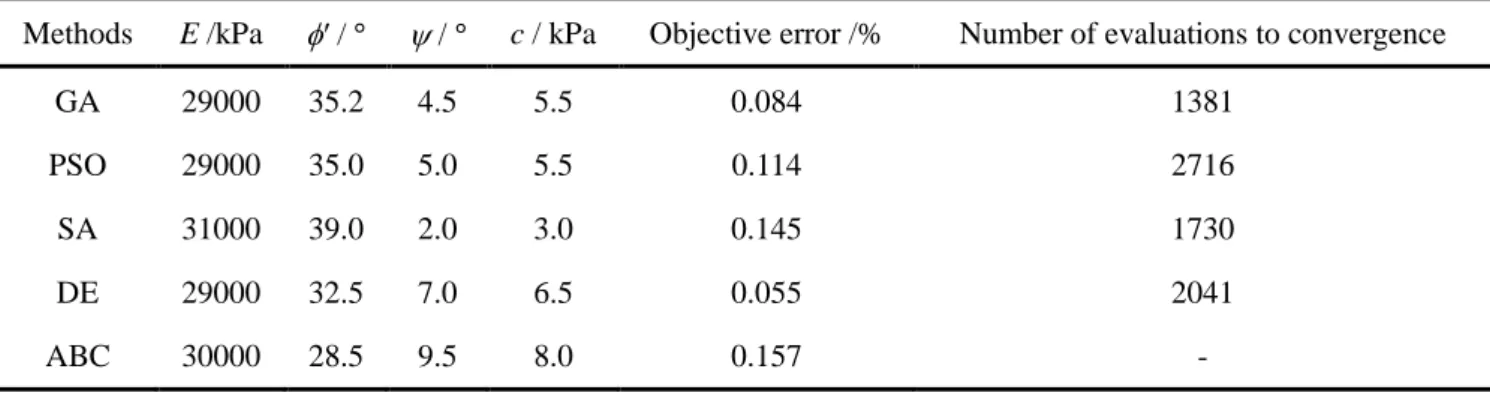
The deterministic optimization methods have significant discrepancies of search ability ensuring only the local minimization reported by many researchers, and therefore they have not been repeated for comparative study. The stochastic methods have generally good search ability, and are usually adopted for combining hybrid methods. Therefore, stochastic methods are more basic than hybrid methods, and five of the mostly used stochastic methods in geotechnical field (i.e., GA, PSO, SA, DE and ABC) were thus adopted for comparisons. Two typical cases, i.e. identification of parameters from pressuremeter tests and excavation measurements respectively were adopted for optimization process.
2.2 Case 1: Pressuremeter test
2.2.1 Simulation of Pressuremeter test
D D D D D D D D D D D D D D D D D D D D 0 .1 6 m 1.6 m Axis D is p la ce m en t
Figure 2.1 Geometry model of PMT test in ABAQUS
In order to conduct the comparative study, a parameter identification using the Mohr-Coulomb (MC) model for a pressuremeter test (PMT) was selected. For a fair comparison and absolute


![Figure 4.1 Typical flow chart for the EPR procedure using RCGA (after Giustolisi and Savic [181])](https://thumb-eu.123doks.com/thumbv2/123doknet/14701869.747118/67.892.340.594.108.590/figure-typical-flow-chart-procedure-using-giustolisi-savic.webp)