Lire
la
première partie
Chapter II: Microstructure and mechanical properties of Inconel 718
(a) (b)
Figure II. 28 Eruption of oxidised (Nb,Ti)C (a) [Connolley et al.,2003], dependence of thermal exposure and temperature on carbides eruption phenomena[Hong et al.,2005].
These results confirm the evidence that a volume expansion of oxidising primary carbides constitutes a mechanism of environmentally assisted crack initiation, that affects the fatigue life of Inconel 718.
XI.2 Crack propagation
Once a crack initiates, it may grow as a result of extended cyclic loading. As discussed early, the propagation path shows a transition from a growth mechanism along the active slip direction (Stage I) to a deviation on a non-crystallographic plane (Stage II) which occurs over few grains. The stage II is often considered as corresponding to a continuum mechanism which influences the fatigue performances of the alloy. The study and the understanding of the mechanisms of Fatigue Crack propagation (FCP) are critical steps in the optimisation of the material. A large number of research programs have been carried out over the last fifty years, in order to investigate the influence of various parameters on the crack growth.
The grain size plays an important role not only for crack initiation, but also for damage propagation: Pedron [Pedron et al.,1982] compared the FCG behaviour of three different microstructures, using a trapezoidal signal with a hold period of 300 seconds at 650°C (Figure II. 29). More precisely, the author compared a fine grained microstructure (ASTM 6-8) with a coarse grained microstructure (ASTM 3-4) and a necklace microstructure (ASTM 3-4 and 8-10). Results showed that the necklace structure gives the best properties while the worst situation is encountered with the fine grain structure. This last structure is considered as the most sensitive to the environmental effects: grain boundaries, as it will be discussed in the next section, are considered as oxidation paths prone to accelerate the intergranular rupture of the alloy. These considerations were confirmed by a series of tests performed under vacuum where all materials exhibited similar behaviour.
The observations on the necklace resistance to crack propagation are in perfect agreement with the studies reported by Lynch [Lynch et al.,1994], who compared the behaviour of a direct age Inconel alloy to a standard treatment. Figure II. 30(a) shows that the direct age structure exhibits a higher resistance to the crack propagation, when tested under
creep-Chapter II: Microstructure and mechanical properties of Inconel 718
high resistance to the crack propagation under creep-fatigue conditions.
Figure II. 29 : Effect of microstructure and environment on the FCP at 650°C: open symbols vacuum, full symbols air [Pedron et al.,1982].
The negative effects of the microstructure on the propagation process, particularly noticed for the standard grade, could be limited by a careful control of the grain boundaries morphology. For this purpose, an innovative thermal treatment (DT 718) was developed by Guedou [Guedou et al.,1994] in order to improve the crack-propagation resistance at high temperature 700-750°C. This procedure, based on an over-aging treatment at 750°C for 50 hours, subsequent to a standard treatment, leads to a microstructural alteration. The grain morphology is more serrated as a result of the heterogeneous distribution of the delta phase at the grain boundaries. Figure II. 30(b) reports the result obtained by the application of a fatigue-creep loading with a dwell time of 90 seconds. It is clear that the benefit of using DT 718 increases with temperature. The superior crack propagation resistance of the modified heat treated materials is due to the presence of serrated grain boundaries which suppress grains sliding as confirmed in earlier studies [Koul et al.,1988]. In addition, a double precipitation/coarsening of γ’ and γ” phases leads to a more homogeneous slip deformation which limits the oxygen penetration along the affected grains. Consequently, the oxidation effects at the crack tip, which contribute to high cracking rates, are prevented.
Chapter II: Microstructure and mechanical properties of Inconel 718
(a) (b)
Figure II. 30 Crack propagation rate evolution as function of different microstructures (a) [Lynch et al.,1994] and alternative thermal treatments (b) [Guedou et al.,1994].
The previous considerations have pointed out the role of the microstructure on the initiation and propagation of cracks. It is obvious that the microstructure has also an important impact on the fatigue performances of the alloy. Figure II. 31 illustrates the effects of the grain size at 350°C [Spath et al.,2001].
Figure II. 31 : Variation of the fatigue life with microstructure. LCF test realised at 350°C at low frequency (1 Hz) [Spath et al.,2001].
These results highlight that a fine grain structure, in the range ASTM 10-12, leads to a substantial fatigue life increase if compared to a coarse grain structure. When the initiation sites are localized on grains, the material exhibits a higher fatigue life, in contrast to a particle initiation which degrades the mechanical properties of Inconel 718. It can be concluded that
Chapter II: Microstructure and mechanical properties of Inconel 718
preferred.
XI.3 Environmental effects
The environmental effects on the fatigue behaviour of Inconel 718 occur in several ways, causing an embrittlement of the material. The previous results, reported for description of the crack growth behaviour, have shown a particular influence of the environment on the propagation rate. The detrimental effects of the air environment are largely documented in the literature. The observations of the fatigue surfaces of specimens, reported by Pedron
[Pedron et al.,1982], have shown that oxygen, at 650°C, is responsible for the occurrence of
brittle intergranular fractures. Tests carried out under vacuum exhibit a fracture surface fully transgranular with the presence of local deformations at grain boundaries.
The intergranular nature of the crack path, associated to a high growth rate, depends on a oxidation mechanism which reduces the ductility of the grain boundaries. These effects are considered as a strong interaction between the mechanical behaviour and the environment, supported by the occurrence of an oxidation phenomenon. This is considered as a diffusional process, mainly influenced by time and temperature. The oxygen activity could be identified in terms of short or long range interaction [Andrieu et al.,1992]. The first mechanism is responsible for the growth of an oxide layer at the crack tip, whereas for the second mechanism, the oxygen penetrates along slip planes and grain boundaries. These processes lead to an inhibition of sliding and a migration of the grain boundaries reducing their ability to release the local stresses deriving from the deformation evolution. Molins [Molins,1995] showed that the oxidation process in Inconel 718 is based on two different stages. Oxidation tests, performed in-situ at 650°C, have shown that some preliminary homogeneously distributed nuclei of (Ni,Fe)O form, at the early stages of the process on the grain surfaces. On the inner subsurface, chromium oxide (Chromia Cr2O3) homogeneously forms. The
coalescence of the oxide nuclei leads to the formation of a continuous layer with parabolic kinetics. The porous morphology of FeO and NiO oxides stands for a selective path for oxygen diffusion, promoting chromia formation.
Previous works [Andrieu et al.,1992; Molins et al.,1997; Bache et al.,1999] investigated the effect of the oxygen partial pressure PO2T on the preferential formation of
oxides. A transition pressure, independent from the mechanical loading, was detected in Inconel 718 alloy as a function of the alloy chromium content. At the lowest pressures (lower than 10-2 Pa) chromia oxide initially forms, inhibiting the development of a continuous layer of nickel oxide on the outer surface. However, when the oxygen partial pressure is higher than 1 Pa, a nickel rich oxide forms. As discussed before, the oxidation process is influenced by time. At atmospheric pressure, the time (tp) required to activate a passivation process
(formation of a continuous layer of Cr2O3) is estimated to be in the range 5-8 min (Figure II.
32) [Andrieu et al.,1992]. When these conditions are satisfied, no further oxygen penetration can take place along the affected grain boundary paths. Figure II. 32 reports the suggested mechanisms for grain boundary oxidation as a function of time.
Chapter II: Microstructure and mechanical properties of Inconel 718
(a) (b)
Figure II. 32 : Types of oxides as function of partial pressure and time (a), oxidation mechanisms at grain boundaries (b) [Andrieu et al.,1992].
The transition found in the oxidation process affects the crack growth rate of the alloy. The formation of the “wedge-shaped” oxide layers along the crack front, followed by their subsequent rupture at the boundary intersections, can increase the crack growth rate. Figure II. 33 illustrates the impact of oxygen partial pressure on the FCP. At pressures lower than PO2T the crack growth rate is independent of the pressure, whereas, beyond this critical value,
the crack propagation rate increases with the pressure. The material embrittlement could be explained considering the oxidation kinetics. When the cracks propagate faster than the time required to form chromia, NiO nuclei appear on the fresh crack surfaces. During the growth mechanism of the nickel oxide, the outer diffusion of Nickel cations Ni2+ is associated to a inner flux of vacancies which can not be annihilated at the oxide/metal interface, because of the coherency relationship between the oxide and the metal. The diffusion process promotes, then, the formation of vacancies at the crack tip. The embrittlement of the alloy results from the condensation of vacancies at the grain boundaries which reduces the crack propagation resistance. The stress relaxation at the crack tip is associated to a plastic strain. It can be noticed that the environmental effects are active until this deformation is positive, due to the interaction between dislocations and oxidation processes. [Ponnelle,2001]
Chapter II: Microstructure and mechanical properties of Inconel 718
Figure II. 33 : Fatigue crack growth as a function of the oxygen partial pressure. [Molins et al.,1997]
It is clear that the material sensitivity to the environmental effects is strongly dependent on its utility to release the stress at the crack tip. For this reason the application of modified thermal treatments, is discussed in the section dedicated to the crack propagation, is considered as a promising solution. The aim is to modify the microstructure in order to optimise the creep properties of the alloy and ensure a fast relaxation of stresses. The application of an over-ageing is a good compromise to guarantee a high crack propagation strength without affecting the static and dynamic mechanical properties (yield strength and creep resistance).[Molins,1995]
XI.4 Effect of the loading cycle on the fatigue properties of
Inconel 718
In industry, materials are usually loaded in complex fatigue conditions including variable holding time under stress/strain, cycle frequency, stress/strain ratio, resulting in a wide range of loading wave shapes. In many applications the mechanical components is subject to fluctuating and steady loadings, deriving from specific in-service conditions.
It is found that at high temperature, the material resistance degrades when a hold period is included in the load cycle. The amplitude of these effects depends on the duration of the steady state, the thermo-mechanical history (softening, hardening…) and the location of the holding period within the cycle (Tension and/or compression period).
The loading waveform has an important effect on the fatigue crack propagation. When a holding time is applied, especially at maximal load, a time dependent behaviour may be introduced. The material tends to be damaged trough O2 diffusion which decreases its
resistance to cracking. The variations in the time spent at peak stress affect the fracture profiles and the crack growth rates. Ponnelle [Ponnelle,2001] showed that the application of steady period of 300 seconds at maximal loading increases the crack growth rate by a factor 7.5 at 550°C, 50 at 600°C and 100 between 650°C and 675°C (Figure II. 34).
Chapter II: Microstructure and mechanical properties of Inconel 718
Figure II. 34 : Effect of the application of a holding time of 300 s on the crack propagation rate of Inconel 718 at high temperature. [Ponnelle,2001]
During the holding time an interaction between fatigue and creep effects can be assumed. The introduction of holding period in strain controlled fatigue tests generates a conversion of the elastic strain to plastic strain, due to the stress relaxation effects (Figure II. 35) . The level of the relaxed stress is proportional to the length of the holding period. The inelastic strain range associated to each fatigue cycle is based on two components:
cp p
in
ε
ε
ε
=
+
Eq.II. 3Where:
• ∆εp is determined by the hysteresis loop without the hold time
• ∆εcp is related to the stress relaxation during holding time by the following equation:
E
r
cp
σ
Chapter II: Microstructure and mechanical properties of Inconel 718
The effects of the holding time on the fatigue performances depends on the test conditions. At temperatures below that defining the creep regime of the material, the holding time application has no effects on specimen life. Figure II. 36 illustrates the effect of different dwell times at 649°C under a continuous fatigue behaviour. [Korth,1991]
Since the amplitude of the hysteresis loop is proportional to the plastic strain range, the relaxation rate is influenced by the conversion of elastic strain to plastic. Considering the importance and the impact of the crack closure process, it is clear that a compressive holding period is less damaging than a tensile one. The crack closure effect decreases with the increase of the inelastic strain, where the crack growth, during tensile relaxation, becomes significant. [Coffin,1968]
Figure II. 36 : Effect of different holding times on the fatigue behaviour of Inconel 718 at 649°C [Korth,1991].
Frequency is also observed to impact cycle life mainly in the low-cycle regime. The results reported by Clavel and Pineau [Clavel et al.,1978] showed that, at 550°C, the fatigue growth rate is almost independent of frequency in the range 0.5 Hz to 20Hz. However, when frequency is decreased below 0.5 Hz, the crack propagation rate is strongly increased as compared to the case of higher frequencies.
Focusing on the deformation structure, the authors pointed out a strong inhomogeneity in the plastic deformation, shown, at low frequency, by the occurrence of twinning. Conversely, at room temperature, the material exhibits a homogeneous plastic zone where the deformation occurs through planar slip even at high crack propagation rates (da/dN > 0.01
µm/cycle). It is clear that temperature plays an important role in the deformation mechanism
enhancing the impact of frequency on the mechanical properties.
Figure II. 37 reports the evolution of the stress amplitude versus fatigue for tests performed at 3 cycles/minute and 0.3 cycles/minute. A lower frequency corresponds to a fast softening which leads to a decrease in the fatigue life.
Chapter II: Microstructure and mechanical properties of Inconel 718
Figure II. 37 : Evolution of the stress amplitude of a LCF test with strain rate at 550°C.[Fournier et al.,1977]
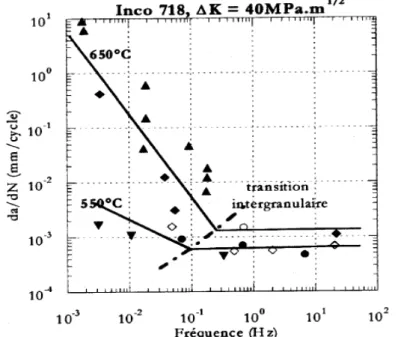
Pedron [Pedron et al.,1982] studied the effects of frequency on the fracture profile. The graph, reported in Figure II. 38, shows the existence of two regimes: a first regime “cycle
dependent”, at high frequency, where the fracture is fully transgranular and independent of
the test frequency, and a second one , so called “time dependent”, at low frequency, where the propagation becomes intergranular and increases with decreasing frequency. These effects are further emphasized by an increase in test temperature.
Figure II. 38 : Variation in the Fatigue Crack growth with the test frequency and temperature for Inconel 718. [Pedron et al.,1982]
The influence of the frequency on the fatigue life of Inconel 718 was explained by Andrieu
[Andrieu,1987] as resulting from a direct interaction between damaging mechanisms and
environmental effects . The oxides formation, at high temperature, is strongly influenced by the localisation of the plastic strain. When material is homogenously deformed, the presence of multiple slip bands at the crack surfaces enhances the diffusion of Cr, facilitating the instantaneous formation of a chromia layer. In such a way, the mechanical properties of the
Chapter II: Microstructure and mechanical properties of Inconel 718
grain boundaries are not affected by the oxidation process, reducing the crack propagation rate.[Molins,1995]
However, when the deformation mechanism becomes heterogeneous, especially at low frequencies, a transient embrittlement occurs through the activation of an intergranular oxidation process (NiO) which accelerates the crack propagation and delays the passivation process [Molins et al.,1997].
All the assumptions have pointed out the dependence of the material behaviour on its specific microstructure. Advanced applications at high temperature are often limited by the tensile, creep, and fatigue mechanical properties of the alloy. These mechanical properties vary with the size, shape and quantity of the strengthening precipitates. It is therefore important to quantify these precipitate parameters and relate them to mechanical properties. For these reasons, a detailed description of the individual effects of the precipitates on the mechanical behaviour of the alloy is reported in the next section.
Chapter II: Microstructure and mechanical properties of Inconel 718
XII
Influence of the intergranular precipitates and solute
atoms on the mechanical behaviour
XII.1 Delta phase impact on the mechanical behaviour
Delta phase has an important effect on the microstructure and the mechanical resistance of Inconel 718. In general, precipitates are discontinuously distributed at grain boundary under normal heat treatment conditions. In some cases, Delta phase was observed within grains showing a cluster appearance with several orientation relationships.
As reported in section X, Inconel 718 is subject to a deformation process based on the dislocations movement along primary slip bands (PSB). Previous works have shown that Delta phase usually precipitates along {111}γ planes which correspond to the main slip
systems. In these circumstances, the heterogeneous bands, whose width is about 0.4-0.6 µm, are extended into needle-like δ particles at grain boundaries, which delays their translation. These mechanisms are not associated to the occurrence of voids or cracks at the intersecting points of δ phases and slip lines [Yuan et al.,2005].
Desvallées [Desvallées et al.,1994] investigated the effect of delta phase on the tensile properties of Inconel 718: the author compared a “standard thermal treatment alloy”, where δ particles are only present at grain boundaries, to an alternative material with a microstructure characterised by a high amount (10% volume fraction) of intergranular/transgranular δ phase. The results showed a detrimental effect of the presence of delta phase on the yield strength of the alloy, reduced by 10%.
A specific control of the microstructure, of the distribution and morphology of the delta phase is essential to improve the cracking resistance of the alloy. As described before (Paragraph XI.2), the coupled effects of mechanical loading and environmental attack lead to an intergranular crack propagation. In this case delta phase plays a role as obstacle able to block the grain boundary propagation. Guided by these particles, crack follows a zig-zag path (Figure II. 39 (a)). These considerations were improved by the studies reported by Li [Li et
al.,1994] who analysed several microstructures obtained by a direct ageing treatment. All the
tests were carried out at a 650°C under creep-fatigue conditions. Results confirmed that a high amount of delta phase decreases the crack propagation rate of the alloy (Figure II. 39 (b)).
Chapter II: Microstructure and mechanical properties of Inconel 718
(a) (b)
Figure II. 39 : Role of delta precipitates on the crack propagation mechanisms (a) [Ponnelle,2001], crack propagation rates at 650°C as a function of the amount of delta precipitates (Treatment A contains more
delta phase than treatment B) (b) [Li et al.,1994].
The improvement of the fatigue resistance, especially at high temperature, is associated to the interaction between the precipitation of these intergranular particles with the other strengthening phases. Delta phase formation is a Nb diffusion control process. Often δ phase is surrounded by a zone depleted in Nb, free of γ” precipitates and particularly ductile. These areas, as illustrated in Figure II. 40, still contain γ’ particles, especially when ageing is carried out at temperature below the γ’ solvus [Sundararaman et al.,1994]. The ductile regions can rapidly release the stress concentration at grain boundaries, delaying crack propagation and limiting the environmental effects.
Figure II. 40 : TEM micrograph of the precipitates-free zone around δ precipitates [Burke et al.,2000].
During forging, the material is subjected to several thermo-mechanical operations leading to a microstructural orientation of the delta phase and carbide particles. Ponnelle [Ponnelle et
al.,2001] analysed the role of these Forming Induced Arrangement (FIA) on the propagation
Chapter II: Microstructure and mechanical properties of Inconel 718
alignments. It is important to point out that these alignments act as preferential path for the oxygen diffusion, increasing the embrittling effects of the environment. However, when crack front is normal to the delta arrangements, a delamination mechanism is activated. This process decreases the stress triaxiality leading to a reduction of the crack propagation rate.
The delta phase has also an important effect in the definition of the microstructural features, acting as an effective barrier to static recrystallization. The particles tend to precipitate heavily in strained grains at 990°C or below and resist to grain boundary migration even if such particles are a spheroidal. When the temperature is well above 990°C, i.e., 1010 to 1025’C, delta particles dissolution and rapid grain growth occur [Radavich et
al.,1989].
When the material is processed by a Direct Age treatment, multiple hot deformation process act on the microstructure of the alloy in order to ensure a dynamic recrystallization (DRX). The plate-like delta phases, whose orientation is not perpendicular to the compression direction, are submitted to a continuous deformation breakage which leads to a
spheroidization [Zhang et al.] of the particles (Figure II. 41). In such a way, dislocations are
accumulated around δ phases as strain increases. This mechanism increases the rate of dislocation nucleation, promoting Dynamic Recrystallization. The thermo-mechanical process leads to an ultra fine structure providing high mechanical properties [Wang et
al.,2009].
(a) (b)
Figure II. 41 : Role of the delta phase in the dynamic recrystallization (a) [Wang et al.,2009], dissolution breakage and creation of globular delta particles (b) [Zhang et al.].
XII.2 The Dynamic Strain Aging (DSA)
Previous sections have shown that the LCF behaviour is often influenced by various test parameters like frequency (strain rate), wave form and holding time under stress.
In addition to the time dependent mechanisms, the Dynamic strain aging is considered as a process, typical of many superalloys, prone to influence the cyclic behaviour of Inconel 718. DSA is a time dependent process based on an interaction between solute atoms and mobile dislocations during plastic deformation. In terms of deformation behaviour, this particular
Chapter II: Microstructure and mechanical properties of Inconel 718
mechanism is associated to a progressive decrease of the strain rate sensitivity parameter (SRS) which becomes negative in a limited range of temperature and strain rate:
p p T SRS
ε
ε
δ
δσ
, log = ⋅ Eq.II. 5Where σ is the flow stress, T the temperature, εp the plastic strain andε& the applied strain p
rate.
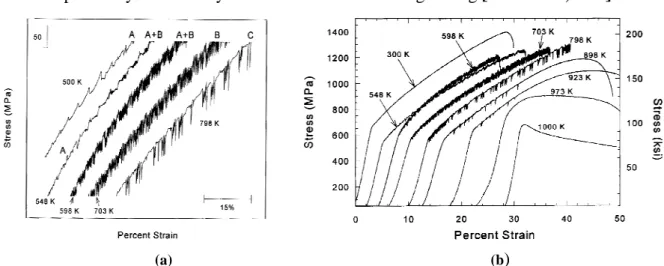
Different manifestation of the DSA mechanism can be noticed, such as yield stress plateau, reduced tensile elongation, sharp upper yield points and serrated stress-strain curves generally associated to Portevin-Le Chatelier (PLC) effects.
This phenomenon, generally considered as a plastic instability, is based on an intensive interaction between diffusive processes of solute atoms and mobile dislocations. Three types of plastic heterogeneities are identified (Figure II. 42): continuously propagating Type A, intermittently propagating Type B and random nucleating and propagating Type C. Previous works showed the activation of type C serration, for Inconel 718, in the temperature range 798-923 K. It’s interesting to point out that each load drop, in monotonic tensile stress, can be accompanied by acoustically identified emissions during testing [Hale et al.,2001].
(a) (b)
Figure II. 42 : Various types of serrated flow observed in stress-strain curves of Inconel 718 (a), typical tensile tests of Inconel 718 at various temperatures showing plastic instabilities. [Hale et al.,2001]
The aspect of the PLC bands is influenced by the dislocations dynamics and work hardening, and is further complexified by the presence of different diffusion mechanisms
[Klose et al.,2003]. According to Cottrell theory[Cottrell,1949], strain-aging results from an
interaction between moving dislocations and foreign atoms diffusing with a velocity of the same order of magnitude. This classical approach is based on a long range diffusion of solute
atoms towards dislocations, forming the “Cottrell atmosphere” around each dislocation edge. The interstitial atoms, having a size lower than that of the matrix atoms, can diffuse towards the compressive part of the stress field of dislocations, while the substitutional atoms, with diameter greater than that of the matrix atoms, can diffuse towards the tensile zone of the
Chapter II: Microstructure and mechanical properties of Inconel 718
relationship. Activation energy calculations, evaluated for Inconel 718 Type C serrations, suggest that plastic instabilities result from lattice diffusion of substitutional solutes, likely Cr, at high temperatures. These fast diffusing atoms block the mobile dislocations until the stress is high enough to release its pinning points between mobile and forest dislocations. With an increase in stress, the forest dislocation density increases. The larger amount of diffusion paths improve the efficiency of DSA resulting in stronger pinning and increased jumps. A critical value of inelastic strain is required to activate the PLC mechanisms. This is a necessary condition to increase the vacancies concentrations, produced by the dislocations glide, enhancing diffusion [Mulford et al.,1979]. Jiang [Jiang et al.,2007] reported that solute concentration decreases with increasing strain rate. Solute is usually localised around dislocations, but its presence tends to be more diluted when elevated strain rates are considered. However, at lower strain rates the solute concentration reaches its saturated value and dislocations are pinned and immobilized.
The influence of the DSA on the mechanical properties of Inconel 718 is schematically represented in Figure II. 43. In general, the effects can be synthesised in a decrease of the yield stress, an increase in the yielding rate (the parameter n of the Hollomon law σ =εn) and a decrease of ductility. DSA occurs also in the cyclic deformation in the form of serrations in stress-strain hysteresis loops over a wider range of temperature than in monotonic deformation. The degree of inhomogeneity of strain during cyclic loading is enhanced and strain is localised in regions characterised by alternative high and low amplitudes of dislocation movements. The DSA process inhibits slip motion and limits the plasticity associated to the fatigue loading. The result is a decreased crack propagation rate and an improvement in the fatigue resistance by dynamic hardening. [Lee et al.,1995]. LCF tests carried out at 723 and 823 K, for PE-16 superalloys, showed an increase in fatigue life with an increase of the strain rate from 3x10⁻⁵ to 3x10⁻³ s-1 [Valsan et al.,1994].
Figure II. 43 : Evolution of the mechanical properties as function of the dynamic strain aging (DSA) [Graff,2006]
An interesting discussion about the interaction between PLC serrations and the fatigue rupture mode was reported by Garat [Garat et al.,2008]. In particular, the author showed how the Portevin-Le Chatelier (PLC) effects play an important role in the inhibition of the
Chapter II: Microstructure and mechanical properties of Inconel 718
intergranular crack propagation. As a matter of fact, the crack initiation sites and the nucleation zones of strain serrations are located in the same regions of the polycrystal. Strain rate becomes a discriminating factor for the activation of the PLC mechanism. As reported in Figure II. 44, at 550°C, two regimes are proposed by the authors. At very low strain rate (lower than 3x10⁻⁴ s-1) the PLC effects are not activated and the fatigue failure is intergranular, while at high strain rate (higher than 3x10⁻⁴ s-1), strain jumps occur and the failure mode is fully transgranular.
Figure II. 44 : Influence of the PLC effects on the rupture mode of Inconel 718 [Garat et al.,2008].
Probably, the PLC bands participate to a redistribution of the local stresses and they simultaneously reduce the flux of embrittling species. Ter-Ovanessian [Ter-Ovanessian et
al.,2008] showed that PLC serration tend to trap interstitial solute atoms in the zones where
the dislocations are pinned. In such a way, the interaction between oxygen and interstitial atoms is avoided at grain boundaries and intergranular failure is inhibited. This assumption permits to conclude that the DSA have a strong effect on the fatigue behaviour of Inconel 718 especially at high temperature.
Chapter II: Microstructure and mechanical properties of Inconel 718
XIII
Conclusions
The nickel base superalloys are a class of materials developed to fulfil a need for stronger and more corrosion resistant alloys for high temperature applications.
Inconel 718 belongs to this class of high performing materials, ensuring high mechanical properties at temperatures up to 650°C. These properties are based on a precipitation strengthening mechanism which is controlled by the size, the morphology, the content and the distribution of the hardening phases (γ’and γ”). The microstructure is completed by the presence of the δ phase, which limits the grain expansion without taking part in the strengthening mechanisms and other primary carbides such as NbC and TiC.
The nickel based superalloys are particularly sensitive to the effect of the thermal treatment. A double steps process, including a solution annealing followed by a precipitation ageing, is generally used to optimise the material. The volume fraction of the strengthening phases depends on the content of the major alloying elements, such as Al, Ti and Nb, which play an important role in the precipitation behaviour.
The mechanical behaviour is strongly dependent on the in-service temperature which can induce structural changes.
Under cyclic loading (fatigue regime), particular transient cyclic phenomena can occur. Depending on the initial state, material can show either full stability, softening or hardening.
At elevated temperature, Inconel 718 exhibits strong softening from the first cycle: the cyclic deformation proceeds by the formation of intense slip bands which progressively shear the γ” precipitates, establishing a preferential path for dislocations.
The wave form, associated to the loading signal, could influence the fatigue performances of the material, especially when the frequency is decreased or a holding time is included in the cycle activating time-dependent mechanisms.
Under these conditions, the material tends to be damaged by the simultaneous interaction of the deformation mechanisms and the environmental degradation. The diffusion of oxygen at grain boundaries decreases the mechanical resistance affecting the fracture profiles and the crack growth rates. Crack propagation could be divided into two regimes: a first regime
“cycle dependent”, at high frequencies, where the fracture is completely transgranular and
independent on the test frequency, and a second one, defined as “time dependent”, at low frequency, where the propagation becomes intergranular and increases with decreasing frequency. These effects are further emphasized by the increase of the test temperature.
Chapter II: Microstructure and mechanical properties of Inconel 718
XIV
References
[Alexandre,2004] Alexandre, F. "Aspects Probabilistes et microstructuraux de l'amorçage
des fissures de fatigue dans l'alliage Inco 718". PhD Thesis, Ecole des Mines de Paris
(2004).
[Andrieu,1987] Andrieu, E. "Influence de l'environnement sur la propagation des fissures
dans un superalliage base nickel: l'Inconel 718". PhD Thesis, Ecole Nationale
Superieure des Mines de Paris (1987).
[Andrieu et al.,1992] Andrieu, E., Molins, R., Ghonem, H. and Pineau, A. "Intergranular
crack tip oxidation mechanism in a nickel-based superalloy." Materials Science and
Engineering: A 154(1): pp. 21-28, (1992).
[Azadian et al.,2004] Azadian, S., Wei, L.-Y. and Warren, R. "Delta phase precipitation in
Inconel 718." Materials Characterization 53(1): pp. 7-16, (2004).
[Bache et al.,1999] Bache, M. R., Evans, W. J. and Hardy, M. C. "The effects of
environment and loading waveform on fatigue crack growth in Inconel 718."
International Journal of Fatigue 21(1): pp. 69-77, (1999).
[Bhattacharyya et al.,1997] Bhattacharyya, A., Sastry, G. V. S. and Kutumbarao, V. V. "On
the dual slope Coffin-Manson relationship during low cycle fatigue of Ni-base alloy in 718." Scripta Materialia 36(4): pp. 411-415, (1997).
[Bhowal et al.,2005] Bhowal, P. R. and Wusatowska-Sarnek, A. M. "Carbides and their
influence on notched low cycle fatigue behavior of fine-grained IN718 gas turbine disk material." Superalloys 718, 625, 706 and Derivatives, Proceedings: pp. 341-349, (2005).
[Bor et al.,2010] Bor, H., Chao-Nan Wei, Huu Tri Nguyen, An-Chou Yeh and Kuo, C.-M.
"Aging effects on γ’and γ" precipitates of Inconel 718 Superalloy". 7th International Symposium on Superalloy 718 and Derivatives (2010).
[Burke et al.,2000] Burke, M. G. and Miller, M. K. "The application of AEM and APFIM to
the analysis of precipitation behaviour in Alloy 718." Microbeam Analysis 2000,
Proceedings(165): pp. 161-162, (2000).
[Clavel,1980] Clavel, M. "Fatigue plastique et fissuration de deux alliages durcis par des
précipités cohérents. Etude comparative des mécanismes". PhD Thesis, Université de
Poitiers (1980).
[Clavel et al.,1978] Clavel, M. and Pineau, A. "Frequency and wave-form effects on the
fatigue crack growth behaviour of alloy 718 at 298 K and 823 K." Metallurgical and
Materials Transactions A 9(4): pp. 471-480, (1978).
[Clavel et al.,1982] Clavel, M. and Pineau, A. "Fatigue behaviour of two Nickel base alloys
I: Experimental results on Low-Cycle fatigue crack propagation and substructures."
Materials Science and Engineering 55(2): pp. 157-171, (1982).
[Coffin,1968] Coffin, L. "Introduction to high-temperature low-cycle fatigue." Experimental
Mechanics 8(5): pp. 218-224, (1968).
[Connolley et al.,2003] Connolley, T., Reed, P. A. S. and Starink, M. J. "Short crack
initiation and growth at 600 °C in notched specimens of Inconel718." Materials
Chapter II: Microstructure and mechanical properties of Inconel 718
[Connolley et al.,2000] Connolley, T., Starink, M. J. and Reed, P. A. S. "Effect of oxidation
on high temperature fatigue crack initiation and short crack growth in Inconel 718."
Superalloys 2000: pp. 435-444, (2000).
[Cottrell,1949] Cottrell, A. H. "Theory of dislocations." Progress in Metal Physics 1: pp.
77-96, IN1-IN2, 97-126, (1949).
[Cozar et al.,1973] Cozar, R. and Pineau, A. "Morphology of γ’ and γ” precipitates and
thermal stability of inconel 718 type alloys." Metallurgical and Materials
Transactions B 4(1): pp. 47-59, (1973).
[Decker,2006] Decker, R. F. "The evolution of wrought age-hardenable superalloys." Jom
58(9): pp. 32-36, (2006).
[Desvallées et al.,1994] Desvallées, Y., Bouzidi, M., Bois, F. and Beaude, N. "Delta phase
in Inconel 718: mechanical properties and forging process requirements".
Superalloys 718, 625, 706 and Various Derivatives (1994).
[Devaux et al.,2008] Devaux, A., Nazé, L., Molins, R., Pineau, A., Organista, A., Guédou, J.
Y., Uginet, J. F. and Héritier, P. "Gamma double prime precipitation kinetic in Alloy 718." Materials Science and Engineering: A 486(1-2): pp. 117-122, (2008).
[Donachie,2002] Donachie, M. J. "Superalloys: a technical guide", ASM International, p.,
(2002).
[Ellyin,1997] Ellyin, F. "Fatigue damage, crack growth, and life prediction", p., (1997). [Fournier et al.,1977] Fournier, D. and Pineau, A. "Low fatigue cycle behaviour of Inconel
718 at 293 K and 823 K." Metallurgical Transactions a-Physical Metallurgy and
Materials Science 8(7): pp. 1095-1105, (1977).
[Fu et al.,2009] Fu, S. H., Dong, J. X., Zhang, M. C. and Xie, X. S. "Alloy design and
development of INCONEL718 type alloy." Materials Science and Engineering
a-Structural Materials Properties Microstructure and Processing 499(1-2): pp.
215-220, (2009).
[Garat et al.,2008] Garat, V., Cloue, J. M., Poquillon, D. and Andrieu, E. "Influence of
Portevin-Le Chatelier effect on rupture mode of alloy 718 specimens." Journal of
Nuclear Materials 375(1): pp. 95-101, (2008).
[Graff,2006] Graff, S. "Viscoplastic behaviour of zirconium alloys in the temperatures range
20°C–400°C: characterization and modelling of strain ageing phenomena". Paris,
Ecole Nationale Supérieure des Mines de Paris: 319 (2006).
[Guedou,2009] Guedou, J. Y. "Optimisation des traitements thermiques dans les alliages de
titane et de nickel pour pièces structurales de turboréacteurs aéronautiques."
Matériaux et Techniques 97: pp. 99-108, (2009).
[Guedou et al.,1994] Guedou, J. Y., Simon, G. and Rongvaux, J. M. "Development of
damage tolerant INCO 718." Superalloys 718, 625, 706 1994: pp., (1994).
[Hale et al.,2001] Hale, C. L., Rollings, W. S. and Weaver, M. L. "Activation energy
calculations for discontinuous yielding in Inconel 718SPF." Materials Science and
Engineering A 300(1-2): pp. 153-164, (2001).
[Han et al.,1982] Han, Y. F., Deb, P. and Chaturvedi, M. C. "Coarsening behaviour of γ"
particles and γ' particles in Inconel Alloy 718." Metal Science 16(12): pp. 555-561, (1982).
[He,1994] He, J. "γ” Precipitate in Inconel 718." J.Mater.Sci.Technol. 10: pp. 293-303,
Chapter II: Microstructure and mechanical properties of Inconel 718
[He et al.,1998] He, J., Han, G., Fukuyama, S. and Yokogawa, K. "Interfaces in a modified
Inconel 718 with compact precipitates." Acta Materialia 46(1): pp. 215-223, (1998).
[Hong et al.,2005] Hong, J. K., Park, N. K., Kim, S. J. and Kang, C. Y. "Microstructures of
oxidized primary carbides on superalloy Inconel 718." New Frontiers of Processing
and Engineering in Advanced Materials 502: pp. 249-253, (2005).
[Hornbogen et al.,1981] Hornbogen, E., Thumann, M. and Verpoort, C. "Fatigue crack
inititation at slip steps." Journal of Metals 33(9): pp. A63-A63, (1981).
[Horvath et al.,2001] Horvath, W., Zechner, W., Tockner, J., Berchthaler, M., Weber, G.
and Werner, E. A. "The effectiveness of direct aging on Inconel 718 forgings
produced at high strain rates as obtained on a screw press". Superalloys 718, 625,
706 and Various Derivatives: 223-228 (2001).
[Jacquelin,1983] Jacquelin, B. "Amorçage des fissures en fatigue oligocyclique sous
chargement multiaxial". PhD Thesis, Ecoles des Mines de Paris (1983).
[James,1986] James, L. A. "The effect of grain size upon the fatigue-crack propagation
behaviour of alloy 718 under hold-time cycling at elevated temperature." Engineering
Fracture Mechanics 25(3): pp. 305-314, (1986).
[Jiang et al.,2007] Jiang, H., Zhang, Q., Chen, X., Chen, Z., Jiang, Z., Wu, X. and Fan, J.
"Three types of Portevin-Le Chatelier effects: Experiment and modelling." Acta
Materialia 55(7): pp. 2219-2228, (2007).
[Kirman et al.,1970] Kirman, I. and Warrington, D. "The precipitation of Ni3Nb phases in a
Ni−Fe−Cr−Nb alloy." Metallurgical and Materials Transactions B 1(10): pp. 2667-2675, (1970).
[Klose et al.,2003] Klose, F. B., Ziegenbein, A., Weidenmüller, J., Neuhäuser, H. and
Hähner, P. "Portevin-LeChatelier effect in strain and stress controlled tensile tests."
Computational Materials Science 26: pp. 80-86, (2003).
[Korth,1991] Korth, G. E. "Effects of various parameters on the Fatigue life of alloy 718".
Superalloys 718, 625, 706 and Derivatives, Proceedings (1991).
[Koul et al.,1988] Koul, A. K., Au P., Bellinger N. and R., T. "Development of a damage
tolerant microstructure for Inconel 718 turbine disc material." Superalloys 1988: pp. 3-12, (1988).
[Krueger,1989] Krueger "The development of direct age 718 for Gas Turbine Engine disks
applications". Superalloy 718-Metallurgy and Applications. M. M. S. The Minerals (1989).
[Lee et al.,1995] Lee, B. H. and Kim, I. S. "Dynamic Strain Aging in the high temperature
Low-Cycle Fatigue of SA508 Cl. 3 forging steel." Journal of Nuclear Materials 226(1-2): pp. 216-225, (1995).
[Li et al.,1994] Li, S., Jingyum, Z., Qun, D. and Jinhui, D. "The effect of delta phase on
crack propagation under creep and fatigue conditions in alloy 718". Superalloys 718,
625, 706 and Various Derivatives (1994).
[Lingenfelter,1989] Lingenfelter, A. "Welding of Inconel Alloy 718: A Historical Overview".
Superalloy 718, Metallurgy & Applications: 673 (1989).
[Lynch et al.,1994] Lynch, S. P., Radtke, T. C., Wicks, B. J. and Byrnes, R. T. "Fatigue
crack growth in nickel based superalloys at 500-700°C. Direct Aged alloy 718."
Chapter II: Microstructure and mechanical properties of Inconel 718
[Mendoza et al.,1989] Mendoza, O. and Feldstein, H. "Analysis and Elimination of high
temperature notch induced microcrack initiation in Inconel 718 Nickel-based alloy".
Report. San Antonio, DTIC Electe (1989).
[Min et al.,1978] Min, B. K. and Raj, R. "Hold Time Effects in High-Temperature Fatigue."
Acta Metallurgica 26(6): pp. 1007-1022, (1978).
[Molins,1995] Molins, R. "Oxydation des superalliages à base de Nickel : identification des
mécanismes et conséquences sur le mode de propagation des fissures en fatigue à haute température". PhD Thesis, Ecole Nationale Superieure des Mines de Paris
(1995).
[Molins et al.,1997] Molins, R., Hochstetter, G., Chassaigne, J. C. and Andrieu, E.
"Oxidation effects on the fatigue crack growth behaviour of alloy 718 at high temperature." Acta Materialia 45(2): pp. 663-674, (1997).
[Mulford et al.,1979] Mulford, R. A. and Kocks, U. F. "New observations on the
mechanisms of dynamic strain aging of jerky flow." Acta Metallurgica 27(7): pp. 1125-1134, (1979).
[Niang,2010] Niang, A. "Contribution à l’étude de la précipitation des phases
intermétalliques dans l’alliage 718". PhD Thesis, INP Toulouse (2010).
[Pedron et al.,1982] Pedron, J. P. and Pineau, A. "The effect of microstructure and
environment on the crack-growth behaviour of Inconel 718 alloy at 650 °C under fatigue, creep and combined loading." Materials Science and Engineering 56(2): pp. 143-156, (1982).
[Ponnelle,2001] Ponnelle, S. "Propagation des fissures par fatigue à haute température dans
l'Inconel 718: effets de microstructure et de chargements complexes". PhD Thesis,
Ecole des Mines de Paris (2001).
[Ponnelle et al.,2001] Ponnelle, S., Brethes, B. and Pineau, A. "Orientational effects and
influence of delta phase on fatigue crack growth rates in a forged disc of INCO718 superalloy." Superalloys 718, 625, 706 and Various Derivatives: pp. 501-510, (2001).
[Radavich et al.,1989] Radavich, J. F. and Couts, W. H. "Factors affecting delta phase
precipitation and growth at hot work temperatures". Superalloys 718, 625, 706 and
Derivatives, Proceedings (1989).
[Sanders et al.,1981] Sanders, T., Frishmuth, R. and Embley, G. "Temperature Dependent
Deformation Mechanisms of Alloy 718 in Low Cycle Fatigue." METALLURGICAL
AND MATERIALS TRANSACTIONS A 12(6): pp. 1003-1010, (1981).
[Slama et al.,2005] Slama, C, Abdellaoui and M "Mechanical properties of the inconel 718
aged at 680 and 750 °C." Physical and Chemical News(22): pp. 8, (2005).
[Slama,1993] Slama, C. "Analyse des évolutions structurales et des processus de
précipitation intervenant dans l'alliage à base de nickel INCONEL 718 (NC 19Fe Nb). Incidence de la microstructure sur les propriétés mécaniques.". PhD Thesis,
Université de Paris Sud- Centre d'Orsay (1993).
[Slama et al.,2000] Slama, C. and Abdellaoui, M. "Structural characterization of the aged
Inconel 718." Journal of Alloys and Compounds 306(1-2): pp. 277-284, (2000).
[Spath et al.,2001] Spath, N., Zerrouki, V., Poubanne, P. and Guedou, J. Y. "718 superalloy
forging simulation : A way to improve process and material potentialities."
Superalloys 718, 625, 706 and Various Derivatives: pp. 173-183, (2001).
[Stephens et al.,2001] Stephens, R. I. and Fuchs, H. O. "Metal Fatigue in Engineering
Chapter II: Microstructure and mechanical properties of Inconel 718
[Strondl et al.,2008] Strondl, A., Fischer, R., Frommeyer, G. and Schneider, A.
"Investigations of MX and γ'/γ'' precipitates in the nickel-based superalloy 718 produced by electron beam melting." Materials Science and Engineering: A 480(1-2): pp. 138-147, (2008).
[Sundaraman et al.,1993] Sundaraman, M., Singh, J. B. and Mukhopadhyay, P. "Estimation
of order strengthening in Inconel 718 type alloys containing all γ” precipitate variants." Scripta Metallurgica Et Materialia 29: pp. 557-562, (1993).
[Sundararaman et al.,1994] Sundararaman, M., Mukhopadhyay, P. and Banerjee, S.
"Precipitation and room temperature deformation behaviour of Inconel 718". Superalloys 718, 625, 706 &nd Various Derivatives (1994).
[Sundararaman et al.,1997] Sundararaman, M., Mukhopadhyay, P. and Banerjee, S.
"Carbide precipitation in nickel base superalloys 718 and 625 and their effect on
mechanical properties". Superalloys 718, 625, 706 and Various Derivatives (1997).
[Tanaka et al.,1981] Tanaka, K. and Mura, T. "A dislocation model for fatigue crack
initiation." Journal of Applied Mechanics 48: pp. 97-103, (1981).
[Ter-Ovanessian,2011] Ter-Ovanessian, B. "Etude comparative de différents superalliages
base Ni pour ressorts de systèmes de maintien". PhD Thesis, INP Toulouse (2011).
[Ter-Ovanessian et al.,2008] Ter-Ovanessian, B., Deleume, J., Cloue, J. M. and Andrieu, E.
"Influence of interstitials content on the sensitivity of alloy 718 to oxidation assisted intergranular fracture." High Temperature Corrosion and Protection of Materials 7,
Pts 1 and 2 595-598: pp. 951-958, (2008).
[Valsan et al.,1994] Valsan, M., Sastry, D. H., Rao, K. B. S. and Mannan, S. L. "Effect of
strain rate on the High-Temperature Low-Cycle Fatigue properties of a Nimonic PE-16 Superalloy." Metallurgical and Materials Transactions a-Physical Metallurgy and
Materials Science 25(1): pp. 159-171, (1994).
[Velay,2003] Velay, V. "Modélisation du comportement cyclique et de la durée de vie
d'aciers à outils martensitiques". PhD Thesis, Ecole des Mines de Paris (2003).
[Villechaise et al.,2002] Villechaise, P., Sabatier, L. and Girard, J. C. "On slip band features
and crack initiation in fatigued 316L austenitic stainless steel: Part 1: Analysis by electron back-scattered diffraction and atomic force microscopy." Materials Science
and Engineering A 323(1-2): pp. 377-385, (2002).
[Wang et al.,2009] Wang, Y., Zhen, L., Shao, W. Z., Yang, L. and Zhang, X. M. "Hot
working characteristics and dynamic recrystallization of delta-processed superalloy 718." Journal of Alloys and Compounds 474(1-2): pp. 341-346, (2009).
[Warren et al.,2006] Warren, J. and Wei, D. Y. "The cyclic fatigue behaviour of direct age
718 at 149, 315, 454 and 538 °C." Materials Science and Engineering: A 428(1-2): pp. 106-115, (2006).
[Worthem et al.,1990] Worthem, D., Robertson, I., Leckie, F., Socie, D. and Altstetter, C.
"Inhomogeneous deformation in INCONEL 718 during monotonic and cyclic loadings." Metallurgical and Materials Transactions A 21(12): pp. 3215-3220, (1990).
[Xiao et al.,2005] Xiao, L., Chen, D. L. and Chaturvedi, M. C. "Shearing of γ'' precipitates
and formation of planar slip bands in Inconel 718 during cyclic deformation." Scripta
Chapter II: Microstructure and mechanical properties of Inconel 718
[Xiao et al.,2008] Xiao, L., Chen, D. L. and Chaturvedi, M. C. "Cyclic deformation
mechanisms of precipitation-hardened Inconel 718 superalloy." Materials Science
and Engineering: A 483-484: pp. 369-372, (2008).
[Xie et al.,2005] Xie, X. S., Dong, J. X., Wang, G. L. and You, W. "The effect of Nb, Ti, Al
on precipitation and strengthening behavior of 718 type superalloys." Superalloys
718, 625, 706 and Derivatives, Proceedings: pp. 287-298, (2005).
[Xie et al.,2010] Xie, X. S., Fu, S. H., Zhao, S. Q. and Dong, J. X. "The Precipitation
Strengthening Effect of Nb, Ti and Al in Cast/Wrought Ni-Base Superalloys."
Thermec 2009, Pts 1-4 638-642: pp. 2363-2368, (2010).
[Yuan et al.,2005] Yuan, H. and Liu, W. C. "Effect of the [delta] phase on the hot
deformation behavior of Inconel 718." Materials Science and Engineering: A 408(1-2): pp. 281-289, (2005).
[Zemzemi,2007] Zemzemi, F. "Caracterisation de modeles de frottement aux interfaces
piece-outil-copeau en usinage: application au cas de l'usinage des aciers et de l'Inconel 718". PhD Thesis, Ecole centrale de Lyon (2007).
[Zhang et al.] Zhang, H. Y., Zhang, S. H., Cheng, M. and Li, Z. X. "Deformation
characteristics of [delta] phase in the delta-processed Inconel 718 alloy." Materials
Chapter II: Microstructure and mechanical properties of Inconel 718
Chapter III: Strategy for Inconel 718 microstructure design and experimental methodology
Chapter III
Strategy for Inconel 718
microstructure design and
experimental methodology
“Que la stratégie soit belle est un fait, mais n'oubliez pas de regarder le
résultat”
Chapter III: Strategy for Inconel 718 microstructure design and experimental methodology
Chapter III: Strategy for Inconel 718 microstructure design and experimental methodology
Chapter III: Strategy for Inconel 718 microstructure design
and experimental methodology
I
Introduction
The study of the LCF behaviour and the optimisation of the microstructural features needs the application of a large variety of experimental methods appropriate to the range of magnification needed for the understanding of different phenomena.
The material optimization, focused on the improvement of the extrusion die properties, could be achieved through the integration of different research and testing methodologies.
In this way, a series of order of magnitudes are needed to move from the macroscopic structure (Extrusion Die) to the atomic arrangement (Inter-metallic phases size and morphology).
The understanding of the mechanical behaviour and the damage mechanisms are based on the relationships between different analysis methodologies. The results combination permits a multi-disciplinary approach based on mechanical tests and simulations, metallurgy and solid-state physicsinvestigations (Figure III. 1).
Figure III. 1 : Multi-disciplinary approach for material investigations.
This chapter is divided into two parts. The first part is focused on the presentation of the microstructural features associated to the standard grade of Inconel 718, adopted for the preliminary LCF tests. This sequence includes a detailed description of the research strategies adopted for the metallurgical optimization of the alloy, introducing some alternative thermal treatments that will be considered for the mechanical tests reported in chapter V. The last part is dedicated to the presentation of the different experimental methods used for the metallurgical and mechanical characterisation of the alloy.
Chapter III: Strategy for Inconel 718 microstructure design and experimental methodology
II
Microstructure of standard Inconel 718
II.1
Composition
The material investigated for all analyses is an Inconel 718 alloy. The elaboration was based on a double melting process (VIM-Vacuum induction melting and VAR Vacuum Arc Remelting) ensuring a high metallurgical quality.
The material is received in the form of 20 mm diameter forged bars from which all samples are extracted, for fatigue tests and metallurgical investigations are extracted.
The alloy composition is reported in Table III. 1:
Element Ni C Cr Fe Nb Ta Mo Ti Al
[% weight] 53.5 0.024 17.8 18.8 5.28 0.01 2.98 0.89 0.50
Table III. 1 : Weight percent analysis of the standard grade of Inconel 718.
The alloy is characterized by a high amount of niobium and a limited content in aluminium, to promote the precipitation of γ’ and γ” phases. As described in the literature, the variation in Al content can change the precipitation behaviour: the thermodynamic calculations reported by Fu [Fu et al.,2009] showed that Al addition (>2 wt.%) leads to a strong increase in γ’ volume fraction, but promotes the formation of σ and Laves phases that degrade the alloy microstructure. For this reason, the alloying elements are carefully balanced in order to limit the embrittlement and enhance the material stability. A reduced carbon amount (0.04 wt.%) is also an important requirement to limit the carbides precipitation.
II.2
Thermal treatment
Samples from the as received Inconel 718 are exposed to a conventional heat treatment (Figure III. 2) following the ASTM B637 specification:
- Solution thermal treatment: at 954°C for 1 hour and air-cooling to room temperature.
- Ageing treatment: at 718°C for 8 hours, furnace cooled to 621°C and held at 621°C
for a total ageing-time of 18 hours followed by air-cooling to room temperature.
Chapter III: Strategy for Inconel 718 microstructure design and experimental methodology
It is important to point out that the solutionizing temperature, expressly chosen below the delta solvus, inhibits a fast grain growth and allows a controlled precipitation of the intermetallic phases, in order to attain the required properties.
II.3
Microstructure
The microstructure of the material, resulting from the conventional thermal treatment, consists of fine equiaxe grain (ASTM 12). Grains are decorated with a clear presence of delta phase, in the shape of thin platelets, preferentially formed at grain boundaries with an average length of 1.5 µm (Figure III. 3).
Figure III. 3 : Microstructure of Inconel 718 after conventional heat treatment [Taina et al.,2010].
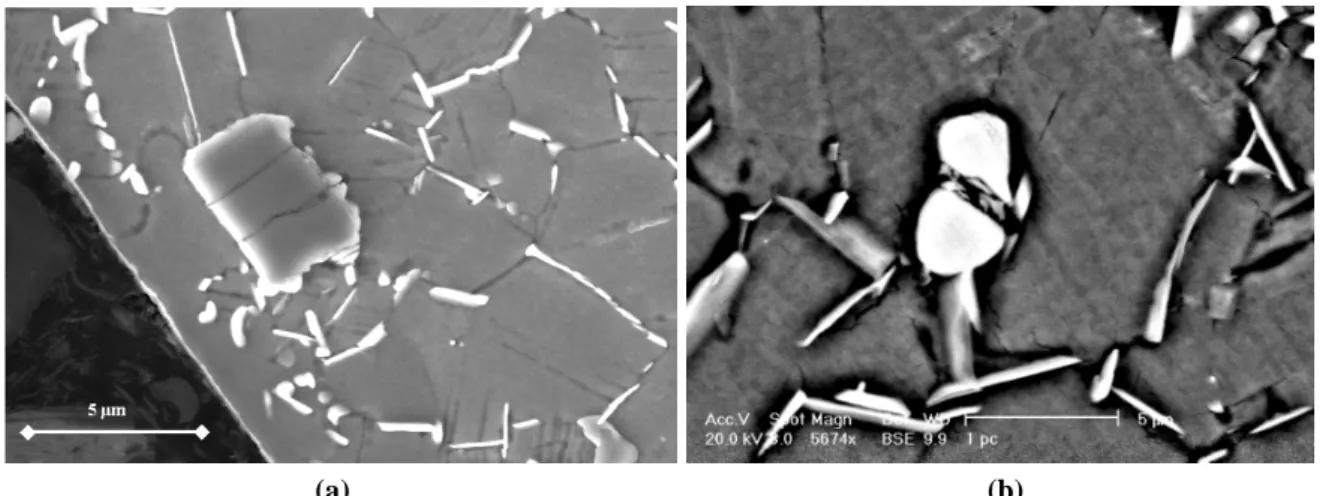
A number of MC type primary carbides (Figure III. 4), inhomogeneously distributed throughout the structure, is observed. They consist of typical NbC or TiC carbides that exhibit irregular or quadrangular shapes showing various contrasts, on etched cross-sections, depending on their composition (orange for TiC and grey for NbC).
(a) (b)
Figure III. 4 : Typical examples of TiC (a) and NbC (b) particles detected by SEM investigation in IN718.
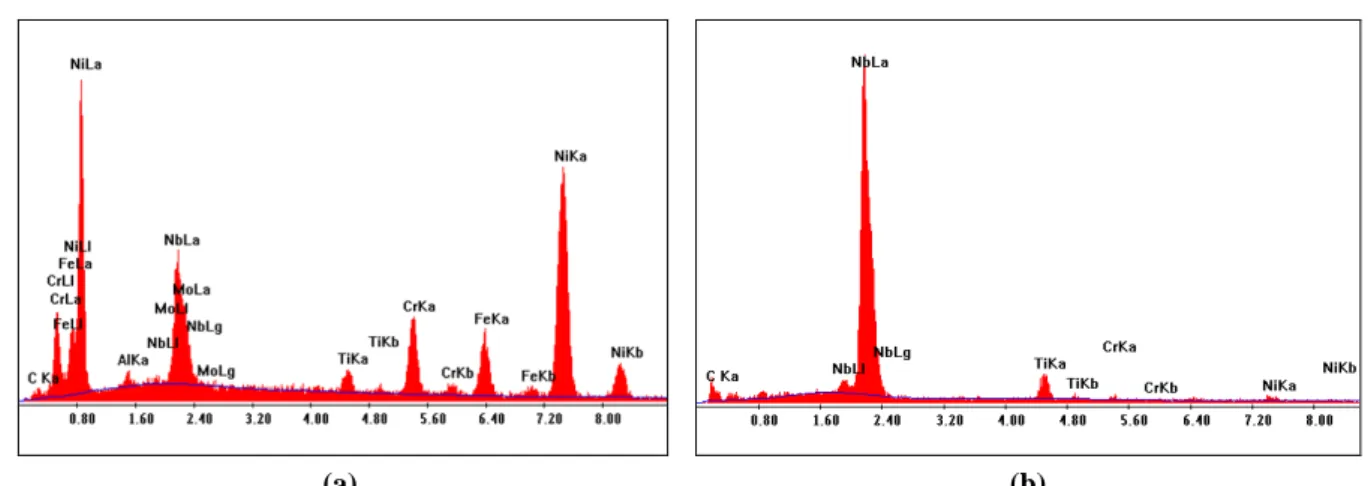
Figure III. 5 reports the EDS spot analyses obtained respectively for delta (δ) phase and MC particles. These phases exhibit a primary peak associated to Nb, while Ti and C show lower contents.
The Delta phase pattern, on the contrary, reveals peaks relative to Nb and Ni, but it shows also the presence of the main matrix alloying elements such as Cr, Fe, Ti and C.
Chapter III: Strategy for Inconel 718 microstructure design and experimental methodology
(a) (b)
Figure III. 5 : EDAX spot patterns evaluated for Delta phase (a) and MC carbides (b) particles.
High resolution diffraction experiments, carried out by Synchrotron XRD, give more information on the hardening phases. The high intensity associated to the synchrotron leads to the detection of γ’ and γ”.
In general, the precipitates size is too small to be detected by conventional X ray diffraction experiments. Synchrotron XRD ensures a better resolution for identifying these nanometric particles, improving the microstructural investigation.
Chapter III: Strategy for Inconel 718 microstructure design and experimental methodology
Diffractograms in Figure III. 6, evaluated in the range 2θ=2-6°, exhibit high intensity peaks associated to the matrix (γ) (Figure III. 6(a)), and low intensity peaks associated to the intermetallic phases (δ, γ’ and γ”) (Figure III. 6(b)).
The X-ray Synchrotron diffraction experiments, added to the SEM investigations, constitute a valid support to analyse the microstructural evolution upon thermal treatment.
II.4
Tensile strength
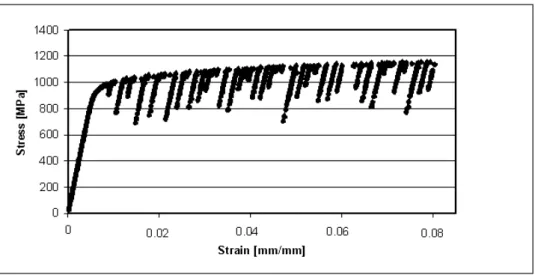
The static mechanical properties are measured by tensile tests carried out at 550°C with a strain rate of 10-3 s-1. The tensile curve, reported in Figure III. 7, exhibits a Portevin-Le Chatelier effect as indicated by stress serrations with amplitudes ranging between 100 and 200 MPa.
As confirmed by previous studies, the stress drops are due to the localisation of strain in the form of deformation bands, as a consequence of an heterogeneous plastic flow
[Rodriguez et al.,1995]. The mechanism originates from fast diffusing solute atoms that
block the mobile dislocations until the stress is high enough to overcome the obstacle. According to Garat and Rodriguez [Rodriguez et al.,1995; Garat et al.,2008], these serrations can be defined as type C Portevin-Le Chatelier because they appear as load drops below the general level of the stress-strain curve.
At the test temperature, the solutes diffusivity is high enough to recapture the mobile dislocations during the motion, initiating stress instabilities. Each load drop is associated to an acoustic emission during the test. With an increase in stress, dislocations density increases resulting in some work hardening [Klose et al.,2003].
The tensile curve shows that stress serrations are activated by a critical plastic strain, 0.25 %, where the stress/strain concentrations enhance the appearance of the jerky flow.
The alloy is characterised by a high Yield Strength (998 MPa) which delays the plastic flow ensuring high performances at high temperature (Table III. 2).
Chapter III: Strategy for Inconel 718 microstructure design and experimental methodology
STANDARD 955 720 8 620 8 998 163216 1228 35.3
UTS [MPa] A [%]
Heat Treatment
HEAT TREATMENTS PARAMATERS TENSILE TESTS DATA
Ta (°C) TR1 (°C) tR1 (h) TR2 (°C) tR2 (h) YS [MPa] E [MPa]
Table III. 2 : Experimental parameters and mechanical properties of standard Inconel 718 grade.
III
Alternative Inconel 718 grades
As described in Chapter I, one of the main objectives of this work consists in the optimisation of the material properties to improve its strength under extrusion loading. Generally speaking, materials are characterised by several parameters, intimately related to their microstructures, which are difficult to modify. These are the intrinsic properties depending on the atomic bonds and arrangements. On the contrary, other properties could be considerably optimised by a change in composition or the application of appropriate thermal or thermo-mechanical treatments. By a proper control of processing parameters, specific microstructures can be achieved in order to enhance tensile and fatigue properties.
The starting point of our optimisation consist in a standard grade of Inconel 718, heat treated following the conventional process described above. The general approach, employed for the achievement of tailored microstructural properties is schematically reported in Figure III. 8 .
Figure III. 8 : General approach adopted for the optimisation of Inconel 718.
The material development is organized considering both industrial and scientific requirements. The main goals of this approach consist in the improvement of the fatigue life
Chapter III: Strategy for Inconel 718 microstructure design and experimental methodology
the risks of failure under extrusion conditions and ensure the process stability. The design of alternative thermal treatments, prone to improve the LCF resistance of Inconel 718 constitutes the main result of this PhD work.
Donachie [Donachie,2002] described the thermal treatment as “the logical consequence of
the processing requirements as well as the logical precursors for the generation of optimal properties”. Following this definition the thermal treatment can be defined as a valid way to
transform the standard Inconel 718 alloy into a material specifically adapted to the extrusion conditions.
Figure III. 9 illustrates the experimental approach adopted for the optimization of the material heat treatment. Two investigation directions can be considered: the first consists in the optimization of the heat treatment parameters as a function of the required mechanical properties, while the second is base on the adoption of thermo-mechanical processes where not only the heat treatment, but also the forging procedure is refined.
Considering the heat treatment optimization, the procedure used for standard Inconel 718 follows a series of requirements contained in the ASTM B637 specification [ASTMB637]. This document, designed for precipitation hardening nickel alloys, recommends specific range of temperature and time for each stage of the heat treatment, prone to ensure high mechanical properties.
The reported recommendations are the following:
Solution treatment
- Solution temperature: 924°C < T < 1010°C.
- Solution Time: 0.5 h minimum, cool at rate equivalent to air cool or faster.
Ageing Treatment
- First ageing: T = 718 ± 14 °C, holding at temperature for 8 hours, furnace cooling to 621 ± 14 °C.
- Second ageing T = 621 ± 14 °C holding until total precipitation heat treatment time has reached 18h and then air cooling.
Following the constraints applied by the specification, we opt for a heat treatment optimization where the specific parameters are chosen following two strategies:
1. Intra-specification design: the solution treatment temperature are selected in the range reported by ASTM B 637 (924°C < T < 1010°C).
2. Extra-specification design: high solution treatment temperatures, above the specification range (T> 1010°C).
This approach allows the consideration of a large variety of process parameters that can be adopted separately or combined, in order to improve the material efficiency. Two alternative Inconel 718 grades (Tr. 990 and Tr.1000) are defined following an intra-specification design, whereas a further heat treatment procedure (API 6A) is optimized by an extra-specification
![Figure II. 40 : TEM micrograph of the precipitates-free zone around δ precipitates [Burke et al.,2000]](https://thumb-eu.123doks.com/thumbv2/123doknet/3670020.108610/13.892.216.702.678.961/figure-tem-micrograph-precipitates-free-zone-precipitates-burke.webp)
![Figure II. 41 : Role of the delta phase in the dynamic recrystallization (a) [Wang et al.,2009], dissolution breakage and creation of globular delta particles (b) [Zhang et al.]](https://thumb-eu.123doks.com/thumbv2/123doknet/3670020.108610/14.892.128.796.599.885/figure-dynamic-recrystallization-dissolution-breakage-creation-globular-particles.webp)
![Figure II. 44 : Influence of the PLC effects on the rupture mode of Inconel 718 [Garat et al.,2008]](https://thumb-eu.123doks.com/thumbv2/123doknet/3670020.108610/17.892.251.663.315.655/figure-influence-plc-effects-rupture-mode-inconel-garat.webp)