Guidelines
of procedures
for risk
assessment
of plants
as pests
(weeds)
Guidelines
of procedures
for risk
assessment
of plants
as pests
(weeds)
Montevideo, Uruguay - 2018
Editorial coordination: Lourdes Fonalleras and Florencia Sanz Translator: Alec McClay
Layout: Esteban Grille Cover design: Esteban Grille Digital printing
Guidelines of procedures for risk assessment of plants as pests (weeds) / Inter-American Institute for Cooperation on Agriculture, Comité Regional de Sanidad Vegetal del Cono Sur; Alec McClay. – Uruguay : IICA, 2018.
42 p.; A4 21 cm X 29,7 cm. ISBN: 978-92-9248-817-8
Published also in Spanish and Portuguese
1. Phytosanitary measures 2. Pests of plants 3. Risk management 4. Pest monitoring 5. Weeds I. IICA II. COSAVE III. Title
AGRIS DEWEY
H10 632.5
Inter-American Institute for Cooperation on Agriculture (IICA), 2018
Guidelines of procedures for risk assessment of plants as pests (weeds) by IICA is published under license Creative Commons
Attribution-ShareAlike 3.0 IGO (CC-BY-SA 3.0 IGO) (http://creativecommons.org/licenses/by-sa/3.0/igo/) Based on a work at www.iica.int
IICA encourages the fair use of this document. Proper citation is requested.
This publication is available in electronic (PDF) format from the Institute’s Web site: http://www.iica.int
3 Guidelines of procedures for risk assessment of plants as pests (weeds)
ACKNOWLEDGMENTS
This Guide was developed as a result of the component aimed to build technical capacity in the region to use a Pest Risk Analysis process with emphasis on the assessment of Plants as Pests (weeds) in the framework of STDF / PG / 502 Project “COSAVE: Regional Strengthening of the Implementation of Phytosanitary Measures and Market Access”. The beneficiaries are COSAVE and the NPPOs of the seven countries that make up COSAVE. The Standards and Trade Development Facility (STDF) fund it, the Inter-American Institute for Cooperation on Agriculture (IICA) is the implementing organization and the IPPC Secretariat supports the project. The editorial coordination was in charge of Maria de Lourdes Fonalleras and Florencia Sanz.
Maria de Lourdes Fonalleras, Florencia Sanz y Alec McClay, have defined the original structure of this Guide.
The content development corresponds exclusively to Alec McClay expert contracted especially for the project.
The technical readers that made important contributions to the content of the Guide are the specialists of the NNPO’s participating in the Project:
Adriana Ceriani, Melisa Nedilskyj, Leonardo Emilio Simón y Marcelo Sánchez from Servicio Nacional de Sanidad y Calidad Agroalimentaria – SENASA from Argentina;
Víctor Manuel Lima y Carla Roca Orellanos from Servicio Nacional de Sanidad Agropecuaria e Inocuidad Alimentaria – SENASAG from Bolivia;
Adriana Araújo Costa Truta y Clidenor Mendes Wolney Valente from Secretaria de Defensa Agropecuaria – SDA/MAPA from Brasil; Cecilia Niccoli y Lilian Daisy Ibáñez from Servicio Agrícola y Ganadero – SAG from Chile;
Maria Eugenia Villalba y Mirta Zalazar from Servicio Nacional de Calidad, Sanidad Vegetal y de Semillas – SENAVE from Paraguay; Efraín Arango Ccente y Cecilia Lévano Stella from Servicio Nacional de Sanidad Agraria – SENASA from Perú;
Leticia Casanova y María José Montelongo from Dirección General de Servicios Agrícolas – DGSA/ MGAP from Uruguay.
We express special appreciation to all of them.
We also thank the support received from the IPPC Secretariat for the implementation of this component of the project.
SCOPE
The purpose of this document is to guide risk analysts of the NPPOs of the member countries of COSAVE in the preparation of risk analyses of plants as pests (weeds). It can be used for the evaluation of plants proposed for introduction, and/or for unintentional introductions, as contaminants in products or means of transport, or by natural spread.
It is to be used in conjunction with the Risk Analysis template for Plants as Pests (Weeds), which will be modified, filling in the necessary information in each section, to produce the PRA document for a specific species.
In addition to the guidance offered in this document, you should consult the Annex 4: Sources of Information for Weed Risk Analysis that provides a broad list of websites, databases, and publications that can be consulted to obtain information required in the analyzes.
This guide is based on ISPM 11: Pest risk analysis for quarantine pests , taking into account the guidance provided in Annex 4: Pest Risk Analysis for plants considered as quarantine pests, and using a qualitative approach to pest risk analysis.
5 Guidelines of procedures for risk assessment of plants as pests (weeds)
INDEX
1. Stage I: Initiation ... 7
1.1. Initiation points for a risk analysis for plants as pests (weeds) ... 7
1.1.1. Identification of a plant that may require phytosanitary measures 1.1.2. Review or revision of phytosanitary policies and priorities 1.2. Identity of the plant ... 7
1.3. Identification of the pest risk analysis area ... 9
1.4. Pest risk analysis history... 9
1.5. Conclusion of Stage I ... 9
2. Stage II: Weed risk assessment ... 10
2.1. Categorization ... 10 2.1.1. Presence or absence of the plant in the pest risk analysis area 2.1.2. Regulatory status 2.1.3. Potential for establishment and spread in the pest risk analysis area 2.1.4. Potential for economic or environmental impact 2.1.5. Conclusion of categorization 2.2. Information about the plant ... 12 2.2.1. Geographic distribution of the plant 2.2.2 Biology of the plant 2.3. Risk evaluation ... 15 2.3.1. Probability of introduction and spread 2.3.2. Conclusion on the probability of establishment and spread 2.3.3. Evaluation of potential economic and environmental consequences 2.3.4. Conclusions on potential economic and environmental consequences 2.4. Summary of the potential risk of the plant ... 23
3. Stage III: Pest risk management ... 24
4. Aspects common to all pest risk analysis stages ... 26
4.1. Uncertainty ... 26
4.2. Documentation ... 28
4.3. Communication ... 28
Annex 1: Climatic tables ... 29
Annex 2: Method of combining probabilities and uncertainties ... 31
Annex 3: Risk analysis template for plants as pests (weeds) ... 32
ACRONYMS
CABI Centre for Agricultural Bioscience International
COSAVE Southern Cone Plant Health Committee (COSAVE by its acronym in Spanish)
EDD Maps Early Detection and Distribution Mapping System EPPO European and Mediterranean Plant Protection Organization
GBIF Global Biodiversity Information Facility GMIA Global Map of Irrigation Areas
GRIN Germplasm Resources Information network IPNI International Plant Names Index
IPPC International Plant Protection Convention
ISPM International Standards for Phytosanitary Measures JSTOR Journal Storage
MAPA Ministerio de Agricultura, Pecuária e Abastecimento MGAP Ministerio de Ganadería, Agricultura y Pesca
NAPPFAST North Carolina State University – Animal and Plant Health Inspection Service - Plant Pest Forecasting System
NPIC National Pesticide Information Center NPPO National Plant Protection Organization NPRO NPIC Product Research Online
PMRA Pest Management Regulatory Agency PRA Pest Risk Analysis
STDF Standards and Trade Development Facility USDA United States Department of Agriculture SciELO Scientific Electronic Library Online
7 Guidelines of procedures for risk assessment of plants as pests (weeds)
1.
STAGE I: INITIATION
1.1. INITIATION POINTS FOR
A RISK ANALYSIS FOR PLANTS
AS PESTS (WEEDS)
Describe the way in which the need for a PRA for this plant was identified. 1.1.1. IDENTIFICATION OF A PLANT THAT
MAY REQUIRE PHYTOSANITARY MEASURES In the following situations:
• Submission of a request to import a plant that had not previously been im-ported or for which a WRA has not previously been performed.
• Appearance of an emergency situation upon the discovery of an established infestation or an outbreak of a new plant within an PRA area.
• Updated scientific research that identifies the risk of a plant.
• Identification of a plant that causes economic and / or environmental impacts in places with a high level of trade with the PRA area, or that has another probable pathway of entry.
• Interception of a plant repeatedly, for example, as a contaminant in imported shipments of seeds or grains.
• Change in the intended use of a plant that is already present in the PRA area (e.g., large-scale production for medicinal purposes).
• Identification of a plant (weed) in a PRA by pathway. 1.1.2. REVIEW OR REVISION OF PHYTOSANITARY POLICIES AND PRIORITIES
In the following situations:
• National decision to review regulations or phytosanitary requirements. • Review of a proposal formulated by another country or by an international
organization.
• Emergence of a controversy regarding phytosanitary measures.
• The phytosanitary situation in a country changes, a new country is created or political boundaries have changed.
1.2. IDENTITY OF THE PLANT
Normally the plant will be identified at the species level. However, there may be cases in which it is appropriate to use higher or lower taxonomic levels. Some genera such as Cuscuta contain a large number of species, difficult to distinguish from each other, although easy to recognize as members of the genus, and all
fairly similar in terms of their biology and potential impacts. In these cases, a PRA can be justified at the genus level. If there are native species of the genus in the PRA area, it will be necessary to exclude them from the scope of the analysis. When a taxonomic level higher than that of the species is used, there is the possi-bility that later taxonomic revisions may change the limits of a taxonomic group. To avoid ambiguity, indicate the sense in which the generic name is being applied, for example “Cuscuta in the sense of (or sensu) Costea et al. 2015, Syst. Bot. 40: 269-285. “
In some cases a PRA can be justified at the infraspecific level, for example, when it is proposed to import a subspecies or cultivate a species known as a weed, but which supposedly has differences from the typical form of the species that makes it less likely to become weedy. In the absence of clear and definitive evidence, however, it should be assumed that infraspecific forms share the biological char-acteristics of the species.
It may also be appropriate to perform a PRA for the importation of a plant be-longing to a species already present in the PRA area, when it is suspected that there are biological differences with the populations already present in the area. For example, the reed Phragmites australis (Cav.) Trin. ex Steud ssp. australis, of European origin, has become a major invader in North America, while the native subspecies P. australis ssp. americanus Saltonstall, P.M. Peterson & Soreng has no invasive tendencies.
The wild progenitors of cultivated plants should also be considered as distinct from the cultivated forms, although botanically they belong to the same species, as is the case of the wild carrot Daucus carota L. ssp. carota, an important weed in North America, and the cultivated carrot Daucus carota ssp. sativus (Hoffm.) Arcang. Indicate if there is any difficulty, doubt or taxonomic ambiguity in the identification of the species. If there are taxonomic problems that make it difficult to identify the plant, these should be resolved by consulting with experts or by new taxonomic research before proceeding with the PRA.
In case of a PRA initiated by the discovery or interception of a plant within the PRA area, it is important to collect and store (in a museum or herbarium) specimens of the plant to document its presence, and so that its identity can be reviewed if any doubt later arises about this. In this section of the PRA, the name of the person responsible for the identification and the location of the plant specimens that were used for identification must be indicated.
Name
The accepted scientific name of the plant may be determined by consulting a com-prehensive and recent taxonomic review of the group to which it belongs (genus, family, etc.), published by a recognized expert, or from a global, standardized list of scientific names, such as The Plant List or the GBIF Backbone Taxonomy (see Annex 4).
The source consulted to determine the accepted name must be cited. The most important synonyms to cite are those that have been widely used in the literature to refer to the species, for example, Agropyron repens (L.) P. Beauv. as a synonym of Elymus repens (L.) Gould.
Common names (if any): In Spanish, Portuguese, English.
9 Guía de procedimientos para la evaluación de riesgo de plantas como plagas (malezas) Taxonomic Position
Family.
In the case of large families such as Asteraceae, Fabaceae, Brassicaceae or Poaceae, also indicate the subfamily and tribe if an accepted classification exists. It is not necessary to cite taxonomic levels above the family (kingdom, division, order, class, etc.).
1.3. IDENTIFICATION OF THE PEST RISK
ANALYSIS AREA
This will normally be a country in its entirety. However, in some cases it may be a specific region within a country, or a group of two or more countries.
1.4. PEST RISK ANALYSIS HISTORY
Identify any PRA that has been performed by the NPPO itself, any other NPPO, or a similar body. If there is a previous PRA performed by the same NPPO, it should be reviewed to determine if it needs to be updated or if it can be used in its cur-rent form. The existence of a previous PRA performed by another organization does not avoid the need to make a new PRA on the part of a member country of COSAVE, but it can save time in the search for data and literature. It is important to check the validity of previous PRAs since the circumstances and information may have changed.
1.5. CONCLUSION OF STAGE I
Report the conclusion of this stage, summarizing the identity of the plant, the reason for the PRA and indicating the PRA area.
2.
STAGE II. WEED RISK
ASSESSMENT
All the information to be included in this stage must be associated with the cor-responding bibliographic reference, in order to be able to consult the scientific justification at the risk assessment stage.
2.1. CATEGORIZATION
2.1.1. PRESENCE OR ABSENCE OF THE PLANT IN THE PEST RISK ANALYSIS AREA
Indicate if the plant is present or absent in the PRA area.
Presence or absence can be assessed by consulting: floras or national or regional catalogs, published or online; publications in scientific journals; international da-tabases1; botanists with knowledge of the flora of the PRA area; persons who work in agricultural research or extension. It is possible that the plant exists in the area only under cultivation; for this purpose it is useful to consult with managers of botanical gardens or arboreta, and search in catalogs of ornamental plants, gar-dening web sites, etc. If there are unconfirmed reports of the presence of a plant it may be necessary to sample in the field to look for it and to collect specimens for identification.
If the plant is present, indicate its range of distribution within the area and if it can be considered as widely distributed within the area.
The ISPM does not provide a precise or quantitative definition of “widely distrib-uted”. It can be considered that a plant is not widely distributed if it occurs in a single locality or in a small number of localities, and if it occupies such a limited area that its eradication might be feasible.
2.1.2. REGULATORY STATUS
2.1.2.1. In the pest risk analysis area
Indicate whether there is a mandatory control program with the aim of eradicating or containing the population of the plant in the PRA area, or if such a program is being planned for the near future.
2.1.2.2. Worldwide
Indicate which country(s) or jurisdictions (e.g., US states, Canadian provinces) regulate the plant as a quarantine pest, regulated non-quarantine pest, or under 1 Such as www.gbif.org
11 Guidelines of procedures for risk assessment of plants as pests (weeds) other legal categories such as noxious weeds, prohibited weeds, prohibited inva-sive alien plants, etc.
2.1.3. POTENTIAL FOR ESTABLISHMENT AND SPREAD IN THE PEST RISK ANALYSIS AREA
Indicate whether suitable climatic and environmental conditions exist in the PRA area for the establishment and spread of the species.
It is not necessary at this stage to carry out a very thorough analysis of the environ-mental requirements of the species: this will be done in in section 2.2 if necessary. In most cases this question will have a positive response. However, there may be cases where a quick review of the data indicates that there is very little likelihood of establishment, for example, of a tropical rain forest plant in a country with a dry and temperate climate. In these cases it can be concluded that the plant has no potential to establish and therefore to have an impact on the PRA area.
2.1.4. POTENTIAL FOR ECONOMIC OR ENVIRONMENTAL IMPACT
At this stage, it is not necessary to document all potential impacts in a compre-hensive manner, but simply to include enough data to demonstrate that there are potential impacts. It will be found in many cases that a plant produces both types of impacts (economic and environmental).
Indicate whether the species has a history of behaving as a weed with economic and / or environmental impacts. The potential for economic impact is evaluated primarily on the basis of documented impacts in other regions of the world where the plant is present.
In the case of weeds of agricultural importance in other parts of the world, there will usually be multiple indications of their importance. These could include their inclusion in official lists of regulated, noxious weeds, etc., the existence of bulletins or information leaflets on how to control them; the existence of research works on their impacts or control methods, their appearance on herbicide labels; etc. Research on weeds is published in journals such as Weed Science, Weed Technology, Weed Research, Canadian Journal of Plant Science, Invasive Plant Science and Management, Weed Biology and Management, Crop Protection, Crop Science, Plant Protection Quarterly, Pakistan Journal of Weed Science, Indian Journal of Weed Science2
In the case of environmental impacts, invasive plants, or weeds of natural areas, much information is available in databases such as CABI Invasive Species Compendium, Global Invasive Species Database and environmental NGOs such as the California Invasive Plant Council3.
If specific documentation of the impacts of a plant cannot be found, information about its characteristics or related species can be used to estimate its possible economic and environmental impacts.
2 Other articles on invasive plants can be found in Biological Invasions, Diversity and
Distributions, Aquatic Invasions, Management of Biological Invasions, NeoBiota, Plant Ecology, and Journal of Ecology
3 These references can be consulted: CABI Invasive Species Compendium https://www.cabi. org/isc/, Global Invasive Species Database http://www.iucngisd.org/gisd/ and California Invasive Plant Council http://www.cal-ipc.org/..
Indicate whether the species has characteristics that indicate that it could behave as a weed, such as: relationship with known weeds, profuse production of viable seeds, adaptation to disturbed places or a wide range of habitats, rapid or aggres-sive growth, climbing or vine growth form, etc.
The use of data on the characteristics of the plant, or information on related spe-cies, instead of documented impacts of the species itself, implies a greater degree of uncertainty in the conclusions.
2.1.5. CONCLUSION OF CATEGORIZATION
Based on the information gathered for the previous sections, indicate whether the species meets the requirements to be considered as a quarantine pest:
(a) Absent from the PRA area, or present in the PRA area, but not widely distributed
and
(b) Has the potential to cause economic or environmental impacts on plants in the PRA area
If the species does not have the potential to meet the definition of a quarantine pest, the analysis stops here, otherwise, the PRA continues.
2.2. INFORMATION ABOUT THE PLANT
This section documents the information that will be used to evaluate the potential of the plant to establish and disperse in the PRA area, and the impacts that this may have. To comply with the transparency requirements under the IPPC, it is important that any prediction of the behavior of a plant as a pest is based on documented information about its biology, distribution, and environmental requirements, and its interactions with other species.
2.2.1.GEOGRAPHIC DISTRIBUTION OF THE PLANT
List all countries, in alphabetical order, where there are confirmed records of oc-currence of the plant, grouped by continent, and divided into:
• Native distribution: Areas in which the plant grows spontaneously without having been introduced by human activities.
• Naturalized distribution: Areas in which the plant grows and reproduces outside cultivation, but as a result of its introduction, intentionally or not, by human activities.
• Cultivated distribution: Areas in which the plant is cultivated, for example, as an agricultural, horticultural or silvicultural crop, or in botanical or private gardens, without having escaped or naturalized.
It is useful to prepare a map of the world distribution of the plant, indicating where possible the native, naturalized, and cultivation zones. The naturalized distribution can be difficult to define exactly. In some cases there is controversy about the sta-tus of a plant species as native or exotic in part of its distribution. There may also be isolated or historical records of plants found outside their normal distribution, without confirmation that they are reproducing. These records can be described in the literature as “casual”, “occasional”, “ephemeral”, “waif”, “adventive” or “vagrant”.
13 Guidelines of procedures for risk assessment of plants as pests (weeds) The text used in this section should comment on the criteria used to include or exclude such records.
The sources of information for the distribution vary depending on the species. Some useful sources are indicated in the attached document in the section “Global or regional distribution”. The GBIF4 database aggregates specimen data from a large number of museums and herbaria worldwide. These data can be downloaded with their geographic coordinates and a lot of additional information. It must be taken into account that the coverage in GBIF is very unequal among countries, and that it is not always easy to distinguish between native, naturalized and under cultivation occurrences.
Maps can be drawn by hand, or they can be generated using GIS (geographic information systems) software if the capacity exists. For NPPOs that do not have access to institutional GIS capacity, there are low-cost options such as Manifold or free such as SimplMappr5.
2.2.2. BIOLOGY OF THE PLANT 2.2.2.1. Morphology
In relation to growth habits indicate if it is: herbaceous/woody, herb, shrub, tree, vine; in the case of aquatic plants indicate submerged, emerged, floating.
About the size of the plant, it will be documented: • Form and arrangement of stems, roots, leaves, • Inflorescences,
• Flowers and fruits. • Branching pattern.
• Presence of spines, trichomes, glands, or other type of vestiture6.
• Presence of bulbs, tubers, corms, rhizomes or other subterranean organs. The morphological description can be based on floras or other published sources. If it is necessary to translate descriptions from other languages, the Wikipedia article “Terminología descriptiva de las plantas”7 is a good guide to the Spanish vocabulary of plant morphology.
2.2.2.2. Life cycle
In this section it will be established: duration (annual, biannual, perennial), method of surviving seasons or periods of adverse conditions (cold, heat, drought, flood), type of reproduction or multiplication (by seeds, spores, and/or vegetative propagation), initial growth rate, time required to reach reproductive maturity and longevity. In the same way will be indicated the reproductive strategies: quantity and viability of propagules produced, reproduction frequency, dormancy, persistence in seed bank.
4 www.gbif.org
5 Manifold® http://www.manifold.net/ and SimplMappr http://www.simplemappr.net/. 6 Vestiture: covering; the type of hairiness, scaliness or other covering commonly found on the external parts of plants
The ability of seeds to persist in the soil can make control more difficult because not all seeds germinate at the same time and it may be necessary to apply control measures over a long period.
It should be noted the type of pollination (by insects, other animals, water, or wind), dependence on specialized pollinators and ability to cross or self-fertilize.
2.2.2.3. Dispersal
Adaptations for dispersal: for example, by wind, water, internal or external trans-port by animals, or explosive dehiscence8.
In this section it is sufficient to mention morphological adaptations for dispersal, such as the presence of a feathery pappus9 on the seeds that facilitates dispersal by wind, or fleshy, sweet fruits that attract birds to eat them. Actual data on dispersal will be considered under natural dispersal pathways, see (2.3.1.3).
2.2.2.4. Habitat and environmental factors affecting the plant
The effect of environmental factors on the plant can be based on published exper-imental studies, if these exist. These could include experiments in which the plant is grown under different conditions of soil pH, nutrient levels, shade, temperature regimes, etc. In the absence of such studies, the environmental requirements of the plant have to be deduced from the conditions in which it naturally grows. Consider:
• Habitats or plant communities in which it typically occurs (grasslands, forest, scrub, riparian areas, wetlands, cultivated fields, urban or disturbed areas, etc.). • Required or optimal conditions of temperature, precipitation, humidity, shade.
Tolerance to extremes of cold, heat, drought.
• Required or optimal soil conditions (texture, pH, drainage, humidity, organic material, nutrients, etc.).
• Biotic factors (dependence on specialized pollinators, specialized dispersal vectors, mycorrhizae, nitrogen fixing rhizobia, etc.). In the case of plants that depend on mutualistic microorganisms such as mycorrhizae or rhizobia, it is necessary to consider the possibility that these organisms may be intro-duced simultaneously with the plant or that they may already be present in the PRA area.
• Requirements for seed germination (soil cover depth, photoperiod, humidity, need for a cold period, etc.)
• Tolerance to natural and anthropogenic disturbances
• In the case of aquatic plants, required or optimal hydrological conditions (depth and speed of water flow, temperature, pH, salinity, nutrients, turbidity, substrate, etc.)
• In the case of parasitic plants, the presence of suitable host plants. 8 Dehiscence: the process by which a fruit opens to release its seeds when ripe
9 Pappus: the tuft of hairs, scales, bristles, etc., longer or shorter, on the apex of some seeds, especially in the Asteraceae.
15 Guidelines of procedures for risk assessment of plants as pests (weeds) 2.2.2.5. Climatic adaptation
Climatic conditions are one of the most important factors that determine the potential distribution of plants. In the absence of experimental studies on the influence of climatic factors, or to supplement them, climatic requirements can be estimated based on the geographical distribution of the plant. Two climatic classifications that can be used for this purpose are the modified Köppen-Geiger system and the NAPPFAST system of cold hardiness zones (see citations and maps in the Annex).
The Köppen-Geiger system takes into account temperature, precipitation and seasonality. The climates are divided into four primary groups: equatorial (A), arid (B), warm temperate (C), snow (D), and polar (E). These in turn are subdivided into subgroups depending on criteria of temperature, precipitation and seasonality. In groups B, C and D a third level of subdivision is applied depending on the tem-perature, resulting in a total of 31 different climates, of which 22 are represented in the member countries of COSAVE.
The NAPPFAST system is a worldwide extension of the USDA system of cold hardi-ness zones. It consists of 13 zones defined solely on the basis of minimum winter temperatures, zone 1 being the coldest and 13 the warmest.
For both systems, climatically suitable zones for a plant can be estimated by su-perimposing the map of the world distribution of the plant prepared in section 2.2.1 on the maps of climatic zones and noting the zones that fall within the known distribution of the plant.
2.2.2.6. Methods of control
Summarize existing control methods in use (chemical, cultural, biological, etc.), their cost and level of efficacy.
Indicate if there are biotypes of the plant resistant to herbicides are reported worldwide, especially in the country of origin
If there are no feasible or economically viable control measures, this tends to aggra-vate the impact of the plant and therefore implies a greater degree of consequences.
2.3. RISK EVALUATION
Each of the elements of risk (probabilities of entry, establishment and spread, and potential economic and environmental consequences) will be classified as insignificant, low, medium or high. For each element, a degree of uncertainty will also be assigned, using the same scale, depending on the reliability and relevance of the information sources available for the element.
2.3.1. PROBABILITY OF INTRODUCTION AND SPREAD
2.3.1.1. Probability of entry
List the potential entry pathways of the plant that could take it from its current distribution to the PRA area. Indicate the probability of entry for each pathway as (insignificant, low, medium, high), and the degree of uncertainty associated with this probability (insignificant, low, medium, high).
In the case of proposals for the intentional introduction of plants for planting, or for new findings of a plant within the PRA area, the probability of entry will au-tomatically be considered as high. However, if other possible routes of entry are identified, these should be listed so that appropriate mitigation measures can be recommended. If there have been previous interceptions of the species, indicate the pathway in which it was intercepted.
In the case of intentional introduction of plants for planting, it can also be assumed that they will be introduced in an area with suitable climatic and environmental conditions by their establishment, or at least that will be the intention of those responsible for the introduction.
In the case of introductions for other purposes or unintentional introductions, the probability that the plant is transferred from its initial point of entry (such as a sea or airport) to an appropriate site for its establishment must be evaluated. Possible routes of entry include:
• Natural spread: evidence of dispersal by wind, water, external or internal transport by animals. Indicate if there are documented cases of dispersal of the species by this means, or if the possibility of the pathway is based solely on biological features of the plant. For example, we can have a study that indicates that viable seeds of species X were found in the excrement of birds that had fed on the fruits of the plant. In another case we can only point out that the plant has sweet red fruits, apparently attractive to birds, but that there are no studies that specifically document their consumption.
• Unintentional introduction: as a contaminant in imported agricultural products such as seeds, hay, straw, animals; in other products such as wood packaging, firewood, nursery plants, substrate10, food; in vehicles, boats, machinery; in clothing, footwear or other personal belongings; etc. Indicate if there are documented cases of dispersal by this means, such as interception in phytosanitary inspections, or research studies on seeds found attached to vehicles. Indicate the manner of association with the pathway, the proba-bility of survival in transport and storage, and the probaproba-bility of survival of management practices applied to the product, as appropriate.
• Intentional introduction as plants for planting: imports for planting as agricultural, horticultural or silvicultural crops, in parks, gardens or urban areas, for the improvement of natural landscapes, erosion control, water purification, soil remediation, etc.
• Importation of viable plant material for use as food, decoration, manufacture of handicrafts, considering the intended use of the material and its disposal.
17 Guidelines of procedures for risk assessment of plants as pests (weeds) If there are multiple potential entry pathways, a table can be prepared indicating the probability of each one, together with the associated degree of uncertainty, such as:
Entry pathway Probability Uncertainty 1. Description of pathway 1 (negligible, low, medium, high) (negligible, low, medium, high) 2. Description of pathway 2 (negligible, low, medium, high) (negligible, low, medium, high) 3. idem
Definition of the probability categories:
• Negligible: the probability of entry is extremely low given the association with the pathway and the probability of survival in transit.
• Low: the probability of entry is low but clearly possible • Medium: entry is probable.
• High: entry is very probable or certain. 2.3.1.2. Probability of establishment
Identify the areas in danger within the PRA area with appropriate climatic and envi-ronmental conditions for the plant based on the information in 2.2.2.4 and 2.2.2.5 The modified Köppen-Geiger classification (Kottek et al., 2006; Peel et al., 2007), and the NAPPFAST system of cold hardiness zones (Magarey et al., 2008) can be used to estimate the climatic suitability of the PRA area for the plant under evaluation. Using the world distribution map of the plant, the Köppen-Geiger climatic zones and the NAPPFAST zones included in its distribution are identified. The portions of the PRA area that fall within the same Köppen-Geiger and NAPPFAST zones can be considered as climatically suitable for the plant, and therefore as endangered areas. Tables 1 and 2 (ANNEX 1) indicate the percentage of the territory of each COSAVE country corresponding to each of the Köppen-Geiger and NAPPFAST zones, respectively.
In some cases the use of artificial irrigation in arid zones can modify the natural climate, allowing the establishment of plants that would not be able to survive in the absence of irrigation. If there are irrigation zones within the PRA area, this factor must be taken into account. A possible way to do this would be to modify the Köppen-Geiger classification for irrigation areas towards a more humid climate or more uniform precipitation. For example, an irrigation zone within the Aw zone (equatorial savannah with dry winter) could be considered as Af (equatorial rainfor-est, fully humid), or one that is in the BWh zone (hot desert) could be considered as BSh (hot steppe).
Within these areas information about soils, vegetation, crops, land use, etc., can be used to define more precisely the potentially endangered habitats.
To identify the endangered areas within the PRA area it will be preferable to have available the most detailed information possible on the climate, soil, vegetation,
hydrology, etc. conditions of the ARP area. For example, if a plant prefers shade habitats and low pH soils, we could conclude that coniferous forests are the most vulnerable areas. A map of vegetation types will help us identify these areas. The availability of such information will vary between countries. Some examples of this type of information are:
• Martínez-Tilleria, K., Núñez-Ávila, M., León, C. A., Pliscoff, P., Squeo, F.A., Armesto, J.J. 2017. A framework for the classification of Chilean terrestrial ecosystems as a tool for achieving global conservation targets. Biodiversity and Conservation 26: 2857-2876.
• Araujo, N., Müller, R., Nowicki, C. e Ibisch, P. 2010. Map of “Unidades ecoló-gicas de Bolivia” in Prioridades de Conservación de la Biodiversidad en Bolivia. National Protected Areas Service of Bolivia.
• Cabrera, A.L. 1976. Regiones fitogeográficas argentinas. Acme, Buenos Aires. 85 pp. In: Kugler WF (Ed) Enciclopedia argentina de agricultura y jardinería. Tome 2. Acme. Buenos Aires, Argentina. Fascicle 1. pp. 1-85.
The global classification of WWF ecoregions can also be used:
• Olson, D.M. Dinerstein, E., Wikramanayake, E. D., Burgess, N., Powell, G. V. N., Underwood, E. C., D’Amico, J. A., Itoua, I., Strand, H. E., Morrison, J. C., Loucks, C. J., Allnutt, T. F., Ricketts, T.H., Kura, Y., Lamoreux, J.F., Wettengel, W. W., Hedao, P., y Kassem, K. R. 2001. Terrestrial Ecoregions of the World: A New Map of Life on Earth: A new global map of terrestrial ecoregions provides an innovative tool for conserving biodiversity BioScience 51: 933-938.
Data for this classification are available online and were used for the “ecoregions” SimpleMappr layer11.
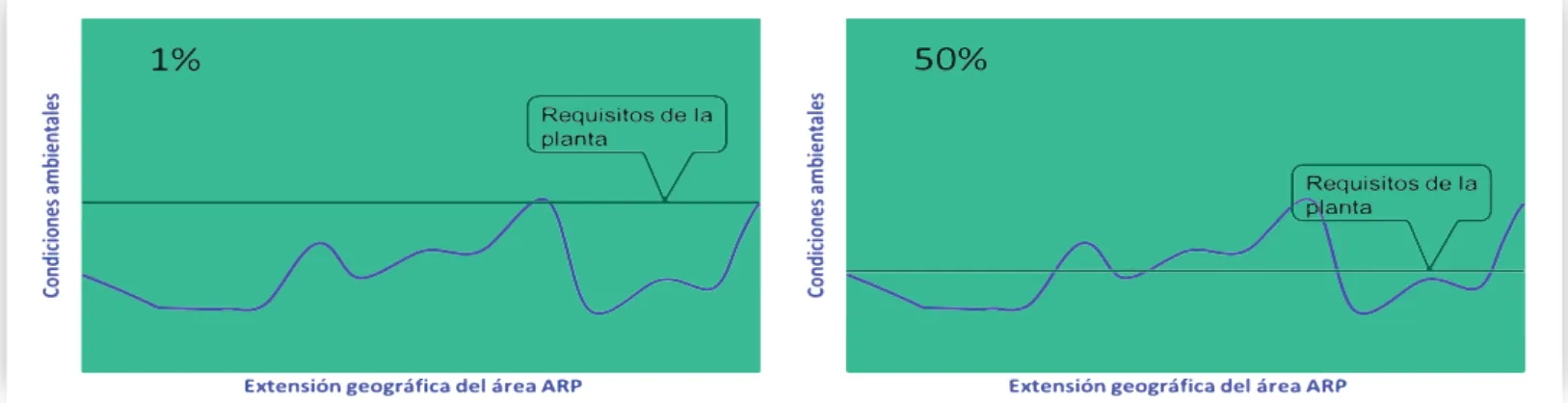
Based on the proportion of the PRA area with suitable climatic and environmen-tal conditions for the plant, the probability of establishment will be estimated as negligible, low, medium, or high. The equivalence between the percentage of the territory with suitable conditions and the probability of establishment depends on the fact that environmental conditions are not uniform over the entire area. If only a small fraction of the PRA area has suitable conditions for the plant, we can say that the probability of establishment is low. As the fraction of the area with suitable conditions increases, the probability of establishment also increases. This equivalence is illustrated schematically in Figure 1.
On the left, example of a hypothetical plant that finds conditions suitable in only 1% of the area of ARP. On the right, another species that finds conditions suitable in 50% of the area. The probabilities of establishment for these cases are evaluated as 1% and 50% respectively.
Each COSAVE member country will have to define ranges to rate the probability of establishment, depending on its conditions and circumstances. To give an example, the ranges could be defined as follows:
• Negligible: able to establish in 0 – 1% of the area of the PRA area. • Low: able to establish in 1 – 5% of the area of the PRA area.
11 Data for this classification are available at https://www.worldwildlife.org/publications/ terrestrial-ecoregions-of-the-world and were used for the “ecoregions” layer at http://www. simplemappr.net/
19 Guidelines of procedures for risk assessment of plants as pests (weeds) • Medium: able to establish in 5 – 25% of the area of the PRA area.
• High: able to establish in 25 – 100% of the area of the PRA area.
2.3.1.3. Probability of spread
Plants capable of rapid dispersal can expand their range within a short period of time after their initial establishment. This makes it more difficult to eradicate, con-trol, or contain them in a limited area. Therefore, dispersal is a factor that tends to increase the potential impacts of the plant.
Identify the dispersal pathways within the PRA area that could lead the plant from its initial establishment site to other endangered areas. These routes can be the same identified for the introduction (2.3.1.1) but others can also operate more locally. Natural spread
Dispersal by wind, water, external or internal transport by animals. Even in cases where the natural dispersal of a plant does not represent a significant risk for its entry into the PRA area, due to the distances or natural barriers between its exist-ing distribution and the PRA area, it may be important for the spread of the plant within the PRA area once established.
Unintentional spread
This includes the movement of the plant and/or its propagules within the PRA area by contamination of vehicles, agricultural products, construction material, clothing and personal belongings, etc.
Intentional spread
This includes the intentional movement of the plant with the motive of planting it or using it in other places within the ARP area, for example, as a crop, ornamental or medicinal plant, aquarium plant, etc.
The probability of spread is classified as negligible, low, medium or high according to the following criteria:
Figure 1. Schematic explanation of the equivalence between the proportion of the PRA area with suitable conditions and the
probability of establishment. On the left, example of a hypothetical plant that finds conditions suitable in only 1% of the area of ARP. On the right, another species that finds conditions suitable in 50% of the area. The probabilities of establishment for these cases are evaluated as 1% and 50% respectively.
• Negligible: the plant has no potential to spread within the ARP area (for example, it does not produce viable propagules and there is no motive for intentional spread).
• Low: the plant has some but limited potential for local spread (e.g., low production of propagules without mechanisms for long distance dispersal). • Medium: the plant has considerable potential for spread within the ARP area
(e.g., high reproduction rate or propagules with effective dispersal mechanisms). • High: the plant has the potential to rapidly spread throughout its potential
range in the ARP area (e.g., high reproduction rate and propagules with effective dispersal mechanisms).
The pathways of spread can be summarized with a table similar to the one devel-oped for the entry pathways, as follows:
Pathway of spread Probability Uncertainty 1. Description of pathway 1 (negligible, low, medium, high) (negligible, low, medium, high) 2. Description of pathway 2 (negligible, low, medium, high) (negligible, low, medium, high) 3. Idem
Overall probability of spread (negligible, low, medium, high) (negligible, low, medium, high)
When there are multiple potential pathways of spread, the overall probability of spread will normally be that of the most probable pathway. However, if there are more than three potential pathways rated as “low”, the overall probability could be raised to “medium”, and if there are more than three potential pathways rated as “medium”, the overall probability could be raised to “high”. The uncertainty level of the overall probability will in general be that which corresponds to the most probable pathway.
2.3.2. CONCLUSION ON THE PROBABILITY OF ESTABLISHMENT AND SPREAD
To rate the overall probability of establishment and spread, the probabilities and uncertainties of establishment and spread are combined according to the method specified in Annex 2.
2.3.3. EVALUATION OF POTENTIAL ECONOMIC AND ENVIRONMENTAL CONSEQUENCES
Plants as pests may have a variety of economic consequences, including yield losses in agriculture, horticulture and forestry; reduction of recreational value; or reduction of biodiversity and negative effects on other parts of the ecosystem.
Assessment of economic consequences of plants as pests may be inherently difficult because they may have broad agricultural, environmental and social consequences that may be non-specific, not readily apparent or not easily quantified (e.g. changes in the soil’s nutrient profile).
21 Guidelines of procedures for risk assessment of plants as pests (weeds) It is important to consider the potential long-term economic consequences for the entire PRA area, including where the plants are intended to grow. The most reliable predictor of potential economic consequences is evidence of consequences else-where, particularly in areas with similar habitats. However, in some cases, plants have never been moved out of their native ranges and therefore may not have had an opportunity to express any potential consequences. In the absence of evidence of economic consequences elsewhere, consideration may be given to whether or not the plant possesses intrinsic characteristics that predict pest potential. For additional guidance for the analysis of the potential economic and environmental consequences, it is recommended to refer to the document “Guidelines for assess economic effects and the non-commercial and environmental consequences of the entry of pests”12
2.3.3.1. Economic effects Effects on crop yield or quality
The following list provides examples of the effects to be considered, but is not exhaustive:
• Crop yield losses due to competition for light, nutrients, or water, or the effects of allelopathy or parasitism
• Impacts on product quality (for example, contamination of grain with weed seeds)
• Effects of pests or diseases hosted by the plant (for example, rusts or aphids that are pests of crops and that use the plant as an alternate host)
• Reduction of pasture quality due to displacement of desirable forage species.
• Hybridization with crop species that introduces undesirable characteristics to these (in the case of crops that are close relatives of weed species such as carrots or sugar beet)
Effects on costs of production
• Cost of control measures (herbicides, manual weeding, tillage, etc.)
• Impacts on machinery or infrastructure (for example, difficulties in harvesting caused by climbing weeds that become entangled in machinery, additional maintenance costs of irrigation canals blocked by aquatic weeds).
• Effects on the health of agricultural workers (allergies, toxicity). • Commercial effects
• Loss of access to markets, rejection of exports due to contamination with seeds of quarantine weeds
Social effects
• Impacts on populations of plant species of cultural or aesthetic importance. • Effects on the valuation of properties or real estate.
12 IICA, COSAVE y STDF (2018) “Guidelines for assess economic effects and the non-commercial and environmental consequences of the entry of pests” G. Schrader (Author); L. Fonalleras y F. Sanz (Eds.).
• Impacts on other industries such as fishing, tourism, or energy, or damage to urban infrastructure.
2.3.3.2. Environmental effects Effects on plant species
• Impact on populations or biodiversity of native plants, keystone species and/ or species in danger of extinction by reduction, displacement or elimination. • Effects on the genetic resources of native species through hybridization. • Effects on pollinators of native plant species.
• Effects of pests or diseases hosted by the plant on native plant species. Effects on ecological systems or processes
• Effects on water resources (for example, depletion of water tables, reduction in the flow of rivers or streams).
• Effects on soil quality or nutrient status (e.g., increased nitrogen levels by nitrogen-fixing species, erosion).
• Changes in the frequency or intensity of fires.
• Physical modification of habitats (for example, conversion of grasslands into forests).
• Environmental impacts of control measures necessary for the management of the plant (for example, impact on native biodiversity of herbicides applied for control of the plant).
2.3.3.3. Non-phytosanitary effects
In some cases it is likely that information about non-phytosanitary impacts of the plant will be found. These could include impacts on animal or human health, or on animal species in danger of extinction. These impacts can not be used exclusively to justify phytosanitary measures, but must be documented in the analysis, and should be communicated to the agencies or agencies responsible for the sectors affected so that they may take the necessary measures (see ISPM 11 section 2.3.1).
2.3.4. CONCLUSIONS ON POTENTIAL ECONOMIC AND ENVIRONMENTAL CONSEQUENCES
Summarizing all the potential consequences identified, the risk analyst will have to use his or her judgment to reach a final rating of these as negligible / low / medium / high.
It does not seem possible to give a formula or recipe for this conclusion, given the wide variety of possible impacts and the variation in the level of uncertainty that may exist for the different impacts. In general, if one or several impacts rated as high, with a high degree of certainty, have been identified, an overall rating of “high” would be justified. If only negligible consequences are identified, the final grade would be “negligible”. Between these two extremes the analyst must use his or her judgment.
23 Guidelines of procedures for risk assessment of plants as pests (weeds) This section could be presented in the form of a table indicating the type and severity of damage, the source of information and the corresponding level of uncertainty
2.4. SUMMARY OF THE POTENTIAL RISK
OF THE PLANT
The risk of the plant is summarized by means of a table that presents the ratings of the probabilities of entry (by each pathway), establishment and spread, and the potential economic and environmental consequences, with their corresponding degrees of uncertainty. This table should be accompanied by a summary that briefly explains each of the assigned ratings, as a way to justify or explain the final result. Generally the plant will be classified as a quarantine pest if:
• there exists at least one entry pathway rated as medium or high probability, and • the overall probability of establishment and dispersal is medium or high, and • the potential economic and environmental consequences are rated as
me-dium or high.
However, this criterion should not be applied mechanically. Rather, the risk analyst should use his or her judgment in each case to decide if the information available on the species justifies its classification as a quarantine pest. For instance, there could be cases in which the potential consequences are so severe and well docu-mented that classification as a quarantine pest is warranted, even if the probability of entry is rated as low.
Risk rating Uncertainty Probabilities of entry
1. By pathway 1 (negligible, low, medium, high) (negligible, low, medium, high) 2. By pathway 2 (negligible, low, medium, high) (negligible, low, medium, high) 3. Idem (negligible, low, medium, high) (negligible, low, medium, high) Probabilities of establishment and spread
Probability of establishment (negligible, low, medium, high) (negligible, low, medium, high) Probability of spread (negligible, low, medium, high) (negligible, low, medium, high) Overall probability of establishment and spread (negligible, low, medium, high) (negligible, low, medium, high) Consequences
Potential economic and environmental
consequences (negligible, low, medium, high) (negligible, low, medium, high)
In the event that as a result of the ARP it is determined that the plant should be considered a quarantine pest, it should be added to the list of national quarantine pests.
3.
STAGE III: PEST
RISK MANAGEMENT
Risk management includes the identification of phytosanitary measures that, alone or in combination, reduce the perceived risk and select the most appropriate options. In the case of PRA initiated by an import application for a plant, if the risk is de-termined to be unacceptable, the main risk management measure would be the prohibition of the import. In the case of unintentional introductions, there would be options for inspection of the pathways of entry identified for the plant, official inspection of the crop, or areas free of the plant in the exporting country. The entry and spread pathway tables developed in sections 2.3.1.1 and 2.3.1.3 will help to identify the most appropriate management measures for each pathway.
The risk management options are translated into phytosanitary measures such as those provided by way of example below:
1. Options for consignments:
• inspection for freedom from the weed
2. Options with respect to the area, place or site of production or crop:
• Place of production, site of production or field inspected and found free from the weed
• Pest (weed) free areas
• Cultivation under protected conditions or in vitro 3. Options within the importing country
• Post-entry quarantine
• Cultivation under controlled conditions
• requirements for growing plants under confinement
• requirements for harvesting plants at a certain stage or specified time to prevent opportunities for reproduction
• restriction of plants to particular locations, such as those that are marginally suitable
• restriction of import to specified cultivars or clones
• restrictions on the disposal of excess or waste plant material
• other restrictions on planting, growing, sale, holding, transport or disposal • considering the use of codes of conduct for sale, holding, transport, planting
or disposal, for example, in the form of internal rules or guidelines within the plant industry to refrain from or restrict the selling of particular plants for specific intended uses.
25 Guidelines of procedures for risk assessment of plants as pests (weeds) 4. Other options
• Risk mitigation system • Monitoring in the PRA area
• Treatment of agricultural machinery • Heat treatment for substrates
In order to evaluate the measures established in the PRA, feedback between the analyst and the inspector is suggested.
4.
ASPECTS COMMON
TO ALL PRA STAGES
4.1. UNCERTAINTY
Uncertainty can be defined as the lack of certain and clear knowledge about an issue or relevant aspect in the PRA. Uncertainties must be identified especially as they increase the level of risk. In the framework of transparency, it must also be explained how and in what aspects expert judgment has been used.
Some uncertainties may arise from:
• Natural variability within pest populations.
• The need to deduce or formulate hypotheses, appropriate to a PRA, based on scientific studies conducted with objectives different from those required for a PRA.
• Scientific information with: - Incomplete data
- Contradictory or inconsistent data - Imprecision or variability of the data - Methodological flaws
- Subjective judgments - Lack of knowledge.
27 Guidelines of procedures for risk assessment of plants as pests (weeds) The following table proposes definitions and examples to describe the levels of uncertainty of the different elements of risk (probabilities of entry, establishment and spread, and economic and environmental effects):
Uncertainty
rating Interpretation Examples to justify the uncertainty rating
Negligible There is very little doubt about the rating. It is very unlikely that the rating will be altered in case of finding additional or better information. • All evidence related to the risk element comes from primary sources (for example, original research articles published in peer-reviewed journals, a survey carried out by an NPPO with approved methodology, an import application, etc.). • The information obtained from various sources is consistent and consistent. • The rating is based on specific data about the area or the species. • The species is very well studied or known. • The information was received from a recognized expert. Low There is little doubt about the rating. Obtaining additional or better information will probably not change the rating. • The evidence related to the risk element comes from a combination of primary and secondary sources (for example, books, review articles, websites associated with universities or recognized scientific societies, surveys of pests whose methodology is uncertain or unknown, etc.). • The information available is clear and any controversy that has existed in the past has been resolved. • The risk rating is based on data specific to the area or species. • The species is well studied and the lack of evidence suggests
that the element is not relevant.
Medium
There are some doubts about the rating. Obtaining additional or better information may change the risk rating. • The evidence related to the risk element comes from secondary sources of moderate or low quality (for example, gardening websites, local or little-known journals, old agricultural bulletins, unreviewed sources, etc.). • The information available is ambiguous or contradictory in some aspects. • The risk rating is based on examples of other species of the same genus. • The species is moderately well studied and the lack of evidence suggests that the element is not relevant. High There are significant doubts about the rating. Reliable information is scarce or absent. The rating could change significantly as a result of obtaining additional information. • There is no direct evidence on the risk element and the available sources are of low quality. • Most of the available information is ambiguous or contradictory. • The risk classification is based on examples of other species from the same family.
4.2. DOCUMENTATION
For each particular analysis, the entire process from initiation to pest risk manage-ment should be sufficiently documanage-mented so that the sources of the information and the rationale for management decisions can be clearly demonstrated.
All the information mentioned in the document must be supported by bibliograph-ical references, citing the author and year. The complete list of references must be provided at the end of the document (in the case of websites, report the date of consultation).
It is suggested to indicate the sources cited and, separately, those sources which were consulted although they did not provide information for the analysis
4.3. COMMUNICATION
Risk communication may be of special importance in relation to plants considered as pests, since some stakeholders may perceive plants intentionally introduced for planting as purely beneficial, without appreciating their possible negative impacts. Risk communication may include, for example:
• consultation with importers, research institutions and other governmental and non-governmental organizations (for example, environmental protection agencies, park services, nurseries, landscapers) in order to exchange infor-mation on plants considered potential pests
• publication of lists of plants considered as quarantine pests
• labeling of commercially marketed plants (for example, explaining the pest risk that plants may present and under what conditions the pest risk may occur). The phytosanitary measures obtained as a result of the PRA should be communi-cated to the exporting country and to the international community before entering into force, through existing institutional channels.
Once the measures are communicated, a response should be provided as soon as possible to any queries or observations received, explaining the rationale for their acceptance or rejection.
29 Guidelines of procedures for risk assessment of plants as pests (weeds)
Table 1. Percentage of the territory of each COSAVE member country corresponding to each of the climatic zones of the
Köppen-Geiger system13
Argentina Bolivia Brazil Chile Paraguay Peru Uruguay Af Equatorial rainforest, fully humid 2.24 16.07 0.69 41.38 Am Equatorial monsoon 13.39 20.48 4.94 9.62 As Equatorial savannah with dry summer 2.56 Aw Equatorial savannah with dry winter 46.43 46.06 37.00 4.98 BSh Steppe climate, hot 7.13 6.62 5.76 18.26 1.67 BSk Steppe climate, cold 25.02 8.98 3.05 1.95 BWh Desert climate, hot 2.08 0.02 <0.01 0.67 7.73 BWk Desert climate, cold 6.06 5.52 25.52 4.08
Cfa Warm temperate, fully humid, hot summer 23.76 0.52 6.89 36.21 99.17 Cfb Warm temperate, fully humid, warm summer 4.36 1.85 0.82 11.23 6.48 0.83 Cfc Warm temperate, fully humid, cool summer and cold winter 1.22 0.05 12.65 0.18
Csb Warm temperate with dry, warm summer and cold winter 5.67 18.11 Csc Warm temperate with dry, cool summer and cold winter 0.74 1.07
Cwa Warm temperate with dry winter, hot summer 15.85 2.51 1.15 2.90
Cwb Warm temperate with dry winter, warm summer 1.98 6.01 0.21 4.66 Cwc Warm temperate with dry winter, cool summer and cold winter 0.45 0.60 0.73 Dfb Snow climate, fully humid, warm summer <0.01 Dfc Snow climate, fully humid, cool summer and cold winter 0.02 Dsc Snow climate with dry, cool summer and cold winter 0.07 0.02 Dwb Snow climate with dry winter, warm summer 0.01 Dwc Snow climate with cool summer and cold, dry winter 0.02 EF Polar climate 0.01 0.02 0.01 ET Tundra climate 5.55 5.25 27.64 16.51
13 Calculated using the March 2017 updated version with data from 1986-2010 and with a resolution of 5 minutes, according to Kottek, M. and F. Rubel. 2017. World Maps of Köppen-Geiger Climate Classification. Accessed online January 10 2018. http:// koeppen-geiger.vu-wien.ac.at/present.htm.
Table 2. Percentage of the territory of each COSAVE member country corresponding to each of the NAPPFAST cold hardiness zones14. NAPPFAST Zone Mean annual extreme minimum temperature (°C) Country
Argentina Bolivia Brazil Chile Paraguay Peru Uruguay 1 < -45.6 <0.01 0.00 0.00 0.00 0.00 0.00 0.00 2 -45.9 — -40.0 0.01 0.00 0.00 0.02 0.00 0.00 0.00 3 -40.0 — -34.4 0.07 0.00 0.00 0.01 0.00 0.00 0.00 4 -34.4 — -28.9 0.67 0.00 0.00 0.25 0.00 0.00 0.00 5 -28.9 — -23.3 2.09 0.15 0.00 1.07 0.00 0.00 0.00 6 -23.3 — -17.8 4.22 1.70 0.00 4.78 0.00 0.93 0.00 7 -17.8 — -12.2 7.45 9.74 0.00 11.47 0.00 5.31 0.00 8 -12.2 — -6.7 17.25 12.07 0.07 16.17 0.00 7.87 0.00 9 -6.7 — -1.1 46.69 10.64 3.69 26.29 4.46 9.35 80.22 10 -1.1 — 4.4 21.55 15.11 8.43 21.67 95.46 8.91 18.74 11 4.4 — 10.0 0.00 38.51 18.52 14.30 0.08 19.59 1.03 12 10.0 — 15.6 0.00 12.08 44.55 3.93 0.00 42.89 0.00 13 > 15.6 0.00 0.00 24.73 0.04 0.00 5.14 0.00
14 Calculated with data courtesy of Dr. R. Magarey, see Magarey, R.D., D.M. Borchert and J.W. Schlegel. 2008. Global plant hardiness zones for phytosanitary risk analysis. Scientia Agricola 65: 54-59.
31 Guidelines of procedures for risk assessment of plants as pests (weeds)
ANNEX 2:
METHOD OF COMBINING PROBABILITIES
AND UNCERTAINTIES
To rate the overall risk of establishment and spread, each probability is convert-ed into a numerical value (negligible = 0, low = 1, mconvert-edium = 2, high = 3), and the numerical scores are multiplied as follows:
Probability of establishment and spread = Probability of entry × Probability of establishment x Probability of spread
This product is used to rate the overall probability of establishment and spread as follows:
Product (probability of establishment ×
probability of spread) Overall rating for probability of establishment and spread
0 Negligible
1 – 3 Low
4 – 6 Medium
>6 High
Similarly, the uncertainty levels of the probabilities of establishment and spread are combined to arrive at an uncertainty score for the overall probability of establish-ment and spread. As before, the levels of uncertainty are converted into numerical scores (negligible = 0, low = 1, medium = 2, high = 3). Unlike the probabilities, the uncertainties are added:
Uncertainty of the probability of establishment and spread = Uncertainty of the probability of establishment + Uncertainty of the probability of spread
This sum is used to rate the uncertainty of the overall probability of establishment and spread as follows:
Sum of uncertainty scores for the overall
probability of establishment and spread probability of establishment and spreadOverall uncertainty rating for the
0 Negligible
1 Low
2 – 3 Medium
ANNEX 3:
RISK ANALYSIS TEMPLATE FOR
PLANTS AS PESTS (WEEDS)
The template to develop the Risk Analysis for Plants as Pests (Weeds) will be modified, filling in the necessary information in each section, to produce the PRA document for a specific species.
In each section of the template, the temporary text in italics will be replaced by the corresponding information for the species that is object of the analysis.
(Cover page for PRA by pest)
RISK ANALYSIS FOR PLANTS AS PESTS (WEEDS) FOR [GENUS AND SPECIES] [AUTHOR] [FAMILY] [Country], [Month, Year]
[NPPO]
[IMAGE OF THE OBJECT SPECIES OF THE PRA]
1. STAGE I: INITIATION
1.1. INITIATION POINT FOR THE PEST
RISK ANALYSIS
Describe the way in which the need for a PRA for this plant was identified, as appropriate: 1.1.1. IDENTIFICATION OF A PLANT THAT
MAY REQUIRE PHYTOSANITARY MEASURES 1.1.2. REVIEW OR REVISION OF
PHYTOSANITARY POLICIES AND PRIORITIES
1.2. IDENTITY OF THE PLANT
• Accepted scientific name • Synonyms
• Common names • Taxonomic position
1.3. IDENTIFICATION OF THE PRA AREA
Indicate the PRA area.