HAL Id: tel-03220805
https://tel.archives-ouvertes.fr/tel-03220805
Submitted on 7 May 2021
HAL is a multi-disciplinary open access archive for the deposit and dissemination of sci-entific research documents, whether they are pub-lished or not. The documents may come from teaching and research institutions in France or abroad, or from public or private research centers.
L’archive ouverte pluridisciplinaire HAL, est destinée au dépôt et à la diffusion de documents scientifiques de niveau recherche, publiés ou non, émanant des établissements d’enseignement et de recherche français ou étrangers, des laboratoires publics ou privés.
Design and control of a robotic system based on mobile
robots and manipulator arms for picking in logistics
warehouses
Muhammad Aqib Khan
To cite this version:
Muhammad Aqib Khan. Design and control of a robotic system based on mobile robots and manip-ulator arms for picking in logistics warehouses. Automatic. Normandie Université, 2020. English. �NNT : 2020NORMLH31�. �tel-03220805�
THESE
Pour obtenir le diplôme de doctorat
SpécialitéAutomatique, Signal, Productique, RobotiquePréparée au sein de « Université Le Havre Normandie »
Conception et commande d'un système robotisé à base de robots mobiles
et bras manipulateurs pour le picking en entrepôt logistique
Présentée et soutenue par
Aqib Khan
Thèse dirigée par Jean-François Brethé et François Guérin, Laboratoire GREAH (EA 3220)
Thèse soutenue publiquement le 10 Décembre 2020 devant le jury composé de
M. Bernard Bayle
Professeur des Universités / Télécom Physique Strasbourg, Icube Université
de Strasbourg
Rapporteur
M. Pierre Blazevic
Professeur des Universités / ISTY, LISV, Université de Versailles
Saint-Quentin-en-Yvelines
Rapporteur et Président du Jury
Mme Sophie Sakka Maître de conférences-HDR / LS2N
Ecole Centrale de Nantes Examinatrice M. Jean-François Brethé Professeur des Universités / GREAH
Université Le Havre Normandie Directeur de thèse
M. François Guérin Maître de conférences-HDR / GREAH
1
Acknowledgements
This doctoral thesis is a collaboration between Groupe de Recherche en Électrotechnique et Automatique du Havre (GREAH) of University of Le Havre and its industrial partner FM Logistic France. For giving me the opportunity to work on this industrial project and acquire the benefits of learning in terms of applied research, I have to thank FM logistic France for taking this initiative. I want to take this opportunity to express my gratitude to my manager Patrick Bellart (FM) for his support all the way till the end for providing me everything I required to finish the project. I truly appreciate his quality of having the full view and scope of the project in terms of understanding the challenges and constraints within and his valuation of achievements in presence of limitations was a true source of motivation.
I would like to thank my thesis director Pr. Jean-François Brethé for his supervision on this thesis, and I highly appreciate his flexibility for giving me the time and space to complete my work and achieve my desired goals. Our cordial relationship gave me a chance to benefit from his knowledge and wisdom he shared during his supervision, pertaining to academia, research, industry and personal matters. I owe a special thanks to my co-supervisor Dr. François Guérin for his relentless support and guidance throughout this thesis. Particularly with his experience in mobile robotics and control, he has been a mentor and a source of new ideas. His encouragement and supervision in the right direction, complemented with a correct insight of the problem and its solution at hand, and the camaraderie we built over the years led me to a successful completion of the project in all respects. I would also like to thank Mr. Hervé Pelvillain (IUT Le Havre), for his help in the development of the electronic cards and Mr. Philippe Saint-Martin (IUT Le Havre) for the fabrication of the gripper concerning the overall development of the prototype of the mobile manipulator.
I also want to thank the respectable jury members, Professor Bernard Bayle (ICube, Université de Strasbourg), Professor Pierre Blazevic (ISTY, LISV Université de Versailles), and Professor Sophie Sakka (LS2N, Ecole Centrale de Nantes), for reviewing my work and giving back an in-depth critical analysis to highlight the significant areas of this thesis and its presentation for the defense. I would like to express my special gratitude to my friend and my colleague Dr. Kharidine Benali for his joyful company, friendly advice and moral support in the tough and challenging times we faced together. I also want to thank my friends and current PhD students (Mark Bastourous, Wafae Sebbata, Ali Sayah) in the lab, without whom the work atmosphere would not have been more pleasurable.
I also dedicate this thesis and my success to my very close family members, whom I could not reach in time to see them one last time, before they left for their heavenly abode. In the end I would like to express all my gratitude to the love and prayers of my parents and my spiritual guide “Baba G”. Their prayers and guidance infused with love, and their concern for my well-being throughout my life enabled me to overcome any challenge, to achieve and become what I am today.
3
Abstract
Logistics is the backbone of industrial and commercial trading. It involves the storage and displacement of goods from one point to the other. Goods are stored in warehouses and shipped to retailers in pallets. Pallets are produced on a customer’s order. Order picking is a cumbersome and fatigue induced process performed by humans. Fatigue is induced due to walking long distances, lifting heavy loads and acute picking postures. This results in musculoskeletal disorders and poor performance of the workers, thus decreasing the productivity and inducing delays in the supply chain. The demand of productivity has been further alleviated by the e-commerce effect. To mitigate this problem and overcome the constraints of production, automation is actively being employed in warehouses. This consists the use of various technologies and engineered infrastructures. Commissioning of huge infrastructures is complex and inflexible in terms of replaceability. Flexibility is introduced by commissioning robots for process automation. These robots consist of autonomous ground vehicles for transporting freight and static manipulators for pick and place. A static robot has limited workspace and the capability of a manipulator is significantly enhanced by adding a mobile base. Hence mobile manipulation is being exploited for pick & place and pallet production. A lot of effort and research is being dedicated in this domain and this thesis presents a first attempt to achieve autonomous palletization using mobile manipulation.
To acquire palletization by mobile manipulation requires the identification of the functional blocks, which are necessary to conceive a framework to achieve this task. A thorough state of the art has been prepared in this thesis corresponding to each element of the global framework. To realize the proof of concept, a prototype has been developed by leveraging existing technologies, which involves the integration of a mobile base with manipulator and development of the grasping system with a gripping element. For each functional block of the global framework, control execution strategies have been developed and tested in industrial environment. Specifically, localization is acquired by augmenting the existing environment with synthetic landmarks, a motion planning and control strategy is employed for global navigation and a rack tracking motion control has been developed for navigation inside the racks. To combine and execute all the elements without deadlocks a coordination framework is used as a global supervisor. The path planner for global navigation is based on the shortest distance between two points, and rack tracking is developed by applying the conventional Hough transform (mainly used with vision) to the lidar data and using the output in a nonlinear controller, while the motion planner for manipulation is based on linear trajectories.
The framework for supervisory control of the functional blocks is based on discrete event systems topology and state machines corresponding to each block have been modelized using Petri nets. Finally, the framework has been tested for a complete picking task on the mobile manipulator to validate the selection of strategies and performance of each functional element. The successful demonstration has been concluded as a first step towards the evolution of autonomous palletization.
5
Contents
Chapter 1 ...18
Introduction ... 18 1.1 Logistics Processes ... 19 1.2 Warehouses ... 19 1.2.1 Challenges ... 19 1.2.2 Productivity ... 21 1.2.3 Automation ... 22 1.2.3.1 Types ... 23 1.2.3.2 Advantages ... 27 1.2.3.3 Problems ... 281.3 Flexibility with robotization ... 29
1.4 European Projects ... 29 1.4.1 ILIAD ... 30 1.4.2 REFILLS ... 31 1.4.3 PICK PLACE ... 31 1.4.4 COLROBOT ... 32 1.4.5 SecondHands ... 33 1.5 Objective of research ... 34
1.6 Contributions and Structure ... 34
Chapter 2 ...36
Mobile Manipulators ... 36
2.1 Mobile manipulator research ... 37
2.2 End effector ... 42
2.2.1 Grasping strategy ... 43
2.2.1.1 Workpiece characteristics ... 43
2.2.1.2 Gripping Process ... 43
2.2.2 Gripper Types ... 44
2.3 Collaborative Robots (Cobots) ... 47
2.3.1 Types ... 48
2.3.1.1 Service Robots ... 48
2.3.1.2 Recommender Systems ... 49
2.3.1.3 Industrial Collaborative Arms ... 49
2.3.2 Cobotic Paradigm Research ... 51
2.3.2.1 Safety based Collaboration ... 52
2.3.2.2 Anticipation based Collaboration ... 53
2.3.2.3 Collaborative Manipulation ... 54
2.3.2.4 Behavior based Collaboration ... 55
2.4 Mobile Robots (AGV) ... 57
2.4.1 Non-holonomic robots ... 58 2.4.1.1 Unicycle ... 58 2.4.1.2 Differential Drive ... 58 2.4.1.3 Tricycle ... 59 2.4.1.4 Ackerman Steering ... 60 2.4.1.5 Skid Steering... 61 2.4.2 Holonomic Robots ... 61
2.4.2.1 Spherical wheel omnidirectional ... 61
2.4.2.2 Castor wheel omnidirectional ... 62
2.4.2.3 Synchronous drive omnidirectional ... 62
2.4.2.4 Swedish wheel omnidirectional ... 62
Chapter 3 ...65
Platform Hardware Integration ... 65
3.1 Mobile Base... 66
3.1.1 Hardware Type ... 66
3.1.2 Kinematic Model Mobile base ... 69
3.1.3 Kinematic Model Robotic manipulator ... 73
3.1.4 Hardware Integration ... 76 3.1.4.1 Mechanical Structure ... 76 3.1.5 Electronic Interfaces ... 77 3.2 Gripper Selection... 78 3.2.1 Objective ... 79 3.2.2 Activity ... 79
7 3.2.3 Environment ... 79 3.2.4 Focus ... 79 3.2.5 Statistical Analysis ... 80 3.3 Selection ... 83 3.3.1 Design characteristics ... 83 3.3.2 Type ... 83 3.3.3 Force calculations ... 83 3.3.4 Vacuum source ... 85 3.3.5 Stability ... 86
Chapter 4 ...88
Localization Navigation Manipulation ... 88
4.1 Scenario ... 88
4.2 Localization ... 90
4.2.1 Relative Positioning ... 91
4.2.2 Absolute Positioning... 92
4.2.3 Localization Indoor and Outdoor ... 95
4.2.4 Indoor Environments ... 95 4.2.5 Localization in Industry ... 96 4.2.6 PAN Robotics ... 97 4.2.7 Warehouse environment ... 100 4.2.8 Issue of SLAM ... 101 4.2.9 Localization Methodology ... 103 4.2.9.1 Artoolkit Library ... 106
4.2.9.2 Vision Sensor Selection... 107
4.2.9.3 Landmarks Placement ... 113 4.3 Navigation ... 122 4.3.1 Global Navigation ... 122 4.3.1.1 Distance Transform ... 125 4.3.1.2 Algorithm ... 127 4.3.2 Motion Planning ... 133 4.3.2.1 Control ... 134 4.3.2.2 Path Tracking ... 138 4.3.3 Rack Navigation ... 141 4.3.3.1 Navigation requirement ... 142
4.3.3.2 Strategy ... 143
4.3.3.3 Implementation ... 150
4.3.3.4 Control ... 163
4.3.3.5 Rack Tracking ... 167
4.4 Motion planning manipulator ... 181
4.4.1 Workspace ... 181 4.4.2 Motion Planner ... 185 4.4.2.1 Kinematic chain ... 185 4.4.2.2 Trajectory generation ... 188 4.4.2.3 Simulations ... 194
Chapter 5 ...198
Task Management ... 198 5.1 Prominent approaches ... 198 5.1.1 Arbitration ... 200 5.1.1.1 Priority based ... 201 5.1.1.2 State based ... 2015.1.1.3 Winner take all ... 201
5.1.2 Command Fusion ... 201
5.1.2.1 Voting fusion ... 201
5.1.2.2 Fuzzy fusion ... 201
5.1.2.3 Superposition ... 201
5.1.2.4 Multiple objective fusion ... 202
5.2 Behavior related works ... 202
5.3 Strategy and framework ... 205
5.3.1 Petri Nets ... 206
5.3.2 Theoretical framework ... 208
5.3.2.1 Mathematical definition ... 209
5.3.2.2 State space ... 210
5.3.2.3 Analysis ... 211
5.3.2.4 Incidence matrix and state equation ... 211
5.3.3 Implementation ... 212
5.3.3.1 System Modeling ... 213
5.3.3.2 Real time testing performance ... 233
9
Chapter 6 ...238
Conclusion and Perspective ... 238
6.1 Conclusion ... 238
6.2 Future Perspective ... 240
Nomenclature
This nomenclature references the principal variables and abbreviations used in this thesis.
I
X
X coordinate of the inertial reference frameI
Y
Y coordinate of the inertial reference frameR
X
X coordinate of robot frameR
Y
Y coordinate of robot frameI
Pose of robot in inertial (global) I
Twist of robot in inertial frameR
Twist of robot in own frame
Angle between the local and global frame( ) R Rotation matrix i
F
Wheel frame RF
Robot framef
i Roller frame i
Angle between robot frame and wheel framei
l
Relative offset of wheel frame with respect to robot framei
Rotation angle between wheel frame and robot framei
Rotation angle between roller frame and wheel frame
i Rotation angle of the wheel r ix
, X coordinate of the roller frame 'i' r iy
, Y coordinate of the roller frame 'i'i
x
Wheel velocity along horizontal axis r iy
, Wheel velocity along vertical axisJ
Robot jacobian 1 i iT
− Transformation matrix THF
Theoretical holding forceμ
Coefficient of frictioni s
F
Force on each suction cup11 Abs
P
Absolute pressure atmosP
Atmospheric pressure negativeP
Negative pressure or vacuum( , )
I x y
Map matrix( , )
d x y
Distance matrix( , )
C x y
Current cell matrix (mask)P
X
Waypoint 'x' in the global coordinate framep
Y
Waypoint 'y' in the global coordinate frame WRX
Waypoint 'x' in the robot frame WRY
Waypoint 'y' in the robot framed
Distance of the robot center from a waypointL
Length of the robote
XR Error along horizontal distanceR
Y
e
Error along vertical distancen
u Linear velocity control input
T
Sampling timeu
Time constant
M
U Saturation velocity linear n
Rotational velocity control input YK
Proportional gainGe
Distance errorm
Slope of linec
Y intercept of line
Distance rho in polar form ( )lid i
X X coordinate of the 'ith' lidar point ( )
lid i
Y Y coordinate of the 'ith' lidar point
i
d Radial distance of the 'ith' lidar point i
Radial angle for the 'ith' lidar pointw Width of the range image
h Height of the range image A
X
Rack 'x' coordinateA
R
w
Rack widthmax
u
Maximum linear velocitymax
r
Maximum rotational velocitymax
v
Maximum transverse velocity Sigmoid tuning parameter
u
k
Gain for linear control input vk
Gain for transverse control input rk
Gain for rotational control input xU
Robot linear velocityy
V Robot transverse velocity z
R
Robot rotational velocityref
Angle with respect to the rackref
d Reference distance to move inside rack
M
Marking of the Petri net( , )
I t p
Set of input places( , )
O t p
Set of output placesij
a
Incidence matrixk
u
The ‘k
th’ firing or the control vectorM
13
List of Figures
Figure 1.1 : An employee preparing the order
Figure 1.2 : Automated Storage and Retrieval Systems Figure 1.3 : Automatic Sorters
Figure 1.4 : Pick to Light Scanners
Figure 1.5 : Robot Arm and Automated Guided Vehicle Figure 2.1 : Industrial Grippers Clamp type
Figure 2.2 : Humanoids Robonaut, Armar, Vylkeri and Baxter Figure 2.3 : Aerial Drone, AGV and Mobile Rover
Figure 2.4 : Common Cobotic Arms being used in the Industry Figure 2.5 : Unicycle Type Kinematic Configuration
Figure 2.6 : Differential Drive Type Configuration and Powerbot Robot Figure 2.7 : Tricycle Type Configuration
Figure 2.8 : Ackerman Steering Configuration
Figure 2.9 : Spherical, Castor and Synchronous omni drive configuration
Figure 2.10 : Forces acting on the wheel and Omni wheels with rollers mounted at 90 and rollers mounted at 45
Figure 2.11 : Basic motions of the Robot due to rotations of the wheels Figure 3.1 : Omnidirectional Robot SummitXLS
Figure 3.2 : Lidars Configuration coverage Profiles Figure 3.3 : Mecannum wheel Frame assignment Figure 3.4 : Omnidirectional platform with wheels Figure 3.5 : DH Frame
Figure 3.6 : DH Convention Frames Assignement UR5 Figure 3.7 : Housing Structure For Mobile Manipulator
Figure 3.8 : Electronic Component layout and Connections For Arm and Pump Figure 3.9 : Homogenous and Heterogenous Pallets
Figure 3.10 : Percentage of Product Range with 5 Kg Figure 3.11 : Product Dimension Distribution
Figure 3.12 : CAD Design of the Custom Vacuum Gripper Figure 3.13 : Vacuum Pump Elements Connection Scheme Figure 3.14 : Weight distribution and the resulting moments Figure 3.15 : Visualization of the Stable regions
Figure 4.1 : Augmented Reality Markers Figure 4.2 : Marker Detection in ROS
Figure 4.3 : Robot Placement for Experimental Setup Figure 4.4 : Robot Lidar Distances
Figure 4.5 : Marker Detection Axis Cam at Speed of 0.3 m/s Figure 4.6 : Marker Detection Ptu Cam at Speed of 0.3 m/s Figure 4.7 : Errors for Axis Cam (RGB) and 3D Depth Cam
Figure 4.8 : Marker Detection by Axis Camera at Speed of 1.0 m/s Figure 4.9 : Marker Detection by Ptu at Speed 1.0 m/s
Figure 4.10 : Robot Placement for Experiment Setup Figure 4.11: Robot Top View Placement
Figure 4.12 : Robot Front View Placement
Figure 4.13 : Marker Detection By Front Axis Cam at Speed 0.5 m/s Figure 4.14 : Marker Detection By Rear Axis Cam at Speed 0.5 m/s Figure 4.15 : Marker Detection by Front and Rear Cameras at 1.5 meters Figure 4.16 : Marker Detection by Front and Rear Cameras at 1.0 meters Figure 4.17 : Maker Detection by Front and Rear Cameras at 2.0 Meters Figure 4.18 : A Distance Transform Map with Path
Figure 4.19 : DT Map with Initialized Values
Figure 4.20 : Distance Map with Distance Values from Goal Figure 4.21 : Shortest Path Extracted in the Distance Map Figure 4.22 : Path Generated in DT Map with Dense Obstacles Figure 4.23 : Tessellated Map of Testing Arena at 30 cm resolution Figure 4.24 : Tessellated Map of Testing Arena at 10 cm resolution Figure 4.25 : Geometric Model of Robot For Control
Figure 4.26 : Robot Level Control Block
Figure 4.27 : Open Loop Step Input System Response Figure 4.28 : Saturation limits for longitudinal velocity Figure 4.29 : Closed Loop Response of First Order System
Figure 4.30 : Generated Path Tracked By Robot at 10 cm Map Resolution Figure 4.31 : Time Evolution For Speed and Waypoints Following
Figure 4.32 : Generated Path Tracked By Robot at 20 cm Map Resolution Figure 4.33 : Time Evolution For Speed and Waypoints Following
Figure 4.34 : Transformation of Points into Curves From Feature Space to Hough Space
Figure 4.35 : Hokuyo UST-10LX Laser Range Sensor Figure 4.36 : Lidar Scans of Two different Environments
15
Figure 4.37 : 2D Representation of the Virtual Range Image Figure 4.38 : Application of Hough Transform
Figure 4.39 : Hough Lines for the Limit of 20 (Left) and Corresponding Two Lines Extracted (Right)
Figure 4.40 : Lines Consideration for Criterion Minimization
Figure 4.41 : Line Segments Representation in the Virtual Range Image
Figure 4.42 : Hough Lines Produced for Different Limits (Left) Corresponding Limits of Accumulators (Right)
Figure 4.43 : Reference Lines for the Limit of 20 and reference Lines for the Limit of 40
Figure 4.44 : Hough Lines (Left) and Corresponding Accumulation (Right) For Sparse Data (top left)
Figure 4.45 : Robot Modeling With Racks
Figure 4.46 : Sigmoid Functions for Smooth Speed Control
Figure 4.47 : Scenario 1 - Robot Lateral Motion for Rack Alignment Figure 4.48 : Robot Lateral Motion Trajectory
Figure 4.49 : Robot Lateral and Linear Speeds
Figure 4.50 : Robot Lateral Alignment and Linear Distance Errors Figure 4.51 : Evolution of Hough Lines tracking (Xm_1, Xm_2)
Figure 4.52 : Difference of Hough lines Midpoints Xrightmidpoint and Xleftmidpoint
Figure 4.53 : Scenario 2 - Robot Lateral and Linear Motion for Rack Tracking Figure 4.54 : Robot Lateral and Linear Motion Trajectory
Figure 4.55 : Robot Lateral and Linear Speeds
Figure 4.56 : Robot Lateral Alignment and Linear Distance Errors Figure 4.57 : Evolution of Hough Lines Tracking Points (Xm_1, Xm_2)
Figure 4.58 : Difference of Hough lines Midpoints Xrightmidpoint and Xleftmidpoint
Figure 4.59 : Scenario 2 - Robot Rotational, Lateral and Linear Motion for Rack Tracking
Figure 4.60 : Robot Rotational, Lateral and Linear Motion Trajectory Figure 4.61 : Robot Motion Trajectory with Bias Compensation Figure 4.62 : Robot Rotational Speed
Figure 4.63 : Robot Lateral and Linear Speeds Figure 4.64 : Robot Initial Orientation Error
Figure 4.65 : Robot Orientation Angle from Odometer
Figure 4.67 : Evolution of Hough Lines Tracking Points (Xm_1, Xm_2)
Figure 4.68 : Constraints imposed by the platform hardware and placement of UR5 Figure 4.69 : The feasible cartesian workspace of UR5 under the joint limits
Figure 4.70 : Graphical representation of frame transformations from base to gripper Figure 4.71 : Transformations from base to gripper and base to marker
Figure 4.72 : Transformations from mobile base to gripper and to marker Figure 4.73 : A generic move in 3D space from point A to B
Figure 4.74 : A full cartesian trajectory for a Pick task Figure 4.75 : A full joint trajectory for a full Pick task Figure 4.76 : A full cartesian trajectory for a Drop task Figure 4.77 : A full joint trajectory for a full Drop task
Figure 5.1 : A simple Petri net
Figure 5.2 : System analysis approach
Figure 5.3 : Petri net Graph of Localization state machine Figure 5.4 : Evolution of states for localization process Figure 5.5 : Firing of transitions corresponding to states Figure 5.6 : Evolution of states for localization process Figure 5.7 : Firing of transitions corresponding to states Figure 5.8 : Petri net graph for Manipulation state machine
Figure 5.9 : Evolution of states for pick and drop tasks for Arm state machine Figure 5.10 : Firing of transitions corresponding to pick and drop process Figure 5.11 : Execution of a concurrent process in state 6.0.3
Figure 5.12 : Firing of transitions corresponding to execution and completion of a concurrent process
Figure 5.13 : Petri net graph for Navigation state machine Figure 5.14 : Evolution of states for a complete picking process Figure 5.15 : Evolution of states for a complete picking process Figure 5.16 : Firing of transitions for a complete picking process Figure 5.17 : Firing of transitions for a complete picking process Figure 5.18 : Firing of transitions for a complete picking process Figure 5.19 : Execution sequence of a picking task in a warehouse Figure 5.20 : Architecture of the Global Supervisory System Figure 5.21 : Proposed concept of an intelligent system Figure 5.22 : Proposed deep learning framework
Chapter 1
Introduction
Modern day logistic is an evolutionary progression spanned across the historic timeline. The logistics has evolved from simple labor-intensive processes of pick, place and transport to the present-day engineering and managing of extremely complex supply chain networks spread across the globe. Traditional logistics in the early times made use of material transportation on mules and camel carts, but with the course of time the logistic industry has developed with the evolution of many innovations in technology and industrialization. Logistics picked up its pace after the mechanization of industry by the invention of steam engine, whereby the steam ships and the railroads streamlined the process flow, while the critical advances in automotive such as the invention of internal combustion engine and pneumatic tires played a crucial role in the progression of logistics. At the same time the advances in aviation and air transportation played a significant role in the speeding up of dispatch and delivery. Conclusively, the railroad, steamship, aircraft and the telegraph had a profound impact on the logistics during the last half of the 19th century. The emanation of conflicts and ensuing events over the course of history,
significantly in the last century resulted in the realization of importance of logistics. More specifically the potential of logistics was realized in World War II, when man and machinery had to be moved in large numbers over large distances across the globe. From there onwards what followed in the development and advancement of logistics is consequently prevalent today.
Taking it a step further, the revolution of digital technology has given the power of managing information leading to the full control of situations to achieve operational excellence. The emergence of computing has completely changed the planning paradigm of logistic processes. Today the modern logistics processes are not only bound to merely transportation of material in conflicts, but have diffused to the industrial domain all the way extending to warehousing, material handling and freight transportation. The technological advances have provided tremendous value to the traditional supply chain in logistic areas, such as warehousing and distribution, transportation and manufacturing logistics. In the context of improvement, the warehouse automation has immensely enhanced warehouse operations producing a huge impact on improving efficiency of logistics. The automation varies from use of technologies for inventory management to autonomous shuttles for material transportation, robotic pickers to pallet producers, and then extending all the way to warehouse management
19
(WMS) and Enterprise Resource Planning (ERP) systems providing better advanced planning and scheduling for logistic processes.
1.1 Logistics Processes
Logistics involves the organization and coordinated process management of planning and control of efficient material handling from the point of distribution to the point of demand. The process framework is realized by integrating information technology, transportation, inventory management and storage facilities. Logistics as a whole, builds upon two primary processes. The movement of materials from the suppliers to utilizers or storage facilities such as warehouses is called inbound logistics, whereas movement of products from the stock to the end user is termed as outbound logistics. The management process of logistics consists of three major components, i.e. order processing, inventory management, and freight transportation. The demand of the customer is accepted in the form of an order. The order is processed and the availability of the requested product is verified by consulting the inventory, resources are allocated and job assignment is planned for the management of the order. The inventory management helps to keep an updated record of the available stocks in production facilities. This record is maintained virtually to track the stock limit in real time against the influx of the demands. The physical management of the product inventory is done by the storage and material handling process. Further freight transportation provides a quick delivery of the materials from the point of production to a distant point of consumption. This freight is usually transported by land, sea and air. The material is moved from the source to the destination by the alternate combination of the three modes of transportation.
1.2 Warehouses
Considering the significance of the operations of logistics, the storage facilities make up the core components in the process flow. Both inbound and outbound logistics make use of the warehouses for goods retrieval and material storage. The typical operations of warehouse involve reception of goods, their sorting, inventory-based storage, picking on order, repacking and then shipping to destination. The pick on order is based on the demand of a certain client. The demand is qualified by verifying the products from the inventory to fulfill the customer’s order. The products are then picked from specified zones in the warehouse and stacked together to make up a pallet. The pallets are then shipped out to the destination.
1.2.1 Challenges
The order preparation or picking of products is a complex process. The products are stored in racks or material storing shelves inside the warehouses. The picking is performed
20
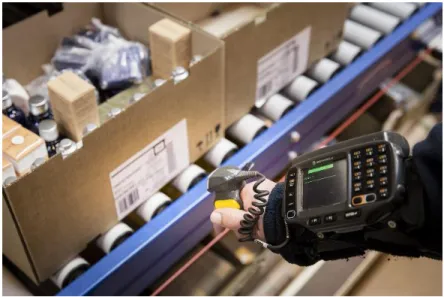
manually by human workers. Each item in the order-based pallet is picked from a specific rack. An employee preparing the order has to walk [1] around the warehouse to gather all the items for a specific order. This process is time consuming and fatigue induced at the same time. The movement around the warehouse consumes a lot of time since the employee has to walk long distances to get to specific locations. In addition, the retrieval of items from the shelves involves repetitive material handling activities of continuous handling or lifting of heavy loads with acute picking postures requiring twisting, bending, kneeling or stretching thus exposing the workers to musculoskeletal [2] disorders. The musculoskeletal disorders lead to a poor health and delayed recovery resulting in a poor performance of the workers leading to a poor management of order preparation and delays of deliveries on time. The arduous work leads to fatigue resulting in the increase of sick leaves. The rise in the number of sick workers results in the consumption of extra resources spent by the enterprises on the healthcare of their employees.
The digital revolution has completely transformed the modern world in the last half century. Whereas the digital transformation has upgraded and enhanced all the domains of life, the most significant advancement has taken place in the field of information technology. Over the last three decades, the introduction of the internet has played a huge impact on the economic growth and prosperity by connecting people, businesses and enterprises. The rapid globalization of industry and supply chain is due to advancement in information technology in which the internet has acted as a bridge to connect and foster the communication channels for a smooth functioning and steady growth. The internet has transformed the structure of
Figure 1.1 : An employee preparing the order1
21
value chains of all the sectors and types of companies. The exponential growth in the e-commerce business especially, is due to the empowerment provided by the internet to the consumers offering a direct route to reach the goal while cutting down the time.
The Amazon effect has played a key role in alleviating the situation of e-commerce trading, directly impacting the logistic business not only for Amazon itself but also for other key competing enterprises. The Amazon effect has changed the traditional shopping pattern, customer expectation and competitive trading landscape in the modern world business market. Following the lead of Amazon, the retailers like ‘eBay’ and ‘Alibaba’ have also added to the competition making the e-commerce universe more competitive and raised the bar to the next level for the proficiency of the supply chain management. Alibaba and eBay perform as middle man between sellers and buyers facilitating the sales through a network of websites, whereas Amazon sells goods directly while managing a network of large warehouses and complex operations of logistics, to deliver the products to the doorstep of the customer. The strategy of these retail giants such as Amazon is not only limited to trade productivity, but also they are utilizing Artificial Intelligence (AI) to increase the product sales by aggregating trading data and analyze it using machine learning to forecast demand, extract purchase patterns to improve customer’s buying and give recommendations, detect marketplace trends, and improve shipping methodologies based on customer’s feedback.
The growth in the e-commerce business has also led to one of the major challenges facing the logistic industry today. The rise of online sales has become inexorable. Due to increase in sales online the objective of meeting supply to demand has increased two folds, since a greater number of products have to be supplied that customers demand. This increase in sales is directly proportional to the demand of supply of required products. To manage the demand a greater number of resources are required in the given time, meaning to supply the products more skilled labor is required to handle and manage the supply chain. The availability of good skilled labor has declined in the last decade due to various factors, resulting in a big gap between the availability of skilled workers and logistic operations to fulfill the ever-growing demand of online retail business. While the giants like Amazon and Alibaba continue to thrive and advance the e-commerce industry, the gap between the workers required to meet the operational demand and deliver is rapidly widening.
1.2.2 Productivity
Enterprises like Amazon are managing large warehouses for the management and distribution of products, but the online business is just one example. In traditional trading for retail, the warehouse operations are primarily conceived on the nature of order received from
the retail client. The orders are prepared and packed in pallets and dispatched in bulk. The delivery of the orders has to be done on bi-weekly and monthly basis. To make the delivery proficient, there is always the requirement to increase the productivity in the warehouses. This is achieved by planning and organizing all the operations of storage, sorting, packing and shipping to save time and space. This is usually done by the employment of a warehouse management system. The objective is to reduce the cycle time of order preparation as much as possible and increase the storage space in the warehouse to manage more stock.
The e-commerce revolution has changed the traditional methodology of sorting, storage, picking, packing and shipping. Now the same course of action has to be used to pick and ship small volumes instead of bulk. Instead of packing in pallets, the packages have to be packed individually requiring care and extra handling for safety. The items have to delivered in 24 to 48 hours’ time to the client in contrast to the delivery after one week. There is a continuous race with time since the e-commerce demand has put a pressure on the warehouse productivity, as now the warehouses have to keep up with the influx of the demands enforced by the online customers. As the order volume increases, the on-hand stock also has to increase in proportion, and warehouse efficiency to deliver has to be improved to avoid complacency. In addition, the customers require a forecast and an undamaged delivery to the doorstep. This requires the product to be tracked in real time, which in turn requires the IT framework to be enhanced to provide an efficient tracking capability.
1.2.3 Automation
Automation is the application of technology to accomplish a process or procedure without human assistance. It facilitates the minimization of manual labor resulting in improved ergonomics, reduction of labor costs and travel time, and preservation of space. The technology is used to automate a process or repetitive tasks in the manufacturing plants and this application is more cost effective in the long term since it reduces the number of required people to do the same job, while at the same time providing a faster and error free service.
Considering the situation of present-day logistic industry, automation is being employed to mitigate the challenges and constraints of production in the warehouses. Warehouse automation consists of the use of technologies which guarantee increase of productivity. This automation is built upon mechanical systems, actuators and control and the mechanization consists of automated storage and retrieval systems (AS/RS), automated guided vehicles (AGV), industrial robots for palletization, sorting systems for inventory, picking systems based on voice and related technologies. Along with the mechanization, computerized
23
systems consisting of warehouse management software solutions, are used to manage and control the physical tracking of the flow of goods in the warehouse.
1.2.3.1 Types
Numerous types of technologies are being used to automate the processes inside the warehouses. The e-commerce is further augmenting the use of automation to keep up with the pace of production. An overview of the basic automation existing in almost every warehouse of large and medium sized enterprises in the logistic industry is outlined below.
1.2.3.1.1 Automated Storage and retrieval systems
These systems consist of automatic bringing out of goods and placing back into storage. There are basic two types. They can either perform as “Unit-load” automated storage and handle large loads of goods such as full pallets, or operate as “Mini-load” systems handling smaller loads of goods.
A. Unit-Load AS/RS systems
− Handle larger loads of material of 1000 to 5000 pounds, typically pallets.
− Consist of a fixed-aisle unit-load crane (fixed to a single aisle) traveling between aisles to retrieve products
− Consists of moveable-aisle unit-load crane (not fixed to a single aisle) moving along the aisles to retrieve products.
B. Mini-Load AS/RS Systems
− Typically handle smaller loads such as totes, trays and cartons. Also called as “tote-stacking” or “case-handling” systems.
− Well suited for operations requiring storage location for a large number of SKUs lacking floor space.
− Common types are mini-load AS/RS cranes and shuttles, carousel-based AS/RS, Vertical Lift Modules and Goods-to-Person (G2P).
In both the unit load and mini-load handling systems, a crane travels between narrow rows of goods while moving either pallets or totes.
24
1.2.3.1.2 Sorting Systems
The sorting systems consist mostly of conveyors performing the sortation of products. The items are identified on the conveyors and then diverted to their specific destination. The configuration and layout of the sorting systems depends upon the activity to perform. Line or linear sorters move the products in a straight line along their length. These sorters are either belt or chain driven and the package diverting mechanism is integrated onto the sorters. The other type of sorters known as loop sorter or circle sorter consists of a series of cells linked together on the track of the conveyor system. The products are identified by scanners and diverted to respective locations by diverting mechanisms. The common examples of circle sorters are Sliding shoe, Tilt tray and Cross-belt sorters. The tilt tray sorter consists of trays mounted onto carts on the conveyor running in a continuous loop. The items are inducted either manually or automatically via the induction stations at multiple locations throughout the loop.
2 https://www.jungheinrich.co.th/products/racking-and-warehouse-equipment/small-parts-storage/automatic-small-parts-warehouse-small-parts-racking/
Figure 1.2 : Automated Storage and Retrieval Systems2
25
1.2.3.1.3 Automated Tracking Systems
The automated tracking systems provide a real time information of the availability, record management and flow control of goods. This tracking is acquired by the use of inventory management systems, scanners and perceptual guidance systems for picking. 1.2.3.1.3.1 Inventory management Systems
It is always required to have a real time information of overstocking and understocking in distribution centers and acquire a knowledge of available capacity in the warehouse. This is achieved by maintaining a record of the total inventory. The inventory management systems (IMS) consist of the equipment and hardware to automate the documentation process of the goods inside the warehouse. The material used to record and process the identification of the products consists of barcode labels, rack labels and signs, Radio Frequency Identification (RFID) tags and Quick Response (QR) codes. The hardware used to scan these materials mostly consists of hand held digital scanners embedded with supported software. The IMS is integrated with the Warehouse Management Systems (WMS) to track the inventory in real time to ensure its matching with the orders placed. The IMS keeps a record of the number and characteristics of Stock Keeping Units (SKUs) and the level of the current inventory in the warehouse indicating the availability of space for incoming products. To update the inventory and have a current status, the workers use the handheld scanners to scan the labels of the products during the storing and shipping procedures. Hence the record maintains a real time status of the products and goods coming in and going out of the warehouse.
1.2.3.1.4 Pick to light
Pick to light systems are supervisory systems for order fulfillment. These systems aid the workers by guiding them for manual pick and record keeping for shipment. These systems consist of alphanumeric displays to guide the workers to the right storage location and indicate the number of items to be picked. The workers scan a barcode and LED displays illuminate to guide them to the next pick location. The operator after placing the picked items in the container presses a verification button and the display continues to illuminate to guide the workers to the next pick location. The same systems can be used in reverse as in put to light for storing items. The pick to light system is employed to reduce the time to walk to the pick location and time taken to read paper-based records by the workers. The pick to light system is installed with the software which is able to integrate with the WMS and supply chain management. These systems improve the picking productivity by increasing the picking accuracy by avoiding identification errors and efficient record management of the products retrieved or stored.
26
1.2.3.1.5 Robot arms and AGVs
Conventional industrial robots are being used for picking and palletizing tasks in the warehouses. These robots along with the sorting systems perform the job of traditional picking done mainly by human workers. These units are static and are installed at the picking locations, next to a conveyor to pick up individual packages and build up a pallet. The picking robot is generally a robotic arm equipped with vision and associated sensors to determine the structure and configuration of the box or package to grasp it. These flexible arms are capable of performing multiple tasks, including individual picking, loading and unloading cartons and producing pallets.
3 https://www.okurayusoki.co.jp/eng/products/plant/sorting/crossbelt/index.html Figure 1.4 : Pick to Light Scanners4
27
Likewise, the Automated Guided Vehicles (AGVs) are used to transport materials from one location to the other. These AGVs are primarily performing the loading and unloading of pallets, boxes and containers. The AGVs navigate autonomously in the warehouse, following a digital path without the intervention of a human, or either follow a worker during material loading and unloading, all the while operating in a fleet to speed up the material transportation within the warehouse.
1.2.3.2 Advantages
Warehouse automation extensively benefits the productivity of the warehouse and logistic operations, producing a significant impact on the enterprise’s gains and profits. For the improvement of business, the benefits in the long term are well accounted for, but the significant primary ones on the macro level are highlighted
1.2.3.2.1 Reduced costs
By using machines, the need for manual labor can drastically be reduced cutting down in the labor costs. The machines keep working all the time and replace the extra workers required to work overtime. Especially during the holiday seasons, the retailers are faced with overtimes due to higher demand load and extra money has to be paid to the workers for over times, whereas the machines can be run for a long time with no incurring costs. Thus, utilizing automation is much cheaper in the long run as compared to spending on manual labor from time to time when demand is invoked.
1.2.3.2.2 Increased speeds
Product retrieval and order fulfillment is also sped up by automation. Machines do the job of handling, quick sorting and storage of goods, and this has a direct impact on the inventory management system. Faster storage and retrieval results in faster update of the changes in the inventory and a real time tracking of inventory status, as contrast to the manual recording of the items by workers.
1.2.3.2.3 Maximization of space
Space is a run time necessity during cyclic operations in the warehouses. Automation employs the use of machines, either robots or AS/RS for product handling in terms of retrieval and storage. The need to walk to an aisle to retrieve an item is eliminated and traditional layout of wide racks with pallets for storage, is replaced by moveable shelves carrying goods, moved around by carrier robots. This is activity is based on “Goods to Person” concept. These shelves are not very high taking up less space than a pallet and require less room to maneuver by the robots. The height is kept small to keep the balance during maneuvering. These product 5 https://sealing-system.dk/en/packaging-solutions/kuka-kr-120-pa/
containing shelves can be installed in small aisles configurations creating more room for storage. The example has been set by Amazon and Alibaba, efficiently eliminating the need for wider aisles for people and robots to move through and producing more space for additional storage.
1.2.3.2.4 Enhanced safety
The employment of AS/RS brings the products to the workers rather than the workers going to the products to pick. This directly reduces the footprint of movement of workers and related equipment traffic through the facility. Also, the safety of the products being handled by the AS/RS is less compromised as compared to manual picking and handling from one point to the other.
1.2.3.3 Problems
Even though automation facilitates higher production rates and increased productivity, yet it does not come with the mode of simplification. Sophisticating the process does not make the system simplified as a whole. One of the significant caveats of employing automation is the installation of huge infrastructure in the form of AS/RS and conveyors lines. The installation of heavy conveyors and retrieval systems affects the global layout of the warehouse. New buffer and safety zones have to be introduced with respect to the operation of equipment and infrastructure in use. These safety zones ensure the safety of the workers as well as that of the equipment. The layout and orientation of work methodology changes which requires the training of workers required to handle the automation equipment. This is also accompanied with the maintenance costs incurred to maintain the infrastructure at the optimum level. The maintenance levels for the employed automation in the current times have tripled with the exponential increase of orders in e-commerce trading.
Another bigger problem is that the deployment of infrastructure comes at the cost of a huge initial capital, even though the Return of Investment (ROI) is granted in the long run. An infrastructure once deployed cannot be removed restricting the flexibility to change the layout when required. Another major fact in the logistic industry is that the client contracts are based on short times. A typical contract lasts from six months to at most three years only. Therefore, installing a heavy capitalized infrastructure for a short-term ROI based on limited time contract is a risky option. The deployed automation must have the scalability and flexibility to change and move to a new application and location based on the fluctuation of the client’s needs.
29
1.3 Flexibility with robotization
To tackle the previous mentioned challenges of picking, increasing productivity while meeting the e-commerce demand, automation has solved the problem to a greater extent, but at the cost of a complex system layout and functioning. It is not possible to employ full automation to a business case since it implies building a new infrastructure loaded with automated technology from scratch. Instead the preferred solution is to introduce flexibility in the existing automation which is achievable by the use of robotics technology. Industrial robots were already introduced in the manufacturing industry five decades ago. Till date they are performing various tasks of additive manufacturing such as assembling, welding, painting, gluing, and subtractive manufacturing such as milling, cutting, grinding, polishing along with miscellaneous operations of machine tending, picking, packing and inspection. Realizing their potential for the outcome, conventional industrial robots quickly migrated to logistics. In warehouses these robots are performing the operations of pick, place, pack and palletize. However, these robots are static and can maneuver to operate, but cannot move to another location for a different operation.
To add the capability of transporting the materials to different locations, AGV’s were also introduced in the warehouses. The previous generation of AGV’s were able to navigate by following wired or magnetic tape embedded in the floor. With the evolution of time the AGVs got more advanced and the present generation of AGVs are equipped with sophisticated sensors and Artificial Intelligence giving them the capability to plan their own routes and avoid obstacles while transporting materials efficiently. These autonomous mobile robots are either working as shuttles, transporting materials in carts executing the “goods to man” framework, or as autonomous forklifts transporting heavy loads from one place to the other. The next step is to enhance the flexibility further and combine the static element of pick and place and the mobile element of transportation to achieve mobile manipulation. Then use these mobile units to pick items and deliver where necessary. This approach will necessarily cut down the commissioning of automated sorters and long conveyor lines, and AS/RS consisting of huge infrastructure of racks and cranes for product extraction. With the recent change in trends and evolution of collaborative robots “Cobots” on the factory floors, the goal is to have a cobotic solution to work alongside human workers while aiding them in orders fulfillment.
1.4 European Projects
Combining the elements of mobility and manipulation increases the scope of application and versatility. Realizing the potential of such an application especially in the
logistic industry, a significant amount of importance is being given to direct the research and development in this direction by the scientific community and industrial enterprises likewise. In this context it is worthwhile to give a perspective of the work conducted by European conglomerates in the context of mobile manipulation in the last five years. These groups consist of large enterprises braided together with research laboratories, to advance the work in the context of industrial application by leveraging the potential of academia. All these projects are part of European Union’s Horizon 2020 Research and Innovation program. A comprehensive overview of these groups is given below
1.4.1 ILIAD
ILIAD7 stands for Intra-Logistics with Integrated Automatic Deployment, of safe and
scalable fleets of robots in shared spaces. The project commenced at the start of 2017 and will last three years with a budget of almost 7 million Euros and consists of four universities and five industrial partners. The goal of the project is the automation of the Intralogistics services of the food distribution sector. This automation consists of utilizing flexible robotics solution which are able to integrate with the existing warehouse infrastructure and facilities. The work is particularly focused on the use case of autonomous robots for logistic automation and the research on the associated aspects that are influenced by the autonomy of the robots. Specific features of the work being done in ILIAD focus on:
− the autonomous deployment of robot fleets in the infrastructure free environment − continuous long-term operation of the fleet and its evolution and adaptation to
changing warehouse conditions
− development of fleet management framework with robust motion planning and coordination
− development of a framework of human awareness for motion prediction
and learning the human behavior models over scales of time and generate robot motions based on the learning acquired from behavior models that is to predict a more conformative motion of the robot. The idea is to have the robots an understanding of the social context they are operating within and how they should behave and evolve when the social context changes. The focus is also on the development of novel end effectors and manipulators for utilization in mobile manipulation to handle, pack and unpack pallets. This approach is augmented with the development of perceptive skills to localize the goods to pick them. Further the work in the context of Human Robot Interaction (HRI) is focused on the safety of humans in the shared environment with the robots. This is achieved by designing safe robot motion control strategies based on the data acquired by studying the basic human injury biomechanics during
31
collisions. The work focus is primarily on the building and improving the safety standards of the shared environment with the robots. In a nutshell, ILIAD is focused to provide the market with a fully autonomous flexible picking solution which is able to integrate with the existing infrastructure of the warehouses without the change of a layout, while leveraging existing technologies without the need to reproduce something new.
1.4.2 REFILLS
REFILLS8 stands for Robot Enabling Fully Integrated Logistics Lines for Supermarkets.
The project is dedicated to improving logistics in a supermarket. The project commenced at the start of 2017 and consists of two universities and five industrial enterprises as collaborating partners. The duration of the project is three years and the objective is to improve and automate the main in-store logistics processes for retail shops. The task of the robot will be to do smart shelf refilling in the stores. The robots will use the knowledge base of the stores acquired through semantic mapping to identify the shelves and identify the missing items and then perform refilling of those shelves. All this will be done by human worker in the loop. Where and when it is required the robots will work alongside the human workers for product monitoring and product refilling and in the absence of the workers, the robots will shift to full autonomous operations after closing hours. The work focusses on the development of individual robotic modules to accomplish the scenarios of store monitoring, collaborative and autonomous shelf refilling.
In store monitoring, fully autonomous robot carrier units will transport passive mobility units to desired location for scanning. The purpose of scanning is to build a semantic map of the environment to have a current more informed representation of the products on the shelves. For the scenario of presorting, autonomous robots will unpack the pallets and do the sorting of packages when the pallets arrive in the store. For the scenario of collaborative shelf refilling, the passive mobility autonomous mobile manipulators will do the task of refilling the shelves in semi-autonomous mode in the presence of the worker. This will be the learning phase of the activity and the robot will do the same activity in full autonomous mode after closing hours in the absence of any worker.
1.4.3 PICK PLACE
Pick and Place9 is also part of European Union’s Horizon 2020 Research and Innovation
Program, starting at the start of 2018 with a total budget of 3.085 million and comprises of six partners located in Spain, Germany, Italy and Turkey. The project focuses on the picking, packing and unpacking of products involving manipulating with high variability. This involves the development of a new generation of multifunctional grippers to handle the products with
7 http://iliad-project.eu/
32
different weights, rigidity and morphology and capable to access complicated grasping positions. This is followed by developing a reactive grasp planning capability based on the cognitive skills developed by learning human grasping skills. In addition, the work focuses on the development of collaborative capabilities of the robot to work in a shared environment. To this end the robot must have the perceptive capability to monitor the environment and the worker, and be able to do on the fly dynamic motion planning to avoid collision or execute compliant motions for task execution. The compliant motions will be executed by using power and force limiting sensors in the robot while avoidance maneuvers will be achieved by exploiting speed and separation monitoring within the shared workspace of the coworker.
1.4.4 COLROBOT
The project Collaborative Robotics10 for Assembly and Kitting in Smart Manufacturing,
commenced at the start of 2016 and ended at the start of 2019 with a budget of 7 million Euros. The consortium consisted of 12 partners with four universities and eight industrial enterprises. The goal of the project is to develop a collaborative mobile solution which is able to deliver parts and tools to the workers. The robot will have the capability to navigate autonomously on the factory floor to pick up the required parts and tools while preparing the kits for assembly, along with the capability to hold a workpiece with the worker for an operational engagement. Globally the work focuses on the interaction and collaboration between the worker and the robot. The interaction focuses on two aspects, the cognitive and the physical. Cognitive interaction will be based on the learning behaviors and will be achieved by robot learning and responding to human gestures, whereas the physical interaction will be achieved by using touch command on robot panels and programming by demonstrations.
In the context of HRI, gesture recognition consists of discerning human body posture. To recognize upper human body posture and gestures concerning the torso and the arms, including the hands, inertial measurement sensors and gesture control arm bands are used in the gesture recognition framework. Since each specific task is encoded with a certain gesture, the robot is expected to perform a task based on the recognition of a certain gesture. An overall task will be a sequence of operations that the robot has to perform. The work in the project is also focused in the development of robust localization and navigation system for the mobile manipulator based on a dynamic map-based representation of the world evolving over time. In addition, the work is augmented by the development of grasping technology, ie. reliable and flexible grippers able to pick variable types of parts with varying size and shape in multiple dynamic scenarios.
33
1.4.5 SecondHands
The project “SecondHands11” involves the development of a robotic platform to help
the maintenance workers in the industrial environment. The robot will be designed as a semi humanoid and will be able to work in a semi structured environment of industry. The robot will be equipped with a variety of sensors e.g. force sensors, cameras and audio for speech synthesis and will be able to perceive, manipulate and navigate to a point for task completion. The robot will have a full understanding of the environment in the form of the knowledge base acquired after learning and will have the advanced sensory and perceptive skills to deal with a dynamic environment. The objective is to acquire an autonomous platform to do or help in the mechanical maintenance work of equipment alongside the workers. Since it has to offer help, therefore the robot will be designed in the perspective of Human Robot Interaction (HRI). Based on machine learning it will be able to learn the behavior of the worker. It will also be able to adapt its behavior in physical coordination while working with the worker. The robot will be able to render worker’s request through vision and if not possible, it will interpret the speech of the worker and process the request to trigger the corresponding action. The robot will be able to observe and learn the skills of the worker over time and build a knowledge base, and then perform independently with the knowledge of previously collected worker demonstrations. The robot will handle a large amount of data for learning, collaboration and environment perception and for this the data handling architecture will be cloud based. SecondHands is a collaboration between four universities and an industrial partner.
11 https://secondhands.eu/
1.5 Objective of research
The objective of this research project is multifold. The aim of the enterprise is to achieve autonomous palletization by application of robotics technology. Therefore, the research objectives have been laid down and organized in the relevant context. The first goal of this research is to study and identify the primary functional elements which can produce a feasible framework to realize the solution of autonomous palletization. After identification the next step is to prepare the state of the art of each brick, to assess and know what exists and how to proceed. After the conclusion of assessing what has already been done in this domain, the next phase is the development of a prototype as a proof of concept by leveraging the existing technologies. This development will be realized in the context of functional blocks already identified before. Then the next step is to develop methodologies and execution strategies pertaining to each functional block in a systematic way to effectively contribute to a global framework. Specifically, this involves the development of a localization and navigation strategy, motion planning inside the racks, motion planning for manipulation, development of a grasping platform, and a global control and coordination framework to execute the global task. The final objective is then to combine all the elements and demonstrate the execution of the concept.
1.6 Contributions and Structure
Considering the contribution of this research, the technique developed for the motion control inside the racks is particular. Without making a claim, to the authors best knowledge, it has been observed by going through the state of the art in detail, that the use of any similar kind of methodology has not been realized in an industrial warehouse context before. The Hough transform has already been used (mainly with vision) for motion planning for navigation, but particularly for rack tracking and alignment motion using lidar data and non-linear control, this is a first attempt presented in this thesis. In addition, for the management of the global framework of functional elements, the discrete event systems approach (modeling with petri nets) has been utilized in industrial scenarios before, but for the management of execution blocks for a picking task for palletization, the use of discrete event systems with communication exchange, is also a first attempt in this thesis.
To give an overview of the thesis structure, every chapter contains a thorough bibliography of the relevant functional element emphasized. Chapter 2 gives an in-depth review on mobile manipulation, gripper types and gripping technology, collaborative robots and their types, holonomic and non-holonomic mobile robots. Chapter 3 presents the types of robots used to develop the prototype, development of the prototype with hardware details,
35
gripper selection analysis, its design and associated grasping system. Chapter 4 covers a review of localization methodologies, method used in this thesis, navigation methodology adopted for global navigation, utilization of the path planner, development of algorithm, development of the control, methodology and technique used specifically for rack navigation, development of algorithm, development of controllers and motion planning for manipulation. Chapter 5 is dedicated to the development of the global supervisory framework (behavior control) of the robot. It covers an overview of robot behavior control methodologies and the approach adopted in this thesis. The development of state machines and their analysis in simulation and execution in real time. Last but not least chapter 6 concludes with the lessons learnt in this research, the achievements and the future perspective.
Chapter 2
Mobile Manipulators
The phenomenon of globalization has impacted the industrialization and production of manufacturing enterprises, changing the course of their evolution, requiring a constant upgradation of the production systems to meet the demands of market. Today the world of manufacturing and production has changed with the focus shifting from mass productions to customized ones, scaling up the demand on flexibility of automation. In this context the robotics-based production systems form an essential block of the industrial manufacturing and production lines. Robotic arms based on human morphology were introduced in the industry four decades ago. Today they are performing operations requiring full scale manipulability and applications of material handling, machining, picking, welding, painting etc. However, the conventional industrial robots today are inflexible and inadequate for automation flexibility. This inflexibility of the robots owes to being fixed and dedicated to one kind of application only at one time, and working in a limited work space. Being immoveable, they cannot be adapted to changes in the production requirements. To overcome the limitations and increase their working range by extending their workspace can be achieved by placing the standard manipulator on a mobile base. By providing mobility to the existing static platforms, flexibility of the robots and autonomy of industrial automation is enhanced altogether leading to task flexibility of manufacturing applications. By placing the manipulator on the mobile base, the robot can travel between different destinations points, thus spanning a large workspace. This is more advantageous as compared to traditional static robots for adapting to changing requirements and performing a variety of assembly tasks.
Adding mobility function to manipulation of the arm constitutes a typical characteristic of the mobile manipulator. As compared to the fixed base manipulator, the dexterous workspace gets enlarged considerably due to the movement of the mobile base. A particular point in space can be reached in multiple configurations, ie. by moving the mobile base or the arm or by moving both simultaneously, due to the independent mobility of the manipulator and mobile base. The significance of the increased manipulability and dexterity leads to the fact that the overall mechanism becomes kinematically redundant due to the addition of the mobile base, which is specifically different from the redundancy acquired by the introduction of an extra joint. This redundancy produces dexterous motion, allowing the mobile manipulator system to be configured for maximum performance in the presence of constraints