ESSAI PRÉSENTÉ À
L’UNIVERSITÉ DU QUÉBEC À TROIS-RIVIÈRES
COMME EXIGENCE PARTIELLE
DE LA MAÎTRISE EN ENSEIGNEMENT AU SECONDAIRE
PAR
CHERYL VAN DEN HOONAARD
METALINGUISTIC AWARENESS AMONG SECONDARY 3 LEARNERS OF ENGLISH AS A SECOND LANGUAGE
Avertissement
L’auteur de cet essai a autorisé l’Université du Québec à Trois‐Rivières à
diffuser, à des fins non lucratives, une copie de son essai.
Cette diffusion n’entraîne pas une renonciation de la part de l’auteur à ses
droits de propriété intellectuelle, incluant le droit d’auteur, sur cet essai.
Notamment, la reproduction ou la publication de la totalité ou d’une partie
importante de cet essai requiert son autorisation.
“Regard man as a mine rich in gems of inestimable value. Education can, alone, cause it to reveal its treasures, and enable mankind to benefit therefrom”
ACKNOWLEDGEMENTS
There are many people to whom I owe my thanks. First of all, I have to express my gratitude to my advisor, Sonia El Euch. She expertly guided me throughout this process, and I never doubted that I was in good hands. She encouraged me and gave me the final push I needed to complete this essay on time. While there is no doubt that I have worked harder than ever before, I would not change a thing.
I also need to give a big shout out to my cooperating teachers during my two teaching practicums, Chantal Fluet and Margaret-Anne Colgan. I learned so much from them and will forever be the better teacher for it. Thank you as well to the students who participated in my study. I had tons of fun working with you guys!
I also need to give a big thank you to Carmel, Hélène Aimée, and Nicolas. They put up with evenings and weekends without me there to tuck them in at night, and I know it wasn’t always easy. They may not believe it now, but it was so hard to be away from them, and I am excited to be able to (finally!!) enjoy some vacation time with them. Kiddos, get ready for some super relaxation time!
My parents, Debbie and Will van den Hoonaard, provided me with so much support, I don’t even know where to start. I knew that I could always count on them when I was feeling overwhelmed by all I had to do. They never lost faith in me and my success has come as no surprise to them. While I may not have followed in their doctorate footsteps, they were undoubtedly an inspiration to me as I continued my education further
than I ever thought I would. Don’t worry, Dad, I’m not slowing down. Mom, I have one last little paper for you to edit for me.
My brother and sister, Jordan and Lisa-Jo, also deserve my thanks. Jay, you’re my baby brother, but I really appreciate all the times you came to see me over the past few years. It may not have seemed like it, but your visits often came at the perfect time! LJ, what can I say? If I ever needed a kick in the pants, you were my first call! All I have to say to you, is GRARR!!
I also could not have spent all that time away from home without the help of my wonderful in-laws, Claire and Mike. Without complaint, they helped chauffeur my kids around to all their activities and often provided me with a wonderful meal when I got home from weekends in Trois-Rivières. You guys are the best! Je vous aime!
Last, but certainly not least, my thanks (and my heart) go out to Gabe. You encouraged me, supported me, took care of the kids, and did everything possible to help me succeed. It hasn’t been an easy three years, but thanks to you, I made it through. You make me smile and laugh every day. Quite simply, you’re the guy.
TABLE OF CONTENTS
ACKNOWLEDGEMENTS ... ii
TABLE OF CONTENTS ... iv
LIST OF FIGURES ... vii
LIST OF ABBREVIATIONS ... viii
SOMMAIRE ... ix INTRODUCTION ... 1 CHAPTER I ... 3 THE PROBLEM ... 3 1.1 Research Objectives ... 7 1.2 Research Questions ... 7 CHAPTER II ... 9 CONCEPTUAL FRAMEWORK ... 9
2.1 Metalinguistic Awareness (MLA) ... 9
2.2 Second Language Learning (SLL) ... 11
2.2.1 Individual differences. ... 11
2.2.2 The learning context. ... 12
2.2.3. Teaching methods. ... 12
2.3 Form-focussed Instruction (FFI) ... 13
CHAPTER III ... 16
RELATED LITERATURE ... 16
3.1 Metalinguistic awareness among adolescents ... 17
3.2 Metalinguistic awareness among adults ... 18
3.3 Methods to Improve Metalinguistic Awareness ... 21
CHAPTER IV ... 25
METHOD ... 25
4.2 Instrument ... 26
4.3 Administration Procedure ... 30
4.4 Scoring Procedure ... 32
CHAPTER V ... 37
RESULTS AND DISCUSSION ... 37
5.1 The MLA development level of Secondary 3 ESL students ... 37
5.2 Discussion ... 43
5.2.1 Understanding the MLA level of Secondary 3 students as far as Comprehension is concerned. ... 43
5.2.2 Understanding the MLA level of Secondary 3 students as far as Synonymy is concerned. ... 44
5.2.3 Understanding the MLA level of Secondary 3 students as far as Acceptability is concerned. ... 44
5.2.4 Understanding the MLA level of Secondary 3 students as far as Ambiguity is concerned. ... 45
5.2.5 Understanding the MLA level of Secondary 3 students as far as Grammatical Function in Concerned. ... 46
5.2.6 Understanding the MLA level of Secondary 3 students as far as Phonemic Segmentation is Concerned ... 46
5.2.7 Understanding the average MLA level of Secondary 3 students... 47
5.3 General recommendations to improve MLA ... 47
5.4 Proposed activities ... 49
5.4.1 Ambiguity Activity ... 50
5.4.2 Acceptability Activity ... 52
5.4.3 Grammatical Function Activity ... 55
5.5 Limitations of the Study ... 57
CONCLUSION ... 59
REFERENCES ... 63
APPENDIX A ... 67
LIST OF TABLES
Table 1: Total possible scores on the MAT-2 and its subtests ... 33
Table 2: Range of T scores per subtest for the MAT-2... 34
Table 3: Range of T scores for L, ML, and MAT-2 ... 35
Table 4: Development levels of MLA based on T scores ... 36
Table 5 : Ranking of students' MLA results (percentage and T scores) ... 42
Table 6: Ambiguity Activity ... 50
Table 7: Acceptability Activity ... 53
LIST OF FIGURES
Figure 1. L and ML results levels, in percentages. ... 37
Figure 2. L and ML levels (T scores). ... 39
Figure 3. Participants’ combined scores for MAT-2 (in %). ... 40
LIST OF ABBREVIATIONS
CM Conscience métalinguistique
ESL English as a Second Language
FFI Form-focussed instruction
L(A) Linguistic (Answer)
L2 Second Language
LQ Linguistic Question
MAT-1(-2; -3) Metalinguistic Awareness Test 1; 2; 3
MLA Metalinguistic Awareness/Metalinguistic Answer MLQ Metalinguistic Question
PACE Present, Attention, Co-construction, Extension PÉI Programme d’éducation internationale
QEP Quebec Education Program
SLL Second language learning SPM Progressive Matrices Test
SOMMAIRE
La conscience métalinguistique (CM) est l’habileté de considérer une langue comme un objet de pensée. Cela veut dire qu’une personne qui possède un haut niveau de conscience métalinguistique est capable de regarder une phrase par rapport à sa structure (ex. sa syntaxe, les catégories des mots, etc.) et ensuite d’analyser cette phrase et ses éléments (Bialystok, 2001; Pinto & El Euch, 2015). Par exemple, si je suis capable d’expliquer correctement pourquoi une phrase possède la bonne forme grammaticale, plutôt que me limiter à dire qu’elle est écrite correctement, cela démontre que j’ai une CM. Cette capacité est importante car les études ont montré que la CM est corrélée avec une meilleure réussite dans diverses matières scolaires (Bialystok, 1992; Dreher & Zenge, 1990; MacGregor & Price, 1999). Cependant, elle n’est pas élevée chez les enfants et les adultes (ex. Alderson & Hudson, 2013; Alipour, 2014; Bloor; 1986; El Euch, 2010; Renou, 2001). De plus, jusqu’à présent, aucune étude n’a été réalisée en lien avec les adolescents au Québec. Cet essai tente de combler cette lacune.
En premier lieu, cet essai présente des études (El Euch, 2010; Herrate, 1998; Pinto, Iliceto & Melogno, 2012) qui portent sur la CM et qui utilisent le même instrument, soit le Metalinguistic Awareness Test (MAT) (Pinto, Titone & Trusso, 1999). Celui-ci est considéré comme un des tests les plus fiables pour mesurer la CM (Jessner, 2006). De plus, cet essai se situe dans le cadre théorique des différences individuelles, des contextes d’apprentissage et de l’enseignement explicite dans le domaine de l’apprentissage d’une langue seconde.
Un des objectifs de cet essai est de proposer des stratégies et des activités qui favorisaient un niveau de CM élevé chez les élèves du secondaire. Afin de bien identifier ces activités, il fallait d’abord connaître le niveau de développement de la CM de ces élèves. C’était le premier objectif de mon étude.
L’étude qui fait l’objet de cet essai a eu lieu lors d’un stage d’enseignement, dans le cadre de ma maîtrise en enseignement au secondaire à l’UQTR. Les élèves qui ont participé étaient tous en secondaire 3 dans le Programme d’éducation internationale (PÉI). Le test utilisé est le Metalinguistic Awareness Test no. 2 (le MAT-2) (Pinto et al., 1999), qui comporte six épreuves : Comprehension, Synonymy, Acceptability, Ambiguity,
Grammatical Function, et Phonemic Segmentation. Ces épreuves mesurent,
respectivement, la capacité des participants de comprendre les relations sémantiques et grammaticales, de saisir la différence entre deux phrases semblables selon le contexte, d’identifier les phrases acceptables et celles qui ne le sont pas, de comprendre le sens d’une phrase selon les ambiguïtés présentes, de comprendre la fonction grammaticale du sujet, objet et prédicat, et finalement de vérifier si les participants sont capables de comprendre les phonèmes, les syllabes et les morphèmes.
Étant donné mon intérêt pour l’enseignement de l’anglais langue seconde, j’ai administré le MAT-2 en anglais, la langue seconde des élèves. Les élèves ont complété une épreuve par jour. Chaque épreuve commençait par une explication de la tâche que les élèves devraient réaliser. Une fois le test complété, les épreuves ont été codées, conformément au protocole de codage de Pinto et al. (1999). Ensuite, les résultats du
codage ont été convertis en pourcentages, avant d’être ramenés aux scores T du test validé (Pinto, Titone & Gonzalez, 2000), afin de voir le niveau de développement de la CM de mes participants par rapport à d’autres participants du même âge.
Les résultats montrent que pour les six épreuves, les réponses linguistiques (L) des élèves sont meilleures que leurs réponses métalinguistiques (ML). En d’autres termes, les élèves possèdent des connaissances implicites de la langue anglaise plus élevées que leurs connaissances explicites. C’est-à-dire que leur compréhension de la langue est meilleure que leurs habiletés à expliquer cette compréhension. Cette habileté relève de la CM. Pour chaque épreuve, les résultats sont les suivants, pour les connaissances L et ML, respectivement : Comprehension, 94% et 48%; Synonymy, 85% et 42%; Acceptability, 77% et 37%; Ambiguity, 62% et 14%; Grammatical Function, 97% et 33%; et Phonemic
Segmentation, 66% et 54%. Ce résultat est normal s’il est mis en contexte de la recherche
sur la CM, qui trouve que les connaissances linguistiques implicites sont souvent plus élevées que la CM. Par ailleurs, si l’on regarde les résultats en termes de scores T, il ressort que le niveau de développement de la CM est en général moyen. À noter que plus le chiffre du score T est élevé, meilleur est le résultat. Ces scores fonctionnent un peu comme les centiles. Les scores T, encore une fois pour les connaissances L et ML, respectivement, sont : Comprehension, 42 et 53; Synonymy, 40 et 55; Acceptability, 15 et 53; Ambiguity, 26 et 34; Grammatical Function, 54 et 45; et Phonemic Segmentation, 36 et 65.
Les trois épreuves les moins bien réussies par les élèves sont celles d’Acceptabilité, d’Ambiguïté, et de Fonction Grammaticale. L’épreuve d’Ambiguïté s’est
avérée l’épreuve la plus difficile. L’explication pour ce résultat peut être la suivante : l’enseignement de l’anglais langue seconde au Québec est fait par compétences avec un accent mis sur la communication (MELS, 2007). Le résultat de cette approche, dans la plupart des cas, est un manque d’enseignement explicite, ou form-focussed instruction (Simard, French & Fortier, 2007). Cependant, il semble y avoir un consensus que l’enseignement explicite donne des meilleurs résultats quand il est utilisé dans le cadre de l’approche communicative (Brown, 2007; Lightbown & Spada, 2013), qui est celui que l’on retrouve au Québec. Alors, nous pouvons en déduire que cet enseignement explicite, qui a un effet positif sur le développement du niveau de CM (Myhill, Jones, Lines & Watson, 2012; Toth, Wagner & Moranski, 2013), est particulièrement manquant par rapport aux épreuves les moins bien réussies par les participants, soit l’Acceptabilité, l’Ambiguïté et la Fonction Grammaticale.
Afin d’améliorer la CM des élèves en ce qui a trait aux habiletés ciblées par les trois épreuves, une variété de stratégies et d’activités sont proposées. Elles font appel aux caractéristiques suivantes : analyse, contextualisation, justification et réinvestissement. Ces caractéristiques sont non seulement essentielles au développement de la CM, mais aussi en conformité avec le Programme de formation de l’école québécoise.
of my peers, I was raised to speak (and write) in ways that were grammatically correct. I think I was destined to be an English teacher, since when I was about 8 years old, my parents told me I had to stop correcting my friends’ grammar. From such a young age, I had already somehow grasped that there was a correct way to express oneself in English. Fast forward about 25 years and I found myself getting ready to start my training to become an English as a Second Language (ESL) teacher in Quebec. Over and over I heard people telling me that grammar was on its way out and that the primary goal of the ESL classroom was to help my students become able to communicate in English. While I did not disagree with this, per se, I was unconvinced that grammar had little or no role to play in my future students’ ability to communicate. As such, I started to ask myself the following questions: Should I teach grammar to my students? Is there a place for it in the Quebec Education Program (QEP)? If there is a place for it, what kind of emphasis should it be given? Also, once students begin to develop their communicative abilities, will their grammar automatically improve as well? Finally, it was something someone said that put me on this path. I was told that I speak English very well, so I’ll be a good teacher. Does this necessarily follow? What about my students? Thinking particularly of the more advanced students, are they able to explain why what they are saying is correct? This was my internal dialogue leading up to the choice of my research topic, metalinguistic awareness.
This essay is divided into six chapters. Chapter One provides an overview of the issue that I look at, metalinguistic awareness, as well as my research objectives and questions. It is followed by Chapters Two and Three, which look at the conceptual framework and related literature, respectively. Chapter Four describes the methodology I used and Chapter Five explains my results and discusses them. Finally, I bring it all together in my Conclusion and look at how I can move forward, as a Quebec ESL teacher in the coming years.
This research project is about metalinguistic awareness (MLA, hereafter). In essence, MLA is the ability to look at language as an object of study. In doing so, one is able to develop a deeper, deliberate understanding of the way the language works (Bialystok, 2001; Pinto & El Euch, 2015), making it possible to step back from the meaning of a sentence, for example, and look at its linguistic and structural aspects (El Euch, 2012). Studies have shown that there is a link between MLA and second language learning (SLL, hereafter) and bilingualism on the one hand (Bialystok, 1987; Bialystok, 2001; El Euch, 2010; Pinto & El Euch, 2015; Simard, French & Fortier, 2007); and MLA and school achievement on the other hand (Dreher & Zenge, 1990; MacGregor & Price, 1999). Those who are bilinguals, as opposed to monolinguals, have a better implicit understanding of language rules as well as better metalinguistic analysis abilities. They are better able to grasp connections between form and meaning. They also have more experience paying attention to changing linguistic features, even if the meaning remains unchanged (Bialystok, 1987), such as choosing between two different forms for the same meaning (e.g. when choosing between two virtual synonyms, such as “tall” instead of “big”). As such, we can say that the development of MLA improves as a result of bilingualism (Bialystok, 2001; El Euch, 2010).
MLA has also been found to help with SLL in a formal context, such as a classroom. According to Simard et al. (2007), “contexts in which learners have the
opportunity to reflect on language and especially negotiate form can promote the intake of linguistic input” (p. 510). This is a form of explicit language learning, which can be very beneficial, despite the widespread use of the communicative approach in the classroom (Alderson & Hudson, 2013; Bloor, 1986).
MLA has also been correlated with achievement in several school subjects. For example, MacGregor and Price (1999) found a correlation between MLA and maths. This is related to selective attention, a key aspect of MLA (Bialystok, 1992), which is the ability to determine which attributes need to be paid attention to in order to complete a task. Similarly, there is a significant correlation between MLA and learning to read and write (Dreher & Zenge, 1990; El Euch, 2010), in both L1 and L2 (El Euch, 2012). At the elementary school level, it could be argued that reading is learned for its own sake. However, once students enter later grades, reading is used to gather information across all subjects, and we can subsequently extend the link from MLA to reading to academic achievement in other subjects (Dreher & Zenge, 1990). From these, MLA appears to have a positive impact on school achievement in multiple subjects.
Despite the benefits of advanced MLA, there remain issues on two levels: a specific contextual level and a more general research level. The first level is related to the Quebec context, where the ESL program is based on the communicative approach and aims at developing three competencies: interacting orally in English, reinvesting understanding of texts, and writing and producing texts (Ministère de l’Éducation, du Loisir et du Sport (MELS), 2007). As such, the program is not based on the explicit
teaching of language or on reflecting on language use, which is the essence of MLA. Learners do not see language as an object of thought. The focus is rather on the development of these three competencies defined in the Quebec Education Program (QEP), even if studies (Alhussain, 2009; Bloor, 1986; Simard et al., 2007; Terrell, 1991) have shown that teaching form or grammar in a communicative context, when done properly, can have a beneficial impact on accuracy. The communicative approach is not exclusive to the Quebec program. It is a rather widespread phenomenon, where any focus on form is usually considered an obstacle to communication (Simard et al., 2007). This raises the question whether students in ESL classrooms based on the communicative approach, as is the case in Quebec, are receiving sufficient form-focussed instruction (FFI) to enhance their MLA to the point that it allows them to perform at a higher level in multiple school subjects.
On a second and more general level, there have already been studies on MLA among adults (e.g. Alderson & Hudson, 2013; Alipour, 2014; Bloor; 1986; El Euch, 2010; Renou, 2001). Bloor (1986) conducted a study on university-age students and found low levels of MLA, despite the fact that the participants in the study seemed to value grammatical knowledge. In her study on undergraduate students, El Euch (2010) confirmed Bloor’s findings as to the low levels of MLA in bilingual and trilingual adult learners and found that linguistic ability, motivation, and attitudes do not have an effect on MLA. Similarly, Alderson and Hudson (2013) conducted a study on U.K. university students and found that levels of grammatical knowledge have decreased in the past 25 years, even when these students receive university-level grammar instruction. Renou
(2001) examined MLA with French second language learners and concluded that increasing MLA should be one of the goals of second-language teachers. Alipour (2014) suggested that teachers should help their students make connections between grammatical form and language production, a recommendation based on her finding that MLA development makes language learning easier.
In addition, there have been many studies on MLA in children (e.g. Bouffard & Sarkar, 2008; Serrano, 2011; Simard et al., 2007). Simard et al. (2007) conducted a study on children and found that a more traditional classroom (vs. one solely based on the communicative approach) would be helpful in increasing the learners’ MLA. They concluded that there is a need for more research to understand the correlation between MLA and SLL. Bouffard and Sarkar (2008) found that 8-year olds were able to increase their MLA more easily through group interactions. Serrano (2011) used a control group and an experimental group to look at whether or not metalinguistic instruction helps increase the students’ knowledge of a grammatical item, possessive determiners in this case. Although she did find a positive correlation between ML instruction and the students’ knowledge, it turned out to be statistically insignificant. However, her further analysis revealed that MLA can have a positive effect on students’ productions.
While a fairly good number of studies looked at MLA in adults and in children, only one (Herrate, 1998) to our knowledge looked at MLA in adolescents. It was not in the Quebec context, however. This gap in research is worth filling. In addition, given that the MLA levels were low among bilingual and trilingual adult Quebecers (El Euch, 2010),
it stands to reason that it is important to assess adolescents’ MLA levels to see if they are even lower, and therefore may explain MLA levels among adults, since they should develop over time. By studying the MLA levels among secondary school students in Quebec, where there is a focus on the communicative approach, we should be able to determine how we can intervene in target areas where the youth are weaker in MLA and subsequently develop or optimize their MLA abilities.
1.1 Research Objectives
To fill the gap in research on MLA in adolescents, the objectives of this research project were:
1. To measure the level of MLA in Secondary 3 ESL learners.
2. To suggest activities that will promote or optimize the students’ MLA levels within the Quebec ESL program framework and with respect to the communicative approach.
3. To suggest strategies that will promote or optimize the students’ MLA levels within the Quebec ESL program framework and with respect to the communicative approach.
1.2 Research Questions
To fulfill the above research objectives, this essay answers the following research questions:
2. What activities can be used with Secondary 3 students to help improve or optimize their MLA?
3. What strategies can be used with Secondary 3 students to help improve or optimize their MLA?
The problem addressed in this study and the research questions that stemmed from it led to a conceptual framework that encompasses MLA, second language learning (SLL) and form-focussed instruction (FFI). Understanding these concepts will inform this study and serve as a guide. Therefore, this section will begin by defining each of the concepts in turn before looking at the relationships among all three.
2.1 Metalinguistic Awareness (MLA)
First and foremost, let us consider what MLA is. In order to do so, MLA must be broken down into its three main components: “meta,” “linguistic,” and “awareness.” To begin with the last word, “awareness” goes beyond simple knowledge. Rather, it refers to explicit consciousness of one’s knowledge. “Meta” comes from the Greek prefix meta, which means “beyond.” This is connected to the second half of the word, “linguistic,” referring to language itself. When combined, MLA is explicit knowledge of language that goes beyond simply being able to speak a language, even fluently. In fact, the language ceases to be solely for communication, but becomes the object of study. Once this happens, there are three defining characteristics of MLA: First of all, it is contemplative. This means that one is able to step back from the meaning of a sentence, for example, and observe the language and its workings (El Euch, 2010; Pinto & El Euch, 2015). One can speak a language fluently, but still not possess this ability. Even a native speaker, who is
presumably completely fluent, could have a very low level of MLA of her1 mother tongue.
The objectification of the language is the second defining characteristic of MLA. Simply put, this refers to language becoming an object of thought. All of this is done by the ability to control which aspects of the language one pays attention to (Bialystok, 1992; El Euch, 2010; Simard et al., 2007).
There are potentially many ways to define and measure MLA, but the Metalinguistic Awareness Test (MAT) (Pinto, Titone & Trusso, 1999) is considered to be the most comprehensive test of metalinguistic abilities (Jessner, 2006). It is designed for three age groups. The 1 is for children, the 2 is for adolescents, and the MAT-3 is for older adolescents and adults (Pinto et al., 1999). Owing to the comprehensive nature of the MAT, this research project was carried out within the theoretical framework of Pinto and her collaborators (Pinto, Candilera & Iliceto, 2003; Pinto & El Euch, 2015; Pinto & Iliceto, 2007; Pinto, Iliceto & Melogno, 2012; Pinto & Titone, 1995; Pinto, Titone & Gonzalez, 2000; Pinto et al., 1999).
MLA is important for many reasons. First of all, as previously mentioned, it can contribute to reading abilities (Dreher & Zenge, 1990) in both L1 and L2 (El Euch, 2012). Secondly, studies have found that it can help in overall school success (Dreher & Zenge, 1990; MacGregor & Price, 1990). Bialystok (1992) found that the selective attention of bilingual children, which is a result of their increased MLA, has a positive impact on all school subjects. MLA is also beneficial in the field of second language acquisition and
bilingualism, and there are many studies which have shown this link (e.g. Bialystok, 1987; Bialystok, 2001; El Euch, 2010; Pinto & El Euch, 2015; Simard et al., 2007).
2.2 Second Language Learning (SLL)
SLL is affected by a multitude of factors, which can be divided into three categories: individual differences among students, the learning context, and teaching methods.
2.2.1 Individual differences. Individual differences can refer to a wide range of
traits, including age, intelligence, language-learning aptitude, learning style, personality, motivation, identity and learner beliefs about SLL (see Lightbown & Spada, 2013 for an overview). It is generally believed that inherent individual differences can be predictors for success in SLL (Lightbown & Spada, 2013). One such example could be language-learning aptitude. Some studies (e.g. Skehan, 1989 in Lightbown & Spada, 2013) have found support for the hypothesis that those with high levels of language-learning aptitude are able to infer language rules based solely on input, without necessarily having to produce any output of their own (Lightbown & Spada, 2013). This is merely one example, but each of the above-listed differences could be broken down and examined in terms of its impact on SLL. What is important to remember is that no two students are alike. It would be impossible for a teacher to cater her teaching to each and every difference present in the classroom. The best alternative is for the teacher to use a variety of teaching methods and for her not to assume that all students will learn the same way. The ways in which each student differs can have an impact on how he learns, and teachers need to learn
how to turn these differences into an advantage (Lightbown & Spada, 2013; Zafar & Meenakshi, 2012).
2.2.2 The learning context. SLL is also affected by learning contexts. There are
two types of learning contexts: natural vs. instructional settings. These are best illustrated through examples. An immigrant in a country whose language differs from her own might learn that language in a natural setting. There is no teaching of the language. Rather, she will acquire this second language through her daily interactions at the grocery store, the doctor’s office, with her neighbours, etc. On the other end of the spectrum, there are those who learn their second language solely in instructional settings, with very little exposure to the target language outside the classroom. The instructional setting (in school or with a private teacher) can involve form-focussed instruction, where the language is explicitly taught, or the communicative approach, where the focus is on interaction, or a combination of the two (Lightbown & Spada, 2013). There are other forms of second language instruction (see Brown, 2007 and Lightbown & Spada, 2013 for a complete overview), but these are the two that this study focusses on. This is because the communicative approach is what is prevalent in Quebec and because of the connections between form-focussed instruction and MLA, the latter of which will be addressed later.
2.2.3. Teaching methods. Teaching methods is another factor that influences SLL.
As mentioned above, an instructional setting can involve form-focussed instruction and/or the communicative approach. However, what happens in the classroom is more nuanced than that. At one end of the spectrum, there is solely form-focussed instruction, where the
students focus on grammar, vocabulary and pronunciation. There are other classrooms where the focus is providing input to the learners in the target language and it is assumed that this will be sufficient for the student to learn the language. There are also immersion contexts, where other subjects (e.g. maths) are taught in the target language. Finally, there is the primarily communicative approach, but where corrective feedback is given as needed. The idea here is that there are some language items that are better to be taught via form-focussed instruction, and that therefore it must occasionally be incorporated into communicative learning environments (Lightbown & Spada, 2013).
Individual differences, learning contexts and teaching methods are important factors to consider by anyone looking to understand how SLL occurs. They have an impact on any learning environment, even if they are not deliberately taken into consideration by the teacher. For example, whether or not the teacher makes any effort to understand her students’ learning styles, those styles will affect how learning takes place. Similarly, if a teacher decides to focus only on communication and ignore form completely, even if this decision is made intuitively without any conscious effort on her part, there will be an impact on learning.
2.3 Form-focussed Instruction (FFI)
FFI is any type of instruction that draws the learner’s attention to the form and structure of the language, and it can be either explicit or implicit, either planned or spontaneous. This means that a teacher can plan to do FFI because she feels the subject-matter requires it, or it can come up during teaching, perhaps as a follow-up to a student’s
query. There are three types of form-focussed instruction: corrective feedback, giving metalinguistic information, and simply drawing attention to the form or structure in question. Corrective feedback is when the teacher tells her student that her use of the target language is incorrect. Providing metalinguistic information is taking this one step further by explaining why it is incorrect. For example, if she tells her student that he used simple past when he should have used past perfect, she would then explain why the past perfect is correct and the simple past is not. The teacher could also choose to draw attention to incorrect target language use, for example via directed questions (e.g. “Look at the verb in that sentence again”) or perhaps by underlining the section containing the error if it is written work (Lightbown & Spada, 2013). From these examples it is possible to see what FFI looks like in the classroom and also that there are many ways for teachers to incorporate it (Brown, 2007; Lightbown & Spada, 2013).
There has been some debate about what kinds of language items are best taught through form-focussed instruction. A meta-analysis by Spada and Tomita (2010) found that FFI can be effective for both complex and simple forms, but they also stated that it depends on how one defines a simple language item and a complex language item (Spada & Tomita, 2010). One consensus that does seem apparent however, is that FFI is most effective when it is incorporated into a classroom that uses the communicative approach (Brown, 2007; Lightbown & Spada, 2013). In addition to these benefits of FFI, there are studies that have shown that FFI, when used among a variety of other teaching techniques, can have a positive impact on students’ MLA (Myhill, Jones, Lines & Watson, 2012; Toth, Wagner & Moranski, 2013).
There is a place for FFI in the classroom, even one that primarily uses the communicative approach. First of all, attention to form is associated with an increased level of speaking proficiency (Spada & Tomita, 2010). It is therefore necessary to provide guidance, or FFI, at the novice and intermediate levels (Golonka, 2006). It is also important to make language learners aware of the benefits of focussing on form when necessary so that they can become autonomous learners.
In conclusion, MLA, SLL, and FFI are interconnected. Studies have shown a strong correlation between MLA and SLL, though it can be hard to determine if the direction of the causality goes always from SLL to MLA (Renou, 2001). It is clear, however, that learning a second language improves MLA (El Euch, 2012; Renou, 2001; Simard et al., 2007). MLA is also closely linked to FFI through the characteristic of explicitness in both concepts; this link was demonstrated in Myhill et al. (2012) and Toth et al. (2013). Similarly, FFI is closely related to SLL. Acquiring explicit knowledge will enable learners to think critically about their L2 language learning and to notice the gap between their own output and the input they receive, which in turn will help with increased L2 proficiency and accuracy (Renou, 2001).
In the field of SLA, there has been research done on the MLA level in children (e.g. Bouffard & Sarkar, 2008; Herrate, 1998; Serrano, 2011) and in adults (e.g. Alderson & Hudson, 2013; Alipour, 2014; Bloor; 1986; El Euch, 2010; Pinto et al., 2012; Renou, 2001; Shintani & Ellis, 2013), but very few studies have measured MLA among adolescents. Since it is not possible to look at studies that have examined MLA within our target population, i.e. Quebec secondary-level students learning ESL, we will look at MLA studies that involved a younger population (Herrate, 1998) and adult populations (El Euch, 2010; Pinto et al., 2012), and that used metalinguistic awareness tests (MAT) that fit within the same theoretical framework as the one underlying our study, i.e. Pinto’s MLA framework (Pinto et al., 1999, Pinto & El Euch, 2015).
To our knowledge, no studies have reported the use of the MAT-1 (Pinto et al., 1999). However, the 2 (Pinto et al., 1995) was used by Herrate (1998) and the MAT-3 (Pinto et al., 1999) was used by El Euch (2010) and Pinto et al. (2012). These three studies (El Euch, 2010; Herrate, 1998; Pinto et al., 2012) will be described in this chapter to help deepen our understanding of MLA tested in concrete examples on the one hand, and draw a general picture of MLA development during the teenage and adult years, on the other hand.
3.1 Metalinguistic awareness among adolescents
Herrate (1998) is the only study to have concretely measured MLA among adolescents. Frustrated with the ambiguities of previous studies (e.g. Baker, 1997; Bild & Swain, 1989; Cenoz & Valencia, 1994; Cummins, 1993), his goal was to use a MAT to determine whether or not MLA among bilinguals contributed to their learning of a third language. His hypotheses were that students who were virtually bilingual would have the highest levels of MLA and that there would be a significant relationship between MLA and proficiency in English, the students’ third language (L3).
Herrate conducted his study on 252 students (10-14 year olds, Grade 5 and Grade 8), each of whom was situated along a spectrum of monolingual (either Spanish or Basque) to virtually balanced bilingual in Spanish and Basque, with English being the L3 for all students. To test his hypotheses, he looked at intelligence (using Raven’s Progressive Matrices Test) (Raven, 1982), background information (e.g. gender, exposure to English outside the classroom, socioeconomic status), MLA, and English proficiency, measured by combining results from vocabulary, speaking, grammar, writing, and reading tests. Intelligence and background information were looked at to ensure similarities on these fronts among the students, since both have been considered to have an influence on MLA and English learning. In other words, by matching his students according to intelligence and background information, i.e. by controlling these variables, he made sure that the comparison of MLA levels would be due to language proficiency.
Herrate considered students who had scores among the five highest possible as having high MLA levels (20.6% of the Grade 8 students2), the next 5 possible scores were
middle of the road (45.2% of the Grade 8 students), and the rest of the group fell into the lowest category (34.1% of the students). As he had hypothesized, those students belonging to the bilingual group had the highest MLA scores. As well, he used Chi-square analysis to show a strong correlation between their L3 (i.e. English) proficiency and MLA scores. Herrate concluded that bilinguals are better at learning an L3, and that this is quite possibly because of increased MLA levels.
3.2 Metalinguistic awareness among adults
Wanting to understand the cognitive and affective factors in multiple language learning and MLA, El Euch’s (2010) research questions were two-fold: 1) Is MLA more developed among those who are trilingual than those who are bilingual? 2) Do motivational and attitudinal factors towards English and Spanish affect MLA, and if they do, is it the same with those who are bilingual and those who are trilingual?
The participants in El Euch’s study were francophone university students with an average age of 27. They were either bilingual (French and English) or trilingual (French, English, and Spanish). There were 30 participants, 17 of whom were bilingual and 13 of whom were trilingual. They were administered a questionnaire to measure sociodemographic factors such as age and level of education, as well as to obtain
2 Herrate (1998) looked at the results of the Grade 5 and the Grade 8 students. The latter are closer to our
information on the participants’ language use (languages known, etc.), their competency in these languages (self-evaluation of their speaking, reading, writing, and oral comprehension), and their language use habits. In addition, this questionnaire provided information on the participants’ parents (e.g. their education level, their attitudes towards languages, etc.). The participants’ MLA was measured using the English (Pinto et al., 1999) and the Spanish (Pinto et al., 2000) versions of the MAT-3, designed for older adolescents and adults. El Euch administered Lafontaine’s adaptation (2001) of the Attitude/Motivation Test Battery (Gardner & Lambert, 1972) to determine the participants’ attitudes and motivation towards French, English, and Spanish use.
In answer to her first research question on the differences in MLA levels between the bilingual and trilingual participants, El Euch did not find a statistically significant difference between the bilinguals’ and the trilinguals’ MLA levels. In response to her second research question concerning the effect of attitudes and motivation on MLA, she found that these affective factors have no effect. The exception was for the trilingual participants, for whom motivational intensity significantly correlated with their MLA levels. El Euch called for further research to substantiate this finding and concluded that although the development of MLA has a positive effect on the learning of additional languages, it seems that once MLA develops to a certain level, the learning of additional languages no longer has an effect. It is a ceiling effect. As for the effects of attitudes and motivation on MLA, she calls for further research involving larger samples.
Pinto et al. (2012) used the TAM-3 (Pinto & Iliceto, 2007), the Italian version of the MAT-3, to better understand the reasoning behind responses in an abstract non-verbal intelligence test, Raven’s SPM (Raven, 1982). Participants in the study were 353 university students, all of whom were enrolled in public universities in Italy.
The study looked at the following points: the non-verbal cognitive level (measured by the Raven’s SPM38); the level of MLA (measured by the TAM-3); how these two factors vary according to gender and to type of academic curriculum; and the correlations between nonverbal cognitive, metacognitive, and metalinguistic abilities measures.
Results showed that male students outperformed females on intelligence (as measured by the SPM38), regardless of their field of study. Also, students in the sciences did better on the SPM38 than those in the humanities. Interestingly, these results were reversed for the argumentative aspect of the test: females and humanities students were able to justify their answers at a statistically more significant level, both with a p value of .000. As for MLA, females, regardless of their field of study, again were better able to explain their answers, at a highly statistically significant level, particularly for the complex metalinguistic forms. Pinto et al. (2012) also looked at the correlations between the two tests and found that nonverbal abilities were significantly correlated with explicit metalinguistic abilities, that is, the combined L and ML scores of the TAM-3. They concluded that participants’ argumentative abilities were even more strongly correlated with the scores from the TAM-3, showing that the better one did on the TAM-3, the better her argumentative ability was.
All three of these studies (El Euch, 2010; Herrate, 1998; Pinto et al., 2012) used different linguistic versions of the MAT to measure the participants’ MLA level. Herrate (1998) found that, by and large, his sample of Grade 8 students had average MLA levels. He also found that more students had lower MLA levels than higher MLA levels. El Euch (2010) found that her participants (both bilingual and trilingual) had average MLA levels. Finally, Pinto et al. (2012) found that males had average MLA levels and that females were on the threshold of average high levels. It would be interesting to examine the MLA levels of Quebec secondary-level ESL students to see how their scores compare to the participants’ of the above-mentioned studies.
3.3 Methods to Improve Metalinguistic Awareness
While research objectively measuring secondary-level students’ MLA levels is virtually absent from the literature, this is not the case with studies done to look at various methods that could be used to improve MLA.
The first such study to be presented here was done by Myhill et al. (2012), which had the following two-fold research question: What is the impact of contextualised grammar teaching on students’ writing and metalinguistic abilities?
Myhill et al. (2012) used a control group and an experimental group, made up of a total of 744 students (11-18 year olds), which were divided evenly according to students’ current abilities, using national standardized tests of English, as well as teachers’ linguistic knowledge to ensure uniformity between the two groups.
The interventions used were teaching plans where the teachers would make meaningful connections between the grammar points and writing – e.g. that when you change from 1st person to 3rd person narration, it alters the perspective. These plans were
developed according to the following seven principles: 1) the use of metalinguistic language, but explained through examples; 2) links are made between the grammar point and how it could be used to improve writing; 3) the modelling of correct usage; 4) the use of activities that included talking about language and its effects; 5) the use by teachers of authentic examples from authentic texts; 6) the use of activities that engage students in their learning; and 7) the use of language play, experimentation, and games when possible. The teachers of the control group, while they had the same learning goals, did not adhere to the above-mentioned seven principles. They used the regular teaching methods they had already been using.
To evaluate writing, the participants did a pre- and post-writing task, in which they had to write a first-person narrative. The experimental group showed significant improvements, especially for able writers. In other words, students who were struggling with writing did not improve as much as those who already found it easier. In terms of MLA, this was measured using qualitative semi-structured interviews in which students were asked to explain their metalinguistic understanding of writing samples similar to the ones they had written. They found that lesson plans had a positive effect on MLA improvement, but that it was mitigated by the teachers’ value of MLA: students whose teachers did not value MLA were less likely to improve on this front, and vice-versa.
Another study on methods for improving explicit language knowledge was done by Toth et al. (2013), who wanted to understand the impact of co-constructing grammatical knowledge on the Spanish pronominal clitic se. Their research questions were: 1) During co-construction of knowledge, how much time do students spend on L2 analytical talk? 2) How are the analytical processes divided among participants? 3) What analytical processes and linguistic terminology emerge?
Toth et al. (2013) looked at 17 American secondary-level students who were learning Spanish as a second language. They used PACE instruction, an acronym of the following four steps: 1) Present target structure within a short narrative; 2) draw the students’ Attention to these forms; 3) Co-construct grammar rules with the students, based on the observed patterns; and 4) Extension tasks, where the target form is needed for communication.
Toth et al.’s study (2013) took place over three consecutive 90-minute lessons, each one comprising a complete PACE sequence. They gathered data using audio and video recordings of the sequences, during which there were both small-group work and work done with the entire class.
Toth et al. (2013) found that small groups did not analyze the material as deeply as the entire class and quickly moved on to other topics once an initial analysis had been done. They also observed that there was sufficient instructional support for learners’ linguistic reasoning. The students would explain new phenomena using terminology and concepts that they were already familiar with.
Overall, they found that PACE guided instruction was a success and that co-construction had a positive effect on MLA and raising the students’ consciousness level. Their caveat is that the teacher needs to make sure that the information they give to their students is not too far above their actual level, or else it will not be meaningful for them. Similarly, when co-constructing this knowledge, it is essential that common ground be found among all the students, again so that the analysis and subsequent established rules have meaning for all.
Both of these studies (Myhill et al., 2012; Toth et al., 2013), while they looked at different research questions, used similar techniques when attempting to, and arguably succeeding in, increasing the students’ levels of MLA. First of all, it is important that the target form be in an authentic context, and not simply in isolation. Secondly, students must be active in their learning – it is not sufficient for the teacher to merely lecture on the target form and expect it to be acquired by the students. Next, it is important that once the form is acquired, the students are given opportunities to use it in new, communicative situations. Finally, it is of the utmost important that some form of analysis is done regarding the target form. These four concepts (authentic context, active learning, communicative situations and analysing form) will be used in our study as well when presenting strategies to improve the students’ MLA, based on their results from the MAT-2 (Pinto et al., 1999).
We chose to carry out a quantitative action research study, because there will be action taken as a result of the data collection (Fortin, 2006). More specifically, in the second part of this project, we will suggest strategies and activities for the students based on their MLA development level.
4.1 Participants
The participants in this study were three groups of PEI3 Secondary 3 students. They
were chosen because they were the groups taught while this study was taking place. The total number of participants was 86. However, owing to the nature of the study (i.e. it took place over 5 days), students (n=19) who missed one or more of the days were eliminated from the study. As well, since this study’s research questions were concerned with native French-speaking secondary-level students, students whose first language was not French and who did not speak French at home (n=4) were also eliminated from the study. The final total number of participants was 63, with a mean age of 14. There were 45 females and 18 males.
3 Le programme d’éducation internationale, which can lead to obtaining the BI (Baccalaureat
4.2 Instrument
Before administering the MAT-2 (Pinto et al., 1999) to the participants, it was important to collect sociodemographic data to better understand the results. This questionnaire (see Appendix A) was intended to collect data on: age, first language, parents’ first language, and languages spoken at home.
The instrument used to measure the development level of MLA in the participants is the MAT-2 (Pinto et al., 1999). This test, designed for adolescents, is made up of six subtests: comprehension, synonymy, acceptability, ambiguity, grammatical function, and phonemic segmentation (see Appendix B).
Comprehension. The comprehension subtest is composed of six sentence pairs.
In each pair, the first sentence has a syntactic relation that is repeated in the second sentence, but with some variation. For example, both are declarative sentences, but one is in the passive voice and the other is in the active voice. Participants are asked questions that determine whether or not they understand the sentences, and the differences between them. This section measures understanding of semantic and grammatical relations.
Example (Pinto et al., 1999, p. 56): Item 1.A: “The queen kissed the frog.” LQ4: “Who was kissed?”
4 LQ: Linguistic Question
MLQ5: “What makes you sure it’s the…?”
Item 1.B: “The queen was kissed by the frog.” LQ: “Who was kissed?”
MLQ: “What makes you sure it’s the…?”
Item 1.C: “I’m going to repeat sentences A and B [sentences are repeated]. According to you, do they mean the same thing or not?
MLQ: “What did you look at to understand that they mean/don’t mean the same thing?”
Synonymy. The synonymy subtest is made up of five sentence pairs, each of which
is syntactically different. Four of these pairs are synonymous. The fifth pair appears to also be synonymous, but in fact the sentences differ in meaning. This subtest measures the participants’ ability to differentiate between two similar sentences based on context.
Example (Pinto et al., 1999, p. 56):
Item 4.A: “The woman is facing the child.” Item 4.B: “The child is across from the woman.” LQ: “Do these sentences mean the same thing or not?”
MLQ: “What makes you sure that they mean/don’t mean the same thing?”
5 MLQ: Metalinguistic Question
Acceptability. The acceptability subtest includes various types of anomalous
sentences. The participants must be able to identify sentences that are acceptable and sentences that are not acceptable. The first five items are sentence pairs, one part of which is acceptable and the other part is unacceptable. The remaining six items have just one sentence, which, if the participants identify as unacceptable, they are then asked to correct it.
Example (Pinto et al., 1999, p. 57):
Item 3.B.a: “The teacher was reading a story.” LQ: “Can you say this?”
Item 3.B.b: “The teacher was reading a chicken.” LQ: “Can you say this?”
MLQ: “Why can’t you say this sentence and you can say the one before?”
Ambiguity. The ambiguity subtest is divided into two parts. The first one includes
a group of sentences that have semantic ambiguities. Participants are asked to give meanings to the polysemic term provided, and then the subsequent meaning of the sentence for each meaning given. For example, if there are two possible meanings for the word “tables,” the participant must then explain how the meaning of the entire sentence changes as a result.
Example (Pinto et al., 1999, pp. 57-58): Item 4.1.B: “The tables were made of stone.”
LQ: What – and how many – meaning do you see in the word “tables”?
MLQ: “Therefore, for the first meaning you gave of ‘tables’, what does ‘The tables were made of stone’ mean?”
“And for the second meaning of ‘tables’? (An MLQ can be formulated for each meaning of the polysemic word the participant is capable of giving.)
The second part has sentences with structural ambiguities. The participants need to interpret ambiguous sentences based on the context provided.
Example (Pinto et al., 1999, p. 58):
Item 4.2.A) Grandmother is painting. Grandmother’s portrait is finished now. LQ: What does “Grandmother’s portrait” mean? Is it a picture of grandmother or is it painted by grandmother?
MLQ: What makes you sure of that?
Grammatical function. The grammatical function subtest has six items, the first
three of which test understanding of the grammatical functions of the subject, object, and predicate. The other three items test understanding of some adverbial phrases and subordinate clauses.
Example (Pinto et al., 1999, p. 58): Item 2.A: “James broke the glass.” LQ: “What was broken?”
MLQ: “What makes you sure it’s…?”
Phonemic segmentation. The final subtest, phonemic segmentation, which has
21 items, tests the participants’ understanding of phonemes, syllables, and free lexemes. As such, the questions are not bound by sentence constraints, making it possible to look at these individual items. It measures the participants’ ability to isolate similar and dissimilar phonemes, as well as connect them to related morphemes.
Example (Pinto et al., 1999, p. 59): Item: “Sound-Round”
LQ: “How are they similar and how are they different?” MLQ: “What do these words mean?”
4.3 Administration Procedure
Before administering the test to the students, the test was presented as follows:
“This is a test designed to measure the way you think about and understand English. The test will predict how able you are to perform at school, and based on the results your teacher and I will be able to design activities that will help you improve. Don’t worry, how you do on these questionnaires will not have an impact on your report card.”
Next, the students completed the sociodemographic questionnaire in French (see Appendix A). This was presented to them as follows:
“Before we can begin, you have to answer these questions about yourself. Knowing this information will help me understand the results of the test.”
Finally, the MAT-2 was administered to the students, following the protocol (see Appendix B) described by Pinto et al. (1999).
Due to the length of the subtests, it was necessary to spread them out, and we made the choice to do one section per class, as opposed to starting the next section as soon as the previous one was complete. In this way, it was possible to avoid some students getting much further ahead than others, and we ensured that all the students were ready for the training items at the same time. In addition, it helped students avoid fatigue when answering the questions. Since the students were able to complete the questionnaires well below the maximum time allowed, we made the choice for them to do the Ambiguity and Grammatical Function sections on the same day. In total, the study took up 5 periods of class time.
Each subtest began with oral training items (see Appendix B) to ensure students understood what was expected of them. Participants were encouraged to ask any questions they had so that there could be no confusion as to what they were supposed to do. Following the training items, the students completed each subtest. The maximum time allotted to each subtest is as follows: Comprehension, Acceptability, Ambiguity, and Phonemic Segmentation each last 50 minutes; Synonymy and Grammatical Function each
last 30 minutes. These times do not include the amount of time needed for the training items, which varies depending on how quickly the students grasp the concept (Pinto et al., 1999).
4.4 Scoring Procedure
The MAT-2 involves two levels of knowledge, linguistic and metalinguistic. Linguistic knowledge refers to the participants’ implicit knowledge of English, whereas metalinguistic knowledge refers to the participants’ ability to express MLA. Each question therefore calls for two answers: a linguistic answer (L) and a metalinguistic answer (ML). L answers are scored in a dichotomous way: they are either right (1 point) or wrong (0 points), and are usually “yes” or “no.” On the other hand, ML answers reflect three qualitative levels of metalinguistic development. These levels correspond to three possible scores that show: exhaustive and pertinent analysis (2-point answers), pertinent but insufficient analysis (1-point answers), and a pre-analytical level (0-point answers). Answers worth two points had to necessarily include all the pertinent semantic and grammatical indices. This means that the answers can be considered independently from the linguistic content of the question. Pertinent but insufficient answers, worth 1 point, provide some analysis, but crucial elements are missing and the participants are not fully able to deconstruct the problem. Finally, answers corresponding to the pre-analytical level would include such answers as “Just because” or “That’s how it works,” or perhaps the participants are unable to give any answer at all.
Example (Pinto et al., 1999, p. 83), corresponding to the Comprehension question, “The queen kissed the frog”:
ML0: “I don’t know.”
ML1: Isolation of only one pertinent clue, such as “kissed.”
ML2: “Because the queen does the action and the frog undergoes it.”
Each subtest was scored following the procedures described in Pinto et al. (1999). The L and ML raw scores were then calculated in percentages with the use of the total scores specified in Pinto et al. (1999) (see Table 1).
Table 1
Total possible scores on the MAT-2 and its subtests
MAT-2 subtests Max L score Max ML score Total max score
Comprehension 15 32 47 Synonymy 5 10 15 Acceptability 30 26 56 Ambiguity 7 14 21 Grammatical Function 6 24 30 Phonemic Segmentation 33 28 61
Results in percentages aimed at describing how well a student performed in the six subtests. Once this was done, it was also necessary to situate the results on a broader scale, i.e. to look at how our secondary-level students ranked compared to other students of approximately the same age. In order to do so, we used the T scores obtained by Pinto et al. (2003, p. 39), where the Italian version of the MAT-2 (i.e. TAM-2) was validated. The T scores have been shown to be an accurate measure of the participants’ MLA, as compared to others of the same age. These scores work similar to percentiles. As such, if a student has a high T score, he or she did much better than others of the same age. Table 2 shows the range of T scores for each subtest.
Table 2
Range of T scores per subtest for the MAT-2
Subtest L Scores ML Scores
Lowest T Highest T Lowest T Highest T
Comprehension 1 56 23 86 Synonymy 4 58 37 82 Acceptability 1 58 25 81 Ambiguity 4 61 23 81 Grammatical Function 1 54 23 90
Phonemic Segmentation
1 59 2 106
Once we had coded the participants’ answers for each subtest, it was time to look at the total scores. In order to do this, we once again used percentages, and then T scores. First, we looked at the total combined L score (i.e. the addition of the L scores from all 6 subtests), and then converted it into a percentage and subsequently a T score. The same thing was done with the total ML score. Finally, the total L was added to the total ML to give us the MAT-2 score, which was once again converted into a percentage and a T score. Table 3 shows the range of T scores for each of these three categories (L, ML, and MAT-2).
Table 3
Range of T scores for L, ML, and MAT-2
Category Lowest possible T score Highest possible T score
L 1 63
ML 16 96
MAT-2 2 94
Finally, we looked at the MLA levels as a whole, based on the MAT-2 T scores (Pinto et al, 2003, p. 38). Table 4 shows which MAT-2 T scores correspond to which level.
Table 4
Development levels of MLA based on T scores
MAT-2 T scores Development level
T < 30 Low
30 < T <40 Low Medium 40 < T < 60 Medium 60 < T < 70 High Medium
The objective of this study was two-fold: to determine the secondary-level students’ MLA development levels and to propose activities and strategies to help increase these levels. In this chapter, the participants’ results will be described in detail before suggesting activities and strategies that would be pertinent for the different MLA levels.
5.1 The MLA development level of Secondary 3 ESL students
The scoring procedure adopted by Pinto et al. (1999; 2003) yielded raw scores that we converted into percentages in order to describe the MLA level of development of Secondary 3 ESL students. Results showed that L is better than ML for all six subtests of the MAT-2 (see Figure 1).
Figure 1. L and ML results levels, in percentages. 94 85 77 62 97 66 48 42 37 14 33 54 0 20 40 60 80 100 L ML
In other words, the students scored higher on the questions that tested their implicit understanding of English than on those that tested their explicit understanding of the language. Essentially, they are not always able to explain how they know what they know. The most striking subtest in this regard is Grammatical Function, with an average L result of 97% but only 33% for ML.
Once we knew how the students did on the test, it was time to consider how they compared to other participants of approximately the same age, as was explained in Section 4.4. The T scores for each subtest are shown in Figure 2. As well, the maximum T score is indicated. It demonstrates that for some of the subtests, most notably for the L T scores, the maximum is not higher than 60, indicating that the majority of participants do well on the implicit knowledge of language. To fully grasp this concept, each subtest will be examined in detail.
As shown in Figure 2, in the Comprehension subtest, the maximum T score is 56, meaning that a participant who gets all the L questions correct still only does better than 56% of participants of a similar age. For ML, on the other hand, the maximum T score is 86, meaning that students who answer all those questions correctly do better than 86% of participants. In the Synonymy subtest, we see a similar trend as the maximum T scores for L and ML, respectively, are 58 and 82. These T scores are virtually identical to those for the Acceptability subtest, which are 58 and 81, for L and ML, respectively, and the Ambiguity subtest, whose T scores are 61 and 81, for L and ML, respectively. The gap widens, however, in the Grammatical Function subtest, whose T scores are 54 and 90, for
L and ML, respectively. Finally, for Phonemic Segmentation, the T scores are 59 and 106, again for L and ML, respectively.
Figure 2. L and ML levels (T scores).
The most striking feature of this figure is that we see a reversal from the results based on percentages. More precisely, the T scores for ML are higher than those for L: Comprehension L is 42 and ML is 53; Synonymy L is 40 and ML is 55; Acceptability L is 15 and ML is 53; Ambiguity L is 26 and ML is 34; Grammatical Function L is 54 and ML is 45; and Phonemic Segmentation is 36 and ML is 65. This indicates that when compared to other participants of the same age, despite their low ML percentages, our secondary 3 PEI students rank comparably, falling within the average range, which as
42 53 40 55 15 53 26 34 54 45 36 65 56 86 58 82 58 81 61 81 54 90 59 106 0 20 40 60 80 100
indicated in Table 4 (above) is between 40 and 60. Another interesting result in Figure 1 is the Acceptability and Ambiguity L results, both of which are extremely low. This shows that Secondary 3 PEI students rank very low in terms of what they know implicitly about acceptable (or not) and ambiguous sentences. They are not able to pick up on the subtleties of sentences that make them unacceptable or that change their meaning.
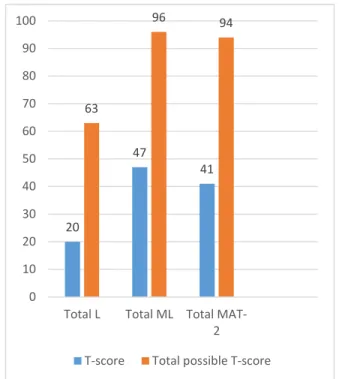
The final data analysis looked at the total scores of the test, both in terms of percentages and T scores, as can be seen in Figures 3 and 4, respectively.
Figure 3. Participants’ combined scores for MAT-2 (in %). 0 10 20 30 40 50 60 70 80 90 Totals (in %)
Figure 4. Participants’ total T scores, for all of the subtests combined.
What we see in Figures 3 and 4 corresponds to what we saw in Figures 1 and 2. For percentages, we can see that the average L score is 77%, which is comparable to results we see in school evaluations. However, when we look at the ML score, it drops down to 37%. If we look at the MAT-2 result, we are somewhere in the middle, at 54%. Again, if we look at the T scores of these same items, we see the opposite. Their total T score for L is very low, at 20. Their ML T score falls again into the average range, with a score of 47. Finally, their total MAT-2 result, barely makes it into the average range, with a score of 41.
Before interpreting the results, Table 5 provides a snapshot of where the students’ ML results are situated, both in terms of percentages and T scores. It shows that as far as Comprehension and Synonymy are concerned, when looking at ML percentages and T
20 47 41 63 96 94 0 10 20 30 40 50 60 70 80 90 100
Total L Total ML Total MAT-2