HAL Id: hal-03014927
https://hal.archives-ouvertes.fr/hal-03014927
Submitted on 19 Nov 2020
HAL is a multi-disciplinary open access archive for the deposit and dissemination of sci-entific research documents, whether they are pub-lished or not. The documents may come from teaching and research institutions in France or abroad, or from public or private research centers.
L’archive ouverte pluridisciplinaire HAL, est destinée au dépôt et à la diffusion de documents scientifiques de niveau recherche, publiés ou non, émanant des établissements d’enseignement et de recherche français ou étrangers, des laboratoires publics ou privés.
Edition 1.2 of the PARSEME Shared Task on
Semi-supervised Identification of Verbal Multiword
Expressions
Carlos Ramisch, Agata Savary, Bruno Guillaume, Jakub Waszczuk, Marie
Candito, Ashwini Vaidya, Verginica Mititelu, Archna Bhatia, Uxoa Iñurrieta,
Voula Giouli, et al.
To cite this version:
Carlos Ramisch, Agata Savary, Bruno Guillaume, Jakub Waszczuk, Marie Candito, et al.. Edition 1.2 of the PARSEME Shared Task on Semi-supervised Identification of Verbal Multiword Expres-sions. Joint Workshop on Multiword Expressions and Electronic Lexicons (MWE-LEX 2020), 2020, Barcelona, Spain. �hal-03014927�
Edition 1.2 of the PARSEME Shared Task on Semi-supervised
Identification of Verbal Multiword Expressions
Carlos Ramisch Aix Marseille Univ, CNRS, LIS, France Agata Savary University of Tours, France Bruno Guillaume LORIA/Inria Nancy Grand-Est, France Jakub Waszczuk University of Duesseldorf, Germany Marie Candito Paris Diderot University, France Ashwini Vaidya IIT Delhi, India
Verginica Barbu Mititelu Romanian Academy, Romania Archna Bhatia Florida IHMC, USA Uxoa I˜nurrieta
Univ. of the Basque Country, Spain Voula Giouli Athena Research Center, Greece Tunga G¨ung¨or Bo˘gazic¸i University Turkey Menghan Jiang PolyU, Hong Kong
China Timm Lichte University of T¨ubingen, Germany Chaya Liebeskind Jerusalem College of Technology, Israel Johanna Monti “L’Orientale” University of Naples, Italy Renata Ramisch NILC, UFSCar, Brazil Sara Stymne Uppsala University, Sweden Abigail Walsh Dublin City University,
Ireland
Hongzhi Xu Shanghai International
Studies Univ., China Abstract
We present edition 1.2 of the PARSEME shared task on identification of verbal multiword ex-pressions (VMWEs). Lessons learned from previous editions indicate that VMWEs have low ambiguity, and that the major challenge lies in identifying test instances never seen in the train-ing data. Therefore, this edition focuses on unseen VMWEs. We have split annotated corpora so that the test corpora contain around 300 unseen VMWEs, and we provide non-annotated raw cor-pora to be used by complementary discovery methods. We released annotated and raw corcor-pora in 14 languages, and this semi-supervised challenge attracted 7 teams who submitted 9 system re-sults. This paper describes the effort of corpus creation, the task design, and the results obtained by the participating systems, especially their performance on unseen expressions.
1 Introduction
Multiword expressions (MWEs) such as to throw someone under the bus ‘to cause one’s suffering to gain personal advantage’ are idiosyncratic word combinations which need to be identified prior to further semantic processing (Baldwin and Kim, 2010; Calzolari et al., 2002). The task of MWE identification, that is, automatically locating instances of MWEs in running text (Constant et al., 2017) has received growing attention in the last 4 years. Progress on this task was especially motivated by shared tasks such as DiMSUM (Schneider et al., 2016), and two editions of the PARSEME shared tasks, edition 1.0 in 2017 (Savary et al., 2017), and edition 1.1 in 2018 (Ramisch et al., 2018).
Previous editions of the PARSEME shared task focused on the identification of verbal MWEs (VMWEs), because of their challenging traits: complex structure, discontinuities, variability, ambigu-ity, etc. (Savary et al., 2017). The problem is addressed from a multilingual perspective: editions 1.0 and 1.1 covered 18 and 20 languages, respectively. The annotation guidelines and methodology are unified across languages, offering a rich playground for system developers.
The framework proposed by the (closed track of) previous shared tasks was tailored for supervised learning. An annotated training corpus for each language was made available for system developers. The
This work is licensed under a Creative Commons Attribution 4.0 International License. License details: http:// creativecommons.org/licenses/by/4.0/.
systems, building mostly on statistical and deep learning techniques, were then able to identify MWEs in the test data based on regularities learned from the training corpora. The strength of supervised machine learning approaches lies in (a) contextual disambiguation and (b) generalisation power. In other words, the identification of ambiguous expressions should be conditioned on their contexts, and new expressions or variants should be identified even if they were not observed in the training corpus.
However, corpus studies show that supervised methods can take limited advantage of these strengths for VMWE identification. Firstly, even if a number of studies have been dedicated to contextual dis-ambiguation (between idiomatic and literal occurrences of MWEs), recent work shows that this task is quantitatively of minor importance, because literal readings occur surprisingly rarely in corpora. Namely, based on manual annotation in German, Greek, Basque, Polish, and Brazilian Portuguese, Savary et al. (2019b) discovered that most expressions are potentially ambiguous, but the vast majority of them never occur literally nor accidentally.
Secondly, MWE idiosyncrasies manifest at the level of types (sets of occurrences of the same ex-pression) and not at the level of tokens (single occurrences). This fact, in addition to MWE’s Zipfian distribution and low proliferation rate, makes it unlikely to detect new MWEs based on a few instances of known ones (Savary et al., 2019a). Thus, the generalisation power of supervised learning only applies to variants of expressions already observed in the training data.
These two findings motivated the current edition of the PARSEME shared task focusing on the iden-tification of unseen VMWEs. A VMWE annotated in the test set is considered unseen if the multi-set of lemmas of its lexicalised components was never annotated in the training data.1 Differently from edition
1.1, by training data we understand all the gold data released before the training stage, i.e. both the subset meant for training proper (train) and the one meant for development/fine-tuning (dev). Therefore, the main novelties in this edition are:
1. Evaluation is not only based on overall F1, but emphasises performance on unseen VMWEs; 2. Corpora are split so that test sets contain at least 300 VMWEs unseen in training sets; 3. Raw corpora are provided to foster the development of semi-supervised VMWE discovery; 4. Unseen VMWEs are now defined with respect to train and dev sets, rather than train alone.
Moreover, we extended and enhanced the corpus annotation effort, both in terms of languages covered and of methods to increase the quality of existing corpora. This included a stronger integration with the Universal Dependencies (UD) framework.2 The remainder of this paper describes the design of edition
1.2 of the PARSEME shared task, and summarises its outcomes.3
2 Manually Annotated Corpora
The corpus used in the shared task and the underlying cross-lingually unified and validated annotation guidelines result from continuous efforts of a multilingual community since 2015.4 The 1.2 guidelines
mostly follow those from edition 1.1, with decision flowcharts based on linguistic tests, allowing anno-tators to identify and categorise candidates into the following categories:5
• inherently reflexive verbs (IRVs), e.g. FR se rendre (lit. ‘return oneself’) ‘go’
• light verb constructions (LVCs), with 2 subcategories:
– LVC.full, e.g. HE �המכסה תתל (lit. ‘give consent’) ‘approve’
– LVC.cause, e.g. RO pune la dispozit,ie (lit. ‘put at disposal’) ‘make available’
• verbal idioms (VIDs), e.g. TR ileri s¨urmek (lit. ‘lead forward’) ‘assert’
• verb-particle constructions (VPCs), with 2 subcategories:
1Instances whose lemmas match, but with different forms in training and test data, are considered seen VMWEs. We also distinguish seen-variant from seen-identical occurrences, to account for form mismatches.
2http://universaledependencies.org
3Although this paper was submitted anonymously and peer reviewed, the process may have been biased by public informa-tion about the shared task published online, including the names of organizers and language leaders who author this paper.
4https://gitlab.com/parseme/corpora/-/wikis/home
– VPC.full, e.g. DE stellt her (lit. ‘puts here’) ‘produces’
– VPC.semi, e.g. ZH 获获获取取取到到到(lit. ‘capture arrive/to’) ‘capture’
• multi-verb constructions (MVCs), e.g. HI (lit. ‘sit went’) ‘sat down’
• inherently adpositional verbs (IAVs), annotated non-systematically on an experimental basis, e.g.
IT intendersi di (lit. ‘understand of’) ‘to know about’
The only changes to these guidelines are language-specific additions: (i) a Chinese-specific decision tree for MVCs, (ii) two Swedish-specific sections about identifying multiword tokens and distinguishing particles from prepositions and prefixes.
The manually annotated corpus for edition 1.2 covers 14 languages: German (DE), Basque (EU), Greek (EL), French (FR), Irish (GA), Hebrew (HE), Hindi (HI), Italian (IT), Polish (PL), Brazilian Por-tuguese (PT), Romanian (RO), Swedish (SV), Turkish (TR) and Chinese (ZH).6
New Languages The underlined languages in the list above are those whose corpora are new or sub-stantially increased with respect to editions 1.0 and 1.1.7
Chinese is the first language in the PARSEME collection in which word boundaries are not spelled out in running text. Thus, tokenisation constitutes a major challenge. We used previously tokenised texts from the Chinese UD treebank and some raw texts from the CoNLL 2017 parsing shared task corpus.8
The latter was tokenised automatically and manually corrected when segmentation errors affected the right scope of a VMWE. About 48% of the annotated VMWEs consist in a single (multiword) token.
Irish is our first language of the Celtic genus, with new VMWE-related challenges. Firstly, frequent contractions of prepositions with personal pronouns make it hard to annotate IAVs. The preposition is usually lexicalised while the pronoun is not, as in GA chuir s´e orm (lit. ‘put he on-me’) ‘he bothered
me’. However, since these contractions are seen in UD as inflected prepositions, they are represented as single words and lemmatised into the preposition alone.9Therefore, the only possible VMWE annotation
is to consider the pronoun as an inflectional ending, i.e. part of the lexicalised preposition (chuir s´e orm). Secondly, some copula constructions, like GA X is ainm dom (lit. ‘X is name to-me’) ‘my name is X’, are
idiomatic and would normally find their place among the VIDs. This is, however, currently not possible because, according to our guidelines, a VMWE (in its syntactically least marked form) has to be headed by a verb. However, following the UD lexicalist morphosyntactic annotation principles, the head of a copula construction is the predicative noun (ainm ‘name’) rather than the copula (is ‘is’).
Swedish had a small annotated corpus in edition 1.0, but the new corpus was annotated from scratch. The main challenge was related to particle-verb combinations occurring as single tokens. Some of them can be seen either as unique words, i.e. no VMWE candidates, or as multiword tokens (MWTs), i.e. potential VPCs. This depends on whether they can occur both in the joint (one-token) and in the split (two-token) configuration, with the same or a different meaning. For instance, SV p˚ag˚a (lit. ‘on-go’)
‘be in progress’ can be split but only with a changed meaning SV g˚a p˚a (lit. ‘go on’) ‘keep bringing
the same issue up’. In SV ¨overleva (lit. ‘over-live’) ‘survive’ the particle (¨over) is easily distinguished
from the verb but the split configuration never occurs. Other compound verbs, like SV syssels¨atta (lit.
‘activity-put’) ‘put into work’, cannot be split either. Currently, all such cases are considered MWTs and annotated as VPCs or VIDs. About 49% of the annotated VMWEs contain a single (multiword) token. Enhancements in Previous Languages For all other 11 languages, the current corpus builds upon edition 1.1, with some extensions and enhancements. In Greek, Hebrew, Polish and Brazilian Portuguese, new texts were annotated (mostly in the centralised FLAT platform)10, which increased the pre-existing
6The annotated corpus for the 1.2 edition is available at http://hdl.handle.net/11234/1-3367
7Some languages present in editions 1.0 and 1.1 are not covered because the corpora were not upgraded: Arabic, Bulgarian, Croatian, Czech, English, Farsi, Hungarian, Lithuanian, Maltese, Slovene and Spanish.
8http://hdl.handle.net/11234/1-2184
9Note that other languages also have inflected (reflexive) pronouns, e.g. in IRVs: FR jeme rends (lit. ‘I return myself’) ‘I go’, ilse rend (lit. ‘he returns himself’) ‘he goes’, etc. The difference is that, in the Irish examples, the pronoun is not lexicalized and should normally not be annotated as a VMWE component.
S A1 A2 Fspan κspan κcat Greek (EL) 874(1617) 293(428) 394(462) 0.652(0.694) 0.608(0.665) 0.715(0.673) Irish (GA) 800 312 270 0.715 0.663 0.835 Polish (PL) 900(2079) 252(759) 296(707) 0.774(0.619) 0.732(0.568) 0.907(0.882) Br. Portuguese (PT) 1251(1000) 253(275) 232(241) 0.672(0.713) 0.640(0.684) 0.928(0.837) Swedish (SV) 700 364 257 0.734 0.671 0.847 Chinese (ZH) 3953 883 840 0.584 0.544 0.833
Table 1: Inter-annotator agreement on S sentences with A1 and A2VMWEs per annotator. Fspanshows
inter-annotator F-measure, κspanshows chance-corrected agreement on annotation span, and κcaton
cat-egory. Subscripts indicate agreement in edition 1.1 (on different samples).
corpora by 13%-209% in terms of the annotated VMWEs. In other languages, previous annotations were corrected in the layers of tokenisation, lemmatisation, morphosyntax or VMWEs.
Quality All 14 languages now benefit from morphosyntactic tagsets compatible with UD version 2. The tokenisation, lemmatisation, and morphosyntactic layers contain manual annotations for some lan-guages (Chinese, French, Irish, Italian, Swedish, partly German, Greek, Polish and Portuguese) and automatic ones for the others (mostly with UDPipe11trained on UD version 2.5). The homogenisation
of the morphosyntactic layer via a widely adopted framework such as UD facilitates the development of tools for corpus processing as well as for MWE identification by shared task participants.
In each language, most of the VMWE annotations were performed by a single annotator per file, except for Chinese and Turkish, where double annotation and adjudication was systematic. In most languages the post-annotation use of a custom consistency checking tool helped to reduce silence and noise (Savary et al., 2018, section 5.4). For the data annotated from scratch in edition 1.2 (Chinese, Greek, Irish, Polish and Portuguese)12 we performed double annotation of a sample to estimate inter-annotator agreement
(Savary et al., 2017; Ramisch et al., 2018). Compared to edition 1.1 (where roughly the same guidelines and methodology were used), the scores presented in Tab. 1 for Greek, Polish and Portuguese are clearly higher for categorisation.13 For span, they are slightly lower in Greek and Portuguese but significantly
higher in Polish. For all 6 languages, the contrast between the last two columns confirms the observation of previous editions that, once a VMWE has been correctly identified by an annotator, assigning it to the correct category is significantly easier.
Finally, we applied a set of validation scripts to ensure that all files respect the CUPT format (see below); each VMWE has a single category label among those specified in the guidelines; all dependency trees are acyclic; the mandatory metadata text and source sent id are present and the latter is well formatted; and that the same set of tokens is never annotated twice.
Corpus Release The annotated corpora were split into training, development and test set (see Sec-tion 5). They were released to participants in an instance of the CoNLL-U Plus format14 called
CUPT.15As described in more detail by Ramisch et al. (2018), it is a TAB-separated textual format with
one token per line and 11 columns: the first 10 correspond to morpho-syntactic information identical to CoNLL-U such as the token’s LEMMA and UPOS tags, and the 11th column contains the VMWE annotations in the form of numerical indices and a category label. Appendix B presents some corpus statistics, including the number of annotated VMWEs per category. Virtually all corpora are released
11http://ufal.mff.cuni.cz/udpipe
12Hebrew was excluded due to insufficient quantity of newly annotated data.
13Chinese had 17 annotators. They were numbered and assigned corpus sentences so that annotator n shared sentences with annotators n-1 and n+1. The outcomes of all annotators with even numbers were grouped into one cluster, and of those with odd numbers into another cluster, as if they were produced by two pseudo-annotators. For Irish, with only one active annotator, self-agreement was measured between the beginning and the end of the annotation process. For Greek, Polish and Portuguese, a subcorpus was annotated by 2 independent annotators.
14http://universaldependencies.org/ext-format.html
Language DE EL EU FR GA HE HI IT PL PT RO SV TR ZH tokens(×106) 185 25.6 21.3 915 34.2 12.9 78 281 1,902 307 12.7 2,474 19.8 67.2
sentences(×106) 10 1.04 1.33 34 1.38 0.45 3.6 12.3 159 26 0.48 164 1.39 4.11
tokens/sentence 18.5 24.5 16.0 26.9 24.8 38.5 21.7 22.9 12.0 11.8 26.6 15.1 14.5 16.3 Table 2: Number of tokens, sentences and average tokens/sentence ratio in the raw corpora
( upos=PUNCT lemma=( The upos=DET lemma=the President upos=NOUN lemma=president [MWE] label=VPC.full mwepos=VERB parseme=MWE cut upos=NOUN lemma=cut off upos=ADV lemma=off the upos=DET lemma=the speaker upos=NOUN lemma=speaker ) upos=PUNCT lemma=)
det nsubj compound:prt det
obj punct
punct
parseme=MWE parseme=MWE
Figure 1: Example of Grew-match visualisation of a MWE annotation. under various flavours of Creative Commons.16
3 Raw Corpora
In addition to the VMWE-annotated data, each language team prepared a large “raw” corpus, i.e., a corpus annotated for morphosyntax but not for VMWEs.17 Raw corpora, uniformly released in the UD
format, were meant for discovering unseen VMWEs. They have very different sizes (cf. Tab. 2) ranging from 12.7 to 2,474 millions of tokens. The genre of the data depends on the language, but efforts were put into making it consistent with the annotated data. The most frequent sources are CoNLL 2017 shared-task data, Wikipedia and newspapers.
For all languages except Italian, the raw corpus was parsed with UDPipe (Straka and Strakov´a, 2017) using models trained on UD treebanks (2.0, 2.4 or 2.5). The Italian corpus was converted into UD from the existing annotated PAIS `A Corpus.18 To ease their use by participants, each raw corpus was split into
smaller files. We checked with a UD tool19that in the first 1,000 sentences of each file: (1) each sentence
contains the required metadata, (2) the POS and dependency tags comply with the UD 2 tagsets, (3) the syntactic annotation forms a tree.
4 New Tools and Resources
Documentation Up to now, the release of data was coordinated with the organisation of shared tasks. This time, effort has been put into dissociating corpus annotation from shared tasks. Each language team was given a git repository containing development versions of the corpora. We have created a wiki con-taining instructions for language leaders to prepare data, recruit and train annotators, use common tools to create and manipulate data (e.g. the centralised annotation platform FLAT), etc. This documentation should evolve as the initiative moves towards more frequent releases of the data. We hope that this will allow more flexible resource creation, in accordance with each team’s needs and resources. Moreover, extensions and enhancements in the corpora will be integrated into MWE identification tools faster. Grew-match All along the annotation phase, the latest version of the annotated corpora (on a git repository) was searchable online via the Grew-match querying tool.20 Grew-match is a generic
graph-matching tool which was adapted to take into account the MWE annotations, by adding MWE-specific graph nodes and arcs, as shown in Figure 1: each MWE gives rise to a fake “token” node, heading arcs to all the components of the MWE. Language teams thus used Grew-match to identify potential errors
16Except parts of the CoNLL-U data, under other open (French, Polish, Irish) or unknown (Irish) licenses. 17The raw corpus for edition 1.2 is available at http://hdl.handle.net/11234/1-3416 and described at http://gitlab.com/parseme/corpora/wikis/Raw-corpora-for-the-PARSEME-1.2-shared-task
18http://www.corpusitaliano.it
19https://github.com/universalDependencies/tools
2000 4000 6000 8000 10000 0.0 0.2 0.4 0.6 0.8 |train+dev| unseen r atio ● ● ● ● ● ● ● ● ● ● ● ● ● ● ● ● ● ● ● ● ● ● BG DE EL EN ES EU FA FR HE HI HR HU IT LT PL PT RO SL TR
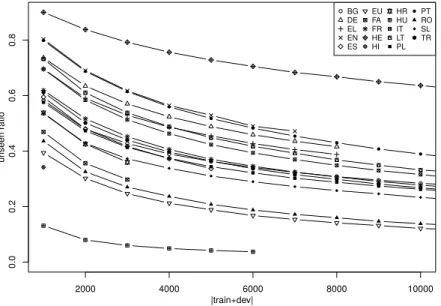
Figure 2: Per-language unseen ratios as a function of train+dev size (data from edition 1.1). and inconsistencies, e.g., the VMWE in Figure 1 would be retrieved by searching for VMWEs lacking a verbal component (in this case, the MWE annotation is correct whereas the POS of cut is incorrect). Evaluation Tools We adopt the script and metrics developed in edition 1.1 and described in detail by Ramisch et al. (2018). In addition to global and token-based precision (P), recall (R) and F-measure (F1), per language and macro-averaged, we evaluate participating systems on specific VMWE phenomena (e.g. continuous vs. discontinuous) and categories (e.g. VID, IRV, LVC.full). Especially relevant for this edition are the scores on unseen VMWEs, that is, those whose multi-set of lemmas never occur in the training data. In edition 1.1, by training data we meant the train subset only. Recently, we found that this introduced bias from those VMWEs which occurred in dev but not in train: they were still known in the gold data during the system development and tuning. Therefore, in edition 1.2, we redefined an unseen VMWE as a multiset of lemmas annotated in test but not in train+dev. Also differently from edition 1.1, the final macro-averaged and language-specific rankings emphasise results on unseen VMWEs.
5 Corpus Splits
Some datasets in edition 1.1 contained very few unseen VMWEs.21 Using them as is would lead to
statistically unreliable assessment of systems’ performance on unseen VMWEs. Thus, we had to design a strategy to re-split the corpora controlling for the distribution of unseen VMWEs. Our two prerequisites were to: (i) ensure a sufficient absolute number of unseen VMWEs for each language (ii) adapt the strategy to the (7 out of 14) languages with no new annotated data compared to previous editions. Hence we could not use the strategy of the WNUT2017 shared task on novel and emerging entity recognition, which would consist in annotating new texts, pre-filtered so as not to contain the VMWEs already present in the existing data (Derczynski et al., 2017). Therefore, we decided to split the whole annotated data for each language by randomly placing sentences in the training (train), development (dev) or test sets.
We considered several splitting methods differing in the parameters that were controlled. Apart from the absolute number of unseen VMWEs, the unseen/all VMWE ratio, as well as the test/whole corpus size ratio, seemed like desirable parameters of the splitting method. However, these three parameters interact. Figure 2, which plots the average unseen ratio as a function of the train+dev size (in terms of the number of sentences), shows that unseen ratios greatly vary across languages, even when controlling for train+dev size. Furthermore, we can see that this ratio depends on the relative size of the train+dev/test sets. So while the unseen ratio may well depend on some traits intrinsic to the language, it clearly depends on other, external, factors (e.g. the chosen text genres and the particular split).
Language DE EL EU FR GA HE HI IT PL PT RO SV TR ZH Dev w.r.t. Nb. 100 100 100 101 100 101 100 101 100 100 100 100 100 100 train Rate 0.37 0.32 0.19 0.24 0.79 0.61 0.54 0.31 0.23 0.25 0.12 0.37 0.27 0.38 Test w.r.t. Nb. 301 300 300 300 301 302 300 300 301 300 299 300 300 300 train+dev Rate 0.37 0.31 0.15 0.22 0.69 0.60 0.45 0.29 0.22 0.24 0.07 0.31 0.26 0.38 Table 3: Number and rate of unseen VMWEs in dev w.r.t. train and in test w.r.t. train+dev. On the other hand, the unseen VMWE ratio was proved to better (inversely) correlate with MWE identification performance than with the training set size alone (Al Saied et al., 2018). The analysis above dissuaded us from controlling for a “natural” (i.e. close to the average across random splits) unseen ratio. Therefore two options were considered: (1) perform random splits using predetermined proportions for train/dev/test sets and pick a split that best approaches the “natural” unseen ratio for that language, while reaching a sufficient absolute number of unseen VMWEs in the test set; (2) target roughly the same absolute number of unseen VMWEs per language, while the test size and unseen ratio follow from it naturally. Both options restrict the unseen ratio (which still varies depending on the specific split). We preferred the second one because it gives equal weights to each language in system evaluation.
Implemented Splitting Method The splitting method relies on two parameters: the number of unseen VMWEs in test with respect to train+dev, and the number of unseen VMWEs in dev with respect to train. The latter ensures that dev is similar to test, so that systems tuned on dev have similar performances on test. The method strives to find a three-way train/dev/test split satisfying the input specification while preserving the “natural” data distribution (in particular, the unseen/all VMWEs ratios).
The same procedure is applied to split the full data into test and train+dev, and then to split train+dev into train and dev, so only the former is detailed below. The procedure takes as input a set of sentences, a target number of unseen VMWEs ut, and a number N of random splits:
• We estimate st, the size (number of sentences) of the target test set leading to the desired value
of ut. As the average number of unseen VMWEs grows with the size of the test set,22we can use
binary search to determine st.23In the course of the search, for a given test size, the average number
of unseen VMWEs is estimated based on N random splits.
• For the resulting test size st, we compute the average unseen ratio rtover the same N splits.
• N random splits with test size stare performed, and the one that best fits utand rtis selected. More
precisely, best fit means here the split, with u unseen and unseen ratio r, that minimises the cost function c(u, r, ut, rt) = |utu−u|t +|rt− r|.
Splitting Results Table 3 shows the statistics of the splits obtained for all languages of the shared task using the above method, with N=100, ut=300 (in test) and then ut=100 (in dev). Due to different sizes
and characteristics of the individual datasets and languages, the obtained test/train+dev and dev/train unseen ratios vary considerably, the former varying from 0.07 for Romanian to 0.69 for Irish.24
6 Systems and Results
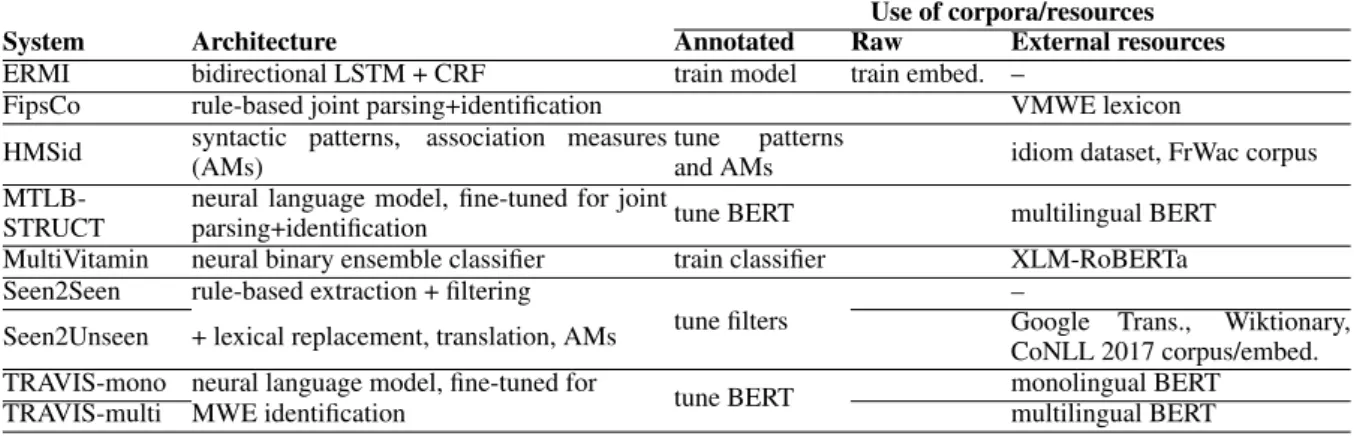
Seven teams submitted 9 results to edition 1.2, summarised in Table 4. They use a variety of techniques including recurrent neural networks (ERMI, MultiVitamin, MTLB-STRUCT and TRAVIS), syntax-based candidate extraction and filtering including association measures (HMSid, Seen2Seen), and rule-based joint parsing and MWE identification (FipsCo). The VMWE-annotated corpora are used for model training or fine-tuning, as well as for tuning patterns and filters. Surprisingly, the provided raw corpora
22The input dataset is fixed, hence a larger test set means a smaller train set, therefore more unseen VMWEs.
23If the input set has T sentences, we iterate using a binary search for the test set size in the [1, T − 1] interval. For instance, the first iteration picks s = �T/2�, the interval considered next ([1, s − 1] or [s + 1, T − 1]) depends on U(s), the average number of unseen VMWEs in N random splits with test set of size s: if the current value is higher than U(s), then the next binary search will operate on [1, s − 1], and so on. The final value of s is assigned to st.
Use of corpora/resources
System Architecture Annotated Raw External resources
ERMI bidirectional LSTM + CRF train model train embed. –
FipsCo rule-based joint parsing+identification VMWE lexicon
HMSid syntactic patterns, association measures(AMs) tuneand AMspatterns idiom dataset, FrWac corpus
MTLB-STRUCT neural language model, fine-tuned for jointparsing+identification tune BERT multilingual BERT
MultiVitamin neural binary ensemble classifier train classifier XLM-RoBERTa
Seen2Seen rule-based extraction + filtering
tune filters –
Seen2Unseen + lexical replacement, translation, AMs Google Trans.,CoNLL 2017 corpus/embed.Wiktionary,
TRAVIS-mono neural language model, fine-tuned for tune BERT monolingual BERT
TRAVIS-multi MWE identification multilingual BERT
Table 4: Architecture of the systems, and their use of provided and external resources. System #Lang Unseen MWE-based Global MWE-based Global Token-based
P R F1 # P R F1 # P R F1 # ERMI 14/14 25.3 27.2 26.2 1 64.8 52.9 58.2 2 73.7 54.5 62.6 2 Seen2Seen 14/14 36.5 00.6 01.1 2 76.2 58.6 66.2 1 78.6 57.0 66.1 1 MTLB-STRUCT 14/14 36.2 41.1 38.5 1 71.3 69.1 70.1 1 77.7 70.9 74.1 1 TRAVIS-multi 13/14 28.1 33.3 30.5 2 60.7 57.6 59.1 3 70.4 60.1 64.8 2 TRAVIS-mono 10/14 24.3 28.0 26.0 3 49.5 43.5 46.3 4 55.9 45.0 49.9 4 Seen2Unseen 14/14 16.1 12.0 13.7 4 63.4 62.7 63.0 2 66.3 61.6 63.9 3 FipsCo 3/14 04.3 05.2 05.7 5 11.7 8.8 10.0 5 13.3 8.5 10.4 5 HMSid 1/14 02.0 03.8 02.6 6 04.6 04.9 04.7 6 04.7 04.8 04.8 6 MultiVitamin 7/14 00.1 00.1 00.1 7 00.2 00.1 00.1 7 03.5 01.3 01.9 7 Table 5: Unseen MWE-based (w.r.t. train+dev), global MWE-based, and global token-based Precision (P), Recall (R), F-measure (F1) and F1 ranking (#). Closed track above separator, open track below. seem to have been used by one system only, for training word embeddings (ERMI). We expected that the teams would use the raw corpus to apply MWE discovery methods such as those described in Constant et al. (2017, Sec. 2), but they may have lacked time to do so. The external resources used include mor-phological and VMWE lexicons, external raw corpora, translation software, pre-trained non-contextual and contextual word embeddings, notably including pre-trained mono- and multi-lingual BERT.
Table 5 shows the participation of the systems in the two tracks, the number of languages they covered, and their macro-average F1 score ranking across 14 languages.25 Two system results were submitted to
the closed track and 7 to the open track. Four results covered all 14 languages.26 As this edition focuses
on performances on unseen VMWEs, these scores are presented first. 27 In the open track, the best F1
obtained by MTLB-STRUCT (38.53) is by over 10 points higher the corresponding best score in the edition 1.1 (28.46, by SHOMA). These figures are, however, not directly comparable, due to differences in the languages covered in the two editions, the size and quality of the corpora. The closed-track system ERMI achieves promising results, likely thanks to word embeddings trained on the raw corpus.
The global MWE-based F1 scores for all, both seen and unseen, VMWEs exceed 66 and 70 for the closed and open track, respectively, against 54 and 58 in edition 1.1. Like for the unseen score, it remains to be seen how much this significant difference owes to new/enhanced resources, different language sets, and novel system architectures. The second best score across the two tracks is achieved by a closed-track system (Seen2Seen) using non-neural rule-based candidate extraction and filtering. Global token-based
25Full results: http://multiword.sourceforge.net/sharedtaskresults2020/
26Macro-averages are meaningless for systems not covering some languages, for which P=R=F1=0.
27When we first published the results, we wrongly considered the unseen in test with respect to train only. Here we provide the results with unseen with respect to train+dev, as explained in Section 4. Results will be updated on the website and in the final versions of system description papers.
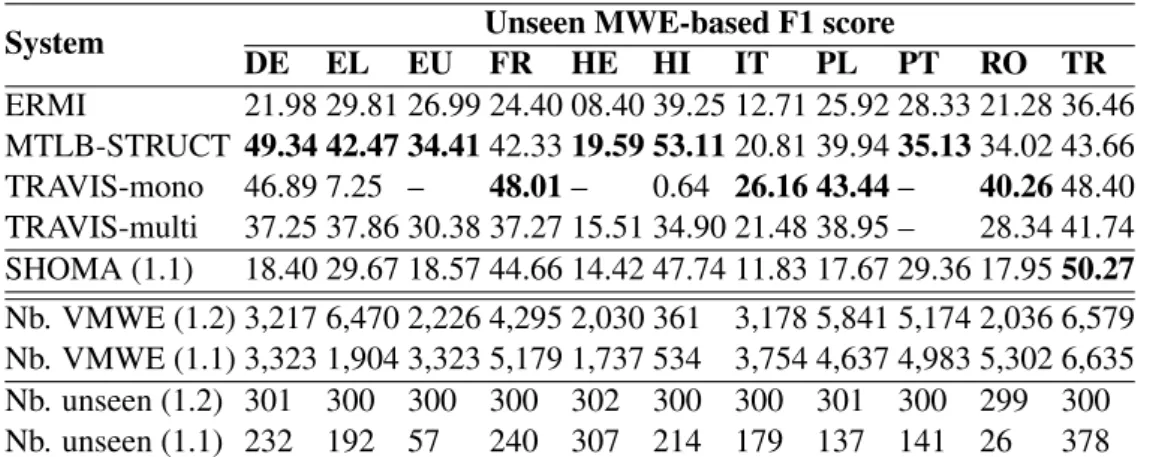
System DE EL EU FR HE HIUnseen MWE-based F1 scoreIT PL PT RO TR ERMI 21.98 29.81 26.99 24.40 08.40 39.25 12.71 25.92 28.33 21.28 36.46 MTLB-STRUCT 49.34 42.47 34.41 42.33 19.59 53.11 20.81 39.94 35.13 34.02 43.66 TRAVIS-mono 46.89 7.25 – 48.01 – 0.64 26.16 43.44 – 40.26 48.40 TRAVIS-multi 37.25 37.86 30.38 37.27 15.51 34.90 21.48 38.95 – 28.34 41.74 SHOMA (1.1) 18.40 29.67 18.57 44.66 14.42 47.74 11.83 17.67 29.36 17.9550.27 Nb. VMWE (1.2) 3,217 6,470 2,226 4,295 2,030 361 3,178 5,841 5,174 2,036 6,579 Nb. VMWE (1.1) 3,323 1,904 3,323 5,179 1,737 534 3,754 4,637 4,983 5,302 6,635 Nb. unseen (1.2) 301 300 300 300 302 300 300 301 300 299 300 Nb. unseen (1.1) 232 192 57 240 307 214 179 137 141 26 378
Table 6: F1 scores on unseen VMWEs (in train+dev) of the 4 best systems in ed. 1.2, of the best open system in ed. 1.1 (SHOMA), nb. of VMWEs (train+dev), and nb. of unseen VMWEs (train+dev). F1 scores are often slightly higher than corresponding MWE-based scores. An interesting opposition appears when comparing the global scores with those for unseen VMWEs. In the former, precision is usually higher than recall, whereas in the latter, recall exceeds precision, except for 2 systems.
As macro-averages hide inter-language variability, Table 6 shows unseen F1 scores for 11 languages present in editions 1.1 and 1.2. Results are not comparable across editions due to different corpora, but for languages with similar number of annotated total and unseen VMWEs, some systems reach higher unseen F1 scores than the best 1.1 system SHOMA (e.g. in German, French, and Hindi). However, this is not systematic (see Turkish) and the best scores are not always obtained by the same systems, preventing us from drawing strong conclusions. Performances for Chinese (not shown in Table 6) are surprisingly high, reaching unseen F1=60.19 (TRAVIS-mono). In Chinese, a many VMWEs are syntactically and lexically regular. A simple system with two rules would reach unseen MWE-based F1=27.33.28
One finding from the previous shared task editions (Section 5), is that performance for a given language is better explained by the unseen ratio for this language than by the size of the training set. This is even truer for the 1.2 edition, as we could measure a very high negative linear correlation between the highest MWEbased F1 score for a given language and the unseen ratio for that language (Pearson coefficient = -0.90). In contrast, the correlation between the best F1 and the size of the number of annotated VMWEs in the training set is quite poor (Pearson coefficient = 0.23). Appendix C plots these correlations graphically. 7 Conclusions and Future Work
The contributions of the PARSEME shared task 1.2 can be summarised as: (1) the creation and enhance-ment of VMWE-annotated corpora including three new languages, (2) an evaluation methodology to split the corpora ensuring the representativity of the target phenomenon, and (3) encouraging results hinting at improvements on the identification of unseen VMWEs. In the future, we would like to implement con-tinuous corpus development, with frequent releases independent of shared tasks, so that new languages can join at any time and system developers benefit from latest corpus versions. Additionally, our long-term aim is to increase the coverage of MWE categories, including nominal expressions, adverbials, etc. Finally, we would like to pursue our efforts to design innovative setups for combining (unsupervised) MWE discovery, automatic and manual lexicon creation, and supervised MWE identification.
Acknowledgments
This work was supported by the IC1207 PARSEME COST action and project PARSEME-FR (ANR-14-CERA-0001). Thanks to Maarten van Gompel for his help with FLAT and to the University of D¨usseldorf for hosting the server. Thanks to language leaders and annotators (Appendix A) for their hard work.
28R1: verbs ending with 入入入are single-token VMWEs; R2: pairs of consecutive verbs linked with mark and such that the dependant’s lemma belongs to a list of 7 lemmas: 到到到, 为为为, 出出出, 在在在, 成成成, 至至至and 出出出are VMWEs.
References
Hazem Al Saied, Marie Candito, and Mathieu Constant. 2018. A transition-based verbal multiword expression analyzer. In Stella Markantonatou, Carlos Ramisch, Agata Savary, and Veronika Vincze, editors, Multiword expressions at length and in depth. Language Science Press.
Timothy Baldwin and Su Nam Kim. 2010. Multiword expressions. In Nitin Indurkhya and Fred J. Damerau, editors, Handbook of Natural Language Processing, Second Edition, pages 267–292. CRC Press, Taylor and Francis Group, Boca Raton, FL. ISBN 978-1420085921.
Nicoletta Calzolari, Charles Fillmore, Ralph Grishman, Nancy Ide, Alessandro Lenci, Catherine MacLeod, and Antonio Zampolli. 2002. Towards best practice for multiword expressions in computational lexicons. In Proceedings of the 3rd International Conference on Language Resources and Evaluation (LREC-2002), pages 1934–1940, Las Palmas.
Mathieu Constant, G¨uls¸en Eryi˘git, Johanna Monti, Lonneke van der Plas, Carlos Ramisch, Michael Rosner, and Amalia Todirascu. 2017. Multiword expression processing: A survey. Computational Linguistics, 43(4):837– 892.
Leon Derczynski, Eric Nichols, Marieke van Erp, and Nut Limsopatham. 2017. Results of the WNUT2017 shared task on novel and emerging entity recognition. In Proceedings of the 3rd Workshop on Noisy User-generated Text, pages 140–147, Copenhagen, Denmark, September. Association for Computational Linguistics.
Carlos Ramisch, Silvio Ricardo Cordeiro, Agata Savary, Veronika Vincze, Verginica Barbu Mititelu, Archna Bhatia, Maja Buljan, Marie Candito, Polona Gantar, Voula Giouli, Tunga G¨ung¨or, Abdelati Hawwari, Uxoa I˜nurrieta, Jolanta Kovalevskait˙e, Simon Krek, Timm Lichte, Chaya Liebeskind, Johanna Monti, Carla Parra Escart´ın, Behrang QasemiZadeh, Renata Ramisch, Nathan Schneider, Ivelina Stoyanova, Ashwini Vaidya, and Abigail Walsh. 2018. Edition 1.1 of the PARSEME Shared Task on Automatic Identification of Verbal Multi-word Expressions. In Proceedings of the Joint Workshop on Linguistic Annotation, MultiMulti-word Expressions and Constructions (LAW-MWE-CxG-2018), pages 222–240. ACL.
Agata Savary, Carlos Ramisch, Silvio Cordeiro, Federico Sangati, Veronika Vincze, Behrang QasemiZadeh, Marie Candito, Fabienne Cap, Voula Giouli, Ivelina Stoyanova, and Antoine Doucet. 2017. The PARSEME shared task on automatic identification of verbal multiword expressions. In Proceedings of the 13th Workshop on Multiword Expressions (MWE 2017), pages 31–47, Valencia, Spain, April. Association for Computational Lin-guistics.
Agata Savary, Marie Candito, Verginica Barbu Mititelu, Eduard Bejˇcek, Fabienne Cap, Slavom´ır ˇC´epl¨o, Sil-vio Ricardo Cordeiro, G¨uls¸en Eryi˘git, Voula Giouli, Maarten van Gompel, Yaakov HaCohen-Kerner, Jolanta Kovalevskait˙e, Simon Krek, Chaya Liebeskind, Johanna Monti, Carla Parra Escart´ın, Lonneke van der Plas, Behrang QasemiZadeh, Carlos Ramisch, Federico Sangati, Ivelina Stoyanova, and Veronika Vincze. 2018. PARSEME multilingual corpus of verbal multiword expressions. In Stella Markantonatou, Carlos Ramisch, Agata Savary, and Veronika Vincze, editors, Multiword expressions at length and in depth: Extended papers from the MWE 2017 workshop, pages 87–147. Language Science Press., Berlin.
Agata Savary, Silvio Cordeiro, and Carlos Ramisch. 2019a. Without lexicons, multiword expression identification will never fly: A position statement. In MWE-WN 2019, pages 79–91, Florence, Italy. ACL.
Agata Savary, Silvio Ricardo Cordeiro, Timm Lichte, Carlos Ramisch, Uxoa I˜nurrieta, and Voula Giouli. 2019b. Literal occurrences of multiword expressions: Rare birds that cause a stir. The Prague Bulletin of Mathematical Linguistics, 112:5–54, apr.
Nathan Schneider, Dirk Hovy, Anders Johannsen, and Marine Carpuat. 2016. SemEval-2016 Task 10: Detecting Minimal Semantic Units and their Meanings (DiMSUM). In Proceedings of the 10th International Workshop on Semantic Evaluation (SemEval-2016), pages 546–559, San Diego, California, June. Association for Compu-tational Linguistics.
Milan Straka and Jana Strakov´a. 2017. Tokenizing, pos tagging, lemmatizing and parsing ud 2.0 with udpipe. In Proceedings of the CoNLL 2017 Shared Task: Multilingual Parsing from Raw Text to Universal Dependencies, pages 88–99, Vancouver, Canada, August. Association for Computational Linguistics.
A Composition of the Corpus Annotation Teams
DE: Timm Lichte (LL29), Rafael Ehren;EL: Voula Giouli (LL), Vassiliki Foufi, Aggeliki Fotopoulou,
Stella Markantonatou, Stella Papadelli, Sevasti LouizouEU: Uxoa I˜nurrieta (LL), Itziar Aduriz, Ainara Estarrona, Itziar Gonzalez, Antton Gurrutxaga, Larraitz Uria, Ruben Urizar; FR: Marie Candito (LL), Matthieu Constant, Bruno Guillaume, Carlos Ramisch, Caroline Pasquer, Yannick Parmentier, Jean-Yves Antoine, Agata Savary;GA: Abigail Walsh (LL), Jennifer Foster, Teresa Lynn; HE: Chaya Liebeskind (LL), Hevi Elyovich, Yaakov Ha-Cohen Kerner, Ruth Malka;HI: Archna Bhatia (LL), Ashwini Vaidya (LL), Kanishka Jain, Vandana Puri, Shraddha Ratori, Vishakha Shukla, Shubham Srivastava;IT: Johanna Monti (LL), Carola Carlino, Valeria Caruso, Maria Pia di Buono, Antonio Pascucci, Annalisa Raffone, Anna Riccio, Federico Sangati, Giulia Speranza;PL: Agata Savary (LL), Jakub Waszczuk (LL), Emilia Palka-Binkiewicz;PT: Carlos Ramisch (LL), Renata Ramisch (LL), Silvio Ricardo Cordeiro, Helena de Medeiros Caseli, Isaac Miranda, Alexandre Rademaker, Oto Vale, Aline Villavicencio, Gabriela Wick Pedro, Rodrigo Wilkens, Leonardo Zilio;RO: Verginica Barbu Mititelu (LL), Mihaela Ionescu, Mihaela Onofrei, Monica-Mihaela Rizea;SV: Sara Stymne (LL), Elsa Erenmalm, Gustav Finnveden, Bernadeta Grici¯ut˙e, Ellinor Lindqvist, Eva Pettersson;TR: Tunga G¨ung¨or (LL), Zeynep Yirmibes¸o˘glu, Gozde Berk, Berna Erden;ZH: Menghan Jiang (LL), Hongzhi Xu (LL), Jia Chen, Xiaomin Ge, Fangyuan Hu, Sha Hu, Minli Li, Siyuan Liu, Zhenzhen Qin, Ruilong Sun, Chengwen Wang, Huangyang Xiao, Peiyi Yan, Tsy Yih, Ke Yu, Songping Yu, Si Zeng, Yongchen Zhang, Yun Zhao.
B Statistics of the Corpora
Lang-part Sent. Tokens Avg. VMWE VID IRV LVC LVC VPC VPC IAV MVC LS
length full cause full semi ICV
DE-train 6568 126830 19.3 2950 1039 249 212 24 1286 140 0 0 0 DE-dev 602 11756 19.5 267 95 14 26 2 122 8 0 0 0 DE-test 1826 34976 19.1 824 303 59 73 7 336 46 0 0 0 DE-Total 8996 173562 19.2 4041 1437 322 311 33 1744 194 0 0 0 EL-train 17733 479679 27 6155 1933 0 3982 101 96 0 0 43 0 EL-dev 909 23911 26.3 315 98 0 203 5 4 0 0 5 0 EL-test 2805 75442 26.8 974 323 0 612 19 17 0 0 3 0 EL-Total 21447 579032 26.9 7444 2354 0 4797 125 117 0 0 51 0 EU-train 4440 61867 13.9 1690 347 0 1261 82 0 0 0 0 0 EU-dev 1418 20509 14.4 536 127 0 383 26 0 0 0 0 0 EU-test 5300 75431 14.2 2020 406 0 1508 106 0 0 0 0 0 EU-Total 11158 157807 14.1 4246 880 0 3152 214 0 0 0 0 0 FR-train 14377 360070 25 3870 1494 1037 1253 70 0 0 0 16 0 FR-dev 1573 39502 25.1 425 157 117 144 5 0 0 0 2 0 FR-test 5011 126420 25.2 1359 505 347 481 22 0 0 0 4 0 FR-Total 20961 525992 25 5654 2156 1501 1878 97 0 0 0 22 0 GA-train 257 6242 24.2 100 14 0 35 23 2 2 24 0 0 GA-dev 322 7020 21.8 126 22 0 29 22 6 5 42 0 0 GA-test 1121 25954 23.1 436 69 6 137 74 20 13 117 0 0 GA-Total 1700 39216 23 662 105 6 201 119 28 20 183 0 0 HE-train 14152 286262 20.2 1864 825 0 765 166 108 0 0 0 0 HE-dev 1254 25392 20.2 166 64 0 80 13 9 0 0 0 0 HE-test 3794 76827 20.2 503 219 0 204 44 36 0 0 0 0 HE-Total 19200 388481 20.2 2533 1108 0 1049 223 153 0 0 0 0 HI-train 282 5764 20.4 175 11 0 109 3 0 0 0 52 0 HI-dev 289 6272 21.7 186 11 0 126 0 0 0 0 49 0 HI-test 1113 23394 21 673 39 0 406 23 0 0 0 205 0 HI-Total 1684 35430 21 1034 61 0 641 26 0 0 0 306 0 IT-train 10641 292065 27.4 2854 999 783 502 112 74 2 343 19 20 IT-dev 1202 32652 27.1 324 109 81 52 18 11 0 44 4 5 IT-test 3885 106072 27.3 1032 376 280 180 44 20 0 110 10 12 IT-Total 15728 430789 27.3 4210 1484 1144 734 174 105 2 497 33 37 PL-train 17731 298437 16.8 5398 629 2723 1807 239 0 0 0 0 0 PL-dev 1425 23950 16.8 443 49 219 162 13 0 0 0 0 0
Lang-part Sent. Tokens Avg. VMWE VID IRV LVC LVC VPC VPC IAV MVC LS
length full cause full semi ICV
PL-test 4391 73753 16.7 1345 148 687 451 59 0 0 0 0 0 PL-Total 23547 396140 16.8 7186 826 3629 2420 311 0 0 0 0 0 PT-train 23905 542497 22.6 4777 945 763 2960 98 0 0 0 11 0 PT-dev 1976 43676 22.1 397 80 73 236 6 0 0 0 2 0 PT-test 6236 142377 22.8 1263 281 191 763 23 0 0 0 5 0 PT-Total 32117 728550 22.6 6437 1306 1027 3959 127 0 0 0 18 0 RO-train 10920 195718 17.9 1218 304 771 108 35 0 0 0 0 0 RO-dev 7714 134340 17.4 818 228 504 56 30 0 0 0 0 0 RO-test 38069 685566 18 4135 1114 2552 352 117 0 0 0 0 0 RO-Total 56703 1015624 17.9 6171 1646 3827 516 182 0 0 0 0 0 SV-train 1605 24970 15.5 752 105 41 95 6 345 160 0 0 0 SV-dev 596 8889 14.9 270 40 24 42 0 108 56 0 0 0 SV-test 2103 31623 15 969 146 50 142 5 418 208 0 0 0 SV-Total 4304 65482 15.2 1991 291 115 279 11 871 424 0 0 0 TR-train 17945 267503 14.9 6212 3351 0 2858 0 0 0 0 3 0 TR-dev 1062 15935 15 367 187 0 179 0 0 0 0 1 0 TR-test 3304 48791 14.7 1151 604 0 546 0 0 0 0 1 0 TR-Total 22311 332229 14.8 7730 4142 0 3583 0 0 0 0 5 0 ZH-train 35326 575590 16.2 8113 676 0 927 148 0 3156 0 3206 0 ZH-dev 1141 18258 16 265 18 0 33 6 0 108 0 100 0 ZH-test 3462 55728 16 786 63 0 94 13 0 300 0 316 0 ZH-Total 39929 649576 16.2 9164 757 0 1054 167 0 3564 0 3622 0 Total 279785 5517910 19.7 68503 18553 11571 24574 1809 3018 4204 680 4057 37
C Correlation of Performance and Unseen Ratio/Training Set Size
Figure 3: Relation between the performance of each language and its unseen ratio (red) and number of VMWEs tokens in the training set (blue). X axis: best MWE-based F1 score. Blue Y axis: Number of VMWEs in training set. Red Y axis: Unseen ratio.