HAL Id: hal-02286169
https://hal.archives-ouvertes.fr/hal-02286169
Submitted on 13 Sep 2019
HAL is a multi-disciplinary open access
archive for the deposit and dissemination of
sci-entific research documents, whether they are
pub-lished or not. The documents may come from
teaching and research institutions in France or
abroad, or from public or private research centers.
L’archive ouverte pluridisciplinaire HAL, est
destinée au dépôt et à la diffusion de documents
scientifiques de niveau recherche, publiés ou non,
émanant des établissements d’enseignement et de
recherche français ou étrangers, des laboratoires
publics ou privés.
Data aggregation architecture “Smart-Hub” for
heterogeneous systems in industrial environment
Ahmed Ahmed, Lionel Roucoules, Remy Gaudy, Bertrand Larat
To cite this version:
Ahmed Ahmed, Lionel Roucoules, Remy Gaudy, Bertrand Larat. Data aggregation architecture
“Smart-Hub” for heterogeneous systems in industrial environment. International Joint Conference
on Mechanics, Design Engineering and Advanced Manufacturing, Sep 2016, Catania, Italy. pp.1-8,
�10.1007/978-3-319-45781-9_85�. �hal-02286169�
heterogeneous systems in industrial
environment
Ahmed AHMED1*, Lionel ROUCOULES1, Rémy GAUDY2 and Bertrand LARAT2
1 Arts et Métier ParisTech, CNRS, LSIS, 2 cours des Arts et Métiers, 13697 Aix-en-Provence,
France
2 Sogeti High Tech – Groupe Capgemini, 2-10 rue Marceau – CS70400, 92136 Issy Les
Moulineaux, France
* Corresponding author. Tel.: +33-6-66-31-33-50; E-mail address: [email protected]
Abstract Distributed systems spread widely in industrial environments. One of the key challenges is the exchange and the aggregation of data between these sys-tems. Although standards play an important role to solve data interoperability is-sues between systems, these standards do not completely address existing indus-trial problems. In fact, it is not granted to have an indusindus-trial environment that complies with a unique standard; therefore, ad-hoc solutions are used to solve this issue. In this article, the authors propose a generic architecture to address the in-teroperability between systems. This architecture is developed based on model-based techniques and principles. Besides, it reduces the need for human interven-tion and time by developing once and reusing the building blocks of the architec-ture. Finally, the architecture is described in its application to a case study. Keywords: interoperability; data aggregation; smart systems; model-based engi-neering; supervision;
1 Introduction
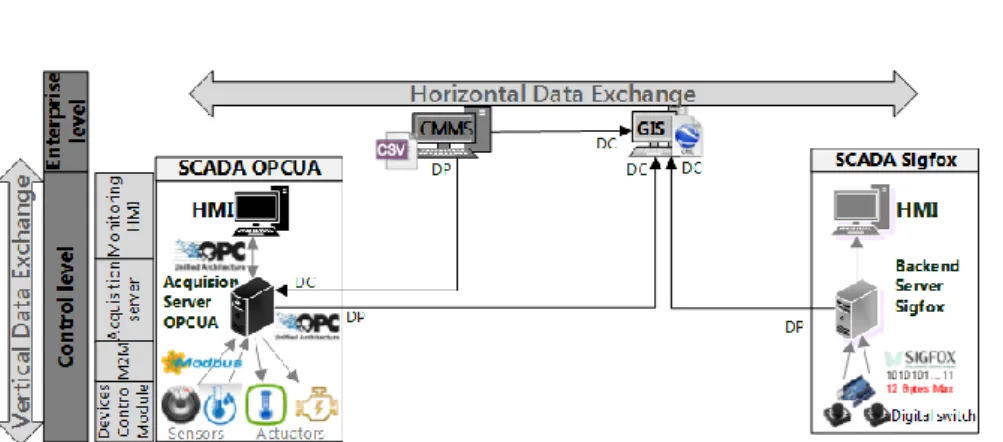
In the environments of industrial enterprise, distributed systems widely spread to perform useful operation independently. The networking and integration of these heterogeneous systems to achieve a common goal leads us to a larger complex system mostly defined as System of Systems SOS [1]. These systems include emerging smart systems such as smart grids, smart gas, smart cities, etc. [2, 3]. As shown in figure 1, they are widely found at the control level and enterprise level.
2
On the one hand, the control level depicts the vertical data exchange. It in-cludes the full data acquisition chain from the control module of devices (sensors and actuators) up to the acquisition servers through Machine-To-Machine (M2M) communication standards. Afterward, the acquisition data are monitored on a hu-man machine interface (HMI). This HMI not only assists in reading the measurements provided by the sensors but also to drive the actuators. This chain for monitoring and driving the physical devices is referenced by an architecture called Supervisory Control and Data Acquisition (SCADA) [4]. Various SCADA systems may co-exist in a given environment, each with its own data format such as OPCUA1, MQTT2, or Sigfox3, etc. and this exhibits the need to use the
appro-priate standard and mechanism to access the data. In this SCADA architecture, we are interested in the acquisition server for exchanging the data with other systems. On the other hand, the enterprise level represents all the other existing infor-mation systems in the industrial environment, e.g. maintenance systems (Comput-erized Maintenance Management System - CMMS), Geographic Information Sys-tem (GIS), decision support sysSys-tems, forecasting sysSys-tems, logistic sysSys-tems, etc. Therefore, the data need to be shared horizontally between the acquisitions servers at the control level and the systems at the enterprise level. Examples on figure 1: a CMMS information system (data producer - DP) produces data in CSV format for the SCADA server (data consumer - DC) that itself uses OPCUA standard; a GIS system (DC) displays alarms originated from the acquisition server OPCUA (DP) and Backend Sigfox (DP) and using data from the CMMS (DP) system as well.
The heterogeneity, due to different data format and data semantic (OPCUA, Sigfox 12 bytes, etc.) of these systems, makes it very challenging to guarantee the interoperable exchange of data between them. Therefore, this paper addresses the problem of syntactic and semantic interoperability to guarantee the interoperable exchange of data between heterogeneous systems. So, the authors propose a ge-neric interoperability architecture for ad-hoc solutions that relies upon model-based engineering principles to deal with this issue.
The remainder of the paper is organized as follows: section 2 discusses the re-lated work; section 3 is devoted to the proposal of the interoperable architecture; section 4 illustrates the technical aspects of implementing the proposed architec-ture, its application on a case study and finishes with a discussion; finally, section 5 concludes with a summary and some insights on ongoing and future work.
1 https://opcfoundation.org/ 2 http://mqtt.org/
Fig. 1. Data Flow and exchange between heterogeneous systems
2 Related Works
The integration and the automatic exchange of data among heterogeneous systems lead us to the essential requirement of interoperability. Some workgroups and or-ganization steer their effort to decompose the interoperability issues by defining a reference model in architectural approaches, such as Grid Wise Architectural Council [5] and the Smart Grid Architecture Model for electricity domain [3] and Reference Architecture Model for Industrie 4.0 (RAMI 4.0) [6]. However, in all these reference models, the information interoperability in terms of syntax and se-mantic are defined by domain-specific standards. Several standards are developed for various domains, examples include: the Common Information Model (IEC 61970, 61968 and 62325) [7] in the electricity domain that defines the components of the electrical power systems and their relationships; the standards ISA-95 [8], B2MML (Business to Manufacturing Markup Language), MIMOSA [9], ISO-15926 [10], or PRODML [11] in the oil and gas industry; ISO-10303 [12] in au-tomation systems and product data exchange.
Furthermore, there exist some technical standards such as OPCUA [13] for da-ta integration platforms. In spite of these sda-tandards, it is not granted to have a fully end-to-end interoperable environment [14]. For instance, it is impossible to have all the information systems using OPCUA. Therefore, some work had been done for the mapping between standards such as CIM to OPCUA in the electricity domain [15]. Other work proposed the use of a model-based integration framework using PRODML as the central metamodel for the oil and gas industry [16]. The major limitation of these approaches is their application on specific standards and do-main only. Similarly, to our best knowledge and based on our industrial partners’ feedback, this issue is usually solved by developing ad-hoc mediator solutions. This approach may not be practical and conventional in all situations because it in-volves numerous human manual interventions that are time-consuming, error-prone, and lack both flexibility and generality. Thus, the previous solutions provide domadependent solutions. Therefore in this work, a domaindependent in-teroperability framework for the aggregation of data among systems is proposed.
4
3 Conceptual proposal: “Smart-Hub Architecture”
As shown in figure 1, the data are originated from various sources, i.e. data
pro-ducers, and consumed by other systems, i.e. data consumers. As a result, the data
consumer must interpret the received data. This leads us to decompose the prob-lem as following:
1. Syntactic interoperability due to different data syntax (format) between systems (e.g. XML, DB, CSV, etc.)
2. Semantic interoperability due to the different interpretation of data be-tween systems. (e.g. data attribute “temperature” in system A is “temp” in system B )
3. Various Interfacing mechanisms to read and write data from data produc-ers and to data consumproduc-ers (e.g. file system, request-reply, publish-subscribe, SQL queries, web services, etc.)
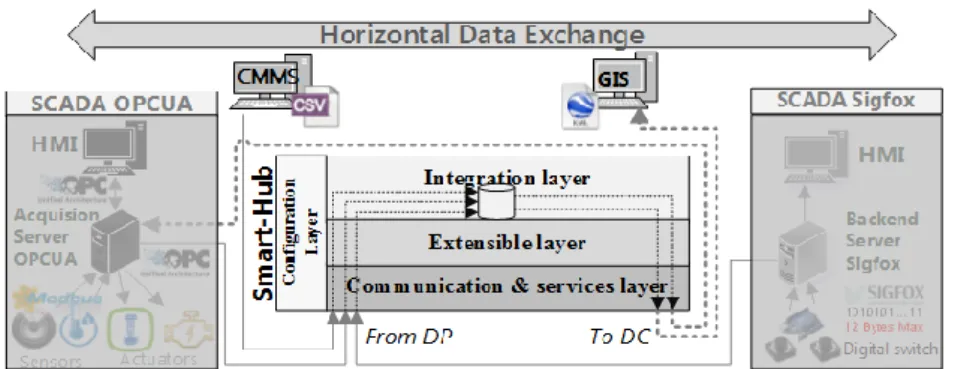
This work introduces a 4-layered generic interoperability architectural solution to address the above-mentioned problems. This architecture dubbed “Smart-Hub” acts as a hub between all heterogeneous systems at all levels of an industrial envi-ronment. It aggregates data originating from various data producers, manipulates it in terms of syntax and semantic and finally communicates it for data consumers. The 4-layers architecture is as follows:
Communication & services layer: This layer manages various proto-cols and mechanisms to establish communication between various data producers and consumer systems. It includes a repository for various data connectors, such as file systems connectors, publish/subscribe connectors, request/reply connectors, etc. It also supports some essen-tial services to read (consume) and write (produce) data from and to the various systems, respectively.
Extensible layer: This layer handles the projection (conversion) of da-ta between DP and DC format and the modeling environment. This in-cludes a repository for the supported data formats and syntax projec-tion rules.
Integration layer: This layer involves the aggregation of the model-based data in a global data model (GDM) repository and the fetching of the specific model-based dataset from the GDM. It relies on a num-ber of operational and transformation rules and deal with the semantic of data.
Configuration Layer: This layer focuses on the internal configuration of the smart-hub. It is shared between all the previous layers to guaran-tee the integration and the functionality of the smart Hub with the sur-rounding interconnected systems.
Figure 2 illustrates the smart-hub for the context of the example given previously in figure 1. At this stage, we evaluate the architecture from a macro level and all the inner details and structure of each layer is out of the scope of this paper.
Fig. 2. Smart-hub layered architecture
4 Technical proposals
In this section, the authors propose the use of Model-based engineering (MBE) techniques and operations to implement the smart-hub layers interoperability ar-chitecture.
4.1 Modeling fundamentals
MBE [17] helps to handle semantic and syntactic interoperability between stand-ards and languages. In MBE, everything is a simplified representation of certain reality, i.e. a model. The OMG proposes 3-layer architecture and the main notions is model, metamodel and metametamodel as shown in figure 3[18]. Each lower notion conforms to the upper notion, i.e. conforms to its modeling language. MBE supports model transformation. It is the generation of a model Mb from a
model Ma by a transformation Mt. The different heterogeneous systems are not
in-teroperable with MBE environments. This results in the requirement of projection phases. Projection is the generation of a model in the chosen modeling environ-ment from structured data in the technical space (TS) of the system and vice versa. This operation is called injection and extraction, respectively.
6
4.2 Architecture Implementation
Many tools support system modeling such as Papyrus4, Uml25, and Eclipse
Modeling Framework (EMF)6. According to the laboratory expertise, we have
chosen the Eclipse Modeling Framework (EMF) to support the implementation of the smart-hub solution. EMF supports model and data interchange via the XML Metadata Interchange (XMI) format. Metamodels are defined using the ECORE language. The extensible layer for projection has been being realized using a combination of the Acceleo tool7 and EMF's built-in XSD/XML support. The
in-tegration layer, for aggregation and fetching rules, has been being implemented using a combination of the rule-based ATL8 tool [19] and direct java
manipula-tion. The communication and services layer has been being implemented through extensible eclipse plugins. The evaluation and selection of the various available tools are under investigation with regards to different case studies.
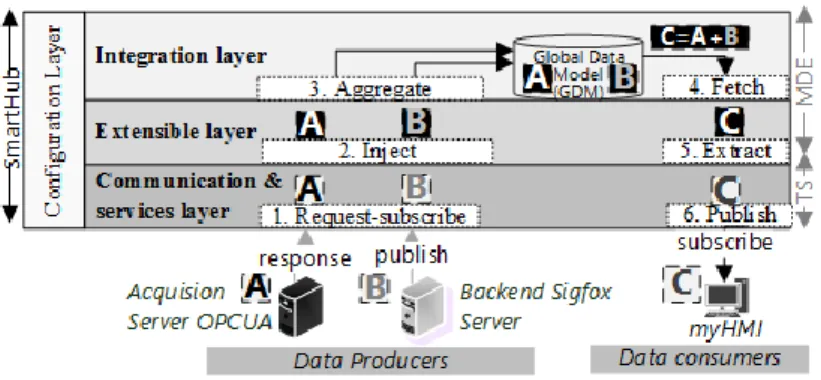
In figure 4, we will illustrate the aggregation of data from the data producers (SCADA server and Backend Sigfox Server) and prepare it for the data consumer (myHMI) that displays the aggregated data. The steps for aggregating the data for the producers to the consumers are as follows:
As a preliminary step, the smart-hub is configured with all the information required to establish the communication between it and the SCADA serv-er using OPCUA connector and the Backend Sigfox using the configura-tion layer. Furthermore, the repositories in the extensible and integraconfigura-tion layer must be configured with the mapping rules for the projection and transformation rules.
By the use of the Communication & services layer, the smart-hub estab-lishes a request for the information from the SCADA server and subscribe to the data of the Sigfox backend server as well.
Using the projection repository at the extensible layer, the data of both the SCADA server (A) and Backend Server (B) are injected in the model-ing environment.
With the Integration layer functionalities, the data (A&B) are aggregated and fetched (creation of C=A+B). This includes some operations such as avg, sum, semantic mapping, etc.
With the extensible layer, the data (C) are then formatted according to the consumer component (myHMI).
Finally, the data (C) are published to myHMI using the Communication & services layer.
4 https://eclipse.org/papyrus/ 5 https://wiki.eclipse.org/MDT-UML2 6 https://eclipse.org/modeling/emf/ 7 https://eclipse.org/acceleo/ 8 https://eclipse.org/atl/
Fig. 4. Aggregating data from OPCUA server and backend server using smart-hub framework
4.3 Discussion
The solutions existing today (in the related works) require the development of ad-hoc solutions and domain dependent solutions. They are time-consuming, error-prone and lack both of flexibility and generality due to numerous human interven-tions. Therefore, for all systems involved in information exchange, a separate ad-hoc solution is required. The originality of our solution relies on the fact that the smart-hub is developed as domain-independent and extensible blocks in each layer of the architecture with respect to the related works. These blocks may require more investment in terms of human intervention and time for development, but once it is developed, it is reused for several times. The end user saves time be-cause he just needs to reuse and setup these pbuilt blocks to accomplish the re-quired interoperability exchange.
5 Conclusion and future work
In this paper, we have studied interoperability solutions between heterogeneous systems in an industrial environment. We proposed a model-based framework to handle various format and standards. The value added of this proposal is the reduc-tion of human intervenreduc-tion and time by just configuring and reusing the building blocks of the smart-hub. Currently, the work focuses on defining the repository models for the layers of the architecture. In our future work, we intend to fully de-scribe and formalize this modeling architecture. This proposal is still in its early phases of development and several practical and theoretical issues remain to be ad-dressed. This includes hub data persistence and historization, the generality of ag-gregation/fetching rules, performance, security, etc.
8
Acknowledgments This research work takes place under a French National project, named
Gontrand, for the real-time management of the smart gas network.
References
1. M. Jamshidi, Systems of Systems Engineering: Principles and Applications, Boca Raton: CRC Press, 2008.
2. K. Su, J. Li and H. Fu, "Smart city and the applications," in International Conference on Electronics, Communications and Control (ICECC), Zhejiang, September 2011.
3. CEN-CENELEC-ETSI and Smart Grid Coordination, "Smart Grid Reference Architecture," European Committee for Standardization: Brussels, Belgium, p. 2437, 2012.
4. P. Zhang, Advanced Industrial Control Technology, Oxford: William Andrew Publishing, 2010.
5. The GridWise Architecture Council, "GridWise Interoperability Context-Setting Framework," 2008.
6. D.-I. P. Adolphs, "RAMI 4.0 An architectural Model for Industrie 4.0," 2015. [Online]. Available: http://www.omg.org/news/meetings/tc/berlin-15/special-events/mfg-presentations/adolphs.pdf. [Accessed 18 03 2016].
7. M. Uslar, M. Specht, S. Rohjans, J. Trefke and M. Specht, The Common Information Model CIM: IEC 61968/61970 and 62325 - A Practical Introduction to the CIM, Springer-Verlag Berlin Heidelberg, 2012.
8. Enterprise-control system integration, IEC 62264 Standard, 2000.
9. "MIMOSA, An Operations and Maintenance Information Open System Alliance," [Online]. Available: http://www.mimosa.org/.
10. Industrial automation systems and integration—Integration of life-cycle data for process plants including oil and gas production facilities, ISO 15926, 2003.
11. Energistics, "PRODML Standards," [Online]. Available: http://www.energistics.org/production/prodml-standards.
12. "Industrial automation systems and integration -- Product data representation," [Online]. Available:
http://www.iso.org/iso/home/store/catalogue_tc/catalogue_detail.htm?csnumber=20579. 13. W. Mahnke, S.-H. Leitner and M. Damm, OPC Unified Architecture, Berlin: Springer
Science & Business Media, 2009.
14. G. A. Lewis, E. Morris, S. Simanta et L. Wrage, «Why Standards Are Not Enough to Guarantee End-to-End Interoperability,» Seventh International Conference on Composition-Based Software Systems (ICCBSS 2008), pp. 164-173, 2008.
15. S. Rohjans, K. Piech and S. Lehnhoff, "UML-based modeling of OPC UA address spaces for power systems," in Intelligent Energy Systems (IWIES), 2013 IEEE International Workshop on, November 2013.
16. V. Veyber, A. Kudinov and N. Markov, "Model-driven Platform for Oil and Gas Enterprise Data Integration," International Journal of Computer Applications (0975 - 8887), vol. 49, no. 5, 2012.
17. V. G. Daz, Advances and Applications in Model-Driven Engineering, IGI Global, August 2013.
18. OMG. Meta Object Facility (MOF), version 2.4.1, OMG Document.
19. F. Jouault and I. Kurtev, "Transforming models with ATL," in Proceedings of the 2005 international conference on Satellite Events at the MoDELS, Montego Bay, Jamaica, 2005.