HAL Id: hal-01278031
https://hal.archives-ouvertes.fr/hal-01278031
Submitted on 2 May 2018
HAL is a multi-disciplinary open access
archive for the deposit and dissemination of
sci-entific research documents, whether they are
pub-lished or not. The documents may come from
teaching and research institutions in France or
abroad, or from public or private research centers.
L’archive ouverte pluridisciplinaire HAL, est
destinée au dépôt et à la diffusion de documents
scientifiques de niveau recherche, publiés ou non,
émanant des établissements d’enseignement et de
recherche français ou étrangers, des laboratoires
publics ou privés.
Distributed under a Creative Commons Attribution| 4.0 International License
Approximation
Radoslaw Jedynak, Jacek Gilewicz
To cite this version:
Radoslaw Jedynak, Jacek Gilewicz. Computation of the c-Table Related to the Padé
Approxima-tion. Journal of Applied Mathematics, Hindawi Publishing Corporation, 2013, 2013, pp.185648.
�10.1155/2013/185648�. �hal-01278031�
Volume 2013, Article ID 185648,10pages
http://dx.doi.org/10.1155/2013/185648
Research Article
Computation of the
𝑐-Table Related to the Padé Approximation
Rados
Baw Jedynak
1and Jacek Gilewicz
2,31Uniwersytet Technologiczno-Humanistyczny im. K. Pułaskiego, ul. Malczewskiego 20a, 26-600 Radom, Poland
2Aix Marseille Universit´e, CPT CNRS, UMR 7332, Luminy, Case 907, 13288 Marseille Cedex 9, France
3Universit´e de Toulon, CNRS, CPT, UMR 7332, 83957 La Garde, France
Correspondence should be addressed to Jacek Gilewicz; [email protected] Received 27 June 2013; Revised 13 September 2013; Accepted 24 September 2013 Academic Editor: Nicola Mastronardi
Copyright © 2013 R. Jedynak and J. Gilewicz. This is an open access article distributed under the Creative Commons Attribution License, which permits unrestricted use, distribution, and reproduction in any medium, provided the original work is properly cited.
The aim of this paper is to give a complete and practical method for numerical application of Pad´e approximation with the help of
the𝑐-table analysis. We present an exhaustive list of useful formulas to compute a 𝑐-table related to a formal power series 𝐶(𝑧) =
∑∞
𝑛=0𝑐𝑛𝑧𝑛. Some of these formulas are not widely known, because they were presented in publications of limited circulation. Some
others were never published, as three symmetric Paszkowski-like formulas to overcome the blocks in a𝑐-table or an extension of
local error formula for Pad´e approximants in the blocks. All formulas are given in two versions: in terms of Toeplitz determinants (𝑐-table) and in the version of Hankel determinants (𝑐-table). We compare the theory with numerical observations by reproducing
different computational aspects of software producing the𝑐-tables with the presence of blocks and their evolution following the
evolution of computer environment.
1. Introduction
The Pad´e approximation method is largely used to solve many problems of numerical analysis such as the convergence acceleration, analytic continuation of complex functions, moment problems, and numerical integration [1–3] and, in general, to approximate functions of the complex variable represented by a truncated power series and the detection of their zeros and poles. This method is also commonly applied to solve numerous problems in physical modeling [4]. We can find some historical background and fundamental concepts of this method in [5] and the recently published book by Trefethen [6]. In [7] the authors present the methods used to construct matrix Pad´e approximants if the coefficient matrices of the input matrix polynomial are triangular. The extended Euclidean algorithm is applied to solve this prob-lem. The application of Pad´e approximants in computational problems starts frequently by the computation of the auxiliary
table, called𝑐-table [8]. The entries of𝑐-table are the Toeplitz
determinants of matrices of linear systems defining the denominators of Pad´e approximants. The square blocks of
zeros in the𝑐-table indicate the existence of corresponding
blocks in the table of Pad´e approximants. The so-called
valleys in the𝑐-table are the lines of minimal absolute values
of entries, which indicate the lines of best Pad´e approximants (BPA) in the Pad´e table [9]. Because the computation of the 𝑐-table is simpler, it is recommended to begin by this com-putation to obtain global preliminary information about the interesting Pad´e approximants before their own calculations. Let us recall some definitions and results related to Pad´e approximation.
Let
𝐶 (𝑧) =∑∞
𝑛=0
𝑐𝑛𝑧𝑛, 𝑐0 ̸= 0 (1)
be a formal power series of a function𝑓. It can be a Maclaurin
series of an analytic function at𝑧 = 0 or an asymptotic series,
such as a Stieltjes series having a zero radius of convergence
[10,11]. Definition 1. Let {𝑚𝑛} (𝑧) = 𝑃𝑄𝑚(𝑧) 𝑛(𝑧) = 𝑝0+ 𝑝1𝑧 + ⋅ ⋅ ⋅ + 𝑝𝑚𝑧𝑚 𝑞0+ 𝑞1𝑧 + ⋅ ⋅ ⋅ + 𝑞𝑛𝑧𝑛 , deg𝑃𝑚 ≤ 𝑚, deg 𝑄𝑛≤ 𝑛 (2)
Table 1 m n 0 1 2 ⋅ ⋅ ⋅ 0 {0/0} {0/1} {0/2} ⋅ ⋅ ⋅ 1 {1/0} {1/1} ⋅ ⋅ ⋅ 2 {2/0} ⋅ ⋅ ⋅ .. . ...
denote in general a rational function. The Pad´e table (𝑝-table) of the formal power series (1) is a doubly infinite
array of irreducible rational functions{𝑚/𝑛} called reduced
Pad´e forms, determined in such a manner that the Maclaurin
expansion of{𝑚/𝑛} agrees with 𝐶(𝑧) as far as possible.
The first column inTable 1contains the truncated series
(1). Because a reduced Pad´e form can be normalized by
dividing all coefficients by one coefficient ̸= 0, then {𝑚/𝑛}
contains only𝑚+𝑛+1 unknowns which can be determined by
𝑚+𝑛+1 first coefficients of 𝐶(𝑧) or, equivalently, by 𝑚+𝑛+1
first derivatives of𝑓 at 𝑧 = 0: {𝑚 𝑛} (0) = 𝑓 (0) , (3) {𝑚 𝑛} (0) = 𝑓(0) , . . . , {𝑚 𝑛} (𝑚+𝑛) (0) = 𝑓(𝑚+𝑛)(0) . (4) This is usually expressed by the condition
𝑓 (𝑧) − 𝑃𝑚(𝑧)
𝑄𝑛(𝑧) = 𝑂 (𝑧
𝑚+𝑛+1) (5)
which means that the power series expansion of𝑃𝑚(𝑧)/𝑄𝑛(𝑧)
matches the power series expansion of𝑓 at 𝑧 = 0 at least up
to the power𝑚 + 𝑛.
Definition 2 (see Gilewicz [11, page 171]). If the reduced Pad´e
form{𝑚/𝑛} satisfies (5), then it is a Pad´e approximant and is
denoted by[𝑚/𝑛]: {𝑚/𝑛} ≡ [𝑚/𝑛].
Definition 3. The power series and associated𝑝-table are said
to be normal if every element of the table is different from any
other element. Each Pad´e approximant[𝑚/𝑛] reproduces the
series𝐶(𝑧) exactly up to the term in 𝑧𝑚+𝑛.
Multiplying (5) by𝑄𝑛we obtain
𝑄𝑛(𝑧) 𝑓 (𝑧) − 𝑃𝑚(𝑧) = 𝑂 (𝑧𝑚+𝑛+1) (6)
which leads to the separated linear system for the coefficients
𝑞𝑗and𝑝𝑗(𝑐𝑖≡ 0 if 𝑖 < 0): −𝑝𝑘+∑𝑛 𝑗=0 𝑐𝑘−𝑗𝑞𝑗= 0 𝑘 = 0, 1, . . . , 𝑚, (7) 𝑛 ∑ 𝑗=0𝑐𝑘−𝑗𝑞𝑗 = 0 𝑘 = 𝑚 + 1, . . . , 𝑚 + 𝑛. (8)
The system (8) of 𝑛 equations for (𝑛 + 1) unknowns 𝑞𝑗
always a nontrivial solution (Frobenius) which determines the reduced Pad´e form. Let us note that (6) is equivalent to
(5) only if𝑄𝑛is reversible, that is, if𝑄𝑛(0) ̸= 0. Following this
remark Baker presented an equivalent definition of the Pad´e approximant as follows.
Definition 4 (see Baker [10, page 5]). The Pad´e approximant is a solution of linear systems (8) and (7) with the condition
𝑄𝑛(0) = 𝑞0= 1 (𝑐𝑖≡ 0 if 𝑖 < 0): −𝑝𝑘+∑𝑛 𝑗=1 𝑐𝑘−𝑗𝑞𝑗= −𝑐𝑘 𝑘 = 0, 1, . . . , 𝑚, (9) 𝑛 ∑ 𝑗=1 𝑐𝑘−𝑗𝑞𝑗= −𝑐𝑘 𝑘 = 𝑚 + 1, . . . , 𝑚 + 𝑛. (10)
The power series converges only inside the convergence circle; the Pad´e approximants reproduce zeros and poles of meromorphic functions and give a good approximation of these functions also outside the circle of convergence. Moreover, in particular cases where the series represents a rational function, the Pad´e approximant method finds this function automatically. In other cases the BPA algorithms allow finding excellent approximations. Pad´e approximant is
the best local rational approximation of𝑓 in the vicinity of
the point of expansion of𝑓 in the power series. Of course, we
are not limited by the point𝑧 = 0 and if we are interested in
other regions inC we can compute the Pad´e approximants at
arbitrary point𝑧0of analyticity of𝑓 knowing the coefficients
of the series∑ 𝑎𝑗(𝑧 − 𝑧0)𝑗.
A determinant of the matrix of the system (10) is the Toeplitz determinant: 𝑚 ≥ 0, 𝑛 ≥ 1: 𝐶𝑛𝑚= 𝑐𝑚 𝑐𝑚−1 . . . 𝑐𝑚−𝑛+1 𝑐𝑚+1 . . . . . ⋅ . . . . . . . . . 𝑐𝑚+𝑛−1 . . . . 𝑐𝑚 , (11)
where we put𝑐𝑘 ≡ 0 if 𝑘 < 0. Defining 𝐶𝑚0 := 1 we can build
an infinite table of𝐶𝑚𝑛’s, called𝑐-table.
The second column of Table 2contains the coefficients
of the power series 𝐶1𝑚 = 𝑐𝑚. The first row contains the
powers of𝑐0,𝐶0𝑛= (𝑐0)𝑛and the second row can be computed
recursively by expanding𝐶1𝑛: 𝐶1 𝑛= 𝑛 ∑ 𝑗=1 (−𝑐0)𝑗−1𝑐𝑗𝐶1 𝑛−𝑗. (12)
The𝑐-table was first introduced by Gragg [8]. Baker [10] used
Table 2 𝑚 n 𝑚 n 0 1 2 3 ⋅ ⋅ ⋅ 0 1 2 ⋅ ⋅ ⋅ 0 1 𝑐0 (𝑐0)2 (𝑐0)3 ⋅ ⋅ ⋅ 0 𝐶00 𝐶01 𝐶20 ⋅ ⋅ ⋅ 1 1 𝑐1 ⋅ ⋅ ⋅ ⋅ ⋅ ⋅ ⋅ ⋅ ⋅ ≡ 1 𝐶10 𝐶11 𝐶21 ⋅ ⋅ ⋅ 2 1 𝑐2 ⋅ ⋅ ⋅ ⋅ ⋅ ⋅ ⋅ ⋅ ⋅ 2 𝐶20 𝐶21 𝐶22 ⋅ ⋅ ⋅ .. . ⋅ ⋅ ⋅ ⋅ ⋅ ⋅ ⋅ ⋅ ⋅ ⋅ ⋅ ⋅ ⋅ ⋅ ⋅ ... ⋅ ⋅ ⋅ ⋅ ⋅ ⋅ ⋅ ⋅ ⋅ ⋅ ⋅ ⋅
resulting Hankel determinants𝐶(𝑚/𝑛) and the
correspond-ing table a𝑐-table. An obvious relation between 𝐶(𝑚/𝑛) and
𝐶𝑚 𝑛 is 𝐶𝑚𝑛 = (−1)𝑛(𝑛−1)/2𝐶 (𝑚𝑛) , 𝐶 (𝑚𝑛) = 𝑐𝑚−𝑛+1 . . . . 𝑐𝑚 𝑐𝑚−𝑛+2 . . . . 𝑐𝑚+1 . . . . . . . . 𝑐𝑚 . . . . 𝑐𝑚+𝑛−1 . (13)
Interest in the𝑐-table is due to its direct relation to the Pad´e
table [8,11] and to the particular ease of its computation. The
𝑐-table contains information about the block structure of the
Pad´e table. Each square block of zeros in the𝑐-table defines a
corresponding block in the Pad´e table. Moreover, a dominant term of the error of Pad´e approximant located outside a block is given by a ratio of two Toeplitz determinants:
𝑓 (𝑧) −𝑃𝑚(𝑧) 𝑄𝑛(𝑧) = (−1) 𝑛𝐶𝑚+1𝑛+1 𝐶𝑛 𝑚 𝑧 𝑚+𝑛+1+ ⋅ ⋅ ⋅ . (14)
A theory of valleys in the𝑐-table [9] leading to a numerical
algorithm of choice of the best Pad´e approximant [11] is based on property (14).
In general a𝑝-table presents a square block structure. We
denote by(𝑚, 𝑛; 𝑘) a 𝑘 × 𝑘 square block of all equal entries
with a west-north corner{𝑚/𝑛}. In each block
∀𝑖, 𝑗 < 𝑘: {𝑚 +𝑛𝑖 + 𝑗}
𝑖+𝑗≤𝑘−1= [
𝑚
𝑛] (15)
are Pad´e approximants and satisfy
𝑓 (𝑧) − [𝑚𝑛] (𝑧) = 𝑂 (𝑧𝑚+𝑛+𝑘) , (16)
but the reduced forms located under the antidiagonal of a block are not Pad´e approximants:
∀𝑖, 𝑗 < 𝑘: {𝑚 +𝑛𝑖 + 𝑗}
𝑖+𝑗≥𝑘 ̸= [
𝑚
𝑛] (17)
because(𝑚+𝑖)+(𝑛+𝑗)+1 > 𝑚+𝑛+𝑘 (see (16)). If the𝑝-table
presents a(𝑚, 𝑛; 𝑘) block, the 𝑐-table presents a (𝑘 − 1) × (𝑘 −
1) block of zeros with the west-north corner on the position (𝑚+1), (𝑛+1). Now the following property becomes evident.
Property 1. The𝑝-table is normal if all 𝐶𝑚𝑛 ̸= 0.
Let us complete the error formula (14) by the
correspond-ing formula for[𝑚/𝑛] belonging to the block (𝑚, 𝑛; 𝑘):
𝑓 (𝑧) − [𝑚𝑛] (𝑧) = 𝑟𝑧𝑚+𝑛+𝑘+ ⋅ ⋅ ⋅ , (18) where 𝑟 = 𝐶𝑚+𝑘𝑛+1 𝐶𝑚+𝑘−1 𝑛 (−1)𝑛 = 𝐶𝑚+1𝑛+𝑘 𝐶𝑚 𝑛+𝑘−1(−1) 𝑛+𝑘−1 = 𝐶 (𝑚 + 𝑘/𝑛 + 1) 𝐶 (𝑚 + 𝑘 − 1/𝑛) = 𝐶 (𝑚 + 1/𝑛 + 𝑘) 𝐶 (𝑚/𝑛 + 𝑘 − 1). (19)
This formula given in [10,12] is given here in terms of Toeplitz
and Hankel determinants. An extension of representations of 𝑟 using other determinants around the zeros block in the 𝑐-table will be presented in the next section.
The existence of an infinite block(𝑚, 𝑛; ∞) means that the
series𝐶(𝑧) represents a rational function [𝑚/𝑛]. If a 𝑝-table
presents a block(𝑚, 𝑛; 𝑘), then the [𝑚/𝑛] Pad´e approximant
computed with𝑚 + 𝑛 + 1 coefficients 𝑐0, 𝑐1, . . . , 𝑐𝑚+𝑛located
on the antidiagonal 𝑚 + 𝑛 = const in the 𝑝-table is
clearly the best Pad´e approximant (BPA) on this antidiagonal, because it is the only approximant which reproduces exactly
the series 𝐶(𝑧) up to the power 𝑧𝑚+𝑛+𝑘−1. A number of
algorithms of choice of BPA are presented in [11]. The detailed modern theory of Pad´e approximants and the exhaustive list
of algorithms of their calculation are presented in [10,11]. The
entries of𝑝-table can be calculated directly by solving the
linear system (10) ((9) is restricted only to the substitutions) or by more efficient recursive algorithms adapted to the Toeplitz systems. One of these is based on the Wynn formula
𝑁 𝑊 𝐶 𝐸 𝑆 1 𝑊 − 𝐶+ 1 𝐸 − 𝐶 = 1 𝑁 − 𝐶+ 1 𝑆 − 𝐶 (20)
which permits computing the𝐸 elements from four others
(ascending algorithm). This method is too laborious and so
it is simpler to discover the block structure of the𝑝-table
by analyzing the block structure of the𝑐-table. In numerical
practice we are always interested in BPA and a more rapid way to determine the position of BPA passes through the analysis
2. Computation of the
𝑐-Table in the Normal
Case: Numerical Recommendations
The particular form of Toeplitz (resp. Hankel) determinants permits computing them recursively using the Sylvester formula 𝑁 𝑊 𝐶 𝐸 𝑆 𝑁𝑆 + 𝐸𝑊 = 𝐶 2 (for 𝐶𝑚 𝑛) , 𝑁𝑆 − 𝐸𝑊 = 𝐶2 (for 𝐶 (𝑚𝑛)) (21)
avoiding the laborious direct computation by (11) (resp. (13)). Starting from the two first columns one can compute the
“East”𝐶𝑚𝑛 elements by the ascending algorithm [13]:
𝐸 = 𝐶
𝑊𝐶 −
𝑆
𝑊𝑁. (22)
Alternatively, starting from the first two rows one can com-pute the “South” elements by the descending algorithm:
𝑆 = 𝐶
𝑁𝐶 −
𝐸
𝑁𝑊. (23)
The above order of arithmetic operations diminishes a risk of overflows or underflows. We have studied in [13] the complexity of both the above algorithms counting multipli-cations and divisions (including that of (12) needed for the
descending algorithm) necessary to obtain the𝐶𝑚𝑛 from the
normalized sequence(𝑐𝑗), that is, with 𝑐0 = 1. The cost of
the normalization of each coefficient𝑐1, 𝑐2, . . . in the second
column of the 𝑐-table is equal to 1. Then the costs in the
second row are0, 0, 1, 2, . . . , 𝑛 − 1, . . . (12). Then the cost𝑝𝐸
of𝐸 computed by (22) is𝑝𝐸 = 𝑝𝐶 + 𝑝𝑊+ 𝑝𝑆 + 𝑝𝑁 + 4,
where𝑝𝐶,𝑝𝑊,𝑝𝑆, and𝑝𝑁 are the previous costs of𝐶, 𝑊, 𝑆,
and𝑁, respectively. In fact it is the cost of the calculation of
all𝑛2 determinants disposed in the triangle pointed on the
last𝐶𝑚𝑛 if it is situated under or on the diagonal. Analogously,
the global cost of the calculation of all𝑚2determinants with
the last𝐶𝑚𝑛 by the descending algorithm is𝑝𝑆 = 𝑝𝐶+ 𝑝𝑁+
𝑝𝐸+ 𝑝𝑊+ 4. The following separation line optimizes the cost
of each algorithm.
In the following example we give the number of opera-tions needed by the descending algorithm followed by the number of operations needed by the ascending one:
𝐶811: 105 266, 159 995 𝐶911:349 092, 160 070. (24)
The precision of𝐸 computed by (22) is, crudely estimating,
proportional to the global cost𝑝𝐸= 2𝑝𝐶+ 2𝑝𝑊+ 𝑝𝑆+ 𝑝𝑁+ 5,
where𝑝𝐶,𝑝𝑊,𝑝𝑆, and𝑝𝑁are the previous global costs. We
count twice𝑃𝐶and𝑃𝑊because each presence of an element
in the arithmetic expression introduces its error. On the other hand if we wish to optimize the precision, we must take into account all arithmetic operations, including additions and subtractions. The errors of differences play a dominant role, but they are not considered here. Consequently the separation line will be modified. The precision observed
Table 3
Row AA DA Exact values
8 .1345 − 54 .1345 − 54 .1344 − 54 9 .3457 − 64 .3445 − 64 .3465 − 64 10 −.1041 − 73 −.1073 − 73 −.1035 − 73 11 −.6476 − 83 −.5203 − 83 −.6054 − 83 12 −.4552 − 92 .1140 − 91 .1443 − 91 13 .1653 − 97 .9137 − 98 .1387 − 98 14 −.9270 − 103 −.7552 − 103 .9683 − 105 15 −.2095 − 108 −.6141 − 108 .2715 − 110 16 −.2044 − 111 −.1911 − 111 .2241 − 115
numerically using multiprecision calculus (see details in [14]) showed that the separation line mounts a few places giving a clear advantage to the ascended algorithm.
Example 5. Fragment of the 13th column of the𝑐-table of the
series of the Stieltjes function−(1/𝑥) log(1−𝑥) is computed by
ascending algorithm (AA) and descending algorithm (DA) in
double precision (seeTable 3).
The underlined elements (Example 5) computed by the ascending algorithm situated in the region of accuracy of the descending algorithm are a little better than those computed by descending algorithm. The exact values were determined by multiprecision calculus with 32 digits.
3. Overflow, Underflow, and Detection of
Blocks: Numerical Recommendations
No problems arise in a numerical computation if all
coef-ficients𝑐𝑗 are integers [8, 12]. If a block exists, the integer
arithmetic produces zeros exactly. Unfortunately in a real case the computational problem is generally much more difficult.
Numerical experiments show that𝐶𝑚𝑛’s decrease or increase
quite rapidly. The risk of the overflow or underflow appears
approximately for 𝑚 + 𝑛 ≥ 3𝑝, where 𝑝 is the number
of decimal digits of the floating point representation ([11,
page 344]). Fortran subroutines given in [13,15] use masks
allowing the determination of exponents of real constants composing of the arithmetic expression (22) or (23) before their evaluation. After that the program checks if a global exponent is inside an authorized range or not and, if so, if it authorizes the evaluation or not. Knowing the computer used it is possible to overcome overflows without stopping an execution of the program, but the use of this technique embarrasses the software portability.
The underflow problem is related to another important
question: is the computed value of 𝐶𝑚𝑛 equal to zero or
not? The Vignes permutation-perturbation method to detect the so-called “zero informatique” in French [16] gives a satisfactory statistical estimation, allowing one to decide if a determinant vanishes or not, but in our practical computa-tional problems its cost is too great. The crude estimation is the following:
Table 4 (a) 𝑚 n 4 5 6 7 3 1. − 8 1. − 10 1. − 11 1. − 12 4 1. − 10 1. − 11 1. − 12 1. − 13 5 1. − 11 1. − 12 1. − 13 1. − 14 6 1. − 12 1. − 13 1. − 14 1. − 16 7 1. − 13 1. − 14 1. − 16 1. − 17 (b) 𝑚 n 4 5 6 7 3 6.28 + 03 −5.60 + 04 4.99 + 05 −4.45 + 06 4 6.61 − 01 2.19 + 00 7.18 + 00 2.34 + 01 5 6.61 − 07 −6.61 − 07 6.61 − 07 −6.61 − 07 6 9.06 − 10 6.55 − 26 −2.26 − 26 7.48 − 27 7 1.24 − 12 −3.11 − 29 3.48 − 47 9.31 − 47
where base denotes the base of representation of the real
con-stant in the computer (essentially2, 10, or 16). The second
method, purely empirical, is due to Guzi´nski [17]. Guzi´nski follows the monotonicity of the ascending or descending
sequences:(|𝐶𝑚+𝑗𝑛−𝑗|), 𝑗 = 𝑛, 𝑛 − 1, . . . , 1, 0 or 𝑗 = −𝑚, −𝑚 +
1, . . . , 0, respectively. Using the 32-bit arithmetic (single pre-cision) he estimates that the true value of determinant (let us call it “new”) is equal to zero if the previous monotonicity changes significantly, that is, if the new determinant with respect to the previous determinant satisfies the following inequality:
new< previous ∗ 5 ∗ 10−12. (26)
We recommend this efficient method which allows the
detec-tion of the zeros blocks in𝑐-tables very quickly. Of course, it
must be readapted to the used real constant representation. These two criteria, (25) and (26), are well-illustrated by Example 6, where the second table represents a fragment of 𝑐-table for a series produced by a rational function:
𝑓 (𝑥) = [54] = 1
(1 − (𝑥/3))2 −
9𝑥3
(1 − (𝑥/9))2. (27)
The numerical constants are denoted shortly by decimal
exponents: for instance.9 × 10−5 is denoted by.9 − 5. The
first table represents the approximative limits (25) for the
base= 16 : 16−(𝑚+𝑛)≈ 10−(6/5)(𝑚+𝑛). The underlined elements
correspond to the beginning of the infinite block of zeros
starting at element𝐶65. As shown here both criteria work: the
underlined elements on the right (𝑐-table) are less than the corresponding limits on the left and also Guzi´nski criterion is satisfied for these elements.
Example 6 (zeros block in the 𝑐-table). If the first zero is
detected by the ascending algorithm, it corresponds to the west-north corner of the block of zeros. Then, we stop at the
moment of the ascending computation of this antidiagonal and we return to the next antidiagonal to verify the value of the determinant situated under this first zero. Suppose that
we find𝑘 − 1 zeros starting from 𝐶𝑚+1𝑛+1 which indicate the
existence of the block(𝑚, 𝑛; 𝑘). The next section is devoted
to the strategy of following the calculus.
The “normal” monotonicity, by opposition to the jumps
(26), can be tested by reference to the normal𝑐-table
corre-sponding, for instance, to the Stieltjes function (seeTable 4)
𝑓 (𝑥) = −1𝑥log(1 − 𝑥) = 1 +1
2𝑥 +
1
3𝑥2+ ⋅ ⋅ ⋅ . (28)
Example 7 presents a fragment of the 𝑐-table for a series
produced by the mentioned function.
Example 7 (fragment of the𝑐-table of the Stieltjes function
𝑓 − (1/𝑥) log(1 − 𝑥)). The minima on the antidiagonals are underlined. They correspond to the positions of the best pad´e approximants on the corresponding antidiagonals in the Pad´e table. Joining these minima we obtain the valley structure in
the𝑐-table mentioned inSection 6(seeTable 5).
Using the 64-bit arithmetic (double precision) the risk of overflows or underflows is rather marginal [14]. Both stan-dards of mentioned representations of numerical values are specified by the IEEE Standard for Floating-Point Arithmetic (IEEE 754).
4. Nonnormal Case: Froissart-Gilewicz and
Paszkowski Identities to Overcome Blocks
The proof of geometrical progression of elements
surround-ing the zeros blocks in the 𝑐-table and an analytic proof
of the identity allowing the computation of the east or south elements of these blocks when the Sylvester identity fails are presented in [11]. The purely algebraic proof of an equivalent identity is given by Paszkowski in [12]. Three new Paszkowski-like identities and an extension of formula (19)
are proved and are given in this section.Figure 2illustrates
the𝑐-table corresponding to the block (𝑚, 𝑛; 𝑘) with 𝑘 = 8
and two “shells” adjacent to the7 × 7 zeros block.
Elements surrounding the blocks of zeros form geomet-rical sequences (attention: the sense of west and north arrows
and the superscripts +, − on the south and east sides are
inverted with respect to [11,12] and now correspond to the
sense of calculation of the elements of the𝑐-table by presented
algorithms) from the corners as indicated by arrows and with
respective ratios ̂𝑆, ̂𝑊, ̂𝑁, and ̂𝐸. Then, it suffices to know
four entries𝐶𝑚𝑛,𝐶𝑚𝑛+1,𝐶𝑚+1𝑛 (these three are already computed
before the detection of the block), and𝐶𝑚+𝑘𝑛+1 (first nonzero
element after𝑘 − 1 zeros on the 𝑛 + 1 column which identifies
the block) to calculate all elements surrounding the block of zeros in the following way:
̂𝑆 = 𝐶𝑚+𝑘𝑛+1 𝐶𝑚+𝑘 𝑛 , 𝐶 𝑚+𝑘 𝑛+𝑖 = 𝐶𝑚+𝑘𝑛 ∗ ̂𝑆𝑖, ̂ 𝑊 = 𝐶𝐶𝑚+1𝑛𝑚 𝑛 , 𝐶 𝑚+𝑖 𝑛 = 𝐶𝑚𝑛 ∗ ̂𝑊𝑖,
Table 5 𝑚 n 1 2 3 4 5 6 7 8 9 10 11 1 .5 + 0 −.8 − 1 .4 − 1 −.3 − 1 .2 − 1 −.1 − 1 .1 − 1 −.9 − 2 .8 − 2 −.7 − 2 .6 − 2 2 .3 + 0 −.1 − 1 −.5 − 5 −.8 − 4 −.2 − 4 −.1 − 4 −.4 − 5 .2 − 5 −.1 − 5 −.7 − 6 −.4 − 6 3 .3 + 0 −.4 − 2 −.2 − 4 .2 − 6 −.1 − 7 .1 − 8 −.2 − 9 .2 − 10 −.1 − 10 .4 − 11 −.1 − 11 4 .2 + 0 −.2 − 2 −.3 − 5 .2 − 8 .4 − 11 .7 − 13 .3 − 14 .2 − 15 .3 − 16 −.3 − 17 .3 − 17 5 .2 + 0 −.8 − 3 −.5 − 6 .9 − 10 .4 − 13 −.5 − 17 .2 − 19 −.2 − 21 −.1 − 21 −.2 − 22 −.6 − 23 6 .1 + 0 −.4 − 3 −.1 − 6 .7 − 11 .2 − 15 −.5 − 20 −.2 − 23 .2 − 25 .3 − 27 .1 − 27 .1 − 28 7 .1 + 0 −.2 − 3 −.3 − 7 .7 − 12 .5 − 17 −.8 − 22 .4 − 26 .3 − 30 .3 − 32 −.6 − 33 −.1 − 34 8 .1 + 0 −.2 − 3 −.1 − 7 .1 − 12 .4 − 18 .3 − 23 −.2 − 28 −.6 − 33 −.1 − 36 −.2 − 39 −.1 − 39 9 .1 + 0 −.1 − 3 −.4 − 8 .2 − 13 −.2 − 19 −.2 − 24 .5 − 30 −.6 − 35 −.3 − 40 .1 − 42 .2 − 44 10 .9 − 1 −.7 − 4 −.2 − 8 .3 − 14 .1 − 19 .2 − 25 .4 − 31 −.8 − 31 −.5 − 41 −.4 − 45 ̂ 𝑁 = 𝐶𝑚𝑛+1 𝐶𝑚 𝑛 , 𝐶 𝑚 𝑛+𝑖= 𝐶𝑚𝑛 ∗ ̂𝑁𝑖, ̂𝐸 = (−1)𝑘+1𝐶𝑚+1𝑛 𝐶𝑚+𝑘𝑛+1 𝐶𝑚 𝑛+1𝐶𝑚+𝑘𝑛 , 𝐶 𝑚+𝑖 𝑛+𝑘 = 𝐶𝑚𝑛+𝑘∗ ̂𝐸𝑖, 𝑖 = 0, 1, . . . , 𝑘. (29) Two additional relations were proved in [11]:
̂
𝑊̂𝑆 = (−1)𝑘+1̂𝐸̂𝑁,
𝑁𝑆 = (−1)𝑖(𝑘+1)𝑊𝐸, (30)
where𝑁 = 𝐶𝑚𝑛+𝑖,𝑆 = 𝐶𝑚+𝑘𝑛+𝑘−𝑖,𝑊 = 𝐶𝑚+𝑖𝑚 , and𝐸 = 𝐶𝑚+𝑘−𝑖𝑛+𝑘 .
The following relations (31) show relationships analogous to (29) which are expressed in terms of Hankel determinants 𝐶(𝑚/𝑛): ̃𝑆 = 𝐶 (𝑚 + 𝑘/𝑛 + 1) 𝐶 (𝑚 + 𝑘/𝑛) = (−1)𝑛̂𝑆, 𝐶 (𝑚 +𝑘𝑛+ 𝑖) = 𝐶 (𝑚 +𝑘𝑛) ∗ ̃𝑆𝑖, ̃ 𝑊 = 𝐶 (𝑚 + 1/𝑛) 𝐶 (𝑚/𝑛) = ̂𝑊, 𝐶 (𝑚 + 𝑖 𝑛) = 𝐶 ( 𝑚 𝑛) ∗ ̃𝑊𝑖, ̃ 𝑁 = 𝐶 (𝑚/𝑛 + 1) 𝐶 (𝑚/𝑛) = (−1)𝑛𝑁,̂ 𝐶 (𝑚 𝑛 + 𝑖) = 𝐶 ( 𝑚 𝑛) ∗ ̃𝑁𝑖, ̃𝐸 = (−1)𝑘+1𝐶 (𝑚 + 1/𝑛) 𝐶 (𝑚 + 𝑘/𝑛 + 1) 𝐶 (𝑚/𝑛 + 1) 𝐶 (𝑚 + 𝑘/𝑛) = ̂𝐸, 𝐶 (𝑚 + 𝑖 𝑛+ 𝑘) = 𝐶 ( 𝑚 𝑛 + 𝑘) ∗ ̃𝐸𝑖, 𝑖 = 0, 1, . . . , 𝑘 (31) ̃ 𝑊̃𝑆 = (−1)𝑘+1̃𝐸̃𝑁, 𝑁𝑆 = 𝑊𝐸, (32) where here𝑁 = 𝐶(𝑚/𝑛 + 𝑖), 𝑆 = 𝐶(𝑚 + 𝑘/𝑛 + 𝑘 − 𝑖), 𝑊 = 𝐶(𝑚 + 𝑖/𝑚), and 𝐸 = 𝐶(𝑚 + 𝑘 − 𝑖/𝑛 + 𝑘). Using
the above relations we can easily extend the formulas for𝑟 in
(18) to other ratios of Toeplitz determinants located around the zeros block. Let us simplify the notation of the left part of the formula (19) as follows:
𝑟 = 𝐴1 𝐵1(−1)𝑛= 𝐴∗1 𝐵∗ 1(−1) 𝑛+𝑘−1 (33)
and denote the next determinants by𝐴𝑖, 𝐵𝑖,𝐴∗𝑖, and𝐵∗𝑖 as
indicated inFigure 3corresponding to the block(𝑚, 𝑛; 𝑘).
Then, we have the following equivalent formulas:
𝑖 = 1, 2, . . . , 𝑘: 𝑟 = 𝐴𝐵1 1(−1) 𝑛 =𝐴𝑖 𝐵𝑖 (−1)𝑛 (̂𝑊̂𝑆)𝑖−1 = 𝐴𝐵∗∗1 1(−1) 𝑛+𝑘+1= 𝐴∗𝑖 𝐵∗ 𝑖 (−1)𝑛+(𝑘−1)[𝑖/2] (̂𝑊̂𝑆)𝑖−1 , (34)
where[𝑗/2] denote the remainder of division of 𝑗 by 2.
The ascending Sylvester algorithm fails for the second east
column because of the division by𝑊 = 0, that is, for 𝐶𝑚+𝑖𝑛+𝑘+1
with𝑖 = 1, . . . , 𝑘 − 1. The descending algorithm fails for the
second south row, that is, for𝐶𝑚+𝑘+1𝑛+𝑖 with𝑖 = 1, . . . , 𝑘 − 1.
This creates the “east shadow” region and the “south shadow” region where the elements can not be computed by respective
algorithms. These regions are shown inFigure 4.
If no block exists in the way of descending algorithm then the east shadow region can be computed by this algorithm. Analogously the ascending algorithm can be used to compute the south shadow region. Then, the two combined
algorithms allow the easy computation of many𝑐-tables with
blocks without the use of the special identities which will be presented in this section. Of course, these identities can be used to compute the black east column or the black south
8 8 7 7 6 6 5 5 4 4 3 3 2 2 1 1 0 0 9 10 11 12 m n Descending algorithm Ascending algorithm
Figure 1: Separation line optimizing the cost of each algorithm.
S S+ S− S ̂S W W+ W− W ̂ W m + k m + i m m + 1 n n + 1 n + i n + k N N+ N− N ̂ N E E+ E− E ̂E Zeros block m + k − i
Figure 2: Location of elements in (𝑚, 𝑛; 8) block for
Gilewicz-Froissart and Paszkowski identities.
row which allows following the use of respective, ascending, or descending algorithm. In fact, the Sylvester algorithms fail
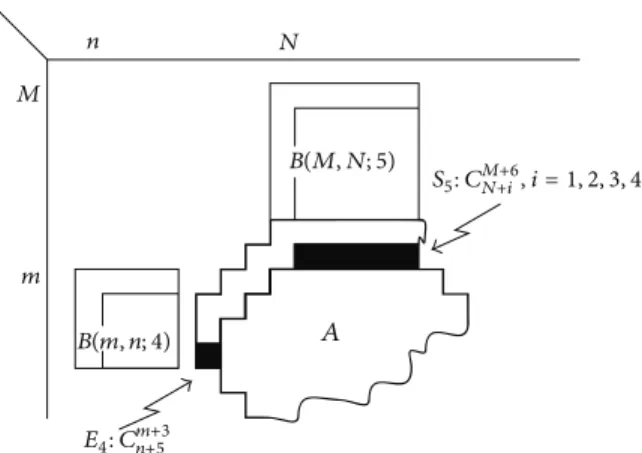
only in the rare situations illustrated inFigure 5. Let𝐴 be an
intersection of an east shadow region produced by a block (𝑚, 𝑛; 4) and a south shadow region produced by the block
(𝑀, 𝑁; 5). Let 𝐸4be an intersection of𝐴 with the second east
3-element column on the right side of the block (𝑚, 𝑛; 4) and
let𝑆5be an intersection of𝐴 with the second south 4-element
row in the bottom of the block (𝑀, 𝑁; 5). The combined
Sylvester algorithm fails only if both𝐸4and𝑆5 (in general:
𝐸𝑘and𝑆𝐾) are nonempty.
In this particular case it is necessary to compute 𝐸4 =
𝐶𝑚+3
𝑛+5 by the Froissart-Gilewicz or Paszkowski identity, to be
able to follow the recurrence computation of the𝑐-table by the
combined Sylvester algorithms. If not, we can compute the
south black elements𝑆5at the bottom of the blocks of zeros
and follow the computation by Sylvester algorithms. The last
strategy is recommended if card(𝑆𝐾) < card(𝐸𝑘), that is, in
the opposite situation, as seen inFigure 5.
However this “theoretical” strategy based on an extensive application of the combined Sylvester algorithm can be only
used near the diagonal of a𝑐-table. Indeed, the complexity
diagram (Figure 1,Section 2) shows that outside this region
the cost of the computation of elements needed is much lower
0 B2 B1 Ak= A∗k Bk= B∗k A∗1 A∗ 2 . . . B∗2B1∗ A1A2. . .
Figure 3: Location of determinants giving different forms of error 𝑟.
Figure 4: East and south shadow regions in the𝑐-table.
if they are computed by the Froissart-Gilewicz or Paszkowski formulas.
The first identity allows going around a block (𝑚, 𝑛; 𝑘)
in the 𝑐-table (i.e., for 𝐶𝑚𝑛). It was proven by Froissart
and Gilewicz [11]. Using the notation of Figure 2it can be
presented in the following form of a determinant:
𝑘 ≥ 3: (−1)𝑘 𝑁 𝑁 1 ̂ 𝑊 𝑆 𝑆 ̂𝐸 = (−1) 𝑖 𝑊 𝑊 𝑁̂ 𝐸 𝐸 1 ̂𝑆 , 𝑘 = 2: 𝑁𝑁2 +𝑆𝑆2 = 𝑊𝑊2 +𝐸𝐸2. (35)
After computing elements𝐸or/and𝑆one can continue the
computing using the Sylvester formulas. This identity written
for𝐶(𝑚/𝑛) (now 𝑁, 𝑁, . . . denote Hankel determinants) is
𝑘 ≥ 3: (−1)𝑘 𝑁 𝑁 1 ̃ 𝑊 𝑆 𝑆 ̃𝐸 = (−1) 𝑖 −𝑊 𝑊 𝑁̃ 𝐸 𝐸(−1)𝑘 1 ̃𝑆 , 𝑘 = 2: 𝑁𝑁2 +𝑆𝑆2 = −𝑊𝑊2 −𝐸𝐸2. (36)
n N m M A B(m, n; 4) B(M, N; 5) E4: Cm+3n+5 S5:CN+iM+6,i = 1, 2, 3, 4
Figure 5: Intersection of two shadow regions in the𝑐-table.
Paszkowski identity for𝐶(𝑚/𝑛), equivalent to the previous,
gives also𝐸or/and𝑆:
𝐸= (−1)𝑘𝑖𝑆+[𝑊𝑁− +𝑊𝑁++ ((−1)𝑘𝑆𝑆+ + (−1)𝑖𝑊𝑊−)] . (37)
Paszkowski presented this identity in the elegant form of a determinant: 𝑁 𝑁+ 𝐸+ 𝑊− 𝑆+ 𝑊 𝑊+ 𝑆 = 0. (38)
Following (32) we have𝑊−∗ 𝐸+ = 𝑁−∗ 𝑆+and𝑁+∗ 𝑆− =
𝐸−∗ 𝑊+which give three new Paszkowski-like identities:
𝑁 𝑁+ 𝐸+ 𝑁− 𝐸+ 𝑊 𝑊+ 𝑆 = 𝑁 𝐸− 𝐸+ 𝑊− 𝑆+ 𝑊 𝑆− 𝑆 = 𝑁 𝑁+ 𝐸+ 𝑁− 𝐸+ 𝑊 𝑊+ 𝑆 = 0. (39)
These identities for𝐶𝑚𝑛 become
𝑁 𝑁+(−1)𝑘 𝐸+(−1)𝑘𝑛 𝑊− 𝑆+ −𝑊 𝑊+ 𝑆(−1)𝑘+𝑛 = 0, 𝑁(−)𝑘+1 𝑁+ 𝐸+(−1)𝑛 𝑁− 𝐸+ 𝑊(−1)𝑛 𝑊+ 𝑆(−1) 𝑘 + 1 = 𝑁(−1)𝑘𝑛 𝐸− 𝐸+ 𝑊− 𝑆+ 𝑊(−1)𝑛 𝑆− 𝑆(−1)𝑘+1 = 𝑁(−1)𝑛 𝑁+ 𝐸+(−1)𝑘+1 𝑁− 𝐸+ 𝑊(−1)𝑘𝑛 𝑊+ 𝑆 = 0. (40)
Achuthan and Ponnuswamy have published [18] a detailed
analysis of a table of approximants of McCabe𝑀-fractions in
the nonnormal case. To this so-called𝑀-table corresponds a
table of Toeplitz (or Hankel) determinants, like the𝑐-table (or
𝑐-table). These tables have a square block structure analogous to that presented in this work. Consequently, all our formulas can be applied to compute the elements around the blocks in
the table of Hankel determinants related to the𝑀-table.
5. Computation of Padé Approximants around
the Blocks: Numerical Recommendations
Our goal consists of indicating the location of the blocks
in the𝑝-table and then giving some information about the
location of the BPA by means of the analysis of the structure
of the𝑐-table. The next step in the work of approximation
consists of computing the relevant Pad´e approximant. Many methods of computation of Pad´e approximants use the relation between the convergents of continued fractions and Pad´e approximants [19]. However if we wish to compute an
individual Pad´e approximant[𝑚/𝑛] solving the linear system
(10) followed by the substitutions (9), we can use Cholesky method, the cost of which is
1
6𝑛 (𝑛2+ 2) + 𝑚𝑛. (41)
The cost of Cholesky method or other methods adapted to this particular symmetric matrix (see [11, page 370] or [20]) represents one-half of the cost of the solution by the Gauss
method. For instance the cost of the computation of[6/4]
by Cholesky is36 but by Longman algorithm is 465. Using
this last algorithm we compute all 45 Pad´e approximants
located in the triangle ended by the antidiagonal𝑚 + 𝑛 = 10.
If we need to know all𝑝-tables it is recommended to use
any efficient recursive algorithm (see [10,11,20]) computing
the so-called𝐿-triangle in the 𝑝-table knowing 𝐿 + 1 first
coefficients of the power series of𝑓. To do this it is also useful
to know the generalization of the Wynn cross identity (20) obtained by Florent Cordellier (see [11, page 369]) for the Pad´e
approximants surrounding a block(𝑚, 𝑛; 𝑘) in the 𝑝-table:
𝑖 = 1, 2, . . . , 𝑘: (𝑆𝑖− 𝐶)−1+ (𝑁𝑖− 𝐶)−1
= (𝑊𝑖− 𝐶)−1(𝐸𝑖− 𝐶)−1, (42)
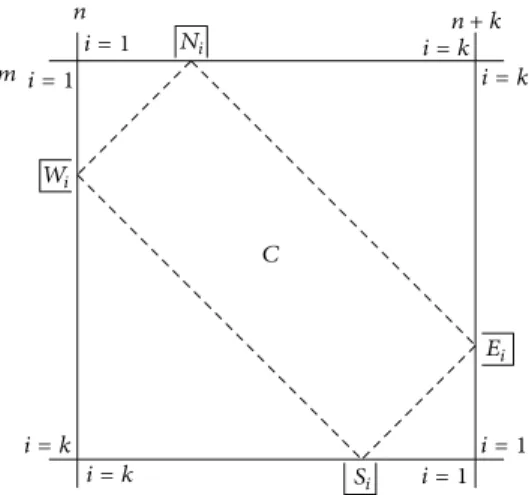
where𝐶 = [𝑚/𝑛], 𝑆𝑖 = [𝑚 + 𝑘/𝑛 + 𝑘 − 𝑖], 𝑁𝑖 = [𝑚 − 1/𝑛 +
𝑖 − 1], 𝑊𝑖 = [𝑚 + 𝑖 − 1/𝑛 − 1], and 𝐸𝑖 = [𝑚 + 𝑘 − 𝑖/𝑛 + 𝑘]
occupied symmetric positions around the block as indicated
inFigure 6.
6. Best Padé Approximant (BPA)
The Pad´e approximant to a function 𝑓 is the best local
approximation of𝑓 with respect to the norm of uniform
con-vergence. However in practice we are commonly interested in the nonlocal quality of this approximation as, for instance, an
analytic continuation of𝑓. Knowing 𝐿 + 1 first coefficients 𝑐𝑗
of power expansion (1) of𝑓 we can compute all Pad´e
i = kn + k i = 1 i = 1 i = 1 i = 1 Si Ei i = k i = k i = k Wi m n C Ni
Figure 6: Location of Pad´e approximants around the block in the Cordellier identity.
in the𝑝-table. The entries on the last antidiagonal 𝑚 + 𝑛 = 𝐿
contain complete initial information. The natural question is: where is the BPA on each antidiagonal? The answer to this question is given in [11] where four empirical algorithms of choice of BPA, based on the numerical experiments and justified for few classes of functions, are proposed:
(i) method𝜌: analysis of the behavior of the sequence
{|𝑐𝑛/𝑐𝑛+1|} which also allows the elimination of badly
computed coefficients;
(ii) method of valleys: the minima of|𝐶𝑚𝑛| on the
antidi-agonals indicate the positions of BPA and/or the
positions of the blocks (seeExample 7);
(iii) method of coefficients of PA: estimation of coeffi-cients which can be neglected allowing the detection of the blocks;
(iv) method of Gram matrix: analysis of the eigenvalues
of𝐺 = 𝐴𝐴𝑇, where𝐴 is the matrix of the system (10);
this shows if|𝐶𝑚𝑛| = (Π𝑛𝑖=1𝜆𝑖)1/2is equal to zero or not.
In numerous scientific papers where the Pad´e approximation method is applied, the authors automatically use the diagonal
Pad´e approximants [𝑛/𝑛] without any justification. This
frequently leads to erroneous conclusions as those of Van Dyke (reported in [11, page 414]) who, after selecting for
his problem the [2/2] PA, claimed that PA method is not
satisfactory in his case. Curiously, the[2/2] PA is the worst
choice among all possible elements in the𝑝-table and the BPA
gives a result ten times better than the better approximation proposed by Van Dyke!
We repeat that our goal is to help the authors wishing to apply correctly the Pad´e approximation method detecting the BPA quickly.
7. Numerical Observations and
Computational Suggestions
In numerical practice the coefficients𝑐𝑗used for the
compu-tation of Pad´e approximants are first computed numerically
or determined experimentally. Then they are affected by some noise and some errors, in general increasing with the
index. The 𝜌-method of choice of best Pad´e approximant
(BPA) [11] allows the elimination of the last badly computed coefficients. This empirical method and the recommendation
do not compute the approximants. Many papers (see [11,21–
24]) were devoted to analyzing the effect of noise on the Pad´e approximants. The so-called Froissart doublets (zero-pole doublets) appearing in the Pad´e approximants are created by the noise. Unfortunately one has not obtained at the present moment an efficient method of filtering the noise from the coefficients: the simple elimination of Froissart doublets spoils the quality of the resulting fraction obtained by the cleaning of the Pad´e approximant.
8. Conclusion
This text contains a complete list of useful identities and empirical numerical rules. Certain of these are new or were never published in current journals. We hope that the
pre-sented strategy of analysis of the𝑐-table before the calculation
of the BPA or of the𝑝-table will allow the improvement of the
efficient use of Pad´e approximation method.
Acknowledgments
The second author wishes to thank Professor Luc Wuytack who has encouraged him many years ago to write the unpublished note [25] which is in the origin of this review. The authors would like to thank the referees for their very valuable corrections.
References
[1] D. Bahuguna, A. Ujlayan, and D. N. Pandey, “A comparative study of numerical methods for solving an integro-differential equation,” Computers & Mathematics with Applications, vol. 57, no. 9, pp. 1485–1493, 2009.
[2] R. Jedynak and J. Gilewicz, “Approximation of the integrals of the gaussian distribution of asperity heights in the Greenwood-Tripp contact model of two rough surfaces revisited,” Journal of Applied Mathematics, vol. 2013, Article ID 459280, 7 pages, 2013. [3] R. Jedynak and J. Gilewicz, “Approximation of smooth functions by weighted means of N-point Pad´e approximants,” Ukrainian Mathematical Journal, vol. 65, no. 10, pp. 1410–1419, 2013. [4] D. Roy, “Global approximation for some functions,” Computer
Physics Communications, vol. 180, no. 8, pp. 1315–1337, 2009. [5] A. I. Aptekarev, V. I. Buslaev, A. Martines-Finkel’shte˘ın, and
S. P. Suetin, “Pad´e approximants, continued fractions, and orthogonal polynomials,” Russian Mathematical Surveys, vol. 66, no. 6(402), pp. 37–122, 2011.
[6] L. N. Trefethen, Approximation Theory and Approximation Practice, SIAM, Philadelphia, Pa, USA, 2013.
[7] M. Kaliyappan, S. Ponnusamy, and S. Sundar, “Recursive for-mulation of the matrix Pad´e approximation in packed storage,” Computers & Mathematics with Applications, vol. 59, no. 4, pp. 1532–1540, 2010.
[8] W. B. Gragg, “The Pad´e table and its relation to certain algo-rithms of numerical analysis,” SIAM Review, vol. 14, pp. 1–16, 1972.
[9] J. Gilewicz and A. Magnus, “Valleys in 𝑐-table,” in Pad´e Approximation and Its Applications (Proc. Conf., Univ. Antwerp, Antwerp, 1979), L. Wuytack, Ed., vol. 765 of Lecture Notes in Mathematics, pp. 135–149, Springer, Berlin, Germany, 1979. [10] G. A. Baker, Jr., Essentials of Pad´e Approximants, Academic
Press, New York, NY, USA, 1975.
[11] J. Gilewicz, Approximants de Pad´e, vol. 667 of Lecture Notes in Mathematics, Springer, Berlin, Germany, 1978.
[12] S. Paszkowski, “Evaluation of a𝐶-table,” Journal of
Computa-tional and Applied Mathematics, vol. 44, no. 2, pp. 219–233, 1992. [13] J. Gilewicz and E. Leopold, “Subroutine CTABLE for best Pad´e
approximant detection,” preprint CPT-81/P.1324, 1981. [14] J. Gilewicz and M. Pindor, “Computation of c-table and
detec-tion of valleys,” Ukrainian Journal of Mathematics, vol. 62, pp. 762–772, 2010.
[15] M. H. Lallemand, Logiciel pour la d´et´ection du Meilleur Approx-imant de Pad´e [Ph.D. thesis], DEA, CPT-CNRS, Marseille, France, 1985.
[16] J. Vignes, “Review on stochastic approach to round-off error analysis and its applications,” Mathematics and Computers in Simulation, vol. 30, no. 6, pp. 481–491, 1988.
[17] W. Guzi´nski, PADELIB: Program Library for Pad´e Approxi-mation, Inst. of Nuclear Research, Warsaw, Poland, 1978, (in Polish).
[18] P. Achuthan and S. Ponnuswamy, “On general two-point continued fraction expansions and Pad´e tables,” Journal of Approximation Theory, vol. 64, no. 3, pp. 291–314, 1991. [19] J. Gilewicz and R. Jedynak, “Compatibility of continued
frac-tion convergents with Pad´e approximants,” in Approximafrac-tion and Computation. In Honor of Gradimir V. Milovanovic, W. Gautschi, G. Mastroianni, and Th. M. Rassias, Eds., vol. 42 of Spriger Optimization and Its Application, pp. 135–144, Springer, New York, NY, USA, 2011.
[20] C. Brezinski, “Computation of Pad´e approximants and contin-ued fractions,” Journal of Computational and Applied Mathe-matics, vol. 2, no. 2, pp. 113–123, 1976.
[21] B. Beckermann, D. Bessis, L. Perotti, and D. Vrinceanu, “Com-puting high precision matrix Pad´e approximants,” Numerical Algorithms, vol. 61, no. 2, pp. 189–208, 2012.
[22] D. Bessis and L. Perotti, “Universal analytic properties of noise:
introducing the𝐽-matrix formalism,” Journal of Physics A, vol.
42, no. 36, Article ID 365202, 15 pages, 2009.
[23] J. Gilewicz and M. Pindor, “Pad´e approximants and noise: a case of geometric series,” Journal of Computational and Applied Mathematics, vol. 87, no. 2, pp. 199–214, 1997.
[24] J. Gilewicz and M. Pindor, “Pad´e approximants and noise: rational functions,” Journal of Computational and Applied Math-ematics, vol. 105, no. 1-2, pp. 285–297, 1999.
[25] J. Gilewicz, “Computation of the𝑐-table related to the Pad´e
Submit your manuscripts at
http://www.hindawi.com
Hindawi Publishing Corporation
http://www.hindawi.com Volume 2014
Mathematics
Journal ofHindawi Publishing Corporation
http://www.hindawi.com Volume 2014
Mathematical Problems in Engineering
Hindawi Publishing Corporation http://www.hindawi.com
Differential Equations
International Journal of
Volume 2014
Hindawi Publishing Corporation
http://www.hindawi.com Volume 2014 Hindawi Publishing Corporationhttp://www.hindawi.com Volume 2014
Hindawi Publishing Corporation
http://www.hindawi.com Volume 2014 Mathematical PhysicsAdvances in
Complex Analysis
Journal ofHindawi Publishing Corporation
http://www.hindawi.com Volume 2014
Optimization
Journal of Hindawi Publishing Corporationhttp://www.hindawi.com Volume 2014
Combinatorics
Hindawi Publishing Corporation
http://www.hindawi.com Volume 2014
International Journal of Hindawi Publishing Corporation
http://www.hindawi.com Volume 2014
Journal of
Hindawi Publishing Corporation
http://www.hindawi.com Volume 2014
Function Spaces
Abstract and Applied Analysis
Hindawi Publishing Corporation
http://www.hindawi.com Volume 2014 International Journal of Mathematics and Mathematical Sciences
Hindawi Publishing Corporation http://www.hindawi.com Volume 2014
The Scientific
World Journal
Hindawi Publishing Corporationhttp://www.hindawi.com Volume 2014
Hindawi Publishing Corporation
http://www.hindawi.com Volume 2014
Discrete Dynamics in Nature and Society Hindawi Publishing Corporation
http://www.hindawi.com Volume 2014
Hindawi Publishing Corporation
http://www.hindawi.com Volume 2014
Discrete Mathematics
Journal ofHindawi Publishing Corporation
http://www.hindawi.com Volume 2014 Hindawi Publishing Corporationhttp://www.hindawi.com Volume 2014