RESEARCH OUTPUTS / RÉSULTATS DE RECHERCHE
Author(s) - Auteur(s) :
Publication date - Date de publication :
Permanent link - Permalien :
Rights / License - Licence de droit d’auteur :
Bibliothèque Universitaire Moretus Plantin
Institutional Repository - Research Portal
Dépôt Institutionnel - Portail de la Recherche
researchportal.unamur.be
University of Namur
The Peace Mediator Effect
Guazzini, Andrea; Barnabei, Graziano; Carletti, Timoteo; Bagnoli, Franco; Vilone, Daniele
Publication date:
2009
Document Version
Early version, also known as pre-print
Link to publication
Citation for pulished version (HARVARD):
Guazzini, A, Barnabei, G, Carletti, T, Bagnoli, F & Vilone, D 2009, 'The Peace Mediator Effect'.
General rights
Copyright and moral rights for the publications made accessible in the public portal are retained by the authors and/or other copyright owners and it is a condition of accessing publications that users recognise and abide by the legal requirements associated with these rights. • Users may download and print one copy of any publication from the public portal for the purpose of private study or research. • You may not further distribute the material or use it for any profit-making activity or commercial gain
• You may freely distribute the URL identifying the publication in the public portal ?
Take down policy
If you believe that this document breaches copyright please contact us providing details, and we will remove access to the work immediately and investigate your claim.
(will be inserted by the editor)
The Peace Mediator Effect
A. Guazzini · G. Barnabei · T. Carletti · F. Bagnoli · D. Vilone
Received: date / Accepted: date
Abstract Statistical mechanics has proven to be able to capture the fundamental rules
underlying phenomena of social aggregation and opinion dynamics, well studied in disci-plines like sociology and psychology. This approach is based on the underlying paradigm that the interesting dynamics of multi-agent systems emerge from the correct definition of few parameters governing the evolution of each individual. Into this context, we propose a new model of opinion dynamics based on the psychological construct named ”cognitive dissonance”. Our system is made of interacting individuals, the agents, each bearing only two dynamical variables (respectively “opinion” and “affinity”) self-consistently adjusted during time evolution. We also define two special classes of interacting entities, both acting for a peace mediation process but via different course of action: “diplomats” and “auctori-tates”. The behavior of the system with and without peace mediators (P M s) is investigated and discussed with reference to corresponding psychological and social implications.
Keywords opinion dynamics · complex systems · peace mediation · cognitive dissonance
1 Introduction
In recent years we have seen the emergence of a new breed of professionals broadly called Peace Mediators, P M s for short, involved in the process of peace (re)construction. They Andrea Guazzini
Institute of Informatics and Telematics (IIT), Italian National Research Council (CNR). Via G. Moruzzi, 1. 56124 Pisa, Italy.
Centre for the Study of Complex Dynamics (CSDC). Via Sansone, 1. 50019 Sesto F.no, Firenze, Italy. E-mail: [email protected]
Graziano Barnabei
Department of Energy, Physics of Complex Systems Laboratory, University of Florence. Via S. Marta, 3. 50139 Florence, Italy. E-mail: [email protected]
Timoteo Carletti
D´epartement de Math´ematique, Facult´es Universitaires Notre Dame de la Paix (FUNDP), 8
rem-part de la Vierge B5000 Namur, Belgium. E-mail: [email protected] Franco Bagnoli
Department of Energy, Physics of Complex Systems Laboratory, University of Florence & National Institute of Nuclear Physics (INFN). Via S. Marta, 3. 50139 Florence, Italy.
Centre for the Study of Complex Dynamics (CSDC). Via Sansone, 1. 50019 Sesto F.no, Firenze, Italy. E-mail: [email protected]
Daniele Vilone
Centre for the study of complex dynamics (CSDC), Via Sansone, 1. 50019 Sesto F.no, Firenze, Italy. E-mail: [email protected]
2
are deployed in countries torn by conflict or post-conflict areas in order to create conditions for sustainable peace. P M s act with the goal of reduce the fragmentation among different parts of the society until a suitable threshold, below which a widespread consensus is achieved and peace can be maintained.
Our model is based on the assumption that it is possible to study the evolution of a social phenomenon by directly considering a few of attributes of the individuals coupled by specific interaction rules. For these reasons, we adopt an agent based model, in which local rules are inspired by the cognitive dissonance [1], a cognitive construct that rules the evolution of human social cognition [3]. According to Cognitive Dissonance Theory, when unknown individuals interact, they experiment an internal conflicting state because of their respective lack of information. In order to avoid the cognitive dissonance, individuals
adopt heuristics strategies making use of mental schemes1 [2]. The mutual affinity is the
mental scheme employed to overcome this lack and to perform the optimal choice in terms of opinion production. Two heuristics strategies are generally employed:
A) if the affinity towards the interacting partner is below some threshold, then the indi-vidual will tend to crystallize its actual opinion, while for higher values of affinity he will change its opinion in the direction of the partner’s one;
B) if the opinion difference between the two interacting agents is below a critical value, then each one will increase its affinity towards the partner, otherwise the affinity score will decrease.
These two way of acting are modulated by internal factors, such as the openness of mind and the confidence2, and external ones, such as the possibility of interacting given by its own social system. Moreover, affinity acts as a long term memory in which individuals can store information useful to solve similar future situations.
By formalizing agents in such a way, we will obtain a dynamical population where interacting agents share their opinions by trying to maintain an acceptable level of dis-sonance. The asymptotic states of such system are either a global consensus (i.e. into an hypothetical opinion space, a mono-clustered state) or a social fragmentation (i.e. crystal-lization of no longer interacting clusters of opinion). Of course, in the goal of P M , latter state must be considered dangerous, since once obliged to interact, the low level of mutual affinity and the differences in opinion, may lead to strong social contrasts between these agents. For this reasons, the goal of P M can be translated into a reduction of the social fragmentation, namely into a reduction of opinion distances of agents into the opinion space.
The aim of this paper is to present two possible models of P M behavior. In the first case, we emphasize principally the skill of interacting and negotiating with people along large opinion distances. We label these P M s as “diplomats” and we tag their most promi-nent characteristic as openness of mind. Classical examples are actual diplomats, transac-tors, intermediaries, etc. On the other hand, we consider as fundamental attribute the P M reputation. The source of information is an essential ingredient to let the information to enter and spread into a population. We hence label this P M figure by “auctoritas”, being characterized by an established opinion and the aptitude to influence the society by their prestige. For sure we can set in this category Mahatma Gandhi and Nelson Mandela.
Targets of this work are to obtain a mathematical representation of both P M ’s figures and to investigate how they can affect a formalized social system of normal agents in order to reach a widespread social consensus.
1
Symbolic and synthetic representations builded up through inferential, imaginative and emo-tional processes. Because of mental schemes can be upgraded in real time during interactions with other individuals, they are used as a guidance for quick decisions in stereotypical situations.
2
The openness of mind is the limit of permissiveness that individual introduces interacting with other people. It allows to ignore the perception of incompatibilities existing between oneself and others and consequently to interact with individuals having very distant opinions. The confidence is the minimal reputation required to accept instance from others.
The paper is organized as follows. The next section is dedicated to describe the model. In forthcoming section we present numerical simulations. Fifth section is devoted to essen-tial results and in the last section we will sum up and talk about future perspectives.
2 The Model
The adopted model has already been studied in [3–5]. Hereby we briefly recall its main fea-tures. The model is characterized by a continuous opinion and a random binary encounter dynamics. We consider a system composed by N autonomous agents, the individuals, each
one characterized by the two constant parameters ∆Oc and αc, respectively the openness
of mind and the confidence. Agents are also described by the two variables α and O, re-spectively affinity and opinion, ∈ [0, 1] and self-consistently adjusted during time evolution according to the following update laws:
Oit+1= Oit− µ ∆Otij Γ1(αtij) (1)
αt+1ij = α t
ij+ αtij [1 − αtij] Γ2(∆Oij) (2)
where the functions Γ1and Γ2respectively read:
Γ1(αtij) =
1
2 [tanh (β1 (α
t
ij− αc)) + 1] (3)
Γ2(∆Oij) = − tanh (β2 (|∆Otij| − ∆Oc)) (4)
being ∆Oijt the difference at time t between the two opinion values of the interacting
partners, µ a convergence parameter and β1 and β2 set large enough to consider the
activating functions as step functions.
At each step t two interacting agents are selected as follows: the i-th agent is drawn with uniformly distributed probability from the population, while the j-th one is the one who minimize the social metric:
Dijt = dtij+ η(0, σ) (5)
composed by the two terms, respectively the social distance:
dtij= ∆Otij(1 − αtij) j= 1, ..., N j6= i (6)
and the gaussian noise (η) with mean value zero and variance σ, called social temperature [2], modulating the mixing degree in the population.
Being the ultimate goal of P M s the reduction of social fragmentation, both diplomats and auctoritates will act in this direction, but via different courses of action. Diplomats are
assumed to have a larger ∆Oc then normal agents and consequently they can interact in
the opinion space with far away agents. According to Eq. 1, this way of acting will lead to an increase of the individuals affinity towards diplomats. On the other hand, auctoritates are assumed to employ their notoriety; this is translated in our model by imposing that all agents have a larger affinity value towards them, directly promoting the convergence into opinion space.
3 Numerical simulations
Simulations are performed with following parameters. N is fixed once for all to 100,
includ-ing P M s. The social temperature η(0, σ), the affinity threshold αc and the convergence
parameter µ are fixed once for all, respectively at 0.003, 0.5 and 0.5. Normal agents have
a ∆Oc = 0.2, while for diplomats ∆Oc = 0.5. Entries in the affinity matrix α are
initial-ized between normal agents with uniformly distributed probability in [0, 0.5], while entries corresponding to normal agents towards auctoritates are set at 0.75.
4 a b c 0 1 2 3 1 Time Opinion 0 1 2 3 1 Time Opinion 0 1 2 3 1 Time Opinion
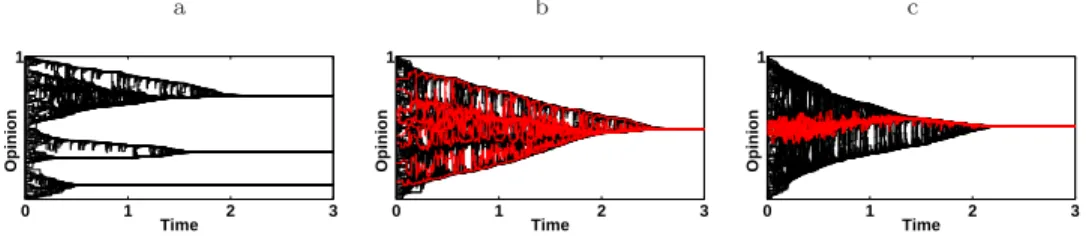
Fig. 1 Typical opinion trajectories. Each time step are 104
interactions. a) Normal agents; b)
Normalagents (black) and diplomats (red); c) Normal agents (black) and auctoritates (red).
We have considered both the fraction of P M s over the entire population and their distribution in the opinion space as the relevant control parameters, hereby measuring the mean number of survived clusters at the equilibrium over 100 runs. The range of employed P Ms is from 5% to 50% in steps of 5%3.
Runs are stopped when the system converge to an equilibrium asymptotic state. We define a such state is reached when the affinity matrix will no longer change. We know that for communities larger than 20 agents, the system converge with respect to the opinion before than respect to the affinity [5]. Hence, when affinity reaches a state where it no longer evolves, the whole system, i.e. also the opinion, will freeze. Such asymptotic state will be characterized by the number of clusters in the opinion dimension.
Scenarios. The behavior of the two P M s figures are separately studied in a starting system which entries of opinion vector O are initialized uniformly spaced in [0, 1]. Diplomats are distributed along the opinion space by substituting them to the already initialized
normal agents and according with the following modalities. In the “uniform” distribution
diplomats are spread along the opinion space with uniformly distributed probability; in
the “gaussian” one with a gaussian distribution (mean 0.5, standard deviation 0.2); in the “bimodal ” distribution they are inserted with a bimodal distribution.
The same opinion vector initialization and distribution strategies are used for auctori-tates, with the addition of a “delta” strategy in which all auctoritates are grouped around the center of the opinion space, namely around 0.5.
The “two opposing factions” case. Hereby we propose an application of the model. We consider a starting opinion space in which agents are divided into two large clusters, such that their respective opinion distances are larger than the opinion threshold of any single agent. In such a way, there is no possibility of interaction between agents belonging to the two different groups. Nevertheless, diplomats are able to interact with both factions because of their large openness of mind, while auctoritates can attract individuals because of their high reputation. We thus compare the two different courses of action.
4 Results
Figure 1 shows typical trajectories into the opinion space of a system of normal agents (1a), a system influenced by diplomats (1b) and a system influenced by auctoritates (1c), respectively. While the system of normal agents quickly converge to a fragmented asymp-totic state, the insertion of P M s increases the convergence time needed as so as the chances of obtaining a mono-clustered state. We remark the different courses of action of the two
P Ms. Because of the great ∆Ocvalue, diplomat increases affinity towards neighbourhood,
approaches partner and inclines it towards its own opinion. Agents inside the opinion bounds of diplomat have a larger probability of collapse in the same final position, and
3
We remark that, so as formalized, the increase of fraction of P M s can corresponds respectively either to a fixed number of P M s having to do with smaller group, or to a population having a
a b
5 %1 10 % 15 % 20 % 25 % 30 % 35 % 40 % 45 % 50 % 1.5
2
Fraction of Diplomats
Mean Number of Cluster
Uniform Gaussian Bimodal 1 2 3 4 0 0.5 1 Number of Clusters Probability Uniform Gaussian Bimodal 1 2 3 4 0 0.5 1 Number of Clusters Probability Uniform Gaussian Bimodal
Fig. 2 Behavior of a system modulated by diplomats, spread as in legend. a) Mean number of
sur-vived clusters at the equilibrium as a function of the fraction of diplomats. b) Probability of having N clusters at the equilibrium in a single run, 5% of diplomats (upper figure), 50% of diplomats (lower). For sake of clearness, the histograms are interpolated by ninth degree polynomials.
a b
5 %1 10 % 15 % 20 % 25 % 30 % 35 % 40 % 45 % 50 % 1.5
2
Fraction of Auctoritas
Mean Number of Cluster
Delta Uniform Gaussian Bimodal 1 2 3 0 0.5 1 Number of Clusters Probability Delta Uniform Gaussian Bimodal 1 2 3 0 0.5 1 Number of Clusters Probability Delta Uniform Gaussian Bimodal
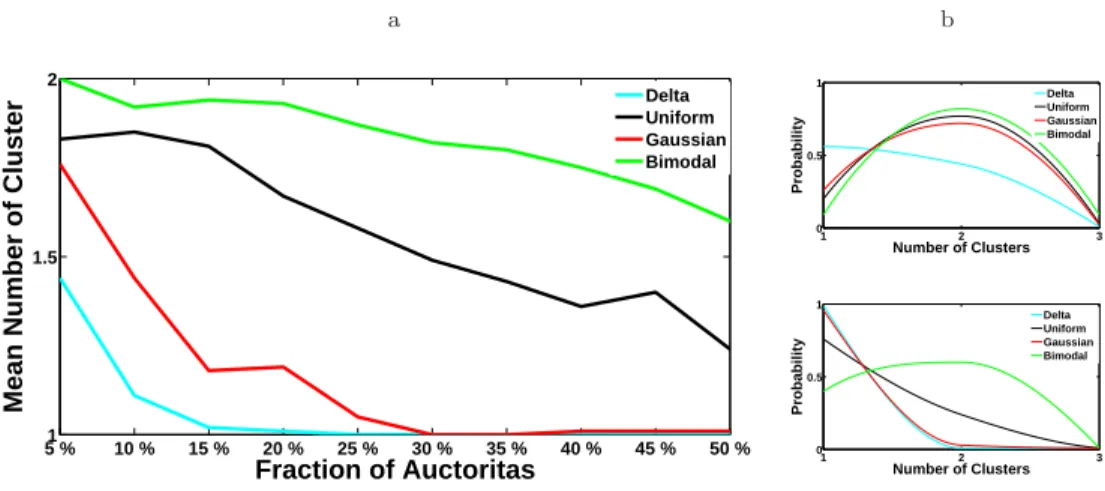
Fig. 3 Behavior of a system modulated by auctoritates, spread as in legend. a) Mean number of
survived clusters at the equilibrium as a function of the fraction of auctoritates. b) Probability of having N clusters at the equilibrium in a single run, 5% of auctoritates (upper figure), 50% of auctoritates (lower). For sake of clearness, the histograms are interpolated by ninth degree polynomials.
the diplomat has the possibility to explore the entire opinion space. On the other hand,
auctoritas tends to reach the equilibrium with the same opinion value with respect to the
initial condition. In this latter case, the affinities of normal agents towards auctoritates trigger the convergence dynamics to monocluster.
Figure 2 resumes results relative to diplomats. The insertion of diplomats reduces the mean degree of fragmentation at equilibrium. Moreover, this reduction is linear and pos-itively correlate with the fraction of employed diplomats. Although the three distribution strategies have similar trends (Fig. 2a), by augmenting the fraction of diplomats, the
gaus-sian one tends to reach the greater number of mono-clusters at equilibrium (Fig. 2b,
lower).
Figure 3 resumes results relative to auctoritates. Once more the insertion of P M s reduces the mean degree of fragmentation at equilibrium, but hereby the adopted distri-bution strategies significatively influence results of simulations (Fig. 3a). By varying the
6 a b 5 %1 10 % 20 % 20 % 25 % 30 % 35 % 40 % 45 % 50 % 1.5 2 2.5 Fraction of Diplomats
Mean Number of Clusters
Uniform Gaussian Bimodal 5 %1 10 % 15 % 20 % 25 % 30 % 35 % 40 % 45 % 50 % 1.5 2 2.5 Fraction of Auctoritas
Mean Number of Clusters
Delta Uniform Gaussian Bimodal
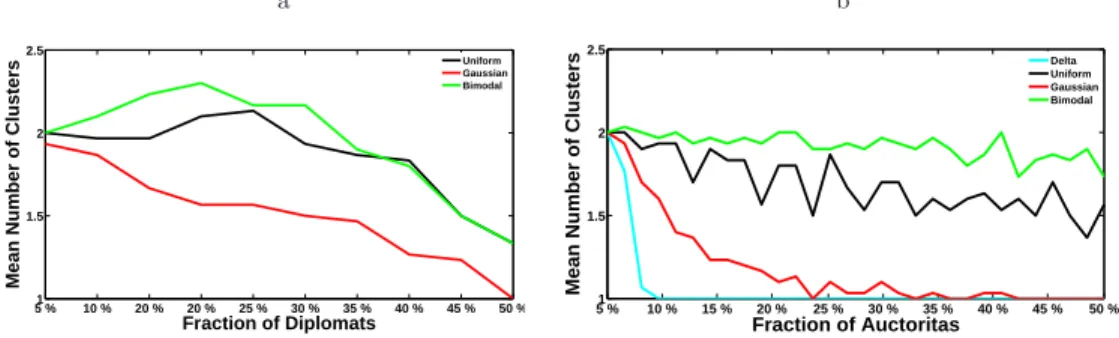
Fig. 4 Behavior of a bi-clustered starting system, spread as in legend. Mean number of survived
clusters at the equilibrium as a function of the fraction of P M s, spread as in legend. a) Acting diplomats; b) acting auctoritates.
employed fractions of auctoritates, gaussian and, mainly, delta distributions show best trends in terms of convergence to a mono-cluster state. The bimodal distribution tends to converge to a bi-clustered state (Fig. 3b, lower).
Figure 4 shows results of insertion of P M s into a bi-clustered starting population; previous results are confirmed. Diplomats become efficacious only for higher fractions of employment and mainly with a gaussian distribution. Auctoritates, spread with either a gaussian or, above all, a delta strategy, assure the convergence to a mono-clustered asymptotic state since lower fractions of employment.
5 Conclusions and future perspectives
In this paper we propose an application of the model of continuous opinion dynamics already introduced in [3–5], by inserting two figures of P M s, one by one either diplomats or
auctoritates respectively, into a population of normal agents. We describe the behavior of
the system in terms of opinion convergence and mean degree of fragmentation for different fraction of employed P M s, also in reference to a more likely situation, namely the case “two opposing factions”.
The typical modus operandi of diplomats becomes more effective by inserting many of them. By referring to Note 3, both the insertion of few diplomats into groups of small
size and the increase of the mean ∆Oc value of the population would lead to the same
result. On the other hand, the promotion of few auctoritates can assure the convergence to a widespread consensus into populations of any sort.
The combined efforts of both the two P M s figures remain to test, as so as the effects of the population size and the time needed by such figure in order to reach the global consensus.
References
1. L. Festinger, A Theory of Cognitive Dissonance. Evanston (1958).
2. R.E. Nisbett and L. Ross, Human Inferences: Strategies and shortcomings of social Judgement. Englewood Cliffs, Prentice-Hall (1980).
3. F. Bagnoli et al., Phys. Rev. E, 76, 066105 (2007).
4. T. Carletti et al., Meet Discuss and trust each other: large versus small groups. Proceedings in WIVACE (2008).