
HAL Id: tel-03155733
https://tel.archives-ouvertes.fr/tel-03155733
Submitted on 2 Mar 2021HAL is a multi-disciplinary open access
archive for the deposit and dissemination of sci-entific research documents, whether they are pub-lished or not. The documents may come from teaching and research institutions in France or abroad, or from public or private research centers.
L’archive ouverte pluridisciplinaire HAL, est destinée au dépôt et à la diffusion de documents scientifiques de niveau recherche, publiés ou non, émanant des établissements d’enseignement et de recherche français ou étrangers, des laboratoires publics ou privés.
environmental fate and impact of complex
(bio)pesticides by Mass Spectrometry-based
Metabolomics
Hikmat Ghosson
To cite this version:
Hikmat Ghosson. Development of a novel universal proxy to assess the environmental fate and im-pact of complex (bio)pesticides by Mass Spectrometry-based Metabolomics. Analytical chemistry. Université de Perpignan, 2020. English. �NNT : 2020PERP0029�. �tel-03155733�
Délivré par
UNIVERSITE DE PERPIGNAN VIA DOMITIA
Préparée au sein de l’école doctorale
ED 305 Energie et Environnement
Et de l’unité de recherche
USR 3278 – CRIOBE – EPHE-CNRS-UPVD
Spécialité :
Chimie Analytique
Présentée par
Hikmat GHOSSON
TITRE DE LA THESE
Développement d’un nouveau proxy universel pour évaluer le devenir et l’impact environnemental de (bio)pesticides complexes par
Métabolomique basée sur la Spectrométrie de Masse
Soutenue le 04/12/2020 devant le jury composé de
Mme. Carole CALAS-BLANCHARD, Professeur des Universités
Université de Perpignan Via Domitia
Président
Mme. Emmanuelle VULLIET, Directeur de recherche, H.D.R.
Centre National de la Recherche Scientifique
Rapporteur
M. Laurent DEBRAUWER, Ingénieur de recherche, H.D.R.
Institut National de Recherche pour l’Agriculture, l’Alimentation et l’Environnement
Rapporteur
M. Julien BOCCARD, Collaborateur scientifique
Université de Genève
Examinateur
M. Yann GUITTON, Ingénieur de recherche
École Nationale Vétérinaire, Agroalimentaire et de l'Alimentation, Nantes-Atlantique
Examinateur
M. Cédric BERTRAND, Professeur des Universités
Université de Perpignan Via Domitia
Doctor of Philosophy
Delivered by
UNIVERSITE DE PERPIGNAN VIA DOMITIA
Prepared at the doctoral school
ED 305 Energie et Environnement
And the research unit
USR 3278 – CRIOBE – EPHE-CNRS-UPVD
Major
Analytical Chemistry
By
Hikmat GHOSSON
THESIS TITLE
Development of a novel universal proxy to assess the environmental fate and impact of complex (bio)pesticides by Mass Spectrometry-based Metabolomics
Defended on December 04, 2020 before the jury composed of
Mme. Carole CALAS-BLANCHARD, Professeur des Universités
Université de Perpignan Via Domitia
President
Mme. Emmanuelle VULLIET, Directeur de recherche, H.D.R.
Centre National de la Recherche Scientifique
Rapporteur
M. Laurent DEBRAUWER, Ingénieur de recherche, H.D.R.
Institut National de Recherche pour l’Agriculture, l’Alimentation et l’Environnement
Rapporteur
M. Julien BOCCARD, Collaborateur scientifique
Université de Genève
Examiner
M. Yann GUITTON, Ingénieur de recherche
École Nationale Vétérinaire, Agroalimentaire et de l'Alimentation, Nantes-Atlantique
Examiner
M. Cédric BERTRAND, Professeur des Universités
Université de Perpignan Via Domitia
Thesis Director
Mme. Marie-Virginie SALVIA, Maître de conférences, H.D.R.
Université de Perpignan Via Domitia
To those who sacrificed their lives when struggling for the foundation of
“Aut viam inveniam aut faciam”
“We will either find a way, or make one”
I would like to thank every person who contributed, supported, or helped realizing the present work and fulfilling the missions required for achieving the present dissertation, and I apologize in advance to any single person who I may forget to mention… You were many, colleagues and friends, to participate in this experience and I am very grateful to you and to your appreciated efforts and support.
First, I would like to acknowledge the members of the Jury Dr. Emmanuelle VULLIET and Dr. Laurent DEBRAUWER, to have given me the honor of being the Rapporteurs of this dissertation, and to have given their precious time to read and assess of the present manuscript. I also acknowledge Pr. Carole CALAS-BLANCHARD, Dr. Yann GUITTON and Dr. Julien BOCCARD for their acceptance to examine the present work and to participate in the Jury of my thesis. This is a great honor for me.
I would like to express my gratitude for the two persons who gave me the opportunity to access this distinct experience, and supervised my work during those three years. They let me take the initiative, helped me focusing the targets, and were always open to discuss new ideas and propositions… And despite all the difficulties and the critical moments, they always supported my work by transferring their knowledge and experience to me, which improved my scientific, technical and personal skills and maturity. They gave me their trust, and finally guided me towards the accomplishment of this dissertation with a lot of satisfaction from my part, so I am very grateful for them, and I had the pleasure to work under their guidance, and still… Thus, I express my deepest thanks to my supervisors Pr. Cédric BERTRAND and Dr. Marie-Virginie SALVIA.
I would like express my deepest recognition to Dr. Frédérique COURANT, Dr. Anne-Emmanuelle HAY-DE BETTIGNIES, Pr. Thierry NOGUER, and once again, Dr. Yann GUITTON for their acceptance to guide and participate in my “Comité de Suivi Individuel” (CSI), and for their appreciated support, guidance and advices that helped me achieving my targets and orientating my future perspectives.
the Doctoral School Director, and the Doctoral School Council represented by all its members, for granting me the doctoral fellowship, and for supporting the pursuit of my learning cursus and training activities. I also acknowledge the “Réseau Francophone de Métabolomique et Fluxomique” (RFMF), and the “Société Française de Spectrométrie de Masse” (SFSM) for the grants that they afforded to me during the three years of the doctoral work, and for allowing me to participate and communicate in the workshops, the schools and the congresses that they organized. These participations helped me improving my knowledge, my skills and my network that were necessary for the accomplishing of the present thesis, and for my aimed future career in scientific research as well.
I would like to express my acknowledgments to all the collaborators who were involved in all or parts of the present thesis. They will be mentioned in the subsequent chapters of the present manuscript.
I express all my sincere gladness to have worked with the CRIOBE team, so I thank all the former and actual “Criobian” colleagues, without any exception, for being a graceful part from this experience. I express my special amical gratitude for my colleagues Chandra, Mathieu, Amani, Slimane, Mélina, Mélanie, Laurine, Christian, and Christelle, for the great time that we spent together when trying to “joyfully” struggle with our theses and research topics. Also, my special thanks to Delphine, Jennifer and Peter who were always here to help and afford their great support.
Otherwise, I would like to express my heartfelt thanks to my former supervisors and teachers Dr. Nicolas LE YONDRE, Dr. Adrián SCHWARZENBERG and Dr. Wafaa NOUN for teaching me and for encouraging my will to take this distinct challenge, and for their permanent and precious support before and during those three years. They always afforded a great help for me, especially when I faced many difficult moments and obstacles, and they have never stopped dedicating their time, their support and their knowledge whenever I asked.
I also warmly thank my friend-colleague Dr. Rim JABER, for affording her great help and precious time when I was preparing for the doctoral entrance exam and for all the professional and personal advices that she gave me along those three years.
Mr. Rami ABOU SAMRA, Mr. Joseph HLEIHEL, Mr. Naji MAKHOUL, Mrs. Maria KAZZI and Mrs. Rola ATALLAH for baptizing my early passion in Science. I also acknowledge their essential role in teaching me how to assume my responsibilities and how to respect my professional, social and personal duties. I was and will be always honored for being one of your students…
My deepest acknowledgments to my friends-colleagues Dr. Ihsan EL MASRI, Dr. Mohamad EL MAOUCH, Dr. May TAHA, Dr. Ali EL ZEIN, Dr. Racha ZGHEIB and Dr. Jamal EL HACHEM for their encouragement and permanent support before and during those three years.
My warmest thanks to the dearest Mira, my classmate-partner, my colleague, and my great friend who was always here to encourage me, and for being the person who understood the most my difficulties, as well as my gladness, my perspectives and my ambitions.
My distinct thanks to Sara, for always being here, especially during those last and most difficult moments. You were a great unforgettable support. I owe you one so when you will make your decision and take your way towards your own adventure, be sure, I will be there…
And last but not least, all my profound, warm, and grateful thanks to my small family… Maha, Ibrahim, Samar and Ward.. No words can express my gratitude to you… Your ultimate confidence and infinite support were and will be always the reason why I can overcome difficulties, achieve success, and aim beyond…
Malgré la prise de conscience écologique et sanitaire, la consommation mondiale des pesticides est en augmentation. Étant donné que ces produits chimiques présentent de nombreux effets néfastes sur la santé humaine et l'environnement, des mesures doivent être prises afin de limiter leurs effets. Les produits de biocontrôle sont proposés comme une solution alternative aux produits synthétiques. En effet, ces « biopesticides » sont présumés être moins nocifs et relativement moins persistants. Toutefois, cet a priori doit être examiné et une évaluation stricte des risques de ces nouvelles substances doit être envisagée.
Le développement de solutions de biocontrôle passe d'abord par les protocoles proposés pour étudier leur activité, leur devenir et leur impact environnemental. Actuellement, le temps de demi-vie (t½) est utilisé pour évaluer le devenir environnemental des pesticides synthétiques. Cependant, l'approche t½ ne donne que des informations sur la persistance des pesticides dans l'environnement, mais aucune indication concernant la formation de produits de dégradation ou son impact sur la biodiversité n'est apportée. De plus, les produits de biocontrôle sont des mélanges (bio)chimiques complexes. La t½ n'est pas applicable pour ce type des produits. Par conséquent, de nouvelles approches analytiques doivent être envisagées afin de surmonter ces limitations.
Une nouvelle approche basée sur la méta-métabolomique non-ciblée et la Spectrométrie de Masse ; nommée « Empreinte Métabolique Environnementale » (EMF), a été récemment introduite. Elle offre un nouveau proxy universel et intégratif; le « temps de résilience », dédié à l'évaluation du devenir environnemental et l'impact des (bio)pesticides complexes dans des matrices environnementales (ex. sol, sédiments). Cette approche vise à analyser le métabolome d’une matrice polluée et le comparer à celui d’une matrice non-polluée. Le méta-métabolome d’une matrice polluée est composé de deux parties principales : 1) « le xénométabolome » contenant la substance active, les ingrédients de formulation et les sous-produits de transformation du pesticide, et 2) « l’endometabolome » produit par les microorganismes de la matrice. Un méta-métabolome d’une matrice non-polluée comprend uniquement l’endometabolome. Le devenir du pesticide sera ainsi étudié par le suivi de l’évolution du xénométabolome au cours du temps. Par ailleurs, la comparaison des profils endométaboliques des échantillons pollués à ceux des échantillons non-pollués permet d’évaluer l’impact du pesticide sur la biodiversité de la matrice.
et complexe doivent être effectués en profondeur. Plusieurs problématiques doivent alors être abordées : 1) des protocoles d'extractions performantes et des méthodes analytiques de pointe doivent être mis en place, 2) les pipelines de traitement de données et les outils chimiométriques appropriés doivent être développés pour maitriser la complexité des ensembles des données générées, 3) l'impact de la complexité du méta-métabolome sur les analyses basées sur la Spectrométrie de Masse doit être évalué, et 4) l'étude des résidus volatiles doit être envisagée et nécessite donc le développement de nouvelles méthodologies analytiques.
Ainsi, le travail a été mené sur 3 axes principaux. Le premier axe, décrit dans le premier chapitre expérimental de la thèse, portait sur deux points étroitement liés. Le premier est le développement des protocoles d'extraction et d’une méthode LC-HRMS pour analyser à la fois les xénométabolites des pesticides et les endométabolites du sol. Ces extractions et méthode doivent aussi être capables de couvrir une gamme moléculaire relativement large en terme de polarité. Le deuxième point est le développement d'une nouvelle approche chimiométrique visant à évaluer les performances des protocoles d’extraction développés. Cette évaluation est basée sur des critères analytiques et contextuels : 1) la capacité du protocole à couvrir la plus large gamme possible en terme de polarité et de famille de métabolites, 2) le compromis entre cette large couverture moléculaire et le rendement quantitative de l’extraction, 3) la reproductibilité du protocole, et 4) la capacité de discriminer les échantillons pollués de ceux non-pollués à partir de leurs profils méta-métaboliques. Dans ces buts, deux nouveaux protocoles d'extraction ont été développés et comparés à trois autres protocoles référencés dans la bibliographie. Ces cinq protocoles ont été appliqués sur deux types de sols de propriétés physico-chimiques dissemblables, pollués par deux pesticides de natures et complexités différentes. Les cinq différentes extractions ont été également appliquées sur des groupes d’échantillons non-pollués servant de contrôle (150 échantillons de microcosmes en total). D’autre part, une méthode UHPLC-ESI-Q/ToF et une approche chimiométrique utilisant les outils computationnels et statistiques de la métabolomique non-ciblée ont été mises en place. La méthode analytique a été bien adaptée pour l’analyse et la détection des petites molécules avec une capacité relativement acceptable pour la couverture d’une large gamme de polarité (en utilisant une colonne RPLC modifiée). Par ailleurs, l’approche chimiométrique a permis de décrypter les larges et complexes jeux de données LC-HRMS multifactoriels. Elle a donc fourni un outil permettant d’analyser et interpréter les résultats qui ont démontrés les nouveaux protocoles développés comme optimaux pour l'EMF et le contexte étudié. Ces nouveaux
quaternaires de solvants polaires et apolaires miscibles. En comparaison avec les trois autres protocoles de simple étape, ils ont été capables 1) de couvrir la gamme de polarité la plus large avec des rendements acceptables, 2) de montrer les meilleures performances pour l’extraction et la détection des xénométabolites et des endométabolites à la fois, avec 3) des reproductibilités acceptables, et 4) des fortes capacités de discrimination entre des sols pollués et non-pollués. Le deuxième axe, évoqué dans le deuxième chapitre expérimental, a visé l’évaluation de l’effet des complexités hétérogènes des méta-métabolomes sur la détermination des biomarqueurs environnementaux. Cette évaluation a été conduite suite à des observations questionnables lors d’une étude cinétique menée sur du sédiment pollué par un biopesticide complexe basé sur des microorganismes. En effet, les analyses multivariées et les statistiques ont démontré une diminution significative d’intensités de certains endométabolites dans les groupes pollués. Cependant, la vérification des données brutes LC-HRMS a révélé que dans les échantillons pollués, ces candidats de biomarqueurs co-éluent avec des xénométabolites qui génèrent des amas importants d’ions multichargés en Electrospray (des macromolécules issues des ingrédients de formulation). Cette observation a suscité des doutes sur la possibilité de l’occurrence du phénomène de la « suppression d’ions » qui provoque une perte du signal. Cela a mené à considérer que la diminution significative du signal des candidats de biomarqueurs est potentiellement due à la suppression d’ions, et non pas à un effet biologique. Pour tester cette hypothèse, une approche pragmatique basée sur la dilution des échantillons a été mise en place. Elle a pu révéler que pour la majorité des candidats sélectionnés, la significativité de la diminution du signal a été perdue après les dilutions, et a donc permis de conclure que la suppression d’ions issue des complexités hétérogènes des méta-métabolomes pourrait entrainer des faux-positifs. Pour cela, la vérification des chromatogrammes et des spectres de masse doit être systématique dans le cadre de l’EMF, afin de vérifier la qualité des données et éviter les interprétations biaisées des résultats. En outre, l’approche pragmatique basée sur les dilutions d’échantillons pourrait servir comme outil de filtration des « vrais » biomarqueurs environnementaux.
Le troisième axe (troisième chapitre expérimental) visait à mettre en place une nouvelle méthodologie pour analyser les résidus volatils de pesticides complexes. Le suivi de ces résidus et l’étude de leur évolution au cours du temps servent comme information complémentaire pour l’évaluation du devenir des pesticides, ainsi que pour l’estimation de l’exposition du milieu à leurs xénométabolites potentiellement toxiques. Pour se faire, une conception d’un microcosme
basée sur la micro-extraction en phase solide (HS-SPME) a été développée et optimisée. Elle a été couplée en ligne avec la GC-MS pour l’analyse des métabolites volatiles. Ce montage du complexe « échantillon-extraction-analyse » a assuré une méthodologie moins laborieuse, verte et non-destructive. Cela permet d’analyser les mêmes échantillons de sols pour plusieurs fois, ce qui diminue le cout et le temps nécessaire pour la préparation d’échantillons. Il limite également le biais « entre-échantillons » causé par la variabilité biologique. De plus, l’automatisation de la méthode permet d’éviter les biais analytiques liés au manipulateur. Suite à la mise en place de cette méthode, une étude cinétique de 38 jours a été menée pour la preuve du concept. Elle impliquait des sols pollués par un biopesticide typique et complexe et des contrôles non-pollués qui ont été analysés pour 8 points cinétiques (8 extractions effectuées sur les mêmes lots d’échantillons). Cette étude propose la métabolomique non-ciblée et ces outils computationnels et statistiques comme alternative pour étudier ce type des pesticides complexes. Elle a pu démontrer la capacité de la méthode et de la stratégie globale à expliquer l’évolution temporelle des profils métaboliques volatiles, leur dissipation, et à filtrer l’information pertinente permettant l’identification putative rapide de 96 xénométabolites, dont 63 signalés pour la première fois pour ce biopesticide, et 20 sous-produits de transformation. Ces identifications ont été faites grâce à la sélectivité avancée de la GC-MS, permettant de calculer les Indices de Rétention de Kováts et la recherche des spectres EI-MS dans les bases de données spectrales. Par ailleurs, les outils chimiométriques et statistiques ont permis d’estimer une reproductibilité et une sensibilité de la méthode qui ont été considérées acceptables.
En conclusion, une avancée significative a été apportée à l’approche « EMF ». Elle a été consolidée pour les applications en laboratoire et sur le terrain, en abordant des différentes problématiques étudiées sur plusieurs types de pesticides et de matrices, ce qui prouve son aspect « universel ». Néanmoins, de nombreux points restent à évaluer et développer, tels que l’optimisation des plans d’expériences des larges études cinétiques, l’étude profonde de la sensibilité de l’approche, et l’évaluation des modèles statistiques convenables pour la détermination du « temps de résilience ».
Development of a novel universal proxy to assess
the environmental fate and impact of complex (bio)pesticides
by Mass Spectrometry-based Metabolomics
Table of Contents
Table of Contents ... 1 List of Publications and Communications ... 5 1. Research articles ... 5 2. Oral presentations ... 5 3. Posters ... 6 Introduction: “State of the Art” ... 9 The State of the Art ... 11 1. Pesticides: general aspects... 11 2. Pesticides toxicity to non-target organisms ... 14 3. Importance of soil microorganisms for agriculture ... 15 4. Impact of pesticides on soil microorganisms ... 16 5. Emergence of “Biopesticides”... 16 6. Regulations on pesticides in the E.U.: an overview ... 19 7. Limitations of the existing methodologies ... 21 8. Metabolomics: an alternative tool? ... 22 9. Environmental Metabolic Footprinting: the concept, objectives, and challenges ... 25 List of Abbreviations ... 31 References ... 33 Materials and Methods: “Fundamental Aspects” ... 47 Preamble ... 49 Analytical Chemistry and Chemometrics: fundamental aspects ... 51 1. Extraction ... 51 2. Analytical Technologies and Instrumentations ... 57 3. Chemometrics and Statistics ... 79 List of Abbreviations ... 89 References ... 91 Chapter I: “Extractions and Chemometrics: a dialectic relation” ... 101 Preamble ... 103 Liquid Chromatography-High Resolution Mass Spectrometry-based untargeted profiling as a tool for analytical development: Assessment of novel extraction protocols for herbicide-polluted soil meta-metabolomics ... 105
Publication: Ghosson, H. et al. In preparation. ... 105 Keywords ... 105 List of Abbreviations related to the experimental design ... 105 1. Introduction ... 107 2. Material and Methods ... 111 3. Results and Discussions ... 121 4. Perspectives ... 135 5. Conclusions ... 135 Acknowledgments ... 137 List of Abbreviations ... 139 References ... 141 Chapter II: “A biomarker or a suppressed ion?” ... 149 Preamble ... 151 Electrospray Ionization and heterogeneous matrix effects in Liquid Chromatography-Mass Spectrometry-based meta-metabolomics: A biomarker or a suppressed ion? ... 153 Publication: Ghosson, H. et al. Rapid Commun. Mass Spectrom. (2021), 35(2):e8977. 153 Keywords ... 153 Abstract ... 155 1. Introduction ... 157 2. Material and Methods ... 161 3. Results and Discussions ... 169 4. Concluding Remarks ... 183 Acknowledgments ... 185 List of Abbreviations ... 187 References ... 189 Chapter III: “Can we footprint the Volatilome?” ... 199 Preamble ... 201 Online Headspace-Solid Phase Microextraction-Gas Chromatography-Mass Spectrometry-based untargeted volatile metabolomics for studying emerging complex biopesticides: A proof of concept ... 203 Publication: Ghosson, H. et al. Anal. Chim. Acta (2020), 1134:58–74. ... 203 Keywords ... 203 Highlights ... 203 Graphical Abstract ... 205
Abstract ... 207 1. Introduction ... 209 2. Material and Methods ... 213 3. Results and Discussions ... 219 4. Conclusions ... 241 Acknowledgments ... 243 List of Abbreviations ... 245 References ... 247 Conclusions and Perspectives ... 255 Conclusions and Perspectives ... 257 Appendix I ... 267 A.I.1. Soils physical-biochemical analyses and characterization: in-details ... 269 A.I.2. High Resolution Mass Spectrometry: parameters and conditions for Q/ToF ... 274 A.I.3. Principal Component Analysis ... 282 A.I.4. R command lines for Euclidean Distance and Euclidean Distance SDs calculation ... 284 References ... 289 Appendix II-A ... 291 A.II-A.1. Mass Spectrometry conditions – Supplementary Information ... 293 A.II-A.2. Mass Spectrometry data: essential indicators for the quality of analyses ... 296 A.II-A.3. Assessment of potential MS-related aberrations ... 297 A.II-A.4. R scripts and command lines ... 305 References ... 307 Appendix II-B ... 309 Putative identification of the relevant biomarker candidates ... 311 A.II-B.1. Full HRMS and MS/MS acquisitions ... 311 A.II-B.2. Computational putative identification ... 312 Appendix III-A ... 317 References ... 333 Appendix III-B ... 335 Summary ... 337
List of Publications and Communications
1. Research articles
Ghosson, H.; Guitton, Y.; Ben Jrad, A.; Patil, C.; Raviglione, D.; Salvia, M.-V.; Bertrand, C. (2021). Electrospray ionization and heterogeneous matrix effects in liquid chromatography/mass spectrometry based meta‐metabolomics: A biomarker or a suppressed ion? Rapid Communications in Mass Spectrometry, 35(2):e8977. doi:10.1002/rcm.8977. Ghosson, H.; Raviglione, D.; Salvia, M.-V.; Bertrand, C. (2020). Online Headspace-Solid Phase Microextraction-Gas Chromatography-Mass Spectrometry-based untargeted volatile metabolomics for studying emerging complex biopesticides: A proof of concept. Analytica Chimica Acta, 1134:58-74. doi:10.1016/j.aca.2020.08.016.
Ghosson, H.; Brunato, Y; Raviglione, D.; Salvia, M.-V.; Bertrand, C. Liquid Chromatography-High Resolution Mass Spectrometry-based untargeted profiling as a tool for analytical development: Assessment of novel extraction protocols for herbicide-polluted soil meta-metabolomics. In-preparation.
2. Oral presentations
Ghosson, H.; Brunato, Y.; Raviglione, D.; Salvia, M.-V.; Bertrand, C. In-depth assessment of exhaustive extraction protocols for pesticide-polluted soil meta-metabolomics
by LC-HRMS-based untargeted metabolic profiling (Oral communication).
1ères journées scientifiques numériques du RFMF 2020 (1JSRFMFnumériques). GoToMeeting, Online. (2020, June 25-26). ⟨hal-03149337⟩.
Ghosson, H.; Raviglione, D.; Salvia, M.-V.; Bertrand, C. HS-SPME-GC-MS-based untargeted metabolomics for kinetics tracking of natural herbicides’ volatile residues: can we “footprint” the “Volatilome”?? (Oral communication). Journée Métabolomique en Occitanie (R-Oc-Me). Perpignan, France. (2019, October 11). ⟨hal-02706143⟩.
Ghosson, H.; Patil, C.; Ben Jrad, A.; Raviglione, D.; Salvia, M.-V.; Bertrand, C. Electrospray Ionization and co-elution in Meta-metabolomics: a biomarker or a suppressed ion? (Oral communication). XXIVèmes Rencontres du Club Jeune de la Société Française de Spectrométrie de Masse (RCJSM2019). Saint-Pierre-Quiberon, France. (2019, March 18-22).
⟨hal-02707111⟩.
Patil, C.; Ben Jrad, A.; Ghosson, H.; Raviglione, D.; Salvia, M.-V.; Bertrand, C. Metabolic foot-printing approach to assess the environmental fate and impact of bioinsecticides (Oral communication). Natural Products & Biocontrol 2018 (Biocontrol2018). Perpignan, France. (2018, September 25-28).
Patil, C.; Ben Jrad, A.; Ghosson, H.; Raviglione, D.; Salvia, M.-V.; Bertrand, C. Study of the environmental impact of Bti vs. chemical insecticides by metabolic foot-printing approach (Oral communication). 11èmes journées scientifiques du RFMF 2018 (11JSRFMF). Liège, Belgium. (2018, May 23-25).
Patil, C.; Ben Jrad, A.; Ghosson, H.; Raviglione, D.; Salvia, M.-V.; Bertrand, C. Mapping the Bti triggered environmental metabolic landscape (Oral communication). Workshop on Environmental and socioeconomic effects of Bti mosquito control. Kurhaus Annweiler, Germany. (2018, March 26-28).
3. Posters
Ghosson, H.; Patil, C.; Ben Jrad, A.; Raviglione, D.; Salvia, M.-V.; Bertrand, C. Electrospray Ionization and samples complexity in Meta-metabolomics: a biomarker or a suppressed ion? (Poster communication). European RFMF Metabomeeting 2020 (MetaboEU2020). Toulouse, France. (2020, January 22-24). ⟨hal-02456148⟩.
Ghosson, H.; Raviglione, D.; Salvia, M.-V.; Bertrand, C. Headspace-Solid Phase Micro Extraction-Gas Chromatography-Quadrupole Mass Spectrometry-based metabolomics for kinetics tracking of natural herbicides’ volatile residues: a simple non-destructive method (Poster communication). 12èmes journées scientifiques du RFMF 2019 (12JSRFMF). Clermont-Ferrand, France. (2019, May 21-23). ⟨hal-02711869⟩.
Ghosson, H.; Suryawanshi, R.; Raviglione, D.; Salvia, M.-V.; Bertrand, C. Introducing High Resolution Mass Spectrometry in the Environmental Metabolic Footprinting metabolomics approach; application on extracted natural herbicide “Myrigalone A” (Poster communication). Natural Products & Biocontrol 2018 (Biocontrol2018). Perpignan, France. (2018, September 25-28). ⟨hal-02712543⟩.
Patil, C.; Ben Jrad, A.; Ghosson, H.; Raviglione, D.; Salvia, M.-V.; Bertrand, C. Study of the environmental impact of insecticides by metabolomic foot-printing approach - An introduction of the concept (Poster communication). EuroScience Open Forum (ESOF 2018). Toulouse, France. (2018, July 09-14).
Ghosson, H.; Lazarus, M.; Raviglione, D.; Patil, C.; Salvia, M.-V.; Bertrand, C. Untargeted metabolic profiling of environmental volatile compounds by Headspace-Solid Phase Micro Extraction-Gas Chromatography-Mass Spectrometry: an introduction to environmental “volatilomics” (Poster communication). 11èmes journées scientifiques du RFMF 2018 (11JSRFMF). Liège, Belgium. (2018, May 23-25). ⟨hal-02713060⟩.
Patil, C.; Ben Jrad, A.; Ghosson, H.; Raviglione, D.; Salvia, M.-V.; Bertrand, C. Study of the environmental impact of insecticides by metabolic foot-printing approach - An introduction to the concept (Poster communication). 5th MCAA Annual Conference and General Assembly. Leuven, Belgium. (2018, February 02-03). ⟨hal-02713858⟩.
Introduction
The State of the Art
1. Pesticides: general aspects
According to The Food and Agriculture Organization of the United Nations (FAO), pesticide is “any substance or mixture of substances intended for preventing, destroying or controlling any pest, including vectors of human or animal disease, unwanted species of plants or animals causing harm during or otherwise interfering with the production, processing, storage, transport, or marketing of food, agricultural commodities, wood and wood products, or animal feedstuffs, or which may be administered to animals for the control of insects, arachnids or other pests in or on their bodies. The term includes substances intended for use as a plant growth regulator, defoliant, desiccant, or agent for thinning fruit or preventing the premature fall of fruit, and substances applied to crops either before or after harvest to protect the commodity from deterioration during storage and transport” [1].
Pesticides are thus agents that target a living organism in order to control it or eradicate it. They are in fact classified according to their targets: insecticides for insects, herbicides for weeds, fungicide for fungus, etc. Their use is essential for several anthropogenic and economic activities. For instance, herbicides are applied in order to enhance the yield and the quality of agricultural production, by eliminating competitive weeds that occupy arable areas and consume soil nutrients. Insecticides are used to eradicate or control various types of insects, as mosquito, aphid, or pine processionary. These insects can be vectors of human and animal diseases, phytopathogenic, or devastators of food and agricultural production. Fungicides and bactericides are mainly used for hygienic reasons, and for controlling devastators of food and agricultural production as well. As shown in Figure Int. 1, pesticides use in the World has increased by a fold of ≈ 2 during the last three decades (between 1990 and 2018), with a constant tendency that started to appear since 2011. For the European Union1 and France, the use of pesticides seems to be constant with a slight decreasing tendency between 1990 and 2018 (Figure Int. 2). These products are still largely applied however. For instance, in 2018, the quantities of active ingredients of pesticides used in or sold to the agricultural sector for crops and seeds were 367794 tons and 85072 tons, which correspond to 3.14 Kg and 4.45 Kg per ha of arable land and land under permanent crops for E.U. and France, respectively [2].
1 United Kingdom included.
Figure Int. 1: Pesticides use in the World between 1990 and 2018.
The Pesticides Use database includes data on the use of major pesticide groups (Insecticides, Herbicides, Fungicides, Plant growth regulators and Rodenticides) and of relevant chemical families. Data report the quantities (in tons of active ingredients) of pesticides used in or sold to the agricultural sector for crops and seeds. Information on quantities applied to single crops is not available. Source: FAO Statistics [2].
2,2 2,4 2,6 2,8 3 3,2 3,4 3,6 3,8 4 4,2 1990 1992 1994 1996 1998 2000 2002 2004 2006 2008 2010 2012 2014 2016 2018 T o n n es M il li o n s Year
Figure Int. 2: Pesticides use in the E.U. and France between 1990 and 2018.
The Pesticides Use database includes data on the use of major pesticide groups (Insecticides, Herbicides, Fungicides, Plant growth regulators and Rodenticides) and of relevant chemical families. Data report the quantities (in tons of active ingredients) of pesticides used in or sold to the agricultural sector for crops and seeds. Information on quantities applied to single crops is not available. Source: FAO Statistics [2].
3,2 3,3 3,4 3,5 3,6 3,7 3,8 3,9 4 4,1 1990 1992 1994 1996 1998 2000 2002 2004 2006 2008 2010 2012 2014 2016 2018 T o n n es x 1 0 0 0 0 0 Year
Pesticides use (1990-2018) - E.U. (U.K. included)
5 6 7 8 9 10 11 12 1990 1992 1994 1996 1998 2000 2002 2004 2006 2008 2010 2012 2014 2016 2018 T o n n es x 1 0 0 0 0 Year
A pesticide consists of two main components: the active substance and the formulation ingredients.
The active substance assures the principal role of the pesticide, i.e. the regulation of the targeted organism. It is mainly consisting of one or several molecules that deliver the toxic action against the targeted organism. In principle, the toxic activity of this/those molecule(s) should be limited to the targeted organism [3].
On the other hand, the formulation ingredients consist of a mix of molecules and/or macromolecules that render the practical use of the pesticide optimal. For instance, they enhance the solubility of the active substance in water, or its stability in solution, and they may assure its effective physical delivery to the targeted organism in order to improve the performance of the product. The formulation ingredients are mostly polymer-based emulsifiers and surfactants. They are considered inert compounds that should not affect the targeted organism or the other organisms present in the environment [3].
2. Pesticides toxicity to non-target organisms
The use of pesticides is historically associated with health, environmental, and social concerns
[4]. Different types of pesticides have been known for their impact on non-target organisms. This was proven by several studies and extended reviews [5–9].
Pesticides risks on human health are a subject for several open scientific debates. For instance, concerns about pesticides potential neurotoxic risks [10–12] and their role as potential endocrine disruptors [13–15] have been reported. Moreover, the correlation between the exposure to pesticides and cancer has been broadly debated in the middle of the scientific and research communities [16–19]. For instance, several pesticides are declared by the International Agency for Research on Cancer (IARC) as “potential carcinogenic agents” for human beings
[20–22]. One popular example is the well-known Glyphosate herbicide [20]. Its carcinogenic effect is still a subject for a scientific and regulatory debate [23–25].
On the other hand, pesticides ecotoxicological risks have also been reported. For instance, pesticides impact on bees have been notably documented [26–35] and present a trendy topic in Ecology. Daphnia is well known for undergoing pesticides toxicity [5,36–38], as well as fishes
[4,5], corals [39], and many other terrestrial and aquatic species [4,5,40]. Besides, diverse studies demonstrated that the formulation ingredients present in the commercial solutions of pesticides can accentuate the ecotoxicity of the active substance [37,41–45]. It is important to note that pesticides transformation products can also have non-negligible adverse effects on non-target organisms [46–51].
All these concerns banished the a priori claiming that pesticides only act on the targeted organisms. The impact of a pesticide can result from several and interlaced factors as its applied quantity (dose), its formulation, and the environment where it is applied. In fact, the impact and/or the toxicity are not only related to the active substance, but can also be issued from the type and the composition of the formulation ingredients, and the transformation pathways of the pesticide. These pathways are mainly determined by the environment and its dominating biosystems, but can also be affected by the applied concentration of the pesticide, and the type of its formulation ingredients.
Hence, with such facts alerting about the potential negative effects of pesticides, questions concerning the environmental impact arise. This impact is more expected in the environments that are highly exposed to pesticides application, mainly, the arable soil of the agricultural fields, and its microbial communities as bacteria, actinomycetes, fungi, algae, protozoa, and nematodes [52], as well as the sediments of lagoons and lakes, where insecticides reproduction takes place.
3. Importance of soil microorganisms for agriculture
Microorganisms of soil constitute one of the essential components that determine soil quality. They assure the decomposition and the re-elaboration of organic matter, and play an important role for plant health, as they can be pathogens and/or beneficial agents. The beneficial role of microorganisms for plants has been widely described and detailed in the literature. This role appears in various aspects of relations between microorganisms and plants.
For instance, several microbes and fungi assure Nitrogen and Phosphorus provision for plants through mutualistic relations with plant roots that give carbohydrates for the microbes and the fungi [53]. This role allows some microorganisms to be qualified as biofertilizers, as the commonly-known Azospirillum, Herbaspirillum, Acetobacter, Azotobacter and Azoarocus that assure the unavailable Nitrogen provision by fixing it from the atmosphere, or as the Bacillus megaterium as Phosphorus solubilizer, and Bacillus mucilaginosus as K solubilizer [54]. On another hand, microorganisms as Pseudomonas trivialis and Burkholderia cepacia can play the role of biopesticides by producing enzymes, nitric oxide, osmolytes, siderophores, organic acids or antibiotics to kill pathogens [55–57]. Others can be biostimulants that induce plants systemic resistance [58], as Pseudomonas spp. and Bacillus spp. [59]. Microbes as Azospirillum, Pseudomonas and Bacillus can help plants to resist biotic or abiotic stress as drought, salinity or metal toxicity [60,61]. Furthermore, several microorganisms as Azospirillum, Rhizobium,
Bacillus, Pseudomonas, Serratia, Stenotrophomonas, Streptomyces, Ampelomyces, Coniothyrium and Trichoderma promote plant growth [62] by producing specific phytohormones as auxins, cytokinins, gibberellins, abscisic acid, ethylene [63,64] or other secondary metabolites [60,65].
4. Impact of pesticides on soil microorganisms
As mentioned in the previous paragraph, soil microorganisms are essential for the assurance of soil quality and agricultural productivity for crops. However, pesticides can have adverse effects on these microbial populations. The impact of pesticides on soil microorganisms have been broadly documented by Stanley & Preetha [5]. They report that pesticides with specific mode of action are unlikely to be harmful or directly affecting soil microbes [66]. However, pesticides with pertinent action can directly harm those microorganisms by killing them, or reducing their population or their activities. They can also affect them by changing the biochemical and physiological attributes in soil or the food sources and chains. The reported effects can be summarized as the following; effects on: microbial biomass, microbial population and growth, microbial diversity, microbial community, microbial biomass carbon, soil/microbial respiration, microbial activities, microbial enzymatic activities, and pesticide resistance vs. metabolism by microbes. These effects were assessed by different experimental scales and designs as Laboratory/Microcosm, Semifield/Mesocosm, and Field studies. They must be assessed on community basis and not at an individual microorganism scale, as the toxic effects of pesticides can be significantly different when it comes to microbial communities (as within the biofilms [67]). It should be mentioned that toxic effects of pesticides transformation products on soil microbes have been also reported [46].
5. Emergence of “Biopesticides”
As described previously, pesticides adverse effects can deteriorate soil health and thus can have negative consequences on agricultural productivity. To limit the damage caused by those products, one of the proposed solutions is to limit their use and to find alternatives. This policy has been adopted in several countries and regions of the World. For instance, the French government initiated in 2008 the “Écophyto I” program that was updated by the “Écophyto II”, and the “Écophyto II+” programs [68]. Those programs are a part of a European policy mainly defined by the Directive 2009/128/EC in order to establish a framework for community action to achieve the sustainable use of pesticides [69].
One of the major aims of the French plans is to reduce the use of “phytopharmaceuticals” (i.e. synthetic pesticides) by 50 % by 2025. This reduction should be achieved by accelerating the withdrawal of the most “risky” substances, including the Glyphosates that must be definitively withdrawn by 2022. Moreover, the reduction of phytopharmaceuticals must be accelerated by promoting recognition and dissemination of the “less risky” pesticides that originate from natural preparations.
Hence, one of the proposed solutions is to replace synthetic pesticides by pesticides originating from nature, i.e. the “biopesticides”.
The definition of biopesticides can differ between various references and works. It can also interfere with the definition of “biocontrol agents”. To avoid the confusion, the adopted definition of “biopesticides” will be based on the statements of Glare et al. [70]. The definition can be summarized as the following:
“Biopesticides are preparations containing living microorganisms such as bacteria, viruses, fungi, protozoa and nematodes and/or bioactive compounds (such as metabolites) produced directly from these microbes, which are used to suppress populations of pests, including insects, pathogens and weeds. Biopesticides can also be plant extracts and other naturally sourced materials as botanical compounds, essential oils and semiochemicals (e.g. pheromones). These products need to be repeatedly applied to the pest-infested areas because their populations are not self-sustaining for more than one or a few growing seasons, and they are not capable of spreading beyond the area of application” [70].
Biopesticides types, categories and examples were documented by Copping & Menn [71]. According to their review, these products can be divided into two principal categories: natural products, and microorganisms. Natural products consist of molecules or mixes of molecules originating from natural and/or biological sources. They can be divided into three sub-categories: microorganism-derived products, compounds derived from higher plants, and animal-derived products. On the other hand, microorganisms can be divided into five sub-categories: viruses, bacteria, fungi, nematodes, and protozoa.
It should be mentioned that beneficial macroorganisms and transgenic plants expressing plant protection compounds are not included in the above definitions and categories. They will not be considered for the present thesis.
Apart from their ambiguous definition, and despite their questionable efficiency and high costs, the biopesticides are increasingly emerging as competitive products (Figure Int. 3) that present a promising alternative solution to replace synthetic pesticides [70]. The main reason supporting
their emergence is that they are supposed relatively less persistent in nature, and less harmful for the health and the environment [70–75]. This latter hypothesis is supported by the fact that the majority of biopesticides target single pathogens [70,75]. Some exceptions can be given; mainly the active substances from natural products such as the Azadirachtin A and B insecticides [72], and the Nonanoic acid-based herbicides that attack cellular membranes, or other microorganisms-based products such as the Serenade® fungicide based on the Bacillus subtilis strain QST [70,76,77]. Thus, as biopesticides target single pathogens, their risks on non-target species are presumed to be narrow.
Figure Int. 3: Evolution of the number of applications for new biopesticides (active substances), compared to
synthetic pesticides, in E.U. (Source: European Commission [78]).
Nevertheless, the a priori claiming that biopesticides are less persistent in the environment is questionable, particularly for living microorganisms. The hypothesis is still however not widely examined, mainly due to difficulties facing the analytical tools and methods. In fact, biopesticides are majorly complex products consisting of organelles, unicellular, or multicellular organisms, and/or contain diverse molecules and/or macromolecules that are partially non-characterized (this problematic will be evoked in details in the subsequent sections). On the other hand, questions concerning the toxic and ecotoxic risks of biopesticides were raised in the middle of scientific and regulation communities [79]. The given argument behind these questions is that precautions regarding the use of the novel emerging natural substances, their transformation products and their formulations should be taken in consideration in order to avoid their potential risks on human health and environment. In fact,
1996-2000 2001-2005 2006-2010 2011-2017 Others 53 38 28 29 Biopesticides 10 10 21 28 0% 10% 20% 30% 40% 50% 60% 70% 80% 90% 100%
Application for new active substances since 1996
and as a confirmation of these concerns, recent safety auditing and research works proved that several biopesticides could present risks on non-target organisms. For instance, concerns were raised by the European Food Safety Authority (EFSA) regarding the potential toxicity of Spinosad insecticide (originating from Saccharopolyspora spinose) on human and animal health [80]. Azadiractine (an active ingredient of neem oil) was reported to be a potential endocrine disruptor [75]. On the other hand, direct negative effects of the anti-mosquito bioinsecticide Bacillus thuringiensis subsp. israelensis on non-target species as Chlorophyta, Diptera, Lepidoptera and Plecoptera were observed in laboratory experiments [81]. Besides, recent preliminary studies investigated a potential impact of the Leptospermone (a natural β-Triketone herbicide) on soil microbial communities [82,83].
Therefore, measures regarding risk assessment of these emerging products should be considered as an essential step that determines the authorization of the use of such products. However, the applied regulations and risk assessment guidelines are still limited to the same regulations and protocols dedicated for the synthetic pesticides. For instance, in the E.U., the Regulation (EC) No 1107/2009 [84] is so far the determinant text that regulates the authorization of the use of biopesticides’ active substances [72,75]. However, several issues regarding this regulation have been reported. Indeed, there is an ambiguous and non-harmonized definition of biopesticides on the E.U. scale [72,75]. This issue caused several practical difficulties regarding the achievement of the required trials that aim to assess the risks in order to obtain the marketing authorization, particularly, for the microorganisms category
[75,85]. After, the regulation has evolved by emitting specific guidelines for the different categories [86–89]. Nevertheless, the major remaining issue is that the guidelines are so far based on the classical protocols that were implemented basically to assess separately the fate and the impact of the synthetic pesticides [72,75]. However, as the biopesticides consist of products with different and more complex biological-chemical natures, the present adopted guidelines for their risk assessment seem to be insufficient and non-adapted.
6. Regulations on pesticides in the E.U.: an overview
The principal law that organizes pesticides use in the E.U., and defines the procedures that allow the acquisition of marketing authorization for a Plant Protection Product (PPP) (i.e., a pesticide) is the Regulation (EC) No 1107/2009 [84]. It is applicable either on synthetic pesticides, or on biopesticides, as mentioned previously. In brief, the application for the use of a novel active substance should first start by its evaluation by the applicant of the authorization (mostly the
manufacturer). The evaluation should respect the guidelines defined by the European Commission [90] (that will be described in brief subsequently). After, the dossier should be submitted to a Member State of his choice (the Rapporteur Member State; RMS). The RMS notifies the other member states, the European Commission and the European Food Safety Authority (EFSA). The RMS shall prepare a draft assessment report, assessing whether the active substance can be expected to meet the approval criteria. Then, the EFSA conducts an in-depth assessment of the dossier. Following the assessment report issued by the EFSA, the European Commission takes the decision regarding the approval (or the rejection) of the marketing authorization of the active substance in query [91]. If approved, the active substance can be classified in one of the four classes defined by the Regulation (EC) No 1107/2009: 1) a “base active substance” with an unlimited-time approval, 2) a “low-risk active substance” approved for a maximum duration of 15 years, 3) a “standard active substance” approved for a maximum duration of 10 years, or 4) an “active substance considered for substitution” approved for a maximum duration of 7 years [84].
The Regulation (EC) No 1107/2009 also defines the criteria and the indicators that should be examined in order to approve and classify the active substance. The European Commission provides guidelines to define those criteria and indicators, and to allow their assessment [90]. Among all the required information and studies for the evaluation; the accumulation, the transformation and the persistence of the PPP and its residues should be investigated in several different matrices as plants, plant products, foodstuffs (of plant and animal origin), feedingstuffs, soil, water, air, body fluids and tissues [92]. The persistence and the dissipation of the active substances are based on the DT50 and DT90. The DT50 is defined as the “disappearance time of 50 % of the substance” (DT90 is for 90 % of the substance) [93]. The disappearance is defined as “processes that result in transformation, degradation and eventually mineralization of the substance, including microbial degradation, chemical hydrolysis, and photochemical reactions, or other processes, such as leaching, volatilization and uptake by plants” [93]. In soil, the tolerated laboratory experiments DT50 is < 60 days at a temperature equal to 20 °C (< 90 days if the temperature is 10 °C – if the active substance must be used in cold areas). In the field, the tolerated DT50 is < 3 months and the tolerated DT90 is < 1 year. The field experiments must be carried out on 4 different soil types. It is worth mentioning that the DT50/DT90 indicators does not distinguish between the chemical degradation mechanisms (e.g. mineralization, microbial degradation, chemical hydrolysis, or photochemical reactions), and the loss by mechanisms as leaching, volatilization, or uptake by
plants. The DT50/DT90 values assess the whole dissipation of the PPP including both mechanisms. In order to exclusively target the degradation of the compound, another parameter was included in the guidelines: the “DegT50” [94,95]. In addition, the adsorption of the active substance on soil should also be assessed [95]. Its measuring indicators are the “Kd”, i.e., the
soil/water distribution coefficient2, or the “Koc”: the soil organic Carbon adsorption coefficient, i.e., the Kd standardized to the organic Carbon percentage in soil3 [96]. Those indicators are
essential to determine the mobility of the substance in soil, and thus the potential pollution by leaching that they may engender to groundwater.
The recommended methods and the criteria for methods validation and for the classification of PPP transformation products (e.g. metabolites) are also defined by the European Commission
[97]. To study the transformation and the dissipation of the products and its residues, targeted multi-residues methods are recommended. The Mass Spectrometry-based methods are also recommended for those experiments [97].
The toxicity and the ecotoxicity should also be assessed on different species. For instance, the terrestrial species that should be examined are summarized in the Guidance Document on Terrestrial Ecotoxicology Under Council Directive 91/414/EEC (SANCO/10329/2002 rev 2 final) [98]. They include soil microorganisms. The defined indicator to assess the ecotoxicity of a PPP on soil microorganisms is the microbial activity that should not be affected by > ±25 %. It should be mentioned that the toxicity and ecotoxicity tests should be carried out on the active substance (a priori risk assessment) and on the formulation ingredients (a posteriori risk assessment). The formulation ingredients should be tested particularly when a “homologation” of the PPP is demanded. The “homologation” is the use of the same active substance in order to control a different pathogen.
7. Limitations of the existing methodologies
As described previously, the classic methodologies and concepts based on the DT50/DT90 only target defined chemical compounds, i.e., the active substance and the known transformation products. From an analytical chemistry point of view, these approaches can present limitations when it comes to the emerging alternatives, i.e., the biopesticides.
2 (Concentration of the chemical substance in soil/concentration of the chemical substance in water) 3 𝐾
𝑜𝑐 = [(𝐾𝑑 % (𝑜𝑐)
In fact, some of those products are complex mixtures consisting of various known and unknown molecules. These molecules can act in a synergic and/or pleotropic mode of actions. An example can be given for the bioherbicide based on the Myrica gale methanolic extract [99]. This bioherbicide contains a wide variety of compounds that were partially identified [99–101]. Among several others, one major active compound is the “Myrigalone A”. However, this active compound has been proven as more efficient when applied within the integral extract mixture
[102]. This mixture contains several known and unknown polyphenolic compounds that help protecting the Myrigalone A from being rapidly degraded by photolysis [103]. Hence, as the DT50/DT90 approaches are based on targeted known molecules, they are not applicable when the composition of the PPP is partially unknown. Furthermore, the transformation products that issue from such complex mixtures are complex to be identified.
On the other hand, the DT50/DT90 approaches are not applicable when it comes to biopesticides based on microorganisms. In fact, this type of biopesticides is not based on defined molecular active substances. The quantification of their active compounds and their transformation by-products are thus not possible. This problematic has been in fact raised during the OECD 9th Biopesticides Expert Group Seminar on Test Methods for Microorganisms. The report issued following the seminar indicated that the microorganisms-based biopesticides are regulated following the same guidelines and approaches that were basically dedicated for chemical pesticides. Thus, it acknowledges the limitation of such approaches for this type of biopesticides, as their nature and mechanisms of actions are different. The report also considers that these approaches are outdated as the recent scientific advances have carried out novel techniques and proxies that can be exploited for microorganisms-based pesticides risk assessment. Therefore, new alternatives are recommended for this task [104].
8. Metabolomics: an alternative tool?
Metabolomics is a branch of Analytical Chemistry that considers studying “small molecules” with molecular mass < 1000-1500 Da. This branch is still increasingly growing and advancing since more than two decades (according to PubMed database [105], the first paper holding the term “metabolome” was in 1998 by H. Tweeddale and her colleagues [106]). Metabolomics has been developed and applied in a wide range of fields that includes medicine, pharmacology, toxicology, forensics, nutrition and food security, livestock, marine biology, plant biology, agriculture, and environment. Its approaches, and particularly the untargeted metabolomics, has
been proven capable for high throughput analyses that provide a big amount of data, using performant analytical chemistry techniques, relatively short-time analyses and computational data processing tools.
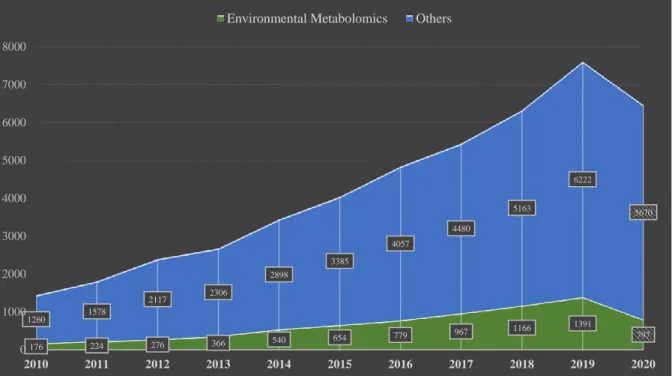
The involvement of metabolomics in the environmental research is increasingly considered in the recent past years [107–112]. The main aims of environmental metabolomics is to study the abiotic stress, the anthropogenic influence, and the impact of environmental diseases on nature and its existing species [108]. Environmental biomarkers and the modifications in the metabolic pathways are searched following factors as temperature or acidity change in the studied environment, or following the pollution of the environment by chemicals or its invasion by intruder species. Nonetheless, the environmental metabolomics is still a “minor” interest if compared to the global state of metabolomics research. Figure Int. 4 shows that between 2010 and 2020, papers holding both terms “environmental” and “metabolomics” did not surpass 18.50 % of the total number of papers holding the term “metabolomics” (the maximum reached was 18.42 % in 2018) [105,113]. In fact, environmental metabolomics still confront several challenging problematics as sample designing, extraction protocols, data processing and the significant lack of environmental metabolome databases [108].
On the other hand, untargeted metabolomics applied for pesticides research was also reported
[114]. It is mostly targeting the elucidation of the modes-of-action of bioactive compounds, ecotoxicological and toxicological risks assessment, and the investigation of disruptions in plant metabolic pathways as response to the application of pesticides.
Figure Int. 4: Evolution of the numbers of articles holding the term “metabolomics”, or both terms
“environmental” and “metabolomics” between 2010 and 2020, according to PubMed database (October 11, 2020) [105,113].
Hence, as the untargeted metabolomics seems to be a promising tool that can provide high throughput generation of biochemical information, it was recently considered in order to suggest a novel “universal” tool for assessing both the environmental fate and impact of complex (bio)pesticides in the environmental matrices. The suggested approach was called “Environmental Metabolic Footprinting” (EMF), introduced in 2016-2017 by Patil et al. [115]
and Salvia et al. [116].
176 224 276 366 540 654 779 967 1166 1391 797 1260 1578 2117 2306 2898 3385 4057 4480 5163 6222 5670 0 1000 2000 3000 4000 5000 6000 7000 8000 2010 2011 2012 2013 2014 2015 2016 2017 2018 2019 2020
9. Environmental Metabolic Footprinting: the concept, objectives, and challenges
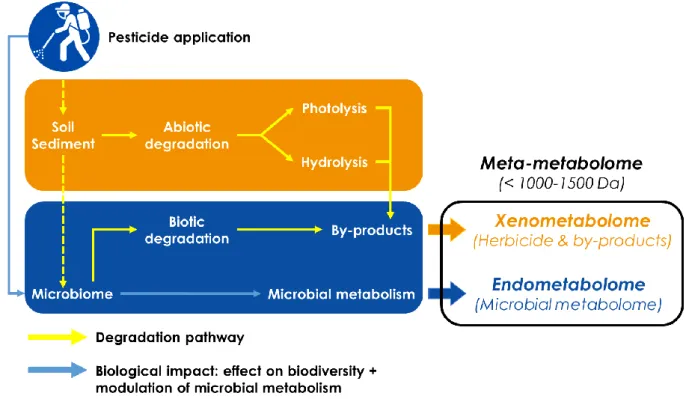
Figure Int. 5: The Environmental Metabolic Footprinting concept.
Figure readapted from Patil et al. [115], with permission from authors.
As shown in Figure Int. 5 the EMF is based on a meta-metabolomics approach (i.e. metabolomics of a whole community [117,118]) that aims to extract, analyze and detect both the xenometabolome of an applied pesticide, and the endometabolome of the environmental matrix. The xenometabolome consists of the active substance, the formulation ingredients, and the transformation products issued either from the active substance or from the formulation ingredients. The endometabolome consists of metabolites produced by the different microorganisms living in the studied environmental matrix, as the primary metabolites and the secondary metabolites. The xenometabolome and the endometabolome will then constitute the meta-metabolome that will be the target of the extraction, the chemical analyses, and the data processing.
The EMF seeks to investigate integrally the persistence, the transformation and the impact of an applied pesticide to an environmental matrix. As an untargeted approach, it can consider either known compounds or unknown compounds. Thus, it must be applicable for both the synthetic pesticides and the biopesticides. In addition, as it aims to analyze the whole meta-metabolome, the fate and the impact of the complex formulated products or microorganisms-based products can be studied. The EMF should also detect new transformation by-products,
and determine new biomarkers of impact. This can be done by comparative kinetics experiments, where the polluted (spiked) matrix is compared to an unpolluted control matrix. The ultimate aim of EMF is to introduce a novel indicator called the “resilience time”. This indicator is defined as the time needed for the difference between the meta-metabolome of the spiked matrix and that of the control matrix to be statistically non-significant (Figure Int. 6). In this case, the biochemical state of the environmental matrix and its community is considered as normalized, as it is comparable to the control matrix, i.e., the “natural” state of the matrix. Thus, at the resilience time, the whole xenometabolome including all pollutants issued from the pesticide are considered dissipated (or more precisely, below the detection limit of the approach), and the observable impact of the pollution is surpassed.
Figure Int. 6: The “resilience time” indicator.
The present example shows that the resilience time is reached between day 45 and day 90.
The previously mentioned research works that introduced the EMF aimed to prove the concept of the approach. The first by Patil et al. [115] was carried out on soil microcosms. It investigated the fate and the impact of two pure β-Triketone herbicides by 90-days kinetics: the Sulcotrione as a synthetic product, and the Leptospermone as its natural alternative. The second work by Salvia et al. [116] proved the applicability of the EMF on a complex microorganism-based bioinsecticide: the Bacillus thuringiensis israelensis (Bti). The study was performed on two kinetics time points after the application of the pesticide on sediment microcosm samples. It showed a significant statistical difference between control and spiked meta-metabolomes after 8 days of the spiking. This approach seems sufficiently sensitive for such microorganisms-based pesticides.
These two studies were proofs of concept that allowed going forward with the EMF approach. Nevertheless, several challenging problematics and questions are confronting this novel strategy.
The starting step is being the extraction of the meta-metabolome. In fact, wider is the extracted meta-metabolome; wider is the collected information on the fate and impact.




![Figure M. 1: A schematic presentation of the SPME. Source: [8,10].](https://thumb-eu.123doks.com/thumbv2/123doknet/14745349.755988/89.892.117.770.432.930/figure-m-schematic-presentation-spme-source.webp)
![Figure M. 2: A mass spectrum (for an unknown compound with a m/z of 459.2536 ([M-H] - ))](https://thumb-eu.123doks.com/thumbv2/123doknet/14745349.755988/96.892.112.789.732.1045/figure-m-mass-spectrum-unknown-compound-m-h.webp)
![Figure M. 3: A scheme presenting the Electron Impact Ionization. Source: [28].](https://thumb-eu.123doks.com/thumbv2/123doknet/14745349.755988/99.892.169.753.156.570/figure-m-scheme-presenting-electron-impact-ionization-source.webp)