People’s Democratic Republic of Algeria
Ministry of Higher Education and Scientific Research Mentouri University- Constantine
Faculty of Letters and Languages Department of Languages
Aesthetic Effect in Arabic-English Literary Translation
A Sample from Gibran Khalil Gibran
A Dissertation Submitted in Partial Fulfillment of the Requirements for the Degree of Master of Arts in Applied Language Studies
By: Meymouna OTHMANI MARABOUT Supervisor: Prof. Zahri HAROUNI
Acknowledgments
I would like to express my heartfelt gratitude and appreciation to my supervisor Prof. Zahri Harouni for her precious advice, continual assistance and valuable remarks and suggestions throughout the preparation of this dissertation.
I am indebted to Dr. Abdelhak Nemouchi for his persistent moral support and encouragement along my Master’s career, as I am grateful equally to Dr. Hassan Hamada for his helpful and intellectual instructions in addition to his effective opinions.
Special thanks go to the following teachers at the English Department: Dr. Nacif Labed, Dr. Al-Hawas Ahmed Sid, Dr. Al-Khayer Atamna, Dr. Youcef Beghoul, Mr. Djamel Azil, Mrs. Messouda Benouar, Miss Amel Soucha, Mrs. Laouali, and Mr. Adel Boushaba for being my respectful teachers all through these last five years at University.
I would like too to thank my encouraging and supportive uncle Miloud Othmani Marabout for his constant help in typing and printing the manuscript.
My sincere thanks are also for my father, my brothers and mostly for my caring sisters.
Last but not least, I would like to pray to my late mother, brother and grandmother who were extremely fond of knowledge, may Allah bless them.
Abstract
The present paper is an Arabic-English comparative study. It explores the area of literary translation from an aesthetic perspective. The study limits its scope into three literary Arabic texts chosen from “Damaa wa Ibtissama” (1914), one of Gibran Khalil Gibran’s creative works. Discovering whether the aesthetic effect of literary Arabic texts is maintained when translated into English is the overall aim of this paper. To this end, the three texts “ْلافؿ Two Infants”, “شؼِظ ٚ شِخكظرح Laughter and Tears”, “مويلا و سملأاYesterday and Today” and their English translation are compared and analyzed in terms of lexical choice, sentence structure and the use of metaphors & similes. The analysis reveals that the procedures followed in the process of translating the texts, such as literal translation, omission, addition, reduction, expansion and avoiding repetition build the target texts’ sense, form and effect. It follows then that, however difficult is the task, the aesthetic effect of the selected literary Arabic texts is almost wholly kept through the translation.
List of Tables
Table 1: A Comparative Analysis of “ىلافط vs. Two Infants” in Terms of Lexical 31 Choice, Sentence Structure and Metaphors and Similes.
Table 2: A Comparative Analysis of “ حعهد و حهاستتا vs. Laughter and Tears” in 40 Terms of Lexical Choice, Sentence Structure and Metaphors and Similes.
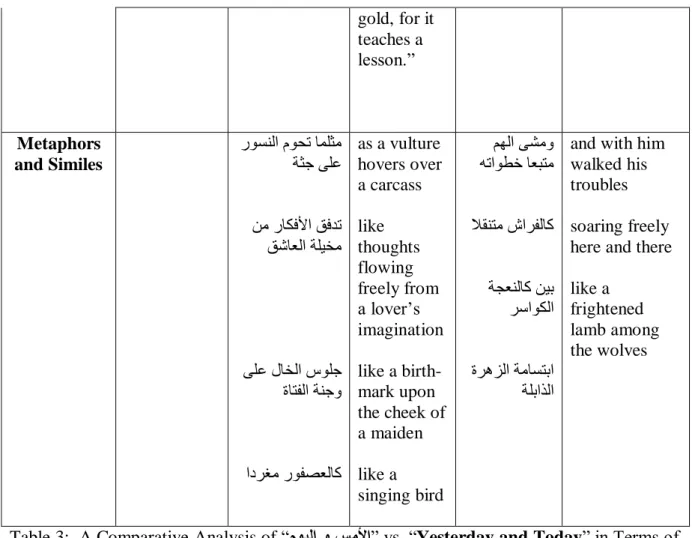
Table 3: A Comparative Analysis of “مىيلا و سهلأا vs. Yesterday and Today” in 54 Terms of Lexical Choice, Sentence Structure and Metaphors and Similes.
List of Abbreviations SL Source Language TL Target Language ST Source Text TT Target Text S Subject V Verb
CEPL Concise Encyclopedia of Philosophy of Language ALTA American Literary Translation Association
X any linguistic object
Table of Contents Dedication Acknowledgements Abstract List of Tables List of Abbreviations Table of Contents
Introduction
Statement of the Problem Aim of the Study
Research Questions Research Methods Structure of the Study
Chapter One: Literary Translation; Aspects, Effects and Procedures
Introduction
І. Literary Translation: An Overview
І. 1. Definitions of Literary Translation
I II III IV V VI
1
1 2 2 3 4 5 5 5І. 2. Criteria for Literary Translation І. 3. Style and Literary Translation І. 4. Figurative language
І. 4. 1. Metaphors І. 4. 2. Similes
І. 5. Aesthetic Effect in Literary Translation І. 6. Procedures Followed in Literary Translation І. 6.1. Transposition
І. 6. 2. Reduction (Omission) І. 6. 3. Expansion (Addition) І. 6.4. Avoiding Repetition
І.7. Gibran khalil Gibran, The Writer Conclusion
Chapter Two: Comparison of “حهاستتا و حعهد” to “A Tear and a Smile”
Introduction
П. 1. Analysis of Text one “ىلافط” vs. “Two Infants” П. 1.1. Lexical Choice
П. 1.2.Sentence Structure П. 1.3. Metaphors and Similes
П.2. Analysis of Text Two “حعهد و حهاستتا” vs. “Laughter and Tears”
9 11 14 15 17 18 21 21 22 23 24 25 28 30 31 36 37 39 40
П.2.1. Lexical Choice П.2.2. Sentence Structure П.2.3. Metaphors and similes
П.3. Analysis of Text Three“مىيلا و سهلأا” vs. “Yesterday and Today” П.3.1.Lexical Choice
П.3.2.Sentence structure П.3.3. Metaphors and similes Conclusion
General Conclusion
Bibliography
Appendix
47 49 53 54 59 61 63 64 66 68Introduction
Statement of the Problem
In an appreciation of a work of artistic writing, the first estimation to conduct such a study came into my mind. I like reading in Arabic and mainly for Arab literary writers because of their agreeable creative works. I am fond of Arabic literary poetry, prose and fiction; I habitually read Mey Ziada, Taha Hussein, Elia Abu Madi, and mostly Gibran Khalil Gibran as their style is extremely pleasant, smooth and enjoyable. This admiration for Arabic literature then dictates the rationale behind the choice of my research topic. Through the present study, I wish to find out whether or not Arabic literary texts, in general, and Gibran’s Arabic literary texts, in particular, would retain their artistic values when translated into English. To this end, I have decided to examine a sample of texts from Gibran’s Arabic prose “شِخكظرح ٚ شؼِظ A Tear and a Smile” (1914); a series of social creative essays, and compare them to their English equivalents to see whether their aesthetic effect is kept in the translation.
In the course of this paper, the field of literary translation is handled from an aesthetic perspective. The sense of delight that the selected texts creates within the readership is obtained via the fine choice of words the writer makes, the excellent arrangement of words to build sentences, and the wide range of figurative tools, mainly metaphors and similes, the author employs. These are principally the features on which this comparative study is built; that is to say the texts are analyzed and compared on the basis of lexical choice, sentence structure, and the use of metaphors and similes.
This dissertation is a comparative descriptive study of the chosen literary Arabic texts and their English counterparts. It examines the texts and their English equivalents in terms of the aforementioned aspects of the aesthetic effect on the target readers.
Aim of the Study
The present paper is a comparative study of a sample of three literary Arabic texts to their corresponding English versions, aiming at discovering whether the aesthetic effect of these texts is maintained throughout the translation. The principal objective is reached upon the following points:
Detecting the similarities and differences between the lexical choices of both ST and TT.
Detecting the similarities and differences between the structural features of both ST and TT.
Detecting the similarities and differences between the ST’s use of figurative language, mainly metaphors and similes, and that of the TT.
Determining the translation procedures followed by the translators as well as their effectiveness.
Evaluating the English versions of the Arabic texts in terms of success and failure in keeping the aesthetic values of the ST.
Research Questions
This paper is an attempt to answer the following research questions:
Is the aesthetic effect of literary Arabic texts maintained when translated into English?
What are the procedures applied in the process of translating literary Arabic texts into English?
Research Methods
This study compares three literary Arabic texts written by Gibran Khalil Gibran to their English counterparts. Unlike the forenamed Arab authors, the Lebanese writer Gibran Khalil Gibran is known for presenting most of his inspirations in the form of relatively short and separate essays, the fact that facilitates the reader’s task and brings about further pleasure. That is the reason why I have chosen a sample of three essays among one of his famous works “شِخكظرح ٚ شؼِظ A Tear and a Smile” (1914) in order to limit the research focus and simplify the analysis. The texts are chosen on the basis of their elevated aesthetic nature, on the one hand, in addition to their shared interest in contrasting the power o f wealth to the trouble of poverty, on the other. The texts are:
“ْلافؿ Two Infants”
“شؼِظ ٚ شِخكظرح Laughter and Tears”
“َٛ١ٌح ٚ فِلأح Yesterday and Today”The comparative analysis is made on three different dimensions:
First, on the lexical choice of both the writer and the translator.
Second, on the structural features represented in the ST and TT.
Third, on the use of metaphors and similes in the ST and TT.
The comparison is presented through tables, one for each text, then followed by a thorough discussion, and finally summarized into its key findings.
Structure of the Study
This study is made up of two chapters: theoretical and practical. The theoretical chapter places the study into its related literature. Literary translation is first introduced by way of definitions, criteria and procedures. Literary style and its association with literary translation are also undertaken in this chapter. Next, figurative language together with its two foremost components; metaphors and similes are given some focus within the chapter. Literary translation is then dealt with from an aesthetic angle, followed by the commonest translation procedures that are applied in the process of literary translation. Finally, this chapter ends up with a brief account of Gibran Khalil Gibran, his style along with his literary works, principally “شِخكظرح ٚ شؼِظ A Tear and a Smile”.
The second chapter is a practical framework, where the analysis of the three Arabic texts and their English equivalents is presented in the form of tables that include the similarities and differences found when comparing the Arabic texts to their English versions in terms of lexical choice, sentence structure and the use of metaphors and similes. The tables are followed by the relevant discussion and then briefly summed up.
Chapter One
Literary Translation; Aspects, Effects and Procedures
Introduction
The present chapter presents a review of the associated literature with the area of literary translation. First, it proposes a characterization for literary translation as given by a number of specialized writers in the field. Second, it attempts to highlight the basic requirements for literary translation as a distinct form of translation. Furthermore, it exhibits the relationship held between literary translation and style, as it displays a brief account of figurative language; metaphors and similes. It also sheds light on one of the central values in literary translation that is the aesthetic value, in addition to the commonly applied procedures of literary translation. The chapter at last briefly offers an overview of Gibran khalil Gibran and his artistic works.
І. Literary Translation: An Overview
І. 1. Definitions of Literary Translation
In attempting to identify the term “literary translation”, a range of related literature is reviewed and evaluated so as to draw as much a clear image for the concept of literary translation as possible. It is then essential to introduce the central component in literary translation that is literary language. The necessity to describe literary language before accounting for literary translation is derived from the fact that language is the means by which any piece of literary writing can reach its core effects. Widdowson (1984, p. 151)
says that no matter how literature may be expressed, its effects are certainly attained via language.
To start with, literary translation, as its name reveals, is concerned with translating texts written in a literary language that is distinct from any other sort of language. According to Adewuni (2004, p. 1), every literary writer has his own lexical and stylistic peculiarities that constitute the highly connotative and subjective character of literary language. By means of his powerful imagination, any literary writer makes use of various literary skills such as figures of speech in order to draw literary constructions. Literary language is also deviant and capable to communicate intellectual, emotional, and spiritual interests of individuals.
To put it in other words, literary language is a unique form of language that enlightens a variety of aspects of humankind through a variety of modes differing from one literary writer to another. It is then subject to numerous interpretations.
A further means to define literary language is by way of its basic characteristics, it is a diversity of aspects related one to another as Fowler (cited in Cook, 2003, p. 62) presents:
…three related aspects of literary language: its frequent deviation from the norms of more everyday language use; its patterning of linguistic units to create rhythms, rhymes, and parallel constructions; and the ways in which the form of the words chosen seems to augment or intensify the meaning…
The previous extract suggests that literary language is noticeably different from ordinary language in the way that it employs particular linguistic patterns in a multiplicity of distinctive variations to generate the literary character of the literary piece, as well as to enhance its essence. That is to say, literary language is exceptional in terms of lexical, musical and sense arrangements.
Taking into consideration the definitions given earlier, it would be easier to provide a comprehensible set of definitions for literary translation.
Literary translation is agreed to be the most challenging form of translation. It is described by Wechsler (1998, p. 9) as an “odd art” because “it consists of a person sitting at a desk, writing a fiction or poetry that has already been written, that has someone else’s name on it...” To simplify somewhat, it is the strange nature of literary translation that dictates its complexity, since it involves the literary translator in the burden of rewriting, in the target language, the same literary work written in the original. That is the literary translator becomes the second author for any piece of literature he is to translate, the fact which raises the literary translation’s difficulty.
In a symbolic description, Goethe considers literary translation “one of the most important and dignified enterprises in the general commerce of the world.” (Stated in Wechsler, ibid.). In here, the author holds an analogy between literary translation and commercial enterprises by which he intends to point out the importance of literary translation in the distribution of peoples’ literary heritage, just as an enterprise significantly contributes in the delivery of goods all over the world.
In the like fashion, literary translation is considered by Landers (1999, p. 3) as a unique form among all other forms that translation takes, such as technical, scientific, legal, and so forth. Landers (ibid., p. 4) says:
Only literary translation lets one consistently share in the creative process. Here alone does the translator experience the aesthetic joys of working with great literature, of recreating in a new language a work that would otherwise remain beyond reach.
The immediate interest here is in the notable delight that literary translation offers. It paves the way for translators towards the artistic pleasure gained from undertaking
original literary works and rewriting them in many other languages, so that these works become known throughout the world. That is to say, literary translation is a special category within the whole range of translation practices, as it enables the literary translator to enjoy as well as to distribute literature.
Adewuni (op.cit. p. 1) points out, in favour of Lander’s claim, that the literary translator participates in the artistic task of the original author and then recreates the target structures by adapting the target language text to that of the source language as strictly as intelligibility permits. Namely, the literary translator’s job is to remodel the literary piece under translation in the target language, so that it represents the original meaning along with form.
Furthermore, Jackson (2003) maintains that it is one of the central requirements of literary translation to afford a firm interpretation about both meaning and effect. Hence, literary translators are usually much more involved in finding out a corresponding mood, tone, voice, and effect than in literal translation (cited in Dastjerdi, 2004, p.2). This is another reason behind the distinctiveness of literary translation since it does not only transmit the original meaning but also the form and effect.
The same idea is demonstrated by Tytler (1774, p. 211) as “The literary translator’s task is very different: he uses the same colours with the original, but is required to give his picture the same force and effect.” It is meant by this that the outcome which every literary translator is to achieve has to do with the creation of a new literary piece, in a new language, that has an equivalent meaning and effect to those of the original. This is, in fact, a major burden on the translator to overcome (Landers, op.cit.), since literary translators have, as their significant aim, the obligation of reproducing the original sense together with form.
Xiaoshu and Dongming (2003, p. 3) also propose that the chief charge of literary translation is seen in the faithful imitation of the spirit and qualities of the original work. As it is an artistic task, literary translation involves recreating the author’s intent, thought, feeling and experience by means of a literary language that is almost similar to the source style. This indicates the considerable duty set on the literary translator in keeping the entire values of the original literary work.
In short, literary translation concerns itself with the translation of material originally written in literary language, and it is agreed among a number of experts to be the most demanding type of translation. It entails the transfer of a diversity of features from the source text to the target such as meaning, form, mood, tone, and effect.
І. 2. Criteria for Literary Translation
The translation of literary language is as special as the literary language itself. It follows then that literary translators are also distinctive among the community of translators. There are many different viewpoints regarding the criteria of literary translation, but only some are given priority by translation experts. The ALTA (2003, p. 4-9) suggests a few criteria for literary translation that are agreed upon by translators. These criteria are presented in the following:
The most important point has to do with the translator’s objectives as an imitator of both intent and form of the original work being translated. It says that a literary translator must, in the first place, set clear goals before translating any literary piece. These goals must include the rendition of the sense, form, style, culture, image, experience and effect of the original literary work.
The love of literature (fiction, short stories, novels...) is the beginning for all good literary translation. Thus, literary translators must read widely in the field.
A firm grasp of the variety of styles and images in both the source and target languages along with their appropriate use must be of prime importance for literary translators.
Literary translation is too much demanding, for it entails the recreation of a new distinct work of literature, in a new language, of which the translator is the author.
There is no definite translation for any piece of literature. Constant reformulations of previous translations remain always present. Several translators of a single work will produce several valid translations.
“Translation is literary when it assumes the complex interaction of meaning and form.”
In the light of the previously stated criteria for literary translation, we can grasp that any literary translation is invalid unless it achieves its foremost aim that is to fully reproduce the ST’s qualities in the TT, and proves a certain mastery of both SL and TL’s proper use and usage so as to create a new valid piece of literature in the TL.
Tytler (1774, p. 179) proposes his principles regarding the requirements of literary translation in the following words:
It is essential for any literary translation to:
“give a complete transcript of the ideas and sentiments in the original passage.
maintain the character of the style.
Through these principles, it is meant that literary translation is expected to provide the target readers with the entire body of thoughts and feelings included in the ST, retain its style, and display the pleasurable nature of the original.
І. 3. Style and Literary Translation
As it has been already stated, literary translation consists of translating texts written in literary language. One basic element composing literary language is style.
In its literal sense, style is, according to Chesla (2001, p. 90), a way of doing something, whether speaking, dressing, walking, eating or writing; it is the way something is done. In writing, style is commonly three components: sentence structure, specification and formality. First, sentences may be short or lengthy, simple or complex and writers are allowed to use a mixture of sentence types or simply a single category, the fact that determines an aspect of the writer’s style. Second, another feature is seen at the level of specification a writer reaches; i.e. how much detail is offered in the description of a given concept. Third, the degree of formality and informality a writer exhibits in the writing practice tells a further aspect. In other words, style is basically perceived through sentence formation, detail and formality which are presented by the authors in their writings.
More narrowly and within the field of literature, style is, as Kane (2000, p. 11) describes, the complete range of all the choices that a literary author makes regarding words and their combinations in order to convey the message as elegantly as possible. Style is flexible in nature and subject to almost persistent variation. It is then “the deep essence of writing.” If we are to explain further, style is the way through which thoughts are transmitted as it reveals the writer’s own selection of words and structures. Style is thus idiosyncratic and would by no means be the same for each writer.
In the same way, Xiaoshu and Dongming (op.cit, p. 4) consider style as the main feature of every piece of writing; it indicates the writer’s personality, experience and feelings. They illustrate the point that style is almost language in the following words:
Style can never go without language. Paragraphs, sentences and words are absolutely essential to style. Paragraphs, sentences and words form the basis of style. Sentences are made up of words, paragraphs of sentences, and an entire work of paragraphs.
The above extract points out the fact that language and style are two facets of the same coin. No style would exist in the absence of language, while language is the medium by which writers show their individual style specific for each of them. The words, sentences and paragraphs an author chooses to communicate meaning are fundamental elements building style.
Further, Shi (2009, p. 61) claims that literary language entails that good form transmits content in more sufficient and adequate manner; that is to say good style significantly helps in appealingly conveying meaning. Unlike poor style, good style enhances meaning and offers a special delight.
Style is the author’s selection of words and phrases, and the way the author organizes these words and phrases into sentences and sentences, in turn, into paragraphs. Style is a means to shape the writer’s experiences in his literary work, thus the reader will get a sense of enjoyment together with meaning (Shi, ibid.). To put it still differently, any artistic writing gets its uniqueness from the author’s unique arrangements of linguistic elements. These arrangements characterize the writer’s style.
Because style is the central quality in literary language and literary language, in turn, is the basic component in literary translation, there must be a certain relationship between style and literary translation.
Xiaoshu and Dongming (op.cit.) include an account of the link that should be held between style and translation in this way:
The excellence of a work is due to its flawless paragraphs, of a paragraph to its faultless sentences, and of a sentence to appropriate choice of words. This has long been the goal writers pursue and translators should make the utmost effort to make translations correspond to the original in style, so that a resemblance in spirit may be achieved. At the same time, the translator should render the words, sentences, and paragraphs so that a resemblance in form may be achieved.
I will attempt, through the following clarification, to apply the description given above to the scope of this study. Style determines the quality of writing, in general, and literary writing, in particular. It is seen in the proper choice of words to shape accurate sentences and smooth paragraphs. Literary translators are therefore basically required to retain the character of the original style as well as its structure. The major purpose behind literary translation is not only in form maintenance but also in style preservation in the TL.
Within the same frame, Nida (1984, p. 94, as cited in Shi, op.cit. p. 62) defines translation as follows: “Translation consists in reproducing in the receptor language the closest natural equivalent of the source language message, first in terms of meaning and secondly in terms of style.” This implies that translation is imitation of the original meaning and style to create the closest appropriate counterpart. Such a definition may also be reflected on literary translation since style is the foremost value in literary language. Then, literary translation is an imitation of the original meaning and style to produce the most reliable equivalent.
Every word in any literary work must be according to Xiaoshu and Dongming (op.cit. p. 3) carefully treated during the process of translation, and every figure of speech must also be seriously considered in an attempt to render the original work by showing fidelity to its style. To be precise, all aspects of literary style such as the choice of words
and figurative tools have to be thoroughly watched out by literary translators so as to faithfully reproduce the SL material in terms of meaning and style.
In sum, style and literary translation enjoy a mutual relationship; no literary translation is adequate when original style is not retained.
І. 4. Figurative Language
In accordance with the aforementioned style descriptions, figurative language comprises one of the most major qualities typical to style. Figurative language is, as Moindjie (2006, p. 77) proposes, an essential feature of style.
As an attempt to point out the disparity between literal and figurative language, Kane (op.cit. p. 295) includes that literal language is simple, clear and straightforward. Intentions are openly expressed via literal language; it employs words in their true meaning. Whereas figurative language involves that a word has been extended to take a larger or even dissimilar sense from the one which it usually suggests. More explicitly, unlike literal language, figurative language uses new extra words’ meanings that are noticeably different from ordinary.
It is also presented in the CEPL (1997, p. 153) that figurative utterances violate the norms of literal language; however they are still understood as meaningful. Syntactic, semantic and pragmatic restrictions govern literal language and let no room for ambiguities or misunderstanding. The same cannot be said about figurative language; figurative utterances generally conform to syntactic rules, occasionally break semantic rules, and frequently violate pragmatic rules. The breach of these constraints results in sentences that are either apparently inaccurate or are clearly improper if understood
literally. It is meant here that figurative language is the result of a series of violations regarding the usually obeyed syntactic, semantic and pragmatic rules.
Besides, figurative language plays an important role in literary works and their perception among the readership. It draws the author’s experience and clarifies his intent in a fairly pleasant and artistic way. Chesla (op.cit. p. 93) suggests that figurative language is so effective since it helps readers visualize what the author is telling in an imaginative fashion. In other words, whenever one meets a figurative tool while reading a literary piece, he is more likely to imagine the concept being described and then fully understands the author’s intended meaning.
Figurative language comes in several categories; it includes a diversity of images such as metaphors, similes, metonymies, synecdoche, personification, allegory and irony (Moindjie, op.cit. p. 77). In the course of this study, I will merely focus on the two former images: metaphors and similes.
І. 4.1. Metaphors
Metaphor is one among the set of figurative tools commonly used by literary writers, in particular, and it serves as a literary device capable of linking the author’s imaginative world of experience to that of everyday life.
In his Dictionary of Literary Terms, Shaw (1972, as cited in the Encyclopedia of Literary Translation into English, 1999, p. 941) defines metaphors along these lines:
A figure of speech in which a word or phrase is applied to a person, idea or object to which it is not literally applicable. A metaphor is an implied analogy which imaginatively identifies one thing with another. A
metaphor is one of the tropes, a device by which an author turns, or twists, the meaning of a word.
Based on the above statement, we can say that a metaphor employs a given linguistic unit in an inventive way on a given concept which does not naturally fit, so that the concept under focus acquires the characteristics of the linguistic unit used. A metaphor is a symbolic tool that describes something by way of something else. For instance, the utterance “Smith is a lion” is a metaphor which indicates that the person “Smith” is as powerful as the animal “lion”. It reflects the features of the word “lion” on “Smith”. Yet, the utterance does not explicitly state similarity rather it says that “Smith” is identical to “lion”. Individuals do not naturally resemble animals but by means of metaphor, such sameness becomes possible.
In line with Shaw’s claim, Young (2008, p. 117) proposes that a metaphor is a literary device that describes a given entity via relating it to another entity which does not actually go with. In addition, in literary works such as novels and stories, metaphors work by stealing familiar experiences and joining them to unfamiliar ones. Namely, a metaphor connects two naturally distinct things and functions, as a prime role within literature, by linking common matters to uncommon ones.
Moreover, Elbow (1998, p. 79) considers every metaphor a “force-fit”, by which he referred to the very nature of metaphors that is putting together things that do not literally go together. Yet, a good metaphor in literary writing works as an elegant expression which enhances sense and effect. To explain further, metaphors gather extremely dissimilar items, the fact that gracefully improves the meaning and strength of artistic pieces.
As far as literary translation is concerned, metaphors are associated with indirectness which largely contributes to the difficulty of translation. Any literary translator has to suffer twice when rendering metaphors from source to target language. First, he has to look for
their intended meaning within the original text. Second, he has to find out corresponding metaphors’ meaning and effect in the target text (Al-Hasnawi, 2007, p. 3). The immediate concern in here has to do with the fuzzy nature of metaphors which dictates the complexity of translating them. Literary translators are thus required to grasp the metaphor’s original meaning and appropriately place it in the target.
І. 4.2. Similes
Unlike metaphors, similes are much more straightforward. A simile is another tool in literature which is nearly identical to metaphor (Young, 2008, p. 117), with a remarkable distinction that is observed in the strength of metaphors. It follows then that similes are less forceful than metaphors in terms of meaning and effect. A simile is less powerful than a metaphor because it explicitly compares two things by means of the words like or as (Chesla, op.cit. p. 92).
It is also stated in the CEPL (op.cit. p. 157) that the simile is a metaphor differing merely by the addition of an item, then it is less enjoyable as it is longer; it does not say this is that, it rather says this is like that. That is to say similes are less pleasurable than metaphors in terms of effect. The addition of the devices like or as to form similes enhances and clarifies the intended meaning, yet it reduces the reader’s enjoyment.
Besides, similes, according to Kane (op.cit. p. 302), build an open similarity between X and Y by literally saying X is like Y, or X is as Y, whereas metaphors do not state that X is like Y but rather that X is Y. This means that a metaphor is capable of inventing new and unusual connections between items, while similes simply set a given resemblance between concepts. For example, as have been proposed elsewhere, the metaphor “Smith is a lion”
draws a strange link between “Smith” and “lion”. Whereas the simile “Smith is like a lion” merely approximates the characteristics of “Smith” to those of “lion”.
For the reason given above; which is directness, similes do not usually set burden on the literary translator (Al-Hasnawi, op.cit. p. 4). This is due to the directness of similes which can, in many respects, facilitates the native reader’s task, in the first place, simplifies the literary translator’s job, in the second, and at last reduces the target reader’s effort to understand the meaning.
І. 5. Aesthetic Effect in Literary Translation
Literary translation, like any other type of translation, has many effects on the target reader. Linguistic, semantic, and communicative effects are the commonest. Since literary texts are best known for the joy they create within the readership, they generate a further dimension in literary translation effects; the aesthetic effect.
It is recommended before any attempt is made to define aesthetic effect within the field of literary translation to first place it in its natural context: literature. Aesthetic effect is said to be one of the most remarkable characteristics of literary writing as Stecker (2003, p. 65) includes:
...literature is the body of works of art produced in linguistic media, and that this body is to be defined in terms of the possession of certain artistic values...a range of values for which works of literature have characteristically been appreciated.
Literature, as the stated extract shows, is to be perceived as the diversity of literary writings which consists of a good deal of artistic values. These values are the reason behind the readers’ admiration for literature. That is to say all literary pieces are valuable for their nicely presented themes that are given in entertaining and appealing forms.
According to Goodarzi (2003, p. 9), literary texts are typically known for the pleasure they create on the readers, for they are more complexly and elegantly organized than their non-literary equivalents. The special patterning of their lexical, structural and stylistic choices creates the unique essence of joy that is lacking in any other sort of writing. This latter is known as the “aesthetic effect”. He states: “Aesthetic effect is a sense of enjoyment experienced by the reader.” Namely, every literary piece is distinct from ordinary writing and capable of generating the aesthetic effect on the readers. The aesthetic effect is a pleasant feeling of enjoyment typical to such an exceptional sort of writing and is the outcome of particular selection of words and structures as well as style design.
In an attempt to apply this description to the main focus of our research paper, we can emphasize that since literary translation entails the rendition of the original meaning together with form, style and effect into the TL, then the aesthetic effect should also be retained in order for the translation to be adequate and effective. To be precise, literary texts should be entirely dealt with in the literary translation practice, i.e. all aspects of the literary language used in a given piece of literature are to be rendered in the target product. Aesthetic effect, as a significant aspect in literary language, is to be retained in the literary translation process so as to amuse the target readers as much as the native readers are amused by the source material.
In line with Goodarzi’s view regarding aesthetic effect, Stecker (op.cit. p. 67) points out his claim in the following words:
Literary value is often identified as aesthetic value, the value of the experience of a literary work…I take the aesthetic value of a piece of writing to consist in the pleasure it is capable of giving to those who imaginatively experience or contemplate the world of the work.
The earlier extract enlightens the leading feature for which literary works are highly appreciated: the aesthetic value. It is the enjoyable perception of a given literary piece experienced by the readers. This involves, as suggested before, that since literary works are valuable for their artistic nature; there must be certain preservation regarding the aesthetic character of literary pieces when translated from source to target languages.
Literary translation is then not simply a process of rendering the linguistic and communicative functions of the source text into the target text, but also a way to show fidelity to the aesthetic aspects included in the original work. (Xiaoshu and Dongming, op.cit. p. 3) state:
Literary translation is to reproduce the original artistic images in another language, so that the reader of the translation may be inspired, moved and aesthetically entertained in the same way as the native reader is by the original.
In other words, literary translation should offer the target readers identical feelings of enjoyment to those experienced by the native readers.
In the same line, literary translation is, according to Shi (2004, p.2), not simply linguistic conversion between languages, but it also requires accommodation in many other factors such as cultural and aesthetic aspects of the original literary text. To put it still differently, no matter how faithful is the linguistic rendition in literary translation, it is incomplete until an adjustment covers a variety of aspects of the source literary piece; basically cultural and artistic.
In the course of this dissertation, the field of literary translation is undertaken from an aesthetic angle. The sense of delight that literary texts creates among readers is gained through the fine choice of words the literary writer makes, the excellent arrangement of words to build sentences, and the wide range of figurative tools, mainly metaphors and similes, the author employs. These features, all in all, compose the aesthetic effect of literature on the readers and thus must be given much consideration in the literary translation process and reflected in the TL with the utmost force in order to provide the target readers with nearly the same aesthetic effect experienced by the readers of the original.
These are principally the features on which the present comparative study is built; that is to say the texts are analyzed and compared on the basis of lexical choice, sentence structure, and the use of metaphors and similes aiming at discovering the extent to which the aesthetic effect of literary texts is kept when translated.
І. 6. Procedures Followed in Literary Translation
Dealing with literary works and attempting to render almost all aspects of the original, literary translators tend to resort to many procedures in order to reach their goals. Transposition, reduction, expansion, addition, omission, and avoiding repetition are some among the wide range of translation procedures that are used by both ordinary and literary translators.
І. 6.1. Transposition
Transposition entails the grammatical changes that occur in translation from SL to TL. It offers a variety of possibilities for translators in order to cope with the problem of untranslatability (Zakhir, 2009, p. 114). Transposition is more likely to occur when the natural arrangements of the two languages significantly differ, as it is the case with Arabic and English languages. It may render a singular noun into plural or a plural noun into singular, as it may alter the position of adjectives to take the position of nouns and so forth.
Newmark (1988, p. 7, stated in Zakhir, ibid. p. 115) presents a categorization for many types of transposition, the following are only some which are applicable to our research focus:
Transposition in word’s form; this procedure allows the translator to change singular nouns into plural or vice versa. For instance: “ًفؿ , boys”. Here, the singular Arabic noun “ًفؿ” is rendered into English in the plural form “boys”.
Transposition in word’s position depending on the TL structure; as in:
“ً١ّخ ؽظل , nice palace”. The example shows the change in the adjective position; it is placed at the end of the Arabic utterance while placed at the beginning of the English utterance.
І. 6.2. Reduction (Omission)
Reduction is, according to Zakhir (ibid. p. 117), the process whereby the translator reduces the number of elements in the TT, though he ought to respect an important requirement; no central information is to be dropped. This entails that reduction is to select among a set of ST’s elements those which do not significantly affect the original meaning
in order to get rid of in the TT. As an example, the following Arabic sentence is translated into English resorting to reduction:
حٌٛح
شؼق يٛٙكٌح هٍط ٟف خٕ١مظٌح ث١ز ٌٝا ش١ػخٌّح ٟظٍزؼ يلاض حعخ لا١ّخ ٛدٌح ْخو The weather was so nice during my last trip where we met.
In this example, the Arabic sentence is longer than the English one. Reduction covers the last part of the Arabic sentence as it does not affect the original meaning that is the detail “شؼقحٌٛح يٛٙكٌح هٍط ٟف” is not retained in the target sentence but without changing the source sentence’s intended meaning.
Another term given by Dickins et al (2002, p. 23, cited in Al Ghussain, 2003, p. 196) to refer to this procedure is “Omission”. They state: “Translation by omission is the most obvious form of translation loss. It is translation in which something in the source text is simply omitted in the target text.” Unlike Zakhir’s claim, this suggests a further dimension in the reliability of translation when omission is applied; that is a translation loses its adequacy if omission is resorted to. However this cannot be true if a good choice of words to be omitted is done beforehand as it is shown in the above example.
І. 6. 3. Expansion (Addition)
Unlike reduction, expansion involves providing the target reader with further explanation regarding a given element in the ST. Through expansion, the translator moves from the implicit into the explicit (Zakhir, op.cit. p. 117). To be precise, expansion in translation means to clarify an item in the ST by offering more details, so that the target readers can fully grasp the intended meaning. Yet, these details are not of major significance; rather they are secondary in importance. The following example illustrates the point:
ٞظحٌٛح يٚحعخ ؽ٠ؽض ع١ؼر ِٓ غّقأ I could hear from a distance the agitated murmur of the rivulet singing its way briskly into the valley.
The Arabic sentence is actually shorter than its English equivalent. This means that some additional elements are used in the target sentence. In here, the translation contains a further description about “the rivulet”, which is “singing its way briskly into the valley.” The detail is expanded in the translation but offers no central information.
Expansion is also termed differently by Dickins et al (op.cit. p. 24, cited in Al Gussain, op.cit. p. 197), it is called “addition”. They state: “Translation by addition is translation in which something is added to the target text, which is not present in the source text.” The previous example may as well work to illustrate the current procedure: “addition”.
І. 6.4. Avoiding Repetition
One more procedure typically present in literary translation practice is avoiding repetition. Repetitions play a major role in literary texts; they may serve as musical devices, emphasis, symbolic tools...etc. Despite the fact, they enjoy an uneasy relationship with translation recommendations. Notwithstanding the importance of repetitions, one of the most constant norms of translation is avoiding repetition. Two ways are followed in the literary translation process in order to tackle repetitions; omission or replacement (Ben-Ari, 1998, p. 1-3). To put it still in other words, repetition is not often welcome in translation even if repetitions are highly effective in literary pieces, in particular. The next Arabic sentence is filled with enjoyable repetitions which are immediately omitted in English:
.ءخمشٌح ٌٝا نخّٙٔلاح ٚ ,نخّٙٔلاح ٌٝا يخٌّح ٚ ,يخٌّح ٌٝا يخٌّح ٟٔظٛم٠ Gold leads into gold, then into restlessness and finally into crushing misery.
In this example, two of the Arabic underlined words are not given in English, the fact that reduces, to some extent, the pleasurable nature of the Arabic sentence.
І.7. Gibran khalil Gibran, the Writer
Gibran Khalil Gibran (January 6, 1883 – April 10, 1931)was a Lebanese American artist, poet and writer. He spent most of his early life in the United States, and started his artistic writing in English. As he did not receive any formal education in Arabic, Gibran determined to learn his mother tongue by himself. He became then a bilingual poet and writer.
Gibran’s poetry and prose writing is notable for its use of standard language to express his powerful inspirations in a variety of topics; such as social, political, idealistic, religious...and many other fields.
All readers of any sort of literary works develop an “aesthetic attitude” towards the piece of art they are reading. The aesthetic attitude is explained by Scruton(1974, p. 148) as follows:
If I am interested in X for its own sake, then I shall respond to the question: “Why are you interested in X?” with the expression of the thought that provides the reason for my continuant interest. In other words, I shall respond with a description of X.
(Cited in Malmkjaer, 2008, p. 306)
The aesthetic attitude is the way one perceives a given work and develops a given sense of interest regarding the work’s qualities. It follows then that since I, as a reader, developed an aesthetic attitude towards Gibran’s literary writing, I shall provide a description of Gibran’s style through the following account.
The elegance of Gibran’s style is derived from his use of creative and spiritual words, powerful images, parallel sentence structures (as far as prose is concerned), and
strong adjectives. It is described by one of the historians of Arabic literature in the following words: غ اثيجع لاايخ ىازثج ليلخ ىازثج يتوأ ذ حيقزش حوزت ٍا يفىص باتكلا يه حسثتقه ىاىلأت و جذقته حفطاعت و ح اوًأك و اثتاك ٌَه زثكأ ارىصه ٍزيثعت يف ىاكف سذقولا ةتاكلا نلقت لا رىصولا حشيزت ةتك ... نعاً ىازثج ءاشًإ و ييعلا زهثي و ٍاقيسىوت زحسي و بذعلا عىثٌيلاك ليسي حعئازلا ًَاىلأت .. . (1098 .ص ،1949 ٞؼٛضخفٌح)
The earlier Arabic extract is translated into English as follows:
Gibran Khalil Gibran was given an extraordinary imagination filled with oriental spirit and consuming emotions, along with images derived from the Holy Book. He was a painter more than he was a writer as if he wrote using the painter’s brush rather than the writer’s pen... Gibran’s writing is so smooth like a pure source, so charming with its tone and so attractive with its wonderful images...
The earlier extract indicates the uniqueness of Gibran Khalil Gibran’s style that is highly pleasurable and extremely fascinating. Thus, the readers of Gibran’s works are likely to be attracted to read more and more, for they largely appreciate his special inspirations written in an exceptional style.
Here are some of Gibran’s works that are originally written in Arabic, published during his life hood and then translated into English and many other languages. The works are given in a chronological order as stated in Wikipedia (2010):
Nubthah fi Fan Al-Musiqa (1905)
Arayis Al-Muruj (1906)
Al-Arwah Al-Mutamarridah (1908)
Damaa wa Ibtissama (1914)
Al-Mawakib (1919)
Al-’Awasif (1920)
Because Gibran Khalil Gibran was a bilingual writer, he wrote in English as well. Here are some other works that were originally written in English:
The Madman (1918)
Twenty Drawings (1919)
The Forerunner (1920)
The Prophet (1923)
Sand and Foam (1926)
Kingdom Of The Imagination (1927)
Jesus, the Son of Man (1928)
The Earth God (1931)
These were only some among the wide range of artistic works written by Gibran Khalil Gibran; there still are numerous others, the fact that reveals the immense amount of literature offered to the readership by this inspirational and intellectual Lebanese author. Proud of being one of Gibran’s loyal readers, I have chosen one of his most delightful works to build the present study on.
“Damaa wa Ibtissama” (1914) is the work from which the corpus of this study is selected. It is a collection of 59 essays filled with so emotional senses, beautiful expressions and nice words. Three essays among the overall collection are examined and analyzed in terms of the aesthetic values seen in their word choice, sentence structure and their use of figurative language. The texts are chosen on the basis of their elevated
aesthetic nature, on the one hand, in addition to their shared interest in contrasting the power of wealth to the trouble of poverty, on the other. The texts are:
“ْلافؿ Two Infants”
“شؼِظ ٚ شِخكظرح Laughter and Tears”
“َٛ١ٌح ٚ فِلأح Yesterday and Today”Conclusion
Literary translation is the rendition, in a new language, of texts that are originally written in literary language. It is not only meaning preservation but is also form, style, mood, voice, experience and effect maintenance. It entails a good grasp of both SL and TL in terms of use and usage so that the resultant literary piece would retain the same force and sense of the original. Style is one of the core features in literary language, and then it must be given much attention in literary translation; no successful literary translation would be if style is not adequately rendered. The use of figurative language, in turn, shapes the literary writer’s style character and entails that the literary translator fully understands the figure of speech used in the ST such as metaphors and similes and looks for the most appropriate equivalent in the TT in order to offer the target reader almost the same pleasure as the native reader. This pleasure is known as the aesthetic effect; the sense of amusement experienced by readers of literary works. It is achieved through good word choice and sentence structure in addition to proper application of figurative devices. Translation procedures such as transposition, reduction, expansion and avoiding repetition help in rendering all these aspects of literary language. The purpose is then to create a new literary piece equivalent to the original in terms of meaning, style and effect.
The chapter fixed the main research focus; literary translation from an aesthetic viewpoint. Then, it displayed the research aim that is to find out whether the aesthetic effect of literary Arabic texts is kept in the translation. Further, it stated the research questions together with the research methodology. The chapter then reviewed the related literature to the following points: definitions and criteria for literary translation, style and its implications to literary translation, as well as figurative language including metaphors and similes. In addition, the chapter included the aesthetic effect in literary translation and the procedures applied by literary translators. Finally, a brief account of Gibran Khalil Gibran along with his literary style and works were placed at the end of the chapter.
Chapter Two
Comparison of “
حهاستتا و
حعهد
” to “A Tear and a Smile”
Introduction
The present analysis is a comparison of three translated literary Arabic text with their English equivalents. The texts are selected from Gibran Khalil Gibran’s artistic literary work “حهاستتا و حعهد” “A Tear and a Smile”. This study compares the original Arabic texts with their English counterparts in order to show the similarities and differences in the lexical and structural features, as well as in the use of figurative language.
The overall aim is to highlight the ways translators follow to maintain the aesthetic effect of the original texts, and also to determine their success or failure regarding this aspect. The three texts are compared to their respective translation and analysed in terms of:
lexical choice
sentence structure
metaphors and similes
The analysis of each text is presented in the form of a table that includes the three features of comparison, paragraph’s number, the similarities found and the differences detected along the whole text. The three Arabic texts along with their translation are given in the Appendix.
The similarities are best understood as a result of the process of literal translation that attempts to render the most basic concepts of the original as faithfully as possible,
whereas the differences are the result of free translation which helps in better aesthetic effect.
П. 1. Analysis of Text one “ىلافط” vs. “Two Infants”
The first text under discussion is entitled “ىلافط” whose English equivalent is purely literal “Two Infants”. It is originally seven paragraphs reduced into five in the English version, but, throughout the study, I’ll follow the Arabic division for a clear follow up, since Arabic is the SL in this study.
The following table (table1) categorizes the information according to the parameters selected for the comparison; lexical choice, sentence structure and the use of metaphors and similes.
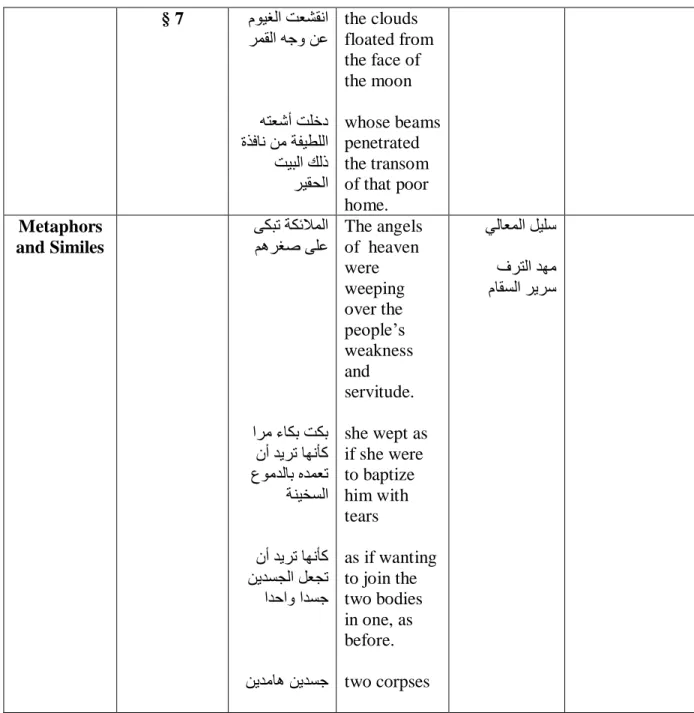
Features of comparison Paragraph number Similarities Differences ST TT ST TT Lexical Choice § 1 ؽ١ِلأح ؽظمٌح شفؽش عّٛدٌح شّزظؿٌّح سع١دٌّح ٟظٍثخػ حٍٍٛٙطٚ حٛزؽفأ a prince the balcony of his palace a great multitude summoned my noble family sing and be merry شم٠عسٌح هٍط ٟف سؽ١ِلأح a new prince fortunate country brilliant future § 2 عّٛدٌح ءخؼفٌح صلأِ ذؽفٌح ح٠ؾخ٘أ شٍ٘ؤظِ ْٕٛغ٠ٚ the throngs flooded the sky exhilarating song welcoming singing فؽظٌح عِٙ ؾحؿػلإح شظِٕ joy thankfulness tyrant bitter destiny the heady the new Emir
§ 3 ْٚعدّ٠ ٜٛمٌح ْٚؽمظس٠ ُٙطحٚغ عزظكٌّح ٝىزط ـّلأ ش١ٌخر ش glorifying the strong belittling themselves despot were weeping ragged swaddles ُؼط ذٙظٌٍّح خ٘ؼعط thinking potential heaven servitude her newly born starving § 4 ضٍّ٘أ ؽ١ِلأح ٍُظ سع١زٚ حؽ١غط خم١فؼ neglected prince’s oppression solitary tiny companion penurious miserable the trap of death sustaining life § 5 شٕ١ىكٌّح خٕٙؼز ٖعّؼط ذحٚؼلأح ٌُخػ شىثلاٌّح غ١قٌٛح ءخؼفٌح ٟػحؼغ ٓ١ظ٠ؼخؼٌح ٝػؽط شؿٛزغِ wretched woman her lap baptize him spiritual world angels spacious firmament naked arms graze placidly ءخىر حؽِ شٕ١طكٌح ٞعزو سػٍف ٞع١زٚ خ٠ the vicinity his face shivering warmth § 6 ضّػ ًفـٌح ٓ٠عكدٌح ضؼفؼ ءلاؼٌح ضضؽط she took the infant the two bodies she lifted heaven cried خ٘ؼعط خٙ١ٕ١ػ withered breast burning eyes slowly as before § 7 خٌّ ٚ َٛ١غٌح ضؼشمٔح ؽّمٌح ٗخٚ سػفخٔ ضزىكٔح at that moment the clouds floated the face of the moon transom fell شف١ـٌٍح ٗظؼشأ ٓ٠عِخ٘ ٓ٠عكخ Sentence Structure § 1 ؽ١ِلأح فلٚ شفؽش ٍٝػ ٜظخٔٚ ؽظمٌح عّٛدٌح شّزظؿٌّح a prince stood on the balcony of his palace addressing a great تٕ٘أٚ ُوؽشرأ ظلازٌح summoned for the occasion. Let me offer you and this whole fortunate
فؽش ٝ١س٠ ٟظٍثخػ سع١دٌّح multitude who will carry the name of my noble family عل سؽ١ِلأخف خِلاغ ضؼػٚ حؽطف ُىٌ ْٛى٠ حغلاِٚ ٗظمرأ خٌّ خث٠ؼٚ َخظؼٌح ٞظحعخأ حٍٍٛٙطٚ حٛزؽفأ ظكّف ؼخط ُىٍزم ً١ٍكر خؿخِٕ ٌٟخؼٌّح country my congratulations
upon the birth of a new prince of whom you will be justly proud He is the new bearer of a great and illustrious ancestry. upon him depends the brilliant future of this realm. Sing and be merry! § 2 هٍط ضزخظف صلأِ ٚ عّٛدٌح ح٠ؾخ٘ؤر ءخؼفٌح ذؽفٌح ٗطٛمر خـرخػ ءخفؼؼٌح شٕػأ , َحعطظقخر خ٠ؽز ٚ ُ٘ظخكخأ ُٙزحٚؼأ فلاطا The voices of the throngs, flooded the sky with exhilarating song. By ruling the weak with bitter authority, and exploiting their bodies and killing their souls.
full of joy and thankfulness the new tyrant for that destiny
§ 3 هٍط ْخىق خّٕ١رٚ ْٚعدّ٠ شٕ٠عٌّح ٚ ٜٛمٌح ُٙطحٚغ ْٚؽمظس٠ ُقخر ْٕٛغظ٠ ٚ عزظكٌّح While the crowds were glorifying the strong and belittling themselves by singing praise to a potential despot ؽ١مز ض١ر ٟف ْخو سأؽِح ؼٛدِٙ ٍٝػ شزٚؽـِ ُؼط َخمكٌح ؽ٠ؽق
while the angels of heaven were weeping over the people’s weakness and servitude a sick woman was thinking. She lived in an old, deserted
خ٘ؼعط ٌٝا لافؿ ذٙظٌٍّح ش١ٌخر شـّلؤر خفظٍِ
hovel and lying in her bed beside her newly born infant wrapped with ragged swaddles, was starving to death. § 4 ٕٝر ِٓ ضٍّ٘أ ْخكٔلإح ْٚظ خٙ٠ع٠ ًزى٠ ًّؼٌح ٚ قحؿطؼلاح neglected by humanity prevent her from working and sustaining life. خٌٙ ضزظو ش١زط حؽمف َخ٠لأح صخِأ شخٚؾ ف١ؼؼٌح خٙم١فؼ ٜٛمٌح ؽ١ِلأح ٍُظ She was a penurious and miserable young wife. Her husband had fallen into the trap of death set by the prince’s oppression. § 5 حؽِ ءخىر ضىرٚ ْأ ع٠ؽط خٙٔؤو عِٛعٌخر ٖعّؼط سػٍفخ٠ ضجخ حغخٌّ ٌُخػ ِٓ ٞعزو ذحٚؼلأح ? she wept as if she were to baptize him with tears why have you left the spiritual world? صٛظر ضٌخل ٚ ٌٗ ععظظط ؼٛطظٌح ٞعٌٚ خ٠ ضٔأٚ هٌ ف١ٌ لاا ٟفؼػٚ ٟطحعٕٙط and with a hunger weakened voice she spoke to the child saying but you, my beloved, have naught save a loving but destitute mother. miserable land of humans, filled with agony, oppression, and heartlessness § 6 ْأ ع٠ؽط خٙٔؤو ٌح ًؼدط ٓ٠عكد حعزحٚ حعكخ as if wanting to join the two bodies in one ٌٝا ًفـٌح ضّػ سعشر خ٘ؼعط دؼ خ٠ خٕر كفؼأ
she took the infant to her withered breast and clasped her arms around him. God! Have mercy on my unfortunate countrymen.
§ 7 َٛ١غٌح ضؼشمٔح ٚ ٓػ ؽّمٌح ٗخ ٗظؼشأ ضٍضظ سػفخٔ ِٓ شف١ـٌٍح ض١زٌح هٌغ ؽ١مسٌح the clouds floated from the face of the moon whose beams penetrated the transom of that poor home. Metaphors and Similes ٝىزط شىثلاٌّح ُ٘ؽغط ٍٝػ حؽِ ءخىر ضىر ْأ ع٠ؽط خٙٔؤو عِٛعٌخر ٖعّؼط شٕ١طكٌح ْأ ع٠ؽط خٙٔؤو ٓ٠عكدٌح ًؼدط حعزحٚ حعكخ ٓ٠عِخ٘ ٓ٠عكخ The angels of heaven were weeping over the people’s weakness and servitude. she wept as if she were to baptize him with tears as if wanting to join the two bodies in one, as before. two corpses ٌٟخؼٌّح ً١ٍق فؽظٌح عِٙ َخمكٌح ؽ٠ؽق
Table 1: A Comparative Analysis of “ ىلافط vs. “Two Infants” in Terms of Lexical Choice, Sentence Structure and Metaphors and Similes.
It should be specified here that throughout the following discussion regarding the three texts, I do not mean by literal translation a word for word translation, rather it is the translation that does not omit or reduce the original imaginative meaning into its real meaning.
П. 1.1. Lexical Choice
As far as the lexical choice is involved, the table reveals that the number of items rendered literally is considerable. In that way, the translators could keep the concepts of the original and build the basic fabric in the target text. Words such asؽ١ِلأح prince,ؽظمٌح palace, سع١دٌّح ٟظٍثخػ my noble family, عزظكٌّح despot, ٜٛمٌح the strong point out the idea of enjoying wealth and oppression which is one of the two main elements building the whole text. The second being suffering poverty is illustrated via words as ٝىزط weeping,ش١ٌخر شـّلأ ragged swaddles, سع١زٚ solitary, شٕ١ىكٌّح wretched,ٓ١ظ٠ؼخؼٌح ٟػحؼغ naked arms, ضضؽط cried.
The ST is aesthetically entertaining, and the translators’ concern should include the rendering of its beautiful aspects along with its bases. To this end, some items are omitted while some others are added. The process of omission covers those elements that lead to padding such as ذٙظٌٍّح, حؽِ, شٕ١طكٌح, شف١ـٌٍح, ٓ٠عِخ٘ for their immediate context expresses the intended meaning. In the utterance حؽِ ءخىر ضىر wept, the adjective حؽِ is not rendered because the verb to weep inherently means to cry with great sadness. The same can be said about شٕ١طكٌح in شٕ١طكٌح عِٛعٌح tears and ٓ٠عِخ٘ in ٓ٠عِخ٘ ٓ٠عكخ two corpses; that is the immediate context, to which these two adjectives belong, perfectly draws the meaning, and there is no need to overload the translation with unnecessary items.
In some other contexts, the translators prefer to insert additional items for the purposes of clarity, suitability and beauty. As an example, in the first paragraph, the word ُىٍزمظكِ is translated as your brilliant future with the addition of the adjective brilliant in an attempt to clarify the intended meaning of the prince’s message by which he meant that the new prince will bring with him all what is good for his people.
In a glance at the third paragraph, we find that the word thinking, which is originally absent, is added in the English text. It makes the expression more suitable to the