HAL Id: hal-02406594
https://hal-amu.archives-ouvertes.fr/hal-02406594
Submitted on 12 Dec 2019HAL is a multi-disciplinary open access archive for the deposit and dissemination of sci-entific research documents, whether they are pub-lished or not. The documents may come from teaching and research institutions in France or abroad, or from public or private research centers.
L’archive ouverte pluridisciplinaire HAL, est destinée au dépôt et à la diffusion de documents scientifiques de niveau recherche, publiés ou non, émanant des établissements d’enseignement et de recherche français ou étrangers, des laboratoires publics ou privés.
Determination of Grain Boundary Diffusion Coefficients
in C-regime by Hwang-Balluffi method: Silver Diffusion
in Pd
Z Balogh, Z Erdélyi, D Beke, A. Portavoce, C Girardeaux, J. Bernardini, A
Rolland
To cite this version:
Z Balogh, Z Erdélyi, D Beke, A. Portavoce, C Girardeaux, et al.. Determination of Grain Boundary Diffusion Coefficients in C-regime by Hwang-Balluffi method: Silver Diffu-sion in Pd. Defect and Diffusion Forum, Trans Tech Publications, 2009, 289-292, pp.763-767. �10.4028/www.scientific.net/DDF.289-292�. �hal-02406594�
Determination of Grain Boundary Diffusion Coefficients in C-regime by
Hwang-Balluffi method: Silver Diffusion in Pd
Z.Balogh
1, a, Z.Erdélyi
1, D.L.Beke
1, A.Portavoce
2,3, C.Girardeaux
2,3,
J.Bernardini
2,3and A.Rolland
2,31
Department of Solid State Physics, University of Debrecen, P.O. Box.2, H-4010 Debrecen, Hungary
2
Aix-Marseille Université, IM2NP and 3 CNRS, IM2NP (UMR 6242)
Faculté des Sciences et Techniques, Campus de Saint-Jérôme, Avenue Escadrille Normandie Niemen - Case 142, F-13397 Marseille Cedex, France
a
corresponding author: email: [email protected]
fax/tel: +36-52-316-073
Keywords: C kinetics, grain boundary diffusion, Auger electron spectroscopy, Hwang-Balluffi method
Abstract. Diffusion controlled processes play a crucial role in the degradation of technical materials. At low temperatures the most significant of them is the diffusion along grain
boundaries. In thin film geometry one of the best methods for determining the grain boundary (GB) diffusion coefficient of an impurity element is the Hwang-Balluffi method, in which a surface sensitive technique is used to follow the surface accumulation kinetics. Results of grain boundary diffusion measurements, carried out in our laboratory by this method in three different materials systems (Ag/Pd, Ag/Cu and Au/Ni) are reviewed. In case of Ag diffusion along Pd GBs the surface accumulation was followed by AES method. The data points can be well fitted by an Arrhenius function with an activation energy Q=0.99eV.
1) Introduction
Understanding the mechanisms of atomic movements in details is vastly important for modern material science/engineering especially in case of nanoscale applications. The manufacturing as well as the use of these devices (when degradation by diffusion may happen) rarely involve high temperature treatments (>0.5Tmelt). At lower temperatures the diffusion through shortcuts (grain
boundaries, dislocations, etc.) plays the major role, so the need for reliable grain boundary (GB) diffusion data is high.
For GB diffusion the most usual classification distinguishes three main kinetic regimes [1]. Type A kinetics is the case when the bulk diffusion fields of the GBs are overlapping and the system is characterized by an effective diffusion coefficient derived from the volume and grain boundary diffusion coefficients. In B kinetics there is also a flow from the grain boundary into the grains, but there is no overlapping of bulk diffusion penetrations. Measurements in this regime give the so called triple product P=Dgbk’ (Dgb is the GB diffusion coefficient, and k’ are the GB width and
the segregation factor at the GB/bulk interface, k’=cgb/co, respectively), provided that the bulk
diffusion coefficient is known. The most interesting is the C kinetics regime where the diffusion is strictly limited to the grain boundaries; this provides the most straightforward method for the determination of Dgb. This approach however requires very low diffusion depths and the use of the
standard tracer technique is very difficult especially if the GB density is low.
The Hwang-Balluffi arrangement [2] is a good approach to realize the C regime by measuring the surface accumulation due to the diffusion through a polycrystalline thin layer. In most cases surface sensitive techniques (AES, XPS, etc.) are used to follow the accumulation kinetics (see also [3]).
In this article brief summary of our earlier grain boundary diffusion measurements in Hwang-Balluffi geometry will be presented, and our most recent results on Ag GB diffusion in Pd will be described in details.
2) Theory and evaluation process
The Hwang-Balluffi equations [2], describing a system with uniformly spaced parallel grain boundaries in C kinetic regime, are:
(k/k) (cs/c0)=[1-exp(-t)], (1)
=(Dgb)/(sh), (2)
where cs is the surface concentration, h is the thickness of the thin film, s is the thickness of the
segregated layer, is the grain boundary density (in a polycrystalline sample with cubic grains of width d, =2/d), k is the segregation coefficient at the surface/GB interface: k=cs/cb and t is the
corrected time, measured from the first appearance of the diffusant. The form given here is not exactly that written in [2], but its a bit generalized version [4,5]. The t’ quantity is a “corrected time” of the form:
0 t t
t , (3)
where t0 is a constant, taking into account that a transient phenomenon occurs in each diffusion
measurement before a quasi-steady-state is reached and t is the real time. The Hwang-Balluffi equations can be applied under the following conditions: i) a quasi-steady-state of the grain-boundary diffusion current to the accumulation surface has been established; ii) the surface diffusion rate is sufficiently rapid, so that the segregated atoms are uniformly distributed laterally in the surface region; iii) a constant concentration of diffusing atoms is maintained at the grain-boundary/source interface.
As k”/k’ ratio is usually not known, it is useful to rewrite Eq. 1 in the following form:
'
exp 1 0 t c cs , (4)where c0 c0k k. Then rearranging the equation and taking the natural logarithm of both sides, one obtains:
1
'ln cs c0 t . (5)
This means if c0 was known, plotting the natural logarithm of
1cs c0
in the function of t’, would be equal to the slope of the fitted straight line. c0 can be determined by trial and error method: we change the value of c0 until the confidence of the regression is the best. Afterc0 has been determined, one simply calculates the slope of the corresponding fitted straight line, which is just the value of .The ratio of the thickness of the segregated layer and the grain boundary depends on the segregation model. In case of one-layer segregation: s/0.5 [4]. And finally for very thin films the grain size is
usually scaled by the film thickness and d can be replaced by h. TEM images of this phenomenon in an Ag/Cu bilayers as well as a more detailed explanation to the above mentioned simplifications can be read in [5]. Thus
3) Earlier experimental results
Our first attempt to measure grain boundary diffusion coefficients in Hwang-Balluffi arrangement was performed on the Ag/Cu system [5]. The importance of this measurement was that it checked the performance of the AES system and refined the evaluation procedure (like the simplifications presented in the earlier chapter). In the later experiments we followed the rules developed in this experiment. TEM investigations to check the connection between the film thickness and the grain size were also performed and the hd relation was fulfilled for this system. The results were as
follows: Dgb(413K)=(2.100.16)10-20 m2/s and Dgb(428K)= (4.660.18)10-20 m2/s.
In the next work [6], although the original intent of it was not the measurement of Gb diffusion by Hwang-Balluffi method, we could determine the Gb diffusion of Au in Ni at 673 K. In this work we investigated the dissolution of a thin nanocrystalline Ni layer into Au single crystal by XPS technique. In the first stage of the process fast diffusion of Au along Ni grain boundaries and its lateral spreading on the Ni surface took place and this was exactly the process on which the Hwang-Balluffi method is based. After separating the grain boundary diffusion and volume diffusion dissolution parts of the XPS signal, it was possible to calculate the grain boundary coefficient (Dgb=
210-20 m2/s), which was in good agreement with the value published in the literature [7].
4) GB diffusion of Ag in Pd.
The investigation of the dissolution of Pd into Ag was originally intended to investigate the Pd bulk dissolution into the single crystalline Ag similarly as the dissolution of Ni into Cu was monitored by AES [8]. Similar experimental difficulties, which were observed in the fist stage of the dissolution experiments on Ni into Au single crystal, made this impossible. However, for this system the more complete experimental realization of the Hwang-Balluffi method for Ag GB diffusion in Pd was possible, allowing even the determination of the temperature dependence of Dgb. Till now there was
only one data published in the literature at ambient temperature [9]. There is also a practical interest on the Ag/Pd system because it is widely used in conductive pastes and their catalytic applications [10,11,12].
Cleaned Ag (111) single crystal was used as substrate (and Ag source also). Pd was thermally evaporated under calibrated conditions. This calibration included both profilometric measurements and thickness determination by the AES machine itself. The segregation of the Ag was followed by AES. Details about the experimental setup can be found in Ref 13.
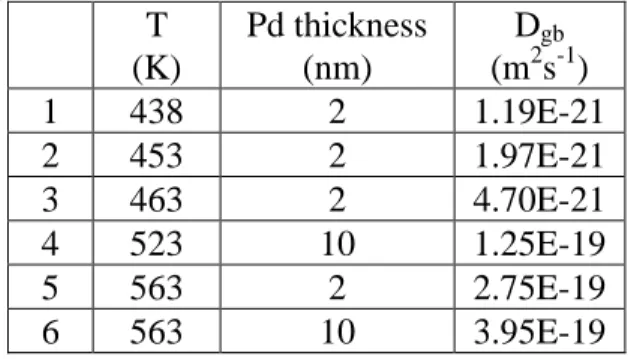
Six experiments were carried out: in four of them (the 438K, 453K, 463K and 563K) 2nm thick Pd films were used and in the other two (523K, 563K) 10nm thick Pd layer was deposited. At 563K both film thicknesses were investigated. This was to test the dh assumption [5] since making a
cross sectional TEM was difficult for such geometry. The calculated values of the grain boundary coefficients are shown in Table 1. The difference between the two data obtained for 563K is well within the experimental error.
Table 1.: Ag GB diffusion coefficients in Pd from six heat treatments T (K) Pd thickness (nm) Dgb (m2s-1) 1 438 2 1.19E-21 2 453 2 1.97E-21 3 463 2 4.70E-21 4 523 10 1.25E-19 5 563 2 2.75E-19 6 563 10 3.95E-19
Fig.1. shows the Arrhenius-plot for the six data points. It can be fitted with one straight line. The activation energy and the pre-exponential factor are Q=0.990.07eV and D0=2.06610-10 m2/s,
respectively.
Fig.1.: Arrhenius-plot of the Dgb coefficients
5.) Discussions
Extrapolating our Arrhenius line to ambient temperature, our value is a bit lower than the one measured by Volkova and Volkov (from 610-21 to 10-19m2/s) [9]. The authors of [9] stated that they most probably measured the diffusion through triple-junctions, so their value can be indeed a bit higher then our. Comparing to the reverse system (Pd in Ag) our activation energy is larger (as compared to 0.62 and 0.58eV in Ref 14), however the melting point of Ag is much smaller than Pd, so in our system the activation energy should be higher. The diffusion of Au in Pt is better for comparison since their chemical behaviour is similar (one period below Ag and Pd in the periodic table, respectively) and the activation energy in that system is close to ours (1.01eV in Ref .15).
6) Conclusions
Results of grain boundary diffusion measurements, carried out by Hwang-Balluffi method in three different materials systems (Ag/Pd, Ag/Cu and Au/Ni) are reviewed. In case of Ag diffusion along Pd GBs the surface accumulation was followed by AES method. Based on our earlier experience with the Ag/Cu and Au/Ni system a simplified evaluation process was used to obtain the data (no need for previous knowledge of grain size, grain boundary thickness and segregation factors). The data points can be fitted with an Arrhenius line with an activation energy Q=0.99eV, D0=2.06610 -10
m2/s pre-exponential factor.
Acknowledgement
REFERENCES
[1] L.G.Harrison Trans. Faraday Soc. Vol.57 (1961) p.1191.
[2] J.C.M.Hwang, J.D.Pan and R.W.Balluffi J. Appl. Phys. Vol.50 (1979) p.1339.
[3] Z.Erdélyi, Ch.Girardeaux, D.L.Beke, J.Bernardini, A.Portavoce, G.L.Katona, Z.Balogh and A.Rolland: Thin film dissolution into semi-infinite substrate: Surface analytical techniques
reveal surprising interface kinetics and dissolution modes (presented in this conference)
[4] M.G.Barthès and A.Rolland Thin Solid Films Vol.76 (1981) p.45.
[5] Z.Erdélyi, Ch.Girardeaux, G.A.Langer, L.Daróczi, A.Rolland and D.L.Beke Appl. Surf. Sci Vol.162-163 (2000) p.213.
[6] G.L.Katona, Z.Erdélyi, D.L.Beke ,Ch.Dietrich, F.Weigl, H-G. Boyen, B.Koslowski and P.Ziemann Phys. Rev.Vol.B 71 (2005) p.115432.
[7] H.Mehrer Landolt-Börnstein, New Series Vol. 26 (Berlin: Springer Verlag, 1990) chap 12 [8] Z.Erdélyi, Ch.Girardeaux, Zs.Tőkei, D.L.Beke, Cs.Cserháti and A.Rolland Surf. Sci.
Vol.496/1-2 (Vol.496/1-200Vol.496/1-2) p.1Vol.496/1-29.
[9] R.P.Volkova and Y.A.Volkov Metallofizika I Noveishie Tekhnologii (in Russian) Vol.25/2 (2003) p.227.
[10] P. Hermann, J.M. Guigner, B. Tardy, Y. Jugnet, D. Simon and J.C. Bertolini. J. Catal. Vol.163 (1996), p.169.
[11] L. Constant, P. Ruiz, M. Abel, Y. Robach, L. Porte and J.C. Bertolini. Topics Catal. Vol.14 (2001),p.1.
[12] S.Abate, S.Melada, G.Centi, S.Perathoner, F.Pinna and G.Strukhul Catal. Today Vol.117 (2006) p.193.
[13] Z.Balogh, Z.Erdélyi, D.L.Beke, A.Portavoce, Ch.Girardeaux, J.Bernardini and A.Rolland Appl. Surf. Sci.Vol. 255 (2009) p. 4844.
[14] A.Bukaluk Appl. Surf. Sci Vol.144-145 (1999) p.395.
doi:10.4028/www.scientific.net/DDF.289-292
Determination of Grain Boundary Diffusion Coefficients in C-Regime by Hwang-Balluffi Method: Silver Diffusion in Pd
doi:10.4028/www.scientific.net/DDF.289-292.763 References
] L.G.Harrison Trans. Faraday Soc. Vol.57 (1961) p.1191. doi:10.1039/tf9615701191
[2] J.C.M.Hwang, J.D.Pan and R.W.Balluffi J. Appl. Phys. Vol.50 (1979) p.1339. doi:10.1063/1.326168
[3] Z.Erdélyi, Ch.Girardeaux, D.L.Beke, J.Bernardini, A.Portavoce, G.L.Katona, Z.Balogh and A.Rolland: Thin film dissolution into semi-infinite substrate: Surface analytical
techniques reveal surprising interface kinetics and dissolution modes (presented in this conference)
[4] M.G.Barthès and A.Rolland Thin Solid Films Vol.76 (1981) p.45.
[5] Z.Erdélyi, Ch.Girardeaux, G.A.Langer, L.Daróczi, A.Rolland and D.L.Beke Appl. Surf. Sci Vol.162-163 (2000) p.213.
doi:10.1016/S0169-4332(00)00194-X
[6] G.L.Katona, Z.Erdélyi, D.L.Beke, Ch.Dietrich, F.Weigl, H-G. Boyen, B.Koslowski and P.Ziemann Phys. Rev.Vol.B 71 (2005) p.115432.
doi:10.1103/PhysRevB.71.115432
[7] H.Mehrer Landolt-Börnstein, New Series Vol. 26 (Berlin: Springer Verlag, 1990) chap 12 [8] Z.Erdélyi, Ch.Girardeaux, Zs.Tkei, D.L.Beke, Cs.Cserháti and A.Rolland Surf. Sci. Vol.496/1-2 (2002) p.129.
[9] R.P.Volkova and Y.A.Volkov Metallofizika I Noveishie Tekhnologii (in Russian) Vol.25/2 (2003) p.227.
[10] P. Hermann, J.M. Guigner, B. Tardy, Y. Jugnet, D. Simon and J.C. Bertolini. J. Catal. Vol.163 (1996), p.169.
doi:10.1006/jcat.1996.0316
[11] L. Constant, P. Ruiz, M. Abel, Y. Robach, L. Porte and J.C. Bertolini. Topics Catal. Vol.14 (2001),p.1.
[12] S.Abate, S.Melada, G.Centi, S.Perathoner, F.Pinna and G.Strukhul Catal. Today Vol.117 (2006) p.193.
doi:10.1016/j.cattod.2006.05.050
[13] Z.Balogh, Z.Erdélyi, D.L.Beke, A.Portavoce, Ch.Girardeaux, J.Bernardini and A.Rolland Appl. Surf. Sci.Vol. 255 (2009) p. 4844.
doi:10.1016/j.apsusc.2008.12.010
[14] A.Bukaluk Appl. Surf. Sci Vol.144-145 (1999) p.395. doi:10.1016/S0169-4332(98)00750-8