HAL Id: tel-01750993
https://hal.inria.fr/tel-01750993v2
Submitted on 16 Jan 2015HAL is a multi-disciplinary open access archive for the deposit and dissemination of sci-entific research documents, whether they are pub-lished or not. The documents may come from teaching and research institutions in France or abroad, or from public or private research centers.
L’archive ouverte pluridisciplinaire HAL, est destinée au dépôt et à la diffusion de documents scientifiques de niveau recherche, publiés ou non, émanant des établissements d’enseignement et de recherche français ou étrangers, des laboratoires publics ou privés.
Sai Qian
To cite this version:
Sai Qian. Accessibility of Referents in Discourse Semantics. Computation and Language [cs.CL]. Université de Lorraine, 2014. English. �NNT : 2014LORR0138�. �tel-01750993v2�
Accessibilit´
e des r´
ef´
erents
en s´
emantique du discours
TH`
ESE
pr´esent´ee et soutenue publiquement le 7 novembre 2014 pour l’obtention du
Doctorat de l’Universit´
e de Lorraine
(sp´ecialit´e informatique) par
Sai QIAN
Composition du jury
Rapporteurs : Isabelle TELLIER Professeur, Universit´e Paris 3, France Yoad WINTER Professeur, Universit´e d’Utrecht, Pays-Bas
Examinateurs : Maxime AMBLARD Maˆıtre de Conf´erences, Universit´e de Lorraine, France Jean-Marie PIERREL Professeur, Universit´e de Lorraine, France
Laurence DANLOS Professeur, Universit´e Paris 7, France
Directeur : Philippe DE GROOTE Directeur de Recherche, INRIA, Nancy, France
It is a great pleasure to come to this end of expressing my gratitude to all the people who have helped and supported me throughout the long journey of my PhD study.
First of all, I am deeply indebted to my two supervisors: Prof. Philippe de Groote and Associate Prof. Maxime Amblard. The completion of this dissertation would have been impossible without the inspiration, guidance and encouragement from them, no one deserves a bigger thank you than them. It was Prof. de Groote who introduced dynamic semantics systematically to me. He also inspired my research interest on anaphora. His encyclopedic knowledge of logics and linguistics have deeply impressed me. More importantly, he taught me the formal and scientific way of writing. During the mornings and afternoons he spent with me in his office, I have gained countless precious suggestions. Associate Prof. Amblard, who is also the supervisor of my master thesis, has always made himself available for me in the past five years. Despite his heavy teaching and administrative duties, he spent numerous hours meeting me everywhere (in the lab and in PLG) and discussing with me whatever questions I encountered in my dissertation. He witnessed and participated in shaping an engineer of telecommunication into a PhD of natural language processing (NLP). Not being a fluent francophone, I often had to struggle with many administrative problems in French. Whenever such things came beyond my reach, Maxime was always standing by my side. Frankly speaking, for my two supervisors, I am more thankful than I can express with words.
In addition, I would like to thank Prof. Isabelle Tellier and Prof. Yoad Winter, who accepted to be the reviewers of my dissertation. The current manuscript has improved considerably on the basis of their insightful comments. I also want to thank Prof. Lau-rence Danlos and Prof. Jean-Marie Pierrel, the examiners of the thesis, who took their valuable time to read the manuscript and to attend my defense.
Besides, I would like to give my gratitude to those professors who taught me during my master study in Saarland University and Nancy 2 University. Although it was not easy for me to enter a new research realm in a new continent, their lectures and seminars have quickly provided me the basis to be a computational linguist. In particular, I am truly grateful to Valia Kordoni and Patrick Blackburn. Valia is the person opening the door of NLP for me. In 2007, when she sent me the admission letter of LCT, I never imagined that someday I would become a PhD in NLP. Since I knew nothing about this area, Valia was spammed by many silly questions of mine. But she was always patient and quick-replying. Her highly-effective style has impressed me a lot. As to Patrick, he has provided a new definition on the relationship between students and teachers. His enthusiasm and kindheartedness made himself not only a qualified teachers, but also a close friend to every student (including me of course). In particular, Patrick was willing to communicate with students from time to time and help them with all sorts of problems. Thanks to his recommendation, I experienced 3 years of course-teaching in the university, which I considered as an invaluable and indispensable part of of my PhD study. Although
Further more, I am really lucky to spend my PhD life in the family of Sémagramma. The team members (in alphabetical order): Bruno Guillaume, Guy Perrier, Maxime Am-blard, Philippe de Groote, and Sylvain Pogodalla, are always friendly and willing to help. I also enjoyed the lunch time and discussion with all PhD and postdoc colleagues in the team (in alphabetical order): Can Baskent, Ekaterina Lebedeva, Florent Pompigne, Jiří Maršík, Karen Fort, Mathieu Morey, Novak Novakovic, Sandro Maskharashvili, Shohreh Taba, etc.
Finally, this dissertation is dedicated to my family. My parents not only have been entirely supportive and encouraging but also have a constant expectation on me. They take my academic achievements as their greatest pride. And very special thanks to my wife, Mengying, who sustained a long distance relation in the past years. Her endless love has enabled me to complete this dissertation.
Les anaphores recouvrent un phénomène linguistique omniprésent, dans lequel l’interpréta-tion d’une expression, appelée anaphore, dépend de celle d’une autre, appelé l’antécédent. Cette thèse étudie la sémantique d’un type particulier d’anaphore : les anaphores pronom-inales où l’anaphore et l’antécédent sont des syntagmes nominaux singuliers. Plus pré-cisément, la thèse traite de l’accessibilité des référents de discours à l’aide d’un système formel de la sémantique dynamique. Nos préoccupations principales sont les facteurs qui déterminent les “antécédents potentiels” d’un syntagme nominal, à savoir, les condi-tions dans lesquelles un syntagme nominal peut agir comme antécédent d’une expression anaphorique donnée.
Grâce au travail de pionniers du siècle précédent comme Tarski et Montague, il a été montré que le langage naturel, en particulier l’anglais, peut être interprété comme un langage formel. Toutefois, la grammaire de Montague (MG) est conçu pour calculer la sémantique de phrases isolées. Mais nous sommes également intéressé par le discours qui est plus qu’une collection aléatoire de phrases sans rapport. Empiriquement, MG ne résout pas une série de phénomènes discursifs, comme les anaphores inter-phrastiques et les Donkey Sentences.
Depuis les années 1980, un certain nombre de théories sémantiques ont été établies pour la sémantique du discours, par exemple, la Discourse Representation Theory (DRT),
File Change Semantics (FCS), et Dynamic Predicate Logic (DPL). Ces théories sont
rassemblées dans la sémantique dynamique, car elles proposent un nouveau point de vue sur le sens: le sens de l’expression est identifié par son potentiel de modification du contexte plutôt que de ses conditions de vérité (comme pour MG). Cependant, les théories dynamiques classiques ne sont pas parfaitement satisfaisantes. Par exemple, la DRT s’appuie sur un niveau indispensable de structure de représentation, où le principe de compositionnalité de Frege et Montague n’est pas respectée. Pour DPL, sa syntaxe est celle de la logique des prédicats standard, qui est une sémantique non-classiques. De plus, à la fois la DRT et DPL souffrent du problème de destructive assignment.
Plus récemment, De Groote propose un autre cadre dynamique appelé type théorique Dynamic Logic (TTDL), qui introduit les bases théoriques des travaux de cette thèse. Ce cadre s’inscrit dans la tradition montagovienne et respecte le principe de composi-tionnalité. Il n’utilise que des outils mathématiques et logiques bien établies, telles que le λ-calcul et la théorie des types. Dans TTDL, les notions de contexte gauche et droit sont introduits afin de rendre compte de la dynamique du discours: le contexte gauche est constitué d’une liste de variables accessibles et le contexte droit est sa continuation. L’accessibilité d’un référent de discours dans TTDL est alors sa présence dans le contexte gauche.
Malgré les précieuses avancées apportées par les théories classiques de la sémantique du discours, il persiste un certain nombre d’exceptions non résolues, par exemple, les anaphores sous double négation et la gestion des modalités. Ce travail de thèse propose
négative d’une expression. La négation est alors vue comme une opération qui com-mute les positions des deux représentations. Ainsi, la présence d’une deuxième négation rétablira les positions comme si aucune négation n’avait jamais eu lieu. De cette manière, une double négation peut être éliminé et l’accessibilité aux référents souhaitée est possi-ble. Quant à l’anaphore sous modalité, nous proposons d’enrichir le contexte gauche de TTDL avec la notion de base modale, introduite par Kratzer. Ainsi le modèle de monde possible est ajoutée à la représentation sémantique. Enfin, nous montrons comment les différentes adaptations peuvent coexister.
Mots-clés : Logique, Anaphore, Montague, λ-calcul, Sémantique Dynamique,
Anaphora is a ubiquitous linguistic phenomenon whereby the interpretation of one ex-pression, called the anaphor, depends on that of another, called the antecedent. This thesis studies the semantics of one particular sort of anaphora: pronominal anaphora, where both anaphor and antecedent are singular noun phrases. More specifically, the thesis deals with the accessibility of discourse referents using a formal system of dynamic semantics. Our central concerns are the factors which determine the “antecedent poten-tial” of a noun phrase, namely, the conditions under which a noun phrase may act as antecedent of a particular anaphoric expression.
Due to the pioneering work of Tarski and Montague in the last century, it has been shown that natural language, in particular English, can be interpreted as a formal lan-guage. However, Montague Grammar (MG) is designed to account for the semantics of isolated sentences. But we are also interested in discourse which is more than a random collection of unrelated sentences. MG is empirically problematic for a series of discourse phenomena, such as the inter-sentential anaphora and the donkey anaphora.
Since the 1980s, a number of semantic theories have been established for the seman-tics of discourses, e.g., Discourse Representation Theory (DRT), File Change Semanseman-tics (FCS), and Dynamic Predicate Logic (DPL). These theories are subsumed under dynamic semantics because they propose a novel point of view: the meaning of an expression is identified with its potential to change the context, rather than its truth conditions (as in MG). However, the classical dynamic theories are not completely satisfactory. For instance, DRT relies on an indispensable level of representational structure, hence the Fregean and Montagovian tradition of compositionality is not restored. As for DPL, although its syntax is the one of standard predicate logic, which is a non-classical seman-tics. Further more, both DRT and DPL suffer from the so-called destructive assignment problem.
More recently, De Groote proposes another dynamic framework called Type Theoretic Dynamic Logic (TTDL), which lays the theoretical foundation of this thesis. This frame-work follows the Montagovian tradition and is completely compositional. It only makes use of well-established mathematical and logical tools, such as λ-calculus and theory of types. In TTDL, the notion of left and right context are introduced in order to achieve dynamics: the left context consists of a list of accessible variables for future reference, and the right context is its continuation. The lift-span of a discourse referent in TTDL is boiled down to its existence in the left context.
Despite the valuable insights yielded by the classical theories of discourse semantics, there is a wide range of exceptional phenomena that they fail to address, e.g., anaphora under double negation and modality. Concentrating on these two exceptions, this thesis provides a corresponding adaptation of TTDL for each case. Briefly speaking, for the problem of double negation, we propose to encapsulate both the affirmative representation and the negative representation of an expression in its semantics. Negation is treated as
a double negation can be eliminated and the desired referent accessibility is modeled. As for anaphora under modality, we propose to enrich the TTDL left context with the notion of modal base, which is proposed by Kratzer. The possible world model is integrated in the semantic representation as well. Moreover, we show how the different adaptations could work in an unified framework.
Keywords: Logic, Anaphora, Montague, λ-calculus, Dynamic Semantics, Discourse,
Contents vii
List of Figures xi
List of Tables xiii
0 Le panorama 1
0.1 Sémantique formelle des langues naturelles . . . 1
0.2 Cohésion and Anaphore . . . 2
0.3 Accessibilité et sémantique dynamique . . . 4
0.4 Problèmes à résoudre . . . 7 0.4.1 Double Négation . . . 7 0.4.2 Subordination modale . . . 8 0.5 Propositions . . . 8 0.5.1 DN-TTDL . . . 8 0.5.2 M-TTDL . . . 9 0.6 Conclusion . . . 10 1 Introduction 11 1.1 Notations . . . 11
1.2 Natural Language Formal Semantics . . . 12
1.3 Cohesion and Anaphora . . . 13
1.4 Accessibility and Dynamic Semantics . . . 15
1.5 Problems to Tackle . . . 17 1.6 Thesis Outline . . . 18 2 Linguistic Preliminaries 21 2.1 What is Anaphora? . . . 21 2.1.1 Classical Definitions . . . 22 2.1.2 Terminologies on Anaphora . . . 25 2.2 Taxonomy of Anaphora . . . 27
2.2.1 Syntactic Category of Anaphor . . . 27
2.2.2 Type of Identity . . . 30
2.2.3 Anaphor-Antecedent Position . . . 32
2.3 Anaphora on Different Linguistic Levels . . . 32
2.3.1 Semantics: Anaphor-Antecedent Relations . . . 33
2.3.2 Syntax: Binding Theory . . . 36
3 Mathematical Preliminaries 41
3.1 Logical Languages . . . 43
3.1.1 Propositional Logic . . . 43
3.1.2 First-Order Logic . . . 48
3.1.3 Modal Propositional Logic . . . 54
3.2 Simply Typed λ-Calculus . . . . 58
3.2.1 Untyped λ-Calclulus . . . . 59
3.2.2 The Language of Types . . . 63
3.2.3 Semantics . . . 65
4 Dynamic Frameworks 71 4.1 Why Dynamics? . . . 72
4.1.1 Inter-Sentential Anaphora . . . 73
4.1.2 Donkey Sentence . . . 75
4.2 Discourse Representation Theory (DRT) . . . 77
4.2.1 Introduction . . . 77
4.2.2 Formal Framework . . . 78
4.2.3 Illustration . . . 82
4.3 Dynamic Predicate Logic (DPL) . . . 85
4.3.1 Introduction . . . 85
4.3.2 Formal Framework . . . 86
4.3.3 Illustration . . . 89
4.4 Type Theoretic Dynamic Logic (TTDL) . . . 93
4.4.1 Introduction . . . 93
4.4.2 Formal Framework . . . 94
4.4.3 Illustration . . . 100
5 Discourse Referent and Exceptions 105 5.1 Accessibility Constraints . . . 106
5.1.1 Accessibility in DRT . . . 106
5.1.2 Internal and External Dynamicity in DPL . . . 107
5.1.3 Left Context in TTDL . . . 110
5.2 Discourse Referent . . . 113
5.2.1 Specificity . . . 113
5.2.2 Predicted Constraints on Accessibility . . . 117
5.3 Exceptions to the Accessibility Constraints . . . 121
5.3.1 Ascriptive and Generic Indefinite . . . 121
5.3.2 Factive Verbs . . . 125
5.3.3 Double Negation . . . 127
5.3.4 Disjunction . . . 130
5.3.5 Modal Subordination . . . 134
6 Double Negation 137 6.1 Double Negation Adapted in DRT . . . 137
6.1.1 Formal Framework . . . 138
6.1.2 Illustration . . . 148
6.2 Adaptation of TTDL to Double Negation . . . 149
6.2.1 Formal Framework . . . 150
6.2.3 Implicit Double Negation . . . 167
6.2.4 Illustration . . . 169
7 Modality 179 7.1 Modality in Natural Language . . . 180
7.2 Kratzer’s Theory of Modality . . . 183
7.2.1 Conversational Background . . . 183
7.2.2 Accessibility Relation & Conversational Background . . . 186
7.2.3 Previous Works on Modal Subordination . . . 190
7.3 Adaptation of TTDL to Modality . . . 196
7.3.1 Formal Framework . . . 196
7.3.2 Elementary Functions . . . 199
7.3.3 Dynamic Translation . . . 204
7.3.4 Lexical Entries for Modals . . . 206
7.3.5 From TTDL to M-TTDL . . . 215
7.3.6 Illustration . . . 225
7.4 Putting Everything Together . . . 230
8 Conclusion 235 8.1 Summary . . . 235 8.2 Future Work . . . 236 8.2.1 Discourse Structure . . . 236 8.2.2 Plurality . . . 238 8.2.3 Accommodating Counterfactual . . . 239 8.2.4 Others . . . 240
Appendix A Dynamic Translation of The Lexicon 243 A.1 The Dynamic Translation of TTDL . . . 243
A.2 The Dynamic Translation of DN-TTDL . . . 246
A.3 The Dynamic Translation of M-TTDL . . . 250
Appendix B Linguistic Examples 255
1 Relations entre les différentes extensions de TTDL . . . 9
2.1 Various Types of References . . . 27
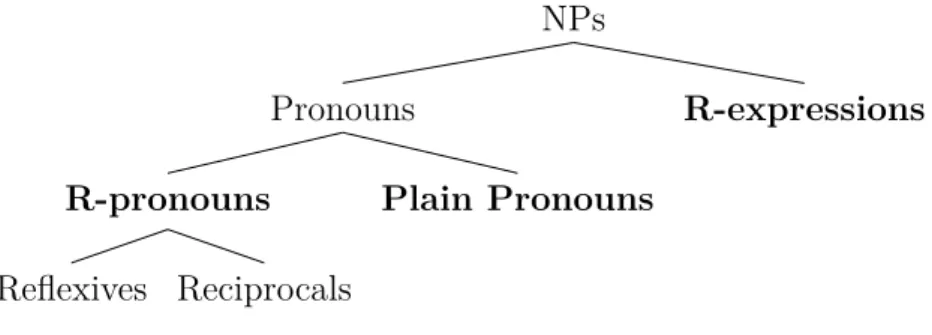
2.2 Classification of NPs in BT . . . 37
2.3 C-Command Illustration . . . 37
3.1 Precedence Among Logical Symbols in FOL . . . 49
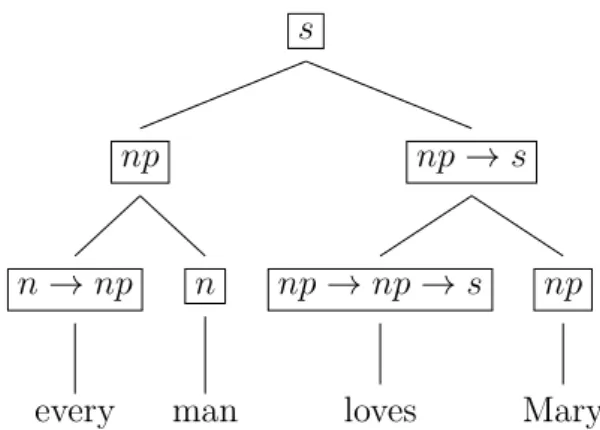
3.2 Syntactic Tree of Example (59) . . . 67
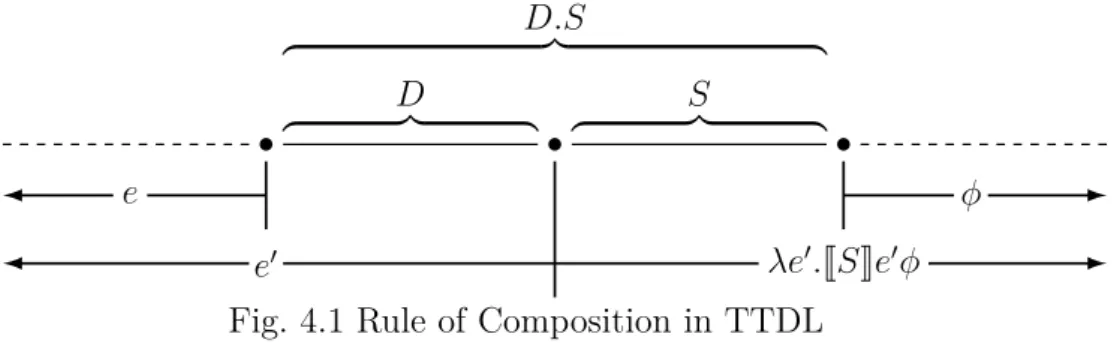
4.1 Rule of Composition in TTDL . . . 96
6.1 Hierarchy of A General Discourse . . . 163
7.1 Possible Worlds Hierarchy of A . . . . 208
7.2 Possible Worlds Hierarchy of 3A . . . . 208
7.3 Possible Worlds Hierarchy of 2A . . . . 210
7.4 Possible Worlds Hierarchy of at H A . . . . 212
7.5 Possible Worlds Hierarchy of JmightKM -T T DLA . . . 213
7.6 Possible Worlds Hierarchy of JwouldKM -T T DLA . . . 214
7.7 Relations between TTDL, P-TTDL, and M-TTDL . . . 224
7.8 Possible Worlds Hierarchy of Example (126-a) . . . 227
7.9 Possible Worlds Hierarchy of Example (126-b) . . . 228
7.10 Possible Worlds Hierarchy of Example (121) . . . 229
7.11 Relations between All Frameworks . . . 231
7.12 Relations between All Frameworks (Completed) . . . 233
8.1 Hierarchical Structure: (128-a)-(128-d) . . . 237
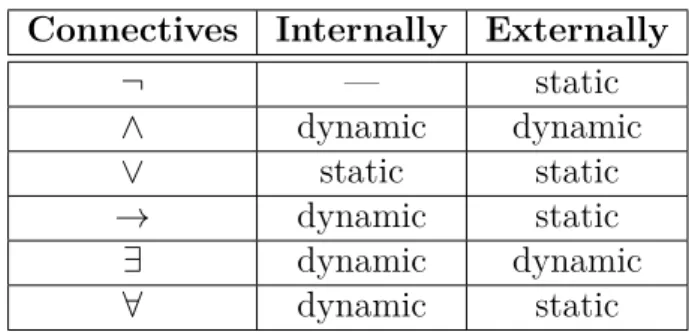
5.1 Dynamicity of Connectives in DPL . . . 109
7.1 Environment at Each World of A . . . . 208
7.2 Environment at Each World of 3A . . . . 209
7.3 Environment at Each World of 2A . . . . 210
7.4 Environment at Each World of at H A . . . . 212
7.5 Environment at Each World of JmightKM -T T DLA . . . 213
Le panorama
Contents
0.1 Sémantique formelle des langues naturelles . . . . 1
0.2 Cohésion and Anaphore . . . . 2
0.3 Accessibilité et sémantique dynamique . . . . 4
0.4 Problèmes à résoudre . . . . 7 0.4.1 Double Négation . . . 7 0.4.2 Subordination modale . . . 8 0.5 Propositions . . . . 8 0.5.1 DN-TTDL . . . 8 0.5.2 M-TTDL . . . 9 0.6 Conclusion . . . . 10
0.1
Sémantique formelle des langues naturelles
Le terme de langage naturel, aussi appelé langage humain, ou langage ordinaire, apparaît dans différentes disciplines de recherche comme la philosophie, la linguistique et la logique. On l’entend comme un concept générique qui dénote des langages parlés ou écrits par des humains. À proprement parler, l’étude scientifique des langues est la linguistique. Une vision contemporaine la décompose en six sous-domaines principaux, chacun étant un sujet de recherche, Fromkin (2000). La phonétique et la phonologie étudient les sons et les systèmes abstraits de sons ; la morphologie étudie la structure des mots ; la syntaxe s’intéresse à la structure des syntagmes et des phrases ; la sémantique observe le sens ; et la pragmatique interprète dans un environnement de communication global. Cette thèse se concentre sur la sémantique formelle du langage naturel, à savoir, l’analyse du sens des expressions linguistiques par des systèmes formels, en particulier la logique.
Au milieu du siècle précédent, Alfred Tarski a étudié la sémantique des langages formels en définissant la notion de vérité Tarski (1944, 1956)1. Cependant, l’auteur ne
s’est pas montré optimiste envers la formalisation de la sémantique des langues naturelles. À la fin de la première section de Tarski (1956), il fait la remarque suivante :
1Tarski (1956) a été traduit de l’allemand et publié en 1936. Les travaux originaux l’ont été en
... the very possibility of a consistent use of the expression ‘true sentence’ which is in harmony with the laws of logic and the spirit of everyday language seems to be very questionable, and consequently the same doubt attaches to the possibility of constructing a correct definition of this expression
...la possibilité même de l’utilisation conforme de l’expression ‘phrase vraie’, qui serait en harmonie avec les lois de la logique et l’esprit de la langue de tous les jours semble être très discutable, et par conséquent, le même doute persiste quant à la possibilité de construire une définition correcte de cette expression
... I now abandon the attempt to solve our problem for the language of ev-eryday life and restrict myself henceforth entirely to formalized languages.Tarski
(1956)
... j’abandonne maintenant la tentative de résoudre notre problème de la langue de la vie quotidienne et me limite désormais entièrement aux langages formalisés.Tarski (1956)
Dans les années 1970, en utilisant des outils mathématiques (la logique des prédi-cats d’ordre supérieur, le λ-calcul, la théorie des types, la logique intensionnelle, etc.), Richard Montague établit une sémantique des langages naturelles dans une perspective
model-theoretic Montague (1970a,b, 1973). Cette série de travaux est connue comme la
grammaire de Montague (MG) qui propose d’interpréter le langage naturel, en particulier l’anglais, comme un langue formel.
Plus précisément, dans Montague (1973), l’auteur propose une interprétation du lan-gage naturel en deux étapes. Tout d’abord, les expressions linguistiques sont exprimées dans un langage formel, par exemple la logique des prédicats d’ordre supérieur. Pour cela, chaque constituant est représenté par un λ-terme qui définit sa contribution sémantique. À partir de la structure grammaticale de la phrase, la combinaison des différentes entrées lexicales construit une expression logique globale, grâce à la β-réduction. Le lien entre la structure grammaticale et la structure logique est ainsi conservé, et permet de donner une représentation du sens de l’énoncé. Ensuite, les formules logiques obtenues à partir des étapes précédentes reçoivent une interprétation dans un modèle, comme tout autre système formel, qui fournit une interprétation des expressions linguistiques en termes de conditions de vérité.
0.2
Cohésion and Anaphore
À première vue, une phrase se compose d’un ensemble de mots. Mais c’est évidemment bien plus que cela. Un ensemble aléatoire de mots qui respectent les règles de la grammaire ne donne pas forcément une phrase acceptable. Chomsky a proposé un exemple devenu célèbre :
(1) Colorless green ideas sleep furiously. Chomsky (1957)
Grammaticalement, la phrase(1) est correcte. Mais du point de vue sémantique, elle n’a pas vraiment de sens : la combinaison des constituants de (1) (ie, colorless, green,
ideas, sleep et furiously) ne construit pas un tout sémantiquement cohérent, notamment
parce que le vocabulaire n’est pas relié. De manière analogue, un discours est plus qu’un ensemble aléatoire de phrases, par exemple:
(2) a. Police have carried out searches of the home and offices of former French President Nicolas Sarkozy as part of a campaign financing probe. A law firm in which Mr Sarkozy owns shares was also searched, reports say. (émission de BBC News Europe du 3 juillet 2012)
b. Police have carried out searches of the home and offices of former French President Nicolas Sarkozy as part of a campaign financing probe. Tens of thousands have turned out in the streets of the Spanish capital Madrid to welcome the national football team after their victory at Euro 2012. (mélange d’émissions de BBC News Europe du 3 juillet 2012)
Chacun des deux discours de (2) est constitué de deux phrases. Les phrases qui les composent sont parfaitement compréhensibles pour elles-mêmes. Cependant, comme on peut le remarquer, (2-a) est un texte cohérent alors que (2-b) est juste un alignement arbitraire de deux phrases (c’est en effet un mélange de deux articles indépendants). Les deux phrases de(2-a)sont centrées autour du même thème et des indices peuvent être mis en avant (répétition du nom propre Sarkozy, relations lexicales entre les expressions telles que the police, law firm, search, etc.). Alors que dans (2-b), ces relations n’apparaissent pas. Cela en fait un texte non compréhensible, à savoir qu’il ne parvient pas à former un “ensemble unifié” en termes de Halliday and Hasan (1976).
Dans Halliday and Hasan (1976), les auteurs caractérisent la connectivité d’un texte cohérent en termes de groupes de mécanismes linguistiques dits de cohésion, y compris les références, la substitution, l’ellipse, la conjonction, et la cohésion lexicale. Ces dis-positifs sont présents pour lier les énoncés entre eux et par cela former la connectivité. Ce processus construit alors le texte. Dans la suite de cette thèse, nous allons utiliser indif-féremment les deux termes “discours” et “texte”, pour désigner un ensemble de phrases connectées. De manière analogue, nous utiliserons “phrase” et “énoncé” pour désigner les constituants de base d’un discours.
La classification des dispositifs cohérents fournit des heuristiques utiles pour des recherches ultérieures, en particulier pour l’analyse de texte. Ces dispositifs ne sont pas mutuellement exclusifs, plutôt, ils se chevauchent et ils s’étendent. Nous ne reviendrons pas sur ces détails, les lecteurs intéressés peuvent se référer à l’ouvrage original Halliday and Hasan(1976). Ici, nous nous intéressons à un sous-domaine particulier de la référence : les anaphores.
Depuis le milieu du 20e siècle, l’étude de l’anaphore a suscité l’intérêt des chercheurs de différentes branches, en particulier celles liées à la linguistique. D’une manière générale, l’anaphore est entendue comme la relation entre deux expressions linguistiques, où l’inter-prétation d’un élément, appelé l’anaphore, est déterminée par l’interl’inter-prétation d’un autre, appelé l’antécédent. Nous dirons qu’il y a un lien anaphorique entre l’antécédent et l’anaphore. Ce qui signifie qu’une phrase contenant une anaphore ne peut pas être inter-prétée pour elle-même, mais doit être plongée dans un contexte. Par exemple:
(3) a. John walks in. He smiles. b. Bill walks in. He smiles.
Les deux discours ci-dessus partagent la même seconde phrase, qui contient le pronom
he. Son interprétation est clairement dépendante du contexte : dans (3-a), c’est John
qui sourit, tandis que dans (3-b), la personne qui sourit est Bill. Dans ces exemples, les noms propres John et Bill sont nommés les antécédents et he est l’anaphore.
L’anaphore peut relever de différentes catégories syntaxiques. On trouve des anaphores sur des syntagmes nominaux (NP), des syntagmes verbaux (VP), des adjectifs, etc. Pour une étude complète sur la taxonomie des anaphores, le lecteur pourra se référer à Hirst
(1981). Nous nous restreignons à un type spécifique d’anaphore : les anaphores pronom-inales, et plus encore sur les cas où l’anaphore et l’antécédent sont tous les deux des syntagmes nominaux singuliers, comme dans l’exemple (3).
Du point de vue syntaxique, l’un des cadres les plus influents sur l’analyse des anaphores est la théorie du gouvernement et du liage (Gouvernement and Binding (GB)) proposé par Chomsky (1981, 1986b). Pour les syntacticiens chomskiens, l’anaphore est un phénomène de grammaire. Ainsi, elle est exprimée en termes purement syntaxiques, tels que local domain, domain, etc. Trois principes ont été introduits pour justifier la distribution de l’anaphore. Par exemple, un pronom (he ou him) ne doit pas trouver son antécédent dans le domaine local, au contraire des pronoms réflexifs. Ces propriétés sont illustrées dans les exemples suivants, où nous avons utilisons le symbole “ ∗ ” devant un indice pour indiquer que la relation anaphorique sur cet indice n’est pas acceptable : (4) a. Russelli admired him∗i/j.
b. Russelli admired himselfi/∗j. Huang (2006)
Selon la théorie GB, les deux NP de (4-a) (Russell et him) ne peuvent pas être anaphoriquement liés, sinon la phrase n’est pas interprétable. Quant à (4-b), le nom propre Russell doit être l’antécédent de himself. Ces prévisions correspondent bien à l’intuition que nous apporte ces exemples.
A contrario de la théorie GB, le point de vue sémantique de l’anaphore vise à en préciser son interprétation. Il est généralement acquis que les anaphores peuvent être classées du point de vue sémantique en au moins deux types : anaphores référentielles et anaphores liéesBach and Partee (1980);Evans(1980). Cette distinction est illustrée par les exemples suivants, où les deux anaphores ne diffèrent que par l’antécédent:
(5) a. Johni loves hisi mother.
b. Every mani loves hisi mother. Evans (1980)
L’anaphore dans (5-a)est référentielle en ce que l’expression anaphorique his se réfère à l’individu particulier John. Celle de(5-b)est appelée anaphore liée parce que l’anaphore
his est interprétée par analogie avec la variable liée en logique des prédicats
tradition-nelle à laquelle il fait référence : his est alors lié par le quantificateur universel de every
man. Les représentations sémantiques de ces deux phrases reflètent bien cela (où
(respec-tivement) John est une constante d’individu, love est un prédicat à deux arguments,
mother of est une fonction qui prend un individu qui retourne un autre individu) : love john(mother of john)
∀x.(man x → love x (mother of x))
0.3
Accessibilité et sémantique dynamique
Il serait erroné de croire que toutes les paires de NP peuvent former des relations antécédent-anaphore. Ainsi, en plus de l’interprétation des anaphores, il faut considérer si un NP
peut servir d’antécédent pour une expression anaphorique particulière. Ce problème est nommé accessibilité de l’antécédent.
La théorie GB définit plusieurs contraintes sur le plan syntaxique, qui ont été établies en fonction de relations structurelles entre l’antécédent et l’anaphore. Cependant, mal-gré les idées fécondes de la théorie GB, elle ne prend pas en compte toutes les carac-téristiques de l’anaphore. En particulier, son étude reste limitée au niveau phrastique, comme dans les exemples(4)et(5)(phénomène que l’on retrouve son le terme d’anaphore intra-phrastique dans la littérature). Pourtant, Halliday and Hasan (1976) montre bien qu’elles sont utilisées pour rassembler des phrases en un texte, ce qui en fait des éléments fondateurs du discours. Cependant, il est important de noter que la plupart de ces in-teractions se produisent au-delà de la phrase, comme dans l’exemple (3), ou le suivant :
(6) A mani walks in the park. Hei whistles.
La classification sémantique abordée précédemment ne suffit pas toujours. Par exem-ple, l’anaphore dans l’exemple (6) ne peut pas être référentielle parce que les deux NP(a
man et he, ne se réfèrent pas à une personne en particulier. Et d’autre part, l’anaphora
ne peut être liée à un quantificateur. SuivantRussell(1905), nous traitons les antécédents indéfinis comme a man comme des quantifications existentielles. Cependant, la portée du quantificateur ne peut pas être étendue au-delà de la phrase. Un autre exemple notoire d’anaphores complexes est les Donkey Sentences :
(7) Every farmer who owns a donkeyi beats iti.
Encore aujourd’hui, l’interprétation sémantique exacte de l’exemple(7)est un sujet de débat. Indépendamment de son interprétation, nous pouvons voir que, bien que l’indéfini
a donkey est dans la portée d’une quantification universelle (c’est-à-dire, every farmer),
il est acceptable de le relier anaphoriquement comme référent au pronom it.
En conséquence, afin de surmonter les problèmes empiriques issus des analyses syn-taxique et sémantique, les chercheurs ont étudié l’anaphore au niveau du discours. C’est dans cette perspective que s’inscrivent ces travaux de thèse. Certaines questions sont évidemment corrélées : comment rendre compte de l’accessibilité des antécédents dans l’anaphore inter-phrastique ? Quelle est la différence entre anaphore inter-phrastique et intra-phrastique ? Peuvent-elles être prises en compte dans une solution unifiée ?
À la fin des années 1960, Karttunen a proposé une façon intuitive et générale de décrire les anaphores, en particulier les anaphores intra-phrastiquesKarttunen(1969). En introduisant la notion de référent discours, il classe d’une manière uniforme les anaphores selon deux classes sémantiques (référentielle et liée). Essentiellement, un référent de discours est une entité fonctionnant comme une variable. Lors de l’analyse d’un discours, les NP indéfinis introduissent un nouveau référent de discours, au contraire des anaphores qui n’en ont pas la capacité. Les anaphores doivent donc chercher un référent de discours précédemment introduit et qui sera donc interprété comme son antécédent. Par exemple dans(6), le NP a man introduit un référent de discours et l’anaphore he est ainsi identifiée avec le même référent. Cependant, il n’est plus possible de poursuivre(6)avec des phrases telles que he smokes, où le pronom doit être anaphoriquement relié au même référent de a man. Ce qui donne une explication pour les anaphores non traitées aux niveaux syntaxique et sémantique.
référent ne peut pas toujours être accessible pour résoudre une expressions anaphoriques. Par exemple:
(8) Bill doesn’t have a cari. *Iti is black. Karttunen(1969)
(9) You must write a letteri to your parents. *They are expecting the letteri. Kart-tunen (1969)
À partir des exemples ci-dessus, Karttunen conclut que la durée de vie d’un référent du discours est généralement déterminée par la portée de l’opérateur logique dans lequel il est introduit. Plus précisément, si un NP indéfini apparaît dans la portée d’un opérateur, la durée de vie du référent est identique à celle de cet opérateur. Dans l’exemple (8), l’indéfini est dans la portée d’une négation, de sorte que le référent de discours de a
car n’est pas accessible pour le pronom it. De manière analogue, dans l’exemple (9),
l’auxiliaire modal doit prend une portée plus large que l’indéfini a letter, l’expression anaphorique the letter ne peut donc pas à être résolue avec a letter.
Les observations de Karttunen fournissent une description précieuse de l’accessibilité de l’antécédent du point de vue sémantique. Cette thèse s’inscrit clairement dans cette lignée. Bien que Karttunen n’ait pas établi une théorie sémantique formelle, son travail a lancé un nouveau mouvement pour les théories sémantiques et ce depuis les années 1980, appelé la sémantique dynamique. Les principaux cadres formels établis depuis lors sont la Discourse Representation Theory (DRT) Kamp (1981), File Change Semantics (FCS)Heim(1982), et Dynamic Predicate Logic (DPL)Groenendijk and Stokhof(1991). Leurs modes de fonctionnement sont divers, bien qu’ils se basent tous sur le principe des référents de discours et tentent de décrire l’anaphore en ces termes. La question de l’accessibilité de l’antécédent est systématiquement caractérisée par les interactions entre les différents opérateurs logiques.
Le fait de chercher à interpréter au niveau du discours et non plus seulement au niveau de la phrase introduit un nouveau point de vue sur le sens. Selon la sémantique dynamique, le sens d’une expression est identifié par son potentiel de modification du contexte, plutôt que par ses conditions de vérité (comme dans la logique classique, telle que dans les MG). Le contexte est alors utilisé pour désigner les affectations de référents de discours (variables) (un contexte est nécessaire pour interpréter une phrase) et, en retour, le résultat de l’interprétation est un contexte mis à jour.
Cependant, les théories dynamiques classiques ne sont pas entièrement satisfaisantes. Par exemple, la DRT repose sur un niveau indispensable de structure de représentation, où la tradition de Frege et Montague de compositionnalité n’est pas respectée2. Quant à
DPL, bien que sa syntaxe soit celle de la logique des prédicats standard, une sémantique non-classique est nécessaire. De plus, à la fois DRT et DPL souffrent du problème appelé
destructive assignment.
Plus récemment, de Groote a proposé un autre cadre dynamique, que nous appelons Type Theoretic Dynamic Logic (TTDL) de Groote (2006). Il établit le fondement théorique de cette thèse. TTDL est principalement motivé par deux aspects. Tout d’abord, il vise à étudier la sémantique des phrases et du discours dans un cadre uni-forme et compositionnel. Deuxièmement, il tente de résoudre le problème de destructive
assignment de la DRT et de DPL. Il se fonde sur des outils logiques et mathématiques
bien établis, tels que le λ-calcul et la théorie des types. Pour TTDL, la notion de
con-2La notion de compositionnalité a été intégrée avec succès dans certaines versions ultérieures de la
texte gauche et droit est proposée afin de modéliser la dynamique : le contexte gauche est constitué d’une liste de variables accessibles pour consultation ultérieure, le contexte droit est la continuation du point d’évaluation. Ici, la période de vie d’un référent de discours est celle de sa présence dans un contexte gauche. Quant à l’interprétation d’une phrase, elle est dépendante à la fois de l’interprétation de son contexte gauche et de son contexte droit. Outre les deux types atomiques classiques en théorie des types Church
(1940), à savoir ι (le type des individus) et o (le type des propositions), un troisième type
γ est introduit pour désigner le type des contextes gauches. Puis le contexte droit, qui
est vu comme une continuation de la phrase, est une fonction de contexte gauche vers une valeur de vérité : son type est γ → o. Les informations sur les types sont reprises dans la figure suivante :
z }| { left context z }| { right context | {z } γ | {z } o | {z } γ → o
Cette proposition est différente des autres théories dynamiques classiques comme la DRT et DPL, où seul le discours précédent (le contexte de gauche) est pris en compte. Comme d’autres théories dynamiques standards, TTDL rend également les prédications correctes sur des exemples tels que (6), (7), (8) et (9).
0.4
Problèmes à résoudre
Les observations de Karttunen sur l’accessibilité des antécédents ont été bien modélisé dans les théories dynamiques que nous avons mentionnés ci-dessus, par exemple, DRT, DPL et TTDL. Ces théories sont conçues de manière à ce qu’un référent de discours introduit dans la portée d’un opérateur logique reste accessible seulement dans le cadre de cet opérateur. Toutefois, dans l’intervalle, Karttunen a également souligné quelques exceptions à sa propre conclusion sur lesquelles nous revenons.
0.4.1
Double Négation
Le premier problème de cette thèse portera sur les interactions entre anaphore et double négation. Par exemple:
(10) a. John did not fail to find an answeri. The answeri was even right.
b. John did not remember not to bring an umbrellai, although we had no room for iti. Karttunen (1969)
Dans(10-a), l’expression définie the answer est anaphoriquement liée à l’indéfini précé-dent an answer. Et il en est de même pour it et an umbrealla dans (10-b). Ainsi, même si un référent de discours est bloqué par une négation, il semble qu’une seconde négation permette de rendre le référent à nouveau accessible. Dans toutes les théories dynamiques précédentes, la négation est considérée comme un opérateur qui bloque les référents de discours de manière définitive. Par conséquent, une double négation bloquera l’accès aux référents de discours deux fois, plutôt que d’annuler le blocage. Les théories dynamiques
standards ne pourront jamais rendre compte de ces liens anaphoriques tels que dans(10). Nous proposerons donc une solution où la double négation permettra de rendre accessible les référents de discours sous la portée de la première négation. Un problème similaire est la disjonction, qui peut être illustrée par le fameux exemple de la salle de bain : (11) Either there’s no bathroomi in the house, or iti’s in a funny place. Roberts(1989)
Comme la partie droite de la disjonction porte une négation, les référents de discours dans sa portée ne sont plus accessibles. L’exemple nous montre bien que la seconde partie de la disjonction est quand même capable d’y faire référence. Comment définir la relation entre les exemples (11) et (10), pourquoi ne pas les traiter comme de manière analogue ? Supposons que p et q sont des propositions, selon la loi de De Morgan, nous pouvons réécrire ¬p ∨ q en ¬(¬(¬p) ∧ ¬q) qui peut se réduire selon les doubles négations en ¬(¬(¬p) ∧ ¬q) peut être encore réduit à ¬(p ∧ ¬q). Ainsi, sous l’hypothèse de simplification de la négation, l’exemple (11) peut être paraphrasé en “ Ce n’est pas le cas qu’il y a une salle de bains, et elle est dans un drôle d’endroit ”. Cette fois, l’anaphore de(11) peut être résolue.
0.4.2
Subordination modale
Une autre exception qui nous intéresse est la subordination modale. Selon Karttunen, les verbes modaux sont traités de la même manière que les autres opérateurs logiques : ils bloquent l’accessibilité des référents dans leur portée, voir l’exemple (9). Cependant, ce n’est pas toujours le cas :
(12) If John bought a booki, he’ll be home reading iti by now. Iti’ll be a murder mystery. Roberts (1989)
(13) A thiefi might break into the house. Hei would take the silver. Roberts (1989) À nouveau, les théories classiques de la sémantique du discours ne prédisent pas cor-rectement les anaphores de (12) et(13), notamment parce que les potentiels NP antécé-dents apparaissent sous la portée d’opérateurs modaux. Bien que des modalités soient impliquées dans ces exemples, les expressions anaphoriques peuvent parfaitement être liées à leurs antécédents. Les travaux en cours tentent de donner une interprétation des discours contenant des modaux comme dans (12) et(13).
0.5
Propositions
0.5.1
DN-TTDL
Un premier cadre formel s’est proposé de gérer la question de la double négation et a été avancé dans Krahmer and Muskens (1995). Il étend la DRT traditionnelle en associant à chaque DRS deux extensions, une positive et une négative. Cette modification complique la sémantique du système formel. Pour éviter cela, nous proposons de traiter le même phénomène par une extension de TTDL, que l’on appelle double negation-TTDL (DN-TTDL). Cette propriété distingue DN-TTDL de la DRT, DPL, et TTDL, où la représentation sémantique ne contient que le cas positif. De plus, dans ces cadres, la négation est une opération irréversible.
L’idée de base de DN-TTDL est que lorsque nous traduisons une expression du langage naturel en formule logique, nous encapsulons deux propositions dans une paire ordon-née. Parmi les deux représentations, l’une correspond à la représentation affirmative de l’expression, l’autre correspond à la représentation négative. L’objectif est de conserver les variables introduites sous la portée de la négation et de pouvoir les ré-introduire en cas de seconde négation en modifiant l’ordre des éléments de la paire. Ainsi le système est capable “d’annuler” les effets d’une négation. Cette proposition permet de gérer les cas de négations multiples.
En outre, nous étudions le lien formel entre TTDL et DN-TTDL. Nous montrons que tous les exemples reconnus correctement par TTDL, le sont par DN-TTDL.
0.5.2
M-TTDL
Pour résoudre le seconde problème, à savoir la résolution d’anaphore dans la portée d’un auxiliaire modal, nous introduisons une autre adaptation de TTDL, appelée modal-TTDL (M-TTDL). Selon la théorie de Kratzer sur la modalité du langage naturelKratzer(1977,
1981), un arrière-plan conversationnel est utilisé comme fonction des mondes possibles vers un ensemble de propositions nécessairement vraies (dans un monde donné). Ils modélisent l’information connue par tous, ou d’ensemble d’hypothèses vraies, pour la suite des énoncés modaux subordonnés. Notre stratégie est d’enrichir le contexte de TTDL avec la notion de points communs, en utilisant le principe de la base modale.
Comme DN-TTDL, le détail formel de M-TTDL est similaire à celui de TTDL : les signatures de différents cadres sont modifiées, tandis que la manière dont propositions, contextes gauches, contextes droits, etc., sont interprétés est presque le même. Avec des entrées lexicales spécifiques, M-TTDL se révèle être capable de gérer un certain nombre de cas complexes de subordinations modales. De plus, le lien formel entre M-TTDL et TTDL est également étudié. Un cadre intermédiaire : propositional-TTDL (P-TTDL), qui est similaire à GL,Lebedeva(2012), est mis en place pour relier M-TTDL avec TTDL. Avec cette connexion, les exemples qui sont reconnus par TTDL le sont par M-TTDL.
A la fin de la thèse, nous proposons un cadre intégré : double négation et modalité -TTDL (DNM--TTDL), qui est capable de traiter en même temps les deux exceptions. Le système ainsi obtenu est plus puissant et il montre la grande flexibilité de TTDL pour la gestion de phénomènes de discours complexes. Le schéma de la figure 1 reprend les relations entre les systèmes présentés dans cette thèse.
TTDL
DN-TTDL
P-TTDL M-TTDL
DNM-TTDL
0.6
Conclusion
L’anaphore est un mécanisme essentiel de la langue naturelle. Il désigne le phénomène linguistique par lequel l’interprétation d’une expression, appelée anaphore, dépend de celle d’un autre élément, appelée antécédent. Pour comprendre le sens d’un énoncé con-tenant une expression anaphorique, il faut résoudre l’anaphore, à savoir relier correcte-ment l’anaphore avec son antécédent.
D’une manière générale, cette thèse a étudié la sémantique d’un type spécifique d’ana-phore : les anad’ana-phores pronominales inter-phrastiques, où les deux éléments, antécédent et anaphore, sont des NP singuliers, apparaissant dans des phrases différentes. Et plus pré-cisément encore, nous nous sommes intéressés à un phénomène particulier de l’anaphore, soit l’accessibilité de l’antécédent. Suivant la tradition de la sémantique dynamique, cette thèse a proposé d’interpréter les expressions linguistiques dans le cadre de la sémantique dynamique. L’interprétation d’une phrase génère un contexte qui est mis à jour par la phrase, et par lequel les expressions anaphoriques peuvent être résolues, tandis que les anaphores qui ne doivent pas trouver leur antécédent ne le trouvent pas.
En résumé, la présente thèse n’établit pas une nouvelle théorie dynamique de la sé-mantique du discours, mais au contraire, cherche à adapter un cadre formel, TTDL, en proposant des extensions permettant un traitement approprié pour les cas mal pris en compte. Pour cela, nous avons travaillé à rendre compte de deux phénomènes particuliers : l’accessibilité sous la portée de la double négation et de la subordination modale. Pour ces deux cas, nous proposons une extension du formelle de TTDL. En particulier, DN-TTDL a été introduite pour traiter de la double négation, et M-DN-TTDL a été proposée pour la subordination modale. En outre, les deux extensions ci-dessus ont été intégrées avec succès pour former un système unifié performant, appelé DNM-TTDL.
Introduction
Contents
1.1 Notations . . . . 11 1.2 Natural Language Formal Semantics . . . . 12 1.3 Cohesion and Anaphora . . . . 13 1.4 Accessibility and Dynamic Semantics . . . . 15 1.5 Problems to Tackle . . . . 17 1.6 Thesis Outline . . . . 18
Language is the most massive and inclusive art we know, a mountainous and anonymous work of unconscious generations. Sapir (1921)
1.1
Notations
At the very beginning, we would like to clarify the notations that are employed in this thesis. We will first see notations in linguistic examples, then talk about notations in the main body.
• In linguistic examples:
– The anaphor and its antecedent will be marked with the same subscript
(in-dex);
– The symbol “∗” is the marker of infelicity, it is used to indicate either a
syn-tactic, or a semantic, or a pragmatic infelicity: when “∗” appears in front of a discourse, it means that the whole discourse is infelicitous; otherwise, when “∗” is in front of a particular sentence in a discourse, it means that only the marked sentence is infelicitous;
– The symbol “?” is used to indicate that the acceptability of an example is
controversial;
– Underline mark is used to highlight a particular segment of an example; – Most linguistic examples in this thesis come from the literature, the original
references will be explicitly indicated at the end of the examples. Sometimes, a single example entry may contain several sub-examples. In this case, the
particular reference will be appended to every corresponding sub-example if they are from different works; otherwise, if they are cited from the same work, a single reference is directly appended at the end of the last sub-example. • In the main body of the thesis:
– The bold font is used to highlight a particular part of the text, for instance,
a terminology to be defined, or a keyword deserving certain attention;
– The italic font is used to mark quotations from references and examples.
1.2
Natural Language Formal Semantics
The term natural language, which is sometimes called human language, or ordinary lan-guage, occurs constantly in research fields such as philosophy, linguistics and logics. It is a generic concept denoting all languages spoken or written by human beings. The scientific study of language is called linguistics. Contemporarily, it includes six major sub-domains, each of which has its own emphasis Fromkin (2000). Phonetics/Phonology studies the sounds and the abstract sound system; morphology studies the structure of words; syntax studies the structure of phrases and sentences; semantics studies the mean-ing; pragmatics studies the general communicative environment. This thesis is mainly concerned with formal semantics of natural language, namely, to analyze the meaning of linguistic expressions with formal systems, in particular, logics.
Around the middle of the last century, Alfred Tarski investigated the semantics of formal languages by defining the notion of truth Tarski (1944, 1956)1. However, he
was not very optimistic towards formalizing the semantics for natural language. At the conclusion of section 1 in Tarski(1956), the author remarked that:
... the very possibility of a consistent use of the expression ‘true sentence’ which is in harmony with the laws of logic and the spirit of everyday language seems to be very questionable, and consequently the same doubt attaches to the possibility of constructing a correct definition of this expression
... I now abandon the attempt to solve our problem for the language of everyday life and restrict myself henceforth entirely to formalized languages.
Tarski (1956)
Later on in the 1970s, using the mathematic tools of that time, e.g., higher-order predicate logic, λ-calculus, type theory, intensional logic, etc., Richard Montague estab-lished a model-theoretic semantics for natural languageMontague (1970a,b, 1973). This series of work is known as the Montague Grammar (MG). It provides the possibility to interpret natural language, in particular English, as a formal language.
Specifically, in Montague (1973), the author proposed to interpret natural language with a two-step method. Firstly, linguistic expressions are translated into a formal lan-guage, e.g., higher-order predicate logic in MG. Each sentence constituent is represented by a λ-term, which specifies its semantic contribution. The combinations of various lexical entries, which conform to the grammatical structure of the sentence, result in other log-ical expressions through β-reduction. Then the link between grammatlog-ical structure and
1Tarski (1956) has been translated from the German version, which was published in 1936. The
logical structure is captured, and the translation process is considered to be meaning-preserving. Then secondly, the logical formulas obtained from the previous step will receive a model-theoretic interpretation with the semantics of the formal system. This interpretation ultimately provides the meaning of the corresponding linguistic expressions in terms of truth conditions.
1.3
Cohesion and Anaphora
Superficially, a sentence consists of a set of words. But it should be more than that: a random set of expressions which conform to the rules of grammar do not always yield a meaningful sentence. Take the famous example from Chomsky:
(1) Colorless green ideas sleep furiously. Chomsky (1957)
Grammatically, sentence(1)is completely correct. But from the semantic perspective, it does not really make sense: the combination of the constituents of (1) (i.e., colorless,
green, ideas, sleep, and furiously) does not mean anything, the vocabulary is not
con-nected. Analogously, a discourse is more than a random set of sentences, for instance: (2) a. Police have carried out searches of the home and offices of former French
President Nicolas Sarkozy as part of a campaign financing probe. A law firm in which Mr Sarkozy owns shares was also searched, reports say. (episode from BBC News Europe on 3 July 2012)
b. Police have carried out searches of the home and offices of former French President Nicolas Sarkozy as part of a campaign financing probe. Tens of thousands have turned out in the streets of the Spanish capital Madrid to welcome the national football team after their victory at Euro 2012. (mixed episode from BBC News Europe on 3 July 2012)
Each of the two discourses in (2) is made up of two sentences. The component sen-tences are perfectly understandable by themselves. However, as one might have noticed,
(2-a) is an integrate text while (2-b) is just an alignment of two arbitrary sentences (it is indeed a mixture of episodes from two unrelated articles). The two sentences of (2-a)
are centered around the same topic, clues can be drawn from the repetition of the proper name Sarkozy, the lexical relations between expressions such as police, law firm, search and so on. Whilst similar connectedness is missing in (2-b). This prevents it to be an appropriate text, namely it fails to form a “unified whole” in terms ofHalliday and Hasan
(1976).
In Halliday and Hasan(1976), the authors characterize the connectedness of a coher-ent text in terms of a group of linguistic mechanisms called cohesive devices, including reference, substitution, ellipsis, conjunction, and lexical cohesion. These devices link ut-terances in a meaningful way, thus to create the connectedness and make the text. For the rest of this thesis, we shall use the two terms: discourse and text, interchangeably, to denote a set of meaningful and connected sentences. Another pair of interchangeable terms: sentence and utterance, will denote the basic constituent of a discourse.
The classification of cohesive devices provides useful heuristics to subsequent re-searches, especially for the analysis of text beyond the sentence level. These devices are not mutually exclusive, rather, they overlap to some certain extend. We will not dive into the details, interested readers may refer back to the original bookHalliday and
Hasan (1976). In this thesis, we are interested in one particular sub-field of reference: anaphora.
Since the middle of the 20th century, the study of anaphora has attracted interest of researchers from various research branches, in particular those related with linguistics. Generally speaking, anaphora is understood as the relationship between two linguistic expressions, whereby the interpretation of one, called the anaphor, is somewhat deter-mined by the interpretation of the other, called the antecedent. And we say that there is an anaphoric link between the antecedent and the anaphor. That is to say, a sentence containing anaphor can not be comprehended on its own, rather, a context is required for its interpretation. For instance:
(3) a. John walks in. He smiles. b. Bill walks in. He smiles.
The above two discourses share the same second part, which contains the pronoun he. The interpretation of that sentence is obviously context-dependent: in (3-a), it is John who smiles, while in (3-b), the person who smiles is Bill. And in this example, proper name John and Bill are antecedents, he is anaphor.
In terms of syntactic category, anaphora can be divided into various categories, e.g., noun phrase (NP) anaphora, verb phrase (VP) anaphora, adjective anaphora, etc. For a comprehensive survey on the taxonomy of anaphora, please refer toHirst (1981). In this thesis, we will focus on one specific sort of anaphora: pronominal anaphora. Particularly, both the anaphor and the antecedent are singular NPs, and the anaphor is a pronoun, such as the ones in example (3).
The research on anaphora spans various branches of linguistics. From the syntactic perspective, one of the most influential frameworks is the Government and Binding The-ory (GB TheThe-ory) proposed by Chomsky (1981, 1986b). For Chomskian syntacticians, anaphora is a grammar phenomenon. So it can be accounted for in purely syntactic terms, such as local domain, command, etc. Three principles were introduced to justify the distribution of anaphor. For instance, a pronoun (e.g., he, him) should not have an antecedent in its local domain, while a reflexive should. Let’s have a look at the follow-ing example, where we put the symbol “∗” in front of a particular index to indicate the infelicity of that anaphoric relation:
(4) a. Russelli admired him∗i/j.
b. Russelli admired himselfi/∗j. Huang (2006)
According to the GB Theory, the two NPs in (4-a): Russell and him, can not be anaphorically linked. Otherwise, the sentence would be infelicitous. As for (4-b), the proper name Russell must act as the antecedent of himself. These predictions correctly correspond to our intuition on examples such as (4).
Different from the GB Theory, research oriented from the semantic perspective aimed to specify the interpretation of anaphora, namely the semantic relationship between the anaphor and its antecedent. It has been commonly acknowledged that anaphora can be semantically classified at least into the following two types: referential anaphora and bound anaphora Bach and Partee (1980); Evans (1980); Partee(1978). This distinction can be best illustrated with the following examples, where the two anaphoras only differ in the antecedent:
b. Every mani loves hisi mother. Evans (1980)
The anaphora in (5-a) is referential because the anaphoric expression his refers to the particular individual John. The one in (5-b) is called bound anaphora because the anaphor his can be construed in analogy with the bound variable in classical predicate logic: his is bound by the universally quantified antecedent every man. This can be reflected by the semantic representations of the two sentences, which are provided as follows, respectively (where john is an individual constant, love is a two-place predicate,
mother of is a function which takes an individual and returns another individual): love john(mother of john)
∀x.(man x → love x (mother of x))
1.4
Accessibility and Dynamic Semantics
It is not the case that any pair of NPs can form an antecedent-anaphor relation. Hence besides the interpretation of anaphora, there is an additional aspect of the phenomenon that should be taken into account. One central concern of a theory of anaphora is to specify when a NP is possible to serve as antecedent for a particular anaphoric expression. This problem is characterized as the accessibility of the antecedent.
The GB Theory provides various constraints on the syntactic level, which were es-tablished on the structural relation between the antecedent and the anaphor. However, despite the fruitful insights from the GB Theory, it does not reflect all the characteristics of anaphora. In particular, the study of anaphora in the GB Theory has been restricted at the sentential level, typically the ones in example (4) and (5). They are called intra-sentential anaphora in the literatures. However, anaphora is a discourse phenomena in nature: according to Halliday and Hasan (1976), it is a cohesive device which glues ut-terances to form a text. In fact, most anaphoras occur beyond a sentence, e.g., the ones in example (3), and the following well-known example:
(6) A mani walks in the park. Hei whistles.
Appealing to the semantic viewpoint, plenty of anaphoras fail to fit the semantic classification. For instance, on the one hand, the anaphora in example (6) can not be referential because the two NPs: a man and he, do not refer to any particular individual. On the other hand, the anaphora can not be bound, either. Following Russell(1905), we treat the indefinite antecedent a man as an existential quantification. The scope of the quantifier is not allowed to extend beyond the sentence boundary. Another notoriously problematic anaphora is the so-called donkey sentence:
(7) Every farmer who owns a donkeyi beats iti.
Even until nowadays, the exact semantics of example (7) is still a matter of debate. Regardless of its interpretation, we may see that although the indefinite a donkey is located within the scope of a universal quantification (i.e., every farmer), it is fairly acceptable to anaphorically link its referent with the subsequent pronoun it.
As a result, in order to overcome the empirical problems arising from the standard syntactic and semantic analysis, researchers have been motivated to study anaphora from
the discourse perspective, and this is what this thesis is concerned with. Some correlated questions are: how to capture the accessibility of antecedent in inter-sentential anaphora? What is the difference between intra-sentential and inter-sentential anaphora? Can they be accounted for with a unified solution?
At the end of the 1960s, Karttunen proposed an intuitive and general way to describe anaphora, in particular those that span across two or more sentences Karttunen (1969). By introducing the notion of discourse referent, he described the two semantic classes of anaphora (i.e., referential and bound) in a uniform way. Essentially, a discourse referent is a variable-like entity. When processing a discourse, an indefinite NP establishes a new discourse referent, while an anaphoric expression does not. Rather, an anaphor retrieves a corresponding referent from its antecedent. It is through the common referent that the two NPs are anaphorically linked together. Take example(6) for instance, the NP a man introduces a discourse referent, the anaphor he is thus identified with the same referent. We can further continue (6) with sentences such as he smokes, where the pronoun will also be directed to the same referent from a man. This gives an explanation for the felicitous anaphoras that are not properly treated by traditional syntactic and semantic analysis.
Karttunen noticed that a discourse referent has a life-span, namely a referent may not always be possible to antecede subsequent anaphoric expressions. For instance: (8) Bill doesn’t have a cari. *Iti is black. Karttunen(1969)
(9) You must write a letteri to your parents. *They are expecting the letteri. Kart-tunen (1969)
Based on the above examples, Karttunen concludes that the life-span of a discourse referent is generally determined by the the scope of the logical operator within which it is introduced. More specifically, if an indefinite NP occurs in the scope of some operator, the life-span of its referent is identical to the scope of that operator. In example (8), the indefinite is within the scope of a negation, so the discourse referent from a car is not accessible to the subsequent pronoun it. Analogously, in example(9), the modal auxiliary
must takes a wider scope over the indefinite a letter, hence the anaphoric expression the letter fails to be resolved with a letter.
Karttunen’s observations provide a valuable account on the accessibility of antecedent from the semantic perspective. The current thesis will follow this line. Although Kart-tunen did not establish a formal semantic theory, his work motivated a new stream of se-mantic theories since the 1980s, called dynamic sese-mantics. Representative work includes Discourse Representation Theory (DRT) Kamp (1981), File Change Semantics (FCS)
Heim (1982), and Dynamic Predicate Logic (DPL) Groenendijk and Stokhof (1991). These frameworks have different appearances, but they capture the idea of discourse ref-erent and try to describe anaphora in terms of it. The accessibility of antecedent is thus characterized by their interactions with various logical operators.
The shift of attention from sentence semantics to discourse semantics brings about a novel point of view towards meaning. According to dynamic semantics, the meaning of an expression is identified with its potential to change the context, rather than its truth conditions (as in classical logical semantics such as MG). The term context is used to denote assignments for discourse referents (variables). With the dynamic viewpoint, a context is required to interpret a sentence, in return, the result of interpretation is an update context.
However, the classical dynamic theories are not completely satisfactory. For instance, DRT relies on an indispensable level of representational structure, hence the Fregean and Montagovian tradition of compositionality is not restored2. As for DPL, although its
syn-tax is the one of standard predicate logic, a non-classical semantics is employed. Further more, both DRT and DPL suffer from the so-called destructive assignment problem.
More recently, De Groote proposed another dynamic framework, which we call Type Theoretic Dynamic Logic (TTDL)de Groote(2006). This framework lays the theoretical foundation of the present thesis. TTDL is mainly motivated from two aspects. Firstly, it aims to study the semantics of sentence, discourse under a uniform and compositional framework. Secondly, it tries to solve the destructive assignment problem, which occurs in DRT and DPL. It only makes use of basic and well-established mathematical and logical tools, such as λ-calculus and theory of types. In TTDL, the notion of left and right context are proposed in order to achieve dynamics: the left context consists of a list of accessible variables for subsequent reference, the right context is its continuation. The lift-span of a discourse referent in TTDL is boiled down to its presence in the left context. As for the interpretation of sentence, it is conducted with respect to both the left and right contexts, and the semantics is abstracted over the two contexts. This is different from other classical dynamic theories such as DRT and DPL, where only the preceding discourse (the left context) is taken into account. Like other standard dynamic theories, TTDL also makes the correct predications on examples such as (6),(7),(8) and
(9).
1.5
Problems to Tackle
The observations of Karttunen on the accessibiliy of antecedent have been well-modeled in the dynamic theories we have mentioned above, e.g., DRT, DPL and TTDL. Namely, these theories are designed in a way such that a discourse referent introduced in the scope of a logical operator is only accessible within the scope of that operator. However in the meantime, Karttunen has also pointed out some exceptions to his own conclusion.
The first problem this thesis will deal with concerns the interplay between anaphora and double negation. For instance:
(10) a. John did not fail to find an answeri. The answeri was even right.
b. John did not remember not to bring an umbrellai, although we had no room for iti. Karttunen (1969)
In (10-a), the definite expression the answer is anaphorically linked to the preceding indefinite an answer, it is the same case for it and an umbrealla in(10-b). Hence although a discourse referent is blocked by a single negation, it seems that a second negation re-allows the referent to be accessible. In all the mentioned dynamic theories, negation is treated as an operator that blocks discourse referents within its scope once and forever. Accordingly, a double negation will block the referents twice, rather than canceling each other out. Standard dynamic theories will run into trouble when handling the anaphoric links in(10). A remedy where double negation can be removed is expected. A problem of the same sort involves disjunction, which can be illustrated with the bathroom example: