RESEARCH OUTPUTS / RÉSULTATS DE RECHERCHE
Author(s) - Auteur(s) :
Publication date - Date de publication :
Permanent link - Permalien :
Rights / License - Licence de droit d’auteur :
Institutional Repository - Research Portal
Dépôt Institutionnel - Portail de la Recherche
researchportal.unamur.be
University of Namur
The SHARE road map
Andoulsi, I.; Blanquer, I.; Breton, V.; Dobrev, A.; Van Doosselaere, C.; Hernandez, V.;
Herveg, J.; Jacq, N.; Legré, Y.; Olive, M.; Rahmouni, H.; Solomonides, T.; Stroetmann, K.;
Stroetmann, V.; Wilson, P.
Published in: Global Healthgrid Publication date: 2008 Document VersionPublisher's PDF, also known as Version of record Link to publication
Citation for pulished version (HARVARD):
Andoulsi, I, Blanquer, I, Breton, V, Dobrev, A, Van Doosselaere, C, Hernandez, V, Herveg, J, Jacq, N, Legré, Y, Olive, M, Rahmouni, H, Solomonides, T, Stroetmann, K, Stroetmann, V & Wilson, P 2008, The SHARE road map: Healthgrids for biomedical research and healthcare. in Global Healthgrid: E-Science Meets Biomedical
Informatics - Proceedings of HealthGrid 2008. Studies in Health Technology and Informatics, vol. 138, IOS
Press, pp. 238-278, 6th Annual HealthGrid Conference - Global HealthGrid: E-Science Meets Biomedical Informatics, HealthGrid 2008, Chicago, IL, United States, 2/06/08.
General rights
Copyright and moral rights for the publications made accessible in the public portal are retained by the authors and/or other copyright owners and it is a condition of accessing publications that users recognise and abide by the legal requirements associated with these rights. • Users may download and print one copy of any publication from the public portal for the purpose of private study or research. • You may not further distribute the material or use it for any profit-making activity or commercial gain
• You may freely distribute the URL identifying the publication in the public portal ?
Take down policy
If you believe that this document breaches copyright please contact us providing details, and we will remove access to the work immediately and investigate your claim.
The SHARE Road Map
1
:
Healthgrids for Biomedical Research
and Healthcare
I. ANDOULSIa, I. BLANQUERb, V. BRETONc, A. DOBREVd, C. VAN DOOSSELAEREe, V. HERNANDEZb, J. HERVEGa, N. JACQf,
Y. LEGRÉf, M. OLIVEg, H. RAHMOUNIg, T. SOLOMONIDESg, K. STROETMANNd, V. STROETMANNd and P.WILSONe a
Centre de recherche informatique et droit, FUNDP, Namur, Belgium b
Universidad Politechnica de Valencia, Spain c
Centre National de la Recherche Scientifique, Clermont-Ferrand, France d
Empirica Gesellschaft für Kommunikations- und Technologieforschung mbH, Bonn, Germany
e
European Health Management Association, Dublin, Ireland (International) f
HealthGrid, Clermont-Ferrand, France (International) g
University of the West of England, Bristol, UK (all affiliations at the time of the commencement of the project)
Abstract. The HealthGrid White Paper was published at the third annual confer-ence in Oxford in 2005. Starting from the conclusions of the White Paper, the EU funded SHARE project (http://www.eu-share.org) has aimed at identifying the most important steps and significant milestones towards wide deployment and adoption of healthgrids in Europe. The project has defined a strategy to address the issues identified in the action plan for European e-Health (COM(2004).356) and has devised a roadmap for the major technological and ethical and legal develop-ments and social and economic investdevelop-ments needed for successful take up of healthgrids in the next 10 years. A “beta” version of the road map underwent full review by a panel of 25 prominent European experts at a workshop in December 2007. The present document is an executive policy summary of the final draft road map. It has sought to reconcile likely conflicts between technological develop-ments and regulatory frameworks by bringing together the project’s technical road map and conceptual map of ethical and legal issues and socio-economic prospects. A key tool in this process was a collection of case studies of healthgrid applica-tions.
Keywords. Healthgrid; Biomedical Informatics; Grid Computing – Research Challenges; Innovation and Technology Management; Ethical, Legal and Socio-Economic Issues (ELSE); Epidemiology; Innovative Medicine; Genomic & Indi-vidualised Medicine; Security; Regulatory Compliance; Collaboration
1
T. Solomonides et al. (Eds.) IOS Press, 2008 © 2008 The authors and IOS Press. All rights reserved.
CONTENT
1. INTRODUCTION ... 241
1.1. SUMMARY... 241
1.2. WHAT ARE HEALTHGRIDS? ... 242
1.3. THEHEALTHGRIDINITIATIVE... 242
1.4. THESHARE PROJECT: FROMWHITEPAPER TO ROAD MAP... 244
2. THE BENEFITS OF HEALTHGRIDS ... 244
2.1. FOR THE HEALTHCARE PROFESSIONAL/BIOMEDICAL RESEARCHER... 244
2.2. FOR THE TECHNOLOGIST... 246
2.3. SOCIO-ECONOMIC BENEFITS... 247
3. USE CASES, USER REQUIREMENTS AND CHALLENGES ... 247
3.1. GRIDPARADIGMS... 247
3.2. COMPUTING GRIDS: ANEXAMPLE FROM INNOVATIVE MEDICINE... 248
3.2.1. Challenges and Requirements... 248
3.3. DATAGRIDS: ANEXAMPLE FROM EPIDEMIOLOGY... 249
3.3.1. Challenges and Requirements... 249
3.4. COLLABORATION GRIDS: AN EXAMPLE FROM VIRTUAL PHYSIOLOGICAL HUMAN (VPH) ... 250
3.4.1. Challenges and Requirements... 250
3.5. KNOWLEDGE GRIDS: AN EXAMPLE FROM GENERAL HEALTHCARE... 251
3.5.1. Challenges and Requirements... 252
4. TECHNICAL, ETHICAL, LEGAL AND SOCIO-ECONOMIC ISSUES... 25 2 4.1. TECHNICAL ISSUES... 252 4.1.1. Standardisation Issues ... 252 4.1.2. Communication Issues ... 253 4.1.3. Security Issues... 253 4.2. LEGALISSUES... 253 4.2.1. Data Protection... 253 4.2.2. Liability ... 254 4.2.3. Intellectual Property ... 254
4.3. ORGANISATIONAL, SOCIAL AND CULTURAL ISSUES IN THE USE OF HEALTHGRIDS... 254
5. RECOMMENDATIONS AND ROADMAPS ... 255
5.1. HEALTHRESEARCH CHALLENGES FROM USERCOMMUNITIES’ REQUIREMENTS... 255
5.1.1. Health Research Challenges for Computing Grids... 256
5.1.2. Health Research Challenges for Data Grids ... 257
5.1.3. Health Research Challenges for Collaboration Grids... 259
5.1.4. Health Research Challenges for Knowledge Grids ... 260
5.1.5. Deployment Milestones ... 262
5.2. PROPOSED ROADMAPS... 263
5.3. MAPPINGELSE REQUIREMENTS... 265
5.3.1. Computing Grids Phase ... 265
5.3.2. Data Grids Phase... 266
5.3.3. Knowledge Grids Phase... 267
5.3.4. Benefiting from the Technology ... 269
6. CONCRETE RECOMMENDATIONS ... 271
6.1. TECHNICAL RECOMMENDATIONS... 271
6.2. LEGALRECOMMENDATIONS... 272
6.3. SOCIO-ECONOMIC RECOMMENDATIONS... 274
7. REFERENCES ... 275
8. TERMINOLOGY ... 276
8.1. ABBREVIATIONS... 276
8.2. DEFINITIONS... 276
1. Introduction 1.1. Summary
Grid technology has been identified as one of the key technologies to enable and sup-port the ‘European Research Area’. This new paradigm offers rapid computation, large scale data storage and flexible collaboration by harnessing together the power of a large number of commodity computers or clusters of other basic machines. The grid was devised for use in scientific fields, such as particle physics and bioinformatics, in which large volumes of data, or very rapid processing, or both, are necessary. The impact of this concept is expected to reach far beyond eScience, to eBusiness, eGovernment and eHealth. However, a major challenge is to take the technology out of the laboratory to the citizen.
The concept of grids for health was born in Europe in 2002 and has been carried forward through the HealthGrid initiative [1]. This European collaboration has edited a white paper setting out for senior decision makers the concept, benefits and opportuni-ties offered by applying newly emerging grid technologies in a number of different applications in healthcare [2]. Starting from the conclusions of the White Paper, the EU funded SHARE project [3] aimed at identifying the important milestones towards wide deployment and adoption of healthgrids in Europe. The project has devised a strategy to address the issues identified in the action plan for a European e-Health [4] and has devised a roadmap for the major technological developments, legal and ethical barriers, and socio-economic investments needed for successful uptake of healthgrids in the next ten years.
The roadmap proposed by the SHARE project expresses certain measurable goals and objectives for the HealthGrid community, provides an analysis of the technical gaps to be bridged in order to achieve a number of staged technical objectives, explores the ethical, legal and socio-economic (ELSE) conditions of such developments, analys-ing the extent to which technology and its environment will need to be reconciled, and articulates a strategy for the concurrent achievement of these goals and objectives sub-ject to realistic contextual conditions.
This roadmap has been developed from three major inputs:
a) an analysis of user requirements in a carefully triangulated set of domains through current projects and scripted use-cases;
b) a technical road map which sets out the key objectives for a viable ‘knowl-edge healthgrid’ to be achieved in a span of 10-15 years;
c) a conceptual map of ELSE conditions, constraints and requirements which must be addressed before a knowledge healthgrid can be deployed in a real healthcare setting.
The conceptual map of ethical, legal and socio-economic issues considered the regulatory challenges that any real healthgrid must meet:
• Legal challenges concerning rights to privacy and confidentiality, ‘right to know’ and duty of care.
• Ethical challenges concerning primary and secondary use of data whether in-dividual or aggregated.
• Legal and ethical challenges concerning provenance and quality of informa-tion.
• Legal, ethical and economic challenges to the use of healthcare data in com-mercial and public research, including questions of ownership of data.
• Legal and ethical challenges in the communication of genetic information and the resultant ‘lateral leakage’ of information.
• Legal and ethical challenges to the communication of medical data across borders.
• Social and legal challenges concerning the formal professional competencies of different healthcare actors.
• Legal, ethical and socio-economic challenges of ‘exceptional cases’, such as assisted reproduction, organ donation and transplantation.
The proposed road map brings all these concerns together into one strategic plan. 1.2. What are Healthgrids?
The White Paper [2] defines the concept of a healthgrid as follows:
Healthgrids are grid infrastructures comprising applications, services or middleware com-ponents that deal with the specific problems arising in the processing of biomedical data. Resources in healthgrids are databases, computing power, medical expertise and even medical devices.
A healthgrid is an environment in which data of medical interest can be stored and made easily available to different actors in the healthcare system, physicians, allied professions, healthcare centres, administrators and, of course, patients and citizens in general. Such an environment has to offer all appropriate guarantees in terms of data protection, respect for ethics and observance of regulations; it has to support the notion of ‘duty of care’ and may have to deal with ‘freedom of information’ issues. Working across member states, it may have to support negotiation and policy bridging.
Early grid projects, while encompassing potential applications to the life sciences, did not address the specificities of an e-infrastructure for health, such as the deploy-ment of grid nodes in clinical centres and in healthcare administrations, the connection of individual physicians to the grid and the strict regulations ruling access to personal data. However, a community of researchers did emerge with an awareness of these is-sues and an interest in tackling them.
1.3. The HealthGrid Initiative
Pioneering projects in the application of grid technologies to the health area have re-cently been completed, and the technology to address high level requirements in a grid environment has been under development and making good progress. Because these projects had a finite lifetime and the healthgrid vision required a sustained effort over a much longer period, and besides because there was an obvious need for these projects to cross-fertilise, the ‘HealthGrid initiative’, represented by the HealthGrid association (http://www.healthgrid.org), was initiated to bring the necessary long-term continuity. Its goal is to encourage and support collaboration between autonomous projects in such a way as to ensure that requirements really are met and that the wheel, so to speak, is not re-invented repeatedly at the expense of other necessary work.
The HealthGrid community identified a number of objectives [5]:
• Identification of potential business models for medical grid applications. • Feedback to the grid development community on the requirements of the pilot
applications deployed by the European projects.
• Development of a systematic picture of the broad and specific requirements of physicians and other health workers when interacting with grid applications. • Dialogue with clinicians and those involved in medical research and grid
de-velopment to determine potential pilots.
• Interaction with clinicians and researchers to gain feedback from the pilots. • Interaction with all relevant parties concerning legal and ethical issues
identi-fied by the pilots.
• Dissemination to the wider biomedical community on the outcome of the pi-lots.
• Interaction and exchange of results with similar groups worldwide.
• The formulation and specification of potential new applications in conjunction with the end user communities.
Apart from research, where the value of grid computing is well established, a healthgrid may be deployed to support the full range of healthcare activities, from screening through diagnosis, treatment planning to epidemiology and public health. For example, anticipating that population trends, air pollution and global warming may lead, through extremes of heat, to increased risks for the elderly, we may deploy a monitor-ing service to track conditions and medical episodes in hot summers.
The results of several major studies of the interface between bioinformatics and medical informatics have been published with a remarkable promise of synergy be-tween the two disciplines, leading to what had already begun to be referred to as ‘per-sonalised medicine’ [6–8]. From the point of view of HealthGrid, this made clear the need to unify the field and to put its various elements in perspective: how would they – improved evidence bases, imaging, genetic information, pharmacology, epidemiol-ogy – fit together, what was their relative importance in the unfolding programme of work?
Given the source of the concept of grid in the physical sciences, many require-ments arising out of the biomedical and healthcare fields were not a central concern to the grid development community. Indeed, even today, when these requirements have been fed through to the middleware services community, they are not always or neces-sarily a priority for the developers. Thus HealthGrid has been actively involved in the definition of requirements relevant to the development and deployment of grids for health and was among the first to identify the need for a specialist middleware layer, between the generic grid infrastructure and middleware and the biomedical or health applications.
Among data related requirements, the need for suitable access to biological and medical image data arose in several early projects, but for the most part these are pre-sent in other fields of application also. Looking to security requirements, most of these are special to the medical field: anonymous or private login to public and private data-bases; guaranteed privacy, including anonymization, pseudonymization and encryption as necessary; legal requirements, especially in relation to data protection, and dynamic negotiation of security and trust policies while applications remain live. Most adminis-trative requirements are common to medicine and eScience, although the flexibility of ‘virtual grids’, i.e. the ability to define sub-grids with restrictions on data storage and data access and also on computing power, is more obviously required in healthcare.
Medical applications also require access to small data subsets, like image slices and model geometry. At the (batch) job level, medical applications need an understanding of job failure and means to retrieve the situation.
1.4. The SHARE Project: From White Paper to Road Map
In the White Paper, the HealthGrid community expressed its commitment to engage with and support modern trends in medical practice, especially ‘evidence-based medi-cine’ as an integrative principle, to be applied across the dimensions of individual through to public health, diagnosis through treatment to prevention, from molecules through cells, tissues and organs to individuals and populations. In order to do this, it had to address the question how to collect, organise, and distribute the ‘evidence’; this might be ‘gold standard’ evidence, i.e. peer reviewed knowledge from published re-search, or it might be more tentative, yet to be confirmed knowledge from practice, and, in addition, would entail knowledge of the individual patient as a whole person. The community also had to address the issues of law, regulation and ethics, and issues about crossing legal and cultural boundaries, finding ways to express these in terms that translate to technology – security, trust, encryption, pseudonymisation. Then it had to consider how the services of the healthgrid middleware would satisfy these require-ments; and, if it was to succeed in the real world, how to make the business case for healthgrid to hard-pressed health services across Europe while they are struggling with their own modernisation programmes.
The vision of health that informs the thinking of the White Paper and the work of HealthGrid since its publication has been defined in the ‘Action Plan for a European e-Health Area’ [4] as follows:
“… the application of information and communications technologies across the whole range of functions that affect the health sector. e-Health tools or ‘solutions’ include prod-ucts, systems and services that go beyond simply Internet-based applications. They include tools for both health authorities and professionals as well as personalised health systems for patients and citizens. Examples include health information networks, electronic health records, telemedicine services, personal wearable and portable communicable systems, health portals, and many other information and communication technology-based tools as-sisting prevention, diagnosis, treatment, health monitoring, and lifestyle management.”
In the light of the White Paper and its impact, the EC funded a ‘specific support action’ project, SHARE, to explore exactly what it would mean to realise the vision of the White Paper, investigate the issues that arise and define a roadmap for research and technology which would lead to wide deployment and adoption of healthgrids in the next ten years.
2. The Benefits of Healthgrids
2.1. For the Healthcare Professional/Biomedical Researcher
Healthcare systems both in developed and in developing countries face major economic and capacity challenges to maintain quality of care in the face of the growing demands of ageing populations and the increasingly sophisticated treatments available. Add to this the desire to improve access to new care methods, and the challenge of delivering
care becomes significant. In an attempt to meet these demands, health systems have increasingly looked at deploying information technology to scale resources, to reduce queues, to avoid errors and to provide modern treatments into remote communities, for example.
From the individualized care point of view, in order for clinicians to make the best diagnosis and decide on treatment all the relevant health information of the patient needs to be available and transparently accessible to them regardless of the location where it is stored. Moreover, computer-aided tools are now essential for interpreting patient-specific data in order to determine the most suitable therapy from the diagno-sis [9].
To store and process medical images, genetic information and other patient data, a large amount of computing power is needed. Large computing resources are also needed for keeping statistics of patient records, for knowledge extraction using data mining, and for the simulation of organisms and diseases using complex biomedical models. Grid technology has undoubtedly much to offer medical professionals, as illus-trated by the following examples [11].
However, the modernisation process faces significant challenges:
• Connecting and understanding patient records across organisation structures and even national borders.
• Ensuring that information is secured and those accessing it are authorised and authenticated.
• Discovering trustworthy sources of information for comparison.
• Handling a huge volume of data, especially that involved in genetic medicine for instance.
• Applying traditional information networks and technology into healthcare. The delivery of medical information and certain services through the internet is familiar. In healthgrid computing, we seek an extension of the concept to consider how to provide large scale services to the user on demand. Some examples will serve to illustrate:
i. Consider a radiologist who needs to manipulate an image: we want to provide a set of services, some of which may require heavy processing, making them available on her desktop ‘transparently’, as if they were programs simply run-ning on her computer.
ii. Consider a public health service which monitors certain infectious diseases and has to trigger an alert in case of a suspected epidemic. The identification of unusual patterns would in many cases be the critical step to halting the problem.
iii. Consider a surgical simulation prior to maxillofacial surgery, to determine how the patient’s face may appear after one manoeuvre versus another, the presence of sufficient tissue to allow the operation or to demand transplanta-tion, and even to involve the patient in the decision.
iv. Consider a ‘neglected disease’ like malaria. Malaria is neglected by the phar-maceutical industry because there is no prospect of profit in it. Relatively little progress has been made towards the eradication of this well understood dis-ease, notwithstanding substantial investments of public funds in research pro-jects. In silico lead generation may possibly be coupled with investment in
plant by the poorer nations that suffer from it to lead to a locally sustainable solution.
v. Consider the possibility of linking genomic information to imaging in diseases like juvenile idiopathic arthritis. The genome will indicate susceptibility long before the disease is expressed, but equally, signs picked up from imaging may obviate the need for genetic screening, thus avoiding some of the most acute problems associated with it.
vi. Consider more abstractly the nature of evidence-based practice, the volume of scientific literature that provides the evidence base and the accumulation of evidence from practice that occurs as a matter of routine healthcare. How can these be integrated? How can they be used without violating any ethical re-strictions on use of data, confidentiality, privacy, security? How can they be shared without violating any data protection laws?
However, there are problems even among these optimistic scenarios. Standards have not stabilised in the grid world, so data exchanges will present problems straight away. Codes and coding languages are also still not universally adopted, while the ap-plication provider will wish to protect investments in software licence rights.
2.2. For the Technologist
The SHARE roadmap for the adoption of healthgrids constitutes a critical analysis of the status of grid and other supporting technologies for the advance on the integration and processing of large scale eHealth and biomedical data.
From the technologist’s point of view, this document outlines the deficiencies, gaps and promising technological research lines that are necessary for achieving a rea-sonable degree of maturity in healthgrids. Therefore, it can be seen as a list of opportu-nities for collaborations, new working lines and technology transfer.
In this sense, four technological areas are considered:
• Computing challenges. Issues related to the reliability, quality of service, lightweight middleware and compatibility on health networks require specific actions which are outlined.
• Data grid challenges. Issues related to data federation, effective update of da-tabases, scalability and privacy management are considered and analysed. • Collaboration grid challenges. Issues related to workflow definition, threading
processes, ‘playing’ with data, adjusting images, consulting colleagues, com-paring and contrasting, have been analysed at greater length in eScience pro-jects than in healthgrids.
• Knowledge challenges. The evolution to future knowledge services through the semantic integration of services, semantic data analysis and federation are medium and long term issues which should be started now through basic re-search.
These technological challenges are summarised in several milestones that are de-scribed in the final section of the roadmap.
2.3. Socio-Economic Benefits
Modern healthcare services are expected to be available around the clock, seven days a week, so that systems with pervasive access and near-absolute fault tolerance are indis-pensable. However, it is difficult for these applications to run non-stop with a high quality of service. Grids could help by providing a platform of collaboration, allowing the linking centres which co-operate to achieve better continuity and quality of service. Medical staff will then be able to share experience, knowledge and ‘second opinion’ with other internal and external staff. The distributed architecture of grids with the availability of high-bandwidth networks responds well to the requirements of health-care provision. There are also optimistic stakeholders’ views towards medical research, healthcare and computing capabilities combined to better satisfy the patient [10].
Healthgrids promise many benefits to mobile patients as well as citizens. It could help a travelling individual to receive the right treatment in an emergency situation, thanks to the ability of the grid to facilitate communication between the local hospital of the patient and the admitting hospital abroad in order to exchange necessary heath related information.
In addition, healthgrids enable the mobility of a patient within EU states and allow them to receive medical treatment in a country of their choice. This could help solve problems of long waiting lists in states with busy hospitals and lack of medical staff. In economic terms, the grid could provide an optimal solution for healthcare. It allows a better use of resources and maintenance of tasks, an improved global IT organisation, scalable costs, and a large and consolidated IT business within the healthcare organisa-tion [11].
Heath tourism is a growing concept which can enrich the economy of countries where modern medical treatments (plastic surgery, dental surgery, reproductive medi-cine, laser surgery for vision correction, etc.) are evolving and having higher success rates than others. This domain can benefit from healthgrid technology as it facilitates the exchange of patient heath records and the communication between foreign hospitals and heath insurance companies to facilitate the referral and payment process.
Transferring medical images for the purpose of a second opinion to another hospi-tal requires high bandwidth connections between hospihospi-tals. Healthgrid technology can provide automated workflows that could be considered a better alternative to manual workflows, such as agreement over the phone and fax transmission of data. These manual workflows are still used by clinicians at present, but are labour-intensive and can cause errors [10].
3. Use Cases, User Requirements and Challenges 3.1. Grid Paradigms
Grids are often differentiated into computational, data and collaboration grids. The ideal grid, envisaged as a servant of a new paradigm of scientific research called ‘e-science’, must provide transparent processing power, storage capacity and communica-tion channels for scientists who may from time to time join the grid, do some work and then leave, so that the alliances they form in their scientific endeavours might be de-scribed as ‘virtual organisations’ or VOs for short. Different sciences have different needs, and the grid concept has become differentiated: particle physics generates
mous amounts of data which must be quickly stored, but not necessarily instantly proc-essed; on the other hand, data in bioinformatics is not large by comparison – it is, of course, in plain terms, large – but requires intensive processing. In extending the appli-cation of grid computing to e-health, another feature becomes pre-eminently necessary: that of collaboration.
3.2. Computing Grids: An Example from Innovative Medicine
Drug discovery is the long term, multi-stage and high cost process by which drugs are discovered and/or designed. The drug discovery goal is to find new molecules that bind with specific macromolecules known to play a key role in a disease process, in a man-ner that changes their function, either to increase resistance to or to reduce the viru-lence of some pathogen. Reducing the research time in the discovery stage and having enhanced information about substances affecting the selected target (‘leads’) are key priorities for pharmaceutical companies worldwide.
In silico drug discovery, including analysis of the gene expression data, target function prediction and target three-dimensional (3D) structure prediction, is one of the most promising strategies to speed up the drug discovery process, avoiding time con-suming and costly in vitro and in vivo tests. In silico drug discovery contributes to in-creasing biological system knowledge, to managing data in a collaboration space, to speeding up analysis and consequently improving the success rate compared with the traditional “wet” approach. The efficiency gains of such an integrated knowledge sys-tem could result in 35% cost savings, or about US$300 million, and 15% time reduc-tion, or two years of development time per drug.
In silico drug discovery requires advances in data integration (including data format standardisation, dataflow definition in a distributed system, services for data and meta-data registration, and development and sharing of ontologies and knowledge rep-resentations), workflow enactment to ease data management and data mining and to assist the scientist and the decision-maker in organising their work in a flexible manner, access to computing and data resources (computing 1 million docking probabilities or modelling 1000 compounds on one target protein requires a few TFlops for one day), and collaboration between public and private partners, involving the concrete shar-ing of data and knowledge, software and workflow, and infrastructures such as comput-ing, storage and networks. Security and the effective protection of intellectual property and sensitive information are key challenges for pharmaceutical industries, but also for academic institutes in most cases.
3.2.1. Challenges and Requirements
The European Federation of Pharmaceutical Industries and Associations (EFPIA) iden-tified pre-competitive barriers to innovation. The objective for the future would be to identify as soon as possible in the pre-clinical phase the reasons for lack of efficacy, despite promising pre-clinical data, and the potential for adverse drug reactions and pre-clinical toxicity. The identified key bottlenecks in the R&D process are:
• predictive pharmacology at the discovery research stage; • predictive toxicology at the preclinical development stage; • identification of biomarkers at the translational medicine stage;
• patient recruitment and validation of biomarkers at the clinical development stage;
• risk assessment with regulatory authorities at the pharmacovigilance stage. The knowledge management area is identified as key to leveraging the potential of new technologies such as genomics and proteomics and to analyse the huge quantity and diversity of information in an integrated way, such as the capture, analysis and interpretation of knowledge generated for one potential drug candidate from discovery, non-clinical and clinical development all the way to lifecycle management. One of the major bottlenecks is the lack of availability of databases across R&D that might facili-tate data integration.
3.3. Data Grids: An Example from Epidemiology
One relevant example of health applications for data grids is epidemiology. The epide-miology use case is defined as a system able to link the information from distributed and heterogeneous databases, identify patients, complete episodes and automatically improving quality without interrupting clinical practice. With this data, complex epi-demiological models are fed and simulated producing aggregated prospective results, in a reliable way. This use case is representative of different applications and systems including ontological information systems, infectious surveillance networks, pharma-epidemiology analysis of efficiency and cost, and study of propagation models for dis-eases.
The main users (from the highest-concept level to lowest) are public health au-thorities, epidemiologists and pharmaceutical companies. The data is normally owned by clinical care (both public and private). In order to achieve this use case the user needs to go through different steps including automatic data gathering, data quality improvement, processing of the data, and presentation of results.
3.3.1. Challenges and Requirements
The main challenges to this use case include the general problem of access to distrib-uted, critically sensitive and heterogeneous data, resulting in costly computing proc-esses. Patient-centric analyses normally deal with smaller amounts of data and require a pre-existing knowledge of models of healthy and diseased organs or tissues. Popula-tion-level analyses normally deal with the integration of larger, poorer-quality data. Semantics are especially relevant in those approaches.
The research requirements for the epidemiology use case can be summarised as follows:
• Effective semantic annotation of data. Data is poorly coded and interoperabil-ity of coding is not trivial. Extracting knowledge from medical data, however, is a main objective.
• Effective integration of distributed and heterogeneous data. Integrating dis-tributed resources requires exchange protocols, secure mechanisms, patient de- and re-identification, and automatic data analysis services.
• Availability of efficient infrastructures and usage policies. Applications will require sufficient resources and a reliable infrastructure to work on under a clear Quality of Service (QoS) promise.
• Robust security mechanisms insuring that the different components of the in-frastructure behave in way that conforms to the European norms controlling the handling of personal data.
• User-friendliness of applications and services. The tools should be available through protocols and interfaces similar to those used in the users’ normal re-search. Not only must the applications be as compliant as possible with cur-rent systems and interfaces, but so must the technologies.
• Ensuring that the research is done in a secure, ethically and legally compliant framework.
• Reliability, scalability and pervasiveness. All the previous services must be robust and should be scalable without reducing performance.
3.4. Collaboration Grids: AN Example from Virtual Physiological Human (VPH) The EuroPhysiome initiative has led to the concept of Virtual Physiological Human (VPH), indicating a methodological and technological framework that once established will enable the investigation of the human body as a single complex system. VPH will provide a framework within which observations made in laboratories, hospitals, and in the field all over the world can be collected, catalogued, organised, shared and com-bined in a variety of ways. It should also allow experts to collaboratively analyse ob-servations and develop systemic hypotheses that involve the knowledge of multiple scientific disciplines, and to interconnect predictive models defined at different scale, with different methods, and with different levels of detail, into systemic networks that provide concretisation to those verifiable systemic hypotheses.
3.4.1. Challenges and Requirements
With respect to grid computing, the following challenges and requirements have been identified.
Knowledge management. The accumulative nature of VPH requires that every-thing is organised within solid knowledge management models. This should make it possible to keep even very large information spaces organised and usable.
Fostering grid adoption. To foster grid adoption in the VPH community, it is highly recommended to identify a few VPH CPU intensive applications which could benefit immediately from deployment on existing grid infrastructures like EGEE or DEISA. The deployment of these applications will allow the identification of missing services on the existing infrastructures, and will raise the awareness of grids in the VPH community.
Access to resources. Researchers require access to all available resources in a uni-form way, from those provided by their own department to specialised HPC resources. Access to these should be as seamless as possible, with simulations at different scales being automatically migrated and appropriate resources being used as required.
User friendly interfaces. Current grid portals require the user to specify parame-ters such as memory to be allocated at execution time; this would not be appropriate for VPH users.
Grid usage models. The nature of VPH simulations means that processing is time critical, and current models of HPC use would not be appropriate. Instead, models which permit a large number of grid nodes to be used for a relatively short time (‘burst mode’) with little or no waiting time should be established. Resource co-reservation
will also be required, particularly where multiscale simulations that run over multiple sites are concerned.
Shared storage for large data/model repositories. The imaging datasets con-cerned can be several hundred megabytes in size, but after pre-processing to generate a predictive model, the modelling and simulation data can be as much as a hundred giga-bytes in size. With potentially thousands of these, there is a clear need for multi-terabyte storage facilities, connected to distributed HPC resources via high speed net-works. These must incorporate the required security and confidentiality measures.
Methods to solve multiple predicted models, in a coupled way. As the coupling of predictive models at different scales is central to VPH’s description of human physi-ology, coupled methods to solve multiple models will be required. This is considerably complicated by the fact that the models concerned may be very different both in con-ceptual nature and mathematical nature. Even relatively simple VPH problems can be considerably complicated by variations between individual subjects and treatment pro-cedures.
Direct prediction from medical images. Methods for transforming a medical im-aging dataset into a subject specific predictive model that do not require the costly pre-processing phase are being developed, such as the Boltzmann Lattice in haemodynam-ics and voxel meshes for hard tissue simulations. However, these are enormously com-putationally intensive, requiring fifty or more teraflops of computational power to solve in less than a day.
3.5. Knowledge Grids: AN Example from General Healthcare
For any given domain, a distinction is often drawn between declarative knowledge (‘know what’) and procedural or operational knowledge (‘know how’). In the domain of healthcare, both kinds occur. What is often referred to as ‘the scientific basis’ of medicine, that which must furnish the evidence in so-called ‘evidence-based practice’, is present in research publications to which different standards of credibility are at-tached. For example, research results based on a randomized, double-blind, controlled clinical trial are held to be the gold standard, provided they were also submitted to ade-quate peer review. Evidence based on one physician’s own practice, although not neg-ligible, would be considerably less reliable. On the other hand, ‘best ways’ of treating patients – in a particular context – are often described in integrated care pathways (ICPs). It is not unreasonable to claim that declarative knowledge in medicine tends to be disseminated through peer-reviewed publication and operational knowledge through such things as guidelines and care pathways. In a healthgrid environment, these are brought together for the better treatment of patients and at the same time to improve research; indeed, the interplay between healthcare and research, e.g. through appropri-ately controlled ‘secondary use’, would be an important element in a full healthgrid environment.
Chronic obstructive pulmonary disease (COPD) refers to an airway obstruction caused by chronic inflammation. It is usually progressive, not fully reversible, and of-ten occurs as a result of smoking but other factors such as air pollution can also con-tribute to the development of COPD. In the UK almost 900,000 people have been diag-nosed with the disease, and the true number of people suffering from the condition is estimated to be around 1.5 million.
According to NHS guidance, the management of the disease should be tailored to the individual, with adjustments being made based on responses to treatment. The
guidance includes a large number of drugs, including some off-label drugs such as Be-clometasone, Fluticasone and Budesonide.
In the UK, the National Institute for Health and Clinical Excellence (NICE) has is-sued national guidelines for the treatment of the disease, but these are frequently modi-fied to account for local variations and priorities. As a result, the procedure for assess-ing and treatassess-ing the disease will vary even within a sassess-ingle country, let alone between countries. The evidence on which this guidance is based comes from a variety of sources, such as national studies by NICE and systematic reviews with an international scope.
Two main concerns exist for general healthcare; supporting the travelling patient, such as migrating elderly populations, and enabling decision support systems that can account for local variations in best practice and clinical evidence.
3.5.1. Challenges and Requirements
Evidence from national studies, such as the aforementioned NICE study, may not be available to a doctor from a different locale. In order to continue treating the patient concerned, the doctor (or decision support system) must be aware of the evidence and guideline/pathway that informed the plan of care for that patient, and any deviations from that plan that have occurred to date. This may not a trivial matter of simply retain-ing a link to the relevant material, as there may be language barriers, and local reasons why the guidance followed in one country would not be appropriate in another.
The guidance also mentions drugs that are not certified for the treatment of COPD (off-label) despite this evidence coming from high quality systematic reviews. Differ-ent drugs will be certified for the treatmDiffer-ent of the condition in differDiffer-ent countries, com-plicating the process of following a single guideline or pathway regardless of travel. In fact, the patient concerned may be travelling for the express purpose of receiving dif-ferent or less costly treatment in another country.
Prior history of exacerbations and smoking are essential for properly treating the disease, and therefore the doctor concerned must be able to access, comprehend and update the patient’s record. This requires standardisation of electronic health records (EHRs) and electronic integrated care pathways (eICPs). When it comes to decision support, a standard interface format, such as the proposed HL7 vMR [15], will also be a necessity.
4. Technical, Ethical, Legal and Socio-Economic Issues 4.1. Technical Issues
4.1.1. Standardisation Issues
Standards are absolutely necessary for the deployment of services which integrate data in bioinformatics and medical informatics, but are also vital for data coming from dif-ferent medical disciplines and even data coming from difdif-ferent countries in Europe. These standards are needed for building data models, producing ontologies and for the development of knowledge management services. The adoption of standards for the exchange of biological and medical information is still limited to a few specific fields. Moreover, they need to be compatible with grid standards so as to allow their imple-mentation on healthgrids.
4.1.2. Communication Issues
Lack of information about grids and grid technologies is frequently identified as one of the key reasons why there has been very little interest in them from the field of medical research. It is essential that all relevant actors to be kept well informed by the Health-Grid community of the potential benefits of the technology to them. Success stories demonstrating the impact of grids for medical research will be vital for convincing medical researchers of these benefits. As a result, there is a need for a suitable demon-stration environment, offering very easy access to the grid for non experts and provid-ing services that will help convince the medical research community. On this dissemi-nation environment, dedicated efforts to promote the technology can then be developed. 4.1.3. Security Issues
Deployment of a data grid for medical research will only be possible when the middle-ware can provide all the necessary guarantees in terms of management of personal data. We perceive the specific technical requirements related to the handling of medical data on the grid to be as follows.
• Manipulation of personal data on the grid must obey strict regulations. These regulations vary between European member states.
• Services for the anonymization and pseudonymization of medical data must be provided.
• Medical data is the property of the patient. A mechanism must be set up to al-low individuals to access their data on the grid.
• For healthcare purposes, the authentication of healthcare professionals on the grid cannot be handled by requesting all of them to get a grid certificate. A mechanism must be set up so that professional cards can be used to provide authentication on the grid.
4.2. Legal Issues 4.2.1. Data Protection
The ethical principle of autonomy is legally underpinned by the duty of data protection. This is taken very seriously at EU level; as well as the inclusion of privacy protection in the European charter of fundamental rights, the EU has developed the robust direc-tive on data protection to promote privacy.
However, the current legislation is not adequate to support most of the longer run-ning research initiatives around which healthgrids are based [12]. As the current EU level legislation stands, member states can enact specific legislation covering specific tools such as healthgrids in order to exempt scientists and medical practitioners using healthgrids from some of the more onerous duties of the directive.
No member state has addressed legislation to this particular issue and so health-grids are burdened with onerous data protection requirements which could deter scien-tists from adopting healthgrid technology and using its enhanced computational and data acquisition power.
4.2.2. Liability
EU level legislation on liability for goods and services is reasonably well developed, but does not in its present form lend itself well to the healthgrid domain. One of the reasons for this is, of course, that health services are organised at national or regional level and that the European Union has no legal competence to draw up legislation which states specifically how a health service should be organised. However, the EU does have a range of legislation designed to protect citizens from harm resulting from goods offered on the market [13]. Steps could be taken using guidelines, or even spe-cific legislation, to address distributed computing services such as healthgrids that would seem at present to be only marginally covered by the existing rules. Accordingly, it is important that the existing European framework of general product safety be re-examined to consider its applicability to distributed networks such as healthgrids. 4.2.3. Intellectual Property
In the EU, legislation dictates that the owner of copyrighted software running a health-grid has exclusive rights to reproduce his work, produce derivative works, distribute copies to the public, and perform and/or display the work publicly. Under these cir-cumstances any natural or legal person would have to pay to use the computer pro-grams that constitute one of the most important components of healthgrids.
An open standards approach to software co-development could help in the devel-opment and implementation of healthgrids. The open source licensing model actually uses copyright and contract principles to retain control of the work while enabling its use effectively for free, and could thus encourage use and development.
4.3. Organisational, Social and Cultural Issues in the Use of Healthgrids
Both at the individual and the societal level, issues like universality of availability of full healthcare services to all citizens, equal access to healthcare, and equally high qual-ity of services rendered are key issues [14]. Geographical factors relate mainly to equal access to quality care independent of location. ICT-based systems pose new problems like access to EHRs by insurance companies or employers, and even police and prose-cutors. The opinions and attitudes of patient and citizen associations and lobbying groups, often magnified by the media, could have a strong impact through public (pol-icy) discussions of these topics on the implementation and diffusion of healthgrids.
The organisational level is always complex. Perspectives, confirmed by two recent research studies, include:
• Changing care pathways that need new information, skills, knowledge and processes for healthcare providers.
• Changing roles of healthcare professionals, teams and healthcare organisa-tions.
• The transfer of roles between healthcare professionals, teams and healthcare organizations.
• Increased collaborative working and exchange of information between pro-viders.
• New relationships between citizens and healthcare professionals and organisa-tions.
• New strategic partnerships for third party financers and healthcare providers.
Cultural issues are a key factor in health services, including the great diversity of attitudes, behaviour and knowledge exchange among professional and non-professional staff involved in healthcare, and the impact this has on the quality, efficiency and or-ganisation of services. Education and training, professional standards and bodies, rules and regulations, attitudes and behaviour all have an influence here.
5. Recommendations and Roadmaps
Objectives have been formulated in terms of milestones according to a number of key criteria:
• Is the proposed healthgrid essentially a computational grid, a data grid or a collaboration grid? Could it potentially develop into a knowledge grid? • Is the necessary development to achieve any given stage likely to be delivered
by generic grid research or is it particular to healthgrids?
• Is some prerequisite standard or other agreed framework necessary for the achievement of any particular milestone?
5.1. Health Research Challenges from User CommunitIES’ Requirements
The analysis of the user community requirements documented in the previous section show very clear patterns:
• Knowledge management is what researchers need. Computing and data stor-age resources are not sufficient although it is expected they can be accessed in a transparent and ubiquitous way;
• Although the existing grid infrastructures do not provide all the services needed by the user communities, they already permit a number of tasks of sci-entific relevance. As a consequence, deployment of scisci-entific applications should be started as soon as possible in order to foster grid adoption and to clearly identify the existing gaps;
• The technological complexity must be hidden from users. Grids are perceived as potential infrastructures in so much as their use does not require adaptation or acquisition of skills;
• The communities examined expressed the need for developing the technology for distributed data management, and while the usage of grids for distributed computing is perceived as available it is still very complex.
In the rest of this section, we have attempted to translate the requirements of three communities (epidemiology, innovative medicine and VPH) into a number of health research challenges and deployment milestones.
• The health research challenges are technical issues which need to be ad-dressed in order for grids to offer services needed by the health communities. • The health deployment milestones are health applications that should be
de-ployed on grids in order to demonstrate their relevance, to identify existing limitations and to quantify the progresses made.
The research challenges have been classified according to their relevance to com-puting, data, collaboration and knowledge grids. We have also identified several that
are not specific to grids but which are needed for the deployment of knowledge grids, such as the definition of agreed standards and ontologies within research communities. 5.1.1. Health Research Challenges for Computing Grids
Table 1 lists the research challenges identified from the requirements expressed by the research communities for computing grids (RCCG). They focus mainly on user friend-liness, interoperability, quality of service and on demand access:
• User friendliness (RCCG5) is needed in order for the communities to use the grids without having to learn complex procedures. To make the grid user friendly, its operating system must be fault tolerant (RCCG6). The complexity should be hidden to the point the use of grids become transparent (RCCG4, RCCG3).
• The need to access resources on clusters and supercomputers raises the need for interoperability between grid infrastructures (RCCG3). The transfer of jobs between infrastructures should also be made transparent to the user to ease his work (RCCG1).
• The quality of service is particularly critical for biomedical applications in re-lation to healthcare (RCCG8). This includes the need for a scalable job sched-uling system (RCCG9), the availability of a robust middleware easy to install in health environments (RCCG7) as well as resources with low latencies and high performance (RCCG10).
• On demand access to the resources (RCCG2) raises technical and political as well as financial issues as to who pays for operating the infrastructures. The four key words we will keep to characterise the research challenges for com-puting grids are user friendliness, interoperability of infrastructures, quality of service and on demand access.
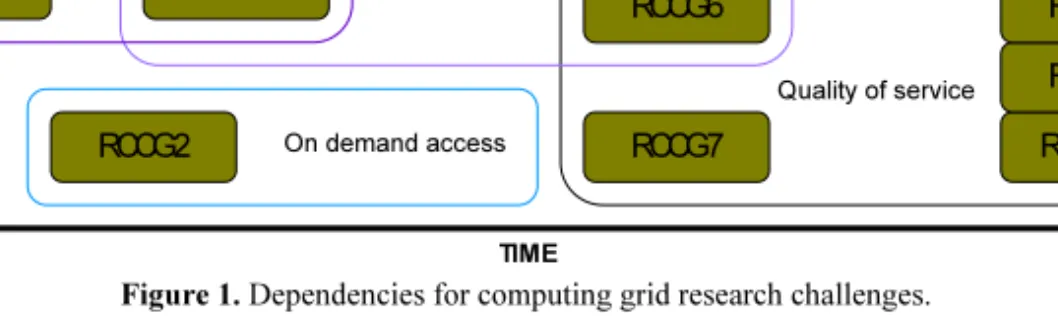
Dependencies for these challenges, grouped by key words, can be seen in Fig. 1.
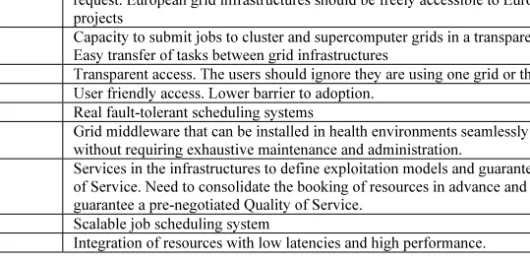
Table 1. Health Research challenges for a computing grid Research
challenge name
Description of the health research challenges
RCCG1 Automatic migration of simulations between different scales and platforms RCCG2 Capacity to access grid resources on demand, without previous agreement or
request. European grid infrastructures should be freely accessible to European projects
RCCG3 Capacity to submit jobs to cluster and supercomputer grids in a transparent way. Easy transfer of tasks between grid infrastructures
RCCG4 Transparent access. The users should ignore they are using one grid or the other RCCG5 User friendly access. Lower barrier to adoption.
RCCG6 Real fault-tolerant scheduling systems
RCCG7 Grid middleware that can be installed in health environments seamlessly and without requiring exhaustive maintenance and administration.
RCCG8 Services in the infrastructures to define exploitation models and guarantee a Quality of Service. Need to consolidate the booking of resources in advance and to guarantee a pre-negotiated Quality of Service.
RCCG9 Scalable job scheduling system
RCCG10 Integration of resources with low latencies and high performance.
Although largely arranged by level of complexity, certain milestones are prerequi-sites for others. For example, for true transparent access to multiple grids and infra-structures (RCCG4) and similarly the transfer of tasks between infrainfra-structures (RCCG3), it will first be necessary to enable on demand access to grid infrastructures without prior agreement (RCCG3).
It should be noted that work towards achieving these milestones is expected to be done in parallel. Although this ideal timeline reflects dependencies (to some extent), it is also the case that the demand for various developments arises from different quarters with plans and development programmes working towards their achievement at differ-ent stages of progress. In any case, we observe that computing grids are at a more ad-vanced stage in their development in general, so that work in progress here may fairly be expected to support and facilitate progress in data grids and, as they emerge, knowl-edge grids.
5.1.2. Health Research Challenges for Data Grids
Table 2 presents the research challenges for a data grid (RCDG). Some of these chal-lenges seem to be common to computing grids like the need for quality of service (RCDG5), including the availability of a robust middleware easy to install in health environments (RCDG4). But these challenges require different skills and content.
On demand access Quality of service User friendliness Interoperability of Infrastructures RCCG10 RCCG9 RCCG8 RCCG7 RCCG6 RCCG4 RCCG5 RCCG1 RCCG3 RCCG2 TIME
Figure 1. Dependencies for computing grid research challenges.
Table 2. Health Research challenges for a data grid Research
challenge name
Description of the health research challenges
RCDG1 Scalable data cataloguing and data transfer.
RCDG2 Storage services designed to ease the upload and download of large binary objects RCDG3 Develop enhanced standards for data protection in a web services environment RCDG4 Grid middleware that can be installed in health environments seamlessly and
without requiring exhaustive maintenance and administration.
RCDG5 Services in the infrastructures to define exploitation models and guarantee a Quality of Service. Need to consolidate the booking of resources in advance and to guarantee a pre-negotiated Quality of Service.
RCDG6 Data architectures and tools that implement private data dissociation, pseudo-anonymisation and encryption, and that are able to fulfil the legal requirements in the matter of data management.
RCDG7 Distributed data models and repositories adapted to the multiscale nature of the data needed and generated by the health community
Some challenges are related to basic data management services which are still to be developed such as scalable data cataloguing and data transfer (RCDG1) as well as upload and download of large binary objects (RCDG2). Further developments include services to provide security in the management of the medical data (RCDG6) related to the adoption of standards (RCDG3).
The need for distributed data models (RCDG6, RCDG7) is also expressed.
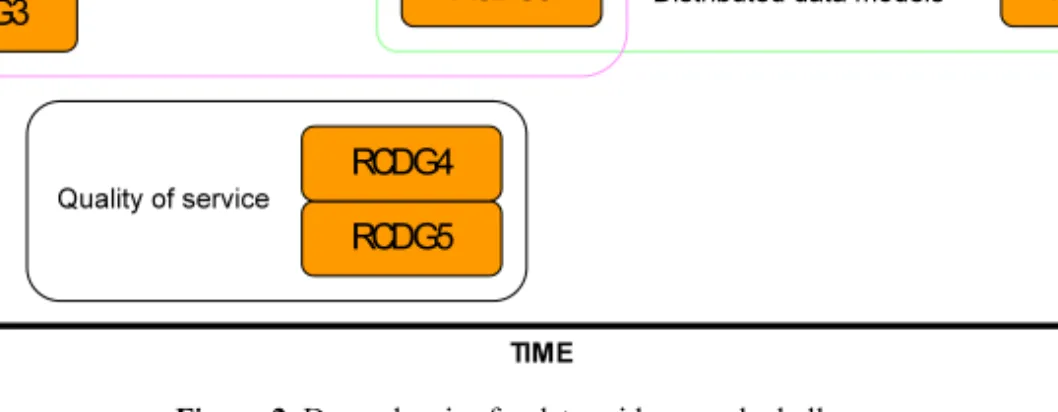
The key words we will keep to characterise the research challenges for data grids are improved distributed data management, quality of service and distributed data models.
The dependency diagram for these milestones, grouped by key words, can be seen in Fig. 2.
It should be noted that quality of service (QoS), a key word for computing grids, is also an important area for data grids. The milestones RCCG7/RCDG4 and RCCG8/ RCDG5 respectively are similar, although there will be differences in the specific re-quirements for QoS between computing and data grids.
Naturally, there is a significant emphasis on the handling of data. Most questions will have already occurred in some guise or other in the field of distributed databases, but they reappear here with force in view of the autonomy of nodes within virtual or-ganisations and especially the critical control that (non-virtual) oror-ganisations in the healthcare and biomedical domains must exercise over their data.
Developments in computing grids are anticipated to support the evolution of data grids, although there is no simple correspondence between the different concerns and drivers in the two paradigms. Indeed, it is important to observe that the principal con-cern of data grids, the management of its transparently distributed data, may be ad-dressed in parallel with the majority of issues in computing grids. This is happening in several quarters in some cases independently of computing grid research and elsewhere in relation to it. Health-related projects dealing with imaging in particular, such as the EPSRC-funded Integrative Biology project [14] and the EC-funded Health-e-Child project [15], have features common to both computing and data grids. These require significant data management facilities for distributed, possibly heterogeneous image data, associated annotations and metadata, but also require computational resources for biomedical modelling and simulations.
Distributed data models
Quality of service
Improved distributed data management
RCDG3 RCDG2 RCDG1 RCDG7 RCDG5 RCDG6 RCDG4 TIME
Figure 2. Dependencies for data grid research challenges.
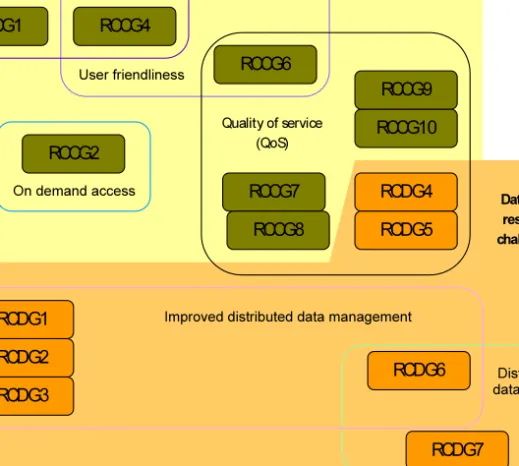
As noted previously, developments in computing grids will support some of the work still necessary in the domain of data grids. Fig. 3 illustrates the overlap between them.
5.1.3. Health Research Challenges for Collaboration Grids
Table 3 below catalogues the principal research challenges for collaboration grids, i.e. for grid services to support collaboration (RCLG). Biomedical research and healthcare are often highly cooperative, multidisciplinary activities, underpinned by informal as well as formal networks. While in some healthgrid projects collaboration has been built into the design from their very conception, in other cases the need for collaboration will arise in the same informal fashion as has arisen in the past. At the same time, many modern influences in medicine (e.g. evidence-based practice) have led to the definition of ‘protocols’ and ‘care pathways’ which may readily be recognised as workflows, thus providing a context for some collaborations. None the less, there is a good deal of scope for knowledge and technology transfer from heavily data-driven branches of e-science, where collaborative workflow engines have begun to be established.
On demand access User friendliness Interoperability of Infrastructures RCCG6 RCCG4 RCCG5 RCCG1 RCCG3 RCCG2 Distributed data models Improved distributed data management
RCDG3 RCDG2 RCDG1 RCDG7 RCDG6 TIME Computing grid research challenges Data grid research challenges RCCG7 RCDG4 Quality of service (QoS) RCCG8 RCDG5 RCCG10 RCCG9
Figure 3. Combined dependency diagram for computing and data grid research challenges.
Table 3. Health Research challenges for a collaboration grid Research
challenge name
Description of the health research challenges
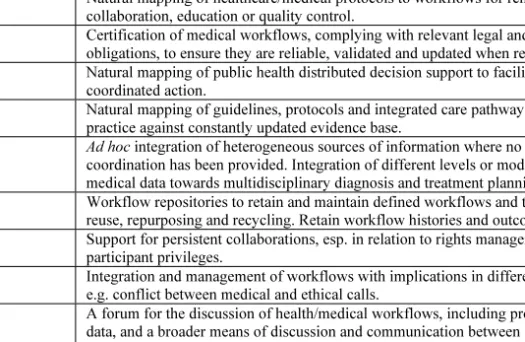
RCLG1 Migration of e-science workflow engines to biomedical research to encompass end-to-end processes, e.g. stages on the road from drug discovery to clinical trial. RCLG2 Natural mapping of healthcare/medical protocols to workflows for remote
collaboration, education or quality control.
RCLG3 Certification of medical workflows, complying with relevant legal and ethical obligations, to ensure they are reliable, validated and updated when required. RCLG4 Natural mapping of public health distributed decision support to facilitate
coordinated action.
RCLG5 Natural mapping of guidelines, protocols and integrated care pathways to validate practice against constantly updated evidence base.
RCLG6 Ad hoc integration of heterogeneous sources of information where no prior coordination has been provided. Integration of different levels or modalities of medical data towards multidisciplinary diagnosis and treatment planning. RCLG7 Workflow repositories to retain and maintain defined workflows and to enhance
reuse, repurposing and recycling. Retain workflow histories and outcomes. RCLG8 Support for persistent collaborations, esp. in relation to rights management and
participant privileges.
RCLG9 Integration and management of workflows with implications in different domains, e.g. conflict between medical and ethical calls.
RCLG10 A forum for the discussion of health/medical workflows, including provenance data, and a broader means of discussion and communication between collaborators.
Issues of collaboration arise in the context of diagnosis by different specialists, second opinion, treatment and surgery planning. Examples would include pipelining second reading or second opinion in breast screening; bringing in additional expertise if appropriate – e.g. staging a cancer; or quality control of the consistency of histopathol-ogy findings, by analysis of reports and checking them against guidelines. Monitoring in the public health domain may be concerned with MRSA-type epidemics or with avian flu or heat wave emergencies. All these call for a different kind of joint action, but all may benefit from decision support. More sophisticated epidemiology may be possible through analysis of associated data, as in the suggestion that avian flu passes more readily among genetically related individuals than among others despite close contact [51]. These suggested requirements would be satisfied through a combination of knowledge management and workflow management tools, linking the two where necessary.
In another dimension of collaboration, the promise of modern biomedicine to re-late genomic data to disease phenotypes, is being explored in such projects as Health-e-Child (HeC) and ACGT [52]. In HeC, there is a need to bring together information not only from different levels but also from different modalities, such as genome and imag-ing data. Thus collaboration here will also mean ability to coordinate different tools and modalities as well as integration of knowledge and data.
Finally, a further development is possible in the context of this discussion, to coor-dinate ‘publication’ of services and certification/licence issues.
5.1.4. Health Research Challenges for Knowledge Grids
Table 4 provides a list of research challenges for knowledge grids (RCKG). These chal-lenges refer repeatedly to data integration and knowledge management.
Workflow management
Medical protocols and guidelines
Coordination and communication
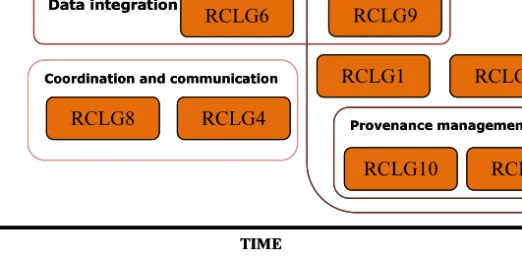
Data integration Provenance management RCLG10 RCLG9 RCLG8 RCLG7 RCLG6 RCLG4 RCLG5 RCLG1 RCLG3 RCLG2 TIME Workflow management
Medical protocols and guidelines
Coordination and communication
Data integration Provenance management RCLG10 RCLG9 RCLG8 RCLG7 RCLG6 RCLG4 RCLG5 RCLG1 RCLG3 RCLG2 TIME TIME
Figure 4. Dependencies for collaboration grid research challenges.
Table 4. Research challenges for a knowledge grid Research
challenge name
Description of the health research challenges
RCKG1 Knowledge-driven grid catalogues and integration based on the metadata. RCKG2 Develop standards and models for exposing web services (semantics), scientific
services, and the properties of data sources, data sets, scientific objects, and data elements
RCKG3 Design standards for and build an expert tool (ontology/schema/rules negotiator) for exposing the properties of local sources in a federated environment
RCKG4 Develop enhanced knowledge representation models and data exchange standards for complex systems, presently largely inconsistent or incomplete, looking for synergies with other initiatives
RCKG5 Develop new, domain-specific ontologies, built on established theoretical foundations and taking into account current initiatives, existing standard data representation models, and reference ontologies
RCKG6 Design standards for and build an expert tool (services/data negotiator) to guide users through the complexities of the data, data models, simulation and modelling tools, etc.
RCKG7 Develop advanced text mining tools for capturing implicit information about complex objects, relationships and processes, as described in patents and literature, beyond and above simple pair-wise relationships between entities
Many of these challenges include the definition of standards and ontologies (RCKG2, RCKG3, RCKG4, RCKG5, RCKG6). Some challenges are directly related to the grid technology itself (RCKG1, RCKG2, RCKG3) while others are more relevant to the research area (RCKG4, RCKG5, RCKG6, RCKG7) and therefore not specific to the grid technology. In that case, it seems the healthgrid should benefit from the knowledge management services once they have been developed by the research com-munity.
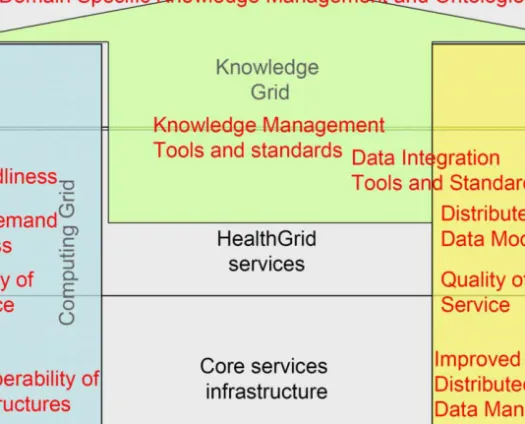
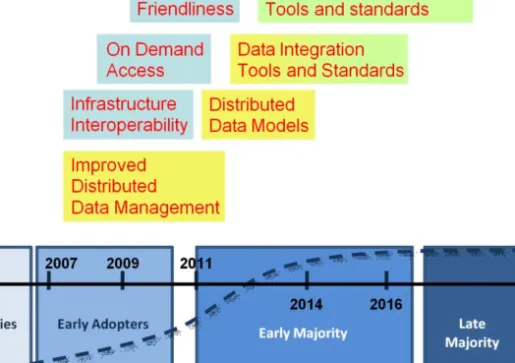
The key words we will keep to characterise the research challenges for a knowl-edge grid are data integration tools and standards as well as knowlknowl-edge management tools and standards. In addition, we will use the concept of domain specific knowledge
management tools and ontologies to characterise the developments which are not spe-cific to grids but are needed to enable a knowledge grid.
The dependency diagram for these milestones, grouped by areas, can be seen in Fig. 5.
While work has been done towards many of these milestones, they remain signifi-cant challenges due to incomplete implementations and immature standards. Many of these challenges are as much in the Artificial Intelligence domain as in grid computing, with issues ranging from ‘knowledge-driven’ resource and service management to on-tologies and meta-onon-tologies for medical knowledge.
5.1.5. Deployment Milestones
Table 5 provides a list of deployment actions which were recommended by the research communities. These actions are perceived as milestones on the road to healthgrid adop-tion as their success will pave the way to the adopadop-tion of the technology.
Some actions are more geared towards computing grids (MD3) some are related to data grids (MD1, MD4) while others require from the beginning knowledge manage-ment (MD2, MD5).
These actions could be started on the existing grid infrastructures in view of the present state of the art of the grid technology. However, the quality of the services as well as their portfolio is expected to improve with the evolution of the technology.
Defining standards and ontologies Research area challenges Grid technology challenges RCKG6 RCKG7 RCKG5 RCKG4 RCKG3 RCKG2 RCKG1 TIME
Figure 5. Dependencies for knowledge grid research challenges.
Table 5. Deployment milestones Deployment
Milestone name
Description of the milestone
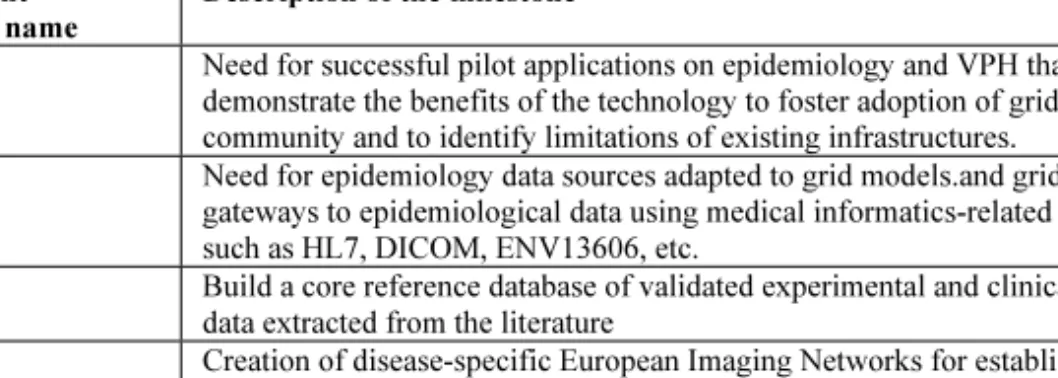
MD1 Need for successful pilot applications on epidemiology and VPH that will demonstrate the benefits of the technology to foster adoption of grids in the community and to identify limitations of existing infrastructures.
MD2 Need for epidemiology data sources adapted to grid models.and grid-enabled gateways to epidemiological data using medical informatics-related connectors, such as HL7, DICOM, ENV13606, etc.
MD3 Build a core reference database of validated experimental and clinical research data extracted from the literature
MD4 Creation of disease-specific European Imaging Networks for establishment of standards, validation of imaging biomarkers and development of regional centres of excellence.