HAL Id: tel-02921530
https://tel.archives-ouvertes.fr/tel-02921530
Submitted on 25 Aug 2020HAL is a multi-disciplinary open access archive for the deposit and dissemination of sci-entific research documents, whether they are pub-lished or not. The documents may come from teaching and research institutions in France or abroad, or from public or private research centers.
L’archive ouverte pluridisciplinaire HAL, est destinée au dépôt et à la diffusion de documents scientifiques de niveau recherche, publiés ou non, émanant des établissements d’enseignement et de recherche français ou étrangers, des laboratoires publics ou privés.
Circular Economy and Reverse Logistics : An End-of-life
Resource Recovery Decision-making Assistant
Yohannes Admassu Alamerew
To cite this version:
Yohannes Admassu Alamerew. Circular Economy and Reverse Logistics : An End-of-life Resource Recovery Decision-making Assistant. Physics and Society [physics.soc-ph]. Université Grenoble Alpes [2020-..], 2020. English. �NNT : 2020GRALI022�. �tel-02921530�
[Type here]
THESIS
To obtain the rank ofDOCTOR OF GRENOBLE ALPES UNIVERSITY
Specialization : Industrial Engineering : Design and ProductionMinisterial decree: 25 May 2016
Presented by
Yohannes Admassu Alamerew
Thesis Director : Daniel Brissaud Prepared within G-SCOP Laboratory in the doctorial school of IMEP-2
Circular Economy and Reverse
Logistics: An End-of-life Resource
Recovery Decision Making Assistant
Thesis publicly defended on June 3, 2020, before the jury composed of :
Mr. Ruud Balkenende
Professor, Delft University of Technology (TU Delft), (Examiner) Mr. Daniel Brissaud
Professor, Univ. Grenoble Alpes, (Thesis Director) Ms. Tatiana Reyes Carrillo
Associate Professor, University of Technology of Troyes, (Reporter) Mr. Bertrand Rose
Professor, University of Strasbourg, (Examiner) Mr. Erik Sundin
Associate Professor, Linköping University, (Reporter) Ms. Peggy Zwolinski
ii
THÈSE
Pour obtenir le grade de
DOCTEUR DE L’UNIVERSITE GRENOBLE ALPES
Spécialité : GI : Génie Industriel : Conception et ProductionArrêté ministériel : 25 Mai 2016
Présentée par
Yohannes Admassu Alamerew
Thèse dirigée par Daniel BRISSAUD Préparée au sein du Laboratoire G-SCOP dans l’École Doctorale IMEP-2
Économie Circulaire et Logistique
Inverse : Assistant
de Prise de Décision
pour la Récupération de Ressources en
Fin de vie
Thèse soutenue publiquement le 3 Juin 2020, devant le jury composé de : Monsieur, Ruud BALKENENDE
Professeur, Delft University of Technology (TU Delft), (Examinateur) Monsieur, Daniel BRISSAUD
Professeur, Univ. Grenoble Alpes, (Directeur de Thèse) Madame, Tatiana REYES CARRILLO
Maître de conférences, Université de technologie de Troyes, (Rapporteur) Monsieur, Bertrand ROSE
Professeur, Université de Strasbourg, (Examinateur) Monsieur, Erik SUNDIN
Professeur, Linköping University, (Rapporteur) Madame, Peggy Zwolinski
iii
Preface
This Ph.D. thesis started in November 2016, at Grenoble Institute of Engineering, as part of the European Circular Economy Innovative Training Network (Circ€uit). The Circ€uit project has received funding from the European Union’s Horizon 2020 research and innovation programme under grant agreement number 721909. The project partners consist of:
iv
Acknowledgements
First, I would like to express my appreciation to members of the Circ€uit project consortium and the European Commission for supporting the research project.
I would like to express my sincere gratitude to my supervisor Professor Daniel Brissaud for his support, guidance, and advice throughout my Ph.D. journey. Thank you so much, Daniel, for not only tutoring me but also supporting me to become an independent researcher. You are cooperative and very responsible indeed.
Many thanks to Peggy Zwolinski, Valerie Rocchi and all members of the G-SCOP laboratory for your encouragement, motivation, lively discussion, and inspiration. Finally, my sincere gratitude to my family and friends for your great support and love which made this possible.
v
Abstract
The Circular Economy (CE) is perceived as one of the main instruments to achieve sustainable development goals (SDGs). Even though companies are showing increasing interest to transform their businesses towards a circular economy model, they are experiencing difficulties due to a lack of tools and indicators to assess circularity strategies and to measure the performance of reverse logistics systems. There are limited studies on the assessment of CE strategies of a product, supply chain, and service at the micro-level. The main objective of this Ph.D. thesis is to propose tools and indicators to evaluate circularity strategies and measure the performance of reverse logistics.
The study begins with identifying decision-making factors and indicators. Afterward, modelling of the reverse logistics system is accomplished to understand the complex interaction among decision variables. Then circular economy assessment tools and indicators have been developed to assist companies in the decision-making process. A case study with multiple companies is performed to examine, validate and demonstrate the applicability of the proposed tools and indicators.
The main contributions of this Ph.D. thesis include:
➢ a taxonomy of decision-making factors and circular economy indicators for reverse logistics, ➢ a system dynamics model to represent the complex system of reverse logistics system in order to
understand the interaction among decision variables,
➢ a circular economy indicator for reverse logistics to measure the performance of products within the reverse logistics system,
➢ a circular economy tool to evaluate the potential environmental and economic benefits of transforming a firm into a circular business,
➢ a circular economy assessment tool to evaluate circularity strategies of end-of-life products, and ➢ a systematic analysis of the interplay among the building blocks of CE including reverse supply
chain, business model, product and service design, product and service use, policy and end-of-life (EoL) recovery in circular economy research.
The findings of this Ph.D. work assist industrial practitioners in decision-making on the management of post-used products. The contributions of this Ph.D. thesis deemed to support the transition towards a more sustainable circular economy.
vi
Résumé
L'économie circulaire (EC) est considérée comme l'une des principales stratégies permettant d'atteindre les objectifs de développement durable (ODD). Cependant, les entreprises rencontrent des difficultés dans la mise en place de l’économie circulaire. Elles doivent faire face à des défis au niveau des modèles économiques, la mise en place d’outils et indicateurs. Ces derniers visent à évaluer les stratégies de circularité et de mesurer les performances des systèmes de logistique inverse. Il existe peu d'études sur l'évaluation de ces stratégies au niveau d'un produit, d'une chaîne d'approvisionnement ou d'un service. L'objectif principal de cette thèse de doctorat consiste à proposer des outils permettant d’évaluer les stratégies de circularité et de mesurer les performances du processus de logistique inverse.
L'étude commence par l'identification des facteurs et des indicateurs de circularité nécessaires pour la prise de décision. Ensuite, la modélisation du système de logistique inverse est réalisée pour comprendre l'interaction complexe entre les variables de décision. Ainsi, outils et des indicateurs d'évaluation de l'économie circulaire ont été mis au point pour aider les entreprises à prendre des décisions. Enfin, une étude de cas avec plusieurs sociétés est réalisée pour examiner, valider et démontrer la pertienence du modèle, des outils et des indicateurs proposés.
Les principales contributions de cette thèse incluent :
➢ une taxonomie des variables décisionnelles et des indicateurs d'économie circulaire pour la logistique inverse,
➢ un modèle de dynamique de systèmes pour tenir compte de la complexité du processus de logistique inverse afin de comprendre l'interaction entre les variables de décision en fin de vie,
➢ un indicateur d'économie circulaire pour la logistique inverse qui mesure la performance des produits dans le système de logistique inverse,
➢ des outils méthode d'évaluation de l'économie circulaire pour évaluer les avantages environnementaux et économiques potentiels de la transformation des activités d'une entreprise vers l’économie circulaire,
➢ un outil d'évaluation de l'économie circulaire pour évaluer les stratégies de circularité des produits en fin de vie, et
➢ une analyse systématique de l'interaction entre diverses disciplines, y compris la chaîne d'approvisionnement inverse et le modèle économique de l’entreprise ; la conception de produits et services ; l’utilisation des produits et services ; les stratégies des processus de traitements de fin de vie dans le domaine de la recherche sur l’économie circulaire.
vii Les résultats de cette thèse aident les industriels à prendre des décisions en matière de gestion des produits après leur phase d’utilisation. Les contributions de cette étude soutiennent la transition vers des stratégies d’économie circulaire plus durables.
viii
This page is left blank intentionally.
ix
Table of Contents
Abbreviations ... xi
List of Figures ... xii
List of Tables ...xiii
1. Introduction ... 1
1.1. Towards building a “New Economy”: The circular economy ... 1
1.2. Motivation and challenges ... 4
1.3. Research questions ... 8
1.4. Research foundations ... 11
1.5. Research approach ... 17
1.6. Structure of the manuscript ... 19
1.6.1. Outline of the thesis ... 19
1.6.2. Summary of publications ... 20
2. Results ... 24
2.1. PART I - Identify: Identifying decision-making factors and indicators ... 24
2.1.1. Introduction ... 25 2.2.2. Literature Review ... 26 2.2.3. Research Methodology ... 29 2.2.4. Result ... 31 2.2.6. Case study ... 38 2.2.7. Conclusion ... 42
2.2. PART II - Model: Modelling of the reverse logistics system ... 44
2.2.1. Introduction ... 45
2.2.2. Literature review ... 47
2.2.3. Methodology ... 52
2.2.4. Results and discussion ... 55
2.2.5. Conclusion ... 67
2.3. PART III - PROPOSE: CE tools and indicators ... 69
2.3.1. Proposition of a circular economy performance indicator for reverse logistics ... 69
2.3.1.1. Introduction ... 70
2.3.1.2. Literature review ... 72
2.3.1.3. Methodology ... 75
2.3.1.4. Results and discussion ... 77
x
2.3.2. A multi-criteria evaluation method of potential product level circularity strategies ... 86
2.3.2.1. Introduction ... 87
2.3.2.2. Literature review ... 89
2.3.2.3. Methodology ... 93
2.3.2.4. Results ... 95
2.3.2.5. Discussion and conclusion ... 103
3. Discussion and Conclusion ... 106
3.1. Main contributions of the Ph.D. thesis ... 106
3.2. Discussion about the structure of the Ph.D. thesis and its contribution ... 108
3.3. Discussion about the results of the Ph.D. thesis and its contribution ... 109
3.4. Discussion on the implications of the Ph.D. thesis to various stakeholders ... 112
3.5. Perspectives and future work ... 113
3.5.1 Limitations and further validation ... 113
3.5.2 Future work ... 114
3.6. Publications ... 115
xi
Abbreviations
CE: Circular Economy
Circ€uit: European Circular Economy Innovative Training Network EMF: Ellen MacArthur Foundation
EoL: End-of-life
EPR: Extended Producer Responsibility EU: European Union
EVBs: Electric Vehicle Batteries
ICoR: International Conference on Remanufacturing LCA: Life Cycle Assessment
LCC: Life Cycle Costing LCE: Life Cycle Engineering LCI: Life Cycle Inventory
LCIA: Life Cycle Impact Assessment OEMs: Original Equipment Manufacturers PRM: Product Recovery Management PRS: Product Recovery Strategy PRO: Product Recovery Options RG: Research Gap
RO: Research Objective RQ: Research Question RL: Reverse Logistics
SDGs: Sustainable Development Goals
SPC: Sustainable Production and Consumption UNEP: United Nations Environmental Programme
xii
List of Figures
Figure 1: How long resources will last ? (New Scientist 2007) ... 1
Figure 2: Circular economy flows (EMF, 2015) ... 2
Figure 3: Benefits of the circular economy (UNCTAD) ... 3
Figure 4: Research gaps, research objectives, and research questions of the Ph.D. thesis ... 9
Figure 5: Life cycle assessment framework ... 12
Figure 6: Forward and reverse logistics (Andrade et al., 2013) ... 13
Figure 7: List of circularity strategies (modified after (Thierry et al., 1995)) ... 15
Figure 8: Main parts of the Ph.D. process ... 17
Figure 9: Research methods used in the study ... 18
Figure 10: Structure of the Ph.D. thesis ... 20
Figure 11: Graphical depiction of the research methodology ... 29
Figure 12: Multicriteria decision tool (MCDT) ... 31
Figure 13: MCDT input ... 32
Figure 14: Interplay between diverse disciplines in the circular economy ... 45
Figure 15: Circularity strategies for retired batteries ... 50
Figure 16: Schematic representation of the methodology ... 52
Figure 17: Proposition of a general model for remanufacturing of spent batteries ... 56
Figure 18: Simulation result for benefit of remanufacturing ... 56
Figure 19: Simulation result of remanufacturing margin ... 57
Figure 20: Simulation result of remanufacturing and new battery price... 57
Figure 21: Dynamics of cost in EVB recovery system ... 59
Figure 22: Dynamics of revenue in EVB recovery ... 61
Figure 23: Dynamics of strategic and regulatory decisions in EVB recovery system ... 62
Figure 24: Interplay among the building blocks of CE research ... 63
Figure 25: Depiction of the interaction between main pillars of CE and circularity strategies ... 64
Figure 26: Integrated supply chain (modified after (Thierry et al., 1995)) ... 71
Figure 27: Depiction of the research methodology employed in this study ... 75
Figure 28: Circular economy indicator for reverse logistics (Excel format) ... 84
Figure 29: List of circularity scenarios (modified after (Thierry et al., 1995)) ... 90
Figure 30: Graphical representation of research methodology ... 94
Figure 31: Depiction of the main steps of the proposed method ... 98
Figure 32: Main steps of the methodology ... 108
xiii
List of Tables
Table 1: Structure of CE practices (Su et al., 2013) ... 4
Table 2: Articles contributed for this Ph.D. thesis ... 22
Table 3: Summary of paper #1 ... 24
Table 4: End-of-life decision making methods ... 27
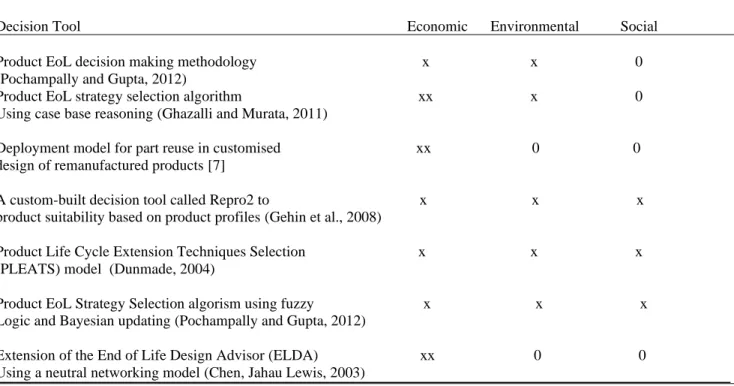
Table 5: EoL decision tools for evaluation of products (after Goodall et al., 2014) ... 28
Table 6: List of reviewer’s positions along with their comments at ICoR 2017 ... 30
Table 7: Definition of product recovery strategies ... 33
Table 8: Categorization of EoL decision making factors... 34
Table 9: List of indicators ... 35
Table 10: Table of evaluations ... 36
Table 11: List of potential product recovery strategies ... 39
Table 12: List of selected indicators ... 39
Table 13: Economic evaluation of EoL strategies ... 40
Table 14: Environmental evaluation of EoL strategies ... 40
Table 15: Social evaluation of EoL strategies ... 41
Table 16: Table of evaluation of EoL strategies ... 41
Table 17: Summary of paper #2 ... 44
Table 18: Definition of transdisciplinary, multidisciplinary and interdisciplinary research (Sakao and Brambila-Macias, 2018) ... 48
Table 19: Summary of companies involved in the case study ... 54
Table 20: Summary of enablers that facilitate circularity of EVBs ... 66
Table 21: Summary of paper #3 ... 69
Table 22: Circular economy indicators at micro level ... 74
Table 23: KPFs for collection in RL ... 77
Table 24: KPFs for inspection and sorting in RL ... 78
Table 26: KPFs for product recovery in RL ... 78
Table 25: Description of product circularity strategies ... 79
Table 27: Guidelines for indicator development (Brown, 2009) ... 80
Table 28: Summary of companies involved in the study ... 82
Table 29: Circularity indicator matrix ... 83
Table 30: Summary of paper #4 ... 86
Table 31: Description of CE evaluation methods ... 92
Table 32: Description of circularity scenarios for case study A ... 99
Table 33: Evaluation of circularity scenarios for company A ... 100
Table 34: Description of circularity scenarios for case study B ... 101
Table 35: Evaluation of circularity scenarios for company B ... 102
xiv
This page is left blank intentionally.
Yohannes A. Alamerew Ph.D. Thesis Page 1
1. Introduction
This chapter introduces the Ph.D. thesis. Section 1.1 presents the concept of circular economy. Section 1.2 explains the motivation that leads to the proposition of this PhD thesis. The research objectives and research questions are formulated in Section 1.3. The research foundation of this research is presented in Section 1.4. Section 1.5 describes the research approach used for this study. The positioning of the thesis and structure of the manuscript is described in Section 1.6 and Section 1.7 respectively.
1.1.
Towards building a “New Economy”: The circular economy
An expanding population coupled with the growing economic growth endangered the consumption of all finite resources on our planet. The world’s population continues to grow at an alarming rate, expected to hit 11 billion in 2100. During the 20th century alone, the world’s population grows dramatically jumping from 1 billion in 1900 to more than 6 billion in 2000 (Haub, 1995). Today, the United Nations Department of Economic and Social Affairs (UN DESA) estimates that the world’s population numbered nearly 7.7 billion in 2019 and is expected to increase further to 8.5 billion in 2030 and 9.7 billion in 2050, and 10.9 billion in 2100 (UN DESA, 2019). As a result of our “throwaway society”, natural resources are being depleted at an accelerating rate (Fig. 1). The demand for resources has quadrupled in the past 50 years and is expected to double the current level by 2050 (Allwood et al., 2011).
Yohannes A. Alamerew Ph.D. Thesis Page 2 Resource and impact decoupling from economic growth is needed to promote sustainable use of available resources (UNEP, 2019). According to (UNEP, 2017) report, roughly €2 trillion would be poured into the global economy every year if resource efficiency was boosted. One potential alternative that could address these problems is the concept of circular economy (CE). CE promotes the reduction of production and consumption levels and recovery of post-used products. A circular economy (CE) is “one that is restorative and regenerative by design, and which aims to keep products, components, and materials at their highest utility and value at all times, distinguishing between technical and biological cycles” (Fig. 2) (EMF, 2015).
Figure 2: Circular economy flows (EMF, 2015)
CE aims to close the flow of resources by keeping products, components, and materials at their highest value through the application of circularity strategies such as repair, remanufacture, recondition, remanufacture and recycling (Bocken et al., 2017). The goal is to retain more of the value of material, energy and labour input that goes into the products to create a system that allows for long life, sharing and resource recovery.
Yohannes A. Alamerew Ph.D. Thesis Page 3 Instead of linear flows of resources through the economy, the circular economy promotes circular flows to reduce environmental impacts and maximize resource efficiency as a strategy for sustainability (Suarez-Eiroa et al., 2019). The application of circular economy principles facilitates the potential to meet sustainable development goals (SDGs) (Korhonen et al., 2018; Saidani et al., 2018). CE mainly aims to meet economic prosperity, while maintaining environmental quality and social equity to create a sustainable world for future generations (Kirchherr et al., 2017). Transforming the production and consumption behaviour based on CE principles is the core to move towards a more sustainable development (Brissaud and Zwolinski, 2017; Di Maio and Rem, 2015). These targets are in line with SDGs, especially with the industrial and innovation aspects of SDG 9, and sustainable production and consumption of SDG 12. The circular economy practices offer everlasting benefits in the form of job creation and reduction of CO2 emissions (Fig. 3).
Figure 3: Benefits of the circular economy (UNCTAD)
Our most spread linear “Take, Produce, Consume and Dispose” economy is no longer sustainable, which waste large amount of embedded materials, energy, and labour. The CE is a new way organizing the relation between markets, customers and natural resources to transform from the old “take-make-dispose” economic model to the one which is regenerative by design to retain more of the value of materials, energy, and labour inputs that goes to products (EMF, 2015). Our vision is that engineering science must tackle circular economy by giving rules for implementation in order to accelerate the transition.
Yohannes A. Alamerew Ph.D. Thesis Page 4
1.2. Motivation and challenges
This section describes the motivation for why it is worth to study this Ph.D. thesis. The first section briefly describes why this Ph.D. study is focused on the application of the CE by describing the main challenges. Then, the main challenges and motivation that initiated this study towards the need for assessment/evaluation tools and indicators are presented.
1.2.1. What are the challenges for the implementation of circular economy?
The concept of circular economy has gained popularity among researchers, business community and policy-makers (Rizos et al., 2016). Companies are increasingly informed of the opportunities promised by CE and have shown significant interest to apply CE practices (EMF, 2015; Geissdoerfer et al., 2017). It is also noted that implementation of CE principles facilitates the goals of sustainable development (Saidani et al., 2018).
Based on the literature on CE theory and policy, there are two main directions to implement CE principles: (i) a systematic economy-wide implementation and (ii) implementation with a focus on a group of sectors, products, materials, and resources (Kalmykova et al., 2018). Systematic economy-wide implementation of CE can be carried out at three levels of intervention: micro (product, company or single consumer level); meso (eco-industrial parks); and macro (cities, provinces, and regions) (Ghisellini et al., 2016; Su et al., 2013). Su et al., (2013), classified the current CE practices into four main areas: product, consumption, waste management and other areas (Table 1).
Table 1: Structure of CE practices (Su et al., 2013)
Micro (single object)
Meso
(symbiosis association)
Macro
(city, province, state) Production area
(primary, secondary, and tertiary industry)
Cleaner production Eco-design Eco-industrial park Eco-agricultural system Network of eco-industrial park
Consumption area Green purchase and consumption
Eco-living park Renting service
Waste management
area
Product/resource recovery
Waste trade market Renewable resources Industrial park
Regional circular industry
Yohannes A. Alamerew Ph.D. Thesis Page 5 The second CE implementation approach targets a group of products, materials, and resources (Kalmykova et al., 2018). The EU embraced an action plan to step up Europe’s transition towards a CE model through measures to “close the loop” of product lifecycles. The action plan identifies five priority sectors along the supply chain including critical raw materials, construction and demolition, food waste, biomass and bio-based materials (European Comission, 2015).
Implementation of circular economy principles has economic, environmental and societal benefits. However, there are several challenges that impede the implementation of CE principles. Some of these challenges are lack of advanced technology, efficient supply chain system, standard performance evaluation system, reliable information, financial resources, technical skills, and poor enforceability of legislation (Rizos et al., 2016; Su et al., 2013).
Technology is one of the key factors that facilitate the successful application of CE principles. The implementation of CE principles requires the development of advanced technologies as well as updating of facilities (incl. equipment change) for recovery of retired products (Su et al., 2013). But the development of technologies and the changing of equipment costs a large amount of money and are time-consuming. On the other hand, Rizos et al., (2016) identified that a lack of technical know-how (gap in employee skills and lack of knowledgeable people) affects the implementation of CE.
CE requires tools and indicators help to assess CE practices at different measurement levels. Various tools and indicators are used due to the diverse areas of application and intervention levels of CE, and distinct characteristics of companies, industries or regions (Su et al., 2013). Heshmati, (2017) noted the different sets of methods, tools and indicators have to be proposed based on the application approaches and heterogeneity of companies, industries, and regions. Furthermore, the lack of effective legislation and support from governmental authorities poses a barrier to the application of circular economy principles (Rizos et al., 2016).
Companies have shown significant interest to engage in reverse logistics activities (Govindan et al., 2015). However, there have been challenges on the implementation, performance analysis and assessment of system change due to limited studies that approached the concept of CE with a focus on reverse logistics at a micro-level.
In a recent article, Govindan and Hasanagic (2018) identified difficulties that impede the application of the circular economy principles in the reverse supply chain activities. Some barriers in organizations include lack of a standardized system for measuring the performance CE in the supply chain; design challenges for recovering EoL products; lack of accurate information for post used products etc. Similarly, Sundin and Dunbäck, (2013) presented the main challenges in the remanufacturing of automotive parts along the
Yohannes A. Alamerew Ph.D. Thesis Page 6 reverse supply chain. This study stressed that companies are mainly concerned with handling, transportation and storing of cores in addition to other challenges.
Another important challenge is the lack of an efficient supply chain system/reverse supply chain system (Rizos et al., 2016). For instance, absence of “green” suppliers for an input that will be used in the production process of products/services. From the demand side, there is a misconception from customers about the quality of product is perceived to be lower than the traditional product.
Moreover, Sangwan (2017) stressed that there is few research on the identification of decision criteria and performance evaluation for reverse logistics. This study identifies decision factors along with the activities of reverse logistics: collection, testing and sorting, and product recovery.
In order to conclude, with this concern, this Ph.D. thesis explores about evaluation of circularity strategies and measuring the performance of reverse logistics in order to support the transition towards the circular economy model.
1.2.2. Why assessment of CE practices in companies/businesses?
Recently, companies are taking significant steps to implement environmental friendly activities that support sustainable development by adopting the circular economy model (Akdoğan and Coşkun, 2012; Elia et al., 2017; Saidani et al., 2017). However, assessment of CE practices is not yet common in businesses (Sassanelli et al., 2019).
Although companies are showing increasing interest to transform their business into a circular economy model, there is limited study on the evaluation of circularity strategies of a product, supply chain, and service at the micro-level (Elia et al., 2017; Geng et al., 2012; Linder et al., 2017). Elia et al., (2017) proposed a reference framework to assist the evaluation phase. The framework has four levels: “the processes to monitor, the actions involved, the requirements to satisfy and the possible application levels of a CE strategy”. Moreover, Elia et al., (2017), stressed that current research on evalution tools and indicators for measuring implementation of circularity scenarios is starting off, especially at the micro-level.
Similarly, Saidani et al., (2018) identified 55 sets of CE indicators and developed a taxonomy in 10 categories. The classification criteria include circularity strategies, levels of CE implementation, performance, degree of transversality, etc. In this study, 20 micro-level indicators are explored. Even though, many of these indicators are still under development and still in the pilot phase (Saidani et al., 2018; Walker et al., 2018).
Yohannes A. Alamerew Ph.D. Thesis Page 7 Due to the lack of measurement tools and indicators, there are few successful examples that demonstrate the performance of CE practices (Asif, 2017). Performance is defined as the achievement of a given task measured with respect to a known standard of accuracy, completeness, cost, and speed. Performance measures help to give a vital sign for a company by quantifying how well the organization achieves a specific goal (Glavan, 2012). In a recent paper by Saidani et al., (2017), a framework to measure the circular economy performance level of a product is proposed based on the analysis of four building blocks of CE. Based on the author’s knowledge, there is hardly any indicator that measures the performance of a reverse supply chain for a typical product. Furthermore, there is a limited study on the assessment and evaluation of product circularity strategies. To fill in this research gap, Saidani et al., (2017), developed a holistic framework to measure product circularity performance. Also, the paper points out that current assessment methods lack systemic vision and operational considerations. Some of these methods assess environmental benefits of circularity strategies Amaya et al., (2010), measure the circularity of a product on material level Ellen MacArthur Foundation and Granta Design, (2015), assess the product/service of a company Evans and Bocken, (2013), and assess the resource duration through an indicator (Franklin-johnson et al., 2016). Companies have faced difficulties to transform their business from a linear into a circular economic model due to lack of tools and indicators to evaluate the performance of CE practices (Saidani et al., 2018). In this regard, several authors suggested the importance to develop effective tools and indicators to support the transition from linear to a circular economy model (Di Maio and Rem, 2015; Elia et al., 2017; Saidani et al., 2018; Sassanelli et al., 2019).
This is, therefore, new tools and indicators are required to support industrial practitioners/decision-makers to measure, evaluate and assess circular economy practices as well as to examine the effects of CE adoption (Elia et al., 2017; Genovese et al., 2017; Saidani et al., 2018; Sangwan, 2017).
The main focus of this Ph.D. thesis is to study CE evaluation methods, tools and indicators to measure, assess and evaluate circular economy practices within the context of product recovery strategies with a focus on remanufacturing and a reverse logistics system at a micro-level.
Considering the aforementioned challenges, the following section identifies the research objective of this manuscript and the resulting research questions which are tackled in this Ph.D. manuscript.
Yohannes A. Alamerew Ph.D. Thesis Page 8
1.3. Research questions
1.3.1. Research gaps and objectives
Based on literature review and expert feedback from academic researchers and industry practitioners, key research problems are identified that led to the proposal of research questions that are investigated in this Ph.D. thesis. In order to tackle the problem effectively, the main research question is divided into three sub-questions.
The main aim of this Ph.D. thesis is to develop an end-of-life decision-making tools and indicators to support companies to evaluate circularity strategies and measure the performance of reverse logistics. Based on the aforementioned research background the following main research question (RQ) is formulated: Main RQ: How to evaluate circularity strategies and measure the performance of reverse logistics? In order to effectively tackle this main research question, this Ph.D. thesis is divided into three main parts (Part #1, Part #2 and Part #3). Each part of the thesis has its own research gap, research objective and research questions to answer the global research question i.e. the main research question formulated the above paragraph. Fig. 4 depicts the research gaps, research questions, and contributions with respect to the main parts/sections of the Ph.D. thesis.
As briefly described at the beginning of this section, the main research question: “How to evaluate circularity strategies and measure the performance of reverse logistics?” has been formulated. To meet the aim this thesis, the main research question is divided into three research questions to systematically solve the main problem at hand. Based on this reasoning, the following three sub research questions are formulated and presented below.
Research question under Part #1 (Section #1)
RQ #1: What are the most important key decision factors and indicators that should be considered in the evaluation of circularity strategies and measurement the performance of reverse logistics?
There is limited research on decision variables (decision factors) and indicators in reverse supply chian in the context of circular economy (Alamerew and Brissaud, 2017; Doyle et al., 2012; Goodall et al., 2014; Saidani et al., 2018; Sangwan, 2017). This RQ aims to identify key decision variables and indicators used to evaluate circularity strategies and performance of reverse logistics. The research will identify decision factors/variables and indicators which are used as input in the evaluation process with respect to the relevant technical, economic, environmental, business and social criteria. Also, the most important factors which are pertinent to consider in the decision-making process are accentuated.
Yohannes A. Alamerew Ph.D. Thesis Page 9
Yohannes A. Alamerew Ph.D. Thesis Page 10 Research question under Part #2 (Section #2)
RQ #2: How to model the complex system of reverse logistics of post-used products to advance in the circular economy?
Regarding the assessment of circular practices in companies, there is a research gap on system analysis of circularity strategies. There is a lack of study that shows the interaction among complex influencing factors in the assessment of circular scenarios (Zhang, 2019). Also, there is a lack of experience in modelling of EoL value chains due to interdependencies, dynamic conditions, innovation etcetera (Brissaud and Zwolinski, 2017; Sakao and Brambila-Macias, 2018; Zhang et al., 2004).
This sub-question aims to model the complex system of reverse logistics of post-used products to understand the interaction among a variety of influencing decision variables. The objective is to model the end-of-life value chains in order to evaluate alternative circularity strategies to choose the appropriate option for a typical product in the end-of-life decision-making process to enable the coming age of the circular economy.
Research question under Part #3 (Section #3)
RQ 3: How to evaluate EoL circularity strategies and measure the performance of reverse logistics for circular economy?
Recently, CE evaluation tools have been developed for managing the transition towards more CE practices (Geng et al., 2013). Assessment of circular practices is crucial to pinpoint areas of improvement in order to move towards a more CE model (Saidani et al., 2017). However, there are limited studies about decision-making tools and indicators to evaluate circularity strategies and measure the performance of reverse logistics for the circular economy (Elia et al., 2017; Geng et al., 2012; Linder et al., 2017; Saidani et al., 2018).
Due to the lack of measurement tools and indicators, there are few successful examples that demonstrate the performance of CE practices (Asif, 2017). New tools, methods and indicators are required to support a company is in making the transition from ‘linear’ to ‘circular’ models (Elia et al., 2017; Genovese et al., 2017; Saidani et al., 2018; Sangwan, 2017). This research question (under part #3) aims to propose tools and indicators to assess circularity strategies and measure the performance of reverse logistics for the circular economy. The former helps to identify the suitable circularity strategy considering product characteristics, end-of-life processes, and business models.
Yohannes A. Alamerew Ph.D. Thesis Page 11
1.4. Research foundations
This section explains the theory of the importance of research initiatives in each of the fields that have been integrated and form the basis of this Ph.D. thesis work. It is the theoretical basis for the research conducted in this thesis. The research areas of life cycle engineering, product recovery management, and reverse logistics are presented in the following sections.
1.4.1. Life cycle engineering
Life cycle engineering (LCE) is a promising approach that comprises a variety of different methods with a consideration of economic, environmental and societal aspects. A broad definition of life cycle engineering is given by (Jeswiet and Szekeres, 2014) as “engineering activities which include the application of technological and scientific principles to manufacturing products with the goal of protecting the environment, conserving resources, encouraging economic progress, keeping in mind social concerns, and the need for sustainability while optimizing the product life cycle and minimizing pollution and waste.” In the life cycle engineering domain, a number of generic tools, methods, and techniques have been proposed to support the decision-making process that can be used at any stage of the product life cycle. Life cycle assessment (LCA), life cycle costing (LCC) are one of the main tools positioned under the roof of LCE that can be applied for life cycle evaluation (Michael et al, 2017; Pecas et al., 2016; Umeda et al., 2012). Life cycle assessment
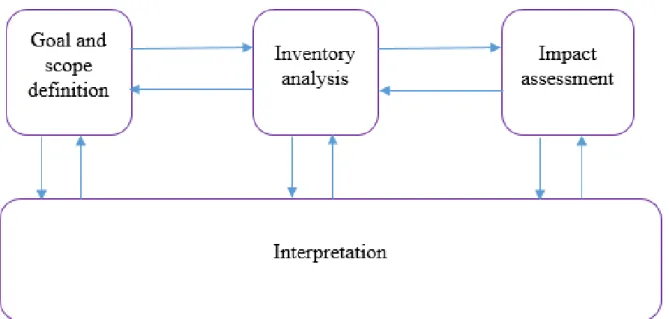
Life cycle assessment (LCA) is a methodology to analyse and evaluate the environmental burdens of a product, process, activity or system by identifying and quantifying the elementary flows across the life cycle of products/services (Jeswiet and Szekeres, 2014). This approach allows for product comparison in the decision-making process. The objective of the method is to identify changes that can lead to effect environmental improvements and overall cost savings. As shown in Fig. 5, LCA process consists of four distinct stages which include: goal and scope definition, life cycle inventory (LCI), life cycle impact assessment (LCIA) and interpretation of results. A short description of the four phases is presented below (Curran, 2006).
➢ Goal and scope definition: This step enable to define and describe the product, process or system and to characterize the boundaries and environmental effects to be examined for the assessment. ➢ Inventory analysis: This phase identifies and quantifies the elementary flow associated with the life
cycle of the product/service
➢ Impact assessment: This step seeks to establish a connection between the product, process or system, and its potential environmental impact.
Yohannes A. Alamerew Ph.D. Thesis Page 12 ➢ Interpretation: This phase attempts to evaluate the life cycle inventory study and impact assessment results in order to select the preferred scenario. Furthermore, the soundness and robustness of the result and assumptions made to generate the results during the evaluation process are evaluated.
Figure 5: Life cycle assessment framework
Life cycle costing
Life cycle costing (LCC) is an approach to assess costs linked with the life cycle of a product/service in order to compare potential alternatives to assist users in the decision-making process. LCC aims at comparing life cycle costs of alternative products, processes or systems and identifying win-win situations once it is combined with LCA and Social-LCA (Lichtenvort et al., 2008).
In general, LCC consists of four main components which include: goal and scope definition, information gathering, interpretation and identification of hotspots and sensitivity analysis and discussion. Even though, during analysis the aforementioned phases can vary from case to case. The results of LCC effectively support the decision-making process if relevant reliable data is available (Gluch and Baumann, 2004; Lichtenvort et al., 2008).
Yohannes A. Alamerew Ph.D. Thesis Page 13
1.4.2. Reverse logistics
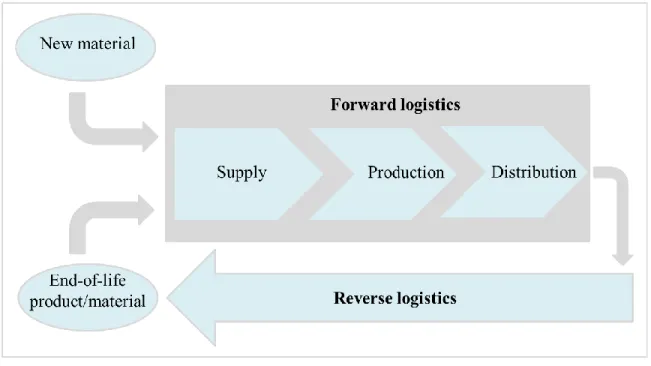
Reverse logistics (RL) is one of the great enablers for sustainable production and consumption (Sangwan, 2017). There is a growing interest in reverse logistics (RL) from scholars and industries due to the increasing environmental problems, future legislation, increased return of post-used products etcetera (Govindan and Soleimani, 2016). According to Rogers and Tibben-Lembke, (1999), “reverse logistics is the process of planning, implementing and controlling the backward flow of raw materials, in-process inventory, packaging and finished goods, from a manufacturing, distribution, or use point, to a point of recovery or point of proper disposal”. Reverse logistics includes three main activities: collection, inspection and sorting, and product recovery and redistribution (Sangwan, 2017). The development of an efficient reverse logistics system is pertinent for the recovery of end-of-life products (Govindan and Soleimani, 2016). The implementation of efficient reverse logistics systems represents as an enabler for an effective transition from a linear to a circular economy model (Ellen MacArthur Foundation and Granta Design, 2015; Gnoni et al., 2018; Lieder and Rashid, 2016). Fig. 6 depicts the forward and reverse supply chain.
Figure 6: Forward and reverse logistics (Andrade et al., 2013) Collection
The collection of post-used products is one of the most crucial parts of reverse logistics. It is the process of retrieving retired products and transporting them to a location where the recovery of products takes place (Pokharel and Mutha, 2009; Sangwan, 2017; Webster and Mitra, 2007). The efficiency of collecting EoL products depends on the collection activity and method of collection. Product collection activity of reverse
Yohannes A. Alamerew Ph.D. Thesis Page 14 logistics could follow a centralized or decentralized system (Webster and Mitra, 2007). This activity may include an incentive to maximize the number of return products. Collection of worn-out products can be performed by the original equipment manufacturers, retailers or third-party logistics providers.
Sorting and testing
To determine the re-usability of a product, collected post-used products are inspected and sorted. Inspection and sorting processes could be performed in centralized and decentralized locations. A centralized facility minimizes the cost of labour and testing equipment (Sangwan, 2017). While decentralized facilities are used for low-cost testing processes such as machine refurbishing (Thierry et al., 1995).
1.4.3. Product recovery management
Product Recovery Management (PRM) is the management of all used and discarded products, components, and materials to recover as much of the economic and ecological value as possible thereby reducing the quantity of discarded waste (Thierry et al., 1995). The implementation of extended producer responsibility (EPR) in new governmental legislation and the growing environmental and economic concern, demand original equipment manufacturers (OEMs) to take care of their products after they have been discarded by the consumer (Hosseinzadeh and Roghanian, 2012). Product recovery management aims to close the loop throughout the product life cycle (Krikke et al., 1998). In recent years, product recovery (product circularity) has become increasingly important in transitioning to a circular economy model (Alamerew and Brissaud, 2017).
Product circularity strategies
An EoL option is considered as a product circularity strategy if it fulfils three main criteria: collection of retired products, reprocessing of a recovered product and redistribution of the processed product (Thierry et al., 1995). End-of-life product circularity strategies include remanufacture, repair, recondition, cannibalization, refurbish and recycle (Jawahir and Bradley, 2016; Thierry et al., 1995). All these end-of-life options are distinct from one another and selecting the best suitable product recovery option should take several factors into consideration (Kumar et al., 2007). According to Stewart and Ijomah, (2011), the selection of product circularity strategies depends on the type of product and the quality level it is returned in. The end-of-life stage in this work refers to the point in time when the product reaches the last stage of existence or at the end of useful life with reference to the first user of the product.
Yohannes A. Alamerew Ph.D. Thesis Page 15 Figure 7: List of circularity strategies (modified after (Thierry et al., 1995))
Repair
Repair is an activity of returning a used product into “working order” (Krikke, 1998) by fixing and replacing specified faults in a product using service parts at the location where the product is being used (Rose, 2000). The quality of repaired products is typically less than the refurbished, reconditioned and remanufactured products. Repaired products issued a warranty less than those of newly manufactured products that cover the whole product or replaced components (King et al., 2006).
Even though repair is the most logical approach to close material loops (King et al., 2006), OEM’s hindered the implementation of the strategy by refusing to sell spare parts to independent repaired shops, failed to provide information on how to repair failed products as well as by remotely deactivating the device when outside party attempts to make a repair in order to gain competitive advantage.
Repurposing
Repurposing is an emergent circularity strategy where discarded products are recovered and used in a new product that has a different purpose and application compared to the original product (Bauer et al., 2017). For instance, repurposed electric vehicle batteries could be reused for different applications such as energy storage for renewables of solar panel and wind farms, residential and public back up power system, distribution grids, and energy storage for the electric heater (Bowler et al., 2015; Richa et al., 2014).
Yohannes A. Alamerew Ph.D. Thesis Page 16 Reconditioning
Reconditioning is the process of rebuilding and replacing failed components of a recovered product resulting in the product being returned to a acceptable working condition which may be less than the original product specification (Ijomah, 2002; Paterson et al., 2017). The resultant product receives a warranty inferior to newly remanufactured product and higher than products that have been repaired. Reconditioning involves greater labour content than repaired products but lower than remanufacturing (King et al., 2006). Refurbishing
Refurbishing involves returning products to a specific quality level, usually less than that of a new product. Compared to refurbished products, reconditioned product has gone through extensive testing and repair than refurbished products.
Remanufacturing
Remanufacturing is an emergent product end-of-life strategy Stewart and Ijomah, (2011) for boosting resource efficiency and achieving the circular economy (Umeda et al., 2017). Remanufacturing is defined as “a process of returning a used product to at least original equipment manufacturer (OEM) performance specification from the customers’ perspective and giving the resultant product a warranty that is at least equal to that of a newly manufactured equivalent” (Ijomah, 2002). Compared to repaired and reconditioned products, remanufacturing involves greater labour content that gives a higher rate of product performance (King et al., 2006).
Cannibalization
Cannibalization is an activity of recovering usable parts of a discarded products and components that can be used for repair, reconditioning and remanufacturing of other return products. In cannibalization, selective disassembly and inspection are accomplished to recover potentially reusable parts while the remaining product component is recycled/landfilled (Krikke, 1998). Compared to the first three product recovery options, cannibalization retrieves only a small proportion of products (Thierry et al., 1995).
Recycling
Recycling is an activity where discarded materials are collected, processed and converted into new raw materials (Jawahir and Bradley, 2016; Paterson et al., 2017). Compared to other product recovery strategies, in the case of recycling the identity and functionality of the original product or component and the energy used to create the pre-recycled product are totally lost (Krikke, 1998). Also, additional energy is needed to transform recovered material into new products (King et al., 2006).
Yohannes A. Alamerew Ph.D. Thesis Page 17
1.5. Research approach
This section describes the proposed research approach of the Ph.D. project. It begins with an overview and description of the main parts of this research. Then a detailed explanation is presented on the research approach formulated and why this approach is chosen for the study.
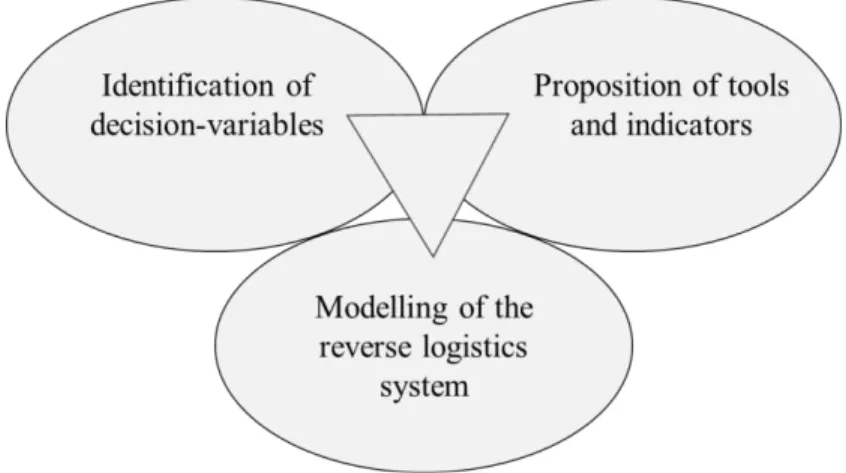
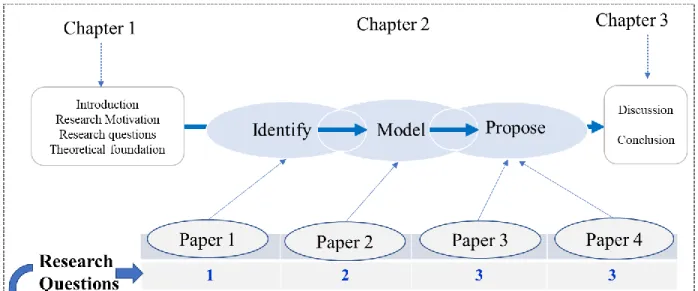
A research process is a stepwise formulation of a set of activities to perform in order to achieve the objective of a researcher in a logical framework. It consists of a series of steps to effectively conduct the research work (Sahu, 2013). The research process started with defining the research area, followed by an in-depth literature review to fully understand the subject area of the study and sharpen (formulate) the research questions. This Ph.D. thesis is framed into three main parts/sections. Fig. 8 shows the main parts of this Ph.D. thesis. First, the identification of decision factors or variables and indicators is accomplished. Then modelling of the reverse logistics system is undertaken. Finally, decision-making tools and indicators are developed. These steps are sometimes iterative to improve the results based on the experience gained during the research period.
Figure 8: Main parts of the Ph.D. process
Due to the nature of the study, in this Ph.D. work, a multi-methodological research approach was chosen in order to tackle the research gaps effectively. Such a multi-methodological approach has been used in various studies. For instance,
➢ Saidani, (2018) in his Ph.D. thesis used a multi-methodological approach from various disciplines such as material flow analysis, life cycle assessment, industrial case studies, multi-criteria optimization, hybrid top-down and bottom-up approach, cognitive mapping and system dynamics to develop indicators and tools applied to the heavy vehicle industry.
Yohannes A. Alamerew Ph.D. Thesis Page 18 ➢ Idjis, (2015) used in his Ph.D. thesis three modelling methods: cognitive mapping, system dynamics, and systems for complex organizational systems’ modelling methods to represent the dynamics of recovery of post-used electric vehicle batteries.
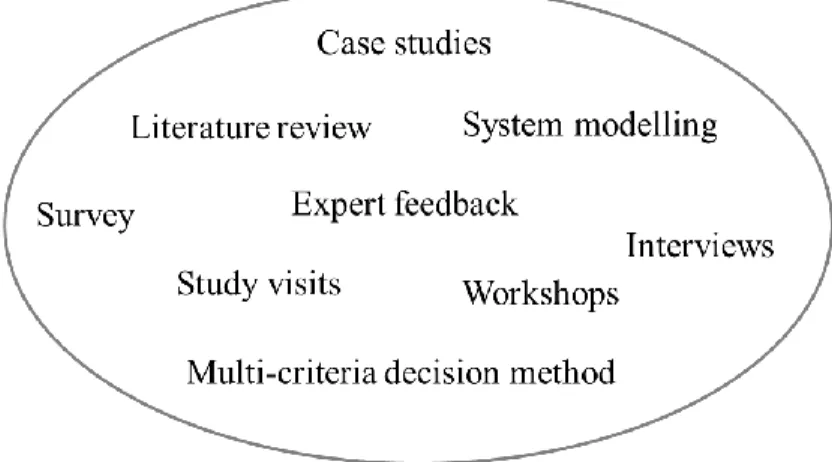
Figure 9: Research methods used in the study
The research methods used in this Ph.D. study (Fig. 9) are listed below:
➢ An in-depth literature review to fully understand the subject area of the study and sharpen (formulate) the research questions,
➢ Study visits to companies to deeply explore the research gaps in the study theme,
➢ A multi-criteria decision methodology to develop tool to evaluate EoL product recovery strategies, ➢ A system dynamic modelling approach to systematically model the complex system of a reverse
logistics system,
➢ An online survey is used to collect data regarding recovery approaches from academia and industrial practitioners, and
➢ A case study approach to validate/test the proposed tools and indicators.
This study applied case studies with various companies to compare the proposed model with current industry practice, and to validate models and tools developed in this Ph.D. thesis. The case study companies are situated in European countries such as France, Sweden, Denmark, and Belgium. A case study method is an in-depth study of a situation especially useful for testing theoretical models, tools and methods by using them in real-world situations to understand specific cases and ensure a more holistic approach to research. By understanding the actual practice in an industry, this study has the potential to assist companies to select a suitable circularity strategy appropriate for the product for their unique position that fits with the company’s product.
Yohannes A. Alamerew Ph.D. Thesis Page 19
1.6. Structure of the manuscript
In the previous sections, an introduction about circular economy and reverse logistics; motivations and challenges that led to this research work; key research questions and research objectives of this thesis; contributions of the present research and theoretical background have been presented. In this section, the overall structure of the Ph.D. thesis is presented including, the outline of the manuscript; summary of articles contributed to the thesis and their connection to the research questions. Fig. 10 depicts the overall structure of this Ph.D. manuscript.
1.6.1. Outline of the thesis
A Ph.D. dissertation could be written in ‘traditional: simple’, ‘traditional: complex’, ‘topic-based’ and ‘compilation of research articles’ formats (Paltridge, 2001). This thesis is written based on a “compilation of research articles” to effectively present the Ph.D. work. The structure of this Ph.D. thesis constitutes introduction and background of the study; a compilation of four research articles; and discussion and conclusion and future research directions.
In this Ph.D. thesis is a compilation of four articles. Each of the research articles have their own introduction, literature review, method, results, discussion and conclusion. Even though the thesis is based on a compilation of publications, a clarification concerning how the articles are interrelated is presented and discussed in this section.
This Ph.D. thesis framed into three main parts: identification of key end-of-life decision variables/factors and indicators; modelling of the reverse logistics system; and development of evaluation tools and circularity-indicator for reverse logistics. This thesis frame is shown in Fig. 10. A brief description of each part is discussed below.
Part #1: To identify key end-of-life decision variables/factors and indicators
This section identifies EoL decision factors from environmental, economic, societal, legislative, technical and business aspects; identifying relevant indicators to measure circularity scenarios and pointing out the EoL decision-making methods. The decision variables/factors and indicators are used as input to the model the reverse logistics system (In part 2) and to develop circularity indicator and assessment tools (In part 3). Part #2: To model the reverse logistics system
In this section modelling of the reverse logistics system is accomplished to understand the interaction among various decision factors. In addition, the interplay among the building blocks of circular economy.
Yohannes A. Alamerew Ph.D. Thesis Page 20 Part #3: To propose circularity strategies evaluation tools and circularity-indicator for reverse logistics In this section development of end-of-life circularity evaluation tools and a circular economy indicator to measure the performance of reverse logistics is presented to aid businesses in decision-making.
Figure 10: Structure of the Ph.D. thesis
1.6.2. Summary of publications
A total of four journal articles and two conference papers have been produced during this Ph.D. project. Table 2 presents a list of articles contributing to this thesis. The following section provides a short description of the four journal articles.
Paper #1: Circular economy assessment tool for end-of-life product recovery strategies
In this article, end-of-life decision-making factors from environmental, economic, societal, legislative, technical and business aspects, and a list of indicators are identified. The study involves experts from academics and the remanufacturing industry. Moreover, an assessment tool for circularity strategies at a strategic level is proposed.
Yohannes A. Alamerew Ph.D. Thesis Page 21
Paper #2: Modelling reverse logistics through systems dynamics for realizing the transition towards
circular economy
In this study, the complex system of reverse logistics is modelled to explore these dynamics using environmental, societal, and economic aspects from a reverse supply chain perspective. A system dynamics (SD) approach is used to model the dynamics of cost, revenue, and strategic and regulatory decisions. In addition, the interplay among the building blocks of circular economy research is discussed. Moreover, the main enablers and challenges for the circularity of electric vehicle batteries are identified. This paper is based on a case study of electric vehicle batteries (EVBs) from 5 companies located in France.
Paper III: Circular economy indicator for reverse logistics: Measuring the performance of reverse supply
chain
In this article, a “Circular Economy Indicator for Reverse Logistics (CEI-RL)” is proposed for measuring the performance of reverse supply chain in a company. CEI-RL aims to assess the performance of reverse logistics with respect to the principles of CE in three dimensions: collection, sorting and testing, and product recovery. This tool is expected to help industrial practitioners to make better and informed decisions about the performance of reverse supply chain in a company.
Paper IV: A multi-criteria evaluation method of potential product level circularity
In this study, a circularity strategy evaluation method is proposed to evaluate potential circularity scenarios of products and, added service in re(manufacturing) firms based on a multi-criteria decision-making approach. The method assesses circularity scenarios including the initial business of the company (traditional business or remanufacturing (reman); advanced reman businesses (target reman businesses, multiple/mixed reuse scenarios plus service offerings) and future reman scenarios. This study involves a case study with companies who would like to transform traditional business models into a circular economy model.
Yohannes A. Alamerew Ph.D. Thesis Page 22
Table 2: Articles contributed for this Ph.D. thesis Thesis
section
Title of the article Type of publication Status
Part 1 Alamerew, Y.A., Brissaud, D., 2018. Circular economy assessment tool for end of life product recovery strategies. J.
Remanufacturing.
Journal article
Journal of Remanufacturing (Paper #1)
Published
Part 1 Alamerew, Y.A., Brissaud, D., 2017. Evaluation of Remanufacturing for Product Recovery : Multi-criteria Decision Tool for End-of-Life Selection Strategy, in: 3rd International Conference on
Remanufacturing. Linköping, Sweden.
Conference paper
International Conference on Remanufacturing
Published Presented
Part 2 Alamerew, Y.A., Brissaud, D., 2020. Modelling Reverse Supply Chain through System Dynamics for Realizing the
Transition towards the Circular Economy: A Case Study on Electric Vehicle Batteries.
Journal article
Journal of Cleaner Production (Paper #2)
Published
Part 2 Alamerew, Y.A., Brissaud, D., 2018. Modelling and Assessment of Product Recovery Strategies through Systems Dynamics, in Procedia CIRP. pp. 822–826.
Conference paper
CIRP Life Cycle Engineering
Published Presented
Part 3 Alamerew, Y.A., Brissaud, D., 2020. Circular Economy Indicator for Reverse Logistics (CEI-RL) : Measuring the Performance of Reverse Logistics in Companies. Journal of Cleaner Production.
Journal article
Journal of Cleaner Production (Paper #3)
In progress!
Part 3 Alamerew Y.A., Kambanou M.L., Sakao T., Brissaud D., 2020. A multi-criteria
evaluation method of potential product level circularity. Journal article Journal of Sustainability (Paper #4) To be Submitted before Ph.D. defence!
Yohannes A. Alamerew Ph.D. Thesis Page 23 This page is left blank intentionally.
Yohannes A. Alamerew Ph.D. Thesis Page 24
2. Results
2.1.
PART I - Identify: Identifying decision-making factors and indicators
In this section the first part of the Ph.D. thesis is presented. Part I identifies a list of indicators and end-of-life decision-making factors from environmental, economic, societal, legislative, technical and business aspects. The results of this research will be used as an input for modelling of the reverse logistics system and proposition of decision-making tools and indicators.
Table 3: Summary of paper #1
Title Circular Economy Assessment Tool for End-of-life Product Recovery Strategies
Published in Alamerew, Y.A., Brissaud, D., 2018. Circular economy assessment tool for end of life product recovery strategies. J. Remanufacturing. Journal of Remanufacturing.
https://doi.org/10.1007/s13243-019-00069-4
Keywords Circular Economy; Remanufacturing; End-of-life strategy; Product recovery; Multi-criteria decision methodology
Abstract Circular Economy (CE) aims to maintain the value of products, components, materials, and resources in the economy for as long as possible. Current end of life (EoL) product circularity decision-making methods are focused on technical and economic factors neglecting other crucial areas such as legislative pressure and customer demand, which are pertinent in the decision-making process. This paper presents a decision-making method to evaluate end of life product circularity alternatives at a strategic level. A Product Recovery Multi-Criteria Decision Tool (PR-MCDT) is proposed to evaluate product circularity strategies from an integrated point of view, i.e. by simultaneously taking into account technical, economic, environmental, business, and societal aspects. The paper also identifies key end of life decision-making factors to assess product recovery strategies. An illustrative example is presented and discussed to show the applicability of the tool for the selection of product recovery options. A PR-MCDT is used at the senior/middle management level to ensure strategic decisions, which then promote the success of the company.
Yohannes A. Alamerew Ph.D. Thesis Page 25
2.1.1. Introduction
The global crisis in resource scarcity, population growth, and climate change impacts are placing pressure to ditch the traditional “Make-Use-Dispose” economic model and adopt “make, use, return” as our collective mantra by joining the circular economy. The circular economy moves away from the traditional “take-make-dispose” economic model to one that is regenerative by design (Fellner et al., 2017). The main aim of the circular economy is considered to meet economic prosperity while maintaining environmental quality and social equity to create a sustainable world for future generations (Kirchherr et al., 2017).
Circular economy aims to facilitate an effective flow of resources, keeping products, components and materials at their highest value at all times through the extension of product life times by repair, recondition and remanufacture as well as closing of resource cycles - through recycling and related strategies (Bocken et al., 2017). Despite being proven to be both economically and environmentally beneficial, there are few successful examples, due to lack of analysis methods and tools that can assess different aspects of circular systems (Asif et al., 2012).
Product recovery has become increasingly important towards transitioning to a circular economy (Alamerew and Brissaud, 2018). Product recovery management aims to close the loop throughout the product life cycle 26. The implementation of extended producer responsibility (EPR) in new governmental legislation, together with the growing environmental and economic concern, demands that original equipment manufacturers (OEMs) to take care of their products after they have been discarded by the consumer (Hosseinzadeh and Roghanian, 2012; Sundin, 2004).
Product recovery management (PRM) is the management of all used and discarded products, components, and materials to recover as much of the economic and ecological value as possible thereby reducing the quantity of discarded waste (Thierry et al., 1995). End of life product recovery strategies include remanufacture, repair, recondition, cannibalization, refurbish and recycle (Jawahir and Bradley, 2016; Thierry et al., 1995). All these end of life options are distinct from one another and selecting the best suitable product recovery option should take several factors into consideration (Kumar et al., 2007). End of life in this work refers to the point in time when the product no longer satisfies the last user.
Current end of life product recovery decision-making approaches are centred on economic and technical factors (Stewart and Ijomah, 2011) neglecting other equally influential aspects which are pertinent in the decision-making process such as market demand, social trends and legislative pressure. Additionally, there is lack of a holistic approach that uses an inclusive methodology to assess and evaluate recovery strategies from an integrated point of view i.e. by taking into account technical, economic, environmental, business