RESEARCH OUTPUTS / RÉSULTATS DE RECHERCHE
Author(s) - Auteur(s) :
Publication date - Date de publication :
Permanent link - Permalien :
Rights / License - Licence de droit d’auteur :
Bibliothèque Universitaire Moretus Plantin
Institutional Repository - Research Portal
Dépôt Institutionnel - Portail de la Recherche
researchportal.unamur.be
University of Namur
The child’s best interests and the right to know his or her origins
Mathieu, Géraldine
Published in:
The best interests of the child
Publication date:
2016
Document Version
Publisher's PDF, also known as Version of record Link to publication
Citation for pulished version (HARVARD):
Mathieu, G 2016, The child’s best interests and the right to know his or her origins. in The best interests of the
child: A dialogue between theory and practice. 2016 edn, Council of Europe, Strasbourg, pp. 130-133, European
conference on the “best interests of the child”. A dialogue between theory and practice., Bruxelles, Belgium, 8/12/14.
General rights
Copyright and moral rights for the publications made accessible in the public portal are retained by the authors and/or other copyright owners and it is a condition of accessing publications that users recognise and abide by the legal requirements associated with these rights. • Users may download and print one copy of any publication from the public portal for the purpose of private study or research. • You may not further distribute the material or use it for any profit-making activity or commercial gain
• You may freely distribute the URL identifying the publication in the public portal ? Take down policy
If you believe that this document breaches copyright please contact us providing details, and we will remove access to the work immediately and investigate your claim.
The best in
ter
ests of the child – A dialogue bet
ween theor
y and pr
ac
tic
e
The best interests
of the child – A dialogue
between theory and practice
Council of E
ur
The best interests
of the child – A dialogue
between theory and practice
The opinions expressed in this work are the responsibility of the author(s) and do not necessarily reflect the official policy of the Council of Europe.
All rights reserved. No part of this publication may be translated, reproduced or transmitted, in any form or by any means, electronic (CD-Rom, Internet, etc.) or mechanical, including photocopying, recording or any information storage or retrieval system, without prior permission in writing from the Directorate of Communication (F-67075 Strasbourg Cedex or [email protected]). Cover and layout: Document and Publications Production Department (SPDP), Council of Europe Cover Photo: Shutterstock Council of Europe Publishing F-67075 Strasbourg Cedex http://book.coe.int Edited by Milka Sormunen © Council of Europe, March 2016
Contents
INTRODUCTION 5 CHAPTER 1 – THE CONCEPT OF THE BEST INTERESTS OF THE CHILD: GENERAL REFLECTIONS 9
Presentation of General Comment No. 14: strengths and limitations,
points of consensus and dissent emerging in its drafting – Jorge Cardona Llorens 11 The concept of the best interests of the child: what does it add
to children’s human rights? – Nigel Cantwell 18 Interpreting and applying the best interests of the child: the main challenges –
Olga Khazova 27
Best interests of the child and the right to be heard – Gerison Lansdown 31 Alpha ursae minoris – The North Star and the child’s best interests
among competing interests – Jacques Fierens 36 Children’s best interests: a discussion of commonly encountered tensions – Eveline van Hooijdonk 40
CHAPTER 2 – ASSESSING, DETERMINING AND MONITORING BEST INTERESTS 45
Determining marginalised children’s best interests through
meaningful participation – Urszula Markowska-Manista 47 How to assess and determine the best interests of the child from a perspective of child development and child-rearing – Margrite Kalverboer 59 The best interests of the child assessment with recently arrived
refugee children – Carla van Os 70 Monitoring best-interests decisions – Can systems developed for monitoring return decisions serve as an inspiration for other domains? – Hanne Op de Beeck 74
CHAPTER 3 – BEST INTERESTS OF THE CHILD IN DIFFERENT ENVIRONMENTS 79
The concept of the child’s best interests in the work of the Council of Europe – Regína Jensdóttir 81 The concept of the best interests of the child in the work
of the European Union – Margaret Tuite 86 The concept of the best interests of the child from the perspective
of a practitioner – Tam Baillie 90 What is the input by children and young people in implementing
their best interests? – Johanna Nyman 93 Ethical pointers and framework for taking decisions in a child’s best interests – The perspective of a children’s ombudsman – Bernard De Vos 96 The best interests of the child and current challenges civil society faces –
CHAPTER 4 – BEST INTERESTS OF THE CHILD IN FAMILY AFFAIRS 103
Jurisprudence of the European Court of Human Rights on the best interests of the child in family affairs – Aida Grgić 105 How can we ensure that the best interests of the child are a primary
consideration in social work? – Cristina Martins 117 The best interests of the child in removal decisions –
A parliamentary perspective – Valeriu Ghileţchi 121 Children’s perspectives concerning imprisonment: setting up a self-expression group of children with imprisoned parents or other relatives – Astrid Hirschelmann 125 The child’s best interests and the right to know his or her origins – Géraldine Mathieu 130 Concluding remarks 134
APPENDICES 137
Appendix I – Speeches presented at the European Conference on the Best interests of the child –
A dialogue between theory and practice (Brussels, 9-10 December 2014) 139 Speech by Koen Geens, Minister of Justice, Belgium 139 Speech by Sven Gatz, Flemish Minister for Culture, Media, Youth and
Brussels Affairs, Belgium 141 Speech by Rudy Demotte, Minister-President of the Wallonia-Brussels Federation Government in charge of Children’s Rights, Belgium 143 Speech by Torbjørn Frøysnes, Ambassador, Head of the Council of Europe
Liaison Office to the European Union 145 Appendix II – Conclusions of the European Conference on the Best Interests of the Child within the framework of the 25th anniversary of the United Nations Convention on the Rights of the Child (Brussels, 9-10 December 2014) 149 Appendix III – Executive summaries of the contributions 154
► Page 5
Introduction
Everyone has heard about it, but we do not actually know what it means – or do we? The concept of the best interests of the child is essential, yet vague and indetermi-nate. It has existed for a long time, but its importance grew when it was included in the United Nations Convention on the Rights of the Child (UNCRC).1 Article 3.1 of the UNCRC states that:
[i]n all actions concerning children, whether undertaken by public or private social welfare institutions, courts of law, administrative authorities or legislative bodies, the best interests of the child shall be a primary consideration.
What does this mean in practice? How should the concept be interpreted and applied? The Belgian authorities and the Council of Europe wished to emphasise the role of the best interests of the child and further develop the normative provisions concerning this concept, specifically the deontological, ethical and procedural rules related to it. The European Conference on the Best Interests of the Child, “a dialogue between theory and practice”, was thus organised within the framework of the Belgian Chairmanship of the Committee of Ministers of the Council of Europe in collaboration with the Council of Europe Children’s Rights Division in Brussels on 9 and 10 December 2014, linking the 25th anniversary of the UNCRC with the Human Rights Day.
The conference was one of the priorities set by the Belgian Chairmanship under the topic “Promotion and realisation of human rights”. The aim of the conference was to shed light on a vague, indeterminate, yet very central concept whose importance for children’s rights is unquestionable. By organising the conference, we wanted to initiate and encourage discussion in order to spread knowledge and enhance understanding of the concept of the child’s best interests.
Clarifying the concept of the best interests of the child and its implementation in practice is important for children’s human rights in general. One of the main chal-lenges related to the best interests of the child is to mobilise decision makers around the concept so that it is genuinely seen as a primary consideration in their daily work. Judges, medical professionals, psychosocial workers, psychologists, educators and other professionals who work with children and youth must have the necessary tools at their disposal to assess and determine the child’s interests. They must also
1. The UN Convention on the Rights of the Child was adopted and opened for signature, ratification and accession by General Assembly Resolution 44/25 of 20 November 1989. It entered into force 2 September 1990, in accordance with Article 49.
The best interests of the child – A dialogue between theory and practice ► Page 6
understand the concept of the child’s best interests in order to make good decisions that respect their human rights.
The conference explored the challenges decision makers face when working to implement the best interests of the child. The target group of the conference included experts, policy makers and practitioners involved in decisions that have an impact on children’s lives, as well as representatives of the major European institutions and non-governmental organisations protecting the rights of the child. Each member state of the Council of Europe was invited to send a delegation of two participants to the conference. For Belgium, as well as for the Council of Europe, it was essential that all partners, experts, decision makers and practitioners, but also children, had the chance to express their views and contribute to the discussion. Organising the conference was a way to bring together a diverse range of actors and combine theory and practice in an effective way.
This publication reflects the main ideas discussed in the conference and sheds light on different aspects of the concept of the best interests of the child. In so doing, it presents 21 texts that all offer their own viewpoint on the concept. Together, these texts provide a comprehensive view of the best interests of the child, wherein the different dimensions of the concept are articulated.
This publication is structured into four chapters discussing the best interest of the child from different points of view.
The first chapter introduces general reflections on the best interests of the child that will help in understanding the regulatory framework surrounding the concept and its application. Jorge Cardona Llorens, member of the UN Committee on the Rights of the Child, discusses the strengths and limitations of the committee’s General Comment No. 14 on the right of the child to have his or her best interests taken as a primary consideration. Nigel Cantwell offers a critical point of view and discusses whether the concept offers added value to children’s human rights. Olga Khazova, also a member of the UN Committee on the Rights of the Child, discusses questions related to the legal framework where the concept applies. Gerison Lansdown anal-yses the connection between the best interests of the child and participation, and Jacques Fierens introduces an idea of the best interests of the child as a guiding light, rather like the North Star. A study by the Children’s Rights Knowledge Centre (KeKi) on children’s best interests is also presented by Eveline van Hooijdonk.
The second chapter focuses on the process of assessing, determining and monitor-ing the best interests of the child. What tools can we use to evaluate, determine and apply the concept of the best interests of the child? How can we involve the child in the process in order to fully respect the requirements of the UNCRC? Urszula Markowska-Manista discusses marginalised children and the legacy of Janusz Korczak. Margrite Kalverboer introduces a model for the best interests of the child as a tool that can be helpful in practical situations, and Carla van Os discusses that model in the context of recently arrived refugee children. Hanne Op de Beeck asks whether systems developed for return decisions could serve as an inspiration when developing other monitoring systems.
Introduction ► Page 7
The third chapter sheds light on the workability of such an indeterminate concept as the best interests of the child, in practice, in different environments. Regína Jensdóttir, Head of the Children’s Rights Division of the Council of Europe discusses the concept of the best interests from the perspective of the Council of Europe. The European Commission Coordinator for the rights of the child, Margaret Tuite, dis-cusses the role of this concept in the work of the European Union, and Tam Baillie, Scotland’s Commissioner for Children and Young People, presents the perspective of an ombudsperson. Johanna Nyman, President of the European Youth Forum, analy-ses the concept from the perspective of young people and their rights. Bernard De Vos, Ombudsman for Children’s Rights of the Federation Wallonia-Brussels, Belgium, discusses conditions for decision making that respects the rights of the child, as well as his past experiences as an ombudsman. Jana Hainsworth, Secretary General of Eurochild, discusses the child’s best interests and challenges to its implementation from the point of view of civil society.
The fourth chapter focuses on the best interests of the child in family affairs, a cen-tral theme of the conference. Aida Grgić, lawyer at the European Court of Human Rights, analyses the best interests of the child in the case law of the European Court of Human Rights related to family affairs. Cristina Martins, President of International Federation of Social Workers Europe (IFSW), discusses best interests in the context of social work, and Valeriu Ghilețchi, Chair of the Social Affairs Committee of the Parliamentary Assembly of the Council of Europe, presents problems that arise when separating children from their families. Astrid Hirschelmann presents research on children whose parents are in prison, and Géraldine Mathieu discusses best interests in the context of the right to know one’s origins.
Finally, the Appendices in this publication offer the full text of the speeches given by three Belgian ministers and the Head of the Council of Europe Liaison Officer to the European Union, followed by the conclusions of the conference, and the Executive summaries of the contributions to the conference.
History has shown that periods of economic, financial, social and environmental crisis do not favour children and youth, or the defence and promotion of their rights. Yet, it is in these times more than any other that children must remain at the heart of decision makers’ concerns. Whether we admit it or not, the concept of the best interests of the child is one of the most central in the field of children’s rights. Whether we like the concept or not, it is an essential provision in a binding international convention and has to be taken into account. If we want to understand children’s rights, we cannot neglect to give particular attention to the concept of the best interests of the child. We hope you find this publication interesting and that it succeeds in continuing the dialogue between theory and practice that shaped the conference in such a fruitful way.
Introduction ► Page 9
Chapter 1
The concept of the best
interests of the child:
general reflections
► Page 11
Presentation of General
Comment No. 14: strengths
and limitations, points
of consensus and dissent
emerging in its drafting
Jorge Cardona Llorens
Professor of Public International Law, University of Valencia,
Member of the Committee on the Rights of the Child
2Writing about the child’s best interests is a comparatively easy task for me because I have already made presentations in numerous conferences pertaining to General Comment No. 14 of the UN Committee on the Rights of the Child. But this time, the challenge is quite different; the purpose of this text is to present current questions and concerns relating to the concept of the child’s best interests and its interpreta-tion by the Committee on the Rights of the Child in General Comment No. 14. In this article, I try to identify the strengths and weaknesses of the General Comment, the points of consensus and dissent which emerged in its drafting, and the difficulties of tangibly fulfilling the child’s best interests in the decision-making process. This is not an easy task, because I must uphold the confidentiality of the delibera-tions in the Committee, and because what I normally try to do is to emphasise the strong points of the General Comment and the benefits of its implementation, not the weak points.
I have decided to concentrate on four questions: firstly the child’s best interests as an indeterminate but not discretionary legal concept, secondly the problems of assess-ing and determinassess-ing children’s best interests in the adoption of general measures, thirdly the relationship between the child’s best interests and the other legitimate interests involved and lastly the consequences of maintaining the threefold legal nature of the child’s best interests as a right, a legal principle and a procedural rule.
2. This text expresses the author’s opinion and not necessarily the opinion of the United Nations Committee on the Rights of the Child.
The best interests of the child – A dialogue between theory and practice ► Page 12
The child’s best interests as an indeterminate but not
discretionary legal concept
Firstly I shall concentrate on the child’s best interests as an indeterminate but not discretionary legal concept. When I joined the Committee in 2011, the chairper-son asked me to choose the working groups to which I wished to belong. I chose three: the working group on the child’s best interests, the working group on state obligations regarding the impact of the business sector on children’s rights and the group on reform of the Committee’s working methods. In principle, the last two were to begin their work in 2011 and the first, on best interests, was in the process of finishing its work.
The chairperson gave me the text which the Committee had already drawn up and asked me my frank opinion. After a first reading, and because frankness had been requested of me, I said that I disliked the text. “Why?” the chairperson enquired. “Because on reading the document I find no criteria for assessing and determining a child’s interest in a given situation,” was my reply. Having heard my answer, the chairperson said to me, “Very well, Jorge. Your opinion coincides with several which we have received in the last few weeks. Since you are the newcomer to the working group, you’ll be the rapporteur for revising the text so that it answers the question you have raised.” What is the basic question? True, the concept of a child’s best interests is adaptable to the situation of each child and to the evolution of knowledge about the child’s development. But, as was emphasised in the General Comment, this flexibility:
may also leave room for manipulation; the concept of the child’s best interests has been abused by Governments and other State authorities to justify racist policies, for exam-ple; by parents to defend their own interests in custody disputes; by professionals who could not be bothered, and who dismiss the assessment of the child’s best interests as irrelevant or unimportant.3
So this was my first besetting concern: the idea of a child’s best interests is indeed an adaptable concept embracing various, constantly evolving questions, an indeter-minate legal concept to be determined case by case. However, it should be clearly established that it is on no account a discretionary concept.
The sentence which I wrote at the top of my blackboard in my office was the following: For the same decision, the assessment and determination of the best interests of five different children should prompt us to make five different determinations (given that no two children are alike in the same circumstances and in the same situation). But the assessment and determination of one child’s best interests made by five adults individually in the adoption of a decision should arrive at the same result.
In other words, although the child’s best interests are an indeterminate legal concept, their assessment and determination should be founded on objective criteria. The concept is intended to ensure both the full and effective realisation of all rights secured by the United Nations Convention on the Rights of the Child (UNCRC), and the child’s overall development. Accordingly, the child’s best interests are not what I consider best for a child but what, objectively, secures for the child both the full and effective realisation
3. Committee on the Rights of the Child, General Comment No. 14 (2013) on the right of the child to have his or her best interests taken as a primary consideration (Article 3.1), paragraph 34.
Presentation of General Comment No. 14 ► Page 13
of all the rights secured in the convention, and his or her overall development. This reasoning explains Part V of the General Comment entitled “Implementation: assessing and determining the child’s best interests”. The Committee was not content just to say that assessment of the child’s best interests should always be a single operation to be performed in each specific case having regard to the circumstances specific to each child, but also tried to show the proper path for this.
That is where the problems begin! What circumstances must be taken into account? Which elements should be considered in assessing them? Which procedural safety nets should be provided for assessing and determining the child’s best interests when decisions concerning him or her are taken?
The General Comment lists the circumstances, elements and safeguards which the Committee has decided to propose to states in every case. But, as explicitly stated in the General Comment, it is a:
non-exhaustive and non-hierarchical list of elements that could be included in a best-in-terests assessment by any decision maker having to determine a child’s best inbest-in-terests. The non-exhaustive nature of the elements in the list implies that it is possible to go beyond those and consider other factors relevant in the specific circumstances of the individual child or group of children. All the elements of the list must be taken into consideration and balanced in light of each situation. The list should provide concrete guidance, yet flexibility.4
Among the elements to be taken into account are the child’s views; the child’s identity; preservation of the family environment and maintaining family relations; the child’s care, protection and safety; situations of vulnerability; the child’s right to health or the child’s right to education. In the Committee’s opinion:
the basic best-interests assessment is a general assessment of all relevant elements of the child’s best interests, the weight of each element depending on the others. … The content of each element will necessarily vary from child to child and from case to case, depending on the type of decision and the concrete circumstances, as will the impor-tance of each element in the overall assessment.5
Concerning balance between these different elements, the Committee has identified three situations to take into account:
a) Firstly, where the various elements taken into consideration for assessing best interests in a given case conflict with the circumstances peculiar to it (for example, concern to preserve the family environment conflicts with the imperative of protect-ing the child from the risk of violence or abuse by parents). That is, balance between the elements, circumstances and factors to be taken into account.
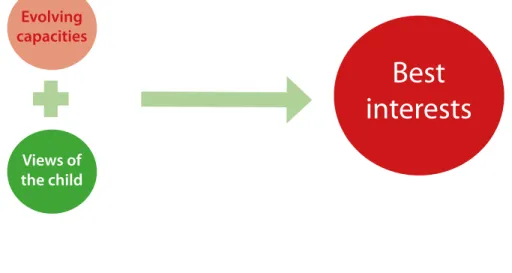
b) Secondly, the problems which arise when factors linked with concern to protect the child (possibly involving limitation or restriction of rights) need to be assessed in relation to measures of “empowerment” (which implies full exercise of rights with-out restriction). That is, balance between the child’s protection and empowerment. c) Thirdly, the connected question of the evolving character of the child’s capacities and the need for decision makers to envisage measures which can be reviewed or adjusted accordingly rather than take final, irreversible decisions. And simultaneously,
4. General Comment No. 14 (2013), paragraph 50. 5. General Comment No. 14 (2013), paragraph 80.
The best interests of the child – A dialogue between theory and practice ► Page 14
the need to assess the continuity and stability of the child’s present and future sit-uation. That is, striking a balance between the child as an evolving subject and the need for the child to enjoy stability.
Balance firstly in selecting the relevant circumstances, elements and safeguards. Balance secondly between protection and empowerment. Balance thirdly in weighing up all the elements taken into consideration.
But I acknowledge that here we might find weak points: has the Committee actually struck these balances? Are the stated criteria sufficient?
Assessing and determining children’s best interests
when general measures are adopted
The second question I wish to address is the relationship between the child’s best interests and children’s best interests (individual and collective best interests): how do we assess and determine the child’s best interests when adopting general measures. The reader will have appreciated that on each occasion I have spoken of assessing and determining a child’s best interests in connection with an individual decision. But Article 3.1 of the convention does not only speak of individual decisions. It sets out to ensure that the right in question is guaranteed in all decisions and actions which concern children. This means that in every decision concerning a child or children, the child’s best interests must be an overriding consideration. The term “decision” is not construed purely as individual decisions but also as all acts, conduct, proposals, services, procedures and other measures. That is why there is question not only of the decisions of administrative bodies or courts, but also of legislative bodies. But if we have said that no two children are alike, that one child’s best interests differ from another’s, how is it possible to assess and determine children’s best interests generally? Moreover, concerning general implementing measures, what should be the procedure for ensuring that the child’s best interests are a primary consider-ation in legislconsider-ation and in the framing and execution of policies at all tiers of public authorities? Clearly we cannot use the same procedure as for an individual decision. The Committee’s final agreement in the matter was that it:
demands a continuous process of child-rights impact assessment (CRIA) to predict the impact of any proposed law, policy or budgetary allocation on children and the enjoy-ment of their rights, and child-rights impact evaluation to evaluate the actual impact of implementation.6
The child-rights impact assessment (CRIA) can predict the impact of any proposed policy, legislation, regulation, budget or other administrative decision which affect children and the enjoyment of their rights and should complement ongoing monitoring and evaluation of the impact of measures on children’s rights. CRIA needs to be built into Government processes at all levels and as early as possible in the development of policy and other general measures in order to ensure good governance for children’s rights.7
6. General Comment No. 14 (2013), paragraph 35. 7. General Comment No. 14 (2013), paragraph 99.
Presentation of General Comment No. 14 ► Page 15
Naturally, the assertion that respect for the child’s best interests in collective deci-sions requires states to make studies of the impact of all their decideci-sions is not readily acceptable for states. However, and this is the second important point, is there another way? And at all events, does the impact study suffice to assess and determine children’s best interests before the adoption of a general measure?
The relationship between the child’s best interests
and the other legitimate interests involved
The third question that I wish to emphasise is the relationship between the child’s best interests and the other legitimate interests involved. There is a danger of con-flict between children’s best interests and the public interests, or the interests of other players. What criteria are to be applied in these situations? Here we come to a question which raised considerable debate in the drafting of the General Comment: the collision of the child’s best interests with other interests.
Firstly it is important to ask whether the child’s best interests should be “a” primary consideration or “the” primary consideration. I do not think it violates the confiden-tiality of the Committee’s proceedings to say that this question was one of the most extensively discussed. Finally, as the General Comment says:
the Committee recognizes the need for a degree of flexibility in its application. The best interests of the child – once assessed and determined – might conflict with other interests or rights (e.g. of other children, the public, parents, etc.). Potential conflicts between the best interests of a child, considered individually, and those of a group of children or children in general have to be resolved on a case-by-case basis, carefully balancing the interests of all parties and finding a suitable compromise. The same must be done if the rights of other persons are in conflict with the child’s best interests. If harmonization is not possible, authorities and decision-makers will have to analyse and weigh the rights of all those concerned, bearing in mind that the right of the child to have his or her best interests taken as a primary consideration means that the child’s interests have high priority and are not just one of several considerations. Therefore, a larger weight must be attached to what serves the child best.8
Of course these are fine words. But having read them, is it now clear how to resolve a conflict between the interest of the child and another interest?
Plainly, some situations are easier than others. For example, in matters of adoption (Article 21), the principle of the child’s best interests is further strengthened; it is not to be simply “a primary consideration”, but “the paramount consideration”. The child’s best interests must indeed be the decisive factor in decisions on adoption, but also in other areas. This is true of Article 9 − separation from parents; Article 10 – family reunification; Article 37.c − separation from adults in detention; and paragraph 2.b.iii of Article 40 – procedural guarantees, notably the parents’ presence at hearings in criminal cases involving children in conflict with the law. In all these cases, the con-vention gives the child’s best interests greater weight than other interests.
The best interests of the child – A dialogue between theory and practice ► Page 16
But there is a large number of other situations not provided for. The Committee has tried to propose certain reflections to settle the conflicts. Allow me to emphasise three of them:
a) Firstly, the child’s best interests must be assessed in all circumstances. As indicated in the General Comment:
The words “shall be” place a strong legal obligation on States and mean that States may not exercise discretion as to whether children’s best interests are to be assessed and ascribed the proper weight as a primary consideration in any action undertaken.9
b) Secondly:
The expression ‘primary consideration’ means that the child’s best interests may not be considered on the same level as all other considerations. This strong position is justified by the special situation of the child: dependency, maturity, legal status and, often, voice-lessness. Children have less possibility than adults to make a strong case for their own interests and those involved in decisions affecting them must be explicitly aware of their interests. If the interests of children are not highlighted, they tend to be overlooked.10
c) Thirdly:
Viewing the best interests of the child as ‘primary’ requires a consciousness about the place that children’s interests must occupy in all actions and a willingness to give priority to those interests in all circumstances, but especially when an action has an undeniable impact on the children concerned.11
In conclusion, where the child’s best interests and other interests involved come into collision, the decision maker must carefully balance the interests of all parties by finding an acceptable compromise. If harmonisation is impossible, the authorities and persons responsible will need to analyse and weigh up the rights of all parties concerned, bearing in mind that the child’s right to have his best interests treated as a primary consideration means that the child’s interests rank high in priority and are not one consideration among others. In spite of everything, I must admit that, regarding this third question, the Committee does not give very exact criteria for adopting the decision. And the question which arises is whether it this even possible.
The consequences of maintaining the threefold legal nature
of the child’s best interests as a right, a legal principle
and a procedural rule
My fourth and last question concerns the legal nature of the child’s best interests. This question is discussed at the beginning of the General Comment which begins by saying that the child’s best interests are a right, a principle and a rule of procedure. This definition is most important. The child’s best interests have traditionally been seen as an interpretative legal principle: if a legal provision lends itself to several interpretations, the one most effectively serving the child’s best interest should be chosen.
9. General Comment No. 14 (2013), paragraph 36. 10. General Comment No. 14 (2013), paragraph 37. 11. General Comment No. 14 (2013), paragraph 40.
Presentation of General Comment No. 14 ► Page 17
But the child’s best interests are not only a legal principle, they are fundamentally a subjective right. The child has the right to have his or her best interests assessed and made a primary consideration when various different interests are examined in order to reach a decision on the question at issue. This right will be applied in all decision making concerning a child, a specified or unspecified group of children or children in general. It is a self-executing right too, so it may be invoked before a court. This question accounts for the last-minute change of title for the General Comment. The title for the General Comment is not “the principle of the child’s best interests”, but “the right of the child to have his or her interests taken as a primary consideration”. However, to be able to demand respect for this right, the holder of the right (or his or her representative) must know what were the factors, elements and circumstances assessed by the decision maker. This logically brings us to the third attribute of the concept of the child’s best interests, as a procedural rule:
Whenever a decision is to be made that will affect a specific child, an identified group of children or children in general, the decision-making process must include an evaluation of the possible impact (positive or negative) of the decision on the child or children concerned. Assessing and determining the best interests of the child require procedural guarantees. Furthermore, the justification of a decision must show that the right has been explicitly taken into account. In this regard, States parties shall explain how the right has been respected in the decision, that is, what has been considered to be in the child’s best interests; what criteria it is based on; and how the child’s interests have been weighed against other considerations, be they broad issues of policy or individual cases.12
As a procedural rule, states are required to establish formal processes with stringent procedural safeguards, intended to assess and determine the child’s best interests in the taking of decisions which concern him or her, including mechanisms for evalu-ating the results. States are bound to develop transparent and objective processes for all decisions made by legislators, judges or administrative authorities, especially in areas which directly affect children.
Accordingly, the Committee invites states and all persons who are in a position to assess and determine the child’s best interests to pay special attention to certain safeguards and guarantees, such as the right of the child to express his or her own views; establishment of facts; time perception; participation of qualified professionals; adequate legal representation for the child; that any decision concerning a child or children be motivated, justified and explained; the existence of mechanisms allowing a decision concerning a child to be challenged or reviewed if it does not appear to have been taken in accordance with the appropriate procedure for assessing and determining the child’s best interests.
This threefold nature (right, principle and procedural rule) is the key for understanding the Committee’s perception of the child’s best interests. In my opinion, this perception is one of the chief contributions made by the General Comment, and its implications will eventually allow a change to be achieved in the paradigm concerning the child contained in the convention – namely that the child should cease to be regarded by the legal system as an object of protection and be regarded as a subject of law in his or her own right, with all the attendant implications.
► Page 18
The concept of the best
interests of the child:
what does it add to
children’s human rights?
Nigel Cantwell
International consultant on child protection policy
The notion of “the best interests of the child” was developed well before the time when children were explicitly granted human rights. Indeed, reference to “best interests” was essentially designed to constitute a standard – albeit a somewhat imprecise one – for decision making on initiatives to be taken in regard to children in the absence of such rights.
Best interests have consequently been invoked in the past in order to justify a wide range of actions. Some of these have been positive, such as Dr Barnardo’s move to replace residential placements by foster care, in late 19th century England already.13 Too many, however, have involved measures that would now be qualified as gross violations of human rights: forced adoptions and forced migration, for example, during several decades in the mid-20th century.14 At the same time, courts of law in many countries have for many years validly relied on “best interests” considerations notably when determining custody and access conditions in situations of parental divorce. This article contends, however, that the prominent role now assigned to “best interests of the child” is mistaken and even dangerous in a context where children have human rights. It argues that the implications of applying the concept in the way foreseen by the United Nations Convention on the Rights of the Child (UNCRC) were not thought through and, notwithstanding General Comment No. 14 of the Committee on the Rights of the Child (hereinafter “the Committee”), have not since been addressed in a sufficiently critical manner. As a result, we are now unwarrantedly duty-bound to take systematic account of a basically paternalistic and charitable notion in the implementation of the human rights of children.
13. See http://www.barnardos.org.uk/barnardo_s_history.pdf. “The history of Barnardo’s”.
14. Detailed examples are given in Cantwell N. (2014), The Best Interests of the Child in Intercountry Adoption, UNICEF Office of Research, Florence, pp. 7-9.
The concept of the best interests of the child: what does it add to children’s human rights? ► Page 19
Best interests in international law
It is first necessary to emphasise the fact that children are the only rights-holders for whom international law foresees consideration of best interests as being essential to realising those rights. The few references to (best) interests in human rights trea-ties only concern children and relate to very specific issues – and this includes the Convention on the Rights of Persons with Disabilities, adopted in 2006 and thus well after the UNCRC, where the notion is studiously avoided save in regard to children. Likewise, the only private international law conventions that mention best interests are those that deal with children’s questions. As for international humanitarian and refugee law, the notion of best interests is quite simply absent from all treaties in these domains.
It is therefore perhaps surprising that so little reflection has been undertaken as to why and how it has been considered unnecessary to ensure that the best interests of rights-holders underpin decision making in regard to the implementation of the human rights of everyone bar children – including particularly vulnerable adults, for example.
Best interests in the UNCRC
The prominent role given to best interests in the UNCRC is, in equal measure, unde-niable and thoroughly intriguing. Objectively, it is in fact quite difficult to explain how Article 3.1 of the UNCRC became phrased in such an all-encompassing manner. To begin with, it is worth noting that the mother of all international texts on children – the 1924 Declaration of the Rights of the Child (Declaration of Geneva) – contains no reference at all to “best interests”.
While the committee’s General comment No. 14 opines that the subsequent 1959 Declaration on the Rights of the Child “enshrined” the concept,15 the text of that declaration in fact mentions it only in two very specific and quite limited contexts. First, best interests of the child are to be “the paramount consideration” in the “enact-ment of laws” enabling the child “to develop physically, “enact-mentally, morally, spiritually and socially” (Principle 2). Second, parents and others responsible for the child’s upbringing are enjoined to take his or her best interests as “the guiding principle” (Principle 7). Since the 1959 Declaration constituted the basis for Poland’s initial proposal for a convention in 1978, this was also the rather restricted perspective (limited to lawmakers and primary caretakers) originally envisaged for the UNCRC. This proposed draft was, however, rejected as a basis for developing the treaty, and Poland submitted a substantially revised version the following year. It was here that, suddenly and without explanation, the scene was set for best interests to take on a vastly enhanced scope in the UNCRC, henceforth encompassing “all actions concerning children, whether undertaken by their parents, guardians, social or state
15. UN Committee on the Rights of the Child, General Comment No. 14 (2013) on the right of the child to have his or her best interests taken as a primary consideration (Article 3.1), paragraph 2.
The best interests of the child – A dialogue between theory and practice ► Page 20
institutions, and in particular by courts of law and administrative authorities” and retaining the status of “the paramount consideration”.16
While this formulation was amended somewhat during the drafting – with, notably, reference to parents and guardians being moved elsewhere, legislators reinstated in the list of actors, and “the paramount” downgraded to “a primary” – the desirability and implications of this major shift in mindset were never discussed. Probably the nearest the drafters got to doing so was in reaction to a last-minute and unsuccess-ful bid by the Venezuelan delegate to provide clearer guidance for interpreting the notion in practice. Hence the all-embracing scope of Article 3.1 with which we are confronted today.
While best interests are, exceptionally, to be “the paramount consideration” in relation to adoption decisions – an issue examined later in this text – this should not mask the fact that they are also similarly the determining criterion in four instances where derogations from specific rights can be envisaged: removing a child from parental care, denying contact with parents, envisaging deprivation of liberty with adults and excluding the presence of parents during judicial proceedings. This special role of best interests as an explicitly foreseen reason for not applying a given right is significant and is taken up again later in this article.
Best interests and the Committee on the Rights of the Child
Once the UNCRC had come into effect in September 1990, the Committee on the Rights of the Child was established and elected, with one of its very first tasks being to draw up the list of issues to be addressed by states parties in their initial reports on implementation. The Committee decided to ask states parties, in the overall context of these reports, to describe their compliance in four spheres that it saw as fundamental, over-arching requirements for implementation: non-discrimination; the right to life, survival and development; the right to be heard; and guarantees that best interests will be a primary consideration in decision making.
The Committee decided to designate these four spheres as being, in its view, “General Principles” of the UNCRC, and thus retaining them as the bedrock of states’ subsequent periodic reports. This designation thus stems from the debates of 10 persons whose focus was on developing a questionnaire for states parties, and who unilaterally decided to elevate “best interests of the child” to that special status.
It can be noted that no other treaty body has ever sought to give such prominence to specific provisions of an international instrument. Despite this, best interests have since been, to all intents and purposes, universally and unquestioningly accepted as a general principle, without adherence to which the treaty’s implementation would be severely compromised or even impossible.
Given in particular its history of misuse and the legacy thereof, the deliberate flexibility of the concept, its unique pertinence to children’s issues in a human rights framework, and the singular importance attached to it by the Committee, it is unfortunate and paradoxical – even though in many ways understandable because of the complexity of
The concept of the best interests of the child: what does it add to children’s human rights? ► Page 21
the issue – that more than 20 years went by before an interpretive General Comment on the implications of applying the “best interests” principle was issued.
However, the Committee’s valiant efforts to settle the conceptual and operational quandaries through its General Comment are uncritical, and faithfully reflect the now sacrosanct stance that best interests are a “fundamental value” of the UNCRC, comprising “a right, a principle and a rule of procedure” to be operationalised on all levels and in all circumstances.
That stance needs to be subjected to in-depth scrutiny, more especially to determine precisely what, and when, the notion of best interests actually contributes significantly to safeguarding the human rights of children. Thus, the Committee’s list of issues to be taken into account when determining the best interests of an individual child is essentially nothing more than a review of the rights implications of various options; indeed, its proposed procedure to ensure that the child’s best interests are a primary consideration in the development of laws and policies is tellingly called a “Child-Rights Impact Assessment”. This surely begs the question as to whether best interests really have to be invoked to justify processes designed to evaluate whether or not human rights are being respected and, if that is by chance the case, why for children alone?
The big test: intercountry adoption
One of the most glaring demonstrations of how the application of best interests is still woefully lacking in guidance – and this to the extent that it can anyway be justified – lies in examination of it being “the paramount consideration” for decisions on adoption, and more especially of its intercountry form. While this may constitute an extreme example of the problem, it is instructive since the various facets involved are by no means unique, in some degree at least, to this particular issue.
When intercountry adoption began in earnest, in the early 1950s, it did so in a legal void – procedurally as well as in terms of substantive standards and human rights – and was solely the result of private initiatives. In that context of an absence of norms, it was invariably justified by those private actors as a humanitarian act responding to the best interests of the children concerned.
Despite successive attempts to regulate the practice, the key role of the private sector in the sphere of intercountry adoption has rarely been contested as such, even though it is unusually significant in terms of the provision of a child protection measure and indeed might itself be open to questioning on best interests grounds. Likewise, and of particular note here, the original reliance on best interests as the most important factor justifying intercountry adoption has simply been reaffirmed without question in all subsequent international texts, including those that establish or take inspiration from the human rights framework.
As a result, we have the intriguing situation – although some might argue that the Committee’s General Comment has adequately responded to this – where interna-tional human rights standards require “the paramount consideration” (that is, the determining factor) in decisions on the adoption of children to be the deliberately vague notion of best interests on which there is no international consensus, rather than demonstrable respect for the rights involved.
The best interests of the child – A dialogue between theory and practice ► Page 22
Flexibility: a challenge for consensus
The lack of international consensus remains remarkable and preoccupying. While, as noted previously, little has been written on the raison d’être of best interests consider-ations in a human rights context, many commentators have in contrast analysed and defended the need for the notion to be flexible in order, notably, to take account of the different socio-cultural contexts in which it is to be applied (although strangely, this barely finds reflection in the General Comment).17
This inevitably presents a special challenge where intercountry adoption and other cross-border issues are concerned. Actors in the socio-cultural context of a country of origin, who in principle bear sole responsibility for determining a child’s best interests, may have a very different view of the latter to the one espoused by actors in receiving countries, whose influence on “adoptability” undeniably holds sway in many instances. This was a point made very strongly at a Pan-African Conference on Intercountry Adoption organised by the Africa Child Policy Forum in 2012.18 Under such circumstances, how is the “paramountcy” of best interests to be assured and proclaimed?
A possibly even more regrettable, and certainly more unfathomable, indication of the absence of consensus lies in the different attitudes taken by receiving countries towards situations in countries of origin where there are clear concerns about the probity of the adoption process, and thus about ability to ensure the primacy of the best interests of the children concerned. Why did only three countries (Ireland, Sweden and the USA) halt adoptions from Vietnam in 2008 because of such concerns? Why, in contrast, did the USA pursue its adoption programme with Guatemala for several years after European countries had withdrawn? Why did the Scandinavian countries and Spain evoke “best interests” concerns to end adoptions from Haiti at the start of this century already, while other European and North American countries were still maintaining that best interests were being systematically respected? The lack of a common baseline – or of the will to impose it – is more than disturbing. It is also Haiti that provides an additional unfortunate example of how, notwith-standing the UNCRC, “best interests” became a pretext for violating children’s human rights. Adoptions from post-earthquake Haiti in 2010 clearly exemplified the fragility of compliance with international standards in disaster situations. Receiving countries spuriously invoked “best interests” to justify circumventing vital established proce-dures designed to protect the rights of the child, resulting in what was tantamount to the unnecessarily expedited evacuation and forced migration of children for the purpose of adoption abroad, some of whom had not even been officially declared “adoptable”, let alone matched and bonded with approved prospective adopters.19
17. It might be said that this is nonetheless alluded to in paragraph 56 concerning the child’s religious and cultural identity.
18. See “Intercountry Adoption: Controversies and Alternatives”, Proceedings of the Fifth International Policy Conference on the African Child, ACPF, Addis Ababa, 29-30 May 2012.
19. See Haiti: “‘Expediting’ intercountry adoptions in the aftermath of a natural disaster… preventing future harm”, International Social Service, 2010, Geneva; World Disasters Report 2012, International Federation of Red Cross and Red Crescent Societies, 2012, Geneva, pp. 68-70.
The concept of the best interests of the child: what does it add to children’s human rights? ► Page 23
There is good cause to believe that the ability to fall back on best interests arguments requiring no real proof and, one dare say, grounded here in emotive paternalism, greatly facilitated these initiatives. They would have been eminently more difficult to justify if the benchmark had rather been fixed simply according to more “tradi-tional” human rights considerations allied with respect for internationally agreed procedures on both adoption and evacuations.
Determining best interests in intercountry adoption:
pitfalls and problems
It is certainly true that carrying out a best interests assessment and determination exercise such as that proposed by the Committee in its General Comment would in principle give both process and substance to decision making, and should help to avoid the more arbitrary interpretations – or manipulations20 – of best interests underpinning reprehensible courses of action. That said, two points have to be raised. First, these exercises require substantial and qualified human resources that would be hard to envisage in many situations. Second, as noted previously, the assessment essentially involves looking at the extent to which a variety of rights are safeguarded (or not) by any given options; there may therefore be a case for simply ensuring, in the first instance, that core rights relating to identity and family ties would not be violated by whatever action is proposed, and that other rights are then protected. In the end, this is not in fact a question of best interests but of fundamental attachment to the promotion and defence of human rights to be enjoyed by all.
There is a further disturbing element when it comes to elevating best interests to “the paramount consideration” in decisions on adoption. The Committee notes in its General Comment that:
In the best-interests assessment, one has to consider that the capacities of the child will evolve. Decision-makers should therefore consider measures that can be revised or adjusted accordingly, instead of making definitive and irreversible decisions.21
This is perfectly reasonable, but of course it does not rhyme with decisions to be made on adoption which are indeed designed to be “definitive and irreversible”. There is no cause at all to take the Committee to task on this issue – it is expressing understandable hesitation as to the longer-term implications of a best interests determination. But it is precisely that hesitation that should spark the question: how, in that light, can best interests possibly be seen as the determining criterion for what is supposed to be a permanent life-changing decision?
When is the notion of best interests counter-productive?
Arguably, then, invoking the notion of best interests is often pointless, sometimes questionable, and even counter-productive in certain situations.
20. In its General Comment No. 14, the Committee itself recognises the opportunities that exist for manipulating the concept (paragraph 34).
The best interests of the child – A dialogue between theory and practice ► Page 24
When the concept of the best interests of the child was being incorporated into human rights law, children still had few recognised human rights – and certainly not a codified set of them. “Best interests” had meanwhile become inextricably associated with children’s issues, precisely because of that state of affairs. The basic tenets of UNCRC Article 3.1 were established already in 1980, well before the then unforeseen panoply of other rights was debated and finalised. It was not reviewed in the light of that comprehensive range of human rights being accepted, and which by that very fact should have made it often irrelevant – and at worst a potentially negative force in some cases – for implementing the UNCRC with a human rights mindset. Moreover, the continued and unwarranted plethora of references to best interests, seemingly required by the UNCRC, actually impedes awareness raising about the fact that children have human rights as opposed to “special” rights, and that these rights can and should be defended on the same basis as those of all other human beings, for whom best interests are simply not a human rights issue.
To illustrate these problems, the following are just three of potentially countless recent examples where it could be argued that best interests have been invoked pointlessly, debatably, or erroneously, and detract from the discourse on human rights as such. First, the International Commission of Jurists (ICJ) has reported a court case in Guatemala where it was “alleged that the State violated through omission the right to food, the rights to life, health, education, and an adequate standard of living and housing, of the children suffering from acute malnutrition in the municipality [in the Department of Zacapa].” While these are clearly and purely issues of human rights (including of the child), the ICJ goes on to note that “the [Court’s legal] analysis focused on the principle of the best interests of the child as a person with full legal responsibility”. The question therefore arises as to why “best interests” would need to be considered or evoked in such an instance.22
Second, the Council of Europe’s Commissioner for Human Rights has very rightly highlighted the fact that “protection of children is sometimes evoked as an argument to block the availability of information about LGBTI people to children”. He continues: There is no evidence that dissemination of information advocating a positive attitude towards LGBTI people would adversely affect children. Rather it is in the best interests of children to be informed about sexuality and gender diversity.23
This comment raises questions, however: how have those best interests been deter-mined and by whom, and why would it be necessary anyway to use that notion as the basis for a judgment on a human rights issue? Surely the same argument could be made equally well on the basis of non-discrimination and UNCRC Article 13 (right to access to information) bearing in mind the restrictions stipulated in that provision. Advancing best interests might therefore be contested as an attempt, in part at least, to nullify limitations to the exercise of that human right as foreseen by the treaty.
22. Cases No. 19003-2011-00638-Of.1a; No. 19003-2011-00639-Of.2a; No. 19003-2011-00637-Of.3a; No. 19003-2011-00641-Of.1 (2013).
23. Council of Europe Commissioner for Human Rights, Human Rights Comment, “LGBTI children have the right to safety and equality”, 2 October 2014.
The concept of the best interests of the child: what does it add to children’s human rights? ► Page 25
Third, the Child Rights International Network carries a report24 that: “Hungary’s Equal Treatment Authority found a school guilty of unlawful discrimination for rejecting the application of a [13-year-old] boy because he was raised by same-sex parents.” The school had “claimed that their decision was in the best interests of the boy to prevent potential bullying”. In this case, best interests had been invoked in order, implicitly, to try to justify non-compliance with the right to education and to protection from non-discrimination. The mere recognition of best interests of the child as a General Principle of the UNCRC surely tends to provoke or promote such responses; while the latter may be successfully combatted after the event in many cases, the overall misleading message sent can be that best interests are on an equal yet different footing to children’s human rights – or even some kind of “super right”.
What are the positive contributions of best interests?
Human rights – including those of children – can invariably be observed and defended quite simply as human rights. There is no a priori assumption that the promotion and protection of human rights in general, individually or collectively, are at risk of being undertaken in ways or for reasons that might be detrimental to the rights-holders concerned or to their interests.
It is therefore difficult to understand why a contrary assumption might be deemed to apply validly to children alone, and this to such an extent that it needs to be explicitly stated – and constantly and actively upheld – that their interests are to be a primary or, in some circumstances, even a paramount consideration.
Yet decision making on the basis of the best interests of the child can undoubtedly contribute to compliance with children’s human rights in specific circumstances. Somewhat paradoxically and albeit in a new context, we need to be returning to a vision of the function of best interests as it was in the era before the UNCRC in order to ensure such a positive contribution.
In essence, that vision is of filling a gap – or gaps – in rights provision rather than underpinning the assurance of all human rights of children. By implication this includes situations where rights considerations alone do not provide sufficient guidance or grounds for decision making. Nowadays a clear human rights framework in which best interests are to be interpreted and operationalised sets a number of boundaries that cannot be lightly crossed: together with a recognised determination process, this should in principle provide some form of guarantee against the kind of unacceptable outcomes that were all too common in the past.
From that standpoint and under those conditions, there are many situations where assessing best interests can be useful, not to say vital. Most have already been acknowledged – including in the Committee’s General Comment – and they comprise decisions involving in particular: choosing between two or more potential solutions that are, a priori, all consistent with the human rights of the child concerned; real or apparent conflict between two or more rights; issues not covered by existing rights; and situations where the interests of other parties might otherwise jeopardise or unduly influence outcomes for the child.
The best interests of the child – A dialogue between theory and practice ► Page 26
Furthermore, best interests can be validly invoked to justify derogation from a given right when the possibility of doing so is already explicitly established in the UNCRC, and notably: removal from parental care/family environment (Articles 9.1 and 20.1); denial of contact with parents (Article 9.3); non-separation from adults in detention (Article 37.c) and prohibition of parental presence during judicial proceedings (Article 40.2.b.iii).
This in itself constitutes a sufficiently challenging list. Our attention should be more especially focused on ensuring appropriate responses in these situations. It is neither justified nor desirable that we feel compelled to consider best interests as expressing “one of the fundamental values of the [UNCRC]”25 that need to be actively assessed and reflected in relation to all rights and situations, regardless of whether or not reference to them meaningfully advances the cause of the human rights of children in those instances.
By way of conclusion
But we cannot turn back the clock. The best interests of the child are now an integral part of human rights law as it applies to children, and we are therefore obliged to deal with this reality. It is undoubtedly helpful that, through its long-awaited General Comment, the Committee has now underlined the need to avoid subjective and arbitrary pronouncements on children’s best interests and thus to set in place an accepted and systematic process to assess and determine those interests.
In so doing, however, the Committee clearly embraced its task by taking the notion and apparent importance of best interests at face value rather than adopting a more critical stance. It therefore lost the opportunity to develop a more nuanced interpretation which could have set best interests determination in a wider human rights context, indicating the limitations on its pertinence therein.
As this article has sought to demonstrate, there are indeed good grounds for broaching “best interests” in a somewhat more circumspect manner than has been the case to date. Those grounds include the genesis and history of the notion itself, the way in which it became incorporated into the UNCRC, the problem of locating it in a human rights framework, its ongoing manipulative usage, and the importance often given to “interests”-based arguments to the detriment of rights-based thrusts. The point is not to deny that the proper determination of best interests has a role in the implementation of the UNCRC, but to ensure that it is called upon to play that role only when necessary, appropriate and feasible as a tool for advancing the human rights of children.
► Page 27
Interpreting and applying
the best interests of the
child: the main challenges
Olga Khazova
Associate Professor at the Institute of State and Law, Russian
Academy of Sciences, Moscow; member of the UN Committee
on the Rights of the Child
This article discusses the main challenges in interpreting and applying the concept of the best interests of the child. I will first present some general considerations, then specific issues related to family cases and finally some procedural issues in the application of this concept in practice. The discussion will be based not only on what was highlighted during the European Conference on the Best Interests of the Child, but also on what we have learned from academic writings, the jurisprudence of the European Court of Human Rights and, of course, from General Comment No. 14 (2013) of the UN Committee on the Rights of the Child on the right of the child to have his or her best interests taken as a primary consideration (Article 3.1). It will hopefully help to define the legal guidelines that would support professionals and policy makers in their everyday work on protection of children’s rights.
The concept of the best interests of the child has been the subject of more academic analysis than any other concept included in the United Nations Convention on the Rights of the Child (UNCRC). It is one of the most important – if not the most import-ant – concepts in the child right’s context. However, it is one of the most difficult concepts to apply in practice. Many distinguished scholars have tried to define it or create a list of factors that are central when defining what is or is not in the best interests of a certain child. But so far, no one has developed with a comprehensive definition that would be workable without exceptions for different purposes and in every situation. Mostly due to this, many academics and practitioners have strongly criticised this concept.
Indeed, the concept is to a certain extent vague and sometimes leads to misunder-standing and confusion. On the other hand, it is due to its vagueness that the concept of the best interests of the child is applicable to very different situations where a child’s interests are at stake. Flexibility comes at a price of vagueness.