RESEARCH OUTPUTS / RÉSULTATS DE RECHERCHE
Author(s) - Auteur(s) :
Publication date - Date de publication :
Permanent link - Permalien :
Rights / License - Licence de droit d’auteur :
Bibliothèque Universitaire Moretus Plantin
Institutional Repository - Research Portal
Dépôt Institutionnel - Portail de la Recherche
researchportal.unamur.be
University of Namur
Chapter 4
Van Bastelaer, Béatrice; Lobet-Maris, Claire
Published in:Europe Appropriates Multimedia.
Publication date:
1999
Document Version
Publisher's PDF, also known as Version of record Link to publication
Citation for pulished version (HARVARD):
Van Bastelaer, B & Lobet-Maris, C 1999, Chapter 4: Development of Multimedia in France. in R WILLIAMS & R SLACK (eds), Europe Appropriates Multimedia.: A Study of the National Uptake of Multimedia in Eight European
Countries and Japan. vol. 42, STS-senter for teknologi og samfunn, Norwegian University of Science and
Technology, Trondheim (Norvège), pp. 123-155.
General rights
Copyright and moral rights for the publications made accessible in the public portal are retained by the authors and/or other copyright owners and it is a condition of accessing publications that users recognise and abide by the legal requirements associated with these rights. • Users may download and print one copy of any publication from the public portal for the purpose of private study or research. • You may not further distribute the material or use it for any profit-making activity or commercial gain
• You may freely distribute the URL identifying the publication in the public portal ?
Take down policy
If you believe that this document breaches copyright please contact us providing details, and we will remove access to the work immediately and investigate your claim.
Multimedia in Denmark
122
Multimedia in France
CHAPTER 4: DEVELOPMENT OF MULTIMEDIA IN FRANCE
Béatrice van Bastelaer in collaboration with Claire Lobet-Maris
The authors want to thank Cédric Curtil, author of ‘La Cartefrançaise des inforoutes' for his useful and relevant help and comments.
Preliminary note: As the French government has changed just when this paper was written, there could be some modifications to its politics regarding multimedia and
the information highways. Even if the new Prime Minister, Lionel Iospin, has
announedinitiatives in that field in August 1997, this seems to early to explain them in details. This text will then maybe changeinthe following weeks or months.
1. Introduction
1.1. Summary Highlights
The development of multimedia in Franceis influenced by the following factors: the presence of Minitel, the economic and political background of the country, the language and the cultural patrimony and the importance of local and regional actors in the development of
multimedia.
|
1.1.1. The Presence of Minitel
With Minitel, France has an important advance in telematics. Minitel is
used in everyday life by almost 23% of the French households. This could have a positive impact on the future development of multimedia applications for different reasons: the presence of telematics in everyday life and the habits of using it, information about services preferred by users, information about the amount users are ready to pay for these
services, existing structuration of information from administrations and
enterprises.
Minitel could also have negative impacts on the development of multimedia in France because most users seem to be happy with the
Multimedia in France
current development of the technology and are not ready to pay morefor the same kind of services on anotherplatform, even a better one.
1.1.2. The Economic and Political Background of the Country
France is an important actor on the European scene. It is quite central geographically speaking but, mainly it is one of the important actors of the European construction. Most important decisions are taken by Germany, France and Great-Britain. France has thus a specific influence on policies developed at the European level.
France has a lot of important industries, either nationalised or
private, in the telecom sector, IT supply sector, broadcasting or audiovisual sector for example. These actors do not only conclude alliances on the national level but also on the European or international levels. The presence of such important actors is a positive fact for the development of multimedia as they have enough resources to initiate multimedia projects.
1.1.3. The Language and the Cultural Patrimony
France has an excessively important installed basis in terms of cultural content. This patrimony could be digitalized and proposed all over the World.
But, contrary to the audiovisual sector, France does not seem to havea specific strategy of defence against English-speaking products in the multimedia field. Language does not seem to be a political stake and if the defence of French is said to be important, concrete effects on multimedia developments are not clear likeit is the case in other French-speaking countries or regions like Québec for instance. France seems to have a reactive attitude rather than a proactive attitude concerning the defence of its culture and language, maybe because French people consider that their patrimony, culture and language are not in danger in the multimediafield. An assumption which is maybe wrong.
1.1.4. Public Initiative
For the development of Minitel, the government has been one of the main initiators through DGT, Direction Generale des
Télécommunications, under the coordination of the Ministry of Industry. It also tries to make a similar initiative for the cable infrastructure (Plan
124
_
j
Multimedia in France:
Cäble) but this has been a failure. However, concerning multimedia
development, the government does not take central initiatives maybe
because the market seems to be mature enough, perhaps because of
funding restriction as in most others countries. Most initiatives are thus taken at the regional or local level with the risk of unequal development
between French regions.
The French government seems to be concretely involved only in
education and culture mainly through the coordination of initiatives. 1.2. National Image of Multimedia
Like in Belgium, multimedia in France seems mainly to mean on-line developments and mostly Internet. CD-Rom, due to the law equipment level of the households, is not really the favourite platform for multimedia developments.
Concerning infrastructure, apart from the traditional telecom networks and the increasing competition on that field with the traditional
operator, France Télécom, and newcomers, the satellite option seems to
gain more and more importance in comparison with the cable possibility. Consequently, multimedia is also perceived as the increasing offer of digital bouquets.
At the level of content, and even if the CD-Rom about the famous museum, Le Louvre, is a best-seller, the fabulous French patrimony is
very little exploited with the risk of being used - and sold - by foreign companies.
Multimedia in France Multimedia in France
Usually, France has a tradition of centralisation of all decisions and initiatives. Since 1982 and mostly since 1992, departments and
regions are taking more and more autonomy concerning economic
development, mainly through pragmatic actions adapted to local or regional needs. But most important decisions are still taken on a 2.1. Geographical Situation
|
|| 2. National Context ||
|Table 1: Geographical and Geo-Political Indicators
i 5
Size (km2)
Population (mio) = Population Density (94)sn. Dos Regional dialects
uistic divisions .
Cultural and ling Nationalist moves
Cent
Editions la Découverte, Paris.
France is the biggest country of the European Union with 547 026 km2 and almost 60 millions of citizens with a relatively low population density (a bit higher than 100 inhabitants per km2). it is centrally locate, at the heart of Europe and welcomes ‘the other European capita Strasbourg. France also has overseas departments like the Frenc Guyana, Martinique, Guadeloupe, Réunion and the West Indies. oral
There is one official language, French, even if there are regiona
dialects (Breton, Catalan, Corsican, Occitan, Basque, mneen
but not very much developed, except in some of these regions, like Corsica or the Basque country, which also suffer from quite violent
nationalist moves.
2.2. Political Background
tion |
coursi a parliamentary democracy coupled with a presidential power (Jacques Chirac, from the RPR (1), a right-wing party, succeeded to François Mitterand, from the socialist party, in May 1995).
France is divided into regions (22) and departments 96
metropolitan and 5 overseas). Departments are _divided | into
arrondissements, cantons and communes, the smallest territorial division.
At the regional level, the power is exerted by the regional council (Conseil Régional) and its president. At the level of the department, it is the general council (Conseil General) and at the commune level, it is the town or local council and the mayor (Conseil municipal). All these councils are elected by universal suffrage.
126
centralised way.
2.2.1. Politics and Multimedia
According to Cédric Curtil, author of ‘La carte française des inforoutes', telematics in France is a mature market and the national government has no major role to play anymore for the development of such market. That is the reason why most initiatives in multimedia and information highwaysare takenat a decentralised level (regionalorlocal).
This is also probably due to the recurrent problem of public
funding and tothe fact that there are few public funding availableforthis
kind of investment. The budget and the public initiatives are thus decentralised and depend onthe financial capacity and political will of
the town, the district, the departmentor the region.
But it does not mean that the government does not consider multimedia and information highwaysas priority. In fact, after having
asked for two general studies on the subject (2), it has defined some
basic principles and meansthat are sometimes implemented by specific laws.
These basic principles are:
e ‘rely on the market and on investment capabilities ofall the economic
actors;
° give to the State, through applications of public interests (health, training, research, …) a leading role to initialise market development; e sustain the development of services and help the diffusion of their usage and ofinfrastructure;
e facilitate SME's access to these services’(3).
In order to reach these objectives, the State defines different means:
e ‘to launch in Autumn 94 a callforproposals to stimulate the market, e to develop new services and contents;
© to incite an optimaluse of existing networks taking into account the importantdelaysfor the developmentofhigh speed networks;
° to participate actively in projects at the Commission level and at an internationallevel;
® to organise meetings, forums and thematic workshops’ (4).
| Multimedia in France
|
|
Multimedia in France
2.3. Economic and Technological Background
|
| 8 would be ears with the support of partnerships between local
| ;
au ti j ?
Table 2: Economic and Technological Indicators
or: ies and industry’.
.
- In consequence and according to the Miléo Report (1996), it seems that the level of equipment of the French households is about to
See Tacieators increase quite a lot and could maybe reach a quart
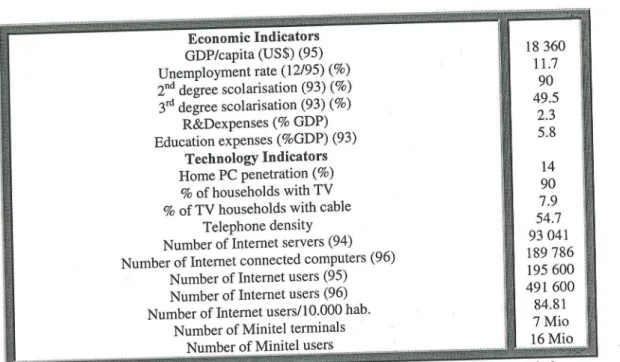
GDP/capita (US$) (95) nu in theyear 2000. nn
Unemploymentrate (12/95) (%) 11.7
2" degree scolarisation (93) (%) 49.590
| 3" degree scolarisation (93) (%)R&Dexpenses (% GDP) 23 2.3.2. The Presence of Minitel
|
Education expenses (%GDP) (93)
5.8
|
Technology se
id
When lookingat the equipmentlevel of French households and firms in
| nz en 5> a the telematic domain, one cannot forget the importance of Minitel
|
% of TV ronseholdswith cable
7.9
development (7 millions of terminal, 16 millions of users, 23% of the
|
Telephone density
54.7
households (6)) whic h has a specific influence on the development of
É NumberofInternet servers (94) 93 041 multimedia applications in France. This is still difficult to know if this
| Number of Internet connected computers (96) 189 786 influence will be positive or negative but it remains clear
that the
À Numberof Internet users (95) 195 600 important installed basis of the Minitel is a critical factor in this
| Number of Internet users (96) 491 600 development.
|
|
NomenfnprARS
eeusers
ENG
ie
The first one, according to Laurent Gille, a French telecom and ICT
It is possible to find at least four positive effects ofthis situation
| 2 : = consultant, is the fact that French individuals and firms are used to
| Source: L'Etat du Monde 1997- annuaire économique et géopolitique mondial,
employ telematics in the everydaylife, at home and at i
| Editions La Découverte, Paris - ITU World Telecom Report 95 - KPMG Reportfor services as shown by exhibit 1 Minitel is part of hei if Or acn of
ISPO - IDATE - Miléo Report. . Sa
eir life. For Cédric
7 Curtil (1996), the second positive aspect is that service providers do have
|| quite good information about most preferred services and this may help
| at Hoenn Whones Pi yawetiation the design and the supply of new multimedia services, perhaps for
31. Information Highways. Studies about Minitel use also reveal the
maximum amount that users are ready to put in these kinds of services | In France, the equipment level of PCs in households is quite small
The:
(almost 100 FF/month (Curtil (1996), p. 92)). Endly, concerning public
|
|
|(around 14%). These 14% mostly concerned old equipments not
‘ . a :informati
ation,N
eda
dedicated to multimedia applications. The penetration level for
order to rations have already structured their information in
multimedia equipmentis even smaller (estimated between 1.5 and 4%).
Web En i A ous be very easy for them to putit on the
But those last years, multimedia PCs are available in retail distribution
Ministries
ple as it begins to be the case, in fact for a lot of
(Carrefour, Mammouth, Leclerc, etc.) for a low price and this may have
a positive effect on households equipmentlevel but there is no existing
| survey measuring the impactof this offer. |
| Specific measures have been taken to boost firms PC equipment | like the 2-year amortization term for this kind of investmentin stead of 5
| years, a measure which, according to GII (press release, 16/02/96) (5),
could cr eate a second market for households.
| Moreover, according to ISPO (1997b), the French government
| said it would launch before the summer of 1997 a plan to increase the number ofPCs in French schools and to connect them to the Internet. It
|
128
Multimedia in France
in 1994 Exhibit 1: Type ofservice
The "11", the Electronic Directory Banking services Transport Mail Order Meteo Spectacles Tourism Administration Announces Education Professional Databases Professional Mail Stock Exchange Internal Applications Sport General Information Radio and TV Games/Astrology Social Action Press Information on Products Anonymous Mail
om France Télécom, Bilan Minitel de l'année 94.
negative aspects related to the presence of Minitel cethe mid 50 in mot French households and firms. ser to Curtil (1996), most Minitel users are happy with the techn = a developed now. Indeed, most Minitel terminals are still in ach an white and not very user-friendly. The speed is really low (1200 ps in
one sense, 75 in the other (Curtil, 1996, P- 98))! France som is
currently developing new Minitel services with new possibilities: ° on terminal, possibility to put a credit card and to pay directly, … But 1 seems quite clear that most French Minitel users are not ready to En more fortheir current use ofthis technology but will maybe be happy to
nology at the same price.
ve arearemoreond more providers of an Internet access fromthe Minitel and vice-versa. French providers, like France Télécom and the
Wanadoo service, have taken into account this matter of fact andpropose
offers appropriated to the situation but which successis still difficult to
assess.
130
Multimedia in France
2.3.3. Cable versus Satellite
Maybe dueto the extent of the territory and ofthe difficulty to cable the entire country, cable is not well developed in France (only 7.9% of households which have a TV set). There have beentrials to develop the cable infrastructure, mainly the Plan Cäble program of the government
but this failed for different reasons (Arlandis, Laubenheimer, 1996).
According to Cédric Curtil (7), other reasons may explain this low rate: The creation of Canal+ at the same time as the cable offer (Plan Câble) but at a more affordable price and for a better offer (more recent movies
etc.)
Anyway, this low penetration rate could be an important incentive for the development of satellite offer. Indeed, there are currently three
satellite offers in France (see 3.3. ): Canal Satellite, TPS and AB Sat.
According to Guy Dutheil (1996a), this seems to be a unique case in Europe. Guy Dutheil (1996b) quotes a recent study from INSEE and CSA emphasising the complementarity of cable and satellite mainly in function of the level of revenue of the households and the place where they live. It seems indeed that satellite will have more chance to be adopted in rural areas andin cities with less than 100.000 inhabitants and
in low revenue households. But at the present time (end of 1996) and
still according to the INSEE-CSAstudy,the diffusion of cable as well as satellite is still very limited: 7.3% for the cable and 5.3% for the satellite.
However, some households have the two equipments and there will
maybe have special initiatives, like Cybercdble which will combine
satellite and cable possibilities (Cousteau, Vincent and Luques, 1996).
2.3.4. Internet Use
According to the Miléo Report (1996, p. 178), the number of French people connected to Internet from their office, from home or from cybercafés has considerably increased between 1995 (195 600 Internet subscriptions) and 1996 (491 600 subscriptions, i.e. a growth rate of more than 150%)andthis will most probably continue.
A sign of this increasing interest for Internet could also be seen in the numberof magazines dedicatedto the subject, on the press as well as
on TV. |
Multimedia in France
3. Key Players in Multimedia
3.1. Map of Key Multimedia Players
The following sections introduce the actors present in differentSectors. However, most of these actors do appear in different domains: “| ze m media IT supply sectoretc. It seemsthat, in France like mtÜ iways the i ustrialised World, multimeriali imedia and Informationati Highw
domnated by some big companies (France Télécom, Havas on
Alcatel, Lagardère Groupe, ...) with the risk of the control o ae ne
different sectors by only a small numberof actors. It appears me ier a
d for diversity, except may
ittle place left for small actors anc | nayb :
Tenet area. But, concerning this market, in France like in one
countries, it is maybe too early to predict if all these new 2 ;
eines very small and with limited technical er jn persistonths
lot of moves during the
In general, there have been a : st m
of 96 in Éfferent sectors (IT, telecom, broadcast, sale, neae
i -CGE, Canal+ or France
for example with Thomson, Havas > | a
the following months will probably provide new information concerning i ia in France.
he development of multimedia in | |
| To summarise, the main multimedia players in France are the following:
e IT Supply Sector: Alcatel Alsthom, Thomsonagent ii Espacebi > | t Media, Audiovisual and Sate lite: ca
Co(COE and Havas), TF1, France Télévision, AB Productions
Telecommunications: France Télécom, CGE, Bouygues Télécom, SNCF, Lagardère Groupe, Matra communication
e Press, Edition and Publicity: Havas, Matra-Hachette .
Electronic Commerce: Club de l'Arche, Globe Online (Compagni
Bancaire and LVMH), AFCEE,3 Suisses, La Redoute
i : 1 ire, Paribas
e Banking Sector: Compagnie Bancaire,
Education and Research: RENATER, CNED, Computer tend
The government in some sectors (culture, education) and local or
regional authorities | | |
The strategies and activities of these actors will be described in detail in the following points
132
Multimedia in France
3.2. IT Supply Sector
Alcatel-Alsthom is an important industrial actor in France. It has developed the telephone network but also a lot of other thingslike travel boats or the high-speed train (TGV) (Curtil, 1996). Through Alcatel Telecoms and its subsidiaries (Alcatel CIT, Alcatel Network System, Alcatel Cäble), Alcatel-Alsthom is not only important on the French scene but is number one on the world-wide area (Le Coeur, 1996), mainly because ofallits technical competencies. Alcatel is also present in other European markets, in Belgium for instance.
Until 1995, Alcatel-Alsthom also had a multimedia department, Generale Occidentale with activities in the edition sector, the
distribution and the press (Curtil, 1996). In 1995, Generale Occidentale
has been bought by Havas, an important French company against 21% shares in Havas' capital.
Thomson, constituted by Thomson CSF (military and professional
electronics) and Thomson MultiMedia (TMM) which provides
electronics products to the general public, is another important actor of this sector.
Thomson MultiMedia, which has a turnover of FF 36.5 billions, is
present on the market of TV (42% of its business - leader of the US
market), telephony (13% - number 2 on the US market), components (15%), digital decoder (8% - world-wide leader for satellite decoders),
video tape recorder and camcorder (15% - leader of the US market for
the video tape recorder) (Nexon, 1996).
This ‘SME patchwork’ (Nexon, 1996) with different brands (RCA, Thomson, Brandt, Telefunken, Saba) but no leader brand, is currently mainly owned by the State (76%) and by France Télécom (20%).
These last months, there has been a lot of move around Thomson with the government will to privatise this Company. But Thomson has a
debt of almost 14 milliards of FF (Nexon, 1996) and its market shares, in
the TV area for example, are decreasing since some years from 13% in 92 to 9.8% in 96 while the major competitors (Sony, Philips) are increasing (Nexon, 1996). However, several companies were interested by the purchase of Thomson MultiMedia amongst which French companies, mainly Alcatel-Alsthom and Lagardére Groupe (Matra)
associated to the Corean Daewoo. In October 96, the government
announced its preference for the Matra-Daewoo's proposal. Lagardère Groupe through Matra was interested by Thomson CSF while Daewoo would take up the activities of TMM. This decision created a chorus of
Protests mainly due to the low evaluation of the company value, to the
fact that this high-tech company will be sold to a foreign society (outside France but also outside Europe) and to other problems. The French
Multimedia in France
ivatisation committee then decided in December 96 to freeze the Processand to launch a new procedure in 1997 for TMM and Thomson CSF. For this new process, Lagardère (and Matra) seems to be the government favourite for Thomson CSF while at the present time,
nothing is clear for TMM (according to Jean-Paul Cadoret (1996),
Toshiba, Compaq, Sagem and Bouygues may be interested). in If all this process full of uncertainties ends up rapidly and wit several restructuring, Thomson MM could have an important 1mpact on different sectors, mainly on the satellite sector through the provision of
igi ers.
uv important actor is Sagem, leader on the market of fax
machine. It also producesdigital decoders, especially for Canal+, and is mainly doing research on telephones and visiophones. According © Curtil (1996), Sagem could be an important actor for the equipment of the future information highways through its subsidiary, SAT (Société Anonyme de Télécommunications), active on the transmission fee Sagem is a very healthy company (Curtil, 1996) and owns a radio and a magazine butits ambitions concerning its expansion In the media sector
ear.
u andre Groupe is another important actor on the IT supply sector but also on other domains, mainly transport, media, military areas,
through different subsidiaries. Matra communication, an alliance with
the Swedish Ericsson, is specialised in terminals and private networks.
Nortel Matra Cellular, subsidiary of the Canadian Nortel, ex-Northern
Telecom (66%), is providingturnkey mobile networks, for France Télécom or Bouygues Télécom for example. Lagardère Groupe is one of the company interested by Thomson but mainly by the military subsidiary, Thomson CSF. Endly, Lagardére Groupe, through Hachette
is an importantactorin the edition field (see 3.5.2.). 3.3. Broadcast Media, Audiovisual andSatellite
The broadcast media sector in Franceis characterised by one state owned company, France Télévision with two different channels (France 2 and France 3) and by some private companies, the biggest one being TFI owned by Bouygues, the building company, also present on the telecom and the movie sectors. There are also pay-TVs and a cable offer with thematic channels (Canal Jimmy, MCM,Eurosport).
Onthefield of multimedia, the most important actor is Canal+, a subsidiary of Havas and Compagnie Générale des Eaux (CGE), the utilities, property and communications group, also present in the telecom
134
Multimedia in France
sector. However,the involvement of CGE in Canal+ could change due to the new alliance between Havas and CGE(see below).
Canal+ whichexists since 84is the first private pay TV channelin France. It has several subsidiaries in other European countries (Spain, Belgium, .). The French pay TV channel, counts 3.5 millions of subscribers in 10 years (Breton, 1994). It has a direction for new technologies, is an important movie producer and proposes a digital bouquet since Spring 96 (CanalSatellite), together with Pathé, the movie
company (20%) and the Générale des Eaux (10%) (Cousteau, Vincent
and Luques, 1996,p. 58).
In December 96, Canal+ signed a merger agreement with Nethold but this agreementwill only be effective in March 97. Nethold, number 3 of the European pay TV, is a Swiss/South-African company, subsidiary of Richemont group and MIH group. With this merger, Canal+ will be present in 14 countries. Canal+/Nethold will then be the leader of pay
TV in Europe.
In fact, Canal+ is also present in Premiere (37.5%), the German
pay TV channel, in partnership with Kirch and Bertelsmann. However, the French TV channel maysell these parts to Kirch against parts in Telepiù in Italy (L'Echo, 1996) in which Nethold also have parts and on which Canal+/Nethold will have the control. Moreover, Canal+ has partnership with Kirch in DF1, the digital platform of Kirch and Murdoch.
Face to this Canal+/Nethold alliance and collaboration with Kirch,
Bertelsmann announced its alliance with CLT (Compagnie Luxembourgeoise de Télévision) through its subsidiary UFA. As shown in exhibit 2 which presents the share ownership of the CLT/UFA alliance, the situation of the satellite and digital offer in Europeis very difficult to apprehend with the cross-participationsofall the actors.
TF1, the first French and even European TV channel, owned by
Bouygues, launched another digital bouquet, TPS, Télévision par Satellite, competitor of CanalSatellite. Other partners of TPS are CLT
(20%), M6 whichis anotherprivate channel (20%), France Télécom, the
national telecom operator and France Télévision, the public TV channel (25%) and the Lyonnaise des Eaux (10%). The bouquet proposes three offers: TPS Thématique (12 channels for the family), TPS Cinéma with 3
movie channels and Tout TPS which adds the twofirst offers (8).
Thereis a third satellite offer and as already explained, this seems to be unique in Europe. AB Sat, owned by the TV programs, mostly sitcoms, producer, AB Productions, has chosen to propose a large and cheap offer but with very few new programs (Cousteau, Vincent and Luques, 1996,p. 67).
Exhibit 2: Share Ownership ofCLT/UFA
Multimedia in France
- se a
GBL: Groupe Bruxelles Lambert, CLMM: Compagnie Luxembourgeoise de MultiMedia
Source: Le Soir, 7-8 décembre 1996, p. 6
al bouquets, CanalSatellite, TPS and AB Sat,
i it is then difficult to assess their have been launched quite recently and \ 5 Sering 96, already Behr
t success. CanalSatellite, launche
200.000 subscribers at the end of TCntsensonpave
i do ousteau,
these 200.000 subscribers at the en aae
1Satellite offer is more expensiv
Luques, 1996, p. 58). The Cana satel 5 ° ses i ll prefer high quality prog
two others but, like for Canal+, it wi r hi ne
ivi i 1Satellite is the high-revenue lusivity. The target public of Cana
WhileABSat and TPS will targetthe low and middle-class revenues. A If we consider the satellite infrastructure, Alcatel ape " Alcatel subsidiary, announced its ambitious piven of aoon
ite i i hat will be laun .
bal satellite infrastructure, Skybridge,t aul
Een initiative will compete with already existing US systems
(ISPO, 1997b).
These three digit
3.4. Telecommunications
France Telecom is the 4th largest World telecom operator ie 1997). Despite its monopoly status,it has always been a quite innovati
136
Multimedia in France
and efficient firm comparing to other national telecom operators in Europe. Almost 90% of France Télécom's customers seem to be satisfied with the services offered by the operator (Curtil, 1994, p. 202). With the
alliance with Deutsche Telecom (Atlas) then with the US Sprint (Global One) and in other countries (9), Franc e Telecom positions itself as one
of the most important telecom actors on the European scene.
France Télécom has been oneinitiator of Minitel, one of the most successful videotex applications created in thelate 70's and which counts today almost 7 millions of terminal and 16 millions of users. One of the reasons of this success, despite the importance ofthe state intervention, is the tarification with the ‘kiosk' system where the user only pays once to France Télécom which distributes the profits to the service provider after removalof its own part and of somefix costs. Sincethe diffusion of Internet in France, France Télécom is improving the Minitel offer through new terminals or through the Wanadoo service which makes possible to access Minitel through Internet.
France Télécom operates the first mobile network in France
(Itineris), has opened a multimedia section since July 96 (France Telecom Multimedia - FT2M), owns 26% of the cable marketin France
(Arlandis, Laubenheimer, 1996), participates in numeric bouquets (TPS) and concludes partnerships with program and content editors or with thematic TV programs. Endly, France Telecom participates in 31 of the 244 projects of Information Highways experimentations in France (see
3.6.4.).
In June 96 , the French Parliament has voted a law modifying the status of the national operator which will turn into a incorporated company and will allow private shareholders to acquire 49% of its capital.
The Compagnie Générale des Eaux (CGE), the utilities, property
and communications group, will probably become the second largest operator in France. This company is a cable-operator through CGV,it is already providing the second mobile telephone network (SFR) and with its telecom subsidiary company Cégétel, it would become one of the most important competitor of France Télécom after 98. Indeed, CGE has
been allied to Unisource, the international telecom consortium in Siris
until 96 and Cégétel has now concluded a strategic alliance with British
Telecom (25% of the stakes), the German Mannesmann (10%) and SBC,
a Baby Bell. Moreover, CGE is also present in the audio-visual sector through almost 23% in GBL (see exhibit 2) and more than 20% in Canal+ (but this could change due to the new alliance between Havas and CGE -see below). CGEis also interested by SFP (Société Frangaise de Production) which is the main TV operator in France . Recently, CGE
has conclude an alliance with Havas, with which it already collaborates
Multimedia in France
in Canal+, for the creation of a big French multimedia pole (ISPO,
1997a). Due to its different activities in the multimedia field and to the recent alliances, CGE could become one of the most important
competitors of France Télécom in the following months and years. The third mobile network is operated by Bouygues Télécom. Bouygues is a well-known and important building company which already acts in the audiovisual sector with TF1, the first private French TV channel and Ciby 2000, a movie production company. Bouygues Télécom has also created a multimedia department and has concluded a strategic alliance with STET, the Italian telecom operator. Veba and Cable&Wireless are already represented in Bouygues Télécom. |
The Société Nationale des Chemins de Fer Français (SNCF),
owner of an important alternative infrastructure of 27 900 km (Curtil, 1996, p. 204),is also entering the telecom sector, partly with its telecom subsidiary, Télécom Développement, created in January 96. For this new
activity, SNCF has chosen Cégétel, CGE's telecom subsidiary, in order
to exploit its private telecom networks (ISPO, 1997b). Concerningits network, the SNCF could lend part of it to other operators, maybe mobile operators,like it is already the case for SFR (Curtil, 1996). With national railroad companies in other European countries, the SNCF participated in Hermes Europe Railtel which could provide a huge European network (Curtil, 1996).
3.5. Key Players in Other Sectors
3.5.1. Reflection Actions
In order to help the development of new multimedia services, some reflection actions were initiated by the private sector like the Groupe
Inter-Industries sur les autoroutes de l'information (GII). Created in
September 95 with the help of the Ministry of IT and Post, this group of
reflection gathered 41 members (10) from th e banking sector (11), comput er constructors (12), consul ting and software companies (13),
teleco m and cable operators (14), press and audiovisual (15), import ant
users (16), resear ch and public institutions (17) and dis tribution sector
(18). In fac t, this lobby group open to private companies, administrations and local institutions, already counts almost all the important actors from the multimedia and Information Highways sector in France mostly from the supplyside but also from the demandside. Its aim is 'to promote and accelerate the development of Information Highways in France and the opening to Europe and the world (19), to
rea lise studies and researchin priority domains (20) if such studies and
138
Multimedia in France
re
sopublic aemot on made elsewhere and to make recommendations It is also worth underlining anotherprivateinitiati j
de l'Arche, which aim is to promote the diffusion of en Highways in particular and to launch a public debate on these subjects
(22). Th is manifesto has been written in November 93 by almost 15
actors from different worlds: electronic commerce banking, research
consultancy, …, Which creates le Club de |rahe: This rou of
reflection also made different suggestions and ceapmitiendations t public bodies based on a positive view of ICT and ontheir impact on the aeent of the country. In fact, it seemsthat the main priority of this uand of this Manifesto is the diffusion of electronic commerce in | Linked to this Manifeste, managed by one of its founders and sustained by a major bank (Compagnie Bancaire), l'Atelier is another place of reflection and of technological forecasting which proposes publications and organises meetings with innovators from all En th world in order to know the best practices in the field of ICT multimedia
applications and Information Highways. | “
3.5.2. Press, Edition and Publicity
As already mentioned, Havas owns Canal+, the pay-TV channel with CGE. CGE and Havas could also enter in SFP’s capital. At the end of
1995, Havas acquired Generale Occidentale, the media pole of Alcatel
Alsthom. Moreover, as shown in exhibit 2, Havas participates in CLT
and according to Cédric Curtil (1996), audiovisual is Havas' mai
strategy. But Havas also proposed on-lineservices. = Concerning the publicity sector, Havas owns ODA, which manages publicity in all telephone inventories and then also th electronic inventories. ODA and Havas have created Havas M dia Communication which could have an important role on on-li and
interactive publicity (Curtil, 1996). ne ane
The second important actor concernin i ia 1
and edition sector is Hachette, subsidiary ofade en
neowns a lot of well-known edition firms like Fayard, Grasset, Staten 2 En Lévy, Le Livre de Poche, Marabout, Grolier (in the
KA we is a lot of school editors (Curtil, 1996). Concerning Bu nas 1 5 serops mainly off-line services like interactive CD-ee nu À or ne general audience and especially for the education 2 = rolier is also active on the on-line sector through an Internet
offer (Club Internet). According to Cedric Curtil (1996), Hachette is
Multimedia in France
interested by two continents for the diffusion of its multimediaproducts:
the States (via Grolier) and Europe.
For the diffusion of its products, Hachette faces the problemof the
low equipment level of French households concerning CD-Rom PCs and the problem of the mass profitability of French products. The factis that usually, most French citizens do not understand foreign language or are not interested by foreign products but that, due to the low equipment level, the French market is quite small. It may then be interesting to search for alliances on the distributionor production level with other French-speaking countries like Québec (6 millions of inhabitants) or Belgium (almost 5 millions of French-speaking people). However, according to the Miléo report (1996),it seems thatthe situation isgetting better and better either concerning the number of PCs with CD-Rom or with the offer and sales of CD-Roms. But theFrench market of CD-Roms
seems to be rather concentrated. In 1995, 100titles represented 50% of the market and 12 titles were sold at more than 10.000 exemplars (Miléo, 1996, p. 180). The CD-Rom about the famous museum, LeLouvre, was for example sold more than 70.000 times (Miléo, 1996,p. 180).
Finally, France Telecom has announced the creation of a new subsidiary specialised in multimedia publishing, France Telecom Multimedia Edition, which will propose CD-Roms and on-line services
(ISPO, 1997b).
3.5.3. Electronic Commerce- Teleshopping
There are a lot of initiatives in the field of electronic commerce in
France: Club de l'Arche and ArcheNet, Kleline, Globe Online, AFCEE
(Association Frangaise pour le Commerce et les Echanges Electroniques). Some of the actors present in these initiatives are the same and were already in EDIpublic initiatives.
Indeed, the Club de l'Arche,for example, created in 93 and which
counts almost the same actors as the ones who wrote the Manifeste de l'Arche (for the diffusion of Information Highways and ICT in France)is close to l'Atelier, a reflection and prospective group sponsored by the Compagnie Bancaire.
In March 96,the Club de l'Arche has founded AFCEE,the French
association for Electronic Commerce and Exchanges (23), with E
DIFRANCE, the organism responsible for the diffusion of EDI in
France, MERCATEL,an association of 100 enterprises of the commerce
and distribution sector and AFTEL,the professional association of the telematic sector (24). Ap art from awareness campaigns, the aim ofthis association is the diffusion of information about best practices in
140
Multimedia in France
electronic commerce, the stimulation and the support of pilot projects and trials and the provision of an open forum for co-operation and discussion. AFCEEis also close from l'Atelier.
Apart from l'Atelier, the Compagnie Bancaire is an important actor of the electronic commerce world in France. In January 96, in association with LVMH (Moët Hennessy Louis Vuitton), a company specialised in luxury products, the bank created Kleline, the system for on-line secure payment on the Net which is used on some virtual shopping centres like Globe Online,the first one in France.
In fact, if the actors are quite the same as in public EDI, it seems
that while it has taken some years in the EDI field to make things change, on pe through the establishment of lobby and reflection groups and also of action groups, the move in: | electronic coi
seems to be quite more rapid. us
R Concerning mail order, the leaders of the sector, 3 Suisses or La
edoute for instance, do also propose electronic commerce, via Minitel Internet or CD-ROM. But at the present time, they do not seem to be interested in teleshopping via TV.
France(Bthe on vereshopP:nE» there are three important actors in
reton, i i
an ) but there is no teleshopping channelat the present e Teleshopping owned by TF1, the first private TV channel and PBRK:
e Home Shopping Service owned bLyonnaise des Eaux;. ythe Swedish Kinnevik, PBRK and e Welcom Internationale.
3.5.4. Banking Sector
According to Cédric Curtil (1996), the Compagnie Bancaire could be the bank of the French infohighways' (p. 215). In fact, as alread explained, this bank supports l'Atelier and participated in the development of Kleline, the system for on-line secure paymenton th
Net. The bank, related to Paribas, an important French banking grou .
also proposed on-line banking services, i.e. banks without “office
(Banque directe). In fact, according to Cédric Curtil (25), there will
probably be banks devoted to a role of intermediariesof electronic commerce, like the Compagnie Bancaire, and other banks onl proposing on-line serviceslike it is more and morethe case )
Multimedia in France
3.5.5. Education and Research
unced in March 96its will to offer a ISDN access
to 11 500 schools at the telephone tariffs. It also 5 par700schoon
i Girar , i k via RENATER(see below) ( ,
beenpresented as a priority domain for the development of multimedia
tion Highways. |
an NTeducation and research network already exists for rare since a lot of years. Contrary to the Belgian situation where pere Fine academic and research network, is fundedogby the governmen. pu i iversiti NATERis financed by its users: priva entirely free for universities, RE Risneon the held +
7 ublic users W |
en meneducation,. research, medical research,re industriali research,medical,.
technological development, supply oe (oiecommercial_ ve information’ (26). No eXC cultural or administrative info h counts almost 500 connected traffic is allowed on RENATER whic
sites (27).
Concerning dist d'Enseignement à Distance, with almost 350.000 users meant correspondence cour Now, CNED is proposing educat
or interactive videotransmission oe)
me a. noue Channa, a subsidiary of France Télécom, proposes àprofessional TV channel on computers and telecoms for the
private companies (Breton, 1994, p. 194) but, in general, the Dan
learning through telecom networks or CD-ROM supports 1s es well diffused in France maybe because of the lack of equipme in households but also in most schools. Measures announced concerning ISDN connection will maybe change this situation.
The government anno
ance learning, the CNED, Centre National is the first institution of this kind in France
(28). During many years, distance learning
se, sometimes with audio and video K7. ional software on CD-Rom, on diskette
for specific publics from Futuroscope,
3.6. Public Sector Promoters
on | |
Theend government and institutions had mainly OF = ordinator of multimedia development through se ies, u proposals, establishment of awareness group and regu nous pend regarding the openingof the telecom sector and the status 0
t seems to have a concerted action on
telecom operator. The governmen hay en
that field with the establishment of an interministrycommittee, with
142
Multimedia in France
decision of putting all the Ministries on the Web butalso let place to initiatives from specific ministries like the Ministry of Culture.
There is no much subsidies at the central level for multimedia initiatives, except maybe for culture or education but more and more initiatives are taking at regional or local levels by regional, general or local councils.
3.6.1. Public Institutions
There are a lot of public bodies and institutions (and acronyms!) in France anda lot of them are involved in the development of multimedia and Information Highways in this country. For example, let’s quote
DGPT (Direction Générale des Postes et Télécommunications) from the
Ministry of Post and Telecommunications and ART (Agence de Régulation des Télécommunications) which will be created at the beginning of 97 in the courseof the liberalisation of the telecom sector,
DGSI (Direction Generale des Strategies Industrielles), SITI (Service
Juridique des Technologies de l'Information), SERICS (Service des
Industries de Consommation et de Service), ANVAR (Agence Nationale de VAlorisation de la Recherche), DATAR (Délégation a l'Aménagement du Territoire et à l'Action Régionale), INRIA, CNRS, …
eDGPT currently works on the deregulation of the telecom sector. With the collaboration of the SJTI, it prepares the two laws on the liberalisation of the sector and on France Télécom's newstatus andit is now designing the application decrees. DGPT will change, in January
1997, into ART, quite similar to the British OFTEL.
eSERICS, depending from DGSI, Direction Générale des Stratégies Industrielles, is in charge of the coordination of the interministry works on information services and highways and has prepared the experimentation of the end of 1994 (30).
eANVAR, Agence Nationale pour la VAlorisation de la Recherche, depending on the Ministry of Industry, is responsible for actions of research valorisation.. It finances new high-tech companies and innovative projects and provides useful help to young entrepreneurs like the establishment of a business plan. ANVAR launched a call for
proposals for the development of multimedia services by SMEsat the
end of 96.
eDATAR, the department for regional planning which depends on the Prime Minister and the Ministry of the regional planning, has mainly be present through two calls for proposals in the field of teleworking launched in 1993 and in 1994 in collaboration with France Télécom. The aim of this call for proposals was the creationofteleservices enterprises
Multimedia in France
and the introduction of new practices in firms, local institutions and
administration (DATAR (1995), p. 242) 25% of the 225 accepted
projects concerned services of general interest (training, education,
administrative information, environment, health and social affairs) and 75% were commercial services (new work organisation, telemaintenance ~
and teleassistance, telemarketing and development of exportation
activities). (DATAR (1995), p- 244). DATAR seemsto be an important
actor in the field of multimedia and Information Highways mainly through the funding of a lot of studies for local authorities and on the impact of ICT on the city, through the set-up of training modules on multimedia or through the analysis of the reconversion of industrial
sectors (automotive sector, banking,...). 3.6.2. Preliminary Studies
The involvement of France in multimedia and Information Highways began in 1994 with the study of Gérard Théry (1994) and the one of Thierry Breton (1994) at the express demand of EdouardBalladur, past-Prime Minister. These initiatives followed the Bangemann report but mainly the Gore NIIinitiative. A third report was made some months later for the Commissariat Général du Plan (Miléo Report) and mainly concerned the problem of the public regulation of information and communication services and the role of the State in that generalfield.
Gérard Théry is well-known in the French telecom area. He has
been director of France Télécom (former-Direction Générale des Télécommunications - DGT) and initiated the Minitel at the end of the
70's. Gérard Théry's main conclusion about Information Highways was the necessity of replacing all existing infrastructure by fibre optic. This statement has not been well accepted in France where the tradition is usually to use existing infrastructure for new applications and to ameliorate infrastructure when necessary but also because of the estimated cost of this investment (evaluated at FF 150 billions). Moreover, this proposal has been seen as an expressed will to reconduct France Télécom's monopoly on infrastructure (Curtil, 1996). Even if it has been much criticised since its publication, the Théry report, which has been much echoed in the media, has been one of the first meeting points between the French public and the problematic of Information Highways.
At the same time, another report was made for the Prime Minister but on the services. The Breton Report, more technical, was devoted to
the analysis of the teleservices market in France, to the offer and demand sides, to the assessment of the strengths and weaknesses of Francein that
144
Multimedia in France
domain and to the potential of these teleservices in terms of growth and job creation. In fact, the report mainly consists of adding the prefix tel 7 before existing services. A lot of figures were proposed concernin the number ofjobs created or suppressed but the method usedto obtain th ° figures has never been explained by the author. However, one of the ee of the Breton report has been the call for proposalsine ex . . . : con 2 oe of information services and highways The report coordinated by Thierry Miléo for the Commissariat Général du Plan summarises the works of a group of experts wh ie
to answerto three questions: . ne ind
e ‘What do we know about the services t ;
in thefollowingyears?
ices that will develop/be developed
e Which technologies will wi iti Sis
ne I win the competitionfor the provision ofthese ° pow could public authorities promote these services and
echnologies while respecting their missi I ice?’ (Milé a D g their mission ofpublic service?’ (Mileo, The first two reports contributed to the diffusion of the concept of Information Highways and societ| y towards the public audii
third one seems more devotedto specialists of the field. res. The 3.6.3. Interministry Committee
rent interministry committees were organised since October 94 mm Enalmost all the French governmental departments: social affairs NS \ | menor and regional planning, justice, defence, external ‚| national education, economy, industrtion, , y, telecoms, tourism.| i
FDEU pnd economic development, employment and professional N ae culture, budget, higher education and research, communication
ane uropean affairs (press release, 24/10/94) (31). The ai m of these
meeoa we en the government policy in the field of tvices and5 highways. The work of th. e committee Isi i
Fe 5 the Minister of Post and Telecommunications but each ry still has its own power ofinitiative in the field of multimedia and Information Highways. The objective i
coherentas possible.
)
objective Is to have a global strategy as
Multimedia in France
3.6.4. Call for Proposals concerning Experimentations of Information Services and Highways
At the end of 1994, the Minister of Post, Telecommunications and Space
launched a call for proposals for the experimentation of new services on Information Highways in France. In February 95, a strategy in thatfield was designed. This program proposes two specific action lines. The first one wasthe experimentations of new services Information Highways, of innovative applications of general interest or of commercial services for firms and individuals. The second line of action was the developmentof technical platforms on which these new services would be proposed. The officialcriteria for the evaluation were:
e ‘the degree of technical or industrial innovation, of use or content
innovation;
e the involvementofusers in the projects;
e the technical, financial, industrial and economic feasibility and viability oftheprojects;
e the societal interest (social, cultural and economic dimensions,
regional development, training, quality of life, …) and the regional,
European and intern ational dynamic’ (32).
635 projects were proposed by the main actors of this sector. In October 95, 170 of these projects are accepted by the interministry committee of the Information Highways and 74 more are accepted in March 96.
The government does not financially help the development of all these 244 projects. Mostof the projects accepted receive an official label from the government, a serious token that may help the promoters in finding partners and financing. Some of them receive a funding for the Ministry of Post and Telecommunications in the form of R&D funds (50
MFin 95, 270 MFin 96) (pressrelease, 27/03/96) (33).
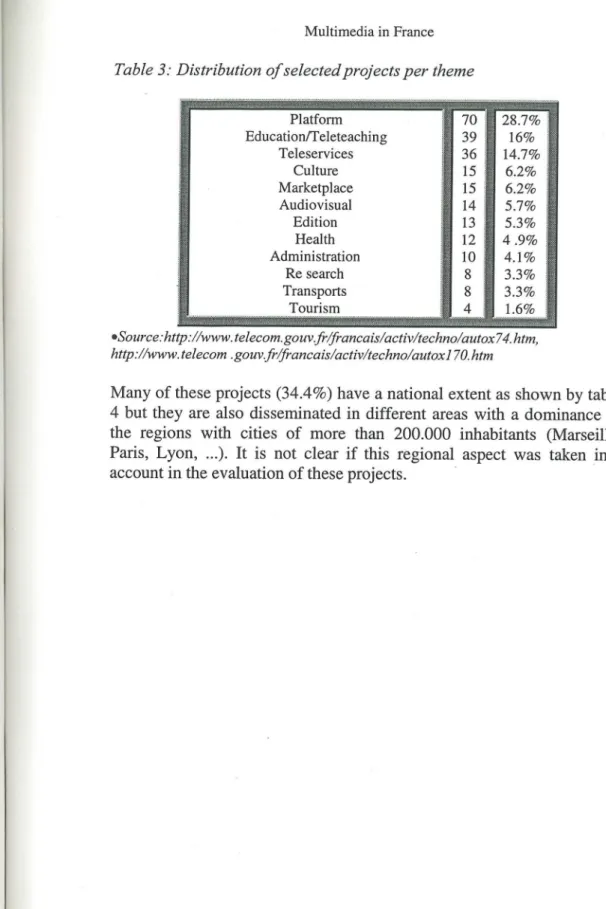
These 244 projects concern different themes: development of
infrastructure (platform), education and teleteaching, teleservices in
general (34), culture, marketplace (principally EDI applications),
audiovisual, edition, health, administration, research, transports and
tourism. Table 3 shows the distribution of the projects amongst these themes.
146
Multimedia in France
Table 3: Distribution ofselectedprojects per theme
Platform Education/Teleteaching Teleservices Culture Marketplace Audiovisual Edition Health Administration Re search Transports eSource:http://www.telecom.gouv.fr/francais/activ/techno/autox74.htm, http://www.telecom .gouv.fr/francais/activ/techno/autox170.htm
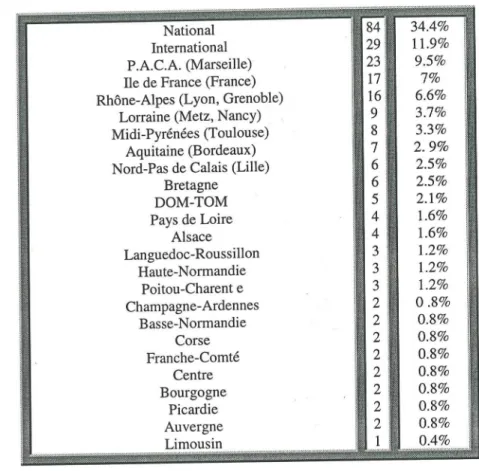
Manyofthese projects (34.4%) have a national extent as shownbytable 4 but they are also disseminated in different areas with a dominance of
the regions with cities of more than 200.000 inhabitants (Marseille,
Paris, Lyon, ...). It is not clear if this regional aspect was taken into accountin the evaluation of these projects. . .
Multimedia in France
Table 4: Distribution ofselectedprojects per region
National International P.A.C.A. (Marseille) Ile de France (France) Rhöne-Alpes (Lyon, Grenoble)
Lorraine (Metz, Nancy)
Midi-Pyrénées (Toulouse) Aquitaine (Bordeaux) Nord-Pas de Calais (Lille)
Bretagne DOM-TOM Pays de Loire Alsace Languedoc-Roussillon Haute-Normandie Poitou-Charent e Champagne-Ardennes Basse-Normandie Corse Franche-Comté Centre Bourgogne Picardie Auvergne Limousin R D R RD D © RD U) U) LU à H Un O\ CN 0 eSource: http://www.telecom.gouv.fr/francais/activ/techno/autox74.htm, http://www.telecom.gouv.flfrancais/activ/techno/autox1 70.htm
According to Cédric Curtil (35), this c all of proposals. eased the emergence of useful and viable projects, eventually innovating but not
all of them. In some cases, it allows to make a first “liberalisation test like in Nice, on the French Riviera, where there are Internet trials on the
cable infrastructure. But a first assessment of these projects underlines that some of th em have turned towards Internet while they had larger ambitions. Moreover, the publicity around this call for proposals and its results have provided useful information concerning the actors of this domain andtheir potential strategies and gaverise to exchangeof ideas, to meetings between actors and endly, to collaborations.
148
Multimedia in France
3.6.5. Second Call for Proposals, Especially Designed for SMEs In February 96, another call for proposals has been launched by the
Ministry of Post, Telecommunications and Space, in collaboration with
ANVARforthe developmentof multimedia applications and services by SMEs. Ona total of 616 proposals, 260 have been accepted for a total financial amountof 876 millions FF for which 100 millionswill be given by ANVARas R&Dfunds (36). Most projects came from the following regions: Ile de France (Paris), Bretagne, P.A.C.A. (Marseille), Rhône-Alpes (Lyon, Grenoble) and Languedoc-Roussillon (Montpellier). Projects mainly concern computer security, electronic commerce, teleteaching, telemedicine and linguistic engineering (37).
3.6.6. Public Initiatives in the Culture Sector
France has an excessively importantinstalled basis in terms of cultural
content. According to Alain Minc (1995), one ofthe author of the
well-known report on the computerisation of the society and inventorofthe concept of telematics, if French culture and knowledgeare digitalized in the following years, this patrimony will be marginalized or digitalized by other countries (p. 10). Moreover, the market does not seem to be able or desirous of doing this effort. The State has then an important incentive role to play in thatfield.
According to Philippe Douste-Blazy (38), French Minister of
Culture, ICT and multimedia technologies do not threaten French
language and culture and the government will sustain the creation of French-speaking contents and services on new digital supports.
Concerning the audiovisual sector, France resists to the invasion of
English-speaking products and especially of American products and culture (39). The 'c ultural exception’ of the world-widetrade agreements during the Uruguay Roundis the best example of this strategy.
But, contrary to the audiovisual sector, France does not seem to
have a specific strategy of defence against English-speaking products in the multimedia field. In this domain, language does not seem to be a political stake as it is the case in Québec for example for the French language or in the Flemish part of Belgium concerning Dutch. It seems that France has a reactive position towards the invasion of foreign products, mainly American ones, and not a proactive position as if French people do not feel that their culture, language and patrimony could be threatened by the current developments in the multimedia field. However, it could be interesting to follow the results of a judicial affair
implying a school for the North of France which provides information on
Multimedia in France
its Web server, concerning its courses and different administrative
information. This school gives courses in English and the information provided is only in English. It is currentlybeing prosecuted on the basis of the Toubon law, from the name of a past Minister of culture who made a law concerning the use of the Frenchlanguage in August 94. The point here is to know if this law could be appliedto information provided
by French Webservers (Arseneault, 1996).
Finally, even if the French Ministry of Culture stated different
priorities in that field, it does not mean that the private sector, given the low equipment rate of the French citizens, will develop mass French-speaking multimedia products because of the potential lack of profitability.
It appears that, at the present time, most problems concerning the development of cultural multimedia products focus on the question of the author rights and of the status of the multimedia creation (Miléo,
1996).
The main priorities stated by the Ministryof Culture (40) concern
the standardisation aspect through the normalisation of multimedia supports, of digital TV (decoders), the presence of French-speaking
experts in international standardisation bodies, the requested norms for
the realisation of French and multilingual products on Internet, terminology works to adapt existing English words concerning multimedia in order to provide French words fortranslators. The support to the creation and diffusion of quality products is also declared as a priority through the set-up of funding for private operators, for the press sector or for public institutions like the French National Library
(Bibliothèque Nationale de France). The French Ministry is also a
producer of multimedia products in collaboration with private firms and want to implement a trial platform of access to existing databases on patrimony. Some authors (Miléo, 1996) suggest that the French State could be obliged to allow all investors to exploit theFrench patrimony at equal conditions and fair prices provided that the production is made in France. They also emphasise the need to take specific measures for the development of cultural industries in France.
3.6.7. Opening ofthe Telecom Sector
Two new laws have been voted in June 96 regarding the telecommunication sector. The first one concerns the regulation of the sector (total opening of the competition) and the secondone refers to the new status of France Télécom. Applications decrees still have to be
150
Multimedia in France
si nu
ar Atthe beginning of July 96,all the alternative infrastructure were pened to competition for telecom services already under competition
3.6.8. Public Service and Universal Service
concepnes a been a defenderof the general interest and of a certain
of public service (Fillon, 1996) called 7 i
t of publ lon, e service public a |.
pese| “ae mo Denoix de Saint-Marc, 1996). In the field of
edia and Information Highways, it is| thus a defender of
universal service, especiall, y on the European scene i irei large consensus in Fran= cm ce that public service is mi sethay universalore than universali
service (; Denoix de Saint-Marc, 1996). H i vice
has beet proncdud ; „ However, as the public service y defined and designed as the i
concept of solidarity, universal servi, vice may be consideredidereda8 ctioni in front of the excessesof the liberalisatitt eralisation process of the telecoeenm sector. The definition of the scope of universal service in France has to be
realised through the application d .
before the end of the year.
Pelze EI NRE DE SEE and. voted
3.6.9. Other Central Initiatives
M
Nmatine government has announcedorsustained otherinitiatives: e law concerning cryptology, the reducti : 5 years of the amortization term, the possibility offeredibilityofferedto115 choc, to have access to ISDN at the telephonetariffs, thft E rotkne oF706i schools before the end of 96befo | , an Internet access at the coseheAustchedood.st of a loc
RE on the entire country, the support from the Ministr 5 hs and Telecommunications to the set up of the Groupe Inter
ndustries and the development of WWW servers for each ministry j Notes
1. Rassemblementpour la République. 2. THE é
Poumonteen Les autoroutes de l'information, Rapport au Premier Ministre, L Thiemy (1998), Le itann des rapportsofficiels, Paris, octobre 1994; BRETON” \information? La Documentation a a
À Seen an 7 te ecom.gouv.fr/francais/activ/techno/techndem.htm.
. http://www.axime.com:9000/gii/com_0296.htm
6. DEVICTOR Bernadette, 18èmes journées de l'IDATE 7. E-mail contact of January Sth 97. | 8. AFP Press Release-SV99, 16/12/96.
Multimedia in France
9. In Belgium with Mobistar, the second mobile operator, in Poland,in Lebanon, in Greece, in Canada, …
10. http://www.axime.com:9000/gii/giimemb.htm
11. Banque Nationale de Paris, Crédit commercial de France,Compagnie Bancaire, Crédit
local de France.
12. Alcatel, Apple France, Bull, Dassault, IBM France,Intel, HewlettPackard, Philips,
Thomson Multimedia, Digital Equipment France.
13. Andersen Consulting, Axime, Cap Gemini Sogeti, MicrosoftEurope, Sema Group, Sligos.
14. France Télécom, Compagnie Générale de Vidéocommunications(Générale des Eaux),
Lyonnaise Communications (Lyonnaise des Eaux). 15. Canal+, Groupe Hersant, Havas, Matra Hachette. 16. EDF,La Poste, Renault, SNCF.
17. Afnor, Direction Générale des Postes et Télécommunications,Direction Générale des Stratégies Industrielles - SERICS, INRIA, Ministère de l'EducationNationale, Ministère de la Culture et de la Francophonie.
18. Galeries Lafayette, Pinault-Printemps-Redoute, 3 Suisses.
19. http://www.axime.com:9000/gii/giiobj.htm
20. Such as medium speed telecoms, high speed telecoms, electroniccommerce between firms, electronic commerce between firms and individuals, financingof the use of on-line services, access to services, legal aspects of on-line services, security(except electronic commerce), health, education.
21. http://www.axime.com:9000/gii
22. http://www.axime.com:9000/gii/giiobj-htm 23. http://www2.atelier.fr/afcee
24. http://www.cordis.lu/esprit/src/invencom.htm 25. E-mail contact of January Sth 1997.
26. http://www.urec.fr/Renater/auj/utilisateurs.html 27: http://www.urec.fr/Renater/auj/utilisateurs.html 28. http://www.cned.fr 29. http://www.cned.fr 30. http://www.telecom.gouv.fr/francais/activ/techno/technac_.htm 31; http://www.telecom.gouv.fr/francais/comdis/cp271094.htm 32. http://www.telecom.gouv.fr/francais/comdis/appeloff.htm 33. http://www.telecom.gouv.fr/francais/comdis/cp270396.htm
34. Examples: telematic application for agriculture, Yellow pages online, database on information highways,...
35. E-mail contact of December 4th 96.
36. http://www.telecom.gouv.fr/francais/activ/techno/aap0296.htm
37. http://www.telecom.gouv.fr/francais/activ/techno/aap0296.htm
38. Speech of May 2ndin front ofthe High French-speaking Council (Haut conseilde la
francophonie): http://www.culture.fr/culture/dglf/com_min/disc-hef.htm
39, Sciences Humaines (1996), "Américanisation: la résistance française, Entretienavec
Richard Kuisel", hors-série, n°14, september-octobre 1996, pp. 38-40.
40. Speech of May 2ndin front of the High French-speaking Council (Haut conseilde la
francophonie): http://www.culture.fr/culture/dglf/com_min/disc-hef.htm
Glossary
eAFCEE
Association Française pour le Commerceet les Echanges Electroniques French Association for Electronic Commerce and Exchanges
eANVAR
Agence Nationale pour la VAlorisation de la Recherche 152
Multimedia in France National Agency for Research Valorisation
Depending from the Industry Ministry
ART
Agence de Régulation des Télécommunications Telecom Regulation Agency
will replace DGPT from the beginning of 1997
eCGE
Compagnie Générale des Eaux
General Water Company eCLMM
Compagnie Luxembourgeoise de MultiMédia
Multimedia Company from Luxembourg eCLT
Compagnie Luxembourgeoise de Télévision Television Company from Luxembourg
International holding, originating from Luxembourg
eCNED
Centre National d'Enseignement à Distance National Centre for Distance Learning
eCSA
Conseil Supérieur de l'Audiovisuel Superior Audiovisual Council eDATAR
Délégation à l'Aménagement du Territoire età l'Action Régionale
Delegation for Regional Planning and Action
Depending from the Prime Minister and the Ministry of R i i
en y of Regional Planning
Direction Generale des Postes et Telecommunications General Direction for Post and Telecommunications
Depending from the Ministry of Post, Telen y ‚ Telecommunications and Spaceicati
Direction Générale des Stratégies Industrielles General Direction of Industrial Strategies
eDGT
Direction Générale des Télécommunications General Direction of Telecommunications
Former name of France Télécom eFT2M
France Télécom Multimedia °GBL
Groupe Bruxelles Lambert
International holding, originating from Belgium
eIDATE
pete “ec l'Audiovisuel et des Télécommunications en Europe
stitute for Audiovisual and Tel ications i
a ecommunications in Europe
Institut National de la Statistique et des Etudes Economiques NationalInstitute of Statistics and Economic Studies
eSAT
Société Anonyme de Télécommunications
Telecom Incorporated Company eSERICS
Service des Industries de Consommation et de Service