RESEARCH OUTPUTS / RÉSULTATS DE RECHERCHE
Author(s) - Auteur(s) :
Publication date - Date de publication :
Permanent link - Permalien :
Rights / License - Licence de droit d’auteur :
Bibliothèque Universitaire Moretus Plantin
Dépôt Institutionnel - Portail de la Recherche
researchportal.unamur.be
University of Namur
Multidirectional Transformations and Synchronisations (Dagstuhl Seminar 18491)
Cleve, Anthony; Kindler, Ekkart; Stevens, Perdita; Zaytsev, Vadim
Published in:
Dagstuhl Reports
Publication date:
2018
Document Version
Publisher's PDF, also known as Version of record
Link to publication
Citation for pulished version (HARVARD):
Cleve, A, Kindler, E, Stevens, P & Zaytsev, V 2018, 'Multidirectional Transformations and Synchronisations (Dagstuhl Seminar 18491): report from Dagstuhl Seminar 18491', Dagstuhl Reports, vol. 8, no. 12.
<http://drops.dagstuhl.de/opus/volltexte/2019/10360/>
General rights
Copyright and moral rights for the publications made accessible in the public portal are retained by the authors and/or other copyright owners and it is a condition of accessing publications that users recognise and abide by the legal requirements associated with these rights. • Users may download and print one copy of any publication from the public portal for the purpose of private study or research. • You may not further distribute the material or use it for any profit-making activity or commercial gain
• You may freely distribute the URL identifying the publication in the public portal ?
Take down policy
If you believe that this document breaches copyright please contact us providing details, and we will remove access to the work immediately and investigate your claim.
Edited by
Anthony Cleve
1, Ekkart Kindler
2, Perdita Stevens
3, and
Vadim Zaytsev
41 University of Namur, BE, [email protected] 2 Technical University of Denmark, DK, [email protected] 3 University of Edinburgh, GB, [email protected] 4 Raincode Labs, BE, [email protected]
Abstract
Bidirectional transformations (bx) are a mechanism for maintaining the consistency of two (or more) related sources of information, such as models in model-driven development, database schemas, or programs. Bx technologies have been developed for practical engineering purposes in many diverse fields. Different disciplines such as programming languages, graph transformations, software engineering, and databases have contributed to the concepts and theory of bx.
However, so far, most efforts have been focused on the case where exactly two information sources must be kept consistent; the case of more than two has usually been considered as an afterthought. In many practical scenarios, it is essential to work with more than two information sources, but the community has hardly started to identify and address the research challenges that this brings.
Driven by the practical needs and usage scenarios from industry, this Dagstuhl Seminar aimed to identify the challenges, issues and open research problems for multidirectional model transformations and synchronisations and sketch a road map for developing relevant concepts, theories and tools.
The report contains an executive summary of the seminar, reports from its working groups, as well as descriptions of industrial and academic case studies that motivated the discussions.
Seminar December 2–7, 2018 – http://www.dagstuhl.de/18491
2012 ACM Subject Classification Information systems → Extraction, transformation and load-ingSoftware and its engineering → Synchronization
Keywords and phrases bidirectional transformation, synchronisation
Digital Object Identifier 10.4230/DagRep.8.12.1
1
Executive Summary
Perdita Stevens (University of Edinburgh, GB)
Ekkart Kindler (Technical University of Denmark, DK)
License Creative Commons BY 3.0 Unported license © Perdita Stevens, Ekkart Kindler
The Dagstuhl Seminar on “Multidirectional Transformations and Synchronisations” was the latest on a sequence of events [1] (coordinated by the Bx Steering Committee [2]) on bidirectional transformations (abbreviated bx) and related topics. Broadly speaking, the concern of the growing community interested in this topic is the maintenance of consistency between multiple data sources, in the presence of change that may affect any of them. The focus of this Dagstuhl meeting, in particular, was the special issues that arise when one
considers more than two data sources at one time. Technical definitions of bx have always allowed for there to be more than two, but in practice, most work to date has focused on maintaining consistency between two data sources. We abbreviate “multidirectional transformation”, hereinafter and generally, to multx or mx1.
We began the week with a presentation of case studies and introductory tutorials, and towards the end of the week we had several plenary talks, in cases where someone was able to discuss work that seemed likely to be of general interest. Overall, though, this was a highly interactive Dagstuhl: most of our time during the week was spent either in working groups or, synergistically, discussing in plenary session the outcomes of those working groups and what else needed to be addressed. Reports from each of those working groups, and descriptions of the case studies, are found in the body of this report. Here we briefly introduce them. Inevitably, the topics of the groups overlapped, and some topics that were proposed for working groups were not reached during the week. We encouraged participants to move freely between groups to foster cross-fertilisation of ideas. The names given are those of the authors of the brief reports. Collectively, these topics comprise a research roadmap for the subject.
WG1: Whether Networks of Bidirectional Transformations Suffice for Multidirectional Transformations.
This group began what turned out to be a recurring theme of the week: see below. WG2: Partial Consistency Notions.
This relates to handling situations in which consistency is not perfectly restored, but only improved to some extent.
WG3: Semantics of Multidirectional Transformations.
This group raised questions about definitions of syntactic and semantic consistencies, vertical and horizontal propagation, etc. After creating enough awareness of the import-ance of this topic, the working group dissolved and its efforts were merged into others, in particular WG4, WG8 and WG12.
WG4: Multiple Interacting Bidirectional Transformations.
This group started with an intention of providing a good example of a “truly” multidirec-tional transformation and defined scenarios where several multx and bx work together towards restoring consitency.
WG5: Mathematical Backgrounds for Multidirectional Transformations.
Following on from WG1, this group considered, from a theoretical perspective, handling multx by the use of a common “federated” supermodel related by spans of asymmetric lenses.
WG6: Synchronisation Policy.
Separate from the issue of what the mechanism is to restore consistency, when should the mechanism be used, and whose decides that?
WG7: Use Cases and the Definition of Multidirectional Transformations. When are multx really necessary in practice, and how?
WG8: Human Factors: Interests of Transformation Developers and Users.
Sometimes in our focus on technical aspects we lose the human element – who are the humans involved and what do they need from whatever languages, tools and techniques are developed for multx?
WG9: Provenance in Multidirectional Transformations.
Information about what changed and why – provenance and traceability – are crucial to trust in multx; how can that information be provided and handled?
WG10: Living in the Feet of the Span.
Following on from WG1 and WG5: what happens when one conceptually uses a common supermodel, but does not wish to materialise it?
WG11: Programming Languages for Multidirectional Transformations.
This group discussed the challenges that need to be met to produce such languages, with a focus on their type systems.
WG12: Verification and Validation of Multidirectional Transformations.
What needs to be verified or validated about multx, and in what ways do these needs challenge the state of the art in verification and validation?
A recurring theme of the week, turning up in one guise or another in most of the working groups, was the question of the extent to which excellent solutions to the two-source bx problems would, or would not, automatically solve the multx problems. Do problems involving multx really introduce new issues, or are they just more complicated than problems involving bx, perhaps organised in networks? The bx problem is far from solved – we do not yet, for example, have widely adopted and well-supported specialist bx languages – and so there was some feeling that we lacked a firm foundation on which to address multx. More positively, considering multx has the potential to help bx research make progress, by motivating areas that still require more study in order to support the multx case. For example, heterogeneity of the languages in which the data sources and the changes to them are expressed clearly points to a need for bx, and hence multx, approaches that do not need to materialise edit histories for all the sources, nor a common supermodel for them – even if the theory that addresses them might still call on such things conceptually.
The following case study descriptions are also included in the report: Multidirectional Transformations for Microservices
Multidirectionality in Compiler Testing Bringing Harmony to the Web
A Health Informatics Scenario
Perhaps the most important observation from this Dagstuhl meeting, though, is how broad the scope of the research necessary to address multx concerns is. The issues and examples discussed by participants went far beyond multidirectional versions of issues and examples already raised in earlier bx meetings. For example, microservices, the focus of the case study presented by Albert Zündorf (§4.1), would not traditionally have fallen under the bx umbrella, yet is clearly related.
This widening of scope is natural. As IT systems become more interdependent and more important to our everyday lives, it is inevitable that data, and the (often separately developed) behaviour it supports, reside in many places. They are coupled, in the sense that changes in one place may mean that changes in another place are necessary, in order to maintain all of these systems in useful operation. Making all such changes manually does not scale: some degree of automated maintenance of consistency is inevitably required. Multx thus subsumes much of software engineering and inherits its concerns.
Readers of this document may wish to join the Bx community by subscribing to its mailing list and/or consulting the Bx wiki: see http://bx-community.wikidot.com/start. There is also a catalogue of examples of bx and multx, including some that were discussed at this Dagstuhl [3].
References
1 Bidirectional Transformations Wiki: Bx Events, http://bx-community.wikidot.com/ bx-events, 2012.
2 Bidirectional Transformations Wiki: Bx Steering Committee, http://bx-community. wikidot.com/bx-steering-committee, 2012.
3 Bidirectional Transformations Wiki: List of pages tagged with multxdagstuhl, http: //bx-community.wikidot.com/system:page-tags/tag/multxdagstuhl, 2018.
2
Table of Contents
Executive Summary
Perdita Stevens, Ekkart Kindler . . . 1
Working Groups
WG1: Whether Networks of Bidirectional Transformations Suffice for Multidirec-tional Transformations
Michael Johnson . . . 6 WG2: Partial Consistency Notions
Anthony Anjorin, Anthony Cleve, Sebastian Copei, Zinovy Diskin, Jeremy Gibbons, Hsiang-Shang Ko, Nuno Macedo, James McKinna, Andy Schürr, Bran V. Selic, Perdita Stevens, Jens Holger Weber, and Nils Weidmann. . . 8 WG4: Multiple Interacting Bidirectional Transformations
Holger Giese, Gabor Karsai, and Vadim Zaytsev . . . 10 WG5: Mathematical Backgrounds for Multidirectional Transformations
Hsiang-Shang Ko . . . 12 WG6: Synchronisation Policy
Jeremy Gibbons and James McKinna . . . 13 WG7: Use Cases and the Definition of Multidirectional Transformations
Fiona A. C. Polack, Anthony Cleve, Davide Di Ruscio, and Martin Gogolla . . . . 14 WG8: Human Factors: Interests of Transformation Developers and Users
Matthias Tichy and Heiko Klare . . . 16 WG9: Provenance in Multidirectional Transformations
Nils Weidmann . . . 21 WG10: Living in the Feet of the Span
Jeremy Gibbons and Michael Johnson . . . 21 WG11: Programming Languages for Multidirectional Transformations
Kazutaka Matsuda, James Cheney, and Soichiro Hidaka . . . 23 WG12: Verification and Validation of Multidirectional Transformations
Perdita Stevens . . . 25
Case Studies
Multidirectional Transformations for Microservices
Sebastian Copei, Marco Sälzer and Albert Zündorf . . . 26 Multidirectionality in Compiler Testing
Vadim Zaytsev. . . 42 Bringing Harmony to the Web
James Cheney. . . 43 A Health Informatics Scenario
Harald König . . . 46
3
Working Groups
3.1 WG1: Whether Networks of Bidirectional Transformations Suffice
for Multidirectional Transformations
Michael Johnson (Macquarie University, AU)
License Creative Commons BY 3.0 Unported license © Michael Johnson
Introduction
A fundamental question about multx, which can be asked even before structures for multi-directional transformations have been precisely defined, is whether a new contentful notion of multidirectional transformations is necessary, or whether its intended outcomes can be achieved with interlinked bidirectional transformations forming something that might be called a network of bidirectional transformations. Accordingly, Working Group 1 was allocated this question.
On Stevens’ counterexample
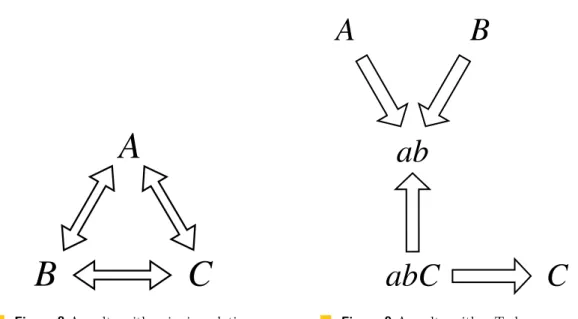
One answer to this question had already been proposed by Stevens [4] who presented an example of a ternary relation R on sets A, B and C which cannot be defined by any collection of binary relations among the three sets. Thus if R were the consistency relation for a multidirectional transformation among A, B and C, then no collection of bidirectional transformations between A, B and C, could properly maintain that consistency relation.
So, in one sense, bidirectional transformations cannot, of themselves suffice.
But it should be noted that this assumes that we restrict ourselves to bidirectional transformations just between the three given systems, A, B and C. Of course, if we permit ourselves to consider a fourth system, S say, then the ternary relation among A, B and C can be obtained from binary relations, indeed functions, between S and A, S and B, and S and C – the tabulation of the relation as a set of triples with projections onto A, B and C provides a trivial example.
This reopens the question: Are there multidirectional transformations that cannot be obtained from the interaction of arbitrarily many bidirectional transformations?
Working Group 1 approach
Working Group 1 decided to approach this problem by attempting again to construct an example of a multidirectional transformation that could not be obtained from bidirectional transformations.
A promising approach seemed to be to look for a collection of three or more systems which would be required to satisfy an inter-model constraint that depended in a fundamental way on the current state of all three systems. One of the working group participants, Harald König, had already developed such an example in a health informatics scenario [2], see also the case study later in this report (§4.4).
Working Group 1 initial outcomes
Working Group 1 developed a detailed analysis of König’s multimodel constraint with the aim of locating the anticipated difficulties in building bidirectional transformations to support the constraint.
To our surprise, no difficulties were found. It seems that one can build sufficient complexity into a system S which is only bidirectionally related to each of the systems A, B and C, to encapsulate the intermodel constraint that needs to be maintained among A, B and C. In a sense this parallels the response to Stevens’ counterexample – if we allow ourselves to introduce extra systems, it seems possible to interact with them only via bidirectional transformations, but to manipulate in them the multidirectional aspects of a given collection of systems.
Work plan
These observations led to a plan of work which, with the agreement of workshop participants over the next two days, was carried through in working groups WG5 and WG10.
Working Group 5 looked into the mathematical foundations of multidirectional trans-formations as wide spans of bidirectional transtrans-formations (the topology that seemed in our initial analysis to side-step the expected difficulties).
Working Group 10 was entitled “Living in the feet of the span”: It was premised on the thought that if wide spans of bidirectional transformations do suffice to capture multidirectional transformations in principle, they might nevertheless be undesirable to build in engineering terms. Having such wide spans as theoretical constructs helps in the mathematical analysis of multidirectional transformations, but experience in building transformations among systems strongly suggests that there are substantial benefits to be obtained from co-spans [1, 3] – small systems that capture the essential shared data among other systems, rather than spans which seem to correspond to large federated systems of systems. Working Group 10 would therefore analyse the interactions needed between the extant systems to efficiently build the multidirectional transformation that might theoretically be described by a wide span.
There are separate reports from each of WG 5 (§3.4) and WG 10 (§3.9). To what extent do networks of bx suffice?
This might be a suitable place to reflect upon the overall outcome of all three groups. WG1: Surprisingly the explored multimodel constraint did not yield any difficulties that
carried us beyond bx.
WG5: Mathematical foundations based on wide spans seemed to suffice.
WG10: Several approaches to building the interactions among the feet of a wide span hold promise.
But it is in the results of Working Group 10 that the truly multidirectional aspects resurfaced, and they present a body of future work that should be explored by the multidirectional transformation community.
Summary
It seems likely that networks of bidirectional transformations suffice for specifying multi-directional transformations and analysing some of their properties.
Indeed, wide spans of bidirectional transformations seem able to capture at least a wide range of multidirectional transformations
But engineering such multidirectional transformations among extant systems in a minim-ally invasive and reasonably efficient manner raises the kinds of questions that present a body of work for future consideration by the multidirectional transformation community including questions such as
Atomicity Concurrency Sequentialisation
Side effects, and, in particular
Intermodel constraints – the problems that began Working Group 1’s deliberations may necessitate cross model querying in calculating how to complete what would otherwise be a propagation in a standard bidirectional transformation such as a symmetric lens.
References
1 S. Copei and A. Zündorf. MX for Microservices. https://materials.dagstuhl.de/files/18/ 18491/18491.SWM.Preprint.pdf, 2018. See also §4.1.
2 H. König. Commonality Specifications, Merged Models, and Partial Morphisms (slides). https://materials.dagstuhl.de/files/18/18491/18491.HaraldK%C3%B6nig.Slides.pdf. Example in the BX Repository at http://bx-community.wikidot.com/examples: patientappointmentbloodtest, 2018. See also §4.4
3 M. Johnson and R. Rosebrugh. Cospans and symmetric lenses. Conference Companion of the 2nd International Conference on Art, Science, and Engineering of Programming. pp. 21–29. https://doi.org/10.1145/3191697.3191717, 2018.
4 P. Stevens. Bidirectional Transformations In The Large. 20th International Conference on Model Driven Engineering Languages and Systems (MoDELS), ACM/IEEE, pp. 1–11. https://doi.org/10.1109/MODELS.2017.8, 2017.
3.2 WG2: Partial Consistency Notions
Anthony Anjorin (Universität Paderborn, DE), Anthony Cleve (University of Namur, BE), Sebastian Copei (Universität Kassel, DE), Zinovy Diskin (McMaster University, CA), Jeremy Gibbons (University of Oxford, GB), Hsiang-Shang Ko (National Institute of Informatics, JP), Nuno Macedo (University of Minho, PT), James McKinna (University of Edinburgh, GB), Andy Schürr (TU Darmstadt, DE), Bran V. Selic (Malina Software Corp., CA), Perdita Stevens (University of Edinburgh, GB), Jens Holger Weber (University of Victoria, CA), and Nils Weidmann (Universität Paderborn, DE)
License Creative Commons BY 3.0 Unported license
© Anthony Anjorin, Anthony Cleve, Sebastian Copei, Zinovy Diskin, Jeremy Gibbons, Hsiang-Shang Ko, Nuno Macedo, James McKinna, Andy Schürr, Bran V. Selic, Perdita Stevens, Jens Holger Weber, and Nils Weidmann
This working group discussed partial consistency for multx. We spent most of our time discussing different reasons why partial consistency is relevant, especially in a multx setting. Each of these “dimensions” explained in the following is not only a source of motivation for supporting some notion of partial consistency, but also represents an initial understanding of what partial consistency could mean to different people:
Generalising the way we measure and represent the “value” of consistency. Especially in a bx network representing a multx, there can be local as well as global measures of consistency. The “consistency as a surface” metaphor/model deliberately draws an analogy with continuous dynamic systems, and their differential geometry [1]; the type-theoretic account [2] emphasises a proof-relevant account of consistency. Each attempts to expand our notion of “how consistency is measured” beyond a mere tt/ff distinction. Stevens [3] has explicitly considered partial consistency as measured lattice-theoretically;
other models, in metric spaces, try to capture the ‘least’ness of ‘least change’. In all cases, being able to “measure” consistency in some way implies a notion of partial consistency ranging from inconsistent to fully consistent.
An approximated, simplified, or incomplete notion of consistency can be viewed as an emergent, provisional property of a modelling/development process. Especially in a multx context, it might even be crucial (from an engineering point of view) to be able to develop the multx incrementally and iteratively, producing, for example, an ordered collection of restorers going from very tolerant to strict as the development process matures and eventually concludes. To be able to work with and test the provisional versions of the multx, therefore, some form of partiality is necessary, e.g., this or that “part” of the models is not yet fully covered.
Accomodating a process where consistency can only be observed (and enforced) at specific synchronisation points requires a means of tolerating continued model evolution in the presence of (unobserved) “inconsistency” and thus partial consistency. Especially in a multx setting, conflicts must be allowed as concurrent updates are unavoidable. It might also be possible to check for local consistency after every change, while global checks can only be conducted, e.g., when everyone else checks in a final version of their models at some agreed upon point in time.
Enabling a decomposition of consistency restoration into phases or parts can be useful. Examples include restoring consistency for more “important”, or the “simplest”, non-contentious parts first. This might not only be necessary to make consistency restoration feasible in a practical setting, but can also be used to simplify an integration with an external component (a user, an optimiser, etc), as these parts can be postponed until the external component provides the required input. As with all other dimensions, such a staggered form of consistency restoration requires being able to handle (temporary) inconsistencies (and thus partial consistency).
The working group concluded by briefly discussing what can constitute an inconsistency. The general consensus was that this can be very different, depending on the approach used to define consistency; It can range from (i) a violation of a constraint, (ii) a violation of a rule application due to deletion of context or violation of application conditions, (iii) existence of structure not described by any rule, or (iv) values that are not in the domain of a restorer.
References
1 Anthony Anjorin. An Introduction to Triple Graph Grammars as an Implementation of the Delta-Lens Framework, Tutorial Lectures of the International Summer School on Bidirec-tional Transformations, pp. 29–72, https://doi.org/10.1007/978-3-319-79108-1_2, 2016.
2 James McKinna. Complements Witness Consistency, Proceedings of the 5th International Workshop on Bidirectional Transformations (BX), pp. 90–94, http://ceur-ws.org/Vol-1571/ paper_10.pdf, 2016.
3 Perdita Stevens. Bidirectionally Tolerating Inconsistency: Partial Transformations, Pro-ceedings of the 17th International Conference on Fundamental Approaches to Software Engineering (FASE), pp. 32–46, https://doi.org/10.1007/978-3-642-54804-8_3, 2014.
3.3 WG4: Multiple Interacting Bidirectional Transformations
Holger Giese (Hasso-Plattner-Institut, DE), and Gabor Karsai (Vanderbilt University, US), and Vadim Zaytsev (Raincode Labs, BE)
License Creative Commons BY 3.0 Unported license © Holger Giese, Gabor Karsai, and Vadim Zaytsev
Most of the work of the working group was shaped, motivated and conceptually linked to two case studies presented earlier during the week of the seminar: the cyber-physical system case study by Holger Giese (cf. [2]) and the compiler case study by Vadim Zaytsev (§4.2, also cf. [3]).
It seemed to us during the numerous discussions that syntactic consistency (achievable with bx) can be viewed as a precondition for enforcing some more global constraints (name uniqueness, deadlock freedom, simulation, model checking, etc.) with multx. This idea could potentially serve as a framework to combine bx and multx into one network. Whether this or another composition framework should be used in the future, it should be related to the scheme proposed earlier in 2018 by Diskin, König and Lawford [1].
3.3.1 Taxonomy
During one of the sessions the working group has sketched a taxonomy that can be, with sufficient domain research and linking to existing literature, worked on in the future and expanded into a real taxonomy of multidirectional transformations.
Arity (of multx)
1 (internal consistency) 2 (bx) >2 (“true” multx) Model relations/hierarchy List or sequence Tree DAG Graph Hypergraph Consistency Representation
Structural consistency (“syntax”)
Behavioural consistency (“dynamic semantics”) Static semantics Versioning Change action Central Distributed Megamodel of multx Authority Conflict resolution Policy or strategy Lossy Preserving Precondition bx–multx multx–bx
3.3.2 Case Study
In an attempt to come up with a simpler case study that would still be capable of serving as an example to demonstrate, we came up with the following. (NB: it was technically impossible to design a truly simple scenario because truly simple scenarios are handled by bx and other simpler frameworks and do not require multx).
Our domain is that of vending machines. The entity we would like to model, is of a machine serving coffee and tea: when enough coins are inserted, and a choice is made by pressing the right button, the machine produces the desired beverage to the best of its ability. Consider three models: L, P and S.
L is a labelled transition system. Its metamodel concerns states and transitions between them, with labels attached to both. L is good at modelling such aspects of the system as various kinds of buttons that the machine may have, as well as consequences of activating them. We also assume the labels have a way of representing sending and receiving messages if buttons are to be understood as channels.
P is a Petri net. Its metamodel concerns places, transitions, arcs between them and tokens that show which transitions can be fired according to the number of incoming arcs matched against the number of available tokens. P is good at modelling counting of all kinds, such as the number of inserted coins or the number of servings of coffee that can be made from available coffee beans before the machine needs to be refilled.
S is a sequence diagram. Its metamodel concerns lifelines, agents, messages and their relative timings. S is good at modelling sequences of events without knowing the internal workings of involved agents. It can represent either valid scenarios of combining L and P , or invalid ones, or even constraints such as “there should always be a beverage served after requesting it”. In general, L k P |= S.
Tasks that are naturally implementable with bx, are of syntactic nature: for example, if one is to edit L to add new actions, such changes need to be propagated to P . Such a bx will contain, among other things, the alignment in the sense of matching elements of L to elements of P , name-based or otherwise.
Tasks that cannot be handled naturally and gracefully by bx, are global and behavioural: for example, simulating execution of L in parallel with P to see if they are capable of producing the sequence of events specified by S.
References
1 Zinovy Diskin, Harald König, Mark Lawford. Multiple Model Synchronization with Mul-tiary Delta Lenses, Proceedings of the 21st International Conference on Fundamental Ap-proaches to Software Engineering (FASE), LNCS 10802, pp. 21–37, https://doi.org/10. 1007/978-3-319-89363-1_2, Springer, 2018.
2 Holger Giese, Bernhard Rumpe, Bernhard Schätz, Janos Sztipanovits. Science and En-gineering of Cyber-Physical Systems, Dagstuhl Seminar 11441. Dagstuhl Reports 1(11), https://doi.org/10.4230/DagRep.1.11.1, 2011.
3 Vadim Zaytsev. An Industrial Case Study in Compiler Testing. Proceedings of the 11th International Conference on Software Language Engineering (SLE), pp. 97–102, ACM, https://doi.org/10.1145/3276604.3276619, 2018.
3.4 WG5: Mathematical Backgrounds for Multidirectional
Transformations
Hsiang-Shang Ko (National Institute of Informatics – Tokyo, JP)
License Creative Commons BY 3.0 Unported license © Hsiang-Shang Ko
Continuing with Harald König’s example (§4.4) about medical record systems from Working Group 1, this working group discussed the idea of modelling multidirectional transformations (multx) using a (wide) span of asymmetric lenses, treating systems/models to be synchronised as views of a federated model incorporating all data in the relevant models and multiary inter-model constraints. The aim (also inherited from Group 1) was to explore to what extent multiary constraints can be handled using this span of lenses. It was emphasised a few times during the session that the span, in particular the federated model, which is monolithic and possibly gigantic, does not need to be actually constructed, and exists mainly for theoretical purposes, namely providing a space where reasoning about the whole system can happen. Some possible ways to avoid constructing the span were subsequently discussed in Working Group 10, whose participants were mostly from this group.
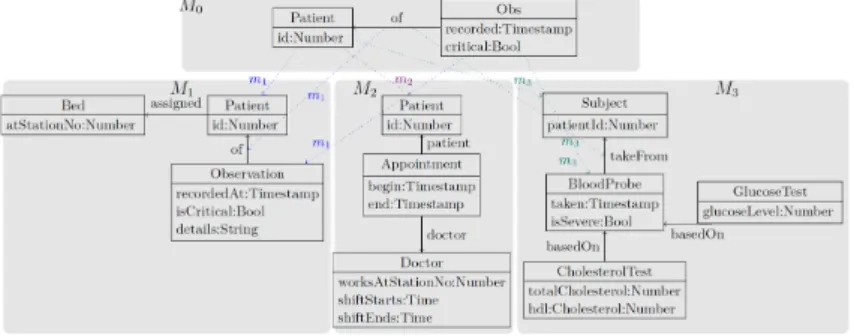
The group first spent some time recapping and clarifying the medical system example, which involved three models respectively responsible for bed assignments to patients (M1), appointments for patients to meet doctors (M2), and blood tests taken by patients (M3). There was a ternary inter-model constraint: “any patient who is assigned a bed (in M1) and has a severe blood test (in M3) must have an appointment (in M2)”. The federated space could then be constructed by merging the three models, making them share the same list of patients, and adding some auxiliary queries that find all patients assigned a bed and having a severe blood test (henceforth “qualifying patients”) so that the constraint can be formulated, checked, etc. Quite a few remarks were made about making the models more precise and comparing their categorical representation with UML, but these remarks did not directly affect the rest of the session.
We went on to discuss the behaviour of putting an updated model into the federated model, and an interesting case was the put transformation for M2(where appointments are managed). It is easy to add an appointment, whereas deleting an appointment is potentially dangerous since that could be the only remaining appointment for a qualifying patient, violating the constraint. One way to avoid the danger is to forbid deletion of appointments, but Zinovy Diskin’s plenary talk on multiary delta lenses [1], in particular the idea of reflective updates, inspired a new solution: further modifying M2 by making a new appointment for the patient. While this opened up a new possibility, some were worried about how to establish the new set of properties of multiary delta lenses and potential consequences of losing the old and fundamental well-behavedness properties (PutGet for example).
The session closed with some general remarks: we may not have the luxury to add an extra federated model, but on the other hand some kind of external solution is necessary when existing models/systems cannot be modified. We also started to think about avoiding the construction of the span, for example by maintaining the list of qualifying patients in M2, whose put needs the list to determine whether the constraint is satisfied and what to do. A more thorough discussion continued in Working Group 10.
References
1 Zinovy Diskin, Harald König, Mark Lawford. Multiple Model Synchronization with Mul-tiary Delta Lenses, Proceedings of the 21st International Conference on Fundamental Ap-proaches to Software Engineering (FASE), LNCS 10802, pp. 21–37, https://doi.org/10. 1007/978-3-319-89363-1_2, Springer, 2018.
3.5 WG6: Synchronisation Policy
Jeremy Gibbons (University of Oxford, GB) and James McKinna (University of Edinburgh, GB)
License Creative Commons BY 3.0 Unported license © Jeremy Gibbons and James McKinna
This working group discussed synchronisation policy for transformations—that is, considera-tion of whose responsibility it is to decide to restore consistency, when that should be done, and which participants should be considered authoritative and which should be updated. (In particular, we did not mean the question of how to choose between different options
for restoring consistency when required to do so, which is sometimes also referred to as a “policy”.)
One might take version control systems as an illustrative example: the man page for gitdescribes which commands are available and what they do, but a novice user needs a separate tutorial that explains recommended patterns of use for the tool, and typical workflows. A developer working on one part of a shared system might legitimately not wish to get interrupted while “in the flow” of coding in order to mentally process repeated synchronisation of updates from other parts of the system. Similarly, Stevens [1] recommends that build systems for megamodels should be demand-driven, rather than attempting global consistency restoration. As another analogy, James Cheney pointed out that the field of computer security distinguishes between policy (what security properties to achieve) and mechanism (how to achieve them).
The group spent some time discussing a number of existing studies and problems. Zinovy Diskin described a taxonomy of 44 distinct bx synchronisation patterns [2]. Josh Ko described a problem of coordinated consistency restoration when reconciling refactorings of communication protocols and their abstractions as session types [3]. Albert Zündorf showed how to express Harald König’s health informatics scenario [4] using synchronisation based on event-driven programming [5]. (The latter two might be viewed in terms of cospans of asymmetric lenses, synchronising on a communication channel that represents the information shared between two parties.) Jens Weber observed that messaging applications in complex environments (specifically, hospital information systems) absolutely need to manage their inbox, and want to have routine messages batched up for efficient handling, only synchronising immediately on truly urgent messages. The following day, Anthony Anjorin described some consistency management scenarios based on examples from the industry automation domain [6], which were also essentially synchronisation policies.
Most of our discussion applied as much to bidirectional transformations as to multi-directional. But the landscape of options for synchronisation is much more interesting for multidirectional transformations than for bidirectional, because there are more degrees of freedom. For one, there is a question of how many participants to fix, and how many may change in order to restore consistency; it is not all-or-nothing. For a second, one need not restore consistency among all participants at once; there is a non-trivial choice of schedules—perhaps one design approach for a multx language would be integrate a bx language for one-to-one transformations with a process algebra for coordination. For a third, whereas it makes sense to compose multiple spans of asymmetric lenses into a single wide span, it does not make sense to compose multiple cospans of lenses into a single cospan—the former represents the “union” of all data sources, and the latter their “intersection”, which is typically empty.
References
1 Perdita Stevens. Towards Sound, Optimal, and Flexible Building from Megamodels. MoD-ELS, p. 301–311, https://doi.org/10.1145/3239372.3239378, 2018.
2 Zinovy Diskin, Hamid Gholizadeh, Arif Wider, and Krzysztof Czarnecki. A Three-Dimensional Taxonomy for Bidirectional Model Synchronization. Journal of Systems and Software 111:298–322, https://doi.org/10.1016/j.jss.2015.06.003, 2016.
3 Liye Guo, Hsiang-Shang Ko, Keigo Imai, Nobuko Yoshida, and Zhenjiang Hu. Towards Bi-directional Synchronization between Communicating Processes and Session Types. Second Workshop on Software Foundations for Data Interoperability (SFDI), 2019.
4 Harald König. Commonality Specifications, Merged Models, and Partial Morph-isms (slides). https://materials.dagstuhl.de/files/18/18491/18491.HaraldK%C3%B6nig. Slides.pdf (2018). Example in the BX Repository at http://bx-community.wikidot.com/ examples:patientappointmentbloodtest.
5 Sebastian Copei and Albert Zündorf. MX for Microservices.
https://materials.dagstuhl.de/files/18/18491/18491.SWM.Preprint.pdf, 2018.
6 Anthony Anjorin, Enes Yigitbas, Erhan Leblebici, Andy Schürr, Marius Lauder, and Martin Witte. Description Languages for Consistency Management Scenarios Based on Examples from the Industry Automation Domain. Programming Journal 2(3):7, https://doi.org/10. 22152/programming-journal.org/2018/2/7, 2018.
3.6 WG7: Use Cases and the Definition of Multidirectional
Transformations
Fiona A. C. Polack (Keele University, GB), Anthony Cleve (University of Namur, BE), Davide Di Ruscio (University of L’Aquila, IT), and Martin Gogolla (Universität Bremen, DE)
License Creative Commons BY 3.0 Unported license
© Fiona A. C. Polack, Anthony Cleve, Davide Di Ruscio, and Martin Gogolla
In practical terms, multiple models (in the widest sense) are used to simplify — either because it is not possible, or because it is not efficient, to capture what is required in one notation, view, tool, etc.
When more than one representation is used, information is lost. That information is needed to establish or maintain consistency. In one sense, the technical debt incurred in decomposing into multiple models must be repaid, at least in part, when establishing cross-model features such as consistency.
We hypothesised that there are two sorts of case:
A network of bx can be used if (likely only if) all the information needed to establish a particular feature (e.g. a specific form of consistency) is held in within the two linked models – we think this is the situation that Zinovy Diskin describes when asserting (informally) that multx are strictly unnecessary.
A multx is needed when the information necessary to establish the desired feature is held separately from the two models between which the feature must be established.
Horizon 2020 project Typhon [1] has the example of a distributed data storage system. A single conceptual model (CM) links to many different components including relational and no-SQL databases, file stores, etc. Each component has its own logical schema (LSi) using
the internal concepts of that component (e.g. relational db; relational schema; rdb tables, rdbms types and operations). There is a bx between each LSi and CM, which maintains
Figure 1 The conceptual model and logical schemata in Typhon [2].
consistency between CM and LSi. However, to determine whether pairs or triples (up to all
LSi) of LSi are consistent requires reference to the CM, which abstracts the relationships
between all concepts. Thus, consistency between LS1and LS2 references CM to establish how concepts in each LSi are related in the overall system. This is a multx.
Albert’s micro-system (§4.1) could be interpreted similarly. However, Albert’s problem required that other notions of consistency be established. For example, protocols defined by outside committees or people needed to be enforced by both software (micro services based on customer oriented views and the “databases” that hold the specific data). It did not seem to be possible to define how overall consistency could be maintained because it was not possible / feasible to establish how the non-software components could become or maintain mutual consistency (i.e. where people change linked policies in such a way that software no longer correctly enforces both parts of the pair). Whilst some desired consistency elements could be multx-enforced because they could be expressed as constraints over the language(s) of the software-related models, it was not possible to express all the desired consistency in the same (set of) language.
Comparing the two examples, we see that the definition of the desired “feature” is critical. In real cases, the third element (which we called the black box, simply because it was drawn using a black pen) might be a collection of different, likely incompatible, boxes. It might also include the need for a person or human role to make a choice or resolve an inconsistency. The box (or collection of boxes) might also capture a synchronisation policy (human or logical).
Finally, we recognised that the black box – the multi part of the multx – was not, in practice, fixed. Even in the case of stable models, it is possible that new forms of consistency that need to be (re)established would be identified – for component models might have an element that is not obviously expressing the same “thing”, but which is subsequently recognised as having a dependency or other constraint-expressive relationship that must be maintained. In real systems, it is also the case that the black boxes change over time. For instance, the complex multi-way relationship between a programming language and machine code would once have been a (or many) bx and multx, but has been replaced by a bx model called a compiler. There is an open question concerning whether a black box element is consistent with the element(s) that is replaces: is the set of rules defining compilation consistent with the behaviour of the new compiler, and if not, what are the consistency consequences elsewhere in the collection of models?
References
1 Typhon: Polyglot and Hybrid Persistence Architectures for Big Data Analytics, https: //www.typhon-project.org/, 2018.
2 Davide Di Ruscio, Fiona A.C. Polack, Martin Gogolla, Anthony Cleve, Dominique Blouin, Nuno Macedo. Conceptual Schema to Multiple Logical Schemas, http://bx-community. wikidot.com/examples:conceptualschematomultiplelogicalschemas, 2019.
3.7 WG8: Human Factors: Interests of Transformation Developers and
Users
Matthias Tichy (Universität Ulm, DE) and Heiko Klare (Karlsruhe Institute of Technology, DE)
License Creative Commons BY 3.0 Unported license © Matthias Tichy and Heiko Klare
3.7.1 Taxonomy
In order to provide a common terminology around the challenges w.r.t. users of multidirec-tional transformations, we derived a taxonomy. The taxonomy covers the following (not complete) set of aspects:
Different roles of users, e.g.:
Developer of a transformation User of a modelling tool
Developer of a modelling language and corresponding tool
Developer of other aspects, e.g., Requirements Engineering, Architecture Domain expert Person characteristics Experience Knowledge Processes Tool Development Model Development Quality Attributes Ease of Use Expressive Power Comprehensibility Justification Teaching Understanding Capability of Change
Number of people (individuals vs. group) Learnability
*X-Req *X-Script MM1 MM2 M1 M2 M* MM* Domain Expert
MX Developer Tool User
(M1 or M2)
Requirements
Engineering Formalization Execution
refers to refers to refers to refers to conforms to conforms to conforms to
Figure 2 Roles and artefacts involved in a consistency scenario for two or more types of models.
Artefacts Transformation Script Transformation Language ∗ Declarative ∗ Operational Transformation Engine Domain-specific Language Syntax Semantics Model
For example, we have to distinguish between the developer of a modelling language, the developer of a model transformation, and the developer of other aspects of a modelling tool, as well as the user of the tool. Experience and knowledge of the different users w.r.t. to the domain, the modelling tool, and the modelled system also have to be considered.
Figure 2 shows the roles and artefacts involved in a scenario, in which two or more types of models shall be kept consistent with a bidirectional or multidirectional transformation (referred to as *X), according to the previously introduced taxonomy. Given two model types MM1 and MM2, a domain expert acquires the consistency relations between them in a requirements elicitation process, leading to the requirements artefact *X-Req. An *X-Developer then formalizes these requirements for a specific *X-Language. This leads to an *X-Script, i.e., a transformation specification for that specific *X-Language. That *X-Script can then be executed using the *X-Engine of the *X-Language by a tool user, who develops a model M1 or M2 (or potentially other models denoted as M*) of the model types MM1 or MM2, respectively, to check and restore consistency with a model of the other model type(s). We discussed interests and challenges for two central user roles in this scenario: the transformation developer, who specifies consistency in transformations, and the tool user, who uses those transformations for preserving consistency.
3.7.2 The Transformation Developer Perspective
We considered the scenario that a transformation developer wants to define a new transform-ation *X-Script, for example between model types MM1 and MM2. Other transformtransform-ations, for example between model types MM1 and MM*, may already be defined.
The good case
In the best case, the transformation operates correctly, i.e. conforming to the requirements in *X-Req. It also interoperates correctly with other transformations, e.g. an existing transformation between MM1 and MM*. Such proper operation should be validated by test cases that indicate absence of errors to the transformation developer.
The bad case
In practice, a transformation developer will make errors while specifying a transformation *X-Script. In that case, two types of errors can occur:
*X-Script does not fulfil *X-Req: Such errors should be identified by failing test cases or at least through feedback from a tool user who experiences erroneous behaviour. *X-Script does not properly interoperate with other *X-Scripts (e.g. between MM1 and MM*): Such errors can be detected during development by test cases that investigate certain combinations of *X-Scripts, or by a tool developer who combines independently developed *X-Scripts in a specific scenario.
In both cases, an a-priori detection of errors by analysing or testing an *X-Script should be preferred over an a-posteriori detection by a tool user. To support the transformation developer in finding bugs during development, he requires support by the *X-Language and its engine to find out why consistency is not preserved correctly. This especially comprises tracing back a failure to the origin of the change that lead to the failure (provenance). Additionally, a transformation developer requires appropriate debugging support to step through an *X-Script execution, just like in ordinary code development.
3.7.3 The Tool User Perspective
We considered the role of a tool user, who performs modifications in one model and executes a transformation to detect and resolve introduced inconsistencies to other models. We identified two different scenarios that reveal different challenges that occur when a tool user applies a transformation. The first scenario deals with the “good case”, in which the formalization of consistency conforms to the actual consistency relations. The second scenario deals with the “bad case”, in which consistency relations are not properly represented in their formalization, leading to errors during execution of the transformation. For ease of understanding, the tool user in the following scenarios will always be responsible for M1.
The good case
We assume that *X-Req and its formalization *X-Script represent all actually existing consistency relations that exist between the model types MM1 and MM2 (and only those). In that case, if a user applies changes to M1, which potentially introduces an inconsistency regarding *X-Req to M2, the execution of *X-Script has to inform the user about potential inconsistencies, provide him information about where the specification in *X-Req is violated and provide options on how to make the models consistent again. When the user selects one option to restore consistency, this can be either directly applied or trigger a consistency
restoration process, in which the modification is wrapped into a change request that has to be sent to a person that is responsible for modifications in M2. After applying the changes, they must be stored together with the decision rationale to ensure that developers understand the reasons for the modifications.
The bad case
In practice, *X-Req and the derived *X-Script will potentially not cover exactly those consistency relations that actually exist between the model types MM1 and MM2. If the tool user performs a modification in M1 that is covered completely and correctly by *X-Req and *X-Script, then still the previously presented “good case” applies. If that case is not correctly covered by *X-Req and *X-Script, two cases can be distinguished:
1. An inconsistency is detected by *X-Script execution, although no inconsistency exists
(false positive)
2. No inconsistency is detected by *X-Script execution, although an inconsistency exists
(false negative)
There are different reasons why this can happen:
1. *X-Req is wrong, i.e., it contains faulty consistency relations 2. *X-Script is wrong, i.e., it does not conform to *X-Req
3. *X-Req is underspecified, i.e., it does not represent all existing consistency relations 4. *X-Req is overspecified, i.e., it contains consistency relations that do actually not exist
While the first two options can lead to both false positives and false negatives, an underspecification of *X-Req will lead to false negatives, whereas an overspecification of *X-Req will result in false positives. Depending on the reason for the faulty inconsistency detection, it is either necessary to fix *X-Req or to fix *X-Script. A fix of those artefacts may take some time, as the error usually occurs when a tool user executes the *X-Script, but the *X-Script is implemented and thus fixed by different persons, the *X-Developers. Due to that, it will be necessary to allow a manual override of decision taken by the *X-Script execution to prevent delays in the development process. Afterwards the user can make a change request to have *X-Req and *X-Script updated.
3.7.4 Challenges
The scenarios reveal different challenges that require further investigation.
C1: How to deal with a lack of domain understanding of M1 tool user about changes in
M2?
The M1 tool user has knowledge about MM1 and its instances but potentially not about other domains, especially MM2, and the relations between them. Because in general the execution of *X-Script can only support the user in making a decision on how to restore consistency by showing and rating potential effects or recommending options, the M1 tool user has to make the final decision on consistency restoration to M2. It is an open challenge how to overcome the lack of necessary knowledge to make that decision.
C2: How to integrate the *X-Script execution into organizational processes and tools?
The *X-Script execution will in general not be fully automated but involve user decisions, even of different roles. This may lead to a complex and time-consuming process that is even influenced by organizational processes or existing development processes. Finally, the consistency restoration process must be integrated into theses processes and especially tooling
C3: How to deal with confidential model parts in intra-organizational settings?
Models may contain parts that are only to be seen and modified by specific roles, e.g., because they contain confidential information. If the modification of another model requires decisions on restoring consistency with such confidential data, it must be ensured that only people with appropriate roles see that data and perform the appropriate decisions. It is an open challenge how to deal with confidential data or, in general, role-based access control during consistency restoration.
C4: When, whom and how to allow a manual override of decisions of the *X-Script execution?
Due to the fact that in practice the specification of consistency will never fully or correctly cover the actual consistency relations, it must be possible to overwrite decision of an *X-Script whenever they are wrong. On the other hand, it should not be possible to always make manual overrides and completely disable the defined consistency restoration process by *X-Script. It is an open challenge when to allow such overwrites and whether that depends on a certain role. In addition, it is yet unclear how to make the *X-Engine deal with ad-hoc, manual overrides of the specified consistency relations, while still preserving traceability of consistency-restoring decisions and their rationales.
C5: How much specification of *X-Req is enough? How to support users in understanding
limitations of *X-Req and *X-Script?
The specifications of consistency relations in *X-Req and *X-Script will potentially not cover all relations that exist between two models types MM1 and MM2, either because some relations are missed or because they are too complex to express in an appropriate formalism. It is an open challenge to decide how much specification is enough and especially how to support the user in understanding the limitations of the specifications, as he has to deal with the rest of the relations that are not specified in *X-Script. Finally, this is a cost/benefit estimation that has to be made by the domain expert who specifies *X-Req.
C6: How to increase the trust of a tool user in the execution of *X-Script?
Due to the fact that *X-Script can be incomplete or erroneous, as discussed in the bad case scenario, the tool user can easily lose confidence in *X-Script if failures occur too often or are too severe. It is therefore a general challenge to increase the trust of a user in such an *X-Script and to find general ways how to achieve that. This is highly related to identifying
the appropriate extent of a specification as discussed in challenge C5.
C7: How to deal with non-determinism w.r.t. user trust?
Non-determinism in *X-Script, e.g. due to different explanations for inconsistencies or reaching consistency in different ways, can reduce the user trust into *X-Script. Tool users will usually expect determinism from such an *X-Script and also assume that small differences in inputs models should result in small differences in the target models by executing *X-Script. It is an open challenge how to preserve user trust whenever non-determinism is inevitable or to reduce evitable non-determinism.
3.8 WG9: Provenance in Multidirectional Transformations
Nils Weidmann (Universität Paderborn, DE)
License Creative Commons BY 3.0 Unported license © Nils Weidmann
The role of provenance and traceability constitutes an important issue in a multx context. Some ideas where exactly and why provenance is an interesting research topic with respect to multx were discussed in this working group.
In the context of model-driven engineering (MDE), traceability is provided by the correspondence model of a triple graph grammar (TGG). Seminal work on the various roles of correspondence nodes in different TGG tools already exists. Depending on the concrete implementation, correspondence links can be attributed, as the original formalism does not say anything about that. However, a certain state defined by the source, target and correspondence model is not unique, e.g. in case of confluent TGGs. Therefore, the correspondence model itself does not provide enough traceability information. As a proof object, an additional protocol is required that tracks the sequence of rule applications. In the context of software engineering, the OSLC (Open Services for Lifecycle Collaboration) standard could provide software engineers with useful ideas how to keep multiple models consistent.
Another topic of interest is traceability in mega modeling for object-relational mapping (ORM). It is possible to have arbitrarily nested containers, whereas it is possible to have
correspondences between those containers.
In general, traceability links provide more than a binary information about the relation between two model elements. The concrete use cases in a multx context have to be defined, though. On the one hand, they can be used to give evidence that some relationship exists in an abstract sense. On the other hand, they can also be used for a special purpose like navigation in data models. In this case, the importance of a link can be measured in terms of how often it is used for navigation.
When restoring consistency, the multx context poses far more challenges with respect to provenance than the binary case. The possibility of consistency restoration within one step is a common case in bx, but very unlikely in multx situations. Therefore, versioning gets more and more important, which means that each rule application creates a new version of the data model.
References
1 James Cheney. Provenance – a Dagstuhl presentation, https://materials.dagstuhl.de/files/ 18/18491/18491.JamesCheney1.Slides.pdf, 2018.
3.9 WG10: Living in the Feet of the Span
Jeremy Gibbons (University of Oxford, GB) and Michael Johnson (Macquarie University, AU)
License Creative Commons BY 3.0 Unported license © Jeremy Gibbons and Michael Johnson
This working group followed on from Group 1 discussing whether multx are necessary or whether networks of bx suffice (§3.1), and Group 5 discussing mathematical foundations of multx (§3.4). Those two groups had already spent some time discussing Harald König’s
health informatics scenario [1] (§4.4): three independent systems, M1 recording patients and their possible assignment to beds, M2 recording appointments between patients and doctors, and M3 recording blood tests, synchronised on the sets of patients, becoming subject to the additional inter-model integrity constraint I that any patient assigned a bed and in receipt of a severe test result must also have a doctor’s appointment.
In particular, as discussed in Group 5, one implementation strategy for incorporating Iinto M1, M2, M3 is to build a federated system M recording all three collections of data, with asymmetric lenses reconstructing M1, M2, M3 as views of M; this forms a three-legged span of lenses. Without considering I, it is easy to implement puts and gets for patients etc, since the individual systems are just projections from the federated system. To address I as well, puts require a bit more work: for example, when assigning a patient to a bed in M1, if that patient already has a severe test result in M3 then they should also be given an appointment in M2.
The particular focus in this working group was to discuss alternative implementation strategies, in case one chooses not actually to implement M itself but simply to treat it as a specification of the required behaviour of M1, M2, M3 and I. What alternative implementation strategies are there? We identified four, in two groups of two:
1. modify one or more of the “feet” M1, M2, M3of the span to implement the constraint I (for example, in our scenario, modifying the appointments database to know about beds
and severe test results);
2. as (1), but adapt the foot by applying some kind of wrapper (a “sock”) to it rather than
modifying it;
3. add a coordinating façade component [3], which intercepts puts to the components
M1, M2, M3, and applies the additional get and put operations required to re-establish I;
4. as (3), but materialise as a separate component M4the queries required for re-establishing I.
Alternative (1) may be unacceptable–perhaps the components to be modified are propri-etary systems, or otherwise unchangeable. Alternatives (1) and (2) both awkwardly duplicate some of the logic required to implement I; in our scenario, the behaviour of M1 will need to change to possibly create an appointment when assigning a patient to a bed, and the behaviour of M3 similarly when recording a severe test result.
Alternative (3) entails several additional operations on the separate components to implement a put; this at least introduces issues of atomicity and transactional updates. Moreover, when the components M1, M2, M3are distributed, put must be allowed to perform I/O actions rather than being a pure function, becoming an effectful lens [4]. Alternative (4) saves the additional queries on other components for determining what reconciliation is required, but cannot help with the additional puts; it also introduces an additional component, which must itself be synchronised.
References
1 Harald König. Commonality Specifications, Merged Models, and Partial Morph-isms (slides). https://materials.dagstuhl.de/files/18/18491/18491.HaraldK%C3%B6nig. Slides.pdf, 2018. Example in the BX Repository at http://bx-community.wikidot.com/ examples:patientappointmentbloodtest. See also §4.4.
2 Sebastian Copei and Albert Zündorf. MX for Microservices. https://materials.dagstuhl.de/ files/18/18491/18491.SWM.Preprint.pdf, 2018. See also §4.1.
3 Erich Gamma, Richard Helm, Ralph Johnson, and John Vlissides. Design Patterns: Ele-ments of Reusable Object-Oriented Software. Addison-Wesley, 1995.
4 Faris Abou-Saleh, James Cheney, Jeremy Gibbons, James McKinna, and Perdita Stevens. Notions of Bidirectional Computation and Entangled State Monads. MPC, LNCS 9129, pp. 187-214, https://doi.org/10.1007/978-3-319-19797-5_9, 2015.
3.10 WG11: Programming Languages for Multidirectional
Transformations
Kazutaka Matsuda (Tohoku University, JP), James Cheney (University of Edinburgh, GB), and Soichiro Hidaka (Hosei University, JP)
License Creative Commons BY 3.0 Unported license
© Kazutaka Matsuda, James Cheney, and Soichiro Hidaka
This working group has discussed language supports for multi-directional transformations, mainly on the two topics: representation of consistency relation and coordination languages. 3.10.1 Consistency Relations by Types
A consistency relation, a relation that any updates must fulfil (after consistency resolution if necessary), is one of the important notions in bidirectional and multi-directional transform-ations. Thus, a representation of a consistency relation in a programming language is an important research question.
It would be a natural idea to represent such constraints as types in a programming language. In response to the discussions in WG 5, which discussed a category-theoretic solution to the hospital example presented by Harald König, we have observed that a type system must be able to represent the following constraints to handle the hospital example:
Functional dependencies and key dependencies Join dependencies
We find that refinement types and dependent types (see Baltopoulos et al. [2] and Xi et al. [9] for examples) would be useful for addressing the problem of representing consistency relation. Here, by a refinement type, we mean a type refined by a predicate, such as {a : Int | a > 0}. In a dependent type system, a type can depend on values, by special forms of types called dependent products (also known as Q types) and dependent sums (also known as P types).
Among the two, a dependent sum is especially useful for representing what is called inter-model constraints in the software engineering community. A dependent sum type P
(a:σ)τ represent a set of pairs (u, v) such that u has type σ and v has the type obtained from τ by replacing a by u. For example, the type Pa:Int{b: Int | a < b} represents a set of
pairs (a, b) of Int values satisfying a < b.
Also, it is convenient if type check can be done locally (i.e., on each component inde-pendently for a dependent sum) instead of globally (i.e., on both components of a dependent sum). To do so, for a dependent sum P{a:A|φ(a)}{b: ψ(a, b)}, it is convenient if we can find a weak enough constraint φ0(b) such that φ0(b) implies φ(a, b), so that we can check the global constraint φ(a, b) only when the local check φ0(b) fails.
Thus, a research question is: can we design a refinement type system that satisfies the above criteria? A good start would be extending the relational lens framework [3], which does not have dependent sums but a sort of refinement types that consider functional dependencies.
As a side note, a sophisticated type system would sometimes be useful for users to give valid updates especially when they support holes. A successful example is a dependent programming language Agda [1], which allows users to specify a well-typed term interactively to fill a hole with editor’s support.
3.10.2 Coordination Language
One of the lessons that we have learned from this Dagstuhl seminar is that there should be a separation of concerns, especially when we realize multi-directional transformations by combining bidirectional transformations; one concern is how to specify bidirectional transformations between two objects, and the other is how to use bidirectional transformations to make a whole system in sync. So far, though there have been a lot of studies addressing the former issue, the latter has been overlooked in the programming language context.
Thus, a research question is: how can we design a programming language for using bidirectional transformations? It is expected that such a language should support:
describing where and when to apply bidirectional transformations (cf. synchronization policies discussed in WG 6),
declaring datatypes for “virtual” data that do not correspond to any concrete target data in sync, such as spans [6], and
mixing bidirectional transformations defined in different systems such as the lens [4] and the triple graph grammar [8].
We may call this kind of languages coordination languages or strategy languages. This needs of coordination languages may be similar to how a multi-tier programming language [7] is about session types [5].
References
1 Agda, The Agda Wiki, https://wiki.portal.chalmers.se/agda/pmwiki.php, 2008.
2 Ioannis G. Baltopoulos, Johannes Borgström, Andrew D. Gordon: Maintaining Data-base Integrity with Refinement Types. ECOOP, pp. 484–509, https://doi.org/10.1007/
978-3-642-22655-7_23, 2011.
3 Aaron Bohannon, Benjamin C. Pierce, Jeffrey A. Vaughan: Relational lenses: a language for updatable views. PODS, pp. 338–347, https://doi.org/10.1145/1142351.1142399, 2006.
4 J. Nathan Foster, Michael B. Greenwald, Jonathan T. Moore, Benjamin C. Pierce, Alan Schmitt: Combinators for bidirectional tree transformations: A linguistic approach to the view-update problem. ACM Transactions on Programming Languages and Systems (TO-PLAS), Volume 29, Number 3, p. 17, https://doi.org/10.1145/1232420.1232424, 2007.
5 Kohei Honda, Vasco Thudichum Vasconcelos, Makoto Kubo: Language Primitives and Type Discipline for Structured Communication-Based Programming. ESOP, pp. 122–138,
https://doi.org/10.1007/BFb0053567, 1998.
6 Michael Johnson, Robert D. Rosebrugh: Spans of lenses. EDBT/ICDT Workshops, pp. 112–118, http://ceur-ws.org/Vol-1133/paper-18.pdf, 2014.
7 Matthias Neubauer, Peter Thiemann: From sequential programs to multi-tier applications by program transformation. POPL, pp. 221–232, https://doi.org/10.1145/1040305.1040324, 2005.
8 Andy Schürr: Specification of Graph Translators with Triple Graph Grammars. WG, pp. 151–163, https://doi.org/10.1007/3-540-59071-4_45, 1994.
9 Hongwei Xi, Frank Pfenning: Eliminating Array Bound Checking Through Dependent Types. PLDI, pp. 249–257, https://doi.org/10.1145/277650.277732, 1998.
![Figure 1 The conceptual model and logical schemata in Typhon [2].](https://thumb-eu.123doks.com/thumbv2/123doknet/14501807.719388/16.892.136.675.149.365/figure-conceptual-model-logical-schemata-typhon.webp)