
HAL Id: tel-02418608
https://tel.archives-ouvertes.fr/tel-02418608
Submitted on 19 Dec 2019
HAL is a multi-disciplinary open access archive for the deposit and dissemination of sci-entific research documents, whether they are pub-lished or not. The documents may come from teaching and research institutions in France or abroad, or from public or private research centers.
L’archive ouverte pluridisciplinaire HAL, est destinée au dépôt et à la diffusion de documents scientifiques de niveau recherche, publiés ou non, émanant des établissements d’enseignement et de recherche français ou étrangers, des laboratoires publics ou privés.
Contributions to shared control architectures for
advanced telemanipulation
Firas Abi-Farraj
To cite this version:
Firas Abi-Farraj. Contributions to shared control architectures for advanced telemanipulation. Robotics [cs.RO]. Université Rennes 1, 2018. English. �NNT : 2018REN1S120�. �tel-02418608�
T
HESE DE DOCTORAT DE
L'UNIVERSITE
DE
RENNES
1
C
OMUEU
NIVERSITEB
RETAGNEL
OIREECOLE DOCTORALE N°601
Mathématiques et Sciences et Technologies de l'Information et de la Communication
Spécialité : « Automatique, Productique et Robotique »
« Contributions to Shared Control Architectures for Advanced
Telemanipulation »
Thèse présentée et soutenue à « Rennes », le « 18/12/2018 »
Unité de recherche :Institut de Recherche en Informatique et Systèmes Aléatoires (IRISA-UMR6074) Thèse N° :
Par
« Firas ABI-FARRAJ »
Rapporteurs avant soutenance :
Antonio Bicchi Full Professor in Robotics at the University of Pisa, Italy
Jee-Hwan Ryu Full Professor in Mechanical Engineering, KOREATECH, Republic of Korea
Composition du Jury :
Examinateurs : Antonio Bicchi Full Professor in Robotics at the University of Pisa, Italy François Chaumette DR1 INRIA, Rennes, France
Katherine Kuchenbecker Director of the Haptic Intelligence Department, Max Planck Institute for Intelligent Systems, Germany
Maud Marchal Maitre de Conferénces, Univ. Rennes, INSA, IRISA
Christian Ott Senior Reseach Scientist, Head of Department "Analysis and Control of Advanced Robotic Systems" at Institute of Robotics and
Mechatronics, DLR, Germany
Three years are coming to their end, and I am about to get my doctorate degree! Coming to Rennes, I didn’t know what to expect, but it was a special and fruitful experience both at the scientific and personal level. I would like to dedicate these (few) lines to acknowledge the contribution of everyone who, in a way or another helped in reaching this point.
I would like to first thank Dr. Paolo Robuffo Giordano. Besides his thorough technical experience and continuous support, he is a great person to work with. Our (joyful) meetings made it always a pleasure to chat and discuss about any technical, scientific or general topic. I honestly couldn’t have had a better adviser and I hope that this relationship goes beyond the PhD.
I would like to also thank Dr. François Chaumette for the excellent working environment and team spirit which he has developed as a group leader over the past years and for providing the guidance and support wherever needed. Special thanks as well to M. Fabien Spindler whose invaluable contribution and support to myself and to the group added significantly to this thesis. It was a pleasure working with you.
During my PhD I have also spent 6 months at the German Aerospace Center (DLR) in the Munich region. I would like to primarily thank Dr. Maximo Roa for accepting this visit and for his warm welcome and continuous support throughout my stay. My gratitude is also extended to Dr. Christian Ott for the same reasons. In this respect, I cannot refrain from thanking my DLR colleagues whose support was crucial to make the stay successful among whom I especially mention Bernd Henze, Alexander Werner and Oliver Porgers.
Special thanks go to my previous and current Rainbow/Lagadic colleagues whom I will refrain from mentioning by name as the list is long. Thank you for your continuous personal and technical support throughout the journey.
Finally, I would like to dedicate these last lines of acknowledgment to my family and friends in France, Lebanon and around the world for many reasons which I do not need to detail!
Sujet de la thèse
Cette thèse s’inspire de la riche histoire de l’IHR pour analyser la relation entre l’opérateur humain et les systèmes autonomes. Les contrôleurs autonomes sont en évolution constante et rapide, en corrélation avec les progrès des capacités maté-rielles (par exemple, caméras de profondeur, capteurs plus efficaces, puissance de calcul) et le développement d’architectures logicielles (par exemple, méthodes ba-sées sur la vision, contrôle de force, apprentissage automatique, IA). Cette évolution entraîne un déplacement continu d’autorité et de dépendance entre l’opérateur hu-main et l’autonomie des systèmes IHR, permettant une interaction plus significative entre les deux et un spectre plus large d’applications. Dans ce contexte, cette thèse vise à proposer une variété d’architectures de contrôle partagé pour les différentes phases des applications de télémanipulation à distance, caractérisées par différents niveaux d’autonomie pour le composant robotique, et différents moyens de fournir un retour d’information à l’opérateur sur l’exécution de la tâche et sur la faisabilité de ses commandes. En plus de l’intérêt scientifique général pour avancer l’état de l’art dans le domaine du contrôle partagé, cette thèse est également motivée par les besoins pratiques du project européen H2020 "Robotic Manipulation for Nu-clear Sort and Segregation" (RoMaNS), qui a servi d’étude de cas (et de motivation sociétale) pour les différentes architectures de contrôle partagé proposées dans la thèse. Nous procédons maintenant à résumer brièvement le projet RoMaNS pour également fournir un contexte supplémentaire aux contributions de la thèse.
Le projet RoMaNS aborde des systèmes de contrôle autonomes, téléopératoires et partagés pour la manipulation à distance des déchets nucléaires hérités. Au Royaume-Uni, le nettoyage des déchets nucléaires du dernier demi-siècle représente l’un des projets d’assainissement de l’environnement les plus importants d’Europe, avec 1,4 millions de mètres cubes de déchets de niveau intermédiaire à traiter.
Cer-tains de ces déchets ont été stockés temporairement dans des conteneurs, dont la plupart contiennent des niveaux de contamination mixtes et parfois des contenus inconnus. Il peut être nécessaire d’altérer ou de couper ces conteneurs pour vérifier leur contenus avant de les trier et de les séparer. D’un autre côté, de grandes quanti-tés de machinerie et d’infrastructures de centrales déclassées hautement contaminées devront être démolies, coupées et redimensionnées et traitées au besoin. Une grande partie de ce travail ne peut être effectuée que par des méthodes de manipulation à distance, car les niveaux élevés de matières radioactives sont dangereux pour l’homme.
Actuellement, il est proposé que les opérateurs trient et séparent en utilisant la téléopération manuelle qui, dans ce contexte, utilise le « teach pendant » standard ou un simple joystick pour déplacer manuellement le robot. Cette méthode soulève des problèmes de sécurité, de fiabilité et de débit, car l’opérateur n’est pas à proximité du robot et doit se fier aux images de la caméra et / ou aux images déformées par les fenêtres en verre au plomb (voir Fig. 1.4). Le projet a l’intention de :
• Développer un nouveau matériel pour doter les bras et les pinces des robots de fonctionnalités avancées, mais adaptés au déploiement dans des environne-ments à forte radiation.
• Développer des méthodes de perception robustes exploitant plusieurs modali-tés de perception (par exemple, caméras standard, IR).
• Développer des méthodes d’autonomie avancées pour des actions de saisie et de manipulation automatiques hautement adaptatives.
• Contrôler en temps réel le mouvement des bras du manipulateur à partir de données visuelles.
• Combiner les méthodes d’autonomie et de téléopération en utilisant l’état de l’art sur la planification d’initiatives mixtes, de l’autonomie variable et des approches de contrôle partagé.
• Fournir une interface visuelle et haptique efficace à l’opérateur humain. Le consortium des projets est composé de cinq partenaires : l’Université de Birmingham (Royaume-Uni ; chef), le Commissariat à l’Énergie atomique et aux Énergies alternatives (France), la Technische Universität Darmstadt (Allemagne), le National Nuclear Laboratory (Royaume-Uni), le CNRS (France). Notre contribution au CNRS (Irisa et Inria, Rennes) porte sur les trois derniers points et notamment sur les buts suivants :
actionner les bras mécaniques.
• Développer des méthodologies de suivi visuel efficaces pour contrôler les ma-nipulateurs en utilisant des approches d’asservissement visuel.
• Développer des interfaces haptiques efficaces et des dispositifs haptiques pou-vant contribuer à une exécution plus efficace des tâches.
• Développer des approches de contrôle partagé avec des niveaux d’autonomie variables qui aident l’opérateur humain et diminuent sa charge cognitive. Dans cette vision, cette thèse utilise le logiciel de suivi visuel et de contrôle développé par l’équipe pour proposer des solutions visuelles innovantes pour la té-lémanipulation assistée avancée. Elle se concentre sur trois aspects principaux : (i) augmenter l’efficacité et la rapidité de l’exécution des tâches, (ii) assurer la sécurité du système et (iii) améliorer l’expérience de l’opérateur et réduire sa charge cogni-tive. À cette fin, la thèse développe des architectures semi-autonomes qui peuvent aider l’opérateur humain à contrôler des parties du système qui peuvent être diffi-ciles à contrôler. Elle s’appuie sur la littérature existante pour explorer différentes formes de guidage haptique informatif utilisant des dispositifs kinesthésiques et cu-tanés. Enfin, la thèse présente également des interfaces visuelles basées sur la réalité virtuelle qui permettent à l’utilisateur de mieux connaître la scène grâce à des mar-queurs visuels, des couleurs et des objets augmentés.
Structure de la thèse
L’essentiel de cette thèse est divisé en trois parties principales. La première par-tie propose une revue des principales techniques utilisées dans les architectures de
téléopération et de contrôle partagé. Les deuxième et troisième parties présentent par contre les contributions originales de ce travail dans le contexte des architec-tures de contrôle partagées pour les tâches de télé-manipulation à distance. Deux systèmes sont considérés : (i) les manipulateurs fixes en série, à un ou deux bras et (ii) les robots humanoïdes. Les manipulateurs sont équipés d’une pince pour ef-fectuer les opérations de manipulation nécessaires et d’une caméra pour observer la scène. Dans certains scénarios, la pince est installée sur un manipulateur et la caméra sur l’autre, tandis que dans d’autres cas, la pince et la caméra sont toutes deux installées sur le même manipulateur. D’autre part, le robot humanoïde utilisé est un robot à contrôle d’effort de 31 degrés de liberté équipé de deux bras huma-noïdes. Les manipulateurs à base fixe sont très efficaces pour la télémanipulation d’objets dans des environnements contrôlés. Le projet RoMaNS H2020 est en réalité un exemple marquant d’un tel scénario où les déchets nucléaires provenant de conte-neurs existants sont vidés sur une table devant le robot pour être triés et séparés. D’autre part, la mobilité est essentielle pour élargir l’espace de travail du robot, ou lorsqu’une intervention imprévue est nécessaire. La catastrophe de Fukushima au Japon est un témoignage regrettable d’un cas où la technologie robotique existante était incapable d’intervenir pour arrêter les noyaux du réacteur nucléaire et éviter les implications ultérieures.
Aperçu de la Partie I
Dans la première partie, une revue de l’état de l’art IHR est proposée. Nous classons la littérature en différentes catégories en fonction du niveau d’interaction entre l’opé-rateur humain et l’autonomie et donnons une brève description de chaque catégorie. La revue se concentre sur deux catégories principales : (i) le contrôle direct (par exemple, la téléopération) et (ii) le contrôle assisté (par exemple, les architectures de contrôle partagées et l’autonomie variable). Nous mettons en évidence les diffé-rentes approches ainsi que leurs avantages, inconvénients et limitations techniques. Cela nous amène naturellement à discuter de l’impact des capacités de perception modernes, de la puissance de calcul accrue et des architectures logicielles innovantes sur le terrain.
Aperçu de la Partie II
La deuxième partie présente les contributions principales de la thèse en lien avec la manipulation à un ou deux bras pendant les phases de manipulation avant, durant et après la saisie. Les travaux présentés dans cette partie ont été publiés et présentés dans [22,23,24,25,26,27,28,29,30,31,32]. En particulier :
bras dans le but d’approcher et de saisir un objet cible. La première modalité donne à l’utilisateur un contrôle instantané sur un sous-ensemble du système DoF tout en permettant une autonomie pour commander le reste. La seconde modalité étend la première vers une architecture de planification partagée dans laquelle l’opérateur et l’autonomie collaborent pour modifier et optimiser les futures trajectoires des manipulateurs (au lieu de fournir des commandes instantanées). Dans les deux cas, un retour d’effort informe l’utilisateur de toute contrainte du système susceptible d’empêcher une exécution correcte des commandes de l’utilisateur, et le guide vers des positions plus sûres. Nous présentons enfin une série d’expériences réalisées pour tester et valider l’approche proposée ainsi qu’une étude utilisateur pour évaluer l’architecture de contrôle partagé proposée par rapport à la téléopération classique.
Au chap. 4 nous étendons les idées introduites dans le chap. 3 en mettant l’ac-cent sur les différents aspects du contrôle partagé et en décrivant les généralisations potentielles des approches proposées vers les espaces de travail partagés, les environ-nements encombrés et les mécanismes de saisie avancés. Nous proposons également une architecture de contrôle partagé basée sur l’apprentissage pour l’ajustement dy-namique en ligne de l’équilibre opérateur / autonomie en fonction de la confiance en l’autonomie lors de l’exécution de la tâche. Des expériences pertinentes et des études approfondies auprès des utilisateurs sont également présentées pour tester la vali-dité des architectures proposées et l’impact du contrôle partagé sur les performances générales de l’opérateur humain.
Au chap.5 nous abordons la phase de manipulation post-saisie, une phase qui est généralement ignorée dans les architectures de contrôle partagées. Nous proposons un nouveau système dans lequel l’autonomie aide un être humain à téléopérer un ensemble bras / pince esclave distant à l’aide d’un appareil maître haptique. Le système est conçu pour exploiter l’expertise de l’opérateur humain en matière de sélection des prises stables (toujours un sujet de recherche ouvert en robotique autonome). Pendant ce temps, un agent autonome transmet des signaux de force à l’homme, afin d’encourager la sélection de positions de saisie avec un maximum de manipulabilité. Nous montrons que le fait de suivre les indications entraîne une réduction significative de l’effort de contrôle du manipulateur, comparé à d’autres saisies réalisables, et démontrons l’efficacité de l’approche par des expériences avec des robots réels et simulés.
Aperçu de la Partie III
La troisième partie de ce travail aborde les problèmes qui se posent lors de la téléopération des bras doubles d’un robot humanoïde et des problèmes de stabilité et d’équilibre associés. Ce travail a été effectué de janvier à juin 2018 lors de la visite de recherche de l’auteur au Centre aérospatial allemand (DLR) à Oberpfaffenhofen et a été publié (ou est en cours d’examen) dans [33,34].
Au chap. 6 nous présentons une interface haptique «pertinente pour la tâche» pour la téléopération humanoïde, qui comble la distance entre la tâche à accomplir et l’équilibre du robot. L’opérateur contrôle les mains de l’humanoïde et est informé par des signaux haptiques de l’impact de ses actions potentielles sur la stabilité du robot. De plus, un contrôleur autonome à espace nul agit dans l’espace nul de l’opérateur pour lui fournir un espace de travail plus large et faciliter l’exécution de la tâche. L’architecture est conçue pour compléter un contrôleur de conformité existant pour un robot humanoïde à contrôle d’effort. Des expériences sur le robot humanoïde TORO ont été rapportées pour démontrer la faisabilité et l’efficacité de l’approche.
Au chap. 7 nous traitons le problème de l’équilibrage des humanoïdes tout en effectuant des tâches d’interaction de force élevée, élément essentiel pour permettre à un opérateur humain d’interagir librement avec l’environnement lors de la té-léopération d’un tel robot. Nous présentons une architecture qui étend un cadre d’équilibrage du corps entier basé sur la passivité pour garantir l’équilibre d’un robot humanoïde, tout en effectuant différentes tâches d’interaction où les forces (élevées) agissant sur le robot sont difficiles à prévoir. Au lieu de contrôler le centre de masse, le contrôleur proposé utilise directement les informations du cône de la force gravito-inertielle (Gravito-Inertial Wrench Cone) pour garantir la faisabilité des forces d’équilibrage. La performance de l’approche est validée par un certain nombre d’essais expérimentaux réussis.
Conclusions et annexes
Le chapitre 7 conclut la description des contributions principales de ce travail. En plus du contenu présenté jusqu’ici, la thèse contient également un chapitre de conclu-sion supplémentaire et une annexe.
Au chap.8 nous fournissons un examen final des principaux résultats de la thèse en soulignant également quelques questions qui restent à résoudre. Nous propo-sons également un certain nombre d’extensions possibles du travail présenté dans
Dans l’annexe A nous présentons des détails techniques supplémentaires pour la dérivation de certains des résultats contenus dans la thèse. Ce contenu n’est pas essentiel pour comprendre le reste de ce travail, mais il est néanmoins inclus ici par souci de complétude.
Chapter 1 Introduction 1
1.1 Thesis Overview . . . 4
1.2 Thesis Structure . . . 6
1.2.1 Outline of Part I . . . 7
1.2.2 Outline of Part II . . . 7
1.2.3 Outline of Part III . . . 8
1.2.4 Conclusions and Appendices . . . 9
1.3 Thesis Publications . . . 9
Part I Preliminaries and State of the Art 13 Chapter 2 State of the Art 15 2.1 Manual Control . . . 18 2.1.1 Teleoperation . . . 18 2.1.2 Telepresence . . . 19 2.1.3 Haptic Interfaces . . . 19 2.1.4 Teleoperation Limitations . . . 21 2.1.4.1 Stability Issues . . . 22 2.2 Supervisory Control . . . 23 2.3 Assisted Control . . . 24 2.3.1 Adaptability . . . 25 2.3.2 Domains of Application . . . 26
2.3.3 Partition of the Control Space . . . 27
2.3.3.1 Shared Space . . . 27
2.3.3.2 Partitioned Space . . . 29
2.3.4 Human Authority vs Haptic Autonomy . . . 29
2.3.5 Control Level . . . 31
2.4 Collaborative Robotics . . . 32
2.5 Peer-to-Peer Collaboration . . . 33
2.6 Conclusions . . . 33
Part II Contributions: Shared Control of Serial Manipulators 37 Chapter 3 Pre-Grasping Phase 39 3.1 Problem Setting . . . 42 3.2 Instantaneous Shared-Control . . . 43 3.2.1 Gripper control . . . 43 3.2.2 Camera Control . . . 45 3.2.2.1 Point-Based IBVS . . . 46 3.2.2.2 Moment-Based IBVS . . . 48 3.2.3 Master Side . . . 52 3.2.3.1 Velocity-velocity control . . . 53 3.2.3.2 Position-Velocity Control . . . 54 3.2.4 Kinematic Constraints . . . 55 3.2.5 Passivity Analysis . . . 57
3.3 Trajectory-Based Shared Control . . . 60
3.3.1 Overview . . . 60
3.3.2 Trajectory Representation . . . 61
3.3.2.1 Definition of a Pose Trajectory . . . 61
3.3.2.2 Velocity Twist of a Pose Trajectory . . . 62
3.3.2.3 Final Considerations . . . 64
3.3.3 System Constraints . . . 65
3.3.3.1 Trajectory Length . . . 67
3.3.3.2 Final Cost Function . . . 69
3.3.4 The Overall Architecture . . . 69
3.3.4.1 Forward Interface . . . 70
3.3.4.2 Backward Interface . . . 73
3.3.4.3 Final Remarks . . . 74
3.4 Experimental Results . . . 76
3.4.1 Instantaneous Shared Control . . . 76
3.4.1.1 First Experiment . . . 77
3.4.1.2 Second Experiment . . . 78
3.4.2 Human-Subject Evaluation . . . 80
3.4.2.1 Experimental setup . . . 82
3.4.2.2 Experimental conditions and task . . . 82 xii
3.4.2.5 Discussion . . . 86
3.4.3 Shared Trajectory Planning . . . 88
3.4.3.1 Experimental Setup . . . 88 3.4.3.2 First Experiment . . . 90 3.4.3.3 Second Experiment . . . 90 3.4.3.4 Third Experiment . . . 93 3.5 Summary . . . 95 Chapter 4 Extensions 97 4.1 Assisted Teleoperation in a Shared Workspace . . . 98
4.1.1 System Architecture . . . 99
4.1.1.1 System Modeling . . . 100
4.1.1.2 Constraints on the Slave Side . . . 100
4.1.1.3 Slave Control . . . 102
4.1.1.4 Haptic guidance . . . 104
4.1.2 Passivity Analysis . . . 105
4.1.3 Experiments in Simulation . . . 106
4.1.3.1 Experimental setup, task, and participants . . . 106
4.1.3.2 Experimental conditions . . . 108
4.1.3.3 Results . . . 109
4.1.4 Experiment in a Real Environment . . . 111
4.1.5 Discussion . . . 111
4.2 Grasping Assistance in a Cluttered Environment . . . 113
4.2.1 Overview on the Architecture . . . 113
4.2.2 Point Cloud and Grasp Pose Generation . . . 115
4.2.3 Haptic shared-control architecture . . . 116
4.2.3.1 Master/slave coupling . . . 116
4.2.3.2 Haptic guidance to avoid kinematic constraints . . . 117
4.2.3.3 Haptic guidance toward suitable grasping poses . . 118
4.2.4 Experimental evaluation . . . 123
4.2.4.1 Experimental setup and task . . . 124
4.2.4.2 Representative repetition of the sorting task . . . . 124
4.2.4.3 Experiment #1: pick and place of one object . . . . 125
4.2.4.4 Experiment #2: pick and place in a cluttered scenario128 4.2.5 Discussion . . . 130
4.3 Learning-Based Haptic Design in Shared Control Systems . . . 133
4.3.2 Modeling . . . 135
4.3.2.1 Demonstrated Trajectory Distributions . . . 136
4.3.3 Shared Control Architecture . . . 137
4.3.4 Trajectory Refinement through Interactive Task Executions . 138 4.3.5 Experimental Results . . . 140
4.4 Summary . . . 144
Chapter 5 Post-Grasping Phase 147 5.1 Related Works . . . 150
5.2 Problem Formulation . . . 151
5.3 Task-Oriented Velocity Manipulability . . . 151
5.3.1 TOV Definition . . . 152 5.3.2 TOV Gradient . . . 154 5.4 Haptic Feedback . . . 156 5.5 Experimental Results . . . 157 5.5.1 First Experiment . . . 157 5.5.2 Second Experiment . . . 158 5.6 Summary . . . 160
Part III Shared Control and Balancing of Humanoid Robots 163 Chapter 6 Humanoid Teleoperation 165 6.1 State of the Art . . . 166
6.2 Background . . . 168
6.2.1 Dynamic Model . . . 168
6.2.2 Underlying Compliance Controller . . . 169
6.3 Shared-Control Architecture . . . 171
6.3.1 Whole-Body Motion . . . 171
6.3.2 Master Side . . . 172
6.3.3 Balancing and Physical Constraints . . . 173
6.3.4 CoM Control Law . . . 175
6.3.5 Haptic Feedback . . . 176
6.4 Experiments and Results . . . 177
6.4.1 Experiment I . . . 178
6.4.2 Experiment II . . . 179
6.4.3 Experiment III . . . 179
6.5 Summary . . . 183 Chapter 7 Humanoid Balancing while Performing High-Force
In-teraction Tasks 185
7.2.1 Force Polyhedron and Support Polygon . . . 188
7.2.2 Proposed Controller . . . 189
7.3 Contact Switching . . . 191
7.4 Experiments and Results . . . 193
7.4.1 Experimental Setup . . . 193
7.4.2 Experimental Results: Balancing . . . 194
7.4.2.1 Experiment 1. Carrying a Heavy Box . . . 194
7.4.2.2 Experiment 2. Table Pushing . . . 194
7.4.2.3 Experiment 3. Interacting with the Right Foot . . . 197
7.4.3 Experimental Results: Automatic Contact Switching . . . 197
7.5 Summary . . . 199
Part IV Conclusions and Future Work 203 Chapter 8 Conclusions 205 8.1 Part II: Shared Control for Serial Manipulators . . . 205
8.2 Part III: Humanoid Teleoperation and Balancing . . . 209
8.3 Final Considerations . . . 210
Appendix A Additional technical details associated to chapter 3 213 A.1 Proving the Validity and Orthogonality of the Basis Proposed in (3.7) 213 A.2 Derivation of the Orientation Jacobians in Sec. 3.3.2.2 . . . 214
A.2.1 The Orientation Jacobian w.r.t. Control Points Velocities . . 214
A.2.2 The Orientation Jacobian w.r.t. the Traveling Speed Along the Trajectory . . . 217
Introduction
Contents 1.1 Thesis Overview . . . 4 1.2 Thesis Structure . . . 6 1.2.1 Outline of Part I . . . 7 1.2.2 Outline of Part II. . . 71.2.3 Outline of Part III . . . 8
1.2.4 Conclusions and Appendices. . . 9
1.3 Thesis Publications . . . 9
T
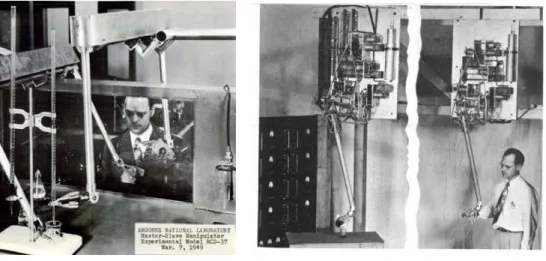
herise of modern-day robotics can be traced back to the late 1940s and the emergence of the nuclear industry [1]. The pressing need for handling dan-gerous radioactive material motivated Raymond Goertz to build the first known master-slave system at the Argonne National Laboratory in 1949 [2]. The master-slave mechanical (MSM) teleoperation system presented by Goertz could grasp and move objects in all six degrees-of-freedom (DoF) and employed a pure mechanical coupling between the master and the slave. During operation, instan-taneous haptic feedback, resulting from the direct mechanical linkage, was received by the human operator behind her/his thick layer of lead glass. Few years later, the Commissariat à l’Énergie atomique et aux Énergies alternatives (CEA) lab, led by Jean Vertut, emerged as a major player in the field presenting significant contribu-tions to MSMs as well [4,5,6]. In parallel, similar teleoperation systems were being employed in applications for particle accelerators [7,8,9]. In fact, MSM teleopera-tion systems proved very efficient over the years and dominated the nuclear industry for a long-time. Surprisingly enough, these systems are still playing a central role in the nuclear industry in our very day.In the 1950s, few years after the introduction of the first MSMs, hydraulic actu-ation and electromechanical servomechanisms brought life to the manipulators we
Haptic-Based Shared Control for Efficient Telemanipulation
are more familiar with today. However, in the absence of ‘computer-control’, these manipulators were manually controlled by human operators without an overlaying logic. They were insensitive to their environment and the control action flew in one direction from the operator to the manipulator with no ‘intelligent’ feedback loops. In fact, this sheds light on the old art of ‘Automata’ blurring the lines of when robotics was actually born. Artisans have perfected complex mechanical systems and impressed the public with dazzling performances for thousands of years [10]. Was Jaquet-Droz’s 18th-century ‘automaton’ writing "Je ne pense pas, ne serais-je donc pas point?"1 a robot?
On the other hand, remotely operated devices have been around since quite some time as well. A boat "incorporating a borrowed mind", as Nicola Tesla described his invention, was presented to the public in 1898. The "borrowed mind", however, was actually Tesla himself as he commanded the boat remotely using radio signals. Several other types of remote-controlled vehicles followed and Tesla hypothesized, ". . . you see there the first of a race of robots, mechanical men which will do the laborious work of the human race." An ‘electric dog’ was later presented by the Naval Research Laboratory in 1923 followed by different remotely piloted vehicles or mechanical creatures along the same lines [13]. Again, non of the above had any ‘intelligence’ or serious computational capabilities.
Alongside these significant advances in machinery, digital computers have started to appear in the late 1930s and were directly used for controlling the early MSM
1"I do not think, do I therefore not exist?"
(a) The first master-slave mechanical sys-tem.
(b) An early electric master-slave system.
Figure 1.1: Early master-slave systems built at the Argonne National Laboratory. Similar systems are still in use in the nuclear industry. Photo courtesy [3].
Figure 1.2: "The writer": A surviving Jaquet-Droz’s automaton from 1774 cur-rently present at the Musée d’Art et d’Histoire of Neuchâtel, in Switzerland. Photo courtesy [11,12].
manipulators. However, the ‘interface’ between the computers and the robot was the human operator himself who did the needed computations on the computer and used the results to manually command to the robot. Heinrich Ernst is arguably the first to have completely removed the human intermediary and given a computer full command over a manipulator [14]. The manipulator used for the experiments was one of the early electromechanical manipulators designed by Raymond Goertz and equipped with tactile sensing. The robot used the tactile sensors to autonomously search for a box on a table. It then searched for cubes on the table, grasped them, and placed them in the box. No previous knowledge of the position of the box or the cubes was needed and the robot could also adapt to changes in the box position during the experiment.
There is no need to stress the impact which computer-controlled systems had on all the aspects of the modern human society and the thousands of robotic applica-tions which resulted from them. However, while robotic autonomy was satisfactory for some applications, it was not sufficient for others and the human intervention
Haptic-Based Shared Control for Efficient Telemanipulation
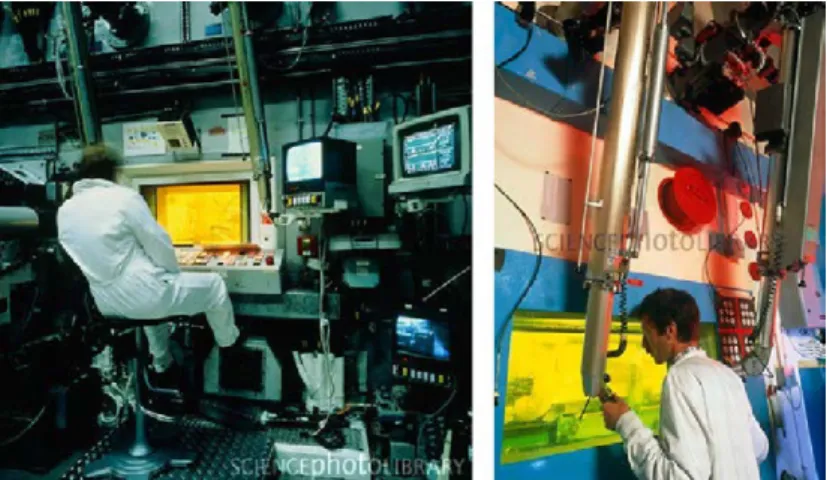
Figure 1.4: Current workspace of the human operator for the sort and segregate application. The operator has to look through a small window to operate the mechanical arms.
was needed. This soon gave rise to new approaches fusing the human intelligence with the precision and efficiency of autonomous systems in the form of human-robot shared-control architectures [1, 13, 15]. Early forms of Human-Robot In-teraction (HRI) experiments, namely supervisory control, were reported by Ferral and Sheridan in [15] and followed by varied contributions ranging from advanced control theoretic methods to teleoperation-oriented software languages, visual en-hancements and hybrid representations [16, 17, 18, 19]. The field evolved slowly over the years and was not established as an independent multi-disciplinary field until the 1990s [13].
1.1
Thesis Overview
This thesis takes inspiration from the rich history of HRI to analyse the relationship between the human operator and autonomous systems. Autonomous controllers are rapidly evolving as a result of advances in hardware capabilities (e.g., depth cam-eras, more efficient sensors, computational power) and software architectures (e.g., vision-based approaches, force control, machine learning, AI). This evolution drives a continuous shift of authority and dependency between the human operator and au-tonomy in HRI systems allowing for a more meaningful interaction between the two and a wider spectrum of applications. In this context, this thesis aims at proposing a variety of shared-control architectures for the different phases of remote telema-nipulation characterized by different levels of autonomy for the robotic component and different ways of providing a feedback to the operator about the task execu-tion and feasibility of her/his commands. Besides the general scientific interest in advancing the state-of-the-art in the shared control field, the work in this thesis is 4
also motivated by the the needs of the European H2020 "Robotic Manipulation for Nuclear Sort and Segregation" (RoMaNS) project2, which has served as a concrete
case study (and societal motivation) for the several proposed shared-control archi-tectures. We then now proceed to briefly summarize the RoMaNS project for also providing some additional context to the thesis contributions.
The consortium of the RoMaNS projects is consisted of five partners: Univer-sity of Birmingham (UK; lead), Commissariat à l’Énergie atomique et aux Éner-gies alternatives (France), Technische Universität Darmstadt (Germany), National Nuclear Laboratory (UK), CNRS (France). The project tackles autonomous, tele-operative and shared control systems for remote manipulation of legacy nuclear waste. Cleaning up the past half century of nuclear waste, in the UK alone, repre-sents one of the largest environmental remediation projects in Europe with 1.4 mil-lion cubic metres [20] of Intermediate Level Waste (ILW) to be processed. Some of this waste have been temporarily stored in containers, many of which have contents of mixed contamination levels, and sometimes unknown contents. These containers may need to be disrupted or cut open, to investigate their contents, before sorted and segregated. On the other hand, vast quantities of highly contaminated decom-missioned plant machinery and infrastructure will have to be demolished, cut and resized, and treated as needed. Much of this work can only be done by remote ma-nipulation methods, because the high levels of radioactive material are hazardous to humans.
Currently, it is proposed that the operators will sort and segregate using manual tele-operation, which in this context is simply using the standard teach pendant or a basic joystick to manually move the robot. There are associated safety, reliability and throughput concerns with this method because the operator is not in close proximity to the robot and must rely upon camera views and/or distorted views through lead glass windows (see Fig. 1.4).
Our contribution at CNRS (Irisa and Inria, Rennes) is notably on:
• Developing efficient visual tracking methodologies for controlling the manip-ulators using visual servoing approaches.
• Developing efficient haptic interfaces and haptic devices which can contribute to a more efficient task execution.
• Developing shared-control approaches with variable levels of autonomy that help the human operator and decrease her/his cognitive load.
Haptic-Based Shared Control for Efficient Telemanipulation
(a)
(b)
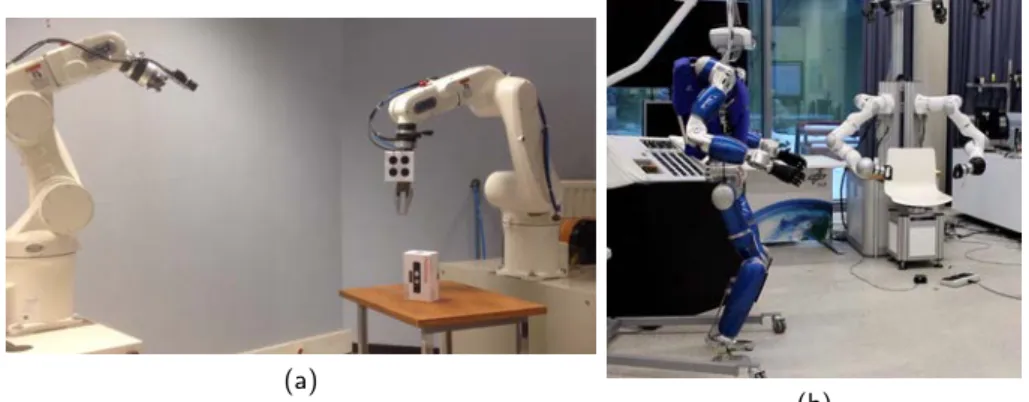
Figure 1.5: Experimental Setup: (a) Two serial manipulators equipped with a grip-per and a camera; (b) TORO, DLR’s torque-controlled humanoid robot.
In particular, this thesis uses visual tracking and control software for proposing innovative visual-based solutions for advanced assisted telemanipulation. It focuses on three main aspects: (i) increasing the efficiency and speed of task execution, (ii) ensuring the safety and security of the system, and (iii) ameliorating the operator’s experience and decreasing her/his cognitive load. To this end, the thesis develops semi-autonomous architectures that can assist the human operator in controlling parts of the system which can be cumbersome to manually/directly control. It builds on existing literature to explore different forms of informative haptic guidance using kinesthetic and cutaneous devices.
1.2
Thesis Structure
The core of this thesis is divided into three main parts. The first part proposes a review of the state-of-the-art and main techniques used in teleoperation and shared control architectures. The second and third parts present instead the original con-tributions of this work in the context of shared control architectures for remote telemanipulation tasks. Two systems are considered: (i) fixed single or dual-arm serial manipulators and (ii) humanoid robots. In the serial manipulators case, the robots are equipped with a gripper to perform the needed manipulation actions and a camera to observe the scene (see Fig. 1.2). In some scenarios, the gripper is installed on one of the manipulators and the camera on the other while in other scenarios the gripper and the camera are both installed on the same manipulator. On the other hand, the humanoid robot used is TORO from DLR, a redundant 31-DoF torque-controlled robot equipped with two humanoid hands (see Fig. 1.2).
Fixed-based manipulators are relevant in our context since they are highly ef-ficient for telemanipulating objects in controlled environments. For instance, the 6
RoMaNS H2020 project offers a prominent example of such a scenario where nu-clear waste from legacy containers is emptied on a table in front of the robot to be sorted and segregated. On the other hand, mobility can be essential for several reasons like the need for a wider workspace of the robot or where an unforeseen human intervention is needed. The Fukushima disaster in Japan is an unfortunate testimony of such a case where existing robotic technology was unable to intervene as needed for shutting down the cores of the nuclear reactor and avoiding the sub-sequent implications [21]. In such cases, the use of a highly articulated “mobile manipulator” such as a humanoid robot is more appropriate, thereby motivating the shared control methods proposed in the thesis for interfacing a human operator with a humanoid robot.
1.2.1 Outline of Part I
In the first part, a review of the state of the art of HRI is proposed. We classify the literature into different categories depending on the level of interaction between the human operator and autonomy and give a brief description of each category. The review focuses on two main categories: (i) Direct Control (e.g., teleoperation) and (ii) Assisted Control (e.g., shared control architectures and variable autonomy). We highlight the different approaches along with their advantages, disadvantages, and technical limitations. This naturally leads us to discussing the impact of mod-ern sensing capabilities, increased computational power, and innovative software architectures on the field.
1.2.2 Outline of Part II
The second part presents the main contributions of the thesis in the context of single and dual serial manipulator arms during the pre-grasp, grasp and post-grasp phases of manipulation. The work presented in this part has been published and presented in [22,23,24,25,26,27,28,29,30,31,32]. In particular:
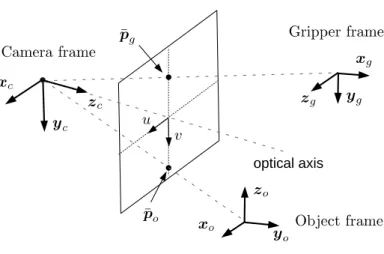
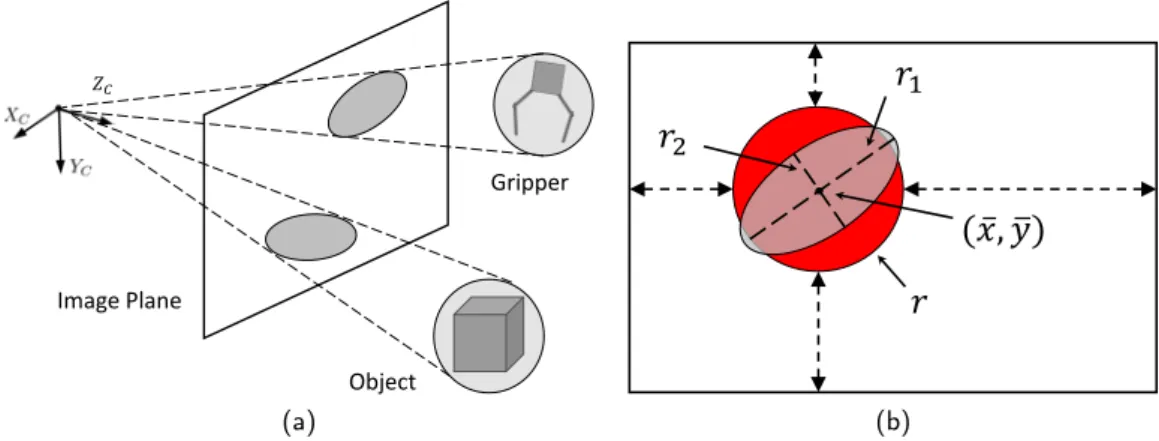
In Chap. 3 we present two visual-based shared-control modalities for allowing a human operator to command a dual-arm system with the objective of approach-ing and graspapproach-ing a target object. One of the manipulators is equipped with a gripper while the other is equipped with a camera. The first modality gives the user instantaneous control over a subset of the system DoF while allowing auton-omy to command the rest (using visual information from the camera). The second modality extends the first one towards a shared-planning architecture in which the operator and autonomy collaborate to modify and optimize the future trajectories of the manipulators (instead of providing instantaneous commands). A simulator
Haptic-Based Shared Control for Efficient Telemanipulation
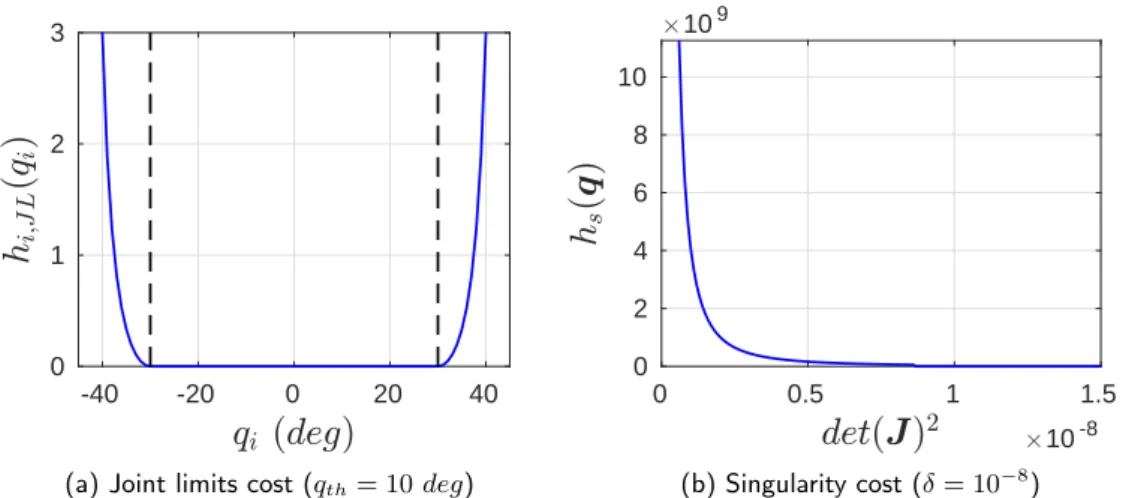
is used to to visualize future trajectories and increase the user’s awareness of the scene through visual markers, colors and augmented objects. In both modalities, an informative haptic feedback informs the user about any system constraint that may prevent a correct execution of the user’s commands. It also guides the user towards safer configurations. We finally present a set of experiments performed to test and validate the proposed approach along with a user study for benchmarking the proposed shared-control architecture against classical teleoperation.
In Chap.4 we extend the ideas introduced in Chap.3towards shared workspaces and cluttered environments. We combine the haptic guidance with shared-control algorithms for autonomous orientation control and collision avoidance meant to further simplify the execution of grasping tasks. Moreover, while the model of the target object was assumed to be known in Chap.3, we hereby employ a depth cam-era to retrieve a point cloud of the scene. The point cloud is then used along with an autonomous grasping algorithm to assist the user towards choosing potentially feasible grasp candidates. On the other hand, we also propose a learning-based shared-control architecture for the online dynamic adjustment of the operator/au-tonomy balance in function of the confidence of auoperator/au-tonomy during the task execution. Relevant experiments and extensive user studies are also presented to test the va-lidity of the proposed architectures and the impact of shared-control on the general performance of the human operator.
In Chap.5 we tackle the post-grasp phase of manipulation, a phase which is usu-ally ignored in shared-control architectures. We propose a novel system in which autonomy assists a human operator in teleoperating a remote slave arm/gripper using a haptic master device. The system is designed to exploit the human opera-tor’s expertise in selecting stable grasps (still an open research topic in autonomous robotics). Meanwhile, an autonomous agent transmits force cues to the human, to encourage maximally manipulable grasp pose selections. We show that following the cues results in significantly reduced control effort of the manipulator, compared to other feasible grasps and demonstrate the effectiveness of the approach by ex-periments with both real and simulated robots.
1.2.3 Outline of Part III
The third part of this work addresses the issues which arise when teleoperating the arms of a humanoid robot like stability and balance. This work described in this part was conducted between January to June of 2018 during the author’s research visit at the German Aerospace Center (DLR) in Oberpfaffenhofen and has been published (or is under review) in [33,34].
In Chap. 6 we present a ‘task-relevant’ haptic interface for humanoid teleopera-tion, which bridges the gap between the task at hand and the balance of the robot. The operator is given command over the humanoid’s hands and is informed through haptic cues about the potential impact of her/his actions on the robot stability. Moreover, a null-space autonomous controller acts in the operator’s null-space to provide her/him with a wider workspace and help in the successful execution of the task. The architecture is designed to top an existing compliance controller for a torque-controlled humanoid robot. Experiments on the humanoid robot TORO are reported to demonstrate the feasibility and effectiveness of the approach.
In Chap. 7 we tackle the issue of humanoid balancing while performing high-force interaction tasks, an essential building block for allowing a human operator to interact freely with the environment when teleoperating such a robot. We present an architecture which extends a passivity-based whole-body balancing framework to guarantee the equilibrium of a humanoid robot while performing different inter-action tasks where the (high) task forces acting on the robot are difficult to foresee. Instead of controlling the center of mass, the proposed controller directly uses in-formation from the Gravito-Inertial Wrench Cone to guarantee the feasibility of the balancing forces. The performance of the approach is validated in a number of successful experimental tests.
1.2.4 Conclusions and Appendices
In addition to the content outlined so far, the thesis also contains an additional conclusive chapter and an appendix.
In Chap. 8 we provide a final overall review of the main results of the thesis while also highlighting some open issues that still remain to be solved. We also propose a certain number of possible extensions to the work presented in this thesis that could be worth investigating. Some of them, are, indeed the subjects of the author’s current research activity.
In Appendix A we include some additional technical details for the derivation of some of the results contained in the thesis. This content is not essential to un-derstand the rest of this work, but it is nevertheless included here for completeness.
1.3
Thesis Publications
• F. Abi-Farraj, N. Pedemonte, and P. Robuffo Giordano, “A visual-based shared control architecture for remote telemanipulation,” in Proc. IEEE/RSJ Int.
Haptic-Based Shared Control for Efficient Telemanipulation
Conf. on Intelligent Robots and Systems, Deajeon, Republic of Korea, 2016.
• N. Pedemonte, F. Abi-Farraj, and P. R. Giordano, “Visual-based shared con-trol for remote telemanipulation with integral haptic feedback,” in Proc. IEEE
Int. Conf. Robotics and Automation, Singapore, 2017.
• F. Abi-Farraj, T. Osa, N. Pedemonte, J. Peters, G. Neumann, and P. Robuffo Giordano, “A learning-based shared control architecture for inter- active task execution,” in Proc. IEEE Int. Conf. Robotics and Automation, Singapore, 2017.
• A. Ghalamzan, F. Abi-Farraj, P. Robuffo Giordano, and R. Stolkin, “Human-in-the-loop optimisation: mixed initiative grasping for optimally facilitating post-grasp manipulative actions,” in Proc. IEEE/RSJ Int. Conf. Intelligent
Robots and Systems, Vancouver, Canada, 2017.
• M. Selvaggio, F. Abi-Farraj, C. Pacchierotti, P. R. Giordano, and B. Siciliano, “Haptic-based shared-control methods for a dual-arm system,” IEEE Robotics
and Automation Letters, vol. 3, no. 4, pp. 4249-4256, Oct 2018.
• F. Abi-Farraj, B. Henze, A. Werner, M. Panzirsch, C. Ott, and M. A. Roa, “Humanoid Teleoperation using Task-Relevant Haptic Feedback,” in Proc.
IEEE/RSJ Int. Conf. Intelligent Robots and Systems, Madrid, Spain, Oct.
2018.
• F. Abi-Farraj, C. Pacchierotti, and P. Robuffo Giordano, “User evaluation of a haptic-enabled shared-control approach for robotic telemanipulation,” in
Proc. IEEE/RSJ Int. Conf. Intelligent Robots and Systems, Madrid, Spain,
2018.
• F. Abi-Farraj, B. Henze, , C. Ott, P. Robuffo Giordano, and M. A. Roa, “Torque-based balancing for a humanoid robot performing high-force inter-action tasks,” IEEE Robotics and Automation Letters, Under consideration for publication.
• F. Abi-Farraj, C. Pacchierotti, O. Arenz, G. Neumann, and P. R. Giordano, “A haptic shared-control architecture for guided robotic grasping in unknown environments,” IEEE Transactions on Haptics, Under consideration for pub-lication.
• F. Abi-Farraj, R. Spica, and P. Robuffo Giordano, “Trajectory-Based Shared Control for TeleManipulation,” in IEEE Transactions on Control Systems
Technology, Under consideration for publication.
• F. Abi-Farraj, R. Spica, and P. Robuffo Giordano, “Trajectory-based shared control with integral haptic feedback,” in IEEE/RSJ Int. Conf. on Intelligent
Robots and Systems Workshop: Human in-the-loop robotic manipulation: on the influence of the human role, Vancouver, Canada, Oct. 2017.
• F. Abi-Farraj, R. Spica, and P. Robuffo Giordano, “Trajectory-based shared control with integral haptic feedback,” in 10th Int. Workshop on Human
Friendly Robotics, Naples, Italy, Nov. 2017.
• F. Abi-Farraj, C. Pacchierotti, and P. Robuffo Giordano, “Human-subject evaluation of shared-control approaches for robotic telemanipulation,” in IEEE/RSJ
Int. Conf. on Intelligent Robots and Systems Workshop: Human in-the-loop robotic manipulation: on the influence of the human role, Vancouver, Canada,
Oct. 2017.
• F. Abi-Farraj, C. Pacchierotti, and P. Robuffo Giordano, “Human-subject evaluation of shared-control approaches for robotic telemanipulation,” in 10th
Preliminaries and State of the
Art
State of the Art
Contents 2.1 Manual Control . . . 18 2.1.1 Teleoperation . . . 18 2.1.2 Telepresence. . . 19 2.1.3 Haptic Interfaces . . . 19 2.1.4 Teleoperation Limitations . . . 21 2.2 Supervisory Control . . . 23 2.3 Assisted Control . . . 24 2.3.1 Adaptability. . . 25 2.3.2 Domains of Application . . . 26 2.3.3 Partition of the Control Space. . . 27 2.3.4 Human Authority vs Haptic Autonomy . . . 29 2.3.5 Control Level . . . 31 2.4 Collaborative Robotics . . . 32 2.5 Peer-to-Peer Collaboration . . . 33 2.6 Conclusions . . . 33A
utomation is the process by which a particular system is controlled us-ing sensory information without any human assistance. From the house-hold thermostat controlling a boiler to large industrial control systems with thousands of sensor measurements and output control signals, autonomy is an essential component of every aspect of modern life with a very wide range of applications. In robotics, autonomy has revolutionized dummy mechanical systems and equipped them with the long sought ‘logic’ in forms of basic or highly com-plicated feedback-control loops. However, while advancements in robot autonomyHaptic-Based Shared Control for Efficient Telemanipulation
have flourished in structured environments, serious limitations have hindered a sim-ilar progress in unstructured settings where the presence of a human operator is often still necessary.
Human-Robot Interaction (HRI), as defined by Goodrich and Schultz [13] is "a field of study dedicated to understanding, designing, and evaluating robotic systems for use by or with humans." In fact, even the most autonomous systems are operated by humans and used to fulfil a certain human need which makes a minimal interaction between the human and the machine indispensable. However, HRI is more concerned with the cases in which a continuous interaction between the human and the machine is needed.
Different robotic applications require different forms of interaction which can range from social interaction to physical interaction, remote control, assistive-control or supervisory control. Social HRI can be distinguished from other forms of HRI in that it focuses on the human experience itself rather than the efficient fulfilment of the task at hand. It is more concerned with the cognitive, social and emotional aspects of the interaction. However, as the focus of the thesis is on the technical rather than social aspect of the interaction, social HRI is omitted from the presented review.
With autonomy being a mean in HRI and not a goal in itself, the level of au-tonomy varies widely from one application to another. Different descriptions of the levels of autonomy have been proposed in literature. The most widely cited descrip-tion is by Tom Sheridan [35]. Sheridan’s scale ranges from the robotic system being fully commanded by an operator to being completely autonomous. The different levels are defined as follows:
1. Computer offers no assistance; human does it all. 2. Computer offers a complete set of action alternatives. 3. Computer narrows the selection down to a few choices. 4. Computer suggests a single action.
5. Computer executes that action if human approves.
6. Computer allows the human limited time to veto before automatic execution. 7. Computer executes automatically then necessarily informs the human. 8. Computer informs human after automatic execution only if human asks. 9. Computer informs human after automatic execution only if it decides too. 16
10. Computer decides everything and acts autonomously, ignoring the human. Several variations of this scale have been proposed by different authors [36] while others argued that it is most useful when applied to each subtask within a problem domain but not on the entire problem domain itself [37]. However, and while the scale gives a significant insight on how autonomous a robotic system is, the level of interaction between the machine and the human operator is of more significance in HRI. On one extreme, the operator is in full control of the system with no input from autonomy and very limited human-robot interaction. On the other extreme, the system is fully autonomous and interacting with the human operator on a peer-to-peer basis. Inspired from the scale presented in [13], we classify the different HRI approaches as follows:
• Manual Control – The human is in full control of the robot DoF with no autonomy present in the robotic system (e.g., basic 6-DoF master-slave manipulators).
• Supervisory Control – The human is not in control of particular DoF of the system. She/He picks and chooses from a set of pre-defined subtasks which the system executes autonomously (e.g., Mars Rovers are controlled in a supervisory control mode because of the large time delay between the Earth and Mars preventing any instantaneous communication).
• Assisted Control – The human operator can be in partial or full control of the system but she/he is assisted by autonomy throughout the task execution (e.g., an operator commanding a fleet of UAVs where the particular position of each is decided by autonomy while the general behaviour of the fleet is commanded by the operator).
• Collaborative Robotics – The robotic system has the capabilities for a nearly-autonomous task execution but follows the lead of the human oper-ator in a high-level master-slave hierarchy. Unlike supervisory control, the operator is here fully immersed in the task execution hand-in-hand with the autonomous system (e.g., a robot assisting a human operator in carrying a heavy load).
• Peer-to-peer collaboration – The system is fully autonomous and mini-mally operated by a human (Turning it on and off, maintenance, and so on). The interaction between the operator and the fully autonomous machine may be on a peer-to-peer basis.
Haptic-Based Shared Control for Efficient Telemanipulation
(a) (b)
Figure 2.1: (a) Position/Velocity controlled manipulators placed in a cage and tele-operated by a human operator. Photo courtesy [38]. (b) A human operator inter-acting physically with a lightweight robot. Photo courtesy [39].
We will now provide a summary of the state of the art of each of the described categories with more elaboration on Shared Control approaches which are the focus of the thesis.
2.1
Manual Control
Manual Control refers to robotic systems which are fully controlled by a human operator. While the command-feedback loop between the operator and the machine is continuous in this scenario, the dynamic interaction between the two is limited because of the lack of autonomy of the machine which operates in a totally passive manner. The most prominent example of direct control is Teleoperation or the operation of vehicles, manipulators and other machines at a distance. However, the notion of ‘distance’ here is flexible. Historically, robots working in close proximity to humans have been separated from them with cages or other forms of barriers for safety concerns. It can be thus argued that all manually-controlled robots were ‘teleoperated’ using some form of input device or teach pendant. This changed in recent years especially with the introduction of lightweight manipulators which brought robots out of their cages (Fig.2.1) and allowed for direct physical interaction between the robot and the operator. Such manipulators can be manually controlled as well and may fit under this label.
2.1.1 Teleoperation
As discussed in chapter1, the need to manipulate nuclear waste without exposing a human operator to radioactivity was the major drive behind modern-day robotics. Other early motives included remotely piloting bombers during World War II and 18
the desire to create remotely controlled vehicles and mechanical creatures for enter-tainment purposes. The development of proper communication channels for remote control and the human desire to explore dangerous and far-reached territories al-lowed teleoperation systems to spread rapidly to new fields such as space [40, 41] and deep ocean exploration [42,43].
Teleoperation is also central in miniature manipulation for micro robotics and medical applications. Minimally invasive surgeries revolutionized the medical field allowing for new efficient procedures which drastically decreased the recovery time of the patients and decreased the complexity of the operations for the surgeons. One of the best known surgical systems is the da Vinci Robot. It scales the surgeon’s actions over a very small communication-delay enhancing the performance for a variety of laparoscopic surgeries [44].
2.1.2 Telepresence
Telepresence is a main aspect of teleoperation were the operator receives audiovi-sual and, uaudiovi-sually, haptic feedback from the remote site. While a certain level of telepresence is needed for any long-distance manipulation to be feasible, telepres-ence may be an end in itself as well. Different applications include teleconferencing, search and rescue missions, intelligence, surveillance-related missions and many oth-ers. While a basic camera-monitor combination creates some sense of telepresence, more sophisticated systems are sought to provide the user with a better experience. The teleoperated robot can, for example, follow the head movements of the user and provide her/him with visual feedback over simple monitors, a head-mounted display or a more complex telepresence system. Similarly, audio feedback can be provided to the user through a regular speaker or a stereo sound system depending on the operator’s need for the audio feedback and its value for the task at hand. Experiments on teleoperating a mine drill machine for example proved that an ac-curate transmission of the sound is extremely valuable in such applications [44]. On the other hand, haptic feedback is also believed to play an important role in transmitting a sense of presence to the human operator. The field has taken a lot of attention since the emergence of early teleoperation systems and several haptic interfaces have been proposed.
2.1.3 Haptic Interfaces
Haptic feedback is provided to the human operator through kinesthetic and cuta-neous stimuli. Kinesthetic stimuli provide humans with information about the ap-plied forces and torques as well as the position and velocity of neighbouring objects (through sensing collisions). They are detected by means of receptors in muscles
Haptic-Based Shared Control for Efficient Telemanipulation
and joints like muscle spindles, which transduce muscle stretch, and Golgi tendon organs, which sense change in muscle tension [45,46]. On the other hand, cutaneous stimuli are felt by mechanoreceptors in the skin and provide the user information about the local properties of objects such as shape, edges, and texture. The human brain analyses measures of the location, intensity, direction, and timing of contact forces on the fingertips for exploration and manipulation purposes [47,48]. A wide variety of haptic devices have been proposed over the years for providing the user with the desired haptic experience of the remote environment. They range from the more conventional kinesthetic and cutaneous devices [47] to the less popular touchable [49] or even ultrasound [50] variations.
Kinesthetic haptic devices represent the bulk of haptic research in terms of device design and rendering algorithms. A kinesthetic haptic device provides a force at its end-effector by applying forces and torques over its joints. The provided force can be a full 6 DoF force tensor or a simple 1 DoF force depending on the design of the device. Fig. 2.2 depicts two examples of a dual-arm and a single-arm kinesthetic haptic devices. In a teleoperation scenario, kinesthetic feedback is used to block or influence the motion of the human operator by mapping the haptic interactions of the slave manipulator with the environment (ex. collisions and friction). This information is valuable for the exploration and manipulation of the remote environment. Moreover, while kinesthetic haptic feedback focuses on the forces the operator is receiving in her/his muscles and joints, it also stimulates the skin through the held tool, effectively providing cutaneous feedback in addition to the actively controlled kinesthetic feedback. In addition to the kinesthetic and implicit cutaneous stimuli, vibratory stimuli can be rendered through kinesthetic devices as well to reflect the vibrations we feel during collisions for example or to reflect the urgency of the message or the identity of the sender [51].
Pure cutaneous feedback is based on applying a shear or vibratory force on the user’s skin to induce skin deformations. The idea is to mimic the skin deformations that naturally occur during haptic interaction especially on the finger tips which are more sensitive to shear forces than to normal forces [54]. Cutaneous haptic devices vary but are usually wearable and focused on the finger tips of the hand. Other cutaneous devices were proposed for other parts of the body like the wrist and the forearm [55], the back [56] or the legs [57]. However, in a classical teleoperation approach, finger tips cutaneous devices (see Fig.2.3) are the most popular [58,47,
51].
In addition to teleoperation, haptic interfaces can be used in Virtual Reality (VR) and Augmented Reality (AR) applications to enhance the virtual experience. Indeed, the immersive experience is missing if the user doesn’t receive haptic stimuli when manipulating objects in the virtual environment. Moreover, the rich possi-20
(a) (b)
Figure 2.2: Examples of kinesthetic haptic devices. (a) HUG, a dual-arm kinesthetic haptic device built by DLR. Photo courtesy [52]. (b) Virtuous 6D, a 6-DoF haptic device by haption [53].
Figure 2.3: Cutaneous Feedback of Fingertip Deformation and Vibration tested for Palpation in Robotic Surgery with the da Vinci robot. Photo courtesy [59].
bilities of visual rendering can be used to enhance the haptic experience in such scenarios [51]. Visuo-haptic illusions seek to use the dominance of the visual experi-ence and haptic illusions to enhance the haptic experiexperi-ence itself. It has been used to augment the cutaneous haptic feedback for increased stiffness rendering [60], to al-ter the perception of rotational alignment [61] or to influence the haptic perception of bumps and other features on a surface [62].
2.1.4 Teleoperation Limitations
Teleoperation is a field which dates back to the foundation of robotics itself and a massive amount of literature has been written on the subject tackling the different issues which face teleoperation systems and proposing solutions and novel ideas for more robust and efficient teleoperation and, especially, haptic rendering. For general reading on the topic, we refer the reader to the several surveys available in the literature and notably [63] and [64].
There are several design parameters that can be taken into account when de-signing a teleoperation system and a trade-off is often necessary. Typical objectives
Haptic-Based Shared Control for Efficient Telemanipulation
are robustness, feeling of presence, task performance, and stability. 2.1.4.1 Stability Issues
The main control issue in bilateral teleoperation is the stability of the closed-loop system despite unmodelled dynamics and faulty communication channels. In de-signing the bilateral controller, a classic engineering tradeoff between transparency and stability is unavoidable, since transparency must often be reduced in order to guarantee stable operation in the wide range of environment impedances (for exam-ple, in terms of stiffness of “free space” and “hard contact”). Enforcing stability has actually motivated the development of many different control schemes over the past decades. A thorough survey of control solutions proposed in literature to counteract these issues (dating back to 2006) is available in [63] and summed up nicely in [44].
Among the many approaches to teleoperation stability, passivity-based approaches have become very popular over the last decades. Early approaches used passivity ideas for the stable control of force-feedback-enabled teleoperation systems with time delay [65,66] and for deriving fixed parameter virtual couplings [67]. Passivity is a sufficient condition for assuring a stable teleoperation system and it has some attractive features:
• it employs intuitive energy concepts: a system is passive if and only if the energy flowing out of the system is less than the energy flowing in at all time. • individual passive blocks can be easily composed in different ways for obtaining
a guaranteed global passive system. • it applies to linear and non-linear systems.
• it can be assumed that the human operator is a passive system at frequencies of interest, which, under the assumption of a passive environment, allows to conclude stability of the complete closed-loop teleoperation system.
Later in [68], the authors proposed a control scheme based on the wave vari-ables where they introduced an energy input/output balance monitoring mecha-nism which limits the energy that the system can generate. The concept of ‘en-ergy tanks’ have since been popular for assuring the stability of the teleoperated system [69, 70, 71, 72]. The time domain definition of passivity have also been exploited for ensuring stability [73, 74, 75,76]. In [73], an adaptive virtual damp-ing is introduced to satisfy the passivity constraints. The framework is extended in [74] to a 2-port network, and the issues in implementing the passivity observer (PO) and passivity controller (PC) to teleoperation systems are studied. A more 22
accurate PO/PC approach is proposed in [75] after introducing a new sampled-time definition of passivity.
Lately, a general and flexible framework, the passive set-position modulation (PSPM) approach, has been presented in [77]. The framework allows for connecting a (continuous-time) multi-DOF nonlinear robotic system to a sequence of (discrete-time) set-position signal via a simple spring coupling with damping injection. The algorithm modulates the original set-position signal in such a way that the modu-lated signal is as close to the original signal as possible (i.e., maximum information recovery for better performance), yet only to the extent permissible by the available energy in the system (i.e., passivity constraints).
A major limitation in teleoperation is also the hardware itself. The availability of convenient high-quality sensors on the slave side and the presence of efficient master devices capable of mapping the sensory information to the master is crucial. For example, tactile sensors are still very sensitive, expensive and limited in capabilities. Moreover, limitations on the master side are even more significant especially for haptic rendering. While kinesthetic haptic devices are relatively efficient, rendering tactile sensing on the human skin is tricky. Some devices are available for local rendering of tactile sensing (on finger-tips for example) but a fully immersive haptic experience is still at far-reach.
2.2
Supervisory Control
Supervisory control or human supervisory control is a form of high-level teleoper-ation where the master and the slave are loosely connected. The machine at the slave side exhibits a certain level of autonomy and is capable of carrying a limited series of actions on its own. It sends sensory information back to the human op-erator who updates/modifies the instructions as necessary. The level of autonomy of the slave side in such scenarios is quite high and the interaction with the human operator is limited. Supervisory control is common in performing routine tasks like handling parts on manufacturing assembly lines and accessing and delivering packages, components, mail, and medicines in warehouses, offices, and hospitals [1]. It is also common in remote environments like space where direct control is not possible due to long time delays. Examples include early successes of the Soviet Lunokhods [43] and later experimentation with ROTEX on-board spacelab D2 on shuttle COLUMBIA [78] and NASA’s Mars rovers [79,80].
A significant volume of the literature on supervisory control dates back to the 1980s and early 1990s. At the time, supervised robots were commanded by updat-ing the computer commands controllupdat-ing them online usupdat-ing a specific programmupdat-ing language. To this end, several authors proposed teleoperation-oriented software
lan-Haptic-Based Shared Control for Efficient Telemanipulation
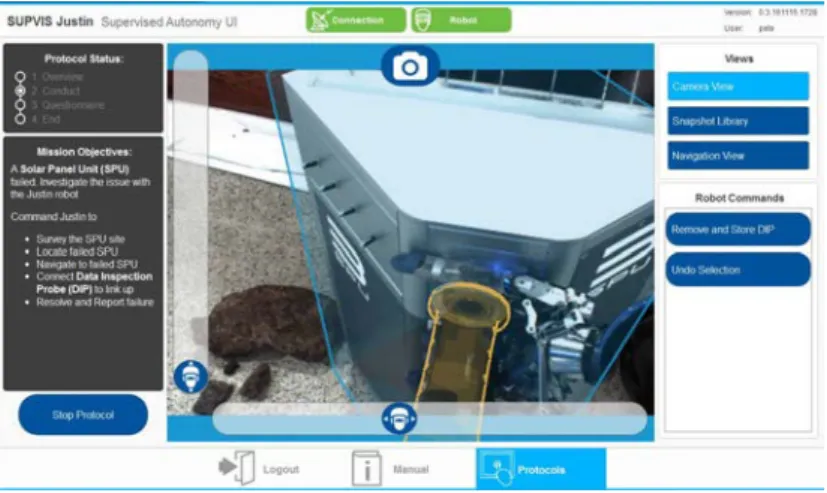
Figure 2.4: The tablet interface used in the SUPVIS Justin experiment. A rich graphical interface with augmented reality overlays allow for an easy and user-friendly experience of supervisory teleoperation. Photo courtesy [83].
guages to facilitate the task for the operator [16,81]. Other enhancements tackled visual interfaces using predictive display [82], advanced control methods such as Lyapunov-based analysis [17] and hybrid representation [18].
Lately, the availability of richer and advanced graphic tools allowed for more user-friendly supervisory control interfaces. A recent example is DLR and ESA’s METERON project where a wheeled humanoid robot, Rollin’ Justin, is controlled by astronauts in the International Space Station to perform some operations like wiping a solar panel or plugging and unplugging cables. A tablet interface (Fig.2.4) was used for the experiments allowing for a richer experience with easy and straight-forward operation modes [83].
2.3
Assisted Control
Assisted control encompasses a wide spectrum of control techniques including vir-tual fixtures, haptic shared control, semi-autonomous systems, shared control and human-to-multi-robot systems. An interesting metaphor explaining assisted control is proposed in [84]. The metaphor is the following. “Imagine to be riding a bike and not knowing where to go. In order to look at the map, you need to stop. Would it be possible to do both actions (riding and reading) and the same time? Yes, if riding a Horse.” A horse can avoid obstacles, keep balance and maintain a sense of direction even if the rider is not looking. Different forms of autonomous assistance exist. In a typical scenario, the user is operating a robotic system and can receive assistance in the form of:
• Visual feedback (e.g. proposing alternative solutions or highlighting a con-24


![Figure 3.12: Results of the second experiment. (a) behavior of the primary task s(t); (b) behavior of the gripper and object positions p = [p T g p To ] T on the image plane; (c) Behavior of the four operator’s commands λ for actuating the null-space direc](https://thumb-eu.123doks.com/thumbv2/123doknet/14493659.718020/100.892.190.666.202.881/results-experiment-behavior-behavior-positions-behavior-operator-actuating.webp)