CONCISE ARTICLE
Variability of SCC
mec in the Zurich area
M. Ender&S. Burger&A. Sokoli&R. Zbinden& B. Berger-Bächi&R. Heusser&M. M. Senn& N. McCallum
Received: 30 July 2008 / Accepted: 22 October 2008 / Published online: 26 November 2008
# Springer-Verlag 2008
Abstract A periodic survey of methicillin-resistant Staph-ylococcus aureus (MRSA) in Zurich in 2004 and 2006 revealed a consistently low prevalence of MRSA. SCCmec and ccr typing showed fluctuations in the proportions of SCCmec types and in the carriage of mobile virulence determinants. Together with the presence of variant SCCmecs these findings suggest a high clonal diversity and level of SCCmec recombination. The prevalence of a local “drug clone”, associated with low-level methicillin resistance and rapid growth, significantly decreased. This clone had spread among intraveneous drug users, steadily increasing from 1994 to 2001 and was dominant in 2001. Apparently, changes in the management of the Zurich drug scene have restricted the spread of this clone.
Introduction
Methicillin-resistant Staphylococcus aureus (MRSA) were first reported only one year after introduction of the penicillinase-resistant antibiotic methicillin into clinical use and have since become an increasing worldwide problem [12]. Initially, MRSA were restricted to hospitals and sites of high antibiotic use, where they accumulated additional resistances and became multiresistant to all
commonly used antibiotics. Recently, however, nonmulti-resistant MRSA clones with lower oxacillin resistance levels, but apparently higher virulence, have emerged and begun spreading within the community and into hospitals [2,5,17,18].
Methicillin resistance is based on the acquisition of an additional penicillin-binding protein (PBP), PBP2a, which has a lower affinity forβ-lactams than the cells’ own PBPs. Staphylococci differ in their ability to accept PBP2a for unknown reasons [13]. The restriction of MRSA to specific genetic backgrounds is also reflected by the observation that MRSA have generally evolved separately and some-times even repeatedly into only five of the main 11 distinct epidemic susceptible S. aureus lineages [22]. Methicillin resistance thus depends on both the production of PBP2a and on the genetic composition of the core genome. Strain-specific resistance levels are therefore dictated by the host strain’s genetic background and can vary extensively from extremely low (<1 μg/ml) to very high (>1000 μg/ml) oxacillin minimum inhibitory concentrations (MICs) [1].
The mecA gene, coding for PBP2a, is localized on the staphylococcal chromosomal cassette SCCmec, a unique genomic island, which integrates into the staphylococcal genome [8]. The mecA gene and its cognate regulatory elements mecI-mecR1 form the mec complex. In some strains the regulatory genes mecI-mecR1 may be truncated by insertion elements, giving rise to different mec complex loci. The other feature common to all SCCmec elements is the ccr locus, which encodes recombinases responsible for the site-specific integration and excision of SCCmec [9]. While the ccr genes from different SCCmec elements show sequence polymorphisms, the mecA gene is highly con-served. SCCmec elements vary to a great extent in size, due to additional resistance determinants, plasmids, transpo-sons, IS elements, and genes unrelated to resistance. The Electronic supplementary material The online version of this article
(doi:10.1007/s10096-008-0663-7) contains supplementary material which is available to authorized users.
M. Ender
:
S. Burger:
A. Sokoli:
R. Zbinden:
B. Berger-Bächi:
R. Heusser:
M. M. Senn:
N. McCallum (*)Institute of Medical Microbiology, University of Zurich, Gloriastrasse 32,
8006 Zurich, Switzerland e-mail: [email protected]
classification of SCCmec elements is based on the allotype of the mec and ccr complex as well as the presence of selected loci unrelated to methicillin resistance [19], which has lead to the identification of six major SCCmec types [10, 11, 14]. A new nomenclature has been proposed to accommodate novel and divergent SCCmec types [3]. The older, hospital-associated SCCmec types I, II, and III are generally larger due to the accumulation of unrelated resistance determinants and other extraneous DNA into the SCCmec element. The emerging community MRSA, with smaller SCCmec elements of type IV, V, or VI, are generally only oligoresistant, express lower methicillin resistance, and grow faster, which appears to give them a fitness advantage. Interestingly, the smaller SCCmec types have entered more diverse strain lineages than the larger types [21, 23], possibly due to increased mobility, or to a lower fitness burden associated with their typically lower/ heterogeneous methicillin resistance.
The convergence of methicillin resistance with virulence is a dangerous development, especially if combined in rapidly growing strains. Examples include the acquisition of the arginine catabolic mobile element (ACME) associ-ated with SCCmec [6], or the phage transmitted pvl genes [24] that are connected to many community-acquired MRSA (CA-MRSA). A particularly successful clone is strain USA300, which is spreading at a tremendous rate in the United States [15].
In recent years the prevalence of MRSA in the 920-bed University Hospital in Zurich had remained relatively low at approximately 3–6%. An epidemiological study per-formed in 2003 showed that about 30% of the MRSA isolates collected had low oxacillin MICs (43% had MIC≤ 6 μg/ml) [20]. The majority belonged to a local MRSA clone spreading among intravenous drug users in the Zurich area. This particular “drug clone” appeared in 1994 and steadily proliferated, culminating in 2001 and remaining at quite a high level until 2004 when it constituted over 25% of all MRSA isolated [20]. The drug clone carries the novel SCCmecN1 element, containing a mecB complex and the
dfrA and fusB1 genes coding for trimethoprim and fusidic acid resistance, respectively. It also contains two almost identical ccrAB4-like complexes that are similar to previ-ously described ccrAB4 complexes, and a core genome belonging to the successful Berlin CC45 clone [7,20]. The very low level methicillin resistance of the drug clone is paired with extremely rapid growth; therefore, we were concerned that this clone may spread beyond its confined circle and acquire additional resistance determinants or virulence factors over time. To follow its fate 56 consec-utive, non-duplicate MRSA isolates collected from April to December 2004 (referred to as 2004), mainly from the University Hospital in Zurich, and 55 isolates from June 2006 to February 2007 (referred to as 2006) were analysed.
Materials and methods
Polymerase chain reaction (PCR)
Specific primers were used to amplify pvl (PVL lukS fwd 5′-GTAAAATGTCTGGACATGATCCA-3′, PVL lukF rev 5′-CAACTGTATTGGATAGCAAAAGC-3′), tst (TSST up CCCTGTTCCCTTATTATCTA-3′, TSST down TTCCTTCGCTAGTATGTTGG-3′), and arcA (arcA+ 5′-GAGCCAGAAGTACGCGAG-3′, arcA- 5′-CACGTAA CTTGCTAGAACGAG-3′).
Susceptibility testing
Resistance levels for ciprofloxacin, chloramphenicol, tri-methoprim, gentamicin, tetracycline, rifampin, fusidic acid, and the MLS antibiotics clindamycin and erythromycin were determined by disk diffusion according to CLSI [4], and oxacillin MICs were obtained by Etest (AB-Biodisk). SCCmec typing
Isolates were typed according to Oliveira et al. [19]. ccr typing was performed as described previously [7,20].
Pulsed-field gel electrophoresis
Strains were genotyped by pulsed-field gel electrophoresis of SmaI-digested chromosomal DNA, following the proto-col given in [20].
Spa typing
spa sequence typing was performed using the Ridom StaphType spa-sequencing protocol (http://www.ridom.de/ doc/Ridom_spa_sequencing.pdf) and the Ridom SpaServer to identify repeats and assign spa types (http://spaserver2. ridom.de/index.shtml).
Results and discussion
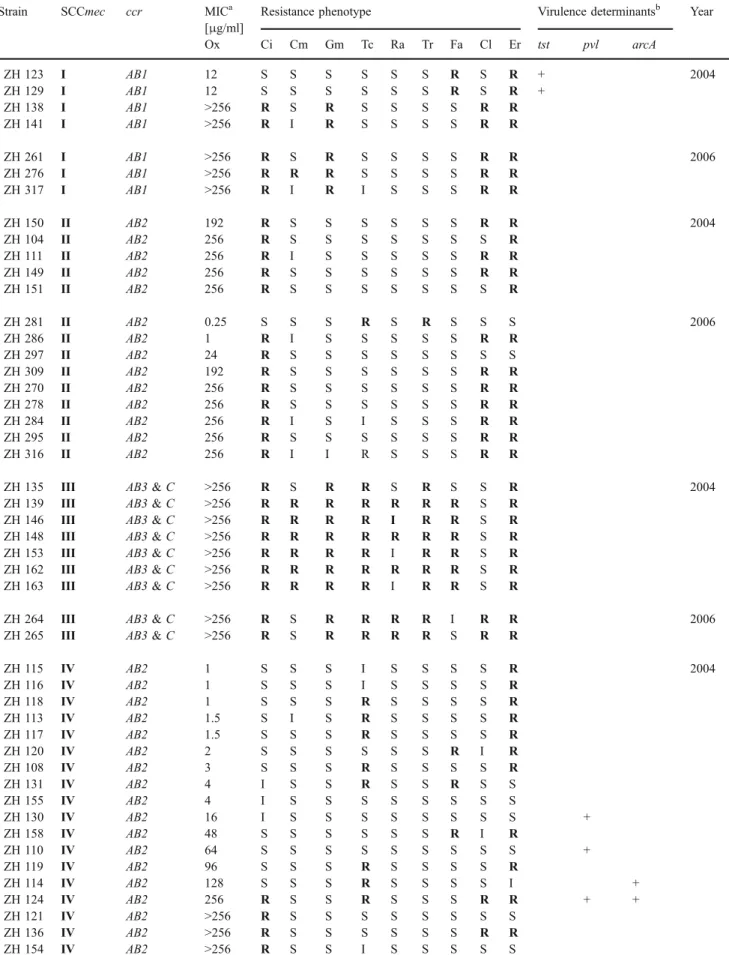
MRSA isolates were characterised and grouped according to their SCCmec typing profile and their ccr type. Antibiotic resistance levels to ciprofloxacin, chloramphen-icol, trimethoprim, gentamicin, tetracycline, rifampin, fusi-dic acid, and MLS antibiotics were measured and oxacillin MICs were determined. Isolates were also screened for the presence of pvl, tst, and arcA by PCR. Unexpectedly, a rather large proportion of MRSA from the second collec-tion period seemed to be unstable and 12 strains lost the mecA gene during storage at −80 °C. Eleven of these strains appeared to have lost their entire SCCmec elements, as they
Table 1 Characteristics of the analysed MRSA isolates grouped according to their SCCmec types Strain SCCmec ccr MICa
[μg/ml]
Resistance phenotype Virulence determinantsb Year
Ox Ci Cm Gm Tc Ra Tr Fa Cl Er tst pvl arcA ZH 123 I AB1 12 S S S S S S R S R + 2004 ZH 129 I AB1 12 S S S S S S R S R + ZH 138 I AB1 >256 R S R S S S S R R ZH 141 I AB1 >256 R I R S S S S R R ZH 261 I AB1 >256 R S R S S S S R R 2006 ZH 276 I AB1 >256 R R R S S S S R R ZH 317 I AB1 >256 R I R I S S S R R ZH 150 II AB2 192 R S S S S S S R R 2004 ZH 104 II AB2 256 R S S S S S S S R ZH 111 II AB2 256 R I S S S S S R R ZH 149 II AB2 256 R S S S S S S R R ZH 151 II AB2 256 R S S S S S S S R ZH 281 II AB2 0.25 S S S R S R S S S 2006 ZH 286 II AB2 1 R I S S S S S R R ZH 297 II AB2 24 R S S S S S S S S ZH 309 II AB2 192 R S S S S S S R R ZH 270 II AB2 256 R S S S S S S R R ZH 278 II AB2 256 R S S S S S S R R ZH 284 II AB2 256 R I S I S S S R R ZH 295 II AB2 256 R S S S S S S R R ZH 316 II AB2 256 R I I R S S S R R
ZH 135 III AB3 & C >256 R S R R S R S S R 2004
ZH 139 III AB3 & C >256 R R R R R R R S R
ZH 146 III AB3 & C >256 R R R R I R R S R
ZH 148 III AB3 & C >256 R R R R R R R S R
ZH 153 III AB3 & C >256 R R R R I R R S R
ZH 162 III AB3 & C >256 R R R R R R R S R
ZH 163 III AB3 & C >256 R R R R I R R S R
ZH 264 III AB3 & C >256 R S R R R R I R R 2006
ZH 265 III AB3 & C >256 R S R R R R S R R
ZH 115 IV AB2 1 S S S I S S S S R 2004 ZH 116 IV AB2 1 S S S I S S S S R ZH 118 IV AB2 1 S S S R S S S S R ZH 113 IV AB2 1.5 S I S R S S S S R ZH 117 IV AB2 1.5 S S S R S S S S R ZH 120 IV AB2 2 S S S S S S R I R ZH 108 IV AB2 3 S S S R S S S S R ZH 131 IV AB2 4 I S S R S S R S S ZH 155 IV AB2 4 I S S S S S S S S ZH 130 IV AB2 16 I S S S S S S S S + ZH 158 IV AB2 48 S S S S S S R I R ZH 110 IV AB2 64 S S S S S S S S S + ZH 119 IV AB2 96 S S S R S S S S R ZH 114 IV AB2 128 S S S R S S S S I + ZH 124 IV AB2 256 R S S R S S S R R + + ZH 121 IV AB2 >256 R S S S S S S S S ZH 136 IV AB2 >256 R S S S S S S R R ZH 154 IV AB2 >256 R S S I S S S S S
Table 1 (continued)
Strain SCCmec ccr MICa
[μg/ml]
Resistance phenotype Virulence determinantsb Year
Ox Ci Cm Gm Tc Ra Tr Fa Cl Er tst pvl arcA ZH 313 IV AB2 1.5 S S S S S S S S S + 2006 ZH 282 IV AB2 3 S S S S S S S S S ZH 268 IV AB2 6 S I S S S S S S S ZH 314 IV AB2 24 I I S R S I R S S + ZH 304 IV AB2 64 S I I S S S S S I ZH 285 IV AB2 128 S S S S S S S S S ZH 263 IV AB2 256 R S S S S S S S R ZH 271 IV AB2 256 R S S S S S S S R + + ZH 312 IV AB2 256 R S S R S S S I R + ZH 262 IV AB2 >256 R S S R S S I S R ZH 266 IV AB2 >256 S S S S S R S S R ZH 272 IV AB2 >256 R S S S S S S S R ZH 274 IV AB2 >256 I S S S S S S S R ZH 275 IV AB2 >256 S S S S S S S S S ZH 279 IV AB2 >256 R S S S S S S S R ZH 283 IV AB2 >256 R S S S S S S S R ZH 291 IV AB2 >256 R S S S S S R S R + ZH 294 IV AB2 >256 R S S S S S I S R ZH 310 IV AB2 >256 R S S S S S I S S ZH 137 N1 AB4 1.5 R S S S S R R S S 2004 ZH 144 N1 AB4 1.5 R I S I S R R S S ZH 145 N1 AB4 1.5 R I I S S R R S S ZH 161 N1 AB4 1.5 R S I S S R R S S ZH 122 N1 AB4 2 R S S S S R R S S ZH 126 N1 AB4 2 R S S S S R R S S ZH 127 N1 AB4 2 R S S S S R R S S ZH 103 N1 AB4 3 R S S S S R R S S ZH 105 N1 AB4 3 R S S S S R R S S ZH 109 N1 AB4 3 S S S S S R R S S ZH 125 N1 AB4 3 R S S S S R R S S ZH 147 N1 AB4 3 R S S S S R R S S ZH 107 N1 AB4 4 S S S S S R R S S ZH 128 N1 AB4 4 R S S S S R R S S ZH 132 N1 AB4 4 S S S S S R R S S ZH 106 N1 AB4 6 S S S S S R R S S ZH 112 N1 AB4 6 R S S S S R R S S ZH 277 N1 AB4 1.5 R I S S S R R S S 2006 ZH 287 N1 AB4 1.5 R S S S S R R S S ZH 292 N1 AB4 2 S S S S S R R S S ZH 315 N1 AB4 3 S S S S S R R S S ZH 273 VI AB4 >256 R S S R R R R R R 2006 SCCmec variants ZH 159 I AB2 192 S R S R S S S S S 2004
ZH 152 II-VAR AB1 & AB4 1 R S S S S S R S S 2004
ZH 134 II AB1 48 R S R R R R S R R +
ZH 133 I/II-VAR AB1 >256 R S R R R S S R R
ZH 299 II AB2 & AB1 0.75 S S S S S S S S S + 2006
gave no amplification products from SCCmec typing PCR. The remaining strain amplified a single band containing the dcs region present in SCCmec types I, II, and IV, but appeared to have lost the region(s) that may have encoded other SCCmec typing loci, including the mecA gene. Pulsed-field gel electrophoresis (PFGE) analysis of these 12 strains identified ten distinct SmaI restriction profiles (Supplementary Fig.1), indicating that the majority of the isolates were not closely related and hence loss of mecA was not associated with a specific clonal background(s). Susceptibility profiles of these strains also showed that there was no clear relationship between these strains (Supplementary Table1). These strains were subsequently removed from the study. The remaining 99 isolates included 56 from 2004 and 43 from 2006 (Table1).
SCCmec type I
The smallest group, containing only seven isolates, was composed of SCCmec type I MRSA and remained stable over the observed period (7.1% in 2004; 6.9% in 2006) (Fig. 1). Five of these isolates were highly oxacillin resistant, with MICs >256 μg/ml, and were resistant to ciprofloxacin, gentamicin, clindamycin, and erythromy-cin. The remaining two strains carried only fusidic acid and erythromycin resistances, were heterogeneously ox-acillin resistant, with MICs of 12 μg/ml, and contained the tst gene. One isolate from 2004 (ZH159) had a SCCmec type I multiplex PCR profile, but contained a ccrAB2 complex and was therefore grouped among the variants.
SCCmec type II
A total of 14 isolates had typical SCCmec type II profiles, containing the ccrAB2 complex. This group strongly increased from 2004 (8.9%) to 2006 (20.9%) (Fig. 1). Generally, they had high oxacillin MICs and were resistant to ciprofloxacin and erythromycin. Five other isolates amplified multiplex PCR profiles identical or similar to that of type II, but were classified as containing variant SCCmecs on the basis of ccr typing. Two of these contained only ccrAB1 and were considerably more multi-resistant than the normal SCCmec type II isolates, and one contained the tst gene. The other three had multiple ccr complexes: ZH299 contained both ccrAB2 and ccrAB1, was PCR-positive for pvl, and had no additional antibiotic resistances; ZH293 had ccrAB2 as well as ccrAB4 and carried tst; the third strain (ZH152) contained both ccrAB1 and ccrAB4. 0 25 50 75 100 III II I IV VI N1 var SCCmec type % of isolates 2004 2006
Fig. 1 Percentage of SCCmec types from isolates collected during 2004 and 2006
Table 1 (continued)
Strain SCCmec ccr MICa
[μg/ml]
Resistance phenotype Virulence determinantsb Year
Ox Ci Cm Gm Tc Ra Tr Fa Cl Er tst pvl arcA
ZH 143 III-VAR C 3 S S R S S S S S S + 2004
ZH 269 III-VAR C 6 S S R S S R S S S 2006
ZH 298 IV AB1 0.38 S S S S S S R S S 2006
ZH 305 IV AB2 & AB4 3 S R S R S R R S I
MRSA methicillin-resistant Staphylococcus aureus, Ci ciprofloxacin, Cm chloramphenicol, Gm gentamicin, Tc tetracycline, Ra rifampin, Tr trimethoprim, Fa fusidic acid, Cl clindamycin, Er erythromycin
a
MIC minimal inhibitory concentration determined for Ox (oxacillin) b
tst encodes toxic shock syndrome toxin, pvl encodes Panton-Valentine leukocidin, ArcA belongs to the arginine deiminase pathway gene cluster located on the ACME element
SCCmec type III
SCCmec type III is a composite element containing both ccrAB3 and ccrC complexes. Only a small proportion of isolates contained SCCmec type III, which further declined from 2004 (12.5%) to 2006 (4.6%) (Fig. 1). SCCmec-type III MRSA were by far the most multiresistant, with resistances to at least six of the nine antibiotic classes tested. Two isolates had SCCmec type III-like multiplex PCR profiles, except that one from 2004 (ZH143) lacked the SCCmec type III J3-specific band and another from 2006 (ZH269) lacked the SCCmec type III J1-specific band. Both isolates amplified only ccrC and one was a carrier of pvl. Unlike the classical SCCmec type III isolates, which had an oxacillin MIC >256μg/ml, these two were low-level resistant strains with oxacillin MICs of 3 and 6 μg/ml, respectively. These two isolates were also much less multiresistant and have therefore been grouped among those carrying variant SCCmecs.
SCCmec type IV
The largest proportion of MRSA isolates contained SCCmec type IV, with 18 isolates in 2004 (32%) and 19 in 2006 (44%) (Fig.1). The oxacillin MICs in this group of strains ranged from 1 to over 256μg/ml. Eight out of the 37 type IV MRSA were pvl positive. Two of these isolates also carried an ACME and were closely related to strain USA300 as they had the same SmaI PFGE pattern. A third type IV SCCmec strain with a different PFGE pattern also carried ACME, but was pvl negative. Type IV MRSA generally had few additional resistances to other antibiotics. The most common resistances found, in decreasing order, were erythromycin in 22 (59.4%), tetracycline in 11 (29.7%), ciprofloxacin in 14 (37.8%), and fusidic acid in five (13.5%) strains. Three additional strains had SCCmec type IV multiplex PCR profiles, but were segregated from this group due to their ccr type. One isolate (ZH273) appeared to contain SCCmec type VI on the basis of amplifying a ccrAB4 complex in addition to the mecA and dcs bands, common to both types IV and VI [16]. This strain was significantly more multiresistant than SCCmec type IV strains. Another isolate (ZH305) contained both ccrAB2 and ccrAB4 and was resistant to four of the ten antibiotics tested. The third (ZH298) contained a ccrAB1 complex, had an exceptionally low oxacillin MIC of 0.38μg/ml, and its only additional resistance was to fusidic acid. Both ZH305 and ZH298 were grouped with the variant SCCmec types. Drug clones
Twenty one isolates that amplified only the mecA band by SCCmec typing were confirmed by drug clone specific
ccrAB PCR [7] to carry the drug clone SCCmec and were shown to produce the characteristic SmaI pattern of the original type clone CH482 by PFGE [7,20], which belongs to ST45 and has the spa type t065. All drug clones were also trimethoprim and fusidic acid resistant. All except six were ciprofloxacin resistant. Their oxacillin resistance levels were low, between 1.5 and 6 μg/ml, and none had acquired additional resistances, suggesting that the drug clone maintained all its characteristics and showed no further evolution to multiresistance or higher oxacillin resistance. The number of drug clone MRSA isolates detected was drastically reduced from 17 isolates in 2004 (30.3%) to only four in 2006 (9.3%) (Fig.1).
Conclusion
The University Hospital of Zurich has a very low prevalence of MRSA compared to many other worldwide healthcare facilities. Periodic surveillance of MRSA, based on SCCmec and ccr typing, was performed to follow the evolution of MRSA diversity between 2003 and 2006. During this period, numbers of MRSA carrying typical hospital acquired SCCmec type I, II, and III elements appeared to have remained relatively stable (28.5% in 2004 versus 32.4% in 2006). However, large fluctuations within this group included an increase of more than twofold in SCCmec type II isolates and a drastic reduction of type III isolates. SCCmec type IV-containing isolates have remained the most prevalent, making up 32.1% and 44.2% of all isolates in 2004 and 2006, respectively. The drug clone, which was very prominent in 2003, seems to be on the decline and does not seem to have acquired any additional resistances, nor spread into the hospital. As a long-term consequence of the disruption of the drug scene in 1995, the locally restricted drug clone is dying out, or has possibly moved to other locations that are not in the catchment area of the University Hospital. The frequency of drug addicts hospitalized at the University Hospital has also declined in recent years.
Ten strains appeared to contain variant SCCmec types. Many of these were similar to defined SCCmecs but appeared to have undergone deletions, rearrangements, or recombinations, leading to losses of ccr loci or to the accumulation of multiple ccr’s. Generally, strains carrying these variant SCCmecs were also divergent in their resistance patterns, oxacillin MIC, and bearing mobile virulence factors such as pvl, tst, or arcA, compared to the corresponding SCCmec type they were most similar to. The observation that almost 10% of the analysed MRSA have undergone SCCmec rearrangements suggests that this chromosomal region is very active. PFGE analysis showed significant genetic diversity amongst the isolates with
variant SCCmec profiles (Supplementary Fig.2), indicating that the recombination events leading to the evolution of new SCCmec structures had not occurred exclusively or preferentially in any specific clonal background.
References
1. Berger-Bächi B, Rohrer S (2002) Factors influencing methicillin resistance in staphylococci. Arch Microbiol 178:165–171. doi:10.1007/s00203–002–0436–0
2. Charlebois ED, Perdreau-Remington F, Kreiswirth BN, Bangsberg DR, Ciccarone D, Diep BA, Ng VL, Chansky K, Edlin B, Chambers HF (2004) Origins of community strains of methicillin-resistant Staphylococcus aureus. Clin Infect Dis 39:47–54. doi:10.1086/421090
3. Chongtrakool P, Ito T, Ma X, Kondo Y, Trakulsomboon S, Tiensasitorn C, Jamklang M, Chavalit T, Song J, Hiramatsu K (2006) Staphylococcal cassette chromosome mec (SCCmec) typing of methicillin-resistant Staphylococcus aureus strains isolated in 11 Asian countries: A proposal for a new nomenclature for SCCmec elements. Antimicrob Agents Chemother 50:1001– 1012. doi:10.1128/AAC.50.3.1001–1012.2006
4. CLSI, Institute CaLS (2007) Performance standards for antimicro-bial susceptibility testing. 17th informational supplement. Clinical Laboratory Standards Institute, Wayne, Pennsylvania, USA 5. Deresinski S (2005) Methicillin-resistant Staphylococcus aureus:
an evolutionary, epidemiologic, and therapeutic odyssey. Clin Infect Dis 40:562–573. doi:10.1086/427701
6. Diep BA, Stone GG, Basuino L, Graber CJ, Miller A, des Etages S-A, Jones A, Palazzolo-Ballance AM, Perdreau-Remington F, Sensabaugh GF, DeLeo FR, Chambers HF (2008) The arginine catabolic mobile element and staphylococcal chromosomal cas-sette mec linkage: convergence of virulence and resistance in the USA300 clone of methicillin-resistant Staphylococcus aureus. J Infect Dis 197:1523–1530. doi:10.1086/587907
7. Ender M, Berger-Bächi B, McCallum N (2007) Variability in SCCmecN1 spreading among injection drug users in Zurich,
Switzerland. BMC Microbiol 7:62. doi:10.1186/1471–2180–7–62
8. Hiramatsu K, Katayama Y, Yuzawa H, Ito T (2002) Molecular genetics of methicillin-resistant Staphylococcus aureus. Int J Med Microbiol 292:67–74. doi:10.1078/1438–4221–00192
9. Ito T, Katayama Y, Asada K, Mori N, Tsutsumimoto K, Tiensasitorn C, Hiramatsu K (2001) Structural comparison of three types of staphylococcal cassette chromosome mec integrated in the chromosome in methicillin-resistant Staphylococcus aureus. Antimicrob Agents Chemother 45:1323–1336. doi:10.1128/AAC. 45.5.1323–1336.2001
10. Ito T, Kuwahara K, Hiramatsu K (2007) Staphylococcal cassette chromosome mec(SCCmec) analysis of MRSA. Methods Mol Biol 391:87–102
11. Ito T, Okuma K, Ma XX, Yuzawa H, Hiramatsu K (2003) Insights on antibiotic resistance of Staphylococcus aureus from its whole genome: genomic island SCC. Drug Resist Updat 6:41–52. doi:10.1016/S1368–7646(03)00003–7
12. Jevons MP (1961) “Celbenein”-resistant staphylococci. BMJ 124:124–125
13. Katayama Y, Robinson DA, Enright MC, Chambers HF (2005) Genetic background affects stability of mecA in Staphylococcus aureus. J Clin Microbiol 43:2380–2383. doi:10.1128/JCM.43.5. 2380–2383.2005
14. Kondo Y, Ito T, Ma X, Watanabe S, Kreiswirth B, Etienne J, Hiramatsu K (2006) Combination of multiplex PCRs for SCCmec type assignment: rapid identification system for mec, ccr, and major differences in junkyard regions. Antimicrob Agents Chemo-ther 51:264–274. doi:10.1128/AAC.00165–06
15. Liu C, Graber CJ, Karr M, Diep BA, Basuino L, Schwartz BS, Enright MC, O’Hanlon JC, Thomas SJ, Perdreau-Remington F, Gordon S, Gunthorpe H, Jacobs R, Jensen P, Leoung G, Rumack JS, Chambers HF (2008) A population-based study of the incidence and molecular epidemiology of methicillin-resistant Staphylococcus aureus disease in San Francisco, 2004–2005. Clin Infect Dis 46:1637–1646. doi:10.1086/587893
16. Milheiriço C, Oliveira DC, de Lencastre H (2007) Update to the multiplex PCR strategy for assignment of mec element types in Staphylococcus aureus. Antimicrob Agents Chemother 51:3374– 3377. doi:10.1128/AAC.00275–07
17. O’Brien FG, Pearman JW, Gracey M, Riley TV, Grubb WB (1999) Community strain of methicillin-resistant Staphylococcus aureus involved in a hospital outbreak. J Clin Microbiol 37:2858– 2862
18. Okuma K, Iwakawa K, Turnidge JD, Grubb WB, Bell JM, O’Brien FG, Coombs GW, Pearman JW, Tenover FC, Kapi M, Tiensasitorn C, Ito T, Hiramatsu K (2002) Dissemination of new methicillin-resistant Staphylococcus aureus clones in the commu-nity. J Clin Microbiol 40:4289–4294. doi:10.1128/JCM. 40.11.4289–4294.2002
19. Oliveira D, de Lencastre H (2002) Multiplex PCR strategy for rapid identification of structural types and variants of the mec element in methicillin-resistant Staphylococcus aureus. Antimi-crob Agents Chemother 46:2155–2161. doi:10.1128/AAC. 46.7.2155–2161.2002
20. Qi W, Ender M, O’Brien F, Imhof A, Ruef C, McCallum N, Berger-Bächi B (2005) Molecular epidemiology of methicillin-resistant Staphylococcus aureus in Zurich, Switzerland (2003): prevalence of type IV SCCmec and a new SCCmec element associated with isolates from intravenous drug users. J Clin Microbiol 43:5164–5170. doi:10.1128/JCM.43.10.5164–5170. 2005
21. Robinson DA, Enright MC (2003) Evolutionary models of the emergence of methicillin-resistant Staphylococcus aureus. Anti-microb Agents Chemother 47:3926–3934. doi:10.1128/AAC. 47.12.3926–3934.2003
22. Robinson DA, Enright MC (2004) Multilocus sequence typing and the evolution of methicillin-resistant Staphylococcus aureus. Clin Microbiol Infect 10:92–97. doi:10.1111/j.1469–0691.2004. 00768.x
23. Saïd-Salim B, Mathema B, Kreiswirth BN (2003) Community-acquired methicillin-resistant Staphylococcus aureus: an emerging pathogen. Infect Control Hosp Epidemiol 24:451–455. doi:10.1086/502231
24. Wannet WJB, Spalburg E, Heck MEOC, Pluister GN, Tiemersma E, Willems RJL, Huijsdens XW, de Neeling AJ, Etienne J (2005) Emergence of virulent methicillin-resistant Staphylococcus aureus strains carrying Panton-Valentine leucocidin genes in The Nether-lands. J Clin Microbiol 43:3341–3345. doi:10.1128/JCM.43.7. 3341–3345.2005