DISASTER HOUSING
CONSTRUCTION
CHALLENGES
IN AMERICA
MIT Humanitarian Supply Chain Lab
Michael Windle
Sarah Quraishi
Jarrod Goentzel
October 2019
MIT Center for Transportation & Logistics | Report
Exploring the Role of
Factory-Built Housing
Suggested Citation:
MIT Humanitarian Supply Chain Lab, MIT Center for Transportation & Logistics. (2019). Disaster housing
challenges in America: exploring the role of factory-built housing. Cambridge, MA: Windle, M., Quraishi, S. &
Research Associate
Research Assistant
M
ichaelW
indleS
arahQ
uraiShia
uthorS
c
ontext
In April 2017, the MIT Lincoln Laboratory (a federally funded research and development center) initiated a research project titled “Alternatives for FEMA Disaster-Related Housing Assistance.” MIT’s work supports one of the 13 working groups involved with the Federal Emergency Management Agency’s (FEMA) Housing Assistance Initiative. FEMA tasked MIT to provide a comprehensive, systematic analysis of FEMA’s existing housing program and use this analysis to design more survivor-centric and cost-effective methods. This report represents just one piece of the broader MIT research project with FEMA, which involved the following groups:
• MIT Lincoln Laboratory • MIT Urban Risk Lab • MIT Digital Structures
• MIT Department of Urban Studies and Planning • MIT Sloan School of Management
• MIT Center for Transportation & Logistics
Achieving Balance in SCM
Research Scientist
d
r. J
arrodG
oentzelThis report was authored by Michael Windle and Sarah Quraishi under the supervision of Dr. Jarrod Goentzel. This report was made possible as part of a sponsored research project with FEMA as part of Air Force Prime Contract FA8702-15-D-0001 with MIT Lincoln Laboratory.
DISASTER HOUSING CONSTRUCTION
CHALLENGES IN AMERICA
a
cknoWledGeMentSa
boutu
Sd
iSclaiMerA number of individuals provided feedback over the course of creating this report. The authors would like to especially thank the following individuals whose feedback was especially in-depth: Dana Bres, Cindy L. Davis, John Douglas Forrest, Tom Hardiman, Carlos Martín, Timothy Russell, and Paul Weishar. Special thanks to Arthur Grau and Daniel McCool for their design help. All errors and omissions are the fault of the authors alone.
This work relies in part on research funded by FEMA. However, any opinions, findings, conclusions, or recommendations expressed in this material are those of the authors alone and do not necessarily reflect the views or policies of their employer or any funding organization.
The mission of the MIT Humanitarian Supply Chain Lab (HSCL) is to understand and improve the supply chain systems behind public services and private markets to meet human needs.
The HSCL is part of the Massachusetts Institute of Technology (MIT) Center for Transportation & Logistics (CTL). Launched in 1973, the MIT CTL is a solutions-oriented environment where students, faculty, and industry leaders pool their knowledge and experience to advance supply chain education and research. Through the Global Supply Chain and Logistics Excellence (SCALE) Network, CTL maintains an international network of:
•
Six centers of excellence•
80+ researchers and faculty from multiple disciplines•
Over 150 corporate partnerships•
More than 170 master’s students annually•
Over 1,000 alumni worldwidet
ableofc
ontentS5
7
8
9
9
10
11
Executive Summary
Background
Key Terminology
Where Are We Now?
State-Driven Building Codes, Locally-Driven
Zoning Laws and Permitting Requirements
Reliance on Manufactured Housing in
Disaster Relief
Year-Round Nationwide Housing Shortage
Limited FEMA Role in Permanent
Post-Disaster Housing
Where Could We Go?
Factory-Built Homes Have Cost and Speed
Benefits Outside Disaster Settings
Pop-Up Factories Could Be a Resource
Following Catastrophic Events
Opportunity to Leverage Disaster Housing
for Affordable Housing Challenges
What Is Stopping Us?
America Has One National Pre-Emptive
Code
A Relatively Small Industry Base for
Factory-Built Homes
Additional Obstacles to Provision of
Post-Disaster Permanent Housing
Recommendations
Necessary Areas of Further Disaster Research
Appendices
A. Overview of FEMA’s Shelter and
Housing Programs
B. Trends with Residential Construction in
America
C. Cost of FEMA Manufactured Homes
36
15
15
17
18
20
20
21
23
29
31
32
34
32
12
Disaster housing is a persistent challenge facing America’s emergency management community. Reports aggregated by the Department of Homeland Security (DHS) indicate that states and territories have ranked housing as the second-least proficient of 32 core capabilities for preparedness. These same reports identified housing as a national area of preparedness improvement every year since 2012. Amidst this disaster housing environment, America is also facing several non-disaster housing challenges: construction workforce shortages, construction labor productivity stagnation, low levels of housing inventory, and high levels of cost-burdened households.
With a focus on new construction (as opposed to repairs), this report examines the distinction between temporary and permanent housing and explores the potential for factory-built housing to be utilized, at scale, as a regular tool for disaster recovery. For this report, “factory-built housing” is defined to include modular, panelized, and pre-assembled housing construction methods and to exclude both site-built housing and manufactured housing. Wider use of factory-built housing after disasters has the potential to be faster and cheaper, act as a resource after catastrophic events, and help states both address affordable housing challenges as well as improve overall community resiliency.
The speedy provision of post-disaster housing is complicated by the array of ordinances, regulations, and permitting practices that emergency managers navigate after each disaster. The disaster housing tool that the Federal Emergency Management Agency (FEMA) has used most frequently when providing direct housing support is manufactured homes. These homes fall under America’s only national pre-emptive code, commonly called the “HUD Code,” due to oversight provided by the Department of Housing and Urban Development (HUD). This pre-emptive code assists with FEMA’s ability to provide direct housing in communities across the United States by reducing, but not eliminating, regulatory delays to installation of direct temporary housing.
e
xecutive
S
uMMary
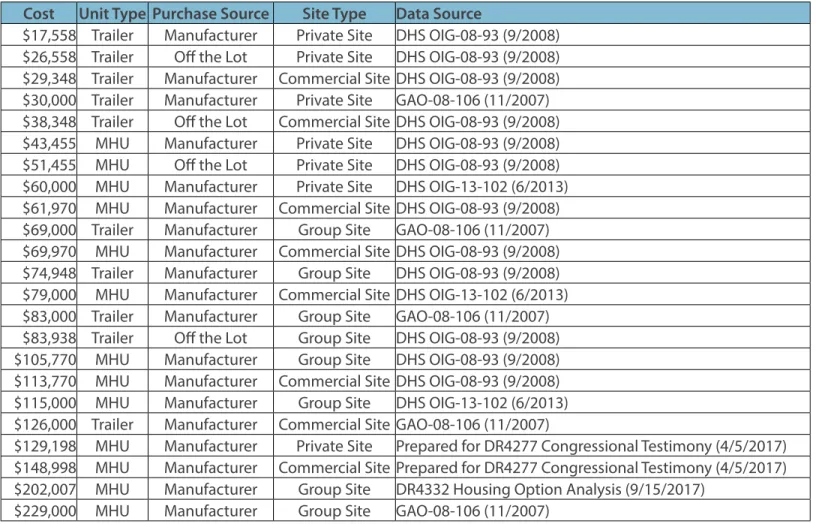
Manufactured homes – though designed to be permanent – are utilized on a temporary basis to provide disaster survivors with direct housing. Manufactured homes are capable of providing housing for a family for more than 50 years, but Congress, via the Robert T. Stafford Disaster Relief and Emergency Assistance Act (Stafford Act), requires FEMA’s temporary housing assistance to last no longer than 18 months. FEMA’s use of manufactured homes comes at an average cost of roughly $110,000 to $129,000 each. (See Appendix C for cost estimate information.)
Factory-built homes could potentially become an alternative to manufactured homes, and they have been utilized after disasters in several pilot programs with varying success. Should emergency managers and policymakers want to utilize factory-built homes more frequently after disasters, they must first overcome several significant barriers. Lack of a pre-emptive building code – and the norm of state and local adoption of differing building codes – reduces the ability of emergency managers to develop a uniform inventory of homes deployable to meet disaster needs across the United States. Tabulation of U.S. Census Bureau figures reveals that America currently only produces 3% of its single-family houses as factory-built homes, which limits its staying power as a tool for emergency managers. The historical average of 3% of new single-family homes being factory-built indicates that this industry is not yet widely accepted as an alternative to site-built homes in America. Finally, disaster restrictions distinguishing temporary housing from permanent housing reduce the use of factory-built homes after disasters, even as temporary housing solutions already reach levels of permanency and as some states seek to develop combined solutions for disaster housing and affordable housing.
When provided with flexible federal recovery dollars, states have occasionally leveraged factory-built houses to address combined disaster housing and affordable housing challenges. These flexible dollars, however, do not arrive until long after a disaster occurs – after temporary housing assistance is likely to be discontinued.
For example, after 2008’s Hurricane Ike, Congress appropriated roughly $1.3 billion in flexible housing construction and repair dollars via HUD’s Community Development Block Grant Disaster Recovery (CDBG-DR), yet virtually none of these funds were expended until after the 18-month timeline for temporary housing. As CDBG-DR dollars have a goal of targeting unmet long-term recovery needs, a long-term timeline seems appropriate. However, CDBG-DR funds that address unmet permanent housing needs are generally not available until well after FEMA’s temporary housing support ends.
A state’s desire to deploy disaster housing to meet both disaster and affordable housing needs is incompatible with Congress’s emphasis that disaster housing be temporary. The United States emphasizes local primacy where state, local, tribal, and territory officials direct their community’s disaster response and recovery efforts. When it comes to disaster housing, however, states have minimal responsibility for direct financial costs. Additionally, state and local governments drive standards amidst a decentralized building code environment.
These overlapping roles and competing perspectives between states, tribes and territories and the federal government highlight a “piecemeal” approach to disaster housing, and effectively excludes factory-built homes as a viable option for post-disaster housing. Should emergency managers and policymakers want to more broadly leverage factory-built housing in their recovery toolkit for future disasters, they will have to address these challenges in a way that also meets the preferences of disaster survivors, the most important decision maker in the recovery process.
Though emergency managers are not primarily tasked with addressing these housing circumstances, improvements in the toolkit of disaster housing options may also help address the broader non-disaster-caused housing challenges in America. Doing so would influence overall community resiliency, an additional goal for emergency managers. This report concludes with recommendations for emergency managers; housing agencies; policymakers at state, local, tribal, territorial, and federal levels; leaders in the building code community; home construction companies; and others who have a goal of addressing challenges around disaster housing. Recommendations are grouped into three categories and are summarized below:
P
roceSSi
MProveMent1.
Develop a common process to track the impact that state, local, tribal, and territory rules and ordinances have on implementation speed of post-disaster housing.2.
Develop criteria for when state, local, tribal, andterritory officials should enact uniform rebuilding standards and processes across counties, cities, and local municipalities impacted by large disasters.
3.
Develop public-private partnerships to more effectively leverage factory-built housing after catastrophic events.d
eciSionS
uPPort4.
Create a measurement of the total cost of sheltering and housing services received by a family, during disaster and non-disaster times, provided by all levels of government.5.
Support research on moral hazard and the incentive effects of providing permanent housing in a disaster context.6.
Conduct an assessment of when disaster housing programs defined and intended to be temporary actually achieve levels of permanency.7.
Update analysis of the cost, time, and labor benefits of different housing construction methods.d
irectionS
ettinG8.
Develop a strategy to engage America’s shrinking construction workforce in disaster rebuilding.9.
Determine if and how the federal government should provide further support to the factory-built housing industry.10.
Analyze and develop a strategy to consider what place (if any) temporary-to-permanent rebuilding should have in America’s emergency management toolkit.11.
Develop a long-term vision on the role emergencymanagement and disaster housing should have in addressing long-term vulnerability reduction and non-disaster affordable housing challenges.
b
ackGround
Prior to FEMA’s creation in 1979, state, local, tribal, and territorial governments led disaster response and recovery. The first major unified piece of disaster legislation, the Federal Disaster Relief Act, positioned the federal government to “supplement the efforts and available resources of states and local governments” in “carrying out their responsibilities” over disaster response and recovery.1 The U.S. Census Bureau
has identified more than 89,000 local governments in the United States.2 With this level of variety, state and local
leaders are more knowledgeable about a community’s nuanced needs, resources, and cultures than employees of the federal government could be from hundreds or thousands of miles away.
Contrary to the usual role of state, local, tribal, and territorial governments leading disaster response and recovery, in housing matters, states view the federal government as the leader. In a 2017 survey, 53% of states and territories viewed housing as mostly or entirely a federal responsibility.3 This may be in
part because states are not responsible for much of the direct financial costs of disaster housing. For example, states pay none of the costs related to disaster housing rental and repair programs.4 As the Congressional Research Service
noted in 2017, states do not “contribute to the costs of disaster housing through any cost-shares with regard to rental or repair expenditures” and also do not “have any obligation to assist in the physical establishment of temporary manufactured housing communities.” The tension over who is responsible for post-disaster housing is only one facet of housing being a persistent challenge facing the emergency management community. Multiple recent reports from the Department of Homeland Security (DHS) have captured the broader extent of the problem:
•
States and territories have ranked housing as the second-least proficient of 32 core capabilities for preparedness. (2017 State Preparedness Report)5•
Housing is one of the nation’s five persistent preparedness challenges. (2018 National Preparedness Report)•
Housing has been identified as a national area of preparedness improvement – every year since 2012. (National Preparedness Reports)On top of decisions by disaster survivors, key policy choices have driven the evolution of disaster housing programs in the United States. This report examines how, even absent any specific statutory authority referencing types of housing technology, the reliance on the federal government for disaster housing significantly narrows the range of options. This virtually excludes the possibility for modular and panelized houses to be used at scale after disasters.6 This report explores
the potential for factory-built housing7 to play a larger
role in America’s disaster housing strategy. While factory-built houses have been utilized after disasters in several pilot programs, they remain largely outside the scope of regularly implemented housing assistance options.
This report’s intended audience is emergency managers; housing agencies; policymakers at local, state, and federal levels; leaders in the building code community; home construction companies; and others who have a goal of addressing challenges around disaster housing. This analysis is grouped around three pillars: current situation, possible future, and obstacles. Recommendations are also included. This report is based on:
•
A June 2018 seminar held at the MIT DC office titled “Systems‐Built Homes for Use, at Scale, Post‐Disaster: A Discussion Hosted by MIT in Washington, DC.” Participants came from across the public and private sectors including federal agencies, state agencies, housing manufacturers, home builders, and housing construction associations.8•
An October 2018 presentation and discussion titled “Roundtable: Meeting Post-Disaster Needs with Offsite Construction.” The presentation and discussion took place at the National Association of Home Builders’ 2018 Building Systems Housing Summit. Summit participants included housing manufacturers, home builders, and housing construction associations.9•
Additional research on disaster housing from July 2017 to July 2019.k
ey
t
erMinoloGy
This report focuses on disaster shelter and housing programs in the United States. Emergency managers in the United States view shelter, temporary housing, and permanent housing as distinct terms describing different types of emergency assistance. Key emergency management terms have been defined in common language in Appendix A. This report focuses largely on direct housing, which is a type of disaster housing support provided when survivors are unable to use financial housing assistance (such as rental assistance) to secure temporary housing.
Additionally, this report draws a distinction between manufactured homes and factory-built homes. Manufactured homes (also called mobile homes) are governed by a pre-emptive national building code established by HUD, the “HUD Code.”10 Factory-built homes (also called
off-site construction) are built to state and local building codes and standards, but are built in factory conditions away from the job site. Factory-built homes is inclusive of modular, panelized, and pre-assembled housing construction methods. For the purpose of this report, manufactured homes are separate from factory-built homes, despite the fact that manufactured homes are manufactured in a factory. Finally, this report has a minimal focus on unique tribal and territorial considerations in disaster housing. The research focuses on state and local considerations in disaster housing.
W
here
a
re
W
e
n
oW
?
States and localities have the freedom to choose their own building codes based on the laws created by their individual governing bodies. Some states adopt a statewide building code, while other states have building code adoption at the local level. These choices differ broadly from one jurisdiction to another, just as terrain, hazards, and political processes differ. Though 49 states, as well as some territories, use/have adopted the International Residential Code (IRC) from the International Code Council (ICC), there is variation in what year code they require.11 For example, most states build to
the 2012 or 2015 IRC standard. Texas, however, builds to the 2000 IRC standard, while Indiana builds to the 2003 IRC standard. To further complicate matters, 11 of these states have adopted the IRC, but not on a statewide basis.12
Zoning laws and permitting requirements further determine what kinds of housing is allowed in a community. Zoning is a purely county, city, or municipal affair; therefore, it is not regulated or uniform from state to state. The Houston-Galveston Area Council identified several statutory barriers that slow housing recovery after disasters:13
• Masonry requirements • Garage requirements • Minimum square footages • Industrialized housing ordinances • Zoning ordinances
• Grandfathered properties • Landscaping requirements • Unsuitable site conditions • Permitting requirements • Code compliance • Historic districts • Homeowners associations • Deed restrictions • Occupancy standards
As part of the 2016 Hurricane Matthew response in North Carolina, the housing team at FEMA’s Joint Field Office sought to get ahead of coordination challenges around local requirements impacting temporary housing. Knowing that “identifying the local governmental requirements was critical to meeting the primary goal of housing disaster survivors, so they can begin their recovery,” FEMA and the state worked in partnership with the following groups to gather information about local ordinances, rules, and requirements: University of North Carolina School of Government, North Carolina League of Municipalities, and North Carolina Association of County Commissioners.14
Though cross-governmental coordination is nothing new for successful disaster response, housing presents unique challenges because of the variety of local requirements. Such requirements include planning for environmental and historic preservation compliance. Infrastructure concerns such as access to utilities and the prevalence of the floodplain add complicating contours to disaster response. The existence of these statutory barriers puts veto power in the hands of state and local decision makers, who, as described above, do not pay for FEMA’s disaster housing programs and have self-reported that they do not think disaster housing is their responsibility.
State-Driven Building Codes, Locally-Driven Zoning Laws and Permitting Requirements
State-Driven Building Codes, Locally-Driven Zoning Laws and Permitting Requirements
Reliance on Manufactured Housing in Disaster Relief
FEMA provides an array of programs that support the shelter and housing needs of disaster survivors. See Appendix A for an overview of FEMA’s programs in this area.
FEMA often provides financial housing assistance which helps eligible households pay for repairs or supports monthly rent payments to provide a temporary place to stay. In cases where financial housing assistance would not be sufficient for meeting disaster caused housing needs, FEMA can provide non-financial forms of assistance.
In communities with insufficient housing stock, FEMA has the ability to provide Direct Temporary Housing Assistance16
via Transportable Temporary Housing Units, Multi-Family Lease and Repair and Direct Lease. An MIT analysis of recent disasters requiring a direct housing mission indicates that FEMA primarily provides transportable temporary housing units in the form for manufactured homes and RVs/travel trailers.17
In response to Hurricanes Katrina and Rita in 2005, FEMA conducted the largest housing operation in the country’s history, primarily through the use of 140,000 RVs/travel trailers. Following these hurricanes, FEMA temporarily stopped using RVs/travel trailers.18 Manufactured homes are
governed by a pre-emptive national building code established by HUD, the “HUD Code”.19 Additionally:
Manufactured homes are capable of
providing housing for a family for more
than 50 years, but Congress, via the
Stafford Act, requires FEMA’s temporary
housing assistance to last no longer than
18 months. Deploying a manufactured
home to provide 18 months of housing
(taking into account resale and reuse)
costs roughly $110,000 to $129,000.
“The time savings of constructing modular
housing offsite are often negated by the
current protracted processes required to
rebuild. The current requirements for
funding housing recovery, qualifying
homeowners, and the various local
authorizations required to rebuild are
all more significant time constraints to
rapid reconstruction than the manner of
construction technology employed.”
Houston-Galveston Area Council,
writing about a Rapid Housing Recovery
Pilot Program following Hurricane Ike
15•
In 2006, FEMA’s Joint Housing Solutions Group created a Housing Assessment Tool that included the following two conditions when evaluating viable housing options:201.
Footprint: Units should be small, capable of HUD certification, and suitable for FEMA community sites or privately-owned sites.2.
Production Lead-Time: Providers must be able to deliver a certain number immediately or within a short time frame to meet FEMA’s operations and performance requirements.•
In 2009, when speaking about manufactured homes, the FEMA Administrator described that:Traditional temporary housing units are generally able to be procured relatively quickly due to the existing production infrastructure supporting the private market.… Alternative forms of temporary housing units, by comparison, have varying degrees of production capabilities, and have not been previously used for extended periods of occupancy in any substantial quantities. Some forms of alternative housing units pose unique delivery and installation challenges, whereas there is an existing private market for delivery and installation of traditional forms of temporary housing units.21
While manufactured homes are often described as the housing option of last resort, they have effectively become the only option when FEMA needs to provide Direct Temporary Housing Assistance. Manufactured homes are, in effect, the de facto form of FEMA’s Direct Temporary Housing Assistance, even absent any specific statutory authority referencing specific types of housing technology.
Year-Round Nationwide Housing Shortage
Though this report is focused on post-disaster housing, it is important for policymakers to understand broader challenges in the overall United States housing market because disasters exacerbate pre-existing stresses. Restrictions on the disaster housing toolkit limit the options available to respond and ameliorate those stresses post-impact.
Whether through the repair of multi-family housing or the provision of more resilient single-family homes, housing support provided during disaster recovery can provide benefits to a community’s housing stock well into the future.
“It is critical to understand the impact that
post-disaster housing stock levels have on
disaster housing operations. The repair
and restoration of housing stocks is one
of the most important challenges FEMA
and its response and recovery partners
face following a catastrophic housing
disaster. All other housing decisions and
programs hinge on this single variable.”
DHS OIG, OIG-09-111, September 2009
30This has created a significant mismatch of product performance and product requirement since manufactured homes were not designed as disaster-specific housing, or even as temporary housing. Manufactured homes are capable of providing housing for a family for more than 50 years.22
Congress, via the Stafford Act, requires FEMA’s temporary housing assistance to last no longer than 18 months (unless specifically extended).23 A year-and-a-half after the declaration
date of a disaster, the Stafford Act indicates that FEMA should no longer be providing any temporary housing assistance (unless a timeline extension has been granted). Taking into account resale and reuse, the average deployment cost for one manufactured home is $110,000 to $129,000. (See Appendix C for information on calculating cost estimates, including figures higher than $129,000.) FEMA expends significant financial resources to meet its mandate of 18 months of temporary housing assistance (unless specifically extended). There are three important caveats to note regarding FEMA’s reliance on manufactured homes for post-disaster housing:
1.
Manufactured housing plays a critical role in the overall housing market as the only non-subsidized form of affordable housing. These homes account for 10% of new homes nationwide, and are especially popular in hurricane-prone Southern states.24 Manufacturedhousing has a necessary place in the American single-family home construction landscape.
2.
It is important to reiterate that in areas with sufficient rental housing options, FEMA would provide financial (rather than direct) housing assistance for the duration of an eligible applicant’s 18-month temporary stay. Approximate costs vary widely depending on an area’s HUD-determined Fair Market Rent, but they are still well below the cost of using manufactured homes. For example, the 18-month cost of financial housing assistance would be approximately $20,000 in Tuscaloosa, Alabama, or approximately $50,000 in Oakland, California.25 As this report will document, there is a persistent affordable housing shortage in America which makes it less and less likely that a community will have sufficient post-disaster rental housing options for survivors.3.
About 10 years after Hurricane Katrina, in 2017, as part of FEMA’s Housing Assistance Initiative, FEMA began to once more use RVs/travel trailers (which meet higher standards developed by the RV Industry Association as well as formaldehyde standards developed by the U.S. Environmental Protection Agency26) as transportable temporary housing units. It is too early to measure theextent to which this additional direct housing option will reduce FEMA’s reliance on manufactured homes governed by the HUD code.
Outside of disaster recovery, the United States faces ongoing challenges with housing. For example, in its 2018 The State of the Nation’s Housing report, Harvard University’s Joint Center for Housing Studies describes that:27
•
Inventories for single-family homes for sale is at its lowest level since the National Association of Realtors began its tracking in 1982.•
About a third of all households in most metros are cost-burdened, defined to be when a household spends more than 30% of its income on housing.•
The national median rent rose 20% faster than overall inflation from 1990 to 2016.•
Inflation-adjusted construction wages and benefits were up 7% from 2001—somewhat less than the 9% increase for all private industry workers.The notion of “Building Back Better” refers to the execution of recovery activities in a manner that also mitigates future risk for disaster impacted communities. This approach emerged after the 2004 Indian Ocean tsunami31 and was
endorsed in 2015 by the UN General Assembly32 as part of
the Sendai Framework for Disaster Risk Reduction.33
In the United States, the National Preparedness Goal and Presidential Policy Directive 8 both describe mitigation as its own mission area, distinct from recovery. However, “Building Back Better” has also started to permeate disaster lexicon in the United States. For example, following Hurricane Maria in 2017, “Building Back Better” was the title of both Puerto Rico’s official Request for Federal Assistance for Disaster Recovery, as well as the electricity sector’s recommendations for the rebuilding of Puerto Rico’s electric grid.34
Within the National Disaster Recovery Framework, recovery is described as “more than the community’s return to pre-disaster circumstances.”35 When it comes to housing,
“Building Back Better” represents an improvement in a community’s long-term housing stock (i.e., its permanent housing stock) to achieve a reduction in vulnerability.
Building Back Better can be both bringing existing buildings up to modern construction standards and codes, as well as
decreasing long-term housing needs in a community.
Over time, Congress and federal emergency managers have been part of a slow evolution over the role of federal government in supporting permanent housing specifically in post-disaster settings.36 Despite adopting a
hands-off approach in the 1980s, the federal government has increasingly included consideration of permanent housing into its doctrine and programs:
•
In 1988, the Robert T. Stafford Disaster Relief and Emergency Assistance Act (Stafford Act)37 stated thattemporary housing assistance is limited to 18 months. Disaster survivors still occupying a government-provided temporary housing unit after 18 months can purchase the housing unit at prices that are fair and equitable when the occupants lack permanent housing.
•
In 2000, the Disaster Mitigation Act38 authorizedpermanent housing construction in insular areas outside the continental United States and in other remote locations. Occupants who purchase the government’s temporary housing unit are required to maintain hazard and flood insurance.
•
In 2006, the Alternative Housing Pilot Program (AHPP) was authorized as a competitive grant program to identify and evaluate better ways to house future disaster victims. As the Department of Homeland Security Office of Inspector General (DHS OIG) describes, Congress created the AHPP “recognizing the extensive housing challenges presented by Hurricane Katrina, as well as limitations within the Stafford Act.”39 Five awards were given to four states (Alabama,Mississippi, Louisiana, and Texas). Each state piloted permanent housing solutions constructed from a range of methods (site-built, modular, panelized, manufactured).40
•
In 2006, the Joint Housing Solutions Group (JHSG) was formed (across FEMA, HUD, and the National Institute of Building Sciences) to evaluate and rate disaster housing options. The options evaluated by the JHSG included modular homes that could transition to permanent housing.41•
In 2006, the Post-Katrina Emergency Management Reform Act (PKEMRA)42 amended the Stafford Actso that permanent housing construction would no longer be limited to remote or insular locations.
Limited FEMA Role in Permanent Post-Disaster
Housing
The slow wage growth is despite there being a record number of job openings in the construction industry. The U.S. Bureau of Labor Statistics estimated a total of 434,000 construction job openings in the United States in April 2019, the highest level recorded since 2000.28
Additionally, the National Low Income Housing Coalition describes in a 2019 report, “The Gap: A Shortage of Affordable Rental Homes,”29 the United States has a shortage
of 7 million affordable rental homes for extremely low-income renters. This population group is also particularly vulnerable to the impacts of disasters.
These are just some of the ongoing challenges the United States faces with housing. Though emergency managers are not primarily tasked with addressing these housing circumstances, improvements in the toolkit of disaster housing options may help address the broader non-disaster- caused housing challenges in America. Doing so would influence overall community resiliency, which is in scope for emergency managers.
•
In 2009, the National Disaster Housing Strategy called for the nation to focus on six housing goals, one of which is to “build capabilities to provide a broad range of flexible housing options, including sheltering, interim housing, and permanent housing.” The Strategy identified that one key principle of permanent housing is that “some interim housing solutions can become permanent housing.”43•
In 2010, the National Disaster Housing Task Force was created as a federal inter-agency coordination structure. One of the Task Force’s purposes is to promote strategic planning across the disaster housing continuum of sheltering, interim housing, and permanent housing.44•
In 2017, FEMA’s Housing Assistance Initiative was created to meet the need for an in-depth, critical look at FEMA’s post-disaster housing strategy. Included among a list of actions is the task to “identify alternative post-disaster housing solutions that leverage [best practices] to provide operational and cost-effective solutions for both temporary and permanent housing.”45•
In 2018, the Disaster Recovery Reform Act46amended the Stafford Act to allow states, tribes, and territories to administer temporary and permanent housing and allowed for more flexibility in FEMA’s Multi-Family Lease and Repair program which completes permanent repairs to a community’s existing housing stock.
While permanent housing is now given a place in the United States’s emergency management doctrine, and while improving a community’s permanent housing stock has the potential to reduce long-term vulnerability, FEMA continues to focus on temporary rather than permanent housing needs. This may be in part due to the fact that FEMA is the Coordinating Agency for Emergency Support Function (ESF) #6 (Mass Care, Emergency Assistance, Temporary Housing, and Human Services) while HUD is the Coordinating Agency for Recovery Support Function (RSF) Housing. Not only are response-oriented temporary housing and recovery-oriented (permanent) housing coordinated by different federal agencies, but the timelines are also quite separated. For example, FEMA’s temporary housing is meant to be available for no more than 18 months (unless an exception is granted) while HUD’s funding mechanism for recovery-oriented (permanent) housing often takes several years. (See the Extended Timelines for Disaster Recovery section on page 23.)
Congress has limited when FEMA can provide assistance via permanent or semi-permanent housing. FEMA can provide assistance in insular areas outside the continental United States or in other locations where no alternative housing resources are available and where temporary housing assistance is “unavailable, infeasible, or not cost-effective.”47
When it comes to shelter and temporary housing, Congress has granted FEMA much broader authorities. The clear distinction in authorities between temporary and permanent housing, however, does not equate to a clear distinction in how survivors utilize temporary and permanent housing programs. The following are examples of activities defined to be shelter or temporary housing, even as they may reach a level of permanency. The examples come from the range of FEMA Individual Assistance and Public Assistance programs.
1.
Transitional Sheltering Assistance (TSA) provides direct payment to approved hotels and motels for disaster survivors. It is intended to initially last from 5 days to 2 weeks, with the goal of moving remaining and returning evacuees out of congregate shelters. After Hurricane Harvey impacted Texas in 2017, congregate shelters had a one-night peak of 28,000 people while the TSA program had a much higher one-night peak of 73,000 people (2.6x). Additionally, some survivors remained in the TSA program for nearly a year after the disaster, far surpassing the intended timeframe of this sheltering assistance.482.
The Blue Roof Program is implemented by the U.S. Army Corps of Engineers and provides free installation of fiber-reinforced sheeting to cover damaged residential roofs until arrangements can be made for permanent repairs. These protective measures are designed to last for 30 days and are intended to prevent further damage to home contents. Blue Roofs are sometimes the only type of roof repair houses may have more than a year after a disaster.493.
Operating as a temporary pilot program since 2012, the Sheltering and Temporary Essential Power (STEP) program has provided free minor repairs to make a home safe, secure, and weatherproof. Essential utilities and plumbing were made safe and operational to meet basic life sustaining needs so that occupants could shelter in place until more permanent repairs could be made.50 The intent was to allow homeowners toreturn to living in their damaged homes while longer-term repairs continue, allowing people to return to work and school in their communities. Repairs,
even if not aesthetically pleasing, often become de facto permanent. The New York Times described Hurricane Sandy’s version of the STEP program in New York in a September 2014 article by stating, “In less than 100 days, Rapid Repairs restored heat, power and hot water service to more than 11,700 buildings. More than $640 million was spent, much of it toward repairs with permanent value.”51
4.
Manufactured Housing Units are utilized for temporary direct housing missions in communities with low available housing stock. This assistance is meant to be available for no more than 18 months (unless extended), yet for survivors unable to make progress towards “permanent housing,” these units can be extended longer than 18 months. Survivors can be asked to begin paying nominal monthly rent and utilities. In some cases, survivors can purchase the FEMA-provided manufactured home outright. Across an initial disaster response and a longer-term disaster recovery, there are different times when sheltering, temporary housing, and permanent housing may each be the most effective and cost-effective manner to meet the needs of disaster survivors. And to be clear, the above examples likely represent FEMA’s desire to utilize judgment and flexibility to help create tailored disaster-, community-, and survivor-specific approaches to housing recovery. However,Outside Perspectives on Distinctions across Sheltering,
Temporary Housing, and Permanent Housing
“There is [an] artificial divide between phases in a post-disaster scenario, with the assignment
of the term “shelter” to the relief phase and the term “housing” to the recovery or development
phase. But in reality, there is no difference between shelter and housing. A shelter is a house
and a house is a shelter regardless of the type or style. Although a common distinction is that
shelters are built in relief and houses are built in development, in both cases the words carry no
indication of quality, standards, type of materials or construction specifications.”
Habitat for Humanity, 2016, Pathways to Permanence
52“By focusing excessively on housing that is defined to be temporary, FEMA has ignored
construction methods that would meet the criteria of emergency housing, but which happen
to not be permanent. … It is the speed, safety, and cost of disaster housing that is important,
not whether the housing is labeled ‘temporary’ or ‘permanent.’ ”
National Association of Home Builders, Public Comments on the National
Disaster Housing Strategy, 2008; DOCKET ID FEMA-2008-0009
53these examples also shed light on ways that hard-and-fast distinctions between temporary and permanent housing may be unrealistic or impractical. The differences between emergency protective measures, sheltering, temporary housing, and permanent housing may be clearly defined within the federal government, but they can also represent bureaucratic distinctions that make the recovery process less straightforward, rather than more.
One consequence of Congress’s choice to focus FEMA on temporary housing is that the United States may be missing an opportunity to leverage disaster recovery efforts (led by FEMA or other agencies) to also improve a community’s long-term housing stock. Rigid distinctions between temporary and permanent housing may limit America’s ability to “Build Back Better.”
W
here
c
ould
W
e
G
o
?
Factory-Built Homes Have Cost and Speed Benefits Outside Disaster Settings
In 2017, roughly 87% of single-family homes built in the United States were site-built homes.54 The site-built
construction method relies on materials and skilled labor available locally at the job site. During disaster events with widespread residential damage, houses will be both repaired and rebuilt. Post-disaster construction can be delayed due to several factors: lack of capital, a shortage of skilled workers, licensing rules hindering out of state workers, unavailability of materials, postponed decisions on rebuilding versus relocating, building code restrictions, floodplain considerations, zoning changes, and infrastructure repair challenges.
An alternative to site-built homes is factory-built homes,55
which come in various forms, such as pre-assembled components and furnished houses that can be assembled on site. Notably, factory-built homes are constructed in a controlled indoor environment away from their final destination. Factory-built home construction can decrease the demand for local skilled labor and building materials in communities recovering from disasters, further increasing a community’s ability to recover. Off-site construction occurs around the world, with many countries utilizing these techniques more than the United States, as outlined in Table 1. These techniques can be utilized even for geographies with a wide range of climate regions like the United States, which may require a larger variety of styles appropriate to local climates.
The National Association of Home Builders (NAHB) Research Center (now known as the Home Innovation Research Labs) has highlighted the benefit of factory-built home construction in decreased labor requirements. The labor cost component of a modular or manufactured home is typically 8 to 12% of the total house construction cost, while the labor cost of a site-built home is upwards of 40 to 60% of the total cost.56 These labor savings are helpful, because as
noted above, the U.S. Bureau of Labor Statistics estimates a total of 434,000 construction job openings in the United States in April 2019, the highest level recorded since 2000.57
Table 1: America Lags Other Countries in Adoption of Prefabricated Techniques
COUNTRY % of Construction Using Factory-Built Techniques
Sweden60 74–84% Finland61 50% Singapore62 40% China63 30% Germany64 20% Netherlands65 20% Japan66 15-20%
UK67 7-12% (and 25% target for publicly
funded social housing)
USA68 3–13%
Australia69 3–5%
Table 2: Cost Comparisons of Home Construction by Method (in 1998 dollars) COST CATEGORY Site-Built Modular Manufactured Construction Costs $77,140 $65,560 $47,277
Structure $71,123 $59,543 $41,260
Foundation $6,017 $6,017 $6,017
Cost per Square Foot $38.57 $32.78 $23.64
Land Costs $35,314 $35,314 $35,314 Improved Lot $34,113 $34,113 $34,113 Site Preparation $1,201 $1,201 $1,201 Financing Costs $2,895 $1,298 $610 Construction Financing $2,895 $1,298 — Inventory Financing — — $610 TOTAL COST $115,349 $102,172 $83,151
Additional benefits to off-site construction were identified in a 2011 McGraw-Hill survey of architecture, engineering, and contracting professionals:58
•
66% of respondents report that project schedules are decreased—35% by four weeks or more.•
65% of respondents report that project budgets are decreased—41% by 6% or more.•
77% of respondents report that construction site waste is decreased—44% by 5% or more.Though more recent cost comparisons are not available, an NAHB Research Center’s 1998 report detailed that site-built homes cost more than both modular and manufactured homes59 (See Table 2). It is important to note that estimates of the speed, cost,
and waste savings from off-site construction excluded considerations needed for building in a disaster recovery environment (e.g., material shortages as well as increased labor and support costs).
Figure 3: Photos of Production of Factory-Built Housing Photo credits: NAHB, Ritz-Craft, Cardinal Homes
Pop-Up Factories Could Be a Resource Following Catastrophic Events
Following catastrophic events, when especially high numbers of homes are completely destroyed, new factories can be stood up near disaster-impacted areas to produce modular/ panelized/pre-cut homes. These so-called “pop-up factories” can be a previously abandoned, refurbished, or newly constructed factory. Initiating a new factory would require tooling, skilled labor, and most importantly, experienced management. Regional fabrication locations could be pre-identified as possible factories, work areas, or distribution centers to aid in disaster rebuilding.
Disaster impacted communities would benefit from new nearby pop-up factories through reduced transportation time and cost for completed homes. A skilled labor pool could be developed and utilized outside the immediate disaster area, reducing the logistical burdens associated with bringing a trained workforce into a community for disaster recovery purposes. Moreover, home manufacturing could represent an investment in long-term economic development, creation of new readily available employment opportunities, and faster re-establishment of an area’s housing stock.
Several factors would need to be addressed for pop-up factories to become a viable option after catastrophic events. For example:
•
Are pop-up factories government-supported, or fully private-sector-led?•
Through what agency (e.g., housing, community development, emergency management) and at what level (e.g., state, local, tribal, territorial, federal) would government support be appropriate and warranted?•
How should pop-up factory facilities be utilized oncethe demand surge for post-disaster housing has passed?
•
What is the best way to leverage the efficiencies ofproduction given the difficulties of managing variation across individual orders and installation?
In preparation for catastrophic events, pop-up factories have the potential to stand alongside policy changes, reciprocity agreements among states, and pre-event contracts—as a multi-pronged approach for disaster housing preparedness.
Factory-built methods are utilized not just for single-family housing, but also for hotels and multi-family housing. For example:
•
Founded in 2015, Katerra, a manufacturer of cross-laminated timber wall assemblies with headquarters in the United States, has residential products focused on multifamily, senior, student, and single-family housing. Katerra platforms include compliance with 48 states’ building and energy codes.70•
In 2017, Google began working with Factory OS to construct 300 apartment units in the San Francisco Bay Area using modular construction.71•
In 2017, Marriott International announced intentions to incorporate modular construction in the construction of 50 hotels in North America. As of May 2019, modular construction has been used in hotels in California, Kentucky, North Carolina, Oklahoma, Washington, and Wisconsin.72•
In 2018, Polish manufacturer Polcom Modular completed construction on a 21 story hotel in Manhattan, creating the (then) tallest modular hotel in the United States.73•
In 2018, the New York City Department ofHousing Preservation and Development
issued a Request for Proposal for 100% affordable housing that explicitly required modular construction.74
•
In 2019, DMD Modular, also from Poland, plans to finish construction on a 26-story Marriott hotel, also in New York City. This will be the tallest modular hotel in the world.75 In these examples, there is one owner, so construction-related decisions are streamlined across multiple units. This benefit is not found in single-family housing.Opportunity to Leverage Disaster Housing for Affordable Housing Challenges
State, local, tribal, and territorial governments face not only periodic disaster housing challenges, but also year-round affordable housing challenges. Rather than address each of these housing problems individually, states are seeking out ways to address both problems in tandem. In the Commonwealth of Virginia, for example, the Virginia Department of Emergency Management and the Virginia Department of Housing and Community Development are trying to address disaster and non-disaster housing needs with a combined solution. Speaking on the need for a coordinated approach to address long-term resiliency, experts from Virginia relayed the following to MIT researchers:
Affordable housing is limited and difficult to attain, even on a blue-sky day. When you consider that the vast majority of individuals in shelters were already living at or below the poverty line when the disaster struck, were transport- and food-insecure, and were living in substandard housing from the outset, the need for affordable housing after an event becomes imminently apparent. Any opportunity to increase affordable housing stock will ultimately benefit communities and disaster survivors.
Virginia Department of Emergency Management
Dawn Brantley, Sheltering Coordinator Ed Porner, Director, Recovery and Resilience Division
The Virginia Department of Housing and Community Development (DHCD) is concerned that the most vulnerable populations after a disaster are those most in need of permanent housing assistance. Recognizing that FEMA is limited in the resources it can provide and the 18-month restriction on temporary housing, DHCD is interested in how our agency can support new policies for temporary housing that can transition to permanent. DHCD believes that identifying an innovative product and process will improve the use of both federal and state funds and most importantly provide affordable permanent housing for vulnerable populations post-disaster.
Virginia Department of Housing and Community Development
Cindy L. Davis, Deputy Director, Division
of Building & Fire Regulations
Pamela Kestner, Deputy Director, Housing
Flexible housing recovery funding most often comes in the form of HUD’s CDBG-DR program. In cases where CDBG-DR funding allows state and local officials to provide permanent housing to disaster survivors, they frequently turn to factory-built or manufactured homes:
•
In areas of the Lower Rio Grande Valley impacted by Hurricane Dolly in 2008, a consortium of organizations76 created the RAPIDO pilot programwhich implemented a temporary-to-permanent housing method for 20 homes. Panelized modules were constructed nearby and formed a core unit the family would move into, with additional bedrooms added on afterwards. Results of the RAPIDO program included successful expansion past the core unit, which would be used immediately after a disaster. The consortium utilized the same temporary-to-permanent housing method in Houston after Hurricane Harvey in 2017 with 15 homes planned, and funded by non-governmental grants.77
•
Following Hurricane Ike in 2008, the Houston-Galveston Area Council78 developed the Back Homepilot program designed to “minimize displacement of residents by developing a strategy for the rapid, efficient, large-scale deployment of temporary-to-permanent housing following future natural disasters.” This program led to the construction of 20 modular homes in Harris and Galveston counties.79 Six years
later, local officials visited the homes to survey damage from Hurricane Harvey in 2017. All units were still occupied and none had any flood damage from Hurricane Harvey.80 A central goal of both of these
Texas programs was “to test the feasibility of… large-scale production of replacement housing for victims of federally declared natural disasters.”81
•
Following Hurricane Sandy in 2012, the City of New York experienced long delays filling unmet housing needs despite receiving federal funds for that purpose.82To improve the speed of the Build It Back program, the city leveraged modular homes. The New York Times reported in an October 2017 article that only minimal additional work was required to install these modular homes on appropriate foundations – adding staircases and finishes – making local contractors available for more projects.83
•
Following major flooding in Louisiana in 2016, the Restore Louisiana Homeowner Assistance Program had a policy of replacing, not rehabilitating or repairing, flood-damaged manufactured housing units. The program was meant to serve the long-term housing needs of survivors and to protect against potential environmental health hazards due to water damage.84The temporary-to-permanent examples listed above (RAPIDO and Back Home) identify unique disaster housing approaches championed and explored by specialized organizations. That is because temporary-to-permanent disaster housing options are generally not supported by the non-disaster market.
These examples also illustrate that when flexible recovery funding is made available, states often choose to implement permanent housing. Unfortunately, the uncertainty and lengthy timeline for flexible recovery dollars,85 and the
limitations preventing initial FEMA funds from being used for permanent housing, slow the ability of states to move towards these recovery options. (See the Extended Timelines for Disaster Recovery section on page 23.)
Through the 2018 Disaster Recovery Reform Act, Congress is asking FEMA to develop grant processes so that states can begin to administer federally funded disaster housing programs. However, it is unlikely that states will be able to use this funding for permanent housing in all cases where they want to do so.
State housing programs will need to follow the same restrictions as FEMA. Thus, this funding for states will likely be for temporary housing (as FEMA is mostly restricted by Congress to do now), even if a state wants to do permanent housing to address a community’s overall resiliency in addition to immediate response and recovery.
W
hat
i
S
S
toPPinG
u
S
?
America Has One National Pre-Emptive Code
The National Manufactured Housing Construction and Safety Standards Act of 1974 represents the lone nationwide pre-emptive building code. Also known as the “HUD Code,” the legislation and regulation dating from nearly fifty years ago addressed wide disparities in manufactured home construction standards. Then referred to as mobile homes, these structures built in one state could be sold by a retailer in a second state, and installed in a third state, each with different building codes.
To assure the quality, durability, safety, and affordability of manufactured homes across jurisdictions, Congress created the HUD Code construction and safety standards which preempt state and local laws that are not identical to the federal standards. Thus, the HUD Code was created to overcome jurisdictional variation when it comes to quality, durability, safety, and affordability. Similarly, FEMA benefits from the HUD Code’s ability to overcome jurisdictional variation when fulfilling direct housing missions. The HUD Code provides a uniform, cross-jurisdictional assurance that FEMA’s direct housing tool will be in compliance with state and local building codes, by pre-empting state and local building codes.
While modular homes face the same challenges of being built in one state, but sometimes utilized in another state, modular homes are produced on demand, which allows manufacturers to know what state and local building codes to utilize during construction.
Forthcoming building code standards that focus on off-site construction should provide more uniformity in state and local choices on building code adoption for future factory-built housing construction. The ICC is on track to develop, propose, and release the following by 2021:86
•
A standard for the planning, design, fabrication and assembly of off-site construction,•
A standard for the inspection and regulatory compliance of off-site construction, and•
A guideline for the transportation of modular components to the construction site.Additionally, in March 2019, the ICC released guidelines for safe use of ISO (International Organization for Standardization) intermodal shipping containers repurposed as buildings and building components.87 While each of these
optional standards is likely to bring more uniformity to state and local building codes, they do not provide the benefit to federal emergency managers of helping ensure that their direct housing tools will be allowable in all jurisdictions across the United States.
Pre-emptive standards provide authority to larger jurisdictions to overrule standards enacted by smaller jurisdictions, which can be at odds with the United States’ system of federalism. Along the same lines as a pre-emptive national building code, when discussing local building regulations as a policy barrier to implementation of the Back Home pilot program, the Houston-Galveston Area Council described the following:88
If the State of Texas wishes to create a rapid housing program using the Back Home design after a disaster, [state] or municipal ordinances would need to be created to override [local] restrictions. … [To adopt] the Back Home model as a standard disaster recovery home, they would need to pass laws at the State level to supersede local restrictions to building the [Back Home]. … Overriding these local controls would be contentious.
The State of Texas’ Natural Disaster Housing Reconstruction Plan in 2010 further identified the challenges that emerged from local requirements when describing post-Katrina disaster housing in Louisiana and Mississippi:89
This idea of “temp-to-perm” disaster housing received much positive attention from state housing and emergency management officials. Local public officials and communities strongly resisted “temp-to-perm.” Ultimately, this resistance created many challenges to realizing the full potential of the [Alternative Housing Pilot Program] projects as long-term recovery solutions.
…
Local officials and the public did not understand that the project was a permanent housing solution. Additionally, a stigma persisted that the AHPP units would lower the property values of the surrounding neighborhood. … Due to the overwhelming demands of recovery on local authorities, many officials did not see housing as an immediate priority, instead focusing efforts on restoring the basic infrastructure and economy of the community. …
Additionally, communities expressed concerns about [these houses] not fitting with the style and size of many neighborhoods. Local officials argued that [these small houses] would do less to restore the tax base than larger, more expensive homes or condos.
Except for the HUD Code, emergency managers and community development managers have no mechanisms that provide the cross-jurisdictional benefits of utilizing a pre-emptive national code for disaster housing purposes.
A Relatively Small Industry Base for Factory-Built
Homes
One obstacle preventing wide-scale adoption of factory-built homes for disaster recovery is the limited annual installation of factory-built homes across the United States. As shown in the figures below, the current industry base for factory-built homes has not been tested to produce at the same scale as disaster recovery.
Following the August 2016 flooding in Louisiana, FEMA provided approximately 4,500 households with a FEMA-provided temporary transportable housing units.90 Given
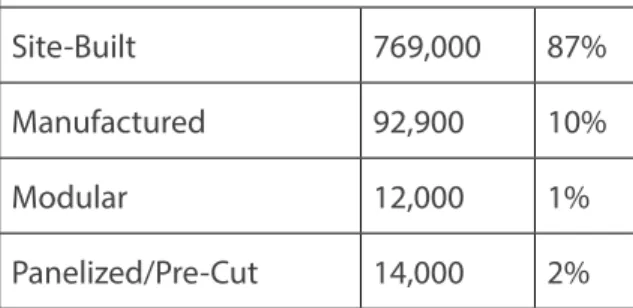
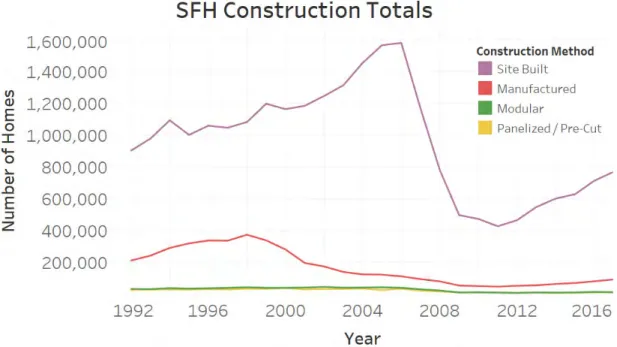
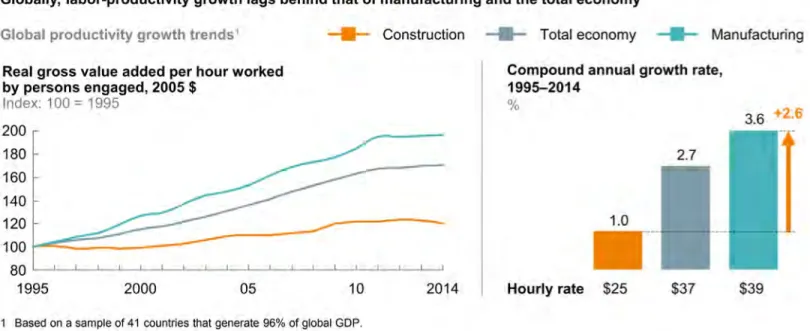
nationwide production and installation of modular and panelized units was 26,000 across all of 2017, a demand of 4,500 units from a single event is a significant demand spike for the industry. As Figure 5 and Figure 6 indicate, output from the factory-built housing industry has remained small relative to site-built homes – both in total units produced and in market share for single-family home construction – since the U.S. Census Bureau began reporting totals in 1992. This relatively fixed output for factory-built homes has occurred despite stagnant construction productivity (see Appendix B), and despite a multi-year effort by Congress and the emergency management community to build out a suite of innovative housing options (see Where Are We Now? section beginning on page 9).
Table 4: Single-Family Home Construction Totals by Construction Method, 201791
2017 Residential 1-Unit Construction Totals
Site-Built 769,000 87%
Manufactured 92,900 10%
Modular 12,000 1%
Panelized/Pre-Cut 14,000 2%
The impact of this relatively small industry size was described by a county official in Florida when speaking about the need for thousands of homeowners to rebuild or replace their homes following Hurricane Irma in 2017:
There were not enough manufacturers to
produce the modular homes that we want
for our community. The modular home
industry does not have the ability to surge
quickly. When you’re talking about ordering
thousands of houses, even when people have
money in their bank account, they’re put
on a 3-year waiting list. Traditionally, this
type of industry cannot accommodate large
surges.
Monroe County, Florida
Marty Senterfitt, Deputy Fire Chief/
Director of Emergency Management,
speaking about recovery efforts from
Figure 5: Single-Family Home Construction Totals by Construction Method, 1992–201792
Inadequate supply of housing deliveries, like the case in Florida above, can be due to a range of factors such as manufacturer capacity, state-specific manufacturer licensing, or transportation limitations. The need for the United States to be able to draw housing industry capacity to disaster areas is also conveyed as part of the National Disaster Housing Strategy, which identified the following as one of more than a dozen “future directions”:
The housing production system must become capable of producing or rehabilitating enough standard housing units to rehouse populations more quickly following a catastrophic event.94
Small industries often lack the surge capacity and standing inventory for catastrophic events. Similarly, smaller-scale manufacturers lack the track record necessary for emergency managers to confidently re-orient their programs around a different product. To regularly and reliably leverage the benefits of factory-built homes during disaster recovery, the industry needs to substantially grow in size, either through normal market changes or government support.
Additional Obstacles to Provision of Post-Disaster
Permanent Housing
Extended Timelines for Disaster Recovery
Disaster recovery is a long-term endeavor that takes years. (See Figure 7 below.) In the private market, appropriate insurance and timely payouts are an important driver in the timeline for disaster recovery. Federal financial support for housing comes largely from CDBG-DR special appropriations. These funds are amongst the most flexible of housing assistance dollars and are thus frequently leveraged for permanent housing. The
99
time from any one disaster event to the ensuing CDBG-DR appropriation often takes several months to more than a year, with uncertainty compounded due to the lack of an ongoing appropriation for CDBG-DR. After an appropriation, states develop action plans to determine how funding should be put to use.95 Each of these represents a step in a community’s
path towards recovery.
Two events, 2008 Hurricane Ike in Texas and 2016 flooding in Louisiana, each illustrate the extended timelines of HUD housing construction funding. As Figure 8 and Figure 9 show, a very concentrated infusion of federal disaster dollars from FEMA, the Small Business Administration (SBA), and the National Flood Insurance Program (NFIP) goes to meet housing construction and repair needs in the initial days, weeks, and months after a disaster. In that same time frame, homeowners receive funds from their private insurance policies. CDBG-DR dollars, which are meant to provide for unmet housing needs during long-term recovery, come much later.
FEMA dollars shown here represent Repair Assistance, Replacement Assistance, and in the case of Louisiana, the Sheltering and Temporary Essential Power pilot. NFIP dollars shown here represent Property and Increased Cost of Compliance, but exclude Contents. SBA loan dollars shown here represent Home and Personal Property Loans. For 2008 Hurricane Ike in Texas, private insurance totals represent homeowners’ policies only and are based on recurring state insurance commissioner reports that detail claims paid out over time. (Louisiana’s insurance commissioner did not require insurance companies to provide homeowner policy claim data on a regular basis. Additionally, as primarily a flooding event, private homeowners’ insurance payouts were likely minimal.) CDBG-DR dollars shown here represent six