DIFFUSION WITH REVERSIBLE CHEMICAL REACTION IN HETEROGENEOUS MEDIA
by
PIETER STROEVE
B.S. University of California, Berkeley (1967) M.S. Massachusetts Institute of Technology (1969)
Submitted in Partial Fulfillment of the Requirements for the
Degree of
DOCTOR OF SCIENCE at the
Massachusetts Institute of Technology August 1973
Signature of Author Certified by
Accepted by
Departn4nt of Chemical Engineering Kepty. Smith, '?lesib; Superisor
6Lfk' K. Colton, Thesig-6upervisor
Glenn C. Williams, rfirman
Departmental Committee on Graduate Theses
Ar
2
Department of Chemical Engineering Massachusetts Institute of Technology Cambridge, Massachusetts
August 3, 1973
Professor David B. Ralston Secretary of the Faculty
Massachusetts Institute of Technology Cambridge, Massachusetts
Dear Professor Ralston:
In accordance with the regulations of the faculty, I herewith submit a thesis, entitled "Diffusion with
Reversible Chemical Reaction in Heterogeneous Media", in partial fulfillment of the requirements for the degree of
Doctor of Science in Chemical Engineering at the Massachusetts Institute of Technology.
Respectfully submitted,
ABSTRACT
DIFFUSION WITH REVERSIBLE CHEMICAL REACTION IN HETEROGENEOUS MEDIA
by
PIETER STROEVE
Submitted to the Department of Chemical Engineering on August
3, 1973, in partial fulfillment of the requirements for the
degree of DOCTOR OF SCIENCE at the Massachusetts Institute of Technology.
A theoretical and experimental program was
under-taken to study diffusion with reversible chemical reaction in heterogeneous media. The heterogeneous systems considered
are media where one phase is dispersed in a second continuous phase, and where reversible chemical reactions may occur in
either phase.
Theoretical equations describing steady-state diffusion with reversible chemical reaction in heterogeneous media were solved using approximate analytical methods.
Equations were developed for several reaction kinetic schemes including the four-step model of Adair. Expressions derived for the effective permeabilities showed that the effect of the reversible chemical reaction is to facilitate the trans-port of the diffusing species. The equations take into
account deviations from chemical equilibrium. The effective permeability is a maximum when the reaction is at equilibrium. In the case that the reaction departs sufficiently from
equilibrium facilitated transport becomes negligible, and the theoretical equations reduce to Maxwell's equation for inert heterogeneous media.
An experimental program was undertaken to measure transport rates in both inert and reactive suspensions.
Effective oxygen permeabilities were measured in thin liquid slabs of inert dispersions, inert and reactive emulsions, and
reactive red blood cell suspensions. The measured permeabilities
showed good agreement with the theoretical predictions. Hemo-globin facilitated oxygen transport is significant in red blood cell suspensions at low oxygen partial pressures. Comparison of
the experimental results on the diffusion of oxygen in red blood cell suspension with theoretical predictions suggests that the oxygen-hemoglobin reaction inside the red blood cell is near but
4 The theoretical framework presented here can be used to model and predict mass transport phenomena in a variety of
other reactive heterogeneous systems. Important biological and
chemical engineering problems of a similar nature can be studied with the presented theoretical framework.
Thesis Supervisors: Kenneth A. Smith
Professor of Chemical Begineering Clark K. Colton
5 ACKNOWLEDGEMENTS
After many years, this thesis represents the climax of a long period of intellectual, emotional, and physical
up and downs. Like so many other theses, the course of this work has affected the lives of not only the author but also
those of his family and friends. There is much that can be said, but that would be inappropriate here; a book would be a better forum. However, it is in all sincerity that I express my appreciation and gratitude to those people who have made
personal contributions of some kind. In particular I wish to thank:
Professors R. C. Reid, L. B. Evans, H. P. Meissner and others for teaching intellectually stimulating chemical engineering courses;
Scott Stricoff, Steve Emmer, Abdalla I. El-Twaty, Joseph Zahka, and Bob Tuntunjian who collaborated with me in various aspects of this thesis;
Drs. B. Bunow, P. A. Dinker, M. B. Laver, and N. N. Li who either offered their facilities or gave
professional advice to me;
My brother Wilbert Stroeve, who, while vacationing
in Cambridge, performed many calculations;
My colleagues and laboratory partners Jerry
Meldon, Joseph Zahka, and Larry Lewandowsky who provided stimulating and challenging discussions during the course of this thesis;
Stan Mitchell and Paul Bletzer, who were of invaluable help with the construction of the apparatus;
My typists, Mrs. Francine (Gedziun) Page and
Mrs. Elenore Kehoe for a job well-done;
My advisor, Dr. Clark K. Colton, who suggested to
me to investigate the problem of the diffusion of oxygen in blood, and who continually helped focus on problems of
importance;
My advisor, Dr. Kenneth A. Smith, who was
instrumental in the development of the theoretical framework presented in the thesis, and who provided leadership during
the course of this work.
Both advisors constantly provided stimulating ideas and discussions. Their contributions pervade all aspects of this thesis.
Financial support in the form of a National Science Foundation Traineeship, a National Institutes of Health
Fellowship (#4-F0l-GM-49, 254-03), an E. I. du Pont de Nemours Fellowship, and funding made available to the Chemical
Engineering Department by E. I. du Pont de Nemours and Shell Oil Companies are deeply appreciated.
Finally I wish to thank my wife, Barbara, and my daughters, Dale and Maryke, who in their own ways have made great sacrifices in order that I could complete this thesis. Without their continual love and support this work would not have been possible.
To my pa~ent and
TABLE OF CONTENTS Chapter Page Number Number ABSTRACT . . . . 3 ACKNOWLEDGEMENT . . . . 5 DEDICATION . . . . 7 1 SUMMARY . . . . 23 1.1 Introduction . . . . 23 1.2 Theoretical Developments . . . . . . . . . . 25
1.2.1 Systems Studied in This Thesis . . . 25
1.2.2 Details of the Derivations ... 31
1.2.3 Average Effective Permeability . . . 36
1.3 Analysis of Theory . . . . 38
1.4 Experimental Materials and Apparatus . . . . 39
1.5 Experimental Results and Discussions . . . . 42
1.6 Conclusions and Recommendations . . . . . . 46
2 INTRODUCTION . . . . 49
2.1 General Introduction . . . . 49
2.2 Introduction to the Problem . . . . . .. . 50
2.3 Heterogeneous Systems Studied in This Thesis 53 3 LITERATURE SURVEY . . . . 58
3.1 Diffusion in Inert Heterogeneous Media . . . 58
3.1.1 Analysis of Theoretical Equations . . 68
3.1.2 Comparison of Experimental Data . . . 74
3.2 Diffusion with Reversible Chemical Reaction in Homogeneous Media . . . . 78
3.2.1 Historical Background . . . . . . . . 78
3.2.2 Theoretical Developments ... . 81
3.3 The Oxygen-Hemoglobin System . . . . . . . . 90
3.3.1 Homogeneous Systems . . . . . . . . . 91
3.3.2 Heterogeneous Systems . . . . . . . . 94
3.3.2.1 Inert Suspensions . . . . . 94
Chapter Page Number Number 3.3.2.2.1 Experimental Work 95 3.3.2.2.2 Theoretical Developments . 98 3.3.3 Physico-Chemical Parameters ... 99
3.3.3.1 Oxygen and Hemoglobin Diffusivities . . . . . . . 99
3.3.3.2 Kinetic Rate Parameters . 102 3.3.3.3 Solubility Coefficient of Oxygen . . . . . .. . . . . 103
3.4 Discussion .o.. . . . ..106
4 DEVELOPMENT OF THEORETICAL MODELS . . . . . . . . 109
4.1 General Mathematical Formulation of the Problem . . . . 110
4.1.1 Outside the Sphere . . . . . 119
4.1.2 Inside the Sphere . . . . . . . . . . 122
4.2 Impermeable Carrier Model . . . . 125
4.2.1 Solution for the Concentrations for the Species Inside and Outside the Sphere . . . . 125
4.2.2 Application of the Model to Other Cases . . . . 129
4.2.3 Effective Permeability for a Suspension of Spheres . . . . . . . . 134
4.2.4 Effective Permeability for Other Heterogeneous Media . . . .. .. .. 137
4.3 Permeable Carrier Model . . .. . - -. .. 138
4.3.1 Solution for the Concentrations for the Species Inside and Outside the Sphere . . . . . . . ... 139
4.3.2 Application of the Model to Other Cases . . . . . .. . . . . 145
4.3.3 Effective Permeability for a Suspension of Spheres . . . . . . . . 147
4.3.4 Effective Permeability for Other Heterogeneous Systems . . . . . . . . 148 4.4 Adair Reaction Scheme Inside the Dispersed
Chapter Page
Number Number
5 ANALYSIS AND APPLICATION OF THEORY . . . . . . . 157
5.1 Reaction in the Dispersed Phase Only . . . . 157
5.1.1 One-Step Model . . . . 157
5.1.1.1 Single Sphere in a Continuum 157 5.1.1.2 Permeability of a Suspension of Spheres: Application to the Oxygen-Hemoglobin System 170 5.1.1.3 A Note on Kinetic Parameters 184 5.1.2 Four-Step Model . . . . . . . . . . . 185
5.1.3 Comparison of One-Step and Four-Step Model . . . . 199
5.2 Reaction in the Dispersed and Continuous Phase. The Impermeable and Permeable Model 213 5.2.1 Single Sphere in a Continuum . . . . 213
5.2.2 Effective Permeability of a Suspen-sion of Spheres . . . . . . . . . . .223
5.2.3 A Note on the Impermeable Model . . . 237
6 EXPERIMENTAL PROGRAM, METHODS, AND APPARATUS . . 240
6.1 Introduction . . . . 241
6.2 Inert Systems ... . ... . .. .. .. . 242
6.2.1 Dispersions . . . . 242
6.2.2 Emulsions . . . . 250
6.3 Reactive Systems . . . . 258
6.3.1 Immobilized Hemoglobin Films . . . . 248
6.3.2 Hemoglobin Solutions . . . . 263
6.3.2.1 Preparation of Hemoglobin Solutions . . . . 264
6.3.3 Red Blood Cell Suspensions . . . . . 265
6.3.3.1 Preparation and Analysis of Red Blood Cell Suspensions 265 6.3.3.2 Equilibrium Saturation Curve Considerations . . . . . . . 267
6.3.3.3 Equilibrium Saturation Curve Measurements . . . . . . . . 269
Chapter Page
Number Number
6.3.4 Model Systems . . . . 272 6.3.4.1 Motivation for Working with
a Model System . . . . . .. 272 6.3.4.2 Methods of Encapsulation . 275 6.4 Gas Permeation Experiments . . . . . . . . . 282 6.4.1 Experimental Apparatus ... . 282 6.4.2 Experimental Procedure . . . . . . . 289 6.4.3 Game Plan and Analysis of
Experimental Results . a. ... . 292 7 EXPERIMENTAL RESULTS AND DISCUSSION . . . . . . . 297 7.1 Characterization of the Permeation Apparatus 297 7.1.1 Permeability of Support Membranes . . 297 7.1.2 Oxygen-Water Runs . . . . . . . . . . 298 7.1.2.1 Effect of Support Material 305 7.1.2.2 Assemblage of Sample Holder 306 7.1.2.3 Permeability of Other Gases
in Water . . . . . . . . . . 307 7.1.2.4 Oxygen Permeability at Different Temperatures . . . 308 7.2 Inert Systems I. . . . .. . . .. . 308 7.2.1 Dispersions . . . . 308 7.2.2 Inert Emulsions . . . . . . . . . . . 320 7.3 "Reactive" Systems . . . . 329
7.3.1 Immobilized (Reactive) Hemoglobin
Films . . . . 329 7.3.2 Inert Hemoglobin Solutions ... 333
7.3.3 Red Blood Cell Suspensions ... 341 7.3.3.1 Inert Red Blood Cell
Suspension . . . . . . . . . 341 7.3.3.2 Reactive Red Blood Cell
Suspension . . . . . . . . . 342 7.3.3.2.1 Details on the Oxygen Permeation Experiments on Reactive Red Blood Cell Suspensions . . . 372 7.3.4 Model System . . . . . . . . . . . . 379
CONCLUSI APPENDIC APPENDIX
ONS AND RECOMMENDATIONS . . . . . . . . Chapter
Number 8 9
Constituents of Blood . . . . . . .
The Hemoglobin Molecule . . . . . .
Reaction of Hemoglobin with Oxygen DETAILS OF THE ADAIR DIFFUSION-REACTION SCHEME. THE FOUR-STEP
MODEL . . . . . . . . . . . . . . .
Equilibrium Solution . . . . . . . . Nonequilibrium Solution . . . . . .
Single Point Linearization Technique for Slab Geometry . . . . . . . . .
COMPILATION OF EXPERIMENTAL RESULTS LISTING OF THE COMPUTER PROGRAMS . .
SAMPLE CALCULATION FOR DATA REDUCTION NOMENCLATURE . . . . . . . . . . . . LITERATURE CITATIONS . . . . . . . . NOTE . . . . . . . . . . . . . . . . APPENDIX B. 1 B.2 B.3 APPENDIX C: C.1 C.2 C.3 APPENDIX APPENDIX APPENDIX APPENDIX APPENDIX BIOGRAPHICAL PUBLICATIONS A: MAXWELL PROBLEM . . . . A.1 Single Sphere in a Continuum . . .
A.2 Effective Permeability for an
Ensemble of Spheres . . . . . . .
B: THE NATURE OF BLOOD AND HEMOGLOBIN
12 515 516 Page Number 384 386 387 387 390 393 393 396 403 409 411 416 428 437 459 491 493 500
13
LIST OF FIGURES
Figure Page
Number Title Number
2.1 GRAPHICAL REPRESENTATION OF THE DIFFUSION OF
SOLUTES IN BLOOD . . . . . . . . . . . . . . . 52
2.2 BASIC COMPONENTS OF SYSTEMS TO BE STUDIED . . . 55
3.1 COMPARISON OF VARIOUS EQUATIONS FOR
NON-CONDUCTING SPHERICAL PARTICLES . . . . . . . . 69 3.2 COMPARISON OF VARIOUS RELATIONSHIPS FOR THE
CASE Kd =5 . . . . . . . . . . . . . . . . . . 70 3.3 COMPARISON OF RELATIONSHIP FOR THE CASE OF
Kd =100 . . . . ' ' ' . . . . . . . . . . . . 71
3.4 Km AS A FUNCTION OF Kd at = 0.3 FOR VARIOUS
RELATIONSHIPS . . . . . . . . . . . . . . . . . 72
3.5 DIFFUSION WITH REVERSIBLE CHEMICAL REACTION IN
A ONE DIMENSIONAL FILM . . . . . . . . . . .. 82
3.6 THE FUNCTION f(L/X) VERSUS L/X . . . .. . . . 89
3.7 PLOT OF AVAILABLE DATA FOR 02 DIFFUSION IN Hb
SOLUTIONS AT 250C . . . . 2 . . . 100 3.8 PLOT OF AVAILABLE DATA FOR Hb DIFFUSION
COEFFICIENT IN Hb SOLUTIONS AGAINST Hb
CONCENTRATION AT 20-250C o... .. . . . ... 101
4.1 REACTING SPHERE IN AN INFINITE REACTING MEDIUM 111
4.2 SINGLE REACTING SPHERE IN A REACTING
CONTINUOUS MEDIUM . . . . . . .. . . . . . .. 113
4.3 SPHERICAL CLUSTER OF REACTIVE SPHERES IN A
REACTIVE CONTINUUM . .. . . . . . o. . .... 135
5.1 COMPARISON OF THE FACILITATION FACTOR FOR
SPHERE AND SLAB . . . . . .. . . . . . . .. . 160 5.2 CONCENTRATION PROFILES INSIDE THE SPHERE FOR
THE SPECIES A AND B FOR DIFFERENT a/X'. ... 161
5.3 POTENTIAL FIELD (LOCI OF CONSTANT PARTIAL
PRESSURE OF A) AROUND INERT SPHERES . . . ... 164 5.4 LOCI OF CONSTANT OF CONSTANT PARTIAL PRESSURE
14
Figure Page
Number Number
5.5 COMPLETE FLUX AND POTENTIAL PLOTS . . . . . . . . . 168
5.5a LOCI OF CONSTANT PARTIAL PRESSURE OF SPECIES A
INSIDE AND OUTSIDE THE SPHERE . . . . . . . . . . . 169
5.6 COMPARISON OF SIGMOIDAL SATURATION CURVE WITH
HYPERBOLIC CURVES . . . . . . . . . . . . . . . . . 173
5.7 CHARACTERISTIC LENGTH FOR RED BLOOD CELL
CONDITIONS . . . . . . . . . . . . . . . . . . . . 176
5.8 THE FACILITATION FACTOR AS A FUNCTION OF OXYGEN
PARTIAL PRESSURE AND EQUIVALENT SPHERE RADIUS . . . 177
5.9 LOCAL EFFECTIVE PERMEABILITY FOR WHOLE BLOOD AT
250C . . . . . . . . . . ..... . . ... 179
5.10 AVERAGE EFFECTIVE PERMEABILITY RATIO . . . . . .. 181 5.11 FLUX VERSUS DRIVING FORCE PLOT WITH p-=L = 0
mm Hg . ... o.... . . . . .. .. .. .. . .. 183 5.12 ADAIR SATURATION CURVES FOR STRIPPED AND UNSTRIPPED
HEMOGLOBIN . . . .. . . . .. . . . . . . .. . .. 186 5.13 THEORETICAL EIGENVALUES FOR THE ADAIR FOUR-STEP
MODEL . . . . . .. . . . .. . . . .. . . . . . . 188
5.14 ADAIR FACILITATION FACTOR FOR SPHERE AND SLAB . . . 190
5.15 ADAIR FACILITATION FACTOR FOR STRIPPED
HEMOGLOBIN .o.... o.. . . . . . ... .. . . . ..191
5.16 ADAIR FACILITATION FACTOR FOR UNSTRIPPED
HEMOGLOBIN . . ... .. . . . . . . . . . . . ... 192 5.17 EFFECTIVE LOCAL PERMEABILITY FOR STRIPPED WHOLE
BLOOD . . . .. . . . . . . . .. . o.. .. . . .. 194
5.18 EFFECTIVE LOCAL PERMEABILITY FOR UNSTRIPPED WHOLE
BLOOD . .. . . o. . ... . . .. .. . . . . .. .. . 195 5.19 AVERAGE EFFECTIVE PERMEABILITY RATIO FOR STRIPPED
AND UNSTRIPPED RED BLOOD CELL SUSPENSIONS; ZERO
BACKPRESSURE o... . . .. .. . .. . 197 5.20 AVERAGE EFFECTIVE PERMEABILITY RATIO FOR STRIPPED
AND UNSTRIPPED RED BLOOD CELL SUSPENSIONS; 2 mm Hg
15 Figure
Number
5.21a AVERAGE EFFECTIVE PERMEABILITY RATIO FOR THE
FOUR-STEP MODEL FOR THE CONDITIONS SHOWN . .
5.21b AVERAGE EFFECTIVE PERMEABILITY RATIO FOR THE
FOUR-STEP MODEL FOR THE CONDITIONS SHOWN . . 5.22
5.23
5.24
AVERAGE EFFECTIVE PERMEABILITY RATIO FOR A DRIVING FORCE OF
x=0 15 mm Hg and pOxL 5 mm Hg .
. . . .
P02 =ls ~ad 0 2 =ni g... AVERAGE EFFECTIVE PERMEABILITY RATIO FOR A DRIVING FORCE OF Page Number . . 202 203 205 P = 0 mm Hg AND pO = 5 mm Hg . . . . . . . 206 ATTEMPTED FIT OF FOUR-STEP MODEL WITH ONE-STEP
MODEL FOR WHICH K = 1.675 x 10⁴ 1/mole . . . . . 207 5.25 COMPARISON OF THE FOUR-STEP AND ONE-STEP
NORMALIZED FACILITATION FACTORS AS A FUNCTION OF
SPHERE RADIUS AND PARTIAL PRESSURE...
5.26 COMPARISON OF THE ONE-STEP MODEL IN TERMS OF THE EQUILIBRIUM SATURATION CURVES . . . . . . . . .
5.27 FLUX PLOT FOR THE FOUR-STEP MODEL . . . . . . .
5.28 ISO-PARTIAL PRESSURE LINES FOR A REACTING SPHERE IN A REACTING CONTINUUM. IMPERMEABLE CASE . . .
5.29 ISO-PARTIAL PRESSURE LINES FOR A REACTING SPHERE IN A REACTING CONTINUUM. PERMEABLE CASE . . . .
5.30 LOCI OF CONSTANT TOTAL FLUX DIFFERENCE FOR THREE
VALUES OF THE CHARACTERISTIC LENGTHS. IMPERMEABLE MODEL . . . . . . . . . . . . . . . . . . . . .
5.31 LOCI OF CONSTANT TOTAL FLUX DIFFERENCE FOR THREE VALUES OF THE CHARACTERISTIC LENGTHS. PERMEABLE MODEL . . . .
5.32a THE FUNCTION f2 (r)/fl(r) AS A FUNCTION OF r/a AND SPHERE RADIUS. IMPERMEABLE MODEL . . . . .
5.32b THE FUNCTION f2 (r)/fl(r) AS A FUNCTION OF r/a AND SPHERE RADIUS. PERMEABLE MODEL . . . . . .
5.33 AVERAGE EFFECTIVE PERMEABILITY RATIO FOR THE IMPERMEABLE MODEL (FOR CONDITIONS SHOWN) . . . .
209 211 212 216 217 220 222 230 231 233
Figure Page
Number Number
5.34 AVERAGE EFFECTIVE PERMEABILITY RATIO FOR THE
PERMEABLE MODEL (FOR CONDITIONS SHOWN) . . . . . 235
5.35 FLUX VERSUS DRIVING FORCE PLOT FOR THE
IMPERMEABLE MODEL . . . . . . . . . . . . . . . . 238
6.1 CHARACTERISTIC LENGTH AS A FUNCTION OF HEMOGLOBIN
CONCENTRATION . . . . . . . . . . . . . . . . . . 274
6.2 MULTIPLE EMULSION OBTAINED IN METHODS 2 AND 3
(SEE TEXT) . . . . . . . .. . . . . . .. 279
6.3 SCHEMATIC DIAGRAM OF EXPERIMENTAL APPARATUS . . . 283
6.4 DETAIL OF THE SAMPLE HOLDER AND THE RUBBER GASKET 284
7.1 UNSTEADY STATE AND STEADY STATE RESPONSE OF
OXYGEN DIFFUSION IN WATER . . . . . . . . . . . . 300 7.2 DIFFUSION OF OXYGEN IN WATER . . . . . . . . . . 304
7.3 DIFFUSIVITIES OF OXYGEN IN WATER PLOTTED VERSUS
THE PARAMETER T/-p . . . . . . . . . . . . . . . . 310
7.4 PERMEATION OF OXYGEN IN POLYSTYRENE DISPERSIONS . 312
7.5 ELECTRON MICROGRAPH OF POLYSTYRENE DISPERSION . . 313
7.6 PERMEATION OF CARBON DIOXIDE IN FEP 120
DISPERSIONS . . . . . . . . . . . . . . . . . . . 315
7.7 ELECTRON MICROGRAPH OF FEP 120 DISPERSIONS . . . 316
7.8 PERMEATION OF CARBON DIOXIDE IN TFE 30
DISPERSIONS . . . . . . . . . . . . . . . . . . . 318
7.8a ELECTRON MICROGRAPH OF TFE 30 DISPERSIONS . . . 319
7.9 PERMEABILITY OF OXYGEN IN CASTOR OIL EMULSIONS
(O/W) . . . . . . . . . . . &... . .... .. 322
7.10 PERMEABILITY OF OXYGEN IN CASTOR OIL (10% SPAN
80) EMULSIONS (O/W) . . . . . . . . . . . . . .. 323 7.11 PERMEABILITY OF OXYGEN IN WESSON VEGETABLE OIL
EMULSIONS (O/W) . . . . . . . . . . . . . . . . . 324
7.12 OXYGEN PERMEABILITY IN FLUOROCARBON EMULSIONS . . 328
7.13 NORMALIZED STEADY-STATE OXYGEN PERMEATION RATE
AS A FUNCTION OF IMPOSED PARTIAL PRESSURE DRIVING
Figure Page
Number Number
7.14 OXYGEN PERMEABILITY IN INERT HEMOGLOBIN
SOLUTIONS . . . . . . . . . . . . . . . . . . . . 334
7.15 COMPARISON OF THE CALCULATED OXYGEN DIFFUSIVITIES
WITH KREUZER'S PLOT FOR ALL PREVIOUS DATA . . . . 337
7.16 COMPARISON OF CALCULATED OXYGEN DIFFUSIVITIES
WITH EQUATION (7.6) ... . .. .. .. . 340
7.17 OXYGEN PERMEATION THROUGH INERT RED BLOOD CELL
SUSPENSIONS AT 250C . . . .. 344 7.18 COMPARISON OF HERSHEY AND KARHAN'S DATA (RBC IN
PLASMA) WITH MAXWELL'S EQUATION . . . . . . . . . 346 7.19a AVERAGE EFFECTIVE OXYGEN PERMEABILITY IN REACTIVE
RED BLOOD CELL SUSPENSIONS FOR CONDITIONS AS SHOWN. COMPARISON WITH ONE-STEP MODEL
(DHb = 7.0 x 10⁻⁸ cm2/sec) . . . . 350 7.19b AVERAGE EFFECTIVE OXYGEN PERMEABILITY IN REACTIVE
RED BLOOD CELL SUSPENSIONS FOR CONDITIONS AS SHOWN. COMPARISON WITH ONE-STEP MODEL
(DHb = 6.0 x 10,8 cm2 /sec). . ... 351 7.20a AVERAGE EFFECTIVE OXYGEN PERMEABILITY IN REACTIVE
RED BLOOD CELL SUSPENSIONS FOR CONDITIONS AS SHOWN. COMPARISON WITH ONE-STEP MODEL
(DHb = 7.0 x 10⁻⁸ cm2/sec) . . . . 352 7.20b AVERAGE EFFECTIVE OXYGEN PERMEABILITY IN REACTIVE
RED BLOOD CELL SUSPENSIONS FOR CONDITIONS AS SHOWN. COMPARISON WITH ONE-STEP MODEL
(DHb = 6.0 x 10⁻⁸ cm2/sec) . . . . 353 7.21a AVERAGE EFFECTIVE OXYGEN PERMEABILITY IN REACTIVE
RED BLOOD CELL SUSPENSIONS FOR CONDITIONS AS SHOWN. COMPARISON WITH ONE-STEP MODEL
(DHb = 7.0 x 10⁻⁸ cm2/sec) . . . . 354 7.21b AVERAGE EFFECTIVE OXYGEN PERMEABILITY IN REACTIVE
RED BLOOD CELL SUSPENSIONS FOR CONDITIONS AS SHOWN. COMPARISON WITH ONE-STEP MODEL
(DHb = 6.0 x 10⁻⁸ cm2/sec) . . . . 355 7.22 COMPARISON OF EXPERIMENTAL DATA AND ONE-STEP
MODEL WITH DHb = 1.5 x 10~7 cm2/sec . . . . . .. 358 7.23 COMPARISON OF EXPERIMENTAL DATA AND ONE-STEP
Figure Number 7.24 7.25 7.26 7.27 7.28 7.29 7.30 7.31 7.32 7.33 A. 1 A.2 B.1 B.2 B. 3
SATURATION CURVE FOR RED BLOOD CELL SUSPENSIONS
COMPARISON OF EXPERIMENTAL DATA AND FOUR-STEP MODEL DHb = 6.0 x 10⁻⁸ cm2/sec . . . . . . . COMPARISON OF EXPERIMENTAL DATA AND FOUR-STEP MODEL WITH DHb = 6.0 x 10⁻⁸ cm2/sec . . . . . .
COMPARISON OF EXPERIMENTAL DATA AND FOUR-STEP MODEL WITH DHb = 6.0 x 10⁻⁸ cm 2/sec . . . . . .
HEMOGLOBIN SATURATION CURVE FOR RED BLOOD CELL
SUSPENSIONS AT CONDITIONS SHOWN . . . . . . . .
AVERAGE EFFECTIVE PERMEABILITY RATIO FOR
PHYSIOLOGICAL DRIVING FORCE CONDITIONS . . . .
EFFECT OF HEMOLYSIS ON THE AVERAGE EFFECTIVE PERMEABILITY RATIO . . . . . . . . . . . . . . EFFECT OF HEMOLYSIS ON THE AVERAGE EFFECTIVE
PERMEABILITY RATIO . . . . . . . . . . . . . .
DEOXYGENATION OF RED BLOOD CELL SUSPENSION IN SEALED SYRINGES . . . . . . . . . . . . . . . . COMPARISON OF EXPERIMENTAL RESULTS WITH
THEORETICAL PREDICTIONS FOR THE ONE-STEP MODEL
FOR THE REACTIVE EMULSIONS . . . . . . . . . .
SINGLE SPHERE IN AN INFINITE MEDIUM . . . . . . SPHERICAL SUSPENSION OF SPHERES . . . . . . . . A REPRESENTATION OF THE 0 CHAIN OF HUMAN HEMO-GLOBIN SHOWING THE LOCATION OF THE AMINO ACIDS
THREE DIMENSIONAL MODEL OF THE HORSE HEMOGLOBIN MOLECULE. TOP FIGURE SHOWS SEGMENTS INVOLVED IN THE CONTACT al a. LOWER FIGURE SHOWS SEGMENTS INVOLVED IN THE CONTACT a2 - - - -. OXYGEN-HEMOGLOBIN SATURATION CURVE AT
PHYSIOLOGICAL CONDITIONS . . . . . . . . . . . . 401 405 18 Page Number . 361 . 363 . 364 . 365 . 367 . 370 . 374 . 375 . 377 . 381 . 387 - 391 . 399
LIST OF TABLES
Title
EFFECTIVE PERMEABILITY RATIO FOR THE
IMPERMEABLE MODEL . . . . . . . . . . . . . . .
EFFECTIVE PERMEABILITY RATIO FOR THE PERMEABLE MODEL . . .o *. . . . .. . . . . .. ... L3 FOR SPHEROIDS (b = C) . . . . . . . . . . .
MAXIMUM RATIO (Km author/Km Maxwell) AND VOLUME FRACTION AT WHICH IT OCCURS . . . . . . .. . .
Page Number . 34 . 35 . 64 1.1 1.2 3.1 3.2 3.3 5.1 5.2 5.3 5.4 5.5 6.1 6.2 6.3 6.4 6.5 6.6 6.7 6.8
PHYSICO-CHEMICAL PARAMETERS USED IN SECTION 5.2.3 FOR THE IMPERMEABLE MODEL . . . . . . . . PHYSICAL PROPERTIES OF 120 FEP DISPERSIONS
(BLEND 283) . . . . . . . . . . . . . . . . . .
PHYSICAL PROPERTIES OF 30 TFE DISPERSIONS
(BLEND 2400) . . . . . . . . . RECIPE FOR MONODISPERSE POLYSTYRENE LATEX (S-6)
PROPERTIES OF POLYSTYRENE LATEX SAMPLE S-6
CLASSIFICATION OF EMULSIFIERS ACCORDING TO H.L.B. VALUES . .. . . . . .. . . . . . . .. H.L.B. VALUES FOR SOME SURFACE ACTIVE AGENTS
EMULSION SYSTEMS STUDIED . . . . . . . . . PHYSICAL PROPERTIES AND DESCRIPTION OF ORGANICS
AT 250C . . . . . . .. . . o.. .. . . . ... 239 245 246 248 249 252 253 255 256 Table Number
BUNSEN SOLUBILITY COEFFICIENT OF OXYGEN IN
VARIOUS FLUIDS CC(STP)/CC/ATM . . . . . . . . . . 105
PARAMETERS EMPLOYED IN CALCULATIONS . . . . . . . 175
PARAMETERS USED FOR THE COMPARISON OF THE
IMPERMEABLE AND PERMEABLE MODEL . . . . . . . . . 214
MAXIMUM ALLOWABLE VOLUME FRACTION FOR
IMPERMEABLE MODEL AS A FUNCTION OF SPHERE RADIUS 234 MAXIMUM ALLOWABLE VOLUME FRACTION FOR PERMEABLE
Table Number 7.1 7.2 7.3 7.4 7.5 7.6 7.7 7.8 7.9 B.1 D. 1 D. 2 D. 3 D. 4 D. 5 D. 6 D. 7
TABULATION OF OXYGEN PERMEATION IN DISTILLED
WATER RUNS . . . . . . . . . . . . . . . . . . . PERMEABILITY OF NITROGEN AND CARBON DIOXIDE IN DISTILLED WATER . . . . . . . . . . . . . . . . .
EXPERIMENTAL OXYGEN PERMEABILITIES AT A VARIETY
OF TEMPERATURES . . . . . . . . . . . . . . . . .
OXYGEN PERMEABILITIES AND CALCULATED OXYGEN
DIFFUSIVITIES IN INERT HEMOGLOBIN SOLUTIONS
(T = 250C) . . . . . . . . . . . . OXYGEN PERMEABILITY IN INERT HEMOGLOBIN
SOLUTION (15.4 gr/100 ml) AS A FUNCTION OF
TEMPERATURE . . . . . . . . . . . . . . . . . . . OXYGEN PERMEABILITIES IN INERT RED BLOOD CELL SUSPENSIONS AT 250C AND pH = 7.0 . . . . . . . . AVERAGE EFFECTIVE PERMEABILITIES OF OXYGEN IN REACTIVE RED BLOOD CELL SUSPENSION FOR THREE
DIFFERENT DRIVING FORCE CONDITIONS . . . . . . . PARAMETERS USED IN THEORETICAL CALCULATIONS . . . PARAMETERS EMPLOYED IN CALCULATIONS FOR THE
MODEL SYSTEM . . . . . . . . . . . . . . . . . . DIMENSIONS OF THE HUMAN RED CELL . . . . . . . .
OXYGEN PERMEABILITY IN MEM-213 MEMBRANES . . . .
OXYGEN PERMEATION THROUGH THIN LIQUID SLABS OF
WATER . . . . . .. . . . . . .... .. ... ..
MISCELLANEOUS GAS (0 , N , CO ) PERMEATION RUNS THROUGH THIN LIQUID LAB9 OF ATER (T = 250C)
PERMEATION OF OXYGEN THROUGH THIN LIQUID SLABS OF POLYSTYRENE DISPERSIONS . . . . . . . . . PERMEATION OF CARBON DIOXIDE THROUGH THIN LIQUID
SLABS OF 120 FEP DISPERSIONS . . . . . . . . . . PERMEATION OF CARBON DIOXIDE THROUGH THIN LIQUID
SLABS OF 30 TFE DISPERSIONS . . . . . . . . . . .
PERMEATION OF OXYGEN IN THIN LIQUID SLABS OF
SURFACTANT SOLUTIONS USED FOR EMULSIONS . . . . .
20 Page Number 303 307 309 336 339 343 348 356 383 395 437 438 440 442 443 444 445
Table Page
Number Number
D.8 PERMEATION OF OXYGEN THROUGH THIN LIQUID SLABS
OF CASTOR OIL EMULSIONS (O/W) . . . . . . . . . . 446
D.9 TYPICAL SIZE DISTRIBUTION DATA FOR EMULSIONS . . 447
D.10 PERMEATION OF OXYGEN THROUGH THIN LIQUID SLABS
OF CASTOR OIL (10% SPAN 80) EMULSIONS (o/W) . . . 448
D.l1 PERMEATION OF OXYGEN THROUGH THIN LIQUID SLABS
OF WESSON VEGETABLE OIL EMULSIONS (0/W) . . . . . 449
D.12 PERMEATION OF OXYGEN THROUGH THIN LIQUID SLABS
OF FLUOROCARBON . . . . . . . . . . . . . . . . . 450
D.13 PERMEATION OF OXYGEN THROUGH THIN LIQUID SLABS
OF PlD EMULSIONS (O/W) . . . . . . . . . . . .. 451
D.14 PERMEATION OF OXYGEN THROUGH THIN LIQUID SLABS OF INERT HEMOGLOBIN SOLUTION (pH = 7.0) ISOTONIC
RESULTS . . . . . . . . . . . . . . . . . . . .. 452
D.15 OXYGEN PERMEABILITY IN THIN LIQUID FILMS OF RED
BLOOD CELL SUSPENSIONS UNDER INERT CONDITIONS AT T = 250C ... . . . . .. .. . .. .. . .453-
-D.16 OXYGEN PERMEATION EXPERIMENTS IN "REACTIVE" RED
BLOOD CELL SUSPENSIONS . . . . . . . . . . . . . 454
D.17 OXYGEN PERMEATION EXPERIMENTS IN "REACTIVE" RED
BLOOD CELL SUSPENSIONS . . . . . . . . . . . . . 455
D.18 OXYGEN PERMEATION EXPERIMENTS IN "REACTIVE" RED
BLOOD CELL SUSPENSIONS . . . . . . . . . . . . . 456
D.19 OXYGEN PERMEATION EXPERIMENTS THROUGH RED BLOOD
CELL SUSPENSIONS AT 370C . . . . . . . . . . . . 457
OXYGEN PERMEATION EXPERIMENTS ON THE MODEL SYSTEM 458 D. 20
1. SUMMARY
Introduction
Theoretical Developments
1.2.1 Systems Studies in This Thesis 1.2.2 Details of the Derivations
1.2.3 Average Effective Permeability Analysis of Theory
Experimental Materials and Apparatus Experimental Results and Discussion Conclusions and Recommendations
1.1 1.2 1.3 1.4 1.5 1.6
23
1. SUMMARY
1.1 Introduction
The understanding of transport processes in heterogen-eous media is an important problem in science and engineering.
In the chemical industry, heterogeneous media such as emul-sions, slurries, foams, disperemul-sions, and solid mixtures are frequently encountered as process streams or materials of construction. Processes such as the drying of textiles, air or moisture permeation through paint films, and the migration of plasticizers into and out of polymers need to be under-stood in order to rationally design or choose equipment to perform a specified task.
In the field of biology one deals almost exclusively with heterogeneous systems, because organisms are constructed from a unit building block, the cell. Engineers and scien-tists are increasingly interested in how biological systems
have solved complicated transport requirements. Such
know-ledge may lead to applications in industrial or chemical processes, as well as to the design of devices that can take over biological functions. For example, with the development of highly permeable membranes, it is now recognized that the blood phase is often the limiting resistance to mass transfer
in membrane oxygenateDs and artificial kidneys. Hence, a fundamental quantitative understanding of solute transport
24 in blood is a prerequisite for the design of more efficient devices that carry out the mass transfer operations normally
performed by the human body.
This thesis is concerned with steady state diffusion with reversible chemical reaction in heterogeneous media.
Although the relevant literature is large, this phenomena is not fully understood and experimental results are often con-tradictory or insufficient. For the most part, previous work has dealt with diffusion without chemical reaction in hetero-geneous media and with chemical reaction in homohetero-geneous media, but the combined problem has not been considered with any
rigor. A theoretical and experimental program was undertaken in this thesis. Systems were studied where mass transport is influenced only by diffusive and chemical reaction effects. The heterogeneous media considered are those for which one
phase is dispersed in a second continuous phase, and for which the characteristic size of the dispersed particles is
much smaller than the characteristic dimension of the overall system. Theoretical expressions were derived for the effec-tive permeability for a variety of cases. The specific
systems studied experimentally include primarily oxygen per-meation through inert suspensions, model reactive suspensions, and whole blood. The latter system was used because the data can be of utility in the design of artificial oxygenators, and, in addition, many physicochemical parameters are avail-able for this particular system.
Some experimental work on the diffusion in stagnant blood is available in the literature. Stein et al (1971) and Hershey and Karhan (1968) measured the oxygen diffusivity in red blood cell suspensions under conditions for which the oxygen-hemoglobin reaction inside the red blood cells was
completely saturated (inert suspension). Kutchai and Staub
(1969) measured significantly larger diffusivities in packed
red blood cells under conditions for which the reaction was unsaturated than for conditions for which the reaction was saturated. However, no theoretical framework that can account for these results has previously been done.
1.2 Theoretical Developments
1.2.1 Systems Studied in this Thesis
A conceptual framework for the problem area
con-sidered in this thesis is shown in Figure 2.2.
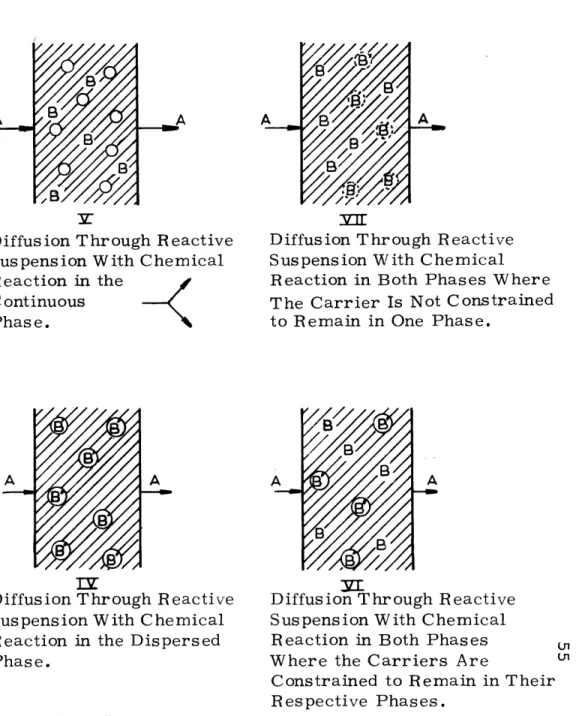
Case 1 is steady state Fickian diffusion of species A in a one-dimensional film. Simple modifications are shown by cases 2 and 3. Case 2 is diffusion in a heterogeneous medium in which one phase is dispersed in a continuous phase, for example an emulsion or dispersion. Such an inert suspension
is a reasonable model for diffusion of solutes in blood where no significant solute interactions occur with the plasma
pro-teins or hemoglobin molecules. Transport in inert heterogeneous media is fairly well understood. The steady state mass
26 (Ax=0 - Ax=L
N A =(. 1
L
where P is the effective permeability. (Permeability as used here is the product of the diffusivity times the solubility). The classical mathematical approach to the problem has been to solve Laplace's equation
V2$
= 0 (1.2)
where $ is the potential. For example Maxwell (1881), con-sidered a single sphere in an infinite continuum where the field is unidirectional and linear at large distances from the sphere. By solving Laplace's equation for the potential
in spherical coordinates both inside and outside the sphere, one obtains the potential variation due to the presence of
the sphere in the continuum.
For the analysis of a dilute suspension of spheres,
Maxwell considered the suspension to be confined to a spherical region and located in an infinite continuous medium. By assum-ing- the perturbation associated with each of the smaller
spheres inside this spherical suspension to be independent of each other, Maxwell obtained an effective permeability for the suspension by equating the perturbation caused by the spherical suspension region with that caused by each of the small individual spheres. The resulting expression for the effective relative permeability is given by
27
P P +2P -21[P -Pd
- = (1.3)
c d+2c+ [c d
where 0 is the volume fraction of the dispersed phase, Pc is the permeability of the continuous phase, and Pd is the permeability of the dispersed phase. Other relationships
include those derived by Fricke (1924) for a suspension of randomly oriented ellipsoidal particles, and Bruggeman (1935), who took into account the interaction of neighboring particles.
Case 3 corresponds to diffusion with reversible chemical reaction in a homogeneous syttem. Reactant B is constrained to remain within the film and combines with the permeating
species A to form product AB ki
A + B AB (1.4)
k2
If both species B and AB have significant molecular diffusivi-ties, they can increase the mass transfer of A beyond that which is possible from purely physical diffusion of A alone. This phenomena has been termed carrier-facilitated transport, and
the steady state mass transport is given by
x=O x=L
N A = P(1+F) ( AA (1.5)
A L
where F is termed the facilitation factor and accounts for the contribution of the carrier molecules to the total mass flux. In order to determine the facilitation factor, the differential
mass conservation equation for A, B, and AB in the film must be solved subject to the associated boundary conditions. If
the reaction is at equilibrium everywhere in the film, the
facilitation factor is a maximum and is given by (Olander 1960)
DBkik2CT
F eq (1.6)
e DA (1+kC A x=) (l+kC A(=6
When the reaction deviates from equilibrium within the film, the problem is more difficult since the equations are non-linear. An approximate solution can be obtained if the equations are linearized, and solutions available in the
literature differ from each other depending upon the method of linearization employed. Friedlander and Keller (1965) presented a single point linearization solution valid for
small driving forces only. For large driving forces the method of matched asymptotic expansions has proven useful in giving accurate predictions of flux for near equilibrium conditions
(Goddard et al 1970, Kreuzer and Hoofd, 1970, 1972). Recently Smith et al (1973) have presented approximate analytical
solutions corresponding to a perturbation from purely physical diffusion on one hand (thin films), and from reaction equilib-rium at each point within the film on the other (thick films).
In all solutions, the facilitation factor is found to be a function of F and the ratio of the film thickness L to the characteristic lenghh A. The latter is the ratio of
-l/2 k1CA+k2
kik2CT-1 =+ _(1.7)
DB DA(k C+k 2)
for the reaction A+B AB. The characteristic length also
gives a measure of the thickness of the region near the boun-daries of the film where the departure from chemical equilibrium is significant. The dimensionless parameter is similar to the Thiele modulus as has been pointed out by Perelson and
Katchalsky (1972), and in a general context by Weisz (1973). asL/X increases, nonequilibrium effects become negligible, and the facilitation factor F reaches the asymptotic value given
by Olander (1960).
Combinations of cases 2 and 3 are shown in cases 4 and
5 which are examples of diffusion with reversible chemical
reaction in heterogeneous media. In Case 4, the carrier species is present only in the dispersed phase. An example is the diffusion of oxygen in whole blood where hemoglobin is present only inside the red blood cells. In Case 5 the carrier species is present only in the continuous phase. Such a situation may arise in gas absorption with chemical reaction in a slurry or in the diffusion in blood of
metabo-lites, drugs, or amino acids that interact with plasma proteins but not with hemoglobin.
Case 6 and 7 are more complicated reactive heterogen-eous systems where the carrier species is present in both
the continuous and dispersed phase. In Case 6, two different carriers are constrained to remain within their respective phases and cannot permeate across the boundary between
dis-persed and continuous phases. In Case 7, one carrier species is present in both phases, and it can diffuse from one phase into the other.
The same approach utilized by Maxwell was employed here to obtain effective permeabilities for the heterogeneous media shown in Figure 2.2. Fisst a solution was obtained for the concentration and potential field of the diffusing species inside and outside a single sphere in an infinite continuum. With this in hand the average effective permeability of a
suspension of spheres was obtained as described above.
The general solutions for Cases 6 and 7 of Figure 2.2 will be referred to as the impermeable and permeable models respectively. These two general solutions can be reduced to give solutions for eases 2,4, and 5. The general utility of
the mathematical approach was demonstrated by employing for Case 4 the four-step reversible reaction scheme proposed by Adair (1925) to model the reaction of oxygen with hemoglobin:
ki A + B AB (1.8a) bi A + AB 2 A2B (1.8b) b2 A + A2B a A3B (1.8c) b3 A + A3B * A4B (1.8d)
31
The Adair reaction scheme is an approximation to an extremely complicated reaction mechanism, but it is a better approxima-tion than a one-step reacapproxima-tion scheme as given by (1.4).
1.2.2 Details of the Derivations
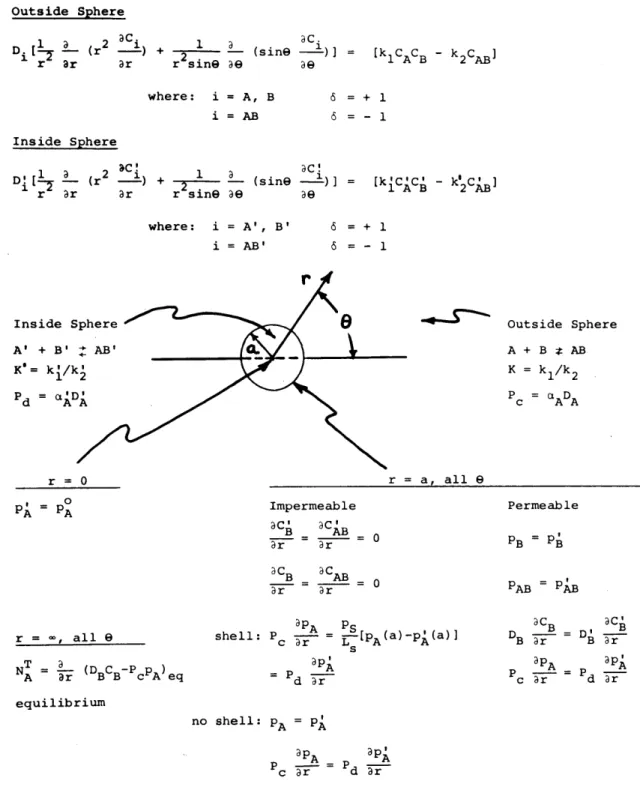
Consider a single sphere, of radius a and per-meability Pd' immersed in an infinite medium of perper-meability Pc, with a constant uniform mass flux of the diffusing species A imposed at large distances from the center of the sphere. A single step reversible reaction with carrier B and B'
occurs in the continuous and discontinuous phases, respectively: ki
A + B+ AB (1.9)
ki'
A'+B' + AB' (1.10)
k2'
Reactions (1.9) and (1.10) were chosen as an example only, and the theoretical development can be extended to other reaction schemes. The steady state diffusion equations in
spherical coordinates for species A, B, AB outside the sphere and A', B', AB' inside the sphere are given in Figure 4.2, along with the associated boundary conditions for both the
impermeable and permeable model. The boundary condition at r=0 fixes the partial pressure of A at the center of the sphere, and the boundary condition at r=m fixes the total flux of A and, in addition, imposes equilibrium between
all reacting species. These boundary conditions apply to both the impermeable and impermeable model, but the boundary conditions at the sphere boundary are of course different. Boundary conditions at r=a insure continuity of species flux and potential, and do or do not constrain the carrier species to remain in its respective phase. For small driving forces across the sphere, an approximate solution can be obtained by utilizing single point linearization about the partial
pres-sure at the center of the sphere. For the sake of simplicity it was assumed that the diffusivities of all the carrier
species in both phases are equal and that Henry's Law is applicable. It can be shown that as a consequence of the single point linearization technique the concentrations at the center of the sphere are at equilibrium. Once the con-centration and potential variation has been determined the effective permeability of a suspension of spheres can be obtained. Tables 1.1 and 1.2 summarize the relationships
obtained for the impermeable and permeable model. The parame-ters A and A' are the continuous and dispersed phase character-istic lengths and are defined analogously to equation (1.7). They give a measure of the thickness of shells outside and
inside the sphere where deviations from chemical equilibrium are significant. The factor Fd is the dispersed phase facili-tation factor, and the terms F q and Feq' are the equilibrium continuous- and dispersed-phase facilitation factors and are
defined as
D Bkik2C T aA
eq P c(ki+k2 tAA A)
F ' = DBk'2C'A (1.12)
eq d (ki'+k2'aA' PAo
It should be noted here that the general equations in Table
1.1 and 1.2 are for a suspension of reactive spheres in a
reactive continuum that is at equilibrium throughout the con-tinuum except locally near the boundary of the spheres. This is a consequence of the boundary conditions at ramw which fixes the species to be at equilibrium. The general equations can give solutions for the other heterogeneous media if the
parame-ters are allowed to attain certain values. To make the spheres inert a/X' must approach zero so that F d approaches zero. To
make the continuum inert F eqmust be set to zero since reduction of a/A will increase nonequilibrium effects around the spheres but will not make the continuum inert. Inspection of the
equations show that the equations are similar in form to Max-well's equation and in fact reduce to MaxMax-well's equation as shown for Case 2. The continuous phase permeability, P c, is
increased by the factor (l+F eq), and the dispersed phase
per-meability is increased by the factor (1+F d)*
The Adair reaction scheme for oxygen combination with hemoglobin has been given by equation (1.8). For the case of
4 Type of Media Reaction inside Reaction outside Case VI TABLE 1. 1
EFFECTIVE PERMEABILITY RATIO FOR THE IMPERMEABLE MODEL
Relationship
P (l+F )
-c eq
2
Pc (1+Feq ) d (1+Fd) (1-2Fe fc ) 2 P[Pc (1+Feg )-Pd (1+Fd) (l+F fc)] 2Pc (1+Feq )+P d (l+F d) (1-2Feq f c )+[P (1+Feq )-Pd (l+Fd )(l+Feq f c)]
Comments General relationship for no shell. Inert inside Reaction outside Case V (impermeable carrier) Reactive inside Inert outside Case IV Inert inside Inert outside Case II P (1+F c )T eq 2Pc (l+Fe )+P d (1-2Fe f c ) 2 [Pc (l+F e )-Pd (1+Fe f c) 2 Pc (l+F )+P (1-2F f )+D[P (l+F )-P (l+F fc)] c eq d eq c c eq d eq c 2Pc +Pd (l+Fd) 2 [PcP d (l+Fd P 2Pc Pd (1+Fd) + [P-Pd (l+Fd P 2P +P +@[P -P] c c d c d where: 1 + x c A a f2 + 2 + a a Fd (3 + 1) tanh - 3 F' eq [ a2 a A (2 X2 + 1) tanh -a 1+F' [ 1 -(3 + 1) tanh - 2 a (2 + 1) tanh - 2 a 0 F =0 eq a 0 F =0 eq
Type of Media Reaction inside Reaction outside Case VI Inert inside Reaction outside Case V (permeable carrier) Reactive inside Inert outside Case IV Inert inside Inert outside Case II where: TABLE 1.2
EFFECTIVE PERMEABILITY RATIO FOR THE PERMEABLE MODEL
Relationship
Pc (1+F )
2Pc(l+F c eq )Pd(l+F d eq , )[-- -Q ]-2,D{Pc(l+F c eg )-Pd(1+F q)[ d l-Q }11
2
Pc (1+Fe )+Pd (l+Fq) [1 Q]+{P (l+Fe) -Pd (l+F 'q) [ ]}
Same as Case V, Table 1.1 only if F' = 0 eq
Same as Case IV, Table 1.1
Same as Case II, Table 1.1, Maxwell
f c F' - F 2 eq eq F' 1 + F P = eq eq d (1+F ')F c eq a+ fcc d eq eq a X,' 2 - tanh (2 +-) la Comments General relationship. a +i~ 0 F =0 eq IL I
36
an Adair reaction scheme inside the dispersed phase with no reaction in the continuous phase the mass conservation equation
for species A', B', AB', AB', AB', and A4B' inside the dis-persed phase and species A in the continuous phase must be
coupled with the boundary conditions in order to be solved. Again, single point linearization about the center point
con-centrations was the technique utilized to linearize the equa-tions; this led to an eigenvalue problem. An effective
permeability was obtained which is of the form
- P d(l+FAdair) + 2P - 24 [P -P (l+FAdair).
P P (l+FAdair) + 2P - [P -P (l+FAdair (1.13)
The parameter FAdair is the facilitation factor in the dispersed phase for the case of four-step Adair kinetics. When equilibrium conditions are attained throughout the sphere, the Adair facili-tation factor approaches its equilibrium value
Adair 4D 'C , dA1
eq T(1.14)
d
where dy/dpA is the slope of the oxygen-hemoglobin saturation curve
1.2.3 Average Effective Permeability
The equations so far derived were for local per-meabilities and facilitation factors in terms of the partial pressure of species A at the center of the sphere. Thus the
effective permeability is uniquely defined only at a local point within the suspension. If one considers a liquid slab composed of a suspension of spheres and across which a large partial pressure gradient of A is imposed, then the average effective permeability of the slab may be calculated by inte-grating the local expression across the thickness of the film
x=L
f
PIPdpA
p x=0 = A (1.15) ave x=0 x=L A ~PA 1.3 Analysis of TheoryThe behaviour of the equations for the various heterogen-eous media shown in Figure 2.2 were analysed. Heavy emphasis was placed in the analysis on Case 4 (oxygen diffusion through blood) and on a comparison of the one-step and four-step
reaction schemes, represented by equations (1.10) and (1.8) respectively. Physicochemical parameters used for the calcu-lations were taken from Kreuzer (1970), Gibson (1959, 1970) and Altman and Dittmer (1971), and are given in Table 5.1. Figure 5.8 shows the local dispersed-phase facilitation factor as a function of sphere radius a and oxygen partial pressure
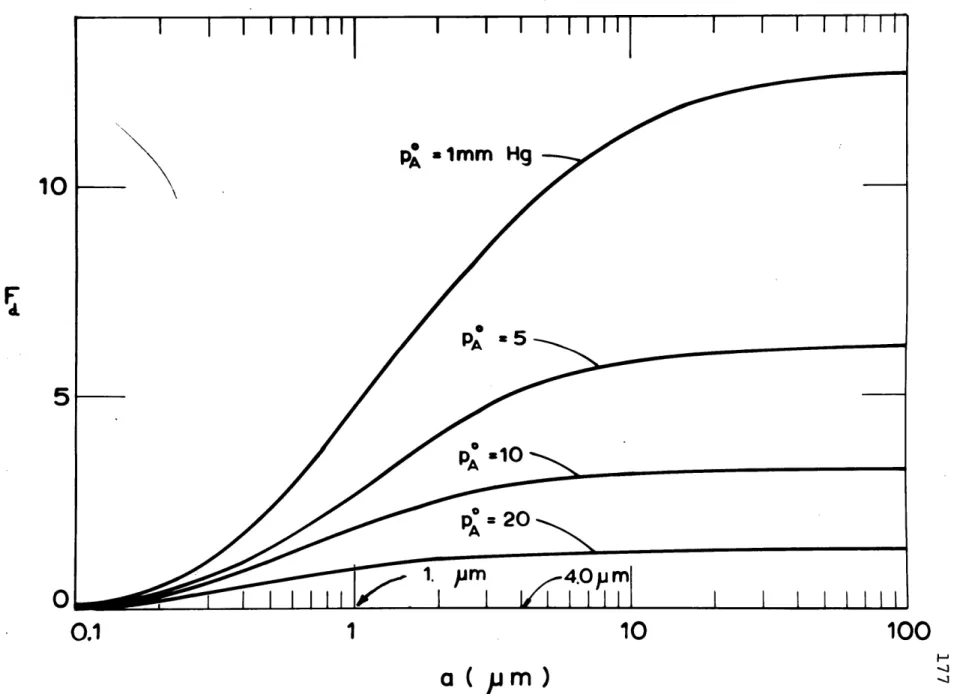
p0 2 for the one-step model. As the size of the spheres in-creases, the facilitation factor reaches the equilibrium facilitation factor. As the partial pressure increases the reaction saturates and facilitation effects become neglioible. Figure 5.9 shows the local effective permeability as a function
of sphere radius and partial pressure.as calculated for whole blood. Curves are shown for radii corresponding to one-half the minimum and maximum red cell dimension.and for a radius based on equivalent red blood cell surface area. The local effective permeability is a maximum at zero partial pressure because the one-step reaction scheme predicts a hyperbolic oxyhemoglobin saturation curve with a maximum slope at that point. Figure 5.10 shows the integrated average effective
permeability for red cell suspensions in plasma for two driving force conditions. The equations show that the chemical reaction inside the dispersed phase increases the effective permeability over that of the inert case.consistent with Maxwell's equation. Analysis was also carried out with the four-step reaction scheme for two cases for which kinetic parameters were avail-able (Gibson 1970): red cells containing (1) normal amounts and (2) "stripped" of 2,3 diphosphoglycerate (2,3 DPG). The Adair facilitation factor for unstripped (normal) blood is
shown in Figure 5.16. The facilitation factors maximize near the partial pressure for which the sigmoidal four-step satura-tion curve has a maximum slope. Local permeabilities for whole blood are shown as a function of oxygen partial pressure and
sphere radius in Figure 5.18. The effective permeabilities
maximize near the point where the oxygen-hemoglobin saturation curve is steepest. Blood depleted of 2,3DPG exhibits higher facilitation factors because of the higher oxygen affinity of
the "stripped" hemoglobin and consequent steeper saturation curves. The effective permeabilities are therefore large in the low oxygen partial pressure range, but decrease rapidly as the reaction saturates. The average effective permeability for unstripped red blood cell suspensions is shown in Figure
5.21 for the same conditions as those shown in Figure 5.10.
It can be seen that the one-step model and the four-step model give reasonably good agreement. This was anticipated in view of: (1) the large driving force (with consequently large
hemoglobin saturation differences); and (2) the use of
kinetic rate constants for each model which are of the same order of magnitude. A number of driving force conditions were investigated, and the one-step and four-step reaction schemes compared. It was concluded that the one-step reaction scheme fails to agree with the four-step scheme only when both
boundary conditions fall within the steep portion of the sigmoidal hemoglobin saturation curve.
In addition to the model for oxygen diffusion in blood, the behaviour of the equations for the other cases discussed above were also analysed.
1.4 Experimental Materials and Apparatus
Gas permeabilities (mainly oxygen) were measured for thin liquid slabs of heterogeneous media. Since diffusion in inert heterogeneous media (for which there is little data in the literature) is relevant to the general problem of reactive