TRANSACTIONS OF THE ROYAL SOCIETY OF TROPICAL MEDICINE AND HYGIENE (2003) 97, 350-354
Treatment of visceral leishmaniasis in south-eastern Nepal: decreasing efficacy
of sodium stibogluconate and need for a policy to limit further decline
S. Rijal a, F. C h a p p u i s ~, R. S i n g h l, P. A. B o v i e r 2, P. A c h a r y a 1, B. M . S. Karki 1, M. L. D a s 1, P. D e s j e u x 3, L. L o u t a n 2 a n d S. K o i r a l a 1 lB. P. Koirala Institute of Health Sciences, Dharan, Nepal; 2Department of Community Medicine, Geneva University Hospital, 1211 Geneva 14, Switzerland; 3Communicable Disease Surveillance and Response
(CSR) , lVorld Health Organization, 2 0 Avenue Appia, 1211 Geneva 27, Switzerland A b s t r a c t
Sodium stibogluconate (SSG) is the first-line therapy for visceral leishmaniasis (VL) in south-eastern Nepal. Recent studies from the neighbouring state of Bihar, India, have shown a dramatic fall in cure rates with treatment failure occurring in up to 65% of VL patients treated with SSG. A prospective study was conducted at a tertiary-level hospital located in south-eastern Nepal from July 1999 to January 2001. Parasitologically proven kala-azar patients with no previous history of treatment for VL were treated with SSG 20 m g / k g / d for 30 d which was extended to 40 d in those with persistent positive parasitology. Of the 110 patients who completed SSG therapy and were assessed at 1 and 6 months, definite cure was achieved in 99 patients (90%) and SSG failure occurred in 11 patients (10%). Except for the presence of hepatomegaly and a lower platelet count there was no clinical or laboratory baseline characteristic associated with treatment failure. A significantly lower cure rate (76%, P = 0.03) was observed in patients from the district of Saptari, which borders the antimony-resistant VL areas of Bihar. The efficacy of SSG as a first-line treatment for VL in south-eastern Nepal was still satisfactory, except for the patients living closer to the antimony-resistant VL areas of India. These findings indicate that the spread of resistance to antimonials is already taking place in Nepal and that a policy to control further spread should be urgently implemented.
Keywords: visceral leishmaniasis, Leishmania donovani, chemotherapy, sodium stibogluconate, drug resistance, Nepal
I n t r o d u c t i o n
Visceral leishmaniasis (VL) or kala-azar affects an estimated 500 000 persons every year worldwide, with 50% of cases reported from Bangladesh, India, and Nepal (Desjeux, 2001). Visceral leishmaniasis is con- sidered a major health problem in Nepal and is ende- mic in 12 districts of the eastern and central part of the southern Terai region, where an estimated 6 million people are at risk of acquiring the disease (Ministry of Health, Nepal, 1999/2000). This region borders the northern part of the state of Bihar in India, which has been the epicentre of the Indian epidemic.
In Nepal, as in most VL-endemic regions, the first- line treatment relies on pentavalent antimony, such as sodium stibogluconate (SSG), as recommended by the W H O (1990). In spite of the inconvenience of pro- longed parenteral therapy and potential for severe ad- verse effects SSG is still used mainly due to its proven efficacy and, when generic compounds are used, afford- ability (Veeken et al., 2000). However, in the state of Bihar in India, there has been an increasing resistance to SSG since the early 1980s despite a gradual increase of the dose and duration of treatment up to the maxi- m u m recommended dose of 20 m g / k g / d for 30 d (Sun- dar, 2001). In 1991-92, cure rates of 60% and 64% were found in 2 separate studies using this maximum recommended dose (Jha et al., 1992; Sundar et al., 1995). This trend has shown a further decline and a recent study has reported a long-term cure rate of only 35% (Sundar et al., 2000a). Thus, SSG has now been abandoned and replaced by the more expensive amphotericin B as the first-line therapy for VL in Bihar. In Nepal, data on the efficacy of SSG is poorly documented. There has been only 1 published study (Karki et al., 1998) that compared SSG 20 m g / k g / d given for 20 d compared with 30 d in 2 groups of 27 patients each. The definite cure rate was found to be 78% and 93%, respectively.
One of the important contributing factors to the drug resistance in Bihar has been attributed to the use of Address for correspondence: Dr F. Chappuis, Travel and Migration Medicine Unit, Geneva University Hospital, rue Micheli-du-Crest 24, 1211 Geneva 14, Switzerland; phone +41 22 3729620, fax +41 22 3729626,
e-mail [email protected]
infra-therapeutic doses and/or insufficient duration of SSG therapy (Sundar, 2001). This p h e n o m e n o n also exists in Nepal. Moreover, the socio-cultural similarity and the open border between southern Nepal and northern Bihar facilitate cross-border population move- ments which may also play an important role in the spread of SSG-resistant strains of Leishmania donovani. The objective of the study was to obtain the current status of SSG efficacy in the VL-endernic regions of eastern Nepal and to look for any factors associated with drug resistance. A policy for the control of SSG resistance in Nepal is discussed.
M a t e r i a l s a n d M e t h o d s Study site
This study was conducted at the B. P. Koirala Institute of Health Sciences (BPKIHS), a 650-bed University Hospital located 2 kin from the town of Dharan, Sunsari district in the Eastern region of Nepal. The BPKIHS serves as a reference tertiary-level hospi- tal for the Eastern region which includes several VL- endemic districts. Recruitment of patients took place at the outpatient department and the emergency room of BPKIHS from July 1999 to August 2000. Patients came directly to BPKIHS or were referred from the district hospitals. The Ethical Committee of BPKIHS approved the research protocol in May 1999.
Inclusion and exclusion criteria
Parasitologically proven VL cases with no history of previous treatment with SSG were included after ob- taining informed consent from the patient or his/her guardian. Only patients from the 3 neighbouring dis- tricts of Sunsari, Morang, and Saptari were included as follow-up would not be practically possible for patients coming from more remote districts. There was no other exclusion criteria.
Initial evaluation
All patients with suspected VL (history of fever t> 2 weeks duration and clinical splenomegaly) were ad- mitted to the medical or paediatric ward for a complete examination. This included clinical evaluation, com- plete blood count, chemistry, blood culture, urine analysis, and chest radiography. HIV testing was done after pre-test counselling using Vironostica ® and Re-
combigen ® enzyme-linked immunosorbent assay tests. Diagnosis of VL was made by Giemsa-stained bone marrow aspirate or spleen aspirate (if bone marrow aspirate was negative). Stained smears were designated as 'positive' if L. donovani bodies were seen or 'nega- tive' if none were seen in 100 oil immersion fields. Two doctors read the slides independently. Parasite density score was determined microscopically in the Giemsa- stained smears by the use of a logarithmic scale ranging from 0 (no parasites per 100 oil immersion fields) to + 6 (> 100 parasites per field). For quality control, 10% of the slides were cross-checked at the Protozool- ogy Unit (Prof. Dominique Le Ray) of the Institute of Tropical Medicine in Antwerp, Belgium.
Treatment
All the patients included were allocated into 2 treat- ment groups: Group A received the full treatment course in the hospital and Group B received the first 5 - 7 d treatment in the hospital and the rest as outpatients at the nearest health facility to their place of residence. Allocation into the 2 groups was made according to patients' preference as random allocation was not pos- sible. Patients were treated with generic SSG (sodium antimony gluconate [SAG] from Albert David Ltd, Calcutta, India) 20 m g / k g / d for 30 d as recommended by the Nepalese National Guidelines.
Follow-up
Clinical assessment and parasitological examination for L. donovani bodies was repeated at the end of 30 d of SSG therapy (1-month follow-up). If L. donovani bodies were still present at this time, SSG was extended for another 10 d. If at the end of this extended period L. donovani bodies were still found in tissue aspirate, the patient was then treated with the second-line ther- apy amphotericin B, 0.5 m g / k g / d for 14 d. All patients were followed-up at 3 and 6 months for further clinical evaluation. Parasitological examination was repeated at 6 months in all patients and at 3 months if relapse was clinically suspected (fever, spleen enlargement). The patients were followed-up at the BPKIHS or actively in their homes if they did not attend the BPKIHS on the fixed date. All relapse cases were treated with ampho- tericin B 0.5 m g / k g / d for 14 d.
Case definitions
We used the following definitions: VL case, patient with clinical signs (prolonged fever and splenomegaly) and positive for L. donovani bodies in tissue aspirate (bone marrow or spleen); initial cure, a VL case with absence of fever and negative parasitology at the end of SSG therapy; non-responder, a VL case with positive parasitology after 40 d of SSG therapy; definitive cure, a VL case with no clinical signs of relapse and negative parasitology at 6 months follow up; relapse case, a VL case with initial cure but with reappearance of clinical signs and positive parasitology during the 6 months follow-up; and SSG failure, non-responder or relapse
c a s e .
Statistical analysis
Frequencies and cross-tabulations were used to de- scribe the proportions of treatment failure across base- line socio-demographic and medical characteristics. Mean and median values were used for continuous characteristics such as age or duration of fever. T o study the effect of place of stay, logistic regression was used to adjust for other significant socio-demographic and medical factors. Pearson's ){2, independent sample t tests, and M a n n - W h i t n e y U tests were used to test the statistical differences across groups, where appropriate. All tests were two-tailed, with a significance level of 0.05.
R e s u l t s
Between July 1999 and August 2000, 120 VL pa- tients were included in the study and started on SSG therapy. Four patients (3.3%) died during the course of treatment: 2 from cardiotoxicity (electrocardiographic- proven arrhythmia), 1 from septic shock and 1 patient with underlying psychiatric illness who committed sui- cide during his hospital stay. Two other patients devel- oped evidence of cardiotoxicity during SSG treatment and were switched to amphotericin B. T h e total inci- dence of cardiotoxicity due to SSG was thus 3.3%.
Of the 114 patients who completed 30 d SSG ther- apy, 103 had a negative parasitology. Eleven remained parasitologically positive and required extension of the SSG therapy to 40 d. Of these 11, only 1 became parasitologically negative and 10 remained positive after 40 d. Thus, at completion of treatment there were 104 initial cures and 10 non-responders. Four patients who had shown initial cure were lost to follow-up at 6 months. Of the 100 patients analysed at 6 months follow-up, 1 had a positive parasitology (relapse) and 99 remained parasitologically negative (definite cure).
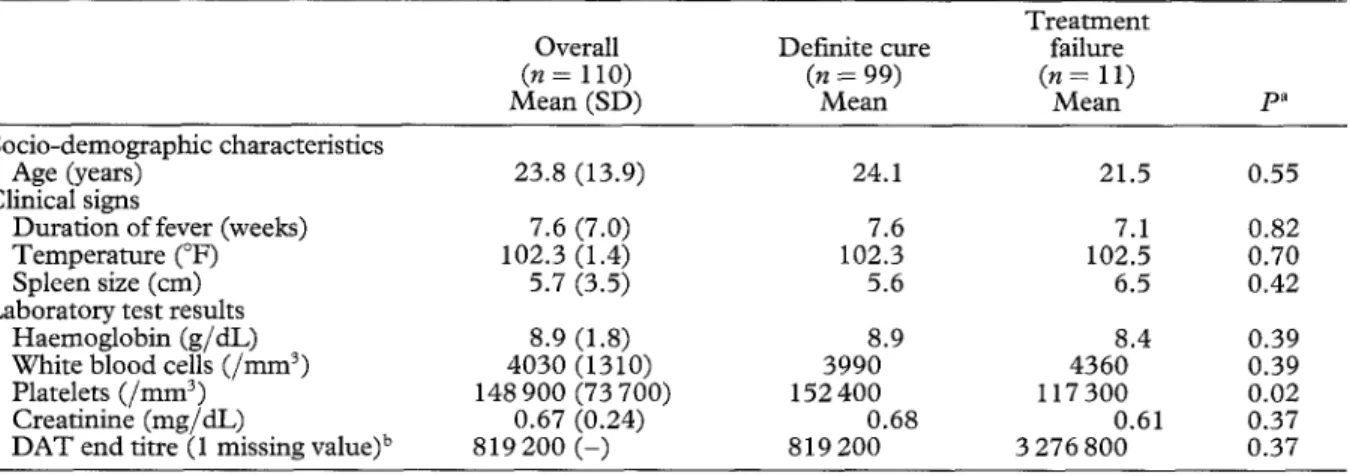
T h e 10 patients with u n k n o w n status of resistance to SSG (death during treatment (4), treatment changed to amphotericin B (2), and lost to follow-up (4)) were excluded from further analysis. Of the remaining 110 patients, SSG failure (non-responders or relapse) was seen in 10% (11/110) and definite cure was achieved in 90% (99/110). Table 1 compares baseline socio- demographic characteristics, clinical signs and labora- tory values in the 110 patients followed-up at 6 months.
All the patients were negative to HIV testing. A total of 84 (76%) received the full treatment as in-patients (group A) and 26 (24%) received the initial SSG treatment ( 5 - 7 d) as in-patients and the rest as out- patients in the peripheral health facilities (group B).
Treatment failure was only significantly associated with the place of stay, the presence of hepatomegaly, and a lower platelet count (Table 2). Treatment failure occurred in 24% of patients coming from the district of Saptari compared with only 5% for the district of Sunsari and 6% for the district of Morang (P = 0.03). Patients coming from Saptari were more frequently men (80% vs. 53%, P = 0.02), more frequently had a positive blood culture at the time of diagnosis (20% vs. 5%, P = 0.01), and had more parasites in bone marrow examination (57% with +++ to + + + + + vs. 31% with + to ++, P = 0.03). However, patients coming from Sap- tari district did not show any other significant differ- ence in disease severity such as duration of fever, spleen size, and haemoglobin count when compared with patients from the other 2 districts (data not shown). In logistic regression analysis, taking into account the effect of gender, positive blood culture and degree of parasite infestation in the bone marrow, treatment fail- ure was still more frequent for patients coming from Saptari (OR = 6.8, 95% CI 1.3-37.1).
D i s c u s s i o n
In this study, we found that the current efficacy of SSG in the treatment of VL remains satisfactory in the eastern part of the VL-endemic area of Nepal where 90% of patients who completed their treatment and 6- month follow-up showed a definite cure. Except for the presence of hepatomegaly and a lower platelet count, we did not find any clinical or laboratory findings associated with resistance to SSG, as also reported by Sundar et aL (2000a) in India. Co-infection with HIV, an important cause of treatment failure, was not found in this study.
However, a significantly lower cure rate of 76% was found in patients coming from the district of Saptari, situated in the western extremity of the study area and closer to the northern districts of the Indian state of Bihar (Figure) where resistance to SSG is at its highest
352 S. RIJAL ETAL.
Table 1. C o m p a r i s o n o f b a s e l i n e s o e i o - d e m o g r a p h i c , clinical, and l a b o r a t o r y v a l u e s in 110 v i s c e r a l l e i s h m a n i a s i s p a t i e n t s t r e a t e d w i t h s o d i u m s t i b o g l u c o n a t e in s o u t h - e a s t e r n N e p a l w i t h definite c u r e or t r e a t m e n t failure at six m o n t h s f o l l o w - u p , July 1 9 9 9 - A u g u s t 2000
Treatment
Overall Definite cure failure
(n = 110) (n = 99) (n = 11)
Mean (SD) Mean Mean pa
Socio-demographic characteristics
Age (years) 23.8 (13.9) 24.1 21.5
Clinical signs
Duration of fever (weeks) 7.6 (7.0) 7.6 7.1
Temperature (°F) 102.3 (1.4) 102.3 102.5
Spleen size (cm) 5.7 (3.5) 5.6 6.5
Laboratory test results
Haemoglobin (g/dL) 8.9 (1.8) 8.9 8.4
White blood cells ( / m m 3) 4030 (1310) 3990 4360
Platelets ( / m m 3) 148 900 (73 700) 152 400 117 300
Creatinine (mg/dL) 0.67 (0.24) 0.68 0.61
D A T end titre (1 missing value) b 819 200 ( - ) 819 200 3 276 800
0.55 0.82 0.70 0.42 0.39 0.39 0.02 0.37 0.37 aIndependent samples t test.
bMedian values and Mann-Whitney U test (DAT end titres were not normally distributed).
Table 2. R e l a t i o n s h i p s b e t w e e n t r e a t m e n t failure a s s e s s e d at 6 m o n t h s f o l l o w - u p and b a s e l i n e s o c i o - d e m o g r a p h i c and c l i n i c a l c h a r a c t e r i s t i c s o f 110 v i s c e r a l l e i s h m a n i a s i s p a t i e n t s t r e a t e d w i t h s o d i u m s t i b o g l u e o n a t e in s o u t h - e a s t e r n N e p a l , July 1 9 9 9 - A u g u s t 2000
Overall Treatment failure (n = 110) ( n = 11) n (%) n (%) pa Socio-demographic characteristics Gender 0.33 Male 65 (59.1) 5 (7.7) Female 45 (40.9) 6 (13.3) Place of stay 0.03 Sunsari 38 (34.5) 2 (5.3) Saptari 25 (22.7) 6 (24.0) Morang 47 (42.7) 3 (6.4) Occupation 0.24 Farmer 26 (23.6) 2 (7.7) Housewife 22 (20.0) 1 (4.5) Student 50 (45.5) 8 (16.0) Other 12 (10.9) 0
Symptoms and clinical signs
Weakness 34 (30.9) 5 (14.7) 0.27 Weight loss 76 (69.1) 7 (9.2) 0.68 Cough 11 (10.0) 2 (18.2) 0.34 Abdominal pain 23 (20.9) 3 (13.0) 0.58 Vomiting 5 (4.5) 1 (20.0) 0.45 Skin darkening 31 (28.2) 4 (12.9) 0.53 Lymph nodes 5 (4.5) 0 0.45 Hepatomegaly 76 (69.1) 11 (14.5) 0.02
Laboratory test results
BM intensity (15 missing values) 0.20
+ to ++ 60 (63.2) 5 (8.3)
+ + + to + + + + + 35 (36.8) 6 (17.1)
Positive blood culture 9 (8.2) 1 (11.1) 0.91
Positive malaria smear 2 (1.8) 0 0.63
Associated tuberculosis 3 (2.7) 1 (33.3) 0.17
Type of care 0.65
In-patient (Group A) 84 (76.4) 9 (10.7)
Outpatient (Group B) 26 (23.6) 2 (7.7)
~Pearson's X 2 test.
(Sundar et al., 2001). This decreased cure rate ob- served in patients from Saptari is not likely to be due to differences in patients' characteristics or disease sever- ity. Our results suggest that it is most likely that the decreased response to treatment observed in Saptari district is due to resistant strains of L . donovani as recently demonstrated in Bihar (Lira et al., 1999). The resurgence of VL in Nepal started in the early 1980s, a
decade after the epidemic began in Bihar, which could explain the current observed difference of SSG efficacy between the 2 countries. T h e increased failure rate in patients from Nepalese districts neighbouring Bihar strongly suggests that the spread of SSG resistance is taking place in Nepal and it may follow a similar course to that in Bihar if no immediate measures are taken.
T i b e t a n P l a t e a u
I n d i a
Kathmandu
BPKIHS
Kala-azar affected districts, Nepal
High antimony resistance area, Bihar
If oraog
• Pama
Figure. Map showing the 12 visceral leishmaniasis-endemic districts in south-eastern Nepal and the antimony resistance area in the state of Bihar, India, 1999. BPIZdHS, B. P. Koirala Institute of Health Sciences.
tween the state of Bihar and the Tera'i plain of Nepal could facilitate the spread of the resistant parasites. Moreover, drug misuse, a well-recognized risk factor for the development of resistant parasites (Bryceson et al., 1985), is also common but poorly documented in Nepal: inadequate dosage and/or duration of treatment of SSG is often prescribed in Nepal, mostly by poorly qualified practitioners. I n Bihar, Sundar et al. (1994) showed that only 26% of the 312 patients previously treated with SSG and presenting with a refractory disease had been treated according to the W H O (1996) guidelines.
T h e current free provision of VL drugs in Nepal to all hospitals located in the endemic region, as part of the National Kala-azar Control Program of the Nepa- lese Ministry of Health, may be a factor promoting adequate drug use. This may relieve economic pressure on patients to prematurely interrupt treatment but does not solve the constraints of transport and costs of hospitalization. Most VL patients belong to the lowest socio-economic class and have very limited capacity to pay for the cost of treating the disease (Desjeux, 1996). Moreover, the vast majority of VL patients admitted to public hospitals in Nepal receive only the initial few days of SSG until clinical improvement as in-patients and their treatment is completed as outpatients in peripheral health facilities. Considering the long daily walking time to reach health facilities, the painful i.m. iniections and the other priorities of daily life, this strategy may lead to inadequate adherence to treat- ment, subsequently decreasing treatment efficiency and promoting the selection of resistant parasites. In our study, we did not find any significant difference in the outcome of patients between those receiving the full treatment as in-patients and those treated mostly as outpatients. However this study design had limitations, as we were unable to randomize the patients groups.
As suggested by Bryceson (2001), a policy to prevent and control the spread of SSG resistance should be implemented in VL-endemic areas like Nepal. Such a policy should include the reinforcement of current activities aiming to decrease overall disease transmis- sion, measures to prevent drug misuse and implemen- tation, after evaluation, of combination therapies.
The tools available for the control of anthroponotic VL have been recently reviewed by Boelaert et al. (2000). Vector control through insecticide spraying, in association with early case detection and treatment, is an effective way to reduce transmission of the disease (Saxena et al., 1996), and thus also transmission of drug-resistant strains. This requires strong political commitment and is costly. T h e use of impregnated bednets has the potential to protect healthy people against VL (Bern et al., 2000), and to impede untreated patients to disseminate the parasite through sandfiy bites.
Measures to prevent SSG misuse in Nepal could include the widespread implementation of test-treat- ment algorithms, directly observed therapy for out- patients' care, education of practitioners from both public and private sectors to prescribe adequate treat- ment schedules, adequate supply of reliable generic SSG with proven efficacy and safety profile to health facilities in the endemic areas, and the patients' access to free or very low-cost drugs.
T h e use of combination therapy for VL could be an appealing approach for treating patients in drug- resistant areas, protecting each component of the com- bination against selection of resistant mutants and using drugs at lower and thus safer total doses. In the case of malaria, a control of mefloquine resistance has been obtained within a few years of systematic use of the artesunate-mefloquine combination in western Thailand (Nosten et al., 2000). It is currently unclear if a similar strategy for VL would be successful b u t such an approach should be considered in areas, such as Nepal, where resistance to SSG is increasing. Combi- nations of SSG and paromomycin have shown to be efficient and safe in India (Thakur et al., 2000), Sudan (Seaman et al., 1993), and Kenya (Chunge et al., 1990) b u t paramomycin has yet to be registered for VL treat- ment and its future production and cost remain u n - clear. Other possible combinations could include in future trials conventional or liposomal amphotericin B as well as miltefosine, an oral drug showed to be very efficient in India when used alone for 4 weeks (Jha et al., 1999; Sundar et al., 2000b). Miltefosine was regis- tered for the treatment of VL in India in 2002 and a
354 S. RIJAL ETAL.
phase IV trial will take place in India and N e p a l in the c o m i n g year. H o w e v e r , because o f the long half-life of miltefosine and the long duration of treatment, one m i g h t fear that L. donovani will rapidly develop resis- tance to this drug if it is used alone.
Regular m o n i t o r i n g of S S G susceptibility in N e p a l should be an i m p o r t a n t c o m p o n e n t of this policy. It should be p e r f o r m e d preferably in vitro using the amas- t i g o t e - m a c r o p h a g e m o d e l , which evaluate the resis- tance of L. donovani isolates to antimonials (Croft, 2001).
T h e H I V seroprevalence in the general p o p u l a t i o n in N e p a l is currently a r o u n d 0.3% b u t risk factors for an increasing prevalence are present (Furber et al., 2002). M o n i t o r i n g and fighting the progression of H I V disease is very i m p o r t a n t in this region considering the m u c h higher risk of t r e a t m e n t failure in H I V - V L co-infected patients treated with S S G or with any other anti-VL drugs (Lopez-Velez et aL, 1998).
In conclusion, we showed that the efficacy of S S G to treat V L in eastern N e p a l remains satisfactory overall b u t that areas of lower response to S S G exist in this region. Considering the lower price o f S S G (in its generic form) and the higher cost a n d / o r lack o f avail- ability of present alternative therapies, it is necessary that current efforts in N e p a l focus on limiting the spread of resistance to S S G .
Acknowledgements
This study was funded by grants allocated by the Novartis Foundation (UK), WHO, and Geneva University Hospital (Switzerland)
References
Bern, C., Joshi, A. B., Jha, S. N., Das, M. L., Hightower, A., Thakur, G. D. & Bista, M. B. (2000). Factors associated with visceral leishmaniasis in Nepal: bed-net use is strongly protective. American Journal of Tropical Medicine and Hy- giene, 63, 184-188.
Boelaert, M., Criel, B., Leeuwenburg, J., Van Damme, W., Le Ray, D. & Van der Stuyft, P. (2000). Visceral leishmaniasis control: a public health perspective. Transactions of the Royal Society of Tropical Medicine and Hygiene, 94, 465-471. Bryceson, A. D. M., Chulay, J. D., Ho, M., Mugambii, M.,
Were, J. B., Muigai, R., Chunge, C., Gachihi, G., Meme, J., Anabwani, G. & Bhatt, S. M. (1985). Visceral leishmaniasis unresponsive to antimonial drugs. I. Clinical and immuno- logical studies. Transactions of the Royal Society of Tropical Medicine and Hygiene, 79, 700-704.
Bryceson, A. (2001). A policy for leishmaniasis with respect to the prevention and control of drug resistance. Tropical Medicine and International Health, 6, 928-934.
Chunge, C. N., Owate, J., Pamba, H. O. & Donno, L. (1990). Treatment of visceral leishmaniasis in Kenya by aminosidine alone or combined with sodium stibogluconate. Transactions of the Royal Society of Tropical Medicine and Hygiene, 84, 221-225.
Croft, S. L. (2001). Monitoring drug resistance in leishmania- sis. Tropical Medicine and International Health, 6, 899-905. Desjeux, P. (1996). Leishmaniasis. Public health aspects and
control. Clinical Dermatology, 14, 417-423.
Desjeux, P. (2001). The increase in risk factors for leishmania- sis worldwide. Transactions of the Royal Society of Tropical Medicine and Hygiene, 95, 239-243.
Furber, A. S., Newell, J. N. & Lubben, M. M. (2002). A systematic review of current knowledge of HIV epidemiol- ogy and of sexual behaviour in Nepal. Tropical Medicine and International Health, 7, 140-148.
Jha, T. K., Singh, N. K. P. & Jha, S. (1992). Therapeutic use of sodium stibogluconate in kala-azar from some hyperen- demic districts of N. Bihar, India [Abstract]. Journal of the Association of Physicians of India, 40, 868.
Jha, T. K., Sundar, S., Thakur, C. P., Bachmann, P., Karb- wang, J., Fischer, C., Voss, A. & Berman, J. (1999). Milte- fosine, an oral agent, for the treatment of Indian visceral
leishmaniasis. New England Journal of Medicine, 341, 1795-1800.
Karki, P., Koirala, S., Parija, S. C., Handsak, S. G. & Das, M. L (1998). A thirty day course of sodium stibogluconate for treatment of kala-azar in Nepal. Southeast Asian Journal of Tropical Medicine and Public Health, 29, 154-158. Lira, R., Sundar, S., Makharia, A., Kenney, R., Gam, A.,
Saraiva, E. & Sacks, D. (1999). Evidence that the high incidence of treatment failure in kala-azar is due to the emergence of antimony resistant strains of Leishmania dono- vani. Joui'nal of Infectious Diseases, 180, 564-567.
Lopez-Velez, R., Perez-Molina, J. A., Guerrero, A., Baquero, F., Villarrubia, J., Escribano, L., Bellas, C., Perez-Corral, F. & Alvar, J. (1998). Clinicoepidemiologic characteristics, prognostic factors, and survival analysis of patients coin- fected with human immunodeficiency virus and Leishmania in an area of Madrid, Spain. American Journal of Tropical Medicine and Hygiene, 58, 436-443.
Ministry of Health, Nepal (1999/2000). Annual Report. Kala- azar Control. Kathmandu: His Majesty's Government of Nepal, Ministry of Health, Directorate of Health Services, Epidemiology and Disease Control, pp. 119-124.
Nosten, F., Van Vugt, M., Price, R., Luxenburger, C., Thway, K. L., Brockman, A., McGready, R., Ter Kuile, F., Looar- eesuwan, S. & White, N. (2000). Effects of artestmate- mefloquine combination on incidence of Plasmodium falci- parum malaria and mefloquine resistance in western Thai-
land: a prospective study. Lancet, 356, 297-302.
Saxena, N. B., Aggarwal, V., Dhillon, G. P., Sharma, R. S. & Rao, J. S. (1996). Visceral leishmaniasis control in India through primary health care system--a successful experi- ment of district level planning. Journal of Communicable Disease, 28, 122-128.
Seaman, J., Pryce, D., Sondorp, H. E., Moody, A., Bryceson, A. D. M. & Davidson, R. (1993). Epidemic visceral leish- maniasis in Sudan: a randomized trial of aminosidine plus sodium stibogluconate versus sodium stibogluconate alone. Journal of Infectious Diseases, 168, 715-720.
Sundar, S. (2001). Drug resistance in Indian visceral leish- maniasis. Tropical Medicine and International Health, 6, 849-854.
Sundar, S., Thakur, B. B., Tandon, A. K., Agrawal, N. R., Mishra, C. P., Mahapatra, T. M. & Singh, V. P. (1994). Clinico-epidemiological study of drug resistance in Indian kala-azar. British Medical Journal, 308, 307.
Sundar, S., Rosenkaimer, F., Lesser, M. L. & Murray, H. W. (1995). Immnnochemotherapy for a systematic intracellular infection: accelerated response using interferon-7 in visceral leishmaniasis. Journal of Infectious Diseases, 171, 992-996. Snndar, S., More, D. K., Singh, M. K., Singh, V. P., Sharma,
S., Makharia, A., Kumar, P. C. K. & Murray, H. (2000a). Failure of pentavalent antimony in visceral leishmaniasis in India: report from the center of the Indian epidemic. Clinical Infectious Diseases, 31, 1104-1107.
Sundar, S., Makharia, A., More, D. K., Agrawal, G., Voss, A., Fischer, C., Bachmann, P. & Murray, H. (2000b). Short course oral miltefosine treatment for visceral leishmaniasis. Clinical lnfectious Diseases, 31, 1110-1112.
Thakur, C. P., Kanyok, T. P., Pandey, A. K., Sinha, G. P., Zaniewski, A. E., Houlihan, H. H. & Olliaro, P. (2000). A prospective randomized, comparative, openqabel trial of the safety and efficacy of paromomycin (aminosidine) plus sodium stibogluconate versus sodium stibogluconate alone for the treatment of visceral leishmaniasis. Transactions of the Royal Society of Tropical Medicine and Hygiene, 94, 429 -431. Veeken, H., Ritmeijer, K., Seaman, J. & Davidson, R. A.
(2000). Randomized comparison of branded sodium stibo- gluconate and generic sodium stibogiuconate for the treat- ment of visceral leishmaniasis nnder field conditions in Sudan. Tropical Medicine and International Health, 5, 312-317.
WHO (1990). Control of the Leishmaniases. Report of a WHO expert committee. Geneva: World Health Organization, Tech- nical Report Series, No. 793.
WHO (1996). Manual on Visceral Leishmaniasis Control. Gene- va: World Health Orgnization, WHO/LEISH/96.40. Received 23 July 2002; revised 26 November 2002; accepted for publication 28 November 2002