Proceedings ofthe Nutrition Society (1987), 46, 143-156
'43
Tryptophan availability and serotonin synthesis
By PETER D. LEATHWOOD, Nestle' Research Department, NESTEC Ltd, 55
avenue Nestle, CH-1800 Vevey, Switzerland
Under carefully chosen experimental conditions, the consumption of specific diets or the administration of appropriate precursor amino acids can influence the synthesis of serotonin and catecholamines in the brain (Fernstrom, 1983; Sved, 1983). Thus, if rats are starved overnight and then given a carbohydrate-rich, protein-free meal, brain serotonin ( 5-hydroxytryptamine, 5HT) increases; if the meal is rich in protein, brain gHT may fall (Fernstrom & Wurtman, 1971, 1972;
Leathwood, 1986). The mechanism by which diet (or tryptophan; TRP) is thought
to influence 5HT synthesis involves the following sequence: the composition of
food consumed changes plasma levels of the large neutral amino acids (LNAA), which affect in turn the rate of T R P transport into the brain, brain T R P levels and hence the rate of 5HT synthesis. It has been suggested that, by this mechanism, dietary interventions might influence a range of behaviours and brain functions linked to serotoninergic neurotransmission. The objective of the present review is
to examine each step in the long sequence of (proposed) causality in an attempt to define the circumstances under which each step may have functional significance.
TRP availability and brain serotonin synthesis
Serotonin in the brain is synthesized from the essential amino acid TRP. The rate-limiting step is the hydroxylation of TR P to 5-hydroxytryptophan by the enzyme tryptophan 5-monooxygenase (EC 1.14.16.4). The rate of this reaction is
influenced by a variety of factors including TR P concentration, the firing frequency of the neuron, Ca2+dependent phosphorylation of the enzyme and cofactor availability (Fernstrom, 1983). End-product inhibition has been reported when brain 5 H T levels are tripled or quadrupled by monoamine oxidase (EC 1.4.3.4)
inhibitors (Macon et al. 1971), but his mechanism does not seem to act at
physiological levels of 5HT (Fernstrom, I 983).
The Michaelis-Menten constant
(K,,,)
of the enzyme for T R P is about 50 VM,both in vitro (Kaufman, 1974) and in vivo (Sved, 1983), although recent studies
with isolated synaptosomes suggest that the apparent
K,,,
might be much lower (Wolf & Kuhn, 1986). Brain levels of T R P usually range between 10 and 30 J ~ M , sothat the enzyme is probably unsaturated and changes in brain T R P should change the rate of 5HT synthesis. Numerous experiments have demonstrated that this is so. Increasing brain T R P not only increases the rate of 5HT synthesis (Carlsson &
Lindqvist, 1g72), it increases concentrations of brain 5HT and 5-hydroxy-
indoleacetic acid (5HIAA) (Hess & Doepfer, 1961 ; Fernstrom et al. 1974). In man,
1984-
Gillman et ul. 1981). Lowering brain T R P decreases the rate of 5 H T synthesis and
lowers brain 5 H T and 5HIAA concentrations (Biggio et al. 1974; Arimanana et al. In general, it appears that a doubling of brain T R P (from about 1 5 to 30 PM)
produces a 2-30% rise in brain gHT and 5HIAA (Fernstrom & Wurtman, 1972;
Fernstrom et al. 1974; Arimanana et al. 1984). The dose-response curve flattens
off as brain T R P approaches 90 PM (the concentration at which T R P
ymonooxygenase should be saturated). The results of Young & Gauthier (1981) suggest that a similar saturation may also occur in man since a 3 g load of T R P
approximately doubles CSF 5HIAA while a 6
g
load produces no further increase. Transport of TRP into the brainTRP is carried across the blood-brain barrier by the LNAA transport system, so
it must compete with valine, leucine, isoleucine, tyrosine, phenylalanine and methionine for access to the carrier-binding site (Pardridge, 1983). The K , of the carrier for T R P in the absence of competing LNAA is approximately 0 . I mM. The
apparent
K,
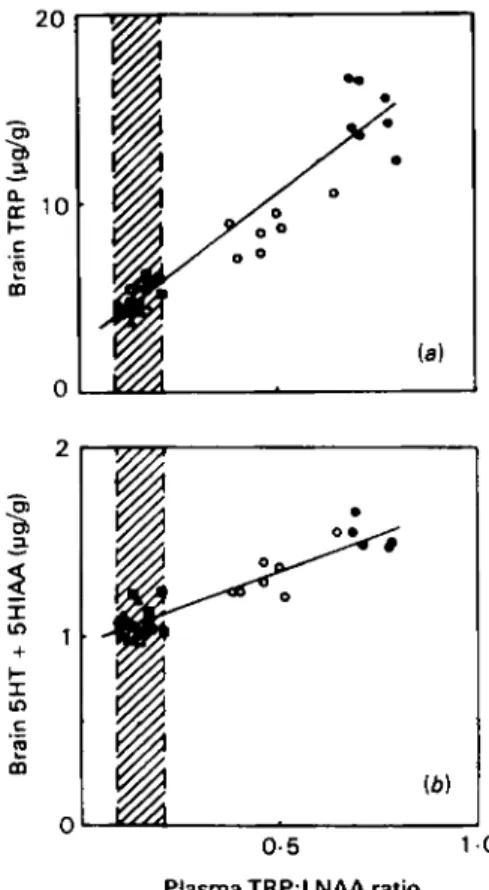
(i.e. taking into account the concentrations and binding constants of the competing LNAA) varies between 0 . 4 and 0 . 6 mM. Since total plasma T R P usually ranges between 0.04 and 0 . 1 mM, the binding site is unsaturated withrespect to TRP, and if plasma T R P levels change while other LNAA remain constant, the rate of T R P transport into the brain will also change. Since the other LNAA compete with T R P for transport, a change in their concentrations will equally influence T R P entry into the brain, even if plasma T R P remains constant. This is illustrated in Fig. I where similar amounts of T R P given alone or in
combination with an amino acid mix produce very different effects on brain T R P and 5HT. Under these circumstances the plasma TRP:LNAA ratio is a good predictor of brain T R P and 5HT
+
5HIAA (the normal range of this ratio is shown in Fig. I ) . As can be seen, a fourfold rise in the ratio doubles brain TRP which in turn produces a 20% rise in 5HT+
5HIAA.The picture is further complicated by the reversible binding of TRP to albumin. Estimates of dialysable tryptophan suggest that only 15-20Y0 of plasma TRP is
‘free’ but, as Pardridge (1983) has pointed out, interactions which are valid at equilibrium in vitro do not necessarily hold in vivo. During passage through the capillary bed of the brain the TRP-albumin complex disassociates and reassociates many times, while the LNAA carrier is competing for TRP. Pardridge (1983)
estimates that 70-80% of total plasma T R P will be available for transport so that albumin binding should play only a minor role in determining the rate of T R P transport into the brain. Even so, measurements both in rats (Leathwood, 1986) and men (Perez-Cruet et al. 1974) suggest that taking into account both albumin binding and competition with LNAA may slightly improve the predictability of brain TRP or CSF serotonin metabolites.
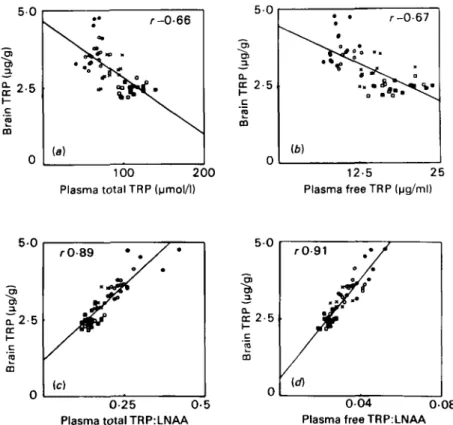
Until recently, there was some disagreement between different research groups as to which of plasma free TRP, plasma TRP:LNAA or plasma free TRP:LNAA best predicts brain T R P and 5HT. An experiment which helps resolve this
Vol.
46
Nutrient metabolism and the CNS
I45
0 . 5 1 .o
Plasma TRP:LNAA ratio
Fig. I . Correlation between ( a ) brain tryptophan (TRP) and (b) brain serotonin (yhydroxy- tryptamine, 5HT) plus 5-hydroxyindoleacetic acid (5HIAA) and the ratio of TRP:large neutral amino acids (LNAA), (LNAA comprise TRP, leucine, isoleucine, valine. phenylalanine, tyrosine and methionine).
Rats were starved for 18 h and fed nothing, a complete amino acid mix or an amino acid mix
minus the LNAA which compete with TRP. Treatments were as follows: starved controls I h (A),
z h (A); complete mix I h (O), 2 h (W); T R P alone I h (0), z h (0). Adapted from Fernstrom &
Wurtman (1972).
(a),
Range of plasma TRP:LNAA ratios seen in free-feeding rats (Leathwood &Ashley, 1983a,b).
question is illustrated in Figs. 2 and 3 where, in rats starved overnight and then
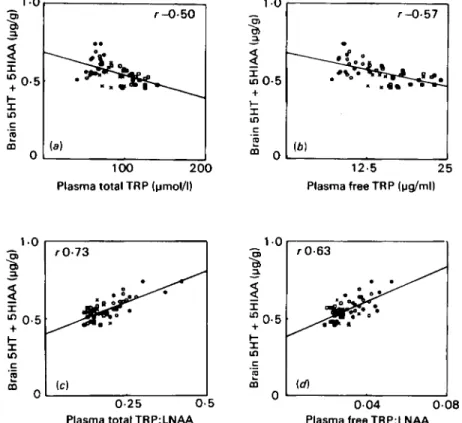
given meals of different compositions, the TRP:LNAA and free TRP:LNAA ratios are the better predictors of brain TRP. In this particular example plasma T R P and free T R P correlate negatively with brain TRP. Fig. 3 illustrates another important point. Although the correlation between plasma TRP: LNAA and brain TRP is rather tight, the correlation with gHT
+
5HIAA
is less reliable. The same conclusion can be drawn from an examination of Fig. I. Over the full range,TRP:LNAA did predict gHT
+
gHIAA, but within the normal range thecorrelation is weak. This point willbe taken up again during discussion of theories
( a )
100 200 Plasma total TRP (umol/l)
r 0 . 8 9
.
.
( C )
0 . 2 5 0
Plasma total TRP:LNAA
( b )
12.5 25
Plasma free TRP (pg/ml)
D 8 Plasma free TRP:LNAA
Fig. z . Correlations between brain tryptophan (TRP) and ( a ) plasma total TRP, ( b ) plasma free TRP, (c) plasma total TRP:large neutral amino acids (LNAA) ratio, ( d ) plasma free TRP:LNAA ratio in rats fed on different meals following a 1 5 h overnight fast. Compositions of the meals were as follows: 2 . 5 g (0) or 5 . 0 g (0) of a high-carbohydrate, protein-free diet; 2.5 g (0) or 5 o g
(m)
of azoo g proteakg diet; fasted control (x).
Effects of diet 01 TRP, or both on plasma TRP:LNAA ratio
Figs. 2 and 3 also illustrate the .effects of carbohydrate- or protein-containing
meals (eaten after an overnight fast) on plasma TRP:LNAA ratio and brain 5HT. The carbohydrate meal produces a sharp rise in insulin which accelerates uptake of glucose and branched-chain amino acids into muscle. Thus, although TRP levels fall slightly, the TRP:LNAA ratio rises, and brain T R P and 5HT increase. After the meal containing protein, plasma levels of all the LNAA rise. In this particular example the protein meal actually lowered the TRP:LNAA ratio (and brain T R P and 5HT) in spite of a rise in plasma TRP. The size of the meals had no significant influence on the ratio or on 5HT metabolism.
Does the same phenomenon occur in 'free-feeding' rats (or people)? In rats, after a short (3 h) fast a carbohydrate meal did produce a 50% rise in the TRP:LNAA
ratio but this was insufficient to change brain TRP, 5HT or 5HIAA. A meal containing 200
g
proteidkg lowered brain 5HIAA but had no effect at all on theVol.
46
Nutrient metabolism and the CNS
I47
ratio (Ashley et al. 1984; Ashley & Leathwood, 1984). Carbohydrate or protein meals eaten by free-feeding rats had no effect on brain TR P or serotonin metabolism (P. D. Leathwood and L. Arimanana, unpublished results). In man, carbohydrate- or proteincontaining evening meals have no effect at all on the TRP:LNAA ratio (Ashley et al. 1982 and Fig. 4), although addition of 400 mg T RP to the carbohydrate meal tripled the ratio. Calculated values for the ratio after combining T R P with the protein meal suggest that it would not even double (see Fig. 4).
Effects on serotoninergic neurotransmission
Having established the conditions under which diet-induced changes in plasma amino acids can influence brain serotonin, it is appropriate to ask if there is any evidence that this ‘cascade’ actually effects 5HT release. One mechanism by which release might be maintained constant in the face of changing intraneuronal gHT is that firing rates might adapt. Moderate to large (i.e. 50 mg/kg or more) doses of
1.0
s
-
8
I 0 . 5 I- I m C .- E m 0 r -0.50..
( a ) 1 0 0 2(Plasma total TRP (pmol/l)
Plasma total 1RP:LNAA
1 .o
-
B
-
8
I+
t- I Ln C LO 0.5 .- E m o r -0.57.
” 0.04 0.08Plasma free TRP:LNAA
Fig. 3. Correlations between brain serotonin (5-hydroxytryptamine; 5HT) plus 5-hydroxy-
indoleacetic acid (5HIAA) and (a) plasma total tryptophan (TRP). (b) plasma free TRP, (c) plasma
total TRP:large neutral amino acids (LNAA) ratio; (d) plasma free TRP:LNAA ratio in rats fed on
different meals following a 15 h overnight fast. Compositions of the meals were as follows: 2.5 g (0)
or 5 . 0 g (0) of a high-carbohydrate, protein-free diet; 2 . 5 g (0) or 5.0 g (B) of a 200 g proteidkg
0
-21 22 23
Period after meal (h)
0.0
-
21 22 23
Period after meal (h)
Fig. 4 (a) Plasma tryptophan (TRP) and ( 6 ) plasma TRP:large neutral amino acids (LNAA) ratio
in healthy men given a carbohydrate-rich soup containing 70 g carbohydrate, 25 g fat and 1 . 6 g
protein ( ); a protein-rich soup containing 50 g carbohydrate, 2 5 g fat and 2 2 g protein
(- - -); a carbohydrate-rich soup plus 400 mg TRP (-x-x-). Values for the protein-rich
soup plus 400 mg tryptophan (--. .-) were calculated. Values are means, with their standard errors represented by vertical bars. Adapted from Ashley et al. (1982).
TRP do slow the firing frequency of raphe neurons (Gallager & Aghajanian, 1976). On the other hand, small, diet-induced changes in 5HT (+12 to -26%) did not
change firing frequencies (Trulson, 1985) and so presumably did influence serotoninergic neurotransmission.
A second mechanism which might limit functional effects is that the ‘extra’ gHT synthesized might be metabolized intracellularly without entering the functional pool. Wolf & Kuhn (1986) have recently shown in synaptosomes that raising T R P increases gHT synthesis but the g H T is immediately metabolized to gHIAA without being released. Extracellular 5 H T is also rapidly taken up and metabolized to gHIAA. However, if the synaptosomes are depolarized, increasing T R P availability does increase gHT release.
In summary, the evidence for or against TRP-induced increases in neurotransmission is inconclusive. Measurements of extracellular or
CSF
gHIAA tell us little because it is impossible to know how much of the 5HIAA comes from the ‘functional’ pool and how much comes directly from 5HT that has not been released. An optimistic interpretation suggests that changes in intraneuronal gHT might influence release when firing rates are high.Vol. 46
Nutrient metabolism and the C N S
'49
The role
of
serotonin in the brainThe majority of serotoninergic neurons in the mammalian central nervous system are located in the raphe nuclei of the brain stem. From these cell bodies, fine, slowly conducting fibres project throughout the brain (Moore, 1981). Most of the terminals seem to discharge into the extracellular fluid without makiig clear synaptic connections with other neurons. This anatomical lack of specificity has led to speculation that 5HT acts as a 'modulator', having broad tonic effects rather than operating in a 'stimulus-response' mode (Bloom, 1981). This idea finds circumstantial support from analysis of the effects of gHT on the brain. The most consistent change following treatments which could
be
expected to produce a smallincrease in gHT availability is an increase in sleepiness or sedation (Garattini &
Valzelli, 1965; Wojcik et al. 1980; Young, 1985). Lowering gHT produces
insomnia or sustained arousal (Jouvet, 1973). In addition, gHT has been reported to influence arousal, temperature regulation, pain sensitivity, sexual behaviour and aggression (Garattini & Valzelli, 1965; Hoebel, 1977; Fernstrom, 1983; Jouvet,
1983; Young, 1985), with a general tendency to be associated with a tonic
suppression of these functions (for review, see Stein & Wise, 1974).
____
I -
..
*
0Good People People
sleepers with mild with severe
insomnia insomnia
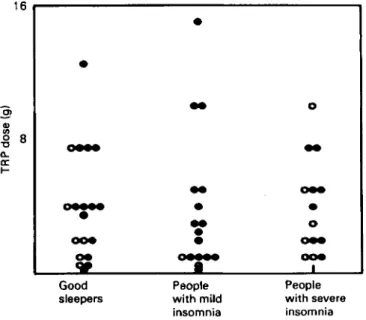
Fig. 5. A summary of the results of nearly forty different studies on the effect of tryptophan (TRP) on sleep in man comparing the effects of different doses of T R P on three types of subjects: ( I ) good sleepers, (2) people with mild insomnia or long sleep latency, (3) people suffering from
chronic or severe insomnia. Points represent individual studies in which the indicated dose of T R P was with (0) or without (0) a sedative effect. From Hartman & Greenwald (1984).
TRP
and sleepSerotonin seems to play a role in the triggering of the onset of sleep but the mechanism involved is still not clearly understood (Jouvet, 1983; Koella, 1984). On the one hand, lowering brain 5 H T by pharmacological or surgical means produces insomnia. Re-establishing gHT levels leads, after a fixed delay of about 45 min, to sleep onset. On the other hand, 5HT release and neuronal activity are maximal during arousal. A plausible explanation for this apparent contradiction is that 5 H T release during arousal has a cumulative effect, gradually increasing the propensity to fall asleep (see Jouvet, 1983).
A s T R P can increase brain 5HT levels, there have been many clinical studies on its effectiveness as a sedative. Fig. 5 (adapted from Hartman & Greenwald, 1984)
summarizes the results of nearly forty different experiments. It shows that T R P is relatively ineffective in normal ‘good sleepers’ and in patients with severe insomnia. However, in doses of I g or more it consistently reduces sleep latency in
people with mild insomnia or long sleep latencies. In two recent studies (Leathwood & Pollet, 1983, 1984) on over IOO volunteers, we have shown that 500
mg T R P combined with a carbohydrate load is also an effective sedative. This dose should be enough to produce a 1o-20% rise in brain 5HT.
TRP
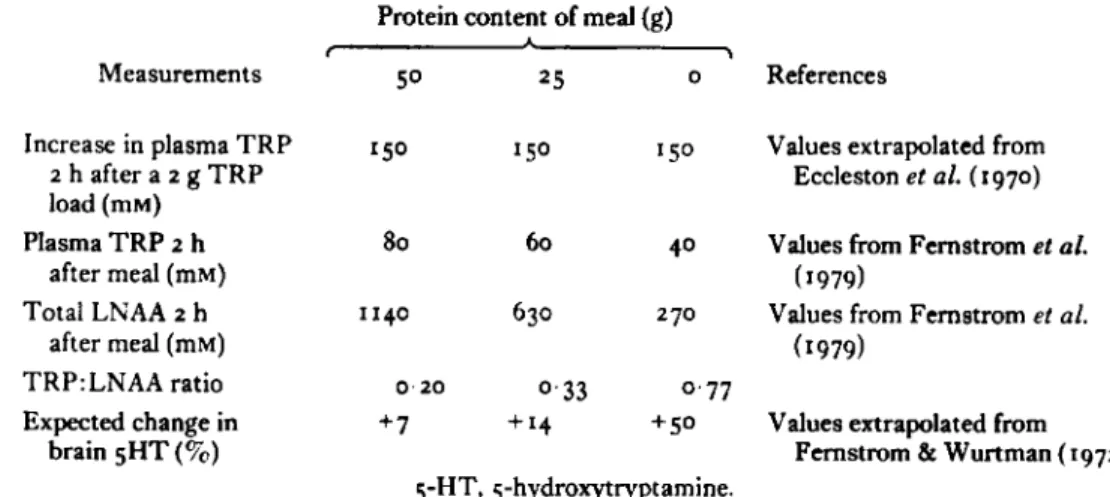
and moodThe observations that gHT tends to produce tonic suppression in a variety of brain functions and behaviours provides the theoretical framework for the use of T R P in treating mania, chronic pain, pathological aggression and hypersexuality. For some of these problems, large doses of T R P have been used with success (for review, see Young, 1985) but results have been inconsistent. Although much of this variability is probably linked to the biochemical heterogeneity of the syndromes being treated, it is appropriate to look at the studies from a nutritional viewpoint to see if the composition of meals eaten with the T R P load might influence its availability to the brain. This is important because the validating studies demonstrating, in man, that T R P increases CSF and brain 5HT metabolites (Eccleston et al. 1970; Gillman et al. 1981; Young & Gauthier, 1981) have used patients fasted overnight and given T R P alone. In clinical practice, T R P is usually given in doses of about 2 g, in combination with a meal (Young, 1985). Table I
shows how the composition of meals eaten concommitantly with the TRP load would be expected to influence brain 5 H T if all the assumptions in the hypothesis outlined above are correct. The changes in plasma T R P after the T R P load have been calculated from the values of Eccleston et al. (1970); the effects of different meals on plasma amino acids from Fernstrom et al. (1979),
and
the extrapolation to changes in brain gHT and 5HIAA from the correlation in Fernstrom &Wurtman (1972). I t can be seen that, according to the composition of the meal, the same 2 g load of T R P may produce anything from a 710 to a 50% rise in brain 5HT and 5HIAA. Thus it should hardly be surprising that clinical studies have, so
Vol.
46
Nutrient metabolism and the CNS
‘5’
Table I. Estimated changes in plasma tryptophan ( T R P ) and large neutral
amino acids (LNAA) after consuming 2 g T R P with dzyerent midday meals in man Protein content of meal (g)
, 1 Measurements 50 2 5 o References Increase in plasma TRP 2 h after a z g TRP load (mM) Plasma TRP 2 h after meal (mM) Total LNAA z h after meal (mM) TRP:LNAA ratio Expected change in brain 5HT (70)
150 1 5 0 I 50 Values extrapolated from
Eccleston et al. (1970) 80 60 40 Values from Fernstrom et al. 1140 630 270 Values from Femstrom et al.
(1979) (1979)
0.20 0 . 3 3 0.77
+7 +‘4 +SO Values extrapolated from
Fernstrom lk Wurtman (1972) y H T , 5-hydroxytryptamine.
.
Several studies have set out to examine the effects of manipulating precursor availability in normal subjects. With large doses of T R P the most commonly reported effect is a mixture of drowsiness and euphoria, but with dizziness, headache and nausea as side effects (Smith & Prockop, 1962; Greenwood et al.
1975). Lowering the plasma TRP:LNAA value by giving large (100 g) doses of a
mixture of LNAA produces a lowering of mood (Young, 1985).
In a double-blind, placebo controlled trial, Leathwood & Pollet (1983) examined the effects of 500 mg T R P combined with a 50
g
carbohydrate load on mood, sleepiness and appetite in sixty volunteers. The TRP-carbohydrate mixture led to feelings of lethargy and sleepiness, and was perceived as sedating. Hunger and protein-carbohydrate preferences were unaffected and there were no untoward side effects. The results also suggested that there was a subgroup of ‘responders’, i.e. people who consistently felt sedated after TRP-carbohydrate.There have also been reports that fasted volunteers feel more sleepy after a carbohydrate meal compared with a protein meal and that, in children, a carbohydrate-rich drink lowers spontaneous activity relative to an artificially sweetened drink (Spring et al. 1983; Lieberman, 1986). These changes are in the direction predicted by the expected effects of protein and carbohydrate (consumed after a fast) on brain 5HT, but we are still a long way from demonstrating that this really is the mechanism involved.
5HT and protein-carbohydrate selection
If rats are starved overnight and then fed on a carbohydrate meal, the plasma TRP:LNAA ratio and brain T R P and gHT concentrations increase. A protein meal can have the opposite effect (Fernstrom & Wurtman, 1974; Figs. 2 and 3).
Curiously, these observations have been extrapolated to the generalization that any carbohydrate meal will, by the same mechanism, increase brain 5HT and any
7 14 0
Period of experiment (d)
Fig. 6. ( a ) Body-weights, (b) food intake and ( c ) percentage of energy a s protein (% P-E) selected by five adult male rats offered a choice of o and 400 g caseidkg diets during z weeks. Most animals initially selected inadequate amounts of protein. They lost weight and ate less food. After anything from 4 to 11 d they abruptly began to eat the 400 g casein/kg diet. Food intake immediately
increased and body-weight began to rise.
protein meal will lower it (for example, see Wurtman, 1973; Fernstrom & Wurtman, 1974; Fernstrom, 1983; Harper & Peters, 1983; Spring et al. 1983; Blundell, 1984; Lieberman, 1986). In turn, this has led to the hypothesis that 5HT might operate as a ‘variable ratio sensor’ detecting and determining the proportions of energy selected as protein and carbohydrate in the diet.
First, is protein-arbohydrate selection regulated ? In the paradigm most often used to examine this question, animals are allowed to select from two diets, one low in protein and high in carbohydrate, the other high in protein and with little carbohydrate. For convenience, the selection pattern is usually expressed in
Vol.
46
Nutrient metabolism and the CNS
'53
percentage of energy selected in the form of protein
(70
P-E). Although this technique appears simple and straightforward, it is beset with methodological difficulties (Blundell, 1983) and results have been contradictory. Musten et al.(1974) reported that, over a range of diet pairs, rats appeared to select about 3070 P-E. (This is about double the requirement for adequate growth.) Unfortunately, others have not been able to confirm this tight pattern of selection. Leathwood & Ashley ( 1 9 8 3 ~ ) noted that rats offered a choice of low- and high-protein diets may take up to 10 d to select adequate and stable levels of protein intake (Fig. 6). Even
then, the range is extremely wide (e.g. 1 5 4 2 % P-E) and selection can be influenced by the composition, taste and texture of the diets as well as by the age of the animals (Bise et al. 1973; Leathwood & Ashley, 1983a,b; Leathwood & Arimanana, 1984). Furthermore, if the diet pairs are changed,
YO
P-E selected also changes (Fig. 7). This suggests that, while stable selection patterns can occur and animals tend to avoid extremely high- or low-protein intakes, there is not much evidence for a mechanism tightly regulating protein-arbohydrate selection.Second, if 5HT is part of a feedback link detecting and then influencing choice of protein and carbohydrate, the proportions of protein and carbohydrate eaten should iduence brain 5HT. As pointed out earlier, this mechanism does seem to function after a period of starvation, but after short fasts or during free-feeding the
60
2
30x
0 14 28 Period of feeding (d)Fig. 7. Mean percentage energy as protein ''9( P-E) selection by three groups of weanling rats offered the following amounts of casein. Group I
(a):
period I (days 1-14) o and 400 g caseidkg diets; period z (days 15-28), 200 and 600 g/kg. Group 2 (-A-): period I, o and 600 g/kg; period 2, IOO and 400 g/kg. Group 3 (-A-): period I , 100 and 400 ghg; period 2, o and600 g caseidkg diets. t, Change in diets offered. Points are means with their standard errors represented by vertical bars.
composition of the last meal either does not affect the plasma TRP:LNAA ratio or the change is so small that brain T R P and 5HT concentrations do not change (Ashley et al. 1982, 1984). If the composition of individual meals is unlikely to influence brain 5 HT, perhaps long-term eating patterns will. Several groups have reported weak correlations in the expected direction between
70
P-E (selected or imposed) and plasma TRP:LNAA, but no detectable changes in brain 5HT or 5HIAA (Harper & Peters, 1983; Leathwood & Ashley, 1983a,b; Fernstrom et al. 1985; Peters 8c Harper, 1985).Third, if the hypothesis is to have any value, changes in brain 5HT availability should have predictable effects on consumption of carbohydrate and protein. If rats are fasted, given an oral dose of TR P and then offered a choice of high- and low-protein diets, they do select a significantly higher
70
P-E than expected (Li 8cAnderson, 1982; Arimanana e t al. 1984). Similarly,
if
rats are fasted for 16 h and then given a small dose of fenfluramine (a 5HT re-uptake blocker), they select proportionately more protein. In free-feeding rats, however, neither fenfluramine nor TR P has any effect on selection (Harper 8c Peters, 1983; Blundell, 1984). In man, amounts of T R P which might be expected to influence 5HT synthesis do not seem to change protein-arbohydrate preference or7
P-E selected, nor do they influence food intake in people who are ‘carbohydrate cravers’ (Leathwood &Pollet, 1983; Hrboticky et al. 1985; Strain et al. 1985).
In summary, the current evidence for a feed-back control of protein-arb hydrate selection via plasma TRP:LNAA-induced changes in brain 5HT synthesis is very weak. In the special case of eating after a fast, brain 5HT availability may induce small changes in selection, but the ecological significance of such an effect is obscure.
Conclusions
Consumption of T R P can increase the rate of 5HT synthesis in the brain. A
similar effect can be seen when a carbohydrate meal is eaten following a prolonged fast, and carbohydrate can potentiate the effect of a T R P load. Direct evidence for a change in serotoninergic neurotransmission is still inconclusive, but indirect clinical and pharmacological observations suggest that serotoninergic function can be changed. T R P combined with carbohydrate does seem to have useful sedative properties, and may also find applications in the treatment of mania and aggression once an effective method of administration is achieved. On the other hand, the evidence for a feed-back mechanism influencing selection of protein and carbohydrate is still far from convincing.
REFERENCES
Arimanana, L., Ashley, D. V., Furniss, D. & Leathwood, P. D. (1984). In Progress in Tryptophan and Serotonin Research, pp. 549-552 [H. Schlossberger, W. Kochen, B. Linzen and H. Steinhart, editors]. Berlin: De Gruyter.
Ashley, D. V., Barclay, D. V., Chauffard, F. A., Moennoz, D. & Leathwood, P. D. (1982). American Journal of Clinicul Nutrition 36, 143-153.
Vol.
46
Nutrient metabolism and the CNS
' 5 5
Ashley, D. V. & Leathwood, P. D. (1984). In Progress in Tryptophan and Serotonin Research,
pp. 579-582 [H. Schlossberger, W. Kochen, B. Linzen and H. Steinhart, editors]. Berlin: De Gruyter.
Ashley, D. V., Leathwood, P. D. & Moennoz, D. (1984). In Progress in Tryptophan and Serotonin
Research, pp. 591-594 [H. Schlossberger, W. Kochen, B. Linzen and H. Steinhart. editors]. Berlin: De Gruyter.
Riggio, G., Fadda, F., Fanni, P., Tagliamonte, A. & Gessa, G. L. (1974). Life Sciences 14,
Bise, A., Leathwood, P. D. & Ashley, D. V. International Journal of Vitamin and
Bloom, F. E. (1981). In Serotonin Neurotrannnission and Behuoior, pp. 403-424 [B. Jacobs and
Blundell, J. E. (1983). In Nutrition and the Brain, vol. 6, pp. 163-221 [R. J. Wurtman and J. J.
Blundell, J. E. (1984). Neurophannacology 23,1537-1551.
Carlsson, A. & Lindqvist, M. (1972). Journal of Neural Transmission 33,23-43.
Eccleston, D., Ashcroft, G. W., Crawford, T. B., Stanton, J. B.. Wood, D. & McTurk, P. H. (1970).
Fernstrom, J. D. (1983). Physiological Reviews 63,484-546.
Fernstrom, J. D., Fernstrom, M. H., Grubb, P. E. & Volk, E. A. (1985). Journal ofNutrition 115,
Fernstrom, J. D., Madras, B. K.. Munro, H. N. & Wurtman, R. J. (1974). In Aromatic Amino Fernstrom, J. D. & Wurtman, R. J. (1971). Science 174, 1023-1025.
Fernstrom, J. D. & Wurtman, R. J. (1972). Science 178,414-416.
Fernstrom, J. D. & Wurtman, R. J. (1974). Scientr$cAmerican 230,84-91.
Fernstrom, J. D.. Wurtman, R. J., Hammarstrom-Wiklund, B., Rand, W. M.. M m . H. N. &
Gallager, D. W. & Aghajanian, G . K. (1976). Neuropharmacology 15, 149-156.
Garattini, S. & Valzelli, L. (1965). Serotonin. Amsterdam: Elsevier.
Gillman, P. K., Bartlett, J. R., Bridges, P. K., Hunt, A., Patel, A. J., Kantamaneni, B. D. & Cunon,
Greenwood, M., Lader, M. H., Kantamaneni, B. D. & Cunon, G. (1975). British Journal of
Harper, A. E. & Peters, J. C. (1983). Experientia 44, Suppl., 107-134.
Hartman, E. & Greenwald, D. (1984).
1321-1329.
(1973). Nutrition Research 53,232.
A. Gelperin, editors]. Cambridge, Mass: M I T Press.
Wurtman, editors]. New York: Raven Press.
Journal of Neurology, Neurosurgery and Psychiatry 33,269-272.
'337-1344-
Acids in the Brain, Ciba Foundation Symposium no. 22, pp. 153-165. Amsterdam: Elsevier.
Davidson, C. S. (1979). AmericanJournal of ClinualNutrition 32, 1912-1922.
G. (1981). Journal of Neurochemistry 37,410-417.
Clinical Pharmacology 2, 165-172.
In Progress in Tryptophan and Serotonin Research, pp. 291-296 [H. Schlossberger, W. Kochen, B. Linzen and H. Steinhart, editors]. Berlin: De Gruyter.
Hess, S. M. & Doepfer, W. (1961). Archives Internationales de Phamcodynamie et de Thdrapie
Hoebel, B. G. (1977). In Handbook of Psychopharmacology, vol. 8, pp. 55-129 [L. Iverson, S. Hrboticky, N., L i t e r , L. A. & Anderson, G. H. (1985). Nutrition Research 5,595407.
Jouvet, M. (1973). In Serotonin and Behuoim, pp. 385-400 [J. Barchas and E. Usdin. editors].
Jouvet, M. (1983). In Sleep 1982, pp. 2-18 [W. Koella, editor]. Basel: Karger.
Kaufman, S. (1974). In Aromatic Amino Acids in the Brain, Ciba Foundutia Symposium no. 22,
Koella, W. P. (1984). Experientia 40,3*337.
Leathwood, P. D. (1986). In Nutrition and Neurobiolugy. pp. 54-71 [J. Somogyi and D. Hotzel.
Leathwood, P. D. & Arimanana, L. (1984). Annual Review of Chronopharmacology I, 255-262.
Leathwood, P. D. & Ashley, D. V. (1983a) Appetite 4,97-112.
Leathwood, P. D. & Ashley, D. V. (19836) Experientia 44, Supp., 171-196.
Leathwood, P. D. & Pollet, P. (1983). Journal of Psychiatric Research 17, 147-154. Leathwood, P. D. & Pollet, P. (1984).
134, 89-99.
Iverson and S. Snyder, editors]. New York: Plenum Press.
New York: Academic Press.
pp. 85-107. Amsterdam: Elsevier.
editors]. Basel: Karger.
In Progress in Tryptophan and Serotonin Research, pp. 311-314 [H. Schlossberger, W. Kochen, B. Linzen and H. Steinhart, editors]. Berlin: De Gruyter.
Li, E. T. & Anderson, G. H. (1982). Physiology and Behavior 29,779-783.
Lieberman, H. J. (1986). In Nutrition and Neurobiology, pp. 219-224 [J. Somogyi and D. Hotzel,
Macon, J. B., Sokoloff, L. & Glowinski, J. (1971). JournalofNeurochemistry 18, 323-331.
Moore, R. Y. (1981). In Serotonin Neurotransmission and Behavior, pp. 35-71 [B. Jacobs and A.
Musten, B., Peace, D. & Anderson, G. H. (1974). J o u m l of Nutrition 104,563-572.
Pardridge, W. M. (1983). Physiological Reviews 63,1481-1535.
PerezCruet, J . , Chase, T. N. & Murphy, D. L. (1974). Nature 248,693-695.
Peters, J. C. &Harper, A. E. (1985). Journal ofNutrition 115,382-389.
Smith, B. & Prockop, D. J. (1962). New England Journal ofMedicine 267, 1338-1341.
Spring, B., Maller, O., Wurtman, J. J., Digman, L. & Cozolino, L. (1983). Journal ofPsychiatric
Stein, L. &Wise, C. D. (1974). Advances in Biochemical Psychopharmacology 112,281-291.
Strain, G . W., Strain, J. J. & Zumoff, B. (1985). Z n t ~ l i o n a l Journalof Obesity 9,375-380. Sved, A. F. (1983). In Nutrition and the Brain, vol. 6, pp. 223-276 [R. J. Wurtman and J. J.
Wurtman, editors]. New York: Raven Press. Trulson, M. E. (1985). Life Sciences 37, 1067-1072.
Wojcik, W. J., Fornal, C. & Radulovacki, M. (1980). Neuropharmacology 19, 163-167. Wolf, W. A . & Kuhn, D. M. (1986). Journal ofNeurochemisty 46,61-67.
Wurtman, R. J. (1973). In Serotonin and Behavior, p. 446 [J. Barchas and E. Usdin, editors). New
Wurtman, R. J., Hefti, F. & Melamed, E. (1981). Pharmacological Reviews 32,315-335.
Young, S. N. (1985). In NutritMn and the Brain, vol. 7, pp. 49-88 [R. J. Wurtman and J. J. Young, S. N. & Gauthier, S. (1981). Journal of Neurology, Neurosurlpery and PsychiatT 44,
editors]. Basel: Karger.
Gelperin, editors]. Cambridge, Mass: MIT Press.
Research 17, 155-167.
.
York: Academic Press.
Wurtman, editors]. New York: Raven Press. 323-327.