JID 1994;169 (June) Concise Communications 1397
C. Biotyping coagulase-negative staphylococci. J Clin Microbiol 1988;26: 1950-6.
6. Parisi JT, Hecht OW. Plasmid profiles in epidemiologic studies ofinfec-tions byStaphylococcus epidermidis.J Infect Dis 1980; 141:637-43. 7, Hartstein AI, Valvano MA, Morthland VH, Fuchs PC, Potter SA, Crosa JH. Antimicrobic susceptibility and plasmid profile analysis as iden-tity tests for multiple blood isolates of coagulase-negative staphylo-cocci. J Clin Microbiol 1987;25:589-93.
8. Renaud F, Frenez J, Etienne J, et al. Restriction endonuclease analysis ofStaphylococcusepidermidisDNA may be a useful epidemiological marker. J Clin Microbiol 1988;26: 1729-34.
9. Selander RK, Caugant DA, Ochman H, Musser JM, Gilmour MN, Whittam TS. Methods of multi locus enzyme electrophoresis for bac-terial population genetics and systemics. Appl Environ Microbiol 1986;51:873-84.
10. Goldmann DA, Pier GB. Pathogenesis of infections related to intravas-cular catheterization.ClinMicrobiol Rev 1993;6: 176-92.
II. Sitges-Serra A,PuigP, LinaresJ,et al. Hub colonization as the initial step in an outbreak of catheter-related sepsis due to coagulase-nega-tive staphylococci during parenteral nutrition. J Parenter Enter Nutr 1984;8:668-72,
12. Salzman ME, Isenberg HD, Shapiro JF, Lipsitz PJ, Rubin LG. A pro-spective study of the catheter hub as the portal of entry for microor-ganisms causing catheter-related sepsis in neonates. J Infect Dis 1993; 167:487-90.
13. Selander RK, Musser JM. Population genetics of bacterial pathogene-sis. In: Iglewski BH, Clark VL, eds. Molecular basis ofbacterial patho-genesis. San Diego: Academic Press, 1990: 11-36.
14. Musser JM, Barenkamp SJ, Granoff OM, Selander RK. Genetic rela-tionships of serologically nontypable and serotype b strains of
Hae-mophilus influenzae.Infect Immun 1986;52: 183-91.
15. Pfaller MA, Herwaldt LA. Laboratory, clinical, and epidemiological aspects of coagulase-negative staphylococci. C1in Microbiol Rev 1988;I:281-99,
Role of Amoxicillin Serum Levels for Successful Prophylaxis of Experimental
Endocarditis Due to Tolerant Streptococci
U. Fluckiger, P. Francioli,
J.
Blaser, M. P. Glauser,andPh.Moreillon
Division of Infectious Diseases, Department of Internal Medicine, Centre Hospitalier Universitaire Vaudois, Lausanne, and Department of
Medicine, University Hospital, Zurich, Switzerland
The importance of amoxicillin serum profiles for successful prophylaxis of experimental endo-carditis in rats was assessed. Animals with catheter-induced vegetations were challenged intrave-nously with large inocula ofStreptococcus sanguisand received one of the following amoxicillin dosages: single or multiple bolus injection of 40 rug/kg; 40 mg/kg administered as a continuous infusion over 12 h; or either 9 or 18 rug/kg administered over 12 or 24 h, respectively. The regimen producing a single transient high peak serum level failed to prevent experimental endo-carditis; in contrast, a second injection 6 h after the first resulted in successful prophylaxis. Likewise, the three regimens of continuous, relatively low-dose regimens prevented infections. Thus, the most important parameter for successful prophylaxis was the duration of inhibitory concentration of the drug in the serum, The total dose of antibiotic, the peak serum levels, or the area-under-the-curve values were not predictive of successful prophylaxis.
To prevent streptococcal endocarditis in patients undergo-ing medical or surgical procedures that put them at risk for bacteremia, high and sometimes repeated doses ofantibiotics are recommended [1,2]. This strategy has been largely based on results of animal studies showing that high and prolonged levels of bactericidal antibiotics (given before or shortly after
Received 3 May 1993; revised 21 January 1994.
Presented in part: 31st Interscience Conference on Antimicrobial Agents and Chemotherapy, Chicago, 29 September to 2 OctoberI991 (abstract 358).
Grant support: Swiss National Foundation for Scientific Research (3-864-0.86).
Reprints or correspondence: Dr. P. Prancioli, Division oflnfectious Dis-eases. Dept. ofIntemal Medicine, Centre Hospitalier Universitaire Vaudois,
10 II Lausanne, Switzerland.
The Journal of Infectious Diseases 1994;169:1397-400 © 1994 by The University of Chicago. All rights reserved. 0022-1899(94(6906-0037$01.00
intravenous [iv] bacterial challenge) were necessary to pro-vide optimal protection against streptococcal endocarditis in rabbits and rats [3, 4].
However, while experimental evidence has demonstrated that prolonged antibiotic serum levels were more effective than short-course prophylaxis [3], the importance of drug serum levels per se for successful protection has not been thoroughly investigated. In fact, while large doses of antibi-otics are recommended for prophylaxis, several lines of evi-dence suggest that high drug concentrations might not be a prerequisite for successful protection. First, many antibiotics do not gain efficacy in a dose-dependent manner once above the MIC. For example, the optimal bactericidal concentra-tion of penicillins in vitro (the most frequently recom-mended drugs for prophylaxis) is usually not much higher than their MICs [5]. Moreover, paradoxically low bacterial killing has been described at high concentrations ofsuch
anti-1398 Concise Communications JlD 1994;169 (June)
biotics [6]. Second, studies have shown that multiple doses of penicillin V, which produced prolonged but relatively low serum levels of antibiotic, successfully prevented endocardi-tis in rabbits challenged with large bacterial inocula (i.e., 108 cfu)
[7].
Therefore, the high blood concentrations of antibi-otics resulting from most prophylactic regimens in humans may not be required for successful protection but merely en-sure more prolonged serum levels.In the present experiments, we investigated the impor-tance of serum levels of amoxicillin for successful prophy-laxis of experimental endocarditis in rats challenged with a large inoculum ofStreptococcus sanguis.
Materials
andMethods
Bacterial strain and antibiotic susceptibility. A previously described strain ofStreptococcus sanguis was used [8]. The MIC and MBC values of amoxicillin for this strain were 0.032 mg/L and> 128rng/L, respectively. Thus, the test organism was "tol-erant" to amoxicillin as defined by an MBC to MlC ratio >32 and by an ability to survive amoxicillin treatment in time-kill curves in vitro [8].
Serum inhibitory and bactericidal titers. Serum inhibitory and bactericidal titers of amoxicillin were measured as previ-ously described [3] in groups of 9 rats, either after a single iv bolus of 40 mg/kg amoxicillin (at 30 min and 2 and 6 h) or after continuous infusion of the drug (at 1, 3, 6, 8, 12, and 14 h). Organisms were subcultured on penicillinase-containing blood agar (5 X 10⁶IU/L; Bactopcnase; Difco, Detroit). The serum inhibitory titer was the highest dilution of serum inhibiting visi-ble bacterial growth, and the serum bactericidal titer was the highest dilution of serum providing 99.9% killing of the original inoculum after incubation for 18 h.
Serum levelsofamoxicillin. Serum levels ofamoxicillin were determined in groups of 3-6 rats several times during and after antibiotic administration. Antibiotic concentrations were mea-sured by the agar diffusion method usingBacillus subtilis ATCC 6633 [9]. For standard curves, amoxicillin was diluted in pooled rat serum. The limit of detection of the bioassay was 0.6 mg/L. Production of endocarditis and installation of the infusion-pump device. Female Wistar rats (180-200 g) were used. As previously described [3, 8], a polyethylene catheter was placed through the right carotid artery across the aortic valve and se-cured with a silk ligature. At the same time, a sterile silastic catheter (Dow Chemical, Midland, MI) was inserted through the jugular vein into the superior vena cava. The line was tun-neled subcutaneously and brought to the skin of the interscapu-lar region. The external portion of this cannula was connected to a programmable infusion pump (pump 44; Harvard Appara-tus. South Natick, MA) through a flow-through swivel, which permitted the animal to move in the cage [10]. Bacterial endo-carditis was induced 24 h after catheterization by iv challenge with various sizes of bacterial inocula.
Efficacy of various doses of amoxicillin administered either as an iv bolus or continuous infusion. Rats were challenged with --100 times the 1090ofS. sanguis (10
7
-8cfu). To ensure that infected rats were exposed to a precise amount of drug,
antibi-otic prophylaxis was started immediately after iv bacterial chal-lenge. Despite the fact that this setting does not exactly mimic antibiotic prophylaxis in humans (who are given prophylaxis prior to procedures that could cause bacteremia), such postchal-lenge prophylaxis has proved to be as effective as standard pre-challenge administration of amoxicillin in experimental endo-carditis[II].Moreover, there is ample evidence in both animals and humans to suggest that prophylactic antibiotics operate es-sentially after, not before, transient bacteremia induced by pro-cedures such as dental extractions (in animals and humans [12]) or after iv bacterial challenge (in animals [3]). We used the fol-lowing amoxicillin regimens: single or multiple bolus injection of 40mg/kg,a total of 40 mg/kg slowly infused over 12 h (by infusion pump), 9 mg/kg administered by continuous infusion over 12h,and 18 mg/kg administered over 24 h. Controls re-ceived saline.
Evaluation of prophylaxis. Animals were killed 48-72 h after bacterial challenge. Aortic vegetations were excised, weighed, homogenized in I mL of saline, serially diluted, and plated on penicillinase-containing blood agar plates. The num-ber of viable bacteria was counted after 48 h of incubation at
3re,
and the results were expressed in 10gIOcfu/g of vegetation. The dilution technique permitted the detection of'> 102cfu/g of vegetation.Pharmacokinetic parameters and statistical analysis. The area-under-the-curve (AUC) values were calculated by the log trapezoid method [13]. The
x
2test with Yates's correction was used for statistical comparison.
Results
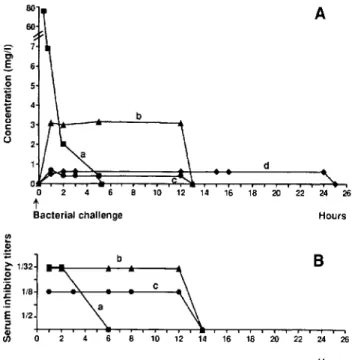
Efficacy ofa fixed dose ofamoxicillin administered either as an iv bolus or continuous infusion. To delineate which pa-rameters were important in preventing endocarditis, experi-ments were designed to analyze the role of the peak serum level, the total dose of antibiotic, the AVC values of antibi-otic serum levels, and the duration of inhibitory drug serum levels after bacterial challenge. The serum kinetics produced by the various antibiotic regimens (figure IA) and the result-ing serum inhibitory titers (figure IB) are shown. A sresult-ingle bolus injection of 40 mg/kg amoxicillin (curve a) generated high peak serum levels(75 mg/L) that were~2000times the MIC of amoxicillin for S.sanguis and high AVC values (60 mg/L . h) but a relatively short duration in serum ofthe drug (~6h), as shown by serum drug levels and inhibitory titers. Of note, no serum bactericidal titers were detected at any time. In comparison, continuous infusion (curve b) pro-duced substantially lower drug serum levels (3 mg/L) and
Ave
values (20 mg/L • h) but longer duration in serum of the drug (;?;12 h).In vivo, these two regimens showed different efficacies. Figure 2 shows that iv bolus (column a) did not protect rats challenged with 100 times the IDgoofS. sanguis. In contrast,
however, 12 h of continuous infusion protected rats chal-lenged with the large inoculum (column b) even though it
JID 1994;169 (June) ConciseCommunications 1399 41
a
n= 40 saline 100 en e .2 80 c;; Q) C'I 60 (1) >"
Q)-
o 40 Q)*
:§
'0
20*
~ 0 DiscussionFigure 2. Prophylaxis of experimental endocarditis with amoxi-cillin given as intravenous (iv) bolus or prolonged (12 or 24 h) infusion. Rats were challenged with -100 times theID90of
Strep-tococcus sanguis. Prophylaxis was started immediately after chal-lenge. Treatment groups received a, iv bolus, 40 mg ofamoxicillin/ kg; b, continuous 12-h infusion of 40 rug/kg; c, continuous 12-h infusion of 9mg/kg:d, continuous 24-h infusion of 18 mg/kg; and e, 2 consecutive iv bolus infections of 40rng/kgat 6-h intervals. Number of animals per group are indicated at bottom of columns.
*
p<.05 compared with animals injected with saline or single bolus of antibiotic (a).These results demonstrate that the most important feature underlying successful amoxicillin prophylaxis against toler-ant streptococcal endocarditis was the duration of toler-antibiotic serum inhibitory titers after bacterial challenge. Successful prophylaxis against this organism did not require high peak serum levels of antibiotics, as often advocated for antibiotic prophylaxis against endocarditis in humans [I, 2]. Indeed, in our experiments, high peak serum levels produced by a sin-gle iv bolus of 40mg/kgamoxicillin (as often used in antibi-otic prophylaxis experiments [3, 8]) failed to prevent endo-carditis due to large bacterial inocula, despite peak serum concentrations of antibiotics that were~2000times greater than the MIC for the test organism and of serum inhibitory titers that were detectable for almost 6 h. In contrast, drug serum levels that were 20 times lower maintained by continu-ous injection for~12h effectively protected the animals de-spiteAVCvalues that were 60 times lower than after the iv bolus regimen. Thus, the only relevant parameter that reli-ably predicted successful prophylaxis was the duration of serum inhibitory activity after bacterial challenge. The total antibiotic dose, peak serum levels, or AVC values did not correlate with protection of the animals.
In these experiments, antibiotic serum levels producing inhibitory titers as low as Yssuccessfully prevented experi-mental endocarditis. Whether even lower levels would also be protective is not known. However, no serum bactericidal activity was detected against this tolerant streptococcal strain at any time or at any antibiotic dosage. Thus, successful
pro-Hours
A
HoursB
i i i ' , i i 20 22 24 26 d i 18 16 10 12 14 16 18 20 22 24 26 b b:s:
c~
2 4 6 8 10 12 14 OE-r--r---r-r-...,r-T"--r--r-r-r.k..,-~"T""""'1r--r--r--,-.,...,r--r...,...,.-~-, ot
Bacterial challengeproduced substantially lower drug levels and AVCvalues than did iv bolus. Thus, in this setting, the total dose of antibiotic, the peak serum levels, or AVCvalues were not predictive of successful prophylaxis. The most important pa-rameter appeared to be the duration of detectable antibiotic serum levels after bacterial challenge. To test whether these observations might be confirmed under more stringent con-ditions, additional experiments were done using a dose of amoxicillin that was two to four times lower.
Prophylaxis with prolonged low-dose amoxicillin. Com-pared with the iv bolus regimen (figure l, curve a), infusion of 9 mg/kg amoxicillin over 12 h (curve c) or 18 mg/kg over 24 h (curve d) produced serum levels that were> 100 times lower (0.6 vs. 75 rng/L compared with iv bolus) and AVC
values that were 5-10 times lower (6-12 vs. 60 mg/L . h) but substantially longer detectable serum drug levels and in-hibitory titers. As a result, prophylaxis with both low-dose regimens successfully prevented endocarditis in rats chal-lenged with 100 times the 1090of S. sanguis (figure 2, col-umns c and d) whereas iv bolus did not (column a).
Efficacy of a single bolus of amoxicillin versus two doses injected at a 6-h interval. Since a single bolus injection of amoxicillin produced only a transient drug level in serum of ~6 h, we tested whether prolonging this drug level by a sec-ond dose of 40 mg/kg antibiotic given 6 h later might restore successful prophylaxis. As expected, injection of this second dose restored successful prophylaxis (figure 2, column e). 01 §. c: ~ E C CII o c: o U
Figure 1. Amoxicillin serum levels (A) and serum inhibitory titers (B) produced by various antibiotic regimens in rats: a, single bolus injection, 40 mg/kg: b, continuous infusion of 40 rng/kg over 12 h: c, continuous infusion of9 mg/kg over 12 h; and d, continu-ous infusion of 18mg/kgover 24 h. No serum bactericidal titers were detected at any time or at any dosage.
1400 Concise Communications JID 1994;169 (June)
phylaxis was unlikely to be mediated by mere antibiotic-in-duced killing. In such nonkilling conditions, the exact mecha-nism underlying successful prophylaxis remains speculative. One hypothesis suggests that prolonged inhibition of bacte-rial growth by nonkilling antibiotics may allow enough time for alternative host defense mechanism(s), such as platelet microbicidal protein(s) [ 14], to clear bacteria from the vegeta-tions. If true, such mechanism( s) would be of major impor-tance for prophylaxis, and presumably also therapy, of endo-carditis due to tolerant (and maybe also nontolerant) streptococci. This may be particularly relevant because up to 80% of streptococci isolated from patients with endocarditis may be tolerant to {j-lactam antibiotics and other cell wall inhibitors [5]. Moreover, since prolonged low-dose prophy-laxis protected animals challenged with a highly amoxicillin-tolerant streptococcal strain, it is likely that such a regimen would also protect rats inoculated with non tolerant (kill-sen-sitive) streptococci.
Although the results of animal experiments cannot be ap-plied directly to humans. the present observation bears some practical implications. First, the results strongly support the current recommendations of the American Heart Associa-tion, which advocates two successive doses of amoxicillin (3 g and 1.5 g 6 h later) as oral prophylaxis for dental proce-dures [1]. Such a regimen provides antibiotic coverage for
>10 h, a period that appeared optimal in our setting.
More-over, administration of two consecutive doses of antibiotics may also find some support in our results with repeated (two dose) iv bolus regimen: Injection of a second iv bolus of amoxicillin 6 h after the first restored successful prophylaxis, presumably by prolonging the overall duration of serum
in-hibitory titers from~6h (after a single bolus) to -- 12 h.
Second, our observations raise the question of prolonged low-dose prophylaxis for humans. Such a regimen might avoid the side effects linked to high doses of oral antibiotics. Prolonged low-dose prophylaxis may be particularly conve-nient by using antibiotics with long serum half-lives in hu-mans. However, a low-dose regimen in humans must be han-dled with caution, because prophylaxis failure has been described after prolonged courses of relatively low doses of antibiotics without an initial loading dose [15]. Therefore, further studies of prolonged low-dose prophylaxis are warranted.
Acknowledgments
We thank M. Giddey and M. Knaup for excellent technical work.
References
I. Dajani AS. BisnoLA,Chung DT. et al. Prevention ofbacterial endocar-ditis. Recommendations by the American Heart Association. JAMA 1990;246:2919-22.
2. Simmons NA. Antibiotic prophylaxis of infective endocarditis. Recom-mendations from the Endocarditis Working Party of the British Soci-ety for Antimicrobial Chemotherapy. Lancet 1990;335:88-93. 3. Moreillon P. Francioli P. OverholserDi MeylanP. Glauser MP.
Mecha-nisms of successful amoxicillin prophylaxis of experimental endocar-ditis due toStreptococcus intermedius.J Infect Dis 1986; 154:80 1- 7. 4. Durack DT. PetersdorfRG. Chemotherapy of experimental streptococ-cal endocarditis. I. Comparison of commonly recommended pro-phylactic regimens. J C1in Invest 1973;52:592-8.
5. Meylan PRo Francioli P. Glauser MP. Discrepancies between MBC and actual killing ofviridans group streptococci by cell-wall-active antibi-otics. Antimicrob Agents Chemother 1986;29:418-23.
6. Eagle H. Musselman AD. The rate of bactericidal action of penicillin in vitro as a function of its concentration and its paradoxically reduced activity at high concentration against certain organisms. J Exp Med 1948;88:99-131.
7. PelletierLLJr. Durack DT. Petersdorf RG. Chemotherapy of experi-mental streptococcal endocarditis. IV. Further observation on pro-phylaxis. J Clin Invest 1975;56:319-30.
8. Glauser MP. Bernard JP. Moreillon P, Francioli P. Successful single-dose amoxicillin prophylaxis against experimental endocarditis: evi-dence for two mechanisms of protection. J Infect Dis 1983; 147:568-75.
9. Anhalt JP. Assays for antimicrobial agents in body fluid. In: Balows A. Hausler WJJr.Isenberg HD. Shadomy HJ. eds. Manual of clinical microbiology. 5th ed. Washington. DC: American Society for Micro-biology. 1991:1105-16.
10. Thauvin C, Eliopoulos GM. Willey S. Wennerstein CH. Moellering RC Jr. Continuous-infusion ampicillin therapy of enterococcal endocar-ditis in rats. Antimicrob Agents Chemother 1987;31: 139-43. II. Berney p. Francioli P. Successful prophylaxis of experimental
strepto-coccal endocarditis with single-dose amoxicillin administered after bacterial challenge. J Infect Dis 1990; 161:281-5.
12. Hall G. Hedstrom SA. Heimdahl A. Nord CEo Prophylactic administra-tion of penicillins for endocarditis does not reduce the incidence of postextraction bacteremia. Clin Infect Dis 1993; 17:188-94. 13. Gibaldi M. Perrier D. Pharmacokinetics. 2nd ed. New York: Marcel
Dekker. 1982:449.
14. Yeaman MR. Norman DC, Bayer AS. Platelet microbicidal protein enhances antibiotic-induced killing of and postantibiotic effect in Staphylococcus aureus. Antimicrob Agents Chemother 1992;36: 1665-70.
15. Durack DT. Kaplan EL. Bisno AL. Apparent failures of endocarditis prophylaxis. Analysis of 52 cases submitted to a national registry. JAMA 1983;250:2318-22.