ORIGINAL PAPER
Effect of domestic sheep on chamois activity, distribution
and abundance on sub-alpine pastures
Silvan Rüttimann&Marco Giacometti&
Alan G. McElligott
Received: 21 December 2006 / Revised: 1 May 2007 / Accepted: 11 June 2007 / Published online: 4 July 2007 # Springer-Verlag 2007
Abstract Resource competition and disease transmission may occur when domestic and wild ungulates live sympatricly. We investigated if the release of sheep (Ovis aries) onto alpine pasture in Switzerland affected chamois (Rupicapra rupicapra) activity budgets, local population size and spatial distribution. We also evaluated the risk of transmission of Mycoplasma conjunctivae (causing a contagious eye disease) from sheep to chamois by examining if the two species had close contact with one another. We carried out the study in an alpine valley containing two adjacent areas: one containing sheep (Fochsenflue) and one where sheep were excluded (Spitzflue). We found no difference between the activity budgets of the chamois at the two sites. At the Fochsenflue, chamois and sheep mainly used separate areas. However, after approximately 1 month, sheep started to move twice per day, into the main area of the chamois. The percentage
time feeding, spatial distribution and numbers of chamois did not change in response. Sheep were responsible for all encounters in which the two species came closer than 50 m to each other. The encounters were brief, body contact never occurred, they were not concentrated at saltlicks and chamois mainly ended them. The results suggest that the presence of sheep had little effect on the chamois. However, competition between the two species could still be occur-ring over a longer time scale. Finally, we found that the risk of inter-specific transmission of IKC through direct body contact is likely to be low, but the risk through indirect means (flies or aerosols) remains.
Keywords Activity budget . Infectious
keratoconjunctivitis . Mycoplasma conjunctivae . Saltlick . Ungulate
Introduction
The presence of domestic livestock can adversely affect the spatial distribution, activity budgets and/or the diets of wild ungulates (Kie 1996; Kie et al. 1991; Loft et al. 1991; Putman1996). This competition for space and food may also have consequences for reproductive success and long-term population dynamics (Forsyth 2000; Forsyth and Hickling
1998; Madhusudan 2004; Mishra et al. 2004). When domestic and wild animals live sympatricly, there is also the risk of disease transmission, and there are many pathogenic infectious diseases that can infect sympatric wildlife and domestic animals (Daszak et al. 2000; Frölich et al. 2002; Gaffuri et al. 2006; Giacometti et al. 2002a; Gortázar et al.2007; Jansen et al.2007; Morgan et al.2006). In Switzerland, sheep are released in early summer on alpine pastures, and their numbers have increased greatly in Communicated by W. Lutz
S. Rüttimann
:
A. G. McElligott Zoologisches Institut, Universität Zürich, Winterthurerstrasse 190, 8057 Zürich, Switzerland S. Rüttimann e-mail: [email protected] M. Giacometti Wildvet Projects, CH-7605 Stampa, Switzerland e-mail: [email protected] A. G. McElligott (*)School of Biology, Biology Building, University of Nottingham,
University Park,
Nottingham NG7 2RD, UK e-mail: [email protected]
the last 50 years. For example, there were 165,000 sheep in Switzerland in 1950, 291,000 sheep in 1970 and 444,811 sheep in 2003. The number of sheep in the Swiss Alps during summer is also more than twice the number of chamois living there (Anonymous 1999, 2005). The time when sheep are usually released on the alpine pastures (between the end of May and beginning of June) coincides with the time of the early lactation period in chamois. It is already known that the presence of sheep affects the spatial distribution of some populations of Rupicapra pyrenaica (Pépin and N’Da1991; Rebollo et al.1993).
Infectious keratoconjunctivitis (IKC) occurred in our study area from 1998 to 1999, and the resulting chamois mortality was estimated at 27% (Degiorgis et al.2000). IKC is caused by Mycoplasma conjunctivae and is characterised by inflammation of the conjunctiva and cornea. In the most advanced stages, the cornea is opaque or even perforated. Recent studies in eastern Switzerland indicate that M. conjunctivae infection is not self-maintained in chamois. However, the disease is endemic and self-maintained in the domestic sheep population. Therefore, outbreaks of IKC may result from sheep living adjacent to chamois (Belloy et al.
2003; Giacometti et al.2002b).
The mycoplasmal organisms responsible for IKC can only survive for a short time in the environment. Therefore, inter-specific transmission must occur either by direct contact or over short distances (Giacometti et al. 2002a). Flies may play a role in inter-specific transmission of M. conjunctivae, and they can also cause avoidance behaviour in ungulates (Degiorgis et al.1999; Fauchald et al.2007). Although chamois generally avoid sheep, the available evidence suggests that they often meet at places such as saltlicks, and therefore these locations may provide con-ditions where disease transmission is more likely to occur (Degiorgis et al.2002; Pépin and N’Da1991; Rebollo et al.
1993; Richomme et al.2006).
The aim of this study was to determine if the presence of domestic sheep on sub-alpine pastures in summer affected the activity budgets, spatial distribution and numbers of chamois. We also evaluated the risk of IKC transmission from sheep to chamois, by observing the encounters between the two species and determining if saltlicks were places of high encounter rates. Data collection was carried at two adjacent sites populated by chamois: one area with sheep and a second an area without sheep.
Materials and methods Study area
The study was carried out at Euschels (46°38′N/7°17′E) in Canton Fribourg, Switzerland, from May 15 to September
4, 2003. Because of late snow cover, it was not possible to begin observations earlier in the year. The valley is approximately 4 km2 in size, runs in a north–south line and has an altitudinal range from 1,381 to 2,103 m above sea level. The valley floor consists of pastures that are used for cattle grazing in summer. The mountain slopes are steep and characterised by rock faces, pastures, scree and sporadic tree groups. The study area consisted of two adjacent parts of the east-facing valley slope; the southern study site called Fochsenflue and the northern part called the Spitzflue. There was a walking trail for tourists to the tops of each part of the study sites. The Fochsenflue was approximately 65 ha in size, and there was a raised meadow (approximately 18 ha) contained in its northern section. The Spitzflue was approximately 30 ha in size. Domestic animals have been excluded from the Spitzflue since 2001, and previously, it was also used as a sheep pasture during summer. The requirements for our study were very specific in that we needed adjacent locations: one contain-ing both sheep and chamois and a second area with chamois and from where sheep had been excluded.
At the beginning of the study, one saltlick was present at both the Fochsenflue and the Spitzflue. A second saltlick was provided at the Fochsenflue on July 20. Salt was also sprinkled for the sheep at one other location within the Fochsenflue. Study animals
The chamois were free to move over all the study area, and they also use it throughout the year (Peissard and Perritaz, personal communication), and hunting is allowed in the study area during autumn. No detailed data concerning the numbers of chamois at the study sites were available.
Approximately 100 sheep were released in a fenced area in the northern meadow of the Fochsenflue on May 30. The flock was not guarded and consisted of females, lambs and one adult male. This area was either fenced or natural obstacles such as cliffs prevented the sheep from leaving. After June 11, part of the fence was removed, and it was possible for the sheep to go further south into the area used by the chamois. However, they remained at all times on the meadow until July 3. After July 3, the sheep continued to spend most time on the meadow but regularly moved twice (rarely only once) per day into the southern half of the Fochsenflue: once in the morning (between 06:00 and 07:00 hours for approximately 1 h) and once in the afternoon (between 14:00 and 15:00 hours for approximately 2 h). After August 29, they were fenced within the southern part of the Fochsenflue.
Observations
We carried out simultaneous observations of the Fochsenflue and Spitzflue between May 15 and September 4, 2003. The
day was divided into two observation periods: period 1 from 6:00 to 13:00 and period 2 from 12:30 to 21:00. We carried out either observation periods 1 or 2 each day and collected data concerning activity budgets of chamois, spatial distri-butions of both chamois and sheep and encounters between the two species. During the observation periods, we also noted the presence or absence of tourists in the study area. For each day, we recorded the temperature with a digital thermometer at 12:30 in the shade at the observation point for the Fochsenflue.
Activity budgets
We randomly chose female chamois and watched them for 30 min, noting at 1-min intervals their behaviour. We avoided repeating focal watches of the same animal within the same observation period. All focal watches were carried out on females with kids because they formed the largest demographic group, and there were only a few males in the study area. The behaviour was divided into the following categories: feeding, walking, lying and standing.
Spatial distribution and number of animals
We recorded the spatial distribution and numbers of the chamois four times per day at both study sites. The observed animals were classified into females, males, yearlings, kids and chamois that could not be identified. Counts were carried out in the morning (06:00–08:00), at approximately midday (11:00–13:00), in the afternoon (15:30–17:30) and in the evening (19:00–21:00). During the same time periods, we also recorded the spatial distribution of the sheep at the Fochsenflue. The daily recordings were at least 3 h apart to avoid autocorrelation (Harris et al.1990; Swihart and Slade 1985), using a map that was divided into 100-m2sections.
Encounters between chamois and sheep
A distance of 50 m is the commonly used distance for large mammals to belong to the same social group (Clutton-Brock et al. 1982; Ruckstuhl and Ingold 1999). We therefore defined an inter-specific encounter between a chamois and a sheep when individuals of the two species came within 50 m of one another. Distances were estimated using body lengths of the animals and known field marks. We then recorded the location of each encounter using a map that was divided into 100-m2sections and the duration of that encounter.
Data analysis
We carried out all statistical analyses using SPSS. Results were considered statistically significant if P<0.05. Data
were tested for normality with the Kolmogorov–Smirnov or the Shapiro–Wilks tests, depending on the sample size. Homogeneity of variances was tested with the Levene’s test. All means are given with standard errors.
All comparisons carried out to test for an influence of sheep on chamois at the Fochsenflue refer to the time periods in which the sheep stayed in the northern meadow (before July 3) and after they used the southern section once or twice per day (after July 3). They do not refer to the complete presence or absence of the sheep. We tested for the influence of time of day on the feeding behaviour of chamois by dividing the observations into five 3-h classes (06:00–09:00, 09:00–12:00, 12:00–15:00, 15:00–18:00 and 18:00–21:00). All home range analyses refer to the total area used by all the animals.
Feeding formed the largest part of the activity budget of chamois (see “Results”), and therefore we tested if the
presence of sheep affected this key component of their activity budget. Firstly, we tested the percentage time spent feeding by chamois at the two study sites (Fochsenflue and Spitzflue) using a Mann–Whitney U test. We then checked for the influence of sheep, month, time of day and temperature on the percentage time feeding by chamois at the Fochsenflue, with a univariate general linear model (GLM). Almost all the observations of chamois before the sheep used the southern part of the Fochsenflue were during June. Therefore, we could not test for the influence of the sheep and the month in the same test, and we carried out two separate GLMs: the first GLM to test the influence of sheep, time of day and temperature on the percentage time feeding and the second GLM to check for the influence of month, time of day and temperature on the percentage time feeding. We carried out an arcsine square-root transformation of the data.
We processed the spatial distribution data of chamois and sheep in ArcView. We used all records of at least one chamois per square and carried out a kernel home range analysis to examine which areas of the Fochsenflue were used. We then divided the spatial data into two periods (before July 3 and after July 3) and carried out two 95% kernel home range analyses to determine if the sheep affected the spatial distribution of the chamois. We calculated the overlap of the two areas. We used a 100% minimum convex polygon to illustrate the area used by the sheep. If we had used a kernel home range analysis for the sheep, we would not have been able to show the important southern areas that they visited for brief intermittent periods after July 3 and that brought them closest to the chamois (see“Results”).
We used the mean of the counts of chamois at the Fochsenflue from the morning (06:00–08:00) and midday (11:00–13:00) or from midday (11:00–13:00) and evening (19:00–21:00) to determine if the sheep affected the
number of chamois using the area. We did not include the kids because they accompanied adult females, and therefore their distribution was not independent (Ruckstuhl and Ingold1998). We tested for the influence of sheep, month, tourists and temperature on the number of chamois with a GLM. Again (see above), we could not test for the influence of sheep and month in the same test. Therefore, we carried out two separate GLMs. The first GLM was to test the influence of sheep, tourists (presence/absence) and temperature on the number of chamois. We used presence/ absence of tourists rather than the number of tourists because their numbers and level of disturbance were not necessarily related. We carried out a second GLM to check for the influence of month, tourists and temperature on the number of chamois. We calculated the mean number of chamois in the same manner for the Spitzflue (no sheep present) and tested the influence of month, tourists (presence/absence) and temperature on the mean number of chamois, using a GLM.
Results
Activity budgets of chamois at the Fochsenflue and Spitzflue
Overall, females at the Fochsenflue (sheep present) and Spitzflue (sheep absent) had very similar activity budgets. Chamois at the Fochsenflue spent 47 ±2% of the time feeding, 33 ± 3% lying, 13 ± 1% standing and 7 ± 1% walking. Chamois at the Spitzflue spent 48 ±4% of the time feeding, 28 ±4% lying, 17 ± 2% standing and 7 ±1% walking. There was no significant difference in the time spent feeding between the chamois at the two study sites (Mann–Whitney U test: Z=−0.30, N1= 191, N2= 77,
P= 0.76).
Time spent feeding by chamois at the Fochsenflue and the effect of sheep
The overall model with the percentage time feeding as the dependent variable and the presence of sheep (before July 3, N=30, after July 3, N=149), time of day and temperature as independent variables was significant (GLM: N=179, F6, 172=
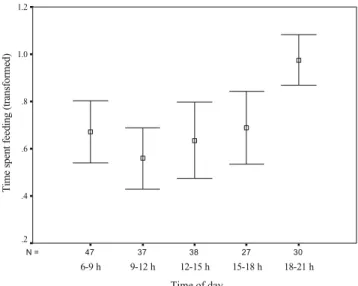
3.18, P=0.005, r2=0.10). The time of day had a significant influence on the time that chamois spent feeding (P<0.001, Fig.1). The presence of the sheep (in the southern section of the Fochsenflue, P=0.42) and temperature (P=0.76) were not related to the time that chamois spent feeding. In a second GLM, we used month as a variable instead of sheep. The overall model with the percentage time feeding as the dependent variable and month, time of day and temperature as independent variables was significant (GLM: N=179,
F7, 171=3.34, P=0.002, r2=0.12). The time of day was again
significantly related to the time spent feeding (P<0.001). The month (P=0.1) and temperature (P=0.17) were not related to the time spent feeding.
Spatial distributions of chamois and sheep
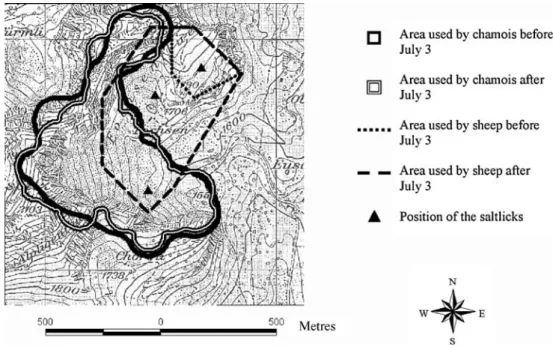
The chamois used 43 ha out of approximately 65 ha at the Fochsenflue (N = 395). The spatial distribution of the chamois did not change as a result of the daily movements of the sheep into the southern section of the Fochsenflue (Fig.2, before July 3, N=86, after July 3, N=309). The two areas used by chamois before and after July 3, overlapped by 81.2% (Fig.2). Figure2also illustrates the areas used by sheep before and after July 3.
Numbers and density of chamois at the Fochsenflue and Spitzflue
The mean numbers of chamois per day at the Fochsenflue and Spitzflue are given in Table 1. These represented densities of 0.26±0.2 and 0.21±0.03 chamois per hectare at the Fochsenflue and Spitzflue, respectively.
Number of chamois at the Fochsenflue in relation to sheep, tourists, temperature and month
The overall model with the mean number of chamois per day as the dependent variable and the presence of sheep (before July 3, N=11, after July 3, N=33), tourists and temperature as independent variables was not significant (GLM: N=44, F3, 40=1.84, P=0.16, r2=0.12). In addition,
none of the independent variables were significantly related to the mean number of chamois per day (P>0.05). In a second GLM, the overall model with the mean number of
30 27 38 37 47 N = Time of day 18-21 h 15-18 h 12-15 h 9-12 h 6-9 h
Time spent feeding (transformed)
1.2 1.0 .8 .6 .4 .2
Fig. 1 The significant relationship between time of day and percentage time feeding by chamois
chamois per day as dependent variable and month, time of day and temperature as independent variables was not significant (GLM: N=44, F5, 38=2.30, P=0.06, r2=0.23).
Again, none of the independent variables were significantly related to the mean number of chamois per day (P>0.05). Number of chamois at the Spitzflue in relation to tourists, temperature and month
The overall model with the mean number of chamois per day as dependent variable and month, tourists and temperature as independent variables was not significant (GLM: N=26, F5, 20=1.53, P=0.23, r2=0.28). Temperature
had a significant negative influence on the number of chamois (P=0.02). Month and the presence of tourists were not related to the number of chamois (P>0.05).
Encounters between chamois and sheep
We observed 30 encounters in which chamois and sheep got closer than 50 m to each other, and these only occurred when sheep moved into the southern section of the Fochsenflue towards the chamois (Mean duration=14.3±2.3 min; mean minimum distance =19.6±1.8 m). Chamois never used the northern meadow of the Fochsenflue (used by the sheep), and there were no encounters directly at the saltlicks or
where salt had been sprinkled for the sheep. Only 3 of 30 encounters took place within the 100 m2of the saltlick, in the area used by chamois. All sex and age classes of chamois except kids alone had encounters with sheep. We observed the following encounters: between female cham-ois without kids and sheep (n=10), females with kids and sheep (n=6), yearling chamois and sheep (n=10), male chamois and sheep (n=3) and one encounter in which we could not assign sex and ages. The encounters were generally short: 16 encounters were less than 10 min, six were between 10 and 20 min and only two encounters lasted more than 30 min. Encounters were significantly more likely to be ended by chamois (23 of 30) than by sheep (7 of 30;χ2=17.07, df=1, P=0.001).
Discussion
When domestic and wild herbivores live sympatricly, inter-specific competition for resources can occur, and there may also be increased disease transmission risk (Gortázar et al.
2007; Putman 1996). In this study, we investigated if the presence of sheep lead to a change in the behaviour or spatial distribution of chamois, and we also quantified the number of encounters (<50 m) between the two species. The encounters were used to assess the risk of transmission
Table 1 Numbers of chamois at the Fochsenflue and Spitzflue
Females Males Yearlings Kids Not identified Total
Fochsenflue 7.1±0.7 0.4±0.1 3.4±0.3 4.5±0.5 1.3±0.2 16.7±1.5
Spitzflue 3.0±0.5 0.3±0.1 0.8±0.3 1.9±0.3 0.2±0.1 6.2±0.8
Fig. 2 Kernel home range anal-ysis (95%) of the area used by chamois before (July 3, N=86) and after the sheep used the southern section of the Foch-senflue once or twice per day (after July 3, N=309). The area used by sheep before July 3 (N= 67) and after July 3 (N=172) is illustrated using a 100% mini-mum convex polygon. Map reproduced with the permission of swisstopo (BA071275)
of IKC from sheep to chamois and particularly if saltlicks were places with high rates of encounters between the two species. The activity budgets of chamois at the Fochsenflue (sheep present) and Spitzflue (sheep absent) were similar, and the presence of sheep did not affect the time spent feeding by chamois or the number of chamois present at the Fochsenflue. Chamois and sheep normally used separate parts of the Fochsenflue. However, even after the sheep started to move twice per day into the part of the Fochsenflue used by the chamois, the overall spatial distribution of the chamois did not change. Sheep were responsible for all encounters (n=30), but chamois were mainly responsible for ending these encounters. It is possible that the number of sheep present was not high enough to induce a change in the time spent feeding of chamois (Kie et al.1991) and that there was also a passive tolerance of sheep by chamois, if sheep did not get too close (Pépin and N’Da1991). The time of day was the only variable that significantly influenced the time spent feeding by chamois, with peaks in the morning and evening. This is consistent with most of the literature (Ingold et al. 1998; Pépin and N’Da 1991). The percentage time feeding by chamois did not change from June to August, and similarly, temperature was not related to the time spent feeding.
The overall spatial distribution of the chamois did not change because of the sheep. Chamois and sheep mainly used separate parts of the Fochsenflue, and this is also consistent with other research (Pépin and N’Da 1991; Rebollo et al.1993). It is not clear why chamois avoided the northern part of the Fochsenflue (occupied by the sheep), but it is possible that they could have been avoiding areas of vegetation with heavy contamination of sheep faeces and therefore higher risk of gastrointestinal parasite infection (Hutchings et al. 2000, 2002). After July 3, the sheep moved into the southern section of the Fochsenflue occupied by the chamois, twice per day, in the early morning for approximately 1 h and in the afternoon for approximately 2 h (Rüttimann, unpublished data). Although this caused a short-term displacement of the chamois (Rüttimann, personal observation), the method we used to quantify their overall home range showed that there was no large-scale change in their spatial distribution.
We could not start observations before mid-May because of snow cover at the study site, and therefore we do not have detailed data on the numbers of chamois before the sheep were released. However, the movements of the sheep at the Fochsenflue did not affect the mean number of chamois per day. The month did not influence the number of chamois at either the Fochsenflue or Spitzflue. Temperature was weakly related to the number of chamois present at the Spitzflue each day but not related to chamois numbers at the Fochsenflue. The Fochsenflue contained more shaded places than the Spitzflue (Rüttimann, personal observation), and
this may explain why we did not find an influence of temperature at the Fochsenflue. Human leisure activities such as walking could also result in a reduction in chamois numbers (Enggist-Düblin and Ingold2003; Schnidrig-Petrig and Ingold 2001). However, we found that tourists did not influence the number of chamois at the study sites.
All the encounters between chamois and sheep occurred in the southern part of the Fochsenflue and happened when sheep moved into areas already occupied by chamois. The ending of most of these encounters by the chamois demonstrates their intolerance of sheep in close proximity. Encounters did not occur directly at saltlicks, and the salt that was sprinkled in the area mostly used by the sheep was never used by chamois. The chamois used a saltlick in the southern part of the Fochsenflue throughout the day, and this saltlick, although accessible, was not used by the sheep. Our findings contrast with other research, which found that saltlicks represented locations with high rates of inter-specific encounters (Degiorgis et al.2002; Richomme et al.
2006). The best method to avoid possible encounters at saltlicks would be to remove saltlicks from an area. How-ever, if having no saltlicks is not an option, then a reduction in close contacts between chamois and sheep might be achieved by placing sufficient saltlicks in the different main areas used by the two species. Our results suggest that the inter-specific transmission of M. conjunctivae (IKC) through direct contact is unlikely. However, because chamois and sheep came within distances of less than 50 m to one another, transmission of M. conjunctivae via aerosols or flies could still be possible (Degiorgis et al.1999).
Overall, our results indicate that sheep did not influence the feeding behaviour, spatial distribution or numbers of chamois, and the transmission of IKC from sheep to chamois through direct body contact is unlikely. However, to provide stronger support for these findings, it is necessary to expand this research to cover multiple study sites and seasons. Grazing by sheep during the summer probably makes food less available for chamois at other times of the year when vegetation growth is restricted (Putman 1996; Mysterud 2000). Therefore, adult chamois survival and population densities may be affected in the longer term (Gaillard et al.2000). Sheep grazing may also cause lower survival for chamois offspring and therefore lower population growth, if their presence results in adult females having less good quality forage available during the early lactation period. These questions could only be addressed with long-term population studies.
Acknowledgements We gratefully acknowledge the Fonds zur Erforschung dre Gemsblindheit, Chur, for funding the research. We also thank the Amt für Wald, Wild und Fischerei of Canton Freiburg, the Stiftung Naturland and the Festungswachtkorps 1 of the Swiss Army, for their support. For assistance either in the field or with data
analysis, we thank Miroslava Barančeková, Nicole Imesch, Wolf Blankenhorn, Patrick Buchs, Beni Gehr, Daniela Jenni, Erich Peissard, Regula Rieser, Kamran Safi, Yvonne Schwarzenbach and Daniel Walther. Finally, we thank the anonymous referees for their comments on the manuscript. The research in this manuscript complies with the laws of Switzerland.
References
Anonymous (1999) Nachhaltige Schafalpung. Bericht der Arbeits-gruppe“Nachhaltige Schafalpung”. Eigenverlag Schweizerischer Schafzuchtverband, Niederönz
Anonymous (2005) Statistisches Jahrbuch der Schweiz. Bundesamt für Statistik. Verlag Neue Zürcher Zeitung, Zürich
Belloy L, Janovski M, Vilei EM, Pilo P, Giacometti M, Frey J (2003) Molecular epidemiology of Mycoplasma conjunctivae in Capri-nae: transmission across species in natural outbreaks. Appl Environ Microb 69:1913–1919
Clutton-Brock TH, Albon SD, Guinness FE (1982) Red deer. Behaviour and ecology of two sexes. University of Chicago Press, Chicago
Daszak P, Cunningham AA, Hyatt DA (2000) Emerging infectious diseases of wildlife-threats to biodiversity and human health. Science 287:442–449
Degiorgis M-P, Obrecht E, Ryser A, Giacometti M (1999) The possible role of eye-frequenting flies in the transmission of Mycoplasma conjunctivae. Mitt Schweiz Entomol Ges 72:189–194
Degiorgis M-P, Frey J, Nicolet J, Abdo El-M, Fatzer R, Schlatter Y, Reist S, Janovsky M, Giacometti M (2000) An outbreak of infectious keratoconjunctivitis in Alpine chamois (Rupicapra r. rupicapra) in Simmental–Gruyères, Switzerland. Schweiz Arch Tierhkd 142:520–527
Degiorgis M-P, Ingold P, Tenhu H, Tébar AM, Ryser A, Giacometti M (2002) Encounters between Alpine ibex, Alpine chamois and domestic sheep in the Swiss Alps. Hystrix 13:1–11
Enggist-Düblin P, Ingold P (2003) Modelling the impact of different forms of wildlife harassment, exemplified by a quantitative comparison of the effects of hikers and paragliders on feeding and space use of chamois Rupicapra rupicapra. Wildlife Biol 9:37–45 Fauchald P, Rødven R, Bårdsen B-J, Langeland K, Tveraa T, Yoccoz NG, Ims RA (2007) Escaping parasitism in the selfish herd: age, size and density-dependent warble fly infestation in reindeer. Oikos 116:491–499
Forsyth DM (2000) Habitat selection and coexistence of the Alpine chamois (Rupicapra rupicapra) and Himalayan thar (Hemitragus jemlahicus) in the eastern Southern Alps, New Zealand. J Zool 252:215–225
Forsyth DM, Hickling GJ (1998) Increasing Himalayan thar and decreasing chamois densities in the eastern Southern Alps, New Zealand: evidence for interspecific competition. Oecologia 113:377–382
Frölich K, Thiede S, Kozikowski T, Jakob W (2002) A review of mutual transmission of important infectious diseases between livestock and wildlife in Europe. Ann NY Acad Sci 969:4–13 Gaffuri A, Giacometti M, Tranquillo VM, Magnino S, Cordioli P,
Lanfranchi P (2006) Serosurvey of roe deer, chamois and domestic sheep in the Central Italian Alps. J Wildl Dis 42:685–690 Gaillard J-M, Festa-Bianchet M, Yoccoz NG, Loison A, Toïgo C
(2000) Temporal variation in fitness components and population dynamics of large herbivores. Ann Rev Ecol Syst 31:367–393 Giacometti M, Janovski M, Belloy L, Frey J (2002a) Infectious
keratoconjunctivitis of ibex, chamois and other Caprinae. Rev Sci Tech Off Int Epizoot 21:335–345
Giacometti M, Janovski M, Jenny H, Nicolet J, Belloy L, Goldschmidt-Clermont E, Frey J (2002b) Mycoplasma conjunctivae infection is not maintained in Alpine chamois in eastern Switzerland. J Wildl Dis 38:297–304
Gortázar C, Ferroglio E, Höfle U, Frölich K, Vicente J (2007) Diseases shared between wildlife and livestock: a European perspective. Eur J Wildl Res, DOI10.1007/s10344–007–0098–y Harris S, Cresswell WJ, Forde PG, Trewhella WJ, Woollard T, Wray S (1990) Home-range analysis using radio-tracking data—a review of problems and techniques particularly as applied to the study of mammals. Mamm Rev 20:97–123
Hutchings MR, Kyriazakis I, Papachristou TG, Gordon IJ, Jackson F (2000) The herbivores’ dilemma: trade-offs between nutrition and parasitism in foraging decisions. Oecologia 124:242–251 Hutchings MR, Gordon IJ, Kyriazakis I, Robertson E, Jackson F
(2002) Grazing in heterogeneous environments: infra- and supra-parasite distributions determine herbivore grazing decisions. Oecologia 132:453–460
Ingold P, Pfister U, Baechler E, Enggist-Dueblin P (1998) Pattern and rhythm of activity in Alpine chamois (Rupicapra r. rupicapra) during winter. Z Säugetierkd 63:183–185
Jansen BD, Krausman PR, Heffelfinger JR, Noon TH, Devos JC Jr (2007) Population dynamics and behaviour of bighorn sheep with infectious keratoconjunctivitis. J Wildl Manage 71:571–575 Kie JG (1996) The effects of cattle grazing on optimal foraging in
mule deer (Odocoileus hemionus). For Ecol Manag 88:131–138 Kie JG, Evans CJ, Loft ER, Menke JW (1991) Foraging behaviour by mule deer: the influence of cattle grazing. J Wildl Manage 55:665–674
Loft ER, Menke JW, Kie JG (1991) Habitat shifts by mule deer: the influence of cattle grazing. J Wildl Manage 55:16–26
Madhusudan MD (2004) Recovery of wild large herbivores following livestock decline in a tropical Indian wildlife reserve. J Appl Ecol 41:858–869
Mishra C, Wieren SE, Ketner P, Heitkönig IMA, Prins HHT (2004) Competition between domestic livestock and wild bharal Pseudis nayaur in the Indian Trans Himalaya. J Appl Ecol 41:344–454 Morgan ER, Lundervold M, Medley GF, Shaikenov BS, Torgenson
PR, Milner-Gulland EJ (2006) Assessing risks of disease transmission between wildlife and livestock: the Saiga antelope as a case study. Biol Conserv 131:244–254
Mysterud A (2000) Diet overlap among ruminants in Fennoscandia. Oecologia 124:130–137
Pépin D, N’Da L (1991) Spatial and temporal relationships between sheep and a protected population of Isards (Rupicapra pyrenaica) during daytime in summer. In: Aulagnier S, Gonzalez G, Janeau G, Spitz F (eds) Ongules/Ungulates 91. Proceedings of the Interna-tional Symposium. Toulouse, France, pp 331–333
Putman RJ (1996) Competition and resource partitioning in temperate ungulate assemblies. Chapman & Hall, London
Rebollo S, Robles L, Gómez-Sal A (1993) The influence of livestock management on land use competition between domestic and wild ungulates: sheep and chamois Rupicapra pyrenaica parva Cabrera in the Cantabrian Range. Pirineos 141–142:47–62 Richomme C, Gauthier D, Fromont E (2006) Contact rates and
exposure to inter-species disease transmission in mountain ungulates. Epidemiol Infect 134:21–30
Ruckstuhl KE, Ingold P (1998) Baby-sitting in chamois: a form of cooperation in females. Mammalia 62:125–128
Ruckstuhl KE, Ingold P (1999) Aspects of mother–kid behaviour in Alpine chamois, Rupicapra rupicapra rupicapra. Z Säugetierkd 64:76–84
Schnidrig-Petrig R, Ingold P (2001) Effects of paragliding on Alpine chamois Rupicapra rupicapra rupicapra. Wildl Biol 7:285–294 Swihart RK, Slade NA (1985) Testing for independence of observations