European Journal of Orthodontics 35 (2013) 610–614 doi:10.1093/ejo/cjs041
Advance Access publication 24 July 2012
© The Author 2012. Published by Oxford University Press on behalf of the European Orthodontic Society. All rights reserved. For permissions, please email: [email protected]
Torque expression of 0.018 and 0.022 inch conventional brackets
Iosif Sifakakis
*
, Nikolaos Pandis
**
, Margarita Makou
*
, Theodore Eliades
***
,
Christos Katsaros
****
and Christoph Bourauel
*****
*Department of Orthodontics, School of Dentistry, University of Athens, Greece, **Private Practice, Corfu, Greece, ***Department of Orthodontics and Paediatric Dentistry, Center of Dental Medicine, University of Zurich, Switzerland, ****Department of Orthodontics and Dentofacial Orthopedics, School of Dentistry, University of Bern, Switzerland and *****C+M Endowed Chair of Oral Technology, School of Dentistry, University of Bonn, Germany
Correspondence to: Theodore Eliades, Department of Orthodontics and Paediatric Dentistry, Center of Dental
Medicine, University of Zurich, Plattenstrasse 11, CH-8032 Zurich; E-mail: [email protected]
SUMMARY The aim of this study was to assess the effect of the moments generated with low- and
high-torque brackets. Four different bracket prescription–slot combinations of the same bracket type (Mini Diamond® Twin) were evaluated: high-torque 0.018 and 0.022 inch and low-torque 0.018 and 0.022 inch. These brackets were bonded on identical maxillary acrylic resin models with levelled and aligned teeth and each model was mounted on the orthodontic measurement and simulation system (OMSS). Ten specimens of 0.017 × 0.025 inch and ten 0.019 × 0.025 inch stainless steel archwires (ORMCO) were evaluated in the low- and high-torque 0.018 inch and 0.022 inch brackets, respectively. The wires were ligated with elastomerics into the brackets and each measurement was repeated once after religation. Two-way analysis of variance and t-test were conducted to compare the generated moments between wires at low- and high-torque brackets separately.
The maximum moment generated by the 0.017 × 0.025 inch stainless steel archwire in the 0.018 inch brackets at +15 degrees ranged from 14.33 and 12.95 Nmm for the high- and low-torque brackets, respectively. The measured torque in the 0.022 inch brackets with the 0.019 × 0.025 inch stainless steel archwire was 9.32 and 6.48 Nmm, respectively. The recorded differences of maximum moments between the high- and low-torque series were statistically significant. High-torque brackets produced higher moments compared with low-torque brackets. Additionally, in both high- and low-torque configurations, the thicker 0.019 × 0.025 inch steel archwire in the 0.022 inch slot system generated lower moments in comparison with the 0.017 × 0.025 inch steel archwire in the 0.018 inch slot system.
Introduction
The criteria determining bracket selection are often subjec-tive and a vast range of appliances is nowadays available. Regarding torque prescription, the differences between bracket systems include alterations of a few degrees, how-ever, the exact influence of this variation on torque expres-sion can be multiplied or negated by factors far different from this. These factors include the dimensions and mate-rial properties of the archwire and the bracket, the angle of twist of the archwire relative to the brackets, the mode of ligation and the relative bracket placement as related to tooth morphology (Germane et al., 1989; Morina et al., 2008; Huang et al., 2009; Archambault et al., 2010). As a result, the studies that compared the final outcome of the orthodontic treatment with bracket systems of different prescriptions failed to find significant differences between appliance systems (Kattner and Schneider, 1993; Ugur and Yukay, 1997; Moesi et al., 2011).
Slot size is another factor that could potentially influ-ence torque expression. The 0.018 inch systems could have some disadvantage over the 0.022 slot during sliding
10.1093/ejo/cjs041
CJS041
Original Article
TORQUE EXPRESSION OF 0.018 AND 0.022 INCH CONVENTIONAL BRACKETS
I. SIFAKAKIS ET AL. xxx2013 xxx2013 35 5 610 614
© The Author 2012. Published by Oxford University Press on behalf of the European Orthodontic Society. All rights reserved. For permissions, please email: [email protected]
mechanics, but a definitive advantage when torque is needed later. With stainless steel archwires steel of 0.021 inch as the smaller dimension—close enough to the orig-inal 0.022 inch bracket slot size to provide full engage-ment of the bracket slot—springiness and range in torsion are so limited that effective torque with the archwire is essentially impossible. Alternatives that overcome this limitation include the use of NiTi and β-Ti alloys, torquing auxiliaries or smaller rectangular steel wires, for example 0.019 × 0.025 inch, with exaggerated inclinations (Proffit and Fields, 2000). For this reason, torque prescriptions of the 0.022 inch brackets tend to be exaggerated since heavy 0.021 or 0.022 inch as the smaller dimension archwires may never be used in these brackets.
Currently, only a few investigations have compared the two different slot systems regarding the clinical outcome and the duration of the orthodontic treatment (Amditis and Smith, 2000; Detterline et al., 2010). Nonetheless, there is a lack of evidence on the quantitative assessment of the generated moments at the final stages of the treatment between the different slot systems.
It was the aim of this study to assess the effect of bracket torque prescription between 0.018 and 0.022 inch appli-ances on the moments generated in the sagittal plane on a central incisor from stainless steel rectangular archwires. Materials and methods
Experimental apparatus
Generated moments (torque) at an upper central incisor was simulated in the orthodontic measurement and simulation system (OMSS), a measuring device used widely in the lit-erature for the quantitative evaluation of various orthodontic force systems (Bourauel et al., 1992). This device is capable of registering the force–torque vectors three dimensionally during the tooth movement, which could be potentially sim-ulated (Drescher et al., 1991). For this purpose, OMSS has two independently controlled positioning tables equipped with six-component force/torque sensors, which are appro-priately connected with the region in question. The resultant tooth movement is calculated with the aid of a mathematical model from the central personal computer and is executed by the positioning tables.
Configuration and materials
Four different bracket prescriptions of the same bracket type (Mini Diamond® Twin, ORMCO, Orange, California, USA) were evaluated: high-torque 0.018 and 0.022 inch and low-torque 0.018 and 0.022 inch. The prescribed torque in the central incisor, lateral incisor, canine, and premolar brackets was 22, 14, 7, and 0 degrees, respectively, in the high-torque series and 14, 7, 0, and −7 degrees, respectively, in the low-torque series. The angulation was the same for
both high- and low-torque brackets (5, 8, 10, and 0 degrees, respectively).
Four identical maxillary models with a levelled and aligned dental arch were constructed from acrylic resin, and each model was bonded with brackets up to the sec-ond premolars. The 0.018 inch slot brackets were bsec-onded onto the models with the aid of an ideal 0.018 × 0.025 inch stainless steel archwire and in such a way so that the wire will be inserted passively into the bracket slots. An ideal 0.021 × 0.025 inch stainless steel archwire was used for bonding the 0.022 inch brackets. A torque–force sensor of the OMSS replaced the right central incisor and the bracket was bonded directly on the sensor. At this configuration, an adjustment of the system was conducted with the above-mentioned archwire in place and all forces/moments gener-ated were nullified.
Ten specimens of 0.017 × 0.025 inch stainless steel arch-wires (ORMCO) were evaluated in the low- and high-torque 0.018 inch brackets. In the 0.022 inch series the measured archwires were ten 0.019 × 0.025 inch stainless steel speci-mens (ORMCO). For the construction of all archwires, a photocopy of the model was used as a template. The arch-wires were ligated with 0.120 inch (Molded ‘O’; ORMCO) elastomeric ligatures into the brackets. A 15 degrees buc-cal root torque (−15 degrees) and then a 15 degrees pala-tal root torque (+15 degrees) was gradually applied to the right central incisor bracket, in steps of 0.5 degree along the central axis of the slot. After each activation, the bracket was set to its initial position and the moments in the sagittal plane were recorded during these rotations of the bracket. Each measurement was repeated once after religation. The measuring range of the torquing moments in OMSS was ±450 Nmm and the torque threshold was 0.2 Nmm.
The OMSS during the measurement cycles was installed in a temperature-controlled chamber (VEM 03/400, Vötsch Heraeus, Germany) (Bourauel et al., 1992).
Statistical analysis
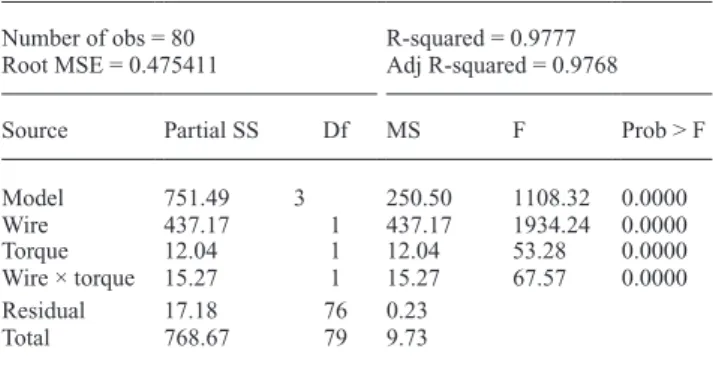
The mean value of the two repeated measurements in every specimen of the generated moments was calculated at the maximum rotation separately for +15 and −15 degrees. A two-way analysis of variance (ANOVA) model was fitted in order to assess the generated moments by wire type at low- and high-torque brackets. In the presence of significant inter-action between torque prescription and wire type student’s t-tests were used to compare generated moments between wires at low- and high-torque brackets separately, and t-test for the comparison of the moments between wires at both bracket series separately. All statistical analyses were performed with the Stata 12 (Stata Corp, College Station, Texas, USA). Results
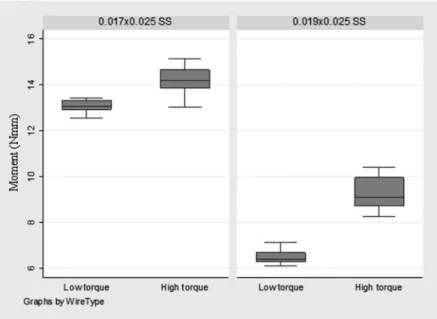
Two-way ANOVA indicated significant interaction be-tween wire type and torque prescription and therefore four independent t-tests were used for statistical inferences as shown in Tables 1 and 2. At +15 degrees, the insertion of a 0.017 × 0.025 inch stainless steel archwire in 0.018 slot high-torque brackets generated 14.3 Nmm in the central in-cisor. In the same configuration but in the low-torque series, the measured moment was 12.9 Nmm. The 0.019 × 0.025 inch stainless steel archwire in 0.022 slot brackets, yielded 9.3 Nmm in the high-torque and 6.5 Nmm in the low-torque series ( Table 1 and Figure 1).
The same trend was observed at −15 degrees. The recorded values were 14.0 Nmm/13.2 Nmm for the 0.018 inch slot and 9.3 Nmm/6.5 Nmm for the 0.022 inch slot in the high- and low-torque brackets, respectively. All four comparisons from the t-test were highly significant (P < 0.001). Estimates were precise as indicated by the
narrow confidence intervals around them and Monte Carlo simulations.
Discussion
Most orthodontic manufacturers offer a variety of brack-ets with different torque prescriptions. In the present ex-periment the difference between the high- and low-torque series, at both slot dimensions, was 8, 7, 7, and 7 degrees for the central incisor, lateral incisor, cuspid, and premo-lar, respectively. This difference influenced the measured moments at the central incisor and resulted in increases of 6–10 per cent in the 0.018 inch and 44 per cent in the 0.022 inch system. The greater increase in the latter system is expected, since the evaluated archwire was 0.019 × 0.025 inch, that is 0.002 inch wider at the smaller dimension in comparison with the measured archwire in the 0.018 inch slot. The increase in stiffness of a cantilever beam accom-panying an increase in cross section from 0.017 × 0.025 to 0.019 × 0.025 inch of the same composition is about 55 per cent (Thurow, 1982). Supporting both ends of a beam makes the beam stronger and its dimension in the direction of bending is the primary determinant of its properties, af-fecting strength in a cubic function. In torsion, shear stress rather than bending stress is encountered and the equations are different but the overall effect is the same. Additionally, if the ends of the beam are tightly anchored, that is they are not allowed to slide freely, the beam stiffness is higher (Proffit and Fields, 2000).
The wires evaluated in this study are most usually inserted as the final archwires during orthodontic treatment. In both torque specifications series, the measured moments generated by the 0.017 × 0.025 inch archwire in the 0.018 slot system were higher, in comparison with the 0.019 × 0.025 inch wire in the 0.022 slot, due to torque loss. The torsional play of a 0.017 × 0.025 inch archwire in 0.018 inch systems could be theoretically estimated at approximately 4 degrees and the double amount for a 0.019 × 0.025 inch in the 0.022 slot (Dellinger, 1978; Thurow, 1982; Sernetz, 1993;
Meling et al., 1997). Experimentally, higher torque losses Table 1 Mean values, standard deviation (SD), mean difference,
and t-test of the labiopalatal moment (Nmm) on the displaced central incisor between the different experimental configurations (n = 10).
0.017 × 0.025* 0.019 × 0.025**
Rotation Torque Mean (SD) Mean (SD) Mean
difference (95% CI) P-value +15 High 14.3 (0.5) 9.3 (0.6) 5.0 (4.5, 5.5) <0.001 Low 12.9 (0.2) 6.5 (0.3) 6.4 (6.2, 6.6) <0.001 –15 High 14.0 (0.6) 9.3 (0.7) 4.7 (4.1, 5.4) <0.001 Low 13.2 (0.3) 6.5 (0.3) 6.7 (6.4, 7.0) <0.001 *Tested in a 0.018-inch bracket slot
**Tested in a 0.022-inch bracket slot
Table 2 ANOVA for the effect of wire type on the generated
labiopalatal moments on the displaced central incisor.
Number of obs = 80
Root MSE = 0.475411 R-squared = 0.9777 Adj R-squared = 0.9768
Source Partial SS Df MS F Prob > F
Model 751.49 3 250.50 1108.32 0.0000 Wire 437.17 1 437.17 1934.24 0.0000 Torque 12.04 1 12.04 53.28 0.0000 Wire × torque 15.27 1 15.27 67.57 0.0000 Residual 17.18 76 0.23 Total 768.67 79 9.73
are measured in the literature (Fischer-Brandies et al., 2000;
Gmyrek et al., 2002; Harzer et al., 2004). The source of this discrepancy may be attributed to the rounded edges of the bracket and slot as well as the tolerance in size; that is, the slot is slightly larger than described and the wire smaller than defined by the manufacturer (Meling et al., 1998;
Gmyrek et al., 2002). The accuracy of the manufacturer’s dimension of the archwires is not to be taken for granted (Fischer-Brandies et al., 2000). According to the findings of this study, the combination of a 0.017 × 0.025 inch archwire in the 0.018 slot system was more efficient in torque delivery than the 0.019 × 0.025 inch in the 0.022 slot, at least regarding stainless steel archwires. Alternatively, alloys with lower moduli of elasticity, such as NiTi and β-Ti, which present only a fraction of the torsional stiffness of stainless steel and reduced hardness, could be ineffective in transmitting torque moments to bracket slots (Morina
et al., 2008). The stiffness in torsion of a 0.021 × 0.025 inch β-Ti archwire, which could be inserted at the final stages into 0.022 inch brackets, shows a 3-fold decrease relative to the 0.019 × 0.025 inch steel archwire, which in turn possesses more than the double stiffness compared with a 0.019 × 0.025 inch NiTi archwire (Kusy, 1983). It is stated that the wires adjusted to torque individual teeth should be sufficiently undersized (0.002 inch) to allow the adjusted wire to rotate in the slot of the adjacent teeth with no transfer of the torque action. Where all the teeth in an arch need some simultaneous torquing action, a close fit in the slot is not such a problem (Thurow, 1982).
The lower torque amount measured in the 0.022 inch system is not necessarily a disadvantage in the clinical practice, since there is no scientific consensus regarding ideal torquing moment (Burstone, 1966; Reitan, 1964;
Bantleon and Droschl, 1988). Most of the authors agree that 5.0 Nmm is the minimum torque required for an upper central incisor (Gmyrek et al., 2002; Harzer et al., 2004;
Huang et al., 2009; Major et al., 2011) and recent experi-mental data suggest that higher magnitudes of torque can cause more root resorption, particularly in the apical region (Casa et al., 2001; Bartley et al., 2011). Nevertheless, a retrospective study among treated patients derived from six different offices failed to establish a significant relation-ship between slot size and root resorption (Sameshima and Sinclair, 2001).
Both wire types in this experiment were ligated with elastic ligatures. The effect of elastic/metal ligation type is not expected to influence torque magnitude in full slot size wires and in the 0.017 × 0.025 inch steel archwire in the 0.018 inch slot system. However, for the 0.019 × 0.025 inch steel wire in the 0.022 inch slot, the measured moment with elastic ligation could be 20 per cent lower than with metal ligation at 5–15 degrees of torque, since the archwire may not completely seat during torquing (Hirai et al., 2011). The 0.120 inch elastic ligatures presenting high seating force were used in this experiment in order to ensure the initial
seating of the archwire with consistent and similar liga-tion forces between the different bracket systems (Taloumis et al., 1997; Iwasaki et al., 2003). Unfortunately, the main disadvantage of the elastic ligatures still remains their rapid force loss—which could exceed 50 per cent in 24 hours— and consequently this fact makes the engagement of the wire into the slot flexible and incomplete. Steel ligatures should be preferred in cases of maximum torque demands (Taloumis et al., 1997; Gioka and Eliades, 2004).
As in most in vitro investigations, there are some limi-tations and difficulties in extrapolating clinical relevance. This study has focused on the comparison of the initial force systems of specific bracket/archwire combinations, but the actual force system acting on the teeth will probably vary in time because of the presence of the anisotropic periodontal ligament. The OMSS could simulate the initial tooth move-ment within the periodontium and although it comes very close to the clinical situation, it fails to take account of some factors that have additional influence in practice, such as intraoral ageing and influence of saliva.
Conclusions
High-torque bracket series produce higher torque mag-nitudes in comparison with low-torque brackets. This difference is exaggerated with a 0.019 × 0.025 inch steel archwire in the 0.022 inch slot systems, in comparison with a 0.017 × 0.025 inch steel archwire in the 0.018 inch slot systems.
The 0.019 × 0.025 inch steel archwire in the 0.022 inch slot system generated lower torque in comparison with the 0.017 × 0.025 inch steel archwire in the 0.018 inch slot sys-tem, in high- and low-torque configurations.
References
Amditis C, Smith L F 2000 The duration of fixed orthodontic treatment: a comparison of two groups of patients treated using Edgewise brackets with 0.018″ and 0.022″ slots. Australian Orthodontic Journal 16: 34–39 Archambault A, Major T W, Carey J P, Heo G, Badawi H, Major P W 2010
A comparison of torque expression between stainless steel, titanium molybdenum alloy, and copper nickel titanium wires in metallic self-ligating brackets. The Angle Orthodontist 80: 884–889
Bantleon H P, Droschl H 1988 [Front torque using a partial arch technic]. Fortschritte der Kieferorthopädie 49: 203–212
Bartley N et al. 2011 Physical properties of root cementum: Part 17. Root resorption after the application of 2.5° and 15° of buccal root torque for 4 weeks: a microcomputed tomography study. American Journal of Orthodontics and Dentofacial Orthopedics 139: e353–e360
Bourauel C, Drescher D, Thier M 1992 An experimental apparatus for the simulation of three-dimensional movements in orthodontics. Journal of Biomedical Engineering 14: 371–378
Burstone C J 1966 The mechanics of the segmented arch techniques. The Angle Orthodontist 36: 99–120
Casa M A, Faltin R M, Faltin K, Sander F G, Arana-Chavez V E 2001 Root resorptions in upper first premolars after application of continuous torque moment. Intra-individual study. Journal of Orofacial Orthopedics 62: 285–295
Dellinger E L 1978 A scientific assessment of the straight-wire appliance. American Journal of Orthodontics 73: 290–299
Detterline D A, Isikbay S C, Brizendine E J, Kula K S 2010 Clinical out-comes of 0.018-inch and 0.022-inch bracket slot using the ABO objec-tive grading system. The Angle Orthodontist 80: 528–532
Drescher D, Bourauel C, Thier M 1991 Application of the orthodontic measurement and simulation system (OMSS) in orthodontics. European Journal of Orthodontics 13: 169–178
Fischer-Brandies H, Orthuber W, Es-Souni M, Meyer S 2000 Torque transmis-sion between square wire and bracket as a function of measurement, form and hardness parameters. Journal of Orofacial Orthopedics 61: 258–265 Germane N, Bentley B E Jr, Isaacson R J 1989 Three biologic variables
modifying faciolingual tooth angulation by straight-wire appliances. American Journal of Orthodontics and Dentofacial Orthopedics 96: 312–319
Gioka C, Eliades T 2004 Materials-induced variation in the torque expres-sion of preadjusted appliances. American Journal of Orthodontics and Dentofacial Orthopedics 125: 323–328
Gmyrek H, Bourauel C, Richter G, Harzer W 2002 Torque capacity of metal and plastic brackets with reference to materials, application, tech-nology and biomechanics. Journal of Orofacial Orthopedics 63: 113–128 Harzer W, Bourauel C, Gmyrek H 2004 Torque capacity of metal and poly-carbonate brackets with and without a metal slot. European Journal of Orthodontics 26: 435–441
Hirai M et al. 2011 Measurements of the torque moment in various arch-wire-bracket-ligation combinations. European Journal of Orthodontics 34: 374–380
Huang Y et al. 2009 Numeric modeling of torque capabilities of self-ligat-ing and conventional brackets. American Journal of Orthodontics and Dentofacial Orthopedics 136: 638–643
Iwasaki L R, Beatty M W, Randall C J, Nickel J C 2003 Clinical ligation forces and intraoral friction during sliding on a stainless steel archwire. American Journal of Orthodontics and Dentofacial Orthopedics 123: 408–415
Kattner P F, Schneider B J 1993 Comparison of Roth appliance and stand-ard edgewise appliance treatment results. American Journal of Ortho-dontics and Dentofacial Orthopedics 103: 24–32
Kusy R P 1983 On the use of nomograms to determine the elastic property ratios of orthodontic arch wires. American Journal of Orthodontics 83: 374–381
Major T W, Carey J P, Nobes D S, Heo G, Major P W 2011 Mechanical effects of third-order movement in self-ligated brackets by the meas-urement of torque expression. American Journal of Orthodontics and Dentofacial Orthopedics 139: e31–e44
Meling T R, Odegaard J, Meling E O 1997 On mechanical properties of square and rectangular stainless steel wires tested in torsion. American Journal of Orthodontics and Dentofacial Orthopedics 111: 310–320 Meling T R, Odegaard J, Seqner D 1998 On bracket slot height: a
meth-odologic study. American Journal of Orthodontics and Dentofacial Or-thopedics 113: 387–393
Moesi B, Dyer F, Benson E 2011 Roth versus MBT: does bracket prescrip-tion have an effect on the subjective outcome of pre-adjusted edgewise treatment? European Journal of Orthodontics Nov 2 [Epub ahead of print] Morina E, Eliades T, Pandis N, Jäger A, Bourauel C 2008 Torque expression
of self-ligating brackets compared with conventional metallic, ceramic, and plastic brackets. European Journal of Orthodontics 30: 233–238 Proffit W R, Fields H W 2000 Contemporary orthodontics, 3rd edn.
Mosby, St Louis, p. 344
Reitan K 1964 Effects of force magnitude and direction of tooth movement on different alveolar bone types. The Angle Orthodontist 34: 244–255 Sameshima G T, Sinclair P M 2001 Predicting and preventing root
resorp-tion: Part II. Treatment factors. American Journal of Orthodontics and Dentofacial Orthopedics 119: 511–515
Sernetz F 1993 Qualität und Normung orthodontischer Produkte aus der Sicht des Herstellers. Kieferorthopädische Mitteilungen 7: 13–26 Taloumis L J, Smith T M, Hondrum S O, Lorton L 1997 Force decay and
deformation of orthodontic elastomeric ligatures. American Journal of Orthodontics and Dentofacial Orthopedics 111: 1–11
Thurow R C 1982 Edgewise orthodontics, 4th edn. Mosby, St Louis, pp. 169–171
Ugur T, Yukay F 1997 Normal faciolingual inclinations of tooth crowns compared with treatment groups of standard and pretorqued brackets. American Journal of Orthodontics and Dentofacial Orthopedics 112: 50–57