Augmented Material Interfaces
Exploring bidirectional microinteractions
enabled by radical elements.
ARCHMS
MASSACHUSES NSITUTE
OF TECHNOLOGY
Felix Heibeck
NOV
2 5 2015
B.Sc. University of Bremen, GermanyLIBRARIES
Submitted to the Program in Media Arts and Sciences,School of Architecture and Planning, in partial fulfillment of the require-ments for the degree of
Master of Science in Media Arts and Sciences at the Massachussetts Institute of Technology
September 2015
C 2015 Massachusetts Institute of Technology. All Rights Reserved
Author
Certified by
Accepted by
.Signature
redacted
Felix Heibeck
Program in Media Arts and Sciences August 7, 2015
Signature redacted__
Hiroshi Ishii
Jerome B. Wiesner Professor of Media Arts and Sciences Program in Media Arts and Scie hesis Supervisor
Signature redacted
Pattie Maes +Academic Head
Augmented Material Interfaces
Exploring bidirectional microinteractions
enabled by radical elements.
Felix Heibeck
Submitted to the Program in Media Arts and Sciences, School of Ar-chitecture and Planning, on August 7, 2015 in partial fulfillment of the requirements for the degree of Master of Science in Media Arts and Sciences at the Massachussetts Institute of Technology
Abstract
Advances in material science and miniaturization of electromechanical devices are liberating the surface of the embedded device from its rigid shell. These new modes of dynamic expression have to be coupled with sensing capabilities in order to create comprehensible interactions. This thesis explores the space of augmented materials that are bidirectional transducers, called radical elements. We present currently available rad-ical elements that facilitate embodied interactions through sensing and actuation methods on the same modality. To exemplify how a radical element can be fabricated with simple materials, we present a thin film shape-changing composite uniMorph. It is based on a flexible circuit composite that is able to actuate its own shape by combining the ther-mo-electric characteristics of copper with the high thermal expansion rate of ultra-high molecular weight polyethylene. Finally, a taxonomy for augmented materials is presented that explores how new material
capa-bilites can extend the perceived behavior of materials in the context of microinteractions. This thesis concludes with a survey of tangible inter-face projects in the design space of radical element enabled augmented
materials.
Thesis Supervisor Hiroshi Ishii
Augmented Material Interfaces
Exploring bidirectional microinteractions
enabled by radical elements.
Felix Heibeck
The following people served as readers for this thesis:
Signature redacted
Hiroshi Ishii
Jerome B. Wiesner Professor of Media Arts and Sciences
Signature redacted
__--Jose aradiso
Pr ssor of Media rts and Sciences
_Si-gnature redacted_
Neri Oxman
Associate Professor of edia Arts and Sciences
-I
Advisor
Reader
Acknowledgements
I would like to thank my advisor Prof. Hiroshi Ishii, for
believ-ing in my abilities and makbeliev-ing me a part of his research team. You will always be in my head, debugging my ideas in less
than 500 milliseconds.
Thank you to Prof. Neri Oxman and Prof. Joseph Paradiso, for challenging my ideas and helping to weave my concepts and thoughts into a more coherent web that has become this thesis.
This work would not be the same without my collaborators, especially Basheer Tome and Clark Della Silva.
Thank you Mary and Amber, our administrators, for being the rock in the stormy waters in which we try to lift our iceberg.
Thank you Linda and Keira, for steering the ship away from bureaucratic rocks and into the safe haven of graduation.
Thank you Jifei and Lining for spawning a lot of the thoughts and discussions that lead to this thesis with your work.
Thank you Sean and Daniel for showing me how to think and work scientifically and inspiring me with your amazing work.
Thank you Xiao Xiao for supporting, discussing debugging my philosophy and wording.
Thank you Viirj, Luke and Ken for bringing in new ideas and challenging the given.
I was incredibly lucky to be accompanied throughout this
jour-ney in the world of tangible bits and radical atoms by Philipp and Basheer. Without you, this would not have been the same.
Thank you Sam, for blindly trusting me, giving me a home, and sometimes tolerating my messiness.
Thank you Jeff, for being as inspiring as an engineer can be. Thank you Bianca And Juliana, for dehyphenating my
word-structures, finding those these weird mistakes and mak-ing me die a little less.
Thanks to my UROP Paul Kalebu who was with me for 3 out of the 4 semesters. Sold(i)er on.
Thank you funfetti, for distracting me when needed and al-ways having the right sticker.
Vielen Dank an Prof. Dennis Paul & Prof. Frieder Nake, ffir eure Einfhfirung in die Welt der digitalen Medien. Ihr seit und bleibt zwei Pfeiler meines Denkens.
Vielen Dank an Laura, fnr die Unterst tzung von nah und fern. Vielen Dank an meine Familie ffir euer Verstandnis fur meine
Kommunikationspausen und eure bedingungslose Unter-stntzung. Ich bin sehr gicklich euch zu haben und vermisse euch oft.
Danke Opa.
In nova fert animus mutatas dicere formasi corpora;
I intend to speak of forms changed into new entities;
Ovid
Metamorphoseon, Book /
lines 1-2
Initial Remarks
Physical materials and digital systems are considered to have inherently opposite characteristics. Materials are static, passive, and permanent, deriving a set of abstract qualities such as af-fordance, ambience and calmness. Tangible User Interfaces are successful because they combine these qualities with dynamic, active, and programmable digital information. They embody and tame the radical nature of computation and enable bodily interaction with it.
Enabled by advances in material sciences, current human com-puter interaction research continues to blur the lines between the physical and digital world. New dynamic materials are introduced that give physical expression to digital computation. While this frontier has great opportunities, we also require rules for how to use this new layers of dynamic materiality to successfully synthesize computation and physical elements without losing the inherent qualities of either.
This thesis presents three complementary research threads. The first one is a taxonomy for bidirectional transducers, called
'Radical Elements', that defines the current design space for the
design of bidirectional microinteractions. The second one pres-ents a novel shape-changing composite that enables designers to create these bidirectional microinteractions. Finally, the last thread presents a design space for future computationally con-trolled dynamic materials.
Hopefully, this thesis will inspire and guide the development towards a future in which bits and atoms can be truly integrat-ed without losing the inherent qualities of physical materials or computation.
Table of Contents
Abstract 3 Acknowledgements 7 Initial Remarks 13 Motivation 17 Thesis Aims 19 Thesis Contributions 20 Thesis Outline 21 Background 23 Introduction 24Material: A brief discussion 25
Object - Body - Space 28
Body 28
Object 29
Microinteractions 31
Computational Control & Feedback 34
Open-Loop Control 34
Closed-Loop Control 35
Interactive Closed-Loop Systems 35 I/O Coincidence & Embodiment 37
Radical Elements 41
Periodic Table of Radical Elements 45 Electromechanical Radical Elements 47 Molecular Radical Elements 49 Radical Element Reactions 51
uniMorph 55
Introduction 56
Dynamic Materials 58
Digital Fabrication of flexible electronics 63 Flexible Sensing Technologies 63 Organic User Interfaces &
Transitive Materials 64
Shape Changing Sheet Technologies 64 Unimorph Actuation Mechanism 66
Passive Shape-Change 67
Active Shape-Change 68
Neutral State Programming 69
Actuation Performance 70
Design Space 72
Actuation Energy 72
Fabrication Process 73
Shape-Changing Primitives 73 Integrated Sensing &
Electronic components 74
Digital Design & Fabrication 75
Digital Design 75
Stiffeners 76
Fabrication 77
Primitives 79
Integrated Sensing Additional Electronics 81 Capacitive Sensing for Touch & Topology 81 Velostat as force and bend sensor 82 Additional Electronics 82
Applications 84
Flower Lamp Shade 84
Responsive Bookmark Light 85
Post-it Notes 86
Interactions with Radical Elements &
Augmented Materials 89
Introduction 90
A brief historical overview of
human-artifact interaction 91 Taxonomies for Tangible User Interfaces 94
Experiential &
Representational Embodiment 94 Reality Based Interaction 95
Level of coherence 96
Fishkin 97
A Framework for Augmented Materiality 99
Energy 102
Time 103
Place 104
Modality 105
Instances 106
A brief survey of Tangible Interactions 107 PegBlocks & inTouch 107
Curlybot & Topobo 108
Actuated Workbench & inForm 108
PneUl & uniMorph 109
A Survey of Augmented Material Examples 110
Beyond 111
The challenge of Material Innovation 112
Material Design 114
Experiential Radical Elements 115 A Toolkit for Radical Elements 117
metaMorph 118
Conclusion 121
Motivation
Advances in synthetic materials have paved the way to a re-versed design process with new possibilities. Instead of a de-sign iteration that is informed and constrained by the available materials, custom materials can now be engineered to fit the design requirements. In addition, a recent frontier of material engineering is trying to liberate materials from their static nature and make them dynamic in form and function. This thesis deals with both, the incorporation of dynamic materials and minituarized electromechanical devices into
electronic objects and the implications for interacting with the resulting artifacts.
Dynamic materials offer new modes of expression for objects with embedded computation. They could help connect us with the computational processes that are executed inside electronic objects in our daily life. The once static shell of an object might be able to match the dynamic nature of the computation it em-beds. In concert with material-embedded sensing, this could allow for haptic connection between immaterial computation and human touch, mediated by the material. Dynamic materi-als could inform us by embodying object's internal computa-tional state through transformations instead of blinking LEDs.
Figure 1: TRANSFORM is a
stre-hat alo crieace of furni Fabrication of synthetic materials enabled a new breed of
ma-new expressions for artists and terials with customized properties, leading to a design process
designers. that can is not informed by material properties, but defines
new materials for its purpose. Now new dynamic materials are being developed new dynamic materials with properties that
are not pre-defined during fabrication but can be changed com-putationally. When designed correctly, those materials might inform us not just about their own materiality, but also connect us to the underlying computational models by sensing and an-swering our actions through transformations -human-material interaction.
In the vision paper 'Radical Atoms' Ishii et al. proclaimed that new materials have to be able to transform its shape, conform to constraints and inform users of interaction possibilities
[Ishii, 2008]. In order to achieve all of those qualities, the mate-rial has to be able to actuate and sense the very same modality. This bidirectionality is the focus of this thesis from the techni-cal (enabling) and the interaction side.
To make sense of these new qualities we need to chart the new qualities that these materials offer for designing interactions. This is common when new technologies are introduced, and prunes particularly important in this case where we blur the lines between the static physical and dynamic digital world.
This is a grand challenge and this thesis merely offers explo-rations into this new field of interaction. In the tradition of the Tangible Media Group, the "answers you'll find offered here
are half technology (how it can be done now) and half
Thesis Aims
This thesis postulates that the ability to understand, design, and prototype interactions with dynamic materials is becom-ing increasbecom-ingly important. While enablbecom-ing technologies are advancing at increasing speed, we have to strive to incorporate human interaction with those materials into the agenda of research.
This thesis examines bidirectional interactive materials that combine sensing and actuation of the same modality. Only these materials can actively transform and conform with the human body and create truely bidirectional interactions. Cur-rently available materials and electromechanical devices that enable both sensing and actuating are surveyed and ordered in
a 'Periodic Table of Radical Elements'. The goal of this table is to
create a comprehensive list of input/output (I/O) transducers as well as the categorization of future radical elements.
Following this table of generally available materials, the thesis highlights the creation of a new radical element called
uni-Morph. The thin-sheet composite shows how common
materi-als can be leveraged to create a shape-changing composite with inert sensing capabilities. With uniMorph we aim to democ-ratize and spread the capabilities of dynamic materials with computational control.
Thesis Contributions
This thesis offers the following contributions:
1.
A perspective on enabling technologies for bidirectional
dy-namic materials: Radical Elements.
2.
A thin-film composite that exemplifies the creation of new
rad-ical elements and democratizes prototyping of shape changing interfaces.
3.
A taxonomy and design space for microinteractions with
Thesis Outline
The following chapters describe the evolution of ideas in this thesis:
Chapter 2 briefly discusses interactions with electrical (digital) systems, surveys the concepts of input/output coincidence, dy-namic materials, and microinteractions, and briefly discusses the potential of dynamic materials in that context.
Chapter 3 presents components and materials that facilitate sensing and actuation transducing on the same modality and the periodic table of radical elements.
Chapter 4 presents uniMorph, a thin-film composite for shape-changing interfaces that is easy to fabricate and exem-plifies how radical elements can be engineered on a material level.
Chapter 5 surveys interactions with electric objects from a his-toric and taxonomy point of view. Finally, it presents a design space and taxonomy for bidirectional interactions with radical elements.
Chapter 6 discusses limitations and future work. Chapter 7 concludes the thesis with a summary.
Introduction
The following chapter partially defines the space in which this thesis is placed and explains the way certain terms are being used. It discusses different terms concerned with materials and locates the conducted research in the field of 'Body -Object
-Space'.
Finally, it describes the term 'microinteractions' and briefly explores how we interact with electric objects from the techni-cal and human side by discussing digital control loops and the concept of input/output coincidence.
It'
lot
Figure 2: Wood exemplifies the recursiveness of materials with
strcutures from cellulose chain
molecules to wood cells and fibers.
Material: A brief discussion
"We shall speak of a 'material' not by defining 'what it is' but describing 'what it does"'
- Ezio Manzini
In the course of this thesis, the term material will be used fre-quently and in different contexts. This section defines different permutations of the term, but the most important definition is the term 'material' itself. What constitutes a material is a complex question and the presented definition is specific to the context of this thesis and by no means generalizable.
Material describes the matter which artifacts and natural objects are made of. The perception of a material is that of a single entity. However, smaller entities, which can also be described as materials, are often found within a material upon closer inspection. For example, wood is perceived as one mate-rial, but a close examination reveals layers and rings that make up the wood. Even closer inspection reveals small fibers that make up those rings. Another example are composite materials
that are made of multiple layers but are perceived as one mate-rial after fabrication.
The term 'material' is highly recursive, with the chemical ele-ments and their molecules as the smallest functional unit. At a molecular scale, every material is a structure. Molecules form structures with various patterns depending on their energy stability. These molecular structures define the properties that a material exhibits.
In this thesis, the term 'material' and its recursive use are expanded a little more. We include electromechanical devices such as motors and electromagnets in the definition of what a material can be. It is important to notice that in their current
scale and deployment, those devices do not constitute a materi-al, but a structure. However, the scale of these devices has been shrinking continuously, pointing to a future of electromechan-ical structures so small, that their structures can be perceived as materials.
Additionally, dynamic materials that create effects similar to motors are engineered and synthesized on the molecular level. It is only a matter of time until the active qualities and func-tionalities that we currently associate with electromechanical devices will be perceived as material properties. To deeply root this evolution in the vocabulary of this thesis, we refer to these
structures as materials.
The other following terms are being used:
Digital Material is a type of material that is assembled of small-scale, discrete building blocks. Similar to larger scale LE-GO-blocks, they allow for only discrete positions and rotations in reference to each other. This makes them simple to manu-facture and possibly fully recyclable. They also exemplify the use of the word material for an assembly of discrete blocks.
Figure 3: Digital Cellular Solids by K.C. Cheung is an example for a digital material.
Programmable Matter can change properties and sense environ-mental or human stimuli. The focus of programmable matter research is on self-sufficient systems that can reassemble into any shape or property. The goal of creating a general purpose material contrasts this approach to dynamic, programmable materials.
Figure 4: Programmable Matter (here exemplified byt work of the Wyss Institute) is a concept for reconfigurable systems, in this example based on self-folding sheets of robotic origami.
Dynamic Material describes materials with dynamic properties. Usually these materials are engineered and synthesized to ei-ther respond to environmental or computational stimuli. While dynamic properties with environmental stimuli can also be found in natural materials (eg. wood), the time scale at which these property changes occur is usually too slow to be charac-terized as dynamic.
Figure 5: Dynamic materials can change their material
proper-ties quickly, often controlled by
computers. This includes, but is not limited to shape. Here shown is a transforming carbon fiber by Skylar Tibbits.
Object - Body - Space
Body
Object
Space
Figure 6: A common view of
interactions is on
Object-Body-Space.
This thesis deals with physical representations of digital infort-mation that enable physical interactions. Specifically physical microinteractions with electric objects. From the perspective of Object-Body-Space, this excludes aspects of space from the fo-cus of this thesis and rather disfo-cusses and explores the relation between the body and the (electric) object.
This thesis will not focus on spatial aspects as they do not in-fluence most physical microinteractions. Hence, the following brief definition is sufficient:
We are spatial, physical beings whose bodies are embedded in a physical space together with other humans, objects and ma-terials, and whose intersections of physicalities we call interac-tions.
The following section discusses the role of the remaining two categories: Body and Object in more detail. Since the focus of these descriptions is the interaction (or intersection) of these categories, the explanations reference each other.
Body
Our body is a living, experiencing, feeling entity. When inter-acting with physical objects we use a multitude of senses. Our multimodal haptic sense allows us to feel temperature, surface friction, weight, and more. The sense of our own body comes with a set of kinaesthetic, proprioceptive, and tactile qualities that we leverage naitiirally in mundane and romnlex phViral
We understand the world in reference to our own body and our sense of touch reminds us that we are embodied beings [B6hme, 1998]. Touching something is "responsive and dia-logic and can be deeply emotional; the aesthetics of touch have immediate emotional responses" [Hornecker, 2011].
When designing physical, embodied interactions, one has to consider the experience of the living human body, as well as the materiality of the world we interact with. This requires an understanding of how the human body experiences, from sen-sory organs to bodily intelligence. Particularly when designing dynamic tangible interfaces, designers have to recognize the intimacy of their design space, since one can not touch without being touched.
Object
We interact with natural and man-made objects (artifacts) everyday. The physicality of objects gives them persistence and allows us to use our bodies in interactions with them. Form and material leverage cultural references that enable us to infer possible and intended interactions with the object (affordances).
With new technical skills, humans developed more categories of artifacts with a new richness of functionalities. The evolu-tion of interacevolu-tions with artifacts developed from interacting
solely with materials, to controlling complexity by translating mechanical movements with gears and pulleys and more re-cently amplifying forces with the help of motors.
With the introduction of the microcomputer, the physical form of artifacts has been liberated from its function, as a large part of the functional digital complexity is encapsulated in small integrated circuits. So called electrical objects [Dunne, 1999]
combine a static, physical shell with dynamic computation and create a bridge between the material and digital immaterial. Electric objects, a form of augmented artifacts permeate our lives. While they have traditionally been bound to the static nature of their comprising materials, their modes of expres-sion will soon expand beyond attached screens and indication lights. Dynamic Materials that can change their material properties such as shape, stiffness, color or temperature will expand the vocabulary of interfaces that mediates between the two worlds.
This thesis explores the nature of interactions with the surface of the electric object, which can be described as the boundary between the immaterial computation and the human. It exam-ines how digital data can be embodied by the materials that comprise the surface and how this embodiment can be tailored to the human body.
Microinteractions
"The details are not the details; they make the product,"
- Charles and Ray Eames
A microinteraction is a small interaction (often within a larger
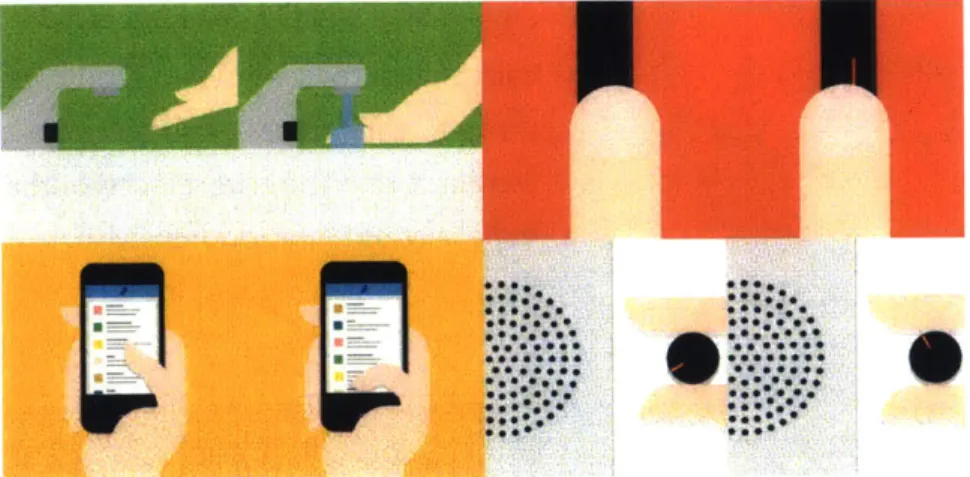
system) that is dedicated to a single task and only does one thing [Saffer, 2013]. Simple examples for microinteractions are switching on the light or adjusting the volume of a device. They span from purely GUI based interactions such as liking a Facebook status to physical interactions such as washing hands.
Figure 7: Microinteractions of the daily life
Microinteractions are ephemeral and simple. However "the difference between a product we love and a product we just tolerate are often the microinteractions we have with it" [Saffer,
2013].
The components of microinteractions are triggers, rules, feed-back, and loops/modes (Figure 8).
Figure 8: The structure of Mi-crointeractions as presented by
Saffer [Saffer, 20131.
O
@
A0
TRIGGER RULES FEEDBACK LOOPS
& MODES Triggers are the start of any microinteraction. They usually are initialized by the user (eg. by pressing a button). Hence the design of the system has to identify its triggers clearly, often
by leveraging affordances. Triggers can also be initialized by an
external event like receiving an email.
Rules describe the logic that specifies the system's mechanic. This is where digital computation generates its feedback behav-ior that is either directly coupled to the trigger or is presented
somewhere else. One of the major challenges of designing for microinteractions is making the outcome of this imperceivable process transparent for the user.
One of the most important parts in this process is the feed-back that provides information back to the user either directly through the trigger or somewhere else. It is only through this feedback that the user perceives the computational system as
responsive and comprehensive.
Finally Loops & Modes can be used to customize the rules with-in microwith-interactions. This allows microwith-interactions to change according to computational states, triggered by the user or ma-chines. This computational structure completes the interaction feedback loop.
An interesting aspect about the microinteraction paradigm is its similarity with the interaction design abstraction popular-ized by Professor Bill Verplank.
His question of "How do you do?" relates to the triggers the de-vice offers. "How do you feel?" corresponds to the microinterac-tion's feedback. "How do you know?" does not directly correlate
Figure 9: Bill Verplank's ques-
How do you... tions of interaction design.
... feel? c o cool & . khot media .know? handle (f button
to a step in the microinteraction perspective. However, the rules and Loops and Modes in microinteractons determine how the user perceives the system. This relationship shows the
differ-ent consideration of either approach and the simplification that each bring with it. While microinteractions take the perspec-tive of the computational medium, Bill Verplank considers the
user's side of the interaction. The microinteraction perspective does not consider more abstract concepts like metaphors or mind-maps as Verplank does, but focuses on a simple mapping between inputs and outputs as executed by the machine.
This thesis looks at interaction design with dynamic material-ity from the microinteraction perspective. While there is also a need for a more holistic approach to this topic, the focus on mi-crointeractions from a machine-side allows for a more focused perspective and much needed basic insights.
In this context, the hypothesis is: Dynamic materials can embody the both trigger and (augmented) feedback for micro-interactions. This interaction is similar to the interaction with inert materials, only instead the materialilty of the trigger is computationally augmented. The following chapter will present a list of materials and electromechanical devices that can facil-itate this type of interaction. Chapter 5 presents a taxonomy of
perceptual qualities that interactions with dynamic materials can afford.
Computational Control &
Feedback
I
I
Figure 10: Most analog control systems have been replaced with digital technology, as exemplified here by an analog honeywell and a modern nest thermostat.
Actuation
up
computation N
Figure 11: Open-loop control example
Control systems are ubiquitous in objects around us. They appear in our homes, cars, and communication systems, to name just a few examples. While there are still some analog
control systems, most control systems are built with a digital computation unit at heart. In electronic objects, control sys-tems allow computation to materialize outcomes of algorithms or computational states. They are an irreplaceable part of the transduction between digital and physical. They are the inter-face between the immaterial and the material.
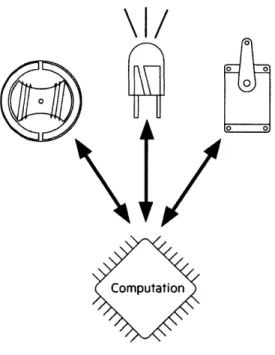
From an engineering perspective, there are two different categories of control systems, open-loop and closed-loop. This section is going to briefly explain the two concepts and explain why the use of closed loop systems is fruitful for physical hu-man-computer interaction.
Open-Loop Control
In an open-loop control system the digital part of the system only has means of physical actuation and no sensor feedback
from its actions. Controlling the speed of a DC-motor with just applied power is a simple example of open-loop control.
Open-loop control systems are useful for well-defined systems with physical behavior that can be modeled with mathematical formulas or simple simulation. The actuation is then car-ried out with no regard for physical deviations from the pro-grammed models.
Closed-Loop Control
( Computation
Actupui N
Figure 12: Closed-loop control incorporates sensor information
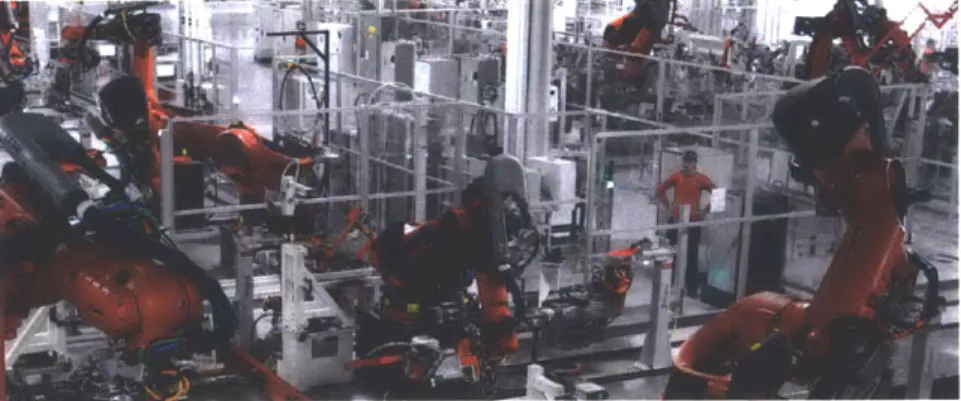
Figure 13: Closed loop control systems in automation often
don't take human interaction into
account. In effect, machines and humans have to be physically separated for safety reasons.
Sensors are key elements of closed-loop control systems be-cause they provide feedback from the actuation process and close the control loop. Ideally, sensors are in-line, meaning that they measure the direct effect of the actuation, but there are also loops with sensors that capture a derivate effect of the actuators effect.
A good example of a closed-loop system is a servo motor. A
servo motor is an assembly of a DC motor, gears, and a poten-tiometer. The rotation of the DC motor is geared down and the resulting rotation is measured by the potentiometer. This closed-loop assembly allows for precise angular control with high torque. Additionally, it can also adapt to changes in its sys-tem. Furthermore, if the servo's position is altered by external forces, the control system can adjust.
More complex applications of control systems take the behavior of the physical system into account. To account for static fric-tion and inertia effects of physical systems, engineers deploy more advanced control algorithms such as PID (Power, Inte-gral, Differential) controls.
Interactive Closed-Loop Systems
The control systems presented so far do not account for hu-man presence or interaction. Especially in automation sys-tems, where machines execute preprogrammed sequences of
Figure 14: The Segway is an
example of a closed loop system
with human interaction mind. By changing the systems center of mass, the human controls the device's speed.
Figure 15: The Segway is an example of a closed loop system with human interaction mind. By changing the systems center of mass, the human controls the device's speed.
Figure 16: Additional sensor data can be used to inform the con-troller about human interaction.
motions, sensors are often deployed merely for feedback on machine performance and accuracy. In the most extreme sce-nario, human interference would be interpreted as an obstacle and pose physically dangerous situations to humans. This often results in physical separations of humans and automated machines as shown in f(Figure 13).
Other control loops are configured to specifically consider human factors. The Segway is a two-wheeled self-balancing ve-hicle invented by Dean Kamen (Figure 14). The control loop is
configured to balance the two wheeled vehicle vertically. When a driver stands on the device and offsets the center of gravity by leaning forward, the control-system attempts to restore its
bal-ance by moving forward. The driver can control the vehicle by leaning back and forward, interacting with the control system.
Another way of creating interactive closed-loop control systems is to incorporate multiple sensor streams to inform the compu-tational model not just about the state of its own actuation, but also data about human interaction. The social robot "Baxter" (Figure 5) is a good example of a system that is designed to collaborate with humans instead of working (physically) sepa-rated from it. The robot is equipped with pressure sensors and cameras to sense a user's presence and interpret his/her intent. Next to its pressure sensors and camera, the robot also incor-porates a screen to inform the user about the machine's inten-tion. This feedback loop creates transparency and safety when collaborating with the device.
Actuation
Computation p Output
Feedback
I/O
Coincidence &
Embodiment
At the heart of human-computer interaction, specifically tangi-ble media, stand two very important concepts:
I/O
Coincidence & EmbodimentI/O coincidence describes the perceptual coupling of two events
as 'action and reaction'. In the context of interacting with elec-tric objects or computational systems, this usually implies a sense of causality in which occuring events are interpreted as a reaction to one's actions. For example, when one taps an app icon on a smartphone screen, the app opens. When we put our hands under an automated faucet, water comes out (sometimes slightly delayed, blurring the impression of 10 coincidence). When interacting with inert physical objects and materials, a physical reaction to any physical action is inherent to their physicality. Newton's Third Law defines that for every action, there is an equal and opposite reaction. When applying a force on a piece of wood, the wood is not just being bent but the material also stores the work invested by the human and acts on the bender by pushing back. A similar example is the in-teraction with a touchscreen of a smartphone. When pushing the finger on the touchscreen, the rigid touchscreen resists the pressure and creates an equal and opposite force on the finger. When the phone is turned on, the perception of the interaction changes because a tap on the touchscreen not only creates a feedback force, but also causes a reaction in the computational system, represented with underlying pixels. While this compu-tational feedback is not a haptic sensation, it still is perceived
as action and reaction because of its immediacy and colocation. While this interaction loop is very efficient for a wide variety of applications, it is missing an augmented physical sensation that would enable a physical interaction with underlying com-putation instead of its rigid shell.
With the introduction of new dynamic materials, those inter-actions become possible but also potentially more complex. As the example of the smartphone shows, we are used to interact-ing with physically inert objects that usually actuate with im-material pixels. The haptic feedback and reaction we get from these devices is static and predictable and makes the role divi-sion between physical and digital clear. With the introduction of dynamic materials, this once clear border is being blurred, which creates new possibilites and challenges. One challenge for designers of these interactions is to clarify the action per-formed by the machine as a reaction to the human's behavior. Only when succesfully designed does the human understand the cause-reaction chain and, on a broader note, how to inter-act with the system. Similar to paradigms in GUIs, inter-active and passive materials need to be disambiguated. Material behavior, just as pixel behavior, has to be designed in a way that creates a cognitive link between the user's input, the computational function and the material actuation. The material has to
em-body computation and offer tirggers to interact with it. Figure 17: One of the guiding
principles of GUI design is: "All energy derives from the user". Here illustrated by Google's Material Design manifesto.
Embodied Interaction is a broader term that deals with ways
of bringing the interface to digital systems of the screen and into the real world (Dourish, 2001). However, as we will show in chapter 5, the term embodiment expands beyond physical entities. With physical objects that are augmented with and linked to computation and data, changes in the digital world are represented in the object and interactions with the object have impact on the computation. This relationship calls for a bidirectionality that blurs the boundary of the immaterial dig-ital and physical world, as actuators mediate digdig-ital expression and sensors inform the machine about human interaction. Successful design of I/O coincidences is important for under-standing the design of an embodied interaction and a well designed embodiment gives meaning to I/O coincidences. They need each other to create meaningful and understandable embodied interactions. The hypothesis of this thesis is that a direct feedback on the input modality can create new materi-al mediated human-computer interactions. One of the most important aspects of those interactions is the direct coupling of trigger and feedback. The following chapter surveys currently available materials that are at designers' disposal to create em-bodied interactions and proposes a taxonomy for bidirectional transducer devices called 'radical elements'.
Radical Elements
Sensors
Actuators
Figure 18: Radical Elements are situated at the intersection of sensors and actuators. They are bidirectional Transducers.
Figure 19: Radical Atoms is the
vision of fully embodied
com-putation and human-material
interaction
The past section briefly discussed interactions with electrical (digital) systems, surveyed concepts of I/O coincidence and dy-namic materials, and briefly discussed the potential of dynam-ic materials that embody the trigger as well as the feedback of microinteractions. This chapter presents components that facilitate this embodiment by offering sensing and actuation methods on the same modalities. In reference to the vision of
Radical Atoms by Ishii et al. [Ishii, 2008], these components are
called 'Radical Elements', as they are the building blocks for the physically embodied computational objects envisioned.
Derived from a decade of experience in tangible interactions, Hiroshi Ishii formulated a vision of 'Radical Atoms' in 2008.
The vision describes a future of human-material interaction, in which "all digital information has physical manifestation so that we can interact directly with it" [Ishii, 2008]. Ishii et
al. describe the qualities that 'Radical Atoms' should facilitate; transform, conform, and inform.
While transform and inform are well explored pillars of this vision, the ability to conform actively is underexplored in HCI
research. Conforming alone is not a very interesting design space, however, to create safe and intuitive devices for human interaction, every transformation of material properties should happen with a real time awareness of its impact.
As discussed in the section about control loops, each actuator needs to be coupled to sensing capabilities not only to create a safe environment, but also to create new modes of interaction.
Figure 21: Radical Elements can
translate voltage into physical
actuation and physical actuation into an electrical signal or electri-cal power.
Figure 20: Radical Elements are bidirectional transducers that can create new modes of expressions for materials by sensing and actuating the same modality
Radical Elements are enabling technologies that unite
transfor-mation and confortransfor-mation. By integrating both functionalities, dynamic affordances can be expressed even during interactions as the device is able to sense the human body and give dynam-ic feedback on its interactive modalities.
Radical Elements range from electromechanical devices to
ma-terial structures, from simple actuators to complex assemblies. What they have in common is that they unify modes of sensing and actuating on the very same sensory modality. For example a DC-motor spins when electrical power is applied. When the motor is spun manually, it translates the kinetic movement to electrical power. This bidirectional transducer quality enables a microcontroller to sense the users' actions and act on them directly. Radical Elements are translators between the user and
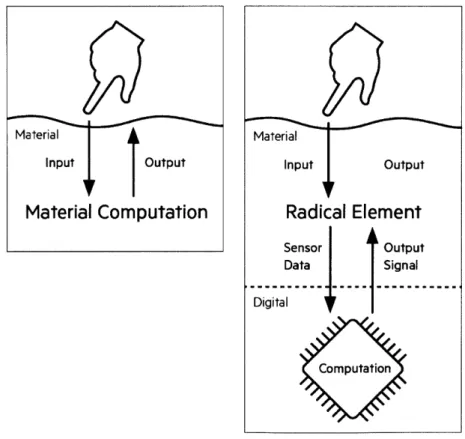
Material Input Output Material Computation Material Input Output Radical Element Sensor Output Data Signal Digital
I
Computationthe microcontroller. From a technical perspective, that entails a translation from electrical energy to physical output as well as a physical input to electrical voltage. This makes not only assemblies with electromechanical effects, but also a range of enabling materials interesting media.
The bidirectionality of radical elements creates an interesting space in which the reaction of materials to a physical input, often called material computation, can be augmented by the underlying computation (Figure 20).
As discussed earlier, inert materials always create haptic feed-back. When one pushes a brick wall, the wall resists the force and creates pressure on the hand pushing it. When trying to warm up a piece of metal with one's hand, the metal will in turn also cool down the hand.
When these materials are equipped with sensors, this direct feedback is complemented with a reaction of the digital system, mediated by pixels and other modalities. This feedback is often colocated and immediate, but very rarely is on the same modal-ity as the input.
Radical elements enable sensing and actuation on the same modality and are able to directly mediate between the user's touch and the computation through the material itself. In the most extreme case of this scenario, the material properties can be completely overwritten by the computational system. The material then purely mediates digital information.
Periodic Table of
Radical Elements
If the task of the display is to serve as a looking glass into the mathe-matical wonderland constructed in computer memory, it should serve as many senses as possible.
Ivan E Sutherland
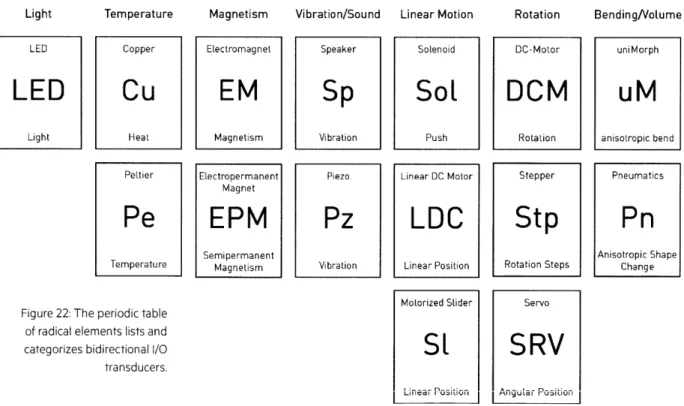
The following section surveys a list of currently available rad-ical elements and orders them in a periodic table. The nature of periodic tables is to incorporate recurring trends, in order to derive relationships between properties of the elements and to predict properties of the new, yet to be discovered or synthe-sized, elements.
The periods (columns) of this table of radical elements describe the modality in which each element can sense and actuate. The rows losely describe the level of artificial complexity that the element requires to attain this functionality. For example, the period 'Rotation' starts with a simple DC-motor as the simplest element to actuate and sense this modality. This is followed by the stepper motor that introduces more complexity in its coil and magnet structure to create more precise, step-based rota-tions. The final element is the servo-motor, that uses an as-sembly of a DC-motor, a potentiometer, mechanical gears, and some electrical control systems to abstract the rotation of the
DC-motor to a controlled angular position. The general order implies that the the further down in its period the element is, the more complex (and sophisticated) is its functionality.
Radical elements are not the only means for designers to create
available that do not have a counterpart to make them bidirec-tional. This is either caused by technical or perceptual limita-tions ( Eg. How does one control a material's stiffness with hu-man input?). This table merely focuses on elements that afford bidirectionality. They are components that physically unify the trigger and feedback of physical microinteractions and enable direct computational feedback on any human input on top of other functionalities.
The purpose of this table is to list and order the devices and technologies at the disposal of interaction designers to create those bidirectional interfaces. Simple interactions can be craft-ed by using just one radical element, while connecting multi-ple elements can create more commulti-plex embodied interfaces and interactions. Magnetism Electromagnet
EM
Magnetism Electropermanent MagnetEPM
Semipermanent Magnetism Vibration/Sound SpeakerSp
Vibration PiezoPz
VibrationFigure 22: The periodic table of radical elements lists and
categorizes bidirectional 1/O
transducers. Linear Motion Solenoid
SoL
Push Linear DC MotorLDC
Linear Position Motorized SliderSt
Linear 'Position Rotation DC-MotorDCM
Rotation StepperStp
Rotation Steps ServoSRV
AnguLr Position Bending/Volume uniMorphuM
anisotropic bend PneumaticsPn
Anisotropic Shape Change Light LEDLED
Light Temperature CopperCu
Heat PeltierPe
TemperatureElectromechanical
Radical Elements
WEIOE
Figure 25: Electromechanical Radical Elements Figure 23: Electromagnet Figure 24: Solenoid"It's electromagnetism (EM) in all its many forms that has been so basic, that haunts us and guides us."
Nick Holonyak Jr
Electromagnetism has been leveraged in a multitude of ac-tuators and can be found in a variety of configurations. Most electromechanical devices work bidirectionally, as sensors and actuators. However, different levels of accuracy often lead to the employment of additional sensors.
The electromagnetic devices presented here exemplify an inter-esting recursiveness, similar to the term 'material' discussed
earlier.
Electromagnets can create magnetic forces when electric
cur-rent is applied. The force and size of the field are dependent on the electric current and the magnetic field disappears when the current is removed. External changes to the magnetic field induce a Lorentz Force into the copper coil and create measur-able voltage changes. Electromagnets are primarily actuators and can be paired with Hall Effect sensors for increased sens-ing accuracy. While electromagnetism can not be perceivable directly, a lot of effects derived from it can be.
Solenoids are built similarly to electromagnets, with the excep-tion of a loose shaft that moves when current is applied to the surrounding electromagnet. Usually the shaft is mechanically restrained to not leave the electromagnets core. The exerting
0
Figure 26: DC-motor
0
Figure 27: Stepper motor
Figure 28: Linear slider
0
o o
0
'0 0
Figure 29: Servo-motor
force of the shaft is dependent on the current applied to the solenoid's coil. Similar to electromagnets, movement of the magnetized core shaft will induce a Lorentz Force that is mea-surable in voltage change.
DC-motors are devices that turn electrical current into rotation
and rotation into electrical current. An ideal DC-motor would do this without energy loss but friction and heat dissipation reduce the energy efficiency of the system.
The speed of a DC-motor is dependent on the electrical current and vice versa. For more precise sensor readings, the DC-motor can be paired with a rotary encoder.
Stepper motors act similar to DC-motors, but are more
com-plex. By using multiple coils and magnets, the way the device rotates is based on steps and not continuous rotation. This requires more complex control structures but also allows for a very precise control of rotation.
Linear actuators use a DC-motor, a potentiometer, and a belt
transmission to move a slider to a defined position. The po-tentiometer and DC-motor create a closed-loop control for the
slider's position. The potentiometer can also sense external interaction with the slider's position.
Servo motors leverage a DC-motor, a potentiometer,
mechani-cal gears, and a control system to abstract the simple rotation of a dc-motor into angular control, usually in a 1800 radius.
Usual-ly the sensor feedback remains internal, however some servos
Molecular
Radical Elements
'I
Figure 31: Molecular Radical Elements
Figure 30: A home-made
"Rochelle Salt" crystal with
piezo-electric transducer qualities.
lo SIX
NOT SK
Figure 32: A peltier junction can
translate electrical into thermal
energy and vice versa.
The concept of radical elements transcends the traditional categories of materials and electromechanical actuators. While electromechanical devices are relatively large scale structures other radical elements are enabled by small molecular struc-tures. These molecular-enabled radical elements exhibit differ-ent electric phenomena that can be leveraged for bidirectional transduction.
One example is a piezoelectric material (Figure 30) that can sense and actuate vibration. Many molecules exhibit piezoelec-tric behavior, including crystals of potassium sodium tartrate and barium titanate ceramic. When two electrodes are connect-ed to the crystals those molecules form, they can be usconnect-ed to sense and actuate sound vibrations.
Another example for a material-based radical element is a Peltier Junction. It is based on two thermoelectric effects
dis-covered in 1821 and 1834. The first is the Seebeck effect, which describes that a temperature difference between two dissimilar (semi-)conductors produces a voltage between the substances.
Figure 33: An LED is known for
emitting light, but can also be
used to sense light.
The second is the Peltier effect, which shows that heat gen-eration (or removal) occurs when a current is made to flow through a junction between two dissimilar conductors. Togeth-er, these two effects result in a Peltier Junction that produces a temperature difference when current is applied and generates
electrical power when exposed to a temperature difference.
A widespread radical element is the LED. Known for its
ca-pability of emitting light in various colors, this component is deployed in almost every electrical device for purposes of indication, illumination and even displays. LEDs are not just actuators, but can also be used to sense light intensity, making them a radical element for light.
Another curious radical element is an electrical conductor, which is usually made of copper. The electrical conductivity of copper decreases with an increase in temperature. Heat can be generated by copper conductors through resistive heating.
Since copper has great thermal conductivity, environmental heat radiation can also increase copper's temperature.
Figure 34: Two radical elements can be connected to create new
behaviors.
Figure 35: Electrical Amplification allows assymetric connections of radical atoms to work.
Radical Element Reactions
The previous sections introduced various radical elements function as unified input and output devices. While they sense and actuate various modalities, they all have voltage as a 'com-mon language'. This allows for interesting connections be-tween them, that translates inputs of one modality to outputs of another. Some of these connections are already being imple-mented in current systems, while others promise interesting new mappings.
The simplest of connection that can be made is between two identical radical elements. Given the element is efficient at translating the input energy into electrical energy and back, this allows for the cloning of inputs. An example for this is connecting two stepper motors directly. When one is rotated manually, the other motor will mirror these same movements. The behavior of this structure is symmetric, as both modules can be used as an input or output of equal power.
When two different radical elements are connected, they create interesting cross modality behaviors. A DC-motor connected to an LED causes the LED to light up when the motor is spun in the right direction. This effect is used to make bike lights that are powered by the rotation of the bike wheel.
This kind of connection is assymetric, as the power that the
LED can create is not enough to drive the DC-motor. In order
to make this connection symmetric, electrical amplification circuits that provide additional energy from power sources such as batteries have to be used.
Figure 36: Assymetric connec-tions allow one element to drive multiple other elements.
Similar to chemical elements, certain combinations of radical elements are 'stable', or in this case symmetric, while others need additional energy to work.
Many types of structures of varying complexities and different quantities of radical elements can be built. For example, one DC-motor can light up multiple LEDs and actuate an additional Peltier Device.
Even more complexity is introduced when the elements are not connected directly but connected through a computational unit. While cause and effect are very simple with direct con-nections, computation introduces algorithmic complexity into the behavior of these elements.
Chapter 5 discusses the new capabilites of radical elements and computation in comparison to inert materials in greater detail.
Figure 37: Computation and external energy sources allow the creation of complex and dynamic rulesets for physical behavior.
Figure 38: Organic User Inter-faces enable new modes of mediation between computation and humans. Here exemplified by stiffness-changing interfaces.
Introduction
This chapter presents uniMorph, a thin-sheet shape-changing composite that enables shape actuation and sensing. The
chap-ter exemplifies how a new radical elements can be fabricated with cheap and available materials.
As discussed earlier, most currently available radical elements are engineered from electromechanical devices. While the argument is made that these devices will be miniaturized and additional new synthetic materials will be engineered to create similar functionality, the list of currently available materials that can change and sense their own shape is still short.
Recently emerged printed electronics are a powerful and enabling technology for HCI products and prototypes that leverage these qualities. Embedding sensors into flat sheets
creates possibilities for thin media as input devices [Lahey, 201], while dynamic sheet materials with active shape-change have been employed as a computational output. In particular user interfaces powered by transitive materials [Girouard, 2011]
are of great interest, as seen in works investigating soft user interfaces [Tarun, 20Ir][Yao, 2013], flexible sensing techniques
[Rekimoto, 2002, Gong, 2014] and dynamic stiffness
explora-tions [Ou, 2014]. Liberated from rigid mechanical structures
and electro-mechanical components [Girouard, 2011] these augmented sheets allow for expressive, precise, and tangible interactions with digital data.
We are used to interacting with passive thin sheet-like paper or other raw materials in our daily lives and have internalized
the affordances that this form factor offers. Recently emerging technologies such as OLEDs [Geller, 2011] or custom thin-film
displays [Olberding, 2014] release GUIs from their confined
rigid form factor and leverage these qualities. The use of this new dimension for input possibilities has been explored in
several papers [Lahey, 20][Rekimoto, 2002][Tarun, 201]
[Wightman, 2ol][Gong, 2014], however there is considerably
less work on active shape output for this medium [Roudaut,
2013][Gornes, 2013][Yao, 2013]. One of the barriers to further
research in this field is the complicated and expensive fabri-cation processes required to create shape-changing material mechanics.
By combining the thermoelectric characteristics of copper with
the high thermal expansion rate of ultra-high molecular weight polyethylene (UHMW PE), one can shape-actuate flexible circuit composites directly. The shape-changing actuation is enabled by a temperature driven mechanism, similar to bi-met-al strips [Howes, 2012] and dramatically reduces the complexity
of fabrication. The copper layer enables capacitive sensing for either bend-angle or touch sensing, making this composite. Furthermore it affords the embedding of sensors, additional actuators, or even micro-controllers, making it a true compu-tational composite [Vallgarda, 2007]. This enables more HCI
researchers to design and fabricate thin-film shape-changing interfaces.
The availability and ease of fabricating this composite democ-ratize the design and fabrication of shape-changing interfaces. For this reason, the steps and materials needed to create this material are documented not just in this thesis, but also in a video online. This way we hope to inspire more HCI research-ers and makresearch-ers to engage in this promising field.
Dynamic Materials
New materials not only improve existing material qualities, but also introduce new qualities, especially in connection with computation. A range of sensing materials and composites are introduced that allow everything from stress monitoring to traffic counting by embedding sensors into the material.
Figure 39: Sensors can be
embedded into materials and composites to monitor material stress computationally. These 'smart' materials can range from
large concrete sandwiches (left) to small optical fibre sensors
embedded in carbon fibre com-posites.
Other materials extend the palette of actuators that was previ-ously dominated by electromechanical devices. A large variety of shape-changing materials and composites have been utilized
by designers to create and assemble new active artifacts. The
following part will present a non-conclusive list of those mate-rials.
One category of dynamic materials is materials that change their shape in response to environmental stimuli without the need for sensing, digital computation, or addtional energy. Those techniques are especially valuable for large-scale archi-tectural applications that would require a lot of energy and wearables that do not require the attachment of rigid batteries.
Figure 40: The bioLogic project
explores humidity responsive
wearables that do not require
additional power or computation.
Figure 41: Doris Kim Sungs work with bimetal structures exempli-fies heat responsive architectural
structures.
Figure 42: Achim Menges' Hygroskin utilizes the natural hu-midity responsiveness of wood.
Figure 43: The Lotus Dome by
Studio Roosegaarde is actuated
by the internal light source.
One example in the space of wearables is the bioLogic project, which utilizes the natural responsiveness of natto Cells to create a shape-changing mechanism. One of the design ap-plications for this technique is a shirt with permeability that responds to the wearers sweat.
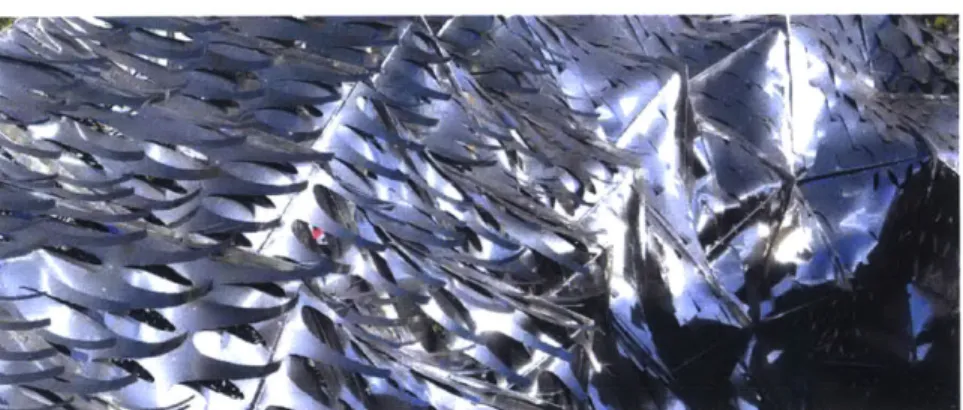
On the architectural level, Doris Kim Sung exploits the
shape-changing dynamic of bimetals that bend when warmed up or cooled down. Her breathing facades open and close solely powered by the sun's rays.
Achim Menges exloits the natural shape-changing qualities of wood to create a pavillon with semi-permeable elements that respond to humidity.
Studio Roosegaarde's 'Lotus Dome' exempifies the artistic expression that responsive materials can have. The Dome's surface consists of a very thin foil material that bends when heated. An internal directional light source follows people in the srace and is revealed by the 'blooming' foil.
Figure 44: Additive Manufactur-ing Techniques make material
transformations more
control-lable.
A
-l
-4
Recent work by Skylar Tibbits shows how the transformation of wood can be controlled by leveraging 3D-printing techniques.
By defining the fiberous structure of the wood during
fabri-cation, the wood's humidity-responsive transformation can be defined. A similar approach works for carbon fibre, which responds to heat that can be generated by means of resistive heating.
Figure 45: Pre-streched Polyeth-ylene sheets allow for one time self-assemblies.
Figure 46: Electro-active poly-mers change their shape when high voltages are applied.
Another group of dynamic materials can be actively controlled
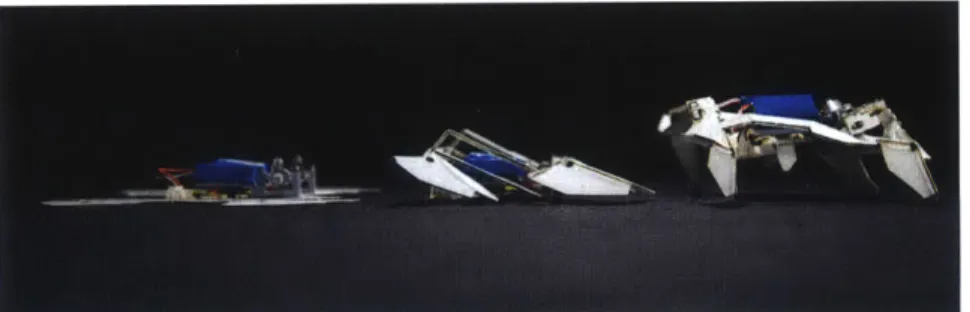
by computation. Pre-stretched polystyrene sheets are used as
one-time actuators to assemble devices from flat sheets. The actuation mechanism is based on the energy stored in the pre-stretched material. When an area of the material is heated up it shrinks and bends. This behavior is very controllable and can be used for complex assemblies like the robot by Felton et al.
seen in Figure 45'.
Electroactive polymers change their size when stimulated by an electric field. They can create large deformation forces and are often referred to as artificial muscles. They often require thousands of volts, but very little electrical current. Due to their high transformation forces, they are often used in experimen-tal architectural contexts.
Materials can also change properties other than shape. Multi-ple approaches have been proven successful to control material
stiffness. Layer jamming uses negative air pressure to increase surface friction of a loose composite to control its stiffness. Another approach is using electroactive polymers that, instead of changing their size, become stiff when voltage is applied.
Figure 48: Controllable stiffness creates new affordances for ad-hoc furnitures.
Another controllable property of a material is its color. Most commonly used is thermochromic material that changes its color based on temperature. Thermochromic material is avail-able as dye powder and can be mixed with and applied to a wide variety of materials. Other lesser known effects are pho-tochromism, electrochromism (e-paper) or materials changing their color based on physical stress.
Figure 47: This artificial material passes through a full rainbow of
colors as it's stretched
Shape-memory alloys are one of the widest known materials used for shape change. It is sometimes referred to as 'smart material' because it is not limited to just changing its shape but also can store a preprogrammed shape and return to it after deformation. Shape memory alloys can be created from a wide variety of metals. However, the most popular materials are nickel and titanium. This material comes in wire or sheet form and is actuated by means of (joule) heating.