Pflugers Arch - Eur J Physiol (2004) 448: 402–410 DOI 10.1007/s00424-004-1253-x
E P I T H E L I A L T R A N S P O RT
C. Madjdpour* . D. Bacic* . B. Kaissling . H. Murer .
J. Biber
Segment-specific expression of sodium-phosphate
cotransporters NaPi-IIa and -IIc and interacting proteins
in mouse renal proximal tubules
Received: 5 January 2004 / Accepted: 10 February 2004 / Published online: 6 March 2004 # Springer-Verlag 2004
Abstract Sodium-dependent phosphate cotransport in
renal proximal tubules (PTs) is heterogeneous with respect
to proximal tubular segmentation (S1 vs. S3) and nephron
generation (superficial vs. juxtamedullary). In the present
study, S1 and S3 segments of superficial and
juxtamedul-lary nephrons were laser-microdissected and mRNA and
protein expression of the Na/Pi-cotransporters NaPi-IIa
and NaPi-IIc and the PDZ proteins NHERF-1 and PDZK1
determined. Expression of NaPi-IIa mRNA decreased
axially in juxtamedullary nephrons. There was no effect of
dietary Pi content on NaPi-lla mRNA expression in any
proximal tubular segment. The abundance of the NaPi-IIa
cotransporter in the brush-border membrane showed
inter-and intranephron heterogeneity inter-and increased in response
to a low-Pi diet (5 days), suggesting that up-regulation of
NaPi-lla occurs via post-transcriptional mechanisms. In
contrast, NaPi-IIc mRNA and protein was up-regulated by
the low-Pi diet in all nephron generations analysed.
NHERF-1 and PDZK1, at both mRNA and protein levels,
were distributed evenly along the PTs and did not change
after a low-Pi diet.
Keywords Proximal tubule . Phosphate reabsorption .
PDZ protein . Laser dissection . Immunostaining
Introduction
In kidneys, filtered inorganic phosphate (Pi) is reabsorbed
mainly along the proximal tubules (PT). This process
involves sodium-dependent phosphate (Na/Pi)
cotranspor-ters that are localized in the brush border membrane
(BBM). The extent of Pi reabsorption in the PT is
determined largely by the abundance of the
Na/Pi-cotransporter NaPi-IIa (SLC34A1) [
23
]. Recently, a
growth-related Na/Pi-cotransporter (NaPi-IIc; SLC34A3),
which may play a role in renal phosphate absorption in
weaning animals, has also been identified [
25
,
29
].
Abundances of both NaPi-IIa and NaPi-IIc within the
BBM are altered, for example, by parathyroid hormone
and dietary intake of Pi [
17
,
18
,
19
,
27
,
33
,
34
].
RT-PCR and in situ hybridization studies have shown
NaPi-IIa mRNA expression only in the PT [
3
,
6
,
27
] and
immunostaining for NaPi-IIa protein is also observed
exclusively in the PT, albeit with an axial decrease of
abundance (intranephron heterogeneity). Furthermore, the
abundance of NaPi-IIa in BBM of PTs in juxtamedullary
PTs is higher than in superficial nephrons (internephron
heterogeneity) [
6
].
Recently, PDZ (postsynaptic protein PSD95,
Drosoph-ila protein dlg (discs large)-A and tight junction protein
ZO-1) proteins that interact with NaPi-IIa have been
identified [
10
]. Two of these, Na
+/H
+-exchanger
regula-tory factor-1 (NHERF-1) and PDZK1, are both localized
in the brush border of the PT. They are assumed to play
roles in the targeting and/or retrieval of NaPi-IIa to or from
the apical membrane [
1
,
24
]. Accordingly, the inter- and
intranephron heterogeneity of NaPi-IIa may be related to
segment- and nephron-specific differences of PT PDZK1
and NHERF-1 expression leading to quantitatively
different trafficking processes and thus apical expression
of NaPi-IIa. To address this question, we analysed the
gene expression of NaPi-IIa and NaPi-IIc and of the PDZ
proteins PDZK1 and NHERF-1 by the use of laser-assisted
microdissection combined with quantitative real-time PCR
and immunofluorescence staining in early (S1) and late
(S3) PT segments of both superficial and juxtamedullary
*C. Madjdpour and D. Bacic contributed equally to this work H. Murer . J. Biber (*)
Institute of Physiology, University of Zürich, Winterthurerstrasse 190,
8057 Zurich, Switzerland
e-mail: [email protected] Tel.: +41-1-6355032
Fax: +41-1-6356814
C. Madjdpour* . D. Bacic* . B. Kaissling Institute of Anatomy, University of Zurich, 8057 Zurich, Switzerland
nephrons. In addition, we examined the effect of different
Pi dietary conditions on gene expression in the various PT
segments.
Materials and methods
Slide preparation and laser-assisted microdissection
Eight-week-old male NMRI mice (Elevage Janvier, Le-Genest-Saint-Isle, France) were placed on a high- (1.2% Pi) or a low- (0.1% Pi) Pi diet for 5 days (three animals/group). The animals were then sacrificed and the kidneys removed immediately and snap frozen in liquid nitrogen. Cryosections (6 µm) were mounted on polyethylene membrane slides (Molecular Machines and Industries, Zürich, Switzerland). Tissue sections were allowed to thaw for 15 s, then immediately fixed for 30 s in 70% ethanol, 2×15 s in 95% ethanol and 2×15 s in 100% ethanol. Subsequently they were placed for 2×1 min in xylenes, mixed (ACS reagent, Sigma), air-dried for 4 min and finally placed on dry ice until microdissection.
Alternatively, for haematoxylin/eosin (HE) staining, sections were fixed in 70% ethanol for 30 s, then placed in Mayer’s Haematoxylin solution (Sigma) for 30 s. After incubation in blueing solution (0.5% lithium carbonate) for 30 s, sections were rinsed in distilled water and placed in 70% ethanol for 30 s, then in alcoholic Eosin Y solution (Sigma) for 5 s. Afterwards sections were placed in 95% ethanol, 100% ethanol and Xylenes, mixed ACS reagent as described for unstained sections.
Laser microdissection was performed with an inverted micro-scope equipped with a motorised scanning stage and a solid-state laser in the UV region (Molecular Machines & Industries; see http:// www.molecular-machines.com). The manufacturer’s control soft-ware (UV CUT) allows the precise measurement of the dissected area in µmetres2. Both S1 and S3 segments of superficial and juxtamedullary nephrons were identified by phase-contrast micros-copy (Fig.1) and a total area corresponding to 100,000±1,000 µm2 (approximately 30 segments each) was microdissected and collected for each sample. For the analysis of the expression of NaPi-IIc, strips of an area of 5,000,000 µm2 of superficial cortex or deep cortex including outer stripe were microdissected.
RNA extraction and cDNA synthesis
RNA was extracted using the Absolutely RNA Nanoprep Kit (Stratagene) following the manufacturer’s instructions. First-strand cDNA was synthesized using random hexamers and TaqMan Reverse Transcription Reagents (Applied Biosystems, Rotkreuz, Switzerland).
Quantitative real-time PCR
Relative quantitation of target gene mRNA was done using the ABI PRISM 7700 Sequence Detection System (Applied Biosystems). As an internal standardβ-actin was chosen. The sequences of TaqMan probes (obtained from Biosearch Technologies, Novato, Calif., USA) and primers (obtained from Microsynth, Balgach, Switzer-land) were as follows: 5′-(6-FAM) CCAGACACAACA-GAGGCTTCCACTTCTATGTC (BHQ-1)-3′ (probe), 5′-AGTCT-CATTCGGATTTGGTGTCA-3′ (forward), 5′-GCCGATGGCCTC-TACCCT-3′ (reverse) for NaPi-IIa, 5′-(6-FAM) CCAGCAAAA-GACCGAACTCTCAGCACAG (BHQ-1)-3′ (probe), 5 ′-TCTGCGGAGTCCGAGCAT-3′ (forward), 5′-TCAGAGTTAGAC-GAAGAGTGCGA-3′ (reverse) for PDZK1, 5′-(6-FAM) AC-CTGGATGGCCCCTTGCCTGA (BHQ-1)-3′ (probe), 5′-AGTG-CAAAGTGATCCCATCCC-3′ (forward), 5′-CCTTCTGTATC TCTCCATTGCTGAA-3′ (reverse) for NHERF-1, 5′-(6-FAM) CCACTTCTTCTTCAACCTGGCTGGCATACT (BHQ-1)-3′
(probe), 5′-TAATCTTCGCAGTTCAGGTTGCT-3′ (forward), 5′-CAGTGGAATTGGCAGTCTCAAG-3′ (reverse) for NaPi-IIc and 5′-(6-FAM) CCATGAAGATCAAGATCATTGCTCCTCCT (BHQ-1)-3′ (probe), 5′-GACAGGATGCAGAAGGAGATTACTG-3′ (for-ward), 5′-CCACCGATCCACACAGAGTACTT-3′ (reverse) for β-actin.
For all genes primer concentrations were 900 nM and the probe concentration was 250 nM. TaqMan probes were located across exon-exon boundaries to exclude any amplification of genomic DNA. PCR reactions were performed using TaqMan Universal PCR Master Mix (Applied Biosystems) in a total reaction volume of Fig. 1A–F Microdissection of proximal tubules. Upon removal, mouse kidneys were frozen immediately in liquid nitrogen. Cryo-sections (6 µm) were fixed in 70% ethanol and microdissected using phase-contrast microscopy to identify proximal tubular segments. A S1 segments were typically identified by their abrupt beginning at the urinary pole (G glomerulus). Asterisks indicate the course of the proximal tubule. B, D The laser left behind a thin black line in the tissue when cutting (white arrowheads in B). C, D Juxtamedullary S3 segments were selected in the outer stripe at the border to the inner stripe where transition to the descending thin limb (DTL) takes place (black arrowheads). The white star indicates a S3 segment that was already microdissected and transferred to the cap of the microdissection tube. E After cutting with the laser, the selected segments (white asterisks) were removed from their place of origin (black asterisks). F After completion of microdissection all the isolated tubules attached to the cap of the microdissection tube could be photographed on an empty area of the microdissection slide as shown by the example of superficial S3 segments. A–E: Bar=50 µm, F 100 µm
25 µl. Reaction conditions were: 2 min at 50 °C (uracil-N-glycosylase incubation), 10 min at 95 °C (activation of AmpliTaq Gold DNA polymerase) followed by 45 cycles of amplification (95 °C for 15 s and 60 °C for 1 min).
Relative expression was calculated according to user bulletin #2 of the ABI PRISM 7700 Sequence Detection System available at http://home.appliedbiosystems.com. Standard curves for target genes andβ-actin were generated using total kidney mouse RNA.
Statistical methods
For PDZK1, NHERF-1 and NaPi-llc, mean expression values of the three animals per sample group were averaged and one-way ANOVA with Student-Newman-Keuls multiple comparisons test used for analysis. P<0.05 was taken as significant. Data are expressed as normalized expression means of three animals per group±SD.
Considerable variability of the expression of NaPi-lla mRNA between the different animals of the same group was observed. Therefore, data are presented for each animal separately as the mean of three determinations.
Immunofluorescence studies
Kidneys of mice that were treated identically as above were fixed and frozen as previously reported [8]. Cryosections (4 µm) were mounted on chrom alum/gelatine-coated glass slides and further processed for immunofluorescence.
For NaPi-IIa and NaPi-IIc immunofluorescence stainings, sec-tions were pretreated for 10 min with 3% defatted milk powder and 0.02% Triton X-100 in PBS (blocking solution). After rinsing with PBS, sections were incubated with rabbit anti-rat polyclonal antiserum against the NaPi-IIa protein [6] or with an affinity purified anti-NaPi-llc antibody (kindly provided by Dr. K. Miyamoto; Japan). For immunofluorescence detection of PDZK1, sections were microwaved in buffer containing 0.01 M citrate in distilled water at 30% power for 10 min. After rinsing with PBS and covering for 10 min with blocking solution, sections were incubated with anti-PDZK1 antibody [10]. For NHERF-1 immunofluores-cence staining, sections were pretreated with 1% SDS in PBS for 7 min. After repeated rinsing with PBS, they were covered for 10 min with blocking solution. Sections were then incubated with affinity-purified anti-NHERF-1 antibody (kindly provided by Dr. E. Weinman).
All primary antibodies were diluted in blocking solution and incubated overnight at 4 °C. Sections where then rinsed 3 times with PBS and incubated for 45 min at room temperature in the dark with the secondary antibody coupled to FITC or CY3. After rinsing with PBS, the sections were finally mounted using DAKO-Glycergel (Dakopatts, Glostrup, Denmark) containing 2.5% 1,4-diazabicyclo [2.2.2.]octane (DABCO; Sigma,) as a fading retardant, and studied on an epifluorescence microscope (Polyvar, Reichert-Jung, Austria).
Western blot analysis
PT brush borders of whole mouse cortex were isolated as described in [6] and the proteins (25 µg) were separated by SDS gel electrophoresis after denaturation by heating under reducing conditions (100 mM DTT, 2 min at 95 °C). After transfer onto nitrocellulose membranes, immunoblots were made [6] using the antibodies mentioned above. Immunoreactions were detected by enhanced chemiluminescence (ECL, SuperSignal, Pierce, Rockford, Ill., USA) and digital imaging (Diana lll, Raytest Straubenhardt, Germany). To ensure equal loading, transferred proteins were stained with Ponceau Rouge.
Results
Establishment of the method
HE staining has already been used in conjunction with
laser-assisted microdissection of the kidney, however, this
staining procedure may interfere with real-time PCR [
2
,
16
,
22
,
30
]. We therefore first examined the effect of HE
staining on the efficiency of real-time RT-PCR of all the
target genes used in this study. To this end, 30 S1
segments of superficial nephrons corresponding to a total
area of 100,000 µm
2were microdissected and either
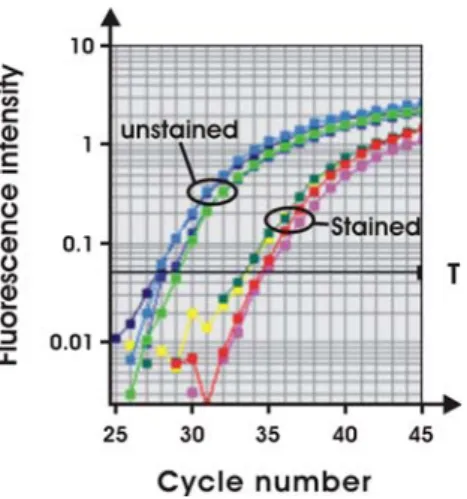
stained or not. As illustrated in Fig.
2
, amplification curves
for NaPi-IIa of stained samples crossed the threshold 6
–7
cycles later than the unstained samples; similar data were
obtained for the amplification of NHERF-1 and PDZK1
(not shown). This suggested that prior staining impairs the
efficiency of real-time RT-PCR, most likely due to lower
recovery of total RNA. We therefore decided to
micro-dissect unstained sections using phase-contrast
microsco-py as illustrated in Fig.
1
.
NaPi-IIa expression
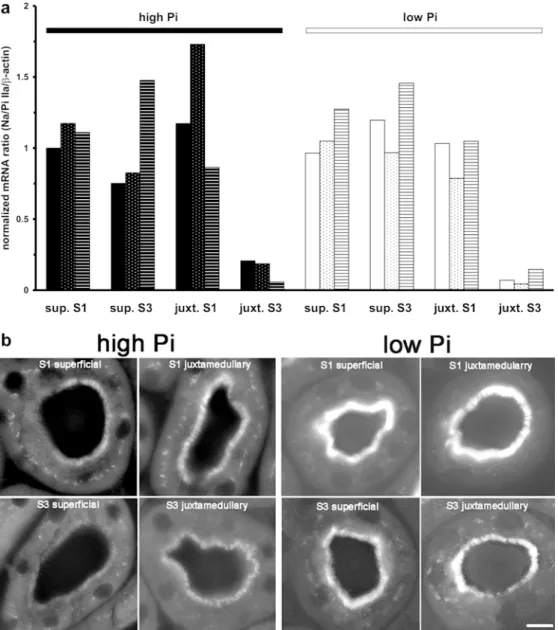
As illustrated in Fig.
3
a, no axial heterogeneity of NaPi-lla
mRNA expression was observed in superficial nephrons,
whereas in juxtamedullary nephrons about 4
–5 times less
NaPi-IIa mRNA was present in S3 segments than in S1
segments. This expression profile was independent of the
phosphate diet (1.2% or 0.1% Pi) given for 5 days,
suggesting that altering the dietary Pi content does not
influence transcription of NaPi-IIa mRNA. All expressions
of NaPi-IIa mRNA are displayed relative to the content of
β-actin mRNA, which was not significantly different
between the different microdissected segments.
Fig. 2 Effect of haematoxylin/eosin (HE) staining on real-time RT-PCR efficiency. Thirty superficial S1 segments from either HE-stained or unHE-stained kidney sections were microdissected, RNA isolated and real-time RT-PCR for NaPi-IIa performed. The amplification plot shown contains amplification curves in duplicates for two independent samples per group (stained amplification curves of samples from HE-stained tissue, unstained amplification curves of samples from unstained tissue, T threshold)
In contrast to the NaPi-IIa mRNA profiles,
immunoflu-orescence staining for NaPi-IIa showed a clear decrease in
intensity between the S1 and S3 segments of both nephron
generations of high-Pi animals (Fig.
3
b). Notably, NaPi-IIa
was more abundant in the S3 segments of deep nephrons
than in S3 segments of superficial nephrons, although the
opposite was the case for the corresponding mRNA
content. In addition, the low-Pi diet increased the
abundance of NaPi-IIa in all segments. Consequently,
inter- and intranephron heterogeneity of NaPi-IIa
abun-dance was not as clear as in the high-Pi diet group.
Expression of NHERF-1 and PDZK1
Analysis of the expression of NHERF-1 and PDZK1
mRNA showed no significant differences between the
different proximal tubular segments (Figs.
4
a and
5
a); nor
were there any changes in the expressions of NHERF-1 or
PDZK1 mRNA between the different Pi diets.
Immuno-fluorescence
staining
showed
equal
intensities
for
NHERF-1 and PDZK1 in the brush borders of all
examined segments of high- and low-Pi diet animals
(Figs.
4
b and
5
b).
Expression of NaPi-IIc
We were not able to detect NaPi-IIc mRNA reliably in
samples containing single microdissected tubules. To
increase the amount of microdissected tissue, whole strips
of tissue containing either superficial cortex or deep cortex
together with outer stripe of the medulla were
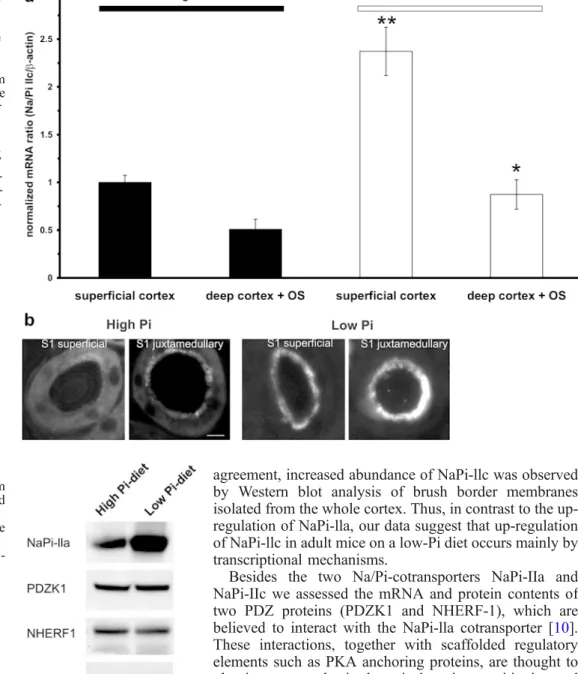
micro-dissected and analysed. In both Pi diet groups,
signifi-cantly lower expression of NaPi-IIc mRNA
(approxi-mately 2-fold lower) was observed in strips containing
juxtamedullary PTs than in strips containing superficial
PTs (Fig.
6
). The low-Pi diet caused a 137% increase
(P<0.001) of NaPi-IIc mRNA in superficial cortical strips
and a 72% increase in deep cortical strips (P<0.05).
Fig. 3 Determination of seg-mental Na/P cotransporter-IIa (NaPi-IIa) mRNA (a) and pro-tein (b) abundance. a NaPi-IIa mRNA from laser-microdis-sected S1 and S3 segments of superficial and juxtamedullary nephrons from mice fed a low-or high-Pi diet (n=3 mice/group) was isolated and quantified by real-time RT-PCR and expressed as the means of three determi-nations relative toβ-actin for each animal. Bars representing values from the same animal are marked by identical patterns. (juxt juxtamedullary, sup super-ficial). b Kidneys of mice trea-ted identically were perfusion-fixed and 4-µm cryosections immunostained for NaPi-IIa in S1 and S3 segments of both nephron generations. Bar ~10 µm
In high-Pi animals, immunofluorescence staining for
NaPi-llc was detected in the juxtamedullary PTs only; no
staining was observed in the superficial PTs (data not
shown and [
25
]). As illustrated in Fig.
6
b, in both
superficial and juxtamedullary S1 segments, the low-Pi
diet increased the expression of NaPi-llc, consistent with
the results obtained by RT-PCR.
Western blots
To confirm the findings obtained by RT-PCR and
immu-nofluorescence, BBMs were isolated from whole kidney
cortex from animals fed a high- or low-Pi-diet and
analysed by immunoblot (Fig.
7
). In agreement with data
shown above, the low-Pi diet increased the expression of
NaPi-lla and NaPi-llc (approximately 2.5-fold and 5-fold
respectively) but not that of NHERF 1 or PDZK1.
Discussion
Dependent on the relative abundance of a cell type of
interest, analysis of gene expression in homogenates of
heterogeneous tissues may result in an
“averaging out” of
expression. Recently, laser-capture microscopy has been
introduced [
9
] and allows the recovery of single cells or
cell populations for quantitative measurements of gene
expression. Since then, a number of other laser-coupled
microdissection devices have been developed and have
proven to be of high precision and efficiency [
4
,
5
,
35
].
Reabsorption of phosphate exhibits considerable
het-erogeneity along different PTs and PT segments: Pi
reabsorption in juxtamedullary nephrons is higher than
in superficial nephrons [
11
,
12
]. In agreement with its role
in proximal tubular reabsorption of Pi [
23
], the abundance
of the Na/Pi-cotransporter NaPi-IIa is highest in S1
segments of juxtamedullary nephrons and decreases
axially along the PT [
6
]. In the present study, in animals
Fig. 4 Na+/H+-exchanger reg-ulatory factor-1 (NHERF-1) mRNA (a) and protein (b) ex-pression and localization in the proximal tubule. a Kidneys of mice fed a high- or low-Pi diet were microdissected and S1 and S3 segments of superficial and juxtamedullary nephrons were isolated. RNA was extracted and quantified by real-time RT-PCR. Bars represent normalized ex-pression; means±SD (n=3 mice). b Immunofluorescence studies for NHERF-1 protein in S1 and S3 segments of superfi-cial and juxtamedullary ne-phrons. Bar ~10 µm
fed a high-Pi diet, the same pattern of heterogeneity of the
abundance of the NaPi-IIa protein was observed. In
contrast, NaPi-IIa mRNA was equally abundant in the S1
segments of superficial and juxtamedullary nephrons.
Furthermore, an axial gradient of NaPi-IIa mRNA
abundance from S1 to S3 segments was found only in
juxtamedullary nephrons; in superficial PTs equal amounts
of NaPi-IIa mRNA were detected in S1 and S3 segments.
Thus, our studies clearly demonstrate that the abundances
of NaPi-IIa protein and mRNA in mouse proximal tubules
diverge.
Mechanisms involved in the regulation of
NaPi-IIa-mediated renal reabsorption of Pi have been studied
extensively. Most is known about the effects of dietary Pi
content and the action of the parathyroid hormone (PTH)
on the expression of NaPi-IIa [
11
,
17
,
23
]. In the present
study we focussed on the chronic effect (5 days) of a
low-compared with a high-Pi diet.
In agreement with earlier studies [
17
,
27
], the content of
NaPi-IIa protein increased in all PT segments of all
nephron generations. This was, however, not the case for
the expression of NaPi-IIa mRNA. Although the
abun-dance of NaPi-lla mRNA in single nephrons varied
considerably between different animals, the data shown
in Fig.
3
a demonstrate that the low-Pi diet did not alter
NaPi-lla mRNA expression, suggesting that in S1 and S3
PT segments of mice the apical abundance of NaPi-IIa is
controlled post-transcriptionally rather than via an effect
on transcription. The literature concerning the effect of a
chronic changes in dietary Pi content on the expression of
NaPi-IIa mRNA is not consistent. In rats, chronic
deprivation of dietary Pi reportedly up-regulates NaPi-IIa
mRNA [
17
,
27
]. In contrast, studies in opossum kidney
(OK) cells have shown that increased NaPi-IIa protein
expression after alteration of the extracellular [Pi] can
occur without the need for increased abundance of the
mRNA [
13
,
26
]. Moreover, in mice chronically fed a
low-Pi diet, renal Nalow-Pi-IIa mRNA does not change [
28
,
32
]. In
contrast, other studies on mouse kidney tissue have shown
Fig. 5a, b Expression and localization of PDZK1. a Quantification of PDZK1 mRNA in S1 and S3 segments of superficial and juxtamedul-lary nephrons. Bars represent normalized expression; means ±SD (n=3 animals). b Immuno-fluorescence staining for PDZK1 protein. Bar ~10 µm
a low-Pi diet to increase NaPi-IIa mRNA to varying
extents [
14
,
15
,
19
,
20
,
21
,
31
].
Recently, a growth-related type II Na/Pi cotransporter
(NaPi-IIc) has been identified in rat and mouse kidney. In
weaning animals, NaPi-IIc immunostaining is present in
PTs of superficial and juxtamedullary nephrons while in
adult rat and mouse kidneys NaPi-IIc is found
predomi-nantly in the brush borders of juxtamedullary PTs [
25
,
29
].
Our present study on the adult mouse kidney demonstrated
that the mRNA of the Na/Pi-cotransporter NaPi-llc is
present in both superficial and juxtamedullary nephrons
and that NaPi-llc mRNA is increased by a low-Pi diet in
both nephron generations (137% and 72% respectively). In
agreement, increased abundance of NaPi-llc was observed
by Western blot analysis of brush border membranes
isolated from the whole cortex. Thus, in contrast to the
up-regulation of NaPi-lla, our data suggest that up-up-regulation
of NaPi-llc in adult mice on a low-Pi diet occurs mainly by
transcriptional mechanisms.
Besides the two Na/Pi-cotransporters NaPi-IIa and
NaPi-IIc we assessed the mRNA and protein contents of
two PDZ proteins (PDZK1 and NHERF-1), which are
believed to interact with the NaPi-lla cotransporter [
10
].
These interactions, together with scaffolded regulatory
elements such as PKA anchoring proteins, are thought to
play important roles in the apical sorting, positioning and
the regulation of NaPi-IIa [
1
]. On the basis of RT-PCR and
immunohistochemistry, our results show that NHERF-1
and PDZK1 are expressed uniformly along the PTs of
superficial and juxtamedullary nephrons. In addition,
neither the mRNA nor the abundance (immunostaining
intensity and Western blots) of these PDZ proteins were
altered by a low-Pi diet. These data thus provide evidence
that the expression of NHERF1 and PDZK1 is not
regulated in parallel to that of NaPi-IIa. With respect to
PDZK1 our findings contrast with two other reports. A
recent study employing Western blot analysis has shown
that the abundance of PDZK1 is up-regulated by a low-Pi
diet [
36
]. At present we have no explanation for this
discrepancy, although, different genetic backgrounds of
the mice can be excluded since PDZK1 in C57Bl/6 mice
also failed to respond a low-Pi diet (data not shown). In
another study, diphor-1 (PDZK1, lacking one PDZ
domain) was identified by a differential display of renal
Fig. 6a, b Expression of NaPi-IIc in mouse kidney. a Quanti-fication of NaPi-llc mRNA. Whole-kidney strips from mice fed either a high- or a low-Pi diet were microdissected and tissue strips obtained either from the superficial cortex or from the deep cortex including the outer stripe. Bars represent normal-ized expression; means±SD (n=3). *P<0.05, **P<0.001 vs. corresponding high-Pi diet (OS outer stripe). b Immunofluores-cence staining for NaPi-llc pro-tein in superficial and juxtame-dullary mouse kidney cortex. Bar ~10 µm
Fig. 7 Immunoblots of brush border membranes isolated from whole kidney cortex of mice fed a high- or a low-Pi diet. Blots were analysed for the abundance of the indicated proteins (PR Ponceau rouge staining of the β-actin band)
cDNAs obtained from rats fed a high- or a low-Pi diet,
indicating changes of diphor-1 mRNA [
7
]. It remains to be
shown whether this apparent discrepancy between the
present findings and the ones reported [
7
] is due to the
different species used (mice or rats).
In summary, we have demonstrated the suitability of
laser-assisted microdissection together with
immunofluo-rescence microscopy for segment-specific analysis of gene
expression in the PT. Gene expression profiles of NaPi-IIa,
its interaction partners NHERF-1 and PDZK1 and of
NaPi-IIc were generated with respect to their localization
in renal PT and their possible regulation by a low-Pi diet.
The data document a discrepancy between
Na/Pi-cotran-sporter mRNA and protein contents, suggesting that
post-transcriptional control mechanisms are of major
impor-tance in the adaptation to a low-Pi diet. In contrast, as
NaPi-llc mRNA was up-regulated by low Pi-diet,
regula-tion of NaPi-IIc may occur both transcripregula-tionally and
post-transcriptionally.
Acknowledgements Affinity purified anti-NaPi-IIc antibody was kindly provided by Dr. K. Miyamoto and anti-NHERF-1 antibodies were obtained from Dr. E. Weinmann. This work was supported by the Postgraduate Course in Experimental Medicine and Biology of the Medical Faculty of the University of Zürich, Switzerland, by the Swiss National Foundations (Grant 31-65397.01 to H.M.) and the Stiftung für wissenschaftliche Forschung der Universität Zürich.
References
1. Biber J (2001) Emerging roles of transporter-PDZ complexes in renal proximal tubular reabsorption. Pflugers Arch 443:3–5 2. Burton MP, Schneider BG, Brown R, Escamilla-Ponce N,
Gulley ML (1998) Comparison of histologic stains for use in PCR analysis of microdissected, paraffin-embedded tissues. Biotechniques 24:86–92
3. Collins JF, Gishan FK (1994) Molecular cloning, functional expression, tissue distribution and in situ hybridization of the renal sodium phosphate (Na/Pi) transporter in the control and hypophosphatemic mouse. FASEB J 8:862–868
4. Cornea A, Mungenast A (2002) Comparison of current equipment. Methods Enzymol 356:3–12
5. Curran SJ, McKay A, McLeod HL, Murray GI (2000) Laser capture microscopy. J Clin Pathol Mol Pathol 53:64–68 6. Custer M, Lötscher M, Biber J, Murer H, Kaissling B (1994)
Expression of Na/Picotransport in rat kidney: localization by RT-PCR and immunhistochemistry. Am J Physiol 266:F767– F774
7. Custer M, Spindler B, Verrey F, Murer H, Biber J (1997) Identification of a new gene product (Diphor-1) regulated by dietary phosphate. Am J Physiol 273:F801–F806
8. Dawson TP, Gandhi R, Le Hir M, Kaissling B (1989) Ecto-5 ′-nucleotidase: localization in rat kidney by light microscopic histochemical and immunohistochemical methods. J Histochem Cytochem 37:39–47
9. Emmert-Buck MR, Bonner RF, Smith PD, Chuaqui RF, Zhuang Z, Goldstein SR, Weiss RA, Liotta LA (1996) Laser capture microdissection. Science 274:998–1001
10. Gisler SM, Stagljar I, Traebert M, Bacic D, Biber J, Murer H (2001) Interaction of the type II Na/Picotransporter with PDZ proteins. J Biol Chem 276:9206–9213
11. Haas JA, Berndt T, Knox FG (1978) Nephron heterogeneity of phosphate reabsorption. Am J Physiol 234:F287–F290 12. Haramati A (1985) Tubular capacity for phosphate reabsorption
in superficial and deep nephrons. Am J Physiol 248:F729–F733
13. Hilfiker H, Hartmann CM, Stange G, Murer H (1998) Characterization of the 5′-flanking region of OK cell type II Na-Picotransporter gene. Am J Physiol 274:F197–F204 14. Hoag MH, Martel J, Gauthier C, Tenenhouse HS (1999) Effects
of Npt2 gene ablation and low-phosphate diet on renal Na+/ phosphate cotransport and cotransporter gene expression. J Clin Invest 104:679–686
15. Kido S, Miyamoto K, Mizobuchi H, Taketani Y, Ohkido I, Ogawa N, Kaneko Y, Harashima S, Takeda E (1999). Identification of regulatory sequences and binding proteins in the type II sodium/phosphate cotransporter NPT2 gene responsive to dietary phosphate. J Biol Chem 274:28256– 28263
16. Kohda Y, Murakami H, Moe OW, Star RA (2000) Analysis of segmental renal gene expression by laser capture microdissec-tion. Kidney Int 57:321–331
17. Levi M, Lötscher M, Sorribas V, Custer M, Arar M, Kaissling B, Murer, Biber J (1994) Cellular mechanisms of acute and chronic adaptation of rat renal Pi transporter to alterations in dietary Pi. Am J Physiol 267:F900–F908
18. Lötscher M, Kaissling B, Biber J, Murer H, Levi M (1997) Role of microtubules in the rapid regulation of renal phosphate transport in response to acute alterations in dietary phosphate content. J Clin Invest 99:1302–1312
19. Lötscher M, Scarpetta Y, Levi M, Halaihel N, Wang H, Zajicek HK, Biber J, Murer H, Kaissling B (1999) Rapid down-regulation of rat renal Na/Pi cotransporter in response to parathyroid hormone involves microtubule rearrangement. J Clin Invest 104:483–494
20. Miyamoto K, Itho M (2001) Transcriptional regulation of the NPT2 gene by dietary phosphate. Kidney Int 60:412–415 21. Morita K, Fujioka A, Haga H, Nii T, Segawa H, Kouda T,
Taketani Y, Hisano S, Fukui Y, Miyamoto K, Takeda E (1998) Dietary regulation of renal phosphate transporters in hypo-phosphatemic mice. J Bone Miner Metab 16:234–240 22. Murase T, Inagaki H, Eimoto T (2000) Influence of
histo-chemical and immunohistohisto-chemical stains on polymerase chain reaction. Mol Pathol 13:147–151
23. Murer H, Hernando N, Forster I, Biber J (2000) Proximal tubular phosphate reabsorption: molecular mechanisms. Physiol Rev 80:1373–1409
24. Murer H, Hernando N, Forster I, Biber J (2003) Regulation of Na/Pi transporter in the proximal tubule. Annu Rev Physiol 65:531–542
25. Ohkido I, Segawa H, Yanagida R, Nakamura M, Miyamoto K (2003) Cloning, gene structure and dietary regulation of the type-llc Na/Pi cotransporter in the mouse kidney. Pflugers Arch 446:186–115
26. Pfister MF, Hilfiker H, Forgo J, Lederer E, Biber J, Murer H (1998) Cellular mechanisms involved in the acute adaptation of OK cell Na/Pi-cotransport to high- or low-Pimedium. Pflugers Arch 435:713–719
27. Ritthaler T, Traebert M, Lötscher M, Biber J, Murer H, Kaissling B (1999) Effects of phosphate intake on distribution of type II Na/Picotransporter mRNA in rat kidney. Kidney Int 55:976–983
28. Roy S, Martel J, Tenenhouse HS (1997) Growth hormone normalizes renal 1,25-dihydroxyvitamin D3-24-hydroxylase gene expression but not Na+-phosphate cotransporter (Np2) mRNA in phosphate-deprived Hyp mice. J Bone Miner Res 12:1672–1680
29. Segawa H, Kaneko I, Takahashi A, Kuwahata M, Ito M, Ohkido I, Tatsumi S, Miyamoto K (2002) Growth-related renal type II Na-Picotransporter. J Biol Chem 277:19665–19672 30. Serth J, Kuczyk MA, Paeslack U, Lichtinghagen R, Jonas U
(2000) Quantification of DNA extracted after micropreparation of cells from frozen and formalin-fixed tissue sections. Am J Pathol 156:1189–1196
31. Tenenhouse HS, Martel J, Biber J, Murer H (1995) Effect of Pi restriction on renal Na+-Picotransporter mRNA and immuno-reactive protein in X-linked Hyp mice. Am J Physiol 268: F1062–F1069
32. Tenenhouse HS, Roy S, Martel J, Gauthier C (1998) Differ-ential expression, abundance, and regulation of Na+-phosphate cotransporter genes in murine kidney. Am J Physiol 275:F527– F534
33. Traebert M, Völkl H, Biber J, Murer H, Kaissling B (2000) Luminal and contraluminal action of 1–34 and 3–34 PTH peptides on renal type II Na-Picotransporter. Am J Physiol 278: F792–F798
34. Traebert M, Roth J, Biber J, Murer H, Kaissling B (2000) Internalization of proximal tubular type II Na-Picotransporter by PTH: immunogold electron microscopy. Am J Physiol 278: F148–F154
35. Walch A, Specht K, Smida J, Aubele M, Zitzelsberger H, Höfler H, Werner M (2001) Tissue microdissection techniques in quantitative genome and gene expression analyses. Histo-chem Cell Biol 115:269–276
36. Weinman EJ, Boddeti A, Cunningham R, Akom M, Wang F, Wang Y, Liu J, Steplock D, Shenolikar S, Wade JB (2003) NHERF-1 is required for renal adaptation to a low-phosphate diet. Am J Physiol 285:F1225–F1232