Type II fatty acid biosynthesis, a new approach in antimalarial natural
product discovery*
Deniz Tasdemir
Institute of Organic Chemistry, University of Zurich, Winterthurerstrasse 190, CH-8057, Zu¨rich, Switzerland; Current address: School of Pharmacy, Department of Pharmaceutical and Biological Chemistry Centre for Pharmacy and Phytotherapy, University of London, 29–39, Brunswick Square, London WC1N 1AX, United Kingdom; (Phone: +44-20-7753 5845; Fax: +44-20-7753 5909; E-mail: [email protected])
Key words: apicoplast, enoyl-ACP reductase, FabI, fatty acid synthase, Plasmodium
Abstract
Malaria, one of the most problematic infectious diseases worldwide, is on the rise. The absence of an effective vaccine and the spread of drug-resistant strains of Plasmodium clearly indicate the necessity for the development of new chemotherapeutic agents and the identification of novel targets. The recent discovery of a relict, non-photosynthetic plastid-like organelle, the so-called apicoplast, in Plasmodium has opened up new avenues in malaria research. It also initiated the Plasmodium falciparum genome sequencing project, which revealed a number of biochemical pathways previously unknown to Plasmodium, i.e. cytosolic shikimate pathway, apicoplastic type II fatty acid, non-mevalonate isoprene and haem biosyntheses. Since these vital biosynthetic processes are absent in humans or fundamentally different from those found in humans, they represent excellent targets for pharmaceutical interventions. We are interested in the type II fatty acid synthase (FAS II) system of malaria parasite and focus on the FabI enzyme, the only known enoyl-ACP reductase in Plasmodium involved in the final reduction step of the fatty acid chain elongation cycle. Here we describe the general aspects of fatty acid biosynthesis, its essentiality to the malaria parasite and our continuing efforts to discover in Turkish medicinal plants natural antimalarial agents, which specifically target the plasmodial FabI enzyme.
Introduction
Malaria is a mosquito-borne disease transmitted by inoculation of the host with the Plasmodium parasite. Plasmodium is a single-celled protozoan belonging to the phylum Apicomplexa, which is known for possessing an apical complex facilitat-ing the invasion of host cells. Although there are over 100 identified Plasmodium species, only four of these parasites (P. falciparum, P. vivax, P. ovale and P. malariae) cause human malaria, with P. falciparumbeing the most lethal. Malaria is an
ancient disease and despite all efforts, has remained one of the major threats to public health and economic development worldwide. Approxi-mately 40% of world population lives in areas where malaria is transmitted, which means 2.5 billion people in 90 countries. Malaria ranks with other infectious diseases, such as tuberculosis and AIDS, and infects 300–500 million people annually, of which over 1 million people, espe-cially children under 5 years of age, die (WHO, 2000). For decades, malaria chemotherapy has relied on a limited number of drugs with severe side effects. The spread of resistance to these drugs caused a recent malaria burden underlining the urgent need for new antimalarial drugs and novel
* Phytochemical Society of Europe (PSE)-Pierre Fabre Prize 2004 Lecture
biological targets. Among the many exciting new targets revealed by the P. falciparum genome sequencing project are the enzymes of the api-coplast.
Discovery of apicoplast
Although microscopists had observed an unknown organelle in Plasmodium in the 1970s (Kilejian, 1975), the discovery of apicoplast occurred only in the mid-1990s (McFadden et al., 1996). This un-ique, apically positioned organelle owes its dis-covery to its 35-kb genome, which was investigated by immunogold labelling and in situ hybridization experiments (Waller et al., 1998; Surolia et al., 2004). By using bioinformatics and the metabolic pathways of plant chloroplasts and bacteria as models, an extensive network for apicoplast functions has recently been reconstructed (Ralph et al., 2004). There have been long debates over the origin of apicoplast, but recent evidence sug-gests that apicoplast, as all other plastids, arose from cyanobacterium (McFadden and Roos, 1999; Williams and Keeling, 2003). The origin of api-coplast from cyanobacterium through a secondary endosymbiosis process is illustrated in Figure 1. The photosynthetic cyanobacterium (prokaryote)
is engulfed by a primary eukaryote (red or green alga), a process referred to as primary endosym-biosis. This cyanobacterium is the ancestor of all plastids, the so-called primary plastids, found in red–green algae and land plants (McFadden, 2001). In secondary endosymbiosis, this primary plastid-containing alga is engulfed and retained by a second heterotrophic eukaryote, i.e. Plasmodium. Due to the two subsequent endosymbiotic events, the apicoplast is surrounded by four membranes, instead of the two found in primary plastids. During both primary and secondary endosymbi-osis processes, which are over millions of years of evolutionary or adaptation processes, the endo-symbiont and host were integrated in a process involving many gene losses and gene transfers. As a result of the former, the secondary plastid (api-coplast) became non-photosynthetic, and this was probably no longer required in the new environ-ment. Besides gene losses, there have been also significant gene transfers from the endosymbiont to the new host nucleus, reducing the apicoplast genome to a bare minimum (McFadden, 2001). Although the apicoplast genome expresses a small number of genes and has some housekeeping processes (e.g. replication, transcription, transla-tion), the majority of apicoplast proteins are encoded by genes in the nuclear genome of the
Figure 1. The origin of apicoplast. The photosynthetic cyanobacterium (the small organism) is engulfed (A) by a heterotrophic eukaryote (red or green alga), and retained (B). During this process, referred to as primary endosymbiosis, some of the genes from the primary endosymbiont are transferred to the host (alga) nucleus. Subsequently, this alga containing the endosymbiont (= pri-mary plastid) is engulfed (C) and retained (D) by a second heterotrophic eukaryote, Plasmodium. This process (secondary endosym-biosis) involved the loss of many genes, by which the plastid became non-photosynthetic, and significant gene transfers to the new host nucleus, which reduced the apicoplast genome enormously (E). The 35-kb circular genome of apicoplast expresses a small num-ber of genes, but relies on nuclear genes to provide the necessary enzymes that operate in several vital anabolic processes, i.e. fatty acid biosynthesis. A specialized transport system delivers these proteins (enzymes) to the organelle across four membranes.
host. The products of these genes (proteins) are post-translationally targeted to the apicoplast organelle via the secretory pathway, courtesy of a bipartite N-terminal leader sequence (Waller et al., 1998; McFadden and Roos, 1999). It is estimated that 500 proteins are exported to the apicoplast (Coppel et al., 2004; Ralph et al., 2004), making up approximately 15% of the whole P. falciparum genome (Chaudhary and Roos, 2005). If the obli-gate intracellular Apicomplexan parasites as well as the apicoplast are obviously non-photosyn-thetic, why have they kept this organelle for mil-lions of years? The answer to this puzzle could be given soon: Apicoplast is not only interesting from an evolutionary perspective, but is indispensable for the malaria parasite as it is the site of several vital anabolic processes. The first-identified and probably best understood function of the apicop-last is the type II fatty acid biosynthesis (Waller et al., 1998), followed by the non-mevalonate isoprene (DOXP/MEP) pathway (Jomaa et al., 1999) and partly haem biosynthesis (Sato et al., 2000). A comprehensive anabolic map of the api-coplast functions has been reported recently by Ralph et al. (2004). The Plasmodium genome sequencing project has uncovered another critical biochemical process, the shikimate pathway, in Plasmodium (Roberts et al., 1998). Although this pathway was originally thought to take place in the apicoplast, recent studies localized it to the
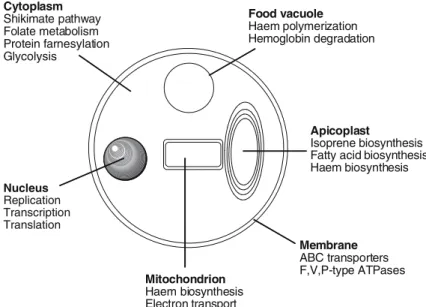
cytosol of Plasmodium (Fitzpatrick et al., 2001). Fortunately, all these core anabolic pathways are prokaryotic in nature and are either absent in humans or are fundamentally different from those found in humans. These prokaryotic anabolic pathways, together with prokaryotic type house-keeping functions on which the malaria parasite depends, are excellent targets for pharmaceutical interventions (Figure 2). Indeed, apicoplast DNA replication, transcription, translation, fatty acid and isoprenoid biosynthesis have been all vali-dated as drug targets (for excellent reviews, see Ralph et al., 2001, 2004; Wiesner and Seeber, 2005). This review, however, will only cover the plasmodial type II fatty acid biosynthesis (FAS) as a biological target for antimalarial drug discovery.
Organization and the importance of the type II FAS to Plasmodium
The fundamental process of fatty acid biosyn-thesis is highly conserved, and involves four basic reactions; a condensation, a reduction, a dehy-dration, and another reduction (Figure 3). The fatty acid synthase (FAS) is the principal enzy-matic unit of this process. Although the basic process is conserved, there are still major differ-ences in the organization of fat biosynthesis among different organisms and based on the
Food vacuole
Haem polymerization Hemoglobin degradation
Apicoplast
Isoprene biosynthesis Fatty acid biosynthesis Haem biosynthesis Mitochondrion Haem biosynthesis Electron transport Cytoplasm Shikimate pathway Folate metabolism Protein farnesylation Glycolysis Nucleus Replication Transcription Translation Membrane ABC transporters F,V,P-type ATPases
enzymes involves, two distinc biosynthetic path-ways can be recognized: Higher eukaryotes (including human), fungi and some mycobacteria synthesize fatty acids by a large multifunctional enzyme in which each reaction is catalyzed by a discrete domain within a single cytosolic poly-peptide, the so-called type I FAS. The type II fatty acid system is widespread among bacteria and is restricted in eukaryotes to the chloroplasts of the plants and the algae. In contrast to the type I, each individual enzymatic reaction is carried out by a separate, distinct enzyme encoded by unique genes. As will be discussed below, the type II pathway was recently identified in several Apicomplexan parasites, including P. falciparum, Toxoplasma gondii (Waller et al., 1998) and Trypanosoma brucei (Morita et al., 2000; Berriman et al., 2005).
As a central component of most lipids, fatty acid biosynthesis is critical for all living organ-isms. In addition to being the major component of cell membranes, fatty acid lipids represent an important form of energy. They also play a key role in a variety of specific biological processes, e.g. signal transduction and protein acylation. Fat biosynthesis is also essential to the cell growth, differentiation and homeostasis of Plasmodium. Lipid metabolism is dramatically elevated during the erythrocytic phases, in which the parasite grows and divides enormously fast. Fatty acids are demanded not only for energy and nutrient acquisition and maturation, but also for the
membrane biogenesis of the new daughter cells. On the other hand, when Plasmodium invades human cells, it has to secure its environment by forming a parasite-made compartment, the so-called parasitophorous vacuole (Vial et al., 2003). The membrane of this vacuole also pro-tects the parasite against the immune system of the host. Recent studies suggest that Plasmodium needs its own fatty acids in order to form and expand the vacuole membrane (Sinnis and Sim, 1997). However, it had long been believed that the malaria parasite is unable to make its own fatty acids do novo, instead, being completely dependent on scavenged fatty acids from the host erythrocyte and serum. This view has been over-turned with the discovery of apicoplast in 1996, followed by the identification of the very first nucleus-encoded genes for plastid-localized enzymes, such as FabB, FabF, FabH and FabI (Waller et al., 1998). This was the first indication of the presence of a type II FAS pathway in Plasmodium. In 2002, when the Plasmodium gen-ome project was finished (Gardner et al., 2002), no cytosolic FAS genes or type I FAS complexes were found anywhere in the entire genome. In labelling experiments, P. falciparum incorporated both acetate and malonyl-CoA into fatty acids in vivoand in vitro (Surolia and Surolia, 2001). All these data suggest that Plasmodium is able to synthesize fatty acids through a type II pathway and that this process is restricted to the apicop-last. -O S-ACP O O S-ACP O S-ACP O S-ACP O O S-CoA O -O S-CoA O O ACC FabD β-ketoacyl-ACP FabH FabG FabA FabZ FabI FabB FabF S-ACP O OH NADPH NADP+ β-hydroxyacyl-ACP trans-2-enoylacyl-ACP Malonyl-CoA Malonyl-ACP Acetyl-CoA Acyl-ACP NADH NAD+ ( )n ( )n ( )n ( )n
Figure 3. Type II fatty acid biosynthesis and its enzymes. ACC: acetyl-CoA carboxylase, ACP: acyl carrier protein, FabD: ACP transacylase, FabH:b-ketoacyl-ACP synthase III, FabG:b-ketoacyl-ACP reductase, FabA:b-hydroxydecanoyl-ACP dehydratase/ isomerase, FabZ:b-hydroxyacyl-ACP dehydratase FabI: enoyl-ACP reductase, FabB:b-ketoacyl-ACP synthase I, FabF:b-ketoacyl-ACP synthase II.
The enzymes and the inhibitors of type II FAS Acetyl-CoA is the major fatty acid precursor. The impermeability of the apicoplast membrane to acetyl-CoA has generated many discussions over the origin of the acetyl-CoA in Plasmodium. After much debate, it has now been established that the acetyl-CoA needed for FAS is generated from pyruvate by the plastidic pyruvate dehydrogenase complex (Foth et al., 2005). The first enzyme of the fatty acid biosynthesis is acetyl-CoA carboxylase (ACC), which carboxylates acetyl-CoA to yield malonyl-CoA. Malonyl-CoA is then transferred to the acyl carrier protein (ACP) by the FabD (ACP transacylase) enzyme. ACP is the small, highly acidic acyl carrier protein that shuttles the hydro-phobic fatty acyl intermediates from enzyme to enzyme (as thioester). The cycles of the fatty acid elongation are initiated by the condensation of malonyl-ACP with acetyl-CoA catalyzed by the FabH enzyme (b-ketoacyl-ACP synthase III). The second step in the elongation cycle is the NADPH-dependent reduction of b-ketoacyl-ACP to b-hy-droxylacyl-ACP. This reaction is carried out by FabG (b-ketoacyl-ACP reductase) protein. Next, water is removed by Fab A (b-hydroxydecanoyl-ACP dehydratase/isomerase) and/or FabZ (b-hy-droxyacyl-ACP dehydratase) to form trans-2 -enoyl-ACP. The final step in the elongation process is the NADH-dependent reduction of the double bond. This key step is catalyzed by FabI, the only enoyl-ACP reductase (ENR) enzyme in Plasmo-dium. Subsequent cycles are started by the conden-sation of malonyl-ACP, a two carbon atoms donor, with acyl-ACP by either FabB (b-ketoacyl-ACP synthase I) or FabF (b-ketoacyl-ACP synthase II). The cycles continue until a certain length of fatty acid chain is achieved. In Plasmodium, decanoic
(C-10), lauric (C-12) and myristic (C-14) acids are the major products of the FAS process (Vial et al., 2003), whereas palmitic acid (C-16) is the most predominant fatty acid synthesized in humans.
In conclusion, each step of the type II FAS is catalyzed by certain specific enzyme(s) and each enzyme in this process is targetable, giving multi-ple opportunities for interventions. Since the FAS II system is absent in humans, FAS II provides a great opportunity for therapeutic applications. Indeed, the type II fatty acid synthesis has been validated repeatedly as an effective antimicrobial target. Some of the inhibitors are shown in Figure 4. The fungal metabolite thiolactomycin interferes with the condensing enzymes (FabB, FabF and FabH) of the bacterial FAS system. This compound is only weakly active against P. falciparum(IC50 50lM), and the sensitivity of
thiolactomycin to the condensing enzymes of Plasmodium is on the order of FabF>FabB‡-FabH (Surolia et al., 2004). The second natural product known to block the fatty acid biosynthesis of bacteria is cerulenin, also of fungal origin. The major target of cerulenin, is FabB, and FabF is less sensitive. Cerulenin inhibits growth of P. fal-ciparum in human erytrocytes (IC50 10–20 lM)
(Surolia and Surolia, 2001; Waller et al., 2003). The other three compounds, isoniazid, diazaborines and triclosan target FabI, the key regulatory and rate-limiting enzyme of the type II FAS. Isoniazid is the first line drug used to treat tuberculosis. Although it has been used in clinics for more than 50 years, its mechanism of action remained unknown until mid-90s, where it was shown to inhibit the InhA enzyme, the FabI ana-log of M. tuberculosis (Parikh et al., 2000). Diazaborines are broad-spectrum antimicrobiot-ics, but due to boron, they are highly toxic in vivo.
S O OH O NH2 O O Thiolactomycin Cerulenin N NH-NH2 O Cl O OH Cl Cl N N B S S O O OH
Isoniazid Triclosan Thienodiazaborine
Isoniazid and diazaborines are covalent inhibitors of FabI (Heat et al., 2002). In contrast, the chlo-rinated bis-phenol, triclosan, binds the bacterial FabI enzyme noncovalently (by hydrogen bonds) and forms a ternary complex with the enzyme and NAD+(Surolia and Surolia, 2001; Perozzo et al., 2002). By removing the FabI protein from the catalytic cycle, triclosan rapidly inhibits the fat biosynthesis. Triclosan is a very potent, broad-spectrum synthetic biocide and is widely used in household formulations, toiletries, toothpastes, lotions etc. as antibacterial agent.
The FabI enzyme
Over the last 5 years, several groups have cloned and sequenced the fabI gene. The FabI protein (PfFabI) encoded by this gene was also purified (McLeod et al., 2001; Surolia and Surolia, 2001; Perozzo et al., 2002) and its aminoacid sequence was compared with the FabI enzymes of plants (Brassica napus), and of bacteria (E. coli and M. tuberculosis). Surprisingly, the plasmodial FabI enzyme had a much greater sequence simi-larity with the plant enzyme than with the ENRs of bacterial origin, which indicates the ‘plant connection’ in malaria parasites.
Above-mentioned groups also found out that triclosan, a potent inhibitor of bacterial FabI, inhibits the plasmodial FabI enzyme (PfFabI) in a very similar fashion and with similar potency. In our studies, its enzyme inhibitory concentration (IC50 value) was about 14 ng/ml (50 nM).
Triclo-san inhibits the growth of P. falciparum in vitro and is also active in vivo in the P. berghei mouse model (rodent malaria) without any significant toxicity (Surolia and Surolia, 2001). All these re-sults indicate that the FabI enzyme is a realistic target for antimalarial chemotherapy.
The application of FabI-target-based antimalarial screening in activity-guided natural product isolation procedures
The discovery that P. falciparum used a type II FAS system for fatty acid biosynthesis has opened the door for developing antimalarial drugs that are specific to this pathway. All of the evidence pre-sented above encouraged us to search for
antimalarial natural compounds, which selectively inhibit the fatty acid pathway of P. falciparum. As previously mentioned, there are only two natural products, thiolactomycin and cerulenin, both fungal metabolites, which have been demonstrated to interfere with the individual enzymes in the type II FAS system of the malaria parasite. However, as they target the condensing enzymes (FabB, FabF, and FabH), no natural product has been reported so far which has FabI inhibitory activity. Because the active site of the enzyme is known and the crystal structure is available in the literature (McLeod et al., 2001; Perozzo et al., 2002), FabI was chosen as a primary target for our further studies. Triclosan is so far the most potent inhib-itor of PfFabI, however, a study reports that it inhibits enoyl reductase of type I fatty acid syn-thase (Liu et al., 2002). On the other hand, the amino acid sequence of PfFabI has a greater similarity with the plant FabI than with that of E. coli(EcFabI) (Perozzo et al., 2002), which led us to hypothesize that plants might provide more potent PfFabI inhibitors than triclosan.
We employed a triple screening strategy in our activity guided isolation protocol, i.e., every step of the isolation process, from extraction to the solvent-solvent partition, from fractionation to the purification, was monitored by three different aspects of bioactivity to obtain the active princi-ple(s):
1. First, we determined the in vitro antiplasmo-dial activity of the crude plant extracts, as well as the fractions and the pure compounds isolated therefrom, on bloodstage forms of the multidrug-resistant K1 strain of P. falciparum. The method used is a standard one that mea-sures the incorporation of radiolabelled 3 H-hypoxanthine, which is taken up by the para-site for purine salvage and DNA synthesis, as an indication of parasitic growth (Sperandeo and Brun, 2003).
2. The same plant samples were tested simulta-neously for enzyme inhibitory activity on the recombinant FabI of P. falciparum (PfFabI), in order to see if the antiplasmodial activity is due to FabI inhibition. The enzyme was heter-ologously expressed in E. coli and purified as described previously (Perozzo et al., 2002). The method we employ is a well-known in vitro spectrophotometric assay whose details have
been reported (Tasdemir et al., 2005a, b). Briefly, the enzyme assay (Figure 5) uses croto-nyl-CoA as the substrate and in the presence of NADH, FabI reduces the double bond to yield butyrylCOA. The consumption of the cofactor NADH (to NAD+) is reflected as an absorp-tion decrease at 340 nm. In the presence of a specific FabI inhibitor, the oxidation of NADH to NAD+will be prevented. The reac-tion mixture is read spectrophotometrically for 1 min. and the IC50 values are estimated from
graphically plotted dose-response curves. Tri-closan was used as a positive control.
3. In addition to the antiplasmodial and PfFabI enzyme inhibiting activities, the cytotoxic potential of the same plant materials on mam-malian L6 cells were determined. This enables us to assess the antiparasitic selectivity of the plant-based research material. An effective drug should not possess cytotoxicity on mam-malian cells.
To our knowledge, this is the first type II FAS-target-based antimalarial screening approach employed in the field of natural product research. Discovery of antimalarial natural products
targeting the plasmodial FabI enzyme
Using the above-mentioned strategy, we have been screening crude extracts obtained from Turkish medicinal plants, especially the endemic ones. Two such projects have recently been completed. The first project investigated the ethanolic root extract of the endemic Scrophularia lepidota (Scrophular-iacea), on which no chemical or biological study had previously been conducted. In preliminary screenings, the crude extract showed activity against the multidrug-resistant (K1) strain of P. falciparum (IC50 17.5 lg/ml) and moderately
inhibited the purified P. falciparum FabI enzyme (IC5080 lg/ml) without any sign of toxicity on L6
cells (IC50>90 lg/ml). By employing a
combina-tion of reversed phase (C18) VLC (Vacuum Liquid Chromatography), MPLC (Medium Pressure Li-quid Chromatography) and normal phase (SiO2)
CC (Column Chromatography), we have isolated eleven compounds, two of which were new (Tasdemir et al., 2005a). During the purification process, we have observed diminishing bioactivity. This is a well-known phenomenon in activity-di-rected natural product isolation and might be due to decomposition of the (unstable) natural products during the chromatographic processes. The other possibility is that the initial bioactivity is a result of the synergistic effect of several plant constituents, which show less activity in the pure form. Hence, despite the promising antiplasmodial potential of the crude extract of S. lepidota, the pure compounds isolated therefrom were either completely inactive or not as active as expected. Interestingly, only the minor iridoid-related aglycone, ())-ningpogenin (Figure 6), was found to have some antiplasmodial (IC50 40.6 lg/ml) and enzyme inhibitory potential
(IC50 100 lg/ml). This compound possessed no
cytotoxicity against mammalian cells (IC50 >90 lg/
ml). We believe that subsequent medicinal chemistry might lead to the optimization of the inhibitory activity of ())-ningpogenin.
The second project was carried out on the aerial parts of another endemic species, Phlomis brunneogaleata(Lamiaceae). The bioactivity of the crude MeOH extract was tracked to the H2
O-sol-uble portion, which was separated by a combina-tion of polyamide, C18 MPLC and silica CC to elaborate 16 secondary metabolites, two of which were new (Kırmızıbekmez et al., 2004). Two common flavonoid glycosides, luteolin 7-O-b-D
-glucopyranoside and its C-3¢-methoxy derivative, chrysoeriol 7-O-b-D-glucopyranoside, were
identi-fied as antimalarial principles of the crude extract (IC50 values 2.4 and 5:9 lg/ml, respectively).
Interestingly, luteolin 7-O-glucoside (Figure 6), but not chrysoeriol 7-O-glucoside displayed good
O OH OH O OH Glucose-O O HO H H HO O OH OH O OH HO
Luteolin-7-O-glucoside (-)-Ningpogenin Luteolin (aglycone) Figure 6. FabI inhibitory antimalarial natural products obtained from Turkish plants.
CoA O NADH NAD+ CoA O FabI
enzyme inhibitory potential towards the plasmo-dial FabI enzyme (IC50 10 lg/ml), which might
indicate the necessity of an ortho-diphenol struc-ture on ring B for enzyme interaction. The differ-ence between the in vitro antiplasmodial and enzyme inhibitory concentrations (IC50s),
how-ever, might suggest that luteolin glucoside has more than a single target. Fortunately, luteolin 7-O-glucoside displays no toxicity on the mam-malian L6 cells (IC50>90 lg/ml; Kırmızıbekmez
et al., 2004).
Thus, the minor compound ())-ningpogenin and the common flavonoid glycoside luteolin 7-O-glucoside appear as the first FAS-II inhibiting natural products that specifically target the FabI enzyme of P. falciparum. Although the FabI inhibitory potential of luteolin 7-O-glucoside is quite moderate in comparison with triclosan (IC50
FabI 14 ng/ml in our studies), both the antiplas-modial and enzyme inhibitory capabilities of this common flavonoid glycoside are comparable and even better than those of cerulenin and thiolacto-mycin, the only natural products that inhibit the FAS of the malaria parasite. Note that the enzyme targets of the latter fungal compounds are not FabI, but FabB/FabF and FabH. After discover-ing that luteolin (Figure 6), the aglycone of lute-olin 7-O-glucoside with known antimalarial activity (Chowdhury et al., 2002), exhibits 20-fold higher enzyme inhibitory activity (D. Tasdemir et al., unpublished results), we started evaluating a large flavonoid library for FabI inhibitory poten-tial in the hope that more potent FabI inhibitors with significant activity in whole cell assays against P. falciparum would emerge. Concurrently, addi-tional studies are being made in our laboratory to understand the mechanism of inhibition and the binding site of the inhibitors to the enzyme.
As a continuation of the current project, a further 58 extracts were prepared from various organs of 16 species of Turkish plants and screened. Over twenty extracts with significant antimalarial activity were also assessed for their ability to inhibit the purified enoyl-ACP reduc-tase (FabI). Only two Ericaceae plant extracts, the CHCl3-soluble portion of Rhododendron
ungernii (antiplasmodial activity IC50 3.5 lg/ml)
and the H2O-soluble components of the endemic
Rhododendron smirnovii (antiplasmodial activity IC50 4.2 lg/ml), strongly inhibited the PfFabI
enzyme with IC50 values of 10 and 0:4 lg/ml,
respectively. The active extracts were fractionated by Sephadex LH20 or polyamide CC to gain information about the chemical nature of their enzyme inhibitory principle(s). The preliminary data, based on TLC (Thin Layer Chromatogra-phy) and1H NMR analyses, indicated that some (poly)phenolic compounds are responsible for the antiplasmodial and the FabI inhibition potential of these extracts (Tasdemir et al., 2005b). The isolation and characterization of the FabI inhib-itory principle(s) of these fractions are in progress in our laboratory.
Conclusions
The completion of both Anopheles mosquito and Plasmodiumgenome sequencing projects at almost the same time opened a new era in malaria research. Probably the most intriguing aspect to emerge from the latter project was the discovery of the apicoplast, a secondary endosymbiotic orga-nelle derived from an ancient cyanobacterium. Although the apicoplast is no longer photosyn-thetic, the parasite is dependent upon this orga-nelle for other metabolic functions. As a parasite, Plasmodiumis able to absorb many nutrients from its host, but apparently the compounds synthe-sized by the apicoplast are either not acquired from the host at some stage of the life cycle, or some particular variants need to be synthesized for specialized purposes (Williams and Keeling, 2003). Interestingly, the inhibition of apicoplast activities (e.g. replication) does not usually result in imme-diate parasite death. This so-called delayed death phenomenon is well known in Toxoplasma and was also observed in Plasmodium previously (Divo et al., 1988). However, inhibitors of Plasmodium FAS, such as triclosan, thiolactomycin did not elicit the delayed death response and demonstrated a rapid parasiticidal effect (Surolia and Surolia, 2001; Surolia et al., 2004). This underlines the pivotal importance of the fatty acid synthesis for the survival of the parasite.
Comparative genomic applications have already proved to be very useful for the identification of substantial divergences between parasites and their hosts (Chaudhary and Roos, 2005). The significant organizational and structural differences between the fatty acid synthesis in the malaria parasite and in humans make this system an attractive target for
malaria drug discovery. FabI is a major point of regulation for bacterial and plastid fatty acid syn-thesis and is a common drug target for antibacterial drug discovery. This enzyme has been shown to be an excellent target for the development of useful antiplasmodial agents (Surolia and Surolia, 2001). Our FabI-target-based antimalarial screening studies have already yielded the very first natural products, ())-ningpogenin and luteolin 7-O-gluco-side, with such activity. Although their bioactivities are moderate, we believe that these compounds might represent good templates for the development of stronger PfFabI inhibitors.
Acknowledgements
The author thanks Prof. Dr. Reto Brun (Swiss Tropical Institute) and Dr. Remo Perozzo (ETH-Zurich) for their contributions to this project. Thanks are also due to Prof. Dr. Peter Ru¨edi (University of Zurich) for his encouragement and support. Financial support from the Dr. Helmut Legerlotz Foundation (University of Zurich) is gratefully acknowledged.
References
Berriman M, Ghedin E, Hertz-Fowler C, Blandin G, Renauld H, Bartholomeu DC, Lennard NJ, Caler E, Hamlin NE, Haas B, Bohme U, Hannick L, Aslett MA, Shallom J, Marcello L, Hou L, Wickstead B, Alsmark UC, Arrowsmith C, Atkin RJ, Barron AJ, Bringaud F, Brooks K, Carrington M, Cherevach I, Chillingworth TJ, Churcher C, Clark LN, Corton CH, Cronin A, Davies RM, Doggett J, Djikeng A, Feldblyum T, Field MC, Fraser A, Goodhead I, Hance Z, Harper D, Harris BR, Hauser H, Hostetler J, Ivens A, Jagels K, Johnson D, Johnson J, Jones K, Kerhornou AX, Koo H, Larke N, Landfear S, Larkin C, Leech V, Line A, Lord A, Macleod A, Mooney PJ, Moule S, Martin DM, Morgan GW, Mungall K, Norbertczak H, Ormond D, Pai G, Peacock CS, Peterson J, Quail MA, Rabbinowitsch E, Rajandream MA, Reitter C, Salzberg SL, Sanders M, Schobel S, Sharp S, Simmonds M, Simpson AJ, Tallon L, Turner CM, Tait A, Tivey AR, Van Aken S, Walker D, Wanless D, Wang S, White B, White O, Whitehead S, Woodward J, Wortman J, Adams MD, Embley TM, Gull K, Ullu E, Barry JD, Fairlamb AH, Opperdoes F, Barrell BG, Donelson JE, Hall N, Fraser CM, Melville SE & El-Sayed NM (2005) The genome of the African trypanosome Trypanosoma brucei. Science 309: 416–422.
Chaudhary K & Roos DS (2005) Protozoan genomics for drug discovery. Nat. Biotechnol. 23: 1089–1091.
Chowdhury AR, Sharma S, Mandal S, Goswami A, Mukho-padhyay S & Majumder HK (2002) Luteolin, an emerging anti-cancer flavonoid, poisons eukaryotic DNA topoisom-erase I. Biochem. J. 366: 653–661.
Coppel RL, Roos DS & Bozdech Z (2004) The genomics of malaria infection. Trends Parasitol. 20: 553–557.
Divo A, Sartorelli AC, Patton CL & Bia FJ (1988) Activity of fluoroquinolone antibiotics against Plasmodium falciparum in vitro. Antimicrob. Agents Chemother. 32: 1182–1186. Fitzpatrick T, Ricken S, Lanzer M, Amrhein N, Macheroux P
& Kappes B (2001) Subcellular localization and character-ization of chorismate synthase in the apicomplexan Plasmo-dium falciparum. Mol. Microbiol. 40: 65–75.
Foth BJ, Stimmler LM, Handman E, Crabb BS, Hodder AN & McFadden GI (2005) The malaria parasite Plasmodium falciparum has only one pyruvate dehydrogenase complex, which is located in the apicoplast. Mol. Microbiol. 55: 39–53. Gardner MJ, Hall N, Fung E, White O, Berriman M, Hyman RW, Carlton JM, Pain A, Nelson KE, Bowman S, Paulsen IT, James K, Eisen JA, Rutherford K, Salzberg SL, Craig A, Kyes S, Chan MS, Nene V, Shallom SJ, Suh B, Peterson J, Angiuoli S, Pertea M, Allen J, Selengut J, Haft D, Mather MW, Vaidya AB, Martin DMA, Fairlamb AH, Fraunholz MJ, Roos DS, Ralph SA, McFadden GI, Cummings LM, Subramanian GM, Mungall C, Venter JC, Carucci DJ, Hoffman SL, Newbold C, Davis RW, Fraser CM & Barrell B (2002) Genome sequence of the human malaria parasite Plasmodium falciparum. Nature 419: 498–511.
Heat RJ, White SW & Rock CO (2002) Inhibitors of fatty acid synthesis as antimicrobial chemotherapeutics. Appl. Micro-biol. Biotechnol. 58: 695–703.
Jomaa H, Wiesner J, Sanderbrand S, Altincicek B, Weidemejer C, Hintz M, Tu¨rbachova I, Eberl M, Zeidler J, Lichtenthaler HK, Soldati D & Beck E (1999) Inhibitors of the nonme-valonate pathway of isoprenoid biosynthesis as antimalarial drugs. Science 285: 1573–1576.
Kilejian A (1975) Circular mitochondrial DNA from the avian malarial parasite Plasmodium lophurae Biochim. Biophys. Acta 390: 267–284.
Kırmızıbekmez H, C¸alıs I, Perozzo R, Brun R, Do¨nmez AA, Linden A, Ru¨edi P & Tasdemir D (2004) Inhibiting activities of the secondary metabolites of Phlomis brunneogaleata against parasitic protozoa and plasmodial enoyl-ACP reduc-tase, a crucial enzyme in fatty acid biosynthesis. Planta Med. 70: 711–717.
Liu B, Wang Y, Fillgrove KL & Anderson VE (2002) Triclosan inhibits enoyl-reductase of type I fatty acid synthase in vitro and is cytotoxic to MCF-7 and SKBr-3 breast cancer cells. Cancer Chemother. Pharmacol. 49: 187–193.
McFadden GI, Reith M, Munholland J & Lang-Unnasch N (1996) Plastid in human parasites. Nature 381: 482. McFadden GI & Roos DS (1999) Apicomplexan plastids as
drug targets. Trends Microbiol. 7: 328–333.
McFadden GI (2001) Chloroplast origin and integration. Plant Physiol. 125: 50–53.
McLeod R, Muench SP, Rafferty JB, Kyle DE, Mui EJ, Kirisits MJ, Mack DG, Roberts CW, Samuel BU, Lyons RE, Dorris M, Milhous WK & Rice DW (2001) Triclosan inhibits the growth of Plasmodium falciparum and Toxoplasma gondii by inhibition of apicomplexan FabI. Int. J. Parasitol. 31: 109– 113.
Morita YS, Paul KS & Englund PT (2000) Specialized fatty acid synthesis in African trypanosomes: Myristate for GPI anchors. Science 288: 140–143.
Parikh SL, Xiao GP & Tonge PJ (2000) Inhibition of InhA, the enoyl reductase from Mycobacterium tuberculosis, by triclo-san and isoniazid. Biochemistry 39: 7645–7650.
Perozzo R, Fidock DA, Kuo M, Sidhu AS, Valiyaveettil JT, Bittman R, Jacobs WR, Fidock DA & Sacchettini JC (2002) Structural elucidation of the specificity of the antibacterial agent triclosan for malarial enoyl acyl carrier protein reductase. J. Biol. Chem. 277: 13106–13114.
Ralph SA, D’Ombrain MC & McFadden GI (2001) The apicoplast as an antimalarial drug target. Drug Resist. Updat. 4: 145–151.
Ralph SA, van Dooren GG, Waller RF, Crawford MJ, Fraunholz MJ, Foth BJ, Tonkin CJ, Roos DS & McFadden GI (2004) Metabolic maps and functions of the Plasmodium falciparumapicoplast. Nature Rev. 2: 203–216.
Roberts F, Roberts CW, Johnson JJ, Kyle DE, Krell T, Coggins JR, Coombs GH, Tzipori S, Ferguson DJP, Chakrabarti D & McLeod R (1998) Evidence for the shikimate patway in apicomplexan parasites. Nature 393: 801–805.
Sato S, Tews I & Wilson RJM (2000) Impact of plastid-bearing endocytobiont on apicomplexan genomes. Int. J. Parasitol. 30: 427–439.
Sinnis P & Sim BK (1997) Cell invasion by the vertebrate stages of Plasmodium. Trends Microbiol. 5: 52–58.
Sperandeo NR & Brun R (2003) Synthesis and biological evaluation of pyrazolylnaphthoquinones as new potential antiprotozoal and cytotoxic agents. ChemBioChem 4: 69–72. Surolia N & Surolia A (2001) Triclosan offers protection against blood stages of malaria by inhibiting enoyl-ACP reductase of Plasmodium falciparum. Nature Med. 7: 167–173.
Surolia A, Ramya TNC, Ramya V & Surolia N (2004) FAS’t inhibition of malaria. Biochem. J. 383: 401–412.
Tasdemir D, Gu¨ner ND, Perozzo R, Brun R, Do¨nmez AA, C¸alıs I & Ru¨edi P (2005a) Anti-protozoal and plasmodial FabI enzyme inhibiting metabolites of Scrophularia lepidota. Phytochemistry 66: 355–362.
Tasdemir D, Brun R, Perozzo R & Do¨nmez AA (2005b) Evaluation of anti-protozoal and plasmodial enoyl-ACP reductase inhibition potential of Turkish medicinal plants. Phytother. Res. 19: 162–166.
Vial HJ, Eldin P, Tielens AGM & van Hellemond JJ (2003) Phospholipids in parasitic protozoa. Mol. Biochem. Paras-itol. 126: 143–154.
Waller RF, Keeling PJ, Donald RG, Striepen B, Handman E, Lang-Unnasch N, Cowman AF, Besra GS, Roos DS & McFadden GI (1998) Nuclear-encoded proteins target to the plastid in Toxoplasma gondii and Plasmodium falciparum. Proc. Natl. Acad. Sci. USA 95: 12352–12357.
Waller RF, Ralph SA, Reed MB, Su V, Douglas JD, Minnikin DE, Cowman AF, Besra GS & McFadden GI (2003) A type II pathway for fatty acid biosynthesis present drug targets in Plasmodium falciparum. Antimicrob. Agents Chemother. 47: 297–301.
Wiesner J & Seeber F (2005) The plastid-derived organelle of protozoan human parasites as a target of established and emerging drugs. Expert Opin. Ther. Targets 9: 23–44. Williams BAP & Keeling PJ (2003) Cryptic organelles in
parasitic protists and fungi. Adv. Parasitol. 54: 9–68. World Health Organisation Health (2000) A Precious Asset
(accelerating follow-up to the World Summit for Social Development. Proposals by the World Health Organisation). WHO: 2000 HSD/HID/00.1.