HAL Id: hal-00305151
https://hal.archives-ouvertes.fr/hal-00305151
Submitted on 5 Mar 2008
HAL is a multi-disciplinary open access
archive for the deposit and dissemination of
sci-entific research documents, whether they are
pub-lished or not. The documents may come from
teaching and research institutions in France or
abroad, or from public or private research centers.
L’archive ouverte pluridisciplinaire HAL, est
destinée au dépôt et à la diffusion de documents
scientifiques de niveau recherche, publiés ou non,
émanant des établissements d’enseignement et de
recherche français ou étrangers, des laboratoires
publics ou privés.
Water quality limits for Atlantic salmon (Salmo salar L.)
exposed to short term reductions in pH and increased
aluminum simulating episodes
F. Kroglund, B. O. Rosseland, H.-C. Teien, B. Salbu, T. Kristensen, B.
Finstad
To cite this version:
F. Kroglund, B. O. Rosseland, H.-C. Teien, B. Salbu, T. Kristensen, et al.. Water quality limits
for Atlantic salmon (Salmo salar L.) exposed to short term reductions in pH and increased aluminum
simulating episodes. Hydrology and Earth System Sciences Discussions, European Geosciences Union,
2008, 12 (2), pp.491-507. �hal-00305151�
www.hydrol-earth-syst-sci.net/12/491/2008/ © Author(s) 2008. This work is licensed under a Creative Commons License.
Earth System
Sciences
Water quality limits for Atlantic salmon (Salmo salar L.) exposed to
short term reductions in pH and increased aluminum simulating
episodes
F. Kroglund1, B. O. Rosseland2, H.-C. Teien3, B. Salbu3, T. Kristensen2, and B. Finstad4
1NIVA, Televn 3, 4879 Grimstad, Norway
2NIVA, Gaustadall´een 21, 0349 Oslo, Norway
3UMB, Institute for Plant and Environmental Sciences, 1432 As, Norway
4NINA, Tungasletta 2, 7485, Trondheim, Norway
Received: 13 November 2006 – Published in Hydrol. Earth Syst. Sci. Discuss.: 11 September 2007 Revised: 5 December 2007 – Accepted: 5 February 2008 – Published: 5 March 2008
Abstract. Acidification has caused the loss or reduction of numerous Atlantic salmon (Salmo salar L.) populations on both sides of the North Atlantic. Acid deposition peaked in the 1980’s and resulted in both chronically and episodi-cally acidified rivers. At present, water quality is improving in all affected rivers due to reduced acid deposition. How-ever, spring snow melt, heavy rainfall and sea salt episodes can still cause short term drops in pH and elevated concen-trations of bioavailable aluminum. Technical malfunction in lime dozers will cause short termed episodic spates in the limed rivers. The current situation has prompted a need for dose-response relationships based on short term exposures of Atlantic salmon to assess the potential population effects of episodic acidification. Water quality guidelines for salmon have been lacking, despite a large number of experiments, all demonstrating dose-response relationships between wa-ter chemistry and fish health. We have summarized results from 347 short-term (<14 days) exposures of salmon parr and smolt performed between 1990 and 2003 in Norway. The experiments have been performed as bioassays, where fish have been exposed in tanks fed river water, in tanks where the river water quality has been manipulated (added
H+ and Al) and as Carlin-tagged smolt releases after
pre-exposure to moderately acidic waters. The results from the various bioassays are compared to water quality limits pro-posed on basis of the relationship between water quality and population status/health in Norwegian rivers. The focus of this article is placed on chemical-biological interactions that can be drawn across experiments and exposure protocols. We propose dose-response relationships for acid neutralizing
ca-Correspondence to: F. Kroglund
pacity (ANC), pH, cationic Al and gill accumulated Al, ver-sus mortality in freshwater, effects on hypo-osmoregulatory capacity in seawater challenge tests and on smolt to adult survival in release experiments. The “no effect” dose de-pends on the life history stage tested and on the sensitivity of the biomarkers. Parr are more tolerant than smolt. Concen-trations of Al that have no significant impact on freshwater life history stages can still have major population effects if they occur prior to smolt migration. While smolt can sur-vive in freshwater for a prolonged period of time (>10 days) at an Al dose resulting in a gill Al concentration of up to
300 µg Alg−1dw, a 3 day exposure resulting in a gill Al
ac-cumulation in the range of 25 to 60 µg Alg−1 dw reduces
smolt to adult survival in a dose related manner by 20 to 50%. For smolt to adult survival, the biological significant response is delayed relative to the dose and occurs first after the fish enters the marine environment. In addition to expo-sure intensity and timing, expoexpo-sure duration is important for the setting of critical limits.
1 Introduction
Acidification has affected the Atlantic salmon (Salmo salar L.) populations in >50 rivers in Norway (Hesthagen and Hansen, 1991; Kroglund et al., 2002; Sandøy and Lang˚aker, 2001). Of these, salmon is classified as extinct in 18 rivers while the catches are reduced in the remaining. Acidification entails a pH reduction, and also a mobilization of aluminum (Al). Toxicity is normally attributed to Al, unless the water is very acid (Gensemer and Playle, 1999; Rosseland and Stau-rnes, 1994). Numerous other water quality constituents can
also affect toxicity, including total organic carbon (TOC) and calcium (Ca). TOC binds metals rendering them unavailable for accumulation whereas Ca reduces the organism’s sensi-tivity to metals (Gensemer and Playle, 1999; Rosseland and Staurnes, 1994).
In northern Europe, acid deposition peaked in the 1980’s and resulted in chronic acid waters in many areas. Water quality is at present improving due to reduced sulfur deposi-tion (Evans et al., 2001; Skjelkv˚ale et al., 2003). However, many salmon rivers are still severely affected by chronic acid water while others are more impacted during acid episodes. An acidification episode has a short duration where the pH depression most often is related to sulfate and possible nitrate pulses, snowmelt, heavy rainfall and sea salt deposition.
Dur-ing an episode, chemical elements such as H+, Al, Ca and
or-ganic carbon will be continuously changing in response to di-lution, mobilization and transformation processes (Evans et al., 2001; Henriksen et al., 1984; Hindar et al., 2004; Teien et al., 2004b, 2005a). While severe acidification (both chronic and episodic) can cause population extinction, the biological response to a more moderate episode depends not only on the
increase in H+and Al concentrations, but also on exposure
duration and timing and on changes in other water quality rel-evant elements. The effects an episode will have on fish will as such depend on numerous simultaneous interacting ele-ments including the prior exposure history of the fish. The ecological impacts of episodes are still poorly documented as fish kills and density reductions are rarely observed and documented. This is not necessarily due to kills being a rare event, and is just as likely due to kills being difficult to ob-serve on juvenile life-stages.
Field bioassays have the capacity to document both mor-tality rates and sub-lethal responses in fish, and link these to the intensity and duration of an acid/Al episode (Barlaup
and ˚Atland, 1996; Lacroix and Korman, 1996; Magee et al.,
2003; Teien et al., 2004b, 2005a). The effects of an episode can be simulated in short-term experiments where the toxic components and the toxicity moderating variables can be controlled and varied (data included here). Population re-sponses to prior exposures can be tested in exposure/release experiments (Staurnes et al., 1996; Kroglund and Finstad, 2003; Kroglund et al., 2007; Magee et al., 2003). The re-sults can later be feed into water quality/biological response models (Korman et al., 1994; Monteith et al., 2005). To identify water quality limits with respect to acidification, it is necessary to identify the critical biological properties that need protection and the physio-chemical factors that affect these. Water that does not inflict mortality is not synony-mous to a “healthy” or satisfactory water quality. Although sub-lethal biological responses can be measured, the impacts these have on population status is still unclear. Although sub-lethal doses can affect health status and growth, the ef-fects are time limited. Fish surviving an acidification episode will enter a recovery phase which depends on the severity of the initial stress response, the water quality present following
the episode, and temperature (Kroglund and Staurnes, 1999; Kroglund et al., 2001a; Lacroix and Korman, 1996; Magee et al., 2003). If fish are exposed to a new episode during the recovery phase, the biological response can be more severe than expected from chemistry alone, as fish health already is compromised (Henriksen et al., 1984). Furthermore, the ecologically relevant responses can be delayed relative to the timing of the dose (see below).
For salmon, the timing of an acid episode is important be-cause the various life stages are not present at all times of the year and have differences in sensitivity where smolt are more sensitive than parr and fry (Rosseland and Staurnes, 1994; Gensemer and Playle, 1999). Due to this variation in tolerance, an episode prior to or during the final smoltifi-cation stage (in spring) can be more detrimental to a salmon population than events of similar severity and duration occur-ring at another time of the year (Staurnes et al., 1995). The chemical/biological interactions are further modified by wa-ter temperature, as toxicity increases with temperature (Pol´eo and Muniz, 1993).
Al is toxic by acting on the gill altering gill tissue struc-ture and function (see review in: Sparling and Lowe, 1996; Gensemer and Playle, 1999; Rosseland and Staurnes, 1994).
The biological responses related to H+can be similar to, but
also different from responses related to Al (Gensemer and Playle, 1999; Rosseland and Staurnes, 1994). Mortality in acid water is often related to ionoregulatory disturbance at low pH values, and to respiratory disturbances at high Al
concentrations. H+and Al act in concert at intermediate
pH-levels. While H+by itself has no effect on the population
status of Atlantic salmon down to a pH of 5.4 (Fivelstad et al., 2004; Lacroix, 1989; Watt et al., 2000), this pH value is highly toxic when present together with cationic Al (Rosse-land and Staurnes, 1993; Gensemer and Playle, 1999;
Stau-rnes et al., 1995). Understanding how H+ and aluminum
interacts with fish health is thus crucial to the interpretation of water quality. Acidification represents therefore a com-bined pressure where the ecological effect of the two main stressors needs to be evaluated separately, but also how they interact and magnify toxicity.
Current water quality guidelines are often related to the
acid neutralizing capacity (ANC) of water, and as H+, Al and
ANC are interrelated, all can be used as indicators of water quality (Bulger et al., 1993; Kroglund et al., 2002; Lien et al., 1996). However, this statement is only valid when both
H+and Al is present and impact water quality: e.g., in water
where low pH is due to organic acids, metal toxicity can be insignificant, falsifying pH-based limits generated from Al-enriched water. Not all forms of Al are toxic. Only cationic species of Al contained within the operational forms termed labile Al (LAl) or inorganic monomeric Al (Ali), are gill-reactive and hence affect fish health (Driscoll et al., 1980; Oughton et al., 1992; Teien et al., 2005b). Experiments show close relationships between cationic forms of Al and the Al concentrations accumulated on gills (Kroglund et al., 2001a,
b; Teien et al., 2006b). Gill Al thus provides an independent measure of the Al-dose and is related to the concentrations of cationic Al. Not all Al-species contained within cationic Al are equally bioavailable as both DOC and silicate inter-feres with the relationship between Ali and gill Al, leading to variation in a dose response model (Teien et al., 2006a, b). A no-observed-effect-concentration (NOEC) relates to “no” biological response and is defined as: the highest con-centration of an effluent or toxicant that causes no observ-able adverse effects on the test organisms (EPA, 2000). The biological response used to identify NOEC for salmon has changed over the last decades; from focus on mortality and ionoregulatory responses in freshwater to an increased awareness that acidification also effects growth and behav-ior (Gensemer and Playle, 1999; Rosseland and Staurnes, 1994). More recently, research has provided data demon-strating how pre-smolt and smolt exposed to Al in fresh-water can produce a delayed response, leading to mortality and population effects after the fish left freshwater and en-tered seawater (Kroglund and Finstad, 2003; Kroglund et al., 2007; Magee et al., 2001; Staurnes et al., 1996). While se-vere acidification affects population status by causing mortal-ity in freshwater, moderate to low levels of acidification can have equal strong effects on population health by reducing smolt quality having an effect on post-smolt survival (Fin-stad et al., 2007; Kroglund and Fin(Fin-stad, 2003; Kroglund et al., 2007; Magee et al., 2001; Staurnes et al., 1996). Because smolt leave the river over a time span of several weeks and episodes can last days, parts of the smolt run can contain fish affected by Al, while other parts of the population leave the river at a time with satisfactory water quality or after they have recovered from the episode. In this respect, not only the timing of an episode is important, but also how well the fish can recover before they leave the river and enter seawater.
There is increasing evidence that with reduced acid de-position, water quality improves and that the intensity of episodes diminishes (Wright, 2008; Evans et al., 2008), though severe acidification episodes still occur during
ex-treme weather events (Barlaup and ˚Atland, 1996; Hindar et
al., 1994; Hindar et al., 2004; Teien et al., 2005a, 2006a). Fish can also experience higher concentrations of Al than predicted on basis of pH or ANC in rivers affected by acid Al-rich tributaries (Rosseland et al., 1992; Pol´eo et al., 1994; Kroglund et al., 2001a, b). Fish are affected by the general water quality, but it can still be the extremes that have the largest impact on population status. Episodes can in part ex-plain the poor biological recovery recorded to date, despite an impressive long-term water chemical recovery (see dis-cussion in: Monteith et al., 2005). The main objective behind the work presented here is to identify empirical relationships between water quality components and their possible effects on salmon populations. Focus is on exposure intensity, du-ration and timing. The results are interpreted as a simulation of an episode.
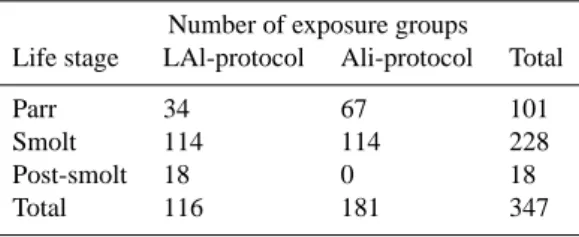
Table 1. Number of exposure groups, separated and sorted
accord-ing to life stage and the analytical protocol for Al fractionation.
Number of exposure groups Life stage LAl-protocol Ali-protocol Total
Parr 34 67 101
Smolt 114 114 228
Post-smolt 18 0 18
Total 116 181 347
2 Material
The material consists mainly of fish exposure experiments carried out in Norway during the period 1990 to 2003. Only brief descriptions of methods are provided here and we refer back to the original articles for full descriptions (Rosseland, et al., 1992; Pol´eo et al., 1994; Kroglund and Staurnes, 1999; Kroglund et al., 2001a, b, c, 2007; Rosseland et al., 2001; Kroglund and Finstad, 2003; Teien et al., 2004a, 2006a). These experiments involve a total of 347 groups of salmon at various life stages exposed in tanks to water qualities rang-ing from satisfactory to lethal (Table 1). In this data compila-tion, focus is placed on conclusions that can be drawn across experiments through a large range of water chemical com-positions and biological responses. The chemical limits de-rived from the exposure experiments are compared to limits suggested for Atlantic salmon based on population surveys (Kroglund et al., 2002).
We have included only experiments where we have access to the raw data to avoid uncertainties related to exposure en-vironment; differences in analytical protocols and large dif-ferences in TOC concentrations. Experiments not included can and should be used for model validation. The material is divided into two main parts differing with respect to exper-imental approach. In the short-term experiments, fish were exposed up to 10 days, while in the sea-survival experiments, the exposures were sub-lethal and exposed fish were released to monitor effects on movements and survival in the marine environment.
2.1 Short-term exposures
2.1.1 Fish material
The fish were offspring of wild parents reared at local hatcheries or wild smolt caught by electro-fishing. It is not possible to define the pre-exposure history of a wild salmon smolt as this life stage is not stationary and it is likely that these fish had experienced acidification episodes prior to our exposures. Fish originating from the hatchery in River Suldal (SW Norway) experienced acidification pulses prior to being used in the experiments, while fish from the other hatcheries were not pre-exposed to acidic waters. Comparative studies
have not been able to detect ecological relevant strain differ-ences in responses to water quality for salmon (Kroglund and Finstad, 2003; Rosseland et al., 2001) as opposed to the large strain related differences in sensitivity observed for brown trout (Salmo trutta L.) (Dalziel et al., 1995; Andr´en et al., 2006). We therefore assume that strain differences are not the cause for response variations in our material.
Salmon migrate from the ocean to spawn in rivers. In the river, the fish develop from eggs to fry to parr and to smolt and this latter stage will migrate into the ocean in the spring (Mills, 1989). Here, data are presented for the life stages parr and smolt. The definition of a life stage is not straight-forward, especially for smolt, as smoltification is a process preadapting the individual to the later marine life. For sim-plicity, fish >12 cm, showing loss of parr marks and col-oration and that were exposed within the period March to May are regarded as being pre-smolt or smolt, while fish ex-posed prior to this time span are treated as parr. Fish size varied between life stages and experiments. Larger fish are more sensitive to Al while smaller fish are more sensitive to
H+(Rosseland et al., 2001). This size-dependent response
and sensitivity to the stressors adds to variation in the mod-els.
2.1.2 Biological protocols
All experimental tanks were monitored for mortality at an in-terval of hours the first days, less frequent thereafter. Mortal-ity is presented as accumulated mortalMortal-ity and time (h) to 1st fish died and in relationship to exposure duration and dose. Before sampling of gills and blood, the fish were killed by a blow to the head. The 2nd gill arch of the fish was cut out for gill Al determination and analyzed according to Teien et
al. (2006b). Concentration of Al is reported as µg Alg−1gill
dry weight (dw). The bioconcentration factor (BCF) is esti-mated as the ratio between cationic Al in water and gill Al. Only data from the terminal samples are presented here. The material is as such valid with respect to biological response recorded within a 7 to 10 day exposure period.
2.1.3 Exposure environment – freshwater, seawater
chal-lenge test and smolt to adult survival
All fish were exposed in 1–4 m3tanks, in 90 L black tanks
or in cages placed in the rivers. Depending on the experi-ment, fish were exposed to natural acid and non-acid source
water and water added Al+ and H+ to increase toxicity or
limestone or sodium-silicate to reduce toxicity.
Seawater challenge tests were performed as a terminal test in all smolt studies. The test was run at salinities of 33–
34 ppt, at temperatures of 6–11◦C and for 24 h. Responses
are here presented as mortality and as blood-plasma Cl−
con-centrations. The responses are presented as average group performance in seawater minus performance in freshwater
(SW plasma Cl−–FW plasma Cl−). Plasma Cl−cannot be
measured on dead fish; thus the average increase in plasma
Cl−in groups suffering from mortality is underestimated.
To address the relationship between seawater challenge tests and population responses, a seawater survival program was initiated in 1999. Over the years 1999, 2000, 2002 and 2003, groups of 1200 to 1500 pre-smolt originating from wild salmon broodstock of the Imsa strain were Carlin tagged (Carlin, 1955) prior to exposure to control water or to one of three acid doses where episodic high Al was administered only for the last 3 days prior to release and long term low-Al and long term high-low-Al lasted >30 days. Following treat-ment termination, the fish were transported to River Imsa (pH>6.5) and released 150 m above the river mouth. Timing of migration from freshwater to seawater was as such volun-tary. Additional details are given by Kroglund et al. (2007).
2.1.4 Chemical protocols
Al is present as unstable inorganic species following changes in pH; e.g. after liming. “Unstable” Al is here functionally defined as acid water containing elevated concentrations of Al that has been aged for <30 min after an increase in pH. Fish exposed to unstable forms of Al are excluded from the models as the aim was to make a “general” model relating stable water chemistry to biological responses.
pH was measured using two protocols. pH was either mea-sured in field or at NIVA’s laboratory in Oslo after transport. Positively charged (cationic) Al was identified using two dif-ferent protocols and is defined as Al retained in an Am-berlite ion exchanger column; pyrechatecol-violet method (Røgeberg and Henriksen, 1985) termed LAl, and in situ modification of the Barnes-Driscoll method (Teien et al., 2004a) termed Ali. Both protocols are commonly used in Norway, the first in the national monitoring program, the lat-ter in fish experiments dedicated to study Al-biological in-teractions and Al-species transformations and mechanisms. The two different protocols have different properties and do not estimate identical concentrations of cationic Al (Andr´en, 2003). The in situ method produces better relationships be-tween Al and a biological response as Al speciation can be changed during transport to the laboratory (Teien et al., 2004a). Aluminum fractionated after transport to a labora-tory can therefore underestimate the “true” dose experienced by the fish (Kroglund et al., 2001a, b; Pol´eo et al., 1994; Rosseland et al., 1992; Teien et al., 2004a, 2005b, 2006a, b). This effect is best detected using gill Al or in situ fraction-ation of Al. All major cfraction-ations and anions were measured at laboratory (NIVA) using standard protocols.
2.1.5 NOEC-limits
We use mortality as the unacceptable, non-recoverable bio-logical response. Elevated mortality related to the exposure is understood as an effect of water quality. Water quality limits are based on various biomarkers and are graded as “no
LAl = -25x + 169 R2 = 0.54 Ali = -70x + 460 R2 = 0.69 0 10 20 30 40 50 60 70 80 90 100 5.0 5.5 6.0 6.5 7.0 pH C a ti o n ic A l, µ g L -1
1000-lake LAl Ali
A Ali = -12Ln(x) + 65 R2 = 0.31 -50 0 50 100 0 25 50 75 100 Cationic Al, µg L-1 A N C , µ e q L -1
1000-lake LAl Ali
B 720 Ali = 48x - 258 R2 = 0.44 LAl = 56x - 293 R2 = 0.55 -50 0 50 100 5.0 5.5 6.0 6.5 7.0 pH A N C , µ e q L -1
1000-lake LAl Ali
C
721
722 Figure 1a-c. a) Relationship between pH and cationic Al (µg•L-1) measured in situ (Ali) or o
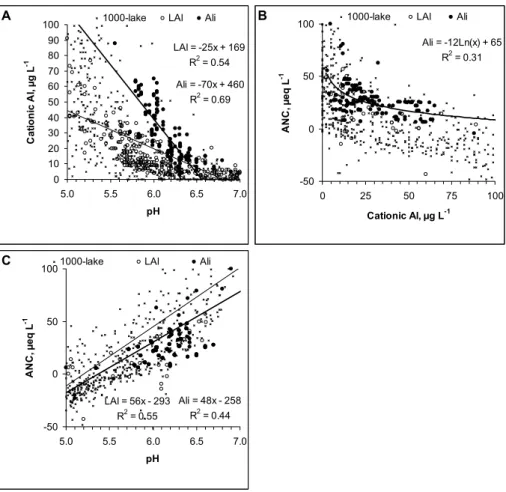
Fig. 1. (A): Relationship between pH and cationic Al (µg L−1) measured in situ (Ali) or on samples after transportation to NIVA for Al fractionation (LAl). (B) and (C): relationship between cationic Al and ANC and pH to ANC. The relationships are superimposed on relationships from the Norwegian 1000-lake survey from 1986 (Henriksen et al., 1989; Rosseland and Henriksen, 1990; Bulger et al., 1993; Lien et al., 1996). Linear relationships are entered into the graphs whenever significant.
effect”, “low to high” and “high”. “No effect” implies that no or few exposure groups responded negatively to the treat-ment. “Low to high effect” defines the chemical range where all response levels can be present, whereas “high effect” de-fines water chemistry where all exposure groups responded strongly. Water quality limits are presented with respect to dose and exposure duration for the life stages parr and smolt.
Performance in seawater challenge tests were used as an indicator of possible effects of freshwater quality on hypo-osmoregulatory capacity of the fish. The test was only per-formed on groups where freshwater survival was high. Water qualities that cause high mortality in freshwater are therefore lacking in the material. The ecologically more relevant re-sponse, actual effects on post-smolt survival affecting adult return rates, was used to define limits with respect to the sur-vival of smolts to the adult stage. Dose response relationships
were tested using linear regressions. R2values and equations
are entered into the graphs whenever p<0.001.
3 Results
3.1 Relationship pH and cationic Al
The relationships we observed between pH, ANC and cationic Al are superimposed onto data from the 1000-lake survey in Norway (Henriksen et al., 1989). The relationship between our data and the national dataset was satisfactory for all elements (Fig. 1). Our data are thus representative of the chemical ranges present in Norway. There was a close
relationship between cationic Al and H+ in the water with
pH<6.4 (Fig. 1a). More cationic Al was measured as Ali than as LAl for a given pH (P<0.001). This difference is probably purely analytical, but may also be due to differ-ent pH/Al relationships in the various water qualities used in these experiments, and/or due to pH being analyzed in the field when Ali was determined. The systematic difference supports an analytical interpretation. Regardless of protocol,
all fish were exposed to a combination of H+and Al in these
experiments. Due to the differences in relationships, guide-lines for pH/Al must be related to the analytical protocols
y = 5x + 8 R2 = 0.748 0 100 200 300 400 500 0 25 50 75 727 Cationic Al; µg L-1 G il l-A l, µ g A l g -1 d w
Ali; smolt Seasurv Ali; parr
A LAl: = 0.19x + 2.1 R2 = 0.31 Ali: = 0.01x + 4.7 R2 = 0.01 0 2 4 6 8 10 12 14 16 18 20 0 25 50 75 Cationic Al; µg L-1 B io c o n c e n tr a ti o n f a c to r
Ali; parr Ali; smolt LAl; smolt
B 728 y = -9x + 395 R2 = 0,48 0 250 500 750 1000 0 25 50 75 10 ANC, µeq L-1 G il l-A l, µ g g -1 d w 0 LAl Ali C 729
730 Figure 2. a: Relationship between cationic Al (LAl and Ali) and gill Al for parr and smolt. Fig. b:
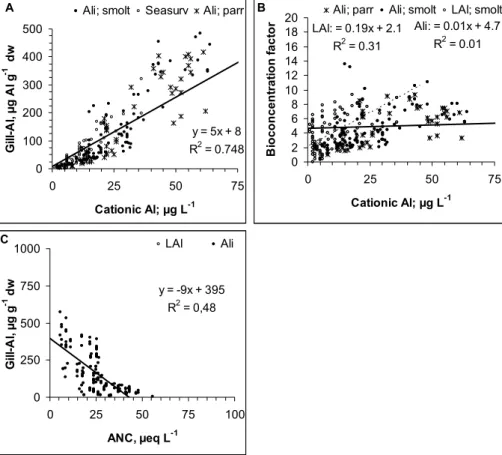
Fig. 2. Relationship between cationic Al (LAl and Ali) and gill Al for parr and smolt. (B): Relationship between cationic Al and
bio-concentration factor. (C): Relationship between ANC and gill Al. Linear relationships are entered into the graphs whenever significant.
being used. The use of different protocols within acid rain research makes comparisons between studies more difficult (Hindar et al., 2000; Andr´en, 2003). There were similar dif-ferences in the relationship between cationic Al and ANC and pH to ANC (Fig. 1b).
3.2 Cationic Al – gill Al concentrations
There was a highly significant relationship (p<0.0001) be-tween cationic Al, ANC and gill Al (Fig. 2a, c). The relation-ship was not significantly influenced by Al protocol or life stage (p>0.1). The bio-concentration factor (BCF) varied within a range of 2 to 8, and increased with Al concentration with respect to LAl but not so for Ali (Fig. 2b). This demon-strates differences in the bio reactive properties for the two forms of cationic Al. The relative large variation in factor suggests that there are other environmental, biological and chemical factors that also influence Al accumulation. Gill Al concentrations in salmon from water having pH values >6.5 and in water outside regions affected by acid rain is usually
<5 µg Alg−1dw and almost always <15 µg Alg−1dw
pro-vided there are no contaminants such as clay present. These values represent background levels (Kroglund et al., 2007).
The relationship between cationic Al and gill Al will be affected by: a) underestimation of LAl in mixing zones, b)
analytical errors in Ali and LAl fractionation, c) gill Al was not in a steady state to cationic Al, d) background concentra-tion of gill Al were elevated due to prior Al-exposures and e) contamination of sample. These factors contribute to un-certainty in the regression models. Most of the unun-certainty is probably related to the determination of cationic Al. Further-more, not all forms of Al species determined as cationic Al are bio-reactive and hence toxic. Measurement of cationic Al can overestimate toxicity in water rich in DOC, silicate (Si) and fluoride (F) (Peterson et al., 1989; Teien et al., 2005b, 2006a). Organically bound Al can have cationic properties with respect to an ion exchanger, but not to the gill. This has
been tested using Al26 by Oughton et al. (1992) and in
ex-posure experiments where fish were exposed to source water
and water that was passed through filters with a 10−3nominal
cut-off removing about 50% of DOC (Teien et al., 2005b). Regardless of these uncertainties, there were strong relation-ships between gill Al and biological responses (see later). The BCF can be used to generate a probability range for gill Al given a concentration of cationic Al.
During an episode there need not be any clear relation-ship between cationic Al and gill Al. While changes in wa-ter quality can occur over a time span of minutes, kinetic constraints will delay the corresponding change in gill Al.
A 0 10 20 30 40 50 60 70 80 90 100 4.5 5.5 6.5 pH A c c u m . m o rt a li ty , % LAl; parr Ali; parr B 0 10 20 30 40 50 60 70 80 90 100 0 25 50 75 100 125 Cationic Al, µg L-1 A c c u m . m o rt a li ty , %
LAl; parr Ali; parr
735 C 0 10 20 30 40 50 60 70 80 90 100 -50 -25 0 25 50 ANC, µeq L-1 A c c u m . m o rt a li ty , %
LAl; parr Ali; parr D
0 10 20 30 40 50 60 70 80 90 100 0 500 1000 Gill-Al, µg Al g-1 dw A c c u m . m o rt a li ty , %
LAl; parr Ali; parr
736 E 0 24 48 72 96 120 144 168 192 216 240 0 25 50 75 10 Accum. mortality, % H o u rs t o 1 s t m o rt a li ty 0 LAl; parr Ali; parr
737
738 Figure 3. Relationship between a: pH, b: cationic Al, and c: gill Al and accumulated mortality of
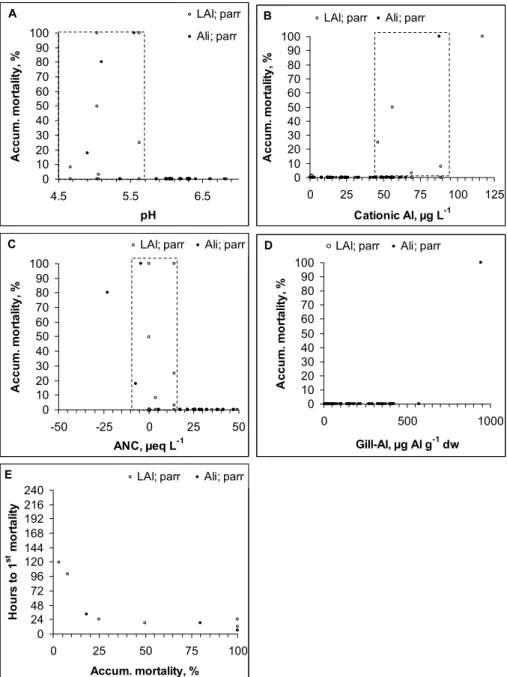
Fig. 3. Relationship between (A): pH, (B): cationic Al, and (C): gill Al and accumulated mortality of parr. (D): the relationship between
accumulated mortality over a 10 day period is related to how long it took to kill the first fish. The dashed lines suggest dose levels separating “no effect”, “low to high” effect and always “high” effect.
During exposure, gill Al increases fast and reaches a “steady” state to the ambient concentration of cationic Al within a time span of 1 day. Likewise, at the end of the episode, water quality can improve faster than gill Al depuration (Teien et al., 2005a, 2006b).
3.3 Biological responses-parr
There is only limited data on mortality in the parr stud-ies. Reduced survival was recorded in only 9 of 101
expo-sure groups. All fish survived when pH>5.6, Ali<45 µgL−1
and ANC>15 µeqL−1(Fig. 3a–c). When water quality
de-teriorated relative to these limits, mortality increased rela-tively steeply, but could also remain low at pH<5, Ali>90 and ANC<–10. Only toxic responses were never observed within the range in water qualities we exposed the fish to.
Parr tolerated gill Al concentrations above
500 µg Alg−1dw. The number of observations are
in-sufficient for determination of NOEC, but 100% of the fish
died when the gill Al concentration was 1000 µg Alg−1dw
A 0 10 20 30 40 50 60 70 80 90 100 4.5 5.5 6.5 pH A c c u m . m o rt a li ty , %
LAl; smolt Ali; smolt B
0 10 20 30 40 50 60 70 80 90 100 0 25 50 75 100 125 Cationic Al, µg L-1 A c c u m . m o rt a li ty , %
LAl; smolt Ali; smolt
C 0 10 20 30 40 50 60 70 80 90 100 -50 -25 0 25 50 ANC, µeq L-1 A c c u m . m o rt a li ty , %
LAl; smolt Ali; smolt D
y = 0.2x - 72 R2 = 0.96 0 10 20 30 40 50 60 70 80 90 100 0 500 1000 Gill Al, µg Al g-1 dw A c c u m . m o rta li ty , %
LAl; smolt Ali; smolt
E y = -1.5x + 177 R2 = 0.90 0 24 48 72 96 120 144 168 192 216 240 0 25 50 75 10 Accum. mortality, % H o u rs t o 1 s t m o rt a li ty 0 LAl; smolt Ali; smolt
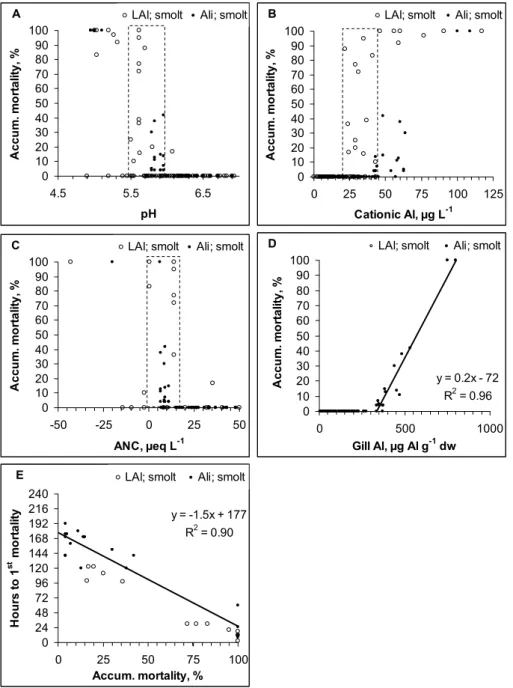
Fig. 4. Relationship between (a): pH, (b): cationic Al, (c): ANC and (d): gill Al and accum
Fig. 4. Relationship between (A): pH, (B): cationic Al, (C): ANC and (D): gill Al and accumulated mortality of smolt. (E): the relationship
between accumulated mortality over a 10 day period is related to how long it took to kill the first fish. Linear relationships are entered into the graphs whenever significant. The dashed lines suggest dose levels separating “no effect”, “low to high” effect and/or always “high” effect.
There was also a clear relationship between accumulated mortality and the time it took to kill the 1st fish. When accumulated mortality exceeded 25% over a 7 to 10 day exposure period, the first kills were observed within the first 24 h exposure separating acute from moderately lethal water qualities.
3.4 Biological responses-smolt
Mortality was frequently observed in the smolt studies
(Fig. 4a–d). Reduced survival was recorded in 39 of
228 exposure groups. All fish survived when pH>5.8,
LAl<20 µgL−1 or Ali<40 µgL−1 and ANC>15 µeqL−1
(Fig. 4a–c). When water quality deteriorated relative to these limits, mortality increased relatively steeply, and was always
high when pH<5.5, LAl>45 µgL−1 or Ali>65 µgL−1 and
ANC<0 µeqL−1. Mortality started when gill Al exceeded
300 µg Alg−1dw and was thereafter correlated to dose. In
water qualities that resulted in high mortality, the first kills were observed within the first 24 h of exposure (Fig. 4e). At lower doses, the fish had to be exposed for 4 days or more to initiate mortality.
757 A y = 0,94x - 148 R2 = 0,57 0 10 20 30 40 50 60 70 80 90 100 130 180 230 SW plasma Cl-l, mM A c c u m u la te d m o rt a li ty ; %
LAl; smolt Ali; smolt B
0 10 20 30 40 50 60 70 80 90 100 0 50 100 1 SW - FW; plasma Cl-1, mM A c c u m u la te d m o rt a li ty ; % 50 LAl; smolt Ali; smolt
758
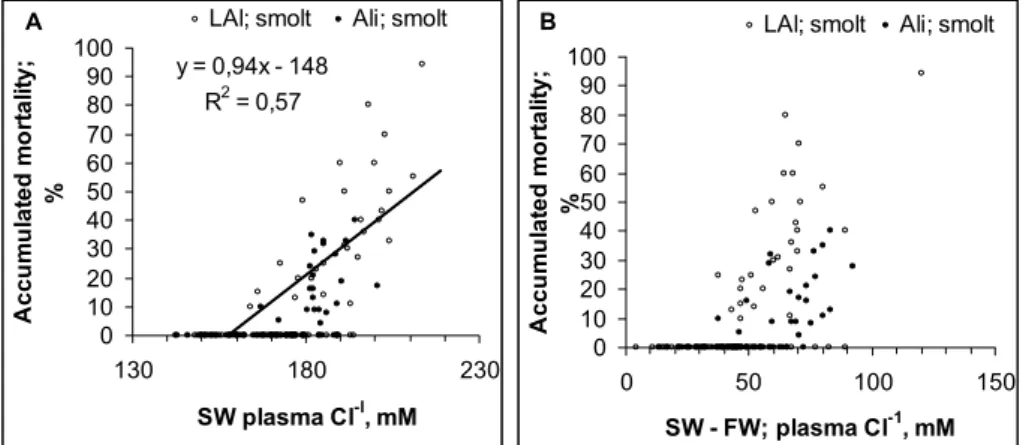
759 Figure 5. Relationship between a) plasma Cl- or b) increase in plasma Cl- re
Fig. 5. Relationship between (A) plasma Cl−or (B) increase in plasma Cl−relative to freshwater values and mortality in seawater challenge tests (n=178). Linear relationships are entered into the graphs whenever significant.
3.5 Seawater challenge tests
There was a relationship between impaired
hypo-osmoregulatory capacity and mortality (Fig. 5). Mortality
increased when plasma Cl− in the seawater challenge test
exceeded 160 mM or when the difference in plasma Cl−
in seawater to freshwater exceeded 45 mM (Fig. 5a, b). These levels differentiate between groups having increasing mortality from groups not suffering from mortality.
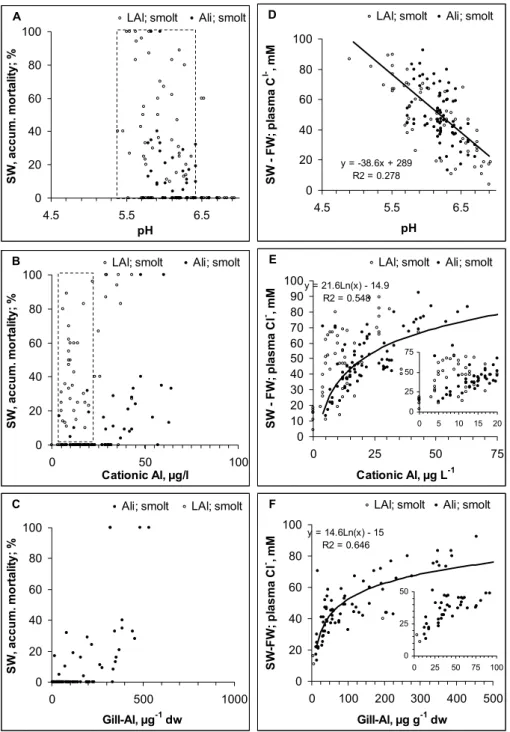
When pH in the pre-exposed freshwater >6.5 and cationic
Al<5 µg AlL−1, we observed close to zero mortality in a
subsequent seawater challenge test. At lower pH or higher Al concentrations, mortality could range from low to high irrespective of dose (Table 2, Fig. 6a, b). Mortality was how-ever significantly (p<0.0001) related to gill-Al and in a clear dose-response manner (Fig. 6c).
The fish had reduced hypo-osmoregulatory capacity with decreasing freshwater pH and increasing cationic Al
(Fig. 6d). The increase in plasma Cl− from freshwater
to seawater increased beyond 40 mM when cationic Al
ex-ceeded 5 µg AlL−1as LAl or 10 µg AlL−1as Ali (Fig. 6e) or
when gill Al exceeded 25 µg Alg−1dw. Mortality in the tests
was always high when cationic Al exceeded 25 µg AlL−1as
LAl and when gill Al exceeded 500 µg Alg−1dw.
Hypo-osmoregulatory regulation was always poor when pH<6.0,
cationic Al exceeded 15 µg AlL−1 as LAl (or 25 µg AlL−1
as LAl) and when gill Al exceeded 100 µg Alg−1dw.
The dose-response relationships with respect to the sea-water challenge tests suggest cut-off limits rather than dose related responses with the exception of gill Al. The strong relationship to gill Al suggests that Al bound to the gill is a stronger indicator of the dose than the chemical indices.
3.6 Seawater survival
Large groups of Carlin-tagged smolt were exposed to control
water (average pH>6.5; <5 µg LAlL−1)or to Al-containing
Table 2. Percent of the seawater challenge tests (24 h, 33–34 ppt
salinity, 6–11◦C) resulting to from zero, >0–<50% and >50% mortality relative to the LAl concentration the fish experienced while in freshwater. N=179.
No Moderate to high High mortality mortality mortality LAl 0% >0–50% >50% µgL−1 <5 100 0 0 5–10 6 54 40 10–15 38 40 22 15–20 11 65 24 >20 22 18 60
water (pH range 5.7–6.6; LAl range 6–17 µgL−1). At
expo-sure termination, the fish had accumulated Al onto gills in a
dose related manner (25 to 60 µg Alg−1dw), while the
con-trol fish had 5.9±3.3 µg Alg−1dw). Gill Al could account
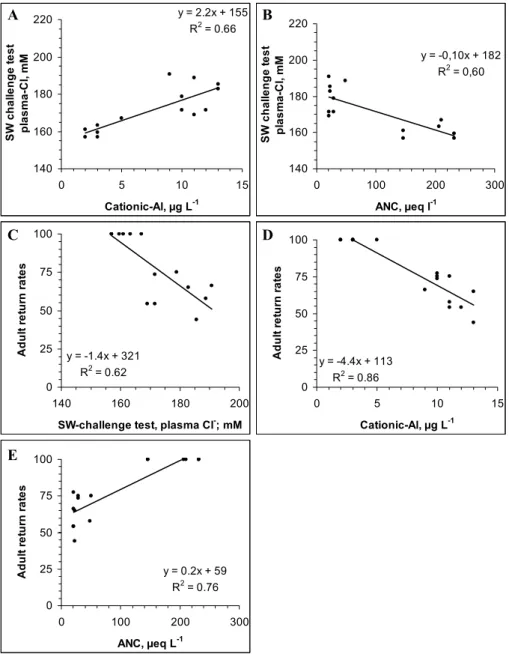
for >80% of the variation in return rates (Kroglund et al., 2007). Hypo-osmoregulatory capacity was related to both ANC and cationic Al (measured as LAl) (Fig. 7a, b). Adult return rates was related to performance in the seawater chal-lenge test, to cationic Al (as LAl) and to ANC. The number of exposure groups is insufficient to set definitive limits for ANC, but support previous conclusions that even low con-centrations of Al have detrimental effects with respect to sur-vival in seawater.
3.7 Water quality limits
In an experimental study, Atlantic salmon smolt exposed to pH 5.4–5.6 for 35 days, in waters having “no” gill-reactive Al. showed no negative effects monitored as post-smolt sur-vival and growth following 100 days in seawater (Fivelstad et al., 2004). In Canada where high organic content bind most
A 0 20 40 60 80 100 4.5 5.5 6.5 pH S W , a c c u m . m o rt a li ty ; %
LAl; smolt Ali; smolt D
y = -38.6x + 289 R2 = 0.278 0 20 40 60 80 100 4.5 5.5 6.5 pH SW F W ; p la s m a C l- , m M
LAl; smolt Ali; smolt
B 0 20 40 60 80 100 0 50 100 Cationic Al, µg/l S W , a c c u m . m o rt a li ty ; %
LAl; smolt Ali; smolt E
y = 21.6Ln(x) - 14.9 R2 = 0.548 0 10 20 30 40 50 60 70 80 90 100 0 25 50 Cationic Al, µg L-1 SW F W ; p la s m a C l - , m M 75 LAl; smolt Ali; smolt
0 25 50 75 0 5 10 15 20 C 0 20 40 60 80 100 0 500 1000 Gill-Al, µg-1 dw S W , a c c u m . m o rt a li ty ; %
Ali; smolt LAl; smolt F
y = 14.6Ln(x) - 15 R2 = 0.646 0 20 40 60 80 100 0 100 200 300 400 500 Gill-Al, µg g-1 dw SW -F W ; p la s m a C l - , m M
LAl; smolt Ali; smolt
0 25 50
0 25 50 75 100
Fig. 6. Mortality in a seawater challenge test with respect to (a) pH, (b) cationic Al (as LAl and Ali) and
Fig. 6. Mortality in a seawater challenge test with respect to (A) pH, (B) cationic Al (as LAl and Ali) and (C) gill Al concentrations measured
in freshwater prior to the test. (D)–(F) show the same data, but using the increase in plasma Cl−from freshwater to seawater as the biological response. To increase resolution, the relationship for low concentrations is inserted into (E) and (F). Linear relationships are entered into the graphs whenever significant. The dashed lines suggest dose levels separating “no effect”, “low to high” effect and/or always “high” effect.
of the Al in water even at pH 5.4, “no effect” on smolt pro-duction is expected at pH levels above 5.4 (Lacroix, 1989;
Watt et al., 2000). These observations suggest that the H+
concentration at pH of 5.4 has no adverse effect on smolt quality by itself. Leivestad et al. (1980) did not observe any
reduction in plasma Cl− above pH 4.5 in waters not
con-taining LAl, suggesting H+ limits to be around pH 4.5 for
freshwater life stages of Atlantic salmon. It is reasonable to assume that fish in our studies were mainly responding to Al as pH was generally >5.4. Even if pH had no direct toxic role, pH contributes to toxicity by mobilizing Al from the catchments and by transporting Al on its toxic form to the
y 22 = 2.2x + 155 R2 = 0.66 140 160 180 200 0 0 5 10 15 Cationic-Al, µg L-1 S W c h a ll e n g e t e s t p la s m a -C l, m M y = -0,10x + 182 R2 = 0,60 140 160 180 200 220 0 100 200 300 ANC, µeq l-1 S W c h a ll e n g e t e s t p la s m a -C l, m M 772 y = -1.4x + 321 R2 = 0.62 0 25 50 75 A B 100 140 160 180 200
SW-challenge test, plasma Cl-; mM
A d u lt r e tu rn r a te s y = -4.4x + 113 R2 = 0.86 0 25 50 75 100 0 5 10 15 Cationic-Al, µg L-1 A d u lt r e tu rn r a te s 773 y = 0.2x + 59 R2 = 0.76 0 25 50 75 C D 100 0 100 200 300 ANC, µeq L-1 A d u lt r e tu rn r a te s E 774
775 Figure 7ab. Relationships between a) cationic Al (as LAl) and b) ANC with respect to effects
Fig. 7. Relationships between (A) cationic Al (as LAl) and (B) ANC with respect to effects on hypo-osmoregulatory capacity (plasma
Cl−). (C)–(E) Relationship between hypo-osmoregulatory capacity, cationic Al (as LAl) and ANC with respect to adult return rates. Linear relationships are entered into the graphs whenever significant.
river. Within the river environment H+interacts with Al
spe-ciation and hence toxicity and acts together with Al to give a combined stressor.
The response relationships presented here were mainly generated on fish that were not pre-exposed to acidic waters. Acclimation to acid water has been suggested as a mech-anism to cope with impaired water quality to enhance sur-vival (e.g. Allin and Wilson, 1999; Mueller et al., 1991). We did not observe acclimation in any of the long-term stud-ies performed on Atlantic salmon smolt, but we did ob-serve growth reduction and immunosuppression (Finstad et al., 2007; Kroglund and Finstad, 2003; Kroglund et al., 2007)
but no signs of genetic adaptation to acid water (Rosseland et al., 2001). This lack of adaptation can be due to the extreme effects Al has on seawater survival (Staurnes et al., 1995) and the flooding of adapted genes by non-adapted genes from fish originating in non-acidic rivers (Rosseland et al., 2001).
3.7.1 Limits affecting freshwater survival (parr to smolt
survival)
Parr exposed to pH values <5.6 or cationic Al concentrations
>45 µg µgL−1suffered from increasing mortality (Table 3).
Mortality was recorded within the first 24 h mainly when
Table 3. Dose levels that separate “no effect” levels from doses where responses can either range from “low to high” or are always “high”
with respect to ANC (µeqL−1), pH (H+), cationic Al (µgL−1)and gill Al (µgg−1dw) as the dose and mortality as the response. Limits are proposed for the life stages parr and smolt. Exposure duration was <10 days.
Mortality-parr Mortality-smolt
ANC pH Ali Gill Al ANC pH LAl Ali Gill Al
No effect >15 >5.6 <45 <400 >15 >5.8 <20 <40 <300 Low-high <15 <5.6 45–90 >1000 <15 5.5–5.8 20–40 40–65 300–450
High <15 <5.5 >40 >65 >450
Table 4. Dose levels that separate “no effect” levels from doses where responses can either range from “low to high” or are always “high”
with respect to ANC (µeqL−1), pH (H+), cationic Al (µgL−1)and gill Al (µgg−1dw) as the dose. All fish were exposed for 7 to 10 days. Responses are evaluated using plasma Cl−(on smolt surviving a 24 h seawater challenge test) and on effects on adult return rates (smolt release experiments; 3–40 days exposure).
Plasma Cl−(SW-FW) Adult return rates pH LAl Ali Gill Al ANC pH LAl Gill Al No effect >6.5 <5 <10 <25 >50 <8 <25 Low-high 6.5–6.0 5–15 10–25 25–100 <50 8–12 25–60 High <6.0 >15 >25 >100 >12 >60
lower dose levels, mortality occurred first after several days. For smolt, mortality increased when pH was <5.8 or when
LAl exceeded 20 µgL−1or gill-Al exceeded 300 µgg−1dw
(Table 3). Mortality could occur within 24 h when pH was
<5.5, LAl>25 µgL−1or gill-Al >750 µgg−1dw (Fig. 7). At
lower levels of the dose, the fish had to be exposed for days before mortality was observed. The differences in limits are to be expected on basis of the differences in sensitivity pre-viously reported (Rosseland and Staurnes, 1993; Gensemer and Playle, 1999).
3.7.2 Limits affecting survival in seawater (smolt to adult
survival)
Performance in the seawater challenge tests were
increas-ingly poor when LAl>5 or Ali>10 µgL−1. All smolt having
gill Al>25 µgg−1dw had poor hypo-osmoregulatory
capac-ity (Table 4). Results from the sea-survival program indicate
that smolt exposed to >5<10 µgL−1had 25 to 50%
reduc-tion in survival, where the reducreduc-tion was strongly related to dose. The return rates were reduced in all groups having
gill Al concentrations >25 µg Alg−1dw (p<0.0001). This
strong relationship between Al and reduction in adult returns was independent of exposure duration as fish exposed for 3 days fitted into the same model as fish exposed for >30 days. The cause-effect mechanisms for this phenomenon are dif-ferent form those associated with mortality in freshwater. Reduced seawater survival is most likely due to the direct
effects Al has on the gill Na+,K+-ATPase activity (ability to
maintain homeostasis in seawater), on mucus quality (charge
and density), immunosuppression (increased sensitivity to diseases and parasites) and behavior effects related to loss of fright response and willingness to enter full strength seawa-ter (Berntssen et al., 1993; Finstad et al., 2007; Kroglund and Staurnes, 1999; Kroglund et al., 2007; Magee et al., 2003; Staurnes et al., 1984, 1995, 1996; Rosseland et al., 1992).
Of these, Al-induced effects on gill Na+, K+-ATPase
activ-ity has received most attention. The activactiv-ity of this enzyme increases steeply during smoltification as a part of the pre-adaptation to tolerate full strength sea water (Wedemeyer et al., 1980). While compromised seawater tolerance has lit-tle effect on performance while the individual is in freshwa-ter, this response is critical for post-smolt survival and can have the same effects on population health as heavy mortality in freshwater (Kroglund and Finstad, 2003; Kroglund et al., 2007). Smolt released into the acidified Rivers Mandalselva and Mois˚ana in the early 1980’s gave zero returns, while fish released into the estuary had a low return rate (Hansen, 1987). Similar results were observed after releasing smolt into the acid river Lygna, while smolt released into the limed River Audna or into the estuary of the two rivers had recover-ies (Staurnes et al., 1996). Improvements in liming strategy can increase salmon adult return rates (Alen¨as et al., 1995; Larsen and Hesthagen, 1995; Hesthagen and Larsen, 2003).
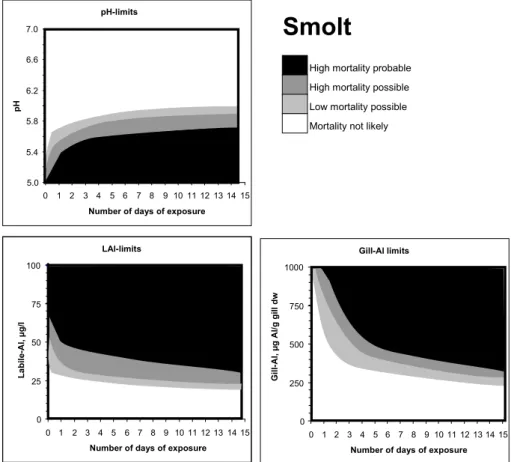
As the timing of the smolt run varies across regions, care must be taken when interpreting the ecological ef-fect of an episodic Al exposure to the actual timing of the
smoltification period. The smolt run can last for weeks,
pH-limits 5.0 5.4 5.8 6.2 6.6 7.0 0 1 2 3 4 5 6 7 8 9 10111213 14 15
Number of days of exposure
p
H
High mortality probable High mortality possible Low mortality possible Mortality not likely
LAl-limits 0 25 50 75 100 0 1 2 3 4 5 6 7 8 9 10111213 14 15
Number of days of exposure
L a b il e -A l, µ g /l Gill-Al limits 0 250 500 750 1000 0 1 2 3 4 5 6 7 8 9 101112131415
Number of days of exposure
G il l-A l, µ g A l/ g g il l d w
Smolt
780781 Figure 7. Expected mortality levels for smolt of Atlantic salmon with respect to pH, cationic Al
Fig. 8. Expected mortality levels for smolt of Atlantic salmon with respect to pH, cationic Al (as LAl) and gill Al in relation to exposure
duration. After: Kroglund and Rosseland (2004).
hypo-osmoregulatory capacity, while individuals migrating earlier or later have normal sea water performance. The eco-logical effect depends on the timing of the episode and how well fish recover after the episode.
4 Discussion
Both in situ bioassays and field surveys suggest that acid
episodes are harmful to fish (Barlaup and ˚Atland, 1996;
Hin-dar et al., 2004; Magee et al., 2003; Teien et al., 2004b, 2005a). In short-term exposures, fish can be exposed to con-trolled levels of water quality constituents mimicking ele-ments of a natural episode, but is at the same time a poor rep-resentation of the complex variation in water chemistry the wild and native fish populations are exposed to prior to, dur-ing and followdur-ing an episode. Results from short-term expo-sures cannot therefore easily be extrapolated to effects at the population level (Lepori and Ormerod, 2005). For instance, fish constrained within tanks or cages during an episode are denied the possibility of behavioral avoidance that could en-hance their survival in the wild. Atlantic salmon has poor de-veloped avoidance behavior with respect to aluminum,
com-pared to other fish species ( ˚Atland and Barlaup, 1995, 1996).
To substantiate the water quality limits suggested on basis of short-term exposures, these limits are compared to limits suggested for Atlantic salmon based on population surveys (Kroglund et al., 2002). The results used in this paper were generated by the use of acidification na¨ıve fish, exposed for a short period (<10 days) under controlled conditions. The short exposure duration mimics, but is at the same time an oversimplification of an episode.
The response limits derived from the parr and smolt stud-ies are not very different from limits suggested on basis of acidification-related effects on adult return rates reported from 73 rivers in Kroglund et al. (2002). Salmon was ex-tinct from all rivers having an annual average pH<5.2 and
>50 µg LAlL−1. This is a water quality that affects both
parr and smolt survival in the bioassays. Within the
pH-range of 5.2–5.7 and 20–50 µg AlL−1 as LAl, salmon was
extinct in some rivers while other rivers had reduced catches. This is a water quality that can cause some mortality in the bioassays, depending on i.e. the calcium level in the river, especially during episodic events. Mortality also will de-pend on exposure duration. All rivers within the pH range of 5.7–6.2 or a LAl concentration within the range of 5–
where parr and smolt survival in freshwater is not affected in the bioassays, but the hypo-osmoregulatory capacity of the
smolt is compromised. Rivers having pH>6.2, <3 µg AlL−1
and ANC values >35 µeqL−1were all categorized as
unaf-fected by acidification. Similar conclusions are drawn from the bioassays. The population status of salmon in the in-dividual river will be controlled by chemical and biological factors and in-between year variations in critical exposures (timing, duration and “intensity” of episodes). Furthermore, it is well known that returning adult salmon, being accounted for in the catch statistics, can have an origin from neighbor-ing rivers (strayers) within a region and that escaped salmon from fish farms can contribute to the annual catches as well. Salmon catches in some of the acid rivers can thus be due to smolt produced in other rivers.
The population responses reported in Kroglund et al. (2002) were all based on annual average water qualities. Fish are affected by the general water quality, but it is proba-bly the extremes (taking exposure duration into account) that have the largest impact on population status. The relation-ship between episode intensity and annual average chemistry is therefore of interest (Wright, 2008). Smolt will migrate from the river and into the ocean during high discharge peri-ods in spring, a time period when acidification episodes were common. Short-term episodes in spring (down to 3 days) can as such be one of the factors contributing to the present low and declined salmon populations in many rivers draining to the Atlantic Ocean (Kroglund et al., 2007).
The above limits suggest that population extinction oc-curs mainly in water qualities where the critical limit for all life history stages is exceeded, since parr (which we have included in our experiments) probably is the most re-sistant life history stage. Catch reductions, however, occur in rivers where water quality is predicted to affect the hypo-osmoregulatory capacity of the smolt. The low tolerance lim-its of smolts to Al suggest that more rivers than presently ac-cepted being acidified can be affected by acidification. This can then have restricted the interpretation of cause and effect, and thus the use of chemicals (lime) as a mitigation method to improve fisheries. In those cases, additional data on gill Al would aid to the interpretation of ecological status.
5 Conclusions
Concern about the adverse impacts of climate change and acid deposition on freshwater ecosystems ultimately revolves around the biological effects. Chemical or physical changes are, per se, really only relevant with respect to the poten-tial effects on organisms. The work presented here shows clear links between climate-induced short-term acid episodes in running waters and effects on salmon. This is precisely the scientific link that is required to put changes in water chem-istry into an ecological perspective.
Acid deposition alone, of course, has profound effects on freshwater organisms. The decades of acid deposition dur-ing the 1900’s severely affected salmon populations in many rivers in southern Norway and elsewhere in Europe. Some of the acute effects undoubtedly came during climate-induced acid episodes, but acid deposition was a necessary factor.
Climate change alone (in the absence of acid deposi-tion) also can have substantial influence on Atlantic salmon. Changes in water temperature and discharge in rivers affect many life stages of the salmon, including timing of migra-tion, hatching of eggs, and smoltification. Quantitative de-scriptions and projections of these physical changes under scenarios of future climate change pose a significant scien-tific challenge to hydrologists and geophysicists. And quan-tification of the biological effects of the projected changes likewise poses a challenge to freshwater ecologists.
Acknowledgements. These experiments would not have been possi-ble without the participation of a large number of scientists, whom are only cited in this paper. We wish to acknowledge their con-tribution to the field work and laboratory work. Experiments and field exposures were funded mainly by the Norwegian Directorate for Nature Management and the Norwegian Research Council, but also by funds from the participating institutions (NIVA, NINA and UMB). This article was produced as a contribution to WP7 within the EU project Eurolimpacs (the Commission of European Communities GOCE-CT-2003-505540). We wish to thank two anonymous reviewers for helpful comments on the manuscript.
Edited by: P. Dillon and R. F. Wright
References
Alen¨as, I., Degerman, E., and Henrikson, L.: Liming strategies and effects: the River H¨ogvads˚an case study, Chapter 14, in: Liming of Acidified Surface Waters, edited by: Henrikson, L. and Brodin, Y. W., Springer-Verlag Berlin Heidelberg, 363–374, 1995.
Allin, C. J. and Wilson, R. W.: Behavioural and metabolic effects of chronic exposure to sublethal aluminium in acidic soft water in juvenile rainbow trout (Oncorhynchus mykiss), Can. J. Fish. Aquat. Sci., 56(4), 670–678, 1999.
Andr´en, C.: Provningsj¨amnf¨orelser av aluminiumsfraksjoner i 2002 og 2003, Comparison of aluminium fractionation and analytical protocols in 2002 and 2003, ITM-report 117, 46 pp., 2003 (in Swedish with English summary).
Andr´en, C. M., Kroglund, F., and Teien, H. C.: Controlled exposure of brown trout to humic water limed to different pH and inorganic aluminium concentrations, Verh. Int. Verein. Limnol., 29, 1548– 1552, 2006.
˚
Atland, ˚A. and Barlaup, B. T.: Avoidance of toxic mixing zones by Atlantic salmon (Salmo salar L) and brown trout (Salmo trutta L) in the limed river Audna, Southern Norway, Environ. Pollut., 90(2), 203–208, 1995.
˚
Atland, A. and Barlaup, B. T.: Avoidance behaviour of Atlantic salmon (Salmo salar L.) fry in waters of low pH and elevated aluminum concentration: Laboratory experiments, Can. J. Fish. Aquat. Sci., 53(8), 1827–1834, 1996.
Barlaup, B. T. and ˚Atland, A.: Episodic mortality of brown trout (Salmo trutta L) caused by sea-salt-induced acidification in west-ern Norway: Effects on different life stages within three popula-tions, Can. J. Fish. Aquat. Sci., 53(8), 1835–1843, 1996. Berntssen, M. H. G., Kroglund, F., Rosseland, B. O., and Bonga, S.
E. W.: Responses of skin mucous cells to aluminium exposure at low pH in Atlantic salmon (Salmo salar) smolts, Can. J. Fish. Aquat. Sci., 54(5), 1039–1045, 1997.
Bulger, A. J., Lien, L., Cosby, B. J., and Henriksen, A.: Brown trout (Salmo trutta L) status and chemistry from the Norwegian 1000 lake survey – statistical analysis, Can. J. Fish. Aquat. Sci., 50(3), 575–585, 1993.
Carlin, B.: Tagging of salmon smolts in the River Lagan, Rep. Inst. Freshwater Res. Drottningholm, 36, 57–74, 1955.
Dalziel, T. R. K., Kroglund F., Lien, L., and Rosseland, B. O.: The REFISH (restoring endangered fish in stressed habitats) project, 1988–1994, Water Air Soil, Poll., 85(2), 321–326, 1995. Driscoll, C. T. J., Baker, J. P., Bisogni, J. J. J., and Schofield, C.
L.: Effect of Aluminium Speciation on Fish in Dilute Acidified Waters, Nature, 284, 161–164, 1980.
EPA.: Understanding and Accounting for Method Variability in Whole Effluent Toxicity Applications Under the National Pol-lutant Discharge Elimination System, EPA 833-R-00-003, 2000. Evans, C. D., Cullen, J. M., Alewell, C., Kopacek, J., Marchetto, A., Moldan, F., Prechtel, A., Rogora, M., Vesely, J., and Wright, R.: Recovery from acidification in European surface waters, Hydrol. Earth Syst. Sci., 5, 283–297, 2001,
http://www.hydrol-earth-syst-sci.net/5/283/2001/.
Evans, C. D., Reynolds, B., Hinton, C., Hughes, S., Norris, D., Grant, S., and B. Williams, B.: Effects of decreasing acid depo-sition and climate change on acid extremes in an upland stream, Hydrol. Earth Syst. Sci., 12, this special issue, 2008.
Finstad, B., Kroglund, F., Strand, R., Stefansson, S. O., Bjørn, P. A., Rosseland, B. O., and Salbu, B.: Salmon lice or suboptimal water quality – reasons for reduced post-smolt survival?, Aquaculture, 273, 374–383, 2007.
Fivelstad, S., Olsen, A. B., Stefansson, S., Handeland, S., W˚agbø, R., Kroglund, F., and Colt, J.: Lack of long-term sublethal effects of reduced freshwater pH alone on Atlantic salmon (Salmo salar) smolts subsequently transferred to seawater, Can. J. Fish. Aquat. Sci., 61(4), 511–518, 2004.
Gensemer, R. W. and Playle, R. C.: The bioavailability and toxicity of aluminium in aquatic environments, Crit. Rev. Env. Sci. Tec., 29(4), 315–450, 1999.
Hansen, L. P.: Growth, migration and survival of lake reared juve-nile anadromous Atlantic salmon (Salmo salar L.), Fauna. Norv. Ser. A., 8, 29–34, 1987.
Henriksen, A., Skogheim, O. K., and Rosseland, B. O.: Episodic changes in pH and aluminium-speciation kill fish in a Norwegian river, Vatten, 40, 255–260, 1984.
Henriksen, A., Lien, L., Rosseland, B. O., Traaen, T. S., and Seval-drud, I. S.: Lake Acidification in Norway: Present and Predicted Fish Status, Ambio, 18(6), 314–321, 1989.
Hesthagen, T. and Hansen, L. P.: Estimates of the annual loss of Atlantic salmon, Salmo salar L., in Norway due to acidification, Aquacult. Fish. Manage., 22, 85–91, 1991.
Hesthagen, T. and Larsen, B. M.: Recovery and re-establishment of Atlantic salmon, Salmo salar, in limed Norwegian rivers, Fish. Manage. Ecol., 10, 87–95, 2003.
Hindar, A., Henriksen, A., Tørseth, K., and Semb, A.: Acid water and fish death, Nature, 372, 327–328, 1994.
Hindar, A., Torseth, K., Henriksen, A., and Orsolini, Y.: The sig-nificance of the North Atlantic Oscillation (NAO) for sea-salt episodes and acidification-related effects in Norwegian rivers, Environ. Sci. Technol., 38(1), 26–33, 2004.
Korman, J., Marmorek, D. R., Lacroix, G. L., Amiro, P. G., Ritter, J. A., Watt, W. D., Cutting, R. E., and Robinson, D. C. E.: Devel-opment and evaluation of a biological model to assess regional-scale effects of acidification on Atlantic Salmon (Salmo salar), Can. J. Fish. Aquat. Sci., 51(3), 662–680, 1994.
Kroglund, F. and Finstad, B.: Low concentrations of inorganic monomeric aluminium impair physiological status and marine survival of Atlantic salmon, Aquaculture, 222, 119–133, 2003. Kroglund, F., Finstad, B., Stefansson, S. O., Nilsen, T., Kristensen,
T., Rosseland, B. O., Teien, H. C., and Salbu, B.: Exposure to moderate acid water and aluminium reduces Atlantic salmon post-smolt survival, Aquaculture, 273, 360–373, 2007.
Kroglund, F. and Staurnes, M.: Water quality requirements of smolting Atlantic salmon (Salmo salar) in limed acid rivers, Can. J. Fish. Aquat. Sci., 56(11), 2078–2086, 1999.
Kroglund, F., Teien, H. C., Rosseland, B. O., Salbu, B., and Lu-cassen, E.: Water quality dependent recovery from aluminium stress in Atlantic salmon smolt, Water Air Soil Poll., 130, 911– 916, 2001a.
Kroglund, F., Teien, H. C., Rosseland, B. O., and Salbu, B.: Time and pH-Dependent detoxification of aluminium in mixing zones between acid and non-acid rivers, Water Air Soil Poll., 130(1–4), 905–910, 2001b.
Kroglund, F., Kaste, Ø., Rosseland, B. O., and Poppe, T.: The return of the salmon, Water Air Soil Poll., 130(1–4), 1349–1354, 2001c. Kroglund, F., Wright, R. F., and Burchart, C.: Acidification and Atlantic salmon: critical limits for Norwegian rivers, Oslo: Nor-wegian Institute for Water Research, Report nr 111, 61 pp., 2002. Kroglund, F. and Rosseland, B. O.: Effekter av forsuringsepisoder p˚a parr- og smoltkvalitet til laks. (Effects of epsiodic acidifica-tion on parr- and smolt quality of Atlantic salmon), NIVA Re-port, LNR 4797-2004, 45 pp., ISBN 82-577-4475-1, 2004 (in Norwegian).
Lacroix, G. L.: Ecological and Physiological Responses of Atlantic Salmon in Acidic Organic Rivers of Nova Scotia, Canada, Water Air Soil Poll., 46, 375–386, 1989.
Lacroix, G. L. and Korman, J.: Timing of episodic acidification in Atlantic salmon rivers influences evaluation of mitigative mea-sures and recovery forecasts, Can. J. Fish. Aquat. Sci., 53(3), 589–599, 1996.
Lacroix, G. L. and Townend, D. R.: Responses of juvenile Atlantic salmon to episodic increases in the acidity of some rivers of Nova Scotia, Canada, in: Ecophysiology Of Acid Stress In Aquatic Organisms, edited by: Witters, H. and Vanderborght, O., 297– 307, 1987.
Larsen, B. M. and Hesthagen, T.: The effects of liming on juvenile stocks of Atlantic salmon (Salmo salar) and brown trout (Salmo trutta) in a Norwegian river, Water Air Soil Poll., 85, 991–996, 1995.
Leivestad, H., Muniz, I. P., and Rosseland, B. O.: Acid stress in trout from a dilute mountain stream, in: Ecological impact of acid precipitation, edited by: Drabløs, D. and Tollan, A., Sande-fjord, Norway, SNSF project The Norwegian interdisciplinary