International Journal of Applied Exercise Physiology
2322-3537 www.ijaep.com Vol.8 No.1
Received: September 2018 , Accepted: December 2018 , Available online: March 2019
DOI: 10. 30472 /ijaep.v8i1.307
Visual/Spatial Intelligence Vs Direct Instruction which method heightens tactical
performance in youth soccer players
Zerf m
1 *, Boras F Z
2, Gourari B
3, Wahib B
41Sports Training, 2
Physical Education Institute
, 3Physical Education Institute, 4Sports TrainingUniversity of Abdel Hamid Ibn BadisABSTRACT:
Backed by football video analysis summarization that provision and augmented information for high-level analysis, especially in tactical sessions than direct instruction (DI). Our investigation in this study support critic of similar studies that repetitive technical exercises are not in line with the enhancement of the player's intelligence. In the opposite of analyzing video, which allows the reproduction of the same situations authentic to the real game. Claims in this study as an approach to creating Visual/Spatial Learner to gain the solution via the tactical situations. Agreeing to study design and statistics applied. Our results advocate that performance in tactical situations be in flavors’ of players exposed to VSL compared to those taught using DI. Owing to motor space using visual tactical feedback as a remained strategy of combining collective tactics. Needing the control of the gaze and attention over multiple visuomotor workspaces. As well as quantitative and qualitative aspects of performance decision-makers, as respond individually or co-operatively during the soccer game.
KEY WORDS Visual/Spatial Intelligence, Direct Instruction, Tactical Performance, Soccer players
INTRODUCTION
In a match, expect players select the proper decisions under time pressure as a key factor of their skillful performance. Claims by similar studies through coaches to integrate strategies. Basic on their
intelligence assimilated by simulation players to explore their tactics in a group of learners. Reported as a technical point of view that allows players to read the game and make effective decisions quickly during the complex competition actions. Needing players to resolve the tactical
difficulty (solo or collective). Despite the fact that the use of visual-spatial learners (VSL) approached methods is able to visualize action in soccer trendy three-dimensional [1]. Permitting players to obtain ability to observe find and classify objects [2]. Evidence suggests overlap between visual imagery and visual working [3]. Described in soccer-based mention analysis as benefits modern educational technology in stimulating the learners in educational [4] or the sporting context [5]. Admitted in sports topics as benefits feedback cancelled to impacts the
information cached from the sources accessible to meet the needs of the game situations. Indicated by Jay Martin (2012) as qualification proficiently that typically based on the coaching job successfully [6] in mastering video analysis software. Combined as imagery, planning sections to discuss tactics and strategy during the competition phases [7]. Reported as a key topic in scientific discussions as well as experts in ball games to creatinine the actions behaviors [8]. Suggested fabricated on creative assignments with video projects, which is not the case of Algerian soccer tactical learning.
Aimed in this investigation at the benefits of the experimental group, as systematically approach that advanced the representing of complex tactics in soccer steered trainers. Conceded in the favoritism of multiple visual assistance for developing soccer players’ skills. The case of this study, which requires our coaches, the employment of interactive program tools as a flexible approach for players to understand his main role in green his post and his teammates. Showing by American football teams in analyzing of games and imitate the same situations in the games according to the analysis. As a new video-based method to describe injury in professional football temporal structures or event hierarchy [11]. Belief by previous through suitable challenge predictors for talent search and talent selection [9]. Where developed countries based their evaluation and training on coaching tools such as the TACTFOOT SOCCER COACHING and tactical test behavior stimulated from FUT-SAT test as a TACTICAL SOFTWARE adapted to examine the players' performance in the realism games situations. For the proposed 36 defender, soccer players participate in the present study, classified into two homogeneous groups (EG VS CG) verified by a mini-game championship in pretest and post-test. Created on FUT-SAT test adopted by Bernardo Silva, et al [10] from 3 vs. 3 to 6 vs. 6 Small-Sided Games.
METHODS
The investigation in this study tends to analyses strategies that increased theoretical performance from the methodological point of view geometric and schemes in the competition. Where the searchers suppose multiple Spatial Intelligence (VSL) method as better to Direct Instruction (DI), as the top score used in Algerian tactical sessions. In the opposite of modern soccer world, that stimulates the use of multimedia. Admitted in case of this study topics through the total football's ideology preaches the defenders to should be willing and able to come forward as attackers [12].
Recording Procedure
Our protocol was built on the same program for both groups. The only difference between the two groups lies in feedback. Experimental group ES=18 using (VSL) based on communicative media technology during the pre-competition phase training (3 competitions, 3 tactical
sessions). Before the start of the national championship years 2015-2016. Control group CG=18 based on Direct Instruction (DI) structured by the coach.
Sample
The sample of this study was selected in a non-random manner by judgement sampling and consisted of 60 federated male soccer players aged between 16 and 17 years. Athletes belonged to a soccer team from the league Oran that participated in national competitions. The athletes trained on average 4 times per week and had a means of 4.2 ± 1.2 years of experiences. These ages were chosen since they are the first to participate in national youth soccer competitions in Algeria.
Tactical Tests
In the lack of System of Tactical Assessment in Soccer (FUT-SAT test) that enables the assessment of tactical actions performed by players with and without ball possession [17]. Built with the aims to provide coaches, teachers and researchers with approaches to access specifically, and objectively the information that reflects tactical behaviors performed by players’ in-games. Its conceptual structure is founded on the core tactical principles of soccer, being for the offensive phase: penetration, offensive coverage, depth mobility, width, length and offensive unity; and for the defensive phase: delay, defensive coverage, balance, concentration and defensive unity [18]. However, in the case of the current study, we use 6 vs. 6 Small-Sided Games to calculate the average of a number of passes decisive (PD), goals successfully (GS), cut the balls (CB), Participate in the offensive phase (POP), Participate in the defensive phase (PDP). Based on video analyses of the match record during the pre-test or post-test. As a derived application extracted from the protocol Teoldo I, et al (2011), the actions performed by goalkeepers were not assessed or considered for analysis. The playing area was adjusted according to the number of players involved (6 vs. 6) 60 m long and 39 m wide, for eight minutes.
STATISTICAL RESULTS
Statistical analyses were carried out using the Statistical Package for Social Sciences (SPSS Macintosh v 20; SPSS Inc., Chicago, IL). Based on the data tests and the data analysis procedures employed in this study consisted of the computation of the means, standard deviations, Levene's Test for Equality of Variances, independent T-test. We have chosen the Descriptive statistics where we have calculated the conditions chosen for this experience with a statistical significance set at P<0.05.
RESULTS
Our data collects based on FUT-SAT test specification. Adapt by the researchers in the video through records and analysis of actions in slower. Reports in similar studies as benefits mean consisted to review and discuss the data records [14]. As well as beneficial method tactical training [16]. Inspired by the previous in the optimizing of training clear decisions. Agreeing to Table 1 in the pertest. Based on data
analyzed our sample is homogeneous in all variables study that was confirmed by the independent T-test and Levene's at P<0.05. In comparison with post-test Table 2. Our results advocate that performance in tactical situations be in flavors of players exposed to VSL compared to those taught using DI. Asserted the case of as DI as a positive and significant relationship between goal orientation and exercise performance [19]. Interpret as routines technical exercises,
which do not permit players to learn how to use their intelligence in order to be adapted to the constantly changing situations in a game [20]. Labelled via perceptual-cognitive skills, such as anticipation and decision-making, which are crucial performance determinants in team sports, such as football. Where speed and accurate decisions are required in a complex and rapidly changing environment [21].
Table 1. Present the characteristics of the sample in a pre-test
Pertest Simple N Mean±SD Levene's Sig. T Sig. PD EG(VSL) 18 0.95±1.50 3.16 0.08 1.02 0.31 CG(DI) 18 0.55±0.88 GS EG(VSL) 18 0.30±0.57 0.98 0.33 -0.50 0.62 CG(DI) 18 0.42±0.68 CB EG(VSL) 18 2.13±1.41 0.65 0.21 -1.04 0.28 CG(DI) 18 3.04±1.37 POP EG(VSL) 18 3.05±2.35 3.82 0.07 -0.81 0.42 CG(DI) 18 3.55±1.43 PDP EG(VSL) 18 5.15±3.57 2.49 0.12 -1.41 0.17 CG(DI) 18 6.55±2.66
Experimental group: EG(VSL)/control group CG(DI)
Numbers of passes decisive (PD), goals successfully (GS), cut the balls (CB), Participate in the offensive phase (POP), Participate in the defensive phase (PDP)
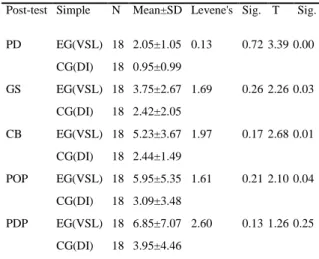
Confirmed in Table 2 or the post-test. Where all variables studies are in the benefits of EG with VSL as tactical methods. Upheld by the present study based on the signification of independent T-test set at P<0.05. Providing the user to accredit that football is a deciding game into
players must digest the information that reached them observed via different positions game. Make them able to act quickly to conclude what it must be done effectively according to the game proper [22].
Table 2. Present the characteristics of the sample in a post-test
Post-test Simple N Mean±SD Levene's Sig. T Sig. PD EG(VSL) 18 2.05±1.05 0.13 0.72 3.39 0.00 CG(DI) 18 0.95±0.99 GS EG(VSL) 18 3.75±2.67 1.69 0.26 2.26 0.03 CG(DI) 18 2.42±2.05 CB EG(VSL) 18 5.23±3.67 1.97 0.17 2.68 0.01 CG(DI) 18 2.44±1.49 POP EG(VSL) 18 5.95±5.35 1.61 0.21 2.10 0.04 CG(DI) 18 3.09±3.48 PDP EG(VSL) 18 6.85±7.07 2.60 0.13 1.26 0.25 CG(DI) 18 3.95±4.46
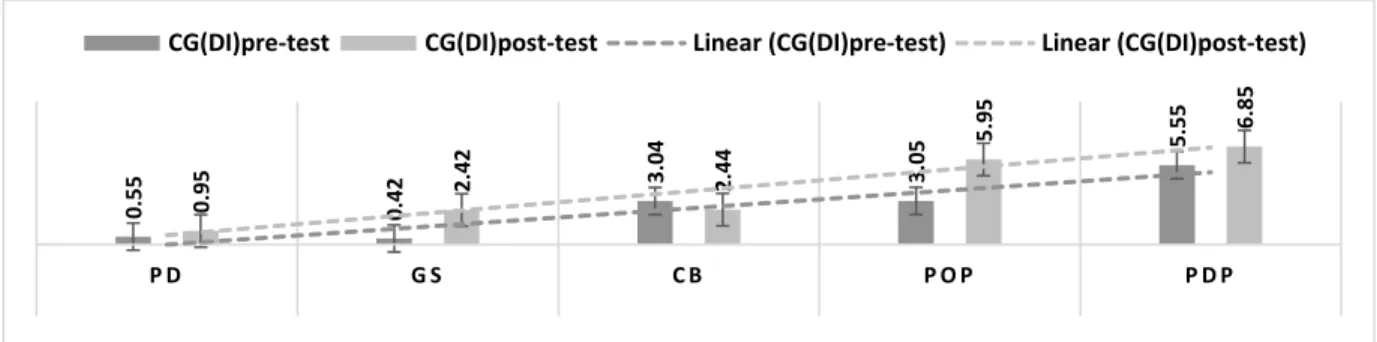
Established by the progress CG (DI) Figure 1 and EG (VSL) Figure 2, designed between pretest and post-test in the same group. Where our figures advocate that performance in tactical situations be in flavors of players exposed to VSL compared to those taught using DI. Interpret by means of role changes form attackers to defenders, the most used during the counter-attacking phase [23]. Commented in the case of our players to encourage the defenders to do a good job as challenges in the attack phase, consisting of its last to run intelligently in order to emphasize a specific tactical around the goal zone [24]. Reported in this researcher in the disadvantage of Direct Instruction (DI) as a tactical placement encompasses in tactical sessions. Approved in similar as
features guided and individual practice [25]. The case of this study where the player's strings carry out its tasks reserved for his post. Owing to the direct oriented instructions claimed by its coach. Criticized by similar in intelligence used, where training based on repetitive technical exercises prevents the player from using their mental abilities. As well as knowledge that the players should learn how to use their intelligence in order to solve the unforeseen situations, which variants constantly in a game (defense or attack) [26]. Frequently revoked in the modification of the game strategy and tactics to score and to stop opponents from scoring [27].
Figure 1. Present the progress of CG (DI)
Confirmed through the experimental group using multiple Spatial Intelligence (VSL) methods as feedback resources from small-sided games. Known in similar as a potential method to increase individual initiatives - numerical augmentation - role exchange to encourage the defender to score. Established in study by the analysis of tactical behavior that should not be solely based on a particular action performed in isolation or post-game. Which in our opinion, he does not rather general tactical patterns, seen he does not comprise all the typical characteristics of actions performed by all players within a team tactical conjugate [28]. Accounted in this study toward the benefits of the detailed training plan and prepared by the coach using video analysis.
Set as the most common methodology used in elite sports individual [29] or collective feedback [30]. Endorses in numerously published peppers via sports videos analyses, including technical
recommendations, coaching comments; analysis of human movement advances [31]. Advanced in this study through EG upon its feedback that based on real game situations presented with different tactical situations selected from real soccer matches by video films. Report Tom Reilly, et al [32] through six types of important decisions specified for a player to master the (shooting at the goal- passing to free teammate-passing around GK or an opponent – avoiding an offside – taking a penalty kick – taking free kick).
Figure 2. Present the progress of EG (VSL)
0.55 0.42 3.04 3.05 5.55 0.95 2.42 2.44 5.95 6.85 P D G S C B P O P P D P
DISCUSSION
From the tactical training point of view, our coaches are demanding to point out the reason for specific errors in technique or tactics learning. Inspected in the case of our study via the defenders that weapon in offensive tactics. Ours comes in this modest study attempts to improve the decision-making process related to the player’s errors, which must be corrected before the following practices (training or match). Claims with multimedia videos use that in our opinion help players to be prepared for any potential anticipation by guiding them through the steps needed to perform a particular skill [33]. Affirmed by video analysis in their benefits qualitative or quantitative designed to provide relevant sports-specific feedback [34]. Revoked by similar as moderate traditional feedback provided subjective observations, achieved by the degree of coaches expertize [35]. While as an objective method to enhance feedback. The most recent involved the uses of video and notations analysis, which provides a computerized representation of poor passing technique or poor choice of where to pass, or poor supporting play by the other [36].
As those qualifications, our results suggest that the advent of high quality, low-cost video technology has opened up new avenues for providing feedback. Assessment by implication of video analysis according to sports studies via the cost-individual effectiveness post-game or collective teams [37]. Admitted by T. Reilly, et al [38] via video analysis as quantitative feedback. Able to judge the individual and collective performance, as well as tactic individual and collective [39]. The case of the presented results advocates that performance in tactical situations are in favors of players exposed to VSL, depending on the source video analysis tactical training or match compared to those taught using DI. Confirmed by Agne Suziedelyte [40] via the ability of players solving the problem, the case of skill that is useful in
many work situations. Indicted by Johnson S.et al, as part of general intelligence [41].
Accounted by Joseph L. et al [42] that a sports coach with a high level of this ability may set a goal of increasing the level events and emotions. Interpret by force of the American Psychological Association via the “ability to understand complex ideas, to adapt effectively to the environment, to learn from experience, to engage in various forms of reasoning, [and] to overcome obstacles by taking thought [43]. Established by Schmidt FL, et al [44] in the “ability to grasp and reason correctly with abstractions (concepts) and solve problems. Set in this study through the session tactical behavior that should not be solely founded on a particular action performed in isolation, but rather on general tactical patterns, which comprise all the typical characteristics of such isolated actions performed by all players within a team [28].
Reason in this study toward the benefits of the detailed training plan and prepared by the coach using video analysis, the most common methodology used in developing countries via the elite sports individual [29] or collective feedback [30]. Approves in several available sports videos analyses studies by its advantages of including the technical recommendations, coaching commentaries; analysis of human movement advances [31].
To summarize, we agree that tactical performance based on Coach DI showed a low correlation with the cost effectiveness of player performance in the offensive tactical the opposite of defensive actions. Explains by the researcher in the objectivity of filling the post-game poorly in complex and predictable situations. Contrary to the method of analyzing video where the team's responsibilities are mapped as an adaptive demand generated by a tactical soccer game. Labelled in this richer by improving perceptual-cognitive skills with a 6 min video-based training performed twice a week [45]. Understand in the
0.95 0.3 2.13 3.05 3.55 2.05 3.75 5.23 5.95 6.85 P D G S C B P O P P D P EG(VSL)pre-test EG(VSL)post-test
initiation of quick actions, where athletes must focus their attention and visual perception on the most relevant information sources or key events [46]. Support by the quality of the decisions depends on its organizations [47]. As well as different contexts, that encouraged the use of a different decision-making style to achieve the most desirable alternative outcome [48].
As mentioned, we suggest that tactical behaviors request means that reproduce the true demands of a game characterized by the permanent interaction between tactical-technical components in a complex decision context [49]. In this respect of video feedback as an essential
instrument for both assessment and training individual or collective. As well as permutations and the supernumerary in the tactics combined in its tales, much on singular solutions to deliberate collaborate [50]. Founded on the above, we recommended our coaches to use the video replays, which must be introduced as new training programs or perceptive additional information through the tactical session [15]. Permitting players to improve the quality of movement by allowing them to exercise more effectively and intelligently in complex situations [16].
CONCLUSION
Our results argue that the progress of tactical performance is in favors of video analyses, which may enhance coaching tactically more than leadership and communication skills. Record in the benefits of players exposed to VSL compared to DI, according to this study. From that, we agree that our trainers must include the sports video technology as strategies that will lead to increase visual-motor function ability to carry out an action, calculations and decisions about orientation, motion, and location from the technical point of view space and time during the competition. While this practice requests multiple Spatial Intelligence (VSL) method training and learning in tactical sessions. Founded on video analyses that are more suitable than Direct Instruction (DI) as a most used by our coaches, especially in the development of the ability to understand and reason correctly with abstractions (concepts) and solve problems. As this hypothesis, the current research encourages our coaches to use the System of Tactical Assessment in Soccer (FUT-SAT) via their tactical situations training or assuming. Because it offers the player to review his individual faults, as well as its contribution to the collective game.
References
1. Klein, Perry, D, "Multiplying the problems of intelligence by eight: A critique of Gardner's theory," Canadian Journal of Education, vol. 22, no. 4, pp. 377–94, 1997.
2. Luis Miguel Ruiz Pérez, Miriam Palomo Nieto, Irene Ramón Otero, Aixa Ruiz Amengual, José Antonio Navia Manzano, "RELATIONSHIPS AMONG MULTIPLE INTELLIGENCE, MOTOR PERFORMANCE AND ACADEMIC ACHIEVEMENT IN
SECONDARY SCHOOL CHILDREN," INTERNATIONAL JOURNAL of ACADEMIC RESEARCH, vol. 6, no. 6, pp. 69-76, 2014.
3. Zimmerman A.E., Dean R.S., Visual-Spatial Intelligence. In: Goldstein S., Naglieri J.A. (eds) Encyclopedia of Child Behavior and Development. Boston, MA: Springer, 2011.
4. Walter McKenzie, Multiple intelligences and instructional technology. Eugene: International Society for Technology in Education, 2005.
5. Daniel Memmert, "Testing of Tactical Performance in Youth Elite Soccer," J Sports Sci Med, vol. 9, no. 2, pp. 199–205, 2010.
6. Jay Martin, The best of soccer journal: an NSCAA guide to soccer coaching excellence. Indianapolis: Meyer & Meyer Sport, 2012. 7. American Sport Education Program.; USA Track & Field.; Hershey Company, Coaching Youth Track and Field. Champaign, IL: Human Kinetics, 2008.
8. Memmert D, Perl J, "Game creativity analysis using neural networks," J Sports Sci. Jan 15; ):, vol. 27, no. 2, pp. 139-49, 2009.
9. Mohammed Zerf, Hadje Besultan, Beghdad Hamek, "Influence of body composition on the goalkeeper fitness Agility and specifics related to decision making via young male-specific post-game," Eur. J. Hum. Mov, vol. 38, pp. 133-144, 2017. [Online]. http://www.eurjhm.com/index.php/eurjhm/article/view/412
10. Bernardo Silva, Júlio Garganta, Rodrigo Santos, Israel Teoldo, "Comparing Tactical Behaviour of Soccer Players in 3 vs. 3 and 6 vs. 6 Small-Sided Games," J Hum Kinet, vol. 41, pp. 191–202, 2014.
11. Emilio Soria Olivas, Handbook of research on machine learning applications and trends: algorithms, methods, and techniques. Hershey, PA: Information Science Reference, 2010.
12. Simon Worsnop, Rugby games & drills. Champaign, IL: Human Kinetics, 2012.
13. Jean-Claude Heudin, Virtual worlds: second international conference, VW 2000, Paris, France, July 5-7, 2000: proceedings. Berlin: SpringerLink, 2000.
14. Greta Björk Gudmundsdottir, Kristin Beate Vasbø, Methodological challenges when exploring digital learning spaces in education. SensePublishers: Rotterdam , 2014.
15. Hüttermann S, Noël B, Memmert D, "Evaluating erroneous offside calls in soccer," PLoS ONE, vol. 12, no. 3, p. e0174358, 2017.
16. Gavin Allanwood, Peter Beare, User experience design: creating designs users really love. London: Bloomsbury Academic, 2014.
17. Teoldo I, Garganta J, Greco PJ, Mesquita I, Maia J, "System of tactical assessment in Soccer (FUT-SAT): Development and preliminary validation," Motricidade., vol. 7, pp. 69–83, 2011.
18. I.T. Costa, J. Garganta, P.J. Greco, I. Mesquita, J. Maia, "System of tactical assessment in Soccer (FUT-SAT): Development and preliminary validation," Motricidade, vol. 7, no. 1, pp. 69-83, 2011.
19. Farkhondeh, Haydar, Alizadeh, Walid, Illon Kashkoli, Fatemeh, "The relationship between goal orientation and competitive anxiety with the performance of young wrestlers," Organizational Behavioral Organizational Management in Sports Studies, vol. 7, no. 2, pp. 88-79, 2015.
20. Miller Jay, Attacking soccer. Champaign, IL: Human Kinetics, 2014.
21. Ward, P., Williams, A.M, "Perceptual and cognitive skill development in soccer: The multidimensional nature of expert performance," J. Sport Exerc. Psychol, vol. 25, no. 1, pp. 93–111, 2003.
22. Mansouri Nabil, Lounas Abdellah, Alouane Rafik, Bouhadj Meziane, "TACTICAL SKILLS AND THEIR RELATIONSHIP WITH THE LEVEL OF TACTICAL THINKING AMONG FOOTBALL PLAYERS - A FIELD STUDY CONDUCTED ON CLUBS FROM BOUIRA PROVINCE, ALGERIA," European Journal of Physical Education and Sport Science, pp. 154-162, 2017.
23. Wilma Shakespear, Margaret Caldow, Netball: steps to success. Champaign, Ill: Human Kinetics, 2009.
24. Inez Rovegno, Dianna Bandhauer, Elementary Physical Education. Burlington, MA: Jones & Bartlett Learning, 2017.
25. Robert P. Pelton, Making classroom inquiry work: techniques for effective action research. Lanham, Md: Rowman & Littlefield Education, 2010.
26. Joy Butler, Linda L Griffin, More teaching games for understanding: moving globally. Champaign, Ill: Human Kinetics, 2010.
27. Lynn Couturier, Stevie Chepko, Shirley Ann Holt/Hale, SHAPE America (Organization), National standards & grade-level outcomes for K-12 physical education. Champaign, Illinois: Human Kinetics, 2014.
28. Mahlo F, Tactical action in play. Paris: Vigot Freres, 1969. 29. Mooney R, Corley G, Godfrey A, et al, "Analysis of swimming performance: perceptions and practices of US-based swimming coaches," Journal of Sports Sciences, pp. 1-9, 2015.
30. Phillips E, Farrow D, Ball K, Helmer R, "Harnessing and understanding feedback technology in applied settings," Sports Medicine, vol. 3, no. 10, pp. 919-925, 2013.
31. Robert Mooney, Gavin Corley, Alan Godfrey, Conor Osborough, Leo R. Quinlan, Gearóid ÓLaighin, "Application of Video-Based Methods for Competitive Swimming Analysis: A Systematic Review," Sport Exerc Med Open J, vol. 1, no. 5, pp. 133-150, 2015. 32. Tom Reilly, Adrian Lees, Keith Davids, W. J. Murphy, Science and Football (Routledge Revivals): Proceedings of the first World Congress of Science and Football Liverpool, 13-17th April 1987. US: Routledge, 2011.
33. Mazin Al-Asadi, "Soccer Players Skill Development with Multimedia Aid: Future Prospects," Education, vol. 6, no. 5, pp. 107-110, 2016.
34. Yves Vanlandewijck, Walter R Thompson, Training and coaching the Paralympic athlete. Chicester, West Sussex, UK; Ames, Iowa, USA: John Wiley & Sons, Inc, 2017.
35. Roger Bartlett, Chris Gratton, Christer G. Rolf,
Encyclopedia of International Sports Studies. London: Routledge, 2009. 36. Terry McMorris, Tudor Hale, Coaching Science: Theory into Practice. Chichester, England; Hoboken, NJ: John Wiley & Sons, 2006.
37. Jeff Archer, Steven Cantrell, Steven L. Holtzman, Better feedback for better teaching: a practical guide to improving classroom observations. San Francisco, CA: Jossey-Bass, a Wiley Brand, 2016.
38. T. Reilly, M. Hughes, A. Lees, Science and Racket Sports I. USA: Taylor & Francis, 2001.
39. Ana L. C. Bazzan, Karim Pichara, Advances in artificial intelligence -- IBERAMIA 2014 : 14th Ibero-American Conference on AI, Santiago de Chile, Chile, November 24-27, 2014 : proceedings. Cham: Springer, 2014.
40. Agne Suziedelyte, "Media and human capital development: Can video game playing make you smarter?," Econ Inq, vol. 53, no. 2, pp. 1140–1155, 2015.
41. Johnson S, Everything Bad is Good for You: How Today's Popular Culture is Actually Making us Smarter. New York: Riverhead Books, 2005.
42. Joseph L. Rotman, "Annual Review of Organizational Psychology and Organizational Behavior," Review in Advance on January, vol. 1, pp. 459-488, 2014.
43. Neisser U, Boodoo G, Bouchard TJ, Boykin AW, Brody N, et al, "Intelligence: Knowns and unknowns," Am. Psychol, vol. 51, pp. 77–101, 1996.
44. Schmidt FL, Hunter JE, Select on intelligence. In The Blackwell Handbook of Organizational Principals, ed. EA Locke. Oxford, UK: Blackwell, 2000.
45. Alfred Nimmerichter, Nikolaus J. R. Weber, Klaus Wirth & Andreas Haller, "Effects of Video-Based Visual Training on Decision-Making and Reactive Agility in Adolescent Football Players," Sports, vol. 4, no. 1, p. 1, 2016.
46. Cañal-Bruland, R.; Hagemann, N.; Strauß, B, "Aufmerksamkeitsbasiertes Wahrnehmungstraining zur taktischen Entscheidungsschulung im Fußball," Z. für Sportpsychol, vol. 12, pp. 39–47, 2005.
47. Kazım NAS, "DECISION-MAKING STYLES: Athletes Playing At University Teams," International Journal of Anatolia Sport Science, vol. Dec, no. 4, pp. 195-207, 2017.
48. Daniel Memmert, Teaching Tactical Creativity in Sport: Research and Practice. London: Routledge, 2015.
49. Zerf Mohammed, "Which visual sight skill tested and developed the interaction between central and peripheral vision case
duels dribbling soccer skills," International Journal of Applied Exercise Physiology, vol. 5, no. 3, pp. 31-37., 2016.
50. Zerf Mohammed, Bengoua Ali, "THE IMPACT
DIMENSIONAL OF DELIMITERS ON TESTING AND TRAINING DUELS DRIBBLING IN YOUNG SOCCER (UNDER 15 YEAR)," European Scientific Journal (ESJ), vol. SPECIAL/ edition VOL.1, pp. 200-208, 2015.